Basic information on the topic of scientific work
- Guidelines for Scientific Papers -
1. Goals of scientific work
Scientific work is based on scientific findings. In your work follow the current scientific discussion, consider different stances and present findings in an appropriate and clear way. In your work your goal is frequently to process a multitude of scientific articles. Processing in this case refers to:
preparing essential statements of the author(s) and explaining these in your own words; including further aspects of the literature that are relevant to your topic in your own
words;
not solely translating scientific texts to English and repeating the work of other authors until you reach the maximum page limit of your thesis/seminar paper.
Your goal should primarily be to identify essential aspects of the papers (or book chapters) that you are using. Focus on such aspects in your thesis/seminar paper and refrain from occupying yourself with less important segments – rather condense or drop these. Make use of literature in order to further explain important aspects, criticize and take a different perspective on your subject.
It is important to not only describe important results of the literature, but to rather also: explain how such results come to being;
which economic mechanisms produce the results;
question whether the explanation of how the results are formed is conclusive and/or universally applicable.
Try to evaluate your described results in your thesis/seminar paper based on these criteria.
2. Procedure
2.1 Structure of the thesis/seminar paper
Your scientific work should be structured as follows: Cover sheet Table of contents Table of abbreviations Table of figures Table of tables 1. Introduction 2. Main part 2.1 Theory 2.2 Methodology 2.3 Results3. Summary / Final remarks / Conclusion References
Appendix
The above example of the structure of a scientific text will be adjusted on your behalf based on the topic of your thesis/seminar paper. The basic structure of introduction/main
part/summary/final remarks/results remains in any case.
Cover Sheet
See the university information on formalities to uphold in bachelor theses / master theses. Follow their criteria regarding name, matriculation number, title of the thesis/seminar paper, specification of the semester and date. Also consider that there are further formal criteria by the faculty, which you must follow (e.g. empty sheets, sworn declaration). The cover sheet is not to be numbered, nor counted as a page in the further numeration of the thesis/seminar paper. Note that the university guidelines apply mainly to theses – the only requirement for a seminar paper is that there must be a cover sheet.
Table of contents
In the table of contents all chapters and sub-chapters of the thesis/seminar paper are listed as well as their corresponding page number. Typically, two to three levels of sub-sections are sufficient. Be careful to include at least two sub-chapters for each new level of sub-section that you create (e.g. if there is 2.1, then you must also have 2.2). Also account for the fact that the depth of your table of contents must coincide with the importance each particular chapter. Finally, be reminded that the extent of your table of contents must maintain clarity and that each sub-section should consist of at least half a page of text.
The table of contents is the first page of tables and is given the page number I in Roman
numeration style. The table of contents begins with the table of abbreviations, figures and tables, which are continuously numbered in the Roman numeration style. In contrast, the first page of the main text body of the thesis/seminar paper is the numbered using Arabic numeration e.g. page 1 and all following pages of the main text body follow the same principle continuously. The numeration style switches again in the appendix, of which the pages are numbered with A1, A2, A3, ... accordingly.
Example:
Table of Contents Page
List of abbreviations..………....II List of figures………....III List of tables…….……….IV 1. Introduction………1 2. Main part……….2 2.1 Theory.………...2 2.2 Methodology...……….6 2.3 Results…..………...9 3. Conclusion.………...16 References...………..18 Appendix………..A1 List of abbreviations
All terms that are shortened throughout the course of the main body of text must be typed out in full the first time they are mentioned with the acronym being given in brackets directly after – e.g. United Nations (UN). In the list of abbreviations all used abbreviations are then listened in alphabetic order. Beispiel: List of abbreviations approx. approximately cf. confer et al. et alii
List of figures
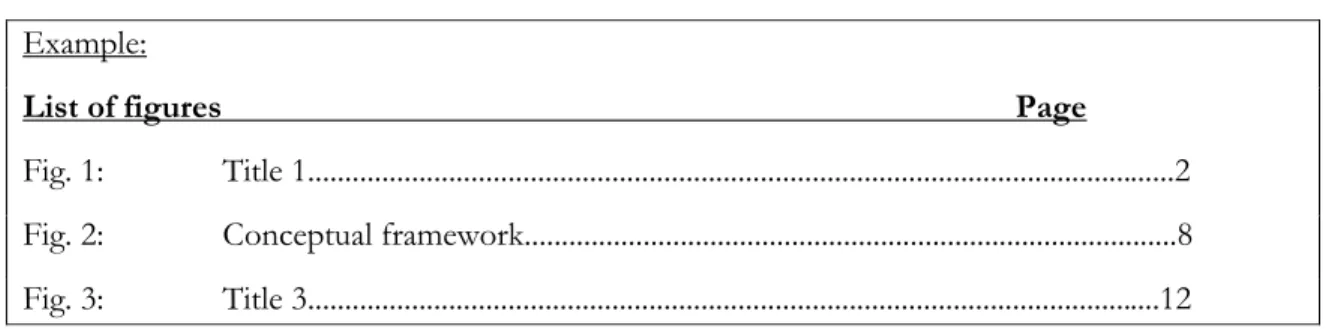
In this list all figures that are found throughout the thesis/seminar paper are listed. Example:
List of figures Page
Fig. 1: Title 1...2 Fig. 2: Conceptual framework...8 Fig. 3: Title 3...12
List of tables
In this list all tables that are found throughout the thesis/seminar paper are listed. Example:
List of tables Seite
Table 1: Title 1...3 Table 2: Title 2………...9 Table 3: Title 3...14
Introduction
Formulate a research question based on a scientific problem and make clear why the topic is relevant and of interest.
Structure your thesis/seminar paper based on your research question and make this clear in your introduction (e.g. follow your central theme).
Clearly state your objectives and research questions in your thesis/seminar paper End your introduction with a short description of the composition of your
thesis/seminar paper Main part
Based on these introductory thoughts the course of your argumentation is developed and the linkage between different sub-sections of your work is created.
Illustrate how the different sub-sections are integral to your solution of the research question during the later stages of the main body of text. Should it not be possible to make such links, you should revisit whether or not the sub-section is necessary to your thesis/seminar paper
Contemplate to which extent you will make use of existing theory – this is a good basis for all further endeavours
Example:
2.1 Economic Migration Theories
The beginning of economic migration theories and migration research in general can be dated back to the 1880s when the demographer Ernest George Ravenstein published two articles in the “Journal of The Royal Statistical Society” about the so-called “Laws of Migration”. In these articles,
Ravenstein primarily explained the phenomenon “migration” with the natural disposition of human beings to improve their material living conditions. Consequently, the existence of places with different levels of development and different wage levels causes the migration of what he called ‘surplus population’ from the places with low salary levels to places with higher salary levels (Ravenstein 1889: 286-289). ...
However, Ravenstein (1889) did not adequately consider factors like migration costs, the probability of employment at the place of destination, or the discount rate. The economic research on migration incorporated these factors only in the 1960s with the upcoming of the human capital theory. This theory, which was particularly developed by Gary S. Becker (1964), introduced the idea that all the above-named factors depend on individual characteristics. For example, it was shown that individuals with lower levels of risk aversion are more likely to migrate than others. Thus, the authors of the human capital theory (e.g. Becker 1964; Todaro 1976; Mincer 1974) emphasized that potential migrants could no longer be seen as a homogenous group.
From the 1980s onwards, new migration theories were developed….
Source: GROTE,U.,ENGEL,S. AND B.SCHRAVEN (2006): Migration due to the Tsunami in Sri
Lanka – Analyzing vulnerability and migration at the household level. ZEF-Discussion Papers on Development Policy 105, Bonn.
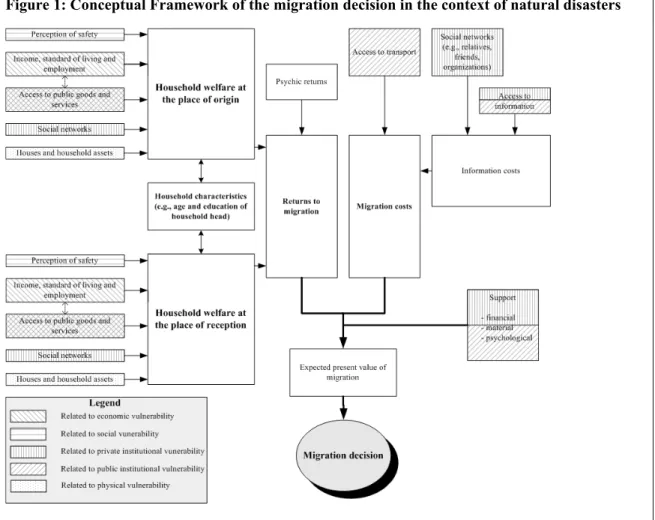
You can also create your own conceptual framework in which different determinants are depicted in a structured manner. This framework in principle is a graphic representation of the structure of your thesis/seminar paper (Your framework needn’t be as complex as shown in the following example).
Example:
Figure 1: Conceptual Framework of the migration decision in the context of natural disasters
Source: Own presentation based on Byerlee (1974: 553).
Conclusion
In this section, you summarize the most important results briefly. You may also repeat your research question from the introduction (e.g. the thesis/seminar paper runs a full circle). The summary part of this section should be proportionate to the length of the thesis/seminar paper und should focus on results and aspects of your work that are useful for your conclusion. A conclusion extends upon the summary in discussing the results by developing, for example, recommendations for action. Further research questions that resulted from the thesis/seminar paper can also be showcased (e.g. further research needs).
Example:
Our empirical results show that households with one or more members dead, missing or seriously injured are less likely to migrate. This seems to indicate that affected people are traumatized. Psychological support programs are needed to help the affected people to overcome the trauma experienced by the
References
Regarding your references, all materials that you referenced in your thesis/seminar paper must be listed. This section consists of the extended textual and formal references used in the main body of text. The references are sorted alphabetically, not by different types of references. Accordingly, every short reference used in the main body of text must also be included as a full reference in this section of the thesis/seminar paper.
All sources must be sorted alphabetically by surname of the author
In case of identical surnames, the sources are sorted in alphabetical order of the first name of the author
Furthermore, sources by the same author are sorted in ascending order by publishing year – e.g. the oldest source is listed first
Should multiple sources of the same author have been published in the same year, then the references are sorted alphabetically by title and in both the short and full reference the publishing year is extended with a, b, c, … in order to ascertain that readers can clearly distinguish between the different references
e.g. UN, 2006a and respectively UN, 2006b
Sources of individual authors are always ordered before sources with multiple authors and an identical lead author
Should information relevant to the reference be unknown, the following replacements are made: shortened title of source or sponsoring organization (unknown author), no date: n.d. and no place of publication: n.p.
a) in the case of books/ monographs
Surname of the author(s) and initials of their first name(s) (academic grades and titles are not mentioned), publication year and title of the book, edition (if necessary), place of publication, publisher. e.g.
Eco, U. (1993). Wie man eine wissenschaftliche Abschlussarbeit schreibt. 6th edition. Heidelberg: C. F. Müller Verlag.
b) in the case of journals
Surname of the author(s) and initials of their first name(s) (academic grades and titles are not mentioned), publication year and title of the paper, title of the journal, year and issue of the journal as well as the page reference from first until last page of the paper. e.g. Schmidt, B.S. (1985). Auswirkungen von Zertifizierung auf Haushaltseinkommen in Indien. Journal of Development Studies, 73(3), 257-276.
c) in the case of anthologies
Surname of the author(s) and initials of their first name(s) (academic grades and titles are not mentioned), publication year and title of the paper. In: Surname and initials of the editor(s) (Ed(s).), title of anthology (page reference), place of publication: publisher. e.g.
Bjork, R. A. (1989). Retrieval inhibition as an adaptive mechanism in human memory. In H. L. Roediger III, & F. I. M. Craik (Eds.), Varieties of memory & consciousness (pp. 309-330). Hillsdale, NJ: Erlbaum.
d) Citing websites
The address of the internet cite must be correct and complete, the source is to be given alongside author(s), title, type of publication, date of publication and location, as well as the date on which you accessed the website (e.g. accessed on 10.03.2020). The source must be reviewable and accessible to the general public. e.g.
Walker, A. (2019, November 14). Germany avoids recession but growth remains weak. Retrieved from https://www.bbc.com/news/business-50419127. Accessed on: 10.03.2020
Should the length of the URL extend over one line you must insert a hyphen (“-“), which is placed directly in front of a slash (“/”) where possible
Reminder: Never simply copy/paste texts / text passages directly from the internet! In conclusion, pay attention to consistent formatting and specifications of your citations.
Appendix
The appendix consists of lengthy tables/figures, questionnaires or, for example, of transcriptions of expert interviews / e-mail correspondences relevant to the thesis/seminar paper. These would normally disrupt the flow of the main body of text, but are still necessary in order to allow an assessment of your work.
The pages of the appendix do not count towards the requirements for text pages of your thesis/seminar paper (see Scope of thesis/seminar paper).
Avoid use of appendix in seminar papers!
Sworn declaration
Follow the exact specifications of the faculty (see Bachelor / Master).
2.2 Regarding format and scope
TypographyThe Institute of Development and Agricultural Economics asserts the following framework for your thesis/seminar paper:
Font (Font size): Times New Roman (12 pt.) / Arial (11 pt.). Line spacing: 1,5 – deviations in tables/figures.
Alignment: Justify – deviations in tables/figures. Indents: 2,5cm top, bottom, right and left. Page numbers: in footer, centred, 12 pt. Chapter titles: Bold, Font can be slightly larger.
Tables/Figures
Tables/figures are integrated into the text in suitable locations and numbered continuously. Larger tables/figures that encompass more than half a page should be placed in the appendix unless it is necessary that they are included for comprehension of the text (Only in theses, not seminar papers). Tables and figures from other sources must be cited accordingly and must be suitable in the context of their position in the text. Should the quality of such a table/figure be low it is your responsibility to create a new version of the table/figure and referencing the source that it is based on
Line spacing is 12pt. before and after tables/figures Within tables/figures line spacing is 1,0
Every table/figure is to have an explanatory title in the same font and font size as the main body of text – the only exception is that the title is bold. The title is located above the figure/table.
Furthermore, the source is located below the element and added to the reference list. Should the figure/table have been created by yourself and not based on the work of others the following citation is applied e.g.
Source: Own representation/calculation [based on Author(s), Year]
For every table/figure that is represented in your thesis/seminar paper there must be at least one reference to it in the main body of text.
Scope of thesis/seminar paper
The scope of the bachelor thesis is 30 pages (in consultation with your supervisor +/- 10%) and the master thesis is 50 pages. The scope of the seminar paper is 12-15 pages. Only the main body of text counts towards the scope of your thesis/seminar paper and our requirements e.g. cover page, table of contents etc. and the appendix do not count towards the scope. Excessive use of tables/figures will also not be counted towards the requirements of your thesis/seminar paper.
2.3 Searching for and reviewing literature
In seminars your will receive some literature in the form of articles or book chapters from your tutor that is a good starting point for your topic.
A good starting point for your thesis/seminar paper is to read an overview article (also know as surveys) or by reviewing relevant textbooks on the subject. Both types of literature commonly review and showcase secondary literature sources and should when possible not be used as the foundation of scientific work. Surveys are often found in international journals and available in electronic form.
After you have researched the topic of your thesis/seminar paper, you should formulate your research questions. This is helpful in maintaining a red line throughout the course of your work and reminds you of the core task of your thesis/seminar paper. In order to formulate the research question, a systematic review of journals relevant to your topic is necessary. In the following, some aspects of searching for literature are presented:
Literature
Topical literature research in specialist databases and from journals E.g.: Wiso-Net, Econlit, Repec, SSRN
Google Scholar (http://scholar.google.com):
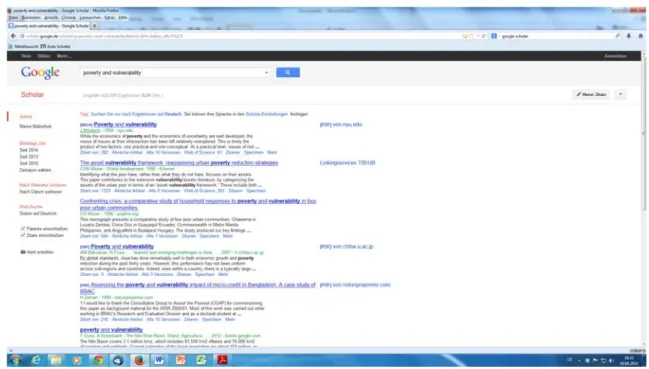
Google Scholar provides a broad overview of existing literature for keyword entered into their search engine. Fig. 1 shows some results for the keywords „poverty and vulnerability”. Using this example, the key functions of Google Scholar will be presented1:
Extended Scholar-Search: This function is accessible on the left-hand side of your screen after having entered a search for a keyword. Here you can adjust your search based on date of publication, journal and further key words.
Search results: Search results to a specific topic are presented in the typical Google style. In Fig. 1 the most important scientific article on our topic according to Google is the article by Moser, which was published in World Development in 1988. Further information is also provided:
Cited by: The order in which Google presents the results is not always indicative of how important the articles are for the scientific community. A good measurement that can be apply is the frequency of citations of the article in question. According to Google, the article by Moser (1988) was cited in 1323 other articles. If you click on the “cited by” icon you will navigate to a new screen that will show in which articles Moser was cited. This gives you the option to chronologically work through the history of Moser’s work and to determine whether Moser (1988) is still frequently cited in current literature2.
Related articles: Aside from articles that directly cite Moser (1998), there are also articles that have an indirect link to the Moser article. Following the Google link, you can also review existing similar literature, which may be of use for your thesis/seminar paper. All versions: Typically, scientific articles are first published in working paper series.
Accordingly, an article may exist in multiple different versions as they are edited before finally being published in a journal. In order to attain an overview, Google Scholar provides the option to review all existing versions of an article. This function can be of particular use if the main article is not accessible with the licence of LUH. Potentially there are prior or current existing versions of the article that can be accessed free of charge.
1You can find further information here: https://scholar.google.com/intl/de/scholar/about.html.
Fig. 1: Example Google Scholar search
Source: Google scholar
Gaining access to literature
Access can be gained via the LUH network or by making use of the university VPN-Client
For most journals there is the option to access via web
You can also check whether the article is available via an electronic library: e.g. http://rzblx1.uni-regensburg.de/ezeit/
The archives of the university can also be accessed (e.g. search for a journal in the university catalogue, online copies, copies to borrow, GBV catalogues, ordering of copies)
Quality of literature
Ranking of journals can be checked e.g.:
Handelsblatt-VWL-Ranking (HB-Ranking): HB-Ranking is a list of over 1400 Journals relevant to the field of economics. These journals are rated based on a fixed rating scheme. Although the ranking is based partially on subjective assessments, it is a good source to assess the quality of relevant literature from specific journals. ist eine Auflistung von 1400 Zeitschriften in der
Volkswirtschaft.
Ranking of the Tinbergen Institute:
https://uvalibraryfeb.files.wordpress.com/2018/11/ti‐journal‐list.pdf
Number of citations (see Google Scholar): The number of citations can show you the importance of the article in the scientific field and is an evaluation criterion of high-quality articles.
Reviewing literature
After delving through the literature, you must ask yourself two questions in order to be able to determine which articles are adequate for your research:
Which available sources are relevant to my thesis/seminar paper? Which are suitable for working on my research question(s)?
Following this logic, the following points are to be considered in reviewing literature:
Do you understand the research goals of the underlying scientific article? Can you identify the primary research question and the main thoughts that lead to the conclusion?;
Review the applied methodology and if necessary, also make yourself familiar with the data used in the study in order to be able to compare economic statements of studies with one another and in order to critically assess studies;
Examine the contribution of the statements in order to determine the type of scientific work (e.g. descriptive, normative, functional), the methodological approach in developing hypotheses (e.g. deductive or inductive) and also differentiate between own
interpretations of the author and your ability to categorize these in the context of your own research (Springmann 2006, p. 8).
Compare studies in similar areas in order to review the validity of statements and identify open questions. This is the beginning of deeper literature reviews and is useful in
formulating secondary research questions;
Do not include direct citations, if they do not provide a clearly identifiable benefit in comparison to paraphrasing an author.
Writing a scientific paper can be understood as a dynamic process in which you should frequently review your content.
From personal experience the discussion of your draft structure(s) of your thesis/seminar paper with your supervisor/tutor is often helpful. In academia, scientists thrive from exchanging ideas and from criticism, for example, co-authorship, feedback by readers, presentations and discussion sessions, expert reviews and feedback of publishers. For seminar papers meetings with tutors are limited to at most three sessions.
2.4 Citing
Citing in the main body of text
It is of the utmost importance that you cite and in doing so cite correctly! Scientific work
necessitates that each argument taken from the literature is cited. Failing to do so results in failing your thesis/seminar paper.
Your thesis/seminar paper is to be handed in as an electronic version in order to allow your supervisors to check for possible plagiarism and deception in your work.
Footnotes
Footnotes are frequently shortened sentences. They begin with capitalized words and end with a full stop. The footnote is located at the end of a page and is in the same font as the main body of text. The font size should be 2 pts smaller than in the main text. The numeration of the footnote is placed in superscript and usually one font size smaller than the main text. Be cautious in your use of footnotes and only make use of them if it is necesssary!
Citations
From a scientific and ethnical stance, the use of the work of others must be designated as such. Citations should only refer to those text passages that are sufficient to make an argument or statement in your text. Citations should be referred to by referencing the original source. Should this source not be available you must make the addition “cited by …”.
Each citation must be presented so a reader can easily identify the source and find it in your references. Sources from the internet must contain the exact URL alongside the date of access.
Citation Style (multiple styles can be found when using Google Scholar i.e. Harvard, APA, …)
Use of direct citations: the thoughts and words of others are adopted word-by-word in your own text;
A direct citation is signalled by encompassing the statement in “quotation marks”; If parts of a statement are not necessary to your argumentation you can leave out these
from your citations by substituting these with “…” (see the example below) In direct citations you must always add the page number, e.g. Schmidt (2006, p.50) Own additions in order to ensure that a statement is clear can be added in square brackets When citing a source with two authors the surnames are split with “&”.
If a source is by more than two authors, then the main authors surname is given and supplemented with “et al.”.
Should a statement be based on the work of multiple articles these are spaced out with a semicolon sorted by year of publication, e.g.
“The insights of theory will only work in practice if … data can be collected in a reliable and valid way” (Hamilton & Craig, 2017, p. 199).
Disallowed citations: e.g. Wikipedia, other free encyclopaedias, the „Work“ of other students, dubious internet sources, tabloid papers (e.g. Bildzeitung, The Sun) …
Indirect citations/paraphrasing: In this approach the thoughts of other authors are given in your own words. In doing so, ensure that you do not follow the wording of the original statement closely as this would constitute plagiarism. The point of paraphrasing is not to adjust the order of words slightly and to replace with synonyms, but rather to reduce long and often complex thoughts of authors to their core.
In using indirect citation, a short form reference is given at the end of the sentence or paragraph related to the source and not encompassed in quotation marks. Otherwise, the rules are the same as with direct citations. e.g.
In many developing countries, the quantity of high-quality survey data sets remains sparse (Booth, 2019; Dang & Carletto, 2018).
The susceptibility of data on income, consumption and assets to non-response and measurement error stems from their sensitive nature and respondent behavior, which frequently results in under-/overestimations (Frick & Grabka, 2014; Meyer et al., 2015; Meyer et al., 2018; Moore et al., 2000; Nicoletti et al., 2011; Watson & Li, 2016)
3. Typical mistakes in scientific work
Unstructured and superficial work – e.g. unclear or very general research questions in the thesis/seminar paper Set a focal point!
The goal formulated in the introduction is not sufficiently handled in the main text or is not reached.
Missing/superficial/uncritical discussion section in regards to central statements of the thesis/seminar paper
Text passages or sub-section of the thesis/seminar paper do not serve the purpose of the thesis/seminar paper
Segments of the thesis/seminar paper are incoherent Missing sources for assumptions and statements
Literature selected is not appropriate, or key literature is disregarded (e.g. focus on seldom cited works in order to better present own stance), or references are incomplete or cited inconsistently
Lack of citations or issues in references
Applying the same term for different contexts (e.g. providing different definitions to a word in different parts of your thesis/seminar paper)
Colloquial phrasing of the thesis/seminar paper (e.g. “This is what broke the camel’s back …)