Aguia Resources Limited ABN 94 128 256 888 Level 12, 680 George Street, Sydney NSW 2000 Telephone 02 8280 7355 Facsimile 02 9287 0350
www.aguiaresources.com.au 9 July 2020
ASX Market Announcements Level 6, Exchange Centre 20 Bridge Street
Sydney NSW 2000
AGRONOMIC TESTS ON CORN REAFFIRM THE HIGH QUALITY OF
TRÊS ESTRADAS DIRECT APPLICATION NATURAL FERTILIZER
Sydney, Australia, - Aguia Resources Limited ABN 94 128 256 888 (ASX:AGR) (‘Aguia’ or the ‘Company’) is pleased to report that further agronomic testing on corn (maize) has again confirmed the high-quality of the Direct Application Natural Fertilizer (DANF) product from the Company’s 100%-owned Três Estradas Phosphate Project (TEPP).Highlights
• The ongoing agronomic tests are being conducted by independent consultants Integrar Gestão e Inovação Agropecuária (“Integrar”).
• Productivity results demonstrate that saprolites from both the carbonatite (CBTSAP) and the amphibolite (AMPSAP) have a positive agronomic efficiency in providing phosphate to corn plants. • The application of CBTSAP and AMPSAP were very effective in increasing the residual phosphate
content of the soils.
• Brazil is the world’s third largest producer of corn and it is a major export for the country.1
• DANF now shown to be highly effective on Brazil’s two major crops – soybean and corn. Further agronomic tests on other crops will be undertaken.
• Test work on crops such as corn and soybean is a critical body of work to support the promotion and marketing of DANF to Brazilian fertilizer consumers thus underpinning future product sales.
1https://www.world-grain.com/articles/13130-brazil-corn-production-surges
Management Commentary
Managing Director Dr. Fernando Tallarico said: “This second batch of results reinforces the high agronomic
potential of our TEPP DANF product on another major crop. The results are very important in supporting future marketing efforts and demonstrating the appeal of our DANF product to local fertilizer consumers. Brazil is a major producer of corn (maize), and Rio Grande do Sul has almost 330,000 hectares planted with corn crops each year (see figure 3). Producers here are therefore a major future sales channel for our TEPP DANF and the Company is now ramping up marketing and promotional efforts to build product awareness well ahead of production.
“We have now demonstrated that our natural fertilizer product has a very positive impact on two of Brazil’s
major crops, soybean and corn. Now that test work on these two summer crops has concluded and been reported to shareholders, our project development initiatives will progress with further agronomic efficiency tests throughout this winter, on ryegrass and wheat, and we expect results to be available by October this year. We are also planning test work for next summer, on rice and soybean, to be initiated between November and December 2020, with results expected by May 2021.”
“This test work is a key step in advancing Três Estradas to a construction-ready stage which is rapidly approaching. Demonstrating that our product can be used in fertilizers and indeed have a positive impact on crop yields and production is a critical step that underpins our project and will help to establish Aguia as
a trusted and dependable supplier to local fertilizer consumers.”
Further commentary on the results of both the soybean and corn agronomic testing is provided in the following video with Dr. Fernando Tallarico and Dr. Felipe Carmona, Managing Director of Integrar. Click here to view the video.
Background
As previously reported in the ASX 16 June 2020 announcement: “Soybean Agronomic Tests Confirm High Quality Três Estradas Natural Phosphate Fertilizer”, the Company has engaged Integrar, a renowned independent agronomic consulting firm located in southern Brazil, to conduct a series of agronomic efficiency tests on the Três Estradas DANF as a source of phosphorous (P) for crops. Two types of processed ore from the TEPP are being used in the agronomic tests, carbonatite saprolite (CBTSAP) and amphibolite saprolite (AMPSAP).2
The agronomic performance tests determine how efficiently the P-nutrient is delivered to the soil and then to the crop. Test #2 is currently ongoing at Integrar’s Agronomic Station located in Capivari do Sul RS and will evaluate three successive crops (corn, wheat and soybean) to determine the reactivity and availability of the P-nutrient from CBTSAP and AMPSAP to the plants, and to determine its agronomic value. The test commenced in late December 2019 on corn, the 2019/2020 summer crop, and will be followed by wheat in the 2020 winter crop and finally soybean in the 2020/2021 summer crop. The corn plants were harvested in May and the wheat then seeded in early June. In this announcement we are presenting the results of the test on the 2019/2020 corn crop.
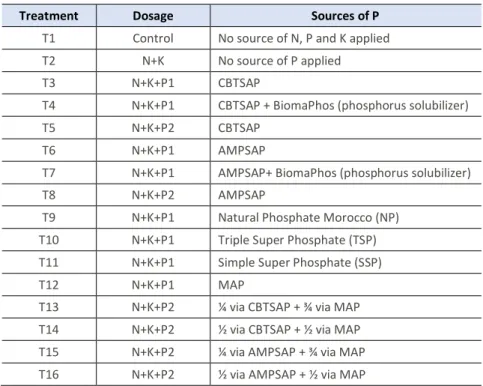
Test #2 consists of 16 distinct agronomic treatments listed in Table 1. The treatments consist of different sources of phosphate for comparison purposes, including conventional phosphate fertilizers such as; Super-simple Phosphate (SSP), Triple Superphosphate (TSP), Monoammonium Phosphate (MAP), and Natural Phosphate from Morocco (NP). Treatments with distinct quantities of our DANF products (CBTSAP and AMPSAP), a combination of CBTSAP and AMPSAP with MAP, and a phosphate solubilizer known as BiomaPhos was also tested. In Test #2 the nutrient sources were incorporated into the soil in the pots. The test was replicated four times with the sequence of blocks randomised for each treatment.
2CBTSAP is the acronym for the saprolite of the carbonatite which is Três Estradas’ higher-grade Natural Phosphate Fertilizer grading about 10% P2O5. CBTSAP is our main product as it represents more than 80% of the resource.
The AMPSAP is the acronym for saprolite of Amphibolite which is a relatively lower-grade Natural Phosphate Fertilizer grading in
The application rate of the nutrients in each treatment was as follows:
• Nitrogen (N): 20 kg/ha of N in treatments T2 to T16. In treatments T12 to T16, the content of N in MAP was discounted from this amount;
• Potassium (K): 200 kg/ha of KCl (Potassium Chloride) in treatments T2 to T16;
• Phosphate dosage P1: 50 kg/ha of P2O5;
• Phosphate dosage P2: 100 kg/ha of P2O5;
• In treatment T2, a dosage of 150 kg/ha N was applied in urea form.
Treatment Dosage Sources of P
T1 Control No source of N, P and K applied T2 N+K No source of P applied
T3 N+K+P1 CBTSAP
T4 N+K+P1 CBTSAP + BiomaPhos (phosphorus solubilizer)
T5 N+K+P2 CBTSAP
T6 N+K+P1 AMPSAP
T7 N+K+P1 AMPSAP+ BiomaPhos (phosphorus solubilizer)
T8 N+K+P2 AMPSAP
T9 N+K+P1 Natural Phosphate Morocco (NP) T10 N+K+P1 Triple Super Phosphate (TSP) T11 N+K+P1 Simple Super Phosphate (SSP)
T12 N+K+P1 MAP
T13 N+K+P2 ¼ via CBTSAP + ¾ via MAP T14 N+K+P2 ½ via CBTSAP + ½ via MAP T15 N+K+P2 ¼ via AMPSAP + ¾ via MAP T16 N+K+P2 ½ via AMPSAP + ½ via MAP
Table 1 – Summary of treatments on corn in pots. Test #2 – Corn Productivity
The corn yield that resulted from each treatment is shown in Figure 1.
Treatment T15, the application of 100 kg/ha of P2O5 (25% AMPSAP and 75% MAP), resulted in the highest corn yield of all treatments with 71.8 g/pot. The corn yield in Treatment T8, the exclusive application of AMPSAP in the same dosage, resulted in a yield of 63.2 g/pot, equivalent to 88% of the highest corn yield and higher than the yields obtained from the conventional fertilizers NP (Treatment T9) 57.5 g/pot, TSP (Treatment T10) 60.3 g/pot, SSP (Treatment T11) 59.9 g/pot, and MAP (Treatment T12) 62.9 g/pot) in dosages of 50 kg/ha. Treatment T13, the application of 100 kg/ha of P2O5 (25% CBTSAP and 75% MAP) resulted in a yield of 65.3 g/pot, which represents 91% of the highest yield.
Treatment T7, the application of 50 kg/ha of P2O5 (50% AMPSAP and 50% BiomaPhos) resulted in a corn yield of 55 g/pot, equivalent to 92% of the yield of SSP (Treatment T11), 91% of TSP (Treatment T10), and 87% of MAP (Treatment T12). Treatment T5, the application of CBTSAP in a dosage of 100kg/ha, resulted in a yield of 41.7 g/pot, which corresponds to 72%, 70%, 69% and 66%, of the yields reached by NP, SSP, TSP and MAP, respectively.
The highest green mass productivity was registered in Treatment T8, the application of AMPSAP in a dosage of 100 kg/ha, resulting in 103.8 g/pot. The application of 100 kg/ha of P2O5 (25% AMPSAP and 75% MAP) resulted in 103.5 g/pot.
The green mass productivity of CBTSAP in a dosage of 50 kg/ha resulted 95.2 g/pot, reaching a similar productivity level registered by NP (Treatment T9) 97.8 g/pot, and TSP (Treatment T10) 96.7 g/pot. The productivity of CBTSAP is equivalent to 95% of the productivity reached by MAP (Treatment T12) 100.2
Figure 1 – Corn productivity from each treatment under Test #2. 2019/2020 harvest in Capivari do Sul, RS, Brazil.
Test #2 – Phosphorus in the Soil
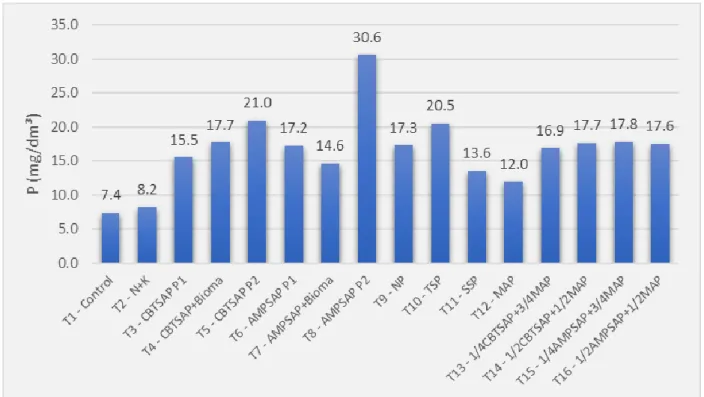
After the corn harvest, the 0 to 10 cm layer of the soil was sampled and assayed to determine the residual phosphorus (P) content (Figure 2).
The highest grade of P in the soil was found in Treatment T8 when AMPSAP was applied in a dosage of 100 kg/ha of P2O5, resulting in 30.6 mg/dm3 of P, followed by CBTSAP in the same dosage (Treatment T5) that returned 21 mg/dm3.
Comparing these treatments with a dosage of 50 kg/ha of P2O5, the residual P after the application of CBTSAP (Treatment T3) was 15.5 mg/dm3 and AMPSAP (Treatment T6) 17.2 mg/dm3, which are higher than the levels of residual P after the application of SSP (Treatment T11) (13.2 mg/dm3) and MAP (Treatment T12) (12 mg/dm3). The AMPSAP reached a similar level to NP (Treatment T9) (17.3 mg/dm3).
The P grades in the soil after the application of CBTSAP and AMPSAP are significantly higher than the P grades found in soils with control treatment where there is no addition of P, and in some cases exceeded the P levels of treatments with conventional fertilizers. The P grade in the soil after the application of AMPSAP in Treatment T8 was much higher than all other treatments, followed by CBTSAP in Treatment T5, which illustrates the potential of the TEPP DANF products.
Figure 2 – Phosphorous grades in the 0 to 10 cm layer of soil after the corn harvest, for each treatment under Test #2. Harvest 2019/2020. Capivari do Sul, RS, Brazil.
Figure 3: Overview of crops planted in Rio Grande do Sul State in a 300km radius from the Três Estradas Phosphate Project. Over 327,000 HA are planted each year to cultivate corn (maize).
AUTHORISED FOR ISSUE TO ASX BY FERNANDO TALLARICO, MANAGING DIRECTOR OF
AGUIA RESOURCES LIMITED
For further information, please contact:
Aguia Resources Limited - Investor Relations ABN: 94 128 256 888
Level 12, 680 George Street, Sydney NSW 2000 Australia E: [email protected]
P: +61 (0) 419 960 560
W: www.aguiaresources.com.au
For enquiries, please contact Ben Jarvis (Six Degrees Investor Relations) at [email protected] or +61 (0) 413 150 448.
About Aguia:
Aguia Resources Limited, (“Aguia”) is an ASX listed company whose primary focus is on the exploration and
development of mineral resource projects in Brazil including copper and phosphate. Aguia has an established and highly experienced in-country team based in Rio Grande State, Southern Brazil. Aguia has multiple copper targets. Aguia is also in the pre-production stage of a low-cost natural phosphate fertiliser project which is expected to be operational in early 2022.
JORC Code Competent Person Statements:
The information in this report that relates to Exploration Targets, Exploration Results, Mineral Resources or Ore Reserves is based on information compiled by Dr. Fernando Tallarico, who is a member of the Association of Professional Geoscientists of Ontario. Dr. Tallarico is a full-time employee of the company. Dr. Tallarico has sufficient experience that is relevant to the style of mineralisation and type of deposit under consideration and to the activity being undertaken to qualify as a Competent Person as defined in the 2012 Edition of the
‘Australasian Code for Reporting of Exploration Results, Mineral Resources and Ore Reserves’. Dr. Tallarico
consents to the inclusion in the report of the matters based on his information in the form and context in which it appears.
Caution regarding forward-looking information:
This press release contains "forward looking information" within the meaning of applicable Australian securities legislation. Forward looking information includes, without limitation, statements regarding the next steps for the project, timetable for development, production forecast, mineral resource estimate, exploration program, permit approvals, timetable and budget, property prospectivity, and the future financial or operating performance of the Company. Generally, forward looking information can be identified by the use of forward-looking terminology such as "plans", "expects" or "does not expect", "is expected", "budget", "scheduled", "estimates", "forecasts", "intends", "anticipates" or "does not anticipate", or "believes", or variations of such words and phrases or state that certain actions, events or results "may", "could", "would", "might" or "will be taken", "occur" or "be achieved". Forward-looking information is subject to known and unknown risks, uncertainties and other factors that may cause the actual results, level of activity, performance or achievements of the Company to be materially different from those expressed or implied by such forward-looking information, including, but not limited to: general business, economic, competitive, geopolitical and social uncertainties; the actual results of current
exploration activities; other risks of the mining industry and the risks described in the Company’s public
disclosure. Although the Company has attempted to identify important factors that could cause actual results to differ materially from those contained in forward-looking information, there may be other factors that cause results not to be as anticipated, estimated or intended. There can be no assurance that such information will prove to be accurate, as actual results and future events could differ materially from those anticipated in such statements. Accordingly, readers should not place undue reliance on forward looking information. The Company does not undertake to update any forward-looking information, except in accordance with applicable securities laws.
APPENDIX A: JORC Code, 2012 EDITION - Table 1 REPORT TEMPLETE
Section 1 Sampling techniques and data
(criteria in this group apply to all succeeding groups)
Criteria JORC Code Explanation Commentary
Sampling techniques
• Nature and quality of sampling (eg cut channels, random chips, or specific specialised industry standard measurement tools appropriate to the minerals under investigation, such as down hole gamma sondes, or handheld XRF instruments, etc). These examples should not be taken as limiting the broad meaning of sampling.
• In the Três Estradas Project area procedures for soil sampling, rock chip samples, drilling samples (auger drilling, reverse circulation and diamond drilling) and bulk sample were compliant with mineral industry standards
• At Três Estradas Project a bulk sample was composed from auger samples, collected from 16 distinct auger holes positioned according with the block model for the pit and the sample grades were targeted as bellow to represent the CBTSAP lithotype
• The 530kg bulk sample was composed in nature and took from 16 auger holes form surface to 4 meters depth
• Soil sampling for chemical analysis in agronomic lab were systematically sampled the 0 to 10 cm layer
• Include reference to measures taken to ensure sample
representivity and the appropriate calibration of any measurement tools or systems used.
Aspects of the determination of mineralisation that are Material to the Public Report. In cases where ‘industry standard’ work has been done this would be relatively simple (eg ‘reverse circulation drilling was used to obtain 1 m samples from which 3 kg was pulverised to produce a 30 g charge for fire assay’). In other cases, more explanation may be required, such as where there is coarse gold that
• Aguia has followed standard practices in their geochemical surveys and drilling programs. They have followed a set of standard procedures in collecting samples, logging and data acquisition for the project. Their procedures are well documented and meet generally recognized industry standards and practices.
• All logging is completed by Aguia geologists and directly entered into a comprehensive database program. Digital and hard copies of all sampling and shipment documentation are stored in the project office at Lavras do Sul.
• The auger holes are twin to previous diamond drill holes with known coordinates and mineralized intersection
Criteria JORC Code Explanation Commentary has inherent sampling problems.
Unusual commodities or
mineralisation types (eg submarine nodules) may warrant disclosure of detailed information.
Drilling techniques • Drill type (eg. core, reverse circulation, open-hole hammer, rotary air blast, auger, Bangka etc.) and details (eg. core diameter, triple or standard tube, depth of diamond tails, face-sampling bit or other type, whether core is oriented and if so, by what method, etc.).
• Aguia has completed five drilling campaigns on the Tres Estradas area between 2011 and 2017. Drilling has included 139 core holes (20,509.5m), 244 reverse circulation (RC) holes (7,800.0m) and 487 auger holes (2,481.65m).
• All core holes were drilled using wireline coring methods. HQ size (63.5mm diameter core) core tools were used for drilling through weathered material and NQ size (47.6mm diameter core) tools were used for drilling through fresh rock. Core recovery has exceeded 90% in 97% of all core holes. RC drilling was used to complete 244 holes with a cumulative length of 7,800.0m. All RC holes were drilled vertically (-90°) using 140mm button hammer bit. Holes were primarily drilled dry.
Drill sample recovery
• Whether core and chip sample recoveries have been properly recorded and results assessed.
• Measures taken to maximise sample recovery and ensure representative nature of the samples.
• Whether a relationship exists between sample recovery and grade and whether sample bias may have occurred due to
preferential loss/gain of fine/coarse material.
• Digital and hard copies of all sampling and shipment documentation are stored in the project office at Lavras do Sul. Documentation includes geological logs, photographs and recovery records.
• Aguia has followed standard practices in their core, RC, and auger drilling programs. They have followed a set of standard procedures in collecting cuttings and core samples, logging, and data acquisition for the project.
• There was no investigation about relationship between sample recovery and grade.
Logging • Whether core and chip samples have been logged to a level of detail to support appropriate Mineral Resource estimation, mining
studies and metallurgical studies.
• Regarding the auger samples, digital and hard copies of all sampling and shipment documentation are stored in the project office at Lavras do Sul. Documentation includes geological logs, sample photographs and portable XRF readings. Detailed geological logs are completed for every auger hole using an appropriate logging form. Sampling intervals in the CBTSAP lithotype are typically targeted for a 1.0m length.
• Whether logging is qualitative or quantitative in nature. Core (or costean, channel etc.) photography.
• The logging is qualitative in nature.
• The total length and percentage of the relevant intersections logged.
• 100% of sampled material from auger was logged. The portable XRF was used in all samples
Criteria JORC Code Explanation Commentary
collected from auger drilling for a preliminary grade control before composing the bulk sample Sub-sampling
techniques and sample
preparation
• If core, whether cut or sawn and whether quarter, half or all core taken.
• 100% of the sampled material from auger drill holes was used to compose a bul sample
• If non-core, whether riffled, tube sampled, rotary split etc. and whether sampled wet or dry.
• Dry RC samples are split using a Jones riffle splitter
• For all sample types, the nature, quality and appropriateness of the sample preparation technique.
• The ALS laboratory in Vespasiano is primarily an intake and preparation facility. Samples are crushed and pulverized into rejects and pulps.
• Quality control procedures adopted for all sub-sampling stages to maximise representivity of samples.
• Lab management system is consistent with ISO 9001:2008 requirements for sampling preparation.
• Measures taken to ensure that the sampling is representative of the in-situ material collected.
• 90% of all core samples falling within the range of 0.8m to 1.2m.
Sub-sampling techniques and sample
preparation
• Whether sample sizes are appropriate to the grainsize of the material being sampled.
• Sampling intervals in the amphibolite and the carbonatite are typically targeted for a 1.0m length but may fall within a range of 0.50m to 1.50m. Samples in the unmineralized gneiss host rock may have considerably longer lengths of up to 6.2m
Quality of assay data and
laboratory tests
• The nature, quality and
appropriateness of the assaying and laboratory procedures used and whether the technique is considered partial or total.
• Chemical analyses were conducted in the laboratories ALS laboratory and SGS Geosol, both labs located in Vespasiano-MG. Sample pulps from the Reverse Circulation, auger drilling and Diamond Drill programs are assayed by X-Ray fluorescence. The assaying regime is the standard for the determination of phosphate mineralizations. The technique is considered to be total.
• The CBTSAP bulk sample was tested in ALS laboratory in Vespasiano-MG
• Regarding the P2O5 solubility tests, the CBTSAP bulk sample was tested in the Agronomic Lab
of the Instituto Brasileiro de Analises (IBRA) in accordance with Brazilian Ministry of Agriculture, Livestock and Supply (MAPA) guidelines for testing fertilisers
• Soil samples tested to demonstrate the residual “P” content in soil as part of the agronomic efficiency tests were prepared trough Mehlich Extractant Technique for Sample Preparation and assayed by ICP in accordance with the accordance with MAPA guidelines for testing fertilisers and soil
Criteria JORC Code Explanation Commentary
• For geophysical tools,
spectrometers, handheld XRF instruments, etc, the parameters used in determining the analysis including instrument make and model, reading times, calibrations factors applied and their derivation, etc.
• The portable XRF is used for drilling samples to screen samples for further testing at the analytical laboratory
• Regarding the auger samples collected for bulk sample composing, the portable XRF was used in all samples collected for a preliminary grade control before composing the bulk sample
• Nature of quality control procedures adopted (eg. standards, blanks, duplicates, external laboratory checks) and whether acceptable levels of accuracy (ie. lack of bias) and precision have been
established.
• For quality assurance and quality control of analyses (QA/QC), Aguia uses a combination of reference samples, blanks, duplicate samples and umpire check assays. Aguia follows a protocol for accepting/refusing each batch of assays returned from the analytical laboratory. Reference, blanks and duplicate samples were inserted into the stream of drill samples such that one in 20 samples was a reference sample, one in every 30 samples was a blank sample, and one in every 30 samples was a duplicate sample.
Verification of sampling and assaying
• The verification of significant intersections by either independent or alternative company personnel.
• The use of twinned holes.
• Documentation of primary data, data entry procedures, data verification, data storage (physical and electronic) protocols.
• Discuss any adjustment to assay data.
• In 2012, SRK Consulting (Canada) Inc., was engaged by Aguia to prepare a geological model and mineral resource estimate for the project, in accordance with the JORC code. The results of additional drilling were incorporated in an updated resource estimate released by Aguia in January 2013. In early 2016, Millcreek was engaged by Aguia to complete a new PEA for the Tres Estradas Phosphate Project. In accordance with accepted standards and best practises for certification of resources, Millcreek personnel have completed two site visits to the Tres Estradas Phosphate Project. The first site visit took place between March 17, 2016 and March 19, 2016.
• Twin holes were not performed in Tres Estradas Project
• Digital and hard copies of all sampling and shipment documentation are stored in the project office at Lavras do Sul. Documentation includes geological logs, core photographs, core recovery records, portable XRF readings and down-hole surveys.
• There were no adjustments on assay data. Location of data
points
• Accuracy and quality of surveys used to locate drill holes (collar and down-hole surveys), trenches, mine workings and other locations used in Mineral Resource estimation.
• All drill collars are surveyed using differential GPS both before and after drill hole completion. Três Estradas, down hole surveys were completed on core holes using a Maxibore II down-hole survey tool. Readings are collected on three-meter intervals.
• Specification of the grid system used.
• Coordinates are recorded in Universal Transverse Mercator (UTM) using the SAD69 Datum, Zone 21S.
• Quality and adequacy of topographic control.
• Differential GPS is considered a precise topographic survey methodology.
Criteria JORC Code Explanation Commentary Data spacing and
distribution
• Data spacing for reporting of Exploration Results.
• Diamonds drill holes and RC drill holes were arranged in a regular grid varying from 25 x 50m to 100 x 50m grid.
Data spacing and distribution
• Whether the data spacing, and distribution is sufficient to establish the degree of geological and grade continuity appropriate for the Mineral Resource and Ore Reserve estimation procedure(s) and classifications applied.
• Millcreek considers the exploration data collected by Aguia to be of sufficient quality to support mineral resource evaluation.
• Whether sample compositing has been applied.
• Sample compositing was applied. Orientation of data
in relation to geological structure
• Whether the orientation of sampling achieves unbiased sampling of possible structures and the extent to which this is known, considering the deposit type.
• In general terms, the geological unit contacts are sub-vertical, and the holes are dipping 60°. Intercepts were produced at 45° average angle which isn’t the best condition, but it’s considered acceptable for mineral resource estimate purpose.
• If the relationship between the drilling orientation and the orientation of key mineralised structures is considered to have introduced a sampling bias, this should be assessed and reported if material.
• The relationship between the drilling orientation and the orientation of key mineralized structures don’t indicate necessarily sampling bias.
Sample Security • The measures taken to ensure sample security.
• The core and chips were transported by the company’s personnel from the drill site to the core storage facilities. Drill boxes are labelled with hole number and depth interval and the core is photographed prior to logging.
• Regarding the CBTSAP bulk sample, the company hired a shipping company to transport the sample from the company facilities at Lavras do Sul till the destination in laboratory. No damage or loss was identified when sample was received in the lab.
Audits or reviews • The results of any audits or reviews of sampling techniques and data.
• In 2012, SRK Consulting (Canada) Inc., was engaged by Aguia to prepare a geological model and mineral resource estimate for the project, in accordance with the JORC code. In early 2016, Millcreek was engaged by Aguia to complete a new PEA for the Tres Estradas. Phosphate Project. Audits and reviews of sampling techniques were performed in these works.
Section 2 Reporting of Exploration Results
(criteria listed in the preceding group apply also to this group)
Criteria JORC Code Explanation CommentaryMineral tenement and land tenure status • Type, reference name/number, location and ownership including agreements or material issues with third parties such as joint ventures, partnerships, overriding royalties, native title interests, historical sites, wilderness or national park and environmental
settings.
• The security of the tenure held at the time of
reporting along with any known impediments to obtaining a licence to operate in the area.
• The three mineral rights combined cover a total area of 2,075.34ha. Aguia holds 100% interest in the three mineral rights permits covering the Tres Estradas Phosphate Project area.
ANM Permit
Issuing
Date Period
Expiry
Date Area (ha) Status Municipality/State Title Holder 810.090/1991 8/16/2010 2 8/16/2012 1,000.00 Final Report
Presented Lavras do Sul/RS
Aguia Fertilizantes
S.A. 810.325/2012 5/03/2017 3 5/03/2020 900.95 Final Report
Presented Lavras do Sul/RS
Aguia Fertilizantes
S.A.
810.988/2011 4/15/2015 3 4/15/2018 84.39 Extension
Submitted Lavras do Sul/RS
Falcon Petróleo S.A.
Total Area 2,075.34
• The permit 810.325/2012 is currently operating under a permit extension. Falcon has requested for an extension of the permit 810.988/2011 which is currently under ANM’s review. The Final Exploration Report regarding the permit 810.090/1991 was file with ANM in September 09th, 2012.
Criteria JORC Code Explanation Commentary Exploration done by other parties • Acknowledgment and appraisal of exploration by other parties.
• Lavras do Sul was originally developed in the 1880’s as a gold mining camp on the Camaquã of Lavras River. In 1959, more detailed studies were organized by the ANM, which were followed in the 1970s by major survey and sampling programs of all mineral occurrences by the Companhia de Pesquisa e Recursos Minerais (CPRM – The Geological Survey of Brazil). In recent years there have been renewed exploration activities for gold and base metals in the region by Companhia Brasileira do Cobre (CBC), Amarillo Mining, Companhia Riograndense de Mineração (CRM) and Votorantim Metais Zinco SA.
• Phosphate mineralization was first observed at Três Estradas in a gold exploration program being conducted jointly by Santa Elina and CBC. Santa Elina was prospecting for gold in ANM #810.090/1991, conducting soil, stream sediment and rock geochemistry, ground geophysical surveys (magnetrometry and induced polarization) and a limited drilling program.
• Exploration results for gold were not encouraging and Santa Elina pulled out of the joint venture with CBC. However, the phosphate chemical analysis from two core boreholes in the ANM #810.090/1991 area yielded results of 6.41% P2O5 from soil and 6.64% P2O5 from core. This information was communicated to CPRM.
• Following petrographic studies, apatite mineralization occurring in carbonatite was confirmed. In July 2011, CBC entered into a partnership with Aguia Metais Ltda, a subsidiary of Aguia Resources Ltd., to explore and develop phosphate deposits in Rio Grande do Sul State.
Criteria JORC Code Explanation Commentary Geology • Deposit type, geological
setting and style of mineralisation.
• The Três Estradas Phosphate Project is situated in the Santa Maria Chico Granulitic Complex (SMCGC), part of the Taquarembó domain (Error! Reference source not found. below). The SMCGC exposes the deepest structural levels within Brazil and may represent the western edge of the Precambrian Rio de la Plata Craton. The Três Estradas deposit consists of an elongated carbonatite intrusion (meta-carbonatite and amphibolite) with a strike of 50° to 60°. The meta-carbonatite and amphibolite form a tightly folded sequence with limbs dipping steeply from 70° to vertical (90°). The surface expression of the intrusion is approximately 2.5 km along strike with a width of approximately 300m. The Late Archean to Early Proterozoic intrusion is intensely recrystallized and metamorphosed to amphibolite assemblages. The carbonatite intrusion is bound mostly by biotite gneiss along with meta-syenite along its northeast and southeast boundaries
• Phosphate mineralization, occurring as the mineral apatite (Ca5(PO4)3(F,Cl,OH)), is the primary mineralization of economic interest at Três Estradas. Apatite is the only phosphate-bearing mineral occurring in the carbonatites. At Três Estradas phosphate mineralization occurs in both fresh and weathered meta-carbonatite and amphibolite. Phosphate also becomes highly enriched as secondary mineralization in the overlying saprolite.
Criteria JORC Code Explanation Commentary Drill Hole
Information
• A summary of all
information material to the understanding of the exploration results including a tabulation of the following information for all Material drill holes:
• easting and northing of the drill hole collar
• elevation or RL (Reduced Level – elevation above sea level in metres) of the drill hole collar
• dip and azimuth of the hole
• down hole length and interception depth
• hole length.
• If the exclusion of this information is justified on the basis that the
information is not Material and this exclusion does not detract from the understanding of the report, the Competent Person should clearly explain why this is the case.
• Tres Estradas project have 383 drillholes including diamond drillholes and RC drillholes.Tables and map below present the location and average grades by intercept domain type.
•
Criteria JORC Code Explanation Commentary
Criteria JORC Code Explanation Commentary
Criteria JORC Code Explanation Commentary Data aggregation methods • In reporting Exploration Results, weighting averaging techniques, maximum and/or minimum grade truncations (eg. cutting of high grades) and cut-off grades are usually material and should be stated.
• Mineralization intervals intersected by drilling was aggregated by weighted average length.
Data aggregation methods
• Where aggregate intercepts incorporate short lengths of high-grade results and longer lengths of low grade results, the procedure used for such aggregation should be stated and some typical examples of such aggregations should be shown in detail.
• Intercept limits was guided by lithological interpretations during core-logging.
• The assumptions used for any reporting of metal equivalent values should be clearly stated.
• Metal equivalents were not reported
Relationship between mineralisation widths and intercept lengths
• These relationships are particularly important in the reporting of Exploration Results.
• Intercepts were produced at 45° average angle which isn’t the best condition, but it’s considered acceptable for mineral resource estimate purpose.
• If the geometry of the mineralisation with respect to the drill hole angle is known, its nature should be reported.
• In general terms, the geological unit contacts are sub-vertical, and the holes are dipping 60°.
Criteria JORC Code Explanation Commentary
• If it is not known and only the down-hole lengths are reported, there should be a clear statement to this effect (eg. ‘downhole length, true width not known’).
Intercepts were produced at 45° average angle.
Diagrams • Appropriate maps and sections (with scales) and tabulations of intercepts should be included for any significant discovery being reported These should include, but not be limited to a plan view of drill hole collar locations and appropriate sectional views.
• See following pictures:
•
•
Criteria JORC Code Explanation Commentary
•
Balanced reporting
• Where comprehensive reporting of all Exploration Results is not practicable, representative reporting of both low and high grades and/or widths should be practiced to avoid misleading reporting of Exploration Results.
• The drilling databases are highly organized with drilling Intercepts and it’s grade x length reports are properly stored and readily available within on the drillhole database.
Other substantive exploration data
• Other exploration data, if meaningful and material, should be reported including (but not limited to): geological
observations; geophysical survey results;
geochemical survey results; bulk samples - size and method of treatment; metallurgical test results; bulk density, groundwater, geotechnical and rock characteristics; potential deleterious or
contaminating substances
• One historical trench exists on the tenement, cut perpendicular to the meta-carbonatite. According to Aguia, this trench was dug over 10 years ago by Santa Elina while prospecting for gold in the area. Within the trench Aguia sampled three vertical channels. Within each channel, two samples were collected from bottom to top. The P2O5 results from these samples vary from 24.10% to 28.80%.
• Aguia made use of data from an airborne geophysical survey completed by CPRM, using rectified imagery for Total Magnetic Field (TMF), signal amplitude of TMF, First Derivative of the TMF, Uranium Concentration and Total Count of Gamma spectrometry. The magnetic anomalies identified in the airborne survey assisted in delineating areas of interest and led to Aguia completing a ground-based magnetic survey over the entire northern tenement area in March, 2012. The survey was carried out by AFC Geofisica, Ltda. from Porto Alegre, Brazil. The survey comprised 104 line kilometers oriented northsouth. Survey lines and control lines were spaced at 25m and 100m apart respectively.
•
• Drillhole location map and total magnetic field geophysical survey map
• Mineral processing and metallurgical testing for the Tres Estradas Phosphate project has been ongoing since 2012. Over that time the understanding of the metallurgical properties and characteristics of the ore and its response to various processes to concentrate and recover phosphate has gradually improved as a series of studies have steadily increased their relevance and level of detail. The most current level of work reflects a well-developed and considered approach to phosphate recovery that is optimized and verified to a level suitable to support a selection of a process route as well as the basis for preliminary
Criteria JORC Code Explanation Commentary
• equipment sizing.
• In 2015 a beneficiation bench-scale study was conducted on carbonatite and saprolite ore samples by SGS. This study confirmed phosphate recoveries of the previous study. Additionally, the slimes (-20μm) fraction were very significant, with similar chemical composition to the coarse fractions, which if discarded would result in high losses of P2O5.
• Eriez began their engagement with a program in 2016 that produced concentrates from various ore types at a commercially viable level of performance using column flotation. Preliminary bench-scale testing was performed using mechanical test cells in order to optimize the process approach, which was then tested using columns.
• Metallurgical and process testing has culminated in Eriez’s most recent pilot-plant testing for flotation (2017), supported with a recent comminution study. A multimonth study, using bulk samples and performed at Eriez Flotation Division’s pilot-plant facilities in Pennsylvania, USA, has confirmed the earlier bench-scale work as well as further improvements in the process design to improve grade - recovery projections
• The agronomic efficiency experiment was designed to use randomized blocks with four replications. Further work • The nature and scale of
planned further work (eg. tests for lateral extensions or depth extensions or large-scale step-out drilling).
• Diagrams clearly highlighting the areas of possible extensions, including the main geological interpretations and future drilling areas, provided this information is not commercially sensitive.
• Millcreek considers the exploration data collected by Aguia to be of sufficient quality to support mineral resource evaluation.