Looking Back at the Transition to High School: Perspectives from Families with Students with Autism Spectrum Disorder
Eric A. Common
A thesis submitted to the faculty of the University of North Carolina at Chapel Hill in partial fulfillment of the requirements for the Masters of Education degree in the School
of Education
Chapel Hill 2013
Approved by:
Samuel L. Odom
Kara Hume
ABSTRACT
ERIC A COMMON: Looking Back at the Transition to High School: Perspectives from Families with Students with Autism Spectrum Disorder
(Under the direction of Kara Hume, Ph. D and Samuel L. Odom Ph. D)
In an effort to better understand the unique experiences of high school students with ASD, and the transition into high school, information gleaned from a literature review, focus group study, and survey study were used to triangulate patterns across multiple and varied data sources. A total of 33 parents and 8 adolescents/young adults with autism spectrum disorder (ASD) participated across studies. Findings revealed that students and parents viewed high school dimensions as more negative, than positive. Social aspects were the most positive dimensions across individuals with ASD and parent perspectives. The three most positive features about high school for students, perceived by parents included: getting good grades, making new friends, and freedom to choose classes. While for parents, the three most positive features for their child were: taking classes in new subjects, freedom to choose some classes, and getting good grades were. In terms of orienting students with ASD during the transition to middle school to high school, both groups preferred personnel support to orientation activities. Most
Acknowledgements
TABLE OF CONTENTS
LIST OF TABLES………. iv
LIST OF FIGURES………... v
LIST OF ABBREVIATIONS……… vi
Chapter I. INTRODUCTION………...……… 1
Conceptual Framework………..…….. 3
Purpose and Hypotheses……….………. 5
II. LITERATURE REVIEW………...………. 8
Secondary Students with Autism Spectrum Disorder………..…… 8
Transitioning into High School………...……. 12
Perception Research………..……... 12
Transitioning and Orientation Programs………..…… 18
Summary………..…… 21
III. METHOD………. 22
Hypotheses………..………. 22
Survey Studies………..……… 22
Focus Group Study………..………. 30
IV. RESULTS………...…………. 33
Recruitment………..…… 33
Survey Results………..……… 34
V. Discussion………...………. 41
Positive and Negative Aspects of High School for Students with ASD………..… 41
Orientation Experiences…...………..………….. 43
Stakeholder Recommendations……..………..……… 43
Implications…..………..……….. 44
Recommendations for Practice………...……. 45
Limitations and Future Directions………..………. 47
Summary……….………. 51
APPENDICES………..…….. 52
LIST OF TABLES
Table
1. Survey Demographics ……… 52
2. Focus Group Demographics……… 53
3. Qualitative Questions……… 54
4. Academic, Social, and Organizational Subscale Means from Parent and Student Report…. 55 5. Three Most Positive Features about High School Perceived by Students and their Parents... 56
6. Three Most Negative Features about High School Perceived by Students and their Parents. 56 7. Student Participation in Orientation Activities Reported by Students……… 57
8. Student Participation in Orientation Activities Reported by Parents……….. 58
9. People Identified as Helpers During Orientation by Students and their Parents ……… 59
10. Most Frequently Reported Orientation/Transition Activities Reported and their Mean Scores……….. 59
11. Most Frequent Individuals Identified as Helpers During Orientation/Transition into High School……….. 59
12. Summary of Thematic Results: Positive and Negative Aspects of High School Across Domains ……… 60
13. Summary of Thematic Results: Orientation and Transition Supports……… 61
14. Summary of Thematic Results: Loss of Services Across Time……….. 62
LIST OF FIGURES
Figure
LIST OF ABBREVIATIONS
ADHD……….. Attention Deficit-Hyperactivity Disorder
ANOVA………...…….Analysis of Variance
AS……….Asperger’s syndrome
ASD……….... Autism Spectrum Disorder
CA………...California
CSESA………..… Center on Secondary Education for Students with Autism Spectrum Disorders
EF………...Executive Functioning
EPF……….. Enhanced Perceptual Functioning
GA………..……Georgia
GPA……….. Grade point average
HFA……… High functioning autism
HP……… High performers
HST……… Hyper-Systemizing Theory
IEP……….…….Individualized Education Plan
IL……….……Illinois
IN………Indiana
IQ………..Intelligence Quotient
IRB………..Institutional Review Board
LP………..Low performers
M………...…..….. Mean
N………...……….Population size
n………..………....Sample size
NLTS-2……….……….. National Longitudinal Transition Study-2
Not ans. ……….………..………....Not answered
Not partic. ……….…..Something like this was offered but my child did not participate
OCS ………Occupational Course of Study Program
PA……….……….Pennsylvania
Partic. ……….………..………..Participated in something like this
PDD………... Pervasive Developmental Disorder
PSSM……….. Psychological Sense of School Membership
PTS-P………. Perception of Transition Survey – Parent Form
PTS-S………..…. Perception of Transition Survey – Student Form
PTS………. Perception of Transition Survey
RA………..….. Rhode Island
RRBI……….Restricted and repetitive behaviors and interest
SCQ……….………. Social Concerns Questionnaire
SD….. ……….……….Standard deviation
STEP……….……….. School Transitional Environmental Program
THI……….……….Total Household Income
TN………..Tennessee
ToM………...Theory of Mind
TX……….Texas
UK………United Kingdom
USA………United States of America
VA……….Virginia
Chapter I INTRODUCTION
The transition to high school is an important milestone coinciding with many physical, cognitive, emotional, and psychological changes that encompass adolescent maturation. Students often experience a mixture of apprehension and excitement during the transition into high school. Akos & Galassi (2004) found students anticipated both positive experiences, such as opportunities to select classes, make new friends, have more freedom, and participate in school events. At the same time, these students expressed concerns around the amount of homework assigned, ability to fit in and making friends, fears of getting lost around campus, and pressures to do well. Students who are
transitioning are expected to not only acclimate to the physicality of a new school, but also to new academic (e.g., new subjects), social (e.g., maintaining new and old
friendships), and organizational (e.g., having multiple teachers with varying expectations) dimensions associated with the new school environment (Akos & Galassi, 2004; Smith, Akos, Lim & Wiley, 2008; Uvass & McKevitt, 2013).
their parents (Akos & Galassi, 2004; Butts & Cruzeiro, 2005; Smith et al., 2008; Uvass & McKevitt, 2013).
For students with disabilities, the transition into high school may be more complicated. Structural shifts in educational delivery frequently mean lower levels of support in secondary settings, as well as higher placements in regular education
classrooms (Letrello & Miles, 2003; Wei, Wagner, Christiano, Shattuck, & Yu, 2013). Students with autism spectrum disorder (ASD) may be more disadvantaged due to a triad of impairments in social interaction, communication, and unusually restricted and
repetitive behaviors and interests (RRBI; American Psychiatric Association, 2000). Additionally, these individuals may have greater need for predictability, difficulty with schedules, distress when a pattern of behavior is disrupted (Flannery & Horner, 1994; Hume, 2008; Mesibov, Shea, & Schopler, 2005); and difficulty organizing their environment and thoughts in processing auditory stimuli (Grandin, 1992). These characteristics may make acclimating to the new physicality and new expectations of high school challenging for students on the spectrum.
In an effort to ameliorate the challenges of transitioning from middle to high school, many schools use orientation activities as well as transition supports to assist their incoming students. Orientation and transition programming typically provide important logistical information as a means to aid students during the transition into secondary educational settings (MacIver, 1990). Students who attend schools with formal and explicit transition programs have shown to be more likely to experience a smooth transition to high school in comparison those students who did not (Smith, 1997). Additionally, schools that provide such programs report greater levels of student
the new school. High quality programs not only offer new students articulation activities around organizational and safety procedures prior to the first day of school, but continue to offer supports that can include interdisciplinary teaming, bridging together middle to personnel, and continual social supports (e.g., homeroom and group advisories) to students (Mac Iver, 1990, Mac Iver & Epstein, 1991, Mizelle 1999). Mac Iver and Epstein (1991) found principles of middle school providing such additional supports expected better outcomes for their students as they entered high school (e.g., retention; MacIver & Epstein, 1991).
Although research examining the high school transition process for the general population is growing (Akos & Galassi, 2004; Mizelle, 1999; Reyes et al 1994; Schiller, 1999; Weiss, 2001), research examining this transition for students with disabilities is nascent (Frasier, 2007; Letrello & Miles, 2003;), and specific to students with autism is nonexistent. Orientation processes explored for students from low-income, urban and/or minority households, students at-risk for achievement loss, and typically developing students in general education may not be as effective in supporting students with ASD because of the complexity of their communication, social and organizational concerns. Furthermore, they do not examine the perceptions of students with ASD, and what their unique needs during the transition to high school may be. In addition, few orientation programs have been empirically investigated regardless of the population of interest so there is a paucity of evidence to support recommended practices (e.g., MacIver & Epstein, 1991; Mizelle, 1999). This study seeks to illuminate the transition experiences unique to students with ASD to inform research and implementation in an effort to encourage future research and development of efficacious orientation programming for students with ASD.
Conceptual Framework
others occur far less frequently, but may culturally be just as normative. The transition to high school is embedded in the life course of students participating in the K-12
continuum. Ecological systems theory (Brofenbrennder, 1979) conceptualizes that human development is influenced by interactions occurring across many systems of influence. In this perspective, the child is at the epicenter of coactive systems within systems (e.g. individual, the family, and the schools). From this developmental
perspective, changes within the individual are influenced by the interactions an individual has within various systems across all levels, some of which child is not directly involved in at all. Across systems, interactions are bidirectional, where events in one system can have an impact on the resources and challenges in another. Events in smaller (e.g., biological constitution of the individual, family) and larger systems (e.g., parent’s work place, school systems, government) all have an influence on the child’s environment, and in turn on his or her behavior and development.
The transition to high school is a common experience for students; therefore they are many structurally embedded to supports within the broader culture that influence this process. For example, before the transition into high school, many students will already notice an increase in their teacher’s expectations of student behavior. Gresham, Dolstra, Lambros, McLaughlin & Lane (2000) found teacher expectations change between fourth and sixth grades - with sixth grade teachers rating more student behaviors as critical for academic success (as cited in Lane, Carter, Common & Jordan, 2012). Ideally, any trajectory such as the leveling of elementary to middle, middle to high school, high school, will include a continuum of support services bridging the lowest and highest levels of ecological systems. For students with special needs, critical issues include identifying their appropriate level and intensity, and how affordable and flexible the transition supports are to meet a wide range of student’s needs.
Galassi, 2004) when transitioning into a new school context. Any specific behavior that takes place has a history rich in developmental, bidirectional interactions that have crossed many levels developmental influence (Gottlieb, 1997; Loeber & Farrington, 1998; 2001) and domains with implications for academic, social, and behavioral
competencies. For many students, including those labeled as gifted or with special needs, the transition across grade levels (e.g., from elementary to middle, middle to high school) has been associated with achievement loss. These losses have been reported in grade point average (GPA) and course failure (Alspaugh, 1998a; Isakson & Jarvis, 1999; Newman, Myers et al., 2000; Reyes et al., 1994); self-perception (Reyes et al., 1994) and social status (Reyes et al., 1994; Schiller, 1999); and risk for drop out (Alspaugh, 1998a; 1998b; Alspaugh, 2000). For students with special needs, one must ask what the
additional stressors exist when transitioning from one schooling environment to the other. This study is an attempt to answer questions around the unique experiences of high
school for students with ASD and their perspectives on the transition into high school.
Purpose and Hypotheses
The purpose of this study is to investigate the perspectives of students with ASD regarding the transition from middle to high school. Most research addressing this transition has targeted the perceptions of students without disabilities. Because high school students with ASD are underrepresented in transition from secondary and more specifically middle to high school literature, this study examined the perceptions of students with ASD regarding students’ transition from primary or intermediary school into high school. Based on a review of perception research on transitioning from middle to high school, the following research questions and associated hypotheses were
examined:
Test hypothesis one. Students will report more experiences negative than positive across academic, social, and organization subscales on the Perception of Transition Survey – Student Form (PTS-S), and rate academics as more positive compared to the social and organizational subscales.
Research question two. What are the perceptions of parents of high school students with ASD regarding the positive and negative aspects of being a high school student?
Test hypothesis two. Parents will express a balance of positive and negative concerns across academic, social, and organization subscales of the Perception of
Transition Survey – Parent Form (PTS-P) and rate academics as most positive and social as most negative.
Research question three. What are the similarities and differences between students’ and parents’ perceptions regarding the positive and negative aspects of high school?
Test hypothesis three.Students and parents will rate similarly on academic domains as favorable; students will rate the social domain more negative than parents. Parents will rate the organization domain more negatively compared to students.
Research question four. What factors (e.g. helpers, activities) do students with ASD as well as their parents find to be the most beneficial contributions to a successful transition into high school?
Test hypothesis four.Parents will: (a) rate helpers higher than activities, and (b) rate peer helpers higher than adult supports. Students will rate: (a) activities higher than helpers, and (b) adult support higher than peer support.
Test hypothesis five. Parents will express concerns around barriers to services and follow through with Individualized Education Plans (IEPs) by general education teachers. Students will express mistrust for other students and a desire for safe areas to go to during unstructured activities (e.g., breaks and lunch).
These research questions were derived from a review of the literature around secondary education, students with autism, and perception research on transitioning into high school. This study will triangulate information gleaned from a conceptual literature review, a pilot survey study of students’ with ASD and parent’s of students with ASD and focus groups implemented with individuals with ASD, as well as parents of individuals with ASD. The results will be shared with a larger project (i.e., Center on Secondary Education for Students with Autism Spectrum Disorders; CSESA),
Chapter II Literature Review
Students with ASD bring a myriad of behaviors, which can impede their
functioning in secondary school environments, and impact their adolescent development including personal-social and adaptive impairments (e.g., social deficits, poor
relationships with peers; poor hygiene), communication difficulties (e.g., poor
understanding of abstract concepts), and unusually RRBI (e.g., elaborate rituals; National Autism Center, 2009). Often, these deficits do not improve with age and may become more pronounced during adolescence and adulthood as the gap between competencies and expectations widen (Rao, Beidel & Murray 2008; Rosenthal et al., 2013). In this chapter the research on issues surrounding secondary education for students with ASD are introduced. Subsequently, how these issues uniquely impact the transition into secondary settings (more specifically to high school) is explored through a discussion of studies identifying perceptions of high school students and other stakeholders of this transition experience. This chapter concludes with articles that have identified recommended supports to aid students as they move from middle to high school.
Secondary Students with Autism Spectrum Disorders
only 33% of secondary students are included in the standard grade-level curriculum (Newman, 2007). Furthermore, in those classes, 67% of general education teachers reported making modifications to the general education curriculum (Newman, 2007). The prominent features of ASD often affect all areas of development including social, emotional, and academic domains (Rao et al., 2008). These effects may facilitate the exclusion of students with ASD from general education classrooms, or their potential to fully participate when enrolled in these classes.
Recent calls by researchers to focus on secondary education for students with ASD (e.g., CSESA) are well timed as more students with ASD are entering secondary settings. For instance, the overall incidence (1:88) of ASD has been consistently rising, only recently has the incidence of ASD in 14 to 17-year olds matched that of younger cohorts (Blumberg et al., 2013; Center for Disease and Control, 2012; 2013). By the same token, between 1996 and 2006, participation in general education classes by students with ASD have gone from 18.3% to 32.3%, and the number of graduations with regular diplomas has risen from 33.6% to 57.1% (U.S. Department of Education, 2011). High school presents not only an increase in content and conceptual information through the curriculum, but opportunities for students to develop the skills required to negotiate personal responsibilities, independence, and social demands of adulthood. The
prevalence of students with ASD in secondary settings necessitates a cohesive research agenda recognizing the complexity of the disorder as it intersects with typical academic and developmental milestones if students are to be successful in these environments.
friends (10%; Wagner et al., 2004). This exclusion from peers has implications for school success, as students who are rejected are more likely to perform poorly on achievement assessments and less likely to participate in classroom activities (Buhs & Ladd, 2001).
Many of the behavioral characteristics associated with ASD have been linked to unique neurological or cognitive processes specific to individuals with ASD.
Researchers have explored Theory of Mind (ToM; Cohen et al. 1985; Baron-Cohen, 1997), issues around executive functioning, enhanced perceptual functioning (EPF; Mottron & Burak, 2001; Mottron et al. 2006) and hyper-systemizing theory (HST; Baron-Cohen, Ashwin, Ashwin, Tavassoli, & Chakrabarti, 2009) as points of intervention and mediators of the behavioral signifiers of ASD. Challenges related to ToM underlies difficulties some individuals with ASD may have attributing mental states (e.g., beliefs, desires, intentions, and memories) in self and in others in order to explain and predict behavior (Baron-Cohen et al. 1985; Baron-Cohen, 1997). For students with difficulties in ToM, rapidly shifting from the expectations of one classroom teacher to the next or navigating peer-to-peer interactions may be especially challenging in the high school context where social interactions will be more nuanced and expectation shifts are frequent.
Conversely, researchers investigating EPF and HST postulate the main difference between individuals with and without ASD is the presence of a unique
cognitive-perceptual process. In both models, individuals with autism have a unique cognitive ability to recognize repeated patterns due to either a superior flow of “low-level”
memory, simple pattern detection, geometric figure completion, and shape reproduction (Baron-Cohen et al., 2009; Mottron, Belleville, & Menard, 1999; Mottron & Burack, 2001; Plaidsted, O’Riordan, & Baron-Cohen, 1998). However, these cognitive profiles are also associated with difficulties organizing perceptual stimuli from their environment. This can result in difficulty discerning meaning from environmental cues (e.g., facial and emotion recognition; Morton, Dawson, Soulières, Hubert, & Burack, 2006).
Another neurocognitive line of inquiry explores issues around executive
functioning (EF) and the broad range of cognitive processes required for action planning and inhibition, organization, self-monitoring, fluid reasoning and set shifting (Lind & Williams, 2011). Several components of EF have been shown to be impaired while others appear to be intact for in individuals with ASD. Evidence of executive dysfunction in individuals with ASD has identified difficulties with planning ability (Ozonoff, Pennington, & Rogers, 1991), cognitive flexibility (Ozonoff et al. 1991), and working memory (Ozonoff & Stayer, 2001), whereas studies measuring inhibitory control have overwhelming suggested it to be intact. Adolescents with EF problems may have greater difficulty with organization, following multiple-step directions and the ability to self-initiate (Rosenthal, et al., 2013). These are critical components to success in the academic and organizational domains associated with expectations of independence for adolescents across settings.
For many students with ASD, transitions across the K-12 continuum will be a challenge without explicit instruction or supports. Tobias (2009) examined attitudes of students with ASD as well as their parents in the United Kingdom regarding the supports received in secondary school (UK). In this study, the supports identified as most helpful included: (a) targeted support at key points (e.g., specific, detailed information about their new skill and problem-solving aides for different eventualities); (b) providing a
anxiety (e.g., a room to calm down in); (d) good communication between staff and parents; (e) knowledge staff of basic knowledge of ASD and key characteristics; (f) individual, tailor-made supports ; (g) welcoming environment; (h) thoroughness (e.g., commitment or dedication to the student); (i) lower student/staff ratios. Tobias (2009) concludes, by recommending additional supports to include: programming to enhance self-confidence, self-awareness, sense of belonging, and social inclusion; as well as greater organizational, independence skills, and other life skills.
Transitioning into High School
Perception Research
Low-income, urban, minority students. Two early studies that describe perceptions of students as they moved from middle school to high school sought to identify factors associated with the school success of low-income, minority students considered academically promising (Newman, Lohman et al., 2000; Newman, Myers, et al., 2000). These studies focused on the perceptions of a group of high-ability, urban, low-income students participating in the Young Scholars Program (YSP; Newman & Newman, 1999). Students with a GPA above 3.0 in both studies were identified as high performers (HP), while the remainders were considered low performers (LP; Newman, Lohman et al., 2000). In both studies, students identified their mothers and/or parents, friends, teachers, and YSP coordinators as academic supports. However, the studies differed subtly in exact shifts in students’ perceptions from middle to high school.
In the first study, Newman and colleagues (Newman, Myers et al., 2000) collected in-depth interviews with students, student responses to standardized measures of
academic motivation, self-esteem, and academic self-esteem; interviews with YSP; and questionnaires completed by persons identified by students as academically supportive for 22 African American students at the end of ninth grade. They found subtle
differences in HP and LP student perceptions of the transition from eighth grade to ninth grade. Negative comments about their ninth grade teachers were most common (77%), however 55% also had positive comments about their teachers. High performers were more likely to mention negative comments about their teachers, while LP were more likely to mention positive comments about their teachers. High performers discussed issues around their ninth grade work being more difficult, and adjusting to the new school, while LP were more divided on whether or not ninth grade was easier or more difficult.
grade year. These interviews focused on researcher identified microsystems researchers likely to affect student’s academic motivation and performance, as well as challenges expected or challenges experienced during the ninth grade year. In this study, HP and LP students viewed the transition to ninth grade similarly, with students reporting ninth grade to be harder and more difficult than eighth grade; and with more demands in homework, note taking, and responsibility (Newman, Lohman et al., 2000). High performers reported challenges in academics, social (e.g., maintain and making friends, getting along with teachers), and staying out of trouble (Newman, Lohman et al., 2000). Low performers reported challenges in academics, peer pressure, their neighborhood, skipping school, getting used to the new school, and family problems (Newman, Lohman et al., 2000).
Students with disabilities. One study has compared perceptions of students with and without learning disabilities (Letrello & Miles, 2003). In this study, six students with learning disabilities were compared with six students without disabilities using
information gleaned from interviews that occurred during the ninth grade year. Both groups gave similar answers across several domains, but one notable difference emerged around supports. Students with learning disabilities indicated they relied more on help from peers and teachers in order to be successful in the ninth grade (Letrello & Miles, 2003). Both groups reported similar fears (i.e., size of school, older students, not having friends, not being able to find classes) and expectations (e.g., wouldn’t see friends, difficult classes, demanding teachers) of what they though high would be like, and how it actually differed from middle school (e.g., bigger school, more freedom, more
getting accustomed to block scheduling, higher expectations, managing time, and a lack of time to socialize because of homework demands as difficult adjustments.
Students in general education. Seven studies explored the perceptions of various stakeholders including students, their parents, and/or high school teachers on the transition from middle to high school using a combination of survey techniques (Akos & Galassi, 2004; Butts & Cruzeiro, 2005; Rice, 2011; Smith et al., 2008; Smith, Feldwisch, Abell, 2006; Uvass & McKevitt, 2013; Zeedyk et al., 2003). In the first study, Zeedyk et al. (2003) demonstrated a perceptual disconnect in academic and social perceptions before and after the transition to high school. Academic competencies were the primary factor identified by students and their parents prior to enrolling in high school. However, once in high school, students listed social and organizational skills (e.g., time
management, ability to stay on-task, appropriate behavior) as critical competencies to a successful transition (Zeedyk et al., 2003).
The Perceptions of Transition Survey (PTS; Akos & Galassi, 2004) was used in five of these studies (Akos & Galassi, 2004; Butts & Cruzeiro, 2005; Smith et al., 2006; Smith et al., 2008; Uvass & McKevitt, 2013). In the original study, Akos and Galassi (2004) compared retrospective perceptions of students, parents, and teachers on positive and negative aspects of the transitions into secondary settings. In this study, 173 sixth grades, 83 of their parents, and 12 teachers responded for the elementary to middle school transition. Three hundred and twenty-nine 9th graders, 61 of their parents, and 17
amount of homework, pressure to do well, and pressure to do things. Teachers reported worry over students’ pressure to do well, fitting in and making friends, and having harder classes (Akos & Galassi, 2004). Overall, these students rated the difficulty of the
transition to high school as being “somewhat easy” (Akos & Galassi, 2004).
In subsequent studies using the PTS, Butts and Cruzeiro (2005) found students perceived helpful factors for the transition to include having teachers who explained things well, having an interest in the class material, having friends in class, and going to class daily. Students reported things that were not helpful for success included having limited time with friends, having a mentor, having tutors help with work, being in a larger school, and difficulty forgetting outside problems (Butts & Cruzeiro, 2005). The
majority of these students (66.1%) reported feeling successful after the transition (Butts & Cruzeiro, 2005). Students recommended having more help during their eighth grade year, and additional support from their family, friends, and teachers would have been helpful for the transition (Butts & Cruzeiro, 2005).
The greatest areas of worry for students were having too much homework and difficulties associated with teachers and classes.
In their subsequent study, Smith et al. (2008) compared how students, their parents, and school staff perceived the transition from middle to high school again. This time they organized the scales around academic, social, organizational and helper elements. Internal estimates ranged from .52 for organization, .72 for academic, .78 for helper, and .81 social subscales. Aggregated students’ and parents’ pre-transition scores revealed parents perceived academic aspects of high school slightly more positive than students, whereas students viewed social aspects significantly more positive than parents with no difference reported between students and parents on the organizational scale. In comparing pre-post student perceptions of the transition, perceptions were statistically more positive on the academic subscale after the transition. No differences were reported in their social or organizational perceptions of being in high school before or after the transition. Prior to the transition, students reported moderate levels of support from their eighth grade counselors, and higher levels of support from their parents and eight grade teachers in preparing for the transition. Retrospectively, they reported lower levels of support from their eighth grade staff and stable levels of support from their parents.
Recently, Uvass and McKevitt (2013) adapted the PST to compare students’ perceptions of eighth and ninth grade for seven subscales. The scales were: (a) positive feelings towards school, (b) school concern, (c) transitional supports, (d) school
connectedness, (e) extracurricular involvement, (f) grades, and (g) attendance. No statistical difference was reported for the slight decreases in mean scores on two of the change scores (i.e., positive feelings about school, absences; Uvass & McKevitt, 2013). After the transition, students perceived less school concerns, lower levels of school connectedness and extracurricular involvement, as well as declines in their grades (Uvass & McKevitt, 2013). Once in high school, student’s greatest concerns focused on
The Social Concerns Questionnaire (SCQ; Thomasson, Field, O’Donnell, & Woods, 2006) in an assessment measure used to identify self-reported school concerns during the primary to secondary transition. Rice (2011) assessed the validity of the measure among 147 primary and 263 secondary students enrolled in six primary and two secondary schools in south central England. She identified concerns of primary school students preparing for the transition to secondary school to revolve around homework, being bullied, remembering equipment for class, school size, and changing classes (Rice, 2011). In a smaller sample, of 67 students were reassessed after their transition. Their overall level of concern decreased, but the items of concerns remained (Rice, 2011).
Transition and orientation programs
Despite evidence that the high school transition represents a point of heightened vulnerability for students, few programs designed to facilitate transitions have been evaluated for their efficacy. Transition programs are considered effective if they improve student attendance, achievement, and retention (Cauley & Jovanovich, 2006) despite growing evidence from student perception research identifying social and organization competencies as critical elements for students’ success (Zeedyk et al., 2003).
Furthermore, few systems are in place to monitor the multiple needs of students. By utilizing schoolwide data systems across academic, behavioral and social domains (e.g., Lane, Kalberg, & Menzies, 2009) to identify students at-risk for achievement loss during the transition into high school, data would be more readily available in examining the efficacy of individual and schoolwide transitional support programs across a broader range of student-level outcomes.
Education (Gottfredson, 1986); and (e) Fast Tack (Conduct Problems Prevention Research Group, 1992; 2002). Best practice programs were identified using the: (a) positive youth development database, (b) the Office of Juvenile Justice delinquency Preventions’ Model Program on juvenile justice, and (c) the Office of Surgeon General (Gentle-Genitty, 2009). In addition, studies were required to have: (a) outcomes
associated with a reduction of problem behavior and/or increase in positive behavior, (b) addressed three of the following five domains – individual, peer, family, school, and community; (c) a structured curriculum or activity format to allow for replication; (d) duration of program that exceeded nine months 3) program strategies that included cognitive-behavioral and social skill development; (f) program fidelity procedures; (g) and reliable evaluation measures (e.g., pre- and post-testing, or experimental designs with assigned comparison groups). Gentle-Genitty (2009) found the STEP program to be the most promising. The step program was unique in that it was the only program to address all five points of entry, including involving teachers, parents, peers, the individual and changes in the school community (Gentle-Genitty, 2009).
Ninth grade reform in practice. Some school districts have taken a more proactive and ongoing approach to orienting freshmen. In order to combat poor performance in ninth grade these districts utilize organizational structures such as
housing all freshmen in “freshmen centers” (Smith et al., 2008), and ninth grade specific staff assignment (International Center for Leadership in Education, ICLE 2008). They are intended to facilitate a sense of community and ease the academic and social transition from middle school to high school. For example, freshmen centers were designed to operate more like middle schools arranged in houses or teams by grade (Smith et al 2008) than high schools, which are compartmentalized by department
(Rutledge, Cohen-Vogel, Osborne-Lampkin, 2012). The efficacy of such a model has yet to be studied. However, the International Center for Leadership in Education (2008) recommends the practice of exclusive staff assignment to the ninth grade by: (a) motivating capable teachers to teach 9th grade and focus on the unique needs of this population, (b) assigning nearly 100% of an administrator’s time to the ninth grade to create a common link to the rest of the faculty, (c) assigning a ninth grade counselor that will either follow the cohort through all four years or for the first year, and (d)
designating other support staff to help coordinate the unique and particular resources available at that high school in aiding students and their families in finding said supports.
An exemplary transition program for students with special needs is implemented in a suburban school district in Los Angeles (Frasier 2007). This district responded to the unique needs of students in special education by collaborating with their feeder middle school and creating a multistage orientation process that begins early in the spring
collaboration with the middle school team; (e) a high school tour for all incoming freshmen; (f) a high school all-parent and child open house; and (g) an eight-week summer orientation program for students with special needs.
Summary
The transition into high school is a time of both concern and excitement for many students and their families as they are presented with new opportunities and challenges. Student perception research has identified a broad range of opinions of their teachers spanning positive and negative attributes (Newman, Lohman, et al, 2000; Newman, Myers et al., 2000). Student-identified challenges in high school include higher academic demands (Akos & Galassi, 2004; Newman, Lohman, et al, 2000; Newman, Myers et al., 2000), adjusting to new behavioral expectations (Newman, Lohman, et al, 2000;
Newman, Myers et al., 2000; Zeedyk et al., 2003), and block scheduling (Letrello & Miles, 2003). Issues around peer relations vary, as some studies identified that students perceived friendships difficult to establish or maintain (e.g., Newman, Lohman, et al, 2000), while others reported the ease of forming new friendships in high school (e.g., Letrello & Miles, 2003). Several studies also emphasized the important role of friends as a support factor during the transition into high school (Butts & Cruzeiro, 2005; Zeedyk et al., 2003). Recommendations to support students emphasized advisory periods,
interdisciplinary teaming, and peer buddy programs as components of a quality transition program in addition to orientation programs that articulate logistical information
Chapter III Method
To gain further insight into the perceptions of students and their parents regarding the transition from middle to high school, five questions were asked. Questions were based on the available literature addressing the perceptions of students and their parents, and focus group data. The information gleaned from the literature review, focus group data, and survey data were used to triangulate patterns across multiple and varied data sources. The following research questions were asked:
1. What are the perceptions of high school students with ASD regarding the positive and negative aspects of being a high school student?
2. What are the perceptions of parents of high school students with ASD regarding the positive and negative aspects of being a high school student?
3. What are the similarities and differences between students’ and parents’ perceptions regarding the positive and negative aspects of high school? 4. What factors (e.g. helpers, activities) do students with ASD as well as their
parents find to be the most beneficial contributions to a successful transition into high school?
5. Having gone through the transition to secondary school, what recommendations do students with ASD as well as their parents have to aid the successful transition for future students?
Hypotheses
Five hypotheses were formulated to address each research question. First,
organization subscales on the Perception of Transition Survey – Student Form (PTS-S), and rate academics as more positive compared to the social and organizational subscales. Second, parents will express a balance of positive and negative concerns across
academic, social, and organization subscales of the Perception of Transition Survey – Parent Form (PTS-P) and rate academics as most positive and social as most negative. Third, students and parents will similarly rate the academic domains as favorable; students will rate the social domain more negative than parents. Parents will rate the organization domain more negatively compared to students. Fourth, parents will: (a) rate helpers higher than activities, and (b) rate peer helpers higher than adult supports. Students will rate: (a) activities higher than helpers, and (b) adult supports higher than peer supports. Fifth, parents will express concerns around barriers to services and follow through with IEPs by general education teachers. Students will express mistrust for other students and a desire for safe areas to go to during unstructured activities (e.g., breaks and lunch).
Survey Studies
Sample and participation selection. Surveys were distributed across two separate and distinct samples. First, participants were sampled from two local school districts. Second, participants were sampled from an online population to reach a broader sample of participants to further triangulate sources of data.
Local school district. Two local school districts with a total of four high schools
with approximately 106 high school students with autism agreed to participate in the study. Eligible students had to have a diagnosis of ASD and be educated in the general education setting or an occupational course of study program (OCS). Eligible parents had to have a child fitting the pervious description.
forms. Parents and students who agreed to participate in the study were directed to a project website hosted by web.unc.edu, where they were able to begin the electronic consenting or assenting process and complete the survey. Sixty-one letters were delivered to families by school staff via postal mail. One letter was returned.
Online population. A second survey was administered, recruiting families at the
national level. Several local and national organizations (e.g., Organization for Autism Research, North Carolina Autism Society), non-public agencies (Goals for Autism, Associated Learning and Language Specialists), CSESA sites, social networking groups (e.g., Asperger’s Support Network, The Autistic Self Advocacy Network), and informal contacts helped distribute online notifications and flyers. Contacts were emailed asking if they would like to distribute recruitment information (i.e., e-mail, flyer,
announcement). Eligibility and inclusion for this sample was broadened to include parents of an adolescent/young adult with high functioning autism/Asperger’s syndrome (HFA/AS) or an adolescent/young adult with HFA/AS who can provide perspectives of a current high school student or student who was enrolled between 2008 and 2013.
Focusing on individuals with HFA/AS was an eligibility requirement to parallel the school district sample of general education and OCS.
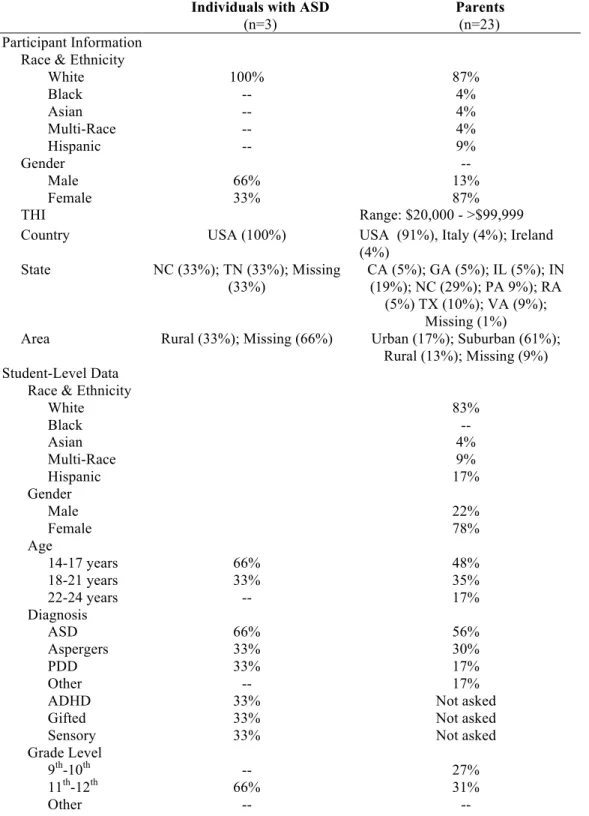
Student demographics. Three individuals with autism participated in the survey; two participants from the online sample and one participant from the school district sample. Two participants reported they were currently enrolled in high school (grades 10-11) and one participant reported graduating within the last five years (2011). Geographically, all “student” participants with ASD reported being from the United States; one participant was from North Carolina, one participant was from Texas, and one participant did not answer. All reported that they were white (100%). Two students reported being male (66%). These participants identified as having ASD (66%),
(33%). See Table 1 for participants with ASD survey demographics. Five individuals with ASD participated in the focus group. All of these participants were male; four were White, and one was Black. See Table 2 for participants with ASD focus group
demographics.
Parent demographics. Twenty-three parents participated in the survey; 21 parents from the online sample and two parents from the school district sample. Their children with ASD ranged from being current lower classman (i.e., 9th – 10th grade; 27%), upper classman (i.e., 11th – 12th grade; 31%), and recent graduates (i.e., within the last five years; 42%). Ninety-one percent of parents reported coming from the United States (91%), Italy (4%); and Ireland (4%). Families reported their children with ASD attended high schools across nine different states (i.e., California, Georgia, Illinois, Indiana, North Carolina, Pennsylvania, Rhode Island, Texas, and Virginia). Parents reported their children with ASD attended high schools in primarily suburban (61%) areas, with 17% attending schools in urban areas, and 13% in rural areas.
Parent participants reported their children were primarily diagnosed on the autism spectrum by a psychologist (56% ASD; 30% Asperger’s syndrome; 17% PDD).
Additional comorbidities reported by parents included: pragmatic language impairment, ADHD, and specific learning disability. Eleven parents provided their estimated child’s most recent high school GPA and their child’s last middle school GPA; six parents reported improvements on their child’s GPA (55%) and five parents reported decreases (45%). Six students were reported to not have GPA’s in middle school, one parent could not remember their child’s last middle school GPA, and three parents could not
remember their child’s most recent high school GPA.
African American (10%). Their child’s age ranged from 13 to 29. See Table 2 for parent focus group demographics.
Measures. The student survey consisted of four forms in addition to the
demographic questionnaire. The parent survey consisted of three forms in addition to the demographic questionnaire. These measures and forms are subsequently described.
Perceptions of Transition Survey. The Perception of Transition Survey – Student
Form and Parent Form were modeled after surveys used by Dr. Patrick Akos from his previous research around school transitioning (Akos & Galassi, 2004; Smith, et al.,
2008). Permission was received from Akos to use the questionnaire on March 25th, 2013. The survey organizes 31 items into perceptions subscale around academic, social,
organization, and helper. The helper subscale and its three items were dropped in this study in favor of information to be gleaned from the transition activities and helper questions. For this survey the following three subscales were employed: (a) academic - 11 items, (b) social -12 items, and (c) organization - 5 items. The purpose of this tool is to measure participants’ perceptions around transitioning. Each item was scored on a four-point Likert-type response scale ranging from one (strongly disagree) to four
(strongly agree) with a fifth option added for participants who did not want to answer. In a mixed method, longitudinal design study, internal consistency estimates ranged from .72 for the academic subscale, .81 for the social subscale, and .52 for the organizational subscale (Smith et al., 2008).
Psychological Sense of School Membership Scale. The Psychological Sense of
School Membership (PSSM) Scale (Goodenow, 1993) is an 18-item questionnaire
real part of my school, other students in this school take my opinions seriously, teachers here are not interested in people like me). It has been used at the middle and high school level with Chronbach’s Alpha scores ranging .77 to .88 on internal consistency across 5-item and 18-5-item versions of the measure (Goodenow, 1993).
Transition activities and helpers. These three questions asked students and
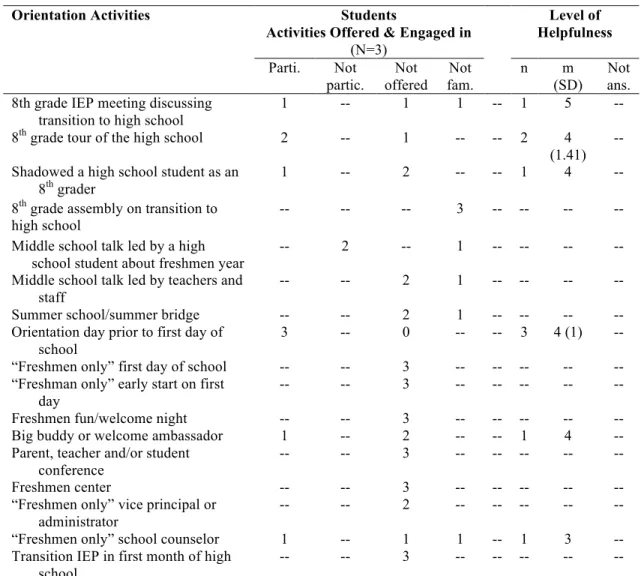
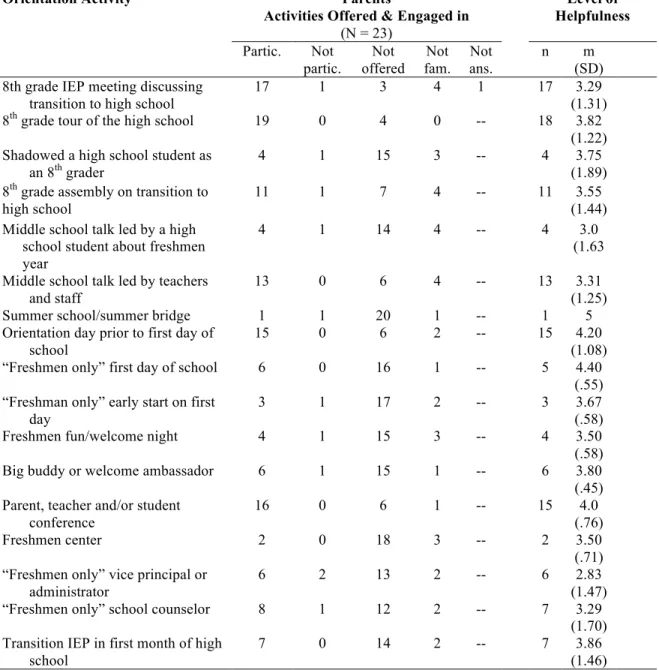
parents about orientation activities and people who helped during the student’s transition into high school. The first question asked which of 17 orientation activities identified in the literature (See Table 7) the student participated in during their transition into high school. Raters could select one of four categories (i.e., participated in something like this; did not participate in something like this, but it was offered; did not participate, and was not offered; not familiar with this activity) with a fifth option added for participants who did not want to answer. The second question asked participants how helpful each of the 17 orientation activities was in the student’s transition to high school. Each item was scored on a 5-point Likert-type response scale ranging from one (not helpful at all) to five (very helpful) with a sixth option to not answer. The third question asked
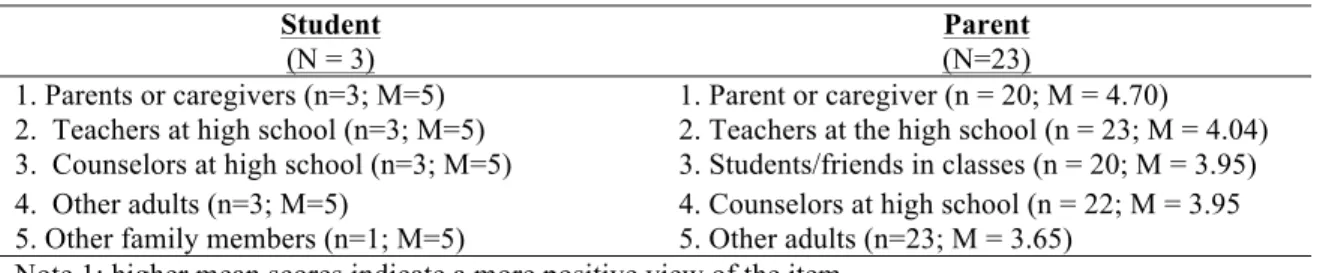
participants to rate how helpful ten types of people (e.g., parent or caregiver, sibling, students/friends in classes, staff, etc.) were during the transition to high school (see Table 9 for the complete list). On the parent form, each item was scored on a 5-point Likert response scale ranging from one (not helpful at all) to five (very helpful), with the additional options to state: “I do not know,” “not applicable to my child, skip.” On the student form, each item was rated on the same 5-point Likert-type response scale with the additional options of “not applicable to me, skip.”
Open-ended questions. The final three questions on the student instrument
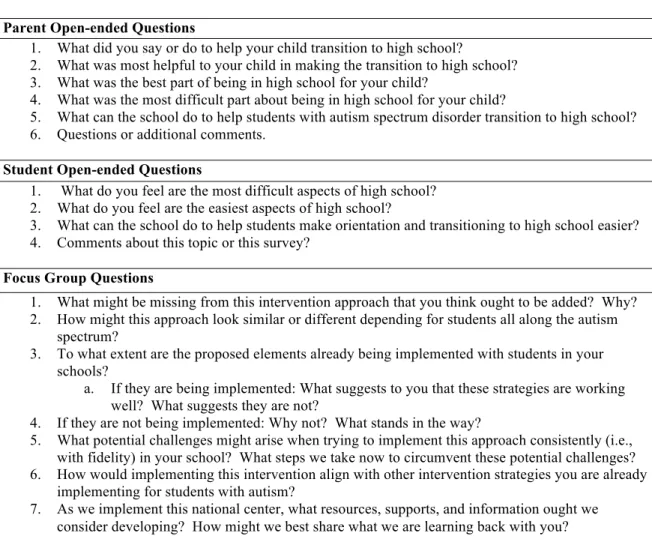
final five questions on the parent instrument included five open-ended questions asking about their perspectives of their child’s transition to high school. These included: (1) What did you say or do to help your child transition to high school? (2) What was the most helpful to your child in making the transition to high school? (3) What was/is the best part of being in high school for your child? (4) What was/is the most difficult part about being in high school for your child? (5) What can schools do to help students with ASD transition to high school? Both students and parent surveys had a final open text box for additional comments about this topic or the survey. These responses were aggregated and included in the qualitative analysis of the focus group data; analyses will be described in a sequential section.
Survey procedures and data collection. The survey instrument used in this study was administered online using web-based Qualtrics survey software (Qualtrics, Provo, UT, 2013). Both student and parent forms were field-tested using expert review by a graduate student in the School of Public Health at the University of North Carolina, focusing on survey methodology. Usability testing occurred by parents with (n =1) and without (n = 5) children with ASD, and high school students without disabilities (n = 1), and one adult with Asperger’s syndrome (29 year-old female). Survey flow and language of questions and directions were modified based on these recommendations. Response time was monitored for the purposes of guiding Institutional Review Board (IRB) and estimations of participant time commitments for recruitment efforts.
Local school district. Recruitment followed both university and school district
information returned without a link to parent permission forms (e.g., not linked using three-digit number) would have been excluded from analysis. Survey participants who completed the survey and provided an email address were entered in a drawing for one of four $25.00 amazon.com gift cards (2 parents, 2 students).
Online population. Recruitment followed university IRB procedures as
previously described. Parents and individuals who followed the link were screened for eligibility. Parents were invited to consent and provide parent permission for children who were minors. An email trigger went out to the parent or child with a recruitment letter inviting the child to participate; children were then able to follow a link to the assenting process if interested. Individuals with ASD 18-years and older, who were currently or retrospectively enrolled in high school between 2008-2013 were invited to consent and were able to begin the survey. Minors between the ages of 14 and 17 years, were screened out of the survey and invited to provide a parent email address to trigger an email to parents requesting their permission. Parents who followed the link and provided permission triggered an email to the parent or child with the link to the student assent form and student survey. Survey participants who completed the survey and provided an email address were entered in a drawing for one of four $25.00 amazon.com gift cards (2 parents, 2 students).
Data analysis Due to the small sample size from the school district (n = 2 for parents; n = 1 for students), both the school district and online data sets were aggregated for a singular analysis. Additionally inferential statistics were not computed to answer research questions one and three after post-hoc analysis determined student sample size to be too small for within group and between group analyses. All analyses were
variance. For each item and totaled subscale, the mean and standard deviation are reported.
Research Question One. Mean (M) and standard deviation (SD) were computed across the PTS-S (4-Likert, academic 11 items; social 12 items, organization 5 items), and PSSM (5-Likert, 18 items). Items across academic, social, and organization subscales were rank ordered and the three most positive and negative features were reported.
Research question two. Mean and SD were reported across the PTS-P (academic 11 items; social 12 items, organization 5 items). Data was screened for normality and homogeneity of variance using Shapiro-Wilks procedure (Royston, 1982) and the Levene’s Test (Lim, Loh, 1996). An Omnibus F-test was performed using one-way ANOVA to determine if there was at least one significant difference between these three conditions (academic, social, and organization) assuming equivalent variance with alpha levels were set at .05.
Research question three. Mean and SD were reported across all 28 items of the PTS-S and PTS-P forms. Descriptive statistics were used to compare the number of positive and negative aspects reported between student and parent groups. Mean scores across PTS subscales were compared. Finally, similarities between the three most positive and negative features of high school according to parent and student responses on the PTS were compared.
Research question four. Computing and comparing the M, SD were used to
analyze orientation activities and helpers during the transition to high school. Items were ranked to determine the three most helpful and least helpful activities and personnel.
Focus Group Study
included individuals with ASD (n = 5), and the other included parents of children with ASD (n = 7). The third focus group took place in an urban community within 60 miles of the first community, with a population of 274,000. This focus group included parents (n = 3). Eligibility for individuals with ASD included the following: (a) had to have a diagnosis of an autism spectrum disorder, (b) be 15 years old or older, and (c) want to discuss their current or retrospective experiences in high school. Eligibility for parents included the following: (a) have a child with ASD who is currently in high school or a young adult, and (b) want to discuss their child’s current or retrospective experiences in high school.
Focus group procedures and data collection. Potential participants who responded to recruitment efforts (e.g., flyers) and called project staff were screened for eligibility. Eligible participants were scheduled for a focus group time. Upon arrival, participants signed a consent/assent form and completed a demographic questionnaire while waiting for the focus group to begin. All focus group facilitators were university-based personnel with a graduate degree and had extensive experience working with individuals with ASD. Facilitators were trained from an expert in conducting focus groups to ensure consistency across the seven focus groups. Each group used a similar presentation, materials, and scripts, with minor variations between parent and student groups. See Table 2 for the seven questions embedded in the script. Each focus group lasted 90-minutes). Facilitators took notes in front of the group to document themes and facilitate a member check to gain informal feedback on how facilitators interpreted participants’ viewpoints (Schwartz-Shea, 2006). An additional note taker, as well as video and audio recordings were used to record the data. All transcripts were transcribed using Microsoft Office, and all transcripts were coded using NVivo Software (QSQ International, 2012).
using the same focus group, coded the data for this particular research question and study. See Table 3 for all open-ended questions and focus group questions used to guide the participant’s reflections. Data from focus groups were aggregated with the open-ended answers from the survey to form the data set. A team-based process of coding,
categorizing, and theme development was used to analyze the data set. Coders were familiar with the transcripts, as both had participated in administering, transcribing and reading through the manuscripts prior to coding. The following research question was asked, having gone through the transition to secondary school, what recommendations do students and their parents have to aid in the successful transition of future students? First, transcripts were randomly divided in half and coded gradually as coding scheme
Chapter IV Results Recruitment
Survey populations. School district personnel distributed sixty-one recruitment letters to families of students with ASD participating in general education or OCS programs to collect data from the school population. In community one, the survey was open April 17th, 2013 through May 10th, 2013. Nineteen recruitment letters were sent to parents and students, with a response rate of zero. In community two, the survey was open April 29th, 2013 through May 16, 2013. Forty-two recruitment letters yielded a response rate of 5% (n= 2) for parents, and 2% (n =1) for students.
Focus group and open-ended questions. For the qualitative analysis,
information provided from two parent focus groups (n =3, n=7), one adolescent/young adult focus group (n=5), and open-ended answers from the school district survey (parents n = 2; students, n = 1) were analyzed. The perceptions from a total sample of twelve parents and six adolescents/young adults were included for analysis.
Survey Results
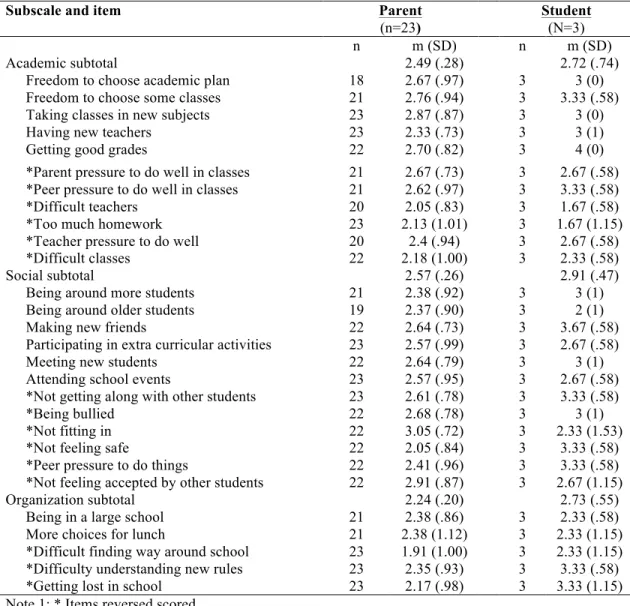
Student perceptions of transition to high school. Two current high school students (grades 10 to 11) and one student that graduated in 2011 answered 28 items on the positive and negative aspects of high school for three domains - academic, social, and organizational components. Due to a small sample size, inferential statistics were not calculated. Descriptive statistics for each subscale and each item for the PTS-S are presented in Table 4. The results of rank order mean scores were contrary to the hypothesis. Students rated items on the social subscale (2.91) slightly higher than the organization (2.73) and academic (2.72) subscales. Furthermore, they reported moderately high levels of feeling a sense of belonging within the school community (ranging 3.38 - 4.72), where a rating of “1” indicates having a poor sense of belonging and “5” indicates a strong sense of belonging (Goodenow, 1993).
assumptions had not been violated (p = value - .60). One-way analysis of means was performed assuming equivalent variance based on these tests of assumptions. The results of the one-way ANOVA found no statistical significant between subscales [F (2, 25) = 2.88, p-value = .08]. No statistical difference was reported between means, and no additional analysis was necessary.
Although no statistical difference was identified between parent perceptions of the three subscales, parent scores indicated slightly higher mean scores on the social (2.57) subscale, in comparison to the academic (2.4) and organization (2.24) domains. These results were not as predicted. Parents viewed more aspects as negative than positive. The descriptive statistics for each subscale and each item on the PTS-P are presented in Table 4.
Comparison of student to parent perceptions. Due to a low student sample size, inferential statistics were not performed to assess the statistical difference between student and parent perceptions of their high school experiences using the P and PTS-S. The following descriptive findings should be interpreted with caution. Parents
reported more individual aspects negatively (20 items) in comparison to the student sample. Students reported seven mean scores lower than the parent sample. Students and parents reported one mean score equally (i.e. parent pressure to do well in classes). Parents reported slightly more negative perspectives on the academic, social, and organizational subscales (2.49, 2.57, 2.24 respectively) in comparison to students (2.72, 2.91, and 2.73; see Figure 1).
identified being around older students, being in a large school, and more choices for lunch as the most negative features of high school. Whereas parents identified taking classes in new subjects, freedom to choose some classes, and getting good grades as the most positive features; and difficulty finding their way around school, difficult teachers, and not feeling safe as the most negative features. Consistent with predictions, parents indicated the organizational domain as more negative in comparison to the student sample. Contrary to predictions, students indicated organizational aspects of high school as slightly more positive than academic aspects.
Transitional supports: activities and helpers. Students reported participating in six types of orientation activities around their transition into high school. All three
students participated in an orientation day prior to the first day of school and found the activity to be helpful (m = 4; sd = 1). Two students reported participation in an eighth grade tour and indicated on average the tour to be helpful (m = 4; sd = 1.41). One student reported participating in his or her eighth-grade transition meeting to be very helpful. One student found shadowing a high school student during their eighth grade year to be helpful and one student found having a big buddy during their ninth grade year to be helpful. Descriptive statistics for each level of participation and level of helpfulness are presented in Table 7.
Parents reported their students participated in all 17 types of orientation activities between their eighth and ninth grade year. The five most frequently reported orientation activities by parents and their respective ranking included: (a) eighth grade tour of the high school (m = 3.82), (b) 8th grade transition IEP meeting (m = 3.29), (c) parent, teacher, student conference (m = 4.0), (d) orientation day (m = 4.2), (e) talk at middle school led by teachers and staff of the middle school (m = 3.31). Descriptive statistics for each level of participation and level of helpfulness are presented in Table 8.
(e.g., parents, teachers, counselors, and other adults) but also indicated siblings, other family members, and students as helpful. Parents rated themselves and teachers as the most helpful during the transition. Additionally, counselors and students were rated highly. In summary, parents rated people supports higher than orientation activities as predicted. However, contrary to predictions, students rated people supports higher than activities, as well. Tables 10 and 11 present ratings of what orientation/transition activities were most helpful during the transition and who rated them as helpful.
Focus Group and Open-ended Results
In response to the research question “What recommendations do students with ASD, as well as their parents, have to aid in the successful transition for future students?” data analysis identified slightly more negative than positive aspects of high school
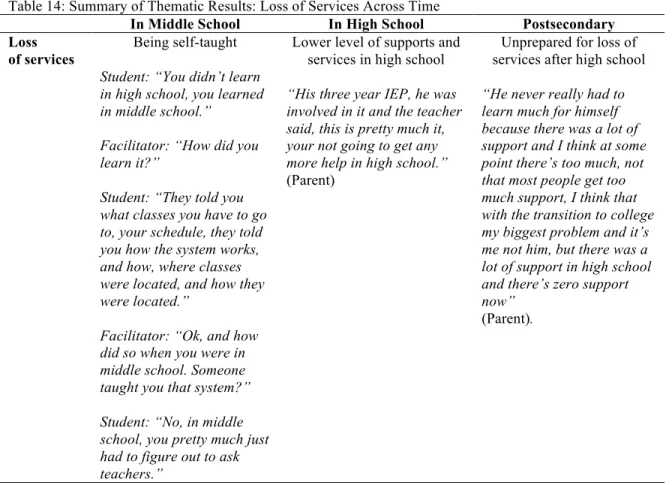
experienced by these youth. Issues emerged around social aspects of high school being generally more positive for students, and academics, social, and organizational elements as being more intertwined and negative than parent perspectives. The supports most frequently identified around orientation were informal, and school or teacher initiated. Desire for more services was overshadowed by parent concerns to prepare their students for the loss of services experienced and expected in secondary settings and beyond. Reflections on orientation activities that worked and recommendation for future students were recorded.
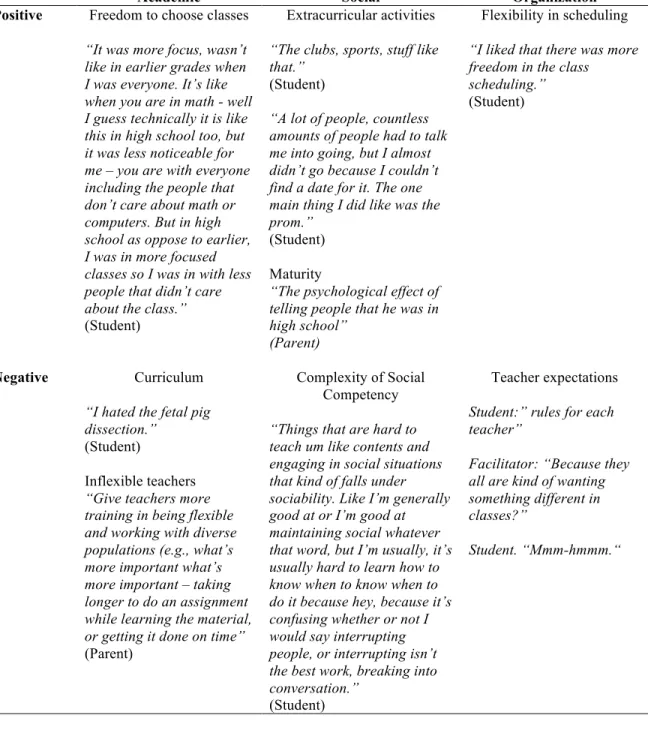
Positive and negative aspects of high school. Consistent with information gleaned from the literature and survey, students and their parents identified both positive and negative aspects of high school around academic, social, and organizational domains. In alignment with the data from the survey, student voices spoke positively around
of high school is/was for their child, one parent expressed “the changing of classes and having to go from floor to floor and wing of school to another. Having seven different teachers each year to get used to and have them get used to him” (Parent). See Table 12 for a summary of thematic results of positive and negative aspects of high school across these domains.
Orientation experiences. Consistent with the survey results on orientation activities and helpers, experiences varied widely across participants. Orientation activities and other transition into high school supports were both formal and informal. Formal orientation activities were school-wide or population specific programming, and were initiated by school, staff, and parents. Formal activities included general education and/or special education orientation programs, school-wide tours; peer buddy/welcome ambassadors; and parent, teacher, student conferences. Informal orientations were not implemented for everyone, afforded more flexibility, and were initiated by different stakeholders (i.e., by student, or parent, or school). For schools, informal orientation programs revolved around walking students through classes and meeting their new
teachers. Parents frequently reported priming their students at home, “we talked at length about his schedule. He practiced opening a combination. We organized his notebook in color order of his schedule.” Whereas students reiterated the notion of needing to be autonomous, and to learn on their own. See Table 13 for a summary of thematic results of orientation activities and transitional supports.
challenges around negotiating their desire to request the necessary supports for their child, but also preparing their child for life after high school by not requesting those same accommodations as preparation. See table 14 for a summary of thematic results of services lost over time.
Recommendations for orientation. Students and parents offered different directions for ways to help future students with ASD orient themselves to high school. Students favored individual support, but were divided if that support should come from a peer or an adult. Some students were distrusting of peers, as one student said, “I didn’t trust the kids” when describing other students. One student recalled the ease of learning back when he had individual support “I had someone there by my side all through elementary and middle school.” Students were also receptive to orientation videos and tours of the school that was catered to them as long as it was not framed as an activity for students who are different. For example, one student shared “my only problem
somewhat would be, sometimes being identified as different is bad. So that depending on how you frame the tour could be - if I, I don’t know, the tour of the kids that rides the special bus would not necessarily be it.”
While students primarily focused on supports for themselves or other students, parents focused on changing school-wide systems. These systems included providing more staff training, orienting schools to autism, and increasing support from peers. Lack of autism awareness was seen as a major barrier needing to be addressed before any changes would sustain. One parent stated:
what that is, I just think you have to have that before any of the other stuff. You can put it into place but if they don’t get it in their head, it’s just not going to work.