A S S O C I A T I O N S T U D I E S A R T I C L E
Testing the role of predicted gene knockouts in human
anthropometric trait variation
Samuel Lessard
1,2
, Alisa K. Manning
3,4,5
, Cécile Low-Kam
1,2
, Paul L. Auer
7
,
Ayush Giri
8
, Mariaelisa Graff
10
, Claudia Schurmann
11,12
, Hanieh Yaghootkar
13
,
Jian
’
an Luan
14
, Tonu Esko
3,15,16
, Tugce Karaderi
17
, NHLBI GO Exome Sequence
Project
†
, GOT2D
†
, T2D-GENES
†
, GIANT Consortium
†
, Erwin P. Bottinger
11
,
Yingchang Lu
11
, Chris Carlson
18
, Mark Caul
fi
eld
19,20
, Marie-Pierre Dubé
1,2
,
Rebecca D. Jackson
21
, Charles Kooperberg
18
, Barbara McKnight
22
, Ian
Mongrain
1
, Ulrike Peters
18
, Alex P. Reiner
18
, David Rhainds
1
, Nona
Sotoodehnia
23
, Joel N. Hirschhorn
3,6,16
, Robert A. Scott
14
, Patricia B. Munroe
19,20
,
Timothy M. Frayling
13
, Ruth J.F. Loos
11,12
, Kari E. North
10
, Todd L. Edwards
8,9
,
Jean-Claude Tardif
1,2
, Cecilia M. Lindgren
3,17,24
and Guillaume Lettre
1,2*
1
Montreal Heart Institute, Montréal, Québec H1T 1C8, Canada,
2Faculté de Médecine, Université de Montréal,
Montréal, Québec H3T 1J4, Canada,
3Medical and Population Genetics Program, Broad Institute, Cambridge, MA
02142, USA,
4Center for Human Genetics Research, Massachusetts General Hospital, Boston, MA 02114, USA,
5Department of Medicine and,
6Department of Genetics, Harvard Medical School, Boston, MA 02115, USA,
7School
of Public Health, University of Wisconsin-Milwaukee, Milwaukee, WI 53201-0413, USA,
8Division of Epidemiology,
Institute for Medicine and Public Health and,
9Department of Medicine, Vanderbilt Genetics Institute, Vanderbilt
University Medical Center, Nashville, TN 37203, USA,
10University of North Carolina Gillings School of Global
Public Health, Chapel Hill, NC 27599, USA,
11The Charles Bronfman Institute for Personalized Medicine and,
12The
Mindich Child Health and Development Institute, the Genetics of Obesity and Related Metabolic Traits Program,
The Icahn School of Medicine at Mount Sinai, New York, NY 10029, USA,
13Genetics of Complex Traits, University
of Exeter Medical School, University of Exeter, Exeter EX2 5DW, UK,
14Medical Research Council Epidemiology
Unit, University of Cambridge, Cambridge CB2 0QQ, UK,
15Estonian Genome Center, University of Tartu, Tartu,
Estonia,
16Division of Endocrinology, Genetics and Basic and Translational Obesity Research, Children
’
s Hospital
Boston, Boston, MA 02115, USA,
17Wellcome Trust Centre for Human Genetics, University of Oxford, Oxford OX3
7BN, UK,
18Division of Public Health Sciences, Fred Hutchinson Cancer Research Center, Seattle, WA 98109-1024,
USA,
19Clinical Pharmacology, William Harvey Research Institute and,
20NIHR Barts Cardiovascular Biomedical
Research Unit, Barts and The London School of Medicine and Dentistry, Queen Mary University of London,
London EC1M 6BQ, UK,
21Division of Endocrinology, Diabetes and Metabolism, Ohio State University, Columbus,
OH 43210, USA,
22Department of Biostatistics, University of Washington, Seattle, WA 98195, USA,
23Division of
†A full list of members and affiliations appears in the Supplementary Text. Received:October 14, 2015.Revised:February 2, 2016.Accepted:February 15, 2016
© The Author 2016. Published by Oxford University Press.
This is an Open Access article distributed under the terms of the Creative Commons Attribution License (http://creativecommons.org/licenses/by/4.0/), which permits unrestricted reuse, distribution, and reproduction in any medium, provided the original work is properly cited.
doi: 10.1093/hmg/ddw055
Advance Access Publication Date: 21 February 2016 Association Studies Article
Human Molecular Genetics, 2016, Vol. 25, No. 10 2082–2092
Cardiology, Cardiovascular Health Research Unit, University of Washington, Seattle, WA 98195-6422, USA and
24The
Big Data Institute, University of Oxford, Oxford, UK
*To whom correspondence should be addressed at: Montreal Heart Institute, 5000 Bélanger Street, Montréal, Québec H1T 1C8, Canada. Email: guillaume. [email protected]
Abstract
Although the role of complete gene inactivation by two loss-of-function mutations inherited intransis well-established in recessive Mendelian diseases, we have not yet explored how such gene knockouts (KOs) could influence complex human phenotypes. Here, we developed a statistical framework to test the association between gene KOs and quantitative human traits. Our method isflexible, publicly available, and compatible with common genotype formatfiles (e.g. PLINK and vcf ). We characterized gene KOs in 4498 participants from the NHLBI Exome Sequence Project (ESP) sequenced at high coverage (>100×), 1976 French Canadians from the Montreal Heart Institute Biobank sequenced at low coverage (5.7×), and >100 000 participants from the Genetic Investigation of ANthropometric Traits (GIANT) Consortium genotyped on an exome array. We tested associations between gene KOs and three anthropometric traits: body mass index (BMI), height and BMI-adjusted waist-to-hip ratio (WHR). Despite our large sample size and multiple datasets available, we could not detect robust associations between specific gene KOs and quantitative anthropometric traits. Our results highlight several limitations and challenges for future gene KO studies in humans, in particular when there is no prior knowledge on the phenotypes that might be affected by the tested gene KOs. They also suggest that gene KOs identified with current DNA sequencing methodologies probably do not strongly influence normal variation in BMI, height, and WHR in the general human population.
Introduction
The identification of complete loss-of-function (LoF) alleles (i.e. genetic null or amorphic alleles) is a powerful strategy to charac-terize gene functions through random (e.g. chemical mutagenesis) or targeted [e.g. knockout (KO) methodology in the mouse, RNAi] genetic experiments. In contrast to model organisms, humans are not amenable to such genetic manipulations. Yet, there is tre-mendous biomedical interest in understanding how the complete disruption of both copies of a gene may impact human biology (1). Our complex physiology, interactions with our environment, and gene redundancy within our genome are only few of the reasons highlighting the importance of describing the phenotypic conse-quences of gene inactivation in humans. From a drug develop-ment perspective, the identification of humans with gene KOs also offers naturally occurring genetic experiments to assess the potential pleiotropic effects of candidate target genes (2).
Mendelian diseases, such as sickle cell anemia [MIM 603903] and cysticfibrosis [MIM 219700], offer an entry point into the study of gene functions in humans. Indeed, the study of these conditions continues to yield important insights into human biology in health and disease (3). But only a limited number of genes have been implicated in Mendelian diseases: as of October 13, 2015, there were 4651 genes in the Online Mendelian Inherit-ance in Man (OMIM) database with phenotype-causing muta-tions. Furthermore, these mutations are often rare such that it is difficult to assemble sufficiently large cohorts of patients to study their pleiotropic effects. Gene KOs can have strong pheno-typic effects on anthropometric traits in the context of Mendelian disorders or syndromes, as evident by mutations causing early-onset morbid obesity (PCSK1,LEPR) or dwarfism (GH1 GHR, ATR) (4–6). These mutations are rare (often private) and unlikely to be involved in anthropometric trait variation in the general popu-lation. However, the possibility that gene KOs of more subtle ef-fect might influence normal variation in anthropometric traits remains to be investigated.
Large-scale whole-exome and -genome sequencing projects are beginning to systematically catalogue coding genetic
variation in the human genome, including predicted LoF variants (7–11). On average, there are∼100–200 LoF variants per individ-ual, resulting in∼20 genes that are inactivated through homozy-gosity or compound heterozyhomozy-gosity (12). These numbers include mostly common variants, which are more likely to be phenotyp-ically neutral given the effect of purifying selection (13). Limiting to variants with a minor allele frequency (MAF) <0.5%, the 1000 Genomes Project estimated that there are 10–20 LoF variants per individual (8). LoF variants are usually defined as variants that truncate protein sequences [nonsense and frameshift inser-tion-deletion (indel)] or that abrogate splice sites or stop codons (stop-loss) (12). Using this definition of LoF variant, and limiting their analyses to variants with a MAF < 2%, Sulemet al. found that∼8% of 104 220 Icelanders carry at least one complete gene KO, and that most gene KOs are seen in <5 individuals (14).
Results
Number and distribution of predicted gene KOs in ESP
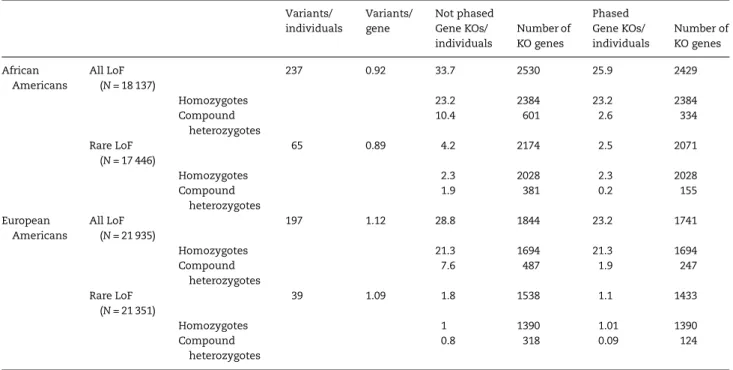
We identified 18 137 and 21 935 LoF variants in 1726 African Americans and 2772 European Americans from ESP, respective-ly (Table1and Supplementary Material, Table S1). These LoF variants included protein truncating (nonsense, frameshift indel), stop-loss and splice site variants. On average, we found 65 and 39 rare or low-frequency LoF variants (MAF < 5%) per African-American and European-American ESP participant, respectively (Table1). These numbers are higher than some of the previous estimates (12,16,18), mostly because we in-cluded frameshift indels in our analyses. When excluding frameshift indels, we found on average 26 and 16 LoF variants with MAF < 5% per ESP African American and European Ameri-can, respectively. Descriptive statistics on the number of LoF variants in ESP after excluding frameshift indels are available in Supplementary Material, Table S2. We screened the ESP data-set for individuals who are homozygous or compound hetero-zygous for LoF variants, and are therefore predicted KOs for a given gene. To detect compound heterozygosity, we used phased genotype information generated with the software Bea-gle to distinguish between LoF variants inherited incisortrans
(Table1) (19). The identification of LoF variants depends on the gene annotation used. To address this concern, we re-analyzed the ESP WES data using the GENCODE basic transcripts annota-tion instead of RefSeq, and only considered variants that fell within all transcripts for a given gene. We obtained very similar association results between the two annotation software (Supplementary Material, Fig. S1). We present below results generated with the RefSeq annotation.
Common LoF variants are responsible for most predicted gene KOs (Fig.1, and Supplementary Material, Fig. S2 for distributions without frameshift indels). For instance, in ESP African Amer-icans, we found on average 25.9 and 2.5 predicted gene KOs per individual when analyzing all or rare/low-frequency LoF var-iants, respectively (Table1). The corresponding numbers in Euro-pean Americans are 23.2 and 1.1 for all and rare/low-frequency LoF variants (Table1). While this article was under review, the Exome Aggregation Consortium (ExAC) reported an average of 35 homozygous protein-truncating variants per individual. This number is higher than the average number of homozygous LoF variants that we found in ESP (∼21–23/participant, Table1) (20). This difference might simply reflect increased power in ExAC to discover rare mutations owing to its larger sample size (N= 60 706 versusN= 4498 for ESP). Because common LoF are more likely to be phenotypically neutral (13), we focused all subsequent ana-lyses on LoF with MAF < 5% within ethnic group or sub-study. In the ESP dataset, we found 2071 and 1433 genes with both al-leles inactivated by such LoF variants in at least one African American or one European American, respectively (Table 1). The higher number of predicted gene KOs in African Americans has been previously observed and is consistent with increased genetic diversity in African-ancestry populations (12). Overall, very few individuals shared the same gene KOs, most of them being found in only one individual (Fig.1). Homozygosity of LoF variants is responsible for the majority of these KO events as we only found (after taking phase information into account) com-pound heterozygous individuals for∼8% of the genes with at least one gene KO (Table1). Stop-loss variants might not be as detrimental as other categories of LoF variants, but they are im-plicated in <0.9% of all gene KOs identified in ESP.
Table 1.Number and frequency of predicted gene knockouts (KO) in 1727 African Americans and 2772 European Americans from the NHLBI Exome Sequence Project (ESP)
Variants/ individuals
Variants/ gene
Not phased Phased
Gene KOs/ individuals
Number of KO genes
Gene KOs/ individuals
Number of KO genes
African Americans
All LoF (N= 18 137)
237 0.92 33.7 2530 25.9 2429
Homozygotes 23.2 2384 23.2 2384
Compound heterozygotes
10.4 601 2.6 334
Rare LoF (N= 17 446)
65 0.89 4.2 2174 2.5 2071
Homozygotes 2.3 2028 2.3 2028
Compound heterozygotes
1.9 381 0.2 155
European Americans
All LoF (N= 21 935)
197 1.12 28.8 1844 23.2 1741
Homozygotes 21.3 1694 21.3 1694
Compound heterozygotes
7.6 487 1.9 247
Rare LoF (N= 21 351)
39 1.09 1.8 1538 1.1 1433
Homozygotes 1 1390 1.01 1390
Compound heterozygotes
0.8 318 0.09 124
Predicted gene KO associated with anthropometric traits in ESP
We tested our newly developed method (Fig.2) on three an-thropometric traits (BMI, height, and WHR) that are available in a large number of ESP participants. We stratified our analyses by ethnicity and meta-analyzed association results (Fig.3). As-suming that most genes are independent and given the number of genes for which we couldfind at least one predicted knocked out individual, we used the following Bonferroni-corrected sig-nificance threshold to declare significance:α= 2 × 10⁻⁵. No single genes reached this significance threshold for any of the three tested anthropometric traits after meta-analysis (Supplementary Material, Table S3).
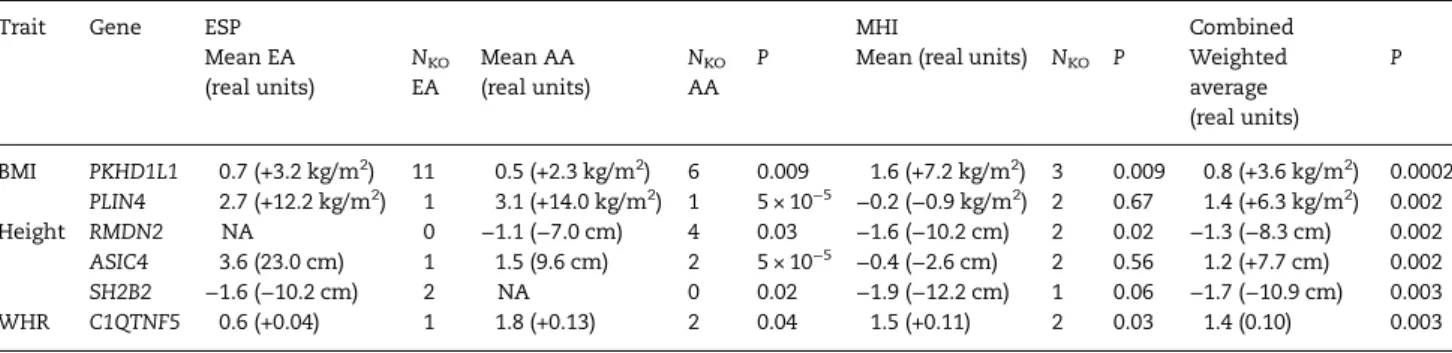
To increase statistical power, we attempted to replicate genes with a nominalP< 0.05 in the ESP dataset using the WGS data from the Montreal Heart Institute (MHI) Biobank (N= 1976). We limited our analysis to genes with at least two KO individuals. Al-though the MHI Biobank dataset results from low-pass WGS, the number of identified LoF variants and gene KOs was similar to the number observed in ESP (Supplementary Material, Table S1), sug-gesting that the data are sufficiently comprehensive to support
these analyses. We found that 30–40% of gene KOs in ESP were also knocked out in the MHI Biobank, highlighting the challenge to replicate such studies in humans. This might particularly be true for gene KOs observed only in ESP African Americans given that the MHI Biobank includes individuals of European ancestry. We combined the ESP and MHI Biobank results but we did not ob-serve any significant associations with quantitative anthropo-metric traits (Supplementary Material, Table S3). We report results with a meta-analysisP< 0.005 in Table2. The most prom-ising gene KO association that we found is betweenPKHD1L1and lower BMI: we found 20 KO individuals for this gene who have on average a BMI that is 0.8 standard deviation (SD) below the popu-lation mean (corresponding to∼−3.6 kg/m2).PKHD1L1may play a role in immunity (21).
While examining the top candidate genes, we noticed that
PKHD1L1is a large gene (78 exons, coding sequence is ∼14 kilobases), raising the possibility that our method could favor longer genes. In the ESP dataset, we found, as expected, that the number of LoF variants in a given gene is strongly correlated with the length of the coding sequence or the number of exons (allP< 1 × 10−67). However, the number of individuals who carry a rare gene KO is not correlated with the length of the coding
sequence or the number of exons of the gene (allP> 0.2), except for a weak correlation observed in ESP African Americans with the length of the coding sequence (Pearson’sr= 0.066,P= 0.003).
To exclude the possibility that gene length may influence our re-sults, we tested correlations with association results from the ESP and MHI Biobank combined analyses. With one exception
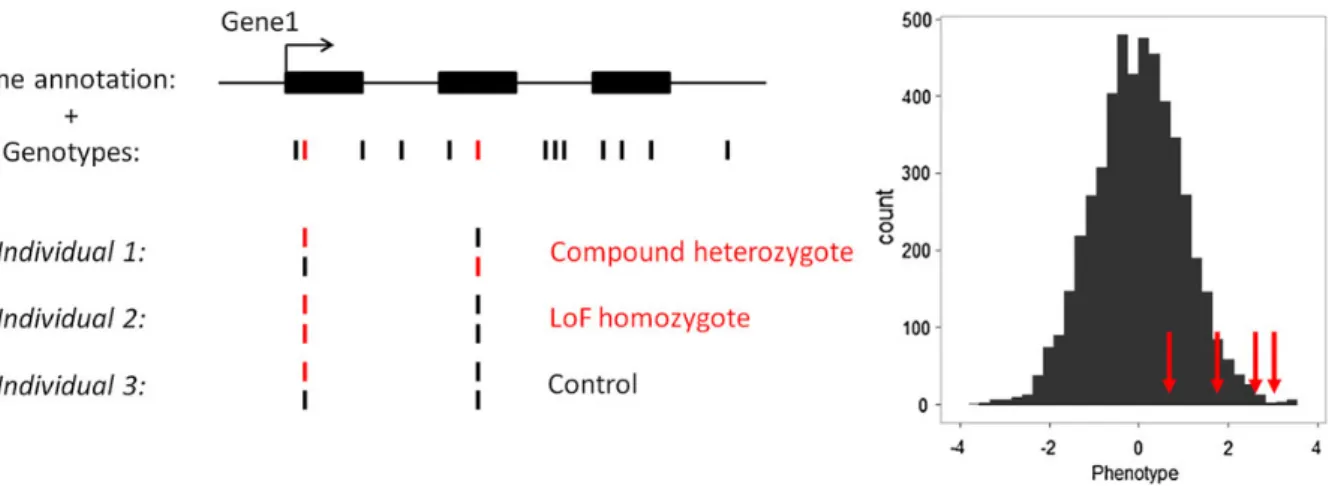
Figure 2.Schematic representation of the method to detect association between gene knockouts (KOs) and human quantitative variation. This example depicts afictive gene with three exons (GENE1) that contains several SNPs. Our analytical framework only considers loss-of-function (LoF) variants (shown in red).GENE1KOs are individuals who are either compound heterozygous of homozygous for LoF variants (individual 1 and 2). The histogram shows the distribution of a normalized human quantitative trait. Our method tests whether individuals that are KOs for a given gene (red arrows) have on average more extreme phenotypes than the rest of the individuals.
(among 12 correlation tests performed), we found no significant correlations between the length of the coding sequence or the number of exons and associationP-values for BMI, height, and WHR (allP> 0.25). In ESP African Americans, there was a weak correlation between the length of the coding sequence and the BMIP-values (Pearson’sr= 0.069,P= 0.002), but it was in the op-posite direction from our expectations (shorter genes have slight-ly more significantP-values). Together, these analyses suggest that our method to test association between gene KOs and human quantitative traits is largely insensitive to gene length.
Gene KO identification and association testing using exome array data
Recognizing that the main limitation of our analysis is sample size, we contacted studies that are involved in the GIANT Consor-tium. Although WES or WGS data are not readily available for most of these studies, they all have genotyped their participants using an exome array that targets 250 000—mostly coding—variants. We reasoned that the large sample size offered by the GIANT Con-sortium could compensate for the limited number of variants pre-sent on the exome array. We recruited 22 studies, totaling >102 000 individuals (BMI and height available for all, WHR available for >62 000 individuals). Each study ran the method locally, stratifying all analyses by ethnicity, and we then combined results using meta-analysis methodology (22). The frequency of KO events was similar in ESP and the GIANT studies. However, there were more singletons (genes with a single KO individual) observed in European-ancestry individuals from the GIANT studies because of the very large sample size (Supplementary Material, Fig. S3).
We present the BMI, height, and WHR meta-analysis results for the GIANT studies in Figure3. As reported above for the WES sequence datasets, and despite a sample size that is >10 times larger, we could not detect significant associations be-tween gene KOs and quantitative anthropometric traits after ac-counting for the number of tests performed (Table 3 and Supplementary Material, Table S4). The most interestingfinding pertains to the association between height and inactivation of
GRHPH: autosomal recessive Mendelian mutations in this gene cause primary hyperoxaluria type 2 [MIM 260000] (23). Primary hyperoxaluria type 1 [MIM 259900], a more severe form of the dis-ease caused by mutations inAGXT, is characterized by very se-vere growth failure (24). However, the connection between primary hyperoxaluria type 2 caused by recessive mutations in
GRHPHand growth in humans has not been as clearly documen-ted, although there is one case report of a child with this disease and short stature (25).
Table 2.Association of gene knockouts (KOs) with anthropometric traits in the Exome Sequence Project (ESP) and Montreal Heart Institute (MHI) Biobank DNA sequencing datasets
Trait Gene ESP MHI Combined
Mean EA (real units)
NKO
EA
Mean AA (real units)
NKO
AA
P Mean (real units) NKO P Weighted
average (real units)
P
BMI PKHD1L1 0.7 (+3.2 kg/m2) 11 0.5 (+2.3 kg/m2) 6 0.009 1.6 (+7.2 kg/m2) 3 0.009 0.8 (+3.6 kg/m2) 0.0002 PLIN4 2.7 (+12.2 kg/m2) 1 3.1 (+14.0 kg/m2) 1 5 × 10⁻⁵ −0.2 (−0.9 kg/m2) 2 0.67 1.4 (+6.3 kg/m2) 0.002
Height RMDN2 NA 0 −1.1 (−7.0 cm) 4 0.03 −1.6 (−10.2 cm) 2 0.02 −1.3 (−8.3 cm) 0.002
ASIC4 3.6 (23.0 cm) 1 1.5 (9.6 cm) 2 5 × 10⁻⁵ −0.4 (−2.6 cm) 2 0.56 1.2 (+7.7 cm) 0.002 SH2B2 −1.6 (−10.2 cm) 2 NA 0 0.02 −1.9 (−12.2 cm) 1 0.06 −1.7 (−10.9 cm) 0.003 WHR C1QTNF5 0.6 (+0.04) 1 1.8 (+0.13) 2 0.04 1.5 (+0.11) 2 0.03 1.4 (0.10) 0.003
We attempted to replicate gene KO associations from the ESP whole-exome DNA sequencing dataset in the MHI Biobank whole-genome DNA sequencing dataset. We tested for replication genes withP< 0.05 and at least two KO individuals in the ESP dataset. We report genes with a combinedP< 0.005. We provide the mean gene KO effect size in standard deviation (SD) and metric units, assuming that 1 SD corresponds to 4.5 kg/m2, 6.4 cm, and 0.07 for BMI, height, and WHR respectively.N
KO: number of individuals that are KO for the given gene.
EA: European-ancestry; AA: African-ancestry.
Table 3.Top association results between anthropometric traits and predicted gene knockouts (KOs) identified using ExomeChip data from 22 studies participating in the GIANT Consortium
Trait Gene NKO Nstudy Weighted
mean (SD)
P
BMI CYP20A1 100 15 −0.35 0.001
ME2 2 2 −1.90 0.002
KIAA1024 7 5 −0.75 0.002
TBC1D5 4 3 1.05 0.003
LRRC39 147 16 0.23 0.003
TAS1R1 191 6 0.15 0.004
LAMA3 9 2 −1.02 0.004
KIAA0391 3 2 −1.64 0.004
TAS2R60 2 2 −2.04 0.005
Height GRHPR 2 2 −2.28 0.0001
ABCB7 365 10 −0.12 0.0003
ZDHHC14 3 2 −2.01 0.0003
ZFPM1 21 3 −0.60 0.0008
DHX57 2 2 −2.04 0.0009
CD8A 2 2 2.35 0.001
CDC42BPA 4 2 1.70 0.001
NSUN4 13 3 −0.78 0.002
ARPC5L 6 2 −1.25 0.002
CCDC125 45 9 0.35 0.002
BOK 27 4 0.61 0.003
NSRP1 9 1 −1.00 0.003
TEX13A 2 1 2.00 0.004
RPGRIP1 10 4 −0.72 0.004
SCGN 6 5 −0.96 0.005
WHR C18orf56 7 1 1.39 0.0002
AARS2 3 2 −1.78 0.001
C18orf34 6 3 1.27 0.002
CCDC68 13 1 0.83 0.002
HRG 3 2 −1.52 0.004
SPTA1 2 2 1.86 0.004
SPTBN5 191 11 0.15 0.005
Prioritizing gene KOs using a candidate-gene approach
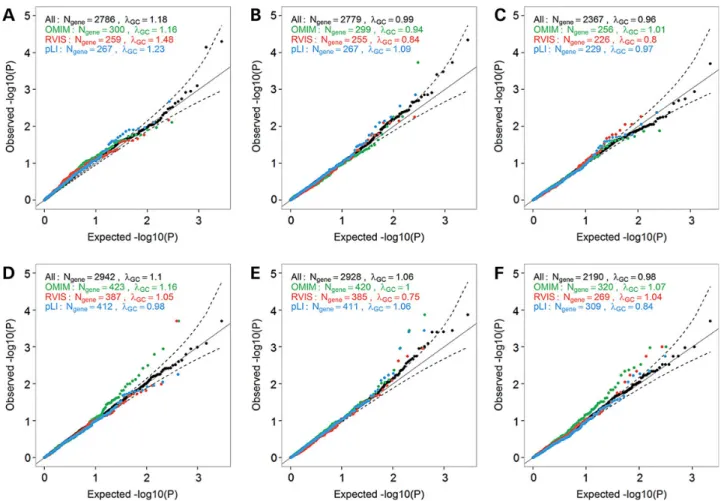
We next asked whether we would increase power to detect associa-tions between gene KO and anthropometric traits by restricting our analyses to strong candidate genes. We focused on subsets of genes that are associated with any phenotypes in OMIM, or genes that are intolerant to LoF mutations based on the Residual Variation Intolerance Score (RVIS) or the probability of being LoF In-tolerant (pLI) score (20,26). We observed several genes that deviate from the null when restricting our analyses to these candidate genes, especially for the OMIM genes in the larger GIANT datasets for BMI and WHR (Fig.4). We also reasoned that the Mouse Genome Informatics (MGI) database might be a good source of candidate genes for our human KO experiment. We retrieved the human homologues of genes from 30 MGI phenotype categories, and tested them against anthropometric traits (Supplementary Mater-ial, Fig. S5). Again, we observed inflation of the KO association re-sults when compared to the null distribution, suggesting that some of these genes might influence anthropometric traits when completely inactivated. The most noticeable result was the distri-bution of test statistics in the GIANT BMI analysis for genes related to taste and olfaction (Supplementary Material, Fig. S5). Genes re-lated to this category were significantly enriched for genes with a BMIP< 0.05 in GIANT (Fisher’s exact test,P= 0.008).
Discussion
We developed a simple statistical method to test the association between predicted gene KOs and human quantitative traits. We tested our method on three quantitative anthropometric traits (BMI, height, and WHR) in large DNA sequencing (ESP and MHI Bio-bank, >6400 individuals) and genotyping (22 participating GIANT studies, >102 000 individuals) datasets. Despite this large sample size, we did not identify significant genetic associations with pre-dicted gene KOs, although the association betweenPKHD1L1and BMI orGRHPHand height are interesting and should be tested for replication. Within the limitations of our study design (sample size, incomplete catalogue of LoF variants), our results suggest that there are no predicted gene KOs with modest-to-large effect size on anthropometric trait variation in the general population. This conclusion is largely consistent with results from a recent study of homozygous LoF variants in 1432 individuals (17).
Importantly, our approach and results can guide future gene KO studies in humans. First, our method assumes that all LoF al-leles for a given gene will shift the phenotypic mean in the same direction. Although it is a sensitive approach in thisfirst large-scale gene KO experiment for quantitative traits, alternative methods could explore effect on phenotypic variance. Second, in order to maximize our sample size, we combined datasets
from different technologies (WES, WGS, exome array). Although we accounted for this technical heterogeneity—gene KO statistics were similar across datasets—this approach could have intro-duced unanticipated biases. Ideally, high coverage WGS data would be available for gene KO studies. Third, haplotype phasing of DNA sequence data from unrelated individuals (ESP and MHI Biobank), and the lack of phase information for the GIANT Exo-meChip studies, has limited our ability to identify compound heterozygous individuals. This could impact our results as nearly 20% of all gene KOs identified in this study were due to compound heterozygosity. We note, however, that excluding compound het-erozygotes from the ESP analyses had very limited impact on our results (Supplementary Material, Fig. S6). Fourth, we only consid-ered nonsense, splice site, stop-loss and frameshift indels as LoF variants to identify gene KOs. Some of these variants are likely neutral: for instance, genes are more tolerant to non-synonym-ous variants at the 3′end of a gene, and nearby variants can res-cue the effect of LoF alleles (12). Furthermore, we excluded missense variants from our analyses, although functional char-acterization can lead to the identification of missense alleles with strong phenotypic effect on human complex phenotypes (27,28).
The main limiting factors of gene KO studies in humans are the sample size and the depth of genetic information available. We have shown that even when the sample size is very large, most gene KOs are identified in single individuals (Supplementary Ma-terial, Fig. S3). To be successful, we will need to develop tools to pri-oritize genes or increase the number of gene KOs. One possibility may be to consider only genes expressed in a tissue that is relevant for the phenotype of interest (e.g. genes expressed in growth plates for height). Another promising solution may be to consider KOs in biological pathways instead of single genes as the testing unit. For instance, a researcher interested in blood lipid genetics could pool together all individuals that carry a gene KO in any of the enzymes or transporters implicated in lipid metabolism. We illustrated this candidate-gene approach by prioritizing OMIM disease-causing genes, genes intolerant to LoF mutations, and genes with relevant mouse KO phenotypes. In particular for the BMI analysis, the en-richment of genes with mouse homologues that disrupt taste or olfaction when inactivated is of interest (Supplementary Material, Fig. S5). Reverse genetic strategies—finding a function to a gene by
first disrupting it—have been very successful in model organisms. Despite early challenges, the large-scale identification of LoF var-iants and characterization of gene KOs promise to also yield inter-esting insights into human biology.
Materials and Methods
Ethics statement
This project was approved by the Ethics Committee of the Montreal Heart Institute (#11-1333, #2013-297, #2013-1438).
NHLBI Exome Sequence Project
We conducted our initial analysis on thefinal whole-exome ESP dataset, which is described elsewhere (9). This dataset was gener-ated from high coverage WES (median depth >100×) (9). All study participants in each of the component studies provided written informed consent for the use of their DNA in studies aimed at identifying genetic risk variants for disease and for broad data sharing. Institutional certification was obtained for each sample to allow deposition of phenotype and genotype data in dbGaP and BAMfiles in the short-read archive. We excluded individuals
based on sex mismatch between clinical database and genotype-inferred sex (N= 13), high homozygosity (N= 1), high genotyping missing rate (>10%) (N= 1), if they appear as population outliers in principal component analyses (N= 30), low concordance to gen-ome-wide association study data (N= 4), or unresolved partici-pant identifiers (N= 4). Moreover, we randomly excluded one member of each pair of duplicates (N= 16), and offirst- and se-cond-degree relatives (N= 108). We also removed individuals with chronic obstructive pulmonary disease or asthma, as these conditions could influence anthropometric traits (N= 688). Finally, we removed participants from the CARDIA (N= 201) and MESA (N= 406) studies, as requested by investigators from these studies. We kept individuals aged between 21 and 80 years old, height between 125 and 240 cm, BMI < 75 kg/m2, and WHR < 1.5. In total, we analyzed anthropometric traits in 1726 African Amer-icans and 2772 European AmerAmer-icans (Supplementary Material, Table S1).
Variant quality-control and annotation
We phased variants in the ESP dataset using Beagle 4.0 and the default parameters (19). We define LoF variants as variants that create or remove stop codons (nonsense and stop-loss) that dis-rupt essential splice sites (two intronic bases at exon-intron boundaries), or that change the reading frame (frameshift indel). We annotated single-base pair variants using in-house custom scripts and build 37.1 of the human genome reference se-quence. We annotated frameshift indels using SeattleSeq (hg19, v.9.03, http://snp.gs.washington.edu/SeattleSeqAnnotation138/). We included in our analyses only frameshift indel variants that fall within validated RefSeq genes (release 69). Afterfiltering out variants with a call rate <95% or a Hardy–WeinbergP< 1 × 10⁻⁶, we retained in our analyses 18 137 and 21 935 LoF variants in African- and European-ancestry individuals, respectively (Supplementary Material, Table S1). For comparison, we also an-notated ESP variants using Ensembl’s Variant Effect Predictor (VEP) module and basic transcripts from GENCODE. We obtained very similar results (Supplementary Material, Fig. S1).
Replication cohorts with WGS or WES data available
We used low-pass WGS data (mean coverage 5.7×) from 2002 French-Canadian participants recruited by the MHI Biobank. Genotypes were imputed and phased using Beagle 4.0 using the default parameters (19). Individuals were removed due to low or high inbreeding coefficient (N= 4). Variants with Hardy– Wein-bergP< 1 × 10⁻⁸were excluded. In total, 1976 MHI Biobank parti-cipants with anthropometric traits available were included in the replication analyses (Supplementary Material, Table S1).
GIANT Consortium ExomeChip datasets
from ENSEMBL’s VEP tool, we found that 17.8% (797/4483) of these splice-site variants disrupt a canonical splice-site, 46.7% (2094/ 4483) are missense variants, and 31.6% (1419/4483) affect a nu-cleotide around the splice-site (1–3 bases within exon or 3–8 bases within intron). Phasing information was not available for the GIANT exome array data. Because we focused on rare var-iants, we assumed that when two rare LoF variants were ob-served in the same gene in the same individual, they were inherited intransto create a compound heterozygous gene KO.
Statistical analyses
We developed aflexible method to determine if the complete in-activation of genes by LoF variants is associated with human quantitative traits (Fig.2). For each gene, our method searches for individuals that are either homozygotes or compound hetero-zygotes for LoF variants; we refer to these individuals as predicted KOs. For X-linked markers that fall outside of the pseudoautoso-mal regions, we consider predicted gene KOs in men if they carry a single LoF variant. For compound heterozygosity, we use phase information to distinguish LoF variants that segregate on the same haplotype (incis) or on different haplotypes (intrans). When phasing information is not available (e.g. GIANT Exome-Chip data), we assume that rare LoF variants segregate on different haplotypes. The method then calculates for each gene the pheno-typic mean in predicted KO individuals. Finally, it computes stat-istical significance using phenotype permutations, as follows:
Pleft¼
Pn
i¼1mim
n ;Pright¼
Pn
i¼1mim
n Pfinal¼2×minimumðPleft;PrightÞ;
whereis the indicator function,mis the observed mean pheno-type in predicted KO individuals,miis theith permuted mean,nis
the number of permutations,PleftandPrightare the left- and right-tailP-values, andPfinalis the reported two-tailedP-value. Using si-mulated null phenotypes and the ESP dataset, we showed that the test is well-calibrated (Supplementary Material, Fig. S4). This method assumes that gene inactivation results in the same phenotypic effect (increase or decrease trait value) in all predicted KO individuals for a given gene. The current implementation of our method also currently assumes that tested individuals are un-related and that the phenotypic distributions are symmetrical. It is compatible with standard genotypefile formats (e.g. PLINK, vcf). The scripts to run our method are publicly available at: http:// www.mhi-humangenetics.org/en/resources.
Association of rare predicted gene KOs with anthropometric traits
We analyzed BMI, adult height and BMI-adjusted WHR. We
strati-fied all our analyses by ethnic group, and we only considered rare or low-frequency LoF variants with MAF < 5%. We used 10 000 per-mutations to assess statistical significance. For genes with an em-piricalP< 2 × 10⁻⁴(i.e. permuted means were never higher (or lower) than the observed mean among 10 000 permutations), we re-ran the analysis using 100 000 permutations: only two genes fell in that category (BRPF1 Pheight= 1.8 × 10⁻⁴;SPZ1 PWHR= 2.2 × 10⁻⁴). For ESP samples, we corrected anthropometric traits for sex, age, ESP phenotype groups, exon capture reagents and the
first three principal components, as recommended by the ESP in-vestigators. We then applied inverse normal transformation on the residuals from the previous correction. For the MHI Biobank, and the GIANT studies, each anthropometric trait was corrected
for sex, age, age-squared and thefirst 10 principal components, and we normalized the resulting residuals using inverse normal transformation. Taking into account the direction of the effect, we combined results across studies using a weightedZ-score meta-analysis method implemented in the software METAL, where the weight is the sample size of the corresponding study (22). To estimate statistical power of our approach, we modeled the effect of a recessive LoF variant on a normally distributed quantitative trait, as previously described (30). This is a simplistic model as we ignore the presence of additional LoF variants in the same gene, which are considered in our method because they can lead to additional individuals that have a predicted gene KO. We assume that the variant has a MAF = 5%, explains 1% of the genetic variance, and used a sample size ofN= 4500 (corresponding to ESP),α= 2 × 10⁻⁵(Bonferroni correction for the number of genes with KOs), and 5000 simulations to perform power calculations. Under this scenario, our gene KO approach would have 95% power to detect the association. Alternatively, testing the associ-ation while assuming that the variant has an additive effect would result in only 3% power. Using the same assumptions, we estimated 64 and 1% power for a variant that explains 0.5% of the variance when tested using our gene KO methodology or a simple additive model, respectively.
Candidate-gene enrichment analyses
We explored whether prioritizing gene KOs into different categor-ies could increase the chance to reveal an association. First, we investigated whether the gene was an OMIM disease-causing gene, as defined elsewhere (26). Next, we considered whether the genes were LoF intolerant by either having a Residual Vari-ation Intolerance Score (RVIS) <15% of the RVIS scores for all genes in the human genome (release 0.3) or a probability of being LoF intolerant ( pLI) score >0.9 (20,26). We looked for enrich-ment by overlapping the QQ-plots of genes belonging to these dif-ferent categories separately on the QQ-plot containing all genes. We also created subsets of genes based on 30 phenotype categor-ies from the Mouse Genome Informatics (MGI) Database (31). We tested the enrichment using Fisher’s exact test.
Supplementary Material
Supplementary Material is available atHMGonline.
Acknowledgements
We thank all participants involved in this project, and Ekat Kriti-kou for comments on the manuscript. P.B.M. and M.C. acknow-ledge that this work forms part of the research program of the NIHR Barts Cardiovascular Biomedical Research Unit. M.C. is a se-nior National Institute for Health Research Investigator. Sequen-cing of the MHI Biobank samples was performed at the McGill University and Génome Québec Innovation Centre.
Conflict of Interest statement. None declared.
Funding
and Génome Québec; the Canada Research Chairs program; and the Montreal Heart Institute Foundation. C.M.L. is supported by Wellcome Trust (grant numbers 086596/Z/08/Z, 086596/Z/08/A); and the Li Ka Shing Foundation. N.S. is funded by National Insti-tutes of Health (grant numbers HL088456, HL111089, HL116747). The Mount Sinai BioMe Biobank Program is supported by the An-drea and Charles Bronfman Philanthropies. GO ESP is supported by NHLBI (RC2 HL-103010 to HeartGO, RC2 HL-102923 to LungGO, RC2 HL-102924 to WHISP). The ESP exome sequencing was performed through NHLBI (RC2 102925 to BroadGO, RC2 HL-102926 to SeattleGO). EGCUT work was supported through the Estonian Genome Center of University of Tartu by the Targeted Financing from the Estonian Ministry of Science and Education (grant number SF0180142s08); the Development Fund of the Uni-versity of Tartu (grant number SP1GVARENG); the European Re-gional Development Fund to the Centre of Excellence in Genomics (EXCEGEN) [grant number 3.2.0304.11-0312]; and through FP7 (grant number 313010). EGCUT were further sup-ported by the US National Institute of Health (grant number R01DK075787). A.K.M. was supported by an American Diabetes Association Mentor-Based Postdoctoral Fellowship (#7-12-MN-02). The BioVU dataset used in the analyses described were ob-tained from Vanderbilt University Medical Centers BioVU which is supported by institutional funding and by the Vanderbilt CTSA grant ULTR000445 from NCATS/NIH. Genome-wide genotyping was funded by NIH grants RC2GM092618 from NIGMS/OD and U01HG004603 from NHGRI/NIGMS. Funding to pay the Open Ac-cess publication charges for this article was provided by a block grant from Research Councils UK to the University of Cambridge.
References
1. Alkuraya, F.S. (2015) Human knockout research: new horizons and opportunities.Trends Genet.,31, 108–115.
2. Kamb, A., Harper, S. and Stefansson, K. (2013) Human genet-ics as a foundation for innovative drug development.Nat. Bio-technol.,31, 975–978.
3. Antonarakis, S.E. and Beckmann, J.S. (2006) Mendelian disor-ders deserve more attention.Nat. Rev. Genet.,7, 277–282. 4. Amselem, S., Duquesnoy, P., Attree, O., Novelli, G., Bousnina,
S., Postel-Vinay, M.C. and Goossens, M. (1989) Laron dwarfism and mutations of the growth hormone-receptor gene.
N. Engl. J. Med.,321, 989–995.
5. Clement, K., Vaisse, C., Lahlou, N., Cabrol, S., Pelloux, V., Cas-suto, D., Gourmelen, M., Dina, C., Chambaz, J., Lacorte, J.M.
et al.(1998) A mutation in the human leptin receptor gene causes obesity and pituitary dysfunction.Nature,392, 398–401. 6. Jackson, R.S., Creemers, J.W., Farooqi, I.S., Raffin-Sanson, M. L., Varro, A., Dockray, G.J., Holst, J.J., Brubaker, P.L., Corvol, P., Polonsky, K.S.et al.(2003) Small-intestinal dysfunction ac-companies the complex endocrinopathy of human propro-tein convertase 1 deficiency.J. Clin. Invest.,112, 1550–1560. 7. 1000 Genomes Project Consortium. (2010) A map of human
genome variation from population-scale sequencing.Nature, 467, 1061–1073.
8. 1000 Genomes Project Consortium. (2012) An integrated map of genetic variation from 1,092 human genomes.Nature,491, 56–65.
9. Fu, W., O’Connor, T.D., Jun, G., Kang, H.M., Abecasis, G., Leal, S.M., Gabriel, S., Rieder, M.J., Altshuler, D., Shendure, J.et al.
(2013) Analysis of 6,515 exomes reveals the recent origin of most human protein-coding variants.Nature,493, 216–220. 10. Tennessen, J.A., Bigham, A.W., O’Connor, T.D., Fu, W., Kenny,
E.E., Gravel, S., McGee, S., Do, R., Liu, X., Jun, G.et al.(2012)
Evolution and functional impact of rare coding variation from deep sequencing of human exomes.Science,337, 64–69. 11. Alsalem, A.B., Halees, A.S., Anazi, S., Alshamekh, S. and Al-kuraya, F.S. (2013) Autozygome sequencing expands the hori-zon of human knockout research and provides novel insights into human phenotypic variation.PLoS Genet.,9, e1004030. 12. MacArthur, D.G., Balasubramanian, S., Frankish, A., Huang, N.,
Morris, J., Walter, K., Jostins, L., Habegger, L., Pickrell, J.K., Montgomery, S.B.et al.(2012) A systematic survey of loss-of-function variants in human protein-coding genes.Science, 335, 823–828.
13. Gorlov, I.P., Gorlova, O.Y., Sunyaev, S.R., Spitz, M.R. and Amos, C.I. (2008) Shifting paradigm of association studies: value of rare single-nucleotide polymorphisms.Am. J. Hum. Genet., 82, 100–112.
14. Sulem, P., Helgason, H., Oddson, A., Stefansson, H., Gudjons-son, S.A., Zink, F., HjartarGudjons-son, E., SigurdsGudjons-son, G.T., Jonasdottir, A., Jonasdottir, A.et al.(2015) Identification of a large set of rare complete human knockouts.Nat. Genet.,47, 448–452. 15. Li, A.H., Morrison, A.C., Kovar, C., Cupples, L.A., Brody, J.A.,
Polfus, L.M., Yu, B., Metcalf, G., Muzny, D., Veeraraghavan, N.et al.(2015) Analysis of loss-of-function variants and 20 risk factor phenotypes in 8,554 individuals identifies loci
in-fluencing chronic disease.Nat. Genet.,47, 640–642.
16. Lim, E.T., Wurtz, P., Havulinna, A.S., Palta, P., Tukiainen, T., Rehnstrom, K., Esko, T., Magi, R., Inouye, M., Lappalainen, T.
et al.(2014) Distribution and medical impact of loss-of-func-tion variants in the Finnish founder populaloss-of-func-tion.PLoS Genet., 10, e1004494.
17. Kaiser, V.B., Svinti, V., Prendergast, J.G., Chau, Y.Y., Campbell, A., Patarcic, I., Barroso, I., Joshi, P.K., Hastie, N.D., Miljkovic, A.
et al.(2015) Homozygous loss-of-function variants in Euro-pean cosmopolitan and isolate populations. Hum. Mol. Genet.,24, 5464–5474.
18. Lim, E.T., Raychaudhuri, S., Sanders, S.J., Stevens, C., Sabo, A., MacArthur, D.G., Neale, B.M., Kirby, A., Ruderfer, D.M., Fro-mer, M.et al.(2013) Rare complete knockouts in humans: population distribution and significant role in autism spec-trum disorders.Neuron,77, 235–242.
19. Browning, S.R. and Browning, B.L. (2007) Rapid and accurate haplotype phasing and missing-data inference for whole-genome association studies by use of localized haplotype clustering.Am. J. Hum. Genet.,81, 1084–1097.
20. Lek, M., Karczewski, K., Minikel, E., Samocha, K., Banks, E., Fennell, T., O’Donnell-Luria, A., Ware, J., Hill, A., Cummings, B.et al.(2015) Analysis of protein-coding genetic variation in 60,706 humans.bioRxiv, doi:org/10.1101/030338.
21. Hogan, M.C., Griffin, M.D., Rossetti, S., Torres, V.E., Ward, C.J. and Harris, P.C. (2003) PKHDL1, a homolog of the autosomal recessive polycystic kidney disease gene, encodes a receptor with inducible T lymphocyte expression.Hum. Mol. Genet.,12, 685–698.
22. Willer, C.J., Li, Y. and Abecasis, G.R. (2010) METAL: fast and
ef-ficient meta-analysis of genomewide association scans. Bio-informatics,26, 2190–2191.
23. Cramer, S.D., Ferree, P.M., Lin, K., Milliner, D.S. and Holmes, R.P. (1999) The gene encoding hydroxypyruvate reductase (GRHPR) is mutated in patients with primary hyperoxaluria type II.Hum. Mol. Genet.,8, 2063–2069.
24. Nissel, R., Latta, K., Gagnadoux, M.F., Kelly, D., Hulton, S., Kemper, M.J., Ruder, H., Soderdahl, G., Otte, J.B., Cochat, P.
et al.(2006) Body growth after combined liver-kidney trans-plantation in children with primary hyperoxaluria type 1.
25. Dent, C.E. and Stamp, T.C. (1970) Treatment of primary hyper-oxaluria.Arch. Dis. Child.,45, 735–745.
26. Petrovski, S., Wang, Q., Heinzen, E.L., Allen, A.S. and Gold-stein, D.B. (2013) Genic intolerance to functional variation and the interpretation of personal genomes.PLoS Genet.,9, e1003709.
27. Majithia, A.R., Flannick, J., Shahinian, P., Guo, M., Bray, M.A., Fontanillas, P., Gabriel, S.B., Go, T.D.C., Project, N.J.F.A.S., Con-sortium, S.T.D.et al.(2014) Rare variants in PPARG with de-creased activity in adipocyte differentiation are associated with increased risk of type 2 diabetes.Proc. Natl Acad. Sci. USA,111, 13127–13132.
28. Thormaehlen, A.S., Schuberth, C., Won, H.H., Blattmann, P., Joggerst-Thomalla, B., Theiss, S., Asselta, R., Duga, S., Merlini,
P.A., Ardissino, D.et al.(2015) Systematic cell-based pheno-typing of missense alleles empowers rare variant association studies: a case for LDLR and myocardial infarction.PLoS Genet.,11, e1004855.
29. Liu, X., Jian, X. and Boerwinkle, E. (2013) dbNSFP v2.0: a data-base of human non-synonymous SNVs and their functional predictions and annotations.Hum. Mutat.,34, E2393–E2402. 30. Lettre, G., Lange, C. and Hirschhorn, J.N. (2007) Genetic model
testing and statistical power in population-based association studies of quantitative traits.Genet. Epidemiol.,31, 358–362. 31. Eppig, J.T., Blake, J.A., Bult, C.J., Kadin, J.A. and Richardson, J.E.