THE BLACK IMAGE IN THE WHITE MIND: EDUCATIONAL CONSEQUENCES OF MEDIA RACISM
Sheldon A. Lanier
A dissertation submitted to the faculty at the University of North Carolina at Chapel Hill in partial fulfillment of the requirements for the degree of Doctor of Education in the School of
Education.
Chapel Hill 2017
Approved by: Kathleen Brown
ABSTRACT
Sheldon A. Lanier: The Black Image in the White Mind: Educational Consequences of Media Racism
(Under the direction of Kathleen Brown)
In the United States of America, Black male students often face a cultural disconnect when entering classrooms today. As a result, outcomes for these students, including academic ones, are both alarming and reprehensible. It is conceivable that a link exists between the exposure to negative racial portrayals of Black males in the media, teachers’ perceptions of their Black male students, and the negative treatments of Black males that result. These perceptions are important when examining how they can affect school policies and practices institutionally. Given the multitude of structures that help shape the negative outcomes of Black males in this country, mixed methods on both quantitative and qualitative inquiry were used to explore and examine the following questions: 1) How are Black males portrayed in the HBO original series, The Wire? 2) Do these portrayals reify (or, not) stereotypes of Black males in the United States?
3) How might these portrayals cultivate White female teachers’ perceptions and subsequent treatment of Black male students?
The Wire was used as the media content sample due to the vast amount of Black male
gender and race-based stereotypes about people of color, specifically Black males (Adams-Bass, Stevenson, & Kotzin, 2014; Bilandzic, 2006; Dutro & Kantor, 2011; Hetsroni, 2012; Jamison & Romer, 2014; Monk-Turner et al., 2010; Oliver, 2003; Parrott & Parrott, 2015; Potter, 2014; Torres, 2015).
The research of Mastro and Greenberg (2010), Monk-Turner, et al. (2010), Khanna and Harris (2015), and Parrott and Parrott (2015) established a framework necessary for conducting a media content analysis. The results of this study indicate that historical racial
stereotypes/caricatures of African American males were consistently portrayed throughout the entire series. The results also indicate that students exhibiting similar characteristics as characters in the series would likely influence perceptions (negatively) of teachers, ultimately affecting school policies and practices institutionally. Negative teacher perceptions could, and often do, lead to a lack of academic growth and achievement, a disproportionate amount of referrals for discipline and special education, the absence of teacher-student relationships, and an overall detrimental impact on the schooling experience of Black males. This study adds to the body of research on negative racial media portrayals of African American males in the United States and concludes by urging educational leaders to provide necessary professional learning to equip teachers to recognize their biases, how they impact the achievement of Black male
ACKNOWLEDGEMENTS
First and foremost, I would like to thank God for bringing me through this amazing journey. You are my light in a sea of darkness and through You I can do all things. Thank you for blessing me and continuing to bless every aspect of my life. I look forward to what You have in store for me now that this chapter is complete. I would like to thank my chair, Dr. Kathleen Brown, for your endless love, guidance, encouragement, and support. You never gave up on me and continued to push me even when I wanted to quit. I never would have made it to the finish line had it not been for your consistent motivation. Thank you for being my mentor and I love you to the moon and back. To Dr. Dana Thompson-Dorsey, thank you for pushing me, thank you for all of the talks before, during, and after your class, the talks walking you to your car…you always listened and I will never forget that…I love you. To Dr. Misti Williams, God brought you into my life at the right moment and from the beginning, you showed me that you genuinely cared about me and about my success…for that, I am forever grateful. I love you more than words. Thank you for being my friend.
To my amazing nephews, Luis and Diego Brown and my amazing “sister” Robin Gasparini, I love you and thank you for loving me and being my family. To my amazing Leesville family – Patti, Revella, Laura, Jennifer, Leslie, and Abby, thank you for all the
placed you in my life for a reason. Thank you for fixing this broken man. I thank God for using you as a vessel to heal me.
To my extended family: Richmond, thank you for saving my life. I will always owe you and love you for that. Shawn, thank you for threatening to never speak to me until I registered for the GRE. It is because of that threat that I finally got my stuff together and applied to graduate school. Justin, thank you for being my ride or die, for the laughs, for the wisdom, for giving it to me straight, and always keeping it real. You are my rock! Justin, Shawn, and
Richmond…you three are my brothers from other mothers, I love you all very much, and I thank God for blessing me with your friendship. Shari and Birnettiah, your love and wisdom are irreplaceable. I love you and thank you for simply being you. Fatou, words cannot begin to express our friendship…you mean the world to me and I love you. Andrea, your smile can cause men to declare war. I love you and thank you for your friendship.
To special family members that have transitioned and are now with God: Gran, Grandma Mable, Aunt Bebe, Grandma Kitty, and Grandpa Fred…I did it…I really did it. Each of you impacted my life in a way that I will never forget. I love you and miss you everyday.
TABLE OF CONTENTS
LIST OF TABLES ... xi
LIST OF FIGURES ... xii
PROLOGUE ... 1
CHAPTER 1: INTRODUCTION ... 3
Background ... 5
Problem Statement ... 7
Purpose of the Study ... 8
Major Research Questions ... 9
Rationale for the Study ... 9
Conceptual Framework ... 10
Significance of the Study ... 12
Limitations ... 13
Definition of Terms ... 14
Conclusion ... 17
CHAPTER 2: LITERATURE REVIEW ... 18
Social Construction of Racism... 18
Institutional Racism ... 22
Media Portrayal – The Caricatures/Racial Stereotypes ... 24
Race and Brown v Board of Education ... 29
Media Portrayals of Black Males ... 43
Black Male Experiences ... 49
Conclusion ... 65
CHAPTER 3: METHODOLOGY ... 66
Purpose of the Study ... 66
Major Research Questions ... 67
Rationale for the Study ... 67
Conceptual Framework ... 68
Significance of the Study ... 69
Media Content Analysis/Mixed Methods Inquiry... 70
Media Content Analysis ... 71
Media Content Sample ... 74
Why The Wire? ... 74
Data Collection Strategies/Coding Scheme ... 76
Role of the Researcher/Limitations ... 80
CHAPTER 4: DATA ANALYSIS ... 83
Introduction ... 83
Overview/Background of The Wire ... 84
Summary of the Data/First Order Effects ...117
Caricatures and First Order Effects by Character ... 122
The Law ... 122
The Street ... 128
The Classroom ... 138
Conclusion ... 146
Cultivation Theory ... 149
Second-Order Effects ... 149
Construction, Categorization, and Mainstreaming in Associative Media Priming ... 150
“Dangerous Black Male” Frame ... 160
Analysis of the Caricatures/Racial Stereotypes ... 163
Recommendations for Professional Practice & Future Research ... 171
Teacher Education, Instructional Practices, & Professional Development ... 171
Recommendations for Future Research ... 175
Conclusion ... 177
APPENDIX A: CODING CATEGORIES FOR U.S FICTIONAL CRIME-BASED TELEVISION DRAMA, THE WIRE ... 180
LIST OF TABLES
Table 1: Cultivation Process of First and Second Order Effects... 41
Table 2: Methodology Alignment to Research Questions ... 71
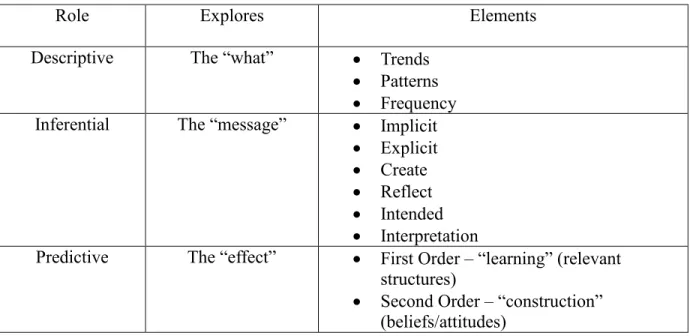
Table 3: Roles of Content Analysis ... 73
Table 4: Cultivation Analysis ... 80
Table 5: The Wire, Season One, Poverty & The Drug Wars ... 94
Table 6: The Wire, Season Two, Gentrification & The Docs ... 100
Table 7: The Wire, Season Three, City Politics ... 108
Table 8: The Wire, Season Four, Education in Baltimore City Schools ...114
Table 9: The Wire, Season Five, The Media, Policing, and Corruption ...118
Table 10: The Wire, First Order Effects ...119
Table 11: The Wire, First Order Effects by Episodes ...119
Table 12: The Wire, First Order Effects – “Gangsta” ... 120
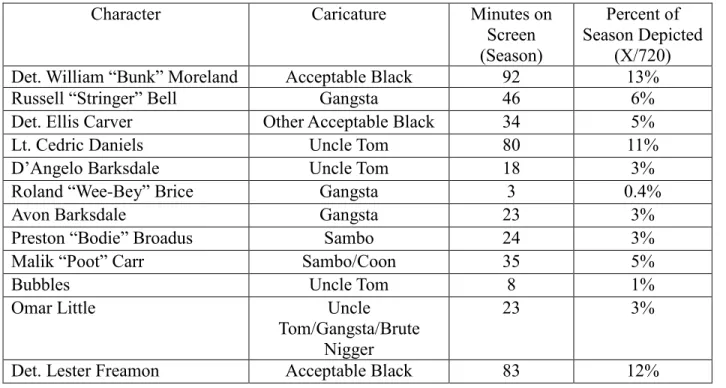
Table 13: The Wire, First Order Effects – “Acceptable Black/Other Acceptable Black” ... 120
Table 14: The Wire, First Order Effects – “Uncle Tom” ... 121
Table 15: The Wire, First Order Effects – “Sambo” ... 121
Table 16: The Wire, First Order Effects – “Coon” ... 121
LIST OF FIGURES
Figure 1: Categorization ... 40
Figure 2: Cultivation Process ... 69
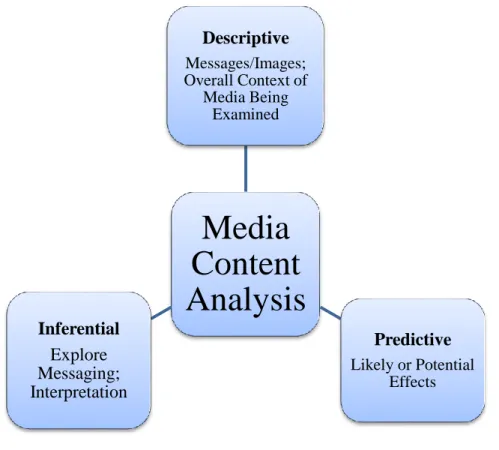
Figure 3: Media Content Analysis ... 72
PROLOGUE
On April 4th, 2016, Zeba Blay, a writer for “Black Voices,” a section of the Huffington Post, wrote an article in response to the backlash over a Gap Kids print ad. The article reported that many took to social media to express outrage over the ad that featured four girls in various poses. Consumers noted that the only Black female featured in the advertisement was used as an armrest by a taller White girl. The article noted that many stated the Black girl was used as a token and “the White girl’s prop.” The article states that many Black consumers expressed concern that the ad served as yet another example of media racism and an example of how the media continues to dehumanize and belittle people of color. The Huffington Post reported similar controversy five years earlier when Dove soap ran a television media blitz promoting the brand’s Visible Care body wash. The television ad features three women standing in front of “before and after” images. The “before” image features what appears to be dry, cracked skin. The “after” image features smooth skin with no visible cracks or dryness. Three women are standing in front of the images in the following order, from left to right: Black (before), Latina (middle), and White (after). The ad seems to relay the message to viewers that if you use Dove, you will not only relieve your dry skin, your skin will become cleaner and gradually get lighter before finally turning White as a result.
stereotypes of people of color. This issue is exacerbated when examining the racial stereotypes portrayed of Black males in the media. Throughout history, the Black male has been cast as violent, devious, and dangerous as the media often leaves its viewers with negative associations of Black males in poverty, as street corner drug dealers, and as criminals. Individuals seek television media for the purpose of entertainment and to seek information and news, unaware of its influence. Negative associations in the media are often exaggerated while limiting positive associations, allowing viewers to cultivate negative attitudes, influencing perceptions, and beliefs without any counter narratives to challenge such ideas. What compounds this problem is the way in which negative stereotypes and racial caricatures depicted in television reaffirm negative racial ideals and in turn, affect outcomes of Black males.
CHAPTER 1: INTRODUCTION
There is an ideology that emerged in our post-Civil Rights society that has become accepted doctrine among Whites: the idea that racism is a non-issue and that institutional racism does not exist (Bonilla-Silva & Dietrich, 2011; Entman, 1990). Therefore, there are no
limitations for Black student, particularly Black male, achievement. This belief is reinforced by the representation of Black journalists, athletes, actors, and actresses on the small and big screen. On November 4, 2008, this ideology was, again, reinforced with the election of America’s first Black President, giving the perception that we as Americans are now living in a post-racial society (Bonilla-Silva & Dietrich, 2011; Juarez & Hayes, 2015; Smith & Brown, 2014). To some, it was the realization of Dr. Martin Luther King Jr’s iconic “I Have a Dream” speech. However, researchers (Agosto, 2014; Beaudoin & Thorson, 2006; Bonilla-Silva & Dietrich, 2011; Diuguid & Rivers, 2012; Irby, 2014; Johnson-Bailey, Ray, & Lasker-Scott, 2014; Juarez & Hayes, 2015; Love, 2014; Martin, 2008; Omi & Winant, 2008; Page, 1997; Smith & Brown, 2014; White, 2010) believe racism and racial inequalities are alive and well and are undeniable components in all facets of our society. As “much as Jim Crow racism served as the glue for defending racial oppression in the past, color-blind racism provides the ideological armor for the ‘new racism’ regime” (Bonilla-Silva & Dietrich, 2011, p. 191).
Although Jim Crow is a “thing of the past” and the majority of Americans vehemently castigate blatant acts of racism, Black Americans, particularly Black males, remain
2008; Omi & Winant, 2008; Page, 1997). According to Allen (2015), Black males often face challenges finding, maintaining, and keeping their employment. The researcher also states Black males experience income disparities as compared to their White counterparts and notes this is regardless of social class status. “Black men are treated exceedingly different in the judicial system, as evidenced by disproportional arrests, convictions and jail sentences, as well as harsher sentences than White males for the same offense” (Allen, 2015, p. 210).
Much is said in regard to racial prejudice, acts of discrimination, and societal disadvantages (Hastie & Rimmington, 2014). However, one must place a critical lens in examining how advantage based on race and privilege for Whites has lead to systemic racism and inequalities for Black Americans. “Race and racism, while defined in numerous ways, is undeniable. It is woven through every facet of our history and is currently both visible and invisible on many levels” (White, 2010, p. 143). White privilege is also undeniable and is an unspoken phenomenon that is rarely seen or acknowledged by those who possess it. This “ignorance is bliss” notion grants those who possess privilege the power to ignore the fact that others do not have it and are denied access to rights, power, and equality in our society (Hastie & Rimmington, 2014). White privilege acknowledges that White culture is the dominant culture and what society would classify as normal. It allows Whites to ignore the everyday life experiences of those of different races/cultures. It allows the “denial of the importance of race and the existence of racism to evaluating race and racism as the most potent political and social force in the history of the United States” (White, 2010, p. 142). It also makes positive
Thorson, 2006; Bogle, 2013; Diuguid & Rivers, 2000; Entman, 1990; Entman & Gross, 2008; Hastie & Rimmington, 2014; Moore & Ratchford, 2007).
Background
There are a multitude of structures that help shape the life experiences of Black males in America. The long, standing legacy of White racism is reinforced everyday through the common belief in America that there is one single way all Americans should live, look, and behave in society. Individuals not living up to these widely viewed, common standards are subject to denial of equal opportunity, academic and instructional opportunities, and isolation from society
(Moore & Ratchford, 2007). In our society, individuals seek various forms of media to gain access to information and news on a regular basis. However, they are unaware how this specific medium is influencing their opinions of groups of people. “The mass media (TV, print, and cinema) has historically functioned and currently operates to maintain a system of White supremacy” (Hawkins, 1998, p. 7). The media often limits its positive portrayals of Blacks and exacerbates its negative portrayals in comparison to Whites (Allen, 2015; Duiguid & Rivers, 2000; Hawkins, 1998; Knight, 2015; Marin, 2008).
of racism (i.e. systemic, structural, and institutional) provide a foundation for understanding the racial inequity people of color face on a day-to-day basis (Golash Boza, 2013).
The image of Black men is constructed by the majority culture, portrayed through
television, film, news media, reality television, and music videos, and is rooted in racial defiance (Johnson-Bailey, Ray, & Lasker-Scott, 2014). Negative portrayals of violence, brutes,
criminality, etc. continue to foster traditional racist attitudes of Whites, influence public opinions, and ideals in a post-Civil Rights era. These representations of “blackness” begin to permeate into our society, becoming socially accepted as the norm while perpetuating misunderstandings, among races and of Black males. Negative images of Black males that consistently appear on screen leave the impression to consumers that anyone and everyone, with the exception of Whites, is guilty.
It is entirely conceivable that the aforementioned barriers Black men face as a result of these negative portrayals parallel their experiences within our schools (Allen, 2015). According to Love (2010), Whites are often taught that discussing race, racism, and the oppression of individuals of marginalized groups is to reveal racism. The researcher further claims that this sets a precedence in the classroom where students barely understand the meaning of race and
experience discomfort as a result of being exposed to it. “Some of the responses by Black males to such poor economic and social opportunities are then used as powerful forms of Black
policies and procedures within the classroom and school environment. Such instructional and institutional behaviors by educators can affect school policies and practices leading to discipline disproportionalities, a lack of academic growth, proficiency, and achievement, the absence of teacher-student relationships, and the overall schooling experience of Black males as a whole. Over sixty years after the historic Brown v. Board of Education decision, school systems all over the United States continue to fail Black students (in particular Black males), “a legacy left behind by racist laws that forbade and then restricted their education with Jim Crow practices”
(Johnson-Bailey, Ray, & Lasker-Scott, 2014, p. 6).
Problem Statement
Too often the plight of Black males is perceived as a cultural problem that relies (solely) on the shoulders of the Black community to address. However, this plight reflects our larger society that equality has yet to be reached (Allen, 2015). Schools operate everyday as places where the realities of race, racism, and how both play a role in the achievement of African Americans, go completely undiscussed. Despite increasingly diverse demographics/backgrounds of students in our classrooms, colleges and universities continue to prepare teachers to teach “primary English speaking White students who come from middle class, two-parent
heterosexual, Protestant Christian homes” (Juarez & Hayes, 2015, p. 318).
structure and that caricatures in the media have real world affects on Black males and place them in positions of vulnerability (Love, 2014). Teacher perceptions, “dumbing down” curriculum, a lack of acceleration and proper remediation, and having low expectations of academic potential all play a significant role in Black male academic achievement (Allen, 2015). This is not a problem that is isolated to just teachers and administrators. Counselors can also effect the outcomes of students of color, specifically, Black males, when acting as gatekeepers for their students by either allowing or denying access to opportunities for educational advancement (Allen & White-Smith, 2014).
Racial discrimination continues to plague the schooling experiences of Black males in schools and various other public settings where they are often viewed as violent, dangerous, and threatening (Hope, Skoog, & Jagers, 2015). By the time Black boys reach the age appropriate to begin kindergarten, they are viewed as grown men, capable of threatening behaviors, criminal activity, oppositional, and often labeled as unteachable (Love, 2014) and “for many Black male students the classroom can be a volatile space where the teacher-student relationship can be antagonistic” (Allen, 2015, p. 224).
Purpose of the Study
The purpose of this research study was to provide a critical lens in examining how the negative caricatures of Black males in the media potentially allow teachers to view some of their Black male students as unintelligent, resistant to authority, disrespectful, and violent. To
perceive and treat Black males negatively in ways that reflect the media images portrayed and stereotypes gleaned as a result of watching the series.
Major Research Questions
It is critical to thoroughly examine controversial media caricatures to decode the hidden meanings behind these images, the influence they could or could not have over the formation of their audiences’ implicit biases, and how the implications of their meaning might or might not cultivate teachers’ perceptions and subsequent treatment of their Black male students. The major research questions for the study were: 1) How are Black males portrayed in the HBO original series, The Wire? 2) Do these portrayals reify (or, not) stereotypes of Black males in the United States? 3) How might these portrayals cultivate teachers’ perceptions and subsequent treatment of Black male students?
Rationale for the Study
Researchers (Martin, 2008; Miller, 1998; Oliver, 2003) suggest that Whites develop negative stereotypes about Black males when dependent upon television and film to learn about them. Research also suggests that marginalizing the schooling experience of Blacks is a normal aspect of our education structure and that caricatures in the media have real world affects on Black males and place them in positions of vulnerability (Love, 2014). While there are an
popular culture images influence practice in addition to the ways in which they are consumed” (Freedman, 1999, p. 81) by teachers.
Conceptual Framework
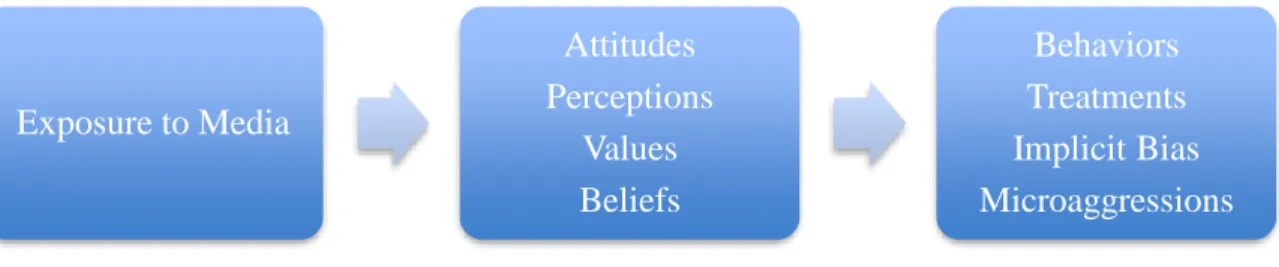
The conceptual framework for this study is derived from media studies and legitimizes the notion that exposure to negative imagery influences the audiences’ attitudes and beliefs. This is the central tenet of Cultivation Theory. Referencing Cultivation Theory, Monk-Turner et al. (2010) and Potter (2014) posit that television reaches a broad audience over a long period of time, making it a very powerful medium. Researchers (Adams-Bass, Stevenson, & Kotzin, 2014; Bilandzic, 2006; Dutro & Kantor, 2011; Hetsroni, 2012; Jamison & Romer, 2014; Monk-Turner et al., 2010; Oliver, 2003; Parrott & Parrott, 2015; Potter, 2014; Torres, 2015) state that
Cultivation Theory reveals that exposure to imagery influences perceptions and beliefs of society and often validate and mainstream long held gender and race-based stereotypes about groups of individuals. I posited that this conceptual framework would provide a critical lens of which to explore and examine the intersectionality of media exposure and the life experiences of students of color, particularly Black males, how these life experiences position Black males in public schools, and the disparities they experience as a result. Cultivation Theory does not imply that every teacher is intentionally harming Black males. However, it does suggest that the
consumption of negative media imagery is part of the human experience and, “therefore, represents points of potential connection between those relating an experience and those who hear and interpret such accounts” (Dutro & Kantor, 2011, p. 140).
Dutro & Kantor, 2011; Hetsroni, 2012; Jamison & Romer, 2014; Lett, DiPietro, & Johnson, 2004; Monk-Turner et al., 2010; Morgan & Shanahan, 2010; Oliver, 2003; Parrott & Parrott, 2015; Potter, 1991; Potter, 2014; Schnauber & Meltzer, 2016; Shrum, Lee, Burroughs, & Rindfleisch, 2011; Torres, 2015). Potter (2014) explains that Gerbner was interested in whether or not media could influence the entire media landscape through its messages. His approach consisted of an analysis of three components: “the media institutions, the mass-produced messages, and their cultivated effect on large aggregates” (p. 1016). The media, according to Banks and Esposito (2003), perpetuates stereotypes by “portraying the subject in specific and frequently stereotypical ways. Television shows are often couched in dominant ideologies of racism, classism, heterosexism, and patriarchy” (p. 236). Therefore, the representations the media projects on screen are important to examine because of how viewers “digest” what they have seen and try to make meaning as a result (Banks & Esposito, 2003).
The results of negative imagery often spill over into schools, potentially influencing teacher perceptions. It is these perceptions that can then potentially shape classroom instructional practices, affect academic achievement and learning, and influence discipline policies and
procedures within the classroom and school environment. Such “management and control” behaviors (suspensions, zero tolerance policies) by educators can affect school policies and practices leading to discipline disproportionalities (Howard, Flennaugh, & Terry, 2012; Juarez & Hayes, 2015; Kinsler, 2011; Skiba, 2011), a lack of academic growth, proficiency, and
Hayes, 2015; Moore & Ratchford, 2007), and the overall schooling experience of Black males as a whole (Allen, 2015; Allen & White-Smith, 2014).
Significance of the Study
Exploring and examining how negative media portrayals might cultivate teachers’ perceptions and subsequent treatment of their Black male students is rather new research (Adams-Bass, Stevenson, & Kotzin, 2014). Using The Wire as the television media source was significant because it was credited as one of the few shows ever created that primarily told the stories of Black men (Ault, 2012). “Black men are stereotypically represented as either sexual threats or emasculated; representations that The Wire takes much care to counter in its panoply of interesting, complex Black male characters” (Ault, 2012, p. 390). The series focused on the various aspects of Baltimore’s relentless pursuit of two drug kingpins and the city’s war on drug trafficking while examining the interconnectedness of poverty, gentrification, city politics, education, and the media. It is important to note that critics of The Wire praised the series for having more Black male actors in major roles than any other show on television during its run (Brock, 2009; Kinder, 2008). It was also hailed as one of the best shows ever produced for network television (Atcho, 2011, Brock, 2009; Dutro & Kantor, 2011; Kinder, 2008; Tyree, 2008; Trier, 2010). The Wire was one example of similar shows within the same genre such as the following: CSI, NYPD Blue, Law & Order, Castle, Blue Bloods, The Closer, Criminal Minds, The Blacklist, Hawaii Five-O, NCIS: Los Angeles, NCIS: New Orleans, and Ray Donovan.
attitudes, beliefs, perceptions, judgments, and values about gender and race-based stereotypes, as well as, the interconnectedness of students of color, their daily interactions with teachers, and their schooling experiences. Given that the majority of Black males are taught by a
predominately White female teaching force (Allen, 2015), Black students all across this nation often enter classrooms where they are faced with a cultural disconnect with their teachers; this directly impacts student-learning and achievement (Love, 2014). Cross cultural relationships between teachers and students present special challenges in the classroom-learning environment.
Limitations
Given the topic and nature of the study, I, as the sole researcher, had to remain completely neutral to protect the credibility of the study. Being the sole researcher and coder presented a limitation regarding validity as Macnamara (2005) explains two or more coders should be used to ensure maximum reliability. Though Cultivation Theory reveals that exposure could influence perceptions and beliefs of society and often validate long held gender and race-based stereotypes about groups of individuals, it does not address “the nuances of Black culture, the history of racial oppression, or the ongoing use of racial stereotyping in contemporary Black life, social and economic mobility and stagnation” (Adams-Bass, Stevenson, & Kotzin, 2014, p, 370). A final limitation related to the wide range of accessibility to a premium channel’s original series. (A premium channel is one that does not come with a basic subscription to cable.) The Wire was and is widely hailed as one of the best television shows ever produced (Atcho, 2011,
Definition of Terms
Abstract Liberalism – framing race-related issues under the guise of liberalism (Bonilla-Silva & Dietrich, 2011).
Achievement Gap – the disparity of academic measures, set forth by each state, between groups of students. These groups are typically Black/African American, Hispanic, and low socioeconomic, as compared to, White/Caucasian students.
Black – a collective descriptor representing anyone with African descent regardless of national origin (Johnson-Bailey, Ray, & Lasker-Scott, 2014).
Color-blind racism – collective expressions of White racial dominance and racial discrimination that is subtle, apparently nonracial, and institutionalized (Bonilla-Silva, 1997, 2001; Winant, 2015).
Counter-Story – a story used as a tool for exposing racial privilege while “voicing” the experiences not often told by people of color (Allen & White-Smith, 2014).
Critical Race Theory – an examination of the intersectionality of race with various other identities and how race and racism impact educational theory, academic gatekeeping, policy, and instructional and discipline practices as a means of further marginalizing minority students.
Cultivation Theory – a term used to describe the correlation between the effects of long-term exposure negative portrayals, in all forms of media, and the validation of negative stereotypes of people of color.
EOG (End – of – Grade) Test – common summative assessments given by the state of North Carolina designed to measure student performance on grade – level goals and objectives.
Interest Convergence – the merging of the interests of White people and racial justice. Media – a means of mass communication, i.e. television, newspapers, and magazines,
that influence people’s opinions, thoughts, beliefs, and actions.
Minority/Minorities – a collective descriptor representing anyone non-White regardless of national origin.
Out of School Suspension – a form of student discipline that prohibits students from participating in school activities and entering school grounds for a length of time under ten days.
Race – a divisive social construct, created by Whites during colonial expansion, as a means of assigning themselves rights and power while using themselves as the model for humanity (Racial Equity Institute, 2015).
Racial Identity – the racial background a person most identifies with.
Racial Realism – a term created by Dr. Derrick Bell that describes “the permanence of the subordinate status for Black Americans, and by extension the persistence of White
supremacy, in establishing law and other social policy” (Ledesma & Calderon, 2015, p. 214).
Racism – one group having the power to carry out systemic discrimination through the major institutions of society (Racial Equity Institute, 2015).
alienate African American males from the learning process within the classroom and academic attainment, toward the criminal justice system (Darensbourg, Perez, and Blake (2010).
Social Cognition – how individuals store, process, and apply information about others based on media influences.
Stereotypes – beliefs and attitudes based on membership of a particular group that inform specific behaviors and prejudices (Parrott & Parrott, 2015; Torres, 2015).
White – a collective descriptor representing anyone with European descent regardless of national origin.
White Gaze – viewing the world through the White lens with undertones or blatant racist views, attitudes, beliefs, and actions; White fear of Black people (George Yancy, 2008) Whiteness – historical and social construction of being White in America; social status,
privilege, and power associated with being White.
White Messiah – a collective descriptor representing a White person who acts as a savior, liberator, or rescuer of Blacks from desolate circumstances.
White Privilege – unearned benefits given to Whites (McIntoch, 1988; Strmic-Pawl, 2014) granting access to power.
White Supremacy – systematic and systemic ways in which those that are considered White benefit from the racial social order of society and, as a result, how this social order oppresses people of color (Strmic-Pawl, 2014).
Conclusion
The image of Black men is constructed by the majority culture, portrayed through
CHAPTER 2: LITERATURE REVIEW
To fully understand the legacy of racism and Whiteness, one must examine the origins of this country and examine the colonization of Virginia in the early 1600s (Pope-Davis & Liu, 1998). The following section will focus on the social construction of race and “Whiteness” in America and the “implications of both as intervening structural barriers in societal interaction patterns and in formal and informal social organization in American society” (Guess, 2006, p. 650). This section will also outline the early days of American exploration and examine the development of institutional racism. It is imperative that one understands the social construction of racism, how it has become institutionalized, how it effects the lives of African Americans daily (Golash-Boza, 2013), and how it trickles down into every institution, every facet of this nation (media, schools) and the educational outcomes of Blacks/Black males.
Social Construction of Racism
The first twelve years (after the colony was founded/established) were chronicled in the Journals of the Virginia House of Burgesses (Zinn, 2003). Within this document, it describes the
limited amount of food available for the settlers that first arrived. As more people made the journey to Virginia, the amount of food began to dwindle tremendously. Early settlers were forced to explore the land and hunt for nuts and berries. As a result, Virginians were starving, struggling to survive, and in desperate need of labor to plant and harvest. They knew they could not enslave the Indians because “they were outnumbered, and while with superior firearms, they could massacre Indians, but they would face massacre in return. They could not capture them and keep them enslaved; the Indians were tough, resourceful, defiant, and at home” (Zinn, 2003, p. 2). This put them at a terrible disadvantage yet, they knew they needed skilled labor. Before the construction of the White race in America, powerful English colonists in Virginia began
separating individuals of African descent from those of European descent, especially among the poorest people, as early as 1619 (Racial Equity Institute, 2015; Smedley & Smedley, 2005; Zinn, 2003). The first Africans were kidnapped and brought to Virginia at a time when the colony was desperate for labor. Africans were brought to the New World socially and intellectually inferior to Whites and enslaved even after the practice (of slavery) was outlawed in Europe. Though the institution of slavery (in the colonies) would not be established for several more decades, importing Black Africans had been going on for as long as 50 years prior in South America and the Caribbean (Zinn, 2003).
privileges given to them because they were White and in the majority (Racial Equity Institute, 2015). Black Africans were the ideal choice of labor because they were unfamiliar with the land, not natives (e.g. Indians), and were not accustomed to European culture (Zinn, 2003). European travelers were impressed with how “advanced” African kingdoms were and knew the inhabitants of this land would be good for planting and harvesting; hence, the development of the economy of the colony. The colony had been founded on the premise of freedom and equality for all. However, Christians had to categorize slaves as nonhumans/three-fifths of a human in order to justify their enslavement (Smedley & Smedley, 2005). Even though many White Christians believed that the practices of enslaving Africans seemed unjust, they were still able to reconcile their feelings and categorize slavery as “uplifting and domesticating” (Winant, 2015, p. 317). They thought, “such obviously primitive and backward people cannot be afforded human status” (Winant, 2015, p. 317). This reasoning would allow the colony to grow and prosper on the backs of slaves and unpaid slave labor. America was hungry for power and was anxious to establish itself as an independent nation having separated from England. The “founding fathers” set out to accomplish all of the things they felt other sovereign nations did, for example, setting up an economic base, citizenry, developing relationships with other nations for the purpose of trade, and developing a social order to determine who and what group would be at the top and who would be at the bottom.
Colonists had selected African people to be permanent slave labor. Out of this decision grew a need to categorize human beings by their differences. In 1680, the Virginia House of Burgesses began to debate what constituted being a White man for the sole purpose of
they determined that a “White man” was defined as one with no Negro or Indian (Native
American) blood. However, there was a problem with this definition. Years earlier, in 1613, John Rolfe married and had children with Pocahontas who was Native American (Indian). Though they were bi–racial, they were wealthy landowners and possessed a lot of power. In order to keep their wealth and power in the new White regime, the House of Burgesses amended the definition of White to be one with no Negro or Indian blood except for the male descendants of John Rolfe and Pocahontas. This set up a process in which (for centuries) courts have looked upon blood as a type of property, with Whites holding the ultimate prize (Sharfstein, 2003). Given that Whites were the property owners, figuratively and literally, they had the right to discriminate against non-Whites, which formed a legal hierarchy/infrastructure, based on race, and of inequality, in society (Sharfstein, 2003).As such, “race developed as a highly practical political technology of oppression and resistance” (Winant, 2015, p. 317). America was the first nation to separate individuals based on their “race” while Europeans, Africans, Asians were separated (in their native countries) by class.
the history of the United States and has been an intricate, crucial piece in economic development, the creation and structure of power and wealth, and the exploitation of those not considered White, particularly Blacks (Racial Equity Institute, 2015; Sharfstein, 2003; Winant, 2015).
Race is an ideology, a social construct that can be defined as a classification of human beings that was created for the sole purpose of assigning wealth, power, and maintaining access to such power, access, and privilege (Hughes, 2007; Pope-Davis & Liu, 1998; Racial Equity Institute, 2015). In terms of race in North America, there are several beliefs that make up the social characteristics of race: 1) “They hold that races are naturally unequal and therefore must be ranked hierarchically (inequality is fundamental to all racial systems).” (Smedley & Smedley, 2005, p. 20); 2) There is an assumption that differences among races are so profound that they are inevitably unalterable. These two beliefs are used in the justification of (Smedley & Smedley, 2005). However, the pursuit of classifying everyone of African descent posed a problem as the “one-drop rule had the broad potential to be destabilizing for the White South. If no one’s racial status was secure without an exhaustive genealogy, the governmental apparatus of segregation and white supremacy would be perpetually threatening to Whites” (Sharfstein, 2003, p. 1476). Institutional Racism
The constitution was created for the benefit of White male land-owners in their continued quest to own land and gain wealth (Strmic-Pawl, 2014). “Members of the White race are set forth in history as the standard, and this depiction is most often accompanied by the phantom of
single most important criterion of status…the racial distinction between Black and White” (Smedley & Smedley, 2005, p. 20). This set the stage for the creation of more racialized policies as the rules of social order that governed Black Africans’ and White indentured servants’ day-to-day routines were known and observed (Guess, 2006). These practices became institutionalized and also determined their separation.Slavery was extremely profitable for slave masters and the economy began to grow as more and more colonies were established. Zinn (2003) explained that, as African slaves continued to arrive, more of their African heritage was destroyed, creating “sambos and helpless dependents” (p. 7). This was the first Black male caricature documented and a prominent racial stereotype that still plagues Black males through media imagery. “Like many of the racial stereotypes that remain embedded in our consciousness, the notion of the dangerous Black male grew directly out of slavery and its aftermath” (Carter, Skiba, Arredondo, & Pollack, 2014, p. 2).
Virginia established slave codes, or “Pig Laws,” to punish slaves that attempted to run away and pass as free men. Pig Laws allowed Whites to punish slaves, even dismember and/or murder them, and claim possession of a new slave if caught hiding, lurking, and killing animals (hogs) for food. In particular, Black men were heavily sought after like chattel for more labor– intensive tasks. Slave owners saw Black men as a way to maintain a wholesome, quality labor supply, power, and wealth within the White race. According to Zinn (2003):
The slave codes of the 17th century made it virtually impossible for any slave, particularly, Black male slaves, to retain any since of normalcy in their daily lives (Carter, et. al, 2014). Carter, Skiba, Arredondo, & Pollack (2014), in their discussion of race and Black males, point to history when discussing the dangerous Black male frame. In their research, the authors reference the slave revolts of the 19th century and point out that slave masters “spread the notion” (p. 2) that Black males attempting to flee plantations were only interested in hunting down and raping White women. (This was the creation of the racial stereotype of the “brute nigger.”) Without any evidence that such a crime had been committed, Pennsylvania passed a law that Black men would be castrated or put to death if such a crime were committed. The authors note that this law helped cement the idea that Black men were a threat to society. As a result, more than 2,000 Black men were lynched between 1889 and 1918 for non-violent offenses.
This next section examined the rise of Black male racial caricatures and stereotypes (portrayed in the media) that were “created” as a result of the social construction of race,
Whiteness, and White supremacy. This section also described caricatures/ethnic notions explored in the research. I focused on both the evolution and the progression of Black male stereotypes for two reasons: first, because of the consistent dehumanization, criminalization, and institutional consequences that result for Black males that I argued are rooted in our nation’s racist history; second, as previously stated, researchers (Martin, 2008; Miller, 1998; Oliver, 2003) have suggested that Whites develop negative stereotypes about Black males when dependent upon negative imagery depicted on television.
Media Portrayal – The Caricatures/Racial Stereotypes
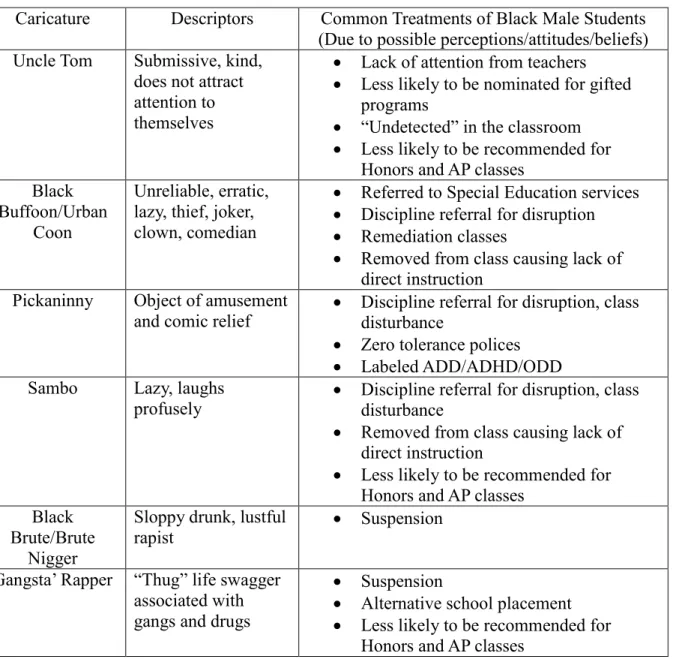
Christian martyr of Stow’s novel, into the submissive race traitor his name connotes today” (Spingarn, 2012, p. 203). The year of 1903 began the portrayal of Black males on the wide screen. The movie industry was in its beginning stages when Uncle Tom’s Cabin was made. A white actor in blackface initially played the title character “Uncle Tom.” The representation of the tom is used to ‘remind Blacks that they need only to obey their White ‘masters’ to solve their problems” (Torres, 2015, p. 293). Bogle (2013) states that the “Tom” remains faithful to their master regardless of the way they are treated, rendering him a hero to some White viewers. One of the most iconic iterations of the “Tom” was portrayed by Bill “Bojangles” Robinson, along side Shirley Temple, in The Littlest Rebel (Bogle, 2013). Within the movie, Robinson played the part of Temple’s guardian, Uncle Billy, and was her favorite of the household slaves. One afternoon, during her birthday party, the Yankee soldiers invaded the plantation. When Shirley’s mother passed and father was captured and taken hostage in the north, Uncle Billy complied with Shirley’s requests to protect her at all cost and rescue her father. Bogle (2013) states “the
Robinson figure was obviously the familiar contented slave, distinguished, however, because he was congenial, confident, and very, very cool” (p. 50).
The Black Buffoon/Coon/Pickaninny/Sambo. T.D. Rice was the first prominent white male comedian that performed in Black face. Rice became known as an “Ethiopian Delineator” after he observed an African American male cripple performing an exaggerated version of “Jim Crow,” a dance that was created by slaves on the plantation. The church outlawed dancing and defined it as any movement that required a person to cross their feet. Slaves found a way to perform without breaking the law. The image Rice portrayed became a reality to those living in America (at the time) that had never seen an African American before. The image of Jim Crow would eventually evolve into the Sambo in the early 1900s (Ethnic Notions, 1987). As such, Whites were bombarded with images of happy slaves and the Sambo gave the perception that slaves were content with their existence (Hawkins, 1998). The Sambo would often avoid the task at hand in favor of living a “care free” life, full of contentment, through dance and song, serving his slave master. The Sambo depicted the African American male as an older, bearded, grey haired gentleman that would laugh profusely while playing an instrument, shining shoes, or performing normal labor expected of Blacks at the time.Given these characteristics, the Sambo was an embraceable caricature because it presented the Black male as dependent upon its master, posing no threat to White Supremacy (Hawkins, 1998).
African Americans were compared to the European standard that society portrayed as normal, beautiful, and acceptable. Images of African Americans were often shown with white bulging eyes, top and bottom lips that resembled a human liver, and kink hair standing erect on top of the head, resembling a fright wig (Bogle, 2013; Ethnic Notions, 1987). Cartoons
Remus. The Pickaninny was the representation of a Black child with big eyes that popped out and whose hair stood on end (Bogle, 2013; Ethnic Notions, 1987). The Pickaninny was/is commonly known as Buckwheat, a comedic character that was portrayed by Eddie Murphy in the early years of Saturday Night Live. Thomas Alva Edison was the first producer to bring the Pickaninny to the big screen when he created Ten Pickaninnies in 1904.
The Brutal Black Buck/Brute Nigger. The Birth of a Nation was a huge
multidimensional, unprecedented movie of its time. Produced in 1915 by D. W. Griffith, The Birth of a Nation took place in Piedmont, South Carolina, and revolved around the fictional
family, the Cameron’s. The film portrays Whites in power and Blacks happily working in the fields, entertaining their masters, and conducting their house work with no complaints. All is in order until the Civil War. The South is taken over by Negro raiders, “unleashing the sadism and bestiality innate in the negro, turning the once congenial darkies into renegades and using them to crush the White South under the hell of the Black South” (Bogle, 2013, p. 12). The film depicts Black men as sloppy drunks, lustful rapists, and barbaric brutes. This caricature posed a direct threat to White Supremacy because it portrayed the Black male as an animalistic, untamed, sexual savage controlled by its sexual urges (Hawkins, 1998).
the Sambo and the Brutal Black Buck/Brute Nigger were used to justify slavery and the need for slavery, as well as, justify the treatment of slaves, the need to keep them in their place, and, ultimately, their lynching. This portrayal aroused hatred that still lingers regarding Black men to date. What has to be remembered is that, in present day, the media delivers the same product wrapped in new packaging, meaning, the same caricatures portrayed in the early 1900s are still being mass produced in today’s news stories, movies, and both scripted and reality television shows such as the CW’s The Originals, ABC’s Mistresses, OWN’s Tyler Perry’s If Loving You is Wrong, and ABC’s Happy Endings. Given the context of these caricatures portrayed in the
media, it is important to remember the media possesses significant power over viewers,
maintaining and perpetuating popular misconceptions of Black males (Martin, 2008) and that the United States of American is a nation that has its history deeply rooted in racism. It is a nation that has enslaved Blacks longer than being an emancipated nation under God.
Race and Brown v Board of Education
When the landmark decision of Brown v Board of Education forced legal integration, social scientists in the United States believed that the increase in contact with people of differing races and ethnicities would make it virtually impossible to hold on to racial and ethnic
stereotypes (Carter, et. al., 2014). The authors state that social scientists believed that mindsets could be changed despite centuries of social segregation and negative stereotypes passed down from generation to generation. Equally important to note is the idea that race applies to Whites just as much as it does to ethnic and racial minorities (Hughes, 2007). Hughes (2007) states that American history must recognize how various immigrant groups were classified as White over time. The author urges individuals “not to dismiss the historical importance of race, but rather to ‘confront White privilege’ by revealing how its social construction has had ‘all-too-real
Guess (2006), in her discussion of the social construction of race, explores the differences in what she identifies as racism by intent and racism by consequence. The author reveals that racism by intent manifests itself through individual acts of racial prejudice towards those that are not White. Racism by consequence is based on historical events that have developed into
inferiority over other races. It permeates through discriminatory behaviors and facilitates the development of social practices that become institutionalized. The author suggests that once racism has reached the institutional level, White Americans may not recognize that is exists. “Racism by consequence then is reflected in differential educational opportunities, economic differentials between Whites and non-Whites, residential segregation, health care access, and death rate differentials between Whites and non-Whites” (p. 652).
Modern Day Media Portrayals of Black Males
Throughout the history of television and film, there have been several remarkable performances of Black actors, actresses, and filmmakers that have contributed to the context of American media. Though some of the works have not been met with astounding critical praise, some of the most important have been those that left their audiences exploring issues, themes, cultural symbols, signs, and concepts that hit so close to home, they provoked thought and sparked a dialogue (Bogle, 2013). News and entertainment stories, that are seen and heard daily by viewers, can strongly influence public opinion, news, television and film. As a result, they facilitate the growth of a culture that is conducive to shaping individual beliefs, attitudes, and behaviors of whom Black males are, how they behave, and how they are to be treated (Agosto, 2014). The first section below offered background on the social construction of racism in the media, how the media “paints a picture” of Black males, and how these images and the beliefs cultivated as a result, affect their daily life struggles.
(often) distorted and exaggerated. At the same time, the Cultural Indicators Project was
established in 1967. According to Morgan and Shanahan (2010), this project began “conducting annual message system analysis of prime-time broadcast programming in 1967. The goal was to track the most stable, pervasive, and recurrent images in network television content, in terms of the portrayal in violence, gender roles, race and ethnicity, occupations, and many other topics and aspects of life” (p. 339). These were two of the first cultivation studies that took place before George Gerbner, considered the founder of Cultivation Theory, began his work. The
representation of Black culture as a whole continues to be a distorted one as Blacks, particularly Black males, are often portrayed as deviant members of society. The media is responsible for using stereotypes to define Blacks and images that are modern day holDovers from slavery.
Visual Texts and Representations. The 1970s and 1980s saw a rise in television
programming, with all Black ensemble cast members (Tukachinsky, Mastro, & Yarchi, 2015), such as Sanford and Son, The Jeffersons, Good Times, What’s Happening, Amen, and 227. However, racial stereotypes ran rampant within the Black male characters. Two examples of this are the characters of JJ and James Evans, Sr. in Good Times. In her discussion of Good Times and The Cosby Show, Hopkins (2012) cites the work of Rountree (2011), who states JJ was “arguably
(Historically Black College Universities) and historically Black fraternities and sororities to the majority audiences. Critics of the shows argued that it was not an accurate depiction of the Black family because of its portrayal of a Black male doctor and a Black female lawyer as working professionals that were financially stable (Hopkins, 2012). Hopkins (2012) states that critics painted the “authentic” Black experience as one where the family is based out of the projects (Good Times), speaks with “Black dialect,” and typically portrayed some type of violence or gang/drug/alcohol activity. The author also states that critics believed The Cosby Show created a false narrative that Blacks had achieved the American dream, overcome racism and
discrimination, and entered the middle class mainstream. The Cosby Show and A Different World were extremely popular among all audiences because it presented a counter narrative to the racial stereotypes popularized in television media. After their departure, Blacks and their roles in television reverted back to situation comedies, e.g., In Living Color, Martin, The Fresh Prince of Bel-Air, Family Matters, Hangin’ with Mr. Cooper, Living Single, and rarely were there
characters of color in dramas or written as regular cast members, that appeared on NBC, CBS, and ABC (Khamma & Harris, 2015; Monk-Turner et. al, 2010). Black characters are still written into programs and depicted in reality television shows where representative stereotypes like the brute, athlete, and buck are still present, e.g., Cops, The Game, Oz, The Wire, Treme, Ballers, Power, Empire. “This form of ‘entertainment’ is one in which Black and Latino men are the
‘villains,’ White men are the ‘heroes,’ and police use of force is a natural and needed means of ‘resorting justice’” (Oliver, 2003, p. 8).Television and film personify how media provides
Many Americans are familiar with the many visceral caricatures and stereotypes targeted towards Black males. These images are readily distributed to the public through local and national news, film, television (scripted and reality), music videos, and other various forms of media. As these images make their way into people’s homes, they have the potential to influence personal opinions, ideas, and racial attitudes towards Blacks, particularly Black males. It is critical to thoroughly examine these controversial images to decode the hidden meanings behind these images, the influence they have over the formation of their audiences’ implicit biases, and how the implications of their meaning can be challenged and overturned (Attwood, 2012; Trier, 2006a, 2006b, 2006c). If left unchallenged, “society runs the risk of making race invisible in the public consciousness” (Smith & Brown, 2014, p. 168).
addicts/dealers, buffoons, and delinquents. “These images can foster the already accepted stereotypes of African Americans within majority culture. But they also continue to create caricatures of the Black experience reducing African Americans from whole beings to an image, behavior, or a sound bite plastered across the TV screen” (Martin, 2008, p. 340).
What begins to form is a link between the media portrayals of Black males and public opinion of members of this subgroup (Allen, 2015; Gray, 1986; Hawkins, 1998; Knight, 2015; Martin, 2008; Miller, 1998; Oliver, 2003). In other words, unless viewers have personal
experience with Black males and/or have Black males within their social circle to challenge these portrayals, the media becomes one of their primary forms of education thus having a great
impact on shaping beliefs and attitudes of Black males (Bonilla-Silva & Dietrich, 2011; Martin, 2008; Monk-Turner et. al, 2010, Shrum, Lee, Burroughs, & Rindfleisch, 2011; Tukachinsky, Mastro, & Yarchi, 2015). (If you continue to tell the same lie, eventually people begin to believe it as true.) According to Bilandzic (2006), viewers will often try and interpret television media content in order to make sense of what they have seen. “If the content pertains to actual
literature review.) Bilandzic (2006) and Morgan and Shanahan (2010) note that various types of media content can prompt relevance structures, including fear.Given that the majority of citizens report that their knowledge of crime and criminals is a result of the media (Johnson-Bailey, Ray, & Lasker-Scott, 2014; Oliver, 2003), the result of such caricatures and misrepresentations lead to the following: a general antipathy/animosity towards Black males, distorted views on violence and crime, a lack of association with Black males, and a lack of empathy for and understanding of the plight of Black males (Bogle, 2013; Darensbourg, Perez, & Blake, 2010; Gray, 1986; Miller, 1998; Page, 1997).
Stereotypes develop from a variety of sources and often involve beliefs and attitudes based on membership of a particular group that inform specific behaviors and prejudices (Parrott & Parrott, 2015; Torres, 2015). Stereotypes are often related to gender and race and are often dubious and troublesome for racial minorities as they typically lead to some form of
discrimination. “While stereotypes are not inherently positive or negative, the meaning assigned to them does exert respective influences on attitudes and cognitions” (Parrott & Parrott, 2015, p. 72). Parrott and Parrott (2015), in their discussion of gender and race-based stereotypes
perpetuated by the media, found that the amount of television media consumed (in hours) by viewers equals 11 years over a 60 year live span; that is 11 years of cultural conditioning. “If we can recognize that the media’s production of Black male imagery is one of the many White cultural practices undergirding the formation of a new world order, then we must decolonize the production and dissemination of media representations” (Page, 1997, p. 99).
history of oppression and stereotyping Blacks have faced for over 400 years (Love, 2014; Oliver, 2003).Many of the lived realities of Black males are not only missing from media portrayals, they are often dramatized and distorted (Bogle, 2013; Howard, Flennaugh, & Terry, 2012; Page, 1997). For example, the largest block of reporting (during the morning and nightly news) typically involves Black males as aggressors and perpetrators of violence whereas Whites are underrepresented, maintaining a second-class status for Blacks that dates from slavery to present day. As such, “crime coverage may compound Whites’ fear of Blacks by showing Black
criminals more than White criminals surrounded with symbols of menace” (Entman, 1990, p. 337). Therefore, it is critical to thoroughly examine both implicit and explicit messages expressed by the media. The following section describes the conceptual framework that undergirded this study and provided a lens in which the racial stereotypes and caricatures portrayed in The Wire were examined.
Cultivation Theory
Cultivation Theory developed out of communication research by Gerbner and Gross in 1976 (Jamison & Romer, 2014). Concerned with violent content in television media and how that would create fear of other people with audiences, Gerbner and Gross posited that television media created a false sense of reality (Adams-Bass, Stevenson, & Kotzin, 2014; Bilandzic, 2006; Dutro & Kantor, 2011; Hetsroni, 2012; Jamison & Romer, 2014; Lett, DiPietro, & Johnson, 2004; Monk-Turner et al., 2010; Morgan & Shanahan, 2010; Oliver, 2003; Parrott & Parrott, 2015; Potter, 1991; Potter, 2014; Schnauber & Meltzer, 2016; Shrum, Lee, Burroughs, & Rindfleisch, 2011; Torres, 2015). Potter (2014) explains that Gerbner was interested in whether or not media could influence the entire media landscape through its messages. His approach consisted of an analysis of three components: “the media institutions, the mass-produced
to the vast amounts of portrayals of groups of people, that media messages influence public perceptions and beliefs and cultivated individual assumptions of society. Gerbner was also quick to narrow his focus to television media arguing, “commercial television, unlike other media, presents an organically composed total world of interrelated stories (both drama and news) produced to the same set of market specifications” (Potter, 2014, p. 1018). As such, Gerbner began what Morgan and Shanahan (2010) described as a cultivation analysis. He was convinced that an “environment in which certain types of institutions with certain types of objectives create certain types of messages, tends to cultivate (support, sustain, and nourish) certain types of collective consciousness” (p. 339). According to Cultivation Theory, television media creates “an impression of a mean world that should mediate the experience of fear” (p. 32). Torres (2015) points to a study that examined an audience’s perceptions of various ethnic groups as a result of heavy television consumption. The results indicated that audiences overwhelmingly perceived ethnic minorities negatively as a result of television depictions.
Categorization. Torres (2015) also cites a study that used Cultivation Theory as its
“categorization is the maximization of differences between social groups and minimization between group members, creating an ‘us’ versus ‘them’ perspective” (p. 289). (See Figure 1)
Mainstreaming. According to Parrott and Parrott (2015), “mainstreaming, in which
television communicates homogenous messages that ultimately reinforce the status quo by cultivating common perspectives among heavy consumers of television” (p. 79), is a key piece of the cultivation process in which media, specifically television media, provides a broad
perspective of everyday life in our society (Adams-Bass, Stevenson, & Kotzin, 2014; Bilandzic, 2006; Dutro & Kantor, 2011; Hetsroni, 2012; Jamison & Romer, 2014; Monk-Turner et al., 2010; Oliver, 2003; Parrott & Parrott, 2015; Potter, 2014; Torres, 2015). The representations the media projects on screen are important to examine because of how viewers “digest” what they have seen and try to make meaning as a result (Banks & Esposito, 2003). The media, according to Banks and Esposito (2003), perpetuates stereotypes by “portraying the subject in specific and frequently stereotypical ways. Television shows are often couched in dominant ideologies of racism, classism, heterosexism, and patriarchy” (p. 236).
Figure 1: Categorization
Behaviors (suspensions, zero tolerance policies) by educators can also affect school policies and practices leading to discipline disproportionalities (Howard, Flennaugh, & Terry, 2012; Juarez & Hayes, 2015; Kinsler, 2011; Skiba, 2011), a lack of academic growth, proficiency, and
achievement (Allen, 2015, Khanna & Harris, 2015; Parks & Kennedy, 2007), the absence of teacher-student relationships (Duncan, 2002; Hope, Skoog, & Jagers, 2015; Juarez & Hayes, 2015; Moore & Ratchford, 2007), and the overall schooling experience of Black males as a whole (Allen, 2015; Allen & White-Smith, 2014).
First-Order and Second-Order Effects. Researchers (Bilandzic, 2006; Hetsroni, 2012;
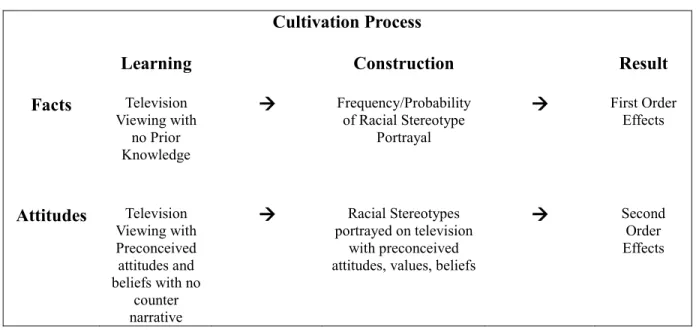
Lett, DiPietro, & Johnson, 2004; Morgan & Shanahan, 2010; Potter, 1991; Schnauber & Meltzer, 2016; Shrum, Lee, Burroughs, & Rindfleisch, 2011) state that there are two particular cultivating effects (see Table 1) that take place and the assumption that what is depicted is the normalization of beliefs.
White
(Cultural assumptions) Perception of Innocence
Black
Table 1: Cultivation Process of First and Second Order Effects Cultivation Process
Learning Construction Result
Facts Television Viewing with
no Prior Knowledge
Frequency/Probability of Racial Stereotype
Portrayal
First Order Effects
Attitudes Television Viewing with Preconceived attitudes and beliefs with no
counter narrative
Racial Stereotypes portrayed on television
with preconceived attitudes, values, beliefs
Second
Order Effects
The first cultivation effect is how viewers gain information about society, i.e. demographics, characteristics, their frequency/quantitative measures, and “encoding of television information” (Bilandzic, 2006, p. 340); these are first order effects. The second cultivation effect is the relationship between television viewing and attitudes and beliefs that might result from images, racial stereotypes, caricatures, and messaging; these are second-order effects. (Hetsroni, 2012, p. 38). Second-order effects involve the viewer constructing judgments and affirming attitudes as a result of exposure/first order effects (Bilandzic, 2006; Lett, DiPietro, & Johnson, 2004; Morgan & Shanahan, 2010; Potter, 1991; Schnauber & Meltzer, 2016; Shrum, Lee, Burroughs, &
cultivation occurs because people encode information while they watch television, intentionally or unintentionally, and that this information is retained in their long-term memory” (p. 38).
Shrum, Lee, Burroughs, and Rindfleisch (2011), in their study of second-order cultivation effects, state that most research has mainly focused on first-order cultivation judgment which has left a gap in the research as to how television influences attitudes, beliefs, and values (second-order effects). However, researchers (Bilandzic, 2006; Hetsroni, 2012; Lett, DiPietro, & Johnson, 2004; Morgan & Shanahan, 2010; Potter, 1991; Schnauber & Meltzer, 2016; Shrum, Lee,
Burroughs, & Rindfleisch, 2011) claim that examining the interconnectedness of first-order and second-order effects provides a better analysis of the effects of television viewing on perceptions of individual groups of people.
Potter (1991), in his discussion of the relationship between first and second order effects, broke down the cultivation process into two subprocesses; the two categories are learning (first order) and construction (second order). Learning involves the relationship between television viewing and the frequency of images. “The more a person views, the more incidental information he or she learns from television (p. 94). Construction is described as the process of using first order effects and the formation of beliefs of society. Therefore, from a cultivation perspective, racial stereotypes/caricatures are measures of second-order effects because they possess a variety of attitudes that can be internalized by media exposure and first-order effects because of the frequency of their appearance on screen. “In this sense, first-order beliefs are seen as an intervening variable in the relationship between television viewing and second-order beliefs” (Schnauber & Meltzer, 2016, p. 123).
telephone survey in which White television viewers were asked to identify who had or would be involved in criminal behavior. They were also asked to respond to the amount of scripted and reality television police shows. The results were overwhelmingly high in terms of Whites believing Blacks would be involved in criminal behavior. It is important to remember that the media is in the business of storytelling and is responsible for the type of characters Black males will play (Beaudoin & Thorson, 2006). Bilandzic (2006), in her study of the cultivation process, states that the judgments that are formed, as a result of the racial stereotypes/caricatures
portrayed in television media, are not instantaneous; they are formed over a process effect. Within this process, imagery plays an important role in “transporting” the viewer into the narrative, making the experience of television viewing memorable and intense while invoking considerable influence over viewers’ perceptions. Bilandzic (2006) states “recipients turn to fiction (in books, television, radio) expecting to be entertained and, consequently, do not engage in critical scrutiny” (p. 338). Continuous exposure has lead to a change in beliefs as a result of the narrative and character portrayal (Bilandzic, 2006).
Media Portrayals of Black Males
Caricatures. Caricatures, known as ethnic notions, portrayed in the media, have the