PRESSURES, PROMISES, AND PAYMENTS:
EXPLAINING GOVERNMENTS’ REPARATIONS DECISIONS AFTER DOMESTIC HUMAN RIGHTS ABUSES
Claire Greenstein
A dissertation submitted to the faculty at the University of North Carolina at Chapel Hill in partial fulfillment of the requirements for the degree of Doctor of Philosophy in the Department
of Political Science in the College of Arts and Sciences.
Chapel Hill 2018
Approved by:
Milada A. Vachudova
John D. Stephens
Liesbet Hooghe
Cameron Ballard-Rosa
ABSTRACT
Claire Greenstein: Pressures, Promises, and Payments:
Explaining Governments’ Reparations Decisions after Domestic Human Rights Abuses (Under the direction of Milada A. Vachudova)
After governments commit human rights abuses against their own citizens, what
motivates those governments (or their successors) to promise and pay reparations? In this
dissertation, I combine insights from the literatures on transitional justice, democratization, and
social movements to create the first generalizable theory explaining the motivations behind
governments’ reparations decisions. I argue that governments promise and pay reparations due to
the efforts of strong, pro-reparations victims’ rights organizations. I use a mixed-methods
approach to support this argument.
In Chapter 1, I introduce my theory about why governments promise and pay reparations
to domestic victims of severe, government-sanctioned human rights abuses. In Chapter 2, I
provide quantitative evidence for my argument by analyzing my original dataset on reparations
promises and payments. This dataset records the domestic reparations outcomes for 180 cases of
internal conflicts and dictatorships in Europe, Latin America, and Central Asia from 1939 to
2006. Using this data, I find that strength of pro-reparations victims’ organizations has a
meaningful and statistically significant influence on reparations outcomes. Chapters 3-5 consist
of three separate qualitative case studies that allow me to process-trace governments’ reparations
decisions over time. In these chapters, I present qualitative data that I gathered in fieldwork
conducted in Germany and Peru from 2015 to 2017 to examine the motivations behind the West
Holocaust, the West German government’s reparations promises and payments to Romani
German citizens after WWII, and the Peruvian government’s reparations promises and payments
to Peruvian citizens who were harmed in Peru’s 1980-2000 Armed Internal Conflict. Drawing on
personal interviews, archival documents, primary sources, and selected secondary literature, I
show that the efforts of victims’ organizations are the central factor in explaining the reparations
To Mom, who always knew just what to say and who gave me permission to do this when I wasn’t sure the timing was right; to Dad, who made a daunting task seem easier; to Seth, who is
ACKNOWLEDGMENTS
I could not have completed this dissertation without the invaluable help, advice, support,
and generosity of a long list of people. Thank you to my wonderful advisor, Milada, who has a
knack for distilling even my messiest thoughts into clear ideas and who somehow ensures that I
leave meetings with her feeling heartened and capable of taking the next step. I simply could not
have asked for a better advisor. Thank you to John Stephens, who has been a kind and steady
source of support and advice since my very first year of grad school. Thank you to Liesbet
Hooghe, whose prompt, insightful feedback always makes my work better. Thank you to
Cameron Ballard-Rosa, who always gives helpful and practical suggestions, and who spent a
great deal of time guiding me through countless iterations of the quantitative and theoretical
portions of this dissertation. Thank you to Graeme Robertson, whose thoughtful and timely
advice on creating my own dataset made the later stages of this project go much more smoothly.
And thank you to Tom Carsey, who—with trademark patience and humor—helped me get this
project off the ground and gave me the methodological foundation I needed to move it forward.
Thank you to all of my interviewees, who were extremely generous with their time,
expertise, and resources. I genuinely could not have done this project without you. The interview
process was an absolute highlight of my research, and I know that I am truly lucky to have been
able to speak with each and every one of you. Thank you for sharing your stories, knowledge,
advice, books, and, in one memorable case, an umbrella with me. It was such a gift to get to talk
to so many exceptional, thoughtful people who were so willing to discuss their work and
your thoughts and insights shaped this project indelibly. I hope I did you credit in this
dissertation and that the following chapters make it clear how much I respect your work and the
experiences you shared with me.
I also benefited from the expertise, encouragement, and advice of brilliant academics who
were not at UNC. I can’t say enough good things about Karin Goihl, who has my deepest thanks
and who made all of my European research possible. She runs the fabulous Berlin Program for
Advanced German and European Studies at the Free University of Berlin with grace and
enthusiasm, and I count myself lucky to know her. Thank you to Jelena Subotić for offering
insightful feedback on various segments of this project at workshops and conferences. Thank you
to Monika Nalepa for reading my early attempts at formal modeling, for giving constructive
feedback, and for continuing to encourage me. Mike Bressler has had faith in me from day one
(or perhaps two, although that’s my own fault; freshmen who need directions to your classroom
don’t generally inspire confidence). He has been extraordinarily supportive through all sorts of
ups and downs, and he will always be my teaching role model. Thank you to Kathy Powers for
showing me that it was okay for political scientists to study reparations, for being a generous and
encouraging academic role model, and for writing an article that I will always return to. I
idolized Kathy long before I met her, and somehow she is even more wonderful in person.
I owe a huge thank you to grad school colleagues (and friends!), too. Comparative
Working Group offered valuable feedback on various drafts. My professors provided excellent
training; thank you for making it possible for me to pursue this career. Santiago Anria helped me
find my footing in grad school and mentored me on everything from picking classes to writing a
prospectus. Martin Caver was the right person at the right time; thank you for the tennis, pizza,
assistant and generously shared her teaching expertise. Jelle Koedam read multiple drafts,
offered clear feedback, and staunchly supported this project as one that was worth pursuing.
Leah Christiani helped me stay on track in the summers and let me talk things through with (and
at) her. In addition to opening my eyes to new ideas and alternative points of view, Tamar
Malloy gave me excellent feedback and even better pep talks. I was lucky to have Cole Harvey
in my cohort; I admire him as both a scholar and a person, and I am grateful to him for his
suggestions and support. Bilyana Petrova explored multiple continents with me, made Peru lots
more fun, helped me stay caffeinated, and gave generously of her time and expertise to help this
dissertation take shape. Phi Sử is a peer role model of mine for numerous reasons, and I thank
her for improving my work, helping me think beyond my discipline, and being my Berlin buddy.
I will forever be grateful to Kate Moore for her easy, honest, and unconditional friendship. Her
deep thoughts and uncanny ability to read me like a book lifted the quality of my scholarship as
well as my spirits. Lars Stiglich talked books and German with me and made things more fun.
Katie Aha has my eternal thanks for letting me bounce thoughts off her, reading drafts carefully
and quickly, and laughing with me about all sorts of things.
Thank you to non-grad school friends who cheered me on and helped me remember there
is a world outside of academia. There are so many wonderful people in my life that I simply
can’t thank all of you by name, but if you’re reading these words, then yes, I mean you.
To all of these people, and to many more who were not mentioned individually, you have
TABLE OF CONTENTS
LIST OF TABLES………xii
LIST OF FIGURES………..xiii
LIST OF ABBREVIATIONS………...xiv
INTRODUCTION………...1
CHAPTER 1: THEORY………16
1. Transitional Justice Literature………..22
2. Democratization Literature………..25
3. A Note on Victims………...29
4. Social Movement Literature………34
a. Resource Mobilization Theory………35
b. Political Opportunity Structure………40
5. Reparations Theory………..45
CHAPTER 2: WHEN SURVIVORS SPEAK UP: A QUANTITATIVE ANALYSIS OF DOMESTIC REPARATIONS PAYMENTS……….49
1. Introduction………..49
2. Theory and Hypotheses………53
3. Data and Methods………58
4. Results………..76
a. Promises………...77
5. Discussion………92
6. Conclusion………...94
CHAPTER 3: WEST GERMANY’S POST-WWII REPARATIONS PAYMENTS TO GERMAN JEWS………..96
1. Introduction……….96
2. The Uniqueness of the West German Case………...100
3. Laying the Foundation for Reparations: 1943-1949……….103
a. Early Non-Jewish Efforts………..………103
b. Early Jewish Efforts………..105
c. Making the Pitch for Individual Reparations to a Reluctant Public………..109
d. Postwar Antisemitism in Germany and the Limits of Allied Assistance…..112
e. Victims in Germany Start to Mobilize………..117
4. Evolving West German Sovereignty and the BWGöD: 1949-1951……….119
a. The Allies Step Back, Victims’ Organizations Step Up………...119
b. Competition Between Victims………..124
5. Drafting the Bundesentschädigungsgesetz, 1951-1953………127
a. The Federal Government Considers Drafting a Comprehensive Reparations Law………127
b. The Finance Ministry Objects; Victims Continue Exerting Pressure……....132
6. Revising the BErG: The Creation of the BEG, 1954-1956………...135
a. Victims Use Reputational Threats to Force Prompt Revisions……….135
7. Conclusion……….140
1. Introduction………....143
2. Data and Methods………..145
3. Laying the Groundwork for Postwar Discrimination: A History of Prejudice……..147
4. Postwar Bureaucratic Discrimination: 1945-1970……….149
a. The Immediate Postwar Period: 1945-1953………..149
b. 1953-1956: Uneven Implementation of the BErG………...158
c. January 1956-December 1963: German Courts Debate………162
5. 1970-1981: From Mobilization to Reparation………..,168
6. Conclusion……….178
CHAPTER 5: REPARATIONS TO THE INDIVIDUALS AFFECTED BY PERU’S 1980-2000 ARMED INTERNAL CONFLICT………181
1. Introduction……….……..181
2. 1980 – 2000: A Short History of the Internal Armed Conflict……….183
3. November 2000 – July 2001: Paniagua’s Interim Government……….…...187
4. July 2001 – July 2006: Toledo Government……….192
5. July 2006 - July 2011: García Government………...205
6. Conclusion……….211
CONCLUSION………...213
APPENDIX: UNIVERSE OF CASES AND ROBUSTNESS CHECKS………...222
LIST OF TABLES
Table 1 - Determinants of Reparations Promises………..77
Table 2 - Determinants of Reparations Payments……….90
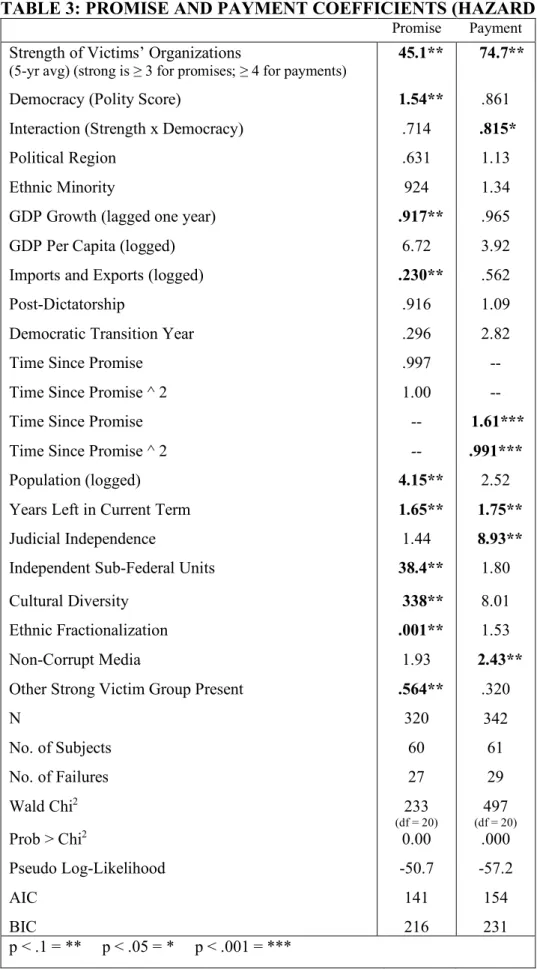
Table 3 - Promise and Payment Coefficients (Hazard Ratios)………..92
Appendix Table 1 - Democracies (Polity Score > 0 ) Promise Rates by
Whether the Abusive Episode Was a Conflict or a Dictatorship……….225
Appendix Table 2 - Non-Democracies (Polity Score < 0 ) Promise Rates
by Whether the Abusive Episode Was a Conflict or a Dictatorship………225
Appendix Table 3 - Democracies (Polity Score > 0) Payment Rates by
Whether the Abusive Episode Was a Conflict or a Dictatorship……….225
Appendix Table 4 - Non-Democracies (Polity Score < 0) Payment Rates
by Whether the Abusive Episode Was a Conflict or a Dictatorship………225
Appendix Table 5 - Correlations Between Variables in the Promised Equation……….226
Appendix Table 6 - Correlations Between Variables in the Paid Equation……….227
Appendix Table 7 - Correlation Coefficients Between Victim Strength
(5-Year Average) and Regime Type………228
Appendix Table 8 - Payments Model Where Victim Strength Is 3 or
Higher (Instead of 4 or Higher)………...229
Appendix Table 9 - Promises Model With Number of Transitional Justice Mechanisms, Presence of Truth and Reconciliation
Commissions, Amnesties, Trials, and UN Funding for Reparations………...231
Appendix Table 10 - Payments Model With Number of Transitional Justice Mechanisms, Presence of Truth and Reconciliation
LIST OF FIGURES
Figure 1 - Reparations Payments by Decade………...8
Figure 2 - Theory of Reparations Promises and Payments………48
Figure 3 - Likelihood of Receiving a Reparations Promise by Victim Strength Level………….78
Figure 4 - Likelihood of a Reparations Promise by Polity Score………..81
Figure 5 - Likelihood of a Reparations Payment by Victim Strength
Interacted With Democracy………...87
LIST OF ABBREVIATIONS
ANFASEP Asociación Nacional de Familiares de Secuestrados, Detenidos y
Desaparecidos del Perú, or National Association of Family Members of the Kidnapped, Detained, and Disappeared of Peru, a victims’ rights organization that aims to locate people who were disappeared in Peru’s internal conflict. It was started in 1983 by Angélica Mendoza, and it was one of the first, if not the first, victims’ rights organizations founded in Peru
AP Acción Popular; Popular Action, a centrist/center-right political party in Peru
APRODEH Asociación Pro Derechos Humanos, The Association for Human Rights, a
civil society organization founded in 1983 by Francisco Soberón to defend human rights in Peru
BArch Bundesarchiv, or Federal Archive
BEG Bundesentschädigungsgesetz, Federal Indemnification Law
BEG-Schlussgesetz Bundesentschädigungsgesetz-Schlussgesetz, Final Federal Compensation
Law
BErG Federal Supplementary Law, or Bundesergänzungsgesetz (also
abbreviated in early documents as BEG, but this was later amended to
avoid confusion with the Bundesentschädigungsgesetz, which is also
abbreviated as BEG)
BGH Federal Supreme Court, or Bundesgerichtshof
BWGöD Bundesgesetz zur Regelung der Wiedergutmachung im öffentlichen Dienst,
Federal Compensation Law for Public Servants
BVN Bund der Verfolgten des Naziregimes, Organization of Individuals
Persecuted by the Nazi Regime
CAI Conflicto Armado Interno, Internal Armed Conflict, a period of violence
and dictatorship within Peru that lasted from 1980 – 2000
CDU Christian Democratic Union
CMAN Comisión Multisectorial de Alto Nivel, High Level Multi-Sectorial
Commission, a body designed to monitor, coordinate, and establish the country’s reparations efforts
Human Rights, a collective organization of Peruvian human rights organizations founded in 1985
COFADER Comité Nacional de Familares Detenidos, Desaparecidos y Refugiados,
National Committee of Relatives of the Detained, Disappeared, and Displaced
CVR Comisión de la Verdad y Reconciliación, Peruvian Truth and
Reconciliation Commission, which ran from June 2001 to August 2003
EPAF Equipo Peruano de Antropología Forense, Peruvian Team of Forensic
Anthropology, a non-governmental organization that works with forensic teams from around the world to fight against impunity and for justice in authoritarian contexts
FARC Revolutionary Armed Forces of Colombia—People’s Army, or Fuerzas
Armadas Revolucionarias de Colómbia—Ejército del Pueblo
FDP Free Democratic Party
FIDH Fédération Internationale des Ligues des Droits de l'Homme, International
Federation for Human Rights, an international NGO that defends human rights and was founded in 1922
GDP Gross domestic product
GfbV Society for Threatened Peoples, or Gesellschaft für bedrohte Völker
IACHR Inter-American Court of Human Rights
IDL Instituto de Defensa Legal, Legal Defense Institute, an organization
founded in 1983 to provide legal counsel to innocent victims of governmental abuses
IRA Irish Republican Army
JRSO Jewish Restitution Successor Organization
KPD German Communist Party, or Kommunistische Partei Deutschlands
MRTA Movimiento Revolucionario Túpac Amaru, Túpac Amaru Revolutionary
Movement (leftist guerrilla/revolutionary group that committed abuses during the Internal Armed Conflict
NGO Non-governmental Organization
OLG Regional Appeals Court, or Oberlandesgericht
PIR Plan Integral de Reparaciones, Comprehensive Reparations Plan, passed
by the Peruvian Congress as Law No. 28592 in July 2005
PIRA Provisional Irish Republican Army
RKPA Reich Criminal Police Department, or Reichskriminalpolizeiamt
RZBZ Reich Central Office to Combat the Gypsy Menace, or Reichszentrale zur
Bekämpfung des Zigeunerunwesens
RzW Reparations Case-Law, or Rechtsprechung zum Wiedergutmachungsrecht
SED Socialist Unity Party of Germany, or Sozialistische Einheitspartei
Deutschlands
SPD Social Democratic Party
UN United Nations
VVN Union of Persecutees of the Nazi Regime, or Vereinigung der Verfolgten
des Naziregimes
INTRODUCTION
Before WWII, reparations were a way for militarily victorious states to punish their
losing adversaries. After WWII, reparations evolved from an international punishment into a
mechanism of domestic transitional justice, prompted by West Germany’s groundbreaking
reparations payments to German Holocaust survivors. The rationale behind turning reparations
into a tool for postwar and post-authoritarian reconciliation efforts is simultaneously hopeful and
cynical, and this tension between idealism and self-interest is a constant undercurrent in my
work. Although reparations can help restore some of the fractured trust between a government
and its citizens, they can just as easily become a political tool that is announced and implemented
to enhance a politician’s reputation, not a policy that is thoughtfully constructed and sustained in
a way that will genuinely help victims.
Seen through a positive lens, reparations are a way to address grievous injustices, make
amends, and help victims repair their lives (hence the term ‘reparations’). Although proponents
of this viewpoint acknowledge that reparations cannot right the wrongs of the past or provide
justice to someone whose life has been irreparably damaged, reparations can provide some
assistance to traumatized victims of severe human rights abuses. When governments are
cognizant of the victims’ individual and communal needs, they can design reparations programs
that target these specific issues. For example, because most of the violent episodes in the
communities, Peruvian reparations are often paid in the form of schools, hospitals, and other
public works projects constructed to benefit entire towns.
Reparations programs can even be amended over time to reflect victims’ changing needs.
For example, once Germany reunified, former East German political prisoners were quickly
granted financial reparations. However, decades later, victims’ rights groups and governmental
officials realized that the legal restrictions on this money meant that the program was no longer
meeting its clients’ practical needs. After speaking with the target population, governmental
officials in Brandenburg implemented a program that allows victims to apply for up to 10,000
Euros to spend on whatever they want, without providing the government with every individual
receipt, as long as the government approves the initial request. Victims have used this money for
a range of purposes, including replacing shoddy furniture, traveling to a health spa, and buying a
confidence-boosting wardrobe (Poppe 2016). The brilliance of this program lies not in the
amount of money disbursed, however, but rather in how it recalibrates the way victims relate to
the government. By allowing people whose health, careers, educations, and relationships were
destroyed by a paranoid, hyper-observant government to spend this money freely and without
oversight, Brandenburg is resetting victims’ expectations of government and reaffirming that the
current government sees these individuals as trusted German citizens, not enemies of the state.
In addition to financial payments and development projects, reparations can come in a
number of other forms, including pensions (Argentina), education vouchers (Chile), free entrance
to national cultural festivals (Estonia), free public transportation (much of Eastern Europe), and
physical memorials (Cambodia). In my dissertation, I do not include memorialization projects as
reparations, simply because of the difficulty of gathering comprehensive data on
entail some sort of financial obligation on the part of the government. I have also decided to
include property restitution as part of my analysis, although restitution is not exactly the same as
reparations. Restitution involves returning property or paying compensation for something that
has a concrete value, whereas reparations are paid for the loss of something irreplaceable and
invaluable. However, because property restitution is often closely linked to and administratively
overlaps with reparations efforts, seeing as the victims of property confiscation are also victims
of further governmental human rights abuses, I have included promises and compensation for
property restitution as a category in my quantitative analysis.
Seen through a cynical lens, reparations allow governments to buy victims off while
reaping international—or even domestic—praise for making progress in respecting human rights.
Victims are particularly likely to see reparations in this light when governments fail to pair
reparations payments with both an explicit apology for the government’s crimes and a guarantee
of non-recurrence. Unfortunately, it is relatively common for governments to issue reparations
without apologies, even though this undermines the abstract ideal of ‘justice’ that reparations are
theoretically supposed to promote. Although paying reparations without acknowledging victims’
suffering can quiet public criticism and satisfy the majority of non-victims, it invariably insults
victims and leads to the perception that governments are attempting to exchange cash for silence,
as is the case in Argentina and Northern Ireland (Hamber and Wilson 2002). The Peruvian case
also shows that, without an apology, victims are likely to view reparations as social assistance,
not as a genuine reparative gesture, which, again, invalidates the moral ends that reparations are
ideally supposed to serve. Nevertheless, reparations without apologies do have the advantage of
being politically expedient, because they allow governments to avoid uncomfortable confessions
The cynical view of reparations is particularly relevant when it comes to setting the
amount of money that is paid for each kind of violation. Reparations are perceived as an
instrument of justice, as a way to help make things right, but this idealization runs into trouble
when it confronts reality. How much do you pay someone for the loss of their leg? For their
inability to sleep without nightmares? For murdering their mother? Distasteful as it may be,
governments have to pick a financial sum or a service to provide, and the amounts often end up
being a pittance. For example, West Germany compensated Holocaust survivors with 5 Deutsch
Marks (DM) for each day they spent in a concentration camp, and, until recently, even that
money was available only to individuals who had spent at least three months in an
officially-recognized camp (BEG §45, Heuss 2016). Although 150 DM a month was enough to make a
difference to someone living on the edge of poverty, 5 DM a day for surviving what Auschwitz
survivor Frank Bright described as “hell on earth” seems more like an insult than a show of good
faith (Woodger 2017). Indeed, despite Israel’s dire financial situation after WWII, many
members of the newly formed Israeli government saw West Germany’s offer of reparations as
highly offensive “blood money” that, if accepted, would amount to nothing more than the
betrayal of millions of murdered Jews (“Knesset Debate” 1952).
Unfortunately, obscenely low sums of money are generally a hallmark of reparations
payments. Although, as in the case of Germany, these payments can add up to billions of dollars
over time, the amount paid to each individual is often laughably small (Bundesministerium der
Finanzen 2017). Governmental assistance with health care, job retraining, or education may
represent a much greater in-kind benefit to survivors, although, depending on the harm they
suffered, these benefits might not be relevant or useful to them (Drescher 2016). It is important
had before they were harmed, reparations do not and cannot accomplish this. Life-changing sums
of money are rare, and anyone who expects reparations payments and benefits to furnish a
comfortable life will invariably be disappointed. Instead, reparations are a symbolic gesture
whose value lies in their existence rather than their financial worth.
Victims are rarely under any illusions about this; in fact, survivors who pursue
reparations payments often want reparations not for purely financial reasons, but also because
reparations represent the government’s concrete acknowledgement of its crimes (Goschler 2016;
Robins 2011). When implemented properly, reparations serve as a signal of the government’s
contrition and its commitment to non-recurrence, two things whose symbolic worth outweighs
any monthly cash payment. This approach to reparations is clearly exemplified in the German
Sinti and Roma’s1 quest for reparations from the West German government. The constant refrain
of the lobbying campaign run by the Central Council for German Sinti and Roma had nothing to
do with how much money the government should pay to Sinti and Roma. Instead, the activists
wanted the government to take responsibility for the Nazis’ actions, admit that Germany had
committed genocide against the Roma, and embark on a path of apology and reconciliation—and
reparations were a tangible way to do this (Greußing 1980).
1 Roma are the largest ethnic minority in Europe. There are multiple subgroups within the
It is important to note that when victims lobby a particular government for reparations,
they are not usually asking for reparations from the exact same group of elected officials that
persecuted them. Although there could certainly be some overlap in terms of the politicians,
staffers, and bureaucrats present in the abusive regime and the current political structure –indeed,
this is quite likely if the violations were recent–, the governments that promise and pay
reparations are rarely the same governments that committed the crimes in question. Although
there are cases in which an abusive regime has paid reparations, with Morocco being a recent
example, the overwhelming majority of reparations payments are made by successor
governments, not perpetrator governments (Guillerot and Carranza 2009). Thus, the link between
human rights abuses and reparations payments is not a particular government, but rather the state
in which the abuses and payments occurred.
Clearly, it is necessary to make a distinction between a state and a government. States
neither commit nor make amends for human rights abuses; for the purposes of this dissertation,
states are merely the territory in which abuses occurred, not independent actors capable of
abusing people. Governments, on the other hand, are made up of individuals who can silently
approve, tacitly permit, or actively commit human rights abuses in the state they are governing.
And, after human rights abuses occur, that same state can be run by a government composed of
individuals who promise reparations, pass reparations legislation, and ensure that reparations are
paid. As a result, the phrase “state-sponsored human rights abuses,” though commonly used in
journalism and advocacy work, is imprecise within the context of my dissertation. Human rights
abuses are committed, sponsored, and atoned for by individual governments, not the states those
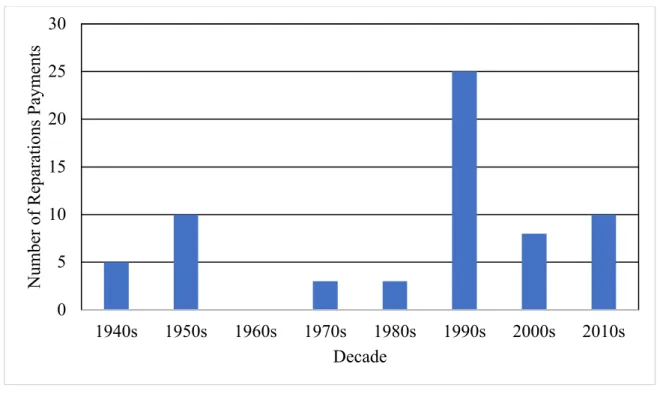
In the years since the West German government became the first to ever pay reparations
to its own citizens, reparations programs have spread to the point where they are no longer a
novelty. Indeed, after West Germany broke new ground in the 1950s with its federal reparations
law, many other Western European countries followed suit by paying reparations to their own
citizens, particularly their Jewish citizens, for the crimes that collaborator governments had
permitted and perpetrated or that occupied governments had failed to hinder. Thus, there was a
large spike in the incidence of reparations promises immediately after WWII, and a similar spike
in payments just a couple of years later.
Although reparations were paid for various crimes between 1960 and 1989, these were
isolated incidents. The next big spate of reparations did not occur until the fall of communism,
when governments across the Eastern Bloc started promising and paying not just for
communist-era crimes, but for WWII-communist-era crimes, as well (which Communist governments had not wanted to
acknowledge or take responsibility for). These long-overdue payments, combined with
Germany’s progressive expansion of the pool of victims eligible for its own Holocaust
reparations payments, point to the development of reparations as an international norm. Although
the number of reparations programs established in the 21st century does not rival the large
clusters of promises and payments caused by the end of fascism and communism, democratic
governments are becoming increasingly likely to pay for past crimes committed in the name of
the state, regardless of when those abuses were committed. Thanks to the slow but steady spread
of reparations as a global norm, it seems that, regardless of when governmental human rights
FIGURE 1: REPARATIONS PAYMENTS BY DECADE
The frequency of reparations is not the only thing that has changed over the years; the
perception of reparations has evolved significantly, as well, as this formerly “elites only” issue
has started to become a topic of more mainstream conversation and remains relevant in the 21st
century. For example, in 2013, several Caribbean countries got the world’s attention by
launching a concerted effort to get former colonial powers to pay reparations for slavery; in
2014, the United States was abuzz with talk of Ta-Nehisi Coates’ article “The Case for
Reparations,” which argued that the American government should pay reparations to victims of
systemic racism; and in January 2016, the United States was again fixated on reparations, as the
city of Chicago announced it would pay $5.5 million to victims of police abuse (CARICOM; 0
5 10 15 20 25 30
1940s 1950s 1960s 1970s 1980s 1990s 2000s 2010s
N
um
be
r of
R
epa
ra
ti
ons
P
aym
ent
s
punishments like those enacted via the Treaty of Versailles; rather, they are a way for
governments to help citizens whose human rights were violated by the country’s current or
former government. Reparations are no longer something considered and discussed only by
presidents, prime ministers, and parliaments—they are resource for ordinary citizens, a
mechanism for targeted social assistance, and, as mentioned above, an increasingly expected
policy tool of governments emerging from internal conflicts and dictatorships.
Despite the increased visibility of reparations, their expanded usage, and their developing
status as a global norm, we know very little about the whens and whys of this transitional justice
mechanism. After governments commit human rights abuses against their own citizens, what
motivates them to pay reparations? Why do governments decide to devote precious resources to
individuals who, until recently, were so devoid of political influence as to be incapable of
preventing their own government from imprisoning, torturing, and even killing them?
Governments could certainly find other ways to spend that money; why, then, would a sovereign
nation choose to make the financially costly commitment of paying reparations to seemingly
powerless individuals?
My dissertation breaks new ground by investigating this puzzle and offering a theory that
accounts for when and why governments promise–and pay–reparations. Although governments
have been paying reparations to their own citizens for systematic, government-sponsored human
rights abuses since the end of WWII, political science has yet to offer a theory about why
governments choose to promise and pay millions of dollars to traumatized citizens–who
oftentimes belong to marginalized groups in society–rather than spending that money on public
following chapters, I use an original quantitative dataset and qualitative data gathered from 68
elite interviews to explain the underpinnings of this globally relevant phenomenon.
Drawing from literature on social movements and transitional justice, I hypothesize that
governments promise and pay reparations only after they have been subjected to substantial
pressure from survivors who are demanding reparations. Although previous studies have shown
that reparations payments are correlated with democratic government and higher levels of
economic development, I argue that these factors do not cause governments to pay reparations
(Powers and Proctor 2015). Instead, my hypothesis is that when victim-survivors2 get organized
and place strong pro-reparations pressure on governments, attracting powerful political allies
along the way, then governments will be more likely to promise and pay reparations. It is
important to note that my theory is probabilistic rather than deterministic and that pro-reparations
pressure from organized victim groups is not a sufficient cause for reparations promises and
payments. Still, with these two caveats in mind, my dissertation finds both quantitative and
qualitative support for the idea that we must look to survivors themselves to discover why some
governments promise and pay reparations when others do not.
I test this theory using a mixed-methods approach. In Chapter 1, I review the relevant
literature on transitional justice, democratization, and social movements and use these insights to
construct and explain my original theory on reparations. In Chapter 2, I test my theory
quantitatively. In order to do this, I had to create my own dataset on reparations promises and
2 There is an ongoing debate in the literature whether to use the term ‘victim,’ ‘survivor,’ or
something else altogether to refer to affected individuals. Although ‘victim’ is, by definition, an accurate term, it carries connotations of passivity and helplessness. ‘Survivor’ bestows greater agency on an individual, but it can elide the severe pain and trauma that can continue to
payments. Constructing an original dataset was necessary because, with the exception of the
dataset created by Kathy L. Powers and Kim Proctor (2015), currently available transitional
justice datasets do not focus on reparations, and no dataset includes information on both
reparations promises and reparations payments. I felt that it was important to include the
promise/payment distinction in my work because some governments publicly promise to pay
reparations and/or pass reparations laws but never follow through on making these promised
payments. A reparations law is not the same as a reparations disbursement, and I believe that
making this distinction will add an important level of precision to future reparations work.
In order to test my theory, I develop and include a variable that measures victim group
strength. Given that this factor is the linchpin of my theory, a quantitative analysis without this
variable would be empirically informative but theoretically useless. Creating and coding a
measure of such an abstract construct proved difficult, but the theory necessitated its
construction. I look forward to refining this measure in the future and anticipate that improving
the quality of this measure will become easier over time, because data on contemporary and
future cases will be more extensive and readily available than data on the historical cases that
make up the bulk of my current dataset. Historical cases occurred in a context where reparations
were not a subject of quantitative scholarly research and when it was less common to keep
records on global human rights abuses, whereas I can collect data on future cases via the Internet
and as they occur. Currently, my dataset contains data on reparations promises and reparations
payments made for domestic, government-sponsored/approved/permitted human rights violations
that were committed in 180 cases across 57 countries in Europe, Central Asia, and Latin America
creation process, case selection rationale, structure, and contents of my dataset in more detail in
Chapter 2.
The next three chapters are in-depth case studies in which I use process tracing to show
how the behavior of victim groups impacts governments’ timing and approach to reparations. By
selecting three cases in which reparations were eventually promised and paid, I am able to
conduct a more focused examination of how the causal mechanisms of my theory translate
victim group strength into reparations outcomes across a diverse set of circumstances. Although I
include non-payment cases in only the quantitative chapter of my dissertation, not in the three
qualitative case study chapters, there are distinct advantages to focusing my attention on positive,
rather than negative, cases. The victim groups in my qualitative case studies exhibit wide
variation in how strong they are, both in comparison to one another and over time, and tracking
these three different victim groups over a series of decades allows me to show how victim group
strength is directly tied to governments’ reparations decisions. Chapters 3-5 serve to corroborate,
deepen, and expand upon the insights from Chapter 2, as I draw on elite interviews, archival
data, primary sources, and secondary literature to show how the uneven trajectory of victims’
movements explains both the timing and the approaches that governments employ when
promising and paying reparations.
Chapter 3 contains my first case study, that of the West German government’s
reparations promise and its reparations payments to Jewish Germans for the horrific human
rights abuses of the Holocaust. I selected this case because it constitutes the first time that a
government paid reparations to its own citizens for abuses committed in the name of the state
that government represents. As a precedent-setting case, there are some highly unique elements
served as a model for all of the cases that came after it constitutes ample reason to support its
inclusion in my dissertation. The data for this chapter come from primary documents, including
archival materials gathered at four different archives across Germany, as well as from secondary
literature, museum and memorial exhibits, and eleven elite interviews that I conducted with case
experts in Germany in Summer 2016.3 Although this case differs from the cases explored in
Chapters 4 and 5 because the victim population in question was largely located outside of West
Germany once the war ended, rather than remaining within the country’s borders, my theory still
holds: Jewish organizations, run in part by victims and victims’ relatives, along with
morally-motivated political allies within West Germany, prove to be the decisive factor in forcing a
reluctant set of politicians to pay reparations.
In Chapter 4, I examine a different post-Holocaust case, that of West Germany’s
reparations promises and payments to Romani Germans, most of whom describe their ethnicity
as Sinti. By selecting this case in addition to the Jewish German case, I am able to hold a large
number of factors constant from one analysis to the next. Even though both of these groups were
persecuted by the same government, were targeted for racial reasons, and suffered many of the
same abuses, Jewish Germans received reparations forty years earlier than Romani Germans did.
Given these similarities, identifying which factors vary across these cases help explain their
vastly divergent reparations trajectories. As in Chapter 3
, Romani Germans’ initial failure to acquire reparations, as well as their eventual success
in the 1980s, are best explained by the extent to which this victim group was organized and
actively exerting pro-reparations pressure on the government. To collect the data for this chapter
I visited libraries across Berlin, consulted four German archives, interviewed eleven case experts
within Germany between 2015 and 2016, and visited relevant memorial sites, museums, and
exhibits. Ultimately, I conclude that German Sinti and Roma received recognition and renewed
reparations from the federal government in 1981 as a direct result of their own organized,
publicized, and internationally-supported lobbying efforts—lobbying efforts that were
completely absent in the immediate postwar period.
Chapter 5, my final case study, examines the case of the Peruvian government’s
reparations payments to Peruvian citizens who were brutalized during the 1980-2000 Armed
Internal Conflict in Peru. Across this twenty-year period of conflict and dictatorship, thousands
of Peruvians were forcibly disappeared, wrongly imprisoned, murdered, raped, and otherwise
abused by government forces and domestic revolutionary groups. Including a contemporary
Latin American case permits me to test the generalizability of my theory by broadening both the
temporal and geographic scope of my work. I base my analysis in this chapter primarily on the
data I collected in the 18 elite interviews that I conducted in Lima, Peru in 2017 with Peruvian
activists, lawyers, human rights advocates, scholars, and other individuals who were personally
involved in the fight for reparations and who generously shared their eyewitness perspectives
with me. Once again, I find that the concerted efforts of organized victims, supported by
educated and influential allies, are the decisive factor in motivating governmental reparations
promises and payments.
I conclude by summarizing the most important points of my dissertation, which
constitutes a novel and significant contribution to the literatures on transitional justice,
post-conflict peace and reconciliation, and social movements. Not only does my work contribute a
decide to promise and pay reparations to their own citizens after the current government or one
of its predecessors has committed, sponsored, sanctioned, or permitted human rights abuses
against those self-same individuals. This section also includes a short discussion of avenues for
future research on reparations, as my dissertation is merely a single step towards understanding
the dynamics of reparations promises and payments. Such a complex phenomenon requires
CHAPTER 1: THEORY
Although the idea of compensating individuals for damages to their property, health, and
physical integrity is nothing new, the notion that a state must make reparation when it violates its
responsibility to take care of its citizens, either when the government actively commits human
rights abuses or passively prevents them from occurring, is relatively recent. In fact, it was not
until the end of WWII that occupied Germany became the first example of a government4 paying
its own citizens for the harm inflicted by a predecessor government.5 Since the 1940s, however,
the incidence of reparations demands, promises, and payments has climbed steadily, to the point
that reparations are no longer seen as an optional method of addressing past human rights
violations, but rather as a human right.6 Nor is there an end to the need for reparations—in
addition to cases of historical abuses for which reparations are long overdue, governments
around the world continue to commit systematic, widespread, and oftentimes grievous human
rights abuses against their own citizens.
4 West and East Germany did create their own national-level reparations schemes later on, but at this point in time there was no national government in Germany. As a result, each occupation zone had its own set of reparations laws, which were not necessarily drafted by the Allies but which were certainly mandated, heavily shaped, and overseen by the Allies.
5 Reparations are sometimes paid by the same government that committed the abuses, but this is
In this chapter, I provide a short history of reparations, examine the relevant literature,
and present my theory about what motivates governments to promise and pay reparations. It is
important to clarify what I mean by ‘reparations,’ as governments can promise and pay many
different kinds of reparations.7 In my dissertation, I examine both communal and individual
material reparations. I have opted not to include symbolic reparations in my analysis because
they often take on abstract forms. This makes them much harder to identify and measure, and it
also means that they are subject to different political dynamics than material reparations. With
these restrictions in mind, I use the transitional justice literature, democratization literature, and
social movement literature to help me develop my theory as to why governments promise and
pay reparations. I argue that governments are motivated to promise and pay reparations by strong
pro-reparations pressure exerted by victims themselves. In the following chapters, I show that
when strong victims’ organizations push for reparations promises and payments, they greatly
increase the likelihood of these promises and payments occurring.
It is important to note that this argument makes the starting assumption that governments
are resistant to promising and paying reparations, which may not always be the case. It holds true
in most cases, though; the vast majority of governments do not leap to promise and pay
reparations. Instead, they require an external incentive to persuade them to allocate precious
government resources to individuals who, up until recently, were so politically meaningless as to
be subjected to brutal, government-sanctioned abuses. Even when governments are committed to
7 As mentioned in the introduction, reparations are usually thought of as being monetary
payments from one government to another, but in practice they are highly diverse. Reparations can take a wide range of material forms, such as pension payments, housing vouchers, or medical care; they can be symbolic, as when governments build memorials to honor victims, open
addressing the crimes of the past, there are many transitional justice mechanisms at their
disposal, and they need not adopt reparations. Reparations programs require a great deal of
bureaucratic coordination, often involve substantial sums of money, and usually the cost of such
programs ends up expanding well beyond initial expectations. It is therefore unsurprising that
entire governments rarely, if ever, immediately support such a financially costly initiative. At the
very least, finance ministers will almost certainly attempt to block or weaken reparations efforts;
this is often the case even when the finance minister’s party supports reparations (Goldmann
1952). Even when victims themselves rise to political power, they are not necessarily vocal
reparations advocates, and those who are will probably not be able to persuade the rest of the
government to adopt pro-reparations views without incentivizing this position. Thus, there is a
strong justification for assuming that governments will be resistant to reparations and will need
external inducement to adopt a reparations policy. I argue that a particular segment of civil
society, namely victims’ organizations, provides this external inducement.
Although the transitional justice literature has yet to explicitly examine the connection
between civil society and governments’ reparations decisions, it has documented the importance
of civil society in steering, supporting, and/or blocking the course of transitional justice overall.
Thus, the transitional justice literature offers an important starting place for constructing my
theory. Reparations are a unique transitional justice mechanism in many respects, however,
because they are the only transitional justice mechanism that focuses solely on victims. All other
mechanisms—truth and reconciliation commissions, trials, amnesties, lustration, and exiles—are
either directed at perpetrators or, in the case of truth and reconciliation commissions, involve
perpetrators, victims, and society at large. As a result, other mechanisms are more likely to
officials) and, therefore, to both affect and interest the public at large. Reparations, in contrast,
benefit a small minority of the population and are rarely, if ever, a salient electoral issue.
Therefore, in order for a government to find value in promising and/or paying reparations, a
strong pro-reparations lobby must make the case for using public funds to compensate a formerly
politically powerless minority.
Victims’ organizations make this case by threatening governments with heavy
reputational costs that could then induce economic costs. The social movement literature is
critical to building this element of my theory, because it explains how non-elites can use
organizational strength to force a government to cater to a small but mobilized minority. In
keeping with the social movement literature, I argue that, if victims want to receive reparations,
the first step is to get organized and articulate their demands. The next step is to enlist outside
help from allies, who are able to give advice on running a lobbying campaign, make
introductions to politicians, and use their own influence to draw attention to the movement.
Media attention is often critical, as survivors’ stories can help attract sympathetic allies both
domestically and internationally. It also helps by making reputational threats more credible,
which in turn makes the government more responsive to victims’ demands.
Clearly, some political systems are more responsive to citizens’ demands and to
reputational costs than others, and as a result some victims’ organizations will experience
success at lower levels of organizational strength than others. The democratization literature is
helpful in this respect, as it provides insight into how citizens and governments interact in the
post-conflict and post-authoritarian contexts in which reparations are most likely to be needed,
always succeed in forcing reparations promises and payments, I do expect that if victims do not
lobby for their interests, governments will neither promise nor pay reparations.
Offering a theory about when and why governments pay reparations is an important
contribution to the literature, because relatively little work on reparations exists. This is likely
due to in large part to the fact that, up until 1980s, when the aftershocks of the Third Wave of
democratization began spreading human rights norms in what is now known as the “justice
cascade,” human rights were not a priority on the international agenda (Finnemore and Sikkink
1998; Keck and Sikkink 1998, 2001). Governments did pay reparations to citizens prior to the
justice cascade, and not solely to Holocaust victims, either, but reparations were most often
thought of as post-conflict payments from one state to another, not as a reparative effort from a
government to its electorate. However, as the scholarly field of transitional justice began to
coalesce in the 1980s, reparations gained traction as being part of the authoritarian,
post-conflict playbook. The fundamental principle of transitional justice is that democratizing
countries ought to address and overcome the past by seeking truth, justice, and reconciliation,
and one way to do that is by compensating individuals who have been subjected to severe
repression.
Over time, practitioners began applying the principles of transitional justice to
non-transitional contexts, as well, which expanded the scope of reparations. This opened a door to
consider reparations for historical reparations and recent human rights violations that occurred in
consolidated democracies, such as slavery in the United States, forced sterilization programs that
were common across the Western world in the 20th century, and the genocides that colonizers
Subnational entities in longtime democracies have also started adopting reparations,8 as was the
case in 2014, when North Carolina began paying reparations to victims of that state’s forced
sterilization program, and again in 2016, when the city of Chicago began paying reparations to
victims of police torture (America 1995; Coates 2014; Kennedy 2016; Mennel 2014).
Due to the increased demand for and the rising implementation rate of reparations
programs in developed Western nations, as well as to the spread of transitional justice more
broadly, reparations have gone mainstream. They are also just as timely today as they were
seventy years ago, when the German occupation zones began paying reparations to Holocaust
survivors. This continued relevance and growing Western interest in the topic has gradually
attracted more scholars to study reparations, but reparations still receive less attention than most
other transitional justice mechanisms, and the big questions regarding reparations remain
unanswered. There have been no cross-temporal, cross-national investigations into why
governments pay reparations or how reparations programs materialize, and the discipline is only
just beginning to examine what effect reparations have on a post-conflict or post-authoritarian
society (Firchow 2017; Vera-Adrianzén 2018). Not only that, there are no generalizable theories
about reparations that could help answer these questions. This makes my dissertation
groundbreaking: The theory that I present in this chapter is the first theory about what motivates
governments to promise and pay reparations, and it constitutes an important step in moving the
discipline forward in its understanding of reparations dynamics.
Given the comparative scarcity of research on reparations, I draw on three broader
strands of literature in order to develop my theory: The literature on transitional justice, the
literature on democratization, and the literature on social movements. These three fields are
closely linked; the name transitional justice implies that a regime transition—generally assumed
to be a democratizing one—is taking place, and social movements are commonly studied in
relation to democratic transitions and, increasingly, in relation to transitional justice (Backer
2003; Burt et al. 2013; Gready and Robins 2017; Musila 2009; Pajibo 2007; Rangelov and Teitel
2011; Sikkink 2008; van der Merwe and Schkolne 2017). My dissertation adds yet another piece
to our understanding of these fields and the ways in which they connect. I turn now to sketching,
in turn, how these literatures underpin my theory.
1. Transitional Justice Literature
The transitional justice literature shows that civil society is an important determinant for
the path of transitional justice overall, but it has less to say about reparations in particular. Given
the relative newness of the field, a great deal of work remains to be done. Currently, a few
noteworthy cases receive a disproportionate amount of attention, truth commissions and trials are
by far the most-studied mechanisms, and the limited existing work on reparations is
overwhelmingly qualitative, which limits the generalizability of the findings. In fact, my dataset
is only the second dataset to focus solely on reparations, and it is the first to include both
reparations promises and reparations payments (Mallinder and O’Rourke 2016; Powers and
Proctor 2015). However, the transitional justice literature still yields important insights about
reparations and transitional justice in general that will allow me to create an informed theory
about why governments decide to make reparations promises and payments.
I begin by discussing the findings from the only three quantitative datasets that include
reparations: the Transitional Justice Data Base/Transitional Justice Data Project (Olsen, Payne,
Powers and Kim Proctor’s (2015) reparations dataset. Although these existing datasets have
different inclusion criteria, which necessitates some caution when assessing and comparing the
results of studies that use this data, it is worth presenting the results and seeing how they align
with or diverge from qualitative work. First of all, Tricia D. Olsen, Leigh A. Payne, and Andrew
G. Reiter (2010) find that post-dictatorship cases are more likely to utilize transitional justice
mechanisms than post-conflict cases and that European countries have a higher incidence of
reparations payments than other regions. They also find that the likelihood of implementing
transitional justice mechanisms increases when a country is experiencing economic growth,
although reparations were not included in this study (Olsen et al. 2010b). Secondly, Powers and
Proctor (2015) find that countries are more likely to pay reparations when they are wealthy,
when they are democratic, and when they have implemented other transitional justice
mechanisms. Finally, Helga Malmin Binningsbø, Cyanne E. Loyle, and Scott Gates (2012) find
that reparations are paid more often after bargained conflict cessations than decisive victories,
when a conflict was fought over territory rather than over control of the government, and when
the conflict was a civil war rather than a low-intensity conflict. Thus, the quantitative literature
does not yet speak to the causal mechanisms behind reparations, but it does indicate that
economics, geography, and regime type may have some explanatory power.
Some of these findings have not yet been investigated in the qualitative reparations
literature; others, however, align with recurring themes in the transitional justice,
democratization, and social movement literatures. Perhaps the most fundamental of these
transitional justice literature findings is the importance of the impact of regime type, because
many of the other findings follow from this one. Powers and Proctor (2015) do not offer a theory
transitional justice, democratization, and social movement literatures all contribute pieces of the
puzzle. To start with, all governments, regardless of how democratic they are, have a limited
amount of resources with which to meet citizens’ demands. This means that they will not usually
choose to fund unpopular projects that could cause them to lose an election or, in the case of
autocracies, to risk popular unrest. Thus, if we view transitional justice mechanisms as but one
option on a menu of policy choices, governments will neither pursue transitional justice in
general, nor select a certain mechanism in particular, unless the public has demonstrated support
for –or at least not mounted active resistance to– the initiative (Bosire and Lynch 2014; Grodsky
2006; Lessa et al. 2014; Subotić 2007).
It is also much easier for governments to say they will pursue justice than it is for them to
act on that promise. As a result, many governments end up twisting so-called justice initiatives to
their own ends, gradually abandoning promised transitional justice projects, or never even
attempting to fulfill their promise (David 2006; Horne 2009, 2012, 2014; Subotić 2007). The
public plays a particularly important role in prompting justice initiatives when governments
prove recalcitrant. Strong, supportive civil societies can embolden victims to voice their
reparations demands, oppose governmental efforts to repress human rights efforts, and help to
ensure that transitional justice in general, and reparations programs in particular, are
implemented appropriately (Adhikari, Hansen, and Powers 2012; Kurze 2012; Laplante 2007;
Oette 2009).
International actors can certainly exert additional pressure on reluctant governments, and
this additional pressure can aid domestic actors in their efforts, but the transitional justice
literature cautions that the impact of international influence on domestic transitional justice
As previous work has shown, international attention fades, and without domestic actors to pick
up the slack, justice and reparations will not be implemented if there is no local initiative to drive
them forward (Kim 2008; Suh 2012; Olsen et al. 2010a). Consequently, as is the case with
democratization, transitional justice is unlikely to succeed if it has international, but not
domestic, buy-in. However, the reverse is not the case.
2. Democratization Literature
Given how critical domestic support is to transitional justice, it is easy to see how the
success of pro-justice and pro-reparations efforts would be heavily influenced by regime type. It
is much simpler for activists to demand and acquire justice in a democracy, which respects the
rule of law and which allows citizens to vote governments out of office if they do not respond to
citizens’ demands, than in an autocracy, which does not hold free and fair elections and which
can restrict citizens’ ability to organize, protest, and/or report on such events (Bueno de Mesquita
et al. 2003).
However, in terms of theory construction, I do not expect democracy to cause
reparations. Rather, my research indicates that the driving force behind reparations –both
promises and payments– is pro-reparations pressure from domestic activists, particularly
pressure from victims themselves. Given the primacy of regime type in the literature on
transitional justice, though, it is worth unpacking the link between the fields of transitional
justice and democratization a little further, so as to gain a clearer picture of how domestic
activism, which is tied to democracy, influences transitional justice in general and reparations in
particular. The importance of democracy to transitional justice is reflected in the very name of
was designed to apply in transitional contexts, even though, as mentioned above, it can be
applied to pre- and post-transitional contexts, as well.
It should be no surprise, then, that reparations research can likely benefit from examining
the democratization literature to see how power dynamics function in transitional contexts.
Previous work on democratization as it relates to justice has found that when the old elite
remains in power, justice tends to be more lenient (Huyse 1995; Pion-Berlin 1994; Zalaquett
1992, 1994). This, too, is unsurprising; justice –including, presumably, reparations– is hardly
likely to be on a government’s to-do list when the government has a vested interest in
maintaining impunity. Pacted transitions, in which democratic reformers and former hardline
autocrats negotiate a transition together, offer more hope for reparations than transitions without
any elite turnover, although pursuing justice and democracy after a pacted transition can still be a
difficult endeavor (Lynch 2012; Powers and Proctor 2015; Rigby 2001; Stepan 1986). After a
pacted transition, new, pro-justice elites do hold some positions of power, but holdover elites
will likely seek amnesty for their crimes or try to institutionalize other methods of obstructing
justice (Laplante and Theidon 2006; Nalepa 2009; Snyder and Vinjamuri 2003/4; Subotić 2009;
Weah 2012). When it comes to democracy and justice, a clear break with the past offers the best
prospects for developing a democracy that respects civil rights and the rule of law. And although
reparations do not surface explicitly in the democratization literature, it seems reasonable to
expect the dynamics of reparations to depend on many of the same factors that influence
democratization.
Regime type is also important because of how it influences the form and vibrancy of civil
society. Civil society is a key player in the transitional justice process, and the literature on
they can and do influence governmental behavior—autocracies do stifle civil society, whereas
democracies offer the participatory environment and civil liberties protections necessary for
fostering active, robust civil societies (Putnam 1993; Reuter and Robertson 2015; Robertson
2009, 2010). A quick glance at social movements in communist Eastern Europe shows that it is
sometimes possible for people to engage in collective action in abusive dictatorships, although
the stars must align on a myriad of factors in order for collective action to occur, let alone change
governmental policy.
These factors can and do align on occasion, however. In a move that was largely seen as
an attempt to quiet domestic discontent and preserve Morocco’s international reputation, King
Mohammed VI paid reparations to certain people who had suffered human rights abuses at the
hands of the monarchy during his father’s tenure (Loudiy 2014). Autocrats may not have the
same electoral incentives to respond to domestic pressure that democrats do, but they still need to
maintain a modicum of public support in order to stay in power, and they have reputational and
economic incentives to avoid attracting too much negative international attention (Loudiy 2014).
Thus, although it is easier to generate pro-reparations pressure in a democracy, committed and
lucky activists in autocracies can successfully push for reparations, as well.
Transitional justice and reparations are also like democratization in that sometimes they
seem to be bottom-up movements, whereas at other times they seem to be purely elite affairs.
When examining the qualitative transitional justice literature, however, and the reparations
literature in particular, a clearer pattern emerges. Almost without exception,9 the main drivers
9 The rare exceptions occur in post-Holocaust cases. Jewish victims were highly mobilized and