HERE AND AWAY: MOTHERHOOD AND BELONGING AMONG EXPAT WOMEN IN GENEVA, SWITZERLAND
Lindsey Marie West Wallace
A dissertation submitted to the faculty at the University of North Carolina at Chapel Hill in partial fulfillment of the requirements for the degree of Doctor of Philosophy in the Department
of Anthropology in the Graduate School of Arts and Sciences.
Chapel Hill 2018
©2018
ABSTRACT
Lindsey Marie West Wallace: Here and Away: Motherhood and Belonging among Expat Women in Geneva, Switzerland
(Under the direction of Michele Rivkin-Fish and Peter Redfield) The transient space of Geneva hosts a cosmopolitan and mobile population that
challenges anthropological understandings of culture, community, and kinship in everyday life. Shrouded in privilege, the world of international expats operated almost invisibly in Geneva. When I asked doctors or midwives questions about them, I heard a dismissive message: "expat women do not have any problems." However, the transition to parenthood is a rite of passage that involved navigating physical, medical, emotional, and social challenges. This dissertation follows a cohort of first-time mothers through pregnancy and birth to explore how their position as expats shaped their prenatal education, care-seeking strategies, experiences, and birth
narratives.
Expat mothers built narratives of self and networks of support to manage their
ACKNOWLEDGMENTS
Many people helped me during the eleven years I have spent working on my Ph.D. My advisors Peter and Michele and my committee provided invaluable feedback and encouragement along the way, as well as sharing their wisdom with me, thank you.
Thank you to everyone at UNC who worked with me and supported me during my time there. My colleagues and classmates, professors, and friends. Thank you to the many women, doctors, midwives, policy experts, and others in Geneva who generously gave their time and shared their experiences with me. I want to especially thanks to my in-laws Jane and Mark Wallace who supported this work not only with encouragement but with a place to live and connections into the expat community in Geneva.
Thank you to the organizations whose financial support was critical at the beginning and ends of this project, specifically the council for European Studies and the Society for the
Anthropology of Europe for providing pre-dissertation funding and much-needed confidence, and Adobe Systems for paying my last semester of tuition so I could graduate. Thank you to the Graduate University of Geneva for allowing me to be a fellow and get papers, especially my supervisor Dr. Schultz-Tenkhoff.
TABLE OF CONTENTS
LIST OF FIGURES ... x
LIST OF ABBREVIATIONS ... xi
INTRODUCTION ... 1
Why Expats? ... 2
Why Reproduction? ... 4
The Field ... 5
Research Phases ... 10
Phase 1 (Summer of 2009) ... 14
Phase 2: Fall 2011- July 30th 20 ... 21
Phase 3: July 30th, 2012 - Fall 2013 ... 26
Overview of Chapters ... 30
CHAPTER 1: GENDERED SPACE-TIME AND MOBILITY AS IDENTITY ... 34
Introduction ... 34
Expat Strategic Citizenship ... 36
Creating Communities in Gendered Space-time... 44
Mobility as Belonging: Digital Communities ... 52
Conclusion ... 62
CHAPTER 2: PREGNANCY, INTEGRATION, AND EDUCATION ... 64
Introduction ... 64
Integration & Citizenship ... 67
“Maman à Genève” ... 73
Anglophone Class ... 83
CHAPTER 3: RITES OF PASSAGE UNMOORED ... 90
Introduction ... 90
Birth as a Grounded Rite of Passage... 93
Location and Economies of Control and Care ... 99
La Maternité... 102
Language and the Physician Guide ... 107
Trust and Care in the Private Clinic ... 108
Vulnerability and Control ... 115
Conclusion ... 124
CONCLUSION ... 127
LIST OF FIGURES
Figure 1. Maps of the city and Canton of Geneva ... 8
Figure 2. Breakdown of research activities during phase 1 of project... 14
Figure 3. Breakdown of research activities during phase 2 of project... 21
Figure 4. Breakdown of research activities during phase 3 of project... 26
Figure 5. Marriage demographics in Geneva between 1984-2004 ... 43
Figure 6. Screenshot of Glocals homepage from February 8, 2018 ... 57
Figure 7. Representing the flow of resources and services through expat internet groups ... 59
LIST OF ABBREVIATIONS CHF Switzerland Franc
HUG Hopitaux Universitaires de Genève ICT internet and communication technologies MMG Mommy Meetup Group
MMO Major Midwife Organization Ngos non-governmental organizations
UK United Kingdom
UN United Nations
INTRODUCTION
This study explores the disjunctures between expat communities and models of belonging built on a transactional model of citizenship and the Swiss model, which centers on integration and focuses on citizenship as a core aspect of membership in a national community, entailing obligations of care. In Geneva, the relative visibility of different groups of foreignness gets created and reified through state categories and policies of health access: migrants, asylum seekers, and undocumented workers are covered under distinct programs that offer different degrees of access to reproductive health care and support for integration into Swiss society. Expatriate communities of highly educated Francophone or Anglophone women “elite migrants” (Coles and Fechter 2008:5) are rendered relatively invisible in this context. The state and
medical apparatus consider them part of the general patient population of the city. These women have health insurance or pay for care out of pocket, navigating the health system on their own.
This introduction situates my research at the intersection of anthropological work on gender, reproduction, and mobility. I provide an overview of my research in Geneva, including the methods I used, how I came to study expats and focus on pregnancy, and how I conducted this study.
mutual blindness results in expat women often seeking out expensive and riskier private medical care during birth. Looking at expat women's birth narratives reveals the importance they place on finding providers who will speak to them in their own languages and give them personalized attention. However, this strategy ends up posing unanticipated risks because the women end up seeking care in private clinics and relying on individual relationships with their providers to navigate pregnancy and birth.
Studying expat communities is often challenging for anthropologists, as expats are defined by their mobility and their quintessential outsiderness (Redfield 2012). Whereas
anthropologists since Malinowsky have been hurling themselves “off the veranda” (Malinowski 1989), studying expats entails embracing and turning towards the people who inhabit and define themselves on the veranda. This dissertation is in conversation with anthropological works that place expats in the context of global migration. This study focuses on the concrete ways that expats positions in the global economy challenges and reshapes ideals of citizenship in the Swiss context, building on insights and questions raised by literature exploring the expat as neo-liberal subject and the messy intimacies of neoliberalism and global migration( Ong 2007: 88,
Hannaford 2017). Why Expats?
While I use the terms "expat" and "international" throughout this dissertation. I do not mean to imply that "expats" are a homogenous or bounded group. In fact, quite the opposite. So then what do we mean when we talk about "expats"? In the anthropological literature, expats are often categorized as people who live outside their home countries for extended periods of time because of their careers.
(Ong 1999) to discuss expats, terms that convey a sense of frictionless motion, of floating above the local context, having no problems, that elide the messy and complicated ways that expats interact with and live in their local contexts in their day to day lives. It might be a coincidence that "expat" and "expert" are so close in sound, but it is an apt pairing. When anthropologists write about expats, they are writing about elite businessmen sent abroad by their corporations or pursuing entrepreneurial opportunities (Ong 2006), humanitarian aid workers with specialized skill sets (Redfield 2012) and diplomats who represent their countries abroad. In contrast, much research on migrants outside of this narrow group focuses on the bonds of kinship and
responsibility linking them to their home country, exploring the ways they remain grounded and tethered (Hannaford 2017). In Geneva, while these people indeed are part of the expat
community, the term has a particular local meaning.
Studying the ways expats made lives in their communities meant confronting how the systems of inequality and privilege that minimized problems for expat families, that allowed them to overcome the inevitable shocks and difficulties of living in a new place, also made my work possible and propped me up as a participant-observer in that community. As an
anthropologist, engaging with my position as a privileged sojourner in the city of Geneva and as a pregnant and mothering researcher became imperative.
Looking at the way expat women navigate becoming mothers and handle the stress of mobility offers a possibility for understanding stratified reproduction (Ginsburg and Rapp 1995) and the ways it creates opportunities and eases reproduction for women at the top. As
unknowingly from their social position. Expat models of belonging challenge the universalizing project of democratic citizenship, which is depersonalized and universal (Ong 2007:88). For expat women, successfully navigating becoming mothers was not easy and did not happen just by their social status, but these women through their experiences, background, and habitus possessed tools they used to make sense of their experiences and craft their subjectivities as mothers. One of my informants, Becky, summed up a lot of the themes that came up during this research as women navigated the transition to motherhood.
As you become a mother, I think, especially while you're at home, however long you're at home with the child, whether it's 3 months or um, 6 weeks or a year, you, your identity changes as you become a mother and you become the caretaker of a small being. And sometimes I think, more so than a man feels as a father, because they're a man and it is not expected of them, you wonder if, you know, you care about them and you love them and everything, but if by giving everything to them, by taking care of them, that you are like, not a modern woman sometimes? You feel a little bit like, "am I like selling out into this retro gender role?" and especially if you're home for a longer time, and you do things around the house, so I think that's probably the biggest challenge, how you view yourself. And I honestly think that by moving and doing it in a city that's new to you, I think it's probably easier. Because, um, you aren't stepping away from something you used to do or how you used to view yourself in the same environment. So you, you have to re-create your identity a little bit so you might as well throw the baby in with it. (Becky,
American) Why Reproduction?
As I developed my project, motherhood became the central focus and lens through which I approached understanding women’s lives. Motherhood links women’s physical, affective, familial, economic and social experience (Maher 2010). At the same time, “professional nomads are at once situated and circulating, and they embody a kind of market citizenship - occupation-driven, mobile, temporary residence, here today, gone next year - bodies that express the sign value and extraterrestrial reach of the global city itself” (Ong 2007:89).
frictionless for expat families, the physical coming and going of an expat life are complicated and full of friction. This research shows that women, particularly mothers, face the downsides of mobility immediately and struggle with loneliness, dislocation, dependence, and adjustment as they work to build families and identities in Geneva.
The woman as a maternal citizen (Arextaga 2003, Gal and Kligman 2000, Krauss 2004, Rivkin-Fish 2010) is in some ways problematically positioned within the male-gendered realm of the state, even as women are central to the nation. “Whether to treat women as producers or reproducers has been a perennial dilemma, differently handled in different historical moments and systems” (Gal and Kligman 2000:32, Berdahl 2003, Paxson 2004). Reproduction and health emerged as essential sites of contested discourse over gender, family, and citizenship even in the privileged expat world. Examining prenatal education and birth care revealed the ways that contests over desirable personhood and gender performance influenced aspects of teaching and medicine that seemed on the surface to be merely biological or scientific (Martin 1987)
Delvecchio-Good 2007).
As many anthropologists have noted (Maher 2010, Cheney 2011, Davis-Floyd 1994, 2003, Rivkin-Fish 2007), birth is a social rite of passage that creates new subjectivities for women as mothers in particular cultural contexts. Robbie Davis Floyd's (1994, 2003) research revealed how numerous rituals in American hospital births have emphasized the central
importance of scientific authority and medical power over women's bodies and practices, a topic I will elaborate on in later sections of this dissertation.
The Field
Politically, Geneva’s history is one of a city-state, and although it joined the Swiss Confederation in 1815, before that time, it existed as an independent republic. Since the early middle ages and the end of Roman occupation it was first ruled by the bishops of the Catholic church, and then after the Calvinist reformation by a council of citizens, In fact, it is still officially known as “The Republic and Canton of Geneva” despite being a part of the Swiss nation-State (Zimmer 2003). In addition to the topographical boundaries, the city is geopolitically bounded. Surrounded on three sides by France, it is a little point of Switzerland, more border than interior. Geneva has been the center of an international community at least since the founding of the League of Nations in 1924. Before that, Geneva was the site of the founding of the International Red Cross and our modern idea of humanitarianism. Going back even further, Geneva's history as a center of new ideas and trade dates back to the Renaissance and its role as the birthplace of Calvinism. Rousseau and Voltaire also frequented Geneva and its surrounding areas.
The geography of Geneva is complicated and made more complex by the scarcity of housing and the ways the city spills across the border with France. The ever-increasing influx of international workers strains the city’s housing supply and contributes to the “crise du
logement," an ongoing housing crisis of escalating costs and diminishing supply of housing in the city. The cost and shortage of housing in the city shape everyday life for expats and locals, and families and the state adopt various strategies to deal with it. Housing in Geneva is
relocation assistance to locate appropriate housing and navigate the complicated Swiss housing laws and rental process. Landlords (régies) take advantage of the transient international labor force through charging more for short-term leases and turning a blind eye to the subletting economy, through which rooms and apartments are rented for short periods of time to people in Geneva for internships or short-term contracts, undocumented laborers, or other temporary appointments, at many times their original rental cost. The people subletting are transient and cannot meet or do not know the requirements to rent an apartment concerning income,
documentation, and stability. Besides, the influx of well-heeled workers and families competing for apartments in the city keeps the demand for flats exceedingly high and allows the régies to basically do what they want regarding charging fees, making income restrictions, and selecting tenants.
To talk about Geneva is to talk about both the relatively compact urban core of the city itself, and the broader reaches of the community that spill into neighboring France and are linked by a complex system of trains, buses, and trams, in addition to roads and bicycle infrastructure. "Le Grand Genève” is the official name for an ongoing project of coordination between France,
Figure 1. Maps of the city and Canton of Geneva
Geneva is a special place to study both expats and families. Situated on the border between Switzerland and France, it is both a place of frequent coming and going and a city that is very concerned with place-making and community. Geneva is perhaps best known globally as the home of the UN and a representation of Swiss neutrality. Heads of state routinely fly in and out of the city to discuss the important matters of the day, and the city is often in the world-wide news as the site of international declarations and negotiations. However, when we talk about this Geneva, the city itself is erased and denationalized (Ong, 2007:84) and becomes just a backdrop to the comings and goings of the very important foreigners in the city.
The tendency has been to consider the big city as a denationalized space, a site of
universal rights for all newcomers. I propose an alternate concept of the city as a national site that activates neoliberal desires for foreign experts whose presence puts into question equality of access to rights and entitlements. As an interstitial space between nation and the world, the megacity becomes a zone of mutating citizenship, as different categories of migrants are differentiated according to the kinds of tangible or intangible assets they bring to the urban economy. The pied-a-terre is the hinge between a global meritocracy and the megacity. The talented expatriate, poised between staying and going, participates in a kind of dysfunctional marriage that destabilizes notions of permanent belonging. (Ong 2007: 84)
While Geneva is in some ways emblematic of a global city, that does not tell the whole story. In contrast to many cities we think of as being cosmopolitan and representing the jet-setting dynamism of fast capitalism, Geneva is not a mega-city. It is not even a particularly big city. The population of the city of Geneva is just about 200,000 people, and the Canton of
Geneva doubles that. In interviews and discussions with people working in the city's government and Swiss friends, they stressed that Geneva was still a "village."
As I'll discuss at length in this dissertation, the value of "integration" - helping immigrants become part of Swiss, and more particularly Genevan, society through learning French and accepting Swiss social practices and values - undergirded a well-developed and complex network of social services provided by the city, canton, and NGOs for migrants in Geneva. This value of integration also came to bear in the efforts that the city made to foster civil society and public life for families. In addition to numerous impeccably maintained parks, public pools, and beaches, the city also funded public spaces specifically for families with babies and small children. Although not explicitly "women only" these public play-spaces and toy libraries were heavily gendered female. The unspoken presumption in Geneva is that when women have children, they don't work, or at least not full time while the children are young. This assumption underlays a strong commitment to fostering inclusion and "integration" for women with young children into public life by providing indoor playspaces and toy libraries as well as other events.
Although the elite UN and diplomatic communities in Geneva were a part of the expat community, it would be a mistake to assume that it was made up uniformly of the elites. Much of the expat community consisted of students and jobseekers drawn to Geneva by the lure of
landing a job with the UN or a large multinational corporation. Looking for a job or pursuing an internship or education in Geneva was precarious and offers no guarantees of success. Also, even "securely employed" foreign workers faced high levels of precarity. My interviews were littered with stories of spouses being laid off after the family had moved to Geneva, divorces pushing women out of the city, and sudden moves because of job changes. Studying expats also offered the opportunity to look at a different aspect of mobility. In contrast to refugees and asylum seekers who are forced to flee their home countries, and also to undocumented migrants who often migrate in circumstances that make the concept of "choice" irrelevant, the mobility of expats was often desired mobility, attained through careful effort and strategic use of papers and citizenships. "A popular view of the city stresses its internationalized role in converting
immigrants into citizens, if not of the country, then of the city itself.” (Ong 2007:84). Research Phases
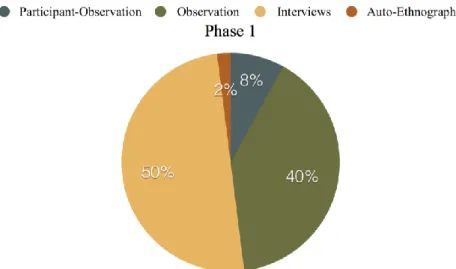
I conducted this research in three phases, and my fieldwork approach shifted over time. I centered each phase around discussions with distinct groups of interlocutors, each conducted in different social spaces. I performed this research over a period of four years between 2009 and 2013. Over the course of the project, I used four main strategies to learn about the world of expat women in Geneva: interviews, participant-observation, observation, and embodied auto-ethnography. Each of these strategies allowed me to understand a different aspect of what people say, what they do, and what they say about what they do, and how these core elements of
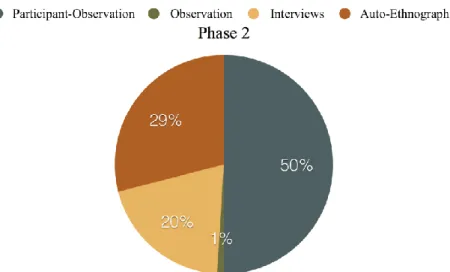
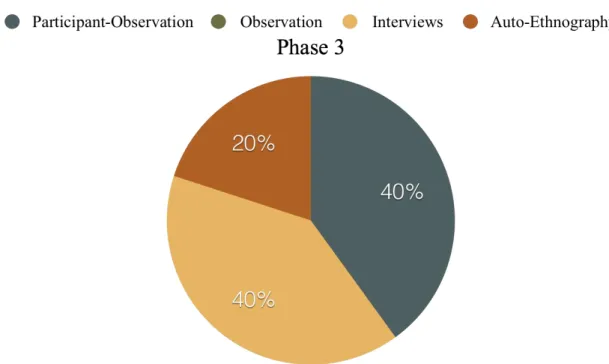
differing intensity over the course of the research, which I’ve represented visually at the start of each section.
My perspective over the course of my research was shaped by growing familiarity with the city and by my transition from being a single person in the summer of 2009, to the married mother of a 1-year-old son when I left in 2013. Writing about the experiences of the women I met while becoming a mother in Geneva provided me with many opportunities as an
ethnographer, while my own experience inevitably shaped my preoccupations, focuses, and biases. Pregnancy and parenthood indelibly shaped this research. I fought nausea during a
lengthy interview in French with a city functionary about integration early in my first trimester. I also learned the ways that people interacted with visibly pregnant women, shielding them from stories of unhappy outcomes in birth, asking "why are you still here?" when I showed up to observe an event close to the end of pregnancy. I experienced the constraints and opportunities of researching while invariably accompanied by an infant.
This research is an in-depth look at a small population of expat parents in Geneva and explores one kind of mothering and parenting experience. Taking seriously Haraway’s (1991) view of bodies as socially constructed rather than biological and “natural” illuminates the limits of this research and what is outside the scope of this project. Haraway is part of a tradition of feminist scholars who speak to the problematic equation of sex and gender and point out that biology is not destiny (Butler 1990, Fausto-Sterling 1992, Oudshoorn 1994, Martin 1996, among others). The population I spoke with was limited to female-identified, cis-gendered pregnant people, but not all pregnant people identify as women. Though this research focuses specifically on pregnancy and birth as rites of passage into parenthood, I do not intend to reify biological reproduction as the only or best way to define motherhood or parenthood, which includes a range of relationships, identities, and activities.
When invoking women's activities as mothers, we recognize the multiple layers of identity, action, and meaning that common conceptualizations of motherhood contain. Motherhood refers to an identified relationship between a woman and her child, but the term simultaneously evokes interactions between women, children, and society more broadly, and encompasses a range of physical, emotional, social and care activities. These activities, which include the biological labor of reproduction, and the cultural and social works of provisioning, care, and emotional relations, contribute value beyond the child and the family to broader social and national goals (Ginsberg and Rapp 1995).
1988, Weston 1991, Bowie ed. 2004, Howell 2009, among others) give us tools and models for broadening our understanding of family and parenting.
During the initial phase of this project, I worked as an observer, gathering necessary information on migration and health practices and organizations. Later, my role shifted to become a participant-observer, as I inhabited an identity similar to the women I studied. I conducted the first phase of research over the summer of 2009. The second and third phases of the project happened over the two years I spent in Geneva from 2011 to 2013, separated by the birth of my son, Victor. I became pregnant shortly after arriving in Geneva in the fall of 2011. My pregnancy ended up determining the course of my research in phase two, granting me default access to the social world of expat parents and access to midwifery organizations, but curtailing possibilities for studying aspects of reproduction such as abortion and contraception. In phase three, after I had my son, my ability to participate in structured ethnographic work such as observing prenatal classes and hanging out in clinics declined dramatically. However, I was welcomed to expat playgroups and was quickly able to recruit other mothers and conduct interviews with them about their experiences living and giving birth in the city. Having "been there, done that" gave me a level of credibility and trust that would have been difficult to obtain otherwise.
Becoming a mother during my research also made my research almost excruciatingly intimate, enabling a depth of empathy and identification with my subject I may not have
Phase 1 (Summer of 2009)
Figure 1. Breakdown of research activities during phase 1 of project
I undertook the first phase of this research during the summer of 2009 with pre-doctoral funding from the Mellon Foundation and Council for European Studies.
My husband’s family lives in Geneva, and I had lived there for six months before starting
most of the people I'd socialized with the first time had moved away (my first lesson in the fragility of expat social life). I learned that trying to gain access to the Swiss life of the city and learn about migration and health as an ethnographer was a completely different experience than staying in the comfort of the UN community.
That first summer in Geneva I barely spoke French, as I found out that despite achieving "fluency" in the classroom, I was nowhere near able to discuss anything meaningful or
understand the level of French used in everyday interactions. My level of comprehension grew over the summer, and more importantly, I learned how to express a willingness to speak French that allowed me to begin interactions and build trust with interlocutors who then usually talked to me in English or a mix of English and French. Although my French was never excellent, I
learned that beginning conversations in French was essential to build rapport and gain access into the professional worlds of Geneva. I also learned that a poorly written email in French asking for a meeting was a lot better than a well-written one in English.
The importance of beginning in French was my first lesson in the tensions and divides between anglophone and francophone Geneva. The people I spoke with over that early summer taught me in no uncertain terms that refusing to try French or insisting on English was
I focused my fieldwork on interviews with people in the fields of migration and health. I wanted to learn about the Swiss cultures of medicine and understand the lived practices of migration policy to deepen my understanding of the relationships between migration and healthcare. This early fieldwork is where the theme of integration emerged in discourses across movement and health, and when I first began to see the invisibility of the expat communities to the Swiss experts in these fields. My interlocutors did not include the expat populations as people for whom migration posed a health risk, or who may view health through different cultural lenses. I carried out some limited observation in clinical settings as a volunteer with the Hopitaux Universitaires de Genève (HUG). Asking for interviews allowed me to build relationships with critical cultural gatekeepers and was often the first step in gaining entry to the organizations and communities where I worked. I conducted three main types of interviews with different groups during my time in Geneva.
My early research efforts hinged on obtaining conversations with people in Geneva working in the fields of migration, government, and healthcare. During my first summer in Geneva and my time living in the city, I was able to meet with key stakeholders, policymakers, and front-line workers in the fields of immigration policymaking at the cantonal and municipal level, immigrant support and advocacy, and health care policy and delivery. These professional interviews broke into three categories outlined below: policy experts, immigrant advocates and front-line supporters, and clinical experts.
Policy experts: To learn about the ways that cantonal and city officials thought about and managed the diverse population of non-Swiss residents, I conducted interviews with
Immigrant advocates and front-line supporters: In Geneva, there is a robust community of over 460 non-governmental organizations (ngos) working in the areas of migration, health and integration. During my first summer in Geneva, I conducted interviews and built relationships with staff and managers at some of them. I spoke with teachers at the Worker’s University of Geneva, a non-profit offering French courses and job training to low-income people and
immigrants, where I learned about how they were trying to help their students manage precarity and navigate social services in the city. I interviewed the director of Camarada, a venerable organization run by Swiss feminists whose mission was to help migrant women integrate into Geneva. Our conversations led to my volunteering with them during stage two of my research and also profoundly influenced my understanding of how the value of integration translates into care, services, and support for migrant women in Switzerland. I also spoke with counselors at Appartenances, a small six-person community psychiatry practice funded through grants from the city and the university that worked extensively with patients dealing with psychological problems from their experiences migrating to and living in Geneva as foreigners. At
Appartenances I learned that despite the many languages spoken in Geneva and the robust infrastructure to support migrants and help them integrate, they were unable to access interpreter services for their patients due to cost and had to send away anyone who needed an interpreter. This restriction primarily affected patients who spoke indigenous and non-European languages, as they had staff conversant in most languages spoken in Western Europe, as well as some Slavic languages. The providers I spoke with were passionate about helping their patients. They
well as they wanted to and allowed them to accept only a third of the patients who came to them seeking care.
Clinical experts: My understanding of the health care system came from extensive interviews with health care providers in three main sites that taught me about different kinds of care: The HUG, offsite programs for migrant health, and the Major Midwife Organization (MMO).
The MMO was the central organization for midwifery care in Geneva. I conducted interviews with senior midwives who focused their practice on non-Swiss populations, including the midwife who founded and taught the migrant prenatal course “Maman à Genève," and midwives who specialized in caring for anglophone and hispanic women before and after birth, and who taught antenatal courses targeting these groups. My interviews at the MMO were the beginning of a long and fruitful practice of participant-observation in the prenatal classes they offered and at the MMO itself. My conversations with midwives taught me about the role of midwifery in pregnancy and birth in Geneva, as well as the ways that midwives conceptualized birth as a rite of passage and problem of integration.
medical training they provided to include issues of intercultural communication and difference and the specific problems caused by the intersectional stressors of gender, culture, and migration for their patients. The doctors I spoke with helped me understand a Swiss medical culture that they thought was shifting from a paternalistic culture of medical authority to one that was more patient-centered.
I also conducted interviews at offsite clinics affiliated with the hospital serving
exclusively migrant populations. At the Programme Santé Migrants I interviewed nurses and observed visits, and at the foyer d’asile (detention center for asylum seekers), I conducted interviews with nurses and doctors and shadowed a nurse visiting residents for health checks. Interviewing staff and observing interactions with patients at these locations provided insight into the everyday interactions through which they provided care to the city's most vulnerable residents. Through spending days shadowing nurses and doctors as they worked with patients, I observed the things that went unspoken in conversations about care and integration of
immigrants. The foyer d’asile changed my perspective on Geneva’s migration policy and revealed the limitations of Geneva’s willingness to invest in care for asylum seekers.
From field notes:
better than it had been the last time the nurse visited. Earlier she had grabbed her 2-year-old daughter and dragged her off from where she stood with us. The nurse explained that the woman was terrified for her daughter and worried about keeping her safe from groups of men. As the nurse took her blood pressure and we chatted, another woman washed her son and made him ready to take a nap. After the appointment, we walked out, and I thanked E. for allowing me to come with her. It has taken me a few days to write these notes. The building was by FAR the worst place I have seen in the entire city of Geneva, a town that
maintains perfect floral arrangements in every public park. It is true that asylum seekers have access to medical care and counseling provided by the state, but there is a lack of political will to give them better conditions or help them leave the foyer.
I learned through my conversations with the nurse and with others in Geneva that the state of the foyer was deliberate, both a response to anti-immigrant political pressure against spending money on housing migrants, and a conscious effort not to make their accommodations "too nice" to discourage them from returning to their home countries.
My experience being in these places and talking to the providers who ran them and the researchers they worked with began to seed my discomfort with the ways that vulnerability and poverty shaped the populations available to study. The regular exchange of services or privacy and information led me to question the ethics of observing these settings as an anthropologist. I felt like an additional pair of eyes who could offer no immediate benefit to these patients through my presence. It also revealed the ways that the expat community existed outside of the
Phase 2: Fall 2011- July 30th 20
Figure 2. Breakdown of research activities during phase 2 of project
The second phase of this research began when I returned to Geneva with my husband in the fall of 2011 as a visiting doctoral fellow at the Graduate Institute of Geneva and continued until July 2012. I initially focused my efforts on reconnecting with the NGOs and midwives I met during phase one. On returning to Geneva, I enrolled in a 2-month long intensive French course and began volunteering in the crèche (daycare) at Comarada, which I did until June 2012, when they told me I was too pregnant to keep coming in. Upon returning to Geneva, I
As I worked to re-establish connections and gain access to the multiple organizations focused on researching and aiding these women, building up networks with the scholars building their careers on their stories, I felt a mounting sense of discomfort. My pregnancy and the contrasts I started to observe in the kinds of care deemed appropriate for expat and migrant women heightened my unease. I was able to attend prenatal classes for migrant women as a participant observer and get to know some of the women and the people running the program.
I learned I was pregnant a month after returning to Geneva, which shaped the trajectory of my research. I quickly learned there were some topics of conversation that no-one was willing to discuss with a pregnant person in Switzerland1. I also learned that pregnancy inspired people to spontaneously share their thoughts, memories, and feelings about the process of giving birth and transitioning into parenthood. These stories and conversations contributed to my interest in examining birth as a social rite of passage. My pregnancy eased my experience as an
ethnographer working with the midwives and observing prenatal classes, and it allowed me entrance into private and digital communities of expat mothers and expectant parents in Geneva. This phase of research centered around participant-observation work with the MMO, including six weeks of antenatal classes for migrant women (from April 20th-May 26th, 2012 and June 8th-July 10th, 2012) and a session of the English language prenatal course (May 5th-June 12th, 2012). The first course was taught in French and translated. Women from diverse linguistic
backgrounds, ranging in age from fifteen to their early forties participated. No men were
1 A prevailing view in Switzerland is that stress in pregnancy is hazardous for both maternal and fetal health, and
people actively try to avoid upsetting and scaring pregnant people by giving them information that might make them worry about their health. Therefore adverse reproductive events such as abortion and miscarriage were taboo topics of conversation during my pregnancy. Preventing stress on the pregnant body informs Swiss parental leave
allowed, including male partners, but some women attended with female relatives. The instructors were two senior midwives from the MMO.
The second course was taught in English and attended by a small group of couples. To try and address the ambiguity inherent in being visibly a participant and also a researcher in these courses, at the beginning of each session I identified myself as an anthropologist, and briefly explained my research interests in French or English. I'd ask for permission from the group to observe and take notes and show my notebook. As I discuss in chapter three, I wound up providing ad-hoc translation during the migrant course, because when a translator was absent, many of the women participants were more comfortable in English than French. As I also discuss in more depth later, I had very different kinds of permission to record in these two courses, an experience which informed the line of questioning I pursued in phase three of this research. In the English language course, the instructor welcomed my participation and permitted for me to conduct my research there and discuss the course, but in the interest of protecting participant confidentiality and creating a safe space, she asked I not record any specifics of individual participation in the class, people's questions or concerns. Because of that, the participants in the course I describe are the ones who became vital informants and whose stories and experiences I learned about during one on one conversations outside of the course setting.
During this phase of the research, I continued conducting interviews with policymakers in the fields of migration, gender, and health in Geneva. I also joined some online parenting groups which hosted events to help expectant and new expat parents connect with others in the city. As I continued in my research, I began to implicitly compare my experience as an
anglophone, white, pregnant foreign women to the experiences of the pregnant “migrant” women I was meeting through my research, and “unofficially” to the expat anglophone community. This perspective brought into relief the ways that class and identity shaped the kinds of care women received and the different extents to which they were expected to integrate into Swiss society.
As my pregnancy progressed and I met more and more English-speaking expats in Geneva, the contrasts in the experiences of the two groups of women I was moving between as I did my research and prepared for my son's arrival stood out to me. I was struck not merely by the sharp contrasts of wealth, education, and status, but also by the disparities in the degree of
privacy these distinct groups enjoyed, and in the extent to which scholars and officials were interested in what these respective groups of women were doing vis-à-vis their health and family practices. As I worked with migrant women and the complex structure of NGOs and official offices that served and researched them, I felt increasingly intrusive. I could neither help migrant women in any meaningful way nor contribute anything to scholarship on their experiences in Geneva. There was already a thriving community of intercultural psychologists, anthropologists, sociologists, public health researchers, and medical doctors interviewing them about every aspect of their experiences as migrants and with pregnancy, birth, and motherhood. As an
The course for migrant women and the English prenatal course differed significantly, which I explore in chapter two. While the class for migrant women had multiple researchers in the room, on the first day of the course for Anglophone women, the midwife asked us to not speak of what happened in class to the outside and to preserve the confidentiality of our
classmates, to create a safe space for people to discuss their experiences. I realized that in stark contrast to the women who relied on the state to provide them with healthcare, the experiences of expats, who operated in a privatized system outside of the scope of "interventions," was
completely opaque. Because of my connections and position in the city, I had access to this community that was unusual and provided an opportunity to “study up” (Nader 1972) and investigate the ways that stratified reproduction (Colen 1984) shaped the experiences of elite expat women in Geneva.
Studying the ways expats make lives in their communities means understanding digital as well as physical community spaces. As an anthropologist, engaging with my position as a
Phase 3: July 30th, 2012 - Fall 2013
Figure 4. Breakdown of research activities during phase 3 of project
In phase three of my research, I left behind researching the systems that structured migration and health in Geneva. I shifted my focus to understanding the private worlds of the individual pregnant and parenting people living in and navigating these systems. During this phase of the project, I gathered most of my data through a mix of interviews, participant observation, and reflecting on my own experiences. When I started my research among
privileged expat women having babies in Geneva, I expected to run into the types of stories and experiences chronicled by Betty Friedan in The Feminine Mystique (1963) with an added dash of culture-shock (Irwin 2007) and homesickness. On the surface, the situation in Geneva for many expat women resembled the context of mid-century middle-class America. Swiss social
structures assumed a single-income patriarchal family resulted in, among other things,
were often at home or working part-time while their children were young and as their husbands or partners pursued demanding full-time careers.
Social activities for expat women in Geneva were almost entirely sex-segregated and most mothers’ days revolved around childcare. As I began my interviews and spent more time in the expat community, I was surprised to see that my expectations of quiet desperation were often wrong. In the course of my research on mothers, I came to know women from many
backgrounds, and a few, such as Ruby, Clarissa, Eliza, and Diana became key interlocutors, and their voices appear throughout these chapters. Women often talked about how they loved living in Geneva, the unique opportunities they seized living away from home, and the sense of adventure and excitement that they felt learning to manage a strange city. They were actively building social worlds in the city, and their inability to work was as often a welcome break as a stifling loss. I also heard many narratives of moments of feeling scared, unsafe, alone, isolated and adrift. Women relied on community resources both online, such as the online "expat mommy's group" and "expat site" as well as physical community spaces such as parks, city-run play-spaces, the midwives’ organization, and private department stores as meeting spaces. Children's classes were essential sources of support and networking to maintain dynamic social lives and make mothering in Geneva enjoyable.
These interviews captured women’s histories and travel to Geneva, family structure, and professional status. I asked them about how they found medical care before, during, and after their pregnancies for themselves and their children, focusing on how they found information about providers and how they chose who to see. These questions illuminated the importance of shared language to building trust with medical providers and pointed to the significance of the figure of the physician guide during pregnancy and birth, as outlined in chapter three.
During the interviews, we discussed the participant's experience giving birth, which often became a detailed story. The women I spoke with loved telling their birth-stories. These stories were meaningful to them, capturing their experience of physical pain, joy, fear, and transition. Women framed these narratives in terms of their sense of agency through the process, medical complications, and degree of happiness with the outcome. I discuss these narratives in depth in chapter three. I built my understanding of how these women viewed their relationship to the Swiss state and integration into Swiss society through our conversations about childcare, plans to stay in Geneva, and the regimes of paperwork involved in navigating questions of citizenship and residence in Switzerland.
I conducted participant-observation fieldwork in many settings both physical and virtual during this phase of the project. Since I had a baby with me at all times, I socialized with new expat mothers and their children daily through informal playdates, interview sessions, walks around the city, and visits to the indoor play-areas and parks. I also participated in a few types of formal events for mothers. The digital expat parents’ group in Geneva discussed in chapter two ran many activities such as lunches, dinners, and structured coffee and play-dates. There were English-language baby-friendly exercise classes for moms run by a Scottish expat where the participants brought babies who rolled around on the floor. I attended events like this at least weekly.
Conducting this fieldwork while pregnant and parenting as an anglophone person in Geneva positioned me in very defined ways while creating many opportunities. Following Haraway in thinking of the scientific (anthropological) gaze as embodied, grounded in an individual perspective, reveals that knowledge is always partial and situated. Far from
discounting the anthropological endeavor, Haraway claims that viewing knowledge as situated "allows us to become answerable for what we learn how to see" (Haraway 1988:183). This view of reality and knowledge as situated and partial, positions actions born from situated knowledge as fundamentally interactional rather than dominating.
emotional and physical turmoil of new parenthood with my research participants changed the way I researched by positioning me within the study as a participant as well as an observer. Haraway’s image of people as enmeshed in complex networks of connection, inequality, technology and sociality offered a way to think about embodied experience and culture. Haraway views bodies as more than material, not coterminous with singular biological entities. Bodies are both biologically and subjectively created, historically through structures of domination,
semiotics, and meaning. To her, feminist consciousness involves painful awareness of how history constructs our bodies through forces partially beyond our control that are nonetheless part of us and implicated in our being (Haraway 1988). Understanding people as interconnected, involved in global structures and networks of circulation of power and capital, engaged in the semiotics of self-presentation, while negotiating identity and the limits of their bodily
possibilities, provided guidance in thinking through the complex social worlds and experience of expat mothering in Geneva.
Through these three phases of research, I built an understanding of the social worlds of expat mothers in Geneva, and how they created communities through their identities as outsiders, living in Geneva but never calling it home.
Overview of Chapters
I begin Chapter One by exploring the communities that expat mothers build through virtual and physical gatherings and how they form identities outside of the framework of
communities of parents through international websites, as well as maintain ties with their home countries and extended families. While scholarship often focuses on the ways immigrants and migrants use Internet and Communication Technologies to maintain ties with their home countries, this study focuses on how women used these technologies to create communities in their local context with others in similar situations and life stages. For expat mothers in Geneva, there was no clear line between the digital and real community spaces they built in the city as they navigated their cities with their phones in hand. Conversations, relationships, and events moved seamlessly between the two. I argue that through the communities they built online and in real life, and their work building families in Geneva, expat women made an understanding of citizenship as a personal form of capital. In this model citizenship is valued primarily for the possibilities it opens up for future mobility, and the locus of value is identity documents. These communities and this way of engaging with Geneva and Switzerland shaped the ways that women found medical care during their pregnancies, normalizing and promoting care in private clinics while positioning the public hospital outside of the scope of desired birth locations.
private courses attended by expat parents focus on personal relationships and market-based healthcare rather than encouraging integration.
In Chapter Three I examine how expat women navigated and narrated birth as a rite of passage and the specific kind of relationships they developed with their physicians and hospitals. My research examines how women navigated becoming mothers in what are often extremely uncertain situations in the city through embracing a consumer identity and placing their trust in private doctors. I discuss the contrasting approaches to prenatal education offered to migrant and expat women, and the strategies expat women used to limit their engagement with the Swiss medical system during birth. This chapter reveals the ways expat women stood outside of Swiss concepts of “integration” and were not often encouraged to learn about Swiss practices during their transitions to parenthood. For many expat women, this resulted in a sense of safety and control that was illusory during labor and delivery. Because they often did not understand how to interact effectively with healthcare personnel in the Swiss hospitals and clinics and did not realize how Swiss medical practice differed from other localized versions of biomedicine, they were unable to question their provider's decisions. For many women, this resulted in the sense of lost agency and failure that was traumatic. Expat women did not make stupid or careless choices around care, but their strategies for navigating Geneva and forming communities of support created blind spots in their understanding of Swiss medical culture. They searched for
In my conclusion, I discuss possible implications of this research, as well as raise
questions that lay outside the scope of this dissertation but warrant further study about how expat women’s models of belonging might shift over time as their children grow up and start
CHAPTER 1: GENDERED SPACE-TIME AND MOBILITY AS IDENTITY Introduction
The expat women I studied managed mobility always only contingently at home in Geneva. I argue that being an expat and being “away from home” became integral parts of these women’s subjectivities. I examine how they defined their identities as parents and created communities of support. From looking at movement in the broader sense, I review how being expat informed the daily lives of women in Geneva and the communities they formed to manage the particular challenges of this kind of "frictionless" mobility. I argue the communities that these women formed, while offering valuable support and reassurance, inhibited their ability and desire to learn how to navigate Swiss social life and norms. These isolated communities shaped the ways women viewed the Swiss healthcare system, encouraging them to value market-based relationships and shared language, and avoid the public hospital.
The mobility women experienced was often tenuous, tense, and the product of untold hours of women's invisible intimate labor. Anthropologists think of expats as an easily mobile group. “One of the starkest divides falls between people who travel easily and people who do not. At the most literal level, those equipped with funds and the right documents pass lightly over borders, whereas the poor and undocumented incite security concerns. […] With a few
problematic and viewed with official suspicion (Salter 2003:95). The women in my study engaged deeply in administrative, organizational, and care-work to create communities around mobility and manage questions about citizenship and belonging.
This experience provided them opportunities to construct creative identities and
communities apart from both the local Swiss community in Geneva and what would be expected of them in their home countries. In this chapter I draw from work in feminist geography on the gendered ways space is coded and created and the ways that power and identity shape
possibilities for mobility. This work shows us that “place itself is a process that makes and is made by migration” (Silvey 2006: 71). Expat women I spoke to were preoccupied with managing mobility, and it was often their full-time occupation. Their invisible labor made mobility look effortless. I argue that the communities mothers built became critical sites for producing belonging outside of citizenship, which the women viewed as social capital to be strategically acquired, rather than a mark of belonging.
Whereas earlier anthropological approaches to reproduction tended to focus on how reproductive practices and beliefs reflected social and cultural systems, scholars now argue that anthropology can benefit from viewing reproduction itself as a key site for understanding the ways in which people reconceptualize and reorganize the world in which they live (Van Hollen 2003, p. 5; emphasis in original, in Kaufman & Morgan 2005:322).
founded and maintained by expat women and mothers who used their own experiences and needs to inform their business and community building endeavors.
Expat Strategic Citizenship
High-status migrant (expat) women living in Geneva, Switzerland thought strategically about citizenship for themselves and their children. I argue that for the multi-national and highly mobile group of women I interviewed, citizenship carried little to no sentimental meaning and was instead primarily a form of expensive social capital (Bourdieu 1986, Hannaford 2017). The legal and bureaucratic structures that shape possibilities for movement provide the framework for understanding how being away from home shapes women's lives in Geneva. Even for families planning to live indefinitely in Switzerland, the desirability of Swiss citizenship rested on whether or not they already possessed a passport that would allow work and residence in the Schengen area, rather than an interest in integration or participation in Swiss political and civil life. This strategic approach to citizenship conflicts with the emphasis in Swiss law on
integration, following Swiss norms of behavior, and engagement with the Swiss political system. Ever-tightening restrictions on claiming citizenship in Switzerland reinforced the divide between the expat community and Swiss civil society.
For international families in Geneva where the parents possessed different citizenships, only those that were advantageous and high-status were passed down to children. These women pursued citizenship status based on ensuring or improving future mobility, work, and educational prospects for them and their children. Expat mobility is comparatively “frictionless," and expats move over borders more easily than most migrants (Ong 2007:98, Redfield: 2012:358).
influenced their options for movement around the world. Strategically managing citizenship and identity documents was an integral part of becoming a parent, a shared rite of passage in the expat community. Examining how expat mothers strategized citizenship and mobility provides a space to explore the changing and stratified relationships between the individual, family, state, and nation.
Expat women in Geneva often discussed citizenship decisions in our conversations about their experiences forming families. In her book, Flexible Citizenship (1999), Aiwha Ong
explained the changing value of mobility in the current globalized moment: “Flexibility,
migration, and relocations, instead of being coerced or resisted, have become practices to strive for rather than stability” (Ong 1999:19). In her book on Senegalese migration and marriages, Hannaford (2017) positions migration as a signature way of belonging and navigating the global inequalities of neoliberalism. In this moment, state power and citizenship become another form of symbolic capital (Bourdieu 1989) strategically deployed by transnational people in the pursuit of liquid wealth. Indeed, the expat women I interviewed in Geneva spoke of citizenship in nearly exclusively practical terms. During my interview with Diana, a Columbian woman who had left Columbia as a young person and been living abroad in Spain and England since she was in college, I asked her where she got citizenship for her daughter.
Diana: It was, we have to register here in our nationalities, but I decided I don't want her to have the Columbian nationality. She only has the British one. Because for me, it's not that I don't like Columbian stuff, but for me, it's been a problem. It's always like, 85 countries ask a visa for you to enter, so it's like, why am I going to do that to my daughter? You know? So no, I decided I did not want her to have that passport. So, she has a British one.
Schengen zone for the free movement of people within the EU, having a western European passport entitles the bearer to live and work indefinitely in Switzerland2. In addition to the freedom to move around Western Europe, Diana chose her daughter's nationality to ensure she had maximum flexibility and access to mobility and travel in her life. Similarly, Samantha was not interested in Swiss citizenship for herself but considered it to solve a problem for her son caused by the restrictive residency requirements of the UK.
Samantha: I’d have to do some more research to see what the benefits (of Swiss Citizenship) would be. I can’t see any benefit. I think for Robert though it is important. I mean he was born here, and also if we did stay here long term, one thing I learned recently is he would not be able to count on British or Irish nationality unless he lived for some significant, like 5-year period in those countries. So, we have a few friends who now are caught in between or else if they have Swissness that they have to pass on, so if it would help him to be Swiss, but I don’t think so. So more, I think I’d want it for Robert than for us.
(Samantha, UK expat) Performing for Papers
Swiss expectations about gender and family infuse the processes for obtaining any Swiss identity documents for newborns, from a birth certificate to citizenship. Expat families must navigate multiple systems of bureaucracy to obtain first a Swiss birth certificate, then the identity papers they need to establish citizenship for their children in their home countries. Although children born in Switzerland have no right to Swiss citizenship, obtaining a simple birth
certificate means performing Swiss family life. In Rites of Passage: The Passport in International Relations Mark Salter traces the history of the passport, and how it assumed its position of prominence. He makes the case that the inspection of papers stands in for the inspection of
2 Although, since the referendum on the 9th of February 2014 instilling quotas for foreigners passed, Switzerland's
bodies to determine the legitimacy of traveling people at border crossings and that the two are intimately bound (Salter 2003:95). He contends that:
The modern passport does not certify the "security" or even "identity" of the bearer; the passport certifies only that the document of the passport is identical to other documents. The accumulation of papers and documents creates the identity. (Salter 2003:93)
If birth certificates are foundational papers that create personhood and identity for states, then Swiss requirements for documentation and family naming regulate not just the personhood of citizens, but also exert control over the personhood of infants born in the country. Families having infants in Switzerland do not receive citizenship for their child, yet they must submit to the inspection of the state and conform to its expectations. Expat families juggle multiple requirements as they strategically pursue passports and papers, performing different norms of family and personhood simultaneously for different official gazes. In this context, “The passport becomes a solution to the problem of nationality and the problem of porous borders” (Salter 2003:96).
At the time of my research, women in Switzerland were legally obligated to take their husband's last names when they got married, and children could only be given their father's last names in married couples. These rules caused many problems for families and particularly women. Although a benefit of giving birth at a private hospital was that they registered the birth, this did not work in the many cases that families did not conform to Swiss expectations. My experience illustrates the conflicts and performative requirements to obtain an identity for a baby born in Switzerland.
anxious first-time parents, we researched the requirements for obtaining a Swiss birth certificate online and made sure we had the correct documents. We entered the hospital prepared with original copies of our marriage certificate and both of our birth certificates. We also brought our passports and visas for good measure. The woman at the hospital took all of our documents and told us we'd get a birth certificate in a few weeks. Instead, we were called and summoned to the municipal hall to discuss our papers. There was a problem with our marriage certificate. The clerk had been researching and had learned that there was no "Boston County," which was what the clerk in North Carolina had listed as my husband's county of birth since he didn't know the name of the county where he was born.3 The clerk needed us to obtain a new marriage certificate and correct the error. Besides, I only had an American Certificate of Birth Abroad (I was born in Germany), and they needed an original birth certificate from Germany. I explained I'd never had one, and pointed out that the baby's birth certificate would not entitle him to any legal status in Switzerland, asking, "is this necessary?" The clerk coldly informed me that if they were not confident we were who we said we were, they could not determine that the baby was who we said he was, or that we were his parents. This logic didn't make much sense to me, but I knew better than to argue. I went home and found one English-speaking person in the Frankfurt city hall on the telephone then asked them to send me a copy of my original birth certificate. That was the moment I learned that American military hospitals in the 1980s were somewhat lax on record-keeping procedures, and in fact, neither my parents nor the hospital had not registered me in the Frankfurt town hall. To obtain a birth certificate, I'd need to send my parents' marriage certificate, birth certificates, and divorce certificates to Germany. Eventually, I tracked
3 In Massachusetts, where my husband was born, official documents expressed location by township, and the county
everything down and sent it off with the help of family around the globe. During this time, the clerk had decided that Alex’s birth certificate was not good enough and we’d need to present a more recent original, which he began working on getting from Massachusetts. Finally, we triumphantly returned to the town hall with all of our expensive and hard-earned documents, only to be told that since I’d kept my maiden name as a second middle name, I’d need an
affidavit from the American embassy stating that this was allowed under US law. The clerk said there was no way she could prove this was my official name as this naming practice was not permitted under Swiss law. I showed her my passport with my name on it and the American seal: "Look, it is on my passport." "Ah, but passports are not official documents that prove identity,” she responded. I stopped arguing. I booked an appointment at the “America Center” in Geneva and paid 50 CHF to have a confused American official put a stamp on a handwritten note that said, "I, Lindsey Marie West Wallace, certify that my legal name is Lindsey Marie West Wallace and that this name conforms with American laws and regulations." I returned the stamped note to the municipal hall, and they said they'd send the file off to Bern for approval. A few weeks later we received Victor's birth certificate and began the comparatively lax process of getting his American passport and Certificate of Birth Abroad. After six months of living in a foreign country with our child a non-person and eight months of him living without any proof of
citizenship, we managed to get his documents. This story is humorous now, but the lived reality was full of anxiety. This anecdote illustrates the ways that identity documents require extensive and expensive performative legitimacy and serve to discipline families into conforming to Swiss norms of a patrilineal family structure.
mother had not changed her name after marriage, or the parents were not married at the time of the birth. Our experience was not unusual. Ruby and her Swiss husband were engaged when their daughter was born, and Swiss law forbade them from giving the child her husband's name until they married. Ellen was married to her husband but had kept her maiden name, and her process took months:
Ellen: Well that was a complete nightmare. The initial thing about his passport and his birth certificate seemed really easy. So, at the hospital, someone came round to hospital and gave me a form to fill out and said, “you know, we'll sort out your birth certificate and everything for you." And we filled out the form and sent it away. But because his name, his surname is different from mine, because I haven't changed my name on my passport since I've been married, that's what caused the issue. I think had we just all been Moles we would have just gotten his birth certificate within 16 days of him being born and it wouldn't have been a problem. But because our names were different, I then had to go to Bern and get an affidavit or whatever they're called. I can't remember what they're called, to say that I WILL change my name and blah blah blah, and I don't think he got his, he didn't get his birth certificate until October, four months after he was born. The state tightly regulates marriage and family practices in Switzerland, and they are a frequent source of anxiety and controversy. During my fieldwork, these laws were in flux. In January 2013, women got the right to keep their names after marriage through a bill passed by popular referendum4. The Swiss also voted through a referendum in 2011 to make it illegal for people without documents to marry in Switzerland and to marry Swiss people5. This law stemmed from fears about foreigners, specifically women, moving to Switzerland and making claims on citizenship through “marriage blanc” or a white/paper marriage. Although this was a federal law, it was interpreted more generously by the Cantonal authorities in Geneva, who continued to allow marriages between Swiss and undocumented people in situations where they
4 https://www.ch.ch/en/married-name/
judged the person well integrated6. The relative flexibility of the Canton of Geneva reflects the
commonality of binational marriages in Geneva as shown in the graph below which shows marriages in the canton between 1994 and 2005.
Figure 5. Marriage demographics in Geneva between 1984-2004
Family life is a central area for surveillance and control in the modern nation-state. Through using citizenship strategically to extend personal possibilities for mobility, expat families subverted these projects of state regulation and control, while at the same time artfully managing them (Ong 2007:88). Begonia Arextaga (2003) expanded on Foucault's model of biopower to highlight how bodies governed by the state are gendered, sensual and sexual (2003:403). Reproduction is a biopolitical space par excellence that highlights “connections between the individual and the collective, the technological and the political, and the legal and