Statin Use and Prostate Cancer Aggressiveness:
Results from the Population-Based North
Carolina
–
Louisiana Prostate Cancer Project
Emma H. Allott
1,2, Laura Farnan
2, Susan E. Steck
3, Lenore Arab
4, L. Joseph Su
5,
Merle Mishel
6, Elizabeth T.H. Fontham
7, James L. Mohler
2,8, and Jeannette T. Bensen
1,2Abstract
Background:Although statin use has been associated with reduced prostate cancer aggressiveness, the impact of race and patient characteristics on this association is not well understood. We examined the association between statin use and prostate cancer aggressiveness in Caucasians (CA) and African Americans (AA) and explored effect modification by health-seeking beha-viors associated with statin use.
Methods:Of 1,930 cases from The North Carolina-Louisiana Prostate Cancer Project, 344 (18%) were classified as aggressive based on clinical criteria. Utilizing nonaggressive cases as referent, logistic regression was used to examine the association between statin use and prostate cancer aggressiveness, overall and stratified by race. Smoking and prostate cancer screening were examined as effect modifiers of this association.
Results:There was an inverse association between statin use and prostate cancer aggressiveness [OR, 0.74; 95% confidence interval (CI), 0.56–0.96], with comparable effect estimates in
both races. Although not statistically significant, statin use was associated with reduced ORs for aggressive prostate cancer in never-screened men (OR, 0.79; 95% CI, 0.45–1.39), men screened at low/recommended frequency (once/year; OR, 0.66; 95% CI, 0.41–1.06), and men screened at high frequency (>once/year; OR, 0.78; 95% CI, 0.53–1.15). Inverse associations between statins and aggressive prostate cancer were strongest in never smokers (OR, 0.42; 95% CI, 0.25–0.72), attenuated in former smokers (OR, 0.84; 95% CI, 0.59–1.19), and absent in current smokers (OR, 1.36; 95% CI, 0.70–2.64).
Conclusions:Statin use was associated with reduced prostate cancer aggressiveness in CA and AAs, with strongest inverse associations in nonsmokers.
Impact: Health-seeking behaviors associated with statin use should be considered when examining the impact of statins on prostate cancer aggressiveness.Cancer Epidemiol Biomarkers Prev; 25(4); 670–7.2016 AACR.
Introduction
Prostate cancer is the most commonly diagnosed noncu-taneous cancer type in U.S. males and the second most common cause of male cancer-related deaths (1). Aggressive disease characteristics at diagnosis, defined by biopsy Gleason
sum, clinical stage, and PSA level, are associated with increased prostate cancer–specific mortality (2). As such, there is a need to identify factors which may impact prostate cancer aggressiveness.
Statins, a class of cholesterol-lowering drugs, are used by approximately one in every four adult males in the U.S. pop-ulation (3). Although statin use is not associated with overall prostate cancer incidence (4–7), two meta-analyses have reported an inverse association between statin use and the risk of aggressive prostate cancer (5, 8). However, many of the studies contributing to these meta-analyses were limited by incomplete assessment of type and dose of statin and the use of other cholesterol-lowering drugs, as well as patient character-istics, including dietary cholesterol and saturated fat intake, smoking status, and prostate cancer screening history. In addi-tion, these prior studies were conducted in predominantly Caucasian (CA) populations, and therefore the impact of race on these associations is unknown.
Using the population-based North Carolina-Louisiana Pros-tate Cancer Project (PCaP), we examined associations between statin use, dose and type, and prostate cancer aggressiveness, overall and stratified by race. We explored prostate cancer screening frequency as both a confounder and an effect mod-ifier of the association between statin use and prostate cancer aggressiveness. In addition, we tested whether associations differed by smoking status, given that smoking is a known modifier of serum lipid levels.
1
Department of Epidemiology, University of North Carolina at Chapel
Hill, Chapel Hill, North Carolina.2Lineberger Comprehensive Cancer
Center, University of North Carolina at Chapel Hill, Chapel Hill, North
Carolina.3Department of Epidemiology and Biostatistics, University
of South Carolina, Columbia, South Carolina.4David Geffen School of
Medicine, University of California Los Angeles, Los Angeles, California.
5Winthrop P. Rockefeller Cancer Institute and College of Public Health,
University of Arkansas for Medical Sciences, Little Rock, Arkansas.
6School of Nursing, University of North Carolina at Chapel Hill, Chapel
Hill, North Carolina.7School of Public Health, Louisiana State
Univer-sity Health Sciences Center, New Orleans, Louisiana.8Department of
Urology, Roswell Park Cancer Institute, Buffalo, New York.
Note:Dr. Merle Mishel was not available to confirm coauthorship, but the corresponding author, Dr. Jeannette Bensen, affirms that Dr. Mishel contributed to the paper and thus confirms Dr. Mishel's coauthorship status.
Note:Supplementary data for this article are available at Cancer Epidemiology, Biomarkers & Prevention Online (http://cebp.aacrjournals.org/).
Corresponding Author:Jeannette T. Bensen, University of North Carolina at Chapel Hill, 135 Dauer Dr., CB#7400, Chapel Hill, NC 27599. Phone: 919-843-1017; Fax: 919-843-2439; E-mail: [email protected]
doi:10.1158/1055-9965.EPI-15-0631
2016 American Association for Cancer Research.
Materials and Methods
Study population
The PCaP is a population-based, case-only study of incident prostate cancer in two southern U.S. states (NC and LA; ref. 9). Men with thefirst diagnosis of histologically confirmed prostate cancer on or after July 1, 2004, were eligible to participate in PCaP if they were 40 to 79 years of age at diagnosis, could complete the study interview in English, did not live in an institution or nursing home, and were not cognitively impaired. Eligibility criteria also required men to self-identify as either African American/black (AA) or CA/white in response to an open-ended question "what is your race?" Recruitment ended in October 2007 in NC and in July 2009 in LA. Research protocols were approved by the Institutional review boards at the University of North Carolina (Chapel Hill, NC), Louisiana State University Health Services Center, and Department of Defense CaP Research Program.
Exposure assessment
PCaP nurses administered a series of structured questionnaires that included baseline characteristics, prostate cancer screening history, and diet and medications during an in-home visit con-ducted approximately 3 months after diagnosis (9). Prostate cancer screening was defined as having received more than one PSA test and/or digital rectal exam (DRE) prior to 12 months before diagnosis. Among screened men, screening frequency was calculated as the total number of PSA or DRE in the patient's lifetime divided by the number of years since thefirst PSA or DRE. Screening was then classified as a 3-level variable (never screened,
1 PSA and/or DRE per year,>1 PSA and/or DRE per year). We also generated this variable based upon PSA tests only, without considering DRE. Screening frequency cut-off points were selected on the basis of prostate cancer screening guidelines in place at the time of PCaP recruitment, which recommended annual screening. Screened men reporting<1 screening test per year were included with screened men reporting the recommended 1 test per year, given insufficient numbers to separate these two categories. The dietary assessment instrument was a modified version of the validated NCI Diet History Questionnaire (DHQ; refs. 10, 11) to which numerous Southern U.S. foods were added. Men were asked to report dietary intake during the 12-month period prior to prostate cancer diagnosis. Dietary cholesterol intake (mg/day) and the average percentage of calories obtained from saturated fat were calculated using DietCalc Analysis Software [version 1.4.3, NCI (Bethesda, MD), Applied Research Program, November 2005]. Although no gold standard exists for validating calories from saturated fat and dietary cholesterol, a comparative valida-tion study has been performed for the NCI DHQ, indicating that energy-adjusted correlations between multiple 24-hour recalls and DHQ estimates were 0.68 for saturated fat intake, 0.64 for dietary cholesterol, and 0.66 for total fat (11). Study participants gathered all prescription and nonprescription medications and supplements used in the 2-week period prior to interview and presented them to the nurse at the time of interview for docu-mentation of current medication use, including type and dose. For this analysis, we abstracted statin use [atorvastatin (Lipitor, Caduet), simvastatin (Zocor, Vytorin), rosuvastatin (Crestor), lovastatin (Altoprev, Advicor), pravastatin (Pravachol), andfl u-vastatin (Lescol)] and nonstatin cholesterol-lowering drug use [niacin (Niaspan, Niacor),fibrate (gemfibrozil, Tricor), and eze-timibe (ezeeze-timibe, Vytorin)]. Statin type was classified as hydro-philic (rosuvastatin and pravastatin) or lipohydro-philic (atorvastatin,
simvastatin, lovastatin, andfluvastatin; ref. 12). Statin dose was converted to a simvastatin dose equivalent, as described previ-ously (13), and dichotomized as low/normal (20 mg simva-statin dose equivalent) versus high dose (>20 mg simvastatin dose equivalent). Data regarding the duration of statin use were not collected in this study.
Outcome assessment
Clinical stage, biopsy Gleason sum, and PSA at diagnosis were abstracted from medical records. Prostate cancer aggressiveness was defined using these three variables as follows: (i) high aggres-sive (Gleason sum8 or PSA>20 ng/mL or Gleason sum7 and clinical stage T3–T4), (ii) low aggressive (Gleason sum<7 and clinical stage T1–T2 and PSA<10 ng/mL), and (iii) intermediate aggressive (all other cases), as described previously for PCaP (9). Our outcome of interest was high aggressive prostate cancer, and low/intermediate aggressive disease was utilized as the referent group for all analyses. Complete prostate cancer aggressiveness data were missing for 85 men, and these men were excluded from our analysis. We also excluded men who were missing body mass index (BMI;n¼21), smoking status (n¼2), and prostate cancer screening frequency (n¼220), resulting in 1,930 research subjects (n¼1,012 CA andn¼918 AA) eligible for this analysis.
Statistical analysis
We examined differences in patient and tumor characteristics between CA and AA men, and between statin users and nonusers, usingc2tests for categorical variables, Student
ttests for contin-uous, normally distributed variables, and rank sum tests for continuous nonnormally distributed variables.
term into the logistic regression model and calculating the global
Pvalue of the interaction term using the Wald test.
Statistical analyses were performed using Stata 13.1 (Stata-Corp). Statistical significance was two sided, withP<0.05.
Results
Characteristics of study participants by race
Incident prostate cancer cases in this study included 1,012 CAs (n¼479 from NC andn¼533 from LA) and 918 AAs (n¼448 from NC andn¼470 from LA; Table 1). As presented in Table 1,
AAs were younger at diagnosis than CAs (62 vs. 64 years of age). AAs had a higher median PSA level than CAs (6.2 vs. 5.2 ng/mL) and were more likely to have a high biopsy Gleason sum (4þ3; 23% vs. 18%) and aggressive prostate cancer (21% vs. 15%).
AAs were less frequently screened for prostate cancer than CAs, with 36% of AAs and 11% of CAs never undergoing any prostate cancer screening (Table 1). In addition, AAs were less highly educated, reported a lower annual household income, and were more likely to be current smokers than CAs (21% vs. 9%; Table 1). Despite lower prevalence of cardiovascular disease (13% vs. 19%), AAs were more likely than CAs to have comorbid health
Table 1. Demographic and tumor characteristics of CA and AA prostate cancer cases in PCap
CA (n¼1,012) AA (n¼918) P
Age at diagnosis, mean (SD) 64 (8) 62 (8) <0.0001
Site
North Carolina 479 (47) 448 (49) 0.519
Louisiana 533 (53) 470 (51)
Clinical stage
T1 559 (55) 509 (55) 0.926
T2–T4 453 (45) 409 (45)
PSA (ng/mL), median (IQR) 5.2 (4.1–7.5) 6.2 (4.5–10.7) <0.0001 Biopsy Gleason sum
3þ4 829 (82) 702 (77) 0.006
4þ3 180 (18) 208 (23)
Aggressive prostate cancer
Low/intermediate 861 (85) 725 (79) <0.0001
High 151 (15) 193 (21)
Prostate cancer screening frequency
Never 116 (11) 328 (36) <0.0001
1 test per year 386 (38) 377 (75)
>1 test per year 510 (50) 123 (25)
Family history of prostate cancer (first-degree relative)a
No 706 (75) 608 (72) 0.122
Yes 232 (25) 236 (28)
Education
Less than high school 94 (9) 265 (29) <0.0001
High school graduate 212 (21) 258 (28)
College graduate or some college 706 (70) 394 (43) Incomeb
<$20,000 91 (10) 273 (32) <0.0001
$20,000–$50,000 268 (29) 327 (39)
$50,000–$80,000 229 (25) 137 (16)
>$80,000 337 (36) 105 (12)
Smoking status
Never 367 (36) 283 (31) <0.0001
Former 551 (54) 441 (48)
Current 94 (9) 194 (21)
BMI (kg/m2)
<30 635 (63) 558 (61) 0.375
30 377 (37) 360 (39)
Charlson comorbidity index
0 542 (54) 436 (47) 0.008
1 470 (46) 482 (53)
Cardiovascular disease
No 821 (81) 791 (87) 0.001
Yes 187 (19) 118 (13)
Diabetes
No 842 (84) 674 (74) <0.0001
Yes 166 (16) 239 (26)
Dietary cholesterol intake (mg/day), median (IQR) 262 (180–355) 302 (206–439) <0.0001 Percent saturated fat intake, mean (SD) 11.2 (2.7) 10.0 (2.6) <0.0001 Nonstatin cholesterol-lowering drug use
None 842 (83) 844 (92) <0.0001
Niacin/fibrate/ezetimibe 170 (17) 74 (8)
Abbreviation: IQR, interquartile range.
a
Family history was missing for 74 CA and 74 AA men.
conditions (Charlson index1; 53% vs. 46%), including dia-betes (26% vs. 16%). Finally, AAs had higher dietary cholesterol intake (302 vs. 262 mg/day), although the percentage of calories from saturated fat was higher in CAs (11.2% vs. 10.0%; Table 1).
Characteristics of study participants by statin use
Of a total of 1,930 patients, 725 (38%) were statin users at the time of interview, with the majority of statin users taking either
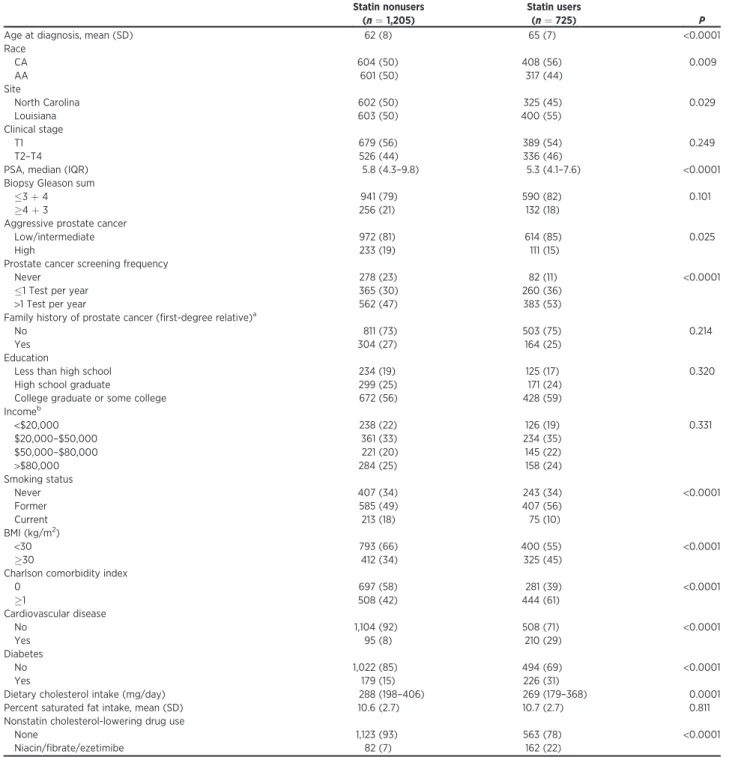
simvastatin (38%) or atorvastatin (34%) and the remainder using rosuvastatin (10%), pravastatin (9%), lovastatin (5%), orfl uvas-tatin (2%). There were no significant differences in statin type or dose by race (data not shown). As shown in Table 2, statin users were older than nonusers (65 vs. 62 years of age at diagnosis) and were more likely to be CA (56% vs. 44%). Although there were no significant differences in biopsy Gleason sum or clinical stage by statin use, statin users had lower median PSA level (5.3 vs.
Table 2. Demographic and tumor characteristics of statin users and nonusers in PCaP
Statin nonusers (n¼1,205)
Statin users
(n¼725) P
Age at diagnosis, mean (SD) 62 (8) 65 (7) <0.0001
Race
CA 604 (50) 408 (56) 0.009
AA 601 (50) 317 (44)
Site
North Carolina 602 (50) 325 (45) 0.029
Louisiana 603 (50) 400 (55)
Clinical stage
T1 679 (56) 389 (54) 0.249
T2–T4 526 (44) 336 (46)
PSA, median (IQR) 5.8 (4.3–9.8) 5.3 (4.1–7.6) <0.0001 Biopsy Gleason sum
3þ4 941 (79) 590 (82) 0.101
4þ3 256 (21) 132 (18)
Aggressive prostate cancer
Low/intermediate 972 (81) 614 (85) 0.025
High 233 (19) 111 (15)
Prostate cancer screening frequency
Never 278 (23) 82 (11) <0.0001
1 Test per year 365 (30) 260 (36)
>1 Test per year 562 (47) 383 (53)
Family history of prostate cancer (first-degree relative)a
No 811 (73) 503 (75) 0.214
Yes 304 (27) 164 (25)
Education
Less than high school 234 (19) 125 (17) 0.320
High school graduate 299 (25) 171 (24)
College graduate or some college 672 (56) 428 (59) Incomeb
<$20,000 238 (22) 126 (19) 0.331
$20,000–$50,000 361 (33) 234 (35)
$50,000–$80,000 221 (20) 145 (22)
>$80,000 284 (25) 158 (24)
Smoking status
Never 407 (34) 243 (34) <0.0001
Former 585 (49) 407 (56)
Current 213 (18) 75 (10)
BMI (kg/m2)
<30 793 (66) 400 (55) <0.0001
30 412 (34) 325 (45)
Charlson comorbidity index
0 697 (58) 281 (39) <0.0001
1 508 (42) 444 (61)
Cardiovascular disease
No 1,104 (92) 508 (71) <0.0001
Yes 95 (8) 210 (29)
Diabetes
No 1,022 (85) 494 (69) <0.0001
Yes 179 (15) 226 (31)
Dietary cholesterol intake (mg/day) 288 (198–406) 269 (179–368) 0.0001 Percent saturated fat intake, mean (SD) 10.6 (2.7) 10.7 (2.7) 0.811 Nonstatin cholesterol-lowering drug use
None 1,123 (93) 563 (78) <0.0001
Niacin/fibrate/ezetimibe 82 (7) 162 (22)
Abbreviation: IQR, interquartile range.
a
Family history missing for 90 statin nonusers and 58 statin users.
5.8 ng/mL) and a lower frequency of aggressive prostate cancer (15% vs. 19%).
Statin users were more frequently screened for prostate cancer, relative to nonusers (Table 2). Statin users had similar level of education and annual household income as nonusers but were less likely to be current smokers (10% vs. 18%; Table 2). Relative to nonusers, statin users were more likely to be obese (44% vs. 34%) and have a comorbid condition (Charlson index1; 61% vs. 42%), including diabetes (31% vs. 15%) and cardiovascular disease (29% vs. 8%; Table 2). However, statin users had lower dietary cholesterol intake (269 vs. 288 mg/day), although there was no difference in saturated fat intake between statin users and nonusers.
We also examined differences in statin users versus nonusers stratified by race and found that these aforementioned differences in tumor and patient characteristics between statin users and nonusers were observed in both CAs and AAs (Supplementary Table S1).
Associations between statin use and prostate cancer aggressiveness
Of 344 (18%) incident cases of high aggressive prostate cancer, 111 (32%) occurred in statin users and 233 (68%) occurred in nonusers. For comparison, of 1,586 (82%) incident cases of nonaggressive prostate cancer, 614 (39%) occurred in statin users and 972 (61%) occurred in nonusers. Utilizing nonaggressive cases as the referent group, and adjusting for potential confoun-ders, statin use was associated with a significantly reduced OR for aggressive prostate cancer (OR, 0.74; 95% CI, 0.56–0.96; Table 3), with similar effect estimates in CAs (OR, 0.64; 95% CI, 0.44–0.95) and AAs (OR, 0.84; 95% CI, 0.58–1.21), although the association in AAs was not statistically significant. We observed similar inverse associations in men taking a low/normal statin dose (OR, 0.70; 95% CI, 0.49–1.01) and in men taking a high statin dose (OR, 0.76; 95% CI, 0.58–1.04), with no evidence for a dose–response relationship, although small numbers of men in each dose category may limit our power to detect such a relationship.
Finally, although there was a suggestion of a stronger protective effect with hydrophilic relative to lipophilic statins (OR, 0.56; 95% CI, 0.32–0.99 and OR, 0.77; 95% CI, 0.58–1.02, respective-ly), these estimates were somewhat imprecise due to low numbers of men using hydrophilic statins and should be interpreted cautiously. Excluding men using nonstatin cholesterol-lowering drugs or additionally adjusting our models for education level, annual household income, and family history of prostate cancer did not substantially alter ourfindings (Supplementary Tables S2 and S3, respectively).
Impact of health-seeking behaviors on the association between statin use and prostate cancer aggressiveness
To explore possible prostate cancer screening–related detec-tion biases, we examined prostate cancer screening frequency as an effect modifier of the association between statin use and prostate cancer aggressiveness. We observed nonstatistically significant inverse associations between statin use and prostate cancer aggressiveness in men who had never undergone PSA or DRE screening (OR, 0.79; 95% CI, 0.45–1.39), in men who were screened annually or less frequently (OR, 0.66; 95% CI, 0.41–1.06), and in men who were screened more frequently than once a year (OR, 0.78; 95% CI, 0.53–1.15; Table 4), although thesefindings should be interpreted cautiously, given relatively small numbers in each screening category. We observed similar findings when we classified prostate cancer screening as PSA tests only, without considering DRE (data not shown).
Smoking increases low-density and total cholesterol levels and decreases high-density cholesterol levels (14, 15), potentially offsetting the cholesterol-lowering effect of statin use. We found no association between statin use and prostate cancer aggres-siveness in current smokers (OR, 1.36; 95% CI, 0.70–2.64). In contrast, there was a strong inverse association between statin use and prostate cancer aggressiveness in never smokers (OR, 0.42; 95% CI, 0.25–0.72), with an attenuated protective effect in former smokers (OR, 0.84; 95% CI, 0.59–1.19; Table 5) and a significant
Table 3. Associations between statin use, dose and type, and prostate cancer aggressiveness, overall and stratified by race
All CA AA
n, cases
(aggressive) ORa(95% CI) ORb(95% CI) n , cases
(aggressive) ORa(95% CI) ORb(95% CI) n , cases
(aggressive) ORa(95% CI) ORb(95% CI)
Statin use
No use 1,205 (233) 1.00 (ref) 1.00 (ref) 604 (99) 1.00 (ref) 1.00 (ref) 601 (134) 1.00 (ref) 1.00 (ref) Use 725 (111) 0.68
(0.53–0.87)
0.74 (0.56–0.96)
408 (52) 0.65 (0.45–0.93)
0.64 (0.44–0.95)
317 (59) 0.73 (0.51–1.03)
0.84 (0.58–1.21) Statin dosec
No use 1,205 (233) 1.00 (ref) 1.00 (ref) 604 (99) 1.00 (ref) 1.00 (ref) 601 (134) 1.00 (ref) 1.00 (ref) Low/normal 306 (45) 0.65
(0.45–0.92)
0.70 (0.49–1.01)
180 (24) 0.68 (0.42–1.11)
0.66 (0.40–1.09)
126 (21) 0.64 (0.38–1.06)
0.74 (0.43–1.26) High 419 (66) 0.70
(0.52–0.95)
0.76 (0.55–1.04)
228 (28) 0.62 (0.39–0.98)
0.63 (0.39–1.01)
191 (38) 0.79 (0.53–1.19)
0.90 (0.59–1.38) Statin typed
No use 1,205 (233) 1.00 (ref) 1.00 (ref) 604 (99) 1.00 (ref) 1.00 (ref) 601 (134) 1.00 (ref) 1.00 (ref) Hydrophilic 132 (16) 0.53
(0.31–0.91)
0.56 (0.32–0.99)
81 (8) 0.48 (0.22–1.05)
0.45 (0.20–1.00)
51 (8) 0.62 (0.29–1.36)
0.72 (0.32–1.62) Lipophilic 591 (94) 0.71 (0.54–0.92) 0.77
(0.58–1.02)
327 (44) 0.69 (0.46–1.02)
0.69 (0.46–1.04)
264 (50) 0.74 (0.51–1.07)
0.86 (0.58–1.27)
aAdjusted for age only. b
Adjusted for age, race (except for analyses stratified by race), site, BMI, cholesterol intake, percent saturated fat intake, smoking status, and prostate cancer screening frequency.
c
Low/normal dose20 mg simvastatin or equivalent; high dose>20 mg simvastatin or equivalent.
dHydrophilic
interaction between smoking status and statin use in predicting prostate cancer aggressiveness (Wald test;P¼0.0008).
Discussion
Using data from the population-based PCaP study, we report an inverse association between statin use and prostate cancer aggressiveness. We observed a similar magnitude of association between statin use and prostate cancer aggressiveness in both CAs and AAs;findings were supported by a prior study, which found that associations between statin use and risk of high-grade pros-tate cancer did not vary by race (16). In contrast to prior cohort and case–control analyses of statin use and prostate cancer risk using prostate cancer–free men as the referent group (5, 8, 16), the case-only design of this study examined the impact of statin use on disease aggressiveness among men diagnosed with prostate can-cer. However, our results are in agreement with approximately 20% to 25% reduced risk of aggressive prostate cancer in statin users, relative to nonusers reported by two meta-analyses (5, 8). As such, ourfindings strengthen existing rationale to explore a role for statins in aggressive prostate cancer prevention.
One important consideration when studying the impact of statin use on prostate cancer aggressiveness is that detection bias arising from higher rates of prostate cancer screening in statin users could produce an inverse association with aggressive dis-ease, irrespective of a causal relationship (17, 18). In this study, we found that adjusting our models for prostate cancer screening frequency did not substantially impact our estimates. Further-more, analyses stratified by screening frequency showed a similar magnitude of inverse association between statin use and prostate
cancer aggressiveness in men screened at high frequency (i.e., more than once a year), low, or recommended frequency (i.e., annually or less) and in unscreened men, suggesting that the association between statin use and prostate cancer aggressiveness cannot be completely explained by screening-related detection bias. In support of thesefindings, inverse associations between statin use and aggressive prostate cancer have been reported both in European populations with very low screening rates (19) and in U.S. populations with higher screening rates (20), although a secondary analysis of the Prostate Cancer Prevention Trial, where-in all participants were screened annually, reported no association between statin use and high-grade prostate cancer (21). Moreover, an analysis of simulated datasets with different PSA screening frequencies suggested that detection bias is unlikely to explain the association between statin use and reduced prostate cancer aggres-siveness (18). Yet another factor to consider is that statin use lowers PSA levels by approximately 3% to 4% (22, 23), poten-tially reducing the likelihood of prostate biopsy and aggressive prostate cancer diagnosis. Indeed, we observed that statin users had lower PSA levels than nonusers in this study. Randomized trials conducting PSA-independent biopsies at regular intervals may circumvent this potential source of detection bias, and secondary analysis of one such trial reported a null association between statin use and high-grade prostate cancer (24). However, given that trial participants are selected based upon specific eligibility criteria and do not represent a population-based sam-ple,findings from secondary analyses of trials (21, 24) may differ fromfindings reported by population-based studies (19, 20), including our own. As such, although the potential for screen-ing-related detection biases should be considered, ourfindings, in addition to those from populations with different PSA screening frequencies (25), support a true association between statin use and prostate cancer aggressiveness.
In addition to differences in prostate cancer screening beha-viors, characteristics of statin users differ from those of nonusers in a variety of ways. Data from this study show that obesity and diabetes, both associated with increased prostate cancer–specific mortality (26, 27), were more prevalent among statin users. On the other hand, we observed that statin use was associated with health-seeking behaviors, as indicated by the higher prevalence of prostate cancer screening, lower prevalence of smoking, and reduced dietary cholesterol intake, relative to nonusers. These health-seeking behaviors themselves have been associated with reduced risk of aggressive prostate cancer (17, 28–33), potentially giving rise to a "healthy-user" bias, whereby the association between statin use and prostate cancer aggressiveness could be explained by the health-seeking behaviors of statin users, and not statin useper se(34). In this analysis, we found that adjusting our models for these health-seeking behaviors did not substantially impact our estimates. However, analyses stratified on smoking status revealed a strong inverse association between statin use and prostate cancer aggressiveness in never smokers, a slightly atten-uated effect in former smokers, and no association in current smokers. There may be multiple mechanisms contributing to the observed effect modification by smoking status, one of which may be the association between smoking and prostate cancer aggres-siveness (32, 33). However, given that the impact of statins on prostate cancer may be mediated, at least in part, via their cholesterol-lowering properties (35), a smoking-related increase in cholesterol level (14, 15) could potentially offset the protective effect of statins on prostate cancer aggressiveness. If confirmed in
Table 4. Associations between statin use and prostate cancer aggressiveness, stratified by prostate cancer screening frequency
n, cases
(aggressive) ORa(95% CI) ORb(95% CI)
Never screened
Statin nonusers 278 (87) 1.00 (ref) 1.00 (ref) Statin users 82 (23) 0.81 (0.47–1.41) 0.79 (0.45–1.39)
1 Screening tests per year
Statin nonusers 365 (61) 1.00 (ref) 1.00 (ref) Statin users 260 (35) 0.67 (0.42–1.07) 0.66 (0.41–1.06) >1 Screening tests per year
Statin nonusers 562 (85) 1.00 (ref) 1.00 (ref) Statin users 383 (53) 0.79 (0.54–1.15) 0.78 (0.53–1.15)
aAdjusted for age only.
bAdjusted for age, race, site, BMI, cholesterol intake, percent saturated fat intake,
and smoking status.
Table 5. Associations between statin use and prostate cancer aggressiveness, stratified by smoking status
n, cases
(aggressive) ORa(95% CI) ORb(95% CI)
Never smokers
Statin nonusers 407 (69) 1.00 (ref) 1.00 (ref) Statin users 243 (24) 0.43 (0.26–0.72) 0.42 (0.25–0.72) Former smokers
Statin nonusers 585 (109) 1.00 (ref) 1.00 (ref) Statin users 407 (67) 0.78 (0.56–1.10) 0.84 (0.59–1.19) Current smokers
Statin nonusers 213 (55) 1.00 (ref) 1.00 (ref) Statin users 75 (20) 1.04 (0.57–1.90) 1.36 (0.70–2.64)
aAdjusted for age only.
bAdjusted for age, race, site, BMI, cholesterol intake, percent saturated fat intake,
future studies, these hypothesis-generatingfindings may add to the many established reasons to promote smoking cessation for direct and indirect reduction of a myriad of noncommunicable diseases.
Ourfindings should be considered in light of the strengths and limitations of this study. First, statin use was captured at the time of interview, with no information regarding the timing of statin initiation relative to prostate cancer diagnosis. However, given that the majority of our study population was interacting with the health care system prior to prostate cancer diagnosis (75% of individuals had a history of PSA screening), it is likely that men indicated for statin therapy would have initiated statins before diagnosis. Indeed, a previous study reported similar prevalence of statin use before (29%) and after (30%) prostate cancer diagnosis, during a study period (1998–2009) which overlapped that of this study (2004–2009; ref. 36). Moreover, any potential misclassifi -cation of unexposed individuals (i.e., prediagnosis nonusers who initiated statin use after diagnosis) as exposed individuals (i.e., prediagnosis statin users) would likely bias our estimates towards the null. As such, our study may have underestimated the strength of the association between prediagnosis statin use and prostate cancer aggressiveness. In addition, although we did not have access to data for duration of use or adherence to statin therapy, the type and dose of statin and nonstatin cholesterol-lowering drugs were documented by a trained nurse, thus improving the accuracy of our exposure data. Second, although serum choles-terol measurements were unavailable, dietary cholescholes-terol and saturated fat intake were available for all study participants, and saturated fat intake is an important determinant of serum cho-lesterol level (37). Third, we lacked sufficient numbers to separate men reporting annual prostate cancer screening from men report-ing less-than-annual screenreport-ing, and larger studies should explore associations between statins and prostate cancer aggressiveness within each of these categories. Fourth, our study had somewhat limited statistical power to conduct analyses stratified by health-seeking behaviors, and larger studies are required to further explore these hypotheses. Finally, observational studies examin-ing the association between statin use and prostate cancer are susceptible to confounding by indication, given that statin use is not randomized. However, an important strength of this study is our comprehensive assessment of clinical and demographic char-acteristics, in addition to health-seeking behaviors of statin users and nonusers, and adjustment for these potential confounders in our analysis.
In summary, we report an inverse association between statin use and aggressive prostate cancer in both CAs and AAs. Differ-ences in patient characteristics and health-seeking behaviors by statin use should be an important consideration for future obser-vational studies of statin use and prostate cancer, although our
findings suggest that the detection bias arising from higher rates of prostate cancer screening in statin users does not entirely explain the inverse association between statin use and prostate cancer aggressiveness. The stronger protective effect of statin use in nonsmokers requires confirmation in other studies but may add to existing rationale, supporting efforts to reduce smoking rates in the population. Statins are cost-effective and widely prescribed cholesterol-lowering drugs, and recent cholesterol-lowering guidelines (38) will likely further increase the prevalence of statin use. Given that cardiovascular disease and cancer are the two most common causes of mortality in the United States (39), with prostate cancer the second most common cause of cancer-related death in U.S. men (1), understanding the role of statins in aggressive prostate cancer prevention will have important public health impact.
Disclosure of Potential Conflicts of Interest
E.T.H. Fontham is a consultant/advisory board member for NCI. No poten-tial conflicts of interest were disclosed by the other authors.
Authors' Contributions
Conception and design:E.H. Allott, L. Arab, L.J. Su, M. Mishel, E.T.H. Fontham, J.T. Bensen
Development of methodology:E.H. Allott, L. Arab, M. Mishel, J.T. Bensen Acquisition of data (provided animals, acquired and managed patients, provided facilities, etc.):S.E. Steck, L. Arab, L.J. Su, E.T.H. Fontham, J.L. Mohler, J.T. Bensen
Analysis and interpretation of data (e.g., statistical analysis, biostatistics, computational analysis):E.H. Allott, L. Farnan, S.E. Steck, L. Arab, J.T. Bensen Writing, review, and/or revision of the manuscript:E.H. Allott, L. Farnan, S.E. Steck, L. Arab, L.J. Su, E.T.H. Fontham, J.L. Mohler, J.T. Bensen
Administrative, technical, or material support (i.e., reporting or organizing data, constructing databases):L. Farnan, J.L. Mohler
Study supervision: E.T.H. Fontham, J.L. Mohler, J.T. Bensen
Acknowledgments
The North Carolina–Louisiana Prostate Cancer Project (PCaP) is carried out as a collaborative study supported by the Department of Defense contract DAMD 17-03-2-0052. The authors thank the staff, advisory committees, and research subjects participating in the PCaP study for their important contributions.
Grant Support
This work was supported by the University Cancer Research Fund of North Carolina (to E.H. Allott).
The costs of publication of this article were defrayed in part by the payment of page charges. This article must therefore be hereby marked
advertisementin accordance with 18 U.S.C. Section 1734 solely to indicate this fact.
Received June 11, 2015; revised October 6, 2015; accepted October 24, 2015; published OnlineFirst January 27, 2016.
References
1. Siegel R, Ma J, Zou Z, Jemal A. Cancer statistics, 2014. CA Cancer J Clin 2014;64:9–29.
2. Daskivich TJ, Fan KH, Koyama T, Albertsen PC, Goodman M, Hamilton AS, et al. Prediction of long-term other-cause mortality in men with early-stage prostate cancer: results from the Prostate Cancer Outcomes Study. Urology 2015;85:92–100.
3. Gu Q, Paulose-Ram R, Burt VL, Kit BK. Prescription cholesterol-lowering medication use in adults aged 40 and over: United States, 2003–2012 . Hyattsville, MD: National Center for Health Statistics; 2014.
4. Dale KM, Coleman CI, Henyan NN, Kluger J, White CM. Statins and cancer risk: a meta-analysis. JAMA 2006;295:74–80.
5. Bonovas S, Filioussi K, Sitaras NM. Statin use and the risk of prostate cancer: A metaanalysis of 6 randomized clinical trials and 13 observational studies. Int J Cancer 2008;123:899–904.
6. Kuoppala J, Lamminpaa A, Pukkala E. Statins and cancer: A systematic review and meta-analysis. Eur J Cancer 2008;44:2122–32.
8. Bansal D, Undela K, D'Cruz S, Schifano F. Statin use and risk of prostate cancer: a meta-analysis of observational studies. PLoS One 2012;7: e46691.
9. Schroeder JC, Bensen JT, Su LJ, Mishel M, Ivanova A, Smith GJ, et al. The North Carolina-Louisiana Prostate Cancer Project (PCaP): methods and design of a multidisciplinary population-based cohort study of racial differences in prostate cancer outcomes. Prostate 2006;66:1162–76. 10. Thompson FE, Subar AF, Brown CC, Smith AF, Sharbaugh CO, Jobe JB,
et al. Cognitive research enhances accuracy of food frequency question-naire reports: results of an experimental validation study. J Am Diet Assoc 2002;102:212–25.
11. Subar AF, Thompson FE, Kipnis V, Midthune D, Hurwitz P, McNutt S, et al. Comparative validation of the Block, Willett, and National Cancer Institute Food Frequency Questionnaires: The Eating at America's Table Study. Am J Epidemiol 2001;154:1089–99.
12. Roy M, Kung HJ, Ghosh PM. Statins and prostate cancer: role of cholesterol inhibition vs. prevention of small GTP-binding proteins. Am J Cancer Res 2011;1:542–61.
13. Hamilton RJ, Banez LL, Aronson WJ, Terris MK, Platz EA, Kane CJ, et al. Statin medication use and the risk of biochemical recurrence after radical prostatectomy: results from the Shared Equal Access Regional Cancer Hospital (SEARCH) Database. Cancer 2010;116:3389–98.
14. Freeman DJ, Griffin BA, Murray E, Lindsay GM, Gaffney D, Packard CJ, et al. Smoking and plasma lipoproteins in man: effects on low density lipopro-tein cholesterol levels and high density lipoprolipopro-tein subfraction distribu-tion. Eur J Clin Invest 1993;23:630–40.
15. Wynder EL, Harris RE, Haley NJ. Population screening for plasma choles-terol: community-based results from Connecticut. Am Heart J 1989; 117:649–56.
16. Kantor ED, Lipworth L, Fowke JH, Giovannucci EL, Mucci LA, Signorello LB. Statin use and risk of prostate cancer: results from the Southern Community Cohort Study. Prostate 2015;75:1384–93.
17. Catalona WJ, Smith DS, Ratliff TL, Basler JW. Detection of organ-confined prostate cancer is increased through prostate-specific antigen-based screen-ing. JAMA 1993;270:948–54.
18. Mondul AM, Caffo B, Platz EA. Minimal detection bias in the inverse association between statin drug use and advanced prostate cancer risk: a simulation study. Cancer Epidemiol 2011;35:e6–11.
19. Murtola TJ, Tammela TL, Lahtela J, Auvinen A. Cholesterol-lowering drugs and prostate cancer risk: a population-based case-control study. Cancer Epidemiol Biomarkers Prev 2007;16:2226–32.
20. Platz EA, Leitzmann MF, Visvanathan K, Rimm EB, Stampfer MJ, Willett WC, et al. Statin drugs and risk of advanced prostate cancer. J Natl Cancer Inst 2006;98:1819–25.
21. Platz EA, Tangen CM, Goodman PJ, Till C, Parnes HL, Figg WD, et al. Statin drug use in not associated with prostate cancer risk in men who are regularly screened. J Urol 2014;192:379–84.
22. Hamilton RJ, Goldberg KC, Platz EA, Freedland SJ. The influence of statin medications on prostate–specific antigen levels. J Natl Cancer Inst 2008; 100:1511–8.
23. Chang SL, Harshman LC, Presti JC. Impact of common medications on serum total prostate-specific antigen levels: analysis of the National Health and Nutrition Examination Survey. J Clin Oncol 2010;28:3951–7.
24. Freedland SJ, Hamilton RJ, Gerber L, Banez LL, Moreira DM, Andriole GL, et al. Statin use and risk of prostate cancer and high-grade prostate cancer: results from the REDUCE study. Prostate Cancer Prostatic Dis 2013;16: 254–9.
25. Platz EA. Epidemiologic musing on statin drugs in the prevention of advanced prostate cancer. Cancer Epidemiol Biomarkers Prev 2007;16: 2175–80.
26. Cai H, Xu Z, Xu T, Yu B, Zou Q. Diabetes mellitus is associated with elevated risk of mortality amongst patients with prostate cancer: a meta-analysis of 11 cohort studies. Diabetes Metab Res Rev 2015;31:336–43.
27. Allott EH, Masko EM, Freedland SJ. Obesity and prostate cancer: weighing the evidence. Eur Urol 2013;63:800–9.
28. Mondul AM, Weinstein SJ, Virtamo J, Albanes D. Serum total and HDL cholesterol and risk of prostate cancer. Cancer Causes Control 2011;22: 1545–52.
29. Platz EA, Till C, Goodman PJ, Parnes HL, Figg WD, Albanes D, et al. Men with low serum cholesterol have a lower risk of high-grade prostate cancer in the placebo arm of the prostate cancer prevention trial. Cancer Epide-miol Biomarkers Prev 2009;18:2807–13.
30. Shafique K, McLoone P, Qureshi K, Leung H, Hart C, Morrison DS. Cholesterol and the risk of grade-specific prostate cancer incidence: evi-dence from two large prospective cohort studies with up to 37 years' follow up. BMC Cancer 2012;12:25.
31. Farwell WR, D'Avolio LW, Scranton RE, Lawler EV, Gaziano JM. Statins and prostate cancer diagnosis and grade in a veterans population. J Natl Cancer Inst 2011;103:885–92.
32. Zu K, Giovannucci E. Smoking and aggressive prostate cancer: a review of the epidemiologic evidence. Cancer Causes Control 2009;20: 1799–810.
33. Ho T, Howard LE, Vidal AC, Gerber L, Moreira DM, McKeever M, et al. Smoking and risk of low- and high-grade prostate cancer: results from the REDUCE study. Clin Cancer Res 2014;20:5331–8.
34. Boudreau DM, Yu O, Johnson J. Statin use and cancer risk: a comprehensive review. Expert Opin Drug Saf 2010;9:603–21.
35. Pelton K, Freeman MR, Solomon KR. Cholesterol and prostate cancer. Curr Opin Pharmacol 2012;12:751–9.
36. Yu O, Eberg M, Benayoun S, Aprikian A, Batist G, Suissa S, et al. Use of statins and the risk of death in patients with prostate cancer. J Clin Oncol 2014;32:5–11.
37. National Cholesterol Education Program Expert Panel on Detection, Evaluation, and Treatment of High Blood Cholesterol in Adults. Third Report of the National Cholesterol Education Program (NCEP) Expert Panel on Detection, Evaluation, and Treatment of High Blood Cholesterol in Adults (Adult Treatment Panel III)final report. Circulation 2002; 106:3143–421.
38. Stone NJ, Robinson JG, Lichtenstein AH, Bairey Merz CN, Blum CB, Eckel RH, et al. 2013 ACC/AHA guideline on the treatment of blood cholesterol to reduce atherosclerotic cardiovascular risk in adults: a report of the American College of Cardiology/American Heart Association Task Force on Practice Guidelines. J Am Coll Cardiol 2014;63:2889–934. 39. American Society of Clinical Oncology. The state of cancer care in America,