Mapping a Suppressor of dmc1-2 in Arabidopsis thaliana
By: Kenan P. Courtney
Senior Honors Thesis
University of North Carolina at Chapel Hill Biology Department
Senior Honors Thesis April 5, 2015
Principal Investigator: Dr. Gregory P. Copenhaver Postdoctoral Associate Mentor: Dr. Jennifer L. Modliszewski
Abstract:
Meiosis is a cellular process in which a diploid cell produces four haploid gamete cells. During Meiosis I, crossovers (COs) between homologous chromosomes result in the reciprocal exchange of genetic material; these COs ensure proper segregation of chromosomes. Without COs, abnormal segregation of unpaired chromosomes in meiosis leaves Arabidopsis thaliana sterile. During crossing-over, DMC1 mediates the strand invasion process. Previous studies have shown that dmc1 null mutants lack COs and are sterile. The Copenhaver laboratory isolated a hypomorphic allele of DMC1 (dmc1-2) and used it to identify suppressor mutants that restore fertility. These were called suppressors of dmc1-2 mutants (sdm lines). Here, we crossed a sdm candidate line (sdm17) to a polymorphic parent (Landsberg erecta), and screened the resulting F1s to identify
heterozygotes. Seeds from a single F1 plant were used to generate a F2 mapping
population. From this population, dmc1-2-/-; sdm17-/- plants were identified by
genotyping and phenotypic (fertility) analysis. Fertile F2s will be pooled for Illumina
sequencing. This will allow us to genetically map the SDM17 locus. The results obtained from this study will provide novel insight into genes that interact with DMC1 in
Introduction:
Meiosis is the cellular process in which a diploid progenitor cell produces four haploid daughter cells. During meiosis, genetic variation arises through crossovers (COs) and independent assortment of chromosomes. COs result in the reciprocal exchange of genetic material (DNA). Crossing over between homologous chromosomes is essential for homologous pairing and bivalent formation [1]. The physical connection created between homologs during crossing over acts as an antipoleward force to signal to the cell that homologous pairing has occurred and that meiosis may proceed. In Arabidopsis, without homologous pairing each chromosome is left as a univalent and the reductional division of meiosis I results in aberrant chromosomal segregation, leaving the plant sterile [1]. In most organisms, homologous pairing requires at least one CO per
chromosome for bivalent formation in order to undergo proper chromosomal segregation [1,2].
double-Holliday junction (dHJ) intermediate forms (Figure 1G). Finally, the dHJ is resolved into a CO product (Figure 1H). Theoretically dHJs can be resolved to form either COs or non-crossovers (NCOs), but data from yeast indicate that COs are the primary product [6]. Most, if not all, NCOs are thought to result from a pathway called synthesis-dependent strand annealing (SDSA) [6,7]. In the SDSA pathway, after some DNA synthesis, the invading 3ʹ strand disassociates from its homolog. The other free 3ʹ strand, whose 5ʹ end was resected, is able to anneal back onto this recently elongated strand. Gap-filling synthesis and ligation results in a NCO.
Figure 1. Double-strand Break Repair (DSBR) Model
The Copenhaver lab investigates meiosis and how it is regulated, particularly in Arabidopsis thaliana. Arabidopsis is a small flowering annual plant in the Brassicaceae family with five pairs of chromosomes and a small sequenced genome (125Mb), making it an ideal model organism to study plant genetics. My research project is focused on the meiosis-specific protein DMC1. In the DSBR model, DMC1 is loaded onto the 3ʹ strand (Figure 1C), enabling it to invade a non-sister chromatid (Figure 1D) [1, 8]. Thus, DMC1 is vital in meiosis because its role in strand invasion facilitates the formation of COs [9,10]. COs, in turn, result in bivalent formation among homologs and allow for the proper segregation of homologs that is required in meiosis. Studies on dmc1 null mutants in Arabidopsis show the effects of the inability to form crossovers [4]. RAD51, another recombinase present in DSBR, is not meiosis specific and repairs DSBs in mitosis as well. In the absence of DMC1, RAD51 repairs meiotic DSBs using the sister chromatid as a template [4]. This prevents both the formation of crossovers between homologous chromosomes as well as chromosome pairing, resulting in unpaired univalents and aberrant chromosomal segregation, which leads to sterility [1, 4].
Previously, a forward genetic screen using ethyl methanesulfonate (EMS)
A second forward genetic screen in a dmc1-2 background yielded plants with higher fertility than dmc1-2 homozygotes but lower fertility that wild type DMC1. Mutants with this rescued fertility phenotype are named suppressor of dmc1 mutant, or sdm, lines. The objective of this research project is to genetically map the SDM17 locus using a combination of marker-based analyses and bulked-segregant mapping with Illumina whole-genome sequencing.
Methods:
Plant Growth and DNA Extraction
A reciprocal cross was made between a dmc1-2-/-; sdm17-/- line in the Columbia ecotype genetic background and second accession, Landsberg erecta (DMC1+/+;
SDM17+/+). F1 seed from this cross was plated on MS (Murashige and Skoog) plates, and
the plates were then stratified for 5 days at 4°C. The plants were then moved to a 22°C growth chamber with 18h days. After seedlings had developed 2-4 true leaves, they were transplanted to MetroMix 360 potting soil in 2.5” pots. F2 seeds were sown directly onto
rpm. Supernatant was discarded and the DNA pellets were washed with 700 uL of 70% ethanol. Tubes were centrifuged for 2 minutes at 14,000 rpm. Supernatant was discarded and the pellets were allowed to dry for 30 minutes. DNA was resuspended in 100 uL of sterile water and the tubes were stored at 4°C. Seeds from a single, heterozygous (dmc1-2+/-) F1 were used to create an F2 mapping population.
DMC1 genotyping
DMC1-locus specific dCAPS [11] primers were used to amplify the DMC1 locus using PCR (See Table 1). PCR conditions used are as follows: 13 minutes at 95°C, 2) 45 seconds at 94°C, 3) 45 seconds at 50°C, 4) 1 minute at 72°C, 5) Repeat steps 2-4 34 more times, 6) 10 minutes at 70°C, 7) held at 10°C. Using a PmeI digest, the DMC1 and dmc1-2 alleles were analyzed by gel electrophoresis to genotype the F1s and F2s. PmeI cleaves
27 base pairs off of the dmc1-2 PCR product, leaving a 321 bp product, but does not cleave the DMC1 product (348 bp) (Figure 2). The digest conditions used are as follows: 1) 2 hours at 37°C, 2) 20 minutes at 65°C. Digested PCR products were run on a 3% agarose gel in TBE (89 mM Tris, 89 mM boric acid, 2 mM EDTA) buffer solution and the digest products were allowed to migrate at 141 V for approximately one hour, or until separation of the two bands was distinguishable enough for genotyping.
Primer Sequence (5ʹ-3ʹ):
Forward Primer GCAAGTTGTACTGATGCTCATAGGTTTAA
Reverse Primer CATGAAAGGAGGGAATGGAA
Fertility analysis
Three different methods were used to gauge the fertility of the dmc1-2-/- F2 plants:
seed count, silique length, and a visual assessment of fertility (qualitative fertility assessment). Once fully elongated, siliques 5-9 of the primary stem were collected for imaging to measure seed count and silique length. These five siliques were mounted onto a laminate sheet and scanned using an Epson GT-1500 scanner set to scan the image as a transparency, thus allowing the seeds in each silique to be digitally visualized. The number of seeds in each silique was then counted manually. Silique length was obtained by measuring the length of each silique using the program ImageJ. A third, quantitative, assessment was made based on the visual fertility of each plant and ranking it on a score of one to three where one represented mostly sterile, two represented intermediate fertility, and three represented fully fertile or nearly fully fertile plants.
SSLP Marker Analysis
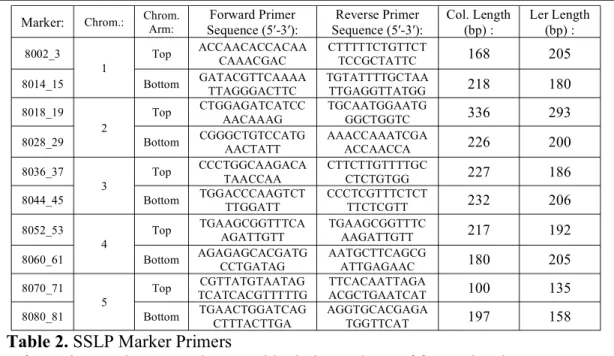
Simple Sequence Length Polymorphism (SSLP) markers were amplified by PCR using genomic DNA and marker-specific pairs of primers (Table 2). PCR and gel
electrophoresis conditions were identical to those used for genotyping F1 and F2 plants.
Results:
To create a mapping population, dmc1-2 sdm17 plants in the Columbia
background were crossed to a polymorphic parent in the Landsberg background (DMC1 SDM17). From the resulting F1 generation, twenty-six dmc1-2+/-; sdm17 plants were
identified through genotyping using PCR analysis with primers capable of distinguishing the DMC1 and dmc1-2 alleles. A single F1 was allowed to set self-fertilized seeds to
generate the F2s (Figure 2B). From the F2 mapping population, 26 dmc1-2-/- F2 plants
were identified through PCR-based genotyping (Figure 2C). Marker: Chrom.: Chrom. Arm: Forward Primer
Sequence (5ʹ-3ʹ): Sequence (5ʹ-3ʹ): Reverse Primer Col. Length (bp) : Ler Length (bp) :
8002_3 1
Top ACCAACACCACAACAAACGAC CTTTTTCTGTTCTTCCGCTATTC 168 205
8014_15 Bottom GATACGTTCAAAATTAGGGACTTC TGTATTTTGCTAATTGAGGTTATGG 218 180
8018_19 2
Top CTGGAGATCATCC AACAAAG
TGCAATGGAATG
GGCTGGTC 336 293
8028_29 Bottom CGGGCTGTCCATGAACTATT AAACCAAATCGAACCAACCA 226 200
8036_37 3
Top CCCTGGCAAGACATAACCAA CTTCTTGTTTTGCCTCTGTGG 227 186
8044_45 Bottom TGGACCCAAGTCTTTGGATT CCCTCGTTTCTCTTTCTCGTT 232 206
8052_53 4
Top TGAAGCGGTTTCAAGATTGTT TGAAGCGGTTTCAAGATTGTT 217 192
8060_61 Bottom AGAGAGCACGATGCCTGATAG AATGCTTCAGCGATTGAGAAC 180 205
8070_71 5
Top TCATCACGTTTTTG CGTTATGTAATAG TTCACAATTAGAACGCTGAATCAT 100 135
8080_81 Bottom TGAACTGGATCAGCTTTACTTGA AGGTGCACGAGATGGTTCAT 197 158
Table 2. SSLP Marker Primers
Fertility Analysis
In order to assess the fertility of the 26 dmc1-2-/- F2 plants we used three analyses.
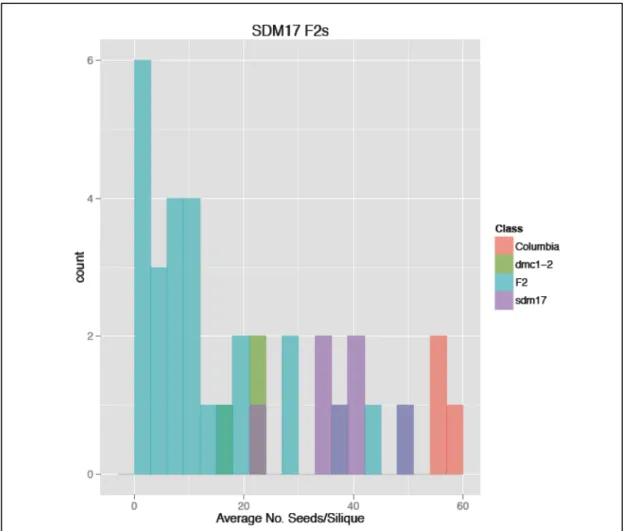
Comparing the average seeds per silique, we found five F2 plants with higher fertility than
the dmc1-2-/- controls (Figure 3). A second qualitative analysis of the F2s resulted in six A B
C
Figure 2. Genotyping with Gel Electrophoresis
Gel electrophoresis shows DMC1 (348bp, uncleaved) and dmc1-2 (321 bp, cleaved) bands separating.
A. Typical banding patterns of DMC1+/+, dmc1-2+/-, and dmc1-2-/-genotypes. (I: dmc1-2-/- II: DMC1+/+ III: DMC1+/+ IV: dmc1-2+/- V: dmc1-2+/-)
B. Banding of PCR and PmeI digest products, indicative of a dmc1-2 +/-genotype in the F1 generation.
C. Gel electrophoresis of F2 mapping population showing segregation at the
DMC1 locus. 26 dmc1-2-/- plants can be identified.
plants that were scored as “Most Fertile,” or ranked a three on a scale of one to three for fertility.
Figure 3. Seed count fertility histogram.
SSLP Marker Analysis
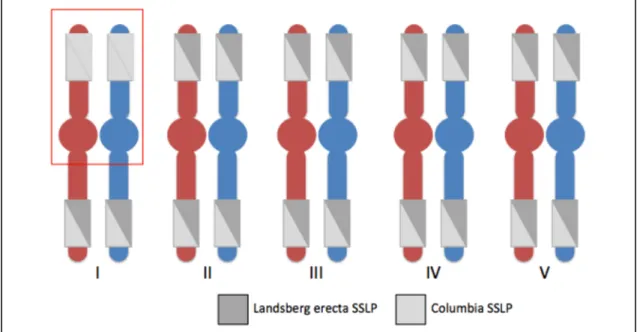
In order to identify the approximate location of the SDM17 locus we used SSLP markers. SSLP markers differentiate between the Columbia and Landsberg erecta ecotypes. Because the sdm17 allele was discovered using a forward genetic screen in a Columbia background we expect its locus to be linked to a Columbia marker. Two
markers were used for each chromosome in Arabidopsis (one for each chromosome arm). Using a total of ten SSLP markers (Table 2), PCR and gel electrophoresis were used to genotype 14 of the 26 dmc1-2-/- ; sdm17 F2 plants (7 of the least and greatest fertility
based on seed count, respectively). Individual one-way ANOVAs were used to test for an association between the Columbia allele frequency (CAF) at each marker and average seed count. The data suggests that the SDM17 locus lies on the top arm of chromosome 1 (Marker 8002-8003, F1, 26 = 7.872, p-value: 0.009381, Figure 4). We found that a
Figure 4. SSLP marker analysis.
Boxes on each chromosome arm represent simple sequence length polymorphism (SSLP) markers. Our marker analysis shows a significant association between the marker on the top arm of chromosome 1 (8002-8003) with fertility and the Columbia allele. This indicates SDM17 likely resides here.
Figure 5. Boxplot of mean seeds per silique for each of the genotypic classes for the 8002-8003 marker. The mean seed count for Columbia homozygotes (frequency = 1, shown in blue) was significantly different from the other genotypic classes (shown in green).
a
a
Discussion:
Five out of the 26 F2 dmc1-2-/- plants showed a higher fertility than the dmc1-2
-/-controls. We believe that the rescued fertility displayed in these plants is due to a sdm17-/- genotype. Using SSLP markers, we found a significant association between this rescued fertility and the top arm of chromosome 1 in Arabidopsis. In order to map the SDM17 locus more precisely we can conduct further SSLP marker analysis using more markers along the top arm of chromosome 1.
In addition to SSLP marker analysis, we plan to use Illumina Sequencing on the fertile and sterile pools we created from the F2 mapping population. Using the sequencing
data we can analyze the SNP distribution of the Landsberg erecta and Columbia alleles across the genome. Because sdm17 was discovered in a Columbia background its propagation through both of my crosses will be identifiable because it is linked to
Columbia specific SNPs. Therefore, we expect to identify a Landsberg erecta SNP desert, or a portion of the genome that is absent of any Landsberg erecta specific SNPs. To continue mapping using either of these methods we will produce more F2 plants to
increase our resolution to find the causal mutation underlying SDM17.
References:
1. Osman K, Higgins JD, Sanchez-moran E, Armstrong SJ, Franklin FC. Pathways to meiotic recombination in Arabidopsis thaliana. New Phytol. 2011;190(3):523-44. 2. Nicklas, R.B., How cells get the right chromosomes. Science, 1997. 275(5300): p. 632
637
3. Bishop DK, Park D, Xu L, Kleckner N. DMC1: a meiosis-specific yeast homolog of E. coli recA required for recombination, synaptonemal complex formation, and cell cycle progression. Cell. 1992;69(3):439-56.
4. Pradillo M, Varas J, Oliver C, Santos JL. On the role of AtDMC1, AtRAD51 and its paralogs during Arabidopsis meiosis. Front Plant Sci. 2014;5:23.
5. Keeney, S., Giroux, C. N.; and Klecker, N. Meiosis-specific DNA double-strand breaks are catalyzed by Spo11, a member of widely conserved protein family. Cell, 1997. 88(3):375-84.
6. McMahill, M. S.; Sham, C. W.; and Bishop, D. K. Synthesis- dependent strand annealing in meiosis. PLoS Biol, 2007. 5(11): e299
7. Allers, T. and M. Lichten, Differential timing and control of noncrossover and crossover recombination during meiosis. Cell, 2001. 106(1): p. 47-57.
8. Vignard J, Siwiec T, Chelysheva L, et al. The interplay of RecA-related proteins and the MND1-HOP2 complex during meiosis in Arabidopsis thaliana. PLoS Genet. 2007;3(10):1894-906.
9. Klimyuk VI, Jones JD. AtDMC1, the Arabidopsis homologue of the yeast DMC1 gene: characterization, transposon-induced allelic variation and meiosis-associated
expression. Plant J. 1997;11(1):1-14.
10. Couteau F, Belzile F, Horlow C, Grandjean O, Vezon D, Doutriaux MP. Random chromosome segregation without meiotic arrest in both male and female meiocytes of a dmc1 mutant of Arabidopsis. Plant Cell. 1999;11(9):1623-34.