Multimodal Analgesic use of Intravenous Acetaminophen/Paracetamol in the Pediatric Surgical Patient:
A Systematic Review and Synthesis John J. Escano and Cecelia I. Roscigno
University of North Carolina at Chapel Hill School of Nursing
Author Note
John J. Escano, BS, UNC at Chapel Hill School of Nursing
Cecelia I. Roscigno, RN, PhD, MN, CNRN, UNC at Chapel Hill School of Nursing The authors would like to acknowledge Elizabeth Moreton, MLS, Amanda M. Escano, RN, MSN, CRNA, and Jacob R. Bosley, MD for their contributions to this work.
Abstract
Intravenous acetaminophen/paracetamol (IVA/P) within a multimodal analgesic approach has been examined in adult surgical populations, but we wanted to understand what was known about its use in children who have surgery. We examined the state of science on IVA/P in a multimodal analgesic approach in children who have surgery. With the assistance of a health sciences research librarian, we searched across three major bibliographic databases (PubMed, Embase, and Cochrane Central Register of Controlled Trials) using the Preferred Reporting Items for Systematic Reviews and Meta-Analyses guidelines. Each report was evaluated
according to our inclusion criteria: (1) research focused on IVA/P in a multimodal approach; (2) focused on pediatric population (<18); (3) full-text article in an English language peer-reviewed journal. Publications were independently analyzed by two reviewers to discern the quality, approach, findings, and limitations to be considered. A total of N = 3781 articles were first identified. After excluding: a) duplicates (n = 689); and b) not meeting inclusion criteria (n = 3087), we included a total of N = 5 articles. A multimodal analgesic approach that uses IVA/P in pediatric surgical patients has the potential to produce opioid-sparring effects, decrease reported pain scores over time, and improves aspects of outcomes. Yet, because there are so few studies in children, more research with rigorous designs and comparable outcome measures is needed. We make a strong case for why IVA/P should be researched, especially in intellectually impaired children or children whose underlying health might warrant sparing use of opioids for analgesia.
Analgesic use of Intravenous Acetaminophen/Paracetamol in the Pediatric Surgical Patient: A Systematic Review and Synthesis
Pediatric inpatient surgery cases are abundant in the United States and pain is a complication of surgery. In 2009, there were 6,393,803 pediatric (<18 years of age) inpatient discharges for surgery (Tzong, et al., 2012). Pain is defined by the International Association for the Study of Pain (IASP) as, “An unpleasant sensory and emotional experience associated with actual or potential tissue damage, or described in terms of such damage” (Merskey & Bogduk, 1994). Damage to tissue from a surgical procedure can result in nociceptive stimuli interpreted as pain (Zeller, 2008). Pain management is complex and often relies on the use of multiple drugs and non-pharmacologic techniques to target the multiple and diverse mechanisms of nociceptive stimuli, increase the patient’s tolerance to the stimuli, and address the patient’s emotional
response to nociception. Surgical pain is a type of nociceptive pain, and nociceptive pain is more common in pediatric patients. If unmanaged or under managed, nociceptive pain can lead to longitudinal undesired effects as a result of the plasticity of children’s afferent and efferent pain pathways (Lundeberg, 2015; Bhutta & Anand, 2002; Fitzgeral & Beggs, 2001).
Pain is typically treated through a multimodal approach to minimize side effects associated with the use of one drug or one therapy and to maximize analgesia by targeting the multiple sources of nociceptive stimuli (Verghese & Hannallah, 2010; Yaster, 2010). A multimodal approach to pain management is defined by the American Society of
involve a multimodal approach” (2012). Evidence in adult populations suggests that IVA/P is an important component to multimodal analgesia and has opioid-sparring effects (Memis, 2010; Remy, Marret, & Bonnet, 2005).
Intravenous acetaminophen (Ofirmev [Brand Name] or Paracetamol) (IVA/P) is a
relatively new administration route of a commonly used and relatively benign analgesic; the oral and rectal forms of acetaminophen have circulated since 1878 (Bertolini, 2006). Acetaminophen is a unique analgesic drug, compared to non-steroidal anti-inflammatory drugs (NSAIDs), in that it is not effective for inflammation. However, it does not produce gastrointestinal, cardiac, or renal effects that NSAIDs are known to produce. The mechanism of analgesic action for acetaminophen is still under question. There is insufficient evidence that acetaminophen works through inhibition of cyclooxygenase (COX) enzymes, specifically COX-3. More recently, evidence supports that acetaminophen may have its analgesic effects by the cannabinoid CB1 receptor (Bertolini, 2006).
Although IVA/P has been widely used as paracetamol outside of the United States (US), recently the intravenous form was approved for use in the United States as of November, 2010, and first available in 2011. (Shastri, 2015; FDA, 2016). IVA/P has been widely investigated for its use in multimodal analgesic therapies in adults. In fact, the oral form is commonly paired with oral opioid analgesics because of its additive analgesic effects, but no literature reviews have synthesized the multimodal use of IVA/P in children.
The aim of this systematic review and synthesis is to identify quantitative and qualitative studies for the use of IVA/P as a multimodal analgesic therapy, synthesize the key concepts, critique the research methods, identify current research gaps, and suggest future directions.
The first author first met with a research librarian to develop appropriate search strategies for our aims. A literature search was conducted across three major bibliographic databases (PubMed, Embase, and Cochrane Central Register of Controlled Trials [CENTRAL]) using the Preferred Reporting Items for Systematic Reviews and Meta-Analyses (PRISMA) guidelines (Moher, et al., 2009). The objective of the systematic review was first discussed between the first author and a research mentor (Second Author). The aim was to gather the most comprehensive group of published studies exploring the use of the IVA/P and what has been published related to its use to manage pain with a multimodal approach during or following surgery so that this information could be synthesized. The goals of this literature review and the appropriate search strategies were then discussed with a health sciences research librarian. PubMed, Cochrane Central Register of Controlled Trials, and Embase were the three major bibliographic databases selected for this study. The search string was initially generated for use within the PubMed database and then adapted to be processed synonymously in the Embase database. The search string was adapted again for processing in Cochrane Central Register of Controlled Trials. Key words of the search string included, “pain*,” “Acetaminophen,” “Paracetamol,” “Ofirmev,” “Intravenous,” “IV,” “inject*,” “Infus*,” “catheter*,” “surg*,” “post-surgical,” “perioperative,” and “postoperative.” The asterisk indicates a strategy commonly used and referred to as the truncation character and it is used to broaden searches by replacing one or more characters (ProQuest, 2016). Paracetamol is another name for acetaminophen commonly used throughout the world. Ofirmev is the trade name associated with the IVA/P in the United States. These strategies yielded a large number of articles within each of the three search engines and then measures were taken to further decipher whether or not the articles met our inclusion criteria.
RefWorks was used as the database for storing and tracking articles. Working with RefWorks can be challenging as large files are difficult to move between the bibliographic databases and the reference tools that were used to manage the data produced (i.e., abstracts and articles). To import large files, a strategy was developed with a researcher with extensive experience in this area of research to increase our efficiency (Havill, et al., 2014). Within Embase, PubMed, and CENTRAL, references can be directly exported to RefWorks. Exporting the citations needed to be done with 100-200 article references per file, depending on the database, for the RefWorks system to maintain efficiency. The consequences of reducing
they were not an original research piece, and if the article could not be obtained through interlibrary loan (n = 2).
Records were assessed for eligibility by two reviewers, and a final set of five full-text articles were included in the final review. A data extraction form was designed by the first author from methods described by Harris Cooper in Research Synthesis and Meta-Analysis (p. 89-100, 2010) with additional suggestions from the second author. The extraction form contained three sections: 1) general analysis; 2) study description; and, 3) data collection.. The general analysis section was concerned with the origin of the article, possible contributing citations accessed by the ancestry approach, and the nature of the publication journal. The study description section was concerned with the purpose of the research and important factors contributing to the quality of the study such as the demographics of the population, the study design, evaluating whether or not a power analysis was conducted, and the inclusion/exclusion criteria of the study. The data collection section was concerned with additional contextual factors contributing to the quality of the study and findings such as where the population under study was recruited from, where data was collected, outcomes measured, the general technique used to assess the measure, and the overall results of the study. The ancestry approach, as explained by Cooper (2010), was utilized to potentially identify additional records not found by our comprehensive database search. However, the records identified using the ancestry approach were all duplicate articles already previously identified.
Results
3,781 records were screened, 33 articles were not excluded by abstract review and
Figure 1 illustrates the overall review process leading to the final full-text article set. Two themes were derived from the full-text articles identified for review: (1) IVA/P displayed opioid-sparing effects and (2) use of IVA/P has positive implications for care.
Opioid-sparring Effects
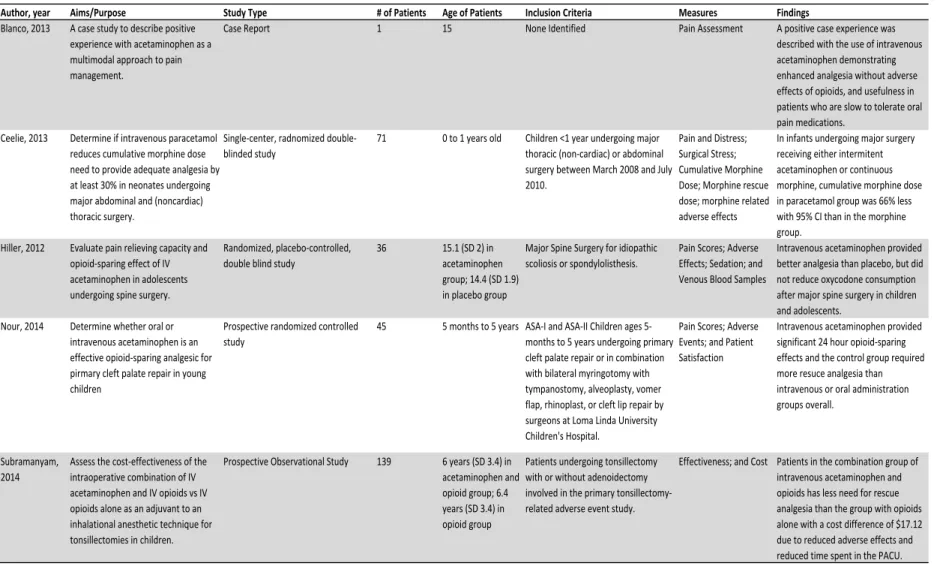
Opioid-sparing effects were defined as those effects that seemed to be mediated by the addition of IVA/P and was correlated with the decreased overall consumption of opioids over time by the patient during pain intervention. From the studies identified, three studies
demonstrated that IVA/P decreased the consumption for opioid analgesia over time. However, one study did not report a decreased consumption of opioid analgesia over time.
(Table 1 inserted here)
One of the four studies was a prospective observational study. Three studies randomized 158 patients and reported on 150 patients (Ceelie, et al., 2013; Hiller, et al., 2012; Nour, et al., 2014). 66 participants in these studies were randomized to receive an IVA/P intervention along with intravenous opioid (Ceelie, et al., 2013; Hiller, et al., 2012; Nour, et al., 2014). Ceelie, et al., reported, that the cumulative intravenous morphine dose over time in the group receiving an initial bolus of morphine and intermittent IVA/P was 66% lower than the group receiving an initial bolus of morphine followed by continuous intravenous morphine (CI 95%, 34% to 109%; P< .001). Pain scores in this study were measured by the Numeric Rating Scale-11 (NRS-11) and the COMFORT Behavior Scale (COMFORT-B), which was used to measure patient distress. In both groups, rescue morphine was available to patients when his or her NRS-11 indicated pain (score ≥ 4) and his/her COMFORT-B score indicated they were stressed (score ≥ 17). Nour, et al., reported that when IVA/P was administered intra-operatively, patients received less
morphine equivalents [CI 95%: 202.9-342.8]; Oral group: 376.5 morphine equivalents [CI 95%: 304.1-448.9]; Control group: 432.0 morphine equivalents [CI 95%:376.1-525.8]; P= .002). These patients also received less morphine in the recovery room (Intravenous group: 101.2 morphine equivalents [CI 95%: 67.1-149.1]; Control group: 174.8 morphine equivalents [CI 95%:120.1-267.4]; P= .09) and on the post-surgical ward (Intravenous group: 48.9 morphine equivalents [CI 95%: 35.4-73.5]; Control group: 96.4 morphine equivalents [CI 95%: 66.5-117.1]; P= .01) when compared to the control group, and the patients had a lower proportion of high pain scores (≥ 4 on
the FLACC scale or ≥ 2 on the FACES scale) for all post-operative pain scores. The study
conducted by Nour, et al., was not blinded. Therefore, this was an individual study limitation because assessment and reporting of pain was done by the investigators. Hiller, et al., reported that overall analgesia in hours post-operatively was improved in a group receiving IVA/P (9.0% of hours for IV group vs. 18.4% of hours for placebo group, P < 0.01) but post-operative
consumption of intravenous oxycodone was not reduced. Pain in this study was measured by visual analogue scores (VAS). Subramanyam, et al., reported in a qualitative observational study in which administration of IVA/P in combination with opioids reduced the use of rescue
analgesia for breakthrough pain and reduced the costs for the hospitals involved. Three of these studies reported an opioid-sparring effect associated with the combined use of IVA/P
administration. The study by Hiller, et al., reported no opioid-sparring effect, but lower pain scores (visual analog scale VAS score < 6) for the time spent in the post-operative ward in the group receiving IVA/P.
Positive Implications for Care
opioid-sparring effects. Blanco, et al. (2013), reported a positive impact on patient care through presentation of a case report that described a surgical case on a 15-year old female. This case was important because post-operative pain control is a challenge for pediatric patients receiving corrective surgery for scoliosis. The authors felt that IVA/P was useful in multimodal pain management. The primary benefits described were: IVA/P could be used for fasting patients, does not sedate or cause nausea, and has the potential for decreased opioid use. Ceelie, et al., (2013) reported non-significant administration of naloxone in three of 39 patients in a morphine only group while those in the IVA/P group did not receive any other medications for analgesia. Patient satisfaction surveys were administered in the Nour, et al., (2014) study to evaluate the child’s satisfaction with the use of IVA/P. In patients randomized to receive IVA/P, patient analgesia satisfaction scores were higher overall compared to the control group who only
received opioids (P = 0.03). Reduced hospital costs was another positive implication on pediatric surgical and post-surgical care. Subramanyam, et al. (2014), identified in a prospective
observational study that a total cost difference of $17.12 per each tonsillectomy procedure could lead to overall hospital cost-savings of $9 million annually in the US. This finding is promising given the recent shift to value-based care in the United States, where quality needs to be
improved and costs need to be reduced (IOM, 2001). In addition to opioid-sparring effects, adding IVA/P within a multimodal analgesic approach could provide positive economic
implications for the care of pediatric patients by increasing patient satisfaction, decreasing side effects of current analgesic treatments focused on using opioids alone, and supporting cost-reductions within the patient’s surgical care.
Discussion
From this study, it is possible to gather that IVA/P may have positive implications on pediatric surgical and post-surgical care. However, there were such a small number of studies to synthesize. Therefore, more research and blinded, randomized, controlled designs are needed before generalizable conclusions can be made. Yet, given the data presented and what we know in other populations about the additive effects of acetaminophen to opioids, its potential for decreasing the cost of care, increasing research on IVA/P involving children would be invaluable because the side effects of opioids can be numerous and serious, especially in particular sub-populations of pediatric patients who commonly have surgeries and are at risk for the side effects of opioids. Some of the sub-populations we are arguing for include but are not limited to
children with cerebral palsy, intellectual impairments, and impaired respiratory or gastrointestinal functioning, or those having neurosurgical procedures and sedation can complicate ongoing neurological assessments (IOM, 2001).
relatively new form of acetaminophen in the United States, with the majority of the publications included in this synthesis published within the last 4 years. The lack of studies reinforcing the pattern of opioid-sparring effects in each respective surgery type presented in Table 1 invites more research to be done on the addition of IVA/P in multimodal analgesic approaches.
Limitations
In the present study, there was a paucity of evidence to make generalizable conclusions other than the need for more randomized controlled pediatric trials involving IVA/P as a multimodal therapy so that a meta-analysis can be conducted. Establishing a quantitative
relationship between the data and the effect sizes can help to statistically validate study findings (Cooper, 2010, p. 148). Another limitation to this study is a single reviewer was responsible for the screening and eligibility of the abstracts pulled from database searches (Liberati, et al., 2009). In one of the studies reviewed, a set of patients were included in the analysis even with a
violation of the study treatment protocol (Hiller, et al., 2012). Because this set of patients remained in the study analysis, the results may have been biased. Variations in how pain was measured (e.g., patient reports versus provider observation and analog scales versus visual scales) in the studies and the developmental capacity of pediatric patients to discern variations in pain may also have had an impact on the findings. Opioid administration protocols also varied amongst the studies included (Ceelie, et al., 2013; Hiller, et al., 2012; Nour, et al., 2014). This could have an impact on the evaluation of the opioid-sparring effect of IVA/P. The fact that patients and clinicians were not blinded to who was receiving what type of pain control also may have influenced findings (Nour, et al., 2014; Subramanyan, et al., 2014).
IVA/P is a drug with potential for an opioid-sparring effect and other positive
References
American Society of Anesthesiologists Task Force on Acute Pain Management. (2012). Practice Guidelines for Acute Pain Management in the Perioperative Setting. Anesthesiology, 116(2), 248-273.
Bertolini, A., Ferrari, A., Ottani, A., Guerzoni, S., Tacchi, R., & Leone, S. (2006). Paracetamol: New Vistas of an Old Drug. CNS Drug Reviews, 12(3-4), 250-275.
Bhutta, A.T., & Anand, K.J. (2002). Vulnerability of the developing brain. Neuronal mechanisms.
Clinical Perinatology, 29, 357-372.
Blanco, J. S., Perlman, S. L., Cha, H. S., & Delpizzo, K. (2013). Multimodal pain management after spinal surgery for adolescent idiopathic scoliosis. Orthopedics, 36(2 Suppl), 33-35.
doi:10.3928/01477447-20130122-55 [doi]
Ceelie, I., Wildt, S. N., Dijk, M., Berg, M. M., Bosch, G. E., Duivenvoorden, H. J., et al. (2013). Effect of intravenous paracetamol on postoperative morphine requirements in neonates and infants undergoing major noncardiac surgery: A randomized controlled trial. Jama, 309(2), 149-154. doi:10.1001/jama.2012.148050
Cooper, H. M. (2010) Searching the Literature. In Research Synthesis and Meta-Analysis: A
Step-by-Step Approach (66). Thousand Oaks, California: SAGE Publications, Inc.
Cooper, H. M. (2010) Gathering Information From Studies. In Research Synthesis and
Meta-Analysis: A Step-by-Step Approach (84-114). Thousand Oaks, California: SAGE
Publications, Inc.
Cooper, H. M. (2010) Analyzing and Integrating the Outcomes of Studies. In Research Synthesis
and Meta-Analysis: A Step-by-Step Approach (145 - 197). Thousand Oaks, California: SAGE
Fitzgerald, M. & Beggs, S. (2001). The neurobiology of pain: developmental aspects. Neuroscientist, 7, 246-257.
Galinkin, J., & Koh, J. L. (2014). Recognition and Management of Iatrogenically Induced Opioid Dependence and Withdrawal in Children. Pediatrics, 133(1), 152-155.
Gottschalk, A., Berkow, L.C., Stevens, R.D., Mirski, M., Thompson, R.E., White, E.E., . . . Yaster, M. (2007). Prospective evaluation of pain and analgesic use following major elective intracranial surgery. Jounral of Neurosurgery, 106, 210-216.
Havill, N.L., Leeman, J., Shaw-Kokot, J., Knafl, K., Crandell, J., & Sandelowski, M. (2014). Managing large-volume literature searches in research synthesis studies. Nursing Outlook, 62, 112-118.
Hiller, A., Helenius, I., Nurmi, E., Neuvonen, P. J., Kaukonen, M., Hartikainen, T., et al. (2012). Acetaminophen improves analgesia but does not reduce opioid requirement after major spine surgery in children and adolescents. Spine, 37(20), E1225-31.
doi:10.1097/BRS.0b013e318263165c [doi]
Institute of Medicine (IOM). (2001). Crossing the Quality Chasm: A New Health System for the 21st Century. Washington, D.C: National Academy Press.
Jayanath, S., Ong, L.C., Marret, M.J., & Fauzi, A.A. (2015). Parent-reported pain in non-verbal children and adolescents with cerebral palsy. Developmental Medicine & Child Neurology, 58, 395-401.
Lundeberg, S. (2015). Pain in children – are we accomplishing the optimal pain treatment?.
Pediatric Anesthesia, 25, 83-92.
McPherson, C., Haslam, M., Pineda, R., Rogers, C., Neil, J.J., Inder, T.E. (2015). Brain Injury and Development in Preterm Infants Exposed to Fentanyl. Annals of Pharmacotherapy, 49(12),
1291-1297.
Memis, D., Inal, M.T., Kavalci, G., Sezer, A., & Sut, N. (2010). Intravenous paracetamol reduced the use of opioids extubation time, and opioid-related adverse effects after major surgery in intensive care unit. Journal of Critical Care, 25, 458-462.
Merskey, H., & Bogduk, N. (Eds.) (1994). Part III: Pain Terms, A Current List with Definitions and Notes on Usage. Seattle, Washington: IASP Press.
Moher, D., Liberati, A., Tetzlaff, J., & Altman, D.G. (2009). Preferred reporting items for systematic reviews and meta-analyses: the PRISMA statement. Annals of Internal Medicine,
151(4):264.
Nour, C., Ratsiu, J., Singh, N., Mason, L., Ray, A., Martin, M., et al. (2014). Analgesic effectiveness of acetaminophen for primary cleft palate repair in young children: A randomized placebo controlled trial. Paediatric Anaesthesia, 24(6), 574-581. doi:10.1111/pan.12393
ProQuest. (2016) ProQuest Research Library: Search Tips. Retrieved from: http://proquest.libguides.com/pqrl/search.
Remy, C., Marret, E., & Bonnet, F. (2005). Effects of acetaminophen on morphine side-effects and consumption after major surgery: meta-analysis of randomized controlled trials. British Journal of Anaesthesia, 94(4), 505-513.
Shastri, N. (2015). Intravenous Acetaminophen Use in Pediatrics. Pediatric Emergency Care, 31(6),
444-448.
Subramanyam, R., Varughese, A., Kurth, C. D., & Eckman, M. H. (2014). Cost-effectiveness of intravenous acetaminophen for pediatric tonsillectomy. Paediatric Anaesthesia, 24(5), 467-475. doi:10.1111/pan.12359 [doi]
Tzong, K.Y., Han, S., Roh, A., & Ing, C. (2012). Epidemiology of Pediatric Surgical Admissions in US Children: Data From the HCUP Kids Inpatient Database. Journal of Neurosurgical Anesthesiology, 24, 391-395.
United States Food and Drug Administration. Available at www.fda.gov. Accessed March 26, 2016. Verghese, S. T., & Hannallah, R. S. (2010). Acute pain management in children. Journal of Pain
Research, 3, 105-123.
Yaster, M. (2010). Multimodal analgesia in children. European Journal of Anaesthesiology, 27, 851-857.
Zeller, J. L. (2008). Acute Pain Treatment. Journal of the American Medical Association, 299 (1),
Figure 1 PRISMA flow chart of screening methods and accepted articles for review and synthesis.
From: Moher D, Liberati A, Tetzlaff J, Altman DG, The PRISMA Group (2009). Preferred Reporting Items for Systematic Reviews and M
eta-Analyses: The PRISMA Statement. PLoS Med 6(7): e1000097. doi:10.1371/journal.pmed1000097
For more information, visitwww.prisma-statement.org.
Records identified through database searching
(N = 3781)
Sc re ening Inc lude d El igi bi lit y Ide ntif ic
ation through the Ancestry Approach, Additional records identified
(Cooper, 2010) (n = 14)
(
(n = 0) Records after duplicates removed
(n = 3,092)
Records screened
(n = 3,092)
Records excluded
(n = 2,701: Not focused on
IVA/P)
(n = 358: Not on Pediatric
Population (<18))
Full-text articles assessed for eligibility
(n = 33)
Full-text articles excluded, with reasons
(n = 4: Not English)
(n = 3: Reviews)
(n = 2: Unobtainable
articles)
(n = 19: Not on a
Multimodal approach to the use of IVA/P)
Qualitative articles
(n =2)
Quantitative Articles
(n = 3)
Articles Included in Review
Table 1 Synthesis of Research Articles.
Author, year Aims/Purpose Study Type # of Patients Age of Patients Inclusion Criteria Measures Findings Blanco, 2013 A case study to describe positive
experience with acetaminophen as a multimodal approach to pain management.
Case Report 1 15 None Identified Pain Assessment A positive case experience was
described with the use of intravenous acetaminophen demonstrating enhanced analgesia without adverse effects of opioids, and usefulness in patients who are slow to tolerate oral pain medications.
Ceelie, 2013 Determine if intravenous paracetamol reduces cumulative morphine dose need to provide adequate analgesia by at least 30% in neonates undergoing major abdominal and (noncardiac) thoracic surgery.
Single-center, radnomized double-blinded study
71 0 to 1 years old Children <1 year undergoing major thoracic (non-cardiac) or abdominal surgery between March 2008 and July 2010.
Pain and Distress; Surgical Stress; Cumulative Morphine Dose; Morphine rescue dose; morphine related adverse effects
In infants undergoing major surgery receiving either intermitent acetaminophen or continuous morphine, cumulative morphine dose in paracetamol group was 66% less with 95% CI than in the morphine group.
Hiller, 2012 Evaluate pain relieving capacity and opioid-sparing effect of IV acetaminophen in adolescents undergoing spine surgery.
Randomized, placebo-controlled, double blind study
36 15.1 (SD 2) in acetaminophen group; 14.4 (SD 1.9) in placebo group
Major Spine Surgery for idiopathic scoliosis or spondylolisthesis.
Pain Scores; Adverse Effects; Sedation; and Venous Blood Samples
Intravenous acetaminophen provided better analgesia than placebo, but did not reduce oxycodone consumption after major spine surgery in children and adolescents.
Nour, 2014 Determine whether oral or intravenous acetaminophen is an effective opioid-sparing analgesic for pirmary cleft palate repair in young children
Prospective randomized controlled study
45 5 months to 5 years ASA-I and ASA-II Children ages 5-months to 5 years undergoing primary cleft palate repair or in combination with bilateral myringotomy with tympanostomy, alveoplasty, vomer flap, rhinoplast, or cleft lip repair by surgeons at Loma Linda University Children's Hospital.
Pain Scores; Adverse Events; and Patient Satisfaction
Intravenous acetaminophen provided significant 24 hour opioid-sparing effects and the control group required more resuce analgesia than intravenous or oral administration groups overall.
Subramanyam, 2014
Assess the cost-effectiveness of the intraoperative combination of IV acetaminophen and IV opioids vs IV opioids alone as an adjuvant to an inhalational anesthetic technique for tonsillectomies in children.
Prospective Observational Study 139 6 years (SD 3.4) in acetaminophen and opioid group; 6.4 years (SD 3.4) in opioid group
Patients undergoing tonsillectomy with or without adenoidectomy involved in the primary tonsillectomy-related adverse event study.