Original Article
Advance care planning in cystic
fi
brosis: Current
practices, challenges, and opportunities
☆
Elisabeth P. Dellon
a,⁎
, Elaine Chen
b, Jessica Goggin
c, Karen Homa
1, Bruce C. Marshall
d,
Kathryn A. Sabadosa
e, Rubin I. Cohen
faUniversity of North Carolina School of Medicine, Chapel Hill, NC, United States bRush University Medical Center, Chicago, IL, United States cUniversity of California San Diego Health System, La Jolla, CA, United States
dCystic Fibrosis Foundation, Bethesda, MD, United States e
Dartmouth Institute for Health Policy and Clinical Practice, Geisel School of Medicine, Lebanon, NH, United States
f
Hofstra North Shore, Long Island Jewish School of Medicine, Hofstra University, Hempstead, NY, United States
Received 12 June 2015; revised 2 August 2015; accepted 14 August 2015 Available online 8 September 2015
Abstract
Background:Studies in cysticfibrosis (CF) report late attention to advance care planning (ACP). The purpose of this study was to examine ACP with patients receiving care at US adult CF care programs.
Methods:Chart abstraction was used to examine ACP with adults with CF dying from respiratory failure between 2011 and 2013.
Results:We reviewed 210 deaths among 67 CF care programs. Median age at death was 29 years (range 18–73). Median FEV1in the year
preceding death was 33% predicted (range 13–100%); 68% had severe lung disease with FEV1b40% predicted. ACP was documented for 129
(61%), often during hospitalization (61%). Those with ACP had earlier documentation of treatment preferences, before the last month of life (73% v. 35%;p=b0.01). Advance directives were completed by 93% of those with ACP versus 75% without (pb0.01); DNR orders and health care proxy designation occurred more often for those with ACP. Patients awaiting lung transplant had similar rates of ACP as those who were not (67% v. 61%;p= 0.55). The frequency of ACP varied significantly among the 29 programs contributing data from four or more deaths.
Conclusions:ACP in CF often occurs late in the disease course. Important decisions default to surrogates when opportunities for ACP are missed. Provision of ACP varies significantly among adult CF care programs. Careful evaluation of opportunities to enhance ACP and implementation of recommended approaches may lead to better practices in this important aspect of CF care.
© 2015 European Cystic Fibrosis Society. Published by Elsevier B.V. All rights reserved.
Keywords:Advance care planning; End-of-life care; Decision making; Lung transplant
1. Introduction
Advance care planning (ACP) is a communication process between patients and health care providers intended to align future medical treatments with goals and wishes of individual patients [1,2]. Tangible outcomes of ACP include advance directives, medical orders for scope of treatment, and appropriate documentation and communication of treatment preferences.
☆ Research Funding: Cystic Fibrosis Foundation
⁎ Corresponding author at: University of North Carolina School of Medicine, CB #7217, 450 MacNider Hall, 333 South Columbia Street, Chapel Hill, NC 27599-7217, United States. Tel.: + 1 919 966 1055; fax: + 1 919 966 6179.
E-mail addresses:[email protected](E.P. Dellon), [email protected](E. Chen),[email protected](J. Goggin), [email protected](K. Homa),[email protected](B.C. Marshall), [email protected](K.A. Sabadosa),[email protected] (R.I. Cohen).
1Health Care Improvement Consultant.
http://dx.doi.org/10.1016/j.jcf.2015.08.004
Cystic fibrosis (CF) is a genetic disease with limited life expectancy due to progressive impairment of lung function. Respiratory failure is the most common cause of death[3]. The few published studies addressing ACP in CF suggest that it often occurs late in the illness course, if at all[4–6]. In one study, only one-third of adults with CF reported having been asked about ACP by a health care provider, and a similar proportion completed an advance directive[7]. Single center investigations have revealed late or absent ACP and advance directives, “do not resuscitate” (DNR) orders written at the very end of life, and a majority of deaths occurring in the hospital with intensive treatments ongoing until the time of death[4,6]. While ACP is recommended for people with CF
[8–11], there are currently no formal guidelines for ACP in this population.
In the US, most CF care is provided in care centers accredited by the Cystic Fibrosis Foundation (CFF). Multidisciplinary care teams, including physicians, nurses, social workers, dieticians, physical therapists, and respiratory therapists, provide coordinat-ed CF care. While only physicians and licenscoordinat-ed practitioners may formally enter orders for limitations on life-sustaining treatments that follow from ACP conversations, patients may choose to have conversations about treatment preferences and future medical care with any trusted provider within the care center. Much of CF care in the US is provided under direction of guidelines
[12], but the personal, patient-centered nature of treatment decision making and lack of formal guidelines for ACP as part of CF care suggests there may be variation in practice for ACP with patients among CF care centers.
Previous studies and clinical experience highlight challenges to ACP, including some that are relatively unique to CF. While shortened life expectancy [3] might seem to trigger ACP, variable disease progression makes prognostication difficult. Lung transplant, an option for select patients with advanced disease, could delay ACP [13]. Family caregivers often participate in medical decision making; thus, planning may not reflect an individual’s preferences and important decisions may be deferred to surrogate decision makers when lung disease progresses more rapidly than anticipated [5,14,15]. Several multidisciplinary CF care team members may participate in ACP, but lack of clarity on the responsible party may delay initiation of the process. Additionally, while practice standards exist for many aspects of CF care, there is lack of consensus about appropriate timing of ACP. To our knowledge, no national study of end-of-life care in CF has been performed in the United States. We undertook this study to examine practices for ACP in US-based adult CF care programs, evaluating these and other potential challenges and informing opportunities for improvement.
2. Methods
We adapted a web-based chart abstraction tool from the End-of-Life Chart Review Tool [16] to collect information about patients who died from complications of CF, including age, cause, and location of death, conversations about ACP, and advance directives. The tool was pilot tested at the authors’ institutions and further refined (Appendix 1).
We invited all 113 currently accredited US adult CF care programs to complete a review of the last five CF deaths at their institutions occurring from 2011 to 2013. One program reported six deaths, and all were included; many programs had less than five deaths occur during that time period. Approval for the study was obtained from the Institutional Review Board at each participating institution. Programs were offered a $100 stipend by the CFF for each abstraction. A pre-programmed query in the CFF Patient Registry [17] was used to identify patients who died within the designated time frame. Patients under age 18 years were excluded. Patients dying after lung transplantation (approximately 16% of CF deaths in the US in this time period(12)) were excluded as their care differs significantly after the procedure, and many of these patients have less consistent follow-up with multidisciplinary CF care teams after transplant. Data from patients with non-respiratory causes of death were excluded (14 unknown, 7 cirrhosis, 17 unrelated to CF) because their clinical courses were not likely representative of those of patients dying from progressive lung disease.
Two researchers (JG and RIC) independently reviewed data and made recommendations regarding potential data errors, recoding of data entries, and exclusions from analysis. Discrep-ancies were reviewed with the research team and final decisions were made by consensus. For purposes of analysis, we defined ACP as“documented conversations about treatment preferences between patients and CF health care providers”and assessed for tangible outcomes of ACP include advance directives, medical orders for scope of treatment, and appropriate documentation and communication of treatment preferences. Conversations between surrogate decision makers and health care providers were included in the analysis as“conversations about treatment preferences”but were not considered ACP even if orders for limitations on life-sustaining treatments were documented as these decisions can be made by surrogates when patients are no longer able to communicate with health care providers.
Summary statistics were used to describe results. Chi-square tests were used to determine differences between groups, such as those with and without ACP. A multivariable logistic model was used to determine whether demographic characteristics (gender, age, lung function, insurance, and transplant status) and ACP measures (location of ACP, advance directives, lung transplant, and palliative care consults) were predictive of outcomes of timing of ACP and timing of advance directives. Variables having a probability of b0.20 from bivariate correla-tions and a variance inflation factor b2.5 (≥2.5 indicates too many correlations with other variables in the model) were entered into the model using a web-based logistic regression building tool
[18]. Missing or“not applicable”responses were excluded from the analysis.
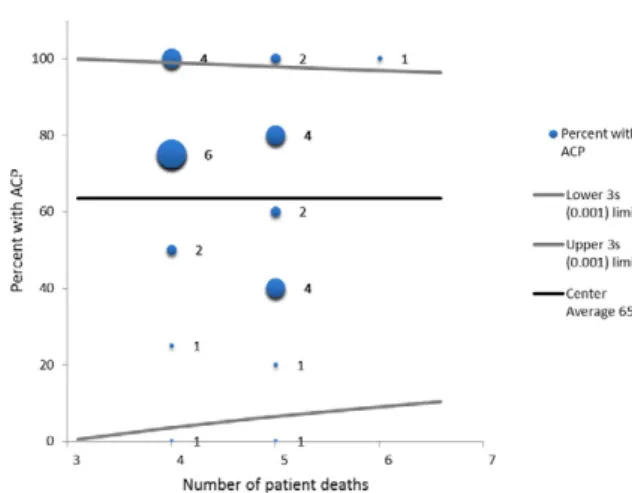
[19]. Programs outside the upper or lower limits were significantly different in regard to ACP rate than those between the control limits. Programs with ACP rates lying within the control limits were considered random variation.
3. Results
Information about 254 patients was submitted by 72 adult CF care programs (63% of currently accredited US programs). Data from 44 patients were excluded (Fig. 1), and data from 210 patients from 67 programs were analyzed. Patient demographic information is displayed in Table 1. Median age at death was 29 years (range 18–73), and 55% of the patients were female. The median highest forced expiratory volume in one second (FEV1) in the year preceding death was 33% of predicted (range 13–100%), and the median lowest FEV1 was 22% of predicted (range 11–89%). Not all patients dying from respiratory complica-tions of CF had severe lung disease: while 74% of patients had both highest and lowest FEV1 in the severe lung disease category (FEV1b40% predicted) in the year preceding death, 32% had only mild to moderate lung disease based on their highest FEV1. Twenty-seven patients (13%) were on the transplant wait list at the time of death. Palliative care or hospice services were utilized by 94 patients (46%).
Conversations about treatment preferences such as resusci-tation status were documented for 164 patients overall (78%), but ACP conversations between patients and health care providers were documented for just 129 (61%), reflecting surrogate decision making on behalf of some patients. Reasons cited for lack of ACP included severe illness precluding patient participation in decision making, unwillingness of the patient to discuss disease progression or death, lack of perceived need for ACP, dissent among patient and family, and dissent among medical providers about treatment options.
Table 2lists the ACP variables stratified by the 129 patients with ACP (61%) and the 81 patients without ACP (39%). Those with ACP had earlier documentation of treatment preferences, with 73% of conversations occurring at least 1 month before death versus only 35% of those without ACP (pb 0.01). Greater involvement of CF care team members, including physicians, nurses, and social workers, in conversa-tions about treatment preferences was documented for those with ACP compared to those without ACP. Nine patients (5%) received palliative care consults; there was no difference in involvement of palliative care consultants between those with and without ACP (Fisher exact testp = 0.11). A majority of ACP (61%) took place during hospitalization for acute illness. Patients who participated in ACP were more likely to have documented an advance directive (93% vs 75%, pb 0.01), designated a health care proxy (75% vs 61%,p = 0.04), and established a DNR order (75% vs 49%,p b0.01).
Multivariate analysis revealed that those dying in the intensive care unit (ICU) had 2.3 times the odds of a late conversation about treatment preferences (last month of life) compared with those dying in another setting (p= 0.048). These patients also had 3.7 times the odds of a documented advance directive, specifically a DNR order (p= 0.017). Those with a late conversation had lower odds of ACP, i.e., a documented conversation between patient and provider as opposed to a conversation that involved a surrogate rather than that patient (OR 0.16, pb 0.01). Age and FEV1 were not significantly associated with timing of ACP. As noted in
Table 2, 86% of patients had an advance directive prior to death. Advance directives were documented earlier for older patients: more than 6 months before death for 46% of those older Fig. 1. Selection of patients for inclusion in the study.
Table 1
Demographic information for 210 patients dying from respiratory complications of CF.
Characteristic Median (range) N(%)
Age in years 29 (18–73)
Age group (from CF annual report)
18–24 years 59 (28%)
25–34 years 80 (38%)
35–44 years 39 (19%)
N44 years 32 (15%)
Female gender 116 (55%)
Insurance
Public/government 133 (64%)
Private 72 (35%)
Uninsured 3 (1%)
Percent predicted FEV1
Lowest past year 22 (11–89) Highest past year 33 (13–100) Highest FEV1and lung disease severity category
Mild (N70% predicted) 5 (2%)
Moderate (40–70% predicted) 60 (30%)
Severe (b40% predicted) 138 (68%)
Lowest FEV1and lung disease severity category
Mild (N70% predicted) 2 (1%)
Moderate (40–70% predicted) 16 (8%)
Severe (b40% predicted) 184 (91%)
Listed for lung transplant 27 (13%)
than median age of 29 years versus 24% of those 29 years or younger (OR 2.6;p b0.01). Severity of lung disease (FEV1) was not associated with timing of advance directives.
Of 27 patients listed for lung transplant, 21 (78%) died prior to transplantation, five became medically ineligible, and one did not complete pre-transplant testing. ACP was documented for 18 (67%) of those listed for transplant, which was not significantly different from patients not listed for transplant (61%; p = 0.055). Completion of advance directives did not differ by lung transplant status.
Finally, we compared ACP provision between CF care programs. For the 29 programs that contributed information on four or more patients dying from respiratory failure, ACP ranged from zero (no ACP provided) to 100% (ACP provided to all deceased patients).Fig. 2 shows a funnel plot of ACP. Programs with no documented ACP and those with all patients participating in ACP differed significantly from the remaining programs.
Table 2
Conversations about treatment preferences for patients with and without ACP.aACP is defined as documented conversations betweenpatientsandhealth care providers.
Total (N= 210) ACP (n= 129) No ACP (n= 81) p-value
Conversation about treatment preferences documentedb b0.01
No 32 (15%) – 32 (39%)
Yes 164 (78%) 129(100%) 35 (43%)
Unknown/no response 14 (7%) – 14 (17%)
Timing of conversation b0.01
More than 6 months prior to death 56 (35%) 52 (40%) 4 (11%)
1–6 months prior to death 51 (32%) 43 (33%) 8 (24%)
Less than 1 month prior to death 52 (33%) 30 (23%) 22 (65%)
CF physician involved in conversation b0.01
No 55 (28%) 12 (9%) 43 (64%)
Yes 141 (72%) 117 (91%) 24 (36%)
CF nurse involved in conversation b0.01
No 130 (66%) 70 (54%) 60 (90%)
Yes 66 (34%) 59 (46%) 7 (10%)
CF social worker involved in conversation b0.01
No 99 (51%) 48 (32%) 51 (76%)
Yes 97 (49%) 81 (63%) 16 (24%)
Palliative care consultant involved in conversationb 0.14
No 187 (95%) 121 (94%) 66 (99%)
Yes 9 (5%) 8 (6%) 1 (1%)
Location of conversation 0.86
Hospital admission 98 (61%) 77 (62%) 21 (60%)
Outpatient clinic visit 62 (39%) 48 (38%) 14 (40%)
Advance directive b0.01
No 26 (14%) 9 (8%) 17 (25%)
Yes 162 (86%) 111 (93%) 51 (75%)
Do not resuscitate order b0.01
No 56 (33%) 26 (24%) 30 (51%)
Yes 113 (67%) 84 (76%) 29 (49%)
Health care proxy 0.04
No 51 (30%) 27 (25%) 24 (39%)
Yes 120 (70%) 83 (75%) 37 (61%)
Timing of advance directive 0.26
More than 6 months prior to death 50 (35%) 37 (38%) 13 (28%)
1–6 months prior to death 33 (23%) 24 (25%) 9 (20%)
Less than 1 month prior to death 61 (42%) 37 (38%) 24 (52%)
a
“Not documented”not included as category. Missing data or“not applicable”responses were excluded from the analysis.
b
Chi-square testp-value reported and verified with Fisher Exact test due to small numbers.
4. Discussion
Our study of ACP for 210 patients at 67 adult CF care programs who died from respiratory failure between 2011 and 2013 represents the largest national investigation of ACP in CF to date. We found that 61% of patients had documented ACP, defineda priorias“conversations about treatment preferences between patients and health care providers.” ACP occurred primarily during hospitalization for acute illness and often involved CF care team members. Patients dying in the ICU had greater odds of late ACP. Patients with ACP were more likely to have advance directives, specifically DNR orders and health care proxies, than those without ACP; older patients completed advance directives further in advance of death. Lung transplant status was not associated with ACP or completion of advance directives. Additionally, we found significant variability in ACP among programs, with some providing no ACP and others providing ACP to all patients.
While prior large studies do not exist for proper comparison, our findings support previous single center studies alluding to challenges of ACP in CF, some of which are unique to the disease[4–6]. While CF lung disease is progressive, the course can be unpredictable, and health care providers are often uncertain about the ideal timing of conversations about ACP. Our study substantiates previous reports that not all patients dying from respiratory failure have advanced lung disease and that conversations about treatment preferences are often delayed until episodes of severe illness requiring ICU care. Shortened life expectancy in CF complicates ACP as patients, caregivers, and health care providers often struggle emotionally with the anticipated early mortality.
We found that advance directives were established earlier in older patients, such that older age may be a trigger for ACP. Many people with CF rely on family caregivers, and complex relationships and roles of surrogate decision makers create further challenges to planning for medical care consistent with patients’wishes. The multidisciplinary CF care model allows for continuity of care with devoted health care providers, but roles may overlap causing uncertainty about who should address ACP. While we found variation among programs, seven of 29 programs contributing data on at least four CF deaths reported ACP occurring forallpatients who died. This suggests that some adult care programs may have developed a practice standard to reliably address ACP, but many have not. As referral for lung transplant is a marker of disease progression and because of uncertain outcomes of transplant for individual patients, it should serve as a trigger for ACP. We found a similar frequency of ACP between those listed and not listed for transplant at the time of death, which supports the clinical observation that the decision to pursue transplant may shift emphasis from comfort and quality of life to medical interven-tions intended to prolong survival and to achieve transplant. We found that a majority of patients dying from respiratory failure were not listed for transplant and, of course, listing for transplant does not guarantee that suitable donor lungs will become available in time. We therefore advocate that ACP should be offered regardless of whether transplant is considered.
We suggest that health care providers introduce ACP earlier in the course of disease and revisit with significant clinical changes regardless of patient age and with milestones such as transitioning from pediatric to adult care, the need for supplemental oxygen, frequent hospitalizations for treatment of pulmonary exacerbations, and referral for lung transplant. Close caregiver involvement necessitates careful assessment of social supports, shared decision making with patients and caregivers, and identification of surrogate decision makers. Multidisciplinary teams allow for care coordination, and psychosocial providers can help to assess and overcome barriers to ACP.
Evidence-based initiatives are underway to improve ad-vance care planning in many serious illnesses, for example, the Medical/Physician Orders for Life Sustaining Treatments (MOLST/POLST)[20,21]. Indeed, ACP is considered a standard of care for people with serious illness and its incorporation into routine CF care, while recommended, is not always followed because of the challenges described above[9,10,22]. As palliative care consultation services become more widely available[23], multidisciplinary CF care teams may wish to form partnerships with these experts for education and support [8] and for consultation in complex cases. A recent policy statement from the American Thoracic Society[22]provides general guidance for clinicians caring for patients with respiratory diseases. This and other resources may serve as a framework for development of CF-specific clinical practice guidelines for ACP and other aspects of palliative care. Thoughtfully developed guidelines for ACP in CF could serve as a model in other chronic diseases lacking a specific framework.
Limitations of our study include the retrospective design and typical challenges of abstracting data from medical records, such as missing information, erroneous data recording, and misinterpretation of chart abstraction tool questions. We reduced the likelihood of erroneous information through careful review of data for each patient death by two researchers. Over half of accredited adult CF care programs in the US participated in this study, but they may have had a particular interest in ACP and end-of-life care, thus biasing the results. Information was collected on deaths that occurred over a relatively short time period from 2011 to 2013 with the rationale to enhance the applicability of the results to current practice.
systematically address and document ACP may help to reduce the variability and make ACP standard in CF care.
Acknowledgments
The authors are grateful to the Cystic Fibrosis Foundation for sponsoring this research and to the CF care programs for assisting with data collection.
Appendix A. Supplementary data
Supplementary data to this article can be found online at
http://dx.doi.org/10.1016/j.jcf.2015.08.004.
References
[1]Sudore RL, Fried TR. Redefining the “planning” in advance care planning: preparing for end-of-life decision making. Ann Intern Med 2010 Aug 17;153(4):256–61.
[2]Garrett JM, Harris RP, Norburn JK, Patrick DL, Danis M. Life-sustaining treatments during terminal illness: who wants what? J Gen Intern Med 1993 Jul;8(7):361–8.
[3] Cystic Fibrosis Foundation Patient Registry: Annual Data Report, 2012.: Cystic Fibrosis Foundation. Available from:http://www.cff.org/research/ ClinicalResearch/PatientRegistryReport/; June 2015.
[4]Dellon EP, Leigh MW, Yankaskas JR, Noah TL. Effects of lung transplantation on inpatient end of life care in cystic fibrosis. J Cyst Fibros 2007 Nov 30;6(6):396–402.
[5]Dellon EP, Shores MD, Nelson KI, Wolfe J, Noah TL, Hanson LC. Caregiver perspectives on discussions about the use of intensive treatments in cystic fibrosis. J Pain Symptom Manage 2010 Dec;40(6): 821–8.
[6]Ford D, Flume PA. Impact of lung transplantation on site of death in cystic fibrosis. J Cyst Fibros 2007 Apr;19.
[7]Sawicki GS, Sellers DE, McGuffie K, Robinson W. Adults with cystic fibrosis report important and unmet needs for disease information. J Cyst Fibros 2007 Nov;6(6):411–6.
[8]Linnemann RW, O'Malley PJ, Friedman D, Georgiopoulos AM, Buxton D, Altstein LL, et al. Development and evaluation of a palliative care curriculum
for cystic fibrosis healthcare providers. J Cyst Fibros 2015 Mar 24;15(1): 90–5.
[9] Yankaskas JR, Marshall BC, Sufian B, Simon RH, Rodman D. Cystic fibrosis adult care: consensus conference report. Chest 2004 Jan;125(1 Suppl.):1S–39S.
[10] Robinson W. Palliative care in cystic fibrosis. J Palliat Med 2000 Summer; 3(2):187–92.
[11] Sands D, Repetto T, Dupont LJ, Korzeniewska-Eksterowicz A, Catastini P, Madge S. End of life care for patients with cystic fibrosis. J Cyst Fibros 2011 Jun;10(Suppl. 2):S37–44.
[12] Cystic Fibrosis Foundation Patient Registry Annual Data Report to the Center Directors 2013. Cystic Fibrosis Foundation. Available from:http://www.cff. org/UploadedFiles/research/ClinicalResearch/PatientRegistryReport/2013_ CFF_Annual_Data_Report_to_the_Center_Directors.pdf; June 2015. [13] Dellon EP, Shores MD, Nelson KI, Wolfe J, Noah TL, Hanson LC.
Caregivers’perspectives on decision making about lung transplantation in cystic fibrosis. Prog Transplant 2009 Dec;19(4):318–25.
[14] Tuchman LK, Slap GB, Britto MT. Transition to adult care: experiences and expectations of adolescents with a chronic illness. Child Care Health Dev 2008 Sep;34(5):557–63.
[15] McGuffie K, Sellers DE, Sawicki GS, Robinson WM. Self-reported involvement of family members in the care of adults with CF. J Cyst Fibros 2008 Mar;7(2):95–101.
[16] TIME: Toolkit to of Instruments to Measure End-of-Life Care. Center to Improve Care of the Dying. Available from:http://www.chcr.brown.edu/ pcoc/charthtm.htm; 1997. [June 2015].
[17] Warwick WJ, Pogue RE. Cystic fibrosis. An expanding challenge for internal medicine. JAMA 1977 Nov 14;238(20):2159–62.
[18] Logistic Regression On-line: Applications in Prospect Marketing & Risk Modeling. Available from:www.jeffreyfmorrison.net/default.aspx. [19] Spiegelhalter D. Funnel plots for comparing institutional performance.
Stat Med 2005;24:1185–202.
[20] Dying in America: Improving Quality and Honoring Individual Prefer-ences Near the End of Life.
[21] Bomba PA, Orem K. Lessons learned from New York's community approach to advance care planning and MOLAT. Ann Palliat Med 2015 Jan;4(1):10–21. [22] Lanken PN, Terry PB, Delisser HM, Fahy BF, Hansen-Flaschen J, Heffner JE, et al. An official American Thoracic Society clinical policy statement: palliative care for patients with respiratory diseases and critical illnesses. Am J Respir Crit Care Med 2008 Apr 15;177(8):912–27.