“THEY GAVE THE CHILDREN CHINA DOLLS”: TOYS AND ENSLAVED CHILDHOODS ON AMERICAN PLANTATIONS
Colleen Betti
A thesis submitted to the faculty at the University of North Carolina at Chapel Hill in partial fulfillment of the requirements for the degree of Master of Arts in the Department of
Anthropology
Chapel Hill 2017
© 2017 Colleen Betti
ABSTRACT
Colleen Betti: “They Gave the Children China Dolls”: Toys and Enslaved Childhoods on American Plantations
(Under the direction of Anna Agbe-Davies)
The lives of enslaved children are often overlooked in archaeological studies of
ACKNOWLEDGEMENTS
TABLE OF CONTENTS
LIST OF TABLES……….vii
LIST OF FIGURES………..viii
CHAPTER 1: INTRODUCTION………1
CHAPTER 2: ANTHROPOLOGY AND ARCHAEOLOGY OF CHILDREN……….4
Childhood as a Cultural Construct………...4
Socialization……….5
Play………..6
CHAPTER 3: HISTORICAL BACKGROUND: CHILDHOOD IN 18TH AND 19TH CENTURY AMERICA………...9
1670-1750………..10
1750-1830………..13
1830-1880………..17
Enslaved Childhoods……….20
CHAPTER 4: ARCHAEOLOGICAL BACKGROUND………..25
Research Questions………25
Archaeological Sites………..26
Analysis………..30
Methodology………..31
CHAPTER 5: TOYS ANALYZED BY SITE………...37
Analysis using MCD-Based Phases………...39
CHAPTER 6: TOYS ANALYZED BY DATE……….49
Dolls………...53
Toy Dishes……….61
Marbles………..64
Other………..73
CHAPTER 7: CONCLUSION………..76
LIST OF TABLES
LIST OF FIGURES
Figure 1 Distribution of sites plotted by BLUE MCD………...35
Figure 2 Percent of toys out of total artifacts for each site………38
Figure 3 Abundance index for toys………39
Figure 4 Percent of toys out of total artifacts for each site………40
Figure 5 Abundance index for toys………...41
Figure 6 All contexts in DAACS by context BLUE MCD arranged by state………...44
Figure 7 Toy BLUE MCD by geographic region………..44
Figure 8 Toys by context BLUE MCD………..44
Figure 9 Total artifacts for each site period against the percent of toys showing r-squared trend line……….45
Figure 10 Distance from urban center in miles plotted against percent of toys for each site……46
Figure 11 Percent of toys for field and home quarter sites………47
Figure 12 Toys by context BLUE MCD………50
Figure 13 All contexts in DAACS by BLUE MCD………..50
Figure 14 Percent of toy types for each historical period………..51
Figure 15 Percent of toy types for each MCD phase……….51
Figure 16 Toy types by context BLUE MCD………52
Figure 17 Dolls by context BLUE MCD………...55
Figure 18 Doll face from the Hermitage’s Field Quarter Cabin 3……….56
Figure 19 Doll leg from Stratford Hall’s ST116………56
Figure 20 Doll arm from Monticello’s Building s……….56
Figure 23 Chinese porcelain toy teacup from Monticello’s West Kitchen Yard,
Dry Well, and MRS………..63
Figure 24 Pewter toy cup from Monticello’s East Kitchen Yard………..63
Figure 25 Clay marble from Monticello’s Building D/j...66
Figure 26 Limestone marble from the Hermitage’s Triplex………..66
Figure 27 Red veined marble marble from the Hermitage’s Triplex……….66
Figure 28 Marble marble from the Hermitage’s Triplex………...66
Figure 29 Painted porcelain marble from the Hermitage’s Field Quarter Cabin 2………67
Figure 30 BLUE MCD for glass and porcelain marbles………67
Figure 31 Marble materials showing percentage and count………..68
Figure 32 Marble materials by historical period………69
Figure 33 Marble materials by MCD phase………...70
Figure 34 Marble diameters by count………71
Figure 35 Pewter horse from Monticello’s Building s………...74
CHAPTER 1: INTRODUCTION
The common perception of children in the United States today is one of “precious, innocent, and cute cherubs” (Lancy 2008:2). They are seen as economically worthless, but emotionally priceless (Zelizer 1985). However, this is not a universal definition of childhood, and ideas surrounding children in the United States have changed greatly over the past three hundred years. Historians have identified a number of shifts that led from a 17th century
perspective of children as incomplete adults, or even evil and sinful creatures, to the modern day concept of childhood (Calvert 1992; Chudacoff 2007). While these shifts have been well
documented historically, at least for the white, middle-class, northern United States, little
attention has been paid to conceptualizations of childhood on plantations in the American South, especially enslaved childhoods, or how childhood is represented materially in the archaeological record.
Formal toys, such as marbles and china dolls, were part of the socialization process. They were designed, manufactured, and purchased by adults for children. Even toy advertisements were directed towards adults until the mid-20th century (Cross 2009). As adult perceptions of children shifted from incomplete adults to priceless and innocent beings, the toys they were given to play with also underwent changes. Because of this, toys that are found archaeologically, especially without highly specific context data, often tell more about the adults who purchased them than the children who may have played with them.
Toys are used by adults to socialize children, reflect the dominant ideas surrounding childhood, and can be identified archaeologically. This study uses artifacts, specifically toys, in the Digital Archaeological Archive of Comparative Slavery (DAACS) to conduct research. Using toys found on plantation contexts associated with enslaved Africans that have been cataloged into the DAACS, this project is looking to determine whether Southern adults, including those who were enslaved, were part of the same changes in dominant discourse surrounding childhood, as white, middle-class, northerners and the effects of this discourse on enslaved children. The toys are from slave quarters, work yards, and other sites inhabited and used by enslaved Africans, not the free white families living on plantations. As such they
represent the experiences of enslaved children, not all Southern children. While clear patterns are apparent in the data, I also discuss challenges with the data set, especially in dating, that resulted from using the DAACS database.
By examining when toys appeared, at what sites they are found, and what kinds of toys are found on sites associated with enslaved Africans1, I hope to understand whether changes in
the number and types of toys relate to shifts in the understanding of childhood rather than only changes in manufacturing. Does the increasing emphasis on the innocence and playfulness of childhood in the late 18th and 19th century result in an increase in manufactured toys for enslaved children? What do toys reveal about the socialization of enslaved children and who is using manufactured toys for socialization? In answering these questions, I argue that the increase in the number and variety of toys in slave associated contexts through the late 18th and early 19th
centuries reflects changes in white slave owners’ understandings of childhood, including seeing enslaved children as inherently playful, and the effects of an innocent conception of childhood on the paternalistic nature of slavery. To do this, I begin by discussing the anthropology of childhood and the relationship between the social construction of childhood and socialization. I then examine the historical background of childhood in 18th and 19th century America before turning to the analysis of the toys in the DAACS database.
CHAPTER 2: ANTHROPOLOGY AND ARCHAEOLOGY OF CHILDREN
Childhood as a Cultural Construct
Ideas surrounding childhood were able to change drastically in the 18th and 19th century United States because childhood is defined culturally and is not a universal or natural state. Childhood is similar to gender, as it is a social construct surrounding a biological reality.
Children’s behaviors are culturally specific and influenced by the political, social, and economic context in which they live (Kamp 2006; Baxter 2008). The amount of parental involvement in children’s lives, how much work they are expected to do, and when children become persons within a society have a significant impact on perceptions and experiences of childhood (Montgomery 2008; Lancy 2008). This has lead Hutson (2006) to define childhood as “an interpretation of what it means to be a child” (103). Anthropological research has shown that the modern Western concept of a biological and innocent childhood is actually at odds with much of the rest of the world and historical patterns (Lancy 2008). The cultural nature of childhood results in changes over time and differences between societies, such as between free whites and enslaved Africans, and potentially even between white society in the northern and southern United States.
those not controlling the discourse, are able to recognize that it is an ideal (Kamp 2006). For example, while the current American understanding of childhood sees work as unnatural for children, it is often necessary for children living in poverty to help support their family and these families are able to see the discrepancy between the ideal and the reality. However,
Schwartzman (2006) suggests that the basic understanding of childhood is a very powerful ideology that appears to be natural and universal to those living within a culture, but has been created by those in power. These concepts are not necessarily mutually exclusive. Childhood can be viewed as a natural and universal state, such as biological childhood in the West, while individuals within a society can still recognize people or groups that fall outside of this
definition, such as working children. This is in part because of the distinction between childhood and a child. Childhood is a culturally defined life stage, while a child is a specific individual with a unique life story (Kamp 2006). While individual children can be identified in the
archaeological record, childhood is more easily recognized and reveals more about the larger culture than a specific child.
Socialization
commonly practiced than learning through explicit instruction (Gaskins and Paradise 2009). The dominant discourse and the social and economic context in which children live both influence the process of socialization (Baxter 2006). This means that two children belonging to the same culture may be socialized differently due to their socioeconomic status and other factors.
For example, gendering plays a large role in socialization and begins at a young age in most cultures (Kamp 2001). It is important for children to reproduce the gender roles they are taught, as societies need to reproduce culturally as well as biologically (Sanchez Romero 2009). Children are socialized into behaviors, roles, occupations, and traits associated with their gender. (Sofaer Derevenski 1997). Markers of gender are also physically present in the clothing and other bodily adornment children wear and the activities and possibly rituals they take part in (Joyce 2000). The age at which this process happens varies and it can be part of a formal ceremony or a more gradual process. Differences in how children are treated by adults, how much attention they receive, how much food they are given, what tasks they are allowed to do, and what they are forbidden to do can all be part of socialization into gender roles. While adults play an important role in gendered socialization, other children play a role through teasing or bullying children who do not obey prescribed gender roles (Lancy 2008).
Play
separations between children and adults (Kamp 2001; Lancy 2008). The urge to play is strong in children, and they tend to incorporate elements of play into daily activities.
There is a strong connotation, at least in the West, that play is fun and meaningless, but it serves a number of social purposes. Through play, children learn about their position in society, relations with other people, and prepare for adulthood by practicing adult roles, physical and mental skills, cooperation, competition, and social strategies (Thomas 2006; Kamp 2001). It is an important part of a child’s behavioral, social, intellectual, and physical development into an adult (Chudacoff 2007). Cultural norms are learned through play, as adults and other children either approve or disprove of various play activities (Lancy 2008; Kamp 2001). Additionally, play may differ for children of different social classes within a society, such as free white children and enslaved African children on American plantations. This difference is why it is important to look at the toys played with by enslaved children as separate and potentially having a different
meaning from those owned by free white children.
While play is a large category and the activities within it are mostly culturally dependent, the majority of play activities can be divided into three general categories. The first, play with objects, includes play using formal toys, natural objects, or cultural objects. The second, locomotor play, involves physical activity of some kind and includes running games and swimming. The last category, rough and tumble play, is a specific form of locomotor play that involves play-fighting. One of the most common examples of this is wrestling (Lancy 2008). Play can also cross-cut these categories and involve objects, physical activity, and play-fighting.
In addition to these three categories, play takes two forms. Children create
information about the key values of a society and adult’s attempts at socialization, while child-structured play presents an opportunity to study children themselves and their agency (Baxter 2005). Adults often see play as imitation of adult activities and as preparation for adult life, which is reflected in toys such as dolls, tea sets, guns, and toy soldiers (Montgomery 2008). Adults use toys to purposefully manipulate children’s play for their own purposes (Kamp 2001). Adult-structured play, especially involving adult provided toys is relatively rare outside of the modern West (Lancy 2008).
CHAPTER 3: HISTORICAL BACKGROUND: CHILDREN AND CHILDHOOD IN 18TH AND 19TH CENTURY AMERICA
Phillip Aries (1962) set forth one of the earliest histories of childhood, focused on France, positing that concept of childhood did not emerge in Europe until the 17th century. Evidence of affection and age distinctions in earlier periods has emerged challenging Aires’ view of
childhood (Calvert 1992; Carencza 2008), but despite this new evidence, there still appear to have been major shifts in perceptions of childhood between the 17th century and the modern day. Because childhood is a culturally dependent concept, a variety of conceptions of childhood have emerged in the United States due to temporal, regional, and ethnic differences. White, middle and upper class, Northern children, have received the most attention in historical studies of childhood, with limited attention given to enslaved African children.
Karin Calvert (1992) provides a useful division how ideas evolved surrounding American childhood through the analysis of children’s portraits. Her analysis is based on the clothing worn by the children, the objects included in the portraits, and how the children are posed. She
completely reflecting reality, these added details may reinforce cultural ideas about an ideal childhood and the portraits provide a key insight into expectations and conceptions of childhood by white American society. Understanding how childhood as a concept developed over each of Calvert’s three periods is necessary for analyzing the archaeological record of children’s toys.
1670-1750
Historians maintain that in the 17th and early 18th centuries children were seen as evil and sinful beings whose will needed to be broken in order to become good adults. However, this view was only common in Puritan New England, but has been applied generally to all of the American colonies due to the greater number of historical records about children in the New England compared to other regions (Chudacoff 2007). Infants in both the North and South were seen as an “other,” or not quite human with no real sense of the world, so their distress and discomfort was generally ignored. Crawling was highly discouraged and viewed as a bad habit as it was associated with animals and sub-human behavior (Calvert 1992). While less information is available in the more Anglican South during this period, personal letters show that by the early 18th century Southern families were more tolerant of children than Northern Puritans and
commonly showed them affection (Smith 1986; Chudacoff 2007). For example, in 1728, Rachel Cocke of Virginia wrote that her six-year-old niece was “exceedingly fondled at [the] other House, more than I think necessary” (in Smith 1986:43) and in 1743 Jane Swann of North Carolina admitted that her four year old daughter was “very lively & full of Inocent Prattle with which she often pleasantly amuses her Father & my Self” (in Smith 1986:45).
during the 17th and early 18th centuries shows that a quarter of children lost a parent by the age of five, half by the age of thirteen, and 73.2% of children had lost one or both parents by the age of twenty-one (Rutman and Rutman 1979). According to county court proceedings, children who lived with step-parents or other family members were often mistreated and valued for economic reasons more than familial love. Estimates from parish records in 17th century Maryland and Virginia suggest that between 20% and 45% of all children died before the age of 20 (Walsh 1979). Letters and diaries from this time suggest that parents, especially fathers, kept an emotional distance from their young children due to the high likelihood of childhood death (Smith 1986). As high mortality rates decreased through the mid-18th century and families became more stable, attachment and affection towards children increased.
Despite increased attachment, it appears that Southern parents encouraged autonomy in their children earlier than European parents. Infants were weaned between twelve and eighteen months in the colonies rather than around twenty-four months in Europe (Smith 1986). There was not a distinct children’s material culture and once children learned to walk they were
superiors and proper behavior at school, church, and the table (Garretson 1701: 22, 37). Being a child was not an excuse for not behaving with the same propriety as adults.
Children’s activities were not necessarily distinct from adults. For example, children’s literature as a genre did not exist in the English-speaking world until 1744 with the publication of John Newbery’s A Little Pretty Pocket-Book. The small book contained poems based on the alphabet and illustrations focused on children playing (Darton 1932). Before the Pocket-Book
was published, children would have read the same books as adults and enjoyed the same games and toys. People of all ages participated in amusements like blindman’s bluff and gambling. In a 1664 diary entry, Samuel Pepys of London wrote, “my people and wife innocently at cards very merry, and I to bed, leaving them to their sport and blindman’s buff.”
Toy originally meant “something frivolous or inconsequential,” and things such as dolls, soldiers, and miniature houses were displayed by the wealthy of all ages, not exclusively
reserved for children (Chudacoff 2007, Calvert 1992). Records documenting the commission of elaborate dollhouses in Europe show they were made for wealthy adult women (Moseley-Christian 2010). Surviving dolls from the period and newspaper advertisements reveal that wooden dolls were used to show the latest women’s fashions, although these dolls may have eventually been passed on to children (Taylor 2012). None of the portraits examined by Calvert from this period included toys or showed children playing (Calvert 1992). Looking at probate and court records, Walsh (1979) suggests that sugar was likely the only treat parents would ever purchase specifically for their children in the 17th and early 18th centuries.
surviving clothing. Young boys were dressed identically to women and girls in long petticoats and bonnets and stayed at home with their female family members. Once boys were given breeches at six or seven years old, they were allowed to enter the outside world through work or schooling. Breeches were a mark of hierarchical superiority of older boys and men over women and young children (Calvert 1992; Baumgarten 2002). As children got older, gender
differentiation became stronger, including which activities they took part in. Interestingly, Newbery’s A Little Pretty Pocket-Book came with a ball for boys and a pincushion for girls. The full title of the volume suggests, “the use of which will infallibly make Tommy a good Boy, and Polly a good Girl” (quoted in Darton 1932). While children, especially those above the age of seven were part of the adult world, the world they entered depended on their gender.
1750-1830
Changes to common perceptions of childhood in the mid-18th century can be largely attributed to the writings of John Locke, which became popular in the 1740s. Between 1700 and 1776, 25% of colonial libraries contained a copy of Locke’s Some Thoughts Concerning
In Some Thoughts Concerning Education (1693), Locke encouraged discipline especially ignoring children when they do wrong and avoiding indulgence as “The great mistake I have observed in people’s breeding their children has been, that this [discipline] has not been taken care enough of its due season; that the mind has not been made obedient to discipline, and pliant to reason, when it was most tender, most easy to be bowed” (33). While Locke’s suggestions for discipline were often ignored, his view of children as malleable and in need of proper shaping was highly influential.
While he believed children were rational beings, they should not be treated as adults. Locke stated, “I consider them as children, who must be tenderly us'd, who must play, and have play-things.” (1693: 39). In fact, he saw play as a crucial part of childhood advising that “playing and childish actions, are to be left free and unrestrain'd, as far as they can consist with the respect due to those that are present.” (1693: 62). He recognized that “this gamesome humour, which is wisely adapted by nature to their age and temper should rather be encourag'd to keep up their spirits, and improve their strength and health” and that parents should “make all that they
[children] have to do, sport and play too” (1693: 63). However, while play was to be encouraged, it was still seen as something that should be structured and purposeful due to the malleable minds of children (Chudacoff 2007).
The writings of Locke and others beginning to write on childhood had a visible impact on how children were viewed in America and started the practice of “enlightened childrearing.” Demographic shifts, changes in inheritance patterns, and a growing economy that allowed for stronger domestic relationships, including bonds with children, compounded this impact.
rethinking of how children should be treated (Reinier 1996). In general, parents began giving their children more freedom, including letting their infants crawl and putting off entry into adult society until after children had been properly educated (Calvert 1992).
By the 1770s, historical documents indicate that openly showing affection towards family members was common for the Chesapeake gentry and that children were viewed as inherently good (Reinier 1996, Smith 1986). In 1775, Daniel Blake Smith observed that among the elites “children became the centerpiece of family attention” (in Reinier 1996: 24). Grandparents in particular played a large role in the development of an affectionate childhood, as they did not have as much responsibility for discipline, which was in the hands of fathers (Smith 1986). Childhood was viewed as a separate stage of development, and following Locke, children were seen as simpler and more malleable than adults (Calvert 1992). Education and environment were important elements to molding children’s personalities (Reinier 1996). Because of this, play was intended to teach “decorum and discipline” and control the development of children, both intellectually and morally (Chudacoff 2007: 26).
The American Revolution brought increased change to childhood in the new United States. Republican Motherhood was emphasized and childhood education was recognized as important to raising the proper republican citizens who were the key to the nation’s future (Reinier 1996, Chudacoff 2007). The malleable child was crucial to this as a child’s character needed to be molded or “domesticated” through industrious activities and self-control.
(Chudacoff 2007). Martha Laurens Ramsay from South Carolina described a model mother in her memoir as someone who:
lively interest in all their concerns and made every practical exertion for their benefit (Ramsay 1812).
As raising one’s children into proper citizens became an important task, mothers began relying on parenting books and institutions. Books of manners for children were a popular genre and children were encouraged to read the biography of George Washington to learn how industrious behavior and a good character made him a great man (Reinier 1996).
With the increase in toys, gendered differentiation of children was strengthened in the second half of the 18th and early 19th centuries. An advice book written by Enos Hitchcock in 1790 advises that mothers should raise both boys and girls until the age of seven. At this point, boys were to be given breeches and their education should be taken over by their father. Girls were supposed play with dolls, learn how to manage a household, hold themselves with modesty and delicacy and know how to protect their reputation (Reinier 1996). The portraits examined by Calvert (1992) show that Hitchcock’s advice seems to have been common practice in the South, even if he was a New Englander. Girls are depicted playing with dolls, dishes, hoops, and dominoes while boys are shown with balls, toy wagons, toy horses, and tin soldiers. Proper toys and games for girls allowed them to practice being an adult woman. Boys generally had more freedom to roam and were more active as play was seen as a way to refresh their mind for their studies rather than practice for later life. Learning proper gender roles was a large part of the education parents endeavored to give their children.
1830-1880
say in 1834 that “the influence which is exerted upon the mind, during the first eight or ten years of existence, in a great degree guides the destinies of that mind for time and eternity” (in
MacLeod 1994:101). While the family was centered on children, childrearing remained the job of mothers who were expected to provide a nurturing environment for their children (Clement 1997). As child mortality rates continued to fall, the mother-child bond was emphasized and even romanticized. Laws, especially in the North, began to change so that parents were given custody, rather than ownership over children and at times children were taken away from abusive parents (de Schweinitz 2012).
Children in some social classes, especially in the North, were required to do less work than in the past. Beginning in the 1830s, Labor movements in the North sought the end of children’s apprenticeships and the hiring of children (Reineir 1996). In 1832 a New England labor Union stated that “children should not be allowed to labor in the factories from morning till night…[because it] endangers their….well-being and health” (in Ishay 2008:166). In the South, however, the laws regarding families, apprentices, and various custodial agreements show children’s emotional value was not prioritized over the economic value of children and the patriarchal family until after the Civil War. For example, George Fitzhugh wrote “The father may not sell his child forever, but may hire him out until he is twenty-one” (1854: 89) and poor and orphaned children were forced into apprenticeships in most southern states (Zipf 2005). Strict obedience was expected from children in both the North and South, but this was generally enforced through love not punishment (Clement 1997). The gulf between adults and children continued to increase, both due to the perceived innocence of children and decreasing birthrates which lead to wider gaps between generations of a family (Clement 1997; Chudacoff 2007).
encouraged to engage in self-structured play that was enjoyable and not simply in preparation for adulthood. Writing in 1857, Samuel G. Goodrich stated, “It is certainly a mistake to consider childhood…as only a period of constraint and discipline…It is the only portion [of life] which seems made for unalloyed enjoyment” (in Chudacoff 2007; 46). Children were still encouraged to play in ways that imitated adult roles, but it became less about morality and character and more about fantasy and happiness (Chudacoff 2007, Clement 1997). The formation of character was increasingly left up to schools or tutors rather than parents (Reinier 1996).
Young boys and girls continued to be dressed alike in frocks until the age of three when both were given half-length petticoats and pantaloons. By dressing children identically until the age of seven, the divide between childhood and adulthood was visually strengthened. While dress was unisex for younger children, toys remained highly gender segregated. Girls were still given mainly dolls and doll-related items. These were often fragile, which required girls to stay near the house and play gently with their toys. According to portraits, it appears that boys were given more toys than girls, both in number and variety, a trend that has continued into the modern period. Many of the boys’ toys were meant for the outdoors or were military in nature, showing that parents expected boys to be active and dominant in society (Calvert 1992).
Before the Civil war, formal toys were still relatively rare, although games such as dominoes, checkers, and puzzles, along with hoops, sleds, hobbyhorses, dolls, tin soldiers, and marbles were more commonly available to white children than earlier in the colonial period according to diaries, letters and memoires. Marbles and balls were the most common toys for enslaved children (Chudacoff 2007). By the mid-19th century, mass-produced toys became more common, although children commonly valued homemade toys over manufactured toys
disposed of. Our best toys were made by ourselves” (1937:84) and an antebellum author observed that girls preferred homemade cloth dolls over wax dolls (Leslie 1831).
Connections between children and the market economy were strengthened during the Civil War and more products were made specifically for children, although they were still advertised to adults (Ringel 2012, Chudacoff 2007). However, until the 1870s, most toys were imported from Europe and were relatively expensive. It was only after domestic toy production began in the late 19th century and businesses such as the Macy’s toy department formed in 1875 that mass-produced toys were widely available (Clement 1997) Manufactured toys played an important role in the formation of child-centered, middle-class families as parents used toys as a way to promote their children’s happiness, show their status, and define their identity (Chudacoff 2007; Mergen 2012).
Enslaved Childhoods
menstruation for girls and by reaching maximum height for boys (Campbell 2006). The lives of enslaved African children certainly did not meet up to the post-1750 Western dominant discourse surrounding innocent childhood and enlightened childrearing, as most enslaved children entered the workforce at the age of three or four years (Barrett 2014, Campbell 2006). Additionally, while the European understanding of childhood may have been the dominant discourse in the Americas, it does not mean that enslaved Africans had the same understanding of childhood even if they were restricted in expressing their own ideas.
Enslaved children in the Americas were socialized by two different groups of adults, enslaved Africans and free individuals, most specifically slaveholder (Lovejoy 2006). In her memoir, Harriet Ann Jacobs remembered her brother’s confusion between these two influences.
One day, when his father and his mistress both happened to call him at the same time, he hesitated between the two; being perplexed to know which had the strongest claim upon his obedience. He finally concluded to go to his mistress. When my father reproved him for it, he said, "You both called me, and I didn't know which I ought to go to first." "You are my child," replied our father, "and when I call you, you should come immediately, if you have to pass through fire and water (1861:2).
place at night within quarters. Stories and folktales were the main method parents used to teach children about their history, traditions, and values (King 2011; Clement 1997).
Mothers were primarily responsible for childrearing, but the amount of time they were allowed to spend with their children varied between plantations. Young children and infants were often left with elderly enslaved women or older children during the day (Clement 1997; King 2011). Tom Singleton who was enslaved as a child in Georgia recalled that he rarely talked to his family because “We were too busy to talk in the daytime, and at night we were so whupped [sic] out from hard work we just went off to sleep early and never talked much at no time” (Federal Writers Project of the Works Progress Administration 1938). This separation could be painful for both parents and children and some parents still created strong attachments to their children. Harriet Ann Jacobs recalled that when her young daughter was “Separated from me, with no one to look after her, she wandered about, and in a few days cried herself sick. One day, she sat under the window where I was at work, crying that weary cry which makes a mother's heart bleed. I was obliged to steel myself to bear it.” (1861: 132). Many children were also raised apart from their parents because they or their parents were sold. Because of the constant threat of being separated, children were taught to rely on other Black adults than just their parents (King 2011).
go out and stay a day or so.” (Federal Writers Project of the Works Progress Administration 1938: 270). Community was highly emphasized, which led to conflicts with Northern white teachers during Reconstruction. These teachers were emphasizing that moral, respectable individuals who worked hard would be able to gain monetary success. This individualism went against what African-American mothers were teaching their children about solidarity,
community, and day-to-day survival (Clement 1997). It is likely that these same ideals were valued during slavery.
Obedience and discipline were emphasized for enslaved children by their parents, in part due to respect for their elders, but also so that they would learn to obey whites and escape punishment. While parents tried to shield their children from the violent reality of slavery, including taking beatings intended for their children, they also knew that children needed to be prepared (Marquis 1996). The main goal of enslaved parents was protection and one of the most important lessons was teaching children to keep quiet around whites (King 2011; Marquis 1996). Additionally, children were expected to be “smart,” which was showing industrious behavior. Being smart indicated that a child was being raised properly (King 2011).
CHAPTER 4: ARCHAEOLOGICAL BACKGROUND
Research Questions
While the historical record gives a few clues to how the lives of enslaved children compared to those of free white children in 18th and 19th century America, bringing in
archaeological evidence allows for the role of play and socialization in enslaved childhoods to be better understood. Looking at the appearance of manufactured toys on archaeological sites associated with enslaved Africans provides a means to examine the effects of changes in the dominant discourse of childhood on enslaved children directly.
There are four main questions that arise from using archaeological toys to examine changes in enslaved childhood. 1) Is there an increase in toys through the 18th and 19th centuries that correlates with the shift in the historical record from seeing children as incomplete adults to innocent and playful? If so, enslaved children were likely included in the changes in the
In order to answer these questions, toys from 18th and 19th century slave quarters, yard areas, and service buildings on twenty plantations in Maryland, Virginia, North Carolina, South Carolina, and Tennessee were examined using a variety of analytical techniques. The rest of this paper describes my methods, analysis, and conclusions. I first begin by describing the various methods used in this analysis, including BLUE Mean Ceramic Dates, the Abundance Index, and the different site and context phasing used. Following that, I turn to the analysis, first looking at whole sites and examining an increase in the amount of toys found on these sites through the 18th and 19th centuries. I use two different sets of phases for the sites, the first based on dates from historical documents, the second other based on Mean Ceramic Dates (MCD). For first the historically based periods and then the MCD based phases, I use raw percentages and then an abundance index to quantify the amount of toys at each site. I also examine other factors besides time that may have affected how many toys were found at each site.
I then move into examining all of the toys as one large assemblage, regardless of which site they were found at. This allows me to look at general trends in quantities and types of toys through the 18th and 19th centuries. In order to compare the frequency of each type of toy through time, I once again use the historical periods and MCD phases. I first divide place the toys into historical periods based on the MCD of their context and then by the historical period of their site. I then do the same for MCD phases. Finally, I look at dolls, dishes, marbles, and other miscellaneous toys individually.
Archaeological Sites
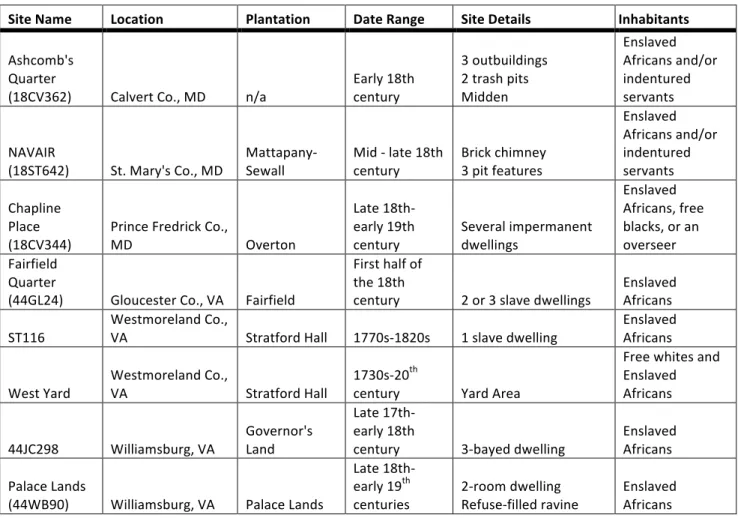
(DAACS), an online database with systematically described site contexts and artifact catalogs from slavery-related sites in North American and the Caribbean (DAACS 2016a). The sites are related to enslaved Africans rather than white slave holders, and do not include contexts from plantation manor houses. There are fifty-two North American sites, from twenty plantations. Some plantations, such as Monticello and the Hermitage, have multiple site entries in DAACS. These sites are located in Maryland, Virginia, North Carolina, South Carolina, and Tennessee, with the majority from Virginia. They span the mid-17th through the late 19th century, with most falling between 1750 and 1830. Toys were found at thirty-six out of the fifty-two sites. A
description of each site’s location, date range, features, and inhabitants is given in Table 1 below.
Table 1: Site Descriptions
Site Name Location Plantation Date Range Site Details Inhabitants
Ashcomb's Quarter
(18CV362) Calvert Co., MD n/a Early 18th century
3 outbuildings 2 trash pits Midden Enslaved Africans and/or indentured servants NAVAIR
(18ST642) St. Mary's Co., MD Mattapany-Sewall Mid - late 18th century Brick chimney 3 pit features
Enslaved Africans and/or indentured servants Chapline Place
(18CV344) Prince Fredrick Co., MD Overton
Late 18th-early 19th
century Several impermanent dwellings
Enslaved Africans, free blacks, or an overseer Fairfield
Quarter
(44GL24) Gloucester Co., VA Fairfield
First half of the 18th
century 2 or 3 slave dwellings Enslaved Africans
ST116 Westmoreland Co., VA Stratford Hall 1770s-1820s 1 slave dwelling Enslaved Africans
West Yard Westmoreland Co., VA Stratford Hall 1730s-20
th
century Yard Area
Free whites and Enslaved Africans
44JC298 Williamsburg, VA
Governor's Land
Late 17th-early 18th
century 3-bayed dwelling
Enslaved Africans
Richneck Quarter
(44WB52) Williamsburg, VA Richneck 1710-1740s 1740s-1778 Domestic site 2-room dwelling Enslaved Africans
Utopia II
(44JC32) Williamsburg, VA Utopia 1700-1730
3 dwellings 1 outbuilding
19 subfloor pits Enslaved Africans
Utopia III
(44JC32) Williamsburg, VA Utopia 1730-1750
2 dwellings 1 outbuilding 21 subfloor pits Trash pits
Enslaved Africans
Utopia IV
(44JC787) Williamsburg, VA Utopia 1750-1775
3 dwellings 24 subfloor pits 9 trash pits
Enslaved Africans House for
Families
(44FX762) Fairfax Co., VA Mount Vernon 1759-1793 Cellar in a slave dwelling Enslaved Africans Servant's
Hall/Wash House
(44FX762) Fairfax Co., VA Mount Vernon
2nd quarter of the 18th
century Trash pit associated with earlier washhouse Enslaved Africans South Grove
(44FX762) Fairfax Co., VA Mount Vernon 1735-1800
Midden from kitchen and mansion
Enslaved Africans
Pope Site
(44SN180) Southampton Co., VA Holladay/ Ridley Tract Late 18th-early 19th
Frame house Cellar
2 structures with cellars Outbuilding
Free whites and Enslaved Africans
Mount Pleasant
Kitchen Site Orange Co., VA Montpelier 1720s-1790s
Kitchen cellar Personal adornment items from cellar of the main house
Enslaved Africans
North Hill Bedford Co., VA Poplar Forest 1770-1785 Enslaved household 3 pits Enslaved Africans
Quarter Bedford Co., VA Poplar Forest 1790-1813
3 log buildings Middens Gardens
Enslaved Africans
Wingos Bedford Co., VA Poplar Forest 1770s-1790s 1 cabin Yard spaces Enslaved Africans
Building C Charlottesville, VA Monticello 1776-1826 Joiners shop Enslaved Africans
Building D/j Charlottesville, VA Monticello
1790s-early 1800s Blacksmith Nailery Enslaved Africans
Building i Charlottesville, VA Monticello 1790s-19th century Carpenter's shop Dwelling Enslaved Africans
Building l Charlottesville, VA Monticello 1790s-1826 Domestic structure Iron storehouse Enslaved Africans
Building m
and MRS 4 Charlottesville, VA Monticello
1790s-1809 1809-
mid-19th century Smokehouse and dairy Dwelling Enslaved Africans
Building n Charlottesville, VA Monticello
1796-1809 19th century
Washhouse A later dwelling
Enslaved Africans
MRS 2 Charlottesville, VA Monticello 1780s Dwelling
Enslaved Africans or free workmen
Building r Charlottesville, VA Monticello 1790s-1830 Dwelling
Enslaved Africans
Building s Charlottesville, VA Monticello 1790s-early 20th century
Dwelling
A later post-Jefferson structured
Enslaved Africans and unidentified
Building t Charlottesville, VA Monticello 1770s-1830s
Barracks-style quarter Later dwelling
Enslaved Africans East Kitchen
Yard Charlottesville, VA Monticello 18th-20th centuries Yard area West Kitchen
Yard/Dry
Well/MRS 1 Charlottesville, VA Monticello
18th-19th centuries Work yard Dwelling Well Enslaved Africans Elizabeth Hemmings Site
(44AB438) Charlottesville, VA Monticello 1795-1807
Dwelling Cobble scatter
Elizabeth Hemmings
Stewart-Watkins Site Charlottesville, VA Monticello 1801-1810 Dwelling Cellar White workmen
Site 7 Charlottesville, VA Monticello 1750-1780 1 dwelling
Enslaved Africans and overseers
Site 8 Charlottesville, VA Monticello 1770-1800 4 structures Enslaved Africans
Stagville Durham, NC Stagville
Late 18th - mid 20th
centuries Slave cabin
Enslaved Africans and later free blacks
Curribbo 245
(38BK245) Berkeley Co., SC Curribbo 1740s-1800
11 structures including slave dwellings and outbuildings
Enslaved Africans
Yaughan 75
(38BK75) Berkeley Co., SC Yaughan 1750S-1820S
4 domestic structures 1 shed
2 possible structures Enslaved Africans
Yaughan 76
(38BK76) Berkeley Co., SC Yaughan 1740s-1770s
13 slave dwellings An overseer's house
Enslaved Africans and overseers Middleburg
(38BK38) Berkeley Co., SC Middleburg 1750s-1825 12 slave cabins Enslaved Africans Silver Bluff Aiken Co., SC Silver Bluff 1740s-1770s Main dwelling house Unknown Drayton Hall
(38CH255) Charleston, SC Drayton Hall 18th century South Flanker well Unknown
Yard Cabin Davidson Co., TN The Hermitage 1820s-1865 Cabin Enslaved Africans
Triplex Davidson Co., TN The Hermitage 1820s-1850s Brick dwelling
Enslaved Africans
South Cabin Davidson Co., TN The Hermitage 1820s-1850s Cabin Enslaved Africans
later free blacks
Field Quarter
Cabin 2 Davidson Co., TN The Hermitage 1820s-early 20th century Brick duplex cabin
Enslaved Africans and later free blacks
Field Quarter
Cabin 4 Davidson Co., TN The Hermitage 1820s-1870s Brick duplex cabin
Enslaved Africans and later free blacks Field Quarter
KES Davidson Co., TN The Hermitage
Early 19th
century Log cabin
Enslaved Africans Field Quarter
STP Davidson Co., TN The Hermitage 1804-early 20th century STP survey Enslaved Africans
Analysis
Methodology
To assess the changes in toy frequency and types overtime, the toys from these fifty-two sites needed to be assigned a date. As the data for this project are online, pictures of artifacts are limited, and some toys do not have detailed descriptions, context dates are more useful than attempting to date toys based on their period of manufacture. There are a number of methods used by historical archaeologists to date contexts and sites including Mean Ceramic Dates, Binford pipe stem bore diameter dates, Terminus Post Quem (TPQ), and Harrington histograms of pipe stems. MCDs and Binford pipe stem dates both provide a mean date for the assemblage, while TPQs determine the earliest possible date an assemblage may have been deposited, and Harrington histograms provide a visual representation of site occupation through time. Each of these methods have benefits and shortcomings and are best used in conjunction with each other to provide the fullest picture of the assemblage date and occupation (Deetz 1987:67).
has multiple periods of occupation or was more heavily used towards the beginning or end of the period of occupation, mean dates may not be accurate (Deetz 1987:67). MCDs in particular can be influenced by ceramics that have long periods of manufacture, such as whiteware and Chinese porcelain and also by vessels that were discarded long after they were purchased.
Despite these issues, I chose to use a form of MCDs and Binford pipe stem dates for my analysis because for the collections and contexts that I am using, TPQs and Harrington
Histograms are not useful. TPQ stands for terminus post quem, meaning “the date after which.” This dating method involves determining which artifact in an assemblage has the latest
manufacturing date, to provide the earliest date that a context may have been created (Miller et al. 2000:1). While this is a very effective dating technique and would avoid some of the dating issues I encountered, including contexts with MCDs decades earlier than when certain toys began to be produced, I only have TPQs for some site phases from DAACS. Because the catalog is online and I do not have access to the original artifacts and not all entries include photographs, I am unable to determine the TPQs of contexts myself.
date individual contexts rather than entire sites, most of the contexts in DAACS do not have enough pipe stems to create histograms.
Despite the issues with using mean dates, MCDs and Binford pipe-stem dates are the most useful dating techniques for the sites and collections that I am using in this analysis. Additionally, although the midpoint may not encompass the entire site occupation and may be skewed due to outliers, mean dates also allow easy comparison between contexts and sites and allow contexts to be arranged in a relative chronological order.
I am using Best Linear Unbiased Estimate Mean Ceramic Dates (BLUE MCD) for all sites except those from the early 18th century. BLUE MCDs are similar to regular Mean Ceramic Dates (MCD), but the formula gives less weight to ceramics with long manufacturing spans, such as delftware and Chinese porcelain (Galle, personal communication, Jan 27, 2016). The DAACS database calculates BLUE MCDs for sites and individual contexts automatically when a MCD query is run. BLUE MCDs are not a perfect means of dating contexts because it is an average. For example, some of the Hermitage contexts have BLUE MCDs of 1808 but the structures were not built until the 1820s. However, BLUE MCDs do provide relative dates if not absolute dates.
𝑀𝐶𝐷!"#$ =
𝑚!𝑝! 𝑠1 !/6
!
! !!!
𝑝! 𝑠1
!/6 ! !
!!!
Where mi is the manufacturing midpoint for the i'th ceramic type, pi is its relative frequency, and si is its
manufacturing span (Galle, personal communication, Jan 27, 2016).
MCDs do not work as well for early 18th century sites and Binford pipe-stem bore-diameter dates are used to calculate tighter and more accurate dates. There are nine sites in DAACS that Jillian Galle, the director of DAACS, recommended using pipe-stem dates:
The pipe-stem dates are only for site phases so the toys from these nine sites are dated by phase rather than context. Fraser Neiman, Director of Archaeology at Monticello, calculated the phase dates in R from the DAACS data (Galle, personal communication, Feb 27, 2016). There are also seven toys for which no BLUE MCD or Binford bore-diameter date could be calculated because they were found in surface collections, clean-up, or unphased contexts such as the plowzone.
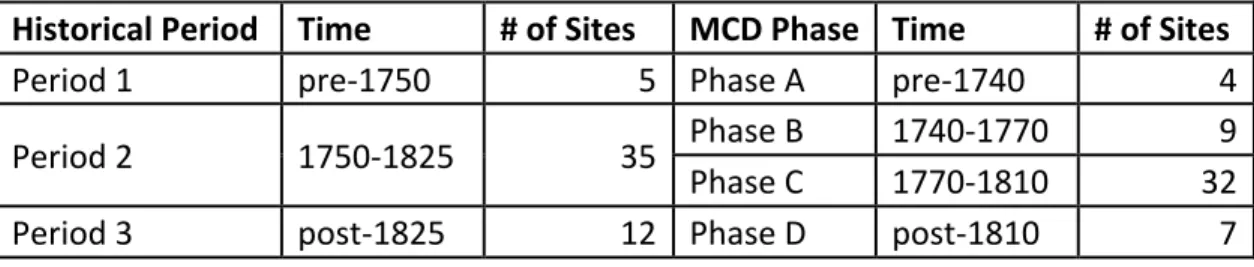
In order to examine changes over time across the fifty-two sites, I employed two different ways of dividing up the 18th and 19th centuries, historically based periods and phases based on MCDs. Comparing shifts in the archaeological record to those in the historical record is a way to understand the influence of the dominant discourse of childhood on enslaved children. The sites were divided into three periods based on the periods of childhood devised by Calvert (1992): Period 1(pre-1750), Period 2 (1750-1825), and Period 3 (post-1825). The dates assigned to each site came from the DAACS website and are based on historically known occupation of the sites. Because the cut off for many of the historical site dates on DAACS is 1825 or the first quarter of the 19th century, 1825 is used as the transition from Period 2 to Period 3 rather than 1830 as Calvert suggests. Five sites date to Period 1, four span both Period 1 and Period 2, thirty-one are from Period 2, five span Periods 2 and 3, and six are from Period 3 (Table 2). For the purpose of analysis, sites that span multiple periods will be grouped with the later period. The majority of sites are from Period 2, which reflects the large number of sites from Monticello.
Table 2: Historical Periods and MCD Phases
Historical Period Time # of Sites MCD Phase Time # of Sites
Period 1 pre-1750 5 Phase A pre-1740 4
I also phased the sites based purely on their BLUE MCD or Binford pipe-stem date in order to obtain groupings not influenced by preconceived ideas from the historical record that mainly relates to Northern white middle-class children. Using the distribution in Figure 1, the sites can be divided into four phases, the Phase A from before 1720 until 1740, Phase B 1740-1770, Phase C 1770-1810, and Phase D 1810-1850. While based on the archaeological rather than the historical record, these phases still match up relatively well with the shifts in the dominant discourse of childhood seen in the historical literature. Both sets of phasing are used because they each provide a different, but still valid, way of dividing the sites, one based purely on the artifacts and the other based on the known historical occupation of the sites.
Percentages are a useful way to look at changes in toy ownership by enslaved children through time because they provide an easy way to compare the number of toys found at sites with different sample sizes, but they have problems. Because the numerator, in this case, toys, is dependent on the denominator, all other artifacts, variation in the category of all other artifacts between different sites can throw the percentages off and present an inaccurate picture of the frequency of toys (Galle 2016). For example, if one of the sites had a large amount of
relatively constant across sites and through time, or changes though time in a way that can be predicted. An abundance index does just that. It is calculated by dividing (artifact group 1) by (artifact group 1) + (artifact group 2) (Galle 2016).
Some historical archaeologists use wine bottle glass as artifact group 2 because it is common across all social classes throughout the 18th and early 19th centuries. However, because some of the sites I am looking at last through the late 19th and even early 20th century, wine bottle glass does not work. Based on recommendations from DAACS analysts, I am using ceramics as artifact group 2. While not perfect, due to the consumer revolution in the 18th century and changes in ceramic types and use, ceramics are found on all sites and can provide a baseline for comparison.
!"#
!"#$%
=
!"#$
CHAPTER 5: TOYS ANALYZED BY SITE
Analysis using History-Based Periods
Based on historically based periods and the percentage of toys found at each site, the data suggests that enslaved children were included in shifts in meanings around childhood. Of the ten sites with the greatest percentage of toys, nine are from Period 3 and the tenth, the Field Quarter KES site, is located nearby four Period 3 sites which may be have had an impact on what
general, the toy index using historical periods shows that there is not a completely straightforward increase in toys through time, although later sites have the most toys.
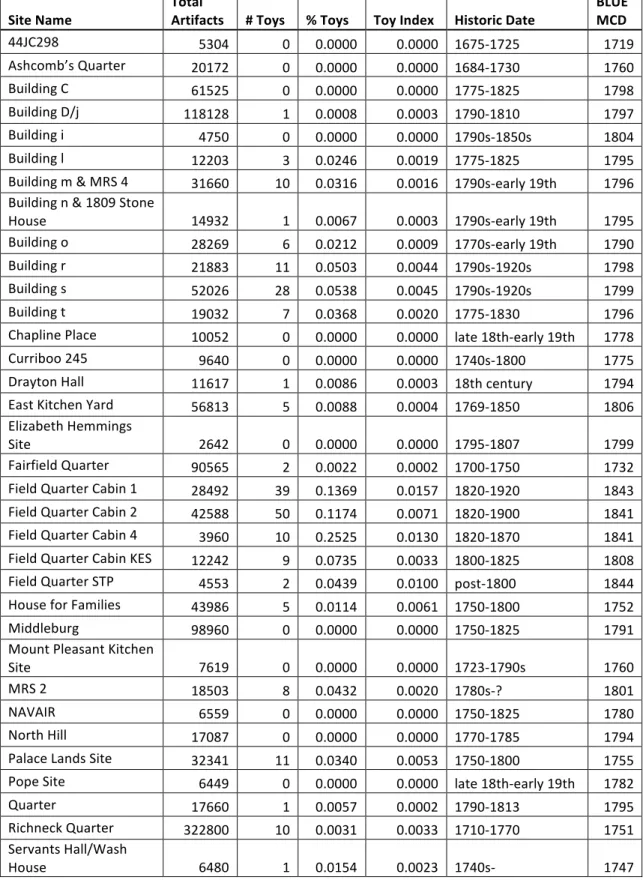
Analysis using MCD-Based Phases
Table 3: Site Dates and Toys
Site Name Total Artifacts # Toys % Toys Toy Index Historic Date BLUE MCD
44JC298 5304 0 0.0000 0.0000 1675-1725 1719
Ashcomb’s Quarter 20172 0 0.0000 0.0000 1684-1730 1760
Building C 61525 0 0.0000 0.0000 1775-1825 1798
Building D/j 118128 1 0.0008 0.0003 1790-1810 1797
Building i 4750 0 0.0000 0.0000 1790s-1850s 1804
Building l 12203 3 0.0246 0.0019 1775-1825 1795
Building m & MRS 4 31660 10 0.0316 0.0016 1790s-early 19th 1796 Building n & 1809 Stone
House 14932 1 0.0067 0.0003 1790s-early 19th 1795
Building o 28269 6 0.0212 0.0009 1770s-early 19th 1790
Building r 21883 11 0.0503 0.0044 1790s-1920s 1798
Building s 52026 28 0.0538 0.0045 1790s-1920s 1799
Building t 19032 7 0.0368 0.0020 1775-1830 1796
Chapline Place 10052 0 0.0000 0.0000 late 18th-early 19th 1778
Curriboo 245 9640 0 0.0000 0.0000 1740s-1800 1775
Drayton Hall 11617 1 0.0086 0.0003 18th century 1794
East Kitchen Yard 56813 5 0.0088 0.0004 1769-1850 1806
Elizabeth Hemmings
Site 2642 0 0.0000 0.0000 1795-1807 1799
Fairfield Quarter 90565 2 0.0022 0.0002 1700-1750 1732
Field Quarter Cabin 1 28492 39 0.1369 0.0157 1820-1920 1843
Field Quarter Cabin 2 42588 50 0.1174 0.0071 1820-1900 1841
Field Quarter Cabin 4 3960 10 0.2525 0.0130 1820-1870 1841
Field Quarter Cabin KES 12242 9 0.0735 0.0033 1800-1825 1808
Field Quarter STP 4553 2 0.0439 0.0100 post-1800 1844
House for Families 43986 5 0.0114 0.0061 1750-1800 1752
Middleburg 98960 0 0.0000 0.0000 1750-1825 1791
Mount Pleasant Kitchen
Site 7619 0 0.0000 0.0000 1723-1790s 1760
MRS 2 18503 8 0.0432 0.0020 1780s-? 1801
NAVAIR 6559 0 0.0000 0.0000 1750-1825 1780
North Hill 17087 0 0.0000 0.0000 1770-1785 1794
Palace Lands Site 32341 11 0.0340 0.0053 1750-1800 1755
Pope Site 6449 0 0.0000 0.0000 late 18th-early 19th 1782
Quarter 17660 1 0.0057 0.0002 1790-1813 1795
Richneck Quarter 322800 10 0.0031 0.0033 1710-1770 1751
Servants Hall/Wash
Silver Bluff 33047 0 0.0000 0.0000 1740-1780 1758
Site 7 16490 1 0.0061 0.0033 1750-1805 1782
Site 8 127190 0 0.0000 0.0000 1770-1800 1787
South Cabin 51863 27 0.0521 0.0053 1820-1860 1848
South Grove Midden 125621 4 0.0032 0.0003 1735-1800 1734
ST116 9274 1 0.0108 0.0016 1775-1825 1785
Stagville 3805 1 0.0263 0.0030 1820-1900 1803
Stewart-Watkins 15598 2 0.0128 0.0005 1801-1810 1796
Triplex 66584 128 0.1922 0.0258 1820-1860 1825
Utopia II 102285 4 0.0039 0.0187 1700-1730 1723
Utopia III 96284 10 0.0104 0.0034 1730-1750 1750
Utopia IV 57152 16 0.0280 0.0128 1750-1775 1762
West Kitchen Yard/Dry
Well/MRS 1 119385 13 0.0109 0.0005 1768- 1798
West Yard Stratford
Hall 19052 1 0.0052 0.0006 1730-1930 1795
Wingos 1132 0 0.0000 0.0000 1770-1790 1781
Yard Cabin 76695 110 0.1434 0.0141 1820-1865 1840
Yaughan 76 29833 4 0.0134 0.0002 1740-1770 1785
Yaughn 75 14145 1 0.0071 0.0002 1750-1820 1792
regional variation also reflects variation in time; shown by Figure 8, and regional differences cannot easily be discussed because it is impossible to separate them from chronological changes. For Figures 6, 7, and 8, each line represents a single toy.
rather than counts removes biases that may arise from sample size and plotting the total number of artifacts against the percent of toys shows that there is very little correlation between sample size and toys with a r2 value of 0.0253 (Figure 9). There is also not an increase in the number of total artifacts in DAACS over time. There also does not appear to be a relationship between the distance between the site and urban centers, which are here defined as cities known to exist during the time period the site was occupied (Figure 10). Similarly, sites closer to the main house on plantations may have had a greater access to toys, but there are no patterns of toys based solely on home versus field quarters (Figure 11), except for the fact that no toy dishes are found on field quarter sites.2
percentages. One possible explanation for the dip in toys in the abundance index for the period between 1770 and 1810 is disruptions to trade with England. This period encompasses the American Revolution, including political acts such as the First Continental Congress’ 1774 Continental Association, which banned the importation of goods from Britain. This ban would have included most toys that survive archaeologically, with the exception of homemade marbles, as most others were imported from Germany, by way of England. Additionally, the Association included the clause that “We will…discountenance and discourage every species of extravagance and dissipation, especially all horse-racing and all kinds of gaming, cock-fighting, exhibition of shews [sic], plays, and other expensive diversions and entertainments.” Imported toys would have been hard to acquire due to the ban on English goods, especially as homemade versions could have been easily made, and toys likely fell under the category of “expensive diversions and entertainments.” While not all of the plantation owners and enslaved Africans in the American colonies and later the newly formed United States may have supported the ban, most of the sites in DAACS with toys from between 1770 and 1810 are from Thomas Jefferson’s Monticello, someone who was highly dedicated to the cause of American independence and may have stopped importing objects such as toys.
The large increase in toys beginning around the 1820s fits well with the change in the dominant discourse surrounding childhood in the antebellum. While there were some
percentages, compared to those sites that only existed through the Civil War. The three sites with the highest percentage of toys all fell out of use by the 1870s. This suggests that the increase in toys after 1820 is not solely due to changes in manufacturing. It can also be attributed to new ideas about innocent childhoods and their influence on paternalistic slavery. Play began to be seen as a critical part of childhood around the same time slaveholders started to view themselves as parental figures towards their slaves. This may have led the slaveholders to give toys to
CHAPTER 6: TOYS ANALYZED BY DATE
While studying the toys in the context of their sites provides evidence for a general increase in toys over the 18th and early 19th centuries, the picture that emerges is not very detailed, especially as some sites have long periods of occupation or belong to more than one period/phase. To combat this problem, I combined all of the toys into a single data set focused on date and type of toy. Each toy was looked at as an individual entity rather than grouped by site. This allowed me to see more detailed trends in when exactly toys begin appearing in the archaeology record and to look at specific toys types.
although the exact point at which toys began steadily appearing may be later than the graph suggests.
Toys were divided into the categories of marbles, dolls, toy dishes, and other. Differences among toy forms are important to understanding the effects changes in childhood had on
removed, dolls still make up half of the toys and marbles are not dominant, showing that this change it is not entirely based on regional differences.
The results based on the MCD phases show the same pattern (Figure 15). Phase A (pre-1740) has marbles as 100% of the 5 toys. Phase B (1740-1770), 90.57% of the 53 toys are marbles, 7.55% are doll parts, and 1.89% are other toys. For Phase C (1770-1810) 78.43% of the 102 toys are marbles, 15.69% are dolls, and 5.88% are toy dishes. Finally, for Phase D (post 1810), 54.76% of the 378 toys are marbles, 39.68% are dolls, 3.97% are toy dishes, and 1.59% are other toys.
Toys were then divided by form and arranged by context date to determine when exactly each category began commonly appearing and how these correlate to the historically identified periods. The results are similar to those produced when toys are divided by period (Figure 16). Marbles are present from the early 18th century and are found in increasing numbers after 1750.
while there are doll parts found in contexts with BLUE MCDs in the period between 1790 and 1825, it is not until after 1825 when dolls begin to appear regularly. Understanding how the “other” category fits into these shifts is difficult as the one 18th-century toy cataloged as “other” is unidentified and objects such as toy horses, cannons, and wagons do not appear until the 19th century.
According to the BLUE MCDs, toys besides marbles are not regularly found until after 1790. This pattern is not simply the result of the Hermitage contexts as the early shift is due to contexts from Monticello and other Virginia sites (Figure 7). This date is most likely skewed slightly early, as there are a number of toys with context MCDs that pre-date their manufacture start date by up to 40 years. There may have been some toys present in the late 18th century, but the large increase was likely in the antebellum period based on the manufacturing dates of marbles, doll, and toy dish ware-types.
when differences between adults and children were beginning to be emphasized and play became an important part of raising properly educated children, toys begin appearing in greater numbers on slave quarter sites and include dolls. By the antebellum period, when the playful nature of children became emphasized and they were encouraged to play for enjoyment, toys became an even larger proportion of the artifacts found on quarter sites and dolls appear in similar numbers to marbles. While the general chronological trends seem to support the idea that enslaved African children were viewed with the same dominant discourse of childhood as free white children, each toy type needs to be considered to understand where the toys were coming from and what they represent to adults.
Dolls
Changes in childhood and socialization for enslaved girls can be discussed using data such as the point in time when dolls began to appear on sites in DAACS and what parts of the doll were found. In order to properly understand the meaning and use of porcelain dolls, they need to be placed in the larger context of dolls in the 18th and 19th centuries. Porcelain dolls are the only dolls likely to survive in an archaeological context, but they were not made in large quantities until the 1840s and did not become affordable for most Americans until after the Civil War (Davis 1993; Formanek-Brunell 1993). Dolls were one of the first items to become part of a separate children’s material culture as they became associated with young girls and not adult dressmakers during the 18th century (Calvert 1992).
maché in the first few decades of the 19th century (Goodfellow 1993; Davis 1993). Some porcelain doll heads and limbs were made as early as the 1750s in Germany but these were relatively rare and expensive (Davis 1993). Dressed and undressed dolls are listed in 18th century newspapers such as the Virginia Gazette and the South Carolina Gazette in announcements of goods arrived from England as early as the 1740s, but none provide any specifics as to the materials used to make the dolls. In the 1840s, porcelain doll heads and limbs began to be mass-produced. These heads and limbs were attached to wooden and cloth bodies. Heads and limbs were commonly sold as separate parts before 1880 so customers could save money by creating their own doll bodies. Frozen Charlotte dolls appeared in the 1850s. These dolls were one solid piece with porcelain bodies and limbs frozen in place. Almost all dolls before the 1880s were adult females with black hair and blue eyes (Davis 1993).
recovered, and each of these sites had only one or two fragments. This indicates that dolls were not commonly the only manufactured toy owned by enslaved children, and if they were going to have only one type of toy, it was more likely going to be marbles.
Ninety-three fragments across all of the DAACS sites came from unidentifiable portions of a doll. Doll head fragments are the most commonly identified doll part, with twice as many heads (59) as limbs (30) (Figure 18, Figure 19, Figure 20). There are only two doll eyes in the database, both from the Stewart-Watkins site (Figure 21). According to the notes accompanying their catalog entries, the eyes are from a Queen Ann style doll which were made of wood
covered with gesso and painted (DAACS 2016e). There are six Frozen Charlotte dolls; however, some of the other doll fragments dating to after 1850 may also be Frozen Charlottes but are not intact enough to be positively identified. Forty-seven doll fragments had decoration, recorded as either molding or painting. Three doll fragments had evidence of blond hair, and eighteen have black hair (Figure 18). The rest of the decorated fragments are painted faces, shoes, or
Figure 21: Doll Eyes from Monticello’s Stewart-Watkins. Artifact ID 102-1698B-DRS—00060. Downloaded from The Digital Archaeological Archive of Comparative Slavery. (http://drc.iath.virginia.edu/media/images/ Optimized_Objects/p_1111.jpg) on April 7, 2016.
Figure 19: Doll Leg from Stratford Hall’s ST116. Artifact ID 1006-187C-DRS--00002. Downloaded from The Digital Archaeological Archive of Comparative Slavery (http://drc.iath.virginia.edu/
media/images/Artifact/1006-187C-DRS-00002b.jpg) on April 7, 2016.
Figure 20: Doll Arm from Monticello’s Building s. Artifact ID 1002-830B3-NOS--00112. Downloaded from The Digital Archaeological Archive of Comparative Slavery http://drc.iath.virginia.edu/ media/images/Object/579.jpg) on April 7, 2016. Figure 18: Doll Face from The Hermitage’s Field Quarter Cabin 3. Artifact ID. 1405-95-01-012-DRS— 00049.Downloaded from The Digital Archaeological Archive of Comparative Slavery