UNRECIPROCATED BEST FRIENDS ON ADOLESCENT ALCOHOL USE
Richard Ernest Hicks
A dissertation submitted to the faculty of the University of North Carolina at Chapel Hill in partial fulfillment of the requirements for the degree of Doctor of Philosophy in the
Department of Psychology (Clinical).
Chapel Hill 2006
Committee members
ABSTRACT
RICHARD E. HICKS: The Influence of Unreciprocated Best Friends on Adolescent Alcohol Use
(Under the direction of Andrea Hussong)
The project aimed to better understand whether some adolescents conform to the alcohol use behaviors of non-reciprocating best friends in order to obtain reciprocated
friendships. The study examined (1) the relative influence of unreciprocated and reciprocated best friends on adolescent alcohol use behaviors; (2) the relative strength of unreciprocated best friend influence in two peer contexts – one in which the adolescent has no reciprocated friendships and the other in which the adolescent has reciprocated friendships; and (3) the success of alcohol use conformity in establishing reciprocated friendships. This project gave particular attention to adolescents whose only friendships within the school context were non-reciprocated relationships. Changes in adolescent alcohol use behaviors and changes in adolescent friendship reciprocity (e.g., transition from an unreciprocated best friendship at 8th grade to a reciprocated best friendship at 9th grade) were examined through the use of
school-based survey data. Peer nomination data were used to determine reciprocity within friendship dyads and to obtain self-reports of peer alcohol use behaviors during the 8th and 9th grades, a time when the adolescents in this study were transitioning from middle school to high school.
friends exerted influence on their subsequent alcohol use behaviors. These relationships held only in the prediction of frequency of alcohol use, and not for initiation of alcohol use. There was modest support for the proposition that initiation of alcohol use facilitated the formation of reciprocated friendships with similar peers. This work may help elucidate the role of friendship selection and influence processes in the development of alcohol use behaviors, and it may help in the identification of adolescents who are particularly susceptible to peer
To
Tika Johnson Hicks &
ACKNOWLEDGEMENTS
I am particularly indebted to Andrea Hussong, my research advisor, for her invaluable role in assisting me with this project and for her important role in guiding my academic and professional growth. Her encouragement, advice, patience, mentoring, and research support throughout my doctoral studies have made this dissertation possible. This dissertation is part of the research carried out through her creative and ardent vision. I also want to thank Susan Ennett, Deborah Jones, Mitch Prinstein, and Patrick Curran, who served on my dissertation committee and offered valuable guidance, support, and feedback on this research project. Through their own research, they have contributed to my understanding of adolescents and their social environments. Thanks go out to many others who have read and listened to me present my ideas and results, especially Susan Purcell, Suzanne Levy, Matthew Hersh, Chris Galloway, Laura Feagans, Gaby Stein, and Jennifer Manning.
I am fortunate to have had the opportunity of working with a truly talented and caring group of professors during my doctoral training at UNC. In particular, I want to thank Janis Kupersmidt, for her instrumental role in helping me enter into graduate studies; Don
Baucom, who has overseen an exemplary clinical psychology program; and Dianne Chambless, who, along with Don, served as an inspirational model of the
have provided me the opportunity to complete this dissertation project while simultaneously developing as a clinician.
I am immeasurably grateful and lovingly indebted to Tika Hicks, who throughout my graduate studies has generously given so much to me in so many ways. Her support,
TABLE OF CONTENTS
Page
LIST OF TABLES ………... x
LIST OF FIGURES ………... xi
LIST OF ABBREVIATIONS ………... xii
INTRODUCTION ………... 1
Influence as a Prominent Theory of Adolescent Substance Use ……….. 2
Friendship Measurement ……….. 6
Why Unreciprocated Friends May Be Important in Understanding Influence ……… 10
Alcohol Use as a Mechanism that Facilitates Friendship Formation ………... 19
Goals of the Study ……… 22
METHOD ………... 25
Study Overview ……… 25
Analysis Sample ……….. 26
Design and Procedure ……….. 28
Measures ……….. 30
Demographic and Control Variables ………... 30
Friendship Nominations and Derived Variables ………. 31
Alcohol Use Variables ……… 34
RESULTS ………. 38
Variation across the Schools ………... 38
Differences between Adolescents with Reciprocated and Unreciprocated Best Friendships ………. 39
Relations between Alcohol Use and Adolescent Descriptive Variables …………. 40
Determination of Control Variables ………. 41
Best Friend Alcohol Use and Best Friend Reciprocity Interactively Predicting Subsequent Adolescent Alcohol Use (Hypothesis 1) ………. 42
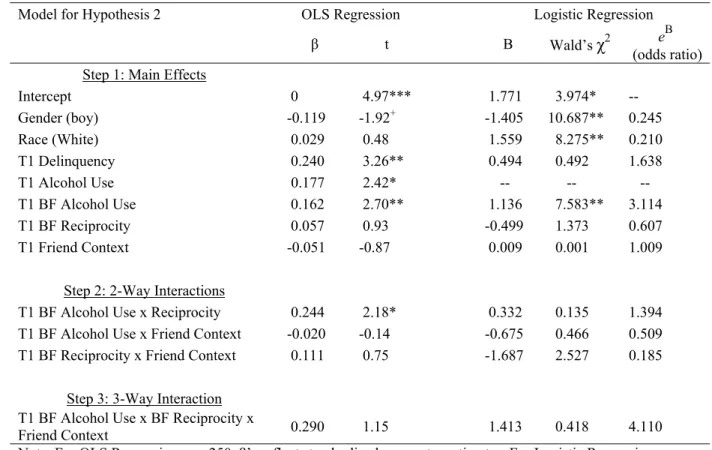
Best Friend Alcohol Initiation, Best Friend Reciprocity, and Friendship Context Interactively Predicting Subsequent Adolescent Alcohol Use (Hypothesis 2) …... 44
Formation of Reciprocated Friendships through the Initiation of Alcohol Use (Hypothesis 3) ...…...………... 47
Statistical Power Analysis ……… 49
Post-Hoc Analyses ………... 50
Alternative Tests of the Interaction of Best Friend Alcohol Use, Reciprocity, and Context ………... 50
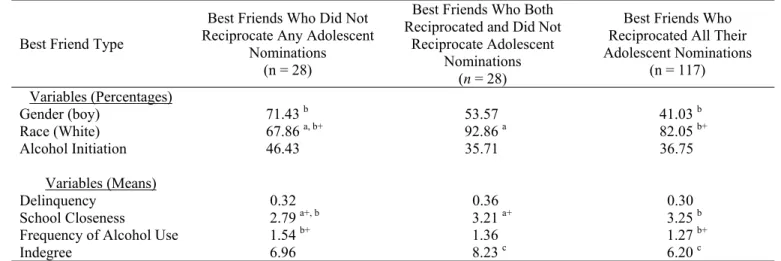
Exploring Who is Being Selected as Best Friends ……….. 53
DISCUSSION ………... 55
Best Friendship Reciprocity and Adolescent Alcohol Use ……….. 56
Best Friendship Reciprocity, Friendship Context, and Adolescent Alcohol Use …… 57
Adolescent Alcohol Use Contributing to Friendship Formation ………... 60
Conclusions………... 62
TABLES ……… 67
FIGURES ……….. 76
APPENDICES ……….. 81
LIST OF TABLES
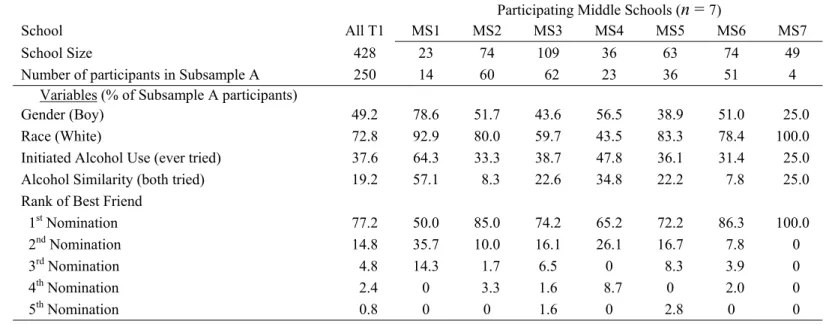
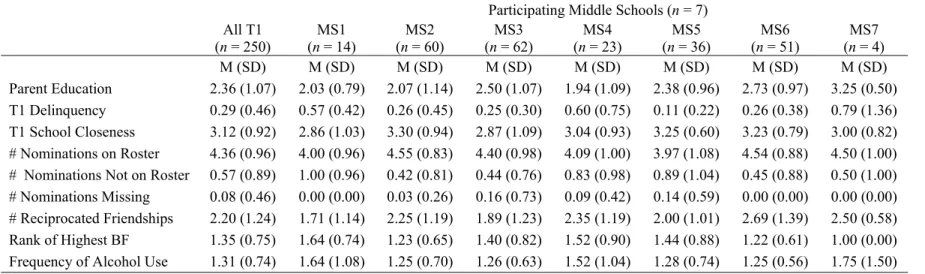
Page Table 1 Frequencies of Descriptive Variables by T1 Schools ………... 67 Table 2 Means of Descriptive Variables by T1 Schools ………... 68 Table 3 Comparisons of Adolescents with a Reciprocated and an Unreciprocated Best
Friend ……….. 69
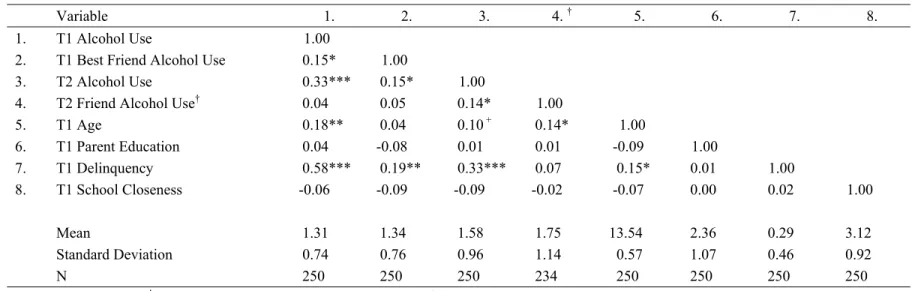
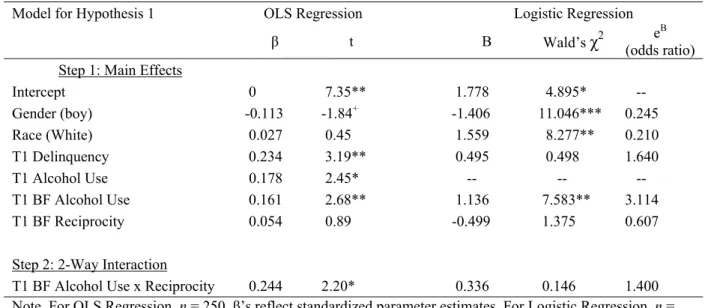
Table 4 Correlations, Means, and Standard Deviations for Adolescent Variables …... 70 Table 5 Best Friends Alcohol Use & Best Friend Reciprocity Interactively Predicting
Subsequent Adolescent Alcohol Use (Hypothesis 1) ………. 71 Table 6 Best Friend Alcohol Use, Best Friend Reciprocity, & Friendship Context
Interactively Predicting Subsequent Adolescent Alcohol Use (Hypothesis 2)… 72 Table 7 T1 Best Friendship with an Alcohol Using Peer & T2 Adolescent Alcohol
Initiation Interactively Predicting Reciprocated Friendship formation with an Alcohol-Using Peer (Hypothesis) ………... 73 Table 8 Best Friend Alcohol Use, Best Friend Reciprocity & Friendship Context
Interactively Predicting Subsequent Adolescent Alcohol Use (Hypothesis 2,
Alternative Model) ……….. 74
Table 9 Post-hoc Comparison of Types of Best Friends, Based on Their Reciprocation
LIST OF FIGURES
Page Figure 1 Design Overview of the High School Transition Study ………. 76 Figure 2 Overview of Analysis Sample ………... 77 Figure 3 Best Friend Alcohol Use & Reciprocity Interactively Predicting Subsequent
Adolescent Alcohol Use (Hypothesis 1; OLS Model) ……….. 78 Figure 4 Best Friend Alcohol Use, Best Friend Reciprocity & Friendship Context
Predicting Frequency of Alcohol Use (Hypothesis 3; Logistic Model) ……… 79 Figure 5 The Predicted Probability of at T1 Abstainer with an Unreciprocated Best
Friend Forming a T2 Reciprocated Friendship with an Alcohol Using Peer
LIST OF ABBREVIATIONS AND SYMBOLS
alpha Cronbach’s alpha
BF best friend
gender biological sex
HSTS High School Transition Study OLS ordinary least squares
PI principal investigator
RF reciprocated friend
SES socioeconomic status
SNA social network analysis T1 time 1 or phase I
T2 time 2 or phase III
B unstandardized beta
β standardized beta
eβ odds ratio
F F-test
N sample size
n subsample size
r correlation
SD standard deviation
t t-test
INTRODUCTION
This project will examine the role of peers in the development of adolescent alcohol use behaviors during the transition from middle school to high school. The project will pay particular attention to adolescents who have difficulty gaining acceptance and establishing friendships with their same-age peers, as this is a subset of adolescents that show risk for maladjustment (Henrich, Kuperminc, Sack, Blatt, & Leadbeater, 2000) and may be
particularly susceptible to social pressures (Abel, Plumridge, & Graham, 2002). A large body of literature supports the idea that friendships are an important part of adolescent
development (Hartup, 1996) and that not having friends may contribute to difficulties later in life (Bagwell, Newcomb, & Bukowski, 1998). Additional support for the importance of friendships in understanding adolescent substance use comes from longitudinal studies on the development of delinquency that indicate that substance use is embedded within the peer group (Elliot, Huizinga, & Ageton, 1985; Hawkins, Catalano, & Miller, 1982), from
theoretical models of adolescent substance use that suggest that friends play a prominent role in adolescent substance involvement (e.g., Oetting & Donnermeyer, 1998), and from
but who also reside in a context without any reciprocated friends. The current study will test whether adolescents in such social contexts are at increased risk for alcohol use and whether alcohol use functions to create reciprocated friendships.
Influence as a Prominent Theory of Adolescent Substance Use
Peers are thought to be important socializing agents, and this view has been supported by a large body of research establishing that adolescents are likely to be similar to their friends in many attributes, including drug use behaviors (for a review, see Akers 1985; Kandel, 1978). Within the field of adolescent substance use, many theoretical models stress the role of peer influence in the initiation, development, and maintenance of substance use behaviors (Newcomb & Bentler, 1989), and consistent findings support the important role of peers in the development of adolescent substance use (e.g., Bahr, Hawks, & Wang, 1993; Bentler, 1992; Clapper, Martin, & Clifford, 1994; Curran, Stice, & Chassin, 1997; Urberg, Değirmencioğlu, & Pilgrim, 1997).
as best-friend dyads, small groups, or couples). In their model, peer clusters provide the major source of deviant norms supporting substance use during adolescence. This emphasis on peers as important socializing agents of drug use is also reflected in the many prevention efforts that focus on teaching adolescents how to resist peer pressure (for reviews see Botvin, 1986; Bukowski, 1986; Donaldson, Graham, & Hansen, 1994; Flay, 1985; Paglia & Room, 1999).
The processes of peer influence are typically described within a social learning framework (Graham, Marks, & Hansen, 1991). The specific mechanisms of influence, which can be defined as the “power to sway or affect based on prestige, wealth, ability, or position” (American Heritage Dictionaries, 1993, p. 697), may occur in a variety of ways, both directly and indirectly, with peers modeling drug use; shaping norms, drinking preferences, and expected consequences; providing access to drugs; and reinforcing drug use (Ennett & Bauman, 1991). As suggested by these mechanisms, peer influence may occur within a variety of peer relationships (e.g., close friends, friendship groups, desired friends, etc.).
substance use within each of these levels of the peer context is associated with increased substance use at the individual level (e.g., Downs & Rose, 1991; Erickson, Crosnoe, & Dornbusch, 2000; Graham, Marks & Hansen, 1991; Hussong, 2002; Mounts & Steinberg, 1995; Urberg et al., 1997). Urberg et al. compared the influence from two of these levels, the closest friend and the friendship group, on alcohol use behaviors. They found only the closest friend was influential for initiation of alcohol use, whereas closest friends and friendship groups were influential for increasing alcohol use. Similar findings by Hussong (2002) compared the unique effects of alcohol use by best friendships, cliques, and social crowds. Hussong found all three levels of social context to be associated with adolescent substance. However, the strongest of these three predictors was the level of substance use by the adolescent’s best friend. Whereas these studies did not test specific mechanisms of social influence, the findings highlight the overall importance of the peer context and the particular importance of best friendships on adolescent substance use. As such, the current study will focus on understanding the influence of best friends on the development of adolescent substance use.
use in friendship formation; e.g., Bauman & Ennett, 1994). Several research studies suggest that the similarity between adolescents and their friends on substance use behaviors may be the result of projection, and relying on adolescent reports of their friends’ substance use is thought to spuriously inflate the substance use similarity between adolescents and their friends (Fisher & Bauman, 1988; Iannotti, Bush, & Weinfurt, 1996). The effects of selection are also thought to account for substance use similarity among friends. When friendships are established based on substance use similarity, the substance use of friends is correlated, but the correlation reflects the friend selection process rather than friend influence. Researchers have argued that selection effects can be addressed by using longitudinal data to assess changes in the behavior of adolescents and their peers, for example, assessing influence after a friendship has formed (i.e. after selection has occurred; e.g., Berndt, 1996; Urberg, 1999). To differentiate influence from effects of projection and selection, Ennett and Bauman (1994) call for the use of mutual assessment data (i.e. both subject and friend self-report of substance use), which allow for friend characteristics to be based on the friend’s self-report rather than the nominator’s perception of a friend’s behavior, and for the use of longitudinal data, so that stability and change in friendships and substance use may be independently assessed.
than influence effects in accounting for the similarity between adolescents and their friends in cigarette use (Ennett & Bauman, 1994), sexual behavior (Billy & Udry, 1985), and drug use (Farrell & Danish, 1993). Other studies that have controlled for selection have found meaningful effects of influence, but the magnitude of influence has been relatively weak (Berndt & Keefe, 1995; Jaccard, Blanton, & Dodge, 2005; Urberg et al., 1997). Although it may be that influence effects are less operative than selection effects, influence effects may also be underestimated because they do not consider two possibilities. First, the effects of peer influence may be most prominent during specific periods of the formation and
development of a peer friendship and, second, influence within friendship dyads may depend on the adolescent’s relations with others in the peer context (Urberg, et al., 2003; Urberg, 1999). Neither of these moderating factors have been tested in previous research.
Friendship Measurement
about friendships. In particular, social network analysis provides a way of defining reciprocity. This approach builds on the mutual assessment approach by asking study participants to create a list of people they consider to be their close friends, with friendship choice information obtained by a question such as “please write the names of your best friends.” The list of “nominations”, or nominated friends, generated by each participant is then compared to the nominations generated by every other participant. The social network data is then most often arranged within a matrix where the nominators, or choosers, make up the rows, and the nominees, or chosen, make up the columns. This arrangement enables identification of any pairing of nominees.
When two participants both nominate each other within their list of “friends”, the structure of their connection is referred to as a reciprocated, or mutual, link. That is, the two nominators provide reciprocal nominations and their relationship appears to be one of mutual liking (i.e. the relationship is reciprocated). The reciprocated friendship represents the
threshold at which friendship is commonly defined in the developmental literature on peer relationships (Furman, 1996). If a nominator’s choice of a friend is not reciprocated, the link between these two individuals is referred to as an unreciprocated, or unilateral, link, and the relationship can be viewed as an unreciprocated friendship for the nominator whose nominee does not reciprocate. If there is no link between a nominator and a peer (i.e. the peer does not appear on the nominator’s nomination list), then the relationship can be referred to as a non-friendship, or a null dyad.
there has been a common reliance on reciprocated nominations to define friendship, and to distinguish relations of mutual liking from unreciprocated relationships which do not meet the threshold for “friendship” (Furman, 1996). The distinction between these two types of nominations is supported by research that shows that reciprocated friendships, in comparison to unreciprocated friendships, last longer (Bukowski & Newcomb, 1984; Gershman & Hayes, 1983) and have more contact, positive feelings, equity, closeness, loyalty, and liking (Newcomb & Bagwell, 1995).
However, this approach to defining friendship does not distinguish between
unreciprocated friends and non-friends. Treating unreciprocated friendships as non-friends may overlook the uniqueness of unreciprocated relationships. As Furman noted (1996), one could argue that from the point of view of the child, unreciprocated relationships are
that conflicts were typically followed by continued social interactions (Hartup, Laursen, Stewart, & Eastenson, 1988).
A recent study by Adams, Bukowski, and Bagwell (2005) highlights the potential importance of differentiating between unreciprocated and reciprocated friendships. In an effort to better understand developmental outcomes related to aggression, the researchers examined how friendship type (unreciprocated versus reciprocated) and friend characteristics (level of aggression) might interactively contribute to the stability of aggression in early adolescence. The researchers hypothesized that whereas friends influence each other’s aggressive behaviors, not having a reciprocated friend results in greater stability of
aggression. It was their contention that difficulty in forming and maintaining a friendship can lead to aggression, as the lack of a meaningful reciprocated relationship leads to negative affect and, in turn, aggression. Their findings show that although early adolescent aggression was fairly stable over a six month period, the stability varied as a function of the aggression of both individuals in the friendship and the friendship type (i.e., whether the friendship was reciprocated or unreciprocated). As the researchers predicted, children who were aggressive and who had unreciprocated friendships with aggressive peers were the most stably high in aggression. The findings underscore the utility of identifying unreciprocated friendships as a unique type of friendship and the potential importance that they may serve in better
understanding processes of peer influence.
In sum, unreciprocated friendships need to be treated as a category that is distinct from both reciprocated friendships and non-friendships. Approaches that fail to treat unreciprocated friends as a distinct type of friendship (e.g., approaches that restrict
these meaningful relationships. When examining adolescent best friendships, researchers commonly find between 10 to 30 percent of adolescent best friendships are unreciprocated (e.g., Hallinan, 1978/79; Stevens & Prinstein, 2005). By treating these unreciprocated relationships as non-friends, or failing to distinguish them from reciprocated friends,
researchers may be overlooking a potentially important peer context for understanding social influence and substance use outcomes.
Why Unreciprocated Friends May Be Important In Understanding Influence In work examining the relative stability of unreciprocated and reciprocated
friendship dyads, Hallinan (1978/79) presents a four step sequential process for friendship formation. First, the person, P, must desire to have another person, O, as a friend. Second, P must initiate a move to establish a friendship with O. Third, O must recognize P’s overture of friendship. Fourth, O must reciprocate P’s offer of friendship. Theoretical support for this friendship model can be found in the literature (e.g., Goffman, 1963; Waller, 1938), and empirical work by Hallinan (e.g., Hallinan, 1978/79) supports this model. As described by Hallinan, the process of making friends is conceptualized as a sequence of tentative steps on the part of one person toward another. The first three of these steps occur while the
Additionally, if these models of social influence are extended into a broader peer context, unreciprocated best friendships that occur within a context where the adolescent has no reciprocated friends may exert the greatest influence. Adolescents who have solely unreciprocated friends can be thought of as less connected to a peer social network and of lower status as compared to those who do have reciprocated friends. These adolescents may then be the most motivated to try to gain relationship reciprocity with their best friend, as the power differential between themselves and their unreciprocated friend is posited to be greater than it is for adolescents who have some reciprocated friendships. As Baumeister and Leary (1995) proposed, the human need to form and maintain interpersonal relationships (i.e. the need to belong), is a powerful, fundamental, and extremely pervasive motivation. Those deprived of this belongingness may then be the most motivated to find belongingness.
Empirical support for the suggestion that peer influence on substance use may vary by reciprocity status and the larger peer context primarily comes from several studies that have utilized social network data to examine how peer cliques and positions within the social network are related to substance use behaviors (Abel et al., 2002; Aloise-Young, Graham, & Hansen, 1994; Ennett & Bauman, 1993; Fang, Li, Stanton & Dong, 2003; Pearson &
Bauman study, the relatively isolated adolescents were those adolescents with few or no links to other adolescents in the network and the category included dyads (i.e. adolescents whose only friendship links are to each other; an isolated friendship dyad), tree nodes (i.e.
adolescents whose connection to the larger peer network was dependent on their relationship with one other person, without whom they would be isolated from the network), and true isolates (i.e. adolescents with no friends or only one friend). Although relatively isolated adolescents could have reciprocated friends, the relatively isolated adolescents were not integrated into peer cliques, had fewer links to other adolescents in the network, and were less connected overall to the school social network. Using slightly different methodological definitions (e.g., use of reciprocated links to define peer cliques), Pearson and Mitchell (2000) found that relatively isolated adolescents engaged in higher levels of risk-taking behavior, including smoking. Similarly, Abel et al. (2002) and Fang et al. (2003) found that relatively isolated adolescents engaged in higher levels of smoking.
As a whole, these findings suggest that adolescents less connected to school social networks, and presumably those with fewer reciprocated friendship links, are more likely to use substances. Because the adolescents defined as relatively isolated could have
reciprocated or unreciprocated friends, the findings are unclear regarding how having an unreciprocated best friend or not having any reciprocated friends may contribute to this relative isolation and the associated risk for substance use. However, given that adolescents without reciprocated friendships may also be thought of as less connected to the social context, these findings suggest that these adolescents are also at risk for substance use.
researchers Abel et al. (2002) examined the process by which these adolescents strive for group membership. To accomplish this, they cluster analyzed unreciprocated and
reciprocated friendship links in adolescents who were identified as non-clique members in an earlier analysis (i.e. liaisons, dyads, tree nodes, and isolates). Whereas clique membership within this study was defined by patterns of reciprocated friendship links, the cluster analysis grouped the adolescents who were not clique members based on structural profiles that characterized their patterns of reciprocated and unreciprocated links. The cluster analyses identified four clusters within these non-clique members, and smoking behavior varied across these clusters of non-clique members. Interestingly, a cluster identified as ‘try-hards’
(because they had few reciprocated links but were making numerous unreciprocated links) were characterized by either smoking more than the other clusters, or having never smoked, depending on to which clique the ‘try-hard’ adolescent was most closely linked. That is, these adolescents were thought to be influenced by the clique that they were ‘trying hard’ to get into. Adolescents with an unreciprocated best friendship and those without any
reciprocated friendships may be similar to these “try-hards,” as they, too, are characterized by friendship nominations that are unreciprocated. As a whole, these studies of peer cliques demonstrate that adolescents less connected to their peers may be at higher risk for substance use and they highlight a potential role that unreciprocated friends may serve in influencing substance use behaviors.
relative isolation from peer cliques may also be an association with isolation that occurs through not having a reciprocated best friend or from not having reciprocated friendships. Though Urberg et al. (1995) found that 50-70% of an adolescent’s close friendship nominations are in their friendship group, 30-50% are not in their friendship group. Additionally, separating dyadic effects from group effects may be important because if influence derives in part from conforming to the behavior of a friend, then influence may differ depending on whether the adolescent is conforming to the behaviors of a group or to those of a specific peer. Second, the peer cliques that are typically defined in social network analyses are often comprised of friends with both reciprocated and unreciprocated links, though the way groups are defined varies somewhat across studies. For example, some researchers defined groups based on both unreciprocated and reciprocated links (e.g., Ennett & Bauman, 1993). However, other researchers relied exclusively on reciprocated friendship links (e.g., Pearson & Michell, 2000; Abel et al., 2002). Third, whereas peer cliques are suggestive of specific types of peer contexts, there is often much heterogeneity in the way the clique membership is defined and clique membership or non-membership does not map precisely onto the peer contexts of interests in the current study (i.e. contexts of either all unreciprocated friends vs. some reciprocated friends). For example, most of the studies use NEGOPY software (Richards, 1989) to identify social positions within a peer social network; however, these studies vary in how they define peer cliques and how they combine
hypothesis that those adolescents who are relatively isolated from their peers are at higher risk for substance use.
The few studies that have utilized social network data to examine dyadic relationships and their influence on substance use have not distinguished between unreciprocated and reciprocated friendships (e.g., Gaughan, 2003; Rice, Donohew, & Clayton, 2003; and Urberg et al., 1997; Urberg, et al., 2003). One exception is a study by Aloise-Young et al. (1994) that extended beyond peer clique analyses by simultaneously examining the role of
unreciprocated and reciprocated best friends on adolescent smoking behavior. Their project found that adolescents who did not have any reciprocated friendships were affected more by the smoking of their best friend than were adolescents whose friendships were all
reciprocated. In other words, the unreciprocated best friend of adolescents with no reciprocated friends was more influential on adolescent smoking behavior than the reciprocated best friend of those adolescents with all reciprocated friends. Moreover, the study found that adolescents without reciprocated friends were twice as likely to begin smoking if their desired best friend was a smoker than if their desired best friend was a non-smoker. This study highlights the potential interactions between best friend use, reciprocity status, and peer context on adolescent substance use.
clarify whether these adolescents became similar and then became reciprocated friends or whether they became reciprocated friends and then became similar. However, the finding does suggest that peer influence that occurs over the course of an established reciprocated friendship may be less of a contributor to friend substance use similarity than influence that occurs earlier in time, during the course of friendship formation (i.e. during the process of selection and movement from an unreciprocated to a reciprocated friendship).
In sum, the majority of studies of peer influence and selection on adolescent alcohol use have not included data from both subjects and their friends, and thus, these studies have not distinguished between unreciprocated and reciprocated friendships. Prior research that has included examination of reciprocity has predominately focused on analyses of influence for those adolescents with reciprocated friendships or has confounded the distinctions between best friends and peer cliques when examining social networks. As a result,
important aspects of peer influence on alcohol use have been omitted, namely, influence that may occur before the establishment of a reciprocated friendship (e.g., during friendship formation). That is, adolescents may be influenced not only by their existing friends (i.e. reciprocated friends), but also by their unreciprocated friends. How the reciprocity status of best friendships may impact the relation between an adolescent’s own alcohol use and that of his or her best friend has not been previously examined.
best friend than were adolescents with a reciprocated best friend. The second hypothesis tested whether adolescent conformity with an unreciprocated best friend varies across two overall friendship contexts in which (1) the unreciprocated best friendship occurs in a context where the adolescent has no reciprocated friendships and (2) the unreciprocated best
friendship occurs in a context where the adolescent has other friendships that are
reciprocated. Adolescents with an unreciprocated best friend were expected to show more conformity with the behavior of their best friend in the friendship context of no reciprocated friendships.
The examination of alcohol use behavior in the current study was guided by methods described by Urberg (1999). In an issue of the Merrill-Palmer Quarterly focused on the study of peer influence, Urberg noted that the effects of influence and selection can be
and Urberg et al. (1997). However, peers may not only be influential at the onset of behaviors, but also at the point of increases in behaviors (e.g., increases in quantity or frequency). The third method for separating influence processes from those of selection is to use statistical controls, which allows for the examination of increases in behavior. This approach is usually done using hierarchical regression to predict future behavior, while controlling for prior behavior. This approach not only controls for the adolescent’s Time 1 behavior, so that the friend’s behavior is predicting change in the adolescent’s behavior, but it also controls for selection by taking out the similarity, or variance, that the two friends have in common. This approach has been utilized by Berndt and Keefe (1995) and Mounts and Steinberg (1995). The first of these three methods (i.e. the examination of influence in stable friendships) is not well suited for the current set of hypotheses because (1) the current study focuses on examining unreciprocated friendships, which are typically short-lived (e.g., Hallinan, 1978/79), and (2) the study’s two assessment points span a school transition, which is thought to disrupt friendship stability (e.g., Hardy, Bukowski, & Sippola, 2002). However, the current study will use the second and third methods to examine influence, independent of selection based on substance use behaviors. Therefore, to examine each of the hypotheses presented, measures of (1) initiation of alcohol use and (2) frequency of alcohol use served as outcome variables that were tested separately for each hypothesis.
Alcohol Use as a Mechanism that Facilitates Friendship Formation
be an important aspect in friendship formation at all ages (Aboud & Mendelson, 1996). Conversations aimed at establishing a common activity, but not conversations aimed at other similarities and differences, predict whether pairs of children who meet for the first time will “hit it off” (Gottman, 1983). Similarity within adolescent friendships is thought to be
rewarding in at least two ways (Aboud & Mendelson, 1996). First, having similar behaviors provides validation of one’s attitudes and beliefs by the peer. Second, similarity provides opportunities for participating in shared activities which are mutually enjoyable and which place peers in close proximity to one another. Kandel (1978) and Cohen (1977) have discussed the process of homophily, a term that refers to the tendency for people to be attracted to others similar to themselves. Though there are many dimensions upon which common ground can be established, Kandel (1985) found that adolescents generally select friends of similar age, the same gender, and race. Beyond demographic attributes, Kandel found that substance use behaviors are the next most shared characteristic. Substance use behaviors may communicate shared attitudes and provide opportunities for shared activities that facilitate friendship formation.
Even though homophily is thought to be an important determinant of friendship selection, the role of substance use similarity in facilitating the formation of reciprocated friendships (i.e. the transition from unreciprocated to reciprocated friendships) has been previously examined in only one study. Aloise-Young et al. (1994) examined the relationship between smoking similarity and the transition from an unreciprocated friendship to a
reciprocated friendship. In their longitudinal study examining adolescents during the 7th and
an unreciprocated friendship in the 7th grade would become a reciprocated friendship in the 8th grade, independent of smoking similarity in the 7th grade. Their findings indicate that similarity in smoking status was related to the formation of friendship reciprocity, but not the breakdown of reciprocated friendships. In other words, adolescents with unreciprocated best friendships were more likely to gain reciprocity within the friendship if the adolescent’s smoking status was similar or became similar to their best friend’s than if it was inconsistent. The results indicated that adolescents may view smoking as a mechanism for gaining
friendship, and for some adolescents this appears to be an accurate view.
The current study attempted to extend the findings of Aloise-Young et al. (1994) to similarity based on alcohol use behaviors, specifically examining the impact of alcohol use similarity on the transition from unreciprocated to reciprocated friend status. To address this, the current study examined non-alcohol using adolescents with an unreciprocated best friend to see if increases in the adolescent’s own alcohol use behavior facilitated a reciprocated friendship formation with an alcohol-using peer.
In the Aloise-Young et al. (1994) study the researchers tested to see if adolescent initiation of substance use would increase the likelihood that an adolescent in an
the adolescent’s change in behavior. Additionally, researchers have noted that old friends tend to be replaced with someone who is similar to the original friend (e.g., Bearman & Brückner, 1999; Billy & Udry, 1985) and adolescents tend to choose new friends who are as similar to them as are their existing friends (Değirmencioğlu & Urberg, 1995, as cited in Urberg et al., 1997). As such, the current study examined whether movement toward substance use similarity with an unreciprocated best friend facilitated an adolescent later forming a reciprocated friendship. The question of how substance use similarity may
facilitate the transition from an unreciprocated friendship to a reciprocated friendship was not limited to a specific dyad, but was examined more broadly to examine if changes in
adolescent substance use behaviors facilitated friendship reciprocity with a substance using peer for those adolescents who earlier selected an unreciprocated substance using best friend.
Goals of the Study
To better understand the potential influence of unreciprocated best friends on adolescent alcohol use, the present study tested three sets of hypotheses.
First, adolescents with an unreciprocated best friend were expected to show more conformity with the alcohol use behavior of their best friend than were adolescents with a reciprocated best friend due to the inherit power differential created by the lack of reciprocity in the relationship. This hypothesis was tested in two separate models, one examining
initiation of alcohol use for those adolescents who were not using at the initial assessment and the other examining changes in the frequency of alcohol use.
the unreciprocated best friendship occurred in a context where the adolescent had other friendships that were reciprocated. Adolescents with an unreciprocated best friend were expected to show more conformity with the behavior of their best friend when they resided in a context without any reciprocated friends, as adolescents less connected to the peer context may be more invested in trying to gain friendship reciprocity through conforming to the behaviors of others. As in the first hypothesis, the second hypothesis was tested in two separate models, one examining initiation of alcohol use for those adolescents who were not using alcohol at the initial assessment and the other examining changes in the frequency of alcohol use.
Third, changing alcohol use behaviors to match an unreciprocated best friend’s alcohol use, specifically, initiation of alcohol use, was expected to facilitate reciprocated friendship formation with an alcohol-using peer. Given that similar substance use behaviors appear to be an important aspect of friendship selection and that many adolescents accurately view smoking as a mechanism for gaining friendship reciprocity, this hypothesis extended current findings into the area of alcohol use.
These hypotheses were examined within a short-term longitudinal sample of adolescents in 8th and 9th grades. This transition is considered a time of significant
METHOD Study Overview
The current study uses data collected through the High School Transition Study (HSTS), a multi-stage, longitudinal study of adolescents, their parents and their friends (PI: Andrea Hussong; Hussong, 2000, 2006). The HSTS includes four phases of data collection. (See Figure 1 for design overview). In Phase I, 399 of 436 8th grade students in participating schools completed classroom administered surveys assessing a broad array of factors,
including risk indicators for substance use in high school (i.e., initiation of alcohol use themselves or by their friends). For Phase II, participants were recruited during a time-limited period from the Phase I sample according to their rank-ordering of risk status (i.e., from high to low). (Because this stage required completion during the summer between 8th and 9th grade, we limited recruitment efforts to an eight-week period.) We attempted to contact 198 Phase I participants, with 81 agreeing to participate. Primary reasons for non-participation were inability to contact (n = 33), ineligibility (n = 20, language barrier,
we conducted follow-up interviews with 56 participants from our Phase II sample (69% participation rate). Because the current study only uses data from Phases I and III, only those phases are discussed in detail below.
Analysis Sample
The current study utilizes a sample of adolescents who participated in the school-based surveys, Phases I and III, referred to hereafter as Time 1 (T1) and Time 2 (T2) of the HSTS. Time 1 included 8th grade students from seven of nine county middle schools. Prior to administration of the T1 surveys (8th grade surveys), school rosters were obtained from the schools indicating that a total of 436 students were enrolled across the seven participating middle schools in spring 2002. However, 8 students had moved out of the school district before assessment, leaving a total enrollment of 428 students at the time of assessment. Of these eligible students, 399 completed the data collection (92%), 4 were absent on both school assessments (i.e., initial and make-up times), 4 were incomplete or refused because the participant did not understand English well enough to complete the survey, 15 students’ parents refused their child’s participation, and 6 students did not assent to participate.
Phase III included 1 who was not eligible due to having sophomore standing, 2 who had moved, 3 who were unable to complete the survey due to language barriers, 26 who had parent or adolescent refusals, and 51 absentees.
Some participants from Phase I were not eligible to participate at Phase III since they were assigned to the non-participating high school. Additionally, some of the Phase III participants were not eligible at Phase 1 (i.e. they were not enrolled in participating Phase I schools). Across assessments, this resulted in a sample of 273 adolescents who participated at Phase I and Phase III. Analyses in the current study included only those adolescents from the school-based surveys who 1) participated in both Phase I and Phase III (i.e. T1 & T2) ; 2) provided valid alcohol use (at T1 and T2) and friendship nomination data (at T1; and for Hypothesis 3, at T2); and 3) nominated at least one friend who completed an 8th grade survey. As indicated in Figure 2, which provides an overview of the analysis sample, of the 273 adolescents who participated at both T1 and T2, 23 were excluded due to missing data (7 did not nominate a participating peer at T1; 13 were missing alcohol use data; and 3 had
participants did not have any best friends with alcohol use data, resulting in Subsample C (n = 45).
In the 8th grade, the largest of these samples, Subsample A, was 48% female; 75% White non-Hispanic, 18% black non-Hispanic, 2% Hispanic, 1% American Indian/Alaskan Native, 1% Asian, 1% Native Hawaiian or Pacific Islander, and 3% other race/ethnicity; with a mean age of 13.59 (SD = 0.57) and 51% 13 years of age, 43% 14 years of age, and 6% 15 years of age at the time of the assessment. The average parental education of at least one parent is 2.41 (SD = 1.08), which falls between the levels of “some college or technical school” and “college graduate.”
Analyses comparing the T1 participants in Subsample A (n = 250) and those excluded (n = 149; 145 of which reported on alcohol use) found that excluded adolescents were
somewhat more likely to have initiated alcohol use (t(393) = 1.86, p = .06; 45 vs. 39%) and nominated fewer friends (t(393) = -3.47, p < .001; M = 3.95 vs. 4.36) as compared to adolescents in Subsample A.
Design and Procedure
although we returned to schools to assess absentees. We entered classrooms as pairs of data collectors, explained the study, obtained informed consent, demonstrated how to fill out the friendship nomination items, administered the survey, and rewarded participants with an HSTS keychain. Teachers were often, though not always, present during testing and it is our sense that their presence helped with class discipline but without interfering in the test protocol.
School based survey data collection occurred again, approximately 1 year later, in spring 2003 (Time 2). Two of the county’s three high schools participated in the study, which prevented Time 2 data from being collected on students who were assigned to the
non-participating high school. This mainly consisted of students from one of the seven
participating middle schools (n = 48). The consent, assent, and collection procedures for the high school surveys followed the same procedures used at Time 1. Unlike Time 1 data collection, where the surveys were administered within classrooms, the high school surveys were administered in large rooms (i.e. the cafeteria). As in the Time 1 data collection,
teachers were present during testing, helping with discipline, however the test administrators monitored the school staff and none were noted interfering in the test protocol.
Measures
All measures described below were assessed at T1 and T2. Subsample A (n = 250) was utilized to obtain the descriptive statistics that are provided within the following text and in Tables 1-4.
Demographic and Control Variables
Demographic variables included self-reported age, gender, race, and parental
education. The mean age at T1 was 13.52 years of age (SD = .57), with ages ranging from 13 to 15 years of age. Gender was dummy coded as 0 = girl, 1 = boy, with girls as the reference group. Race was dummy coded as 0 = non-White, 1 = White, with non-White as the
reference group. Parental education served as an SES indicator and was scored as the
maximum level of mother education and father education. The mean parental education was 2.39 (SD = 1.06), with the average parental education falling between “some college or technical school” and “college graduate”.
Given that the friendship variables of interest in the study may serve as a proxy for other constructs (e.g. having unreciprocated friends may be related to delinquency; or having reciprocated friends may be related to one’s connectedness to the school environment), variables assessing delinquency and school closeness were included as possible control variables.
reliability (Cronbach’s alpha = 0.79). The scale did not include any items that asked about substance use.
School closeness was measured by one item where participants answered whether or not they agreed with the statement “I feel close to people at this school,” using a five-point scale varying from 0 to 4 where higher ratings indicated more agreement. The mean response on this item was 3.15 (SD = 0.92). This item was selected from a scale of school bonding from the Context Study of Adolescent Substance Use by Ennett, Bauman, Hussong, Faris, Foshee, DuRant, and Cai (in press).
Friendship Nominations and Derived Variables
Following procedures used by Ennett and colleagues (Ennett et al., in press), the final section of the survey asked adolescents to list the initials of their best friends who are around their same age, “starting with your very best friend”. Adolescents were given five spaces to indicate the initials of their “very best friend,” “second best friend,” through “fifth best friend.” The five spaces for friendship nominations that were provided are thought to provide a sufficient balance between having adolescents provide too few nominations, which
inadequately captures their close friends, and too many nominations, which may result in some participants nominating peers who are not close friends (Rogers & Kincaid, 1981). Additionally, we did not want adolescents to name casual acquaintances, so we specifically requested “best friends.” Previous work by Urberg suggests that most adolescents nominate 4 to 5 friends (Urberg et al., 1995). After listing the initials of up to five best friends, the
participants were given five additional spaces to list a code for each of their friends. To list a code for each friend, participants used The List of Student Names, which included an
digit numerical identifier that was unique to each student. Friends not listed in the List of Student Names (e.g., friends from other grades or other schools) were identified using the code of “00”. Use of the unique code allowed for subsequent determination of friendship reciprocity among participants by the researchers. Additionally, adolescents were asked to rate how close they felt to each of their friends, ranking each relationship as “very close,” “pretty close,” or “not very close.”
Several variables were derived from these nominations to characterize the peer context. Friendship reciprocity was coded as “reciprocated” if (1) the peer that was selected as an adolescent’s friend also selected the adolescent as a friend (i.e., any of the five
available friend nominations) within the same assessment period; AND (2) the adolescent and the peer both ranked each other as either “very close” or “pretty close” friends (i.e., A nominated B, B nominated A, and A and B ranked each other as either a “very close” or “pretty close” friends).1 Friendship reciprocity was coded as “unreciprocated” when a
participant’s nomination of another participant was either not mutual (i.e. A nominated B, but B failed to nominate A) or not positive (i.e. A ranks B as “very close” or “pretty close” friends, but B ranks A as “not very close”). The method of limiting reciprocity to those with a closeness rating of “very close” or “pretty close” is consistent with methods used within other studies (e.g., Henrich et al., 2000).2
Best friendship reciprocity.Best friend was operationalized as the study participant who was listed first among the up to five participants listed by the nominator. This best
1 Seven adolescents were previously excluded (i.e., excluded prior to forming the subsamples of analyses) due to not having at least one nominated friend who participated in the study at T1.
friendship may be more accurately thought of as the best friend among participants within the school context. Other studies have used similar approaches to identify best friendships, for example, relying on the first listed nomination when an adolescent failed to identify a best friend (e.g., Urberg et al., 1997). Defining best friend as the first listed participant, rather than the first listed nomination, allows for the inclusion of additional participants who would otherwise not be included because their first nomination was directed toward a
non-participant (77% directed their first nomination toward a non-participant; see Table 1 for rank of best friend). Of the 250 participants in the sample of interest, 186 (74%) had a reciprocated best friend and 64 (26%) had an unreciprocated best friend.
Friendship context.Friendship context is a dichotomous variable that coded the reciprocity of each of the adolescent’s nominated friends, excluding the relationship defined as the Best Friendship nomination. That is, the variable coded the peer context in which the best friendship occurred, indicating whether or not any of the adolescent’s other nominations, with a maximum possible quantity of four, were reciprocated. The variable was coded as “0” for “no reciprocated friends,” if all the adolescent’s other nominations had friendship
reciprocity coded as unreciprocated. It was coded as “1” for “some reciprocated friends,” if at least one nomination was coded as reciprocated.
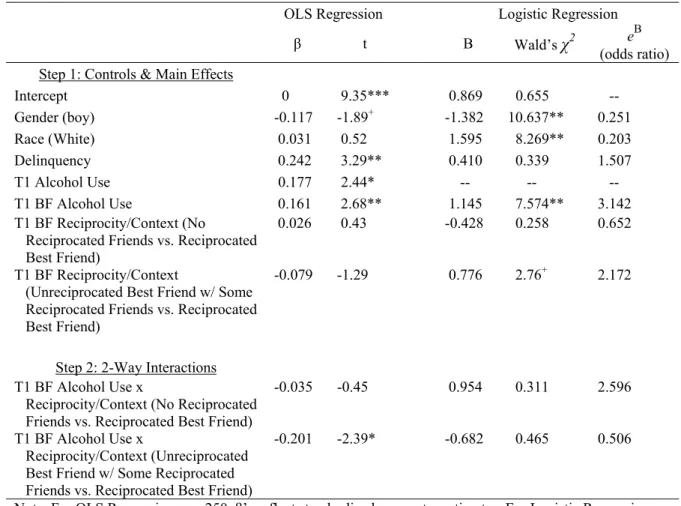
Best friend reciprocity/context. This variable was created for post-hoc analyses to test
where the adolescent had some reciprocated friends within the school. If best friend reciprocity was coded as “unreciprocated” and friendship context was coded as “no
reciprocated friends”, the variable was coded as “unreciprocated best friend/no reciprocated friends.” If best friend reciprocity was coded as “unreciprocated” and friendship context was coded as “some reciprocated friends,” the variable was coded as “unreciprocated best
friend/some reciprocated friends.” If best friend reciprocity was coded as “reciprocated,” then the variable was coded as “reciprocated best friend.” The categories resulted in 21 adolescents with no reciprocated friends, 64 adolescents with an unreciprocated best friend but some reciprocated friends, and 165 adolescents with a reciprocated best friend. Dummy coded variables were then created to allow for comparisons of the three resulting categories.
Across all three categories, the majority of adolescents nominated 4 to 5 participants as their friends. Among the 21 adolescents categorized as having no reciprocated friends, all except 1 nominated 2 or more participants as a best friend (i.e., all but 1 had the opportunity to be included in the “unreciprocated best friend/some reciprocated friends” category).
Indegree. For use in descriptive post-hoc analyses, an indicator of popularity was created by counting the number of friendship nominations that an adolescent received and dividing it by the number of possible friendship nominations (i.e. the number of peers within the adolescent’s school who completed a survey; calculated as ([“arrows-in” / (# of school participants – 1)] x 100). This is a measure of the proportion of friendship nominations received. It is standardized across respondents from varying school sizes.
Alcohol Use Variables
behavior due to projection (e.g., Bauman & Fisher, 1986). The alcohol use items used in this study were adapted from a measure assessing adolescent substance use by Chassin, Rogosch, & Barrera (1991).
Alcohol initiation.One item measuring lifetime alcohol use was used to determine the initiation of alcohol use. The item reads, “What is the most that you have ever used alcohol? By alcohol, we mean more than just a sip of beer, wine, wine cooler, or hard liquor.” The scale was dichotomized between points 0 (never) and 1 (1-2 times in my life) to code as “lifetime non-drinker” (also referred to as “abstainer”) or “drinker” status at 8th Grade and 9th Grade. Additionally, if the participant indicated use on any of the other T1 alcohol use items (i.e. 3 items that assessed past 6 month frequency of use, heavy use, and being drunk), this item was recoded to 1 (e.g., if this item was missing but other alcohol use items completed by the participant indicated they had previously used alcohol). At T1, 94 adolescents (37.6%) had initiated alcohol use. At T2, 146 adolescent (58.4%) had initiated alcohol use.
a 5-point response scale by collapsing the three highest response levels, with the transformed scale ranging from never (1) to once a week or more (5).3
This variable was used as a single item measure of frequency of alcohol use for each time point – 8th Grade (T1) and 9th Grade (T2). Analyses at T1 (n = 250) indicated that scores on this measure ranged from 1 to 5 with a mean of 1.31 (SD = .74), with 53 (21 %)
adolescents reporting alcohol consumption in the past 6 months. This mean falls between “not at all” and “1-2 times in the past 6 months.” Analyses at T2 (n = 250) indicated that scores on this measure ranged from 1 to 5 with a mean of 1.58 (SD = .96), with 95 (38 %) adolescents reporting alcohol in the past 6 months. This mean falls between “not at all” and “1-2 times in the past 6 months.”
T2 frequency of alcohol use served as an outcome variable in two OLS regression analyses. The skewness and kurtosis (2.12, 4.45) of this variable, and the related Shapiro-Wild statistic (W=.63, p<.05), indicate that this variable has a non-normal distribution, and as such, the OLS regression models using this outcome variable are interpreted in tandem with the parallel logistic models which examine initiation of alcohol use.
Alcohol similarity. Friends within assessment were matched on similarity of alcohol use behaviors using the alcohol initiation variable. This is a dichotomous variable that was coded as 1 = “similar/both users”, indicating that the adolescent and their best friend had both initiated alcohol use, or 0 = “dissimilar or both non-users.” This was used only as a
descriptive variable to better understand the sample of analysis.
T2 reciprocity/alcohol using friend. This variable summarizes the adolescent’s friendship nominations to indicate whether or not the adolescent had any friendships that were reciprocated with an alcohol-using peer. T2 reciprocity/alcohol using friend is a
RESULTS Descriptive Analyses
Descriptive statistics were examined to characterize variability across schools in the primary variables of interest (Tables 1 & 2) as well as differences between adolescents with and without a reciprocated best friend (Table 3). In addition, I examined bivariate
associations among primary variables of interest (Table 4). Variation across the Schools
was a feeder school for a high school that did not participate in the T2 school survey. As such, only a few of the T1 participants from this school had T2 data available (a requirement for inclusion in subsequent analyses) because most of these students went to the high school that did not participate in T2 of the project.
Student nestedness within schools created potential non-independence in alcohol use measures. To examine if students from the same school may be more similar on alcohol use behaviors than students from different schools, a random effects ANOVA model was run using the SAS PROC MIXED (SAS Institute Inc., 2003) procedure with the dependent variable assessing lifetime alcohol use (i.e. “What is the most that you have ever used alcohol?”) examined by school (seven T1 schools). Intraclass correlations indicated a small amount of nesting (ICC = 0.007). Though this variance was not of theoretical interest within the current study, it is a violation of the assumption of independence for subsequent
regression analyses. Steps were taken to control for the effects of this nesting by including the school variable as a possible statistical control within the analyses. T1 schools were dummy coded and examined in both a logistic regression model predicting T2 alcohol initiation and an OLS regression model predicting T2 frequency of alcohol use. T1 school was not a significant predictor of T2 alcohol use and was therefore not included as a control variable in subsequent regression analyses.
Of the participants in Subsample A (n = 250), 74.40% had a reciprocated best friend best friend and 25.60% had an unreciprocated best friend at T1. The mean levels of
descriptive variables, as well as significance tests, for continuous variables comparing adolescents with and without a reciprocated best friend are presented in Table 3.
Those adolescents with a reciprocated best friend were more likely to be female (χ2(1, n = 250) = 9.29, p < 0.01) and more likely to be White (χ2(1, n = 250) = 6.11, p = 0.00). Those adolescents with a reciprocated best friend also tended to have a greater number of reciprocated friendships (t(248) = 9.12, p < 0.00) than adolescents with an unreciprocated best friend. Additionally, a marginally significant finding suggests that adolescents with a reciprocated best friend had a higher average rank for their best friend (t(248) = 1.74, p = 0.09) than adolescents with an unreciprocated best friend. That is, their best participating friend tended to occur earlier in the list of nominated friend (e.g. a nomination in the first of five survey spaces would be higher than one in the second space). Adolescents having a reciprocated best friend, as opposed to an unreciprocated best friend, did not differ on parent education, delinquency, school closeness, the overall number of friendship nominations, or the number of out of school/grade friendship nominations (all p > 0.10).
Relations between Alcohol Use and Adolescent Descriptive Variables
Table 4 shows the correlations among relevant model and control variables.
Adolescent frequency of alcohol use was positively related to subsequent adolescent alcohol use and concurrent best friend alcohol use. Additionally, best friend alcohol use was
tended to drink alcohol more frequently than younger adolescents did, and higher levels of delinquent behavior were associated with higher levels of concurrent and subsequent alcohol use as well as concurrent best friend alcohol use. School closeness and socioeconomic status were not correlated with alcohol use.
Additional chi-square tests showed that alcohol use did not vary by gender [T1 Initiated Alcohol Use (χ2(1, n = 250) = 2.26, p = 013), T2 Initiated Alcohol Use (χ2(1, n = 250) = 0.98, p = 0.33), T1 frequency of alcohol use (t(248 = -1.13, p = 0.26), or T2 frequency of alcohol use (t(248 = 0.77, p = 0.44)] or by reciprocity status of the best friendships [T1 Initiated Alcohol Use (χ2(1, n = 250) = 0.77, p = 0.38), T2 Initiated Alcohol Use (χ2(1, n = 250) = 0.60, p = 0.44), T1 Alcohol Similarity (χ2(1, n = 250) = 1.00, p = 0.32), T2 Alcohol Similarity (χ2(1, n = 250) = 0.95, p = 0.33), T1 frequency of alcohol use (t(248 = 1.25, p = 0.21), or T2 frequency of alcohol use (t(248 = -0.51, p = 0.61)].
To examine potential multicollinearity problems in subsequent analyses, bivariate correlations among predictors were also examined. All bivariate correlations of variables that appear within a single regression analysis as predictors fall below .60, well below the
correlation values (.90 and higher) where multicollinearity problems are more likely to occur (Tabachnick & Fidell, 1996). Nonetheless, to reduce multicollinearity between main effect and interaction terms, predictor variables that were continuous measures (i.e. T1 frequency of alcohol use, T1 delinquency) were centered before being entered into regression equations (Aiken & West, 1991).
Determination of Control Variables
education, delinquency, school closeness, and school were first modeled as predictors of the alcohol use outcome variables. First, these potential control variables were modeled with the alcohol use outcome variables of T2 alcohol initiation, using logistic regression, and T2 frequency of alcohol use, using OLS regression. In initial models, all of the above potential control variables were included in the tests. The variable of school, consisting of 6 dummy coded variables, was non-significant in both of the tests. The tests were then run again without the school variable. Gender (logistic, β = -1.07, p = 0.00; OLS, β = -1.13, p = 0.04), race (logistic, β = 1.23, p = 0.01; OLS, β = 0.00, p = 0.97), and delinquency (logistic, β = .65, p = 0.35; OLS, β = 0.35, p = 0.00) emerged as the significant predictors of T2 alcohol use and were therefore included as control variables in the subsequent OLS and logistic regression analyses. Subsequent OLS and logistic analyses both used the same control variables for comparability.
Best Friend Alcohol Use and Best Friend Reciprocity Interactively
Predicting Subsequent Adolescent Alcohol Use (Hypothesis 1)
was added to the model. The overall model accounted for 20% of the variance in T2
frequency of alcohol use (F(7,242) = 8.38, p < 0.00). The addition of the two-way interaction contributed 2% additional variance beyond the model with only the control variables and main effects. The interaction contributed significantly to the prediction of T2 frequency of alcohol use (β = 0.24, p = 0.03). Control variables and main effects (step 1) accounted for most of the variance in T2 frequency of alcohol use, with delinquency (β = 0.23, p = 0.00) and T1 frequency of alcohol use (β = 0.17, p = 0.02) predicting greater T2 frequency of alcohol use. Gender marginally predicted subsequent alcohol use (i.e. being a girl; β = -0.11, p = 0.07) whereas race (β = 0.03, p = 0.65) did not uniquely predict subsequent alcohol use.
The significant two-way interaction was interpreted by calculating the predicted values of T2 frequency of alcohol use at varying levels of T1 best friend alcohol initiation (i.e. non-drinker or drinker status) and T1 best friend reciprocity (i.e. unreciprocated or reciprocated status). Figure 3 shows the resulting findings.4 These results suggest that best friend alcohol use contributed greatest to subsequent alcohol use when the best friendship was reciprocated and the best friend had initiated alcohol use. This is inconsistent with the hypothesis that had predicted that having an alcohol using unreciprocated friend would uniquely contribute to subsequent alcohol use, however, more generally the finding supports the possible interactive effects of best friend use and reciprocity status.
A parallel model was tested to examine the dichotomous dependent variable of T2 alcohol initiation. Specifically, a logistic regression model, analyzed using the SAS PROC LOGISTIC procedure, was estimated to test the hypothesis that non-alcohol using
when their best friendship is unreciprocated than when it is reciprocated (Hypothesis 1; see Table 5). Prior alcohol use was controlled by limiting the analyses to the subsample of adolescents who had not initiated drinking at T1 (Subsample B, n = 156). As a first step in the model, the previously identified control variables of gender, race, and delinquency, along with the main effects of T1 best friend alcohol initiation and T1 best friend reciprocity, were entered into the logistic model. Next, the interaction between T1 best friend alcohol initiation and T1 best friend reciprocity were entered into the logistic model to test the hypothesis of interest. The overall model was significant, Wald’s χ2(6, n = 156) = 18.568, p = 0.01. However, the interaction between T1 best friend alcohol use and T1 best friend reciprocity did not contribute significantly to the prediction of T2 alcohol initiation (β =.336, p = .70). The main effects of being White (White compared to non-White; β = 1.56, p = 0.00), being a girl (boy compared to girl; β = -1.40, p = 0.00), and having a T1 best friend who had initiated alcohol use (β = 1.4, p = 0.01) contributed significantly to T2 alcohol initiation.
Across the two models, there was some support for the hypothesized interaction between best friend alcohol use and friendship reciprocity, however, contrary to my
hypothesis, adolescents who had a reciprocated best friend that had initiated alcohol use were at highest risk of subsequently increasing their alcohol use. This finding held only with the outcome of frequency of alcohol use, not initiation of alcohol use.
Best Friend Alcohol Initiation, Best Friend Reciprocity, and Friendship Context Interactively Predicting Subsequent Adolescent Alcohol Use (Hypothesis 2)
friendships and (2) the unreciprocated best friendship occurs in a context where the
adolescent has other friendships that are reciprocated. The first model testing this hypothesis used an OLS regression model and included the full subsample comprised of both T1 alcohol users and T1 abstainers (Subsample A, n = 250). Prior alcohol use was controlled by
including T1 frequency of alcohol use in the model. In the first step, the control variables were entered into the model as well as the main effects of T1 adolescent frequency of alcohol use, T1 best friend alcohol initiation, T1 best friend reciprocity, and T1 friendship context. In the second step, the effects of the 2-way interactions between T1 best friend alcohol initiation, T1 best friend reciprocity, and T1 friendship context were added to the model. In the third step of the model, the 3-way interaction between T1 best friend alcohol initiation, T1 best friend reciprocity, and T1 friendship context was tested. The overall model
accounted for 20% of the variance in T2 frequency of alcohol use (F(11,238) = 5.55, p = 0.00; see Table 6). The addition of the interactions to the model contributed 2% additional variance beyond the model with only the control variables and main effects. However, the 3-way interaction of interest did not significantly contribute to the prediction of T2 frequency of alcohol use (β = .290, p = .25). As in the previous OLS model for the test of hypothesis 1, control variables and main effects (step 1) accounted for most of the variance in T2