ON THE RECEPTION OF CICERO’S TUSCULAN DISPUTATIONS IN THE REGION OF LIÈGE FROM THE 9th TO THE 11th CENTURY
W.E.L. Begley
A thesis submitted to the faculty at the University of North Carolina at Chapel Hill in partial fulfillment of the requirements for the degree of Master of Arts in the Classics in the School of
Arts and Sciences.
Chapel Hill 2014
Approved by: Robert G. Babcock Luca Grillo
ABSTRACT
W.E.L. Begley: On the Reception of Cicero’s Tusculan Disputations in the Region of Liège from the 9th to the 11th Centuries
(Under the direction of Robert G. Babcock)
TABLE OF CONTENTS
MATERIAL EVIDENCE IN THE STUDY OF RECEPTION ... 1
THE TUSCULAN DISPUTATIONS IN THE MIDDLE AGES ... 2
THE CRITICAL SIGNS IN THE GEMBLOUX TUSCULANS ... 3
THE MANUSCRIPT ... 4
THE MARGINAL ANNOTATIONS ... 5
The Diple Periestigmene ... 5
The Chrisimon ... 12
Imperatives ... 18
The Anchora Superior ... 23
DM and M ... 26
The Letter Y ... 36
QUOTATIONS OF THE TUSCULANS ... 43
CONCLUSION ... 48
Material Evidence in the Study of Reception
Studies of the reception of a classical work in the Middle Ages have traditionally focused mostly on the work’s extant manuscripts, its presence in medieval booklists, and its quotation by medieval authors. This evidence can yield a picture—albeit an oft-incomplete one—of whether a particular work was being read; when the work was read; and where it was read. That picture is much fuzzier, however, when it comes to how the work was read, the interests, foci, and
predilections of the audience of a given work. These questions have begun to be explored relatively recently using material evidence, namely, the physical manuscripts themselves. This thesis represents an exercise in a new way of studying reception, a way that takes into account the material evidence as an indicator of how the work was read.
The Tusculan Disputations in the Middle Ages
C. Stephen Jaegerdescribes the Tusculan Disputations as “a rule of life, a philosophy that lent dignity to administrative service.”1 His support for this comes almost exclusively from the use of the Tusculans in the Regensburger Rhetorischen Briefe (hereafter, RRB), an epistolary collection from the 11th century that discusses the difficulties of clerical administration. The RRB quotes the Tusculans so extensively “that the letters occasionally appear a cento of passages from that work,”2 and the Tusculans become the bene vivendi disciplina, the “rule for living well,” and represent philosophy as the “teacher of manners and discipline.”3 Jaeger’s conclusion from Cicero’s heavy influence on the Regensburg letters is that the Tusculans represent “a work of major importance for the cathedral schools of the eleventh century.”4 Jaeger’s evidence for this, however, comes only from the work of a single author in a single location. In fact, Günther Glauche’s extensive study of school texts of the period before 1200 includes numerous works by Cicero,5 but the Tusculan Disputations are not mentioned a single time. The bulk of the reading and transmission of the Tusculans seems to have taken place later than Jaeger suggests, and in an entirely different location: “Though known in Bamberg, the Tusculans primarily circulated through the Loire houses. The role of this area in the dissemination of the text can be clearly seen in the library catalogues and surviving manuscripts of the late eleventh and twelfth centuries, by
1 Jaeger 84.
2 Jaeger 84. 3 Jaeger 121. 4 Jaeger 84.
which time the Tusculan Disputations were well established and assured of survival.”6
Furthermore, the Tusculans seem not to have been read, as Jaeger argues, simply as a guide to the active life. This thesis will address the gap between Jaeger’s assumptions about the
importance of the Tusculans and the material evidence from the 11th and 12th centuries.
The marginalia in the Gembloux Tusculans does not consist of scholia or commentary on the text, but rather a system of critical signs. First, I will examine this system of annotation by describing each of the seven kinds of critical signs that appear in the Gembloux Tusculans. I will describe the form and usage of each sign, drawing conclusions, where possible, about the
meaning of the sign to the annotator(s). Next, I will give a brief synopsis of quotations of the Tusculans in the 11th and 12th centuries by writers connected to the Liège diocese and discuss whether there is any correlation between the interests of the Gembloux annotator and those of the authors who quote from the Tusculans.
The Critical Signs in the Gembloux Tusculans
One of the most helpful and most overlooked tools one has in the study of the reception of a work is the marginalia in the work’s extant manuscripts. By examining the annotations made in the margins, one can see the foci, interests, and predilections of the work’s readers, helping answer why and how the work was read in a given period.7 The Gembloux manuscript of the Tusculan Disputations is particularly fecund in this regard: annotators have introduced well over 180 distinct signs in the margins of the work. Because this study is limited to the reception of the work in the 11th and 12th century, I have not included in my discussion the marginalia, mostly
names, that dates to the 16th century. The older marginalia, however, contains seven types of notations, five of them from the list of critical marks in Isidore’s Etymologiae. The following study will examine the usage of each of these signs and adduce the reading interests that it betrays.
The Manuscript
The Tusculan Disputations are the third of four works in Brussels MS 5348-52, a
manuscript produced at Gembloux in the 11th century. The manuscript also contains Cicero’s De Inventione, Grillius’ commentary on the Pseudo-Ciceronian Rhetorica ad Herennium, and Cicero’s Pro Archia. The first two of these were copied under Olbert, Abbot at Gembloux from 1012-1048, but the Tusculans and the Pro Archia may date to the second half of the century.8 The Tusculans extend from folio 80r to 113r.
Our evidence for the medieval transmission of the text begins in Carolingian Gaul, where an archetype that arrived in the latter part of the eighth century was promulgated among the scholars of the Carolingian court.9 Despite its popularity during the Carolingian Renaissance, however, it seems not to have been common in libraries before the 11th century. Lupus of Ferrières requests a copy of the Tusculan Disputations in a letter to Adelgaud (840/841 A.D.), but according to Reynolds, Lupus never quotes from the Tusculans, and may never have received
8 Munk Olsen, C68.
the copy of them he had requested.10 Only by the late 11th century were the Tusculan Disputations “well established and assured of survival.”11
The Marginal Annotations The Diple Periestigmene
A common sign in the margins of Brussels MS 5351 consists of a bent line, like a “greater than” sign, with a dot on either side of the upper half of the
line (Figure 1). Isidore identifies the sign: diple periestigmene, id est cum geminis punctis. Hanc antiqui in his opponebant quae Zenodotus Ephesius non recte adiecerat, aut detraxerat, aut permutaverat. In his et nostri ea usi sunt (the diple periestigmene, i.e. ‘with two dots.’ The ancients put this sign opposite passages which Zenodotus of Ephesus12 had incorrectly inserted, removed or changed. Our scribes too use it in these cases; XXI.15).13 Like the antiqui, the annotators at Gembloux used the sign to mark textual problems or suspected textual problems. The note appears 33 times (once, on 108v, it appears within the actual body of the text between the lines of writing rather than in the margin. It is the only such appearance of any of the signs discussed in this paper). Some of the textual difficulties marked by the diple are more severe than others, but in the majority of cases, the passage in question contains an easily identifiable textual problem.
10 Reynolds 133. Lupus does in fact quote once from the Tusculans (Ep. 1, p. 2 in Marshall’s edition), but the passage comes more directly from Augustine’s De Civitate Dei.
11 Reynolds 135.
12 The first librarian at the Library of Alexandria and a textual critic of Homer.
The marked textual problems most often involve the omission or transposition of a letter or two. For example, at 95r (Tusc. 3.26), in a poetic quotation, the manuscript reads lacrimae peredere humorem exsanguis genas situ nitoris. The text in the manuscripts has generally
troubled editors. For the sake of the sense, humorem must be corrected from the accusative to the ablative humore. The manuscripts generally have situ nitoris, but the Loeb edition, following Lachmann, has situm inter oris.
Similarly, on 107v, the manuscript reads nam quid profitetur odiibo perfecturam se qui legibus suis paruisset... The odi ibo (“I hate! I will go!”) is utterly nonsensical, and subsequent editions have emended it to o di boni, giving nam quid profitetur? o di boni! perfecturam se, qui legibus suis paruisset... (for what does it promise? Ye gods! That it will perfect the one who obeys its laws... ; Tusc. 5.19). A further example appears on 111r (Tusc. 5.88), where the text should read nec haec sic agit ut ex tempore quasi effutire videatur, but the manuscript has ait for agit (“says” rather than “does”).
Beyond simple transposition and omission of letters, sometimes the diple periestigmene marks garbling and omission of entire words. At 93r, the text should read cum vero eodem quasi maxumus quidam magister populus accessit atque omnis undique ad vitia consentiens multitudo (but when popular opinion is added to this [i.e., the influence of the poets] as if it were the greatest teacher and the whole mob joins together on all sides in faults... ; Tusc. 3.3). The
with the annotator in doubting the accuracy of the text, and the Loeb follows Halm’s
emendation, which moves the punctuation and alters two words: ...nec debet. Ne aegrotus sim; si sim, qui fuerat sensus adsit...(the second sentence, newly divided, reads “Let me not be sick; if I should be sick, let what sensation I had before remain...”). A similar passage that is generally emended for the sake of the sense comes at 102v where the manuscript has quae si quando ei demptaretur id quod ei fuerit concupitum... (Tusc. 4.35). Demptaretur is an otherwise unattested form in classical Latin, and the Loeb, following other manuscripts,has si quando adepta erit in place of si quando ei demptarentur (the revised text translates “if [the soul] acquires what it has longed for...”). In a similar circumstance, the sign marks a nonexistent word at 110v, where the manuscript reads inde est inadatio nata initiorum (Tusc. 5.69). Inadatio does not exist in Latin, and other manuscriptsreplace it with indagatio.
The Phrontis
There are 23 appearances of a phi-rho ligature in the Gembloux Tusculans, with the circle of the phi partly down the shaft of the rho (Figure 2). Isidore is fairly concise about the sign: Phi et Ro, id est ‘frontis.’ Haec, ubi aliquid obscuritatis est, ob sollicitudinem ponitur (a phi
and a rho, that is, a phrontis. This sign is placed where something is obscure in order to signal concern about the passage; XXI.23). There is evidently a great deal of solicitude
on the part of the annotator, who uses this sign very often: among the notations in the Tusculans, it trails only the diple periestigmene and the dm/m abbreviation in frequency.
The usage appears to be related to that of the diple periestigmene in that it denotes difficult readings, but where the diple tends to mark passages with textual problems, the phrontis
The primary meaning of the Greek φροντίς is “attention,” and the implication both of Isidore’s definition and the sign’s usage is that phrontis-marked passages, unlike diple-marked passages, can be understood, but they require more careful attention on the part of the reader. When the annotator came across a difficult passage, he seemed to feel the need to mark it; if he suspected the text was faulty, he generally used a diple periestigmene, and if he thought the text was correct but found it difficult to understand, he used the phrontis.
ante docuisset for se ante docuisse; at 108v (Tusc. 5.36), the manuscript has esse where the generally accepted ex se makes better sense.
Sometimes, the text is correct but the manuscript’s punctuation (such as it is) obscures the meaning. Some of these passages too are marked by the phrontis. At Tusc. 3.36, for instance, Cicero imagines himself being encouraged by the ancient philosophers:
...Pythagoras mihi si diceret aut Socrates aut Plato: 'Quid iaces aut quid maeres aut cur succumbis cedisque fortunae? quae pervellere te forsitan potuerit et pungere, non potuit certe vires frangere. Magna vis est in virtutibus; eas excita, si forte dormiunt. (Tusc. 3.36)
...if Pythagoras or Socrates or Plato were to say to me “why are you lying down? Why are you sad? Why are you giving up and surrendering to your luck? Luck could perhaps have poked or prodded you, but surely it could not break your strength. There is a great power in your virtues; awake them, if they happen to be asleep.”
In the manuscript, however, the passage contains the following punctuation and capitalization: quae pervellere te forsitan potuerit · & pungere non potuit · Certe vires frangere magna vis est · in virtutibus eas excita si forte dormiunt · (perhaps [luck] could have bothered you, and was not able to prick you. Surely to break your strength is a great violence: awake them [?] in virtues if they happen to be asleep). Grammatically, the manuscript reading is at least defensible, but the sense of the passage suffers from the punctuation. The annotator found here aliquid obscuritatis, and marked it with a phrontis.
scutella, and hedychrum, which is spelled hedrycrum in the manuscript, are all found only here in Cicero. So too at 106r, where the sign accompanies a use of the word aeculeum (Tusc. 5.12), a relatively rare14 word for an instrument of torture,
and at 92v (Tusc. 2.45), where Cicero alludes to the death of Epicurus by colic
(tormina) and painful urination (stranguria, or stransguria in the manuscript). In both cases, since the phrontis, which is elsewhere enlarged to mark out as many as nine lines of text (Figure 3), marks only the line in which the unusual word appears (Figure 4), the mark
probably signifies that the obscurity stems from a single abstruse word. The other most common source of confusion that leads to a use of the
phrontis is difficulty with Greek. The sign appears at 101r, for instance, next to the following garbled Greek: Quale in misso gino atili est · ut in hominum universum genus quod accepimus de Timone · qui misανερωιτοσα appellantur... (Tusc. 4.25). Here, two different problems are in play. First, the scribe seems not to have recognized that the name of Atilius’ play was the Greek word Μισόγυνος, which resulted in the botched transliteration misso gino. Throughout the rest of the
manuscript, Greek words are written in Greek characters and are
overlined (Figure 5). Misso gino, however, is in Roman characters
and has no line over it, indicating that the scribe failed to identify the word as Greek. The second source of confusion is the poor transliteration of µισάνθρωπος, the epithet applied to Timon of Athens. The manuscript has what seems to be a mix of Roman and Greek letters
(misανερωιτοσα)—the line over the word does not begin until after the first two letters—and the
14 Though not unprecedented: see Cicero Phil.11.7, De Finibus 4.31, and twice more in the Tusculans themselves (5.13 and 5.14).
Figure 3
Figure 4
Greek lettering is incorrect. Whether or not the annotator knew Greek, the passage would have vexed him.
Even when transliterated correctly, Greek names and terms are often marked with a phrontis. A long passage at 95r is marked by a phrontis, in which several names from Greek myth appear: Tantalus, Oenomaus, Hippodamea (Tusc. 3.26). All the names are written in accurate Roman characters except that Hippodamea appears without the initial h (hardly
uncommon). Toward the end of the marked passage, however, where the name Thyestes appears, the text is slightly corrupt: rather than Tu te, Thyesta, the manuscript reads Tu&hyesta. The missing t is probably not the only reason that the annotator has urged the reader to pay attention, since it appears at the very end of a lengthy passage; more likely, the quick succession of Greek names made the reading difficult. Another large specimen of the phrontis appears on 94r beside a lengthy passage that deals with distinctions between various Greek philosophical terms:
at illud est latius; omnis enim abstinentia, omnis innocentia (quae apud Graecos usitatum nomen nullum habet, sed habere potest ἀβλάβειαν ; nam est innocentia adfectio talis animi quae noceat nemini)—reliquas etiam virtutes frugalitas continet. Quae nisi tanta esset, et si iis angustiis, quibus plerique putant teneretur, numquam esset L. Pisonis cognomen tanto opere laudatum. (Tusc. 3.16)
But that [i.e., the Latin term frugi] is broader in meaning [than the Greek term χρησίµους], for it describes all self-restraint, all innocence (which has no
everyday term among the Greeks, but can be called ‘harmlessness;’ for innocence is a state of mind of the kind that would not harm anyone)—frugality contains all the other virtues as well. If it were not so inclusive, and if it were checked by the restraints that most people think, Lucius Piso’s cognomen [Frugi] would never have been praised as greatly as it is.
In any case, the phrontis almost invariably denotes a passage that contains some difficulty for the reader—aliquid obscuritatis, in Isidore’s words. Unlike the diple periestigmene, the phrontis is not limited to textual problems, and the annotator may not have realized that some of the passages by which he wrote the phrontis were corrupt at all, so slight are the errors.
The Chrisimon
Another sign described by Isidore found in the margins of the Gembloux Tusculans is a rho in ligature with a chi (Figure 6). The marginal note should not, however, be
interpreted with the Christian connotations of its heraldic doppelgänger; the likeness in appearance is entirely coincidental. Isidore calls the note the
chrisimon, and says haec sola ex voluntate uniuscuiusque ad aliquid notandum ponitur (this is set down to mark something according solely to the will of any one person; XXI.22). Isidore’s meaning is not entirely clear, but he seems to imply that the chrisimon is a marker of private interest to the annotator, as opposed to the anchora superior (see below), for instance, which marks matters of great importance to anyone.
Isidore’s vagueness is borne out by the chrisimon’s variety of uses in the Tusculans manuscript. The sign appears ten times, five of them in Book 4, and any pattern in its usage is obscure. It marks a few topics more than once, and on a pair of occasions it marks minor textual variations, but there is no clear unifying feature in chrisimon-marked passages in the manuscript.
Twice, the chrisimon coincides with a passage that contains a minor textual variant. At 93v (Tusc. 2.60), the manuscript reads
ad philosophos me revocas, qui in aciem non saepe prodeunt. e quibus homo sane levis, Heracleotes Dionysius, cum a Zenone ne fortis esse didicisset, a dolore dedoctus est. Nam cum ex renibus laboraret, ipso in eiulatu clamitabat falsa esse illa quae antea de dolore ipse sensisset.
You call me back to the philosophers who do not often go forth into battle. Though one of them, Dionysius of Heraclea, a rather inconstant fellow, had learned from Zeno not to be brave, he forgot his learning because of his pain. For when he was in distress from his kidneys, in the very midst of his groans he shouted that what he had previously thought about pain was wrong.
The repeated ne is an instance of scribal dittography, and its presence reverses the meaning of the passage (i.e., Zeno presumably taught Dionysius to be brave, not cowardly). The chrisimon may, then, indicate to the annotator to return to a passage and verify his initial impulse that the text does not say what it ought to say.
Similarly, at 103v (Tusc. 4.49), the manuscript reads Ergo re Torquatum quidem illum, qui hoc cognomen invenit, iratum existimo Gallo torquem detraxisse (Therefore, in fact [?], I suppose that the famous Torquatus, who obtained this cognomen, was angry when he tore the chain away from the Gaul...). The re standing alone is irregular, and the passage as it stands does not support the speaker’s point in the context, since his argument is that soldiers need not be angry at their enemies to be effective in battle. Most other manuscripts read ego ne for ergo re. Again, the chrisimon may indicate in this case an annotator’s unease with the text of the passage. Since these two passages are the only chrisimon-marked instances of textual errors, however, the sign’s primary function cannot be to notate textual problems; furthermore, two other signs (the diple periestigmene and the phrontis, discussed above) already deal with difficult readings. The chrisimon may even have been written in error where the fairly similar phrontis sign was intended, but both of these passages, like those discussed below, are historical anecdotes.
The topics of the marked passages also vary. One such topic is the desirability of an early death:
veste posita corpora oleo perunxerunt, ad iugum accesserunt. ita sacerdos advecta in fanum, cum currus esset ductus a filiis, precata a dea dicitur... (88r; Tusc. 1.113)
When she was obliged to be carried in a chariot to an annual religious festival at a shrine fairly far from the town, and her oxen were going slowly, these young men whom I just named removed their garments, oiled their bodies, and took up the yoke. In this way was the priestess conveyed to the shrine, and because her chariot had been drawn by her sons, she is said to have entreated the goddess to...
This is the beginning of the story of Cleobis and Biton, the two pious sons who carry their mother to the temple and are rewarded with quod maxumum homini dari posset a deo (the greatest thing that can be given to a human by a god, Tusc. 1.113), namely a painless and immediate death. The note, however, marks out only the portion of the story quoted above, that is, the set-up rather than the punch line. The text is entirely legible, and no rare words appear, so it is difficult to see what the mark notates besides the topic.
Another marked passage comes during a discussion of how one’s motivation affects one’s ability to suffer pain. The passage illustrates with the example of wounded soldiers:
Saepe enim multi qui aut propter victoriae cupiditatem aut propter gloriae aut etiam, ut ius suum et libertatem tenerent, vulnera exceperunt fortiter et tulerunt, iidem omissa contentione dolorem morbi ferre non possunt; neque enim illum quem facile tulerant ratione aut sapientia tulerant, sed studio potius et gloria. (93v; Tusc. 2.65)
For often many people have been wounded, either on account of their desire for victory or for glory, or even so that they retain their rights and freedom, and have borne their wounds bravely, but these same people cannot bear the pain of
sickness when no such strife exists. For indeed, that which they had borne easily they had borne not through reason or wisdom but rather through fervor and glory.
is a way to avoid the pains of life, and comes up as part of a discussion about the dead’s insensibility to pain. Since the sign appears so infrequently, the chrisimon’s link to this topic, however, or any topic is difficult to defend—no clear topical pattern emerges from the chrisimon passages.
On two occasions, the sign marks a passage that contains an attack on an ancient
philosophical school and its permissiveness toward vice. First, the Stoic interlocutor takes aim at the Epicureans: ‘At laudat saepe virtutem'. Et quidem C. Gracchus, cum largitiones maximas fecisset et effudisset aerarium verbis tamen defendebat aerarium. Quid verba audiam cum facta videam? (‘But [Epicurus] frequently praises virtue.’ To be sure, just so Gaius Gracchus defended the public treasury in his speeches even though he had dispensed huge bribes and squandered the treasury. Why should I heed words when I can see deeds? 97v; Tusc. 3.48). The insinuation of Epicurus’ hypocrisy marked here is mild compared to the philosophical shortcomings of the Peripatetics on the matter of vice, however: Quam ob rem nihil interest, utrum moderatas perturbationes adprobent an moderatam iniustitiam, moderatam ignaviam, moderatam
intemperantiam; qui enim vitiis modum apponit, is partem suscipit vitiorum (Therefore, it makes no difference whether they approve moderate passions or moderate injustice, moderate laziness, moderate immoderation; for he who accords a proper measure to vices supports a part in those vices. 102r; Tusc. 4.42). The interlocutor finds the Peripatetic emphasis on “moderation in all things” indefensible when it comes to vice. In these cases, the chrisimon seems to mark an interest in Stoic refutation of rival philosophical schools, especially on the topic of the permissibility of vice.
chrisimon’s loci—the annotator shows a predilection for anecdotes. In three cases, the sign coincides with an anecdote from Greek history, philosophy, or mythology. The chrisimon on 88r marks the initial lines of the story of Cleobis and Biton, quoted above; the sign on 93v notates an anecdote about the Greek philosopher Dionysius of Heraclea and his recantation of stoicism, also quoted above; and at 95r, the sign appears beside a pithy story of a different Dionysius:
Dionysius quidem tyrannus Syracusis expulsus Corinthi pueros docebat: usque eo imperio carere non poterat (the ruler Dionysius, for example, when he was driven out from Syracuse, used to teach schoolboys in Corinth because he could not do without having sovereignty; Tusc. 3.27). On two other occasions, the sign marks short episodes from Roman history, both already quoted in this section: the hypocrisy of Gaius Gracchus at 97v, and the beginning of the story of Torquatus’ cognomen at 103v. Even the passage at 93v about soldiers’ ability to suffer pain in battle but not in sickness is a sort of anecdote, albeit one removed from the specificity of the historical and literary realm to the generality of the world at large. In these cases, the marked anecdotes illustrate points on a number of topics, most often discussions of virtue and vice, broadly speaking. The Tusculans’ profusion of dialogue about virtue and vice, however, makes it seem that the chrisimon marks these passages as much for their value as illustrative anecdotes as for the specific content that they illustrate.
The other use worth mentioning that deals with a type of illustration instead of with content is that of the distinction. Frequently in the Tusculans, Cicero must define the terms of the discussion by making fine distinctions between two easily confused words. At 95v, he
distinguishes between invidia and invidentia:
I did not say invidia, which indicates when one is envied, but it can rightly be called invidentia, which comes from invidere, so we can avoid the ambiguous term invidia. This word is derived from the act of giving excessive attention to someone else’s fortune, as in Melanippus: ‘Who has looked down on my blossom of children?’
The sign extends down to the introduction of the quotation from Melanippus, but the main area marked out is the distinction itself, which might be of use to a medieval reader trying to understand the subtleties of the classical vocabulary, or one who enjoys an etymological excursus. A little later in the manuscript, the
chrisimon reappears beside another distinction: nam cum omnis perturbatio miseria est, tum carnificina est aegritudo (for while any disquiet is a misery, anguish is a torture; Tusc. 3.27). Here, Cicero’s interlocutor illustrates the difference in degree between two related words about psychic distress, perturbatio and aegritudo, both of which are important and almost technical to the discourse of the Tusculans. The sign next to this passage is written along with the word carnificina (Figure 7). If the two pieces of marginalia are doing the same work, it is possible that a use of the chrisimon is to mark an unfamiliar word: a search for carnificina yields only 13 results in classical literature, and only three of them from Cicero. On balance, however, the chrisimon seems more likely to denote the passages definition of philosophical terms than the rare vocabulary.
The sign, then, has no obvious and consistent usage, so I have presented what small patterns exist among the passages it marks. If indeed the Gembloux annotators have used the sign as Isidore described it—according solely to the will of the annotator—there need not be any consistency in its usage. The most likely explanations for the annotation are as follows: the chrisimon appears by passages that are interesting to the annotator but not in such a way that
would make another sign appropriate (such as the dm or the y discussed below), or the chrisimon indicates a difference in degree of interest from related signs.
Imperatives
The least ambiguous of the annotations are the direct commands to the reader. At seven points in the text, six of them in Book 1, the annotations order the reader to pay greater attention, albeit varying degrees of greater attention. These marginal
imperatives appear either written out one letter at a time from top to bottom (Figure 8) or, in three cases of the word nota, in ligature (Figure 9). That the annotator uses four different words for “pay attention”
(attende, intende, insiste, nota) indicates a desire to create a hierarchy among the marked passages. Nota (take note) is the weakest of the four words; attende and intende are nearly synonyms—intende may be slightly more emphatic—of a somewhat greater strength than nota; and the command for the most intensive (insistent?) attention is insiste.
The nota ligature appears for the first time on 80r, marking a short passage
about glory: honos alit artes, omnesque incenduntur ad studia gloria, iacentque ea semper, quae apud quosque improbantur (Esteem nourishes the arts, and all are kindled to their pursuits by the desire for glory, while things that are generally disapproved are always neglected; Tusc. 1.4). The passage is aphoristic in its concision, which may explain both the kind of mark and the form of the mark. The annotator may wish the reader to play closer attention to Cicero’s summary of the preceding discussion. The other two uses of the nota ligature seem to
arise from similar motives. At the end of a long argument filled with illustrative anecdotes about the necessity of burial and the treatment of the dead, Cicero quotes from Anaxagoras, who has been asked if he would like his body to be returned to his homeland: ‘nihil necesse est' inquit, 'undique enim ad inferos tantundem viae est’ (‘No need for that,’ he said, ‘for the road to the underworld is the same length from everywhere;’ 87r, Tusc. 1.104). Again, the nota ligature accompanies a brief encapsulation of a longer section. The final nota ligature (and the only imperative after Book 1) comes on 89r, where Cicero summarizes his previous thoughts about the necessity for good style in philosophical writing: nobis autem videtur, quicquid litteris mandetur, id commendari omnium eruditorum lectioni decere (it seems to me, though, that whatever is entrusted to writing ought to be agreeable to the reading of all educated people; 2.8). Here too, the nota ligature appears opposite a pithy, memorable summary of a lengthier
preceding passage.
On one occasion (at 83r), the command nota is written out fully to mark out a much longer passage:
sed ut non physici solum docent verum etiam medici, qui ista aperta et patefacta viderunt, viae quasi quaedam sunt ad oculos, ad auris, ad naris a sede animi perforatae. Itaque saepe aut cogitatione aut aliqua vi morbi impediti apertis atque integris et oculis et auribus nec videmus, nec audimus, ut facile intellegi possit animum et videre et audire, non eas partis quae quasi fenestrae sint animi, quibus tamen sentire nihil queat mens, nisi id agat et adsit. Quid, quod eadem mente res dissimillimas comprendimus, ut colorem, saporem, calorem, odorem, sonum? Quae numquam quinque nuntiis animus cognosceret, nisi ad eum omnia referrentur et is omnium iudex solus esset. atque ea profecto tum multo puriora et dilucidiora cernentur, cum, quo natura fert, liber animus pervenerit. nam nunc quidem, quamquam foramina illa, quae patent ad animum a corpore, callidissimo artificio natura fabricata est, tamen terrenis concretisque corporibus sunt
intersaepta quodam modo... (Tusc. 1.46-47)
eyes and ears are open and sound, often we do not see or hear because we are hindered by deep thought or by some illness. It is easily understood, then, that the soul sees and hears, not those parts that are essentially windows to the soul. Even so, the mind can see nothing with them without being attentive and interested. What about the fact that we perceive such dissimilar things as color, taste, heat, smell, and sound all with the same mind? The soul would never receive the understanding of these things from its five messengers unless everything were referred to it and it were the only judge about everything. Furthermore, much purer and clearer things will be surely be sensed once the soul is liberated and comes to the place where nature brings it. For even now, although those channels that lead from the body to the soul were designed with the most skillful artistry by nature, they are still in a way enclosed by earthly, concrete matter...
Here, rather than mark out a short summary, the nota designates a whole passage of interest, a passage about the soul as the agent of sensation in the body, which is kept connected to the ears, eyes, etc. by physical passages. Book 1’s extensive discussion of the soul and its characteristics is heavily marked (see especially the discussion of the y sign below), and the topic clearly fascinates the annotator.
If the gradations of the different imperatives I have proposed are true, the annotator finds even more fascinating the passage on the facing page (83v), which he has marked with an intende so long that the inten- appears in the left margin and the –de in the central one. This passage (ad universi caeli complexum...cum e corpore excesserint; Tusc. 1.40) describes Cicero’s cosmology—that the earth is a κέντρον in the middle of the universe, created by the separation of the heavy elements (water and earth) from the light ones (air and fire)—and uses it to prove that souls, being composed of airy matter, must rise when they leave the body. Here, the intende identifies the whole passage as one of significant interest rather than just marking the closing summary.
Cicero goes further, mentioning mankind’s primacy in the world (hominemque ipsum quasi contemplatorem caeli ac deorum eorumque cultorem atque hominis utilitati agros omnes et maria parentia; [we see] Man himself, as though an observer and worshipper of heaven and the gods, and all the fields and seas obedient to Man’s use; Tusc. 1.69) and using the complexity of the world to argue for the existence of a divine creator:
haec igitur et alia innumerabilia cum cernimus, possumusne dubitare quin iis praesit aliquis vel effector, si haec nata sunt, ut Platoni videtur, vel, si semper fuerunt, ut Aristoteli placet, moderator tanti operis et muneris? (Tusc. 1.70) When we recognize these proofs, then, and countless others, can we doubt that presiding over them is either some author (if they came into being, as Plato thinks) or (if they have always existed, as Aristotle opines) some governor of so great a work and structure?
Both of the passages I have quoted would be noteworthy to a Christian reader. Compare to Cicero’s view of Man’s place in the universe to God’s command to the first humans: replete terram et subicite eam et dominamini piscibus maris et volatilibus caeli et universis animantibus quae moventur super terram (fill the earth and subdue it, and rule over the fish of the sea and the flying things of the sky and all the living creatures that move on the ground; Vulg. Gen. 1.28). To a reader steeped in the Vulgate Bible, Cicero’s expression of mankind’s dominion over the land and sea is biblical, as is the proof of God’s existence from the signs of creation.
The most emphatic of this set of imperatives, insiste, also appears beside a passage that would echo strongly in a Christian reader’s mind. At 84v, the annotator urges readers to dwell on (literally, “stand on top of”) a Platonic proof of the eternal nature of souls:
renascetur, nec ex se aliud creabit, siquidem necesse est a principio oriri omnia. ita fit, ut motus principium ex eo sit, quod ipsum a se movetur; id autem nec nasci potest nec mori, vel concidat omne caelum omnisque natura et consistat necesse est nec vim ullam
nanciscatur, qua a primo inpulsa moveatur. Cum pateat igitur aeternum id esse, quod se ipsum moveat, quis est qui hanc naturam animis esse tributam neget? inanimum est enim omne, quod pulsu agitatur externo; quod autem est animal, id motu cietur interiore et suo; nam haec est propria natura animi atque vis. Quae si est una ex omnibus quae se ipsa semper moveat, neque nata certe est et aeterna est.
(Tusc. 1.53-54)
That which is always in motion is eternal. Moreover, that which effects motion in
something else and which itself derives motion from somewhere, must necessarily end its life when its motion had ended. Only that which moves itself, therefore, never stops moving, since it never is severed from itself. Indeed, this is the source and origin of everything else that moves. There is nothing that causes this origin, because everything comes from this origin; and even it itself cannot come from anything else but itself, because it would not be an origin if it came into being from something else. If it never began, it certainly would never end, because the origin, when it has been extinguished, will not be reborn from anything else, nor will it create anything from itself, since everything necessarily came from some origin. Therefore, the origin of motion is that which moves itself; and that can neither be born nor die, or all of heaven would
necessarily topple, all of nature stand still, finding no force by which it might receive the initial impulse to move. Since it is obvious, therefore, that whatever moves itself is eternal, who could deny that this characteristic has not been given to souls? Everything that is moved by some outside impulse is inanimate, and an animate object is that which put in motion by its own internal stimulation, because that is the appropriate nature and power of the soul. But if it is the one thing out of everything that always moves itself, surely it was not born; it is eternal.
The purpose of the imperatives to the reader, and especially of the longer imperatives, seems to be to encourage care and reflection on passages that provide classical support for Christian ideas about the soul and cosmology. The weak imperative nota in its ligatured form is linked less to specific topics than to encapsulations of long discussions of a given subject.
The Anchora Superior
The least common of the marginal notes in the Gembloux manuscript
of the Tusculans is what Isidore calls the anchora superior. The form of the
notation is a vertical line that splits at the top into two curls (Figure 10). The line may also be elongated to annotate a larger swath of text (Figure 11). Isidore’s explanation of the sign is short and leaves a great deal of room for interpretation: anchora superior
ponitur ubi aliqua res magna omnino est (the anchora superior is located where
something universally important is discussed; XXI.24), and he couples it with his description of the same sign upside down: Anchora inferior, ubi aliquid vilissime vel inconvenientius
denuntiatum est (the anchora inferior, where something excessively sordid or unbefitting has been denounced; XXI.25). Inconvenientius could mean “unsuitable” in the sense of “morally unsuitable” or more neutrally in the sense of “inappropriate to the topic at hand:” in any case, the annotator deemed nothing in the Tusculans guilty of either problem. The visual relationship between the two signs, however, and Isidore’s related treatment the two of them make them appear to be opposite ends of the same spectrum: if the anchora inferior denotes a topic too unseemly for a reader, the anchora superior probably marks a particularly laudable sentiment or topic. The criterion for employing the anchora superior, then, seems to be an important topic or argument, the sentiment of which the annotator endorses.
Figure 10
Within the Tusculans manuscript itself, the infrequency of the sign makes it difficult to generalize too broadly about its meaning to the annotator. Since it only appears twice, however, it seems reasonable to suppose that it was reserved as an extremely high level of approbation: only a very select set of passages in the work merit the distinction of the anchora superior.
The first appearance of the sign is in the middle margin of 95v, where it marks a passage on the Stoic conception of evil: Omne enim malum, etiam mediocre, magnum est; nos autem id agimus, ut id in sapiente nullum sit omnino. Nam ut corpus, etiamsi mediocriter aegrum est, sanum non est, sic in animo ista mediocritas caret sanitate. (For every evil, even if it is a
moderate one, is still a great matter,15 because our aim is that there should be no evil whatsoever in the wise man. Just as the body is not healthy even if it only moderately sick, even so that very moderation in the soul is unhealthy; Tusc. 3.22). The passage has balance and rhetorical power, and sentiment might well be considered res magna by a Christian annotator concerned with the nature of sin and its relationship to the soul, as well as res magna omnino, that is, an idea with general applicability.
The other anchora superior appears on 106v, where it marks a purple passage on the importance of philosophy:
in eundem portum ex quo eramus egressi, magna iactati tempestate confugimus. O vitae philosophia dux, o virtutis indagatrix expultrixque vitiorum! quid non modo nos, sed omnino vita hominum sine te esse potuisset? Tu urbis peperisti, tu dissipatos homines in societatem vitae convocasti... (Tusc. 5.5)
Battered by a great storm, I take refuge in the same port from which I had embarked. O philosophy, guide of life, investigator of virtue, and banisher of vices! Without you, what would I have been—not only myself, but the life of people in general? You are the mother of cities, you have convened scattered mankind into the companionship of life...
The Gembloux annotator was not the only person to have been struck by this passage and its elevated, poetic apostrophe to philosophy. It seems to have been one of the most famous passages from the Tusculans during the period: Sedulius Scottus includes it in his florilegium (81.16), the author of the Regensburger Rhetorischen Briefe quotes from it,16 and the epithet for philosophy as dux vitae or magistra vitae had general currency in the Middle Ages.17 The passages justifies the study of philosophy, and thus to some extent the study of the Tusculans themselves. If philosophy and the contemplative life represent a haven amid the storms of life, then the task of reading and annotating a work of philosophy—even a pagan one—might be seen as important and fulfilling.
The topics of both passages quoted above have general significance, that is, both apply to mankind writ large rather than to a select few who are interested in a specific topic. This
universality may itself be a qualification of a passage for the anchora superior. Isidore’s res magna omnino can mean “a matter that is altogether great” or “a great matter in general,” and the word omnino appears in both passages of the Tusculans marked by the anchora. A general
significance seems not to be the only criterion for using the sign—after all, Cicero uses the word omnino 17 times in the Tusculans’ first book alone, and none of its appearances there are
marked—but for a topic to be considered res magna omnino, it seems likely that it would refer to humanity as a whole, as both of the marked passages do.
DM and M
The final sign I will treat is the marginal notation of an m or a dm (Figures 12 and 13), usually in an uncial script, but sometimes in Caroline minuscule. The two
notations appear 17 times apiece in the manuscript, and should be understood as alternate forms of a single sign indicating the same thing, since the m almost invariably appears when
a dm is nearby, either on the same leaf or on the facing leaf, and seems to be nothing more than a shorthand version of the dm. The 34 appearances of the sign make it the most frequently occurring note in the Gembloux Tusculans.
Although the sign appears not uncommonly in books of the 12th century,18 the meaning of the dm has only been explained fairly recently. Teresa Webber identifies 25 books from
Salisbury Cathedral containing the notation,19 and in one manuscript of the 12th century, the note is twice written out in full as dignum memoriae (worthy of remembering; MS 191, fos. 115 and 121).20 The majority of the dm notations appear in patristic works, in which context “such annotations had a specific function: to identify sententiae as auctoritates—texts which could be excerpted from their immediate context within the works of an auctor, and employed elsewhere as authoritative in their own right.”21 Webber finds that the passages marked by the sign in Salisbury have in particular a kind of practical spiritual authority, since memorization, to a medieval reader, “implied the will to put what had been memorized into practice.”22
18 Webber 133.
19 Webber 132.
20 See N. R. Ker, “Salisbury Cathedral Manuscripts,” 154 n. 3. 21 Webber 134; see also Chenu 109-13.
22 Webber 134.
Figure 12
The 11th-century annotators at Gembloux seem to have used the same sign with even more emphatic meaning: Robert Babcock located an instance of the sign written out in Brussels, Royal Library, MS 5499 (Origenes, Homeliae in Genesi), an 11th-century Gembloux manuscript, as da memoriae (commit to memory). The lone m is not written out anywhere in the 11th-century Gembloux manuscripts that I have found, but one may infer that it stands for memora
(memorize). To the Gembloux annotators, apparently, the dm signified such importance that the marked passage was not merely to be noted and recalled by the reader, but actually to be
memorized. Furthermore, Babcock finds evidence that readers at Gembloux in fact obeyed the marginal injunction. In the Gembloux edition of Statius’ Thebaid (Brussels 5337-8), the phrase nequit iram explere potestas (their power could not satisfy their wrath; 1.623) bears the dm note. That phrase is quoted only once in extant medieval literature—in his Vita Theodardi, Sigebert of Gembloux quotes it verbatim, having evidently taken to heart the order to memorize Statius’ turn of phrase.23 Readers at the Gembloux scriptorium took this sign seriously, and it is reasonable to extend that conclusion to the other marginal notes as well.
The usage of such a sign would naturally relate to as many different topics as the
annotator deemed worthy to be memorized. Among the Salisbury manuscripts, Webber does not find “one criterion” in the annotator’s non-systematic process of selection of passages to mark with the dm, but “certain preferences and special interests emerge,” such as “an interest in pastoral problems and pastoral activity, [which] appears to lie behind the noting of many sententiae.”24 Similarly, the usage in the Tusculans does not follow a single specific topic (as
does, for instance, the y), but certain subjects and disputative techniques seem to garner more interest than others.
Where the y tended to mark discussions of the properties of the soul, the dm/m seems to mark proofs and discussion of the soul’s separation from the body at death. A dm accompanies Socrates’ response when asked about his own funerary preparations:
‘Multam vero' inquit 'operam, amici, frustra consumpsi; Critoni enim nostro non persuasi me hinc avolaturum neque mei quicquam relicturum. Verum tamen, Crito, si me adsequi potueris aut sicubi nanctus eris, ut tibi videbitur, sepelito. Sed, mihi crede, nemo me vestrum, cum hinc excessero, consequetur.' (Tusc. 1.103; 87r).
‘I sure have wasted a great deal of effort, my friends,’ said [Socrates], ‘since I have not persuaded our friend Crito that I will fly away from here and leave nothing of myself behind. Even so, Crito, if you have procured or acquired my body, bury me wherever seems good to you, but believe me: none of you will follow me once I have left here.’
separates from the body at death; the Gembloux annotator marked all three as memoranda. On the following folio as well, a dm appears opposite a passage conceding that funeral rites should be observed: quantum autem consuetudini famaeque dandum sit, id curent vivi, sed ita, ut intellegant nihil id ad mortuos pertinere (let the living concern themselves with what must be granted to custom and reputation, but let them do it in such a way that they understand that it makes no difference to the dead; Tusc. 1.109). The frequency of the notes in this section, which discusses the separate existence of body and soul after death, indicates a certain preference for this topic on the annotator’s part.
Another such preference seems to be for passages that discuss the desirability of death when one is at the height of virtue or glory. The m appears on 88v opposite Cicero’s lament about outliving a suitable time for death: nemo parum diu vixit, qui virtutis perfectae perfecto functus est munere. Multa mihi ipsi ad mortem tempestiva fuerunt, quam utinam potuissem obire! (No one who has completely fulfilled his duty of complete virtue has died too soon. In my own case, there were many times when death would have been timely; if only I could have died then! Tusc. 1.109). Again on the same folio, a laconic Laconian advises a proud father to die as soon as possible: cum Rhodius Diagoras, Olympionices nobilis, uno die duo suos filios victores Olympiae vidisset, accessit ad senem et gratulatus: 'morere Diagora' inquit; 'non enim in caelum ascensurus es' (when Diagoras of Rhodes, a renowned Olympic victor, saw two of his sons win at Olympia on the same day, [the Spartan] approached the old man and said by way of
captus esset, hoc ei muneris pro sua missione dedisse scribitur: docuisse regem non nasci homini longe optimum esse, proximum autem quam primum mori (there is also a certain tale about Silenus, who was captured by Midas, and in exchange for his release, it is written that he gave him this favor: he told the king that it is by far the best thing for a human never to be born, but the next best thing is to die as soon as possible; Tusc. 1.114). On the same page, the
annotator marks a quotation from Crantor’s Consolatio to the same effect: Ignaris homines in vita mentibus errant: / Euthynous potitur fatorum numine leto. / Sic fuit utilius finiri ipsique tibique (in life, people wander with heedless minds: / Euthynous masters the divinity of the fates by his death. / It is thus more profitable to die, both for him and for you; Tusc. 1.115). Finally, a story on 88r almost identical to that of Cleobis and Biton bears an m mark: simili precatione Trophonius et Agamedes usi dicuntur; qui cum Apollini Delphis templum exaedificavissent, venerantes deum petiverunt mercedem non parvam quidem operis et laboris sui: nihil certi, sed quod esset optimum homini (Trophonius and Agamedes used a similar prayer, it is said. When they had finished building the temple at Apollo at Delphi, they entreated the god, requesting no small reward for their toil and accomplishment: nothing defined, but ‘that which was best for a person;’ Tusc. 1.114). Apollo agrees; three days later, the men are found dead. As Cicero presents it, Apollo implies that death is absolutely the best thing for man, and the annotations exhort the reader to commit the anecdotes to memory.
iucundius: numquam videlicet sitiens biberat (during his retreat, after Darius had drunk water that was murky and befouled by corpses, he said that he had never drunk anything more
pleasing; obviously, he had never taken a drink when he was truly thirsty; Tusc. 5.97). Socrates practices a similar principle to whet his appetite: Socraten ferunt, cum usque ad vesperum contentius ambularet quaesitumque esset ex eo, quare id faceret, respondisse se, quo melius cenaret, obsonare ambulando famem (they say that when Socrates was asked why he would walk fairly vigorously into the evening, he answered that he worked up his appetite by walking, and dined better by doing so; Tusc. 5.97). A little further on the page, the Spartans teach the same lesson to their guest:
Ubi cum tyrannus cenavisset Dionysius, negavit se iure illo nigro, quod cenae caput erat, delectatum. Tum is qui illa coxerat: 'Minime mirum; condimenta enim defuerunt.' 'Quae tandem?' inquit ille. 'Labor in venatu, sudor, cursus ad
Eurotam, fames, sitis; his enim rebus Lacedaemoniorum epulae condiuntur.' (Tusc. 5.97)
When the tyrant Dionysius had eaten, he said he did not like the black broth that had been the main course. The man who had cooked it said ‘No wonder! You didn’t have the seasoning.’ ‘What seasoning?’ said the other. ‘The struggle of the hunt, sweat, running to the Eurotas, hunger, thirst—with these things Spartans’ feasts are seasoned.’
Cicero uses all three anecdotes from the Greek world to substantiate his point that the soul derives pleasure from the anticipation of satisfaction of a need.
(88v, 1.111), and the Spartan cook’s description of condimenta (112v, Tusc. 5.97). Similarly, the annotator has placed an m beside a passage on 87r that retells the story of a bereaved Spartan woman: qualis tandem Lacaena? quae cum filium in proelium misisset et interfectum
audisset,'idcirco' inquit 'genueram, ut esset, qui pro patria mortem non dubitaret occumbere' (what sort too was the Spartan woman? When she had sent her son into battle and heard that he had been killed, she said ‘That is why I bore him, to be the sort of man who would not hesitate to die on behalf of his homeland;’ Tusc. 1.102). The phlegmatic Spartan character is marked again at 91v: Spartae vero pueri ad aram sic verberibus accipiuntur 'ut multus e visceribus sanguis exeat,' nonnumquam etiam, ut, cum ibi essem, audiebam, ad necem; quorum non modo nemo exclamavit umquam, sed ne ingemuit quidem (the boys of Sparta receive blows at the altar to the point ‘that a great deal of blood oozes from their innards,’ sometimes even, as I heard when I was there, to death. Not only do none of them ever cry out, but none so much as whimpers; Tusc. 2.34). The annotations reveal that the Spartan ethos was a source of fascination for the annotator to the point that he recommended the memorization of these passages to other readers.
Another commonly marked source of quotations and anecdotes are Greek philosophers, especially Socrates. His ambulatory aperitif (112v, Tusc. 5.97) has already been quoted, as has his reply to Crito’s question about burial rites (87r, Tusc. 1.103). The annotator also encouraged the memorization of the following anecdote on 99v about Socrates and his rich young pupil Alcibiades:
For what will we say, when we learn that Socrates proved to Alcibiades that he was not a man and that there was no difference between an Alcibiades born in the height of privilege and some workman; and when Alcibiades was agitated about this and begged Socrates in tears to teach him virtue and remove his iniquity— what will we say, Cleanthes? Was there not something bad in that thing that afflicted Alcibiades with disquiet?
No other dm/m marginal notes appear in this section of the discussion, and so it seems that the marked passage was selected not for the point it illustrates in the particular disputation but for its depiction of Socrates. So too at 112r, where a dm marks a quotable line from Socrates: Socrates quidem cum rogaretur, cuiatem se esse diceret, 'mundanum' inquit; totius enim mundi se incolam et civem arbitrabatur (when Socrates was asked where he would say he comes from, he replied ‘from the world;’ for he judged that he was an inhabitant and a citizen of the whole world; Tusc. 5.108). Nearly as often as he marked Spartan anecdotes and quotations, the annotator marked the words and deeds of Socrates.
Although the annotations display a special interest in Socrates, quotations from a number of ancient authors appear with an m or a dm. As discussed above, Cicero quotes from Crantor’s Consolatio at Tusculans 1.115, marked with an m on 88r, and from Ennius at Tusculans 1.107, marked with an m on 87r. On 89r, the dm marks a quotation from the 2nd-century B.C. tragic poet Accius: nam ut agri non omnes frugiferi sunt qui coluntur, falsumque illud Accii: 'Probae etsi in segetem sunt deteriorem datae / fruges, tamen ipsae suapte natura enitent,' sic animi non omnes culti fructum ferunt (for just as not all fields that are cultivated bear fruit, and that line of Accius’ is false: ‘good crops, even planted in a worse field, / still shine forth by their own nature;’ even so, not all minds that are cultivated bear fruit; Tusc. 2.13).
omnium et regina ratio, quae conixa per se et progressa longius fit perfecta virtus. Haec ut imperet illi parti animi quae oboedire debet, id videndum est viro (but close by stands the mistress and queen of everything, Reason, who struggles on by her own power and, when she has advanced further, becomes perfect virtue. A man must see to it that she rule that part of the soul which ought to obey; Tusc. 2.47). The personification of reason and virtue is striking and quotable, and the practical advice to train one’s mind to obey reason could be part of a moral education. The use of the sign here supports Webber’s assessment of the practice of
memorization by medieval readers, the idea that “what had been consigned to memory could involve not only living it in one’s own life but teaching it to others.”25 Other instances of the sign in the Tusculans mark thoughts of Cicero that must have been deemed quotable, because they are indeed quoted. The first dm in the manuscript is on 80r, where Cicero argues for good style in all writing, even writing of philosophy:
fieri autem potest, ut recte quis sentiat et id quod sentit polite eloqui non possit; sed mandare quemquam litteris cogitationes suas, qui eas nec disponere nec inlustrare possit nec delectatione aliqua allicere lectorem, hominis est intemperanter abutentis et otio et litteris. (Tusc. 1.6)
It can also happen that someone notices something correctly but cannot express what he notices in a refined way. But committing one’s thoughts to writing when one cannot arrange or elucidate them properly or entice the reader with some kind of appeal is characteristic of a man who immoderately misuses both leisure and literature.
This passage is quoted by Einhard in the prologue to his Vita Karoli Magni, where he quotes verbatim from mandare to the end of the passage, and even attributes it accurately to the first book of the Tusculans, as well as by the prolific theologian Rupert of Deutz, who was a student
at Liège in the 11th century.26 Some readers, clearly, were taking these passages to heart. A dm-marked passage on 102v discusses the many internal dangers that pose no threat to the Stoic wise man:
Ergo, hic, quisquis est qui moderatione et constantia quietus animo est sibique ipse placatus, ut nec tabescat molestiis nec frangatur timore nec sitienter quid expetens ardeat desiderio nec alacritate futili gestiens deliquescat, is est sapiens quem quaerimus, is est beatus, cui nihil humanarum rerum aut intolerabile ad demittendum animum aut nimis laetabile ad ecferendum videri potest. (Tusc. 4.37)
Therefore, whoever is serene in his soul because of self-restraint and resolve and is content with himself, so that he neither dissolves from vexations nor is
shattered by fear nor burns thirstily with longing for what he wants nor falls to pieces, itching with some bootless enthusiasm, he is the wise man for whom we are searching, he is blessed, for whom no state of human affairs can seem so unbearable as to lower his spirits nor seem so delightful as to lift them up.
Rupert paraphrases this passage in his De Sancta Trinitate, transferring the attributes of Cicero’s wise man to the Christian who trusts in God (XX.264).
In both the above cases, Rupert found that a passage from the Tusculans could be lifted out of context and used to serve his own purposes. This seems to be the unifying factor for all the appearances of the dm/m sign: all the marked passages may be removed from their original source and context and still carry weight in their own right. In the case of Cicero’s quotations of other authors and presentations of anecdotes from Greek history, the passages’ ability to be excerpted is clear: Cicero has removed the passages from their original context and arranged them to support his own point. Just as Cicero calls from his memory a story about Spartan boys he heard during his travels, the annotator enjoins with the m and the dm subsequent readers to memorize the same story and employ it for some other end. The m and the dm emphatically
encourage the reader to build a memory bank of anecdotes, quotations, and turns of phrase that are applicable to a broad range of scenarios.
The Letter Y
Of the two annotations in the Tusculans that are absent from Isidore,
the more mysterious is the letter y that appears in the margins 21 times in
Book 1, once in Book 2, and never again after that. The only sign in Isidore’s Etymologiae that bears even a passing resemblance to the y-note is the antigraphus, but the note in the Tusculans is
clearly conceived of as the same letter y that appears within the text itself, complete with the dot above the fork of the y (compare Figure 14,
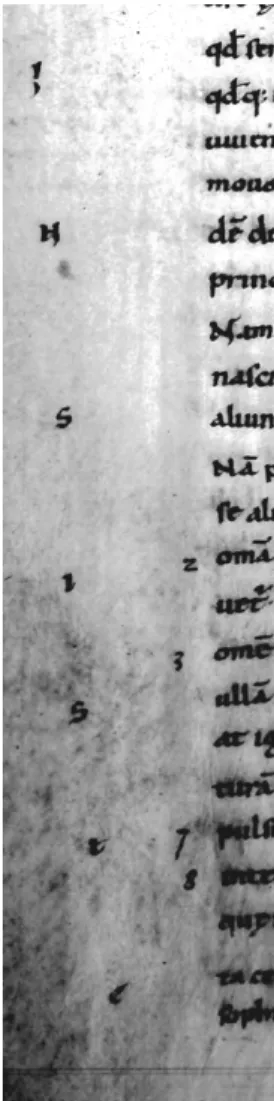
the marginal notation, to Figure 15, a y in the text). Like the other annotations with tails, the y may be elongated to mark a more extensive passage (Figure 16). Given the deficiency of evidence for the sign’s meaning relative to the other notations discussed in this paper, I will discuss the y at greater length and treat more examples of its usage.
Despite its frequency, the y is confined to a more circumscribed space of the
work as a whole than any of the other marginal notations. All 22 occurrences of the sign come between 82v and 89r, a space of 16 leaves. The organization of the Tusculans is such that each book deals at length with a single subject—Book 1 with death, Book 2 with pain, Book 3 with grief, Book 4 with the passions, and Book 5 with happiness through a virtuous life. Since the y-note is almost exclusive to Book 1, it seems to be linked more than any other annotation to a specific topic. Furthermore, the topic must not be death itself, the subject of Book 1, or every
Figure 14
Figure 15
passage in the book would be marked. Instead, the sign must deal with a single topic that relates closely to death and appears frequently in Cicero’s discussion of it. Overwhelmingly often—19 out of 22 times—the passages accompanied by the y-note deal with the nature of the human soul.
The body of passages marked by the y may be broken down into a few aspects of the nature and attributes of the soul. Two passages deal with the soul’s ability to sense. At 83r (Tusc. 1.46, quoted supra in the section on imperatives; the y coincides with the word nota), Cicero describes ancient physicians’ discovery of viae perforatae from the eyes, nose, etc. to the soul, and at 82v, he alludes to an ancient belief in sensation in death: Itaque unum illud erat insitum priscis illis, quos ‘cascos’ appellat Ennius, esse in mortem sensum neque excessu vitae sic deleri hominem, ut funditus interiret (and so the belief had been adopted by the ancients, whom Ennius calls the ‘men of yore,’ that there exists even in death the ability to sense, and man is not so completely destroyed by his departure from life that he dies completely; Tusc. 1.27). Both passages describe primordial beliefs in the soul as the seat of sensation in humans.
A related attribute, the soul’s ability to move, is also noted on a pair of occasions by the annotator. At 82v, Cicero describes the soul in a state of perpetual motion: et sic ipsum animum ἐνδελέχεια appellat novo nomine quasi quandam continuatam motionem et perhennem (...and
in motion to prove that eternity exists in Tusculans 1.55 (84v), another passage marked with the y-sign:
non modo nihil umquam tam eleganter explicabunt, sed ne hoc quidem ipsum quam subtiliter conclusum sit intellegent. sentit igitur animus se moveri; quod cum sentit, illud una sentit, se vi sua, non aliena moveri, nec accidere posse ut ipse umquam a se deseratur. ex quo efficitur aeternitas, nisi quid habes ad haec. Not only will [philosophers who are inferior to Plato and Socrates28] never explain anything so elegantly, but they will not even realize how keenly this matter has been resolved. The soul, then, senses that it is in motion, and because it senses this, it senses at the same time that it moves by its own power, not
something else’s, and that it is impossible for it to be severed from itself. Unless you have something to respond to this, this argument proves the existence of eternity.
Cicero’s extension of Plato’s argument (which is itself marked by the command insiste,
discussed in the section on imperative annotations) is that since the soul cannot be divorced from itself and its essential property of motion, the soul’s sensation of its own motion proves the existence of eternity. At 85v (Tusc. 1.79-80), Cicero lists Panaetius' arguments that the soul is mortal (contra Plato) and provides the Platonic refutation of those arguments. At 83v (Tusc. 1.39), Cicero credits the oldest argument for the eternity of human souls to Pherecydes Syrius. The annotator marked with the y-annotation all these passages that contain quotations by the ancient philosophers, indicating a special interest in classical philosophical proofs of the eternity of the soul.
A similar object of interest and concern for the annotator is the actual physical location and composition of the soul. On 82v, Cicero briefly takes up the subject of the seat of the soul as part of a proof that death need not be feared: nam si cor aut sanguis aut cerebrum est animus, certe, quoniam est corpus, interibit cum reliquo corpore (for if the soul is the heart or the blood
or the brain, surely it will die along with the rest of the body, since it is a part of the body; Tusc. 1.24). As I noted above, Cicero goes on to reject these loci for the soul, following Plato’s proof that the soul is eternal and therefore does not perish along with the body.
The annotator likewise marks heavily with the y-sign Cicero’s discussion of the soul’s physical makeup. At 83v, he marked a passage in which Cicero wonders whether the soul is a quintessence: si vero aut numerus quidam est animus, quod subtiliter magis quam dilucide dicitur, aut quinta illa non nominata magis quam non intellecta natura (...but if the soul is a certain number, which it is called more with subtlety than with clarity, or if it is some fifth essence, unnamed rather than not understood...; Tusc. 1.41). Again, the marked passage has to do with ideas about the soul derived from Greek philosophy: the image here is drawn from
Aristotle’s idea of a quintessence, a fifth element made up of neither earth, air, fire, nor water. Shortly after this passage, on the same folio, the y appears beside a rejection of an atomic visualization of the soul: illam vero funditus eiciamus individuorum corporum levium et
rotundorum concursionem fortuitam (then let us completely dismiss the notion that [the soul is] the random concurrence of light, round atoms; Tusc. 1.42). Again, Cicero refers to the soul as it is conceived in Greek philosophy, this time rejecting the views of the atomic theorist
85v, later on in the same quotation from the Consolatio (discussed above), a second y appears beside a proof of the soul’s divinity.
quicquid est illud, quod sentit, quod sapit, quod vivit, quod viget, caeleste et divinum ob eamque rem aeternum sit necesse est. nec vero deus ipse, qui
intellegitur a nobis, alio modo intellegi potest nisi mens soluta quaedam et libera, segregata ab omni concretione mortali, omnia sentiens et movens ipsaque
praedita motu sempiterno. (Tusc. 1.66)
Whatever senses, discerns, lives, and thrives, must necessarily be heavenly and divine, and for that reason be eternal. Nor indeed could God himself, whom we perceive, be perceived in any way but by the kind of mind that is free and uninhibited, separate from all mortal matter, sensing everything, moving everything, and endowed with its own eternal motion.
The annotator’s decision to use two separate y-signs in short succession indicates that he thinks that the two attributes of the soul that Cicero discusses are distinct and each deserve a mark. The y, then, indicates more in the Tusculans manuscript than merely “the subject of this passage is the soul;” rather, an appearance of the y seems to alert the reader to a discussion of a specific attribute of the soul.
Another use of the y-sign is to mark instances of the soul being used as an analogy to understand God, and vice versa. At Tusculans 1.70-71 (marked with an elongated y on 85v), he appeals to his interlocutor’s belief in the divine in order to support the understanding of the soul: