13. Rodrigues-Pereira J, Kim J-H, Magallanes M et al. A randomised phase 3 trial comparing pemetrexed/carboplatin and docetaxel/carboplatin as first-line treatment for advanced, nonsquamous non-small cell lung cancer. J Thorac Oncol 2011; 6: 1907–1914.
14. Patel JD, Socinski MA, Garon EB et al. PointBreak: a randomized phase III study of pemetrexed plus carboplatin and bevacizumab followed by maintenance pemetrexed and bevacizumab versus paclitaxel plus carboplatin and bevacizumab followed by maintenance bevacizumab in patients with stage IIIB or IV nonsquamous non-small-cell lung cancer. J Clin Oncol 2013; 31: 4349–4357. 15. Fearon K, Arends J, Baracos V. Understanding the mechanisms and treatment
options in cancer cachexia. Nat Rev Clin Oncol 2013; 10: 90–99.
16. Argilés JM, Busquets S, Stemmler B et al. Cancer cachexia: understanding the molecular basis. Nat Rev Cancer 2014; 14: 754–762.
17. Temel JS, Abernethy AP, Currow DC et al. Anamorelin in patients with non-small-cell lung cancer and cachexia (ROMANA 1 and ROMANA 2): results from two randomised, double-blind, phase 3 trials. Lancet Oncol 2016; 17: 519–531. 18. Crawford J, Prado CMM, Hancock ML et al. Results from two phase 3 randomized
trials of enobosarm, selective androgen receptor modulator (SARM), for the prevention and treatment of muscle wasting in NSCLC. J Thorac Oncol 2013; 8 (Suppl 2): abstr P3.11-026.
19. Penna F, Minero VG, Costamagna D et al. Anti-cytokine strategies for the treatment of cancer-related anorexia and cachexia. Expert Opin Biol Therapy 2010; 10: 1241–1250.
20. Tsai VWW, Husaini Y, Manandhar R et al. Anorexia/cachexia of chronic diseases: a role for the TGF-βfamily cytokine MIC-1/GDF15. J Cachexia Sarcopenia Muscle 2012; 3: 239–243.
21. Bruunsgaard H, Pedersen BK. Age-related inflammatory cytokines and disease. Immunol Allergy Clin North Am 2003; 23: 15–39.
22. Michaud M, Balardy L, Moulis G et al. Proinflammatory cytokines, aging, and age-related diseases. J Am Med Dir Assoc 2013; 14: 877–882.
23. Scott HR, McMillan DC, Forrest LM et al. The systemic inflammatory response, weight loss, performance status and survival in patients with inoperable non-small cell lung cancer. Br J Cancer 2002; 87: 264–267.
24. Martin L, Senesse P, Gioulbasanis I et al. Diagnostic criteria for the classification of cancer-associated weight loss. J Clin Oncol 2015; 33: 90–99.
25. Dahlberg SE, Schiller JH, Bonomi PB et al. Body mass index and its association with clinical outcomes for advanced non-small-cell lung cancer patients enrolled on Eastern Cooperative Oncology Group clinical trials. J Thorac Oncol 2013; 8: 1121–1127.
Annals of Oncology27: 1619–1625, 2016 doi:10.1093/annonc/mdw224 Published online 27 May 2016
The role of oral hygiene in head and neck cancer: results
from International Head and Neck Cancer Epidemiology
(INHANCE) consortium
D. Hashim
1*, S. Sartori
1, P. Brennan
2, M. P. Curado
3, V. Wünsch-Filho
4, K. Divaris
5, A. F. Olshan
6,
J. P. Zevallos
7, D. M. Winn
8, S. Franceschi
2, X. Castellsagué
9,10, J. Lissowska
11, P. Rudnai
12,
K. Matsuo
13, H. Morgenstern
14,15, C. Chen
16, T. L. Vaughan
16, J. N. Hofmann
17, G. D
’
Souza
18,
R. I. Haddad
19, H. Wu
1, Y.-C. Lee
20, M. Hashibe
20, C. La Vecchia
21& P. Boffetta
1,221
The Institute for Translational Epidemiology, Icahn School of Medicine at Mount Sinai, New York, USA;2
International Agency for Research on Cancer, Lyon, France; 3
Epidemiology—CIPE/ACCAMARGO, Sao Paulo;4
School of Public Health, University of São Paulo, São Paulo, Brazil; Departments of5
Pediatric Dentistry;6
Epidemiology, University of North Carolina School of Public Health, Chapel Hill;7
Department of Otolaryntology/Head and Neck Surgery, University of North Carolina at Chapel Hill, Chapel Hill;8
Division of Cancer Control and Population Sciences, National Cancer Institute, Bethesda, USA;9
Catalan Institute of Oncology (ICO)-IDIBELL, L’Hospitalet de Llobregat, Catalonia;10
CIBER of Epidemiology and Public Health (CIBERESP), Madrid, Spain;11
Department of Cancer Epidemiology and Prevention, The M. Sklasodowska-Curie Memorial Cancer Center and Institute of Oncology, Warsaw, Poland;12
National Public Health Center, Budapest, Hungary;13
Division of Molecular Medicine, Aichi Cancer Center Research Institute, Nagoya, Japan; Departments of14
Epidemiology;15
Environmental Health Sciences, School of Public Health and Comprehensive Cancer Center, University of Michigan, Ann Arbor;16
Fred Hutchinson Cancer Research Center, Seattle;17
Division of Cancer Epidemiology and Genetics, National Cancer Institute, Bethesda;18
Johns Hopkins Bloomberg School of Public Health, Baltimore;19
Dana Farber Cancer Institute, Harvard Medical School, Boston;20
Division of Public Health, Department of Family and Preventive Medicine and Huntsman Cancer Institute, University of Utah School of Medicine, Salt Lake City, USA;21
Department of Clinical Sciences and Community Health, Università degli Studi di Milano, Milan, Italy;22
The Tisch Cancer Institute, Icahn School of Medicine at Mount Sinai, New York, USA
Received 24 April 2016; revised 22 May 2016; accepted 23 May 2016
Background:Poor oral hygiene has been proposed to contribute to head and neck cancer (HNC) risk, although causal-ity and independency of some indicators are uncertain. This study investigates the relationship offive oral hygiene indica-tors with incident HNCs.
Methods:In a pooled analysis of 8925 HNC cases and 12 527 controls from 13 studies participating in the International Head and Neck Cancer Epidemiology Consortium, comparable data on good oral hygiene indicators were harmonized.
*Correspondence to:Dr Dana Hashim, Department of Preventive Medicine, Icahn School of Medicine at Mount Sinai, One Gustave L Levy Place, New York, NY 10029, USA. Tel: +1-212-824-7002; E-mail: [email protected]
These included: no denture wear, no gum disease (or bleeding), <5 missing teeth, tooth brushing at least daily, and visit-ing a dentist≥once a year. Logistic regression was used to estimate the effects of each oral hygiene indicator and cumula-tive score on HNC risk, adjusting for tobacco smoking and alcohol consumption.
Results:Inverse associations with any HNC, in the hypothesized direction, were observed for <5 missing teeth [odds ratio (OR) = 0.78; 95% confidence interval (CI) 0.74, 0.82], annual dentist visit (OR = 0.82; 95% CI 0.78, 0.87), daily tooth brushing (OR = 0.83, 95% CI 0.79, 0.88), and no gum disease (OR = 0.94; 95% CI 0.89, 0.99), and no association was observed for wearing dentures. These associations were relatively consistent across specific cancer sites, especially for tooth brushing and dentist visits. The population attributable fraction for≤2 out of 5 good oral hygiene indicators was 8.9% (95% CI 3.3%, 14%) for oral cavity cancer.
Conclusion:Good oral hygiene, as characterized by few missing teeth, annual dentist visits, and daily tooth brushing, may modestly reduce the risk of HNC.
Key words:head and neck neoplasms, oral neoplasms, pharyngeal neoplasms, oral hygiene, pooled analyses
introduction
Primary head and neck cancer (HNC) is estimated to exceed 500 000 cases worldwide per year [1]. Geographic differences in HNC incidence rates persist among [2] and within some countries [3]. Although the prevalence of alcohol and tobacco use varies, regional variations in HNC incidence rates cannot be explained by these risk factors alone [4].
HNCs include cancers originating in the oral cavity, orophar-ynx, hypopharorophar-ynx, or larynx. Oral hygiene indicators, such as missing teeth [5], denture use [6], bleeding gums [7], infrequent dental visits [8], and tooth brushing infrequency [5,7,8], have been suspected to contribute to the etiology of HNCs. The causal and independent role of oral hygiene in HNC development has thus been inconclusive due to the limited numbers of cases as well as a lack of available detailed information on more than one oral hygiene indicator for most studies [9–11]. Oral hygiene is not an established risk factor for HNCs and the population attributable fraction (PAF) of oral hygiene to HNCs has not been assessed.
In separate analyses of Latin American and central European case–control studies, poor condition of the mouth, regular mouthwash use, and lack of tooth-brushing were associated with HNC risk [8]. Our study expands the scope of this analysis to include countries fromfive continents and explores the role of oral hygiene indicators. We pooled oral hygiene and HNC data from studies participating in the International Head and Neck Cancer Epidemiology (INHANCE) Consortium. This pooled analysis describes the largest and most comprehensive assessment of the association between oral hygiene indicators and HNCs to date, including oral cavity, laryngeal, hypopharyn-geal, and oropharyngeal cancers.
methods
studies and participants
The pooled analysis consisted of 8925 incident cases and 12 527 controls from 13 INHANCE case–control studies (data version 1.5) (http://www. inhance.utah.edu) [12,13]. Data pooling and questionnaire harmonization methods have been described previously [12,13]. Our investigation included studies from the United States (n= 8), Central Europe (n= 1), Latin America (n= 2), Japan (n= 1), and one international multicenter study (supplemen-tary Table S1, available atAnnals of Oncologyonline). Subjects with missing information on all oral hygiene variables were excluded (n= 1013).
Incident cases included patients with invasive tumors of the overall head and neck (n= 8925), oral cavity (n= 2858), oropharynx (n= 2402), hypo-pharynx (n= 738), larynx (n= 2086), and oral cavity/pharynx not otherwise specified (n= 841), as defined by International Classification of Disease, 2nd edition (ICD-O2) or ICD 9th or 10th edition as previously described [13]. Results for some oral hygiene variables have been previously published for 4 out of the 13 studies [8,14,15]. Written informed consent was obtained from study subjects, and investigations were approved by the institutional review board at each institution involved [16].
oral hygiene variables
Oral hygiene data were obtained from questionnaires administered by den-tists in the central Europe study and self-report by face-to-face questionnaire interviews in other studies. Self-reported oral hygiene has been shown to be reliable [17–20]. Gum disease (which included periodontal disease and/or gingivitis) and wearing dentures were defined dichotomously. The number of missing teeth was defined as <5 or≥5 teeth missing. Tooth brushing was categorized by frequency as≥once/day versus <once/day, and dentist visit frequency as≥once/year versus <once/year. These data were also coded cat-egorically: for tooth-brushing frequency 1 = <once/day, 2 = once-to-twice/ day, or 3 =≥twice/day, regularity of dental visits (never or seldom, <once/ year,≥once/year); and number of missing teeth number (1 = <5, 2 = 5–15, and 3 =≥16). The Puerto Rico, Latin America, and international multicenter studies contained allfive oral hygiene variables.
covariates
Covariates included age (5-year age categories above age 40), sex, race/ethni-city (White, Black, Hispanic, Asian and Pacific Islander, Brazilian, and other), and education level (≤high school versus >high school, to adjust for educational level across countries with varying access to education). For indi-viduals not reporting education level (0.1%), multiple imputation was applied to predict education level for each geographic region separately using logistic regression models with terms for age, sex, race/ethnicity, study center, and case–control status under the assumption that data were missing at random [21]. Alcohol consumption was calculated as the number of drinks/day based on average cumulative lifetime consumption, assuming one standardized drink contains 15.6 ml of pure ethanol (non-drinker, 0.1– 0.9, 1.0–2.9, 3.0–4.9, and 5.0+, and missing drinks/day) [13]. Cumulative tobacco smoking was categorized as those who smoked 0–10.0, 10.1–20.0, 20.1–30.0, 30.1–40.0, 40.1–50.0, and 50.0+ pack-years. Missing data on race/ ethnicity (0.4%), tobacco smoking (6.3%), and alcohol drinking (3.1%) were included in separate categories in models.
statistical analysis
Multivariable logistic regression was used to estimate odds ratios (ORs) and 95% confidence intervals (CIs) for associations of oral hygiene indicators and incident HNCs. All ORs were adjusted for study (and center for multicenter studies), sex, age, race, education, alcohol consumption, and tobacco smoking.
Pvalues for monotonic trends were derived from thefitted models of oral hygiene indicators as continuous variables. Interactions between each oral hygiene indicator and alcohol drinking, tobacco smoking, and geographical region were assessed with likelihood-ratio tests.
To determine the PAF of poor oral hygiene, an oral hygiene score was cal-culated for studies that included all oral hygiene indicators. Scores ranged from 5 to 0 on a best-to-worst oral health scale. The sum of the indicators was combined: denture wear: yes = 1, no = 0; gum disease: yes = 0, no = 1; missing teeth:‘≥5’= 0,‘<5’= 1; regular dental visit: yes = 1, no = 0; teeth brushing frequency:‘≥once per day’= 1,‘<once per day’= 0. The referent category for OR was defined as those with the best scores for oral hygiene (score≥4). The PAF was calculated using the formulaPEC× (OR–1)/OR [22], where OR is the adjusted OR andPEC is the proportion of cases
exposed to the worst oral hygiene. The definition of exposure for calculating PAF estimates considered subjects exposed when the oral hygiene score≤2, and unexposed when the score was≥3. PAF confidence limits were calcu-lated with the command aflogit [23].
Harmonization and PAF calculation were completed using the Stata Statistical Software (Release 12.2; StataCorp LP, College Station, TX) and all other analyses were carried out using the SAS Statistical Software (Version 9.4; SAS Institute Inc., Cary, NC).
results
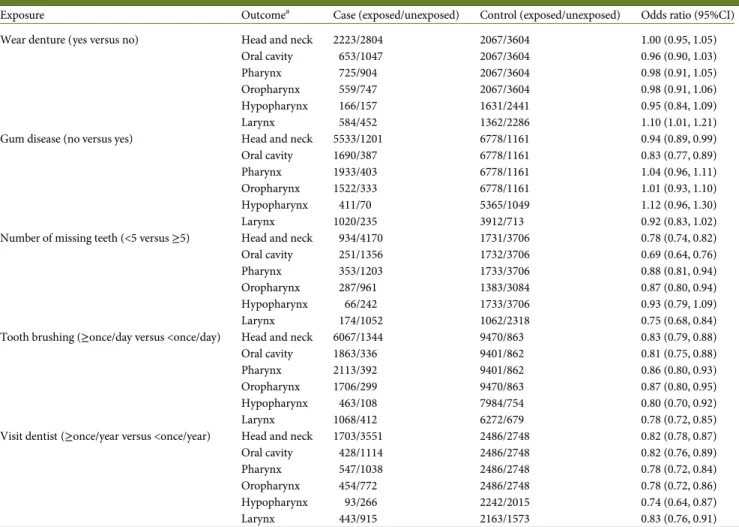
Selected characteristics of HNC incident cases and controls, in-cluding known risk factors, are displayed in supplementary Table S2, available atAnnals of Oncologyonline. After multi-variable adjustment, inverse associations were observed between HNC and no gum disease, missing <5 teeth, brushing teeth ≥once/day, and visiting a dentist≥once/year (Table1). No asso-ciation was found between wearing dentures and HNC.
Table 1. Association of head and neck cancer risk overall and by subsite with oral hygiene indicators, INHANCE Consortium
Exposure Outcomea Case (exposed/unexposed) Control (exposed/unexposed) Odds ratio (95%CI)
Wear denture (yes versus no) Head and neck 2223/2804 2067/3604 1.00 (0.95, 1.05)
Oral cavity 653/1047 2067/3604 0.96 (0.90, 1.03)
Pharynx 725/904 2067/3604 0.98 (0.91, 1.05)
Oropharynx 559/747 2067/3604 0.98 (0.91, 1.06)
Hypopharynx 166/157 1631/2441 0.95 (0.84, 1.09)
Larynx 584/452 1362/2286 1.10 (1.01, 1.21)
Gum disease (no versus yes) Head and neck 5533/1201 6778/1161 0.94 (0.89, 0.99)
Oral cavity 1690/387 6778/1161 0.83 (0.77, 0.89)
Pharynx 1933/403 6778/1161 1.04 (0.96, 1.11)
Oropharynx 1522/333 6778/1161 1.01 (0.93, 1.10)
Hypopharynx 411/70 5365/1049 1.12 (0.96, 1.30)
Larynx 1020/235 3912/713 0.92 (0.83, 1.02)
Number of missing teeth (<5 versus≥5) Head and neck 934/4170 1731/3706 0.78 (0.74, 0.82)
Oral cavity 251/1356 1732/3706 0.69 (0.64, 0.76)
Pharynx 353/1203 1733/3706 0.88 (0.81, 0.94)
Oropharynx 287/961 1383/3084 0.87 (0.80, 0.94)
Hypopharynx 66/242 1733/3706 0.93 (0.79, 1.09)
Larynx 174/1052 1062/2318 0.75 (0.68, 0.84)
Tooth brushing (≥once/day versus <once/day) Head and neck 6067/1344 9470/863 0.83 (0.79, 0.88)
Oral cavity 1863/336 9401/862 0.81 (0.75, 0.88)
Pharynx 2113/392 9401/862 0.86 (0.80, 0.93)
Oropharynx 1706/299 9470/863 0.87 (0.80, 0.95)
Hypopharynx 463/108 7984/754 0.80 (0.70, 0.92)
Larynx 1068/412 6272/679 0.78 (0.72, 0.85)
Visit dentist (≥once/year versus <once/year) Head and neck 1703/3551 2486/2748 0.82 (0.78, 0.87)
Oral cavity 428/1114 2486/2748 0.82 (0.76, 0.89)
Pharynx 547/1038 2486/2748 0.78 (0.72, 0.84)
Oropharynx 454/772 2486/2748 0.78 (0.72, 0.86)
Hypopharynx 93/266 2242/2015 0.74 (0.64, 0.87)
Larynx 443/915 2163/1573 0.83 (0.76, 0.91)
Odds ratios (95% CIs) were estimated using logistic regression models adjusting for study (and center for multicenter studies), age (<40, 40–44, 45–49, 50– 54, 55–59, 60–64, 65–69, 70–74, 75+ years), sex, race (Black, Hispanic, Asian and Pacific Islanders, Brazilian and Others), education level (≤high school, >high school), amount of alcohol drinking (non-drinker, 0.1–0.9, 1.0–2.9, 3.0–4.9, and 5.0+ drinks/day), and cumulative tobacco smoking (never smoker, smoked 0–10.0, 10.1–20.0, 20.1–30.0, 30.1–40.0, 40.1–50.0, 50.0+ pack-years). Cases and controls from studies with no data for a given oral hygiene variable were excluded from analyses of that exposure, as follows: wear dentures, 3898 cases and 6856 controls; gum disease, 2191 cases and 4588 controls; missing teeth, 3821 cases and 7090 controls; tooth brushing, 1514 cases and 2194 controls; and visit dentist, 3671 cases and 7293 controls.
aICD-O-2 codes: oral cavity, C00.3–C00.9, C02.0–C02.3, C03.0, C03.1, C03.9, C04.0, C04.1, C04.8, C04.9, C05.0, C06.0–C06.2, C06.8, C06.9; oropharynx, C01.9,
C02.4, C05.1, C05.2, C09.0, C09.1, C09.8, C09.9, C10.0–C10.4, C10.8, C10.9; hypopharynx, C12.9, C13.0–13.2, C13.8, C13.9; larynx, C32.0–C32.3, C32.8–C32.
Stratified associations between oral hygiene and HNC persisted among participants with risk profiles defined by smoking, alcohol drinking, and geographic region for gum disease, tooth brushing, and number of missing teeth with con-sistent directions of association with non-stratified results (sup-plementary Table S3, available at Annals of Oncology online). Supplementary Table S4, available atAnnals of Oncologyonline, displays associations with HNC and oral cavity cancer after restricting the study to never smokers and never drinkers.
When all oral hygiene variables were adjusted for each other (38% of the pooled study population that included: Puerto Rico, the Latin American multicenter, and the international multicenter), all good oral hygiene indicators were inversely associated with HNC and oral cancer (Table2). Magnitudes of associations between missing teeth and the risk of both HNC and oral cancer increased 75% and 107%, respectively, com-pared with models unadjusted for other oral hygiene indicators. No gum disease increased 95% for HNC and 160% for oral cancer risk compared with unadjusted models. Associations of dental visits with HNC and oral cavity cancer were attenuated.
However, HNC attenuation was modest and within the CI of the unadjusted analysis.
oropharyngeal, hypopharyngeal, and pharyngeal cancers
Oropharyngeal and pharyngeal cancers were inversely associated with <5 missing teeth, tooth brushing ≥once/day, and regular dentist visit after multivariable adjustments. Hypopharyngeal cancers were inversely associated with brushing teeth≥once/day and regular dentist visit. After mutual oral hygiene variable adjust-ment, strengths of association for cancers of the oropharynx, pharynx, and hypopharynx cancers were strongest for missing teeth and wearing dentures.
laryngeal cancers
Laryngeal cancer was inversely associated with <5 missing teeth, brushing≥once/day, regular dentist visit, and wearing dentures. Strengths of association with laryngeal cancer were attenuated for regular dentist visits, tooth brushing, no gum disease, and
Table 2.Association of oral hygiene indicators in terms of association with risk of head neck cancer and oral cavity cancer restricted to Puerto Rico (n= 733), Latin America (n= 2938), International Multicenter (n= 1635), INHANCE Consortium
Exposure Head and neck Oral cavity Pharynx Oropharynx Hypopharynx Larynx
Odds ratio (95% CI)
Odds ratio (95% CI)
Odds ratio (95% CI)
Odds ratio (95% CI)
Odds ratio (95% CI)
Odds ratio (95% CI)
Wear denture (yes versus no) 0.65 (0.57, 0.75) 0.58 (0.48, 0.72) 0.63 (0.51, 0.78) 0.62 (0.49, 0.78) 0.67 (0.46, 0.96) 0.93 (0.73, 1.18) Gum disease (no versus yes) 0.48 (0.37, 0.63) 0.32 (0.23, 0.44) 0.78 (0.51, 1.18) 0.66 (0.45, 1.02) 0.75 (0.32, 1.79) 0.82 (0.45, 1.47) Number of missing teeth (<5 versus≥5) 0.38 (0.32, 0.46) 0.28 (0.21, 0.36) 0.51 (0.39, 0.66) 0.51 (0.38, 0.68) 0.48 (0.30, 0.79) 0.53 (0.38, 0.75) Tooth brushing (≥once/day versus <once/day) 0.83 (0.68, 1.00) 0.79 (0.60, 1.04) 0.82 (0.62, 1.14) 0.84 (0.62, 1.14) 0.68 (0.41, 1.28) 0.99 (0.73, 1.33) Visit dentist (≥once/year versus <once/year) 0.86 (0.73, 1.01) 0.91 (0.72, 1.16) 0.64 (0.50, 0.83) 0.69 (0.52, 0.90) 0.54 (0.33, 0.89) 0.95 (0.73, 1.23)
Results were based on populations from the following three studies, who had all five markers available: Puerto Rico (n= 733), Latin America (n= 2938), International Multicenter (n= 1635). Odds ratios (95% CIs) were estimated when put all five markers into one logistic regression model, which adjusted for study (and center for multicenter studies), age (<40, 40–44, 45–49, 50–54, 55–59, 60–64, 65–69, 70–74, 75+ years), sex, race (Black, Hispanic, Asian and Pacific Islanders, Brazilian and Others), education level (≤high school, >high school), amount of alcohol drinking (non-drinker, 0.1–0.9, 1.0–2.9, 3.0–4.9, and 5.0+ drinks/day), and cumulative tobacco smoking (never smoker, smoked 0–10.0, 10.1–20.0, 20.1–30.0, 30.1–40.0, 40.1–50.0, 50.0+ pack-years).
Table 3.Association of head neck cancer overall and by site with oral hygiene score, INHANCE Consortium
Head and neck Oral cavity
Cases/controls OR (95% CI) Cases/controls OR (95%CI)
Oral hygiene score (worst to best oral hygiene)
≤1 184/127 1.98 (1.68, 2.35) 57/127 3.12 (2.08, 4.68)
2 951/823 1.79 (1.50, 2.13) 287/823 2.42 (1.87, 3.15)
3 1171/940 1.98 (1.48, 2.65) 496/940 2.45 (1.93, 3.12)
≥4 366/744 1.0 (referent) 118/744 1.0 (referent)
Pfor trend <0.0001 <0.0001
Oral hygiene score is the sum of the five following items: wear denture: yes = 0, no = 1; gum disease: yes = 0, no = 1; missing teeth:‘≥5’= 0,‘<5’= 1; regular visit dentist: yes = 1, no = 0; teeth brushing frequency:‘≥once/day’= 1,‘<once/day’= 0. Oral hygiene scores range from 0 to 5, corresponding to worst to best oral hygiene.
Odds ratios (95% CIs) were estimated using logistic regression models adjusted for age (<40, 40–44, 45–49, 50–54, 55–59, 60–64, 65–69, 70–74, 75+ years), sex, race (Black, Hispanic, Asian and Pacific Islanders, Brazilian and Others), education level (≤high school, >high school), amount of alcohol drinking (non-drinker, 0.1–0.9, 1.0–2.9, 3.0–4.9, and 5.0+ drinks/day), and cumulative tobacco smoking (never smoker, smoked 0–10.0, 10.1–20.0, 20.1–30.0, 30.1– 40.0, 40.1–50.0, 50.0+ pack-years).
wearing dentures once allfive variables were included in mutu-ally adjusted logistic regression models.
oral hygiene score
Associations of cancer risk with oral hygiene scores mutually adjusted for all oral hygiene indicators ranged from 5 to 0 (from best to worst oral hygiene, respectively) are displayed in Table3. The PAF for a suboptimal oral hygiene score≤2 was 8.9% (95% CI 3.3%, 14%) for oral cavity cancer and 5.4% (95% CI 0.36%, 10%) for HNCs.
discussion
Associations were observed between oral hygiene indicators and HNC, independent of alcohol drinking and tobacco smoking. Having≤2 indicators of good oral hygiene contributes to an esti-mated 8.9% of oral cavity cancers. Among the specific HNCs, the associations with oral hygiene were greatest for oral cavity cancers, strengthening the possibility of a causal role. Having <5 missing teeth demonstrated the greatest magnitude of association in the inverse direction for HNC, in addition to all subsites.
The mechanisms by which poor oral hygiene is associated with HNCs fall into categories of trauma and inflammation. Causes of trauma and inflammation are due to coexisting disease and/or negligence of oral hygiene. Thus, these indicators may be indi-cative of dysbiotic shifts in the commensal oral microbiome [24,25], tooth wear [26], mechanical trauma [27,28], and general health maintenance, all of which are linked to cancer.
Tooth loss is directly related to each of the other four oral hygiene indicators (P< 0.001 for interaction with each), and is supported by a magnitude of association increase for both HNC and all subsites when adjusted for all other oral hygiene indica-tors. It is biologically plausible that missing teeth reflects poor oral health maintenance (irregular tooth brushing and dental visits), mechanical trauma, inflammation (secondary to dia-betes, nutritional deficits), infection (secondary to periodontitis or gingivitis), and exposures such as nitrosamines [29], tobacco use [30], and alcohol [30] which also result in tooth loss. Missing teeth may be causally related to dentures and infl amma-tion, resulting in gingiva trauma in addition to receding gums, jawbone weakening, and teeth collapsing [31].
Dental visits had a 26% reduced risk association with oral cancer (P< 0.001) when adjusted for wearing dentures alone. To obtain dentures, a patient must visit a dentist more than once for diagnosis and denturefittings [32]. These necessary dental visits indirectly lead to treatment for any mechanical trauma or inflammation that resulted in the need for dentures and had a significant interaction with wearing dentures (P= 0.005). Adjusting for regular dental visits resulted in a 20% reduction in association between wearing dentures and HNCs (OR = 0.81; 95% CI 0.74, 0.89).
In addition to denturefittings, dental visits are also related to regular teeth cleaning, preventive diagnoses of dental carries, and an overall better quality of life [32]. In adjusted models, annual dental visits were associated with a 26% reduction in HNC for patients with gum disease. Because dental visits were found to interact with missing teeth (P< 0.001), gum disease (P= 0.004), and wearing dentures (P< 0.001), the inverse
association of dental visits was attenuated after adjustment for all oral hygiene indicators.
Gum diseases develop either secondarily to chronic disease or as a result of neglected health maintenance [33] and was inde-pendently associated with increased risk of HNC. Previous observational studies have shown that gum diseases are also associated with poorly controlled diabetes and smoking [33]. These host-compromising factors may also lead to a strong asso-ciation between gum disease and HNCs.
Our analysis is limited by factors influencing oral hygiene indicators and behaviors that could not be adjusted for. Control and management of diabetes [34], in addition to past and present medical history of inflammatory oral and/or systemic conditions such as osteoporosis and cardiovascular diseases [35], can increase the risk of gum disease and tooth loss which can increase HNC risk. The consortium, however, previ-ously found a weak association with diabetes and HNC risk (OR = 1.09; 95% CI 0.95–1.24) [30]. Our study also includes only a small proportion of the age group (over the age of 75) in which osteoporosis is most prevalent (6% cases and 6% con-trols) and most cases were men. Another concern is that oral hygiene behaviors such as dental visits, wearing dentures, and tooth brushing may be influenced by socioeconomic status (SES) [36] and relative deprivation [37] within and between countries with access to dental care depending upon national healthcare system infrastructures and gross national income per capita [37]. Models in this study were adjusted for SES measured by educational level and regional disparities measured by study center. However, SES effects may be slightly underestimated or overestimated due to absent data on individual income levels, cultural class systems, and insurance status. We carried out stratified analysis for each study center (data not shown) and for four main regions. The stratified analysis was consistent with overallfindings. Likewise, risk for HNCs was predictably lower for higher educated individuals. Additionally, although frequency data were measured, we have no data on the duration of teeth brushing over a year. However, it is reasonable to assume that the habits of tooth brushing, similar to other daily human hygiene or grooming rituals, are relatively consistent throughout one’s life.
As with all case–control studies, a possibility of recall bias exists. Using newly diagnosed (incident) cases, recall of past events in personal histories tends to be more accurate than preva-lent cases and cases were less likely to have changed their habits as a result of the cancer [38]. Because this study also selected rep-resentative controls from the case population, we were able to in-vestigate the effect of oral hygiene on HNC cases, much like a cohort study [38]. Only two studies (2.4% cases and 2.2% con-trols with variables) utilized non-cancer hospital concon-trols. These studies had data available for tooth brushing (both HOTSPOT and Baltimore) and denture wear (Baltimore). Although the mag-nitude of the inverse relationship between HNCs and tooth brushing was stronger for these two studies, exclusion from the analysis resulted in an OR of 0.84; 95% CI 0.65, 0.98.
This study has several strengths. It encompasses a large popu-lation of low-incidence cancer cases, resulting in more precise effect estimates and the ability to extend analysis to HNC sub-sites. Four geographical regions are also included, strengthening external validity. This study also incorporates multiple oral hygiene variables using primary data and is able to stratify oral
hygiene indicators by specific subgroups, eliminating possible confounders of alcohol drinking and tobacco smoking.
In conclusion, good oral hygiene is associated with lower risk of HNC. Improvements in oral hygiene by increasing oral hygiene literacy, particularly for annual dentist visits and daily tooth brushing, may be protective against HNC, although the extent of risk reduction is modest.
acknowledgements
We acknowledge Sergio Koifman from the Escola Nacional de Saude Publica, Fundacao Oswaldo Cruz, Rio de Janeiro, Brazil, for his contributions.
funding
The INHANCE Consortium was supported by NIH grants NCI R03CA113157 and NIDCR R03DE016611. Studies participat-ing in the pooled analysis were supported by: Latin America: Fondo para la Investigacion Cientifica y Tecnologica (FONCYT) Argentina, IMIM (Barcelona), Fundaco de Amparo à Pesquisa no Estado de Sao Paulo (FAPESP) (No. 01/01768-2), and European Commission (IC18-CT97-0222). North Carolina (1994–1997): NIH (R01CA061188), and in part by a grant from the National Institute of Environmental Health Sciences (P30ES010126). US multicenter: The Intramural Program of the NCI, NIH, United States (No grant number applicable). International Multicenter study: Fondo de Investigaciones Sanitarias (FIS) of the Spanish Government (FIS 97/0024, FIS 97/0662, BAE 01/5013), International Union Against Cancer (UICC), and Yamagiwa-Yoshida Memorial International Cancer Study Grant. Central Europe study: World Cancer Research Fund and the European Commission INCO-COPERNICUS Program (Contract No. IC15-CT98-0332). Los Angeles study: NIH (P50CA090388, R01DA011386, R03CA077954, T32CA009142,
U01CA096134, R21ES011667) and the Alper Research
Program for Environmental Genomics of the UCLA Jonsson Comprehensive Cancer Center. Japan study: Scientific Research grant from the Ministry of Education, Science, Sports, Culture and Technology of Japan (17015052) and a grant for the Third-Term Comprehensive 10-Year Strategy for Cancer Control from the Ministry of Health, Labour and Welfare of Japan (H20-002). Seattle study (1985–1995): NIH (R01CA048996, R01DE012609). Seattle-LEO study: NIH (R01CA030022). Puerto Rico study: jointly funded by National Institutes of Health NCI and NIDCR intramural programs (No grant number applicable). Baltimore: NIH (DE016631). Memorial Sloan Kettering Cancer Center, New York, USA: NIH (R01CA051845). HOTSPOT: Johns Hopkins Richard Gelb Cancer Prevention Award (no grant number applicable).
disclosure
The authors have declared no conflicts of interest.
references
1. Ferlay J, Shin H-R, Bray F et al. Estimates of worldwide burden of cancer in 2008: GLOBOCAN 2008. Int J Cancer 2010; 127(12): 2893–2917.
2. Ferlay J, Soerjomataram I, Dikshit R et al. Cancer incidence and mortality worldwide: sources, methods and major patterns in GLOBOCAN 2012. Int J Cancer 2014; 136(5): E359–E386.
3. Goodwin WJ, Thomas GR, Parker DF et al. Unequal burden of head and neck cancer in the United States. Head Neck 2008; 30(3): 358–371.
4. Hashibe M, Hunt J, Wei M et al. Tobacco, alcohol, body mass index, physical activity, and the risk of head and neck cancer in the prostate, lung, colorectal, and ovarian (PLCO) cohort. Head Neck 2013; 35(7): 914–922.
5. Lissowska J, Pilarska A, Pilarski P et al. Smoking, alcohol, diet, dentition and sexual practices in the epidemiology of oral cancer in Poland. Eur J Cancer Prev 2003; 12(1): 25–33.
6. Manoharan S, Nagaraja V, Eslick GD. Ill-fitting dentures and oral cancer: a meta-analysis. Oral Oncol 2014; 50(11): 1058–1061.
7. Chang JS, Lo H-I, Wong T-Y et al. Investigating the association between oral hygiene and head and neck cancer. Oral Oncol 2013; 49(10): 1010–1017. 8. Guha N, Boffetta P, Wünsch Filho V et al. Oral health and risk of squamous cell
carcinoma of the head and neck and esophagus: results of two multicentric case– control studies. Am J Epidemiol 2007; 166(10): 1159–1173.
9. Zeng X-T, Luo W, Huang W et al. Tooth loss and head and neck cancer: a meta-analysis of observational studies. PLoS One 2013; 8(11): e79074.
10. Zeng X-T, Deng A-P, Li C et al. Periodontal disease and risk of head and neck cancer: a meta-analysis of observational studies. PLoS One 2013; 8(10): e79017. 11. Tezal M, Sullivan MA, Reid ME et al. Chronic periodontitis and the risk of tongue
cancer. Arch Otolaryngol Head Neck Surg 2007; 133(5): 450–454.
12. Conway DI, Hashibe M, Boffetta P et al. Enhancing epidemiologic research on head and neck cancer: INHANCE—the international head and neck cancer epidemiology consortium. Oral Oncol 2009; 45(9): 743–746.
13. Hashibe M, Brennan P, Benhamou S et al. Alcohol drinking in never users of tobacco, cigarette smoking in never drinkers, and the risk of head and neck cancer: pooled analysis in the International Head and Neck Cancer Epidemiology Consortium. J Natl Cancer Inst 2007; 99(10): 777–789.
14. Garrote LF, Herrero R, Reyes RM et al. Risk factors for cancer of the oral cavity and oro-pharynx in Cuba. Br J Cancer 2001; 85(1): 46–54.
15. Divaris K, Olshan AF, Smith J et al. Oral health and risk for head and neck squamous cell carcinoma: the Carolina Head and Neck Cancer Study. Cancer Causes Control 2010; 21(4): 567–575.
16. Toporcov TN, Znaor A, Zhang Z-F et al. Risk factors for head and neck cancer in young adults: a pooled analysis in the INHANCE consortium. Int J Epidemiol 2015; 44(1): 169–185.
17. Buhlin K, Gustafsson A, Andersson K, Håkansson J, Klinge B. Validity and limitations of self-reported periodontal health. Community Dent Oral Epidemiol 2002; 30(6): 431–437.
18. Gilbert GH, Duncan RP, Kulley AM. Validity of self-reported tooth counts during a telephone screening interview. J Public Health Dent 1997; 57(3): 176–180. 19. Pitiphat W, Garcia RI, Douglass CW, Joshipura KJ. Validation of self-reported oral
health measures. J Public Health Dent 2002; 62(2): 122–128.
20. Allen F, Burke F, Jepson N. Development and evaluation of a self-report measure for identifying type and use of removable partial dentures. Int Dent J 2005; 55(1): 13–16. 21. Rubin DB, Schenker N. Multiple imputation in health-care databases: an overview
and some applications. Stat Med 1991; 10(4): 585–598.
22. Bruzzi P, Green SB, Byar DP, Brinton LA, Schairer C. Estimating the population attributable risk for multiple risk factors using case-control data. Am J Epidemiol 1985; 122(5): 904–914.
23. Greenland S, Drescher K. Maximum likelihood estimation of the attributable fraction from logistic models. Biometrics 1993; 49(3): 865–872.
24. Hong B-Y, Furtado Araujo MV, Strausbaugh LD et al. Microbiome profiles in periodontitis in relation to host and disease characteristics. PLoS One 2015; 10(5): e0127077.
25. Socransky SS, Smith C, Haffajee AD. Subgingival microbial profiles in refractory periodontal disease. J Clin Periodontol 2002; 29(3): 260–268.
26. Carvalho TS, Colon P, Ganss C et al. Consensus report of the European Federation of Conservative Dentistry: erosive tooth wear-diagnosis and management. Clin Oral Investig 2015; 19(7): 1557–1561.
27. Rotundo LDB, Toporcov TN, Biazevic GH et al. Are recurrent denture-related sores associated with the risk of oral cancer? A case control study. Rev Bras Epidemiol 2013; 16(3): 705–715.
28. Vaccarezza GF, Antunes JLF, Michaluart-Júnior P. Recurrent sores by ill-fitting dentures and intra-oral squamous cell carcinoma in smokers. J Public Health Dent 2010; 70(1): 52–57.
29. Abnet CC, Qiao YL, Mark SD et al. Prospective study of tooth loss and incident esophageal and gastric cancers in China. Cancer Causes Control 2001; 12(9): 847–854.
30. Similä T, Virtanen JI. Association between smoking intensity and duration and tooth loss among Finnish middle-aged adults: the Northern Finland Birth Cohort 1966 Project. BMC Public Health 2015; 15(1): 1141.
31. Cernei ER, Maxim DC, Zetu IN. The influence of premature loss of temporary upper molars on permanent molars. Rev medico-chirurgicală̆a Soc Medici s¸i Nat din Ias¸i 2015; 119(1): 236–242.
32. Pistorius J, Horn JG, Pistorius A, Kraft J. Oral health-related quality of life in patients with removable dentures. Schweiz Monatsschr Zahnmed 2013; 123(11): 964–971; 955.
33. Nichols C, Laster LL, Bodak-Gyovai LZ. Diabetes mellitus and periodontal disease. J Periodontol 1978; 49(2): 85–88.
34. Tseng K-S, Lin C, Lin Y-S, Weng S-F. Risk of head and neck cancer in patients with diabetes mellitus: a retrospective cohort study in Taiwan. JAMA Otolaryngol Head Neck Surg 2014; 140(8): 746–753.
35. Holmlund A, Holm G, Lind L. Number of teeth as a predictor of cardiovascular mortality in a cohort of 7674 subjects followed for 12 years. J Periodontol 2010; 81(6): 870–876.
36. Evren BA, Uludamar A, Is¸eri U, Ozkan YK. The association between socioeconomic status, oral hygiene practice, denture stomatitis and oral status in elderly people living different residential homes. Arch Gerontol Geriatr 2011; 53(3): 252–257.
37. Marmot M, Bell R. Social determinants and dental health. Adv Dent Res 2011; 23 (2): 201–206.
38. Dos Santos Silva I, ed. Chapter 9: Case–control studies. Cancer Epidemiology: Principles and Methods. Lyon: IARC Publications, 1999; 195–197.
Annals of Oncology27: 1625–1632, 2016 doi:10.1093/annonc/mdw225 Published online 10 June 2016
Adjuvant treatment with pegylated interferon
α
-2a
versus low-dose interferon
α
-2a in patients with
high-risk melanoma: a randomized phase III DeCOG trial
†T. K. Eigentler
1*, R. Gutzmer
2, A. Hauschild
3, L. Heinzerling
4, D. Schadendorf
5, D. Nashan
6,
E. Hölzle
7, F. Kiecker
8, J. Becker
5, C. Sunderkötter
9, I. Moll
10, E. Richtig
11, I. Pönitzsch
12,
H. Pehamberger
13, R. Kaufmann
14, C. Pföhler
15, T. Vogt
15, C. Berking
16, M. Praxmarer
17&
C. Garbe
1on behalf of the Dermatologic Cooperative Oncology Group (DeCOG)
1
Department of Dermatology, Center for Dermatooncology, University Medical Center Tübingen, Tübingen;2
Department of Dermatology and Allergy, Hannover Medical School, Hannover;3
Department of Dermatology, University Hospital Kiel, Kiel;4
Department of Dermatology, University Hospital Erlangen, Erlangen;5
Department of Dermatology, University Essen-Duisburg, Essen;6
Department of Dermatology, Hospital Dortmund, Dortmund;7
Department of Dermatology, Hospital Oldenburg, Oldenburg;8
Department of Dermatology, Charité Berlin, Berlin;9
Department of Dermatology, University Hospital Münster, Münster;10
Department of Dermatology, University Medical Center Hamburg-Eppendorf, Hamburg, Germany;11
Department of Dermatology, University Hospital Graz, Graz, Austria;12
Department of Dermatology, University Hospital Leipzig, Leipzig, Germany;13
Department of Dermatology, AKH Wien, University Hospital Vienna, Vienna, Austria;14
Department of Dermatology, University Hospital Frankfurt am Main, Frankfurt/Main;15
Department of Dermatology, Saarland University Medical School, Homburg/Saar;16
Department of Dermatology and Allergy, University Hospital of Munich, Munich, Germany;17
Assign Group, Innsbruck, Austria
Received 26 April 2016; revised 19 May 2016; accepted 30 May 2016
Background:Adjuvant treatment with interferon (IFN)-α-2a improved disease-free survival (DFS) and showed a trend for improving overall survival (OS) in melanoma. This trial was designed to examine whether PEG-IFN is superior to IFN with regard to distant metastasis-free survival (DMFS), DFS and OS.
Patients and methods:In this multicenter, open-label, prospective randomized phase III trial, patients with resected cutaneous melanoma stage IIA(T3a)–IIIB (AJCC 2002) were randomized to receive PEG-IFN (180μg subcutaneously 1×/ week; 24 months) or IFNα-2a (3MIU subcutaneously 3×/week; 24 months). Randomization was stratified for stage,
†Presented at the 50th Annual Meeting of the American Society of Clinical Oncology,
Chicago, IL, 30 May–3 June 2014.
*Correspondence to: Dr Thomas K. Eigentler, Department of Dermatology, Center for Dermatooncology, University Medical Center Tübingen, Liebermeisterstrasse 25, 72076 Tübingen, Germany. Tel: +49-7071-29-85748; Fax: +49-7071-29-5265; E-mail: [email protected]