THE AGENCY OF WILD NATIVE PLANTS AND PLANT MATERIALS IN THE POLITICAL LIVES OF THE TUSCARORA OF NORTH CAROLINA
Sara Carlson Maxwell
A dissertation submitted to the faculty at the University of North Carolina at Chapel Hill in partial fulfillment of the requirements for the degree of Doctor of Philosophy in the Department
of Geography.
Chapel Hill 2019
© 2019
ABSTRACT
Sara Carlson Maxwell: The Agency of Wild Native Plants and Plant Materials in the Political Lives of the Tuscarora of North Carolina
(Under the direction of Altha Cravey)
This dissertation examines the agency of wild native plants and plant materials by following their interactions with humans. Specifically, I worked with Tuscarora artists and artisans in Robeson County, North Carolina, who use wild native plants in their art, to learn what contributions the plants and plant materials make to Tuscarora political struggles. My data collection methods were ethnobotanical, and included ethnographic interviews with Tuscarora artists, the collection and identification of wild native plants on which the Tuscarora artists rely for materials, visits to the artists’ studios, participatory observation of arts sales, and observation and participation in Tuscarora political struggles. I took an actor-network approach to tracing a network that includes the plants and plant materials, the collector, the artist, the buyer, the political activist, and the politician. In my analysis, which relied on nonmodern, more-than-human ontology, or cosmopolity, I worked with Bruno Latour, Marisol de la Cadena, Keith Basso, Alfred Gell, and Kriti Sharma, among other scholars. I concluded that the agency of plants and people are mutually constitutive, emerging in each other in ways that make the plants’ and people’s actions contingent on each other. Plants and plant materials make a contribution to Tuscarora political efforts when the arts that they constitute help to tell the story of the
ACKNOWLEDGEMENTS
TABLE OF CONTENTS
LIST OF TABLES ... vii
LIST OF FIGURES ... viii-ix CHAPTER 1: INTRODUCTION ...1
CHAPTER 2: BACKGROUND ...9
CHAPTER 3: FOUNDATIONS ...25
CHAPTER 3.1 NETWORK ...26
CHAPTER 3.2 PLANT AND PLANT MATERIALS AGENCY ...32
CHAPTER 3.3 COSMOPOLITY ...39
CHAPTER 4: METHODOLOGY ...47
CHAPTER 5: FOLLOWING THE NETWORK ...59
CHAPTER 6: AFFECTIVE ECOLOGIES ...88
CHAPTER 7: PLANTS’ AND PLANT MATERIALS’ ROLES IN THE POLITICAL LIVES OF THE TUSCARORA ...112
CHAPTER 8: CONCLUSION ...129
LIST OF TABLES
LIST OF FIGURES
Figure 2.1 – Robeson County, North Carolina ...9
Figure 2.2 – Robeson County land cover ...13
Figure 2.3 – The plants and the artists ...21
Figure 3.1 – Becoming Caiman latirostris in the networks of sustainable use ...31
Figure 3.2 – Smilax connects collector and artist Rick Jones with a baby goat ...37
Figure 5.1 – Becoming Taxodium distichum in the networks of care ...61
Figure 5.2 – Rick and Larry ...66
Figure 5.3 – Francine’s cypress knee sculpture: turtle view ...69
Figure 5.4 – Francine’s cypress knee sculpture: feather view ...70
Figure 5.5 – Francine tells a story as she works ...71
Figure 5.6 – Francine’s buyers, a mother and daughter ...72
Figure 5.7 – Money changes hands ...73
Figure 5.8: The Tuscarora Nation of North Carolina, and Taxodium distichum, meet Senator Smith ...76
Figure 5.9 – Plant collections ...79
Figure 5.10 – Plant destinations ...79
Figure 6.1 – Contemplating the greenbrier to be extracted ...89
Figure 6.2 – Rick and I dig a trench around the rhizome ...90
Figure 6.3 – Larry’s backhoe completes the extraction ...91
Figure 6.4 – Rhizome after cleaning ...93
Figure 6.5 – Carving the pipe head ...95
Figure 6.8 – The chain saw work ...99
Figure 6.9 – Mr. Elisha’s ‘cocky’ bread bowl ...101
Figure 6.10 – Mr. Elisha’s rough-hewn craft ...103
Figure 6.11 – The plant, the material, and a Native American friend have a hand in the production of Francine Scott’s Mother Earth ...105
Figure 6.12 – Francine peels the bark off the cypress knee ...106
Figure 6.13 – Francine traces the hair ...108
Figure 6.14 – Francine and Gertha see a shape in the cypress knee ...108
Figure 7.1 – Elisha Locklear and AIM co-founder Dennis Banks take part in a wedding in Robeson County in 2017 ...118
Figure 7.2 – Elisha Locklear presents the bride and groom with a genealogy gourd he had fashioned himself ...119
Figure 7.3 – Dennis Banks with the groom’s mother ...120
Figure 7.4 – The bread bowls and Elisha Locklear expand their network to the National Museum of the American Indian ...121
CHAPTER 1: INTRODUCTION
The Tuscarora Indians of North Carolina have for centuries faced social and natural forces that have sought to erase them through war, epidemic, land loss, impoverishment, ecological degradation of their landscapes, and lack of government recognition as an “authentic” American Indian tribe or nation (Greenbaum 1991).
And yet the Tuscarora of Robeson County, North Carolina, have a set of practices that link them with The Tuscarora Nation that fought an unsuccessful four-year war against colonial invaders in the 18th Century (LaVere 2013). Their genealogical records trace back to the time of the Tuscarora diaspora immediately after the war, when many of the Tuscarora rejoined their Iroquois relations in the North to form a sixth nation in their Confederacy in what is now New York, while others remained behind in Carolina (TTNC 1989). Their social structure favors that of the New York Tuscarora, organized along matrilineal clans, unlike the patriarchal political organization of some other North Carolina tribes (Sider 2003; Tammy Jones, Tuscarora elder, personal communication, 2016). And like their forebears, they still today rely on the few remaining swamps for fish and fowl, plants and wood, to help feed their families and carve objects of use and beauty (Sara Maxwell ethnographic interviews with Tuscarora artists, 2014-2016; Maxwell 2017). So despite decades of the Robeson County Tuscaroras’
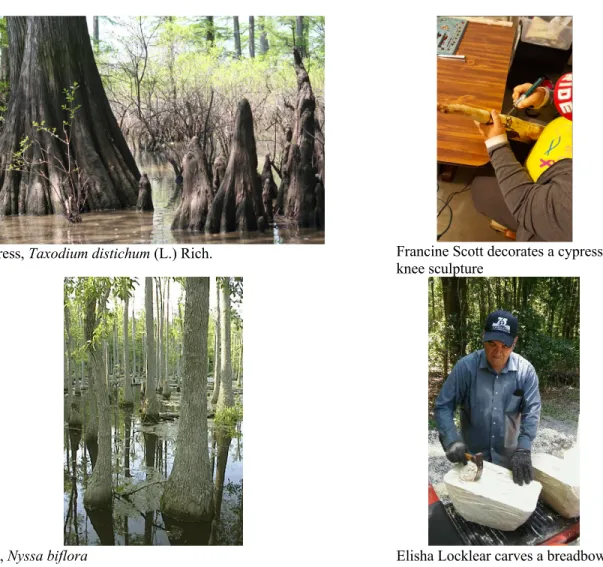
Meanwhile, the forests and wetlands that the Tuscarora have relied on for centuries for sustenance and for materials to make objects of use and beauty are steadily being converted to monocrop agriculture, urban subdivisions, and other developments. The wetlands are being drained (Maxwell 2017). And this is happening in an ecosystem that ecologists acknowledge is one of the world’s most biodiverse (Noss et al. 2015; Palmquist, Peet, and Weakley 2014). And yet, Tuscarora artists and artisans are still today making use of wild native plants to provide the materials for their arts and crafts. Elisha Locklear carves the base of the tupelo tree (Nyssa sp.) into bread bowls; Rick Jones carves smoking-pipe heads out of greenbrier rhizomes (Smilax laurifolia L.); Francine Jones peels and inscribes cypress knees (Taxodium distichum L.) to make sculptures.
Sharma (2015), their actions are contingent upon each other. The art helps tell the story of the Tuscarora to other tribes and to the settler state. But the materials do not sit there mutely waiting for the artists to shape them into something meaningful for other humans. Working with Alfred Gell, I argue that the artist’s materials -- the plant materials -- call upon the artist to make them into politically powerful art. They “cause the artist to produce” an image (Gell 1998, page 99).
This dissertation is a consideration of the agency of beings that Western scholars have not traditionally thought of as having agency: plants and plant materials. The plant provides the plant materials to the artist, and the artist fashions the plant materials into objects of use and beauty. But the plant does not always willingly or enthusiastically provide these materials, even if parting with these materials does not necessarily kill the plant. A 2017 plant collection activity undertaken with a Tuscarora artist revealed how reticent the greenbrier is to part with its rhizome (a horizontal underground stem). Hours of shovel work left the artist injured, and the researcher exhausted. So while the plant is the ultimate supplier of the artist’s materials, the plant may not supply the materials enthusiastically. And its protest is an expression of its agency. The plant does not always have the power to keep its rhizome. But it does have the power to protest over its removal.
something. In a 1996 explanation of actor-network theory (ANT), Bruno Latour stated that something must happen in this network, in order for it to be considered an actor-network: “ANT makes use of some of the simplest properties of nets and then adds to it an actor that does some work...” (371). The work that is accomplished in the network I outline is in the name of
Tuscarora sovereignty and their struggle for recognition.
Nor is this network static, with actors obediently maintaining their places. I argue that it is a dynamic network. The network changes the actor. Sarah Whatmore traced what happened to a species of crocodile, Caiman latirostris, as it moved from the river in the wild, through elaborate human networks of fashion design and fabrication, of wildlife conservation and “sustainable use,” until it finally ended up as a purse in the fashion leather market of Milan (Whatmore 2002). Whatmore refers to the “becoming” of “Caiman latirostris in the networks of sustainable use” (see Figure 3.1) (my emphasis). I argue that Taxodium distichum, for example, the swamp cypress, undergoes a similar transformation as it travels from the wetland, through human networks of inscription (being turned into art), sale, display, and political performance (see Figure 5.1). I call this the “Becoming” of “Taxodium distichum in the networks of care.” Just like the crocodile, the species is no more the tree in the wild than it is a cypress knee with the power to impress a human politician.
heads because it is fire proof and water proof. The rhizome must be, in order to survive in a place frequently inundated and regularly beset by fire.
I employed ethnobotanical data gathering methods for this dissertation. These included ethnographic interviews with Tuscarora artists and artisans, and the collection and identification of the plants the artists use, and their accession to an herbarium. However, I consider this study a multispecies ethnography (see Kirksey 2014) in the sense that I believe I am querying the plants and plant materials as well as the artists. I do this by observing the interactions of the plants and plant materials with the artists at the points of collection and in the artists’ studios. This allowed me to explore the ways in which the plants and the materials co-created the politically active pieces of art with the artists.
A chapter-by-chapter discussion of the rest of the dissertation’s contents follows.
Chapter 2: Background contains a capsule history of the Tuscarora and a short natural history of Robeson County. I introduce my research questions here. Chapter 4: Methodology describes my ethnobotanical data gathering methods and their relevance to my research
Throughout the dissertation, I often mention collecting: Collecting plants, and collecting data, for example. In Chapter 4, I also point out that collecting is not the point of this
dissertation. This dissertation bears witness to the knowledge my collaborators and I produced together. That is what ethnography is about.
Chapter 3 provides a literature review and lays out my theoretical framework. It is divided into three sections, corresponding to my three empirical chapters. I introduce the three sections adjacent to their corresponding chapters here. In Chapter 3.1 Network, I define an actor-network and provide an extended discussion of material agency and bridging the nature-culture divide, with the help of Bruno Latour. And I connect this with the assemblage of gladesman hunter, mangroves, alligators, water, and public officials that Laura Ogden described (2011), and go on to describe the dynamic nature of networks in Sarah Whatmore’s world, whereby the crocodile Caiman latirostris becomes a purse (2002). In Chapter 5: Following the Network, I describe the
network in which the plant and plant materials collaborate politically with the Tuscarora. The network includes the plant, the plant materials, the collector/artist/political activist, the buyer, and the politician. The chapter is divided into parts based on these actors. I relate relevant fieldwork experiences and data: a plant-sample-gathering trip; Rick Jones’s participation at the One Fire Council, an event that brought together different Tuscarora factions; an art sale; and a meeting between the Tuscarora Nation of North Carolina and a settler state politician that allowed the plant to intervene directly in the political lives of the Tuscarora and the settler state. Maps and a table speak to the propagation of plants and plant materials through human networks.
Network Theory. I explore concepts of interdependence developed by biologist and philosopher Kriti Sharma (2015), and argue that the plant materials engage the artist in the studio in ways that involve all five senses. I bring in Carla Hustak’s and Natasha Myers’s concept of affective ecologies to describe the interaction between species in the studio (2012), and explore the agency of the work of art using the work of Gell (1998), via Despret (2016).
In Chapter 6, I describe a rhizome-collecting trip that left Rick Jones with a back injury, and me, exhausted. The Smilax laurifolia (greenbrier) did not want to part with its rhizome. I briefly examine the agency of a plant that can display such resistance, and describe in detail Rick
Jones’s work on a Smilax rhizome in his studio. I relate the sensual interaction between the plant materials and the artist to Hustak and Myers’ description of the interaction between orchids and their pollinators (2012). Since I eventually bought the smoking pipe that Rick began to carve that day, I explain that I also am part of the network I describe in this dissertation. I describe a bread bowl carving session with Elisha Locklear, who appears to ascribe a certain agency to his work of art by describing it as having a “cocky” attitude. In a cypress knee carving session, Francine Scott discusses the agency of her ancestors in her works of art. I describe the revelation of Mother Earth in a cypress knee, and show that humans collaborate with Francine’s ancestors to reveal her.
concept of the agency of a work of art, which involves the figure calling upon the artist to carve it (1998).
In Chapter 7: Plants’ and Plant Materials’ Roles in the Political Lives of the Tuscarora, I discuss the cypress knee that impresses a settler politician, and explore in greater detail the activities of Rick Jones and his greenbrier smoking pipe at the One Fire Council. I delve into Elisha Locklear’s concept of “Indianness,” and his premium on indigenous ecological
knowledge. I tell the story of Locklear’s and Jones’s collaborations with founding leaders of the American Indian Movement (AIM), and show how Francine Scott’s sympathetic relationship with her dying sister’s nurse, a member of a different Native American tribe, is as political an activity as the male interlocutors’ collaboration with world-renowned militant activists (AIM).
CHAPTER 2: BACKGROUND
Figure 2.1: Robeson County, North Carolina
Sources: Google Maps, politicsnc.com
under imperial control. Meanwhile, it was a haven for American Indians fleeing war and epidemic diseases, escaped African-American slaves, and settlers on the run from colonial authorities (Lowery 2010).
Centuries of cohabitation in Robeson County resulted in the amalgamation of cohesive indigenous communities, intimately connected to farming, family social networks, and affective relationships with their landscapes. While dismissed derisively by some 20th century
anthropologists as “tri-racial isolates” (Beale 1972, Greenbaum 1991, DeMarce 1993), they prided themselves in their indigenous roots (Blu 2001, Oakley 2005). While they came together from many different American Indian tribes and nations and lost the original languages that they spoke, adopting English instead, they coalesced into coherent indigenous communities. Many of them are known today as the Lumbee Tribe, which with a tribal membership of over 50,000 is the most populous American Indian tribe east of the Mississippi (United States Census 2010). Other Native American people in the county claim direct descent from the Tuscarora of the 18th Century, and still call themselves Tuscarora today. Their population in 1980 was estimated at 11,000 (TTNC 1989).
Tuscarora History
With its temperate climate and fertile soils, the Carolina Colony became in the 18th Century a plantation economy that represented one of the points in the Triangle Trade that enriched
coast for agriculture, the colony’s indigenous peoples rarely gave up control of their communities without protest.
Landmark in this shifting struggle was The Tuscarora War (1711 to 1715) (LaVere 2013). It was the culmination of decades of a deteriorating settler-indigenous relationship, following numerous Tuscarora protests over land encroachment and other grievances. The powerful and well-organized Tuscarora Nation, in the eastern coastal plain of the Carolina Colony, was a major impediment to the Colony’s westward ambitions. The devastating war, including the vast massacre of Tuscarora prisoners of war at Fort Neoheroka, resulted in the forced migration of many of the colonies’ Tuscarora for the North, where they eventually rejoined their cousins to form the sixth nation in the Iroquois Confederacy (New York’s Tuscarora are today federally recognized) (LaVere 2013). Some of those who remained settled on a small state reservation in eastern North Carolina. The state closed that reservation early in the 19th Century, and according to documentary sources, many of those Tuscarora departed for the North as well (Wallace 2012).
White repression in the South before and in the first decades after the Civil War resulted in Native Americans in North Carolina deemphasizing their indigenous ancestry and identity
(Lowery 2010). This was as true in Robeson County as it was in the rest of the state, and it was a major cause of loss of perishable knowledge of indigenous languages and ways. Robeson
County’s modern-day Tuscarora base their connection to the 18th-Century Nation on
The Robeson Tuscaroras’ politically militant stance and tactics have over the decades led them to friction with other Native American communities in the county, including the Lumbee Tribe. Landmark in their militant activism has been their close connection to the American Indian Movement and their collaboration in the 1972 protest occupation of the offices of the Bureau of Indian Affairs in Washington DC (Sider 2003). Also notable was the 1988 occupation by two Tuscarora activists – Eddie Hatcher and Timothy Jacobs – of the offices of the
Robesonian newspaper in Lumberton. The two said they took over the offices to call attention to
corruption in the county (Sisk and Hardy 1997).
Living in what is today one of the most agricultural counties (by percentage of land area) and the 2nd-most impoverished county in the state (NCDA 2008, United States Census 2010),
Natural History of Robeson County
Figure 2.2: Robeson County land cover
Sources: Rains, Lawrence, and Maddox 2010; U.S. Geological Survey.
This map of Robeson County’s land cover types shows how prominent the crop land and wetlands are. Dry forest is relatively rare in the county.
The following imparts an encapsulated version of the recent natural history of Robeson County, and of recent human impacts on the landscape.
Robeson County lies at the western edge of the inner Coastal Plain of North Carolina
county forms the local western border of an approximately 100-mile-wide coastal plain that stretches along the Atlantic coast of the southeastern states, and along the Gulf of Mexico well past the Mississippi River. This coastal plain is the historic home of a once extensive biome called the Longleaf Pine Savanna (Pinus palustris Mill.). These mighty trees, reaching to over 100 feet tall, with leaves that can grow to a foot-and-a-half in length, and cones the size of house cats, used to be the dominant plant species in a vast ecosystem that formed the oceanic border of a substantial part of this continent (Jose et al. 2006).
A European explorer through what today is known as North Carolina in the early 18th Century described Tuscarora and other indigenous people using longleaf pine bark to make houses and to cover the dead. The wood of the tree was a prime source of cooking fire fuel (Lawson 1709).
producing colorful flowers, and carnivorous plants, including many species of pitcher plants and the Venus fly trap (Dionaea muscipula Sol. ex J.Ellis 1768), endemic to North Carolina.
With colonization came rapid and accelerating changes to the landscape. The Robeson County natural and cultural landscapes today are as much a product of millions of years of evolution as they are of colonial exploitation, development for agriculture, and other export-oriented uses.
Already early in the 18th Century, the longleaf pine, also known as pitch pine, was famous for its resinous sap, useful in the manufacture of tar, pine, and turpentine, all useful in the naval stores industry (Lawson 1709). These materials sealed the cracks in the hulls of wooden ships and served various other maintenance purposes on ships. Almost the entire ecosystem fell victim over the centuries to exploitation for the worldwide naval stores industry. Carolina exported 70 percent of the naval stores from the American colonies, and from 1720 to 1870, North Carolina was the most important producer of naval stores in the world (Earley 2004). Extraction of the pitch involved scarring the tree near its base and allowing the pitch to bleed slowly into a container at the bottom. The process generally killed the tree.
The savanna in Robeson County largely yielded to farms, roads, towns, and railroads. But not all parts of the longleaf pine savanna were equally accessible. The savanna is a complex ecosystem that in North Carolina also included cypress-gum swamps along the rivers and
pocosins, which are mysterious teardrop-shaped depressions (up to a mile in diameter) with their own soggy ecosystems.
eastern United States that would not reach its peak until well into the 20th Century (Maxwell 2017). The most ambitious project in Robeson County, and the one that would have the greatest ecological impacts, was the Back Swamp drainage project. The Back Swamp was a vast body of water and reservoir of biodiversity that stretched for 15 miles across the southern half of the county. It was largely drained in a major public works project that was erected from 1913 to 1918 (Maxwell 2017).
Preparatory research leading up to the drainage indicated that there were still substantial forests in Robeson County, but many of these areas were under water. A 1909 soil survey stated that large areas of land (largely swamp land) were as yet undeveloped for agriculture (Hearn 1909). The county’s fertile loamy soil, brought in by the sea over many thousands of years, was a great draw for the region’s farmers. In the first half of the 20th Century, much of the Back Swamp yielded to farms and other establishments. Top crops were cotton, corn, wheat, and “truck crops” such as fruits and vegetables (Robeson Soil and Water Conservation District 1965).
The bay forest is dominated by black gum (Nyssa biflora Walter) and tulip poplar (Liriodendron tulipifera L.). The author also made a brief reckoning of the county’s swamp forests, which still
today follow the Lumber River through the county. This vegetation community at the time was dominated by black willow (Salix nigra Marshall), river birch (Betula nigra L.), and swamp cypress (Taxodium distichum (L.) Rich.), along and near the banks of the river. Herbaceous species were few, and the author noted Spanish moss (Tillandsia usneoides (L.) L., 1762) (actually a lichen) draped over the trees.
By 1965, government officials had begun documenting the environmental changes and problems that the county’s vast Back Swamp drainage project had caused (Robeson Soil and Conservation District 1965). In a document meant to inspire governments and land owners to fund a renovation of the infrastructure, federal researchers documented erosion and siltation found on farms across the drainage district. These soil problems were due to accelerated runoff of rainwater after the removal of deep-rooted vegetation that had acted as a natural filter when the area was a wetland. According to the plan, half of the watershed’s acreage was still forested, but actual forested swamp had become rare. Few waterfowl used the drained swamp, and the quality of the remaining fish habitat was low (Ibid.) The ensuing renovation works helped combat the erosion and siltation problems, but did little for the forest or for wildlife.
In the second decade of the new millennium, environmental studies have revealed that the drainage project is unfortunately an excellent carrier of chemical runoff from farms into the watershed (NCDENR 2010). Fertilizers and pesticides carried downstream kill
wetlands. The Clean Water Act of 1972 enshrines protections for the nation’s waters, including wetlands. But the change came too late for the Back Swamp. Drainage projects are
grandfathered in (O’Driscoll 2012).
The Back Swamp drainage project brought more farms to the southern half of the county, but it has in recent decades also been the site of other types of infrastructure. Interstate 74 now bisects the drainage district, and some landowners have begun to carve out subdivisions near the county seat of Lumberton (Robeson County Tax Department GIS).
Nevertheless, some natural, unpopulated areas remain throughout the county. An inventory of natural areas in the county completed in 2009 reveals that the plants Tuscarora artists use to make art, consisting of some of the inner coastal plain’s most common species, are still to be found in the county (LeGrand 2009). Swamp cypress (Taxodium distichum (L.) Rich.), whose knees are used to make sculptures, can still be found in the cypress-gum swamps along the Lumber River. Greenbrier (Smilax laurifolia L.), whose rhizomes1 are used to make pipe heads, is found in streamhead pocosins. Tupelo gum (Nyssa aquatica L.) is also found in the cypress-gum swamp. Tupelo is used to carve bread bowls. And water oak (Quercus nigra L. 1753 not DuRoi 1772), used to make mortars and pestles, can be found in fire-suppressed areas, such as the dry outer portion of a Carolina Bay (pocosin) (all LeGrand 2009).
longleaf pine as an important enough symbol of its culture that the pinecone patchwork, derived from the shape of the longleaf pine cone, is the tribe’s official symbol (Lumbee artist, personal communication).
Meanwhile, Tuscarora artists bemoan the continued decimation of some of the last few remaining stands of forest, and the continuing water pollution emanating from the county’s chemically intensive farms (Tuscarora artists, personal communications). While Robeson County’s American Indian communities took part in the extractive activities that removed much of the forest from the county, the forest still plays an important role in local peoples’ imaginaries of personal and community identity, a “way it was” to which they at times hearken back.
Today’s Tuscarora in the county remember collecting driftwood and notable objects, fishing, hunting, and collecting berries and other edibles and useful materials, in the forests around their houses (collaborator interviews and personal communications). Tuscarora elder and artist Elisha Locklear remembers growing up near the Lumber River, which was a source of recreation and sustenance for him and his family:
My family didn’t put a name on it because the creek to us was just part of our life. It was an everyday thing, we fished there day and night. We could fish at night or in the daytime. We swam in it during the summer time. We didn’t have any air conditioning so, we would go in the field working, get hot in the middle of the day, we would go in the river, jump in the river to cool off, and come home and have lunch and go back to the field working. And in the wintertime we hunted and fished. We could go in the swamp, in the river at night with a boat and a light, gigging2 and killing fish, we could go and set hooks in the river, all these things. We probably had at least a dozen ways to catch fish (Locklear 2015).
Leon Locklear, chief of the Tuscarora Nation of North Carolina, fashions knives using the wood of native swamp trees even as he leads a recognition campaign within the North Carolina Commission of Indian Affairs. Elisha Locklear3 carves bread kneading bowls out of the trunk of the tupelo (Nyssa sp.) and mortars and pestles out of the wood of the red water oak (Quercus nigra L.) while, as vice chairman of the Tuscarora Tribe of North Carolina, he helped compile a
Figure 2.3: The plants and the artists
Swamp cypress, Taxodium distichum (L.) Rich. Francine Scott decorates a cypress-knee sculpture
Tupelo gum, Nyssa biflora Elisha Locklear carves a breadbowl out of tupelo
Sources: http://www.wilderness.net/NWPS/enlargeAndDetails?id=2466; dendro.cnre.vt.edu. Artist photos by Sara Maxwell.
a quality of wood that will not impart its own flavor to the dough. Indeed, the wood is
impervious to the rotting odor and flavor of food stuffs as well, according to Elisha Locklear. Similarly, greenbrier rhizomes are both water- and fire-proof, making them suitable for the manufacture of smoking pipes (Tuscarora artists, personal communications).
The tension between historical, political, and cultural forces that would erase North Carolina’s Tuscarora, and Tuscarora persistence in the face of such societal and ecological pressure, prompted for me a trio of questions which I explored in my fieldwork.
RQ 1: The Actors in a Network
A 1956 Act of Congress declared all American Indians in Robeson County and adjoining counties to be Lumbee Indians (Public Law 570, Chapter 375). At this time, popular lore held that the constituent elements of the Tuscarora Nation had migrated North in the 18th Century to reform in what is now New York and Ontario, except for a small reservation of short tenure in North Carolina, which dissolved late in the 18th Century, and most of whose members also departed for the North (Wallace 2012, LeMaster and Wood (Eds.) 2013). Robeson County’s Native Americans have had trouble gaining settler government recognition as sovereign communities. The Lumbees enjoy state recognition and only limited federal recognition. The county’s Tuscarora enjoy neither state nor federal recognition.
American Indian has often been subject to the arbitrary rubrics of a colonizing power. What have been the factors contributing to the world of the Tuscarora? Not only humans are active in these processes. RQ 1: What actors contribute to Tuscarora persistence and cultural resilience?
RQ 2: Wild Native Plants and Plant Materials, the Tuscarora, and Agency
Robeson County is home to some of the most biodiverse and threatened landscapes on Earth. At the same time, Tuscarora artists are using materials from some of the plants that are important parts of these threatened ecosystems. What is the exact nature of the relationship between these plants and plant materials, and the artists? How do they interact? Conservation of these
ecosystems is important, for they have fed, clothed, and housed the local people for centuries. It is in an endeavor to better understand the interactions between the Tuscarora and their physical environment that I ask, RQ 2: How do plants and plant materials express their agency in their interactions with Tuscarora artists?
RQ 3: Wild-Native-Plant-and-Tuscarora Cosmopolity
Studies of the tri-racial American Indian communities of the Southeast have tended to focus on social aspects, such as a mixed-race community’s navigation of the Jim Crow racial system (Greenbaum 1991). Other researchers have analyzed these communities in the context of capitalist hegemony (Sider 2003). Few have approached these communities from the point-of-view of material culture (Croom 1982 and 1992, Boughman and Oxendine 2003, Johnson 2004). References in the literature to North Carolina Tuscarora material culture tend to be
include the materials from which today’s Robeson County Tuscarora artists draw in order to create their art. Responding to these lacunae in the scholarly literature, I ask: RQ 3: Do wild native plants and plant materials play a role in the political lives of the Tuscarora?
CHAPTER 3: FOUNDATIONS
The Foundations Chapter has three parts, which provide the theoretical framework for and are parallel to the empirical Chapters 5, 6, and 7. With those chapters in mind, sections are entitled Chapter 3.1‘Network,’ Chapter 3.2 ‘Plant and Plant Materials Agency,’ and Chapter 3.3 ‘Cosmopolity.’ Therefore, it is suggested that the reader skip between chapters, reading Chapter 3.1 immediately before reading Chapter 5, reading Chapter 3.2 immediately before reading Chapter 6, and reading 3.3 immediately before Chapter 7.
and Chapter 3.1 offers a brief, pragmatic literature review, with an in-depth focus on a short list of salient works, for the purpose of building a theoretical framework.
Chapter 3.1: Network
For the purpose of this paper, I consider plants and plant materials as having agency. (In what follows in this section, anywhere I specify ‘plant,’ ‘plant material’ would also be
appropriate.) Before I can make the claim that plants and plant materials have agency, I need to explain what I mean by agency. What kind of agency are we talking about? Where does the plant’s action come from? My argument is that the action comes from the environment as much as it comes from the plant itself. But it is not just any environment. It is not just for example the herbivores and pollinators fluttering around a flower. It is not just the teachers and parents and friends around a child. It is a network of all the other actors connected to the actor. And those actors are not just living beings, or living beings and ‘inanimate’ objects, or living beings and ‘inanimate’ objects and energy, or all those and space and time. It is all those and additionally abstract ideas, conditions, illusions, concepts, imaginations, theorems, theories.
The plant’s (plant material’s) action never occurs in a vacuum. The artist, the activist, the buyer, and the politician are mediators acting on it, and simultaneously being acted upon by it. This makes the plant material both actor and actor-network and mediator; and it makes the artist, activist, buyer, and politician both mediators for the plant material and actors whose actions are mediated by the plant material.
But what is the nature of the actor-network around the plant material? Is it a blueprint? Is it a cold schema, like a diagram of a computer circuit, or a corporate organization chart? Is it
abstract, like a flow chart developed by an R&D Department for the process of idea to product? No, it is warm, sensual, painful, vibrant, and lively. It reeks; it shrieks; it cuts; it is sour; it glares. It assaults the senses.
The plant and plant materials are in an assemblage that includes the other actors much like the gladesman hunter is part of an assemblage that also includes mangroves, alligators, water, and National Park Service rangers in Laura Ogden’s Swamplife (2011). “Gladesmen subjectivity emerges through muddy, smoky, bloody relations with other animals, such as alligators” (19). Ogden describes a gladesman skinning an alligator: “Tactile and odorous, it is a refrain of hands grappling in blood and shit” (63).
Sarah Whatmore calls for a bodily practice, “thinking through the body” (Whatmore 2002, page 5), in a hybrid geography that considers the lively nature of spatial formations, seeing space as alive rather than a flat Cartesian grid (see also Massey 2005). In her study of a wildlife
poaching of crocodile eggs in the wild, the hatching of crocodiles in a breeding station, the return of some of the youths to the wild, the raising of the others in concrete tubs, and their ultimate slaughter, skinning, and processing to make fashion items. Whatmore argues that a consideration of this process shatters the illusion of a wild animal existing solely in a pristine natural place. The species, she argues, is caught up in the conservation literature, commercial-conservation web sites, international breeding regimes, the crocodile skin market, and the runways of Milan and New York in a way that binds them to a network that includes not only mud and rivers and gazelles but also scientists and fashion designers. So, the species is as much a purse as it is a live animal in a far-away river.
Whatmore traces the process of becoming Caiman latirostris in a flow chart that I have reproduced as Figure 3.1. It shows that the actor-network that brings to life this species extends beyond the animal’s mother and father, the water, the sun, and its prey, to the poachers and breeders and international bureaucrats.
In 2005, Bruno Latour argued that social scientists had spent some generations taking
shortcuts, taking many things for granted. They erected abstract giants such as HEGEMONY and THE SYSTEM, THE MACHINE, THE MILITARY INDUSTRIAL COMPLEX, and POWER RELATIONS, that were supposed to explain the behavior of people and institutions in most every instance (Latour 2005). Meanwhile, on the other end of campus, natural scientists pretended that everything outside of human society operates predictably according to natural laws. Generation after generation of social scientists put their best face on even in those awkward situations in which historical events seem to be influenced as much by things from ‘nature’ – be they microbes or lawns or cats (Latour 1984, Robbins 2007, Haraway 2008) -- as by people. Meanwhile, natural scientists pretended that the process of comprehending the things in their assigned thematic group – the objects of ‘nature’ – was a fairly straightforward process of empirical observation and induction that the human scientists, by virtue of the marvelous, God-given machine between their earlobes, could complete all by themselves. By contrast, Latour and Woolgar showed (1979) that knowledge is produced in the laboratory not just by human
scientists but also by inscription devices such as spectrometers, and a number of scholars have shown that mussels can be business partners (or not) (Callon 1986), climate conferences have a life of their own (Law 2004), and the moose has as much to say about the hunt as the human hunter (Watson and Huntington 2008).
Given all this disorienting ontological complexity, Latour argued in 2005 that scholars ought to take a cue from the methodical, plodding, thorough, leaf cutter ant searching for food,
own pocket... the ANT-scholar has to trudge like an ant, carrying the heavy gear” (Latour 2005, pages 23 and 25). (ANT, in capital letters, is an abbreviation for Actor-Network Theory.)
In so doing, we can rescue some of the objects of ‘nature’ and show that what they are and who they are to us is more complicated than a rarefied (“purified”) natural object. Sarah Whatmore did this in 2002 with Caiman latirostris, a species of crocodile. Through careful documentary evidence, and a flow chart, Whatmore shows that an actor-network that includes the conservation literature, the chic purse in the crystal window of the expensive fashion store, and the grisly process that turns a crocodile in the ‘wild’ into a purse, all co-produce this
Figure 3.1: Becoming Caiman latirostris in the networks of sustainable use
Source: Whatmore 2002, Figure 2.6, page 30. See also Figure 5.1.
And in Chapter 5, I will talk about the becoming of Taxodium distichum, the swamp cypress. For, Whatmore’s crocodile and the Tuscaroras’ swamp cypress become not only natural objects but also political subjects.
network that has contributed to the Robeson County Tuscaroras’ persistence and cultural resilience.
Chapter 3.2 Plant and Plant Materials Agency
The agency of plants, and of plant materials, becomes evident in the interactions between collectors and plants in the forest, where the artist breaks his or her back to acquire the plant or plant materials, and also in the studio, where interaction between plant materials and artist involve all five senses.
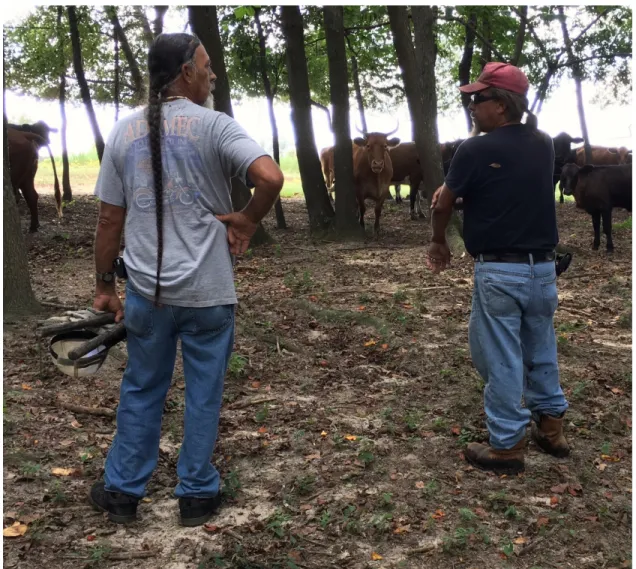
Rick Jones’s journey into the forest to collect Smilax laurifolia rhizomes allowed him to join an assemblage of “domesticated” and “wild” beings, of wandering cows and calves, of birds of prey and seemingly “wild”-growing Smilax, of muck composed of livestock waste and the tannin-rich waters of Richland Swamp. Rick would not take a Smilax rhizome from the forest behind his friend Larry Oxendine’s farm and home without first becoming part of this teeming assemblage. In the words of Laura Ogden, who described a similar campaign of engagement by the hunter with the alligator’s habitat in the Everglades in her 2011 book, Swamplife: “The refrains suggest the world-making, human-making power of plants, mud, reptiles, and all the rest we used to call nature.” (Ogden 2011).
much in the way that “gladesmen subjectivity emerges through … tactile engagements” in the Everglades (Ogden 2011, page 19), Rick’s subjectivity as plant collector, as artist, does not emerge until he begins to grapple in the mud with the materials he will use to make his art.
Given the political impact of Rick’s smoking pipes, with their heads hewn from these Smilax rhizomes – and the plant’s forceful interaction with Rick at the point of collection – enough to cause an injury – we see then that the plant as material benefactor, the collector as artist, the artist as political agent – and finally, the plant and plant materials as political agents – all emerge reciprocatively, beginning with Rick’s tug on the rhizome with his shovel, and the plant’s
grudging, but eventual acquiescence.
This is not an immediate, but rather a gradual and always-continuing process. In the words of Eduardo Kohn, who quotes Charles Sanders Peirce when he writes in How Forests Think: “Selves don’t exist firmly in the present; they are ‘just coming into life in the flow of time.’” (Kohn 2013, page 206). Kohn makes clear that he includes plants, not just humans, in this process of emergent selfhood: “Furthermore, selfhood is not limited just to animals with brains. Plants are also selves” (Ibid., page 75). And on the next page, “A self, then, whether ‘skin-bound’ or more distributed, is the locus of what we can call agency” (Ibid., page 76).
The plant, in this instance, displayed agency of a kind that announced to us collectors that it would have preferred to have remained unmolested in the ground. While the plant’s “attitude” might not have served the human collector’s objective very well, it must be respected as an expression of the plant’s “will,” or “response” to the collectors’ initiative in grappling with the rhizome. Much like Haraway’s cat gazing back at a naked human companion with full
inertia (Haraway 2008). It is the plant’s willpower pitted against the human collector’s. It is the plant’s agency.
Latour showed in his 1996 article, “On Actor-Network Theory: A Few Clarifications,” that an actor-network always begins with one actor, reaching out and making contact with a second actor. But what exactly happens in this interaction? What happens in the moment of this
contact? Kriti Sharma showed in her 2015 book, Interdependence: Biology and Beyond, that, in biology, any time two living beings come into contact with each other -- and even when a living being interacts with some organic material – they mutually constitute each other. She wrote: “things can be viewed as dependent on one another in such a way that each brings the other into being” (Sharma 2015, page 103). For example, the presence of sugar in the environment might
inspire an organism to become more active, or to reproduce: activities, that in themselves, will have a reciprocal effect on its environment. The example she used involved single-celled
organisms interacting with each other and with signals in their environments, but the interactions she described become fertile ground for thinking about what exactly happens when the artists interact with their materials in the studio.
As the artists process plant materials into pieces of art and use in the studio, these
interactions involve all five human senses: The sight of the wood grain; the sound of a saw or a drill digging into wood; the fresh pear smell of flying tupelo shavings as Elisha Locklear works with his chainsaw; the clean taste of tobacco as a Rick Jones pipe head is tested; the rough texture of a previously smooth, peeled cypress knee that Francine Scott has decorated with her wood burning tool.
the macroscopic world of the studio, the materials have an effect on the artists even while the artists change the plant materials into a different form. The sight of the wood grain inspires Elisha to count the rings and tell stories from the era the tree was born. The mechanical sound of the drill reminds Rick of the modern technology to which his ancestors did not have access, and inspires him to make the next few pieces of art using more traditional tools. Even as the Smilax pipe head holds the burning embers of tobacco that Rick tastes, Rick dreams of the meaning and import of the tobacco, and decides to grow his own tobacco. As Francine’s thumb passes over the rough texture of the cypress knee, memories flood her and she tells stories of collecting driftwood from the river outside her house when she was a child. The memory will invigorate her determination to advocate for local rivers, the local environment, and the Tuscarora people.
would earn him a smidgeon of pollen on his hindlegs. He would then fly on to do the same dance with other orchids of the same species. The bee carried the first plant’s pollen to a second plant’s female sex organs, and orchid offspring would ensue.
Hustak and Myers focus on the ways the orchids interact with the flies and the bees. They describe the interaction as a dance, as a sensuous love-making between species, “an affective ecology shaped by pleasure, play, and experimental propositions” (Ibid., page 78). Affective ecology is emotional interaction between species, just as the ecological term ‘community’ suggests (but does not always mean) the meaningful living together of different species. This interaction is not only on the emotional level; it is on the physical, embodied level as well. Bees penetrate the folds of flower petals, flower stamens and pistils caress fly legs. A true interspecies lovemaking.
I argue that a similar process happens in the studios (often open-air studios) of the artists with whom I worked for this project. The plant materials forge a sensual connection with humans via the rhizomes, knees, and wood that the plants have donated, sometimes at the expense of their own lives, in order for the art to be made. The plant materials do not sit there passively. They engage the artists in ways that involve their senses, that evolve into a sensual interplay of tools and movements, of sights, sounds, smells, taste, and touch.
which will be recounted in greater detail in Chapter 6, connected Rick with his friend Larry Oxendine, who was keeping a baby goat in his tool shed at the time we visited. Rick used the occasion to cuddle with the baby goat and hold it in his arms (see Figure 3.2). So, the Smilax plant, which inspired us to visit the Oxendine farm, brought us together with its rhizome, and brought Rick into an affective connection with the baby goat.
Figure 3.2: Smilax connects collector and artist Rick Jones with a baby goat
Sara Maxwell photo
proposes “a reconsideration of the distribution of action in terms of making one make [faire-faire]” (Ibid., page 117). She later gives an example: “The work makes happen; the shield
makes the artist make” (Ibid., page 199). Despret explains that part of the reason for the confusion about exactly who is making exactly what stems from a misunderstanding about the nature of art itself. Anthropologists have long grappled with the meanings of objects found in other cultures that Westerners somewhat arbitrarily recognize as art. Despret takes up the example of a warrior’s shield, the kind of object that might grace a European explorer’s living room wall as an object of art. For the community whose craftspeople produced the shield, for the sake of battle, for warriors, the shield is not so much an object of art as it is a political, a military agent coming into being, demanding to be made. In the words of Despret: “The work not only fascinates, captivates, enchants, and traps the recipient; rather, it is the agency contained within the very material of the work to be made that controls the artist, who thus takes the
position of patient [i.e. who takes a passive position]. … the work makes happen [fait-faire]; the shield makes the artist make (the artist is made-to-make by the shield), it makes the one using it (e.g., it can make one more daring in battle), and it makes the enemy warrior (e.g., be fascinated, scared, captivated by it)” (Ibid., page 119). Similarly, Rick’s, Elisha’s, and Francine’s works, which have similarly urgent roles in society – as political agents, as carriers of prayers for the sick, as nourishers of the community – call on the artists to bring them into being, even when they are still in the form of plant materials.
I would allow that the plant materials end up doing political work that benefits the plants they came from, or at least their species, or at least the biome the plants inhabited. And this is not a coincidence. This is where plant agency and plant materials agency connect.
In Chapter Six, I will describe artist studio visits and a plant collecting trip, to follow the thread of plant agency and plant materials agency throughout. I do not ignore the agency of the Tuscarora Indians of North Carolina. However, scholars have for too long ignored the
collaboration of plants in the things humans do. So, I do not suggest that the Tuscarora are passive receptors of plant and plant materials agency. The agency does not rest with the plants and plant materials. It rests with everyone. In the end, the smoking pipes, cypress knees, and bread bowls that inspire politicians, political activists, cultural leaders, elders, and school children, work together with humans. And the plant materials, drills, chainsaws, and wood burning tools work together with the human artists and the plants to create these powerful, politically active works of art.
In the next section, I explore the theoretical implications of beings reaching across
ontological divides – of species and even taxonomic kingdoms – to collaborate politically: in other words, to form a cosmopolity.
Chapter 3.3 Cosmopolity
issue on vegetal politics, the authors argue that “urbanised plants, some of them extremely tough, do not fit the dichotomized categories of wild or cultivated, but instead become ‘active agents’ in the making of the streets” (Ibid.) The studies in that special issue examine how some plant practices are treated by urban environmental managers as belonging, while others are written out; how certain sexual practices and certain kinds of bodies are made to feel excluded in lower Manhattan’s High Line park, and how those practices of exclusion are mirrored in park
managers’ treatment of the excluded Ailanthus altissima, or tree of heaven; and how vines on a vineyard press upon human workers their own “planty temporalities,” as subtle changes in the ripening fruit dictate the phases of human labor (all Ibid.).
One author announces the foundation of the field of “vegetal political ecology” in his study of orchard cultivation in a former Soviet republic. Jake Fleming argued that fruit trees in
Kyrgyzstan’s walnut-fruit forests intervene in villagers’ relations with their national government because of their graftability. Their ability to be grafted makes the trees more productive, which gives villagers more economic and political autonomy from the post-Soviet regime. “Village grafters enter into a politics that, because of the capacities of the plants who also participate, tends toward the non-hierarchical, both in how bodies relate and in how resources are accessed,” writes Fleming (2017, pages 27 and 28). “Trees are political agents,” Fleming argues, quoting Paul Robbins.
Proponents of vegetal politics scholarship are quick to point out that this plant agency occurs in an assemblage that also includes humans and other actors. “Attention to the specific
process of relations. Such relations occur across – indeed help constitute – different scales of space and time” (Head et al. 2014).
In addition to the recently burgeoning literature of vegetal politics and vegetal political ecology, a number of other scholars have treated more-than-human agency in ways that will serve to shed light on the ways that plants and plant materials contribute to the social and political lives of the Tuscarora. For the rest of this section, I will shift my focus to these other scholars of more-than-human agency.
According to the American Heritage Dictionary, the word, vegetable, derives from the Latin vegēre, ‘to be lively’ (Pickett 2019). The word, ‘vegetable,’ did not always have only the prosaic, or pejorative, meanings, it does today, referring alternatively to inhabitants of the supermarket’s produce section or, demeaningly, to a brain-damaged human with virtually no intellectual function. In previous centuries, ‘vegetable’ had a more pronounced connotation of liveliness. Indeed, as the AHD goes on to explain in the entry’s Word History, the Scholastics ascribed a vegetative soul to plants, animals, and humans (Ibid.) And Andrew Marvell famously exhorts his coy mistress with the following words: “Had we but world enough and time/ This coyness lady were no crime/ … / My vegetable love should grow/ Vaster than empires and more slow” (Marvell 1681), ascribing slowness but also a persistent liveliness to the vegetable.
“forays into the lively worlds of Leguminosae” (Whatmore 2002). Donna Haraway connects lively capital with the pet health industry and the development of the idea that dogs have a right to health (Haraway2008). It is the liveliness of plants that helps to explain their agency. Not the quality of being alive, but liveliness in the sense of intelligence and presence.
Plant materials, once removed from the plant, are they lively? Not in the sense of
photosynthesizing and growing and reproducing. However, Chapters 5-7 will show that these plant materials do have certain lively qualities, which allow them to engage with the artists and become active in their affective and political worlds.
It is the liveliness in the things of nature that inspired Bruno Latour to invite them to join us in a grand, more representative, Parliament of Things: “Half of our politics is constructed in science and technology. The other half of Nature is constructed in societies. Let us patch the two back together, and the political task can begin again” (Latour 1993, page 144). However, as effective as Latour is in showing that the moderns’ obsession with dividing up the world into the things of nature and the things of society is specious, he continued some of the mistakes of those he criticized by comparing Western society to the communities he calls “the others,” in other words, indigenous communities whom the moderns have labeled as “premodern” (Ibid., 142). He even falls into the trap of contrasting “the others” unfavorably with Western society at one point, claiming that “the others’” ontological chains are not as long as those of Western society (Ibid.)
immemorial,” he writes (Ibid., page 144). A quasi-object could include something like the ozone hole, something that politicians fret about, but which sumptuously is part of the stuff of nature and science as well. On the Nature side of the house, however, Latour highlights the role of human experts: “Natures are present, but with their representatives, scientists who speak in their name” (Ibid., page 144). In other words, according to Latour, the things of nature cannot speak for themselves, without human experts giving voice to their aspirations.
What we are left with here is a concept of material agency that is modulated by humans. Marisol de la Cadena continues in this vein in her study of an Andean peasant who enlists the help of a local mountain to liberate his community from a form of neo-colonial rule (De la Cadena 2015). De la Cadena’s Earth Beings: Ecologies of Practice Across Andean Worlds is a story of “mountains that intervened – decisively – in struggles among humans” (Ibid., page 35). Mariano Turpo is a Peruvian peasant who spearheaded the effort of his Quechua community to shatter the hacienda system that had enslaved his people. Central to all of his efforts was
Ausangate, a local mountain but also an earth being with agency in the lives of the local people. Adjacent mountains are of central importance to indigenous people in the Andes not only for affording access to material resources, but also as prominent members of the hybrid, multi-species, multi-being local political and economic community known as an ayllu.
runakuna do and say in their respect is consequential” (Ibid., pages 164 and 165). Calling to mind the semiotics of Eduardo Kohn (2013), whose refrain is that all life is signs, de la Cadena explains the constitutive role of invoking the mountain’s name in the following manner: “Without distinction between signifier and signified, words do not exist independently of the thing they [the runakuna] name; rather their utterance is the thing(s) they pronounce” (Ibid., page 231). The result is a reciprocal constitution of tirakuna and runakuna in the instance of invoking the mountain’s name: “it makes the rapport and brings all its components into being” (Ibid., pages 164 and 165). The mutually constitutive element transcends the human-earth-being
relationship and also defines relations between different communities of humans, according to de la Cadena: “The indigenous and nonindigenous, city and countryside, Quechua and Spanish, emerge in each other forming a complex hybridity in which the different elements composing it cannot be pulled apart for they are both distinct and part of each other” (Ibid., page 187).
Also instrumental in Mariano Turpo’s ritual was his blowing air over coca leaves with his mouth. This instance of using plant materials in order to invoke the presence of an earth being – the cosmopolitical presence of an entire mountain -- indicates the amount of agency plant
materials can possess. (By cosmopolitical, de la Cadena refers to the political collaboration of two beings that Western scholars have held are not in each others’ ontological worlds, in this case, humans and mountains (Cadena 2010, 2015)).
heterogeneous assemblage that brings it into being, pachamama has forced its own constitutional recognition as a subject with rights!” (Blaser 2014, page 51).
By highlighting the role of the human in mobilizing the agency of the non-human, De la Cadena echoes the point of view of Keith Basso, who investigated the intimate relations between a Western Apache community in Arizona and the geographical landscape around it: “Places express only what their (human) animators enable them to say,” Basso wrote (Basso 1996). Basso discerns the “place-making” power of particular community members (Ibid., page 5). These are generally elders whose activities over the decades have led them to know the places around them extremely well. A place, in this context, might be anything from a favorite spring or creek to an outcropping with a good overview of the surrounding country, or a path where a memorable event occurred. “Charles Henry, age sixty or thereabouts, skilled herbalist, devoted uncle, and veteran maker of place-worlds,” was one such place-maker whom Basso described (Ibid., page 8). Charles “constructs ancestral place-worlds” by intoning what the ancestors might have said in coming upon the places. He imagines his ancestors “arriving on the scene, studying it intently, and assessing its potential for helping them survive” (Ibid., page 13). Coming upon one such place, Charles comments, “’The country was wetter and greener when the ancestors first explored it.’” He later continues: “’Water must surely be angry at us’” (Ibid., pages 16 and 17, respectively). According to Basso, places have a life of their own, but one always modulated by human experiences. “Places, we realize, are as much part of us as we are part of them,” he writes (Ibid., page xiv).
context of idolatry, the idol is not a ‘depiction’ of the god, but the body of the god in artefact-form” (Ibid., page 99). Echoing Kohn, who describes plants as selves (Kohn 2013, page 75), Gell ascribes a particular kind of life, or consciousness, to the idol, when he refers to “the mystery of the animation of idols, their genuine, if peculiar, personhood” (Gell 1998, page 99). The genuine life of the idol has a profound impact on those who would worship it or simply behold it. But also, in a sense, the idol calls itself into being by inspiring the artist to carve it, and instructing it how to carve it: “The nature of agency extended by the prototype is to cause the artist to produce” an image (Ibid., page 99). And the artist does this through her or his sensory perception, through her or his sensual understanding: “To see (or to know) is to be sensuously filled with that which is perceived, yielding to it, mirroring it – and hence imitating it bodily” (Ibid., page 100).
The kind of material agency Gell is talking about is very different from the one invoked by Latour – in which scientists represent Nature in the Parliament of Things; de la Cadena – where the earth being is constituted by a human ritual and the invocation of a name; and Basso – where humans are in the business of place-making. For Gell, humans are relevant to the being and the influence of the idol. After all, a human carved it; humans behold it. However, there is
something genuinely agentic about the life and being of the idol itself: it calls itself into
existence, using the human carver as an instrument. In Chapter 7: Plants’ and Plant Materials’ Roles in the Political Lives of the Tuscarora, we shall see -- based on information from
CHAPTER 4: METHODOLOGY
I gathered data in various media, and using a variety of data-gathering methods, for this dissertation, in order to approach the subject of plant agency from a variety of angles. My research questions ultimately drove my data-gathering methods, which will be discussed in greater detail after the research questions below.
RQ 1: What actors contribute to Tuscarora persistence and cultural resilience?
In order to trace the becoming of Taxodium distichum and other relevant species in networks that will ultimately put into play their political agency and that of their materials, a number of data-gathering methods must be used. This network includes the plant, the plant material, the collector, the artist, the activist, the buyer, and the politician. The collection of plants in the forest, participant observation, and ethnographic interviews are all important data-gathering methods to answer this question. Participant observation includes the observation of art sales at cultural events. Chapter 5: Following the Network, most explicitly addresses this research question.
RQ 2: How do plants and plant materials express their agency in their interactions
with Tuscarora artists?
artists’ studios were used to answer this research question, which was most explicitly addressed in Chapter 6: Affective Ecologies.
RQ 3: Do wild native plants and plant materials play a role in the political life of the
Tuscarora?
The answer to this question largely emerged from ethnographic interviews I completed with the artists and activists, and social and political events I attended with Tuscarora collaborators (participant observation). This research question was most explicitly addressed in Chapter 7: Plants’ and Plant Materials’ Roles in the Political Lives of the Tuscarora.
Fieldwork challenges: New directions
During my initial, exploratory travels to Robeson County in 2013 and 2014, the knowledge potential collaborators professed to have, and professed to not have, had a pivotal effect on the final shape of the project itself. My initial interest was in working with Lumbee herbalists who crafted herbal remedies from wild native plant materials in Robeson County. However, despite using several avenues of inquiry, I heard from Lumbee interlocutors that this particular
traditional Lumbee knowledge had withered since Edward Croom had conducted his fieldwork on the topic in the early 1980’s (Croom 1982, 1992). Meanwhile, I was meeting a significant number of Tuscarora artists and artisans at the annual Homecoming celebration in Pembroke, and elsewhere. They were wildcrafters, meaning that they sourced their materials from the nearby forest (they used wild native plants and plant materials). My Tuscarora interlocutors and I developed the theme of ecology and politics together; they all had a genuine interest in the health of the woods around them, and many of them had long histories of political activism. As I continued working with Tuscarora artists, some of them displayed significant medicinal plants knowledge, as did other members of the Tuscarora community to whom they introduced me. It turned out that I could have remained closer to my initial research topic if I had had more time for exploratory research. To this day, I do not know if my Lumbee interlocutors were telling the truth, or whether their profession of ignorance was a case of ethnographic refusal meant for acquisitive researchers deemed outsiders (Simpson 2007). In any case, this change in direction helped to shape my study.
indigenous medicinal plants knowledge (Shiva 2014). It is therefore not surprising to me that indigenous interlocutors were reticent about acknowledging medicinal plants knowledge during my exploratory fieldwork.
Once my study shifted to the agency of plants in the political lives of the Tuscarora, my focus changed further based on the activities (or lack of activities) of my interlocutors, and their
relations with the settler state. My initial impetus was to emphasize plant agency over plant materials agency. The reason for this was that it seemed that plants would have some
conservation interest in working with Tuscarora who were interested in protecting the forest. And further it seemed that it would be easier to interest the reader in focusing on the agency of something that is alive, and is more easily graspable, understandable, than a piece of material, which seems comparatively abstract.
I was therefore eager to travel to the forest with my collaborators and observe the behavior of the plants the artists collected. The problem was that Rick Jones was the only artist with whom I developed an extended knowledge-producing relationship who regularly traveled into the woods to collect plants and plant materials. Other interlocutors relied on other people to collect plants and plant materials for them, or ran into controversy with the settler state, impeding my ability to work with them further (more about that later). I did not have the opportunity to track down my interlocutors’ collectors, and was therefore left with limited opportunity to observe the plants in the forest.
thematic focus. The dissertation became more about the agency of plant materials than the agency of plants themselves.
This study initially had more interlocutors and potential interlocutors, but a number of these ended up behind bars while I was conducting fieldwork for my study. A main leader – very active on recognition efforts – was charged with drug trafficking. And a longtime Tuscarora activist who was well known for his wild-native-plant-based arts and for his militant political tactics, was charged in connection with one of a number of Tuscarora gambling casinos that briefly opened around Robeson County. The casino operators had maintained their sovereign right, as Tuscarora, to operate them on what they held is their own land. Had these interventions of the settler state (the arrests of the activists) not taken place, this study might have had far more detail about Tuscarora political struggles, and possibly more information about the artists’ plants in the forest.
My limited observation of plants in the forest resulted in a major shift in focus from the plants to the plant materials the artists work with in their studios. This does not altogether erase plant agency, however. The plants are still the providers of the materials with which the artists work; without the plants, the artists’ work would look very different, or would possibly not exist at all. A consideration of the circumstances under which plants part with their materials is still worthwhile.
Finally, a consideration of the network that brings together the plant, the collector, the plant material, the artist, the activist, the buyer, and the politician. There is one more actor in this network who is worth mentioning: It is I. I helped to harvest a Smilax laurifolia L. rhizome alongside artist Rick Jones. I collaborated on the Tuscarora Nation of North Carolina