Impairment of Notes Receivables
US GAAP requires entities to assess whether financial assets are impaired and recognize the impairment. If a note receivable is impaired, the loss is measured by the creditor as the difference between the investment in the loan (usually the principal plus accrued interest) and the expected future cash flows discounted at the loan’s historical effective interest rate. US GAAP recognizes the
uncollectible amount through an allowance account. Unlike IFRS, US GAAP prohibits the reversal of impairment losses. In the U.S., creditors sometimes work with customers and change the terms of the original agreement – giving customer more time to make the payments, reducing the interest rate, or even reducing the balance owed. This situation is often referred to as “restructuring” or “troubled debt restructuring.” This semester, we will look only at the rules for creditors but you should be aware that there are even more complicated standards to guide accounting by debtors in troubled debt restructuring situations. If you use old exams to study, you should skip all problems that ask for the debtor’s
accounting procedures.
With respect to IFRS, review Unit 6 on receivables in the VirginiaTech material. In short, IAS 39 also specifies that entities should assess whether their financial assets are impaired. If a portion of accounts receivable is impaired, the loss is measured as the difference between the asset’s carrying value and the present value of expected future cash flows discounted at the asset’s original effective interest rate. Entities can choose to recognize the uncollectible amount either directly or through an allowance account. IFRS refers to the allowance account as a ‘provision.’ The amount of the loss is recognized in profit or loss. IFRS allows entities to subsequently reverse impairment losses provided there is objective evidence to warrant reversing the original impairment. Reversal of impairment is recognized in profit and loss.
Note that neither FASB nor IASB are measuring the “fair value” of the problem receivables and these standards could change as SFAS No. 157 becomes more familiar. The current reasoning is that these troubled debt situations are not NEW loans (which would be recognized at fair value). Therefore, it makes sense to use the original interest rate – the creditor is just trying to collect the highest possible amount from the existing loan.
The problem with getting a “fair value” would be the interest rate – since this is a problem customer, there is considerable risk involved and it is probably difficult to find an ”orderly” market where such troubled receivables are actively traded.
There is also a “notes” file available with a flowchart on the schedule page.
Note: Excel versions of these problems are available – but the only “real” benefit of using Excel instead of this paper copy is the ease of doing amortization tables when needed.
DEBT RESTRUCTURING - DEMONSTRATION PROBLEM #1
1. Viola Vacations signed a note to Empire Airways in the amount of $50,000. The terms specified annual 10%
interest payments on the unpaid balance. The note is due today. Viola Vacations has not paid the interest for the last year and is unable to pay anything on the principal due.
2. Empire has agreed to a concession which involves the transfer of noncash items with a market value of less than the $55,000 amount of the past-due debt ($50,000 principal, $5,000 accrued interest already debited to interest expense and credited to interest payable).
3. Viola Vacations will transfer a parcel of real estate to Empire. The fair market value of the land (per the appraisal) is $30,000. Viola Vacations had purchased the land several years ago for $10,000.
Creditor’s Books
Debit Credit
Land
Notes receivable
Interest receivable
Allow for bad debts
DEMONSTRATION PROBLEM #2
Same as #1 except that instead of transferring land:
3. Viola Vacations will issue to Empire Airways 4,000 shares (a 10% ownership interest) of its common stock which
has a par value of $10 and has been estimated to be worth $12 per share. In return, Empire Airways will accept the stock in full settlement of the debt principal and accrued interest (i.e., $55,000).
Creditor’s Books
Debit Credit
Investments Portfolio
Notes receivable
Interest receivable
Allow for bad debts
DEMONSTRATION PROBLEM #3 - CREDITOR
1. Farview Farms had signed a $40,000 note to Idaho First Bank and Trust. The note specified annual payments of
$10,000 per year plus 12% interest on the unpaid balance. Unseasonable weather two years in a row has ruined the crops which Farview intended to sell to make its loan payments. The bank has agreed to restructure the terms of the loan. [Assume that Farview has already recorded as interest expense the $4,800 unpaid accrued interest.]
2. The new loan agreement specifies an immediate payment of $4,000 which represents 10% interest on the balance
which was outstanding during the year. Farview will then pay interest only for three years at a 10% rate on a reduced principal amount of $25,000. Four years from now, the balloon payment of $27,500 will come due. Find present value of new cash flows using original effective interest rate:
Creditor’s New Amortization Table:
Period Cash Flows Interest
Revenue Difference Carrying Value 0 12% 27,481 0 4,000 23,481 1 2,500 2,818 318 23,799 2 2,500 2,856 356 24,155 3 2,500 2,899 399 24,554 4 2,500 2,946 446 25,000 25,000 0
Revenue recognition using effective interest method:
Creditor’s Books Debit Credit
At date of restructure:
Cash
Accrued Interest Receivable
Note Receivable (old)
Note Receivable (restructured)
Allowance for doubtful accounts
End of year 1
Cash
Interest revenue
Cost Recovery Method (FAS 118 Amendment to FAS 114)
Under FAS 114 troubled debt accounting required creditors to use the interest method to recognize interest income on the restructured debt. Many financial institutions objected to this procedure because it caused them to recognize revenue that would later have to be written off as a loss if the debtor was unable to meet the terms of the restructured debt. Under the amendment, creditors are permitted to use other revenue recognition methods such as the cost recovery method. This method assumes that all cash collected goes toward principle until the entire amount has been recovered.
If the creditors in the demonstration problems used cost recovery method instead, they would recognize revenue as shown below -- no interest income would ever be recorded.
Troubled Debt Demonstration Problem #3
Period Cash Rec'd Revenue
Recognized Principal Received Carrying Value 27,481 0 4,000 23,481 1 2,500 0 2,500 20,981 2 2,500 0 2,500 18,481 3 2,500 0 2,500 15,981 4 27,500 11,519 15,981 0 Totals 39,000 11,519 23,481
The entry at the date of restructure would be the same as under the effective interest method of revenue recognition.
End of year 1, 2 and 3:
Cash 2,500
Note Recbl - Restructured 2,500
End of year 4
Cash 27,500
Note Recbl - Restructured 15,981
Income Realized on Impaired Loans 11,519
Compare this table and journal entries to the original solution - Is the issue a matter of amount or timing?
TROUBLED DEBT RESTRUCTURING - CREDITOR DEMONSTRATION PROBLEM #4
[Alternate terms, same as #3 except for item 2]
1. Farview Farms had signed a $40,000 note to Idaho First Bank and Trust. The note specified annual payments of
$10,000 per year plus 12% interest on the unpaid balance. Unseasonable weather two years in a row has ruined the crops upon which Farview intended to sell to makes it loan payments. The bank has agreed to restructure the terms of the loan. [Assume that Farview has already recorded as interest expense the $4,800 unpaid accrued interest.] 2. The new loan agreement specifies no immediate payments. Farview will pay interest only for three years at a 11%
rate on a reduced principal amount of $35,000. Four years from now, the balloon payment will come due, i.e.,
$38,850 principal plus interest.
What is the present value of the cash flows using the original effective interest rate? Do we need to make an amortization table?
Creditor’s New Amortization Table:
Period Cash Flows Interest
Revenue Difference Carrying Value 0 11% 1 3,850 2 3,850 3 3,850 4 3,850 4 35,000 0
Revenue recogntion using effective interest method
Creditor’s Books Debit Credit
At date of restructure:
Note Receivable (restructured)
Accrued Interest Receivable
Note Receivable (old)
Allowance for doubtful accounts
End of year 1
Cash
TROUBLED DEBT RESTRUCTURING - CREDITOR DEMONSTRATION PROBLEM #4
Assume that the creditor uses the cost recovery method of revenue recognition for impaired debt. Prepare the following schedule using the cost recovery method and make the journal entries. Troubled Debt Demonstration Problem #4
Period Cash Rec'd Revenue
Recognized Principal Received Carrying Value 0 35,000 1 3,850 2 3,850 3 3,850 4 38,850
Creditor’s Books Debit Credit
At date of restructure:
Note Receivable (restructured)
Accrued Interest Receivable
Note Receivable (old)
Allowance for doubtful accounts
Demonstration Problem #5
Troubled Debt (Question from F06 Exam 1). Bobs Brakes Inc. is a major
creditor of Adam’s Auto Repair Inc. Adam’s Auto Repair Inc. is experiencing substantial financial difficulties. Its original note with Bobs Brakes Inc. was dated August 1, 2005 and has a face value of $100,000 and specified a 10% interest rate. The interest for the year ending August 1, 2006 has not been paid. On August 1, 2006, the debtor persuaded Bobs Brakes to reduce the principal from $100,000 to $70,000 and to reduce interest payments to $3,500 per year for the remaining 3-year life of the debt. The modified terms also waive payment of the accrued interest currently due. Both debtor and creditor have fiscal years that coincide with the calendar year.
Demonstration Problem #6 –
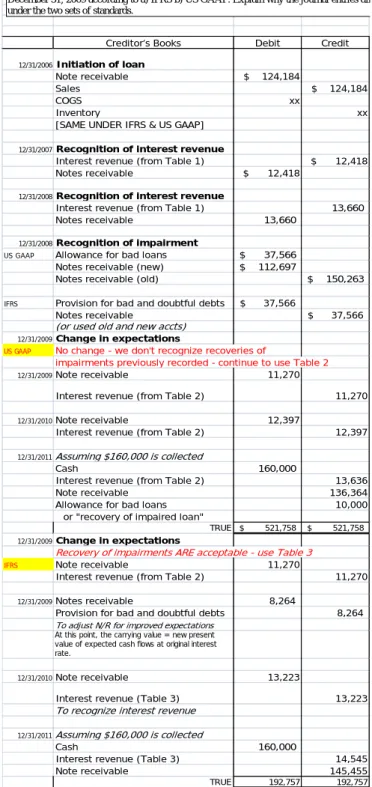
Comparing US GAAP and IFRS for a Loan Impairment From VirginiaTech Unit 6, problem 9 (modified slightly)
On December 31, 2006, Jones Company sold manufacturing equipment to Steel Corporation. Steel Corporation gave Jones Company a 5 year $200,000, zero interest note. The market rate of interest for a note with similar risks is 10%. At December 31, 2008 Jones Company reviews its financial assets for impairment. Jones Company concludes that the value of the note is impaired and it only expects to collect $150,000 of the principal at maturity. By December 31, 2009 Jones Company has determined that it is probable that $160,000 will be collected at maturity. Prepare the appropriate journal entries for December 31, 2008 and December 31, 2009 according to a) IFRS b) US GAAP. Explain why the journal entries differ under the two sets of standards.
SOLUTIONS - Troubled Debt Restructuring Examples
Example #1 - Empire Airways (Creditor)
__________________________________________
Land 30,000
Notes Receivable 50,000
Interest Receivable 5,000
Allow for doubtful accts 25,000
Example #2 - Empire Airways (CREDITOR) __________________________________________
Investments 48,000
Notes Receivable 50,000
Interest Receivable 5,000
Allow for doubtful accts 7,000
Troubled Debt Example #3
CREDITOR ACCOUNTING (FASB 114) Find PV of cash flows using original i = 12%: 2,500 * 3.037 + 25,000 * .636 + 4,000 immediately = approx. $27,481
Difference between carrying value $44,800 and PV calculated $27,481 = ordinary loss for creditor
Troubled Debt Example #3
Empire Airways (CREDITOR) Journal entries __________________________________________ At date of restructure
Cash 4,000
Accrued Interest Receivable 4,800
Notes Receivable (old) 40,000
Note Rec'bl - Restructured 23,481
Allow for doubtful accts 17,319
At end of first year
Cash 2,500
Interest Revenue 2,818
Notes Rec'bl - Restructured 318
Period Cash Receive d Interest Revenue 12% Difference Carrying Value 0 4,000 23,481
Troubled Debt Example #4
FOR CREDITOR:
Accrued Interest Receivable $4,800 Note Receivable (old) 40,000 Note Receivable (restructured) $ 33,937
Allowance for doubtful accounts 10,863
Creditor’s New Amortization Table:
Period Cash
Flows RevenueInterest Difference Carrying Value
0 12% 0 33,937 1 3,850 4,072 222 34,159 2 3,850 4,099 249 34,409 3 3,850 4,129 279 34,688 4 3,850 4,163 313 35,000
End of year 1 - effective
interest method Debit Credit
Cash $3,850
Interest revenue $ 4,072 Notes receivable (restructured) $ 222
End of year 1 - cost recovery
method
Cash $ 3,850
Notes receivable (restructured) $ 3,850
Troubled Debt Example #4
Empire Airways (CREDITOR) journal entries __________________________________________ At date of restructure
Notes Rec'bl - Restructured 35,000
Allowance for bad debts 9,800
Notes Recbl (old) 40,000
Accrued Interest Rec'bl 4,800
End of year 1
Cash 4,200
Interest Revenue 4,200
Example 5:
Creditor’s Books Debit Credit
8/1/2006 Alllowance for bad debts $ 48,704 Restructured note receivable $ 61,296
Note Receivable $ 100,000
Interest receivable $ 10,000
Using effective interest method, accrue interest at year end
5 = number of months
12/31/2006 Interest receivable $ 2,554
Interest revenue $ 2,554
8/1/2007 Cash $ 3,500
Unit 6, No. 9
IFRS vs. US GAAP example (zero coupon loan) IFRS vs. US GAAP - Loan Impairment (creditor)
Creditor’s Books Debit Credit
12/31/2006Initiation of loan
Note receivable $ 124,184
Sales $ 124,184
COGS xx
Inventory xx
[SAME UNDER IFRS & US GAAP]
12/31/2007Recognition of interest revenue
Interest revenue (from Table 1) $ 12,418
Notes receivable $ 12,418
12/31/2008Recognition of interest revenue
Interest revenue (from Table 1) 13,660
Notes receivable 13,660
12/31/2008Recognition of impairment
US GAAP Allowance for bad loans $ 37,566
Notes receivable (new) $ 112,697
Notes receivable (old) $ 150,263
IFRS Provision for bad and doubtful debts $ 37,566
Notes receivable $ 37,566
(or used old and new accts)
12/31/2009Change in expectations
US GAAP No change - we don't recognize recoveries of
impairments previously recorded - continue to use Table 2
12/31/2009Note receivable 11,270
Interest revenue (from Table 2) 11,270
12/31/2010Note receivable 12,397
Interest revenue (from Table 2) 12,397
12/31/2011Assuming $160,000 is collected
Cash 160,000
Interest revenue (from Table 2) 13,636
Note receivable 136,364
Allowance for bad loans 10,000
or "recovery of impaired loan"
TRUE $ 521,758 $ 521,758
12/31/2009Change in expectations
Recovery of impairments ARE acceptable - use Table 3
IFRS Note receivable 11,270
Interest revenue (from Table 2) 11,270
12/31/2009Notes receivable 8,264
Provision for bad and doubtful debts 8,264 To adjust N/R for improved expectations
At this point, the carrying value = new present value of expected cash flows at original interest rate.
Note receivable 13,223
6-9. On December 31, 2006, Jones Company sold manufacturing equipment to Steel Corporation. Steel Corporation gave Jones Company a 5 year $200,000, zero interest note. market rate of interest for a note with similar risks is 10%. At December 31, 2008 Jones Company reviews its financial assets for impairment. Jones Company concludes that the va the note is impaired and it only expects to collect $150,000 of the principal at maturity. By December 31, 2009 Jones Company has determined they will probably collect $160,000 on manufacturing equipment. Prepare the appropriate journal entries for December 31, 2008 a December 31, 2009 according to a) IFRS b) US GAAP. Explain why the journal entries dif under the two sets of standards.
Original schedule as of 12/31/2006 Creditor’s Original Amortization Table:
Table 1 Flows Cash Revenue Interest Differ-ence Carrying Value
12/31/2006 0 10% 124,184 12/31/2007 1 0 12,418 12,418 136,603 12/31/2008 2 0 13,660 13,660 150,263 12/31/2009 3 0 15,026 15,026 165,289 12/31/2010 4 0 16,529 16,529 181,818 12/31/2011 5 0 18,182 18,182 200,000 12/31/2012 6 IFRS&USGAAP
New schedule upon impairment 12/31/2008 Creditor’s NEW Amortization Table (after impairment): Table 2 Flows Cash Revenue Interest Differ-ence Carrying Value
12/31/2006 0 10% 12/31/2007 1 12/31/2008 2 112,697 12/31/2009 3 0 11,270 11,270 123,967 12/31/2010 4 0 12,397 12,397 136,364 12/31/2011 5 150,000 13,636 13,636 0
IFRS ONLY - new table 12/31/2009
IFRS ONLY - Creditor’s NEW Amortization Table after recovery: Table 3 Flows Cash Revenue Interest Differ-ence Carrying Value
12/31/2006 0 10% 12/31/2007 1 12/31/2008 2 12/31/2009 3 132,231 12/31/2010 4 0 13,223 13,223 145,455 12/31/2011 5 160,000 14,545 14,545 0