Management Science Letters 5 (2015) 639–650
Contents lists available at GrowingScience
Management Science Letters
homepage: www.GrowingScience.com/msl
Responsive supply chain: modeling and simulation
Amit Kumar Sinhaa*, Prerna Swatib and Ankush Ananda
aSchool of Mechanical Engineering, Shri Mata Vaishno Devi University (SMVDU), Katra, India-182320
bAlumni of the School of Design and Human Engineering, Ulsan National Institute of Science and Technology, UNIST-gil 50, Ulsan, Republic of Korea
C H R O N I C L E A B S T R A C T Article history:
Received January 20, 2015 Received in revised format 6 February 2015
Accepted 25 March 2015 Available online March 25 2015
Unexpected occurrence like natural calamity, abruptly change in customer demands, upgradation of technologies, necessity of compatible suppliers etc. is the most challenging issues even for efficient global supply chain management. Therefore, modeling of responsive supply chain is an emerging technology for sustaining any firm/industry in future competitive environment. In this paper, an attempt has been made to not only analyze the performance of efficient supply chain management but also how to improve the performance of existing supply chain with the objective of developing a modeling of responsive supply chain management. The complexity of the model is also highlighted with the help of numerical example. This paper also explores the possibility to mathematical modeling of the responsive supply chain which will be an emerging topic for researchers and practitioners. The modeling of responsive supply chain can be employed as a competitive strategy for e-commerce, green supply chain, and compatible supplier selection problem. The another salient feature of this paper is that a distinct comparative literature review of the lean, agile, efficient, and responsive supply chain management has been presented.
Growing Science Ltd. All rights reserved. 5
© 201
Keywords:
Efficient supply chain Responsive supply chain Lean supply chain Agile supply chain
1. Introduction
During the last few years, supply chain network faces new challenges to sustain in diversified and globalized competitive market’s competition, such as uncertain customer demands, shorter product development time, lower time-to-market, higher product quality, and last but not the least optimal total supply chain cost. Furthermore, compatible supplier selection and environmental consideration also creates additional problem to maintain efficient and responsive supply chain network. When we start to visualize supply chain network from perspective of diverse customer demand then it is inevitable to make supply chain more efficient and responsive so that it could handle the customer’s requirements. Therefore, in this paper we proposed a modelling of responsive supply chain.
* Corresponding author.
E-mail address: [email protected] (A. K. Sinha) © 2015 Growing Science Ltd. All rights reserved. doi: 10.5267/j.msl.2015.4.001
640
1.1. Objectives
The study tries to model responsive supply chain by considering following objectives:
(1) Integration of the trade-off in between agile manufacturing and supply chain management
under customer demand uncertainty,
(2) Integration of innovative technology under customer demand uncertainty,
(3) Integration of inventory, time-to-market, and safety stock under customer demand uncertainty, (4) Supply chain responsiveness enables manufacturers to reduce risk,
(5) Supply chain responsiveness enables manufacturers to improve fulfillment of customer
requirements in terms of on-time and on-budget delivery of quality product,
(6) Develop an efficient and robust algorithm as compare to existing algorithm for solving the model of responsive supply chain.
1.2 Motivation
We have the following motivation to do research in the domain of responsive supply chain:
(1) In the case of frequent demand of new product with high product variety the responsive supply chain is only option to provide a close loop feedback control system for responding market demand.
(2) Indirectly, Graves et al. (1996) give some clue which state that efficient and responsive supply chain can be created with the help of doing some changes in the distribution network of supply chain. Although, their research needs more exploration and validation but at least the outcome which they suggested is sufficient to motivate us for doing modelling of responsive supply chain.
(3) The survey, on the basis of one hundred and fifteen manufacturing firms, conducted by
Somuyiwa (2012) reveals that there is a positive relationship in between supply chain responsiveness (SCR), and competitive advantages but it needs more exploration. Therefore, there is a great scope to do research and identify how the different types of supply chain network say for example, lean, agile and responsiveness are related with each other.
(4) How to identify the enablers of responsive supply chain for different manufacturing industry say for example steel plate, automotive plant, and ship building industry.
(5) How to characterize the responsiveness in supply chain? (6) How to measure the responsiveness in supply chain? 2. Problem formulation
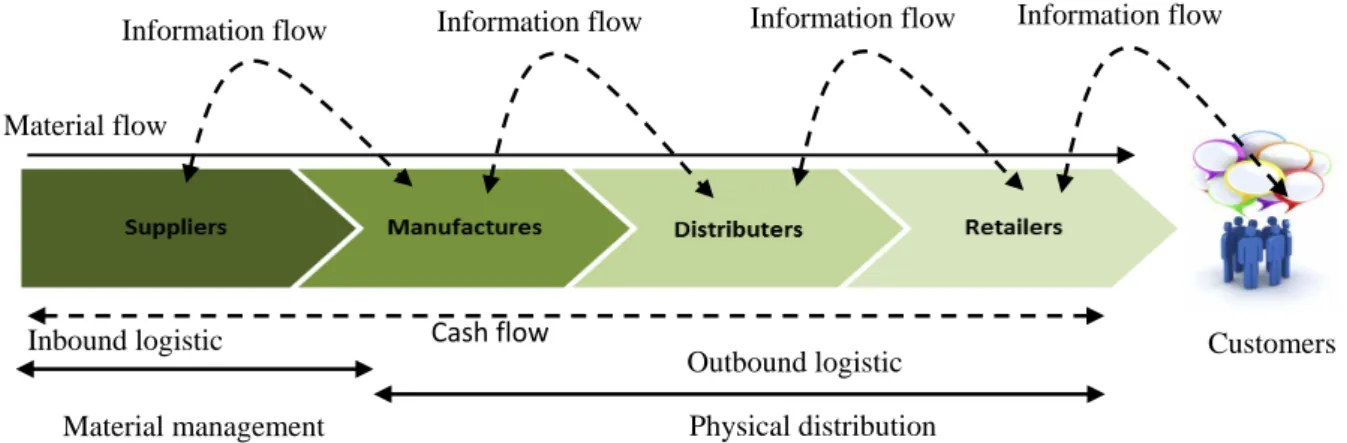
During 1980s, researchers and practitioners suggest supply chain management (SCM) as a key motivational factor for improving organizational competitiveness. Till the mid of 1990s SCM became most popular and their concept of the managerial applications has been widely practice among industry, academia, governance and non-governmental organization. Normally for any supply chain, the flow of goods and information started from the source and accelerated towards end customer but the direction of cash flow follows the reverse direction (Jayaraman & Ross, 2003). In general, supply chain contains three basic modules: inbound logistics, manufacturing process and outbound logistics. Inbound and outbound logistics are also called as upstream and downstream respectively. At the beginning of the proposed research proposal, it is necessary to understand the basic stages of supply chain management which is illustrated in Fig. 1.
Fig. 1. Stage of SCM (figure modified from Chopra & Meindl, 2007)
At the beginning of the twenty-first century, the competitiveness in the global business marketplace was grown abruptly in terms of technological innovations, the globalization of markets and wide fluctuation of customer demands. Now a day, the competitiveness in the market place depends mainly on the ability of a firm to handle the challenges of reducing manufacturing cycle time, reducing delivery lead time, reducing total supply chain cost, increasing customer service level, and improving product quality. In order to remain competitive and for continual survival in the market, firms need to effectively handle fluctuations in an ever-changing market better than their competitors. Thus the main objective for any firms is minimizing the total supply chain cost by facilitating efficient as well as responsiveness towards today’s constantly changing business environment with shorter product life cycles, fluctuating inventory level. According to Chan and Prakash (2012), the real challenge for supply chain (SC) networks is to become more efficient as well as and more responsive towards the increasing demands of customers which is generated due to highly competitive pressures and utilization of higher innovative technology. In other words, there is a global call for building supply chains that are flexible and responsive enough to handle changing market and customer requirements. Firms are attempting to make supply chain more responsive by considering minimum total supply chain cost as well as time to market.
Catalan and Kotzab (2003) define responsiveness of a supply chain as the ability to respond and manage time effectively based on the ability to read and understand actual market signals. Fisher (1997), Christopher (2000) and Grossmann (2005) suggested that responsive supply chain is an essential strategy to gain competitive advantage. Hines (1998) also explained how the responsive supply chains facilitates for a new generation of product, new product development, within a shorter time period and are thus able to achieve an edge over their competitors in terms of capturing market shares.
In today’s global environment of business competitive market, most of the supply chains at least intend to be responsive. Now, the inevitable question arises: How challenging would it be to embrace responsiveness in supply chains while accounting for effective design and management, delivery of product variety, high quality, short lead times, high plant and volume flexibility, network structure, and inventory control?
2.1.Scope
To do this (above discussed problems) effectively, supply chains have various scopes as follows (Gunasekaran et al., 2008; Tiwari et al., 2012; Sinha & Swati, 2014):
1. Reducing production time via lot splitting, decreasing setup time, or decreasing non-productive time, and increasing use of automation and control,
Inbound logistic Cash flow Customers
Information flow Information flow Information flow Information flow
Material flow
Physical distribution Outbound logistic Material management
642
2. Supply involvement in the early stage of new product development,
3. Investing in either finished products or raw materials safety stocks to buffer disruptions coming from the downstream or upstream, respectively,
4. Opening retail outlets near the customer’s market,
5. Reducing time-to-market through shipping via faster transportation modes, 6. Dealing with firms resorting to highly reliable suppliers,
7. Access the performance of incompatibility among suppliers for supplier selection, 8. Reduced the manufacturer risk by better identification of underperforming suppliers, 9. Improve manufacturers to improve fulfillment of customer’s requirement.
Furthermore, to gain critical competitive advantage, firms also need to understand their potential weak spots while assessing the implementation of new policies to be responsive (Stevenson & Hojati 2007). 2.2. Background
2.2.1. Terminology
Agile supply chain: Christopher (2000) defined agility as the ability of an organization to respond rapidly to changes in demand both in terms of volume and variety. Mason-Jones et al. (2000) defined agility means using market knowledge and a virtual corporation to exploit profitable opportunities in a volatile market place. By considering the definition of agility, I can conclude that volatile and unpredictable demand increases the need of agile supply chain for any firms. Agile manufacturing (AM) or agile strategy mainly relies on strategic alliances/partnerships (virtual enterprise environment) to achieve speed and flexibility. But agile strategy is not so much concern about the issue of cost and the integration of suppliers and customers.
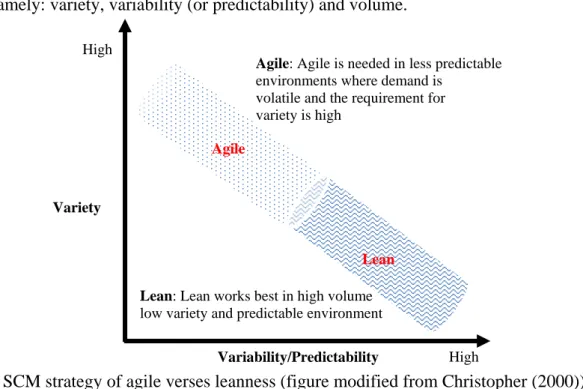
Lean supply chain: Mason-Jones et al. (2000) defined leanness as a development of a value stream to eliminate all waste, including time, and to enable a level schedule. Christopher (2000) explained a clear demarcation in between the concept of agile and lean (see Fig. 2) by considering three critical dimensions namely: variety, variability (or predictability) and volume.
Fig. 2. SCM strategy of agile verses leanness (figure modified from Christopher (2000)) Efficient supply chain: Fisher (1997) defined efficient supply chain as a supplying functional product efficiently at the lowest possible cost. The major concern issue of efficient supply chain is cost and
Variability/Predictability Variety High High Agile Lean
Agile: Agile is needed in less predictable environments where demand is
volatile and the requirement for variety is high
Lean: Lean works best in high volume
quality. Efficient supply chains mainly emphasize on the certainty of the demand and the minimization of the production costs by making the best use of the supply chain system.
3. Modeling of responsive supply chain
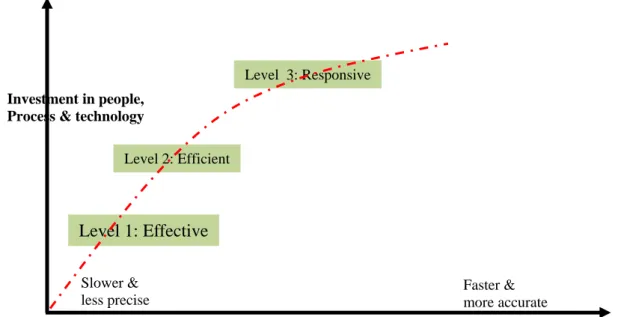
Responsive supply chain strategy can be defined as the determination of major customer requirements in terms of range, frequency, cost, time-to-market, demand variability, and innovation of product offering (Gunasekaran et al., 2008). Hitachi consulting suggests that it is the ability of firm to response the fluctuating of the customer demands (Brant et al., 2009). They argue that being operationally efficient does not lead directly to long term profitability. Therefore, Hitachi consulting clearly explains that the strategy of the supply chain should be both operationally excellent as well as market responsive. Fig. 3 clearly explain how the efficient supply chain becoming responsive towards the market demands.
Fig. 3. Correlation among effective, efficient and responsive strategy of SCM (Brant et al., 2009)
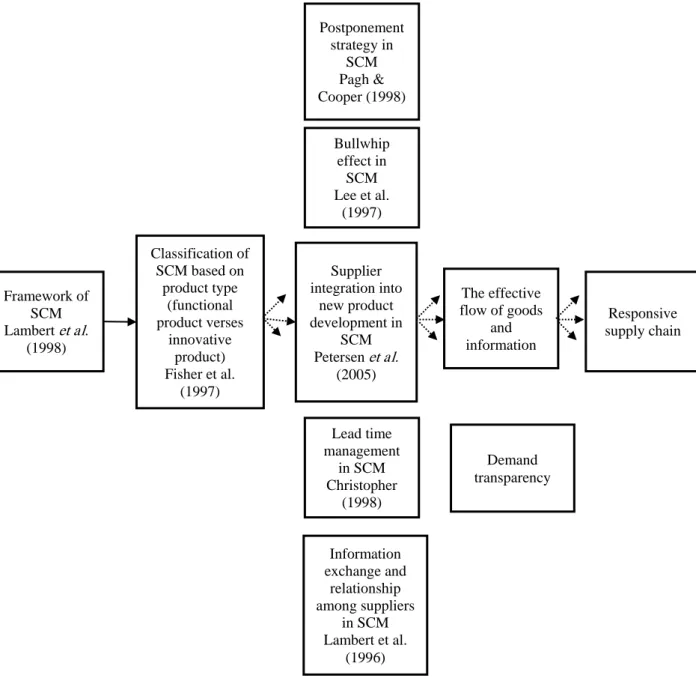
On the basis of literature survey, the theoretical approach of responsive supply chain can be expressed in Fig. 4. Responsive supply chains mainly are concentrated on how quickly they can respond to the customer needs and the facilities such type of manufacturing operations which can produce variable capacity. In short, responsive supply chain handles the issue of aggressive reduction into lead time by sacrificing the cost occurred. Quality aspects like flexibility and speed with which they deliver, decide the fate of vendors who bid for supplier contracts is only possible through the responsive supply chain. In nut shell, responsive supply chain is the end result of all other existing supply chain strategy (see Fig. 5). Level 1: Effective Level 2: Efficient Level 3: Responsive Slower & less precise Faster & more accurate Ability to respond to market events
Investment in people, Process & technology
644
Fig. 4. Theoretical approach for responsive supply chain (Catalan & Kotzab 2003)
Fig. 5. Strategy of responsive supply chain
Framework of SCM Lambert et al. (1998) Classification of SCM based on product type (functional product verses innovative product) Fisher et al. (1997) Lead time management in SCM Christopher (1998) Postponement strategy in SCM Pagh & Cooper (1998) Bullwhip effect in SCM Lee et al. (1997) Information exchange and relationship among suppliers in SCM Lambert et al. (1996) Supplier integration into new product development in SCM Petersen et al. (2005) Responsive supply chain Demand transparency The effective flow of goods and information Visibility of real demand Demand Continuous replacement programmers Responsive Supply Chain
Lean Production High
Flexibleresponse
Agile supply chain
Organizational agility Quick Economic of sale Waste reduction Capacity management Set-up time reduction Vendor Managed inventory Synchronized production Process re-engineering
Non-value-adding
time reduction Process managem t Cross functional team
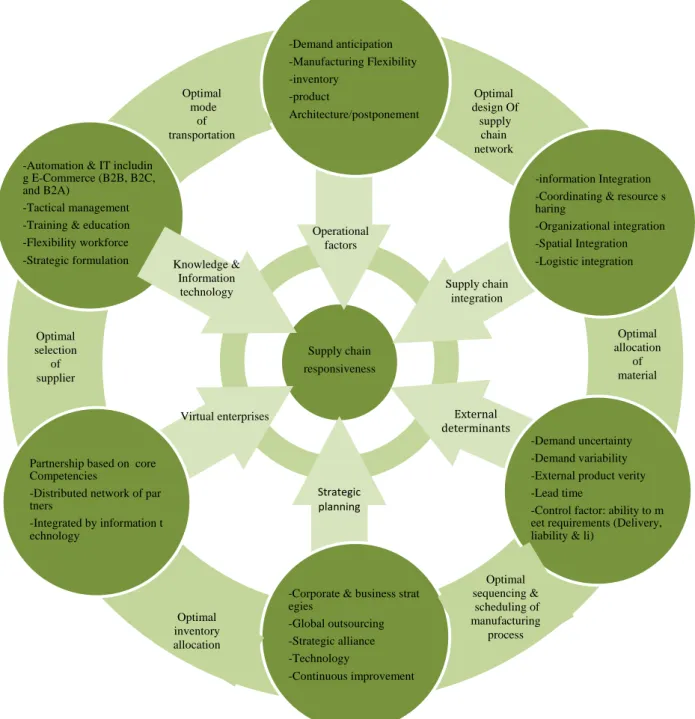
Finally, the modeling of responsive supply chain can be done on the basis of its framework which is illustrated in Fig. 6.
Fig. 6. Framework of responsive supply chain (figure modified from (Gunasekaran et al., 2008; Tiwari et al., 2012)
4. Result and analysis
Undoubtedly due to the complexity of integer or mixed-integer (linear/non-linear) optimization model of responsive supply chain, it is hard to solve them by using exact method of optimization. Here we would like to discuss the nature of complexity by considering a well-known assignment problem of optimally matching 10 suppliers to 10 manufacturers (one-to-one basis). This example will show us
how the number of alternative solutions (which is most commonly known as search space in
optimization problem) increases exponentially (abruptly) by slightly increasing the size of problems.
Optimal selection of supplier Optimal design Of supply chain network Supply chain responsiveness Optimal allocation of material -information Integration -Coordinating & resource s haring -Organizational integration -Spatial Integration -Logistic integration Operational factors Supply chain integration -Demand uncertainty -Demand variability -External product verity -Lead time
-Control factor: ability to m eet requirements (Delivery, liability & li)
External determinants
-Automation & IT includin g E-Commerce (B2B, B2C, and B2A)
-Tactical management -Training & education -Flexibility workforce -Strategic formulation -Demand anticipation -Manufacturing Flexibility -inventory -product Architecture/postponement Optimal mode of transportation Knowledge & Information technology
Partnership based on core Competencies
-Distributed network of par tners -Integrated by information t echnology Virtual enterprises Strategic planning
-Corporate & business strat egies -Global outsourcing -Strategic alliance -Technology -Continuous improvement Optimal sequencing & scheduling of manufacturing process Optimal inventory allocation
646
Table 1
Abruptly increasing of search space in well-known operation research assignment problem
Size of problem (n) No of alternative solution (search space) Remarks
10 10!= 3.628×10⁶
11 11! = 39.9×10⁶ 10% increase in the size of problem yields 1100%
increment in the number of alternative solutions
12 12!= 479.9×10⁶ 20% increase in the size of problem yields 13200%
increment in the number of alternative solutions
13 13! = 6227×106 ………..
According to Table 1, search space increases abruptly by slightly enhancement in the size of problem. In general, supply chain network design problem comes under the banner of NP-hard in nature (Ibaraki & Katoh, 1988). As discussed above reasons, it is a challenging task to solve the model of responsive supply chain network. Therefore, definitely we need some robust and efficient optimization algorithm (particularly meta-heuristic algorithm) for solving the model of responsive supply chain network. 4.1.Steps for research methodology
Step 1: Literature survey
In section 2 (Scope and background of research in terms of problem formulation) we already presented a wide literature survey and identified the research gap related to responsive supply chain.
Step 2: Data collection and analysis Data acquisition
We can collect data by using questioners. In actual practice, the process of data collection begins with a feasibility assessment. Sometime a fairly detailed specification of data is required to determine the desired analytical technique. For development of the modeling of responsive supply chain the major data is related to the product sales and customer orders. Forecasting techniques can be utilized for prediction of the future data say for example annual sale forecast is usually necessary to determine logistic volume. Shipping pattern and shipping size can be estimated with the help of historical data. For supply chain logistics analysis, it is necessary to identify the costs associated with manufacturing and purchasing of raw materials. Costs associated with inventory transfer, reordering, and warehouse processing is necessary for modeling of responsive supply chain.
For the situations when data is extremely difficult to collect or when the necessary level of accuracy is unknown then we can try to calculate data impact on the basis of sensitivity analysis/statistical techniques or by doing random simulation say for example transportation costs can be estimated with the help of distance-based regressions.
Data filtering and smoothing
We can try to remove the outliers from the gather data sets. After that we can go for data smoothing which can be done either by using moving average method or exponential smoothing method.
Pattern recognition or classification
From the collected data sets, we can try to find out characteristics features from the data set and if it would be necessary then we can also go for dimension reduction of the collected data set. Principle component analysis is well known tool for dimension reduction. With the help of support vector
machine, neural network or logistic regression, we can try to find out some patterns from the collected data.
Step 3: Model formulation of responsive supply chain
Define the variables: Quantity of raw material shipped from supplier to manufacturing plant, quantity of product shipped from plant to distribution centre, quantity of product shipped from retailer to customer etc. comes under the banner of variables.
Define the constraints: Capacity of the manufacturing plants, maximum capacity in single shipment etc. comes under the banner of constraints.
Define the objective function: Minimization of total supply chain cost, minimization of time-to-market, maximization of profit, minimum level of inventory etc. can be formulated as an objective function for modeling of responsive supply chain. The objective function may be either single objective or multi-objective.
Step 4: Meta-heuristic based algorithm for optimization model of responsive supply chain Genetic algorithm is a well-known meta-heuristic for solving optimization problem. Non-Dominated Sorting Genetic Algorithm II (NSGA II) is an efficient meta-heuristic for solving multi-objective optimization problem (Deb et al., 2002). Sometimes, we can convert multi-objective optimization problem into single objective optimization problem by using appropriate weight, but assigning of weight is again a challenging task for practitioners and scholars.
Step 5: Robustness of the proposed algorithm as well as proposed model
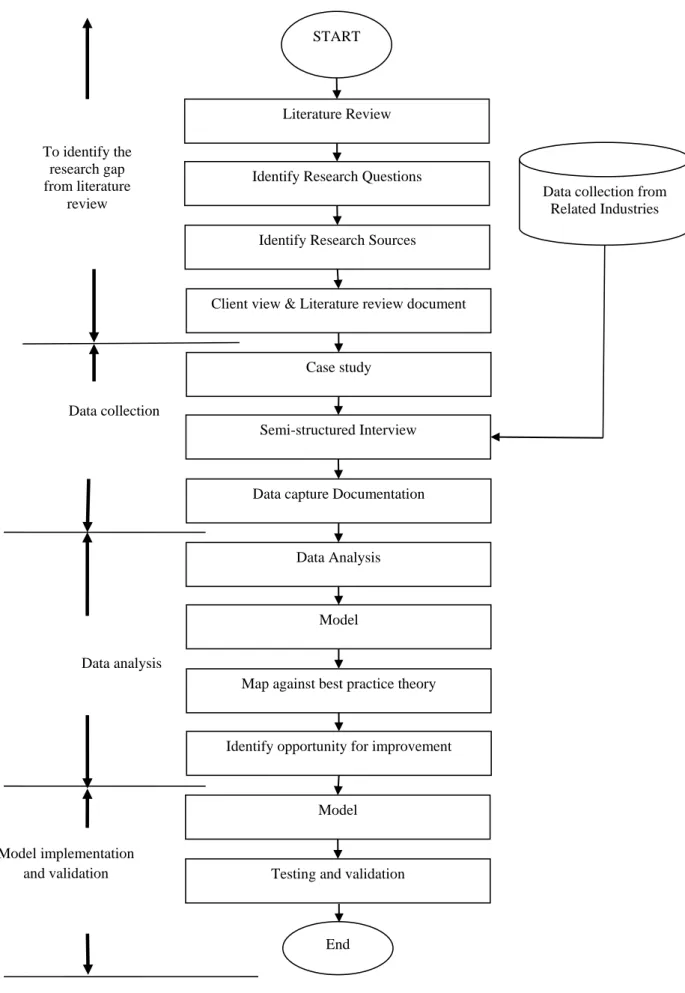
Statistical interference is necessary for robustness of the meta-heuristic based algorithm. T-test or different statistical test conform the robustness of the solution methodology. Feedback control system can be used for improving the efficiency of the proposed model. Case study also confirmed the robustness of our model. The flow chart of research methodology is illustrated in Fig. 7. The major aim of this research will be to conduct experiments from live commercial projects to see how well the framework developed here performs under the real world. The model which will be introduced, balance the costs of identifying and fixing bugs against the costs of declining market position while the model undergoes continued testing. Thus, the model developed will assess and track bug rates for regular and catastrophic bugs for a commercial system.
5. Conclusion
In a challenging and competitive environment, there is a call for developing a cost efficient solution to firm and facilitate that are highly flexible and responsive to changing customer demands. Therefore, the proposed modeling will help to any firms for sustaining in future market. Even though the lean strategy in supply chain network is no longer enough therefore, firm needs to integrate internally and externally for operating as close to the market as possible. To develop a mature supply chain network design capability that is responsive to change. The proposed model will also help to develop a key performance index (KPI) for quantitative characterization of responsive supply chain network design.
648
Fig. 7. Flow chart of research methodology
START
Case study
Semi-structured Interview Client view & Literature review document
Identify Research Sources Identify Research Questions
Literature Review
Data Analysis Data capture Documentation
Map against best practice theory
Identify opportunity for improvement
Model Model
Testing and validation
Data collection from Related Industries To identify the research gap from literature review Data collection Data analysis Model implementation and validation End
Acknowledgement
The authors would like to thank the anonymous referees for constructive comments on earlier version of this paper.
References
Brant, S. (2009). Report based on beyond lean the market responsive company. Hitachi consulting.
Catalan, M., & Kotzab, H. (2003). Assessing the responsiveness in the Danish mobile phone supply
chain. International Journal of Physical Distribution & Logistics Management, 33(8), 668-685.
Chan, F. T., & Prakash, A. (2012). Inventory management in a lateral collaborative manufacturing
supply chain: a simulation study. International Journal of Production Research, 50(16), 4670-4685.
Chopra, S., & Meindl, P. (2007). Supply chain management. Strategy, planning & operation (pp.
265-275). Gabler.
Christopher, M. (1999). Logistics and Supply Chain Management: Strategies for Reducing Cost and Improving Service Financial Times: Pitman Publishing. London, 1998 ISBN 0 273 63049 0
(hardback) 294+ 1× pp.
Christopher, M. (2000). The agile supply chain: competing in volatile markets.Industrial marketing
management, 29(1), 37-44.
Deb, K., Pratap, A., Agarwal, S., & Meyarivan, T. A. M. T. (2002). A fast and elitist multiobjective
genetic algorithm: NSGA-II. Evolutionary Computation, IEEE Transactions on, 6(2), 182-197.
Fisher, M. L. (1997). What is the right supply chain for your product?. Harvard business review, 75,
105-117.
Graves, S. C., Gutierrez, C., Pulwer, M. J., Sidhu, H. S., Weihs, G. L., & Director, S. C. (1996).
Optimizing Monsanto’s supply chain under uncertain demand. In Annual conference proceedings–
council of logistics management, Orlando FL (pp. 501-516).
Grossmann, I. (2005). Enterprise‐wide optimization: A new frontier in process systems
engineering. AIChE Journal, 51(7), 1846-1857.
Gunasekaran, A., Lai, K. H., & Cheng, T. E. (2008). Responsive supply chain: a competitive strategy
in a networked economy. Omega, 36(4), 549-564.
Hines, P. (1998). Benchmarking Toyota's supply chain: Japan vs UK. Long Range Planning, 31(6),
911-918.
Ibaraki, T., & Katoh, N. (1988). Resource allocation problems: algorithmic approaches. MIT press.
Jayaraman, V., & Ross, A. (2003). A simulated annealing methodology to distribution network design
and management. European Journal of Operational Research, 144(3), 629-645.
Lambert, D. M., Emmelhainz, M. A., & Gardner, J. T. (1996). Developing and implementing supply
chain partnerships. The international Journal of Logistics management, 7(2), 1-18.
Lambert, D. M., Emmelhainz, M. A., & Gardner, J. T. (1996). Developing and implementing supply
chain partnerships. The international Journal of Logistics management, 7(2), 1-18.
Lee, H. L., Padmanabhan, V., & Whang, S. (1997). The bullwhip effect in supply chains1. Sloan
management review, 38(3), 93-102.
Mason-Jones, R., Naylor, B., & Towill, D. R. (2000). Engineering the leagile supply
chain. International Journal of Agile Management Systems, 2(1), 54-61.
Pagh, J. D., & Cooper, M. C. (1998). Supply chain postponement and speculation strategies: how to
choose the right strategy. Journal of business logistics, 19, 13-34.
Petersen, K. J., Handfield, R. B., & Ragatz, G. L. (2005). Supplier integration into new product
development: coordinating product, process and supply chain design. Journal of operations
management, 23(3), 371-388.
Sinha, A., & Swati, P. (2014). Supply Chain: Next generation issues and concerns. Uncertain Supply
650
Somuyiwa, A., & Adebayo, T. (2013). Firm’s competitiveness through supply chain responsiveness
and supply chain management practices in Nigeria.Journal of Poverty, Investment and
Development, 1, 142-147.
Stevenson, W.J. & Hojati, M. (2007). Operations management: McGraw-Hill/Irwin Boston.
Tiwari, M.K., Mahanty, B., Sarmah, S., & Jenamani, M. (2012). Modeling of responsive supply chain: CRC Press.