Keysight E1968A
GSM/GPRS/EGPRS Test Application
For the E5515C/E wireless communications test set and the
E1987A fast switching test application
Technical
Overview
lowest possible cost
Flexible
– The E1968A includes all essential connection types and signaling options necessary for a complete GSM/GPRS/ EGPRS/E-EDGE manufacturing test solution
– Some licensed feature options can also be used in R&D and reduce your R&D cycle
Fast
– Digital ORFS – up to 20x faster
– Dynamic power – fast automatic signaling and non-signaling method for Tx output power calibration
– Phase and amplitude versus time (PAvT) – measurement for calibration of polar modulated devices
– Fast device tune (FDT) – faster simultaneous mobile phone Rx and Tx calibration (based on typical test plan)
– Discontinuous timeslot TXP – supports simultaneous power measurement for up to 7 timeslots, reduces phone calibration time
Key features
– PAvT and IQ capture functionality
– Enhanced fast device calibration across level and frequency simultaneously – E-EDGE2-A signaling and measurement
– VAMOS type I and type II solutions for mobile R&D and manufacturing
– Test mode BER reduces your BER measurement time in production without setting up a call connection; MS calculated BER separates the Rx from Tx test and reduces Rx test time through multi-phone test scenario
– Class 45 feature enables simultaneous Tx and Rx measurement of all bursts up to 6 uplink timeslots
– Real-time audio codec and DAI interface
– Free text-type SMS functionality and licensed full functionality SMS – Single channel GPS source
– FM radio source allows easy FM radio phone calibration in production – 2-box voice handover between GSM and W-CDMA
GSM/GPRS/EGPRS/E-EDGE Signaling and Base Station Emulation
The E1968A GSM/GPRS/EGPRS/E-EDGE mobile test application gives you the test solution designed especially for your GSM/GPRS/EGPRS test requirements of transceivers and wireless terminals by delivering speed and flexibility needed for high-volume, automated production-test environments. Since this solution is based on the high-performance E5515C/E (8960) wireless communications test set, you get speed and concurrent measurement capabilities, providing immediate benefits that translate into a competitive advantage for mobile phone manufacturers. This significantly cuts test times, helping reduce the manufacturing cost per phone.
Audio functionality
– Choice of speech encoded on downlink TCH: none, echo, 300 Hz sine, 1 kHz sine, 3 kHz sine, or PRBS-9, PRBS-15, multi-tone, or custom
– GSM analog audio measurement (audio level, distortion, frequency, SINAD) – Uplink and downlink audio measurement with real-time audio codec and DAI – PESQ measurement
Receiver measurements
– GSM fast BER via loopback type C – GSM BER via loopback type A and B – GPRS/EGPRS multislot BER– GPRS/EGPRS multislot block error ratio (BLER) – MS calculated BER
– Test mode BER
– EGPRS2-A 16QAM/32QAM BEP report
Transmitter measurements
– GPRS/EGPRS multislot transmit power – EGPRS multislot-tolerant transmit power
– 8PSK multislot-tolerant modulation accuracy (peak, rms, 95th percentile and sample EVM; frequency, magnitude and phase errors; origin offset suppression; IQ imbal-ance)
– GMSK multislot-tolerant frequency error
– GMSK multislot-tolerant phase error (peak and rms with confidence limits) – Multislot power versus time (burst mask comparison with settable masks) – Burst timing error with signaling
– Burst timing error under test mode
– Multislot-tolerant output RF spectrum due to modulation and switching – ORFS measurement in time domain
– IQ tuning
– GSM decoded audio level – Dynamic power
– Phase and amplitude versus time (PAvT) – IQ capture
– Fast device tune (FDT) – AM-PM timing offset
– Discontinuous timeslot TXP measurement – 8PSK/16QAM measurement
Instruments
– Audio generator– General-purpose spectrum monitor
– GSM multi-tone audio Figure 1. Use graphical measurement results to troubleshoot your
Integrated GSM, GPRS, and EGPRS
Functionality
– Switch between GSM, GPRS, and EGPRS serving cells – Switch between data and voice connections without losing
camp or attach
– Establish a voice or data connection after initial GPRS attach – Supports Evolved EDGE functionality
– Supports EGPRS2-A signaling and test mode measurement
GSM functionality
Mobile station power
output level control Meets GSM phase one and phase two power control levels Traffic channels TCH/FS – FR, EFR, and HR speech modes Broadcast channel
configuration BCCH + CCCH + SDCCH/4
Signaling protocol setup FACCH audio speech echo delay is settable from 1 to 4 seconds
Real-time audio codec Audio encoder and decoder support FR, HR, EFR, AMR, and WB-AMR codec
GPRS functionality
Multislot classes
supported 1 through 1230 through 45
Control channels BCH on timeslot 0 on any ARFCN in any band Broadcast channel
configuration FCCH + SCH + BCCH + CCCH + SDCCH/4 (0-3) + SACCH/C4 (0-3) Downlink PDTCH One, two, three, or four on the same PDTCH
ARFCN with one or two PDTCH amplitudes settable between 0 and 55 dB below BCH amplitude; amplitudes in adjacent timeslots selectable as off, PRL (power reduction level) one, or PRL two
EGPRS functionality
Multislot classes
supported 1 through 1230 through 45
Control channels BCH on timeslot 0 on any ARFCN in any band Broadcast channel
configuration FCCH + SCH + BCCH + CCCH + SDCCH/4 (0-3) + SACCH/C4 (0-3) Downlink PDTCH One, two, three, four, or five on the same
PDTCH ARFCN with one or two PDTCH ampli-tudes settable between 0 and 55 dB below BCH amplitude; amplitudes in adjacent timeslots selectable as off, PRL one, or PRL two
Evolved EDGE Functionality
Downlink PDTCH
– Downlink dual carrier (DLDC) setup – Supports RTTI mode
– Fast Ack/Non-Ack setup – 16QAM/32QAM downlink setup – 16QAM uplink setup
Call Processing Functionality
– GSM MS and BS origination– GSM MS and BS release
– GPRS mobile-initiated attach and detach
– GPRS and EGPRS packet data transfers on uplink and downlink
– E-EDGE and EGPRS2-A call setup – Intra-cell channel assignments – Inter-cell handovers between all bands
– Handover from W-CDMA to GSM (with E1987A test application)
– 2-box handover from W-CDMA to GSM or GSM to GSM – BA table with 16 settable neighbor cells
– External triggers provide a signal output each frame with settable timeslot, bit, and option to include or exclude the idle frame
BCH setup and parameters
– Settable downlink power, band, and channel number
– Settable maximum control channel power used by the MS for access bursts of 0 to 31
– Settable maximum control channel power offset value for DCS 1800 MHz band of 0 to 3
– Band indication of DCS or PCS
GSM TCH parameters
– Settable downlink in TCH power including power in unused bursts, uplink band, channel number, and power level – Channel modes of FR, EFR, and HR, plus HR subchannel of 0
or 1
– Settable uplink timeslot of 1 to 7 – Settable timing advance of 0 to 63
– Mobile loopback of off, type A, type B, or type C as defined in ETSI 04.14 or 3GPP 44.014
– Downlink TCH speech types of none, echo, 300 Hz sine, 1 kHz sine, 3 kHz sine, or PRBS-9, PRBS-15, multi-tone, cus-tom or real-time vocoder
GPRS and EGPRS PDTCH parameters
– Settable downlink PDTCH power including power in unused bursts, uplink band, channel number, and power level – GPRS coding schemes of CS-1, CS-2, CS-3, or CS-4
– EGPRS uplink modulation coding schemes of MCS-1, MCS-2, MCS-3, MCS-4, MCS-5, MCS-6, MCS-7, MCS-8, or MCS-9 – EGPRS downlink modulation coding schemes: Same as
uplink, MCS-1, MCS-2, MCS-3, MCS-4, MCS-5, MCS-6, MCS-7, MCS-8, or MCS-9
– EGPRS2-A downlink modulation coding schemes: MCS1 to MCS9, DAS5 to DAS12
– EGPRS2-A uplink modulation coding schemes: MCS1 to MCS6, UAS7 to UAS11
– EGPRS modulation coding scheme of 8PSK clear coded in EGPRS BCH+PDTCH operating mode
– (E)GPRS multislot configurations of 1x1, 1x2, 1x3, 1x4, 1x5, 1x6, 2x1, 2x2, 2x3, 2x4, 3x1, 3x2, 3x3, 4x1, 4x2, 5x1, 6x1 (downlink x uplink)
– Selection of which contiguous down- link bursts to loop back on the uplink with connection type ETSI type B or SRB loopback
– Selection of which uplink burst to use for multislot-tolerant RF measurements
Cell parameters
– Three-digit MNC off or on in PCS 1900 MHz and GSM 850 MHz bands
– Settable MCC, MND, LAC, RAC, NCC, and BCC – Option to get IMEI at call setup
– Mobile DTX on or off
– Paging mode reorganized or normal – Settable paging multiframes of 2 to 9 – Repeat paging on or off
– Tx level FACCH signaling on or off
– Symmetric or asymmetric uplink frame segmentation – Settable random frequency offset for BCH and PDTCH
Handover setup
– GSM traffic band, traffic channel, timeslot, channel mode, half-rate speech subchannel, MS Tx level
– GPRS traffic band, traffic channel, coding scheme, multislot configuration, P0, MS Tx level burst 1 to 6
– EGPRS traffic band, traffic channel, downlink modulation coding scheme, uplink modulation coding scheme, multislot configuration, P0, MS Tx level burst 1 to 6
Protocol control
– RLC/MAC header off or on in GPRS BCH+PDTCH operating mode
– RLC/MAC header selectable as uplink or downlink in EGPRS BCH+PDTCH operating mode
– RLC/MAC packet timeslot reconfigure off or on – RLC/MAC packet power timing advance on or off – Settable RLC/MAC block poll rate of 1 to 256
– RLC/MAC frame start position of relative, absolute, or immediate
– LLC BLER FCS of valid or corrupt
Protocol control (continued)
– Settable LLC payload patterns for connection types ETSI type B or for BLER with corrupt FCS of all zeros, all ones, alternate bits, alternate pairs, alternate quads, PRBS-9, PRBS-15, fixed 2B (hex), custom, GMM information for BLER
Receiver control
– Expected power control auto or manual – Manual power bursts 1 to 6 settable in dBm – Measurement frequency auto or settable in MHz – Modulation formal control auto or manual
– Manual modulation of bursts 1 to 6 selectable as GMSK or 8PSK
DUT information
– International mobile subscriber identity (IMSI)
– International mobile equipment identity (IMEI) (if selected) – GPRS multislot class
– EGPRS multislot class – GMSK power class – 8PSK power class
Counters reported
– RACH count – Corrupt burst count – Page count
– Decode error count – Missing burst count
Errors reported
– Burst timing error – BLER (block error rate)
Last location information reported
– Location area code (LAC)– Mobile country code (MCC) – Mobile network code (MNC)
SACCH reports (on a GSM voice call)
– Timing advance– Tx level – Rx level – Rx qual
Neighbor cell reports
– Channel number– Base station color code (BCC) – Rx level
Operating Modes
Active cell GSM, GPRS, or EGPRS
A BCH is generated on the downlink. Attach and detach procedures, voice and packet data transfers on the uplink(s), and downlink(s) can be executed. TCH and PDTCH band and channel, GSM timeslot, GSM channel mode, GPRS and EGPRS multislot configurations, GPRS coding scheme, EGPRS uplink and downlink modulation coding schemes, and downlink and uplink power level(s) can be changed. All transmitter measurements can be made. GSM, GPRS, or EGPRS is used as the serving cell. Six connection types are available in the active cell operating modes as follows:
Cell off
All signaling and RF power output is discontinued; this mode is used mainly for adjusting cell parameters that cannot be changed when a live cell is operating.
The following six operating modes use limited signaling for call setup. Protocol is used only to maintain a link established by the mobile station. Over-the-air signaling and capability to demodu-late and decode uplink random access channel (RACH) bursts are not available.
(E)GPRS connection type
ETSI type A Test mode A as defined in ETSI 04.14 or 3GPP 44.014; the downlink is terminated once the uplink has been established
(E)GPRS connection type
ETSI type B (unack) Test mode B as defined in ETSI 04.14 or 3GPP 44.014 with MS in RLC acknowledged mode; downlink PDTCH(s) data is generated and the mobile loops back the downlink data on the uplink(s); BER and BLER measurements can be made
(E)GPRS connection type
ETSI type B (ack) Test mode B as defined in ETSI 04.14 or 3GPP 44.014 with MS in RCL acknowledged mode; downlink PDTCH(s) data is generated and the mobile loops back the downlink data on the uplink(s); BER and BLER measurements can be made
(E)GPRS connection type
BLER Keysight-proprietary data connection with the primary purpose of calculating BLER Connection type auto A GSM voice call or GPRS or EGPRS data
connection can be initiated by the mobile; the test set can initiate a GSM voice call; if a voice call is in progress, data transfer requests are ignored; network-initiated GSM voice call while a GPRS or EGPRS data transfer is in progress causes the data connection to be terminated EGPRS connection type
SRB loopback An EGPRS Layer 1 loopback mode for testing BER as defined in ETSI 04.14 or 3GPP 44.014
GSM BCH A broadcast channel (BCH) without a traffic channel (TCH) is generated on the downlink and mobile station level information is carried on the broadcast control channel (BCCH) GSM BCH+TCH A BCH and TCH are generated on the downlink;
mobile station level information is carried on the BCCH and the downlink slow associated control channel (SACCH); timing advance changes are sent on the downlink SACCH; a call can be established by manually syn-chronizing the mobile station with the TCH and turning on the mobile station’s TCH at the same absolute radio frequency channel number (ARFCN) and timeslot as the test set’s TCH; during a call, demodulation and channel decoding of the uplink are available, although no messages are decoded
GPRS BCH A BCH is generated on the downlink, but no uplink demodulation occurs
GPRS BCH + PDTCH(s) A BCH and PDTCH(s) are generated on the down link and the downlink multislot config-uration can be changed; a forced call can be established if the mobile is manually syn-chronized to the test set’s downlink and the mobile’s uplink PDTCH(s) uses the same ARFCN and timeslot(s) as the downlink; when a forced call is established, BER and BLER measure-ments can be made and demodulation and channel decoding of the uplink are available, although no messages are decoded EGPRS BCH A BCH is generated on the downlink, but no
uplink demodulation occurs
EGPRS BCH+PDTCH(s) A BCH and PDTCH(s) are generated on the down link and the downlink multislot config-uration can be changed; a forced call can be established if the mobile is manually syn-chronized to the test set’s downlink and the mobile’s uplink PDTCH(s) uses the same ARFCN and timeslot(s) as the downlink; when a forced call is established, BER and BLER measure-ments can be made and demodulation and channel decoding of the uplink are available, although no messages are decoded
CW Under CW mode, an unmodulated continuous wave (CW) or a FM signal can be generated on the downlink; the level and frequency of the CW signal can be changed; for FM signal, besides the level, frequency, some other FM related parameters such as FM deviation and modulation frequency are also settable; no uplink demodulation or channel decoding is available with CW mode; in the latest firmware, reduced single channel GPS source signal can be generated under CW mode. The power level, satellite ID and data patterns can be changed Fast device tune With this special operating mode, a downlink GSM/GPRS signal sequence based on GSM/ GPRS burst and frame structure can be gener-ated for mobile phone Rx calibration; simulta-neously, a measurement uplink test sequence also can be configured for mobile phone Tx calibration. Thus, the phone calibration time will be reduced significantly
Technical Specifications
These specifications apply to an E5515C mainframe with Option 002, or E5515E when used with the E1968A test application of firmware revision A.09 or higher, or the E1987A test application of firmware revision A.08 or higher. Depending on the exact con-figuration, earlier E5515C and E5515B instruments may require hardware upgrades to obtain certain features and capability. Fea-tures which may require hardware upgrades include: EGPRS (all capability), higher EGPRS multislot classes, spectrum monitor, RF out only port, phase and amplitude versus time (PAvT), fast device tune, and ORFS digital filter option.
CAUTION: Loading an application onto your E5515C/E test set that is not compatible with your E5515C/E’s hardware revision can cause your E5515C/E to lock-up. For information on appli-cation/E5515C/E compatibility go to www.keysight.com/find/ E5515C and select the relevant link to E5515C/E Release Notes. Always refer to this information before loading an application. Supplemental characteristics are intended to provide additional information useful in applying the instrument by giving typical, but non-warranted performance parameters. These characteris-tics are shown in italics and labeled as “typical,” or “supplemen-tal,” and apply at +25 °C.
RF generator level accuracy is derived from 95th percentile observations with 95 percent confidence (corresponds to an expanded uncertainty with a 95 percent confidence (k=2)) at ambient conditions, then qualified to include the environmental effects of temperature and humidity.
RF frequency
Frequency ranges 450 to 496 MHz, 700 to 800 MHz, 810 to 960 MHz, 1.7 to 1.9 GHz
Accuracy and stability Same as timebase reference
Supplemental characteristics
Typical CW frequency
switching speed < 10 ms to be within < 0.1 ppm of final frequency Operating frequency
range 292 to 2700 MHz Setting resolution 1 Hz
RF amplitude
Output level range at RF
IN/OUT −110 to –13 dBm Output level range at RF
OUT ONLY −110 to –5 dBm Absolute output level
accuracy < ± 1.0 dB
VSWR at RF IN/OUT < 1.14 : 1 for 450 to 496 MHz and 810 to 960 MHz, < 1.2 : 1 for 1.7 to 1.99 GHz Reverse power at
RF IN/OUT < 2.5 W continuous, < 5 W peak bursted power Reverse power at
RF OUT ONLY < 500 mW continuous
Supplemental characteristics
Typical output level
accuracy < ± 0.5 dB Typical output level
re-peatability at RF IN/OUT (returning to the same frequency and level)
< ± 0.1 dB
Typical VSWR at RF OUT
ONLY < 1.4 : 1 for 450 to 496 MHz and 810 to 960 MHz, < 1.45 : 1 for 1.7 to 1.99 GHz Typical isolation from RF
OUT ONLY port to RF IN/ OUT port (when the RF generator is routed to the RF OUT ONLY port)
> 60 dB for 450 to 496 MHz and 810 to 960 MHz, > 40 dB for 1.7 to 1.99 GHz
Operating level range at
RF IN/OUT –127 to –10 dBm Operating level range at
RF OUT ONLY –119 to –2 dBm
FM signal generation
These specifications apply to an E5515C/E test set when used with an E5520A FM adapter. Output signal amplitude and distortion specifications for FM testing with the E5515C/E and E5520A are supplemental.
Amplitude
Conversion gain through
E5520A −20.00 dB Output level range −20 to −140 dBm
Output level accuracy ± 1 dB at 76 to 108 MHz and −30 to −110 dBm
Frequency modulation
Rate range 50 Hz to 20 kHz Deviation range 0 to 75 kHz
Deviation accuracy ± 5% + residual FM at 1 kHz rate Residual FM < 30 Hz at 50 Hz to 20 kHz
RF (downlink) generator specifications
RF generator specifications apply to both RF IN/OUT and the RF OUT ONLY port on the 8960 (E5515C/E).
Single channel GPS source
A reduced single channel GPS signal can be generated for GPS receiver C/N0 test. The signal can be output from either RF IN/OUT or RF OUTPUT ONLY.
Signal frequency 1575.42 MHz Signal level range –70 to –125 dBm Satellite ID 1 to 37
Chip rate 1.023 Mcps Code support C/A code
Signal level accuracy < ± 1.0 dB for signal level from – 70 to –116 dBm < ± 1.5 dB for signal level from –116 to –25 dBm
Transmitter and receiver measurement
specifications
The time until a measurement times-out and returns control to the user can be set independently for each measurement. All measurements return a measurement integrity result indicating the accuracy and usefulness of each measurement’s results. EGPRS 8PSK measurements are GSMSK-tolerant. Any GMSK bursts are detected and discarded. Measurements continue when the next 8PSK burst is detected. EGPRS GMSK measurements are also 8PSK-tolerant.
Frequency coverage and amplitude range
Unless otherwise noted, all specifications apply to frequencies of 450 to 496 MHz, 700 to 960 MHz, and 1.7 to 1.99 GHz, signals with peak input power at the test set’s RF IN/OUT not higher than +37 dBm, and temperatures of 0 to +55 °C. Input signal transmit power (defined as the average power over the useful part of the burst) at the test set’s RF IN/OUT must be within ± 3 dB of the test set’s expected power for warranted performance.
GMSK signal generation
Absolute output level accuracy with GMSK modulation on: Specification Ranges
< ± 1.10 dB Single slot from –110 to –13 dBm
< ± 1.10 dB 1 multislot level between –110 and –13 dBm < ± 1.50 dB 2 multislot levels ≤ 20 dB apart between –110
and –70 dBm
Peak phase error < ± 4 degrees rms phase error < 1 degree
Frequency error < ± 0.01 ppm plus timebase reference Amplitude flatness < ± 0.3 dB for single-slot GMSK signals
< ± 1.0 dB for multislot GMSK signals
Supplemental characteristics
Typical absolute output level accuracy with GMSK modulation on: Specification Ranges
< ± 0.55 dB Single slot from –110 to –13 dBm
< ± 0.55 dB 1 multislot level between –110 and –13 dBm < ± 0.85 dB 2 multislot levels ≤ 20 dB apart between –110
and –70 dBm
Typical burst modulation on/off ratio (referenced to lowest signal level)
> 50 dB
8PSK signal generation
Absolute output level accuracy with 8PSK modulation on: Specification Ranges
< ± 1.10 dB Single slot from –110 to –13 dBm
< ± 1.10 dB 1 multislot level between –110 and –13 dBm < ± 1.50 dB 2 multislot levels ≤ 20 dB apart between –110
and –70 dBm rms EVM < 4% Origin offset
suppression > 35 dB
Frequency error < ± 0.02 ppm plus timebase reference
Supplemental characteristics
Typical absolute output level accuracy with 8PSK modulation on: Specification Ranges
< ± 0.57 dB Single slot from –110 to –13 dBm
< ± 0.57 dB 1 multislot level between –110 and –13 dBm < ± 0.85 dB 2 multislot levels ≤ 20 dB apart between –110
and –70 dBm
Spectral purity
Harmonics ≤ –25 dBc for levels ≤ –17 dBm Subharmonics ≤ –40 dBc
Non-harmonics < –55 dBc for 100 to ≤ 1500 kHz offsets from carrier, < –68 dBc for > 1500 kHz offsets from carrier
Supplemental characteristics
Typical non-harmonic
performance < –55 dBc for 3 to < 100 kHz offsets< –53 dBc for line-related non-harmonics Typical spurious due to
receiver LO leakage < –50 dBm for spurious at 105 ± 2.5 MHz below expected transmitter frequency and its second harmonic
RF analyzer functionality
RF frequency Ranges applied to demodulation and transmitter specifications 450 to 496 MHz, 700 to 800 MHz, 810 to 960 MHz, and 1.7 to 1.99 GHz Supplemental characteristics Operating range 292.5 to 2700 MHzReceiver measurement specifications
Simultaneous demodulation and measurements
The test set’s RF analyzer provides dedicated signal paths for demodulation (maintaining the link) and measurements to be performed simultaneously.Demodulation frequency
capture range Signal must be within ± 100 kHz of test set’s expected frequency for warranted performance Single-slot
demodula-tion sensitivity ≥ –30 dBm for BER and BLER measurements Multislot demodulation
sensitivity All uplink timeslots ≥ –30 dBm for maintaining a data link when
– Adjacent GMSK timeslots from GPRS signals are ≤ 25 dB different in level
– Adjacent GMSK timeslots from EGPRS signals are ≤ 20 dB different in level, or
– Adjacent 8PSK timeslots are ≤ 10 dB different in level
Supplemental characteristics
Typical demodulation
sensitivity ≥ –40 dBm for maintaining a link
GSM BER measurement
Types of signals
measured Compares 260 bits of speech data using mobile phone loopback with or without signaling of erased speech frames
Minimum input level Uplink signals at test set’s RF IN/OUT must have transmit power ≥ –30 dBm for warranted performance
Residual BER < 10-6
Mobile loopback In active cell operating modes as type A or type B must be selected
Measurement type Selected as residual type Ia, residual type Ib, residual type II, type Ia, type Ib, or type II Signaling loopback
control Selectable as on or off
Data patterns Selectable in GSM+TCH operating mode as all zeros, all ones, alternate bits, alternate pairs, alternate quads, PRBS-9, PRBS-15, fixed 2B (hex), multi-tone, or custom
Closed-loop signaling
delay: Settable between 0 and 5 s
Speech frames delay Settable between 1 and 15 frames or automati-cally determined
Measurement unit Selectable as percent or count
Numerical results BER, number of bits tested, number of bad bits, frame erasure (FER) for residual measure-ment types, cyclic redundancy check (CRC) for non-residual measurement types, speech frame delay, Rx level, Rx quality
Multi-measurement
capabilities 1 to 999,000 bits
Concurrency capabilities GSM BER measurements cannot be made con-currently with GSM FBER measurements, GSM decoded audio level measurements, or while speech is provided on the downlink TCH; GSM BER measurements can be made concurrently with all other measurements
Supplemental characteristics
Measurement resolution 0.01 percent
GSM fast bit error ratio (FBER) measurement
Types of signals
measured Comparison of 114 bits of interleaved data with mobile phone in burst-by-burst loopback Minimum input level Uplink signal at test set’s RF IN/OUT must
have transmit power ≥ –30 dBm for warranted performance
Residual BER < 10-6
Measurement data
pattern PRBS-9, PRBS-15
Mobile loopback In active cell operating mode type C must be selected
TDMA frame delay Settable between 0 and 26 frames or automatically determined
Signaling loopback
control On or off Closed-loop signaling
delay Settable between 0 and 5 s Measurement unit Selectable as percent or count
Numerical results Number of bits tested, FBER, number of bad bits, TDMA frame delay, Rx level, Rx quality Multi-measurement
capabilities 1 to 999,000 bits Concurrency
capabilities GSM FBER measurements cannot be made concurrently with GSM BER measurement, GSM decoded audio level measurements, or while speech is provided on the downlink TCH; GSM FBER measurements can be made con-currently with all other measurements
Supplemental characteristics
(E)GPRS multislot BER measurement
Types of signals
measured PRBS-15 data sent on GMSK or 8PSK downlink PDTCH(s) and looped back by the mobile Minimum input level For warranted performance, uplink signals at
test set’s RF IN/OUT must have transmit power ≥ –30 dBm and
– ≤ 25 dB difference in power between levels of adjacent GMSK timeslots sent on GPRS signals
– ≤ 20 dB difference in power between levels of adjacent GMSK timeslots sent on EGPRS signals, or
– ≤ 10 dB difference in power between levels of adjacent 8PSK timeslots Residual BER < 10-6
Connection types ETSI type B in active cell GPRS or EGPRS operating mode or SRB loopback in active cell EGPRS operating mode
Measurement data
patterns With data connection type ETSI B (unack) and data looped back by the mobile, selectable as all zeros, all ones, alternate bits, alternate pairs, alternate quads, PRBS-9, PRBS-15, fixed 2B (hex), or custom
GPRS block delay Settable from 1 to 12 blocks or automatically determined
EGPRS close loop
signaling delay Settable from 0 to 5 s EGPRS loopback delay From 0 to 20
GPRS zero bad blocks Settable as off or on; when on, all bits within a bad block are set to zero
Numerical results Number of bits tested, BER, bit error count, GPRS block delay, EGPRS loopback delay Multi-measurement
capabilities 1 to 999,000 bits
Concurrency capabilities (E)GPRS BER measurements cannot be made concurrently with (E)GPRS BLER measure-ments, but can be made concurrently with all other measurements
Supplemental characteristics
Measurement resolution 0.01 percent
(E)GPRS multislot BLER measurement
Types of signals
measured GMSK data looped back by the mobile using connection type ETSI type B (unack), 8PSK data looped back by the mobile using connec-tion type SRB loopback, or informaconnec-tion report-ed by the mobile in Packet_Uplink_Ack_Nack messages using connection type ETSI type B (ack) or BLER
Minimum input level For warranted performance, uplink signals at test set’s RF IN/OUT must have transmit power ≥ –30 dBm and
For warranted performance, uplink signals at test set’s RF IN/OUT must have transmit power ≥ –30 dBm and
≤ 25 dB difference in power between levels of adjacent GMSK timeslots sent on GPRS signals ≤ 20 dB difference in power between levels of adjacent GMSK timeslots sent on EGPRS signals, or
≤ 10 dB difference in power between levels of adjacent 8PSK timeslots
Connection types Settable as ETSI type B (unack), ETSI type B (ack), BLER (for GPRS), or SRB loopback (for EGPRS)
Measurement data
patterns With data connection type ETSI B (unack) and data looped back by the mobile, selectable as all zeros, all ones, all alternate bits, alternate pairs, alternate quads, PRBS-9, PRBS-15, or fixed 2B (hex), or custom
Block delay Settable between 1 and 6 blocks or automati-cally determined
Numerical results Number of blocks tested, BLER, block error count, BLER of each burst (for connection type ETSI type B (ack), or BLER), level of each downlink burst, block delay
Multi-measurement
capabilities 1 to 99,000 blocks
Concurrency capabilities GPRS/EGPRS BLER measurements cannot be made concurrently with GPRS/EGPRS BER measurements, but can be made concurrently with all other measurements
Supplemental characteristics
GMSK multislot-tolerant phase and frequency
error measurement
Types of signals
measured Normal GSMK bursts from GPRS or EGPRS signals, RACH bursts for a single uplink timeslot only
Multislot input signal
conditions ≤ 30 dB difference in power level between adjacent timeslots Multislot signal
measurement capability Measurement of one user-specified timeslot transmitted as a single timeslot or four adjacent timeslots
GPRS frequency capture
range Signal must be within ± 100 kHz of test set’s expected frequency for warranted performance EGPRS frequency
capture range Signal must be within ± 1 kHz of test set’s expected frequency for warranted performance Minimum input level Signal at test set’s RF IN/OUT must have
transmit power ≥ –15 dBm for warranted performance
Frequency error
measurement accuracy < ± 12 Hz plus timebase accuracy for normal bursts, < ± 18 Hz plus timebase accuracy for RACH bursts
When using the RF generator as the RF refer-ence frequency for the mobile, the RF generator frequency error relative to the timebase refer-ence must be added
rms phase error
measurement accuracy < 1 degree Peak phase error
measurement accuracy < 4 degrees
Trigger sources RF rise, protocol, immediate, auto, external Trigger delay Settable between ± 2.31 ms
Trigger qualification On or off
Burst synchronization Midamble, RF amplitude, none for a single up-link timeslot; midamble for two upup-link timeslots and all EGPRS signals
Transmitter measurement specifications
Unless otherwise specified, transmitter measurements can be performed in active cell (GSM), active cell (GPRS), and active cell (EGPRS) operating modes.GMSK multislot-tolerant phase and frequency
error measurement (continued)
Confidence level Settable from 80 to 99.99 percent Peak phase error pass/
fail maximum limit Settable between 0 and 20 degrees rms phase error pass/fail
maximum limit Settable between 0 and 5 degrees Frequency error pass/
fail maximum limit Settable between 0 and 0.1 ppm
Numerical results rms and peak phase error, frequency error, pass/fail for each result
Displayed graphical
results Peak phase error in degrees versus bits and demodulated bits with settable marker and pass/fail limits, variable bit and amplitude axes Multi-measurement
capabilities 1 to 999 bursts; maximum, minimum, and average phase and frequency error, and worst-case frequency error results
Concurrency capabilities GMSK multislot-tolerant phase and frequency error measurements can be made concurrently with all other measurements
Supplemental characteristics
Frequency error
measurement resolution 0.01 Hz Phase error
measurement resolution 0.01 degree Typical rms phase
error uncertainty versus transmitter actual error
8PSK/16QAM multislot-tolerant modulation
accuracy measurement
All specifications for the 8PSK/16QAM multislot-tolerant modulation accu-racy measurement are valid for the frequency ranges 700 to 800 MHz, 810 to 960 MHz, and 1.7 to 1.99 GHz.
Types of signals
measured Normal 8PSK/16QAM bursts Multislot input signal
conditions ≤ 30 dB difference in power level between adjacent timeslots Multislot signal
measurement capability Measurement of one user-specified timeslot transmitted as a single timeslot or four adjacent timeslots
Frequency capture range Signal must be within ± 200 Hz of test set’s expected frequency for warranted performance Minimum input level Signal at test set’s RF IN/OUT must have
8PSK/16QAM burst power ≥ –15 dBm for warranted performance
Residual rms EVM < 1 percent for 8PSK
< 1 percent for 8PSK difference ≤ 30 dB rms EVM measurement
accuracy < 0.5 or > –1.0 for 8PSK< 1.5 or > 2.0 for 16QAM for measured average rms EVM between 1 and 10 percent
Sample EVM
measurement accuracy < ± 4 percent Frequency error
measurement accuracy < ± 10 Hz plus timebase accuracy Origin offset suppression
measurement accuracy for 8PSK
< ± 1.5 dB for measured origin offset suppression between 25 and 40 dB
Trigger sources RF rise, protocol, immediate, auto, external Trigger delay Settable between ± 2.31 ms
Burst synchronization Midamble Displayed graphical
results EVM versus symbol, demodulated symbols in octal and binary, magnitude error versus symbol, phase error versus symbol, sample EVM histogram with plots of measured sample EVM PDF, expected sample EVM PDF, 95th percentile EVM, and probability with settable markers and variable axes
Multi-measurement
capabilities 1 to 999 bursts; maximum, minimum, and average results Concurrency capabilities 8PSK multislot-tolerant modulation accuracy
measurements can be made concurrently with all other measurements
Supplemental characteristics
Measurement resolution 0.01 percent Frequency error
measurement resolution 0.01 Hz Origin offset suppression measurement resolution 0.01 dB Amplitude droop
measurement resolution 0.01 dB Magnitude error
measurement resolution 0.01 percent Phase error
measurement resolution 0.01 degree IQ imbalance
measurement resolution 0.01 dB Probability measurement
resolution 0.01 percent
GSM/GPRS/EGPRS multislot transmit power
measurement
The following specifications are valid when the burst capture range is set to Single:
Types of signals
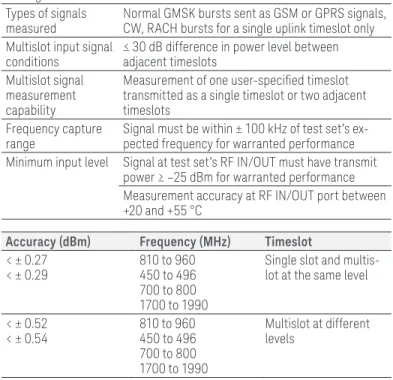
measured Normal GMSK bursts sent as GSM or GPRS signals, CW, RACH bursts for a single uplink timeslot only Multislot input signal
conditions ≤ 30 dB difference in power level between adjacent timeslots Multislot signal
measurement capability
Measurement of one user-specified timeslot transmitted as a single timeslot or two adjacent timeslots
Frequency capture
range Signal must be within ± 100 kHz of test set’s ex-pected frequency for warranted performance Minimum input level Signal at test set’s RF IN/OUT must have transmit
power ≥ –25 dBm for warranted performance Measurement accuracy at RF IN/OUT port between +20 and +55 °C
Accuracy (dBm) Frequency (MHz) Timeslot
< ± 0.27
< ± 0.29 810 to 960450 to 496 700 to 800 1700 to 1990
Single slot and multis-lot at the same level
< ± 0.52 < ± 0.54 810 to 960450 to 496 700 to 800 1700 to 1990 Multislot at different levels
Measurement accuracy when RF OUT ONLY port is selected for signal generation (in addition to measurement accuracy at RF IN/OUT port): Accuracy (dBm) Frequency (MHz) < ± 0.27 < ± 0.29 450 to 496700 to 800 810 to 960 < ± 0.52 < ± 0.54 1700 to 1990
VSWR at RF IN/OUT < 1.14 : 1 for 450 to 496 MHz and 700 to 960 MHz, < 1.2 : 1 for 1.7 to 1.99 GHz Trigger sources RF rise, protocol, immediate, auto, external Trigger delay Settable between ± 2.31 ms
Figure 2. EGPRS modulation accuracy measurement includes a graphical sample EVM histogram to observe your device’s statistical EGPRS performance.
GSM/GPRS/EGPRS multislot transmit power
measurement (continued)
Burst
synchroni-zation RF amplitude (GSM/GPRS midamble-synchronized transmit power result is available as part of the multislot power versus time measurement) Numerical result GMSK transmit power
Multi-measurement
capabilities 1 to 999 bursts; minimum, maximum, average, and standard deviation results Concurrency
capabilities GSM/GPRS/EGPRS multislot-tolerant transmit power measurements can be made concurrently with all other measurements
Supplemental characteristics
Extended amplitude
range Results are provided for signals at the test set’s RF IN/OUT port for transmit power within –10 and +5 dB of expected power
Typical measurement accuracy at RF IN/OUT port:
Accuracy (dBm) Frequency (MHz) Timeslot
< ± 0.10 < ± 0.13 < ± 0.14 450 to 496 700 to 800 810 to 960 1700 to 1990
Single slot and multislot at the same level
< ± 0.32 < ± 0.36 < ± 0.38 450 to 496 700 to 800 810 to 960 1700 to 1990 Multislot at different levels
Typical measurement accuracy when RF OUT ONLY port
is selected for signal generation (in addition to typical
measurement accuracy at RF IN/OUT port):
Accuracy (dBm) Frequency (MHz) < ± 0.01 < ± 0.04 450 to 496 700 to 800 810 to 960 1700 to 1990 Typical measure-ment repeatability < ± 0.05 dB Measurement resolution 0.01 dB
The following specifications are valid when the burst capture range is set to All:
Types of signals
measured Normal GMSK bursts sent as GSM or GPRS signals, normal GMSK and 8PSK bursts sent as EGPRS sig-nals, CW, RACH bursts for a single uplink timeslot only Multislot input
signal conditions < 30 dB difference in power level between adjacent timeslots. When autoranging is off, input signal trans-mit power must be within ± 3 dB for highest burst and +3 dB/–30 dB for other bursts relative to expected power of highest burst; when autoranging is on, input signal transmit power must be within
± 3 dB/–30 dB for all bursts Multislot signal
measurement capability
Simultaneous measurement of all bursts up to 6 uplink timeslots in the multislot Class 45 configuration
Frequency capture
range Signal must be within ± 100 kHz of the test set’s expected frequency for warranted performance Minimum input
level For warranted performance, signal at test set’s RF IN/OUT must have transmit power > –25 dBm for GMSK transmit power or 8PSK burst power, and > –20 dBm for 8PSK estimated carrier power
Measurement accuracy for GMSK transmit power at
RF IN/OUT port between +20 and +55 °C (continued)
Accuracy (dBm) Frequency (MHz) Timeslot
< ± 0.32 < ± 0.34 700 to 800 810 to 960 450 to 496 1700 to 1990
Multislot at the same level < ± 0.70 < ± 0.72 700 to 800 810 to 960 450 to 496 1700 to 1990 Multislot at different levels
Measurement accuracy for 8PSK burst power at
RF IN/OUT port between +20 and +55 °C
Accuracy (dBm) Frequency (MHz) Timeslot
< ± 0.32 < ± 0.33 700 to 800 810 to 960 450 to 496 1700 to 1990 Single slot < ± 0.36 < ± 0.37 700 to 800 810 to 960 450 to 496 1700 to 1990
Multislot at the same level < ± 0.75 < ± 0.76 700 to 800 810 to 960 450 to 496 1700 to 1990 Multislot at different levels
Measurement accuracy for 8PSK/16QAM estimated
carrier power at RF IN/OUT port between +20 and +55 °C
Accuracy (dBm) Frequency (MHz) Timeslot
< ± 0.42 < ± 0.43 700 to 800 810 to 960 450 to 496 1700 to 1990 Single slot < ± 0.46 < ± 0.47 700 to 800 810 to 960 450 to 496 1700 to 1990
Multislot at the same level < ± 0.85 < ± 0.86 700 to 800 810 to 960 450 to 496 1700 to 1990 Multislot at different levels
Note: 8PSK estimated carrier power specifications above can be met when signal quality is not degraded.
Measurement accuracy when RF OUT ONLY port is
selected for signal generation (in addition to measurement
accuracy at RF IN/OUT port)
Accuracy (dBm) Frequency (MHz) < ± 0.01 < ± 0.04 450 to 496 700 to 800 810 to 960 1700 to 1990
VSWR at RF IN/OUT < 1.14 : 1 for 450 to 496 MHz and 700 to 960 MHz, < 1.2 : 1 for 1.7 to 1.99 GHz
Trigger sources RF rise, protocol, immediate, auto, external Trigger delay Settable between ± 2.31 ms
Burst
synchroni-zation Midamble
Numerical result GMSK transmit power, 8PSK burst power, 8PSK es-timated carrier power, 16QAM burst power, 16QAM estimated carrier power
Multi-measurement
capabilities 1 to 999 bursts; minimum, maximum, average, and standard deviation results Concurrency
capabilities GSM/GPRS/EGPRS multislot transmit power mea-surements can be made concurrently with all other measurements
Measurement accuracy for GMSK transmit power at
RF IN/OUT port between +20 and +55 °C
Accuracy (dBm) Frequency (MHz) Timeslot
< ± 0.27 < ± 0.29 700 to 800 810 to 960 450 to 496 1700 to 1990 Single slot
Typical measurement accuracy for GMSK transmit power
at RF IN/OUT port:
Accuracy (dBm) Frequency (MHz) Timeslot
< ± 0.10 < ± 0.11 700 to 800 810 to 960 450 to 496 1700 to 1990 Single slot < ± 0.14 < ± 0.15 700 to 800 810 to 960 450 to 496 1700 to 1990
Multislot at the same level < ± 0.29 < ± 0.30 700 to 800 810 to 960 450 to 496 1700 to 1990 Multislot at different levels
Typical measurement accuracy for 8PSK/16QAM burst
power at RF IN/OUT port:
Accuracy (dBm) Frequency (MHz) Timeslot
< ± 0.14 < ± 0.15 700 to 800 810 to 960 450 to 496 1700 to 1990 Single slot < ± 0.17 < ± 0.17 700 to 800 810 to 960 450 to 496 1700 to 1990
Multislot at the same level < ± 0.33 < ± 0.34 700 to 800 810 to 960 450 to 496 1700 to 1990 Multislot at different levels
Supplemental characteristics
Supplementalcharacteristics Results are provided for signals at the test set’s RF IN/OUT port for transmit power within –10 and +5 dB of expected power
Typical measurement accuracy when RF OUT ONLY port
is selected for signal generation (in addition to typical
measurement accuracy at RF IN/OUT port):
Accuracy (dBm) Frequency (MHz) < ± 0.01 < ± 0.04 450 to 496 700 to 800 810 to 960 1700 to 1990 Typical measurement repeatability < ±0.05 dB Measurement resolution 0.01 dB
Measurement accuracy for GMSK transmit power or
8PSK/16QAM burst power at RF IN/OUT port between
+20 and +55 °C:
Accuracy (dBm) Frequency (MHz) Timeslot
< ± 0.32 < ± 0.34 700 to 800 810 to 960 450 to 496 1700 to 1990
Single slot and multi-slot at the same level
< ± 0.57 < ± 0.59 700 to 800 810 to 960 450 to 496 1700 to 1990 Multislot at different levels
Measurement accuracy for 8PSK/16QAM estimated
carri-er powcarri-er at RF IN/OUT port between + 20 and +55 °C:
Accuracy (dBm) Frequency (MHz) Timeslot
< ± 0.40 < ± 0.42 700 to 800 810 to 960 450 to 496 1700 to 1990
Single slot and multi-slot at the same level
< ± 0.65 < ± 0.67 700 to 800 810 to 960 450 to 496 1700 to 1990 Multislot at different levels
Note: 8PSK estimated carrier power accuracy specifications above can be met when signal quality is not degraded.
Measurement accuracy when RF OUT ONLY port is
selected for signal generation (in addition to measurement
accuracy at RF IN/OUT port):
Accuracy (dBm) Frequency (MHz) < ± 0.01 < ± 0.04 450 to 496 700 to 800 810 to 960 1700 to 1990
VSWR at RF IN/OUT < 1.14 : 1 for 450 to 496 MHz and 700 to 960 MHz, < 1.2 : 1 for 1.7 to 1.99 GHz Trigger sources RF rise, protocol, immediate, auto, external Trigger delay Settable between ± 2.31 ms
Burst synchronization Midamble
Numerical result GMSK transmit power, 8PSK burst power, 8PSK estimated carrier power, 16QAM burst power, 16QAM estimated carrier power
Multi-measurement
capabilities 1 to 999 bursts; minimum, maximum, average, and standard deviation results Concurrency capabilities EGPRS multislot-tolerant transmit power
measurements can be made concurrently with all other measurements
Supplemental characteristics
Extended amplitude
range Results are provided for signals at the test set’s RF IN/OUT port for transmit power within –10 and +5 dB of expected power
Typical measurement accuracy for GMSK transmit power
or 8PSK burst power at RF IN/OUT port:
Accuracy (dBm) Frequency (MHz) Timeslot
< ± 0.15 < ± 0.16 700 to 800 810 to 960 450 to 496 1700 to 1990
Single slot and multi-slot at the same level
< ± 0.35 < ± 0.36 700 to 800 810 to 960 450 to 496 1700 to 1990 Multislot at different levels
EGPRS multislot-tolerant transmit power measurement
Types of signals
measured Normal GMSK and 8PSK/16QAM bursts sent as EGPRS signals Multislot input signal
conditions ≤ 30 dB difference in power level between adjacent timeslots Multislot signal
measurement capability Measurement of one user-specified timeslot transmitted as a single timeslot or two adjacent timeslots
Frequency capture range Signal must be within ± 1 kHz of test set’s expected frequency for warranted performance Minimum input level For warranted performance, signal at test set’s
RF IN/OUT must have transmit power ≥ –25 dBm for GMSK transmit power or 8PSK burst power, and
≥ –20 dBm for 8PSK/16QAM estimated carrier
power Typical measurement
repeatability < ±0.05 dB Measurement resolution 0.01 dB
Multislot power versus time measurement
All specifications for the multislot power versus time measure-ment are valid between +20 and +55 °C and using high linearity ranging mode. GSM/GPRS/EGPRS multislot transmit power mea-surement or EGPRS multislot-tolerant transmit power measure-ment accuracy specifications apply to output power results.Types of signals
measured Normal GMSK and 8PSK bursts, RACH bursts for a single uplink timeslot only Multislot input signal
conditions ≤ 30 dB difference in power level between adjacent timeslots. For warranted performance at Capture All Mode, the maximum difference between all slots should be ≤ 20 dB
Multislot signal
mea-surement capability Measurement of a single GMSK or 8PSK uplink timeslot or five adjacent GMSK and/or 8PSK uplink timeslots with capture all mode Frequency capture
ranges Signal must be within ± 100 kHz of test set’s expected frequency for warranted performance Minimum input level Signal at test set’s RF IN/OUT must have
transmit power ≥ –15 dBm for warranted performance
Mask placement timing
accuracy < ± 0.1 symbols with midamble synchronization
Trigger sources RF rise, protocol, immediate, auto, external Trigger delay Settable between ± 2.31 ms
Burst synchronization Midamble, RF amplitude, none for a single GSM or GPRS uplink timeslot; midamble for two GSM or GPRS uplink timeslots or any EGPRS uplink timeslots
Tx power method Estimated carrier power or average burst power
Ranging mode High linearity or high dynamic range Marker measurement
points 12 time points within each burst are definable PCS ETSI limit Selection of narrow or relaxed mask in PCS
1900 MHz band
Mask types Selectable as ETSI, custom 1, custom 2, or no mask for each burst and ETSI, custom, or no mask for guard period between bursts Numerical results – For entire single or multislot signal: pass/
fail for rising edge, active part(s), falling edge, and guard period
– For each burst: GMSK transmit power or 8PSK burst power, worst case upper mask limit margin and time, worst case lower mask limit margin and time, amplitude at marker measurement points
Displayed graphical
results – For single-slot signals: fixed dBc versus μs views of full, rising edge, falling edge, and useful part of burst
– For multislot signals: fixed dBc versus μs views of both bursts, guard period, burst 1, and burst 2
– For all signals: ETSI-defined mask, pass/ fail indicators, settable marker, and variable time and amplitude axes Multi-measurement
capabilities 1 to 999 bursts; minimum, maximum, average, and standard deviation results Concurrency capabilities Multislot power versus time measurements can
be made concurrently with all other measure-ments
Supplemental characteristics
Typical relative
measurement accuracy < ± 0.25 dB over –7 to +1 dB for GMSK bursts< ± 0.25 dB over –4 to +4 dB for 8PSK bursts Typical dynamic range
and typical noise floor For measurement of the second burst in a multislot configuration with the first burst > 10 dB higher than the second burst
– Typical dynamic range: > lesser of 74 or 84 dB minus power offset between bursts, or
– Typical noise floor: < –62 dBm, whichever dominates
For all other single and multislot signals
– Typical dynamic range
– > 74 dB, or
– Typical noise floor – < –62 dBm, whichever dominates Measurement resolution 0.01 dB Accuracy (dBm) Frequency (MHz) < ± 0.5 dB –7 to +1 dB for GMSK bursts < ± 1.0 dB –7 to +4 dB for 8PSK bursts < ± 2.0 dB –20 to < –7 dB –32 to < –20 dB < ± 2.7 dB –50 to < –32 dB, ≥ –46 dBm 1 < ± 3.0 dB –60 to < –50 dB, ≥ –46 dBm 1 1. For measurements on any burst in a multislot configuration where the
burst is not the highest, the minimum power is the higher of the following three cases:
– –60 dB below reference
– For capture all mode –60 dB and for capture single mode, –70 dB below reference plus the offset between this burst power levels and the highest burst power level
Burst timing error measurement
Burst timing error measurement result is available on call setup screen. Types of signals
measured Normal GMSK or 8PSK bursts, RACH bursts for a single uplink timeslot only Measurement capture
range Signal must be within ± 3 T (bit periods) of test set’s expected position Minimum input level Signal at test set’s RF IN/OUT must have
transmit power ≥ –30 dBm and ≤ 20 dB difference in levels of adjacent timeslots Numerical result Burst timing error
Concurrency capabilities Burst timing error measurements can be made concurrently with all other measurements, but burst timing result is not available when PDTCH(s) are not active
Supplemental characteristics
Typical measurement
repeatability < ± 0.25 T (0.923 μs) Measurement resolution 0.25 T (0.923 μs)
Multislot-tolerant output RF spectrum (ORFS)
measurement
All specifications for the multislot-tolerant ORFS measurement are valid between +20 and +55 °C. GSM/GPRS/EGPRS multislot transmit power measurement or EGPRS multislot-tolerant trans-mit power measurement accuracy specifications apply to output power result. These specifications apply to E5515C mainframes with Option 002 supplied after serial number GB46040001 January 2006, or E5515E.
Modulation
measure-ment implemeasure-mentation Performed using a five-pole, synchronous-ly-tuned 30 kHz RBW filter averaged over 40 bits
Switching measurement
implementation Performed using a five-pole, synchronous-ly-tuned 30 kHz RBW filter with peak hold during the whole burst
Types of signals
measured GMSK or 8PSK normal bursts Multislot input signal
conditions ≤ 30 dB difference in power level between adjacent timeslots Multislot signal
measurement capability Measurement of one user-specified timeslot transmitted as a single timeslot or four adja-cent timeslots
Frequency capture range Signal must be within ± 200 Hz of test set’s expected frequency for warranted performance Minimum input level Signal at test set’s RF IN/OUT must have
transmit power ≥ –10 dBm for warranted performance
Filter options Digital, analog, and auto
Trigger sources RF rise, protocol, immediate, auto, external Trigger delay Settable between ± 2.31 ms
Burst synchronization RF amplitude for GSM or GPRS signals, midamble for EGPRS signals
Measurement offsets 22 modulation and 8 switching offsets from carrier are definable
Pass/fail limits ETSI or user-defined
Numerical results Modulation and switching results at each selected offset, output power, transmit power in 30 kHz bandwidth, modulation and switching pass/fail indicators, modulation type
Displayed graphical
results Fixed dB versus frequency views of modulation, switching, or both modulation and switching, settable marker and pass/fail limits, modula-tion and switching pass/fail indicators, variable frequency and amplitude axes
Multi-measurement
capabilities 1 to 999 measurements; average modulation result, maximum switching result Concurrency capabilities Multislot-tolerant ORFS measurements can
be made concurrently with all other measure-ments
Supplemental characteristics
Modulation dynamic
range – –74 dBr digital filter-type for full spectrum, power 0 dBm or greater
– –74 dBr analog filter-type for full spec-trum, power +10 dBm or greater Typical switching
dynamic range –70 dBc/–60 dBm (whichever is greater) at 600, 1200, and 1800 kHz offsets, power +10 dBm or greater
Phase and amplitude versus time (PAvT)
measurement
Optional PAvT measurement, requires separate license, orderable as part number E1968A-410.
All specifications for the PAvT measurement are valid between +20 and +55 °C.
Types of signals
measured CW only – discrete amplitude step waveform or continuous ramp waveform Waveform type Discrete or continuous
Trigger sources RF rise, immediate, external Trigger delay Settable between 0 to 10 ms Trigger threshold Settable between 0 to 30 dB Measurement timeout Settable between 0.1 to 999.9 s Continuous
measurement count Settable between 1 to 5000 Continuous
measurement delay Settable between 0 to 500 ms Discrete step width Settable between 0.1 to 400 ms Discrete step count Settable between 1 to 512
Discrete step center Settable between 0.05 to 399.95 ms Concurrency capabilities PAvT measurements cannot be made
concurrently with any other measurements
Fast device tune (FDT) measurement
Optional FDT measurement requires separate license, orderable as part number E1999A-202.
All specifications for the FDT measurement are valid for the frequency ranges 450 to 496 MHz, 740 to 960 MHz, and 1700 to 1990 MHz.
FDT transmit power measurement specifications
Input signal conditions First slot has to be the highest burst, and power level of first timeslot has to be within ± 3 dB of expected power
Multislot signal
measurement capability Measurement of up to seven timeslots Minimum input level For warranted performance, the signal at the
test set’s RF IN/OUT must have transmit power > –14 dBm for first timeslot, and ≥ –25 dBm for second to seventh timeslot
Measurement accuracy for FDT GMSK transmit
power at RF IN/OUT port between +20 and
+55 °C
Accuracy (dBm) Ranges < ± 0.85 700 to 800 810 to 960 < ± 0.87 450 to 496 1700 to 1990FDT (downlink) generator specifications
FDT absolute output level accuracy with GMSK modulation on: Specification Ranges
< ± 2.10 dB Single slot from –110 to –13 dBm
< ± 2.10 dB 1 multislot level between –110 and –13 dBm < ± 2.50 dB 2 multislot levels ≤ 20 dB apart
Peak phase error < ± 5 degrees
Frequency error < ± 0.02 ppm plus timebase reference
Typical burst modulation on/off ratio (referenced to lowest signal level)
> 50 dB
Typical RMS phase error < 0.9 degree
Supplemental characteristics
Typical FDT absolute output level accuracy with GMSK modulation on:
Specification Ranges
< ± 1.40 dB Single slot from –110 to –13 dBm
< ± 1.40 dB 1 multislot level between –110 and –13 dBm < ± 1.70 dB 2 multislot levels ≤ 20 dB apart
Frequency capture range Signal must be within ± 70 kHz of test set’s expected frequency for warranted performance VSWR at RF IN/OUT < 1.14 : 1 for 450 to 496 MHz and 700 to
960 MHz, < 1.2 : 1 for 1.7 to 1.99 GHz Trigger sources Fixed as protocol trigger (RF rising trigger for
the first step) Trigger delay ± 2.31 ms
Concurrency capabilities Fast device tune measurements cannot be made concurrently with other measurements
Supplemental characteristics
Typical measurement accuracy for FDT GMSK transmit power at RF IN/OUT port between +20 and +55 °C:
Accuracy (dBm) Frequency (MHz) < ± 1.40 700 to 800 810 to 960 < ± 0.41 450 to 496 1700 to 1990 Typical measurement repeatability < ± 0.05 dB Measurement resolution 0.01 dB
General-purpose spectrum monitor
Operating modes Active cell and test mode Measurement modes Swept mode or zero span
Frequency ranges Although the spectrum monitor is available at any frequency supported by the test set, spec-ifications apply only inside of the calibrated bands: 450 to 496 MHz, 700 to 800 MHz, 810 to 960 MHz, and 1.7 to 1.99 GHz Frequency spans, resolution bandwidth, displayed dynamic ranges
Coupled, with the following combinations available
Displayed average noise
level < –90 dBm for reference level of –40 dBm and 30 kHz bandwidth Typical residual
responses < –70 dB with input terminated, reference level of –10 dBm and RF generator power < –80 dBm Typical spurious
responses < –50 dBc with expected frequency tuned to carrier, carrier > 420 MHz, signal and reference level at –10 dBm and all spectral components within 100 MHz of carrier
Frequency resolution 1 Hz Marker amplitude
resolution 0.01 dB
RBW filter types Flattop in swept mode, Gaussian in zero span Zero span sweep time Settable from 50 μs to 70 ms
Zero span offset time Settable from 0 to 10 s
Reference level range Settable from –50 to +37 dBm, or automatically determined
Amplitude scaling Settable from 0.1 to 20 dB/division in 0.1 dB steps
Trigger source Immediate, protocol, RF rise, external, auto Trigger delay Settable between ± 50 ms
Peak threshold Settable from –120 to +37 dBm Peak excursion Settable between 1.2 to 100 dB Trace functions Clear write, max hold, min hold Detector type Peak or sample
Averaging capabilities Settable between 1 and 999, or off Marker functions Three independent markers with modes of
normal, data, and off; operations are peak search, marker to expected power, and marker to expected frequency
Concurrency capabilities Spectrum monitor analysis can be performed concurrently with all measurements
Span RBW Displayed dynamic range
100 MHz 5 MHz 50 dB 80 MHz 1 MHz 55 dB 40 MHz 300 kHz 60 dB 20 MHz 100 kHz 65 dB 12 MHz 100 kHz 65 dB 10 MHz 100 kHz 65 dB 5 MHz 30 kHz 70 dB 4 MHz 30 kHz 70 dB 2.5 MHz 10 kHz 75 dB 1.25 MHz 3 kHz 80 dB 500 kHz 1 kHz 80 dB 125 kHz 300 Hz 80 dB 0 1 MHz 55 dB 0 300 kHz 60 dB 0 100 kHz 65 dB
Supplemental characteristics
Typical level accuracy:
– < ± 2 dB for signals within 50 dB of a reference level ≥ –10 dBm and RBW < 5 MHz
– < ± 2 dB for signals within 30 dB of a reference level < –10 dBm and RBW = 5 MHz using 5 averages – < ± 3.5 dB for signals > –70 dBm and within 50 dB of a
reference level < –10 dBm with RBW < 5 MHz
GSM decoded audio level measurement
The MS needs to be stimulated with a pulsed audio signal at a 10 Hz rate with 50 percent duty cycle for the decoded audio level measurement to provide accurate results.
Types of signals
measured Encoded audio present on uplink TCH Measurement range 200 Hz to 3.6 kHz
Measurement accuracy Observed inaccuracies are due to MS encoder errors since the algorithm in the test set contributes no bit errors
Band pass filter
capabilities 100 Hz bandwidth, tunable from 200 Hz to 3.6 kHz, selectable as on or off Measurement trigger
source Immediate Measurement
synchronization None required Numerical result rms audio level Multi-measurement
capabilities 1 to 999 measurements; average, minimum, maximum, and standard deviation results Concurrency capabilities GSM decoded audio level measurements
cannot be made concurrently with GSM BER or GSM FBER measurements; GSM decoded audio level measurements can be made con-currently with all other measurements
Supplemental characteristics
Audio generator specifications
FrequencyOperating range 100 Hz to 20 kHz
Accuracy Same as timebase reference
Supplemental characteristics
Typical operating range 1 Hz to 20 kHz Frequency resolution 0.1 Hz
GSM analog audio level measurement
Types of signals
measured Sinusoidal audio signals Measurement frequency
range 100 Hz to 15 kHz
AUDIO IN level range 7.1 mV to 20 V peak (5 mV to 14.1 V rms) Measurement accuracy < ± (2 percent of reading + resolution) for
100 Hz to ≤ 8 kHz
< ± (3 percent of reading + resolution) for > 8 to 20 kHz
Measurement THD plus
noise < 200 μV rms Measurement detectors rms or peak Measurement trigger
source Immediate Measurement
synchronization None required Numerical result Audio level Multi-measurement
capabilities 1 to 999 measurements; average, minimum, maximum, and standard deviation results Concurrency capabilities GSM analog audio level measurements cannot
be made concurrently with GSM multi-tone audio, but can be made concurrently with all other measurements
Supplemental characteristics
Typical measurement
accuracy < ± 1.2 percent of reading for 100 Hz to ≤ 8 kHz and 20 mV to 20 V peak Typical external input
impedance 100 k Ω in parallel with 105 pF
Measurement resolution 0.3 percent of expected level setting or 0.2 mV, whichever is greater
Output level from AUDIO OUT connector
Ranges 0 to 1 V peak, 1 to 9 V peak (into ≥ 600 Ω) Accuracy < ± (1.5% of setting + resolution) when output
is DC coupled
Distortion < 0.1 percent for 0.2 to 9 V peak into ≥ 600 Ω Pulse mode Pulsed audio signal at a 10 Hz rate with 50
percent duty cycle, selectable as on or off (for use with the GSM decoded audio level measurement)
Coupling mode Selectable as DC or AC (5 μF in series with output)
Supplemental characteristics
Typical maximum output
current 100 mA peak into 8 Ω Typical output
impedance < 1.5 Ω at 1 kHz when output is DC coupled Typical DC offset (when
output is DC coupled) < 1 mV for 0 to 1 V peak output, < 10 mV peak for 1 to 9 V peak output Output level resolution < 0.5 mV for 0 to 1 V peak output
< 5.0 mV for 1 to 9 V peak output
GSM analog audio measurement specifications
All analog audio measurement specifications apply to signals present at test set’s AUDIO IN ports.
De-emphasis 750 μs de-emphasis selectable as off or on Expandor Selectable as off or on with reference level
setting of 10 mV to 10 V
Filters None, C-message, 50 Hz to 15 kHz band pass, 300 Hz to 15 kHz band pass, or 100 Hz bandwidth tunable band pass, tunable over 300 Hz to 15 kHz
GSM analog audio distortion measurement
Types of signals
measured Sinusoidal audio signals Measurement frequency
range 100 Hz to 10 kHz
AUDIO IN level range 42.4 mV to 20 V peak (30 mV to 14.1 V rms) Measurement accuracy < ± 12 percent of reading (± 1.0 dB) for
distortion > 0.67 percent
Residual THD plus noise < –60 dB or 200 μV rms, whichever is greater Measurement trigger
source Immediate Measurement
synchronization None required Numerical result Audio distortion Multi-measurement
capabilities 1 to 999 measurements; average, minimum, maximum, and standard deviation results Concurrency capabilities GSM analog audio distortion measurements cannot be made concurrently with GSM multi-tone audio, but can be made concurrently with all other measurements
Supplemental characteristics
Measurement resolution 0.1 percent
GSM analog audio SINAD measurement
Types of signals
measured Sinusoidal audio signals Measurement frequency
range 100 Hz to 10 kHz
AUDIO IN level range 42.4 mV to 20 V peak (30 mV to 14.1 V rms) Measurement accuracy < ± 1.0 dB for SINAD < 43.5 dB
Residual THD plus noise < –60 dB or 200 μV rms, whichever is greater Measurement trigger
source Immediate Measurement
synchronization None required Numerical result SINAD ratio Multi-measurement
capabilities 1 to 999 measurements; average, minimum, maximum, and standard deviation results Concurrency
capabilities GSM analog audio SINAD measurements cannot be made concurrently with GSM multi-tone audio, but can be made concurrently with all other measurements
Supplemental characteristics
Measurement resolution 0.1 dB
GSM analog audio frequency measurement
Types of signals
measured Sinusoidal audio signals Measurement frequency
range 100 Hz to 15 kHz
AUDIO IN level range 7.1 mV to 20 V peak (5 mV to 14.1 V rms) AUDIO IN signal
conditions Signal at test set’s AUDIO IN must have signal-to-noise ratio > 30 dB for warranted perfor-mance
Measurement accuracy < 0.1 Hz averaged over 10 measurements, < 1.0 Hz for a single measurement Measurement THD plus
noise < 200 μV rms Measurement trigger
source Immediate Measurement
synchronization None required Numerical result Audio frequency Multi-measurement
capabilities 1 to 999 measurements; average, minimum, maximum, and standard deviation results Concurrency capabilities GSM analog audio frequency measurements cannot be made concurrently with GSM multi-tone audio, but can be made concurrently with all other measurements
Supplemental characteristics