GS6001/6002/6004
1MHZ CMOS Rail-to-Rail IO Opamp with RF Filter
Features
• Single-Supply Operation from +1.8V ~ +6V
• Rail-to-Rail Input / Output
• Gain-Bandwidth Product: 1MHz (Typ.)
• Low Input Bias Current: 1pA (Typ.)
• Low Offset Voltage: 3.5mV (Max.)
• Quiescent Current: 75µA per Amplifier (Typ.)
• Embedded RF Anti-EMI Filter
• Operating Temperature: -40°C ~ +125°C
• Small Package:
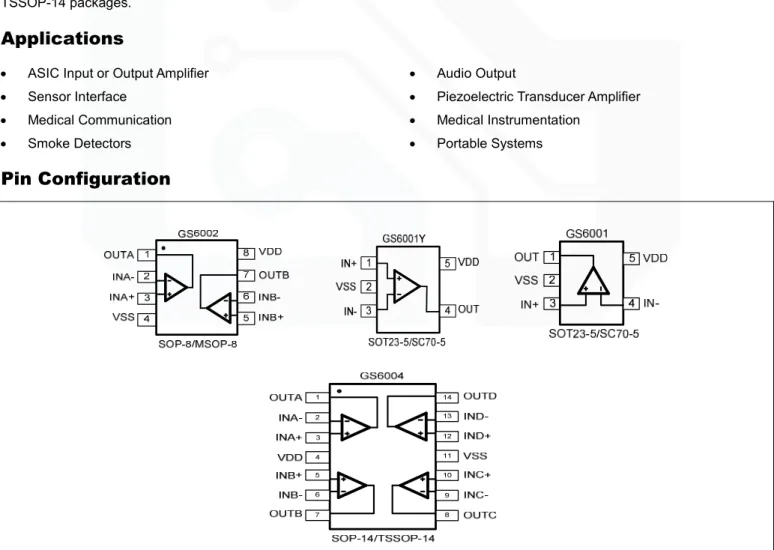
GS6001 Available in SOT23-5 and SC70-5 Packages GS6002 Available in SOP-8 and MSOP-8 Packages GS6004 Available in SOP-14 and TSSOP-14 Packages
General Description
The GS6001 family have a high gain-bandwidth product of 1MHz, a slew rate of 0.6V/μs, and a quiescent current of 75μ A/amplifier at 6V. The GS6001 family is designed to provide optimal performance in low voltage and low noise systems. They provide rail-to-rail output swing into heavy loads. The input common mode voltage range includes ground, and the maximum input offset voltage is 3.5mV for GS6001 family. They are specified over the extended industrial temperature range (-40℃ to +125℃). The operating range is from 1.8V to 6V. The GS6001 single is available in Green SC70-5 and SOT-23-5 packages. The GS6002 dual is available in Green SOP-8 and MSOP-8 packages. The GS6004 Quad is available in Green SOP-14 and TSSOP-14 packages.
Applications
• ASIC Input or Output Amplifier • Sensor Interface
• Medical Communication • Smoke Detectors
• Audio Output
• Piezoelectric Transducer Amplifier • Medical Instrumentation
• Portable Systems
Pin Configuration
GS6001/258/224
Absolute Maximum Ratings
Condition Min Max
Power Supply Voltage (VDD to Vss) -0.5V +7.5V
Analog Input Voltage (IN+ or IN-) Vss-0.5V VDD+0.5V
PDB Input Voltage Vss-0.5V +7V
Operating Temperature Range -40°C +125°C
Junction Temperature +160°C
Storage Temperature Range -55°C +150°C
Lead Temperature (soldering, 10sec) +260°C
Package Thermal Resistance (TA=+25℃)
SOP-8, θJA 125°C/W MSOP-8, θJA 216°C/W SOT23-5, θJA 190°C/W SC70-5, θJA 333°C/W ESD Susceptibility HBM 6KV MM 400V
Note:Stress greater than those listed under Absolute Maximum Ratings may cause permanent damage to the device. This is a stress rating only and functional operation of the device at these or any other conditions outside those indicated in the operational sections of this specification are not implied. Exposure to absolute maximum rating conditions for extended periods may affect reliability.
Package/Ordering Information
MODEL CHANNEL ORDER NUMBER PACKAGE DESCRIPTION PACKAGE OPTION MARKING INFORMATION GS6001 Single
GS6001-CR SC70-5 Tape and Reel,3000 6001 GS6001-TR SOT23-5 Tape and Reel,3000 6001 GS6001Y-CR SC70-5 Tape and Reel,3000 6001Y GS6001Y-TR SOT23-5 Tape and Reel,3000 6001Y GS6002 Dual GS6002-SR SOP-8 Tape and Reel,2500 GS6002
GS6002-MR MSOP-8 Tape and Reel,3000 GS6002 GS6004 Quad GS6004-TR TSSOP-14 Tape and Reel,3000 GS6004 GS6004-SR SOP-14 Tape and Reel,2500 GS6004
GS6001/258/224
Electrical Characteristics
(At VS = +5V, RL = 100kΩ connected to VS/2, and VOUT = VS/2, unless otherwise noted.)
PARAMETER SYMBOL CONDITIONS
GS6001/258/224
TYP MIN/MAX OVER TEMPERATURE
+25℃ +25℃ -40℃ to +85℃ UNITS MIN/MAX
INPUT CHARACTERISTICS
Input Offset Voltage VOS VCM = VS/2 0.8 3.5 5.6 mV MAX
Input Bias Current IB 1 pA TYP
Input Offset Current IOS 1 pA TYP
Common-Mode Voltage Range VCM VS = 5.5V -0.1 to +5.6 V TYP
Common-Mode Rejection Ratio CMRR
VS = 5.5V, VCM = -0.1V to 4V 70 62 62 dB
MIN VS = 5.5V, VCM = -0.1V to 5.6V 68 56 55
Open-Loop Voltage Gain AOL
RL = 5kΩ, VO = +0.1V to +4.9V 80 70 70 dB
MIN RL = 100kΩ, VO = +0.035V to +4.965V 84 80 80
Input Offset Voltage Drift ∆VOS/∆T 2.7 µV/℃ TYP
OUTPUT CHARACTERISTICS
Output Voltage Swing from Rail
VOH RL = 100kΩ 4.997 4.980 4.970 V MIN VOL RL = 100kΩ 5 20 30 mV MAX VOH RL = 10kΩ 4.992 4.970 4.960 V MIN VOL RL = 10kΩ 8 30 40 mV MAX Output Current ISOURCE RL = 10Ω to VS/2 84 60 45 mA MIN ISINK 75 60 45 POWER SUPPLY
Operating Voltage Range
1.8 1.8 V MIN 6 6 V MAX Power Supply Rejection Ratio PSRR VS = +2.5V to +5.5V, VCM = +0.5V 82 60 58 dB MIN
Quiescent Current / Amplifier IQ 55 75 85 µA MAX
DYNAMIC PERFORMANCE (CL = 100pF)
Gain-Bandwidth Product GBP 1 MHz TYP
Slew Rate SR G = +1, 2V Output Step 0.8 V/µs TYP Settling Time to 0.1% tS G = +1, 2V Output Step 5.3 µs TYP
Overload Recovery Time VIN ·Gain = VS 2.6 µs TYP
NOISE PERFORMANCE
Voltage Noise Density en
f = 1kHz 27 nV/ Hz TYP
GS6001/258/224
Typical Performance characteristics
At TA=+25oC, Vs=5V, RL=100KΩ connected to VS/2 and VOUT= VS/2, unless otherwise noted.
Large Signal Transient Response Small Signal Transient Response
O u tp u t V o lt a g e ( 5 0 0 m V/ d iv ) O u tp u t V o lt a g e ( 2 0 m V/ d iv ) Time(10µs/div) Time(2µs/div) CMRR vs. Frequency PSRR vs. Frequency C M R R ( d B ) PSR R ( d B ) Frequency (kHz) Frequency (kHz)
Supply Current vs. Temperature Overload Recovery Time
Su p p ly C u rr e n t (µ A ) Temperature (℃) Time(2µs/div) Vs=5.5V CL=100pF RL=100kΩ G=+1 CL=100pF RL=100kΩ G=+1 Vs=2.5V Vs=1.6V Vs=5V G=-5 VIN=500mV
GS6001/258/224
Typical Performance characteristics
At TA=+25oC, RL=100KΩ connected to VS/2 and VOUT= VS/2, unless otherwise noted.
Output Voltage Swing vs.Output Current Output Voltage Swing vs.Output Current
O u tp u t V o lt a g e ( V ) O u tp u t V o lt a g e ( V )
Output Current(mA) Output Current(mA)
Input Voltage Noise Spectral Density vs. Frequency Open Loop Gain, Phase Shift vs. Frequency
V o lt a g e N o is e ( n V/√ H z) O p e n L o o p G a in ( d B ) Ph a s e S h if t (D e g re e s ) Frequency (kHz) Frequency (kHz) Sourcing Current Sinking Current 135℃ Vs=3V 25℃ -50℃ -50℃ Sourcing Current Sinking Current Vs=5V 135℃ 25℃ -50℃ -50℃
GS6001/258/224
Application Note
SizeGS6001 family series op amps are unity-gain stable and suitable for a wide range of general-purpose applications. The small footprints of the GS6001 family packages save space on printed circuit boards and enable the design of smaller electronic products.
Power Supply Bypassing and Board Layout
GS6001 family series operates from a single 1.8V to 6V supply or dual ±0.9V to ±3V supplies. For best performance, a 0.1µF ceramic capacitor should be placed close to the VDD pin in single supply operation. For dual supply operation, both VDD and VSS supplies should be bypassed to ground with separate 0.1µF ceramic capacitors.
Low Supply Current
The low supply current (typical 75µA per channel) of GS6001 family will help to maximize battery life. They are ideal for battery powered systems
Operating Voltage
GS6001 family operates under wide input supply voltage (1.8V to 6V). In addition, all temperature specifications apply from -40 o
C to +125 oC. Most behavior remains unchanged throughout the full operating voltage range. These guarantees ensure operation throughout the single Li-Ion battery lifetime
Rail-to-Rail Input
The input common-mode range of GS6001 family extends 100mV beyond the supply rails (VSS-0.1V to VDD+0.1V). This is achieved by using complementary input stage. For normal operation, inputs should be limited to this range.
Rail-to-Rail Output
Rail-to-Rail output swing provides maximum possible dynamic range at the output. This is particularly important when operating in low supply voltages. The output voltage of GS6001 family can typically swing to less than 10mV from supply rail in light resistive loads (>100kΩ), and 60mV of supply rail in moderate resistive loads (10kΩ).
Capacitive Load Tolerance
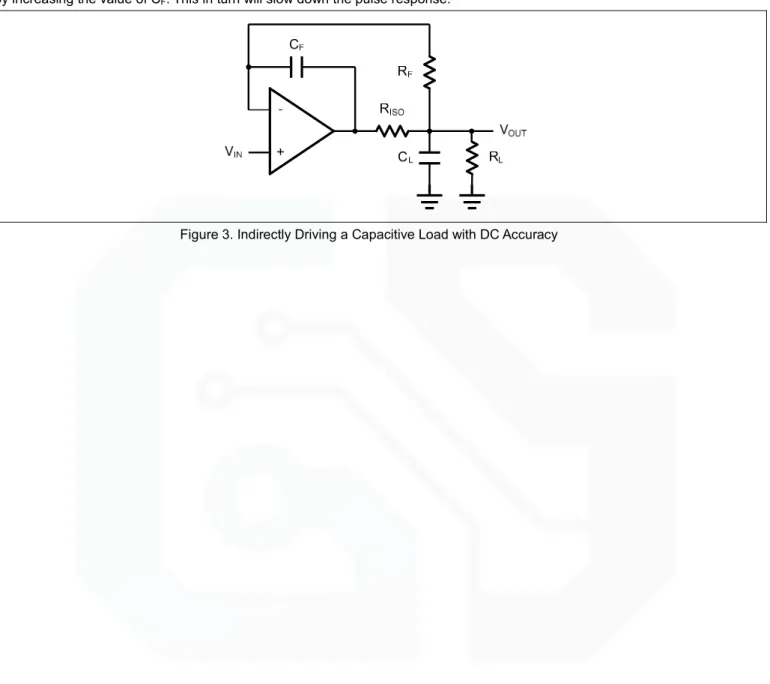
The GS6001 family is optimized for bandwidth and speed, not for driving capacitive loads. Output capacitance will create a pole in the amplifier’s feedback path, leading to excessive peaking and potential oscillation. If dealing with load capacitance is a requirement of the application, the two strategies to consider are (1) using a small resistor in series with the amplifier’s output and the load capacitance and (2) reducing the bandwidth of the amplifier’s feedback loop by increasing the overall noise gain. Figure 2 shows a unity gain follower using the series resistor strategy. The resistor isolates the output from the capacitance and, more importantly, creates a zero in the feedback path that compensates for the pole created by the output capacitance.
Figure 2 Indirectly Driving a Capacitive Load Using Isolation Resistor
The bigger the RISO resistor value, the more stable VOUT will be. However, if there is a resistive load RL in parallel with the capacitive load, a voltage divider (proportional to RISO/RL) is formed, this will result in a gain error.
GS6001/258/224
and RISO serve to counteract the loss of phase margin by feeding the high frequency component of the output signal back to the
amplifier’s inverting input, thereby preserving the phase margin in the overall feedback loop. Capacitive drive can be increased by increasing the value of CF. This in turn will slow down the pulse response.
GS6001/258/224
Typical Application Circuits
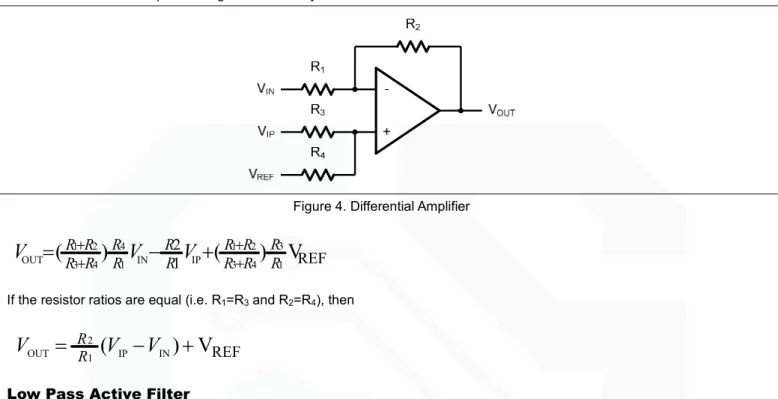
Differential amplifierThe differential amplifier allows the subtraction of two input voltages or cancellation of a signal common the two inputs. It is useful as a computational amplifier in making a differential to single-end conversion or in rejecting a common mode signal. Figure 4. shown the differential amplifier using GS6001 family.
Figure 4. Differential Amplifier
REF
1
2
(
)
V
)
(
1 3 4 3 2 1 IP IN 1 4 4 3 2 1 OUTR
R
R
R
R
R
R
R
R
R
R
R
R
R
V
V
V
+
+
+
+
−
+
=
If the resistor ratios are equal (i.e. R1=R3 and R2=R4), then
REF
V
)
(
IP IN 1 2 OUT=
V
−
V
+
V
R
R
Low Pass Active Filter
The low pass active filter is shown in Figure 5. The DC gain is defined by –R2/R1. The filter has a -20dB/decade roll-off after its corner frequency ƒC=1/(2πR3C1).
GS6001/258/224
Instrumentation Amplifier
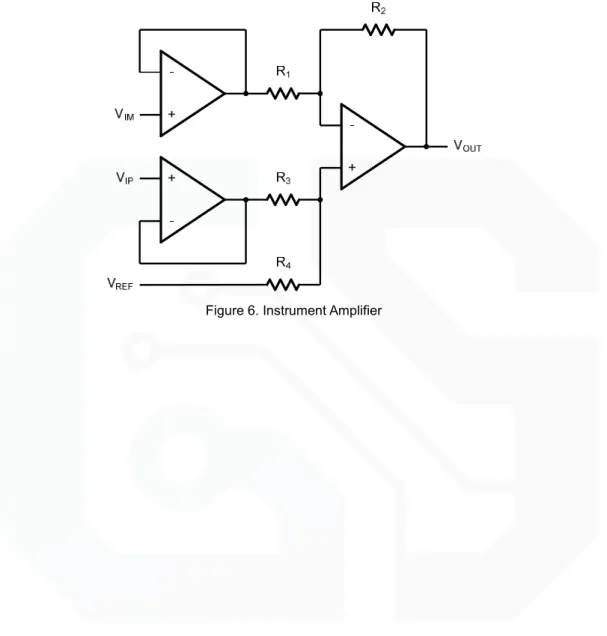
The triple GS6001 family can be used to build a three-op-amp instrumentation amplifier as shown in Figure 6. The amplifier in Figure 6 is a high input impedance differential amplifier with gain of R2/R1. The two differential voltage followers assure the high input impedance of the amplifier.
Figure 6. Instrument Amplifier