Framework
SMF Operating Procedures
Contents
1 Introduction ... 1 2 Participant Eligibility ... 3 3 Reserves Accounts ... 64 Operational Standing Facilities ... 9
5 Open Market Operations ... 10
5A Indexed Long-Term Repo operations ... 12
5B Contingent Term Repo Facility ... 14
6 Discount Window Facility ... 15
7 Collateral Eligibility ... 18
8 Daily Management of Positions ... 21
9 Collateral Delivery and Maintenance ... 32
10 Settlement ... 37
11 Maturity and termination ... 39
12 Contingencies... 41
12A Contingencies arising from Bank actions or operations ... 41
12B Contingencies arising from market-wide issues ... 42
Appendix A – Communication with the Bank ... 45
1
1
Introduction
1.1 These Sterling Monetary Framework (SMF) Operating Procedures govern participation in the SMF and explain the operational procedures involved.
1.2 All capitalised terms have the meaning defined in the Glossary in clause H of the Terms and Conditions.
1.3 These SMF Operating Procedures should be read together with the other parts of the legal SMF Documentation – comprising the Terms and Conditions for participation in the Bank of England’s Sterling Monetary Framework, the Eligibility Criteria, the Admission Letter, the
Commencement Letter, any Market Notice, the Annexes, the Declaration of Trust, the Scottish Declaration of Trust and Scottish Transfer and Trust Asset Designation – which form
part of the Documentation by which all transactions referred to in these SMF Operating Procedures are governed. In addition, the ‘Collateral Pooling: Explanatory Note’ describes how collateral pooling works in general, and ‘Loan Collateral Pooling under the Sterling Monetary Framework and Funding for Lending Scheme: Explanatory Note’ describes how pooling applies to loan collateral in particular1. The ‘Red Book’2 describes the rationale behind the SMF and, at a high level, the elements currently in operation.
1.4 In the event of a conflict between these SMF Operating Procedures and the Terms and Conditions, the Terms and Conditions shall prevail. In the event of any conflict between any Market Notice and these SMF Operating Procedures or the Terms and Conditions, the Market Notice shall prevail.
1.5 The Bank may amend these SMF Operating Procedures generally or in particular
circumstances from time to time, with any such amendment taking effect at a time specified by the Bank. A link to copies of the Documentation as amended, or the relevant amended parts, will be circulated to Participants in the SMF and posted on the Bank’s website.3 1.6 The Bank will endeavour to give reasonable notice of any amendment, but reserves the right
to introduce any amendment with immediate effect. The Bank may also vary the operational timetable4 or vary or omit any of the procedures described on any particular day.
1.7 All transactions or planned transactions by individual Participants as part of the Bank’s Sterling Monetary Framework are confidential (see clause A.16 of the Terms and Conditions). 1.8 All references to times are to London time, unless stated otherwise.
1.9 In some cases these SMF Operating Procedures and Market Notices follow market terminology in using expressions such as ‘lending’, ‘repurchase’, ‘repo’, ‘margin’ and
‘substitution’. This is done for the sake of familiarity, but is not a reflection of the legal nature
1
Explanatory Notes are available on the Bank’s website at
www.bankofengland.co.uk/markets/money/documentation.htm and
www.bankofengland.co.uk/markets/Pages/money/Single-Collateral-Pool-Implementation.aspx. 2
The Red Book is available on the Bank’s website at
www.bankofengland.co.uk/markets/Pages/sterlingoperations/redbook.aspx. 3
www.bankofengland.co.uk/markets/money/documentation.htm 4
The calendar of operations is available on the Bank’s website at
2
of the transactions described in these SMF Operating Procedures and any Market Notice, which is determined by the Terms and Conditions.
1.10 Reference is made in these SMF Operating Procedures to a ‘coupon’ or ‘dividend’ being payable during the life of a security; this word has the same meaning as ‘income payments’ as used in clause D.5 of the Terms and Conditions.
3
2
Participant Eligibility
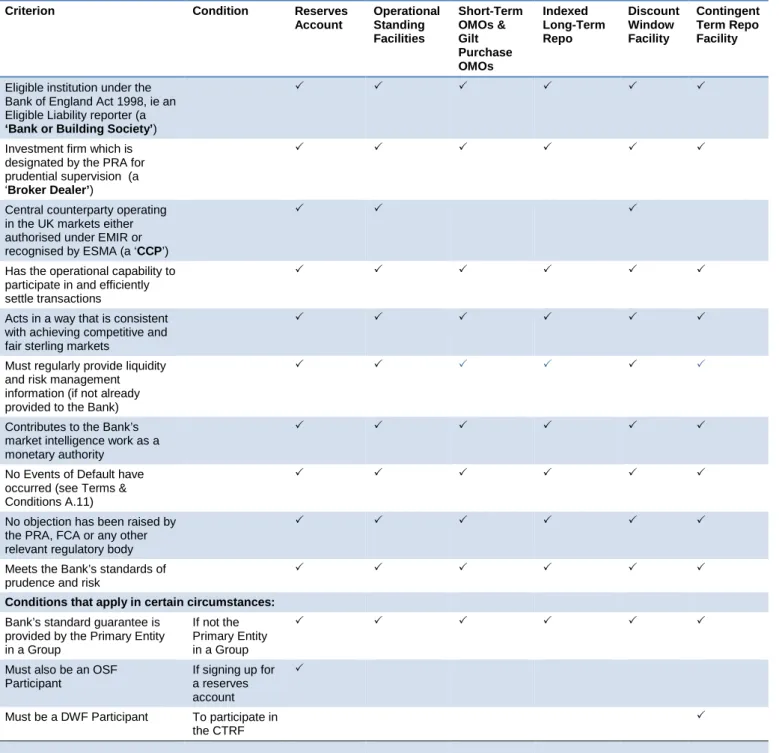
2.1 All Participants must conform to the ‘Eligibility Criteria for Participation in the Bank of England’s operations under the SMF’.5 These Eligibility Criteria are summarised in Table 1. Table 1 Summarised Eligibility Criteria for SMF Facilities
Criterion Condition Reserves Account Operational Standing Facilities Short-Term OMOs & Gilt Purchase OMOs Indexed Long-Term Repo Discount Window Facility Contingent Term Repo Facility
Eligible institution under the Bank of England Act 1998, ie an Eligible Liability reporter (a
‘Bank or Building Society’)
Investment firm which is designated by the PRA for prudential supervision (a ‘Broker Dealer’)
Central counterparty operating in the UK markets either authorised under EMIR or recognised by ESMA (a ‘CCP’)
Has the operational capability to participate in and efficiently settle transactions
Acts in a way that is consistent with achieving competitive and fair sterling markets
Must regularly provide liquidity and risk management information (if not already provided to the Bank)
Contributes to the Bank’s market intelligence work as a monetary authority
No Events of Default have occurred (see Terms & Conditions A.11)
No objection has been raised by the PRA, FCA or any other relevant regulatory body
Meets the Bank’s standards of prudence and risk
Conditions that apply in certain circumstances:
Bank’s standard guarantee is provided by the Primary Entity in a Group
If not the Primary Entity in a Group
Must also be an OSF Participant
If signing up for a reserves account
Must be a DWF Participant To participate in the CTRF
5
The full SMF Eligibility Criteria are included in the SMF Documentation, available at
4
Criterion Condition Reserves Account Operational Standing Facilities Short-Term OMOs & Gilt Purchase OMOs Indexed Long-Term Repo Discount Window Facility Contingent Term Repo Facility
Must demonstrate that they meet additional Group entity assessment criteria (see 2.3 below) If another member of the Group is a participant in that facility
Legal capacity and
enforceability opinion must be provided in relation to the applicant
If applicant is incorporated overseas
Legal capacity and
enforceability opinion must be provided in relation to the guarantor
If guarantor is incorporated overseas
= Criterion must be met
2.2 All legal entities within a Group which are eligible to act as Participants in the SMF may apply for access to the Discount Window Facility (DWF). The Bank will normally limit the number of its Participants within a Group which have access to other SMF Facilities. It will however grant more than one entity access where members of the Group are subject to the Banking Reform Act’s ring-fencing rules, and will also be willing generally to grant access to additional Group entities subject to the criteria set out in 2.3 below.
2.3 If another member of the institution’s Group has been granted access to a reserves account, Operational Standing Facilities (OSFs), Short-Term Open Market Operations (OMOs), Gilt Purchases OMOs or the Indexed Long-Term Repo (ILTR) operation and another member of the institution’s Group also wishes to apply for the same facility, then it must demonstrate to the Bank’s satisfaction that:
i) there are legal or regulatory barriers to the movement of liquidity or collateral around the Group;
ii) access to that Facility does not increase complexity in the Group’s use of the SMF facilities, in the provision of liquidity insurance or in group structures; and
iii) access to the Facility is appropriate given the relative scale and independence of the applicant institution compared to the rest of the Group.
2.4 The Bank may terminate or suspend access to a reserves account, OSFs, Short-Term OMOs, Gilt Purchase OMOs or the ILTR for additional legal entities within a Group if the
circumstances of the Group change (eg following a merger or major organisational or business change).
2.5 Eligible institutions wishing to apply for access to participate in SMF facilities should complete an application form, available to download from the Bank’s website.6
6
5
Fee Paying Institutions
2.6 Banks and Building Societies which are not required under the Bank of England Act 1998 to place Cash Ratio Deposits with the Bank – ie are not ‘CRD-payers’ - but have been granted access to one or more of the Bank’s Facilities are, along with Broker Dealers and CCPs, ‘Fee Paying Institutions’. The fee which a Fee Paying Institution pays to the Bank is the ‘Access Fee’. The Bank will review the level of the Access Fee from time to time and may amend it, any such amendment taking effect at a time specified by the Bank.
2.7 The Access Fee is calculated by category as follows: i) Bank or Building Society: £10,000 per annum
ii) Broker Dealer: an annual fee equivalent to 0.0001% of the Participant’s Total Liabilities, Total Liabilities being the average of the Participant’s total liabilities (excluding equity) reported by the Participant to the PRA under form FSA001 in the two quarters
immediately preceding the date on which the semi-annual Access Fee payment is due, as described in clause 2.10 below.
iii) CCP: £50,000 per annum.
2.8 The Access Fee will be collected by direct debit and the Fee Paying Institution will be required to complete a direct debit instruction signed by an authorised signatory and to send this to the Bank.
2.9 In the event that the Bank or the Participant are unable to set up the direct debit within the required timeframe, the Bank may allow the Participant to make a CHAPS payment of the Access Fee into an account designated by the Bank until such time as the direct debit is successfully set up.
2.10 The Access Fee will be collected from all Fee Paying Institutions in two semi-annual amounts each of half of the fee stated in or calculated under 2.7, payable in advance on 1 June and 1 December, or, if the date is not a business day, on the next business day. If on these dates, a Fee Paying Institution becomes a CRD-payer, it will not be required to pay the Access Fee. However, if on those dates, a Participant has ceased to be a CRD-payer it will become a Fee Paying Institution and will be required to pay the Access Fee.
2.11 The Access Fee for the initial six-month period in which a Fee Paying Institution is admitted to the Facilities under the SMF is payable in advance and will be pro-rated to reflect that
institution’s date of admission.
2.12 The Bank will send an advance notice to the Fee Paying Institution before the first direct debit is collected setting out the amount of the direct debit, the due date and frequency of
collections. The Bank will send further notices to the Fee Paying Institution if the amount, due date or frequency of the direct debit changes.
2.13 Fees are non-refundable, including in the event that a Fee Paying Institution merges or amalgamates with another entity or in the event of suspension or termination in accordance with clause A.9 of the Terms and Conditions.
2.14 Where a Fee Paying Institution fails to pay the Access Fee, the Bank reserves the right to suspend the Fee Paying Institution’s access to any or all of the Facilities under the SMF. If that Fee Paying Institution is a Reserves Account Participant, the Bank reserves the right to deduct the amount payable from that Fee Paying Institution’s reserves account.
6
3
Reserves Accounts
3.1 Reserves accounts are in effect sterling current accounts for Participants.
Balances, remuneration and maintenance periods
3.2 Maintenance periods7 run between one scheduled Monetary Policy Committee (MPC) decision date and the next, beginning on the day of the MPC decision and ending on the day before the next MPC announcement (normally, but not necessarily, a Thursday and a Wednesday respectively).
3.3 For Participants other than CCPs, the reserves scheme does not require Participants to hold a particular level of reserves; instead, reserves balances can be varied freely8 to meet day to day liquidity needs, for example to accommodate unexpected end of day payment flows.9
3.4 For Participants other than CCPs, the reserves balance is typically remunerated at Bank Rate. 3.5 For CCP Participants, the reserves scheme requires such Participants to hold a target average daily
balance across a maintenance period (as defined in 3.2). The expected average daily balance (“Target Balance”) for a maintenance period must be agreed between the Participant and the Bank at least two working days before that maintenance period commences.
3.6 For CCP Participants, where the actual average daily balance held during the maintenance period is greater than or equal to 99% and less than or equal to 101% of the Target Balance, the reserves balance is typically remunerated at Bank Rate. Where the actual average daily balance held during the maintenance period exceeds 101% of the Target Balance, the Bank will pay interest at Bank Rate up to 101% of the Target Balance, and at Bank Rate minus 200bps on the amount by which the actual average daily balance exceeds the Target Balance. Where the actual average daily balance is less than 99% of the Target Balance, the Bank will pay interest at Bank Rate on the actual average daily balance and in addition, will make a charge of 200bps on the shortfall between the actual average daily balance and the Target Balance. The charge will be deducted from a CCP Participant’s reserves account. Interest, paid up to and including the last day of the maintenance period, is credited directly to the Participant’s reserves account on the first day of the following maintenance period.
Accounts in RTGS
3.7 All reserves accounts are held in the Real Time Gross Settlement (RTGS) Processor, as defined in the RTGS Reference Manual.
3.8 Account holders in RTGS are also subject to the RTGS Terms and Conditions10, the Reserves Account Annex and the RTGS Reference Manual (or other agreements in relation to the operation of the account), issued separately from this Documentation.
7
A calendar of maintenance periods is available at www.bankofengland.co.uk/markets/money/schedule.htm. 8
Under the reserves averaging scheme used by the Bank between 2006 and 2009, Participants are required to set a target for their average reserves balance.
9
For further information see the Red Book at www.bankofengland.co.uk/markets/Pages/sterlingoperations/redbook.aspx. 10
The RTGS Terms and Conditions under collateral pooling are published on the Bank’s website at
www.bankofengland.co.uk/markets/Pages/paymentsystems/default.aspx. Other documentation is available to Participants on the Bank’s website.
7
Enquiry Link
3.9 Participants manage their accounts and can access information about their account balances via Enquiry Link.11
3.10 Enquiry Link is a service interface on a SWIFT Alliance WebStation.12 All Participants must be SWIFT members and subscribe to the Enquiry Link service.13 Messages between Enquiry Link and the RTGS Processor at the Bank are provided over the SWIFT network. The Enquiry Link service is available for enquiries and receiving messages throughout the RTGS Business Day (as defined in the RTGS Reference Manual), until shortly before the RTGS Processor closes.
3.11 Reserves accounts can also be funded and de-funded through use of the Bank’s OSFs (see section 4) and OMOs (see section 5). For additional information regarding RTGS payments, please refer to section 10 covering settlement.
3.12 On the final day of the maintenance period, Participants which are also CHAPS settlement banks are able to make payments to each other’s reserves accounts for a 10 minute period after the CHAPS close.14 OSFs are available to all reserves account Participants for a further 10 minute period after this additional 10 minute window, providing eligible collateral required for the operational standing lending facility is already held with the Bank.
CHAPS and CREST Settlement Banks
3.13 Reserves account Participants that are CHAPS settlement banks use their reserves account for CHAPS settlement.15 CREST settlement banks have a separate account in RTGS for CREST settlement. CHAPS and CREST settlement banks use the Enquiry Link service for managing their settlement accounts.
3.14 CHAPS or CREST settlement banks whose reserves accounts are likely to be overdrawn at the end of the day may apply to use the operational standing lending facility. In the event that they are overdrawn at the end of the day, overdrafts on individual days during the maintenance period are charged at 2% plus Bank Rate. There is a minimum charge of £500. The overdraft charge is deducted from the account on the next RTGS business day.
3.15 The RTGS tariff continues to apply to CHAPS and CREST settlement banks’ RTGS accounts and is described in the RTGS Reference Manual.
11
Under the reserves averaging scheme, Participants also input their target average balance via Enquiry Link. 12
The Bank is introducing a new Enquiry Link Browse service. Connection will be through either SWIFT Alliance Webplatform or Alliance Lite 2.
13
The Enquiry Link Security Code of Conduct, which describes the security standards applicable to the service, also applies to Reserves Account Participants. The Reserve Accounts User Guide provides a detailed description of the operation of reserve accounts in RTGS.
14
Cut-off times for CHAPS and CREST are set out on the Bank’s website at
www.bankofengland.co.uk/markets/Pages/money/reserves/default.aspx. 15
A guide to Bank of England Settlement Accounts is published on the Bank’s website, available at
8
Participants which are not CHAPS Settlement Banks
3.16 For non-CHAPS members, reserves accounts can be funded via CHAPS payments, either from a CHAPS settlement bank or from the Bank of England (see 3.10). Participants must ensure that incoming CHAPS payments are addressed to the Bank of England ‘RT’ CHAPS membership for the credit of their reserves account.
3.17 Non-CHAPS members’ reserves accounts can be de-funded via Enquiry Link, to generate a CHAPS payment to a single pre-defined account (usually at their CHAPS settlement bank), as notified to the Bank in writing as a standard settlement instruction.
3.18 Enquiry Link is available for de-funding throughout the CHAPS Day. Timings for funding may be subject to any restrictions imposed by CHAPS settlement banks.
3.19 Non-CHAPS members are not able to make payments from their reserves accounts of greater size than the balance on the account. If a de-funding payment is entered for more than the current balance on a reserves account, the payment will be queued awaiting incoming funds and cancelled at the end of the day if no funds are forthcoming.
9
4
Operational Standing Facilities
4.1 The Operational Standing Facilities (OSFs) provide a means for Participants to manage unexpected
‘frictional’ payments shocks which may arise due to technical problems in Participants’ own systems or in the market-wide payments and settlements infrastructure.16
4.2 The operational standing lending facility is provided via collateralised overnight lending against the Bank’s Level A collateral set. The operational standing deposit facility is provided as an unsecured overnight deposit.
Rates
4.3 The OSF rates establish a corridor around Bank Rate and help limit volatility in overnight market interest rates. This corridor is usually symmetric and the rates are reset at the start of each maintenance period and announced alongside the MPC decision.17
4.4 On MPC decision days18 the OSFs are charged using the Bank Rate set at 12.00 pm (noon) that day even if the request or transaction takes place before then.
Requesting OSF Transactions
4.5 OSFs are available to Participants on demand throughout the day, subject to timing constraints imposed by settlement and payment system deadlines. Cut-off times for delivery of cash and securities are set out on the Bank’s website.19
4.6 Participants requesting use of the OSFs must contact the Bank’s sterling dealing desk via telephone. OMO Participants should use their direct telephone line, unless otherwise agreed by the Bank. OSF Participants without a direct line should contact the Bank’s sterling dealing desk on 020 7601 5000. The Bank’s sterling dealing desk will then call Participants back on a landline telephone number which has been pre-authorised on behalf of the Participant by one or more authorised signatories, to authenticate requests and confirm the amount.
4.7 The Bank will seek to satisfy itself that use of the OSFs is consistent with the purpose of the OSFs.
16
See the Red Book for further details, available at
www.bankofengland.co.uk/markets/Pages/sterlingoperations/redbook.aspx. 17
The current OSF rates are published on the Bank’s website at
http://www.bankofengland.co.uk/markets/Pages/money/osf/default.aspx. 18
In the event of an unscheduled MPC meeting, the approach outlined in paragraph 12.4 will be applied. 19
10
5
Open Market Operations
Open Market Operations currently in operation and suspended
5.1 Participants in Open Market Operations (OMOs) must be either a Bank or Building Society or a Broker Dealer.
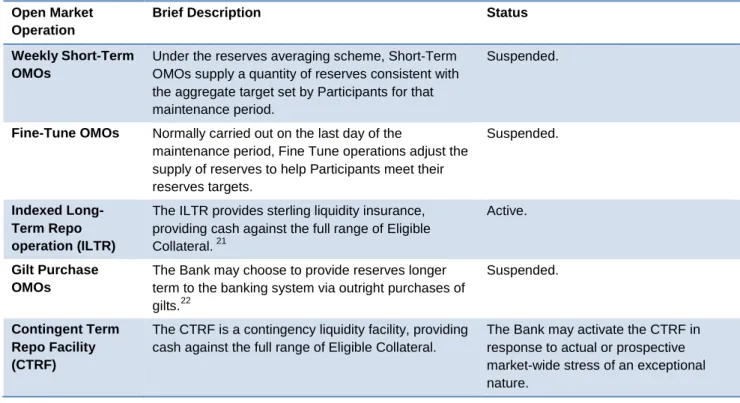
5.2 The SMF includes a number of OMOs, not all of which are currently active. The status of each of these is summarised in Table 2 below and in a table on the Bank’s website.20
Table 2 OMOs currently in operation and suspended Open Market
Operation
Brief Description Status
Weekly Short-Term OMOs
Under the reserves averaging scheme, Short-Term OMOs supply a quantity of reserves consistent with the aggregate target set by Participants for that maintenance period.
Suspended.
Fine-Tune OMOs Normally carried out on the last day of the
maintenance period, Fine Tune operations adjust the supply of reserves to help Participants meet their reserves targets.
Suspended.
Indexed Long-Term Repo operation (ILTR)
The ILTR provides sterling liquidity insurance, providing cash against the full range of Eligible Collateral. 21
Active.
Gilt Purchase OMOs
The Bank may choose to provide reserves longer term to the banking system via outright purchases of gilts.22
Suspended.
Contingent Term Repo Facility (CTRF)
The CTRF is a contingency liquidity facility, providing cash against the full range of Eligible Collateral.
The Bank may activate the CTRF in response to actual or prospective market-wide stress of an exceptional nature.
5.3 The ILTR and CTRF are described in more detail in sections 5A and 5B. These SMF Operating Procedures will be updated for the other operations once they are re-activated.
Conducting Open Market Operations via Btender
5.4 The timetable for the Bank’s OMOs and a summary of the parameters of each operation are published on the Bank’s website.23
5.5 The Bank conducts OMOs via its electronic trading system, Btender.24
20
A summary of the parameters of each of the Bank’s operations is available at
www.bankofengland.co.uk/markets/Pages/sterlingoperations/default.aspx. 21
See section 7 on Collateral Eligibility for more detail. 22
These are separate from Asset Purchase Facility gilt purchases undertaken by the Bank as part of Quantitative Easing.
23
The OMO timetable is available at www.bankofengland.co.uk/markets/money/schedule.htm. 24
11
5.6 The start and end times for each OMO are set out in the Btender system shortly ahead of the
operation and are available, for information, in the Bank’s wire services announcements. Bids may be submitted once the operation begins in Btender. Bids must be received by the Bank prior to the close time for the operation.
5.7 The time stamp applied to any bid in accordance with these SMF Operating Procedures is final and binding. Participants should note that it may take some seconds for bids to be received at the Bank’s server after being input. A countdown timer is provided in the Btender system to assist users.
5.8 It is the responsibility of Participants using Btender to ensure that access rights to Btender are assigned appropriately within their organisations. The Bank does not accept any liability for loss or damage, whether direct, indirect or consequential resulting from the use of, or inability to use, Btender.
5.9 Participants may cancel or amend bids using the Btender system at any point up to the close of the operation. Bids which are submitted as at the close of the operation are irrevocable. By submitting a bid a Participant is committed, if its bid is accepted, to entering into OMO transactions up to the amount specified in the bid, the details of those transactions being determined in accordance with the procedures described below.
5.10 Participants may neither bid through, nor discuss their bids with, any third parties.
5.11 Participants should access their individual allocations via the results screen in the Btender system to confirm whether the full value of their bid has been accepted or, if not, what amount of their bid has been accepted. Should Btender not be available, the Bank would call each Participant by telephone to confirm allocations.
5.12 In the event of a dispute, reference may be made to the Btender system archive or recordings of telephone conversations.
5.13 Notwithstanding any provision in these SMF Operating Procedures, the Bank reserves the right to accept individual bids in full, in part and in any amounts determined by the Bank at its sole discretion, and to reject individual bids.
5.14 For security and contingency purposes, the Bank requires OMO Participants to install and maintain a designated direct line into the Bank’s sterling dealing desk. At its sole discretion, the Bank may agree to waive this requirement where it proves operationally challenging and disproportionately costly for the Participant. In these instances, the Participant would need to provide assurance that it accepts the risk that its participation in some of the Bank’s operations may be restricted in the event that access to Btender is not available for an Open Market Operation, and must provide a landline telephone number, pre-authorised on behalf of the Participant by one or more authorised signatories, which the Bank will use to call back to authenticate telephone bids. The caveats associated with telephone bids more generally are further explained in section 12A.
12
5A
Indexed Long-Term Repo operations
5.15 The regular monthly market-wide Indexed Long-Term Repo (ILTR) operations provide liquidity insurance for Participants with a predictable need for long-term liquidity. They allow Participants to bid for reserves against Level A, B or C collateral.25
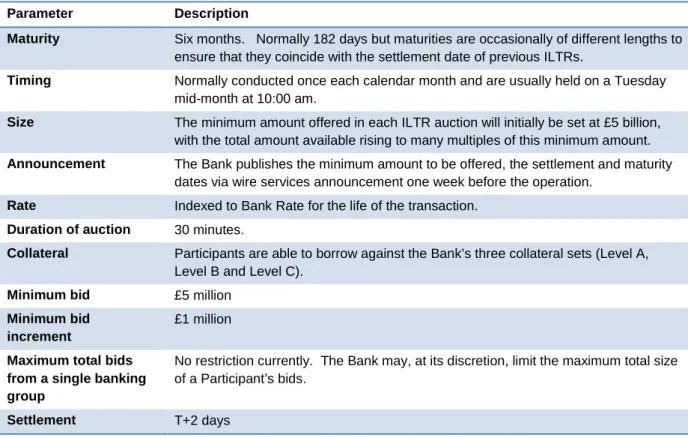
5.16 The key parameters of the operation are set out in Table 3 below, and are also available on the Bank’s website.26 The Bank will keep all ILTR parameters under review.
Table 3 Parameters currently applicable for the ILTR
Parameter Description
Maturity Six months. Normally 182 days but maturities are occasionally of different lengths to ensure that they coincide with the settlement date of previous ILTRs.
Timing Normally conducted once each calendar month and are usually held on a Tuesday mid-month at 10:00 am.
Size The minimum amount offered in each ILTR auction will initially be set at £5 billion, with the total amount available rising to many multiples of this minimum amount. Announcement The Bank publishes the minimum amount to be offered, the settlement and maturity
dates via wire services announcement one week before the operation. Rate Indexed to Bank Rate for the life of the transaction.
Duration of auction 30 minutes.
Collateral Participants are able to borrow against the Bank’s three collateral sets (Level A, Level B and Level C).
Minimum bid £5 million Minimum bid
increment
£1 million
Maximum total bids from a single banking group
No restriction currently. The Bank may, at its discretion, limit the maximum total size of a Participant’s bids.
Settlement T+2 days
Interest
5.17 The interest charged on each ILTR transaction will be calculated on a daily basis, using the
applicable interest rate that day. The interest rate will be the sum of Bank Rate at close of business that day plus the clearing spread (see 5.18) for the respective collateral set in the auction. The total interest payable over the life of the ILTR transaction will be the sum of these daily interest accruals.
Participation
5.18 Participants may choose to submit any number of bids against Level A, Level B or Level C collateral. Participants should bid by submitting a nominal amount and a spread to Bank Rate expressed in whole basis points. Bids will be subject to a minimum bid spread, as outlined in the Market Notice.27
25
See the Red Book for further details, available at
www.bankofengland.co.uk/markets/Pages/sterlingoperations/redbook.aspx. 26
A summary of the Bank’s current operations in the sterling money markets is available at
www.bankofengland.co.uk/markets/Pages/money/default.aspx. 27
13
The Bank does not set plausibility limits in Btender for the ILTR operations; Participants may do so individually.
Allocation
5.19 The auction’s pricing mechanism uses a so-called uniform-price format, in which every successful bidder pays the lowest accepted spread (the ‘clearing spread’) for borrowing against a specific collateral set.
5.20 The clearing spread for each collateral set is determined in the auction based on the pattern of bids received and the Bank’s preferences for supplying funds across collateral sets and in aggregate. For each collateral set, bids are ranked in descending order of their bid spread. Bids at the highest spread are accepted first, followed by bids at successively lower spreads until the Bank’s
pre-determined supply preferences have been met. Bids above the clearing spread will be fully allocated and bids at the clearing spread may be scaled back, ie allocated 0%-100% of the bid amount, rounded down to the nearest allocation increment, currently £0.1 million.
5.21 The auction is designed to be flexible. Two automatic responses are built into each ILTR operation. First, a greater proportion of funds is lent against a particular collateral set as the clearing spread for that collateral set increases relative to the other collateral sets. Second, a greater total quantity of funds is made available as the pattern of bids observed in the auction suggests a greater demand for liquidity insurance.
5.22 The Bank will offer some funds against each collateral set in each ILTR operation at the minimum bid spreads to Bank Rate and will offer more funds as the clearing spreads rise. The minimum aggregate amount offered in each ILTR auction will initially be set at £5 billion, with the total amount available rising to many multiples of this minimum amount.
5.23 The Bank aims to announce the result of each operation at 10.40 am on the day of the operation on the Bank’s wire services pages, or as soon as possible thereafter. The results detail the amount bid and the amount allocated for the operation in aggregate and the amount bid, amount allocated and the clearing spread to Bank Rate for each collateral set.
14
5B
Contingent Term Repo Facility
5.24 The Contingent Term Repo Facility (CTRF) is a contingent liquidity facility that allows the Bank to provide liquidity against Level A, Level B and Level C collateral at any time, term and price it chooses, in response to actual or prospective exceptional market-wide stress.
5.25 The terms of the CTRF are set by the Bank each time it is deployed. Its contingent nature means the Bank will announce its activation and the supporting operational details, including the size, term, frequency and price, via a Market Notice.28 The sections below therefore provide summary
information only.
5.26 The Bank will publish the settlement and maturity dates on the business day preceding the auction, normally at 4.00 pm. This information will be set out in Btender and will also be available on the Bank’s wire services pages.
Interest
5.27 The interest charged on each CTRF transaction will be calculated on a daily basis, using the applicable interest rate that day. The interest rate will be the sum of Bank Rate at close of business that day plus the clearing spread in the auction. The total interest payable over the life of the CTRF transaction will be the sum of these daily interest accruals.
Participation
5.28 Bids should be submitted via Btender where possible. Participants should bid by submitting a nominal amount and a spread to Bank Rate expressed in whole basis points. The Bank does not set plausibility limits in Btender for CTRF transactions; Participants may do so individually.
5.29 Participants without access to Btender should submit bids via telephone to the Bank’s sterling dealing desk via direct lines or on 020 7601 5000. Participants who submit multiple bids via telephone must also provide the weighted average spread of those bids to three decimal places.
Allocation
5.30 CTRF auctions operate under a variable rate, uniform-price format, in which every successful bidder pays the lowest accepted spread (the ‘clearing spread’).
5.31 Bids are ranked in descending order of the spread bid. Bids at the highest spread are accepted first, followed by bids at successively lower spreads until the auction is fully allocated or bids received are exhausted. Bids at the clearing spread may be scaled down on a pro rata basis and rounded down to the nearest allocation increment.
5.32 The Bank will announce the result of each operation on the Bank’s wire services. The Bank will publish the total value of funds allocated and the clearing spread to Bank Rate in the result announcement.
28
15
6
Discount Window Facility
6.1 The Discount Window Facility (DWF) is a bilateral on-demand facility designed to address short-term liquidity shocks.
6.2 DWF Transactions involve the transfer of DWF Swap Securities by the Bank on the DWF Transaction Date and the transfer of securities equivalent to such DWF Swap Securities by the Participant on the Termination Date.
6.3 DWF Swap Securities normally comprise gilts. The Bank may designate other securities as DWF Swap Securities and it may agree to lend sterling cash in place of securities in some circumstances, for example if government bond repo markets fail to function properly, or for smaller counterparties. 6.4 Eligible Collateral consists of:
i) In the case of a Bank or Building Society or a Broker Dealer, collateral from the Bank’s three collateral sets: Level A, Level B and Level C.
ii) In the case of CCPs, collateral from the following two of the Bank’s collateral sets; Level A and Level B.
6.5 The DWF is not a facility to obtain particular gilts, for example those trading ‘special’ in the repo market. That would be contrary to the purpose of the DWF and could interfere with HM
Government’s debt management objectives, which are the responsibility of HM Treasury and the UK Debt Management Office.
6.6 Participants are not permitted to borrow gilts from the DWF simply to use them in the operational standing lending facility in order to obtain cash against eligible collateral. That would be contrary to the purpose of the OSFs, which is to give Participants a means to manage short-term frictional problems in the payment systems and overnight money markets. However, gilts borrowed in the DWF may be used as collateral in the Bank’s Open Market Operations.
6.7 DWF Transactions typically terminate 5 calendar days (for CCPs) or 30 calendar days (for Banks and Building Societies and Broker Dealers) after they are entered into, where applicable rolled back to the preceding sterling business day, but the Bank at its discretion may offer other maturity terms. The Participant or the Bank may terminate a DWF Transaction at any time subject to giving the requisite notice in accordance with the Terms and Conditions.
6.8 Participants may apply to roll an outstanding DWF Transaction from its maturity date. This will be at the discretion of the Bank. A rolled DWF Transaction will have the same terms as the earlier DWF Transaction except with regards to the Termination Date, which will be 5 calendar days (for CCPs) or 30 calendar days (for Banks and Building Societies and Broker Dealers) from the last Termination Date or such other date as the Bank may agree.
Fee for Banks and Building Societies
6.9 For Banks and Building Societies, the DWF Swap Fee payable on use of the DWF varies according to the level of collateral and the total stock of borrowing by the Participant relative to the aggregate six-monthly average of sterling Eligible Liabilities (ELs) of all entities in the Group, as used in the most recent payment calculation to determine the level of CRDs required to be held at the Bank. 6.10 The DWF Swap Fee accrues daily, dependent on the type of collateral and total stock of borrowing
from the DWF on that day. For drawings of gilts, the stock of borrowing is the total market value of gilts outstanding under the DWF. For any drawings of sterling cash permitted by the Bank, the stock of borrowing is the nominal value of borrowed cash.
16
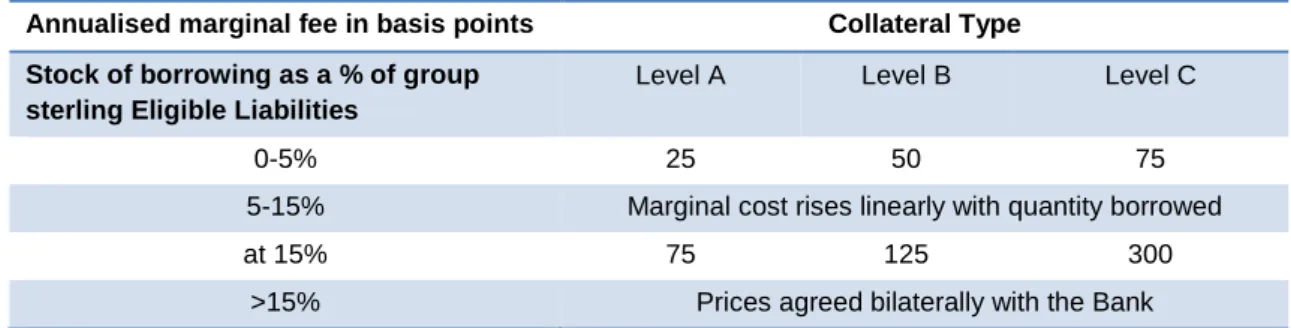
6.11 The table below sets out how the DWF Swap Fee relates to the size of drawing and Level of collateral used. For drawings of up to 5% of a Group’s ELs, the Bank charges a flat fee. For drawings above 5% and up to 15% of ELs, the marginal fee (ie the fee on a particular unit of borrowing) increases linearly for each 0.1% increase in the size of the drawing relative to the Group’s ELs. The Bank will discuss very large drawings, above 15% of ELs, with Participants on a bilateral basis. Table 4 below shows the marginal fee for DWF drawings at various percentages of a Group’s ELs.
Table 4 DWF Swap Fee matrix
Annualised marginal fee in basis points Collateral Type Stock of borrowing as a % of group
sterling Eligible Liabilities
Level A Level B Level C
0-5% 25 50 75
5-15% Marginal cost rises linearly with quantity borrowed
at 15% 75 125 300
>15% Prices agreed bilaterally with the Bank
6.12 For example, applying the above marginal fees to a drawing of 15% ELs against Level C gives an average fee (ie the average fee across the total drawing) of 151 bp, reflecting the 75 bp fee for the first 5% of ELs, which rises linearly up to 300 bp for the marginal £1 at 15% of ELs. The indicative DWF Swap Fee for any size of DWF drawing can be found on the Bank’s website by using the DWF illustrative pricing spreadsheet.29
6.13 For drawings of sterling cash permitted by the Bank, the DWF Swap Fee is indexed to Bank Rate plus the fees set out in Table 4.
Fee for Broker Dealers and CCPs
6.14 For Broker Dealer Participants, the DWF Swap Fee payable on use of the DWF varies according to the level of collateral posted, and the total stock of borrowing by the Participant. For CCP
Participants, the DWF Swap Fee payable on use of the DWF varies according to the level of
collateral posted. The fee for a specific drawing will be agreed bilaterally with the Bank at the time of the drawing.
Fee arrangements – all Participants
6.15 DWF Swap Fees are rounded to the nearest penny.
6.16 The DWF Swap Fee is applied to the total stock of borrowing at the end of each day. In calculating the fee, the Bank assumes that for mixed buckets of collateral (where total drawings are against collateral from more than one Level) the collateral from the Level which equates to the lowest fee is used first.
6.17 Where a Participant substitutes Collateral, the DWF Swap Fee will be adjusted if necessary in accordance with the fee structure.
29
The DWF illustrative pricing spreadsheet is available at
17
6.18 Details of accrued and estimated future DWF Swap Fees are available from the Bank each day. 6.19 The DWF Swap Fee is payable in arrears on the first business day of each calendar month or on the
maturity of the final outstanding drawing on the DWF if earlier. The DWF Swap Fee payable then is equal to the total of daily fees incurred since the start of each calendar month.
6.20 The Bank may vary the DWF Swap Fee at its discretion.
6.21 If the Adjusted Values of Collateral and additional Eligible Collateral are below the market value of DWF Swap Securities on any day, the balance will be charged:
i) For Banks and Building Societies: as Level C, as described in 6.9-6.14. ii) For Broker Dealers and CCPs: as agreed bilaterally with the Bank.
6.22 If the Participant fails to pay the DWF Swap Fee when due, it will pay interest on the unpaid amounts in accordance with the Terms and Conditions.
Conducting the Transaction
6.23 Participants considering use of the DWF should discuss this with the Bank at an early planning stage. Requests for a DWF Transaction should be initiated by telephoning the Bank’s sterling dealing desk as early as possible (via direct line or 020 7601 5000) to maximise the chance of the drawing settling on the same day.
6.24 A Participant can request a DWF Transaction by completing a DWF Transaction Notice30 and submitting it by one of the methods set out below:
i) by email to [email protected]; or
ii) delivery by hand, registered post or recorded delivery to Bank of England, Threadneedle Street, London EC2R 8AH marked urgent for the attention of the Head of Sterling Markets Division. 6.25 The DWF Transaction Notice should specify the aggregate market value of DWF Swap Securities
the Participant would like to receive in sterling. Depending on the time received, delivery of DWF Swap Securities will take place same day on a reasonable endeavours basis, or the following business day. Participants may use a combination of securities and loans as collateral if they wish.
Acceptance of a request
6.26 Following receipt of a DWF Transaction Notice, the Bank will inform (typically by telephone) the Participant whether it will enter into the DWF Transaction on the terms specified in the DWF
Transaction Notice. It will also confirm the anticipated amount of the DWF Swap Fee over the life of outstanding DWF Transactions.
6.27 Notwithstanding any other provision of these SMF Operating Procedures, the Bank reserves the right to reject any request to enter into a DWF Transaction. The Bank also reserves the right to cancel a DWF Transaction before settlement.
30
18
7
Collateral Eligibility
7.1 The Bank accepts collateral from three collateral sets31:
i) Level A comprises certain high-quality sovereign securities which are liquid in all but the most extreme circumstances.
ii) Level B comprises high-quality liquid collateral, including other sovereign supranational, mortgage and corporate bonds.
iii) Level C comprises less liquid securitisations, own-name securities and portfolios of loans. 7.2 The Bank will confirm on application the collateral level into which a particular security is placed.
The Bank will discuss bilaterally with each Participant any preferences the Bank has over the order in which Eligible Collateral should be used in the Bank’s facilities.
7.3 Participants should advise the Bank if at any time they become aware of information that may affect the eligibility of any collateral delivered to the Bank.
7.4 The Bank forms its own independent view of the risks in the collateral it takes in its operations and reserves the right to reject any security offered or loan provided as collateral, for any reason, at any time.
Collateral Securities – Eligibility
7.5 Level A securities will not become eligible unless and until they are detailed in a list published on the Bank’s website.32
7.6 For the other collateral sets, Participants can confirm security eligibility directly with the Bank. Lists of collateral securities to be checked for eligibility should be submitted to the following email address [email protected]. The lists should be accompanied by a formal assurance of compliance with the criteria as specified on the Bank’s website33 from time to time.
7.7 If a Participant opts to use the Collateral Management Portal (CMP), eligibility can be checked using the CMP. A list of collateral securities can be submitted, and if the security has previously been assessed by the Bank, the CMP will return a definitive result. If the security has not been assessed previously, Participants will need to contact the Bank via email as set out in paragraph 7.6 above. 7.8 Participants have a responsibility to ensure collateral securities comply with the Bank’s eligibility
criteria. Only securities which the Participant believes to be eligible, or expects to become eligible, should be delivered to the Bank.
7.9 Should a security be downgraded by a credit rating agency, the Bank would normally seek to understand the circumstances of the downgrade before determining whether that meant any change to the security’s eligibility.
7.10 Collateral Securities can be delivered to the Bank by the methods set out in section 9.
31
Definitions of these sets are available at www.bankofengland.co.uk/markets/Pages/money/eligiblecollateral.aspx. 32
A list of Level A collateral eligible securities is available at
www.bankofengland.co.uk/markets/Pages/money/eligiblecollateral.aspx. 33
19
Loan Collateral – Eligibility and Pre-positioning
7.11 Portfolios of loans are eligible as collateral in certain Bank facilities (including the ILTR, DWF and CTRF), provided they are pre-positioned with the Bank in advance of transactions. The eligibility criteria for individual loans are defined on the Bank’s website.34
7.12 Pre-positioning cannot take place until the loan portfolio eligibility approval process has been
completed, and the Bank has made a decision that the Participant and the loan portfolio are eligible. 7.13 The eligibility review process involves a review of the Participant’s lending practices, policies,
procedures and controls including a due diligence questionnaire and site visit; a legal review of the loans, including a legal sampling exercise; the provision of a loan level data tape in a format agreed by the Bank; and a data audit to provide assurance on the accuracy and integrity of the data on which the Bank bases its risk management. The review process will be repeated from time to time. Full details of the Participant and loan portfolio eligibility process can be found in a guide to Loan Collateral Pre-positioning, which is available on request from [email protected]. 7.14 Upon satisfactory completion of the documentation, the Bank will confirm to the Participant that the
loan portfolio is eligible, and will inform them of the unique identifier that should be used in all subsequent correspondence.
7.15 Pre-positioning is concluded by the Participant submitting a Pre-positioning Notice35 to
[email protected], summarising all loan portfolios to be pre-positioned, specifying nominal values and the loan portfolio’s unique identifier that the Bank has previously assigned to it. 7.16 There is an ongoing requirement that the Participant should inform the Bank of any significant
changes that might impact the Bank’s view of the Participant’s eligibility. 7.17 Loans written under Scottish Law need to be held in a separate loan portfolio.
7.18 Pre-positioned loan portfolios are still owned by the Participant and can be used as the Participant wishes prior to drawing against the portfolio as collateral, at which point they would be transferred to the Bank using the agreed transfer mechanism.
7.19 While a loan portfolio is pre-positioned (ie before it is transferred to the Bank), a Participant is permitted to remove individual loans from a portfolio and add additional loans into a portfolio. To effect changes to the loans in a portfolio, Participants are required to submit a new loan level data tape. The Bank reserves the right to carry out further due diligence and the eligibility of the loan portfolio may be reassessed. Further legal due diligence will be required for loans added to a portfolio that use loan documentation that is different from that which is reviewed as part of the initial legal due diligence carried out as part of the loan portfolio eligibility process. Normally the Bank would expect the loans in a pre-positioned portfolio to be changed no more frequently than monthly, but at its discretion may allow for additional changes to be made. Loans that have repaid can be removed from the pool whilst such loans are pre-positioned.
7.20 Loan portfolios which have been transferred to the Bank may only be topped up in certain circumstances, and Participants should discuss this bilaterally with the Bank.
34
www.bankofengland.co.uk/markets/Pages/money/eligiblecollateral.aspx 35
20
Loan Collateral – Data requirements and disclosure
7.21 Subject to section 7.22, the Bank will not disclose Loan Level Data (as defined in 7.23 below) which could otherwise be disclosed under clause A.16.3(a) or (b) of the Terms and Conditions unless such data has first been aggregated and anonymised so that the recipient of such Loan Level Data would not be able to ascertain to whom such data relates.
7.22 The Bank may disclose Loan Level Data which has not been aggregated or anonymised in accordance with clause A.16.2 of the Terms and Conditions or if legal title to the mortgage loan to which such Loan Level Data relates has been transferred to the Bank.
7.23 Loan Level Data means, in relation to each mortgage loan, the primary and secondary income of the borrower, start date and maturity date of the loan, the postcode and/or region of the property, the original and latest valuation of the property, the property type and the credit score of any borrower and any borrower identification. Information is required on a regular basis to enable ongoing
monitoring and valuation of the loan portfolio once pre-positioned. Where applicable, the information requirements will be consistent with the Bank’s ABS loan-level reporting requirements, but more granular in some areas (e.g. full start and maturity dates of loans rather than quarters).
7.24 The Bank requires weekly reporting of nominal loan balances. The Bank is willing to consider pre-positioning portfolios in instances where Participants are only able to provide balances on a monthly basis, but additional Haircuts will apply, at its own discretion.
21
8
Daily Management of Positions
8.1 The Bank operates a collateral pooling model to support its official operations. Under this model, each Participant maintains one or more collateral pools of securities and loans, to cover the exposures the Bank has to that Participant. The collateral is not earmarked against individual transactions. Instead, subject to the application of the Bank’s risk controls, the aggregate Adjusted Value of the collateral held in each pool will be used to collateralise the aggregate value of the Bank’s exposure(s) to that Participant managed in that pool. 8.2 Security settlement movements and the associated back-office processes are reduced to
those instances where a Participant needs to supply more collateral to cover the Bank’s aggregate exposure to them (e.g. in the case of a valuation change leading to a call for additional Eligible Collateral), or where the Participant requests the return of individual securities (e.g. when there is excess collateral which is over and above the value of exposures).
Collateral pools
8.3 Under the Bank’s collateral pooling model, each Participant will maintain one main collateral pool, with further sub-pools (subject to their participation in the Bank’s operations), as illustrated in Figure 1.
Figure 1 Simplified illustration of the Bank’s collateral pooling model
8.4 Collateral held in a Participant’s main collateral pool can currently be used to collateralise the following operations:
i) Short-Term OMOs and Fine-Tune OMOs; ii) Operational standing lending facility; iii) Indexed Long-Term Repo operations;
Collateral movements managed by the Bank on behalf of the Participant Movement of Collateral Securities into and out of the main collateral pool Movement of Loan Collateral into and out of the pre-positioned pool
Participant
Main collateral pool Pre-positioned pool
for loan collateral
DWF pool
FLS pool
Pools shown within the blue box can be viewed using the Collateral Management Portal. Loan collateral will be added to the pre-positioned pool once it has been approved. Movements to and from the FLS pool are managed, and reports provided, via email.
22 iv) Contingent Term Repo Facility;
v) Intra-day Liquidity (IDL) provided to RTGS settlement banks for CHAPS settlement; and vi) Notes Circulation Scheme exposures.
8.5 Where a Participant is also a CHAPS settlement bank, eligible excess Level A collateral in the main collateral pool (ie that which is over and above the amount required to cover the Bank’s exposure to the Participant) is used to generate intraday liquidity (IDL) within RTGS up to an agreed limit. This functionality is described in the RTGS Reference Manual.36
8.6 To ensure Participants can participate efficiently in the Bank’s operations, they are strongly encouraged to hold collateral in the main collateral pool with an Adjusted Value sufficient to back all existing and any new exposures that they expect to arise as a result of current and planned participation in the Bank’s operations.
8.7 A separate collateral pool is used to collateralise exposures arising from DWF transactions. 8.8 The ‘Pre-positioned pool for loan collateral’ is for loans which meet the Bank’s collateral
eligibility requirements but have not yet been used to cover any transactions. Once a loan from the pre-positioned pool has been encumbered, the Bank will transfer it to the main collateral pool for use.
8.9 The Funding for Lending Scheme (FLS) collateral pool operates in the same way as the other collateral pools listed above. It is, however, not currently possible to view or manage
positions within the FLS pool using the CMP, but the intention is that this will be possible in due course.
8.10 The FLS Documentation is available on the Bank’s website.37 For movements between the main collateral pool (or the loan pre-positioned pool) and the FLS collateral pool, the relevant FLS template confirmations should be completed and submitted as per the FLS Operating Procedures. Correct completion of the FLS template confirmations will be sufficient for the Bank to complete the internal movements.
Collateral transfers into or out of the pools
8.11 At a high level, collateral pooling operates as follows:i) Collateral securities must first be delivered into the main collateral pool. A Participant is able to add or remove collateral from its main collateral pool at any time, subject to the deadlines of the relevant Securities Settlement System (SSS), Custodian or
(International) Central Securities Depository ((I)CSD) and subject to any exposures in the main or DWF pools being covered and there being no cash amounts owing to the Bank. ii) Only the Bank can instruct movements into and out of the DWF pool, having first agreed
them with the Participant.
iii) A Participant can only withdraw securities via the main collateral pool. Securities that have been moved to a different pool will need to be transferred back to the main collateral pool before they can be withdrawn. There must be sufficient excess collateral, after the
36
The RTGS Reference Manual is available to Participants on the Bank’s website. 37
23
Bank has re-valued the collateral, to allow a withdrawal of securities.
iv) Loan collateral is held in a pre-positioned pool, which is separate to a Participant’s main collateral pool. The Bank controls movements of loan collateral between the
pre-positioned pool and main DWF and FLS collateral pools. Once the beneficial or equitable transfer of the loan collateral has been completed a Participant can use some or all of that loan collateral to cover exposures in another pool.
v) Each pool operates in the same way, but there may be different risk controls in place depending on the operations it covers. Any exceptions are described within these SMF Operating Procedures.
Methods for moving collateral to or from pools
8.12 There are four methods for Participants to use when instructing the Bank to effect movements of collateral between pools.
i) The Collateral Management Portal (CMP). The CMP can be used to instruct the delivery
or removal of collateral securities to or from the main collateral pool. A Participant is able to monitor positions of securities and loan collateral and check the eligibility of collateral securities. A description of the full functionality of the CMP can be found in the CMP User Guide.38 Participants that sign up to use the CMP will be subject to a fee, as set out in section 8.15 below.
ii) SWIFT. The Bank has adopted a range of ISO 15022 compliant messages to allow
Participants to instruct deliveries of collateral securities to or from the main collateral pool. Any Participant wishing to use this option should contact [email protected] to discuss the preparation and testing required.
iii) Secure email. Participants who have not signed up to the CMP or do not have access to SWIFT may move collateral securities by submitting a confirmation form39 via secure email.
iv) Loan collateral. When a loan portfolio is first encumbered, instructions to transfer loan
collateral from the pre-positioned pool to the main collateral pool should be sent via secure email to the Collateral Management and Custody Team
[email protected] using a confirmation spreadsheet (see section 9.24 to 9.28). If loan collateral is already encumbered then instructions to move it between pools should also be detailed in the confirmation spreadsheet and sent via secure email to the same address.
8.13 Participants will be required to quote the Securities Account number of the destination collateral pool on all instructions to the Bank. The account number of the (I)CSD/SSS should not be quoted.
8.14 It is the responsibility of Participants using CMP to ensure that access rights to CMP are assigned appropriately within their organisations. The Bank does not accept any liability for loss or damage, whether direct, indirect or consequential resulting from the use of, or inability
38
The CMP User Guide will be supplied directly to Participants by the Bank. 39
24 to use, CMP.
8.15 The annual fee for using the CMP will follow a tiered structure based on the market value of a Participant’s average monthly holdings of collateral (both securities and loans) over the previous year. Charges for the first year are set out in Table 5.
Table 5 CMP fee structure
Tier Average monthly holdings £ billion Annual charge £ A >30 12,000 B 10 – 30 8,000 C 1 – 10 4,000 D < 1 1,000
8.16 The CMP fee will be invoiced on 1 April each year, with the first fee being charged shortly after go-live and pro-rated, and will be reviewed annually.
Regulatory reporting and encumbrance
8.17 Securities delivered to the Bank are held under the terms of a collateralised loan structure with collateral provided by way of outright title transfer.
8.18 Loan portfolios pre-positioned with the Bank continue to be owned by the Participant prior to their transfer to the Bank. Once transferred using the agreed transfer mechanism, the Bank will have either equitable ownership or beneficial interest under a trust. Legal title to the loans will remain with the Participant until such time as there is an event of default and the Bank decides to perfect and enforce its security interest over the loans.
8.19 SMF Participants and RTGS account holders may be subject to Chapter 12 of the Prudential Regulatory Authority (PRA)’s Prudential sourcebook for Banks, Building Societies and Investment Firms (BIPRU 12).40
8.20 The PRA regards as encumbered any asset that the firm has provided as collateral. In general assets that have been used as collateral should not be included in the firm’s liquid assets buffer. However, excess collateral held by a participant in the collateral pools may be regarded as unencumbered by the PRA if it meets the requirements of the BIPRU rules relating to the eligibility of collateral held with central banks and so could be available for Participants to count as part of their liquid assets buffer. The Participant should confirm with the PRA how their collateral should be treated in their liquid assets buffer.
8.21 If a Participant makes a DWF drawing, the collateral posted in respect of that DWF drawing will be transferred from the Participant’s main collateral pool into the Participant’s DWF pool. Any collateral held in the DWF collateral pool will be regarded as encumbered by the PRA even if it is in excess of the DWF drawing as it does not satisfy the conditions of eligibility set out in the BIPRU rules.
40
25
Daily Valuation Process, including Haircuts
8.22 On a daily basis, Participants should ensure that, for each ‘active’ collateral pool (ie a pool with one or more open exposures), the Adjusted Value of Transferred Collateral in that pool is equal to or greater than the Bank’s Relevant Exposure to the Participant being managed in that pool.
8.23 Collateral Securities transferred to the Bank will be valued daily by the Bank, using the Haircuts applicable to the SMF specified on the Bank’s website,41 or at the Bank’s discretion. The website also sets out the circumstances in which additional Haircuts are applied
including, but not limited to, where securities are denominated in currencies other than sterling, where securities have no observable market price and where the quality of the underlying asset pool warrants a higher Haircut in the Bank’s judgment.
8.24 Haircuts will be kept under review. They will be updated and refined, including, for example, in the light of developments in financial markets and the financial system.
8.25 Securities are valued by the Bank using observed market prices that are independently and routinely publicly available or reference prices published by the UK Debt Management Office. If, in the Bank’s judgment, an independent market price is unavailable, the Bank will use its own calculated price and apply a higher Haircut. The Bank’s valuation is binding.
8.26 The value of securities will include the aggregate amount of income owed to the Bank which, as of the relevant record date, has accrued but not yet been paid. During any ex-dividend period for those securities, the value of accrued income will be excluded.
8.27 Where necessary, valuations are converted to sterling based on Bloomberg’s exchange rate fixing (BFIX), published at 4.00 pm on the previous Business Day. The Bank reserves the right to use other rates at its discretion.
8.28 Any valuations of securities notified to the Participant by the Bank are only indicative, are provided purely for information purposes and do not necessarily reflect the default market values of the securities following an event of default.
8.29 The Bank will stop giving value to a security once it reaches a set point prior to its redemption or repayment date. For most securities this will be ten business days before redemption date. But exceptions apply to certain other asset types – for example, UK Treasury Bills will retain value until one day before redemption and Bank of England Bills will retain value until redemption date. The Bank may change this at its discretion.
8.30 In addition, where the current business date is within ten business days of a free of payment Term DBV transaction Return Date, then those transactions will be given zero value in the relevant pool. In this situation, subject to settlement deadlines, a Participant can choose to either extend the return date of the Term DBV beyond ten business days or change it to the current date to mature the transaction.
8.31 The Adjusted Value of loan portfolios will be calculated by the Bank and will be dependent on the credit quality of the loan portfolios. The Bank’s valuation is binding, but the process of analysing different types of loan assets will be broadly in line with the methodology applied to securities backed by equivalent assets. The Adjusted Value ascribed to individual portfolios
41
26
will be kept under review. Participants are required to provide to the Bank on a weekly basis (or less frequently if permitted by the Bank) updated nominal balance information for all loans in portfolios, whether encumbered or unencumbered.
8.32 When the Bank undertakes a liquidity withdrawal Fine-Tune OMO, normally it delivers securities to Participants using the DBV mechanism in CREST. In such a case, the Adjusted Value delivered is the Value divided by the appropriate Margin Ratio.42
Concentration limits
8.33 For certain operations the Bank will apply a concentration limit to cap the Adjusted Value of securities issued by a single issuer eligible in the Level B collateral set when considering if there is sufficient adjusted value to meet the relevant exposures. Concentration limits apply within a pool but not across pools, and are currently applicable to ILTR and CTRF facilities within the main collateral pool.
8.34 The cap on adjusted value for relevant securities varies depending on the overall value of the qualifying exposures ie those exposures used to determine the concentration limit. Where the overall value of qualifying exposures is less than or equal to £1 billion, the Adjusted Value of securities issued by a single issuer will be capped at £250 million. Where the overall value of qualifying exposures is greater than £1 billion, the Adjusted Value of securities issued by a single issuer will be capped at 25% of the qualifying exposures. The threshold and collateral concentration limit may be varied at the Bank’s discretion from time to time.
8.35 For the purposes of calculating concentration limits, eligible debt securities explicitly guaranteed by national governments should be aggregated with bonds issued by that government and treated as a single issuer. Any Level B eligible debt securities explicitly guaranteed by a national government43 whose own debt securities are eligible as Level A collateral will not be included in concentration limit calculations. All issues for a single issuer in other collateral levels will be aggregated, regardless of asset class.
Concentration limit monitoring
8.36 Where a pool contains collateral for operations where the Bank applies a concentration limit, securities issued by a single issuer that are part of the Level B collateral set will be capped based on the overall value of the qualifying exposures collateralised by that pool. The cap is applied proportionately across all the relevant securities and the revised value available is known as the Concentration Limit Adjusted Market Value (CLAMV). The CLAMV will be used to assess whether the Relevant Exposures the Bank has to the Participant are covered, not the Adjusted Value. The CLAMV will be assessed throughout the day and recalculated when changes to the pool arise e.g. a change in exposure level.
8.37 The Bank monitors compliance with its concentration limit policy intra-day, as part of the process that compares a Participant’s aggregate collateral to the Bank’s aggregate exposure to the Participant whenever a change to either occurs. As such, the Bank prevents
42
The appropriate Margin Ratios (depending upon the category of DBV used) are found on the Bank’s website at
www.bankofengland.co.uk/markets/money/eligiblecollateral.htm. 43
27
movements of collateral from a Participant’s collateral pool that would cause the remaining securities to be in breach of the Participant’s concentration limit. The Bank would not prevent receipt of collateral which would be in breach of concentration limits. However any collateral in excess of concentration limits would not count towards a Participant’s aggregate collateral position when assessing if the aggregate exposure to the Participant was covered (for exposures from operations where concentration limits apply).