-I
Program Review
Photography Technician Program
May 2008
Approved b
Date
cJ
17-/
07
" I ~Name of Program: Photography (PHO) May 2008
Division Dean: Dr. Patrick Canary (formerly Eric Henderson)
Department Chair: Lee Sweetman (formerly Dale Schicketanz)
INTRODUCTORY REMARKS
The Photography Program has evolved and changed since last reviewed in two significant ways. First, enrollment increased due to the addition of day photography classes combining NAVIT sections with regular student sections. Second, remodeling of the White Mountain Campus building by the former Program Coordinator, Dale Schicketanz and Adjunct Faculty member, Karl Larson improved the instructional environment. The remodeling reduced crowding and the larger darkroom improved the learning environment.
FTSE increased beginning in spring 2003 due to the improved facilities, finding new adjunct faculty for Holbrook and Springerville, and the increased in NAVIT enrollments.
A major challenge facing the program is the general shift from wet-process based photographic techniques to digital photography.
GOAL STATEMENT/PROGRAM CONTENT:
The mission of the photography technician program was reformulated in Spring of 2006 as follows:
The photography technician program provides the opportunity to learn the skills needed in the creative and commercial photography
marketplace. The program emphasizes the proper technical background -- including technical aspects of picture making, cameras, exposure, processing, and lab work – balanced with creative aspects of photography – including form, design, and the aesthetics of photography.
The Photography Technician (Photo Tech) program can prepare students of all ages, backgrounds and knowledge/skill levels for job entry and career advancement as
Photographers, Photo Processor Operators, Computer and Manual Photo Enhancers, and related occupations.
The Photography Program also serves students with special interests and those in the fine arts. Northland Pioneer College offers the following degrees and certificates through the
Photography Department:
AAS Photography Technician (64 credit hours)
CAS Photography Technician (33 credit hours)
COP Black and White Photography (17 credit hours)
COP Color Photography (16.5 - 21 credit hours)
COP Photography Marketing (18 credit hours)
Objectives: The primary objective of the photography technician program is to ensure that completers will be technically proficient in their completed area of specialization and prepared
to be successfully employed in their chosen area of specialization or to continue their education and training
Assessment: Assessment takes place at the program level including continuing assessment of
photographs, portfolio reviews, and hands-on reviews. (See photographic evaluation sheet in
Appendix 1.)
Outcome assessment: Assessmentof student learning outcomes has not been systematically implemented. The former program coordinator proposed the following assessment procedure be initiated:
Program completers will be randomly sent a follow- up survey initiated by the college within one year of program completion. Technical proficiency in at least 85% of the specific program competencies by program completers will be documented by instructor certification of achievement. An employer survey conducted every second year by the college would measure employer satisfaction and alert the college to changing needs.
Retention: Retention of enrolled students has been the highlight of the Photography Program. According to data supplied by Institutional Research in 2004, student retention in the
photography program was 67%.
Success: Although job growth in the field in Navajo County is limited (see Table 1), many program graduates have been successfully employed in the field or started their own
photography businesses. A number of graduates have found work outside of Northeastern Arizona.
TABLE 1: Local Projections of employment in Photography related occupations
Photography Related Occupations Occupational Category Occupation Code 2005 Jobs 2015 Jobs Change in Jobs Replacement Jobs % New & Rep. Hourly Earnings Education Photographers 27-4021 98 90 -8 20 12% $7.36 Long-term on-the-job training Television, video, and
motion picture camera
operators and editors 27-4030 13 16 3 2 42% $12.17
Photographic process workers 51-9131 19 20 1 7 43% $9.64 Moderate-term on-the-job training Photographic processing machine operators 51-9132 19 15 -4 11 34% $6.86 Short-term on-the-job training data supplied by Institutional Research, from Bureau of Labor Statistics data
Positive features are: Several photography related businesses operated by former NPC photography students. The following are some recent placements of current and former NPC students who took coursework in photography:
1 White Mountain Independent (local newspaper) graduate placed as a photojournalist.
3 Wal-Mart photo lab supervisors, Lewiston, Idaho, and Show Low, Arizona
4 Jones Photo labs in Tucson, Arizona – graduate working as Photo retouching and
refinishing specialist
5 Owner, Photobug photography store in Show Low, Arizona
6 Owner, Snapshots photography store in Show Low, Arizona
7 Student work in Arizona Highways
8 PIO/Marketing Supervisor at Coconino Community College
9 NPC graduates in NAU Photography programs
10 Photography-related job at International School of Photography in Phoenix
11 Photography-related job at Motorola
12 Fine art sales
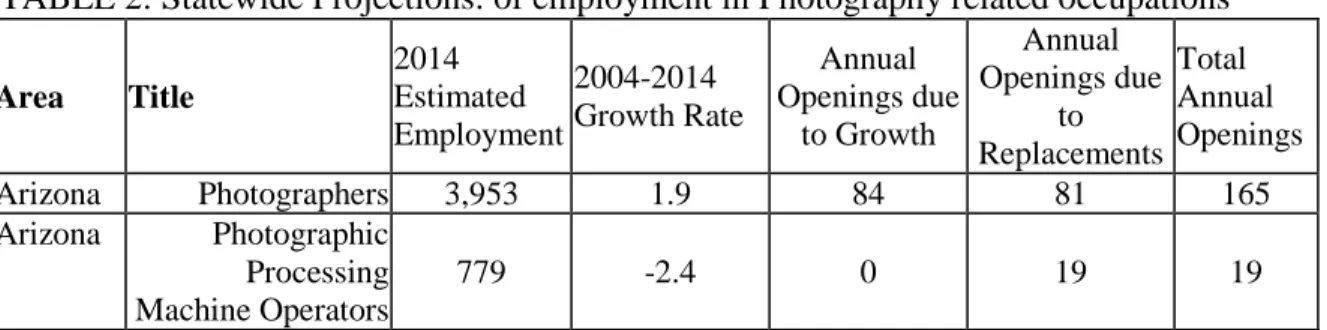
Table 2 shows statewide projections from the Bureau of Labor Statistics. There are slightly over 100 openings annually in Arizona for the occupational codes related to photography. TABLE 2: Statewide Projections: of employment in Photography related occupations
Area Title 2014 Estimated Employment 2004-2014 Growth Rate Annual Openings due to Growth Annual Openings due to Replacements Total Annual Openings Arizona Photographers 3,953 1.9 84 81 165 Arizona Photographic Processing Machine Operators 779 -2.4 0 19 19 Source: http://www.workforce.az.gov/cgi/dataanalysis/occprjReport.asp?menuchoice=occprj HISTORY
In the fall of 1975, Northland Pioneer College Photography Program began essentially with twenty-four students (4.5 FTSE) and with a part-time instructor. By the spring of 1976, there was an enrollment of 65 students (about 12 FTSE) and a full-time instructor.
The first classes were offered in a small classroom and a converted restroom for a darkroom/lab. Why was this done in this manner? Because there was no permanent
darkroom/lab facility at any spot except the classroom darkroom conversion in Lakeside. This was in an old 1930’s two-room classroom building not being used by Blue Ridge High School in Lakeside.
The program operation went literally from a rags-to-riches. Classes were taught by the full-time instructor in Whiteriver, Lakeside, and Holbrook. Soon classes were taught in any place that could support the classes with a lab. The instructor typically picked up darkroom lab equipment at the Lakeside site and transported it to Holbrook via the Show Low center, where it was unloaded from a personal car into an NPC car and taken onward to Holbrook. It was then unloaded in Holbrook and the reverse was accomplished after class back to Lakeside. Equipment transported included 5 enlargers, timers for the enlargers, 5 easels, lenses, washing equipment, cameras, chemicals, paper and film, extension cords, trays, film development equipment, etc. This all started at 1:00 P.M. and finished after doing the last unloading 11:00 pm back at Lakeside. This task was required to teach classes in Holbrook and in Whiteriver
once a week, in addition to the other classes in Lakeside that didn’t require the moving of equipment.
As student numbers increased, a small lab facility was constructed in a new building purchased by NPC at the Show Low Campus. A small facility was also erected in Holbrook. These were all built by the full-time instructor, adjunct faculty members, and students because, as is true today, maintenance was so overworked with projects it was and is easier to do remodels ourselves. The lab was in a modular building, 24 feet square and divided into a lab and a classroom. No new lab was ever built at an original site. Labs were set up in an existing building and remodeled to accommodate classes. This makes a workable situation, but by not being originally designed for the space, it leaves something to be desired as a teaching site. For example, as the multi-course class offerings necessitated several classes going at once, the students working in the 1978 lab had to walk through another course’s slide show to access print drying screens. Students would run over each other often in the small space. We are in the same building today, even after the 1990’s campaign to give “NPC New Schoolrooms.” Imagine 45-50 student (bodies) using each week a 24-foot square space, divided into two 12x24 foot rooms, one a lab and one a classroom. The second lab, in Holbrook, began in an obscure Air Force building and later was relocated to a modular building at the old PDC campus on Hermosa.
The former full- time faculty/program coordinator built at least five darkrooms while at NPC. In 2006 the program occupied the same classroom/darkroom lab space in Show Low and handled about 80-100 students per week. The program enrolled about 25 students in Holbrook and 10-12 in Springerville. The old facilities (1978) at Show Low, a facility which was not originally designed for photography, and the “hand-me-down” spaces there are not conducive to easy work flow. The Show Low facility is a major shortcoming in the program.
Beginning in Fall 2006 a new photography classroom and darkroom opened at Holbrook in a remodeled building on the PDC campus.
The Photography program has weathered many changes and has been a perfect chameleon with regard to handling a continuing stream of students. The program was moved from the Liberal Arts Division to the Division of Business and Technology between 1995 and 1997 but returned to the Liberal Arts Division in Fall 2005.
In Fall 2001, the photography technician program began a NAVIT component. Although the program coordinator was somewhat skeptical about adding day classes, which traditionally have been light in enrollment, the combined NAVIT/”regular” student classes created a workable mix. Between Fall 2001 and Fall 2005, the program grew from 3.8 FTSE to 13.8 FTSE but dropped to 5.40 FTSE in Spring 2006. NAVIT informed NPC in March, 2006 that it would discontinue its offering of the photography technician program. In Fall 2006, students enrolled in program in the spring allowed to complete the program but no new students were accepted.
COURSE OFFERINGS
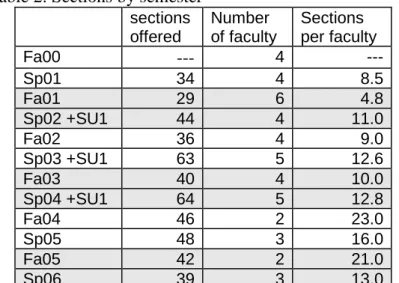
The photography program offers a wide array of courses, ranging from “Basic Camera Techniques” (PHO080) and “Beginning Photography” (PHO100) to “Photography as an Art Medium” (PHO250) and “Photography Practicum” (PHO280). Table 1 shows the number of sections with enrolled students over the past six years.
Table 2: Sections by semester
sections offered Number of faculty Sections per faculty Fa00 --- 4 --- Sp01 34 4 8.5 Fa01 29 6 4.8 Sp02 +SU1 44 4 11.0 Fa02 36 4 9.0 Sp03 +SU1 63 5 12.6 Fa03 40 4 10.0 Sp04 +SU1 64 5 12.8 Fa04 46 2 23.0 Sp05 48 3 16.0 Fa05 42 2 21.0 Sp06 39 3 13.0
These figures could be somewhat misleading because most photography courses are offered in a multi-course lab format. For example, in Fall 2005 the department scheduled 70 sections of photography courses (including internships and “199” offerings). These courses were
scheduled in eight different time blocks. Five of the eight time blocks were multi-course “labs” (with from 3 to 14 courses in a single schedule lab). There were also two sections of “Digital Photography” (PHO101), one at SPE and another at WMC, and an internship. Students enrolled in from 3 to 11 of the sections scheduled.
Similarly, in Spring 2006 the department scheduled 63 sections of photography in 9 time blocks. Seven of these were multi-course labs, including two dual enrollment blocks at Show Low High School consisting of beginning and intermediate photography (PHO100 and PHO 200). Again, single sections of PHO101 were offered at SPE and WMC. Apart from the dual enrollment “labs,” students enrolled in from 4 to 9 of the offered sections in multi-course labs.
As with many “multi-course lab” offerings, some sections enroll about a half dozen students while other sections in the same lab have only one or two students. Over the past six years, multiple sections of three courses PHO100, PHO200, and PHO220 have attracted enrollments each semester. Several other courses have enrolled students nearly as frequently.
A new course, PHO101 -- Digital Photography, was approved in Fall 2003 and first offered in Fall 2004. Over the past four semesters, this course has enrolled 94 students, making it the single most popular photography course. The department responded to this demand by developing a second new course in this area, PHO 201 – Intermediate Digital Photography, which was approved in Fall 2005 and was offered first in Fall 2006 at WMC.
Faculty Data
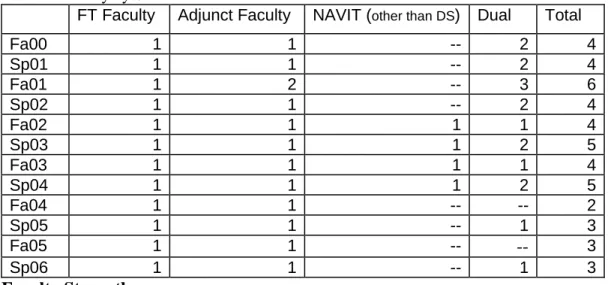
The photography department had a single full-time faculty member who teaches the majority of sections, including all NAVIT sections beginning in Fall 2004, and who served as the program coordinator until his retirement in December 2006. Apart from the Fall 2001
semester, only one adjunct has taught regular NPC photography courses. Dual enrollment photography courses have been offered at Show Low High School every spring semester. Blue Ridge High School has not offered dual enrollment courses since the Spring 2004 semester. See Table 2. In Fall 2001 there was a dual enrollment offering at Chinle High School. For several semesters (Fall 2002 through Spring 2004) NAVIT photography courses were offered in Holbrook as well as in Show Low.
Table 4: Faculty by Semester
FT Faculty Adjunct Faculty NAVIT (other than DS) Dual Total
Fa00 1 1 -- 2 4 Sp01 1 1 -- 2 4 Fa01 1 2 -- 3 6 Sp02 1 1 -- 2 4 Fa02 1 1 1 1 4 Sp03 1 1 1 2 5 Fa03 1 1 1 1 4 Sp04 1 1 1 2 5 Fa04 1 1 -- -- 2 Sp05 1 1 -- 1 3 Fa05 1 1 -- -- 3 Sp06 1 1 -- 1 3 Faculty Strengths
Dale Schicketanz is widely recognized for the quality of his photography efforts. He is also widely published. Karl Larson, adjunct faculty since Fall 2001, is also widely recognized for his photography efforts and is becoming an authority on digital imagery.
Dale Schicketanz
NPC Photography Technician Advisory Committee
NAU Photo Advisory Committee
Show Low High School Photo Advisory Committee Arizona Highways Contributors Association
Board Member, Linden Homeowners Association Active exhibiting artist for 2004:
Broadway Palm Dinner Theatre, Mesa, Arizona, April 6-June 12, 2004 Cochise College, August 2004
Pine Artisans Gallery, Pine, Arizona 107 Gallery, Winslow, Arizona
Fire on the Mountain Gallery, Flagstaff, Arizona
Solo Exhibition, Talon Gallery, Northland Pioneer College Feb.2008 NPC Photography Advisory Committee
Karl Larson
Custom fly fishing net manufacturer Active exhibiting artist:
Broadway Palm Dinner Theatre, Mesa, Arizona, April 6-June 12, 2004 Cochise College, August 2004
FTSE Count, Photography Department 2002-2006:
Table 5 shows enrollment in photography courses has fluctuated. Between Fall 2002 and Spring 2005, enrollments in photography increased (with the exception of Fall 2003). The 2005-2006 academic year decline in photography enrollments mirrors a college-wide decline although the photography decrease was slightly more than the overall college trend.
Table 5: Photography Department Enrollments (FTSE Day); FTSE & Headcount Sp02 to Sp06
Photography Headcount (unduplicated)
FTSE Academic Year FTSE
Sp02 112 25.7 Fa02 104 24.0 Sp03 136 32.7 28.4 Fa03 88 21.8 Sp04 133 36.5 29.2 [+2.6%] Fa04 108 33.5 Sp05 128 37.9 35.7 [+22.3%] Fa05 84 27.8 Sp06 86 24.2 26.0 [-27.2%]
Table 5 breaks down FTSE data into instructional components. These data show that enrollment changes are not due to any single type of instructional program. Regular student enrollment reached their highest levels in the three semester period from Spring 2004 through Spring 2005.
Regular student enrollments fell dramatically the following semester but picked up some in the Spring of 2006 when NAVIT enrollments fell by more than half. In general, “Regular” student enrollment generally accounts for between half and two-thirds of the total FTSE. Some
“regular” students report avoiding day classes comprised primarily of NAVIT students. This anecdotal information suggests that day sections may pick up some enrollment as the NAVIT program ends.
TABLE 5: Photography FTSE by type of instructional program (end of the semester FTSE; except spring 2006 -- as of May 1, 2006)
Regular FTSE
Dual NAVIT percent
regular Academic Year FTSE Fa00 15.40 6.00 --- 71.96 Sp01 15.47 10.40 --- 59.80 23.64 Fa01 13.67 8.50 3.80 52.64 Sp02 13.23 10.00 3.40 49.68 26.30 Fa02 15.93 3.40 7.13 60.20 Sp03 17.60 6.80 6.87 56.28 28.87 Fa03 16.40 2.40 5.80 66.67 Sp04 20.13 7.00 10.20 53.92 30.97 Fa04 20.13 -- 13.40 60.04 Sp05 19.67 6.00 10.00 55.14 34.60 Fa05 13.20 --- 13.80 48.89 Sp06 15.40 2.60 5.40 65.81 25.20
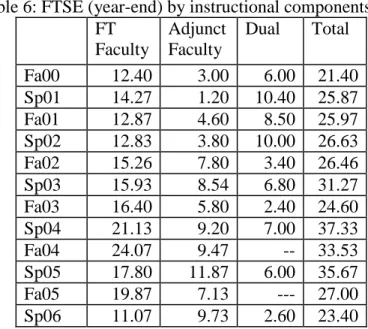
Table 6 indicates that in total, and proportionally, FTSE attributable to the single full-time faculty member increased significantly during the six-year period. The Spring 2006 figures are anomalous and reflect, primarily, the sudden loss of NAVIT students. Despite this, the FTSE level of the one full-time faculty member is about what it was at the beginning of the period (Fall 2000).
Table 6: FTSE (year-end) by instructional components FT Faculty Adjunct Faculty Dual Total Fa00 12.40 3.00 6.00 21.40 Sp01 14.27 1.20 10.40 25.87 Fa01 12.87 4.60 8.50 25.97 Sp02 12.83 3.80 10.00 26.63 Fa02 15.26 7.80 3.40 26.46 Sp03 15.93 8.54 6.80 31.27 Fa03 16.40 5.80 2.40 24.60 Sp04 21.13 9.20 7.00 37.33 Fa04 24.07 9.47 -- 33.53 Sp05 17.80 11.87 6.00 35.67 Fa05 19.87 7.13 --- 27.00 Sp06 11.07 9.73 2.60 23.40
Table 7 provides data on cost per FTSE. Here the total budget for the department is divided by the annualized FTSE. The sharp increase in the 2005-2006 academic year is largely an artifact of a new administrative practice which includes adjunct faculty salaries within departmental budgets.
Table 7: COST per FTSE 2003-2006 Photography Semester FTSE Annualized FTSE Total Budget Budget/ FTSE Sp02 25.7 Fa02 24.0 Sp03 32.7 28.87 Fa03 21.8 2003-04 Sp04 36.5 30.97 $79,012 $2,551 Fa04 33.5 2004-05 Sp05 37.9 34.60 $84,274 $2,436 Fa05 27.8 2005-06 Sp06 24.2 25.20 $133,800 $5,310 Program Graduates
Although course enrollments increased markedly between 2000 and 2004, there has not been an increase in the number of program completers as measured by the award of degrees and certificates. Over the past seven years only eight students have completed an AAS degree and
three have earned certificates of proficiency (one COP in each of the three tracks). Since 2002, only one student has received an AAS in this program. The Advisory Committee should examine ways to address issues related to degree and certificate programs.
TABLE 7: Photography Technician Degrees and Certificates awarded 1998 to 2005
Academic Year (July - June)
1998 1999 2000 2001 2002 2003 2004 2005 1998 Grads Grads Grads Grads Grads Grads Grads Grads Grads AAS 0 2 1 2 2 0 1 0 8
CAS 0 0 0 0 0 0 0 0 0
CP 0 0 2 0 0 0 1 0 3
All 0 2 3 2 2 0 2 0 11
STRENGTHS OF THE PROGRAM
The advisory committee, meeting in June 2006, identified several strengths of the program, including
(1) excellence of the instructional skills exhibited by full-time and adjunct faculty and strong skills of support personnel, especially lab aides,
(2) involvement of faculty in exhibits and publications, and (3) faculty keeping abreast of advances in technology.
Thus, faculty were involved in both film based and digital instruction. CHALLENGES FACING THE PROGRAM
A number of challenges were also enumerated by the advisory committee. Two broad areas were singled out as important challenges –
(1) resources, including facilities, and
(2) faculty responsibilities and workloads. Despite the opening of space dedicated to
photography at the Painted Desert Campus (Holbrook), the W MC (Show Low) facility, the site attended by most students, remains serviceable but needs improvement.
Resource issues for supporting expanded digital offerings, maintaining computer hardware and software, additional sources for supplies for students, and replacing equipment were noted as continuing concerns.
Both fulltime and adjunct faculty teach heavy loads. Given the number of contact hours spent in classroom work, faculty had little time for student recruitment and the offering of short-term workshops for avocational students. In addition, while faculty have continued to upgrade technological skills on their own, time is limited for taking advantage of formal professional development activities. The committee also expressed a need to promote the enrollment of avocational students in degree programs and the need to identify the potential for local jobs in the field. Finally, the committee expressed concern over the direction the program would after the retirement of the lead faculty. A final challenge faced by program was not addressed by the committee. With the discontinuation of NAVIT involvement, the student enrollments are expected to decline slightly.
Addendum (Spring 2008)
The original program review report was completed in December 2006. At the time the report was ready for review, the only full-time faculty member in the program, Dale Schicketanz, retired. The declining enrollments, the loss of the NAVIT partnership in the program, and the continued availability of excellent adjunct faculty willing to teach led to the vacant position being redefined. In consultation with Lee Sweetman, Chair of the Art Department, the replacement for Mr. Schicketanz was advertised for a two-dimensional art instructor with an emphasis on painting and drawing. Although ability to teach photography was desired, the person hired for the position did not have that particular background.
Although FTSE continued to decline after the Spring 2006 semester, the raw number of student enrollments in photography courses showed an increase in Fall 2007.
Fall 2006 86 21.6
Spring 2007 83 18.6 20.1 [- 22.7% over previous year]
Fall 2007 99 20.0
Spring 2008 83 17.3 18.7 [- 7.0% over previous year]
In the 2008-2009 academic year the art department will review the photography curriculum and make any necessary revisions to courses and certificate and degree programs. In addition, the art department plans to collaborate more closely with the Computer Information Systems department and, specifically, its Graphics Design program in relation to digital photography and other media that involve both art and computer graphics.