State Programs for Veterans
Informational Paper 92
Wisconsin Legislative Fiscal Bureau
January, 2013
State Programs for Veterans
Prepared by
Grant Cummings
Wisconsin Legislative Fiscal Bureau
One East Main, Suite 301
Madison, WI 53703
http://legis.wisconsin.gov/lfb
TABLE OF CONTENTS
The Department of Veterans Affairs ... 1
General Eligibility Requirements for State Veterans Programs ... 2
Military Service ... 2
Wisconsin Residency ... 2
Wisconsin Veterans Homes ... 3
History and Description... 3
Eligibility ... 3
Funding ... 4
Nurse Education Stipend Program ... 6
Veterans Loan Programs ... 6
Primary Mortgage Loan Program ... 7
Home Improvement Loan Program ... 8
Personal Loan Program ... 8
Veterans Grant Programs ... 9
Veterans Education Programs ... 9
Assistance to Needy Veterans ... 12
Assistance to Veterans Organizations ... 14
Grants to Support County Veterans Service Offices ... 14
American Indian Veterans Service Grants ... 14
Grants to Veterans Organizations ... 15
Transportation Services Grant Program ... 15
Other Programs ... 15
Veterans Assistance Program ... 16
Veterans Property Tax Credit ... 16
Veterans Memorial Grants ... 17
Veterans Outreach Efforts ... 18
Wisconsin Veterans Cemeteries ... 18
Military Funeral Honors ... 19
Wisconsin Veterans Museum ... 20
Funding for Home Loans ... 20
Veterans Trust Fund ... 22
Appendix I Military Service Requirements for Eligibility for State Veterans Programs ... 28
Appendix II Primary Mortgage Loan Program Activity ... 29
Appendix III Primary Mortgage Loan Refund Bonds ... 31
State Programs for Veterans
The Department of Veterans Affairs (DVA) administers several loan and grant programs and operates the Veterans Home at King (Waupaca County), the Veterans Home at Union Grove (Racine County), and contracts for the operation of the Veterans Home at Chippewa Falls (Chip-pewa Falls County) for the benefit of Wisconsin veterans. The U.S. Department of Veterans Af-fairs projects that approximately 387,800 Wis-consin veterans will live in WisWis-consin as of Sep-tember, 2013. Many of these veterans may be eligible for services provided by DVA as a result of having prior service in the armed forces and meeting certain residency and specific program eligibility requirements.
This paper is organized into eight major sec-tions. The first section provides a brief introduc-tion to the Department of Veterans Affairs. The second section describes the general military ser-vice and state residency eligibility requirements applicable to most veterans programs. The third section discusses DVA-operated care facilities. The next four sections summarize DVA's loan programs, grant programs to individual veterans, grant programs to veterans organizations, and other programs, respectively. The last section de-scribes how DVA's loan and grant programs are funded.
The Department of Veterans Affairs
The Wisconsin Department of Veterans Af-fairs (DVA) was created by Chapter 580, Laws of 1945, to administer the state's veterans pro-grams and to assist the state's veterans in secur-ing federal veterans benefits.
Some state veterans programs existed years
before DVA was created. The Grand Army Home at King was established in 1887 by the Grand Army of the Republic, an organization of Civil War veterans. The home was later turned over to the state. Similarly, the Grand Army of the Republic Memorial Hall, a museum for Civil War veterans, was established in the State Capi-tol in 1901. Two segregated funds had also been established. The first was the soldiers rehabilita-tion fund, which was established in 1919 to pro-vide cash bonuses for World War I veterans. The second was the post-war rehabilitation fund, which was established in 1943 to meet the medi-cal, educational, and economic needs of World War II veterans.
Many of the veterans programs that existed when DVA was created continue in some form today. The Grand Army Home at King has since been renamed the Wisconsin Veterans Home at King. Two additional Veterans Homes, one at Union Grove and one at Chippewa Falls, have been built. A new museum honoring all veterans was opened in 1993 and includes the Memorial Hall exhibits that were relocated from the State Capitol. A third segregated fund, the veterans housing trust fund, was created in 1947 to make second mortgages to qualified veterans. In 1961 the soldiers rehabilitation fund, the post-war re-habilitation fund, and the veterans housing trust fund were combined to form the veterans trust fund, which supports many of DVA's current programs. Another fund, the veterans mortgage loan repayment fund, was created in 1974.
Through the years, the scope of programs ad-ministered by the Department has expanded to include several types of state assistance programs for veterans, organizations that serve veterans, and the operation of Wisconsin's veterans ceme-teries.
Prior to the enactment of 2011 Wisconsin Act 36, DVA was under the direction and supervision of the Board of Veterans Affairs. The Board con-sisted of seven veterans, including two Vietnam War veterans, appointed by the Governor for staggered six-year terms. The Board was author-ized to promulgate rules relating to the Depart-ment's programs, and the Board appointed the Secretary of the Department.
Act 36 established DVA as a cabinet agency. The Governor appoints the DVA Secretary, but must first consult with the presiding officers of at least six Wisconsin veterans organizations. The Secretary must be a veteran. Act 36 increased the number of Board members from six to nine, and reduced the terms of Board members from six to four years. The Board must include at least one resident from each of Wisconsin's congressional districts. Rule-making authority rests with the Secretary, although all rules must be provided to the Board and any written comments or opinions submitted by the Board must be included with the proposed rule when it is published or distributed.
General Eligibility Requirements for State Veterans Programs
Although most DVA-administered grant and loan programs have a variety of specific eligibil-ity requirements that an applicant must meet, there are two requirements that are uniform for nearly all programs. First, the individual must meet certain military service requirements to qualify as a veteran. Second, since most of DVA's programs are designated for the benefit of Wisconsin veterans, there is a state residency re-quirement. With few exceptions (identified in the individual program descriptions), the following military service and Wisconsin residency re-quirements are uniform across all DVA pro-grams.
Military Service
State statutes define a "veteran" to include a person who has done any one of the following: (a) served for at least one qualifying term of ser-vice during a war period or in a crisis zone; (b) served for two continuous years or more or for the full period of his or her initial service obliga-tion, whichever is less; (c) served for 90 days or more during a wartime period; or (d) received an expeditionary or equivalent service medal. Indi-viduals discharged early for reasons of hardship, service-connected disability, or a reduction in military personnel are also considered veterans, as are individuals that died while on active duty, are missing in action, died as a result of a ser-vice-connected disability, or died while training.
In most cases, a veteran must have served un-der honorable conditions (persons who died or are classified as missing in action may be exclud-ed from this requirement). Individuals that are eligible for federal veterans benefits are consid-ered to have served honorably for the purpose of determining state veteran benefit eligibility.
Appendix I enumerates the statutory war peri-ods, designated conflicts, and veterans eligibility criteria.
Wisconsin Residency
Most DVA grant and loan programs have a state residency requirement. To be eligible to re-ceive benefits, an applicant must be a current Wisconsin resident at the time of application and meet either of the following requirements: (a) the veteran must have been a Wisconsin resident upon entering or reentering military service; or (b) the veteran was a resident of Wisconsin for any consecutive 12-month period after entry or reentry into service and before the date of an ap-plication for benefits or death.
Wisconsin Veterans Homes
History and Description
Since 1887, the Wisconsin Veterans Home at King has provided residential care, nursing and medical services, food services, and social and counseling opportunities to its resident veterans and dependents. The campus includes four sepa-rately licensed nursing homes, with a total of 721 licensed skilled nursing care beds, a chapel, and an activity center containing a post office, thea-ter, bowling alley, museum and library.
The Wisconsin Veterans Home at Union Grove opened in 2001. It consists of three sepa-rately licensed facilities -- Fairchild Hall, a 40-bed community-based residential facility, Boland Hall, a 120-bed skilled nursing facility, and Gates Hall, formerly a residential care apartment com-plex, which is scheduled to re-open as a 38-bed skilled nursing facility in calendar year 2013. A second 42-bed community-based residential fa-cility, Shemanske Hall, was closed in February, 2012. The closure of Shemanske Hall allowed DVA to consolidate all assisted living residents in one facility, rather than operate two facilities with low occupancy.
The Union Grove campus includes a United States Department of Veterans Affairs (USDVA) community-based outpatient clinic, a state veter-ans cemetery, and a veterveter-ans assistance center for homeless veterans. It is adjacent to the Southern Wisconsin Center campus which includes the Southern Wisconsin Center for the Develop-mentally Disabled and the Robert E. Ellsworth minimum security correctional facility.
2003 Wisconsin Act 102 authorized DVA to develop and operate residential, treatment and nursing care facilities and programs on the cam-pus of the Northern Wisconsin Center for the Developmentally Disabled in Chippewa Falls.
Construction on the Veterans Home at Chippewa Falls began in May, 2011, and the facility is ex-pected to open in February, 2013. Provisions in 2011 Wisconsin Act 32 permitted the Department to contract with a private company to provide services at the Veterans Home at Chippewa Falls if the Department determined as a result of a cost-benefit analysis that contracting would be more cost-effective than hiring state staff. DVA submitted its completed cost-benefit analysis on April, 17, 2012, and subsequently contracted with Health Dimensions Group for a three-year period. The combined three-year amount of the contract is $19,322,900.
The Wisconsin Veterans Home at King, the Veterans Home at Chippewa Falls, and Boland and Gates Halls on the Union Grove campus are licensed and regulated by the Department of Health Services (DHS) and the USDVA as skilled nursing facilities and, as such, are subject to state and federal rules that govern the mainte-nance, operation and construction of nursing homes. These rules specify staffing requirements, program and service standards and various sani-tary and physical plant regulations.
Eligibility
Any individual who wishes to be admitted as a member of either veterans home must meet all of the service and residency criteria that he or she would be required to meet to receive other DVA benefits. In addition, an applicant must demon-strate that he or she: (a) is permanently incapaci-tated due to disability or age; (b) has not been convicted of a felony or other crime involving moral turpitude; (c) has not been diagnosed with certain chronic ailments unless the facility is able to provide care for the individual; (d) provides a financial statement for evaluation purposes; and (e) has care needs which the home or facility can meet. Spouses, surviving spouses, and parents of qualifying veterans may also be admitted. The order of priority for admissions to the facilities is as follows: (a) veterans; (b) spouses of eligible
veterans; (c) surviving spouses of eligible veter-ans; and (d) parents of eligible veterans. Excep-tions to these priorities may be made to avoid the separation of husbands and wives.
As of July 1, 2012, the membership at Wis-consin Veterans Home at King totaled 697, in-cluding 555 veterans and 142 dependents (pri-marily spouses). The veteran members as of that date included 222 World War II veterans, 122 Korean War veterans, 138 Vietnam-era veterans and 73 other qualifying veterans. Some veterans served in multiple conflicts.
The membership at the Wisconsin Veterans Home at Union Grove totaled 153 individuals, including 141 veterans and 12 dependents. There were 72 World War II veterans, 33 Korean War veterans, 21 Vietnam-era veterans, and 18 other qualifying veterans. Some veterans served in multiple conflicts.
Funding
The Department's residential care facilities are supported from five primary sources: (a) member contributions; (b) Medical Assistance (MA) payments; (c) USDVA per diem payments; (d) Medicare payments; and (e) USDVA service-connected disability payments. Table 1 shows the number and percentage of residents by primary funding source as of July, 2012. A brief explana-tion of these revenue sources is provided below.
Table 1: Primary Funding Sources for Nursing Home Care (as of July, 2012)
King Union Grove Residents % Residents % Medical Assistance 567 81.4% 78 66.7% Payments by Residents
at Private Pay Rates 63 9.0 19 16.2 Federal Service-Connected
Disability Program 67 9.6 19 16.2 Medicare 0 0.0 1 0.9
Total 697 100.0% 117 100.0%
Member Contributions. Member
contribu-tions include VA pension amounts that are paid directly to the member, as well as other individu-al sources of revenue. Each member is billed monthly for the cost of his or her care. Any ad-justments in the actual cost of care provided are made on the next billing. Members, or their per-sonal representatives, have 30 days after the re-ceipt of the statement to pay the bill. If the mem-ber's income is insufficient to cover the monthly cost of care, revenues derived from the other funding sources may be used to cover the mem-ber's cost of care. Table 2 shows the private pay rates for residents at King and Union Grove from January 2005 through January 2012.
Table 2: Daily Private Pay Rates for Skilled Nursing Care Provided to Veterans
Date King Union Grove
January 2005 $148.24 N/A
January 2006 165.60 N/A
January 2007 163.29 $225.00
March 2007 163.29 163.29
January 2008 176.58 176.58
January 2009 185.58 217.00
January 2010 207.47 257.47
January 2011 195.41 256.00
January 2012 199.18 246.00
Since January, 2009, private pay rates for nursing home care at King and Union Grove have been based on each facility's average cost per res-ident, by level of care. These costs are calculated in two parts: direct and non-direct care costs. The Department of Health Services maintains pro-jected direct care costs for individuals in each nursing level of care. The average direct care cost per patient day for Veterans Home residents is calculated by taking the weighted average of these cost projections. Average non-direct costs are calculated by taking the total projected non-direct costs and dividing them by the projected number of residents. The sum of the average di-rect care costs and average non-didi-rect care costs is the private pay rate. In January, 2010, DVA began using this same methodology to establish rates for the assisted living facilities at Union
Grove. The Department is in the process adjust-ing the rate methodology to reflect the recent building closures.
USDVA Per Diem Payments. The
Depart-ment receives USDVA per diem payDepart-ments for its member veterans, which vary depending on the level of care provided. In federal fiscal year 2012, USDVA paid $39.90 per day for each member in an assisted living unit and $110.10 per day for each member who received nursing home care.
Medicare. Veterans may be eligible for both
USDVA veterans benefits and Medicare. Medi-care eligible veterans can receive treatment both from VA facilities through VA benefits and non-VA facilities through Medicare benefits. In most cases, veterans benefits will not pay for a service that Medicare has covered, or vice versa. In some cases, where veterans receive VA-authorized ser-vices from a non-VA provider, Medicare may cover costs not covered by veterans benefits and/or pay copayments USDVA charges veter-ans. Medicare may also cover some prescriptions not covered by veterans benefits.
USDVA Service-Connected Disability
Payments.USDVA provides monthly cash
bene-fits to veterans that have a service-connected ability and were discharged under other than dis-honorable conditions. To be eligible for disability compensation, a veteran must have: (1) a medical diagnosis of the impairment; (2) evidence the condition occurred or worsened in-service; (3) medical proof of a connection between the in-service injury or illness and the current disability.
Medical Assistance Payments. DVA's
nurs-ing homes are certified to participate in the MA program and receive MA reimbursement for the costs of services they provide to MA-eligible res-idents. Most MA benefits costs, including pay-ments to nursing homes for the care they provide to MA recipients, are funded on an approximate-ly 60% federal/40% state cost-sharing basis. The
Veterans Homes are able to claim all allowable MA costs under the MA program, as long as the total claim is less than the Medicare upper limit, the amount that the state estimates would have been paid under Medicare payment principles. Allowable costs under MA include the interest portion of debt service costs and depreciation. Since a portion of debt service costs are funded by a state, general purpose revenue (GPR) appro-priation, MA reimbursement of interest costs are required to lapse to the general fund at the end of each fiscal year. At the end of 2011-12, approxi-mately $367,900 lapsed to the general fund as a result of MA reimbursement for interest costs related to the Veterans Homes at King and Union Grove.
An example of the payment sources used to support care at an assisted living facility at the Veterans Home at Union Grove is shown in Ta-ble 3. The average cost of residency in an assist-ed living facility at Union Grove for an individu-al not requiring memory care was $4,500 per month, as of June 30, 2012. The costs of care to the individual are reduced by any VA per diem payments and aid and attendance benefits for those members who qualify (in this case, $1,197 and $1,703, respectively). The aid and attend-ance benefit is an enhattend-anced monthly pension payment paid in addition to a veteran's pension. Veterans and surviving spouses are eligible if
Table 3: Example of Payment Sources to Sup-port Care at Veterans Home at Union Grove -- Assisted Living Facility
Monthly Cost (June 30, 2012) $4,500
VA Per Diem Payments* $1,197
Aid and Attendance Benefit** 1,703
Subtotal $2,900
Remaining Costs of Care
(Paid by the Member's Own Funds) $1,600 *The VA per diem payment for domiciliary care is $39.90 per day in federal fiscal year 2011-12.
**In calendar year 2012, the maximum annual pension for a veteran with no income, no dependents and who qualified for aid and attendance benefits was $20,436 per year (approximate-ly $1,703 per month).
they do not exceed the income limits and if they require the aid of another person for activities of daily living, are bedridden, are patients in a nurs-ing home due to mental or physical incapacita-tion, or have specific vision limitations. If an in-dividual resides in a Union Grove facility for the entire month and is eligible for the maximum aid and attendance benefit, the cost of residency would decrease to approximately $1,600 per month.
Table 4 indicates the amount of revenue the Department received from each of the revenue sources for the combined operation of the Veter-ans Home at King and the VeterVeter-ans Home at Un-ion Grove from 2006-07 to 2011-12. Expendi-tures for these facilities are also shown. DVA uses uncommitted surplus revenues from previ-ous years' operations ("carry-over funds") to sup-port costs that exceed revenues in any given year.
Nurse Education Stipend Program
DVA provides stipends to individuals to
at-tend school and receive the necessary credentials to become employed at the Veterans Homes. Re-cipients are required to work for DVA for one year for each year they receive a stipend. From the program's origination in 2003-04 through fis-cal year 2011-12, DVA has awarded 99 stipends totaling $316,500.
Veterans Loan Programs
On December 1, 2011, DVA placed an indef-inite moratorium on the primary mortgage loan program, the home improvement loan program, and the personal loan program. The Department cited its inability to compete with very low con-ventional market interest rates and decreased de-mand as the primary reasons for the moratorium. This section describes the loan programs as they existed before the moratorium.
The Department administers three loan
pro-Table 4: Combined Operating Revenues and Expenditures (Fiscal Years 2006-07 through 2011-12)
2006-07 2007-08 2008-09 2009-10 2010-11 2011-12
Revenues
Medical Assistance $28,544,000 $33,483,300 $34,729,100 $35,441,700 $31,309,400 $46,791,200 Payments by Residents 21,420,500 23,318,800 24,412,800 24,441,700 23,980,500 25,101,700 Federal per Diem Payments
for Veterans 15,711,800 17,624,600 18,604,200 15,720,100 21,597,900 21,591,100 Medicare 1,716,600 2,207,900 2,893,600 2,260,800 2,661,800 2,315,500 Federal Service-Connected
Disability Program 0 0 354,300 7,869,900 5,074,100 7,414,100
Aid to Indigent Veterans 174,900 191,900 303,600 370,400 193,300 182,800
Other 159,100 184,300 188,100 182,900 379,800 172,400
Revenue Transfers -1,164,500 -1,388,100 -1,407,800 -1,447,800 -1,436,300 -1,407,600 Total $66,562,400 $75,622,700 $80,077,900 $84,839,800 $83,760,500 $102,161,200
Expenditures
Salaries $37,495,000 $40,885,300 $42,973,500 $43,528,900 $44,423,700 $46,093,600 Fringe Benefits 17,006,200 19,957,900 22,686,900 25,259,000 28,490,500 24,387,100 Supplies and Services 7,722,200 8,168,500 9,394,400 9,739,400 10,721,300 8,962,300 Transfers 1,462,300 422,100 7,050,800 2,229,700 1,495,600 1,757,400 Utilities 2,386,800 2,782,600 2,809,100 2,425,400 2,539,900 4,869,500 Administration 1,677,900 1,858,900 1,761,700 1,207,400 1,306,900 1,342,600 Other 2,041,600 2,400,400 3,033,300 2,826,900 3,131,700 3,185,500 Total $69,792,000 $76,475,700 $89,709,700 $87,216,700 $92,109,600 $90,598,000
grams to improve housing opportunities, provide home improvement assistance, and access multi-purpose low-cost loans for Wisconsin veterans. These programs are the primary mortgage loan program, the home improvement loan program, and the personal loan program.
Eligibility for DVA administered loans is lim-ited to: (a) a veteran; (b) a person that served honorably on active duty for more than six months between February 1, 1955 and August 4, 1964; (c) an unremarried surviving spouse or de-pendent child of a deceased veteran (as described under (a) and (b)); or (d) a person that served un-der honorable conditions and has completed six years of continuous service in the National Guard or a reserve component of the U.S. armed forces who lives in the state.
A person may not receive a loan if any of the following apply: (a) the person would be incur-ring a debt that is excessive in light of the indi-vidual's income; (b) the person has another out-standing loan (unless the loan debt has been as-sumed by another individual, or the person is ap-plying under the mortgage loan program for a second mortgage loan to improve the home); (c) the loan exceeds 2.5 times the median price of a Wisconsin home; and (d) the person is delinquent on child support or maintenance obligations as evidenced by a lien issued by the Department of Children and Families (DCF) (this clause does not apply for permanently and totally disabled veterans).
An otherwise eligible veteran may receive a loan despite child support delinquency, if an ap-propriate agreement for repayment has been en-tered through a county child support agency or DCF signs a statement that the person is not de-linquent.
Primary Mortgage Loan Program
The primary mortgage loan program (PMLP) provides mortgage loans to qualifying state
vet-erans and Wisconsin residents currently serving on active duty in the U.S. armed forces in order to purchase or construct a home. In state statute, active duty does not include "active duty for training" as defined in federal law. Under the program, nearly $2.7 billion has been made available for 55,598 home loans to Wisconsin veterans through June 30, 2010. In 2009-10, DVA made 63 primary mortgage loans totaling $10,572,400. No new loans have been made since fiscal year 2009-10 because of the low in-terest rates available in the community.
Funding for the primary mortgage loan pro-gram is derived primarily from the proceeds from state general obligation bond issuances as well as from the recycling of prepayments from general obligation bonds, fund equity, and excess insur-ance reserves.
The interest rate charged to veteran borrowers under the primary mortgage loan program is de-pendent on the interest rate associated with each bond issue. The Board of Veterans Affairs sets the interest rate. In 2009-10, the primary mort-gage loan interest rate was 5.25% for a 30-year loan. The rate was available through November 2, 2009, when the PMLP was closed to new ap-plications due to lack of available funding.
There are additional specific requirements that must be met before a veteran may receive a primary mortgage loan. These requirements in-clude: (a) a down payment on the home of at least 5%; (b) the value of the loan may not ex-ceed 2.5 times the value of the median price of a house in Wisconsin (as of July 1, 2012, this maximum was $355,000); (c) the loan must be secured with a first mortgage on the subject property; (d) a veteran receiving a primary mort-gage loan must be a resident of the home; and (e) the home must have adequate fire and extended coverage insurance.
For manufactured homes, the loan must be secured by both a first mortgage and a chattel
security agreement (writings which evidence both a monetary obligation and a security interest in the home) on the home itself. The loan period may not exceed 12 years for manufactured homes.
A veteran may receive more than one primary mortgage loan provided the previous loan has been repaid in accordance with the terms and conditions of the mortgage or other agreement executed in connection with the loan.
Primary mortgage loans carry a fixed rate of interest, impose no prepayment penalties, may not be used to pay closing costs, and typically run for 30 years, which is the maximum term allowed under the program.
If a veteran's down payment, closing costs or moving expenses are acquired through borrow-ing, the loan application will be denied unless the funding source is government-sponsored or is from a program approved by the Department. The applicant must be financially able to pur-chase the house, including construction and im-provements, as well as afford all closing and moving expenses with personal assets and the loan provided by the Department to be eligible for the loan. Work credits, rent credits and other items that may reduce the cost are allowed, but only after the applicant has already shown that they possess the required 5% down payment from their own funds.
A veteran must also have a satisfactory re-payment record on any other departmental loan or the loan will be denied.
Home Improvement Loan Program
The home improvement loan program (HILP) was created as part of the veterans home loan program by 1989 Wisconsin Act 31. This pro-gram allows veterans to borrow up to $355,000, or up to 90% of the home's value, for alterations, repairs or improvements to primary residences. Up to 50% of the value of the improvements can
be considered as increased value for the purposes of determining the maximum loan amount. The Department sets interest rates on a quarterly ba-sis.
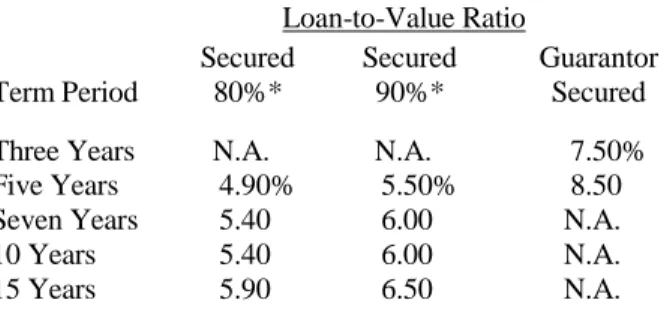
The rates offered vary based on whether the loan is secured by a mortgage or by a guarantor. Mortgage secured loans also vary based on the percent of the home's value that is loaned. Home improvement loans that are less than 80% of the home's value (termed the loan-to-value ratio) have lower rates than those loans that are be-tween 80% and 90% (maximum loan value) of the home's value. Table 5 shows the loan periods and the interest rates as of December, 2010. The Board of Veterans Affairs has not set new HILP rates since the loan moratorium went into effect.
Table 5: Home Improvement Loan Rates
Loan-to-Value Ratio
Secured Secured Guarantor Term Period 80%* 90%* Secured
Three Years N.A. N.A. 7.50%
Five Years 4.90% 5.50% 8.50
Seven Years 5.40 6.00 N.A.
10 Years 5.40 6.00 N.A.
15 Years 5.90 6.50 N.A.
*Percent of the home improvement Loan compared to the value of house.
All eligible veterans may qualify for these loans. In addition, Wisconsin residents that serve on active duty in the U.S. armed forces at the time they apply for a loan are eligible for the program. The general eligibility requirements for HILP are the same as for the primary mortgage loan program. However, no property security is required for HILP loans under $3,000; instead a simple guarantor is acceptable. In 2011-12, prior to the moratorium, DVA approved nine HILP loans totaling $273,100.
Personal Loan Program
The personal loan program (PLP) provides low-interest loans to eligible veterans, veterans'
unremarried surviving spouses, and children of deceased veterans. Individuals may use personal loans for any purpose.
The PLP is funded from the segregated (SEG) veterans trust fund, but the Department may bor-row from the primary mortgage loan repayment fund or may enter into an agreement with the State of Wisconsin Investment Board to obtain additional moneys for these loans. These amounts (along with interest fees) are then repaid to these funds. In 2010-11, DVA provided 285 loans under the program, totaling $920,875. No PLP loans were approved in the 2011-13 bienni-um.
The statutes authorize veterans to borrow up to $25,000, or such lesser amounts as the De-partment establishes, by rule, for a term of up to 10 years. A borrower may have more than one PLP loan outstanding, provided the current ceil-ing is not exceeded. PLP loan interest rates are also set by administrative rule and may be adjust-ed by DVA basadjust-ed on the term of the loan, the type of security offered, method of payment, or any other relevant factor.
Current DVA rules specify that a PLP loan may range from one to ten years. Educational loans may be deferred for up to five years, though interest accumulates during the deferral. The borrower then has an additional five years to pay off the loan.
DVA will not approve a loan if the loan would bring the applicant's total indebtedness to more than 35% of his or her monthly income un-less the applicant can show he or she has an ex-cellent debt repayment history. The applicant must also have at least one of the following: a demonstrated ability to accumulate savings, at least 15% equity in real estate, or such other fac-tors as the Department determines relevant to the applicant's ability and motivation to make higher repayments.
Most PLP loans must be evidenced by a
promissory note and secured by a Wisconsin mortgage. However, if a loan is less than $5,000 and is made to an individual with total PLP in-debtedness of less than $5,000, the loan may be evidenced simply by a promissory note secured by a guarantor. (The loan may also be secured by a Wisconsin mortgage.) DVA is required to es-tablish, by rule, the minimum allowable equity for mortgages that may be used to secure a per-sonal loan.
The Department has established variable in-terest rates, depending on the securitization of the loan. As of December, 2012, interest rates ranged from 4.9% for five-year loans secured by a mort-gage to 8.5% for five-year loans secured by a guarantor.
A qualifying veteran may not receive a loan if the outstanding loan balance for a PLP loan com-bined with any loans under any predecessor loan programs, would exceed $25,000 for a mortgage-secured loan, or $5,000 for a guarantor-mortgage-secured loan.
Individuals delinquent in any child support or maintenance obligations, as certified by the De-partment of Children and Families, may only re-ceive a PLP loan if the amount of the arrearage is to be paid from the proceeds of the loan. In these cases, DVA is required to ensure that the pro-ceeds of the loan are first applied to pay any de-linquent child support or maintenance payments and to pay any past support, medical expenses or birth expenses.
Veterans Grant Programs
Veterans Education Programs
The Department of Veterans Affairs adminis-ters two education-related grant programs for veterans -- the veterans education grant program
and the retraining grant program. These programs are funded from the segregated veterans trust fund and provide grants to individuals for educa-tion and for emergency assistance. In addieduca-tion to these programs, the University of Wisconsin Sys-tem (UW SysSys-tem) and the Wisconsin Technical College System (WTCS) administer tuition re-mission programs for veterans.
This section identifies two types of tuition aid: (a) remitted tuition and fees, the amounts that are not charged to a student but are instead deducted from the amount owed before a pay-ment is made; and (b) reimbursed tuition and fees, the amounts repaid to a student, in this case at the end of a semester. In the case of reim-bursements, the student must initially pay the tui-tion and fees actually charged (tuitui-tion and fee costs minus any other grants or scholarships or amounts remitted by Wisconsin higher education institutions) and then seek reimbursement upon completing a semester and meeting all qualifica-tions (such as filing required forms with the De-partment in a timely matter and maintaining a grade point average of at least 2.0).
Veterans Tuition and Fee Remissions. The
UW System Board of Regents and technical col-lege district boards must remit 100% of tuition and fees, less any amount paid under the federal Post-9/11 G.I. Bill, for up to 128 credits or eight semesters, whichever is longer, to eligible veter-ans. To qualify as a veteran eligible for this re-mission, a student must be verified by the De-partment of Veterans Affairs as: (a) being a resi-dent of this state for the purpose of receiving benefits; (b) having been a resident of this state at the time of entry into the armed services; and (c) having qualifying military service. In 2011-12, the UW System provided tuition and fee remis-sions totaling $8.1 million to 1,913 veterans. Of this amount, $2.2 million was remitted to veter-ans enrolled as graduate and professional stu-dents. The Wisconsin technical colleges provided remissions totaling $2.7 million to 2,055 veter-ans.
Beginning in the spring 2010 semester, veter-ans who are eligible for benefits under the federal Post-9/11 G.I. Bill have been required to use those benefits before accessing state tuition and fee remissions. The federal Post-9/11 G.I. Bill provides education benefits, including the direct payment of tuition and fees, a monthly housing allowance, and an annual books and supplies sti-pend, to veterans who served at least 90 days of active duty (or 30 days in the case of a service-related disability) after September 10, 2001. Stu-dents are required to use Post-9/11 G.I. Bill bene-fits before receiving state tuition and fee remis-sions even if they are eligible for benefits under the Montgomery G.I. Bill or certain other federal education programs for veterans unless the stu-dent is eligible for 12 months or less of benefits under those programs. Under 2011 Act 32, cred-its that are wholly paid for with Post-9/11 G.I. Bill benefits do not count against the 128 credit limit on state remissions. In cases where Post-9/11 G.I. Bill benefits pay for a fraction of a credit and the remainder is remitted under state law only the portion of the credit that is remitted is counted against the 128 credit limit.
Of the 1,913 UW students and 2,055 technical college students who received tuition remissions under state statute, Post-9/11 G.I. Bill education benefits paid a portion of tuition and fees for 773 UW students and 709 technical college students. An additional 1,886 UW students and 1,668 technical college students were eligible for re-missions under state statute but had their tuition and fees wholly paid with Post-9/11 G.I. Bill benefits. Although these students did not receive remissions through the state program, they were eligible to receive reimbursement/supplemental payments from the institution attended (described below). In 2011-12, Post-9/11 G.I. Bill tuition and fee payments for veterans to UW institutions totaled $16,574,553. The technical colleges re-ceived $4,931,034 in tuition and fee payments for veterans through the Post-9/11 G.I. Bill in that year. Payments from the Post-9/11 G.I. Bill pro-gram have reduced the amount of state tuition
remissions to veterans which peaked in 2008-09. The Montgomery G.I. Bill provides a monthly stipend to veterans who are enrolled as students which can be used for tuition, books and supplies, and living expenses. Veterans whose stipend under the Montgomery G.I. Bill or certain other federal education programs would have exceeded the amount of the monthly housing allowance provided under the Post-9/11 G.I. Bill (adjusted to reflect the annual books and supplies stipend) are reimbursed by the institution attended for the difference in these benefits. In 2011-12, the UW System provided reimbursement payments totaling $1.8 million to 897 veterans and the Wisconsin technical colleges provided $1.1 million to 685 veterans.
An appropriation under the Higher Educa-tional Aids Board (HEAB) has been provided to reimburse, in whole or in part, the UW Board of Regents and the Wisconsin technical college dis-trict boards for remissions provided to veterans, for remissions provided to the children and spouses of certain veterans, and for reimburse-ment payreimburse-ments made to veterans, children, and spouses. (For more information on tuition and fee remissions for children and spouses of certain veterans, please see the Legislative Fiscal Bu-reau's Informational Paper "Student Financial Aid.") Unlike the appropriation for DVA's veter-ans tuition and fee reimbursement program, dis-cussed below, which is funded through the veter-ans trust fund, the HEAB appropriation for the reimbursement of the UW Board of Regents and the Wisconsin technical college district boards is funded with state, general purpose revenues (GPR). In 2011-12, the appropriation was set at $6,496,700 and the UW Board of Regents re-ceived a reimbursement payment of $4.6 million while the Wisconsin technical college district boards received reimbursements totaling $1.9 million. This amount fully funded all reimburse-ment payreimburse-ments made directly to veterans (identi-fied above) and reimbursed the institutions for approximately 17.5% of remissions provided to
veterans, children, and spouses. Remissions costs beyond the amount reimbursed through the HEAB appropriation must be absorbed within the UW System's and the Wisconsin technical col-lege district boards' budgets or funded through other revenues such as tuition charged to other students.
Veterans Tuition and Fee Reimbursements.
Eligible veterans who attend qualifying institu-tions other than the UWS and WTCS or did not enter service from Wisconsin cannot have tuition or fees remitted. However, these veterans are still eligible for tuition and fee reimbursement from DVA.
The Department reimburses veteran students for tuitions and fees that are not remitted by a UW System or WTCS institution. If the veteran student was also eligible for DVA's veterans edu-cation grant program, the student could be reim-bursed for the amounts not remitted by the UW System or WTCS institution, up to 100% of the cost of undergraduate tuition and fees, minus any other grants or scholarships received by the vet-eran, with a maximum reimbursement based on the costs of a UW-Madison resident undergradu-ate. The statutes specify that veterans that are eli-gible for National Guard tuition reimbursement or tuition assistance from the U.S. Department of Defense may not receive DVA veterans educa-tion grants.
Under the DVA education grant program, tui-tion and fees reimbursements are made upon an eligible veteran's successful completion of a se-mester at any UW System institution or center, state technical college, private school approved by the Educational Approval Board, private or public high school, or similar institution with a tuition reciprocity agreement with Wisconsin.
Tuition reimbursement credit limitations are based on the length of active duty service for the veteran. Veterans who were on active duty for at least 90 days but no more than 180 days may be
reimbursed for up to 30 credits or two semesters. Veterans with at least 181 days of active duty service but no more than 730 days are eligible for reimbursement of up to 60 credits or four semes-ters. Veterans with more than 730 days of active duty service may be reimbursed for up to 120 credits or eight semesters of study.
Veterans may receive tuition and fee reim-bursement only for credits begun prior to the 10-year anniversary of their separation from active duty. After the 10-year anniversary, the veteran may only be reimbursed for up to 60 of the cred-its for which they are eligible. For all semesters started after May 27, 2010, eligible veterans may be reimbursed for up to 11 credits per semester regardless of whether the student is full- or part-time, for up to 60 credits past the delimiting date. All applications for the veteran education grant program must be received by DVA within 60 days following the end of the semester for which reimbursement is sought. A veteran may not be reimbursed by the Department if he or she has an undergraduate degree.
Part-time students may be reimbursed by DVA for courses taken at out-of-state institu-tions, if the course is not offered within 50 miles of the veteran's residence, and the course is taught at an institution within 50 miles of the state boundary, or a correspondence course is not offered in this state.
Eligibility for DVA reimbursement is restrict-ed to veterans with incomes of $50,000 or less (plus $1,000 for each dependent in excess of two). The veteran may not be reimbursed in any semester in which the veteran failed to achieve at least a 2.0 grade point average, or a "C" average.
Spouses, unremarried spouses, widows and dependents are not eligible for tuition and fee re-imbursement, unless they also qualify as veter-ans.
In 2011-12, DVA awarded 479 veterans edu-cation grants, totaling $986,300.
Retraining Grant Program. DVA awards
grants to veterans who participate in retraining programs to enable them to obtain gainful em-ployment. The grant amounts are limited to $3,000 in any 12-month period. A veteran may not receive more than $6,000 in grants during his or her lifetime.
These grants are available to any veteran who: (a) is enrolled in a state technical college or an in-state proprietary school that is approved by the Education Approval Board (other than a proprie-tary school offering a year degree or a four-year program), or is engaged in a structured on-the-job training program that meets program re-quirements promulgated by DVA; (b) meets fi-nancial assistance criteria established by DVA; (c) has become unemployed, underemployed or received a notice of termination of employment in the year prior to submitting the grant applica-tion; (d) proposes to participate in a retraining program that could enable the veteran to find gainful employment; and (e) has not received a DVA tuition reimbursement grant for the same period. The eligibility criteria and the determina-tion of the grant amount are further specified in administrative rule.
In 2011-12, DVA awarded 30 retraining grants, totaling $52,351.
Assistance to Needy Veterans
DVA provides limited emergency financial assistance to eligible veterans and their families under the assistance to needy veterans (ANV) program.
By rule, eligibility for these grants is limited to veterans in families with income less than 130% of the federal poverty level. In 2012, this amount was $14,521 for an individual and $24,817 for a family of three. In addition, each grant applicant must submit a declaration that he or she has applied for all aid offered through or administered by county, state or federal
govern-ments, and must list all assets that are available to the applicant or the applicant's family. An indi-vidual may not receive more than $7,500 in ANV grants during his or her lifetime.
In addition to veterans, unremarried spouses and dependents of veterans who died while on active duty (including training) are eligible to receive assistance if they meet the income re-quirements. Further, spouses and dependents of activated or deployed members may be eligible for assistance grants if they submit evidence that: (a) the service member has been deployed or ac-tivated; (b) due to the activation or deployment, a loss of income has occurred; (c) an economic emergency has occurred during the activation or deployment; and (d) the spouse and dependents are residents of the state. For this latter group, the requirement that the applicant have income that does not exceed 130% of the federal poverty lev-el does not apply.
The ANV program provides two types of ser-vice: (a) assistance for health care costs; and (b) subsistence aid.
Dental care (including dentures), hearing care (including hearing aids) and vision care (includ-ing eye glass frames and lenses) are funded under the health care aid component of the program. In order to be eligible for health care aid, a veteran may not have liquid assets that exceed $1,000. In calculating liquid assets, DVA may not include the first $50,000 of cash surrender value of any life insurance policy.
The Department may not provide health care aid unless the health care provider agrees to ac-cept the following as payment in full: (a) the amount of the DVA grant payment; (b) any available insurance payment; and (c) a payment by the veteran in the amount the Department de-termines the veteran is able to pay.
By rule, dental care assistance cannot exceed $500 for any 12-month period unless dentures are required. The grant may not exceed $1,875 for an upper or lower denture or $3,750 for both in any 48-month period.
Hearing care may not exceed $200 in any 12-month period, unless a hearing aid is needed. A grant for a hearing aid may not exceed $1,875 for any 48-month period, unless documentation vided by a licensed audiological health care pro-fessional demonstrates a compelling medical need for additional assistance.
A grant for vision care may not exceed $400 in any 12-month period, except in the following circumstances: (a) there is a significant change to the refraction error of eyes [the rules specify the necessary refraction changes for additional aid]; or (b) an ophthalmologist or optometrist docu-ments the medical necessity of additional assis-tance, or for an additional set of eyewear.
The subsistence aid component of the pro-gram provides temporary emergency aid to veter-ans in the event of an illness, injury or natural disaster that causes a loss of income. The De-partment may grant subsistence aid to veterans whose loss of income is the result of abuse of al-cohol or other drugs if the veteran is participating in an alcohol and other drug abuse treatment pro-gram approved by DVA.
The amount an individual receives is limited to the difference between the amount of income earned before the loss of income and the amount of income earned after the loss of income. Sub-sistence aid is provided for 30-day periods for a maximum of 90 days. Payments cannot exceed $3,000 over any consecutive 12-month period.
In 2011-12, DVA awarded 304 assistance to needy veterans grants totaling $488,600.
Assistance to Veterans Organizations
The Department administers three grant pro-grams that provide funding to organizations or entities that assist Wisconsin veterans -- the county veterans service office grants program, the grants to veterans organizations program, and a transportation services grant program.
Grants to Support County Veterans Service Offices
The statutes require each county to have a county veterans service officer (CVSO) and to provide the CVSO with office space and clerical assistance. Each CVSO must be a Wisconsin res-ident and a veteran who served on active duty under honorable conditions.
CVSOs are required to: (a) advise veterans of any benefits to which they may be entitled and to provide assistance regarding any complaint or problem arising from such services; (b) make re-ports to their county board; (c) cooperate with federal and state agencies that serve or grant aid or benefits to former military personnel and their dependents; and (d) furnish information about veterans burial places within the county. These duties are required to be performed separately and distinctly from any other county department.
DVA awards grants to counties that maintain and operate a county veterans service office con-sistent with standards developed by the Depart-ment. A county's grant to support these activities is based on whether the CVSO is full-time or part-time and on the county's population. For counties with full-time CVSOs, the statutory grant amounts are as follows:
• $8,500 for counties with a population under 20,000 (Ashland, Bayfield, Buffalo, Bur-nett, Crawford, Forest, Green Lake, Iron, Lafa-yette, Langlade, Marquette, Menominee, Pepin,
Price, Richland, Rusk, Sawyer, and Washburn Counties);
• $10,000 for counties with a population from 20,000 to 45,499 (Adams, Clark, Door,
Douglas, Dunn, Green, Jackson, Juneau,
Kewaunee, Lincoln, Marinette, Monroe, Oconto, Oneida, Pierce, Polk, Shawano, Taylor, Trem-pealeau, Vernon, Vilas and Waushara Counties); • $11,500 for counties with a population from 45,500 to 74,999 (Barron, Calumet, Chip-pewa, Columbia, Grant, Portage, Sauk, Waupaca, and Wood Counties); and
• $13,000 for counties with a population of 75,000 or more (Brown, Dane, Dodge, Eau Claire, Fond du Lac, Jefferson, Kenosha, La Crosse, Manitowoc, Marathon, Milwaukee, Out-agamie, Ozaukee, Racine, Rock, St. Croix, She-boygan, Walworth, Washington, Waukesha, and Winnebago Counties).
• Counties with a part-time CVSO are eli-gible for a grant of $500 annually. Currently, two counties have part-time CVSOs (Florence and Iowa Counties).
In the 2011-13 biennium, the CVSO grant program is funded 45% from the veterans trust fund, 45% from the primary mortgage loan pro-gram, and 10% from Veterans Homes operations. In 2011-12, $731,500 was awarded in grants to counties ($329,200 from the veterans trust fund, $329,200 from the veterans mortgage loan pro-gram, and $75,200 from Veterans Homes opera-tions).
American Indian Veterans Service Grants
The Department provides grants to federally recognized Indian tribes and bands that appoint a tribal veterans service officer and that meet min-imum budget and operating standards. The ser-vice officer must be a veteran and must serve as a full-time employee. The tribal veterans service
officer provides the same services as CVSOs provide, but provide these services to tribal members. These grants are funded with tribal gaming revenues. In 2011-12, nine tribal grants totaling $61,200 were awarded to the Bad River Band, Ho-Chunk, Lac Courte Oreilles, Lac du Flambeau, Menominee Nation, Oneida, Red Cliff, Sokaogon Chippewa, and Stockbridge-Munsee Tribes.
Grants to Veterans Organizations
This program provides grants to state and na-tional veterans organizations that maintain a claims service office at the USDVA regional of-fice in Milwaukee for the purpose of assisting Wisconsin veterans with obtaining federal veter-ans benefits. To qualify for the state grant, the veterans organization must have maintained the office for at least five out of the ten years preced-ing the date of application for the grant.
Grant amounts are based on the total amount of salaries and travel expenses incurred by a qualifying service organization as follows: (a) for organizations with costs ranging from $1 to $2,499, DVA reimburses the entire amount; (b) for organizations with costs ranging from $2,500 to $9,999, DVA reimburses $2,500; (c) for or-ganizations with costs ranging from $10,000 to $119,999, DVA reimburses 25% of the costs; and (d) for organizations with costs of at least $120,000, DVA reimburses $30,000.
In 2011-12, DVA provided grants totaling $102,000 to four organizations -- the American Legion, Disabled American Veterans, the Mili-tary Order of the Purple Heart, and Veterans of Foreign Wars.
Transportation Services Grant Program
DVA distributes grants to counties and to vet-erans service organizations that transport veter-ans to medical facilities. A total of $200,000 from the veterans trust fund is budgeted in each year of the 2011-13 biennium for the program.
Of the funding available in the 2011-13 bien-nium, DVA has allocated $100,000 annually to the Wisconsin Chapter of the Disabled American Veterans to provide free transportation for veter-ans to community-based outpatient clinics and medical centers. In addition, DVA has allocated $100,000 annually for grants to counties that are not served by the transportation network devel-oped by the Wisconsin Chapter of the Disabled American Veterans. Counties may use these grant funds to develop, maintain, and expand transportation services to veterans, including the development of multi-county cooperative trans-portation services.
Counties may not allocate any portion of a transportation services grant for use by another county department or reduce funding to a county veterans service office as a result of receiving a transportation services grant.
In most cases, the grant is divided among the eligible counties based upon the total number of miles that eligible veterans were transported in that particular county compared to the total num-ber of eligible miles that were driven in all coun-ties. Counties that are starting a new transporta-tion program, or are expecting to significantly increase the number of miles that veterans will be transported may submit an application based on estimated costs.
Other Programs
In addition to loan and grant programs for veterans and veterans organizations, DVA ad-ministers several other programs that provide services to veterans -- the veterans assistance program, veterans property tax credit, veterans memorial grants, state veterans cemeteries, mili-tary funeral honors, and the state Veterans Muse-um.
Veterans Assistance Program
The veterans assistance program (VAP) pro-vides transitional housing and support services to homeless veterans and veterans who are at risk of becoming homeless. By rule, a veteran is eligible for the program if the veteran's need for services is based on any of the following circumstances: (a) homelessness or conditions that indicate that the veteran is at risk of becoming homeless; (b) incarceration; (c) unemployment or underem-ployment that significantly limits the veteran's ability to be self-supporting; (b) an affliction with acute or chronic physical or mental health prob-lems that significantly limits the veteran's ability to be self-supporting; and (d) insufficient month-ly income and resources to pay for the cost of care provided at an assisted living facility operat-ed at a state Veterans Home.
DVA funds VAP residential services on the campuses of the three state Veterans Homes (26 beds at King, 30 beds at Union Grove and Chip-pewa Falls) and at Fort McCoy (14 beds). DVA contracts for program operations at the state Vet-erans Homes, and employs state staff to operate the program at Fort McCoy. DVA has contracted with the Center for Veterans Issues (CVI) since May, 2007. CVI operates other transitional hous-ing facilities for veterans that are not partially supported with state funds. In October, 2012, DVA requested bids for a new contract beginning in January, 2013.
Services provided in the VAP include: (a) transitional housing; (b) referrals to service pro-viders; (c) financial assistance to veterans who are eligible for residency at a veterans home but lack financial resources; (d) assistance in seeking vocational opportunities; and (e) single occupan-cy rooms at reduced rent for working veterans.
All veterans who have served in the U.S. armed forces with other than a dishonorable dis-charge are eligible to participate in the VAP. There is no state residency requirement for this
program. The assistance centers do not provide services to veterans' spouses (unless the spouse is a veteran) or to veterans' children.
In 2011-12, the program was supported from federal per diem payments ($1,298,500) the vet-erans trust fund ($261,100) and revenue contrib-uted by veterans who received VAP services ($44,700 including $10,300 veterans paid for services provided by DVA and $34,000 for ser-vices provided by CVI). Veterans who are gain-fully employed are required to pay part of pro-gram costs.
The Department also provides services to vet-erans who are incarcerated in Wisconsin or are under community supervision by the Department of Corrections. The Department assists veterans at the assessment and evaluation centers at the Dodge and Taycheedah Correctional Institutions. The Department conducts monthly briefings for veterans at the Dodge facility and at other correc-tional facilities on request.
Veterans Property Tax Credit
Since tax year 2005, Wisconsin has provided a refundable credit against the individual income tax for property taxes paid by certain veterans and unremarried surviving spouses of veterans. Currently, the tax credit is equal to real and per-sonal property taxes paid on a principal dwelling by an eligible veteran or by an eligible unremar-ried surviving spouse.
An eligible veteran is defined as a person: (a) who served on active duty in the U.S. armed forces; (b) was a resident of this state at the time of entry into that service or had been a Wisconsin resident for any consecutive five-year period af-ter entry; (c) who is a resident of the state for purposes of receiving veterans benefits; and (d) has a service-connected disability of 100% or a 100% disability rating based on individual em-ployability.
An unremarried surviving spouse includes persons meeting any of three criteria relative to the deceased spouse:
a. The spouse died while on active duty in the U.S. armed forces, was a Wisconsin resident at the time of entry into service or for any subse-quent, consecutive five-year period, and was a Wisconsin resident at the time of death;
b. The spouse served on active duty in the U.S. armed forces, was a Wisconsin resident at the time of entry into active service or for any subsequent, consecutive five-year period, was a resident of this state at the time of death, and had a service-connected disability of 100% or a 100% disability rating based on individual employabil-ity; or
c. The person served in the National Guard or U.S. armed forces reserves, who was a Wis-consin resident at the time of entry into active service or for any subsequent, consecutive five-year period, and who died in the line of duty while on active or inactive duty while a Wiscon-sin resident.
For married-joint filers, an eligible veteran may claim the credit for the entire property tax imposed on the veteran's principal dwelling, ra-ther than for the share of property taxes that re-flects the veteran's ownership interest in the dwelling (which is 50% for property owned as marital property). For a married couple filing separate returns, an eligible veteran and an eligi-ble spouse are each permitted to claim the veter-ans property tax credit based on their respective ownership interest in the veteran's principal dwelling.
The veterans property tax credit is not al-lowed if an individual or the individual's spouse files a claim for the property tax/rent credit, the farmland preservation credit, or the homestead credit.
Almost 6,000 veterans or spouses claimed the credit in tax year 2011. Because the veterans property tax credit is a refundable credit, it is treated as an appropriation, and $19.9 million was expended from the appropriation in 2011-12.
Veterans Memorial Grants
The Department has provided funding and administrative support for the construction of several veterans memorials.
The Vietnam Veterans Memorial was dedi-cated in September, 1988. The monument is lo-cated near Neillsville in Clark County at the Highground Memorial Park, which includes a number of tributes and trails, and provides educa-tional and social programs. The Highground Memorial Park is operated and maintained by the Wisconsin Vietnam Veterans Memorial Project, a private, non-profit corporation.
The Wisconsin Korean War Veterans Memo-rial was dedicated in June, 1994, at a site near Plover in Portage County. It is operated by the Korean War Veterans Memorial Association of Wisconsin, Inc., also a private, non-profit corpo-ration.
1991 Wisconsin Act 44 provided funding for the construction of World War I, World War II and Persian Gulf War memorials at the Highground Memorial Park. The World War I memorial was dedicated in September, 1992, and the World War II memorial was dedicated in September, 1993. Construction for the Persian Gulf War memorial began in November 2011.
The state has also made contributions to the creation and maintenance of two women's war memorials in Washington, D.C. One grant was for the Vietnam Women's Memorial depicting women's role in that war. This memorial is locat-ed at the site of the Vietnam Veterans Memorial Wall and was dedicated in November, 1993. The second grant was for the Women in Military Ser-vice for America Memorial to honor women who
served from the American Revolution to the pre-sent, as well as those who will serve in the future. This memorial is located at the grand entrance of the Arlington National Cemetery in Arlington, Virginia, and was dedicated in October, 1997.
1999 Wisconsin Act 2 provided $166,100 GPR in one-time funding to support the construc-tion of a World War II Memorial in Washington, D. C. This memorial was dedicated in May, 2004.
Veterans Outreach Efforts
The Department conducts outreach events to inform and assist veterans in receiving state and federal veterans benefits. DVA, in collaboration with the Wisconsin Department of Workforce Development (DWD), conducted 16 career and benefit fairs in calendar year 2012. The fairs fea-ture employers providing job search assistance to veterans seeking employment, along with local, state and federal veterans advocates offering ben-efits and services information to state veterans. The Department estimates that over 2,400 veter-ans attended these fairs in 2012.
In addition, in 2012, DVA co-sponsored and coordinated five "Year of the Veteran Business Symposiums" to educate employers on the bene-fits of hiring veterans.
In March, 2012, DVA created the Veterans Benefits Resource Center (VBRC) which provides veterans improved access to information about the Department's programs, benefits and services via phone, chat (through DVA's website), walk-in and e-mail communications. The goal of the VBRC is to ensure that veterans who contact DVA during business hours will be able to immediately speak to VBRC support staff trained to provide the most frequently requested information about the Department's programs, benefits, and services.
The Department's outreach staff also
coordi-nates and attends re-integrations, demobilizations and other veterans events. The Recently Separat-ed Veterans Program provides monthly informa-tional mailings to veterans recently separated or discharged from active duty and returning to Wisconsin.
Wisconsin Veterans Cemeteries
There are four veterans cemeteries located in Wisconsin. The Wood National Cemetery, oper-ated by the USDVA, is co-locoper-ated with the VA Regional Office and VA Medical Center in the City of Milwaukee and is closed to new inter-ments. DVA operates three state veterans ceme-teries -- the Central Wisconsin Veterans Memori-al Cemetery at the Veterans Home in King, the Southern Wisconsin Veterans Memorial Ceme-tery at the Veterans Home at Union Grove, and the Northern Wisconsin Veterans Cemetery near Spooner in Washburn County. The state veterans cemeteries provide burials for veterans, spouses and dependent children. Each of the state ceme-teries provide casket and cremation internments.
Veterans whose military service and state res-idency meet specific requirements are eligible for burial at a Wisconsin veterans cemetery. The vet-eran must have been discharged or released from active duty service (except service on active duty for training purposes) or died while on active du-ty. In addition, the veteran must meet one of the following residency and service release require-ments: (a) military service was entered from Wisconsin and the person was discharged or re-leased under conditions other than dishonorable; (b) service was entered from another state but the veteran was a Wisconsin resident at the time of death and the person was discharged or released under conditions other than dishonorable; or (c) military service was entered from another state but the veteran was a Wisconsin resident for at least 12 months preceding his or her death and the person was discharged or released under hon-orable conditions. DVA receives a $700 plot al-lowance from the federal government for each