IPA
International Journal of Psychology Vol. 9, No. 2, Summer & Fall 2015
PP. 1-24 Iranian Psychological Association
Effectiveness of Problem Solving Skills on
Academic Help-Seeking and Self-Efficacy of
Female High School Students
Farideh Hamidi, PhD
Department of Education Shahid Rajaee Teacher Training
University
Zahra Shirdel
Department of Education Shahid Rajaee Teacher Training
University
The present study aimed to investigate the effectiveness of problem solving skills training on academic help-seeking and self-efficacy of students. The population consisted of high school female students during the academic year of 2011/2012 in Ghaemshahr, Iran. The sample consisted of 50 female students selected through multistage clusteringand they were divided into control and experimental groups (25 students in each group). Research tools included help-seeking behavior questionnaire and general self-efficacy scale (GSES). Problem solvingskills training duringeight sessions (2 hours) was appliedfor one month. Data was analyzed using descriptive statistics and multivariate analysis of covariance (MANCOVA). Results showed that problem solving skills training influenced adaptive help-seeking, avoidance of help-seeking and self-efficacy of students, so that it increased adaptive help-seeking, reduced avoidance of help-seeking and increased self-efficacy of the experimental group compared to the control group. The results of this study have important implications in the field of improved performance and academic achievement of students.
Keywords: Problem solving skills training, adaptive help-seeking, avoidance of help-seeking, self-efficacy
in most societies everybody believes that there should be a focus on increasing problem-solving skills.One of the important aims of the modern educational and training systems is training individuals who would be able to easily conquer their problems in daily life and social environment (Selcuk, Caliksan & Erol, 2007). These educational systems help individuals to acquire knowledge, skill and sight necessary for coping with their problems (Altun, 2003). In this matter, Students can seek help from some strategies whenever they are facing a problem. Educational help-seeking has been defined as a strategy for overcominglearning difficulties and improving conversance (Karabenick, 2002). Hence help-seeking is one of the learning strategies that by using it students can recognize their learning and educational difficulties and solve them by means of questioning and seeking help from others. They can use these
strategies to achieve skills proficiency and better learning. In fact educational help-seeking includes behaviors such as asking questions from teachers, parents and classmates, asking for more explanation about the problem and getting hints and solutions
for the problem and other educational helps( Karabenick and Newman, 2006).
knowledge because students had been trained properly in help-seeking. Young (2009; according to Ryan & Huiyoung Shin, 2011) has found counter relationship between avoidance of help-seeking and cognitive strategies (problem solving strategies) among students. Also Ryan and Huiyoung Shin (2011) through a research reported that self-efficacy has a positive correlation with adaptive help-seeking and a negative correlation with avoidance of help-seeking. Gordon (2012) in studying the correlation among self-efficacy, help-seeking behavior and educational development concluded that self-efficacy and help-seeking behavior are predictors of students’ educational development and there is a positive and meaningful correlation between self-efficacy and help-seeking.
Self-efficacy is a part of individual’s self-image that is related to individual’s beliefs about his/her abilities to do a task which
he/she will face in the future (Bandura, 1997). Self-efficacy means that the individual can take the control of a situation and produce positive outcomes. Bandura mentions that self-efficacy has great effect on behavior. As an example, a student with low
reasonably, they would try harder and in facing the problems they would be more persistent. Also they would focus on the problem and have more peaceful and successful feelings and benefit from more effective strategies. Zimmerman and Cleary (2004) in their case studies found out that one of the important reasons for unsuccessful education is low self-efficacy. They found that educational problems of some students are due to not implying self-regulation strategies. Failure in doing tasks and problem-solving lowers their self-efficacy and in result of that they trust their own abilities less and will face more educational problems. Zeraat and Ghafourian (2010) through a study showed that teaching problem-solving skill to students increases their abilities and promotes their educational self-image and development; hence it should be noticed in the curriculum. The results of the study conducted by Zahrakar, Rezazadeh and
Ahghar (2010) indicated that the self-efficacy of the students trained with the problem-solving skills was more than that of students without those trainings. Also the self-efficacy of the students throughout the time enjoys reasonable stability.
which one defines the problems decides to find a solution and applies the problem-solving strategy and monitors it (Elliot, et al, 1999). Different studies have suggested that cognitive-behaviorist therapy with focus on problem-solving can be effective on individuals’ self-efficacy and help-seeking. A study by Agbaria (2011) showed that teachers of special education who perceived themselves as less involved in school activities reported symptoms of learned helplessness with respect to their work at school, expressed as unwillingness to expend effort, dissatisfaction and difficulty in perseverance. Also he found clear links between motivation and its components and participation in the process of choosing an academic institution (Agbaria, 2013).
The results of Morton’s study (2005) showed the effect of teaching problem-solving in lowering the causes of educational
downfall. Khaledian, Omidi, Sepanta, and Tavana (2014) showed the effect of life skills training on the students' self esteem. According to Deguzman (2008) problem-solving skill in a task that is accompanied by help-seeking provides better
that teaching problem-solving skill as a technique can dynamize the metacognitive and characteristic elements of creativity.
Regarding the fact that problem-solving is considered an important topic in educational and cognitive psychology and also as an important strategy in learning and with respect to its importance and the effect of self-efficacy and help-seeking on education and learning of the students, this study attempted to find out whether problem-solving skill affects students’ self– efficacy and educational help-seeking? In order to find an answer to this problem, the following two hypotheses were proposed:
1) Getting trained in problem-solving decreases avoidance of help-seeking among students.
2) Training in problem-solving increases self-efficacy among students.
Method
The present study regarding the practical purpose and administration is experimental and in the pre-test post-test
model with the control group.
Population, sample and sampling method
by multi steps clustering meaning that first geographically the Ghaemshahr city is divided into two schooling areas and then from those two areas one area randomly was chosen and from 19 female high schools of this area randomly one school was selected and from three grades of this high school, first grade was randomly selected. In next stage 170 questionnaires were distributed among the students and 68 students got grades with one standard deviation lower the average in both questionnaires of the educational help-seeking and general self-efficacy and among them 50 students were selected randomly and paced in experimental and control groups.
Instruments
Help-seeking behavior questionnaire.This questionnaire is a self -reporting instrument that has been set by Ghadampour and
Sarmad (1382) according to the points made by Newman (1998), Newman and Goldin (1990) and Ryan and Pintrich (1997) and has 14 items that measures help-seeking behavior by two components of adaptive and avoiding help-seeking. For
and .72.
The General Self-Efficacy Scale (GSES).This questionnaire has been made by Sherer, et al (1982) and measures individual’s beliefs about his abilities to conquer different situations (AziziAbarghouei, (2008). This questionnaire has 17 items that the respondent answers according to the Likert’s five degree scale (from firmly against to absolutely fore). High grades show individual’s feeling of high self-efficacy. Barati (according to Keramati and Shahraraye, 2004) reported the admissibility of the structure of this test in a 100 members group .61 which was meaningful in the level of .05. The final correlation of the test has been achieved .76 by Spearman Brown formulawith even length, .76 without even length and .76 by Gutman’s two halves method or general similarity of the questions was .79 which is pleasing. Keramati and Shahraraye (2004) by Cronbach’s alpha
method have reported the final correlation of that 0/85. In
present research, the questionnaire demonstrated a Cronbach's alpha reliability coefficient of 0.75 and 0.72 for help seeking and avoidance of help seeking.
Problem-solving skill educational sessions.In this study of the interfering program of teaching problem-solving skill in groups and after implication of pre-test on the experimental and control group, the experimental group took part in 8 two-hours sessions of teaching problem-solving skill programs within a month (two sessions each week). The interfering program by using various references especially Goldfried and Division' behavior therapy book (1976) was made and implied as following:
reporting the previous session’s tasks and giving feedback and making smaller groups. Third session (exact definition of the problem): brief review of the previous session’s tasks, discussing about the necessity of the more exact definition of the problem and prioritizing of problems. Forth session (making a list of different solutions), fifth session (assessing different solutions and selecting the best one), sixth session (making decision and implying different solutions), seven’s sessions (emphasis on instrumen-purpose thinking), eights session (reviewing previous stages).
Administration Method. After coordination and getting the permissions from the education bureau and by the help of the dean and staff of the school, 170 questionnaires were distributed among first year students of the high school and among them students with one standard deviation below the average in two
variables were selected and randomly were divided into control and experimental groups. Then by coordination with the dean of the school within 8 two-hour sessions for two times a week problem-solving skill was taught in groups to the experimental
analysis eliminates the covariates’ effect on the relationship between the independent grouping variable and the continuous dependent variables.
Results
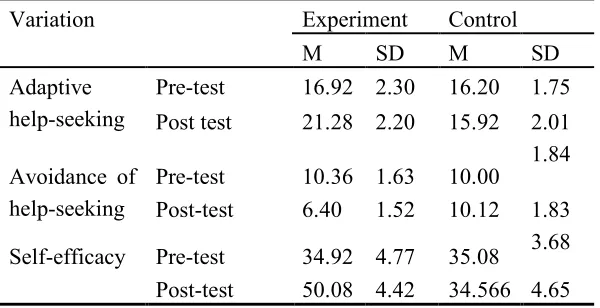
The participants of the study were in the first grade of high school with the average age of fifteen. For assessing the hypothesis of research, mean and standard deviation of the grades, small scales of the students’ academic help-seeking and self-efficacy in stages of pre-test and post-test were compared.
Table 1
Mean and Standard Deviation of the Grades of Adaptive and Avoidance of Help-seeking and Self-efficacy of the Female Students of the both Experiment and Control Group I Pre-test and Post-test
Table 1 includes mean and standard deviation of pre-test and post-test in both groups of experiment and control. Results show that in pre-test there isn’t a great difference between mean
grades of adaptive and avoidance of help-seeking and self-efficacy in experiment and control groups but in the post-test the
Control Experiment Variation SD M SD M 1.75 16.20 2.30 16.92 Pre-test Adaptive
help-seeking 2.01
1.84 15.92 2.20 21.28 Post test 10.00 1.63 10.36 Pre-test
Avoidance of
help-seeking 1.83
mean grades of the adaptive help-seeking and self-efficacy in experiment group has increased and also the mean of avoidance of help-seeking in experiment group compared to control group has decreased.
Before using covariance analysis parametric test for observing its assumptions, Box and Levene's tests were used. According to BOX test which was meaningful for none of the variables, homogeneousity of variance/covariance matrixes was observed properly (Box's =8.58, F=1.33, P=0.238).
According Levene's Test for Equality of Variances and its meaningfulness for no variables, the equality of inter groups variances has been observed.
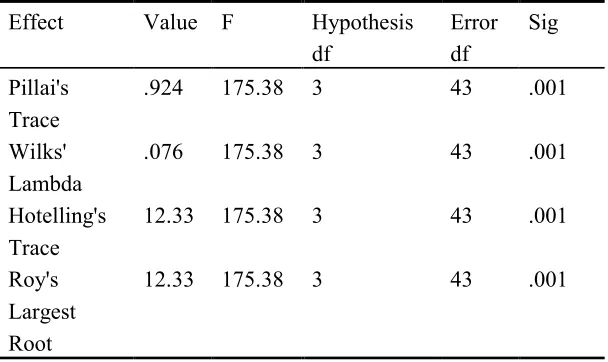
Table 2
Validity Criteria of Multi Variables Covariance Test
Sig Error df Hypothesis df F Value Effect .001 43 3 175.38 .924 Pillai's Trace .001 43 3 175.38 .076 Wilks' Lambda .001 43 3 175.38 12.33 Hotelling's Trace .001 43 3 175.38 12.33 Roy's Largest Root
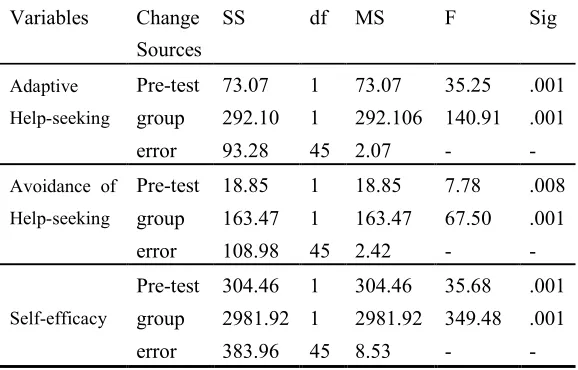
Table 3
Result of MANCOVA Analysis of Grades from Adaptive Help-seeking, Avoidance of Help-seeking and Self-efficacy Tests in Experiment and Control Groups
Sig F MS df SS Change Sources Variables .001 35.25 73.07 1 73.07 Pre-test Adaptive
Help-seeking group 292.10 1 292.106 140.91 .001
- - 2.07 45 93.28 error .008 7.78 18.85 1 18.85 Pre-test
Avoidance of
Help-seeking group 163.47 1 163.47 67.50 .001
- - 2.42 45 108.98 error .001 35.68 304.46 1 304.46 Pre-test
Self-efficacy group 2981.92 1 2981.92 349.48 .001 - - 8.53 45 383.96 error
As seen in table3 the amount of calculated F for grades of adaptive help-seeking, avoidance of help-seeking and self-efficacy in experiment and control groups, after stabilizing the effect of pre-test, is meaningful. In result there is a meaningful difference between the mean of post-test grades of the adaptive help-seeking, avoidance of help-seeking and self-efficacy in experiment and control group after stabilizing the effect of pre-test. The comparison between means of two groups shows that the mean grade of adaptive help-seeking in experiment group
experiment group with (M=6.40) is lower than that of control group with (M=10.12). So we can say that in contrast to the control group students, the problem-solving skill teaching program has its effects in adaptive help-seeking, avoidance of help-seeking and self-efficacy on the experiment group students that have been exposed to the program in a way that it has increased the adaptive of help-seeking and decreased the avoidance of help-seeking in experiment group students.
Discussion
The purpose of this study was to assess the effectiveness of problem-solving skill training on students’ self-efficacy and academic help-seeking. The results from first hypothesis showed that problem-solving skill training increases adaptive help-seeking and turned out that the tests of the experiment group
who were taught the problem-solving skills showed a remarkable increase in their help-seeking and self-efficiency in the post-test. This increase in comparison to the control group that had never been taught was meaningful. In fact the
Ahmadpour (1998), Pakdaman, et al, (2007), Khoshkam,et al, (2008) and Zare’e and Mobini (2010) .In defining of these findings one can say that students who use the help-seeking strategy, by using metacognitive strategies can recognize their academic problems and become aware of their need to others’ help much better. In result these students by relying on effective metacognitive strategies for solving academic and learning problems use help-seeking strategy and get better academic achievement (Ghaddampour and Sarmad, 2005). Since help-seeking is one of the self-regulative strategies, these strategies help students to manage the facilities in class and the environment. This kind of help-seeking acts as a strategy for preventing academic failure. By help-seeking not only students’ academic problems would decrease but also they would grasp skills and knowledge that would act as a method of
problem-solving and professional learning in other situations (Nelson-le-Gall,1987). Regarding the fact that the problem-solving skill is on the highest level of human’s cognitive and metacognitive activities, creating the problem-solving ability in students makes
these people well-prepared in facing life conditions and new situations they would be exposed to. In this way, problem-solving skill teaching to students lets them have better countering in facing the problems and not to lose their hope. It also helps them to make themselves able to encounter any problem and to seek help from others. In conclusion, according to these results, one can say that acquiring problem-solving skill reinforces the help-seeking behavior in students.
which is problem-solving skill teaching has decreased the avoidance of help-seeking was similar to the results of the following studies: Ames and Archer(1988), Butler and Newman (1995), Ryan and Pintrich (1997), Elliot, et al, (1999), Kavanagh, (1999), Morton, (2005), Ryan and Hyuang Shin, (2011, Izadyfard and Sepasi Ashtiani, (2009).
Ryan and Pintrich (1997) show that avoidance of help-seeking comes in two patterns: 1) help-help-seeking is not exclusively academic but also relies on social interactions and 2) the learner’s social competency has its effect on help-seeking. Students avoid help-seeking because there is no practical rule against help-seeking. A student might feel that no one can help him/her. As time passes, the student might feel hopeless to receive any help.
In addition students might have their own concerns about too
much of tendency toward independence and fear from threats to their own competency. In fact social and cognitive competency of the students plays an important role in help-seeking. Students, who are less successful, won’t ask for help because if they do,
their help-seeking is the confirmation to this assumption that they are disabling. On the other hand, successful students worry a lot less about what others think about him/her and it is more probable for them to seek help. In addition students, who feel more socially competent, seek help with higher probability. So the probability of help-seeking relies on social interactions (Ryan and Pintrich, (1997).
real life problematic situations. Therefor by teaching this skill that utilizing social problem’s solution is one of its important features, one can expect that avoidance of help-seeking as a behavior with social consequences would decrease. This is because the first stage of this protocol is the general orientation toward the problem which focuses on controlling human’s excitements and reactions in facing the problems and factors that cause these feelings. Then students in the following stages of this pattern, by having problem-adaptive belief as a life reality and by an optimistic look toward the future and using logical thinking instead of spontaneous and elusive decisions, learn to make a firm decision and also learn to recognize his/her weak and strength points and in facing problems, he/ she learns how to use other solutions. Therefor problem-solving skill teaching through group work has its role in students’ cognitive, affective
and professional maturity. So according to the importance of decision-making power and ability to solve the problems and by reinforcing problem-solving skill, one can expect to see increase in help-seeking acceptance behavior and decrease in avoidance
of help-seeking behavior.
have the ability to recognize inefficient thoughts and neutralize them and also they can control thei negative feelings and thoughts. These individuals do not see the existence of the problem as a sign of their weakness, incompetency, untalentedness and disability and can predict the solutions along with the results of their decisions. When individuals use problem-solving skill properly, their feelings of competency, domination and self-efficacy would be reinforced (Zahrakar, et al 2010). In addition, one can say that problem-solving cognitive skills can be taught in small groups which in most educational and real life cases improve the performance and also improves individuals’ attitude towards their abilities, especially their academic ability and eventually increases academic improvement (Rozenhan and Silgman, 1989; cited in Zeraat and Ghafourian, 2010).
In a general conclusion, we can say that problem-solving is an important issue in educational and cognitive psychology and also it is known as an important strategy in learning matter. According to O’Neil (1999), both students and educational staff
research and results from implication of this method would make the job of school authorities and consulting centers easier to spread this educational method.
This study like any other scientific work was exposed with some limitations. In this study all the data was collected from one city and also limiting all the samples to females can put our generalization of findings to boys into doubts. So it is suggested that a similar study be conducted on male students and also on students of other grades and especially on schools for students with special needs. It is also suggested to introduce this educational method to teachers and education specialists so that by having this skill, they would help students to become more successful.
References
Ahmadpour, Z. (1998). Effects of problem-based learning ofhigh school studentsinschoolpsychology. MA thesis, University of Allameh Tabatabai.
Agbaria, Q. A. (2011). The Relationship between the Level of
School-Involvement and Learned Helplessness among Special-Education Teachers in the Arab Sector. Australian Journal of Teacher Education, 36, 2, 1-15.
Agbaria, Q. A. (2013). Self-Efficacy and Participation in Choosing the Teaching Profession as Predictors of Academic Motivation among Arab Student's Girls. Australian Journal of Teacher Education, 38(3). http://dx.doi.org/10.14221/ajte.2013v38n3.7
Altun, I . (2003). The perceived problem solving ability and values of student nurses and midwives. Journal of Nurse Education Today, 23, 575-584.
processes. Journal of Educational Psychology, 80, 260-267. Azizi Abarghoei, H. (2008). The relationship between self-efficacy and quality of graduate students'learning experience buurnout. Master's thesis, Allameh Tabatabai University, Tehran
Bandura A., Pastorelli C., Barbaranelli C. & Caprara G.V. (1999). Self- efficacy path ways to childhood depression. Journal of Personality and Social Psychology, 76, 258-269. Bandura, A. (1997). Self-Efficacy: The Exercise of Control. New
York: Freeman.
Bandura, A. (2001). Guide for Constructing Self-Efficacy Scales. Stanford, CA, USA: Stanford University.
Bartholomé, T., Stahl, E., Pieschl, S., & Bromme, R. (2006). What matters in help seeking?A study of help effectiveness and learner-related factors. Computers in Human Behavior,
22(1), 113-129.
Bornstein, M. H. (2003). Well-being positive development across thelife course. Maha-wah: Lawrence Erjbaum. Butler, R., & Newman, O. (1995). Effects of task and ego
achievement goal on help seeking behaviors and attitudes. Journal of Educational Psychology, 87(2), 261-271.
DeGuzman, P. (2008). Effects of helo-seeking in a blended high school biology class. A Dissertation Presented to the factualy of the rossier school of education university of southern california in partial fulfillment of the requirements for the degree Doctor of Education.
Dzurilla, T. J., & Sheedy, C. F. (1992). The relation between social problem solving ability and subsequent level of academic competence in college students. Cognitive Therapy and Research, 16(5), 589-599.
adjustment to recent onset physical disability. Rehabilitation Psychology, 44(1), 104-123.
Ghadampour, E. & Sarmad, Z. (2005).The role of motivational beliefs in help seeking behavior and academic achievement learners. Journal of Psychology, 7(2), 112-126.
Goldfried, N. R., & Division, G. C. (1976). Clinical Behavior Therapy. New York: Holt, Reinhart, and Winston.
Gordon, D. (2012). The relationship between self-efficacy, help-seeking behaviors and student achievement among middle level mathematics students in an interactive learning environment, TUI University, Dissertations and Theses Gradwork, 130 pages; 3501586.http:// gradworks.umi.com /35/01/3501586.html, http://www.uky.edu/~eushe2 /Pajares/ ZimmermanClearyAdoEd5.pdf
Izadyfard, R. & Sepasi Ashtiani, M. (2009).Effectiveness of
cognitive -behavioral therapy and problem-solving skills training to reduce symptoms of anxiety. Journal of Behavioral Sciences, 4(1), 23-27.
Jafari, M., Shahidi, S., & Abedin, A. R. (2006). Comparison of
efficacy Trans-theoretical Model of Cognitive-Behavioral improving abstinence self-efficacy in drug dependent adolescents. Journal of Behavioral Sciences, 7(1), 1-12. Karabenick, S. A., (2002). Seeking help in large college classes:
A person–centered approach, Journal Contemporary Educational Psychology, 28, 37-58.
Karabenick, S., & Newman, R. (Eds.). (2006). Help seeking in academic settings: Goals, groups, and contexts. Mahwah, NJ: Lawrence Erlbaum Associates.
Kavanagh, D. (1999). Self-efficacy and Depression. In R. Schwarzer (Ed.), Self–efficacy: Thought control of action. Washington DC: Hemisphere.
self-efficacy in mathematics performance. Quarterly Journal of Educational Innovations, 4(1), 103-115.
Khaledian, M., Omidi, M., Sepanta, M., & Tavana, M. (2014).The efficacy of training life skills on the students' self esteem. International Letters of Social and Humanistic Sciences, 9, 108-114.
Khoshkam, Z., Malekpour, M., & Moulavi, H. (2008). Group problem solving, social skill straining effectiveness of students withvisual impairment. Exceptional Children Research, 8(2), 141-156.
Litt, M. D., Kaddenj, R. M., Kabela-Cormier, E., & Petry, N. M. (2009). Coping Skills training and contingency managementtreatments for marijuana dependence: Exploring mechanisms ofbehavior change. Addiction, 103(4), 638-48.
Mayer, R. E. (2002). A taxonomy for computer-based assessment of problem solving. Computers in Human Behavior, 18(6), 623- 632.
Morton, J. A. (2005). A study to determine the influence of
teaching problem solving tools to educationally at – risk high school students. Dissertation Abstracts International Section. A: Humanities and Social Sciences, 66 (4-A), PP. 1266.
Nelson-Le Gall, S. (1987). Necessary and unnecessary help seeking in children. Journal of Genetic Psychology, 148, 53-62.
Newman, R. S. (1998). Student’s help-seeking during problem-solving: Influences ofpersonal and contextual achievement goals. Journal of Educational Psychology, 90,644-658. Newman, R. S., & Goldin, L. (1990). Children's reluctance to
Nezu, A., & Dzurilla, N. (2001). Problem-solving training. In S.Kdobsor (Ed.), Handbook of Cognitive Behavioral Therapies.New York: Guilford press.
O’Neil, H. F., Jr. (1999). Perspectives on computer-based performance assessment of problem solving. Computers in Human Behavior, 15, 225-268.
Pakdaman, M., Farzad, V., Sarmad, Z., & Khanzadeh, A., (2007). Student shelp seeking knowledge of the mathematical problem: the impact of preference goal and objective conditions. Journal of Research Psychology, University of Tabriz, 2(8), 39-69.
Rezaei, A. & Pashaei, L. (2010).The relationship between cognitive beliefs and attitudes towards help-seeking behaviors of students with academic achievement. Journal ofEducational Sciences, 3(9), 109-126.
Ryan, A. M., & Huiyoung Shin (2011).Help-seeking tendencies during early adolescence: An examination of motivational correlates and consequences for achievement. Learning and Instruction, 21, 247-256.
Ryan, A. M., & Pintrich, P. R. (1997). Should I ask for help? The role of motivation and attitudes in adolescents’ help seeking in math class. Journal of Educational Psychology, 89, 329–341.
Ryan, A. M., & Pintrich, P. R. (1997). Should I ask for help? The role of motivation and attitudes in adolescents’ help seeking in math class. Journal of Educational Psychology, 89, 329–341.
Schunk, D. H. (2001). Social cognitive theory and self-regulated learning. Mahwah, NJ: Erlbauam.
Schunk, D. H. (2001). Social cognitive theory and self-regulated learning. Mahwah, NJ: Erlbauam.
gender and grade levels on Turkishphysics teacher candidates’ problem solving Strategies. Journal of Turkish since education, 4, 10.
Sherer, M., Maddux, J. E., Mercadante, B., Prentice-Dunn, S., Jacobs, B., & Rogers, R. W. (1982). The self-efficacy scale: Construction and validation. Psychological Reports, 51(2), 663–671.
Warnecke, R. B., Morero, O., Turner, L., Mermelstein, R., Johnson, T. P., & Parsons, J. (2001). Changes in self-efficacy and readinessfor smoking cessation among women with high school or lesseducation. Journal of Health and Social Behavior, 42(1), 97-100.
Wollfolk, A. (2004). What do teachers need to know about self-efficacy. Paper presented at the annual meeting of the American Educational Research Association, San Diego,
CA.
Wolters, C. (2003). Understanding procrastination from a self- regulated learning perspective, Journal Educational Psychology, 95(1), 179-187.
Zahrakar, K., Rezazadeh. A., & Ahghar, Gh. (2010).Effectiveness of problem solving training on self-efficacy of high school girls in the city of Rasht. Journal of Modern Thoughts in Education, 5(3), 133-150.
Zahrakar, K. (2009). Counseling Stress: Antecedents, Consequences Stress Treatment Strategies. Tehran: Bal Press.
Zarr’e, H., Pirkhaefi, A., & Mobini, D. (2010).The efficacy of problem-solving skills training to enhance creativity in engineers according to their personality type. Journalof Modern Industrial/organizational Psychology, 1(3), 49-56. Zeraat, A., & Ghafourian, A. (2010). The Effectiveness of
learners. Journal of Educational Strategies, 2(1), 23-26. Zimmerman, B. J., & Cleary, T. J. (2006). Self-Efficacy Beliefs
of Adolescents, 45–69. Information Age Publishing.