________________
*Corresponding author
Received November 8, 2014
1
RELIABILITY AND AVAILABILITY ANALYSIS OF A 2-STATE REPAIRABLE SYSTEM WITH TWO TYPES OF FAILURE
*
DAMCESE, M. S. SHAMA
-M. A. EL
Department of Mathematics, Faculty of Science, Tanta University, Tanta, Egypt
Copyright © 2015 El-Damcese and Shama. This is an open access article distributed under the Creative Commons Attribution License, which permits unrestricted use, distribution, and reproduction in any medium, provided the original work is properly cited.
Abstract: This paper deals with a 2- state repairable complex system with two types of failure. Let failure rate and repair rate of [type1, type2] components are assumed to be exponentially distributed. The expressions of availability and reliability characteristics such as the system reliability, and the mean time to failure are derived. We used several cases to analysis graphically the effect of various system parameters on the availability system, reliability system and mean time to failure. We also investigate the sensitivity analysis for the system reliability with changes in a specific value of the system parameters.
Keywords: Availability, Reliability, Mean time to failure, Sensitivity analysis.
2010 Mathematics Subject Classification: 93A30.
1. Introduction
Studding the reliability of machine repair problem is very important in our life because it is
widely used in industrial system and manufacturing system .any system becomes unreliable due
to various reasons. In the traditional systems, the units of the system have only two states up and
down. However, in many situations the units of the system can have finite number of states.
Most reliability models assume that the up and down times of the components are exponentially
distributed. This assumption leads to a Markovian model with constant transition rates. The
analysis in such cases is relatively simple and the numerical results can be easily obtained.
In [1] stochastic analysis of a repairable system with three units and two repair facilities was
introduced. In [2], reliability characteristic of cold-standby redundant system was introduced. In Eng. Math. Lett. 2015, 2015:2
[3], some reliability parameters of a three state repairable system with environmental failure
were evaluated. In [4], human error and common-cause failure modeling was established for a
two-unit multiple system. In [5], reliability modeling of 2-out-of-3 redundant system is
introduced subject to degradation after repair. Recently Reliability and availability analysis of a
standby repairable system with degradation facility were studied in [6]. In. [7] Reliability
measures of a degradable system with standby switching failures and reboot delay were
introduced. In. [8] Reliability and availability analysis of a standby repairable system with two
types of failure were studied. In this paper, we consider a system consists of a 2-state repairable
unit with two types of failures. We develop the explicit expressions for availability function,
reliability function and mean time to failure using Laplace transform techniques then we perform
a parametric investigation which presents numerical results to analyze the effects of the various
system parameters on the system reliability and system availability.
1.1.Notations
1
: the failure rate of type1.
2
: the failure rate of type2.
1
: the repair rate of type1.
2
: the repair rate of type2.
) (t
Pi : Probability for i = 0, 1, 2
0→normal state
1→failed state due to failure rate of type1.
2→failed state due to failure rate of type2.
) (s Pi
: Laplace transform ofPi(t). )
(t
A : availability function of the system.
) (t
R : reliability function of the system.
MTTF : mean time to system failure.
Laplace Transform ofPi(t) are defined as:
. 2 , 1 , 0 , ) ( )
( 0
i dt t P e s
1.2 Model description
We consider a system consists of a 2-state repairable unit with two types of failures. Let failure
times of type1 and type2 are assumed to be exponentially distributed with parameter1 and 2
respectively, repair rates oftype1 and type2 are assumed to be exponentially distributed with
parameters1and2respectively. We also investigate the sensitivity analysis for the system
reliability with changes in a specific value of the system parameters.
In this paper various states probabilities have been evaluated in the form of Laplace transform.
The expressions of availability and reliability characteristics will be obtained in addition to we
perform sensitivity analysis of system reliability with respected to system parameters.
Figure1.System configuration diagram.
1.3. Mathematical formulation of the model
According to System configuration diagram in Fig.1, the difference-differential equations for
this stochastic process which is continuous in time and discrete in space are given as follows.
( ) ( ) ( ) (1)) (
2 2 1
1 0
2 1 0
t P t
P t P dt
t
dP
) 2 ( )
( )
( )
(
0 1 1 1 1
t P t P dt
t
dP
) 3 ( )
( )
( )
(
0 2 2
2 2
t P t
P dt
t
dP
Initial conditions:
otherwise i where Pi
0
0
, 1 ) 0 (
Taking Laplace transform of equations(1)(3), we get
12 s
P0(s)1P1(s)2P2(s) P0(0) (4)
1s
P1(s)1P0(s)P1(0) (5)Solving Equations(46), we obtain:
) 7 ( ) ( ) ( 2 1 1 2 2 1 2 1 2 1 2 1 20
s s s s s s s s s P
) 8 ( ) ( ) ( 2 1 1 2 2 1 2 1 2 1 2 2 11
s s s s s s s s P
) 9 ( ) ( ) ( 2 1 1 2 2 1 2 1 2 1 2 1 22
s s s s s s s s P
By taking inverse Laplace transform of equations(79), we get
(10)
) 4 ) 4 2 1 sinh( ) 2 ( ) 4 2 1 cosh( 1 ) ( 2 2 2 2 1 0 d c d c t cb dc ad d c t b d e b d t P tc , 2 1
awhere b
1
2 ,c
1
2
1
2 ,d
1
2
2
1
1
2.2. System Availability and Reliability
2.1. Availability analysis of the system
We find that
) 11 ( 4 ) 4 2 1 sinh( ) 2 ( ) 4 2 1 cosh( 1 ) ( 2 2 2 2 1 d c d c t cb dc ad d c t b d e b d t A tc
The steady-state availability can be obtained from the following relation
) 12 ( ) ( lim 2 1 1 2 2 1 2 1 At
A t
Special cases:
1- When1 0 we find
2 2 2 ) ( 2 2 2 ) ( e t
t
A and .
2 2 2 A
2- When2 0 we find
1 1 1 ) ( 1 1 1 ) ( e t
t
A and .
1 1 1 A
2.2. Reliability analysis of the system
To obtain the reliability function for this model, we assume that at least one of failed states
(13) )
4
) 4 2
1 sinh( ) 2
( ) 4 2
1 cosh( 1
) (
2
2 2
2 1
d c
d c t cb
dc ad d
c t b
d e b d t
R tc
As we know, we have two failed states this lead to three cases of reliability function.
1- Failed state [type1] is absorbing when10.
2- Failed state [type2] is absorbing when2 0.
3- Failed states [type1, type2] are absorbing when12 0.
2.3. The mean time to failure
The mean time to system failureMTTF can be obtained from the following relation.
) 14 ( )
( 0
R t dt MTTF
As mention above, reliability function has three cases so we find MTTF has following cases:
1- When1 0we find 1. 1
MTTF
2- When2 0we find 1 . 2
MTTF
3- When1 2 0we find 1 . 2 1
MTTF
It is noticed that MTTF depend only on failure rate that doesn’t has repair.
2.4. Sensitivity analysis
In this section we use numerical example to perform sensitivity analysis for changes in the
reliability of the systemR(t)from changes in system parameters
1,
2,
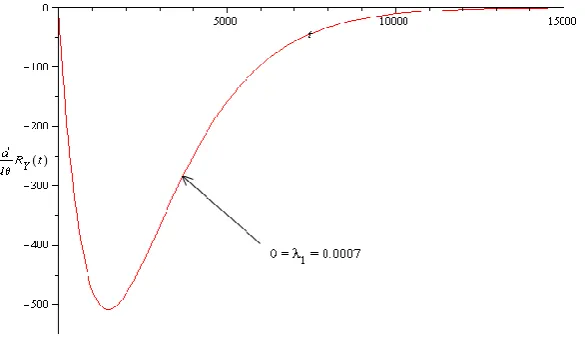
1 and2in three cases of reliability.1- When 10
We setting 1=.0007, 2=.001, 1=0, 2=.03, Fig.2 reveals that the sensitivities of 2and2on
theR(t), we observe that the sensitivity of 2reverse the sign from negative to positive nearly at
the same certain time when the sensitivity of 2reverse the sign from positive to negative. We
Figure 2.Sensitivity of system reliability with respect to2and2.
Figure 3.Sensitivity of system reliability with respect to1.
2- When 2 0
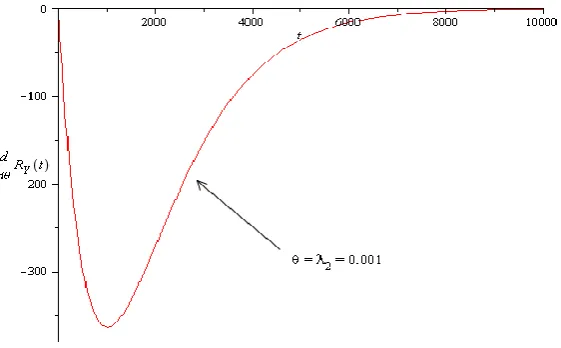
We setting 1=.0007, 2=.001, 1=.05, 2=0, Fig.4 reveals that the sensitivities of 1and1on
the R(t) have the same sensitivities of 2 and2 on theR(t) when 1 0 . From Fig.5 the
Figure 4.Sensitivity of system reliability with respect to1and1.
Figure 5.Sensitivity of system reliability with respect to2.
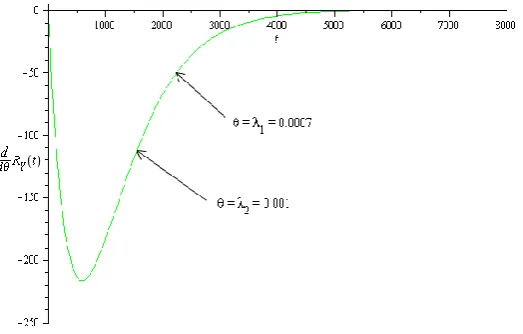
3- When 12 0
We setting 1=.0007, 2=.001, 1=0, 2=0, in Fig.6 it is noticed that1and2have the same
Figure 6.Sensitivity of system reliability with respect to1and2.
4. Conclusions
In this paper, a mathematical model was constructed for a repairable system with two types of
failure. Availability, reliability and mean time to failure in addition to sensitivity analysis for the
system reliability were obtained and the results were shown graphically by the aid of MAPLE
program. Results indicate that the MTTF and sensitivity analysis for the system reliability
depend on which of failed states [type1, type2] is absorbing.
Conflict of Interests
The authors declare that there is no conflict of interests.
REFERENCES
[1] Wei, L., Attahiru, S.A. and Yiqiang, Q.Z. Stochastic analysis of a repairable system with three units and two repair facilities. Journal of Microelectronics Reliability, 38(4) (1998), 585-595.
[2] Agarwal, S.C., Mamta, S. and Shikha, B. Reliability characteristic of cold-standbyredundant system.
International Journal of Research and Reviews in Applied Sciences, 3(2) (2010), 193-199.
[3] Sachin, K. and Anand, T. Evaluation of some reliability parameters of a three state repairable system with environmental failure. International Journal of Research and Reviews in Applied Sciences, 2(1) (2009), 96-103.
[4] El-Damcese, M.A. Human error and common-cause failure modeling of a two-unit multiple system. Journal of Theoretical and Applied Fracture Mechanics, 26(1997), 117-127.
[6] El-Damcese, M.A., Shama,M.S. Reliability and availability analysis of a standby repairable system with degradation facility. International Journal of Research and Reviews in Applied Sciences, 16(3) (2013) 501-507.
[7] El-Damcese, M.A., Shama,M.S. Reliability measures of a degradable system with standby switching failures and reboot delay. Applied Mathematics in Engineering, Management and Technology, 1(4) (2013), 1–16. [8] El-Damcese, M.A., Shama,M.S. Reliability and availability analysis of a repairable system with two types of