in the population sciences published by the Max Planck Institute for Demographic Research Konrad-Zuse Str. 1, D-18057 Rostock · GERMANY www.demographic-research.org
DEMOGRAPHIC RESEARCH
VOLUME 21, ARTICLE 7
,
PAGES 177-214
PUBLISHED 13 AUGUST 2009
http://www.demographic-research.org/Volumes/Vol21/7/ DOI: 10.4054/DemRes.2009.21.7
Descriptive Finding
“Living Apart Together” relationships
in the United States
Charles Q. Strohm
Judith A. Seltzer
Susan D. Cochran
Vickie M. Mays
© 2009
C
harles Q. Strohm et al.This open-access work is published under the terms of the Creative Commons Attribution NonCommercial License 2.0 Germany, which permits use, reproduction & distribution in any medium for non-commercial purposes, provided the original author(s) and source are given credit.
1 Introduction 178
2 Background 179
2.1 Living apart together and the Second Demographic Transition 179
2.2 Variation in living apart together unions 180
2.3 Non-residential partnerships in the United States 181
2.4 Sexual orientation and LAT relationships 182
3 The present study 184
3.1 Data 184
3.2 Measures 187
3.3 Analysis plan 189
4 Results 189
4.1 Differences in demographic characteristics by union status 189 4.2 Multivariate analysis of demographic correlates 194 4.3 Union status differences in attitudes and expectations about
marriage among heterosexuals
197
4.4 Union type differences in perceptions of support from partners for heterosexuals, gay men and lesbians
199
5 Discussion 200
6 Acknowledgements 205
References 206
“Living Apart Together” relationships in the United States
Charles Q. Strohm1
Judith A. Seltzer2
Susan D. Cochran3
Vickie M. Mays4
Abstract
We use two surveys to describe the demographic and attitudinal correlates of being in “Living Apart Together” (LAT), cohabiting, and marital relationships for heterosexuals, lesbians, and gay men. About one third of U.S. adults not married or cohabiting are in LAT relationships – these individuals would be classified as “single” in conventional studies that focus on co-residential unions. Gay men are somewhat more likely than heterosexual men to be in LAT relationships. For heterosexuals and lesbians, LAT relationships are more common among younger people. Heterosexuals in LAT unions are less likely to expect to marry their partners, but more likely to say that couples should be emotionally dependent than are cohabiters. Regardless of sexual orientation, people in LAT relationships perceive similar amounts of emotional support from partners, but less instrumental support than cohabiters perceive.
1 Department of Sociology and California Center for Population Research (CCPR). University of California –
Los Angeles. Please address correspondence to Charles Q. Strohm, Department of Sociology, 264 Haines Hall, 375 Portola Plaza, UCLA, Los Angeles, CA 90095. E-mail: [email protected].
2 Department of Sociology and CCPR. University of California – Los Angeles.
3 Department of Epidemiology, Department of Statistics, and CCPR. University of California – Los Angeles. 4 Department of Psychology, Department of Health Services, and CCPR. University of California – Los
1. Introduction
“Living Apart Together” (LAT) relationships are gaining visibility in Western countries among scholars and the general public (ABC News 2006, Brooks 2006, Casper et al. 2008, Haskey and Lewis 2006, Levin 2004). LAT unions are intimate relationships between unmarried partners who live in separate households but identify themselves as part of a couple. These relationships are sometimes referred to as “non-residential partnerships” (Castro-Martín, Domínquez-Folgueras, and Martín-García 2008).
Reasons for forming LAT relationships are diverse and are likely to vary across the life course (Beaujouan, Regnier-Loilier, and Villeneuve-Gokalp 2008). Some young couples may intend to marry, but live apart due to the constraints of school and the labor market (Levin and Trost 1999). Others form non-residential partnerships as part of the dating process; typically, these unions involve less long-term commitment. In older age, individuals may choose to live apart from their partners to facilitate contact with adult children from previous unions and to maintain privacy and autonomy (de Jong Gierveld 2004, Karlsson and Borell 2002). Individuals in LAT relationships themselves may be uncertain about what their relationship means (Castro-Martín, Domínquez-Folgueras, and Martín-García 2008).
In addition to life course variation in the reasons for forming LAT relationships, there also may be differences by sexual orientation. Lesbians and gay men may live in separate households to maintain privacy about their relationship, to facilitate an egalitarian partnership, or to foster intimacy while remaining self-sufficient (Peplau and Cochran 1990, Weston 1997). Sharing a residence might also be a less defining feature of same-sex relationships because childrearing is less common among same-sex couples (Black, Sanders, and Taylor 2007).
New data, such as from the Generations and Gender surveys, are accumulating to describe LAT relationships in Europe (Vikat et al. 2007), but U.S. data on non-residential partnerships remain very limited. Most U.S. surveys solely collect data on couples who live together, which prevents researchers from distinguishing individuals who are single from those in LAT unions. The dearth of data on LAT relationships in the United States is matched by the limited national data on couple relationships among lesbians and gay men. The most widely used national data on same-sex couples come from the U.S. census, which cannot identify individuals in unmarried non-residential partnerships, regardless of sexual orientation. The U.S. census also lacks information about sexual orientation that would allow researchers to compare single lesbians and gay men to those in unions.
men than among heterosexual women and men? What are the attitudes and values of individuals in non-residential unions? Finally, what emotional and instrumental benefits are LAT relationships likely to provide when compared to the benefits individuals receive when they live with a partner? We use data from the 1996 and 1998 General Social Surveys supplemented by data on lesbians, gay men, and heterosexual women and men from the 2004-05 California Quality of Life Survey I.
We begin by contextualizing the rise of non-residential partnerships in Western countries, describing variation in LAT unions, summarizing U.S. research about LAT relationships, and considering the potential importance of LAT relationships among lesbians and gay men. The next sections describe our data, methods, and results. We conclude by speculating about the significance of LAT relationships for contemporary family life, as well as considering the conceptual and methodological issues that must be addressed to learn more about LAT unions in the United States.
2. Background
2.1 Living apart together and the Second Demographic Transition
The label “Living Apart Together” challenges the longstanding assumption of most Western demographic research that two people must live in the same household to be considered a couple.5 Sharing a residence signals commitment, facilitates the sharing of
expenses and work of daily life, and fosters intimacy. Individuals in LAT unions, however, also treat the relationship with their partner as important and identify as being part of a couple even though their partner lives in a separate household (Bawin-Legros and Gauthier 2001, Haskey and Lewis 2006). LAT relationships appear to be part of the Second Demographic Transition, which marked a change in the demography and meaning of couple relationships in Western societies. These changes include the rise in sexual relationships outside of marriage, increases in non-marital cohabitation, and high rates of divorce – the behavioral manifestations of a long-term normative shift toward individualism and egalitarianism (Lesthaeghe 1995, van de Kaa 1987). Although the Second Demographic Transition is characterized by a decline in lifelong marriages, the rise of non-marital cohabitation suggests that individuals are not rejecting partnerships
per se. They still seek significant intimate relationships, but not necessarily marriage or relationships that involve sharing a household.
5In contrast, “visiting” unions in non-Western cultures have long been recognized (e.g., Ariza and de Oliveira
Demographers’ attention to cohabitation might have increased the salience of the distinction between being a part of a couple and living together, and thus indirectly fostered new data collection on LAT relationships (Bawin-Legros and Gauthier 2001). These emerging data show that in a wide range of countries there are small but significant percentages of people who have LAT partners (Beaujouan, Regnier-Loilier, and Villeneuve-Gokalp 2008, Caradec 1996, Castro-Martín, Domínquez-Folgueras, and Martín-García 2008, de Jong Gierveld 2004, Haskey 2005, Haskey and Lewis 2006, Kiernan 2000, Levin 2004, Milan and Peters 2003). For example, using data from the Fertility and Family Surveys, Kiernan (2000, Table 3.3) finds that the prevalence of LAT relationships among women 20-39 years old who have never married or cohabited ranges from 32% in France to 47% in Switzerland. Notably, non-residential unions occur in settings in which cohabitation is institutionalized, such as in northern Europe (Levin 2004, Levin and Trost 1999), as well as in southern Europe where cohabitation is relatively uncommon (Castro-Martín, Domínquez-Folgueras, and Martín-García 2008, Kiernan 2002). Thus high levels of cohabitation are not necessary for the occurrence of LAT unions.
2.2 Variation in living apart together unions
Estimates of the prevalence of non-residential partnerships vary, suggesting that stage in life, attitudes, social and economic constraints, and cultural context affect the formation and stability of non-residential partnerships (Castro-Martín, Domínquez-Folgueras, and Martín-García 2008, Haskey 2005, Kiernan 2002). Young people are more likely to be in LAT relationships than are older people (Beaujouan, Regnier-Loilier, and Villeneuve-Gokalp 2008 for France, Haskey 2005 for Britain, Milan and Peters 2003 for Canada). Compared to those who are older, young people in LAT relationships are more likely to live with other adults, often their parents (Haskey 2005). Young people are also more likely to expect to live with their partner in the future (Beaujouan, Regnier-Loilier, and Villeneuve-Gokalp 2008, Milan and Peters 2003), suggesting that LAT relationships among the young are often a step on the pathway to cohabitation or marriage. In addition, education distinguishes those in non-residential and co-non-residential unions: Individuals in LAT unions are likely to have more schooling than those who live with their spouse or a cohabiting partner (Castro-Martín, Domínquez-Folgueras, and Martín-García 2008 for Spain, Haskey and Lewis 2006 for Britain).
of a shared, intimate life with autonomy and independence in taking care of children or older parents (Haskey and Lewis 2006, Levin 2004). In older age, those who form LAT unions may do so to remain in a long-held residence or to stay near family and friends instead of moving in with their partner (de Jong Gierveld 2004, Levin 2004).
In-depth interviews indicate that divorced persons may prefer non-residential partnerships because they are reluctant to give up their autonomy and want to avoid falling into habits that they associate with their previous relationship (Haskey and Lewis 2006, Levin 2004, Levin and Trost 1999). Previously married women in Haskey and Lewis’ (2006) study also explained their decision to live apart from their intimate partner as an effort to achieve greater gender equity in the division of household work. The expressed goals of autonomy, personal fulfillment, and a more egalitarian relationship reinforce the claim that LAT unions are part of the Second Demographic Transition’s normative change in the value and meaning of couple relationships (Bawin-Legros and Gauthier 2001, Surkyn and Lesthaeghe 2002).
Intimate partners also may live apart due to economic constraints rather than choices (Kiernan 2002). In a recent French study almost three fifths of individuals in LAT relationships said they were living apart from their partner because of circumstances out of their control, such as financial pressures (Beaujouan, Regnier-Loilier, and Villeneuve-Gokalp 2008, Table 8). Economic constraints are likely to differ across the life course; Beaujouan, Regnier-Loilier, and Villeneuve-Gokalp (2008) find that young adults are much more likely than those who are older to say that financial constraints are the reason they are in a LAT relationship. For young people who live with their parents, transitioning from a LAT union to a co-residential union is costly because it requires sufficient economic resources to relinquish the intergenerational transfers associated with living with parents (Castro-Martín, Domínquez-Folgueras, and Martín-García 2008). Labor market opportunities, housing costs, and partners’ economic circumstances affect young people’s ability to move in with a partner. These economic factors are akin to those that affect marriage decisions among cohabiting couples (Smock, Manning, and Porter 2005). In contrast, for older persons who have already established independent households and have greater economic security, the transition from a LAT union to a co-residential union may be guided more by lifestyle choices, such as a desire to preserve autonomy.
2.3 Non-residential partnerships in the United States
“commuter marriages” (Gerstel and Gross 1984). Commuter marriages are uncommon; only 3.1% of married persons are “married, spouse absent” to use Census Bureau parlance (U.S. Bureau of the Census 2006). Rindfuss and Stephen (1990) use data on young adults to show that marriages are more likely to break up when spouses do not live together. At least for married couples who live apart, the state of being in a non-residential partnership may be short-lived.
More recent U.S. efforts to study non-residential partnerships adopt the European focus on non-marital unions, as we do in our study. These studies find that most non-marital LAT relationships are also of short duration. Binstock and Thornton (2003) use cohabitation histories for White young adults to examine transitions between living with a partner, periods of separation, and then returns to a shared home. They find relatively high rates of movement between co-residential partnerships and what they infer are non-residential partnerships. Other research investigates non-residential unions among parents to assess the stability of children’s contact with fathers. Data from the Fragile Families and Child Wellbeing project, a U.S. birth cohort study of parents and their young children, show that only 14% of parents in a “romantically involved but living apart relationship” were still living apart one year later (Carlson, McLanahan, and England 2004: 245). There are no U.S. studies to our knowledge that investigate the prevalence or characteristics of non-residential partnerships for a broader age range and for both parents and non-parents.
2.4 Sexual orientation and LAT relationships
There also has been very little research on non-residential partnerships among lesbians and gay men in the United States. In fact, demographic research on same-sex couples is even more limited by data availability than is research on heterosexual couples (Casper et al. 2008). However, theory and data exist which provide possible insights about LAT relationships among lesbians and gay men. The same normative changes associated with the Second Demographic Transition contributed to greater approval of heterosexual cohabitation and fostered more acceptance of homosexuality and same-sex couple relationships. For example, individuals in cultural settings that emphasize the value of self-expression are more accepting of homosexuality (Adamczyk and Pitt 2009). In an environment that encourages autonomy and personal fulfillment, lesbians and gay men are likely to form LAT unions for the same reasons that heterosexuals do – to balance desires for intimacy and personal autonomy or because of economic constraints.
2001, Peplau and Fingerhut 2007). For example, approximately half of American adults in 2003 reported a “mostly unfavorable” or “very unfavorable” opinion of lesbians and gay men (Pew Research Center 2003). Policies also limit the opportunities of same-sex couples. For example, same-sex couples cannot marry in most U.S. states and cannot adopt or foster children in some states (Gates et al. 2007).
This social context is likely to make non-residential partnerships more attractive to lesbians and gay men than to heterosexual women and men. Stigma may increase the desirability of forming a LAT relationship because non-residential partnerships keep sexuality more private than does moving in together (Peplau and Cochran 1990, Steven and Murphy 1998). Two other factors may contribute to a higher prevalence of non-residential unions among lesbians and gay men compared to heterosexuals. First, individuals’ expectations that part of being a couple includes sharing a household may be much stronger for heterosexual unions than for same-sex unions. An example of the emphasis on co-residence for heterosexual unions includes major theories of family life developed by Parsons (1943) and Becker (1981, 1991), both of which focus on heterosexual couples who live with children. Because lesbians and gay men are less likely than heterosexuals to express interest in having children (Gates et al. 2007), and because same-sex couples are less likely to have children (Black, Sanders, and Taylor 2007), sharing a residence may be a less salient feature of same-sex than heterosexual unions. Second, if LAT relationships facilitate an egalitarian division of labor (Haskey and Lewis 2006), and if gay men and lesbians are more likely than heterosexual women and men to seek equality in their intimate relationships (Kurdek, 2005) then LAT unions may be more common among gay men and lesbians than among their heterosexual counterparts.
The recent article by Carpenter and Gates (2008) presents some insights on the prevalence and demographic correlates of LAT unions among self-identified lesbians and gay men in the United States. Their article focuses on how lesbians and gay men who register as domestic partners differ from people whose partnerships are not registered with the State. Using data from the 2003 California LGBT Tobacco Survey, Carpenter and Gates (2008, Table 3) find that 11% of lesbians and gay men 18 to 59 years old are in non-residential partnerships. These non-residential partnerships are of shorter duration than cohabiting unions, especially for lesbians. The Tobacco Survey results also show that lesbians in non-residential unions are younger than are lesbians who are living with their partner and than their single counterparts, but among gay men there is little or no difference in mean age by union status.
unrelated. Because the younger adults in the Tobacco Survey sample may still be enrolled in school, it is unclear if the gender difference is due to differences in the timing of LAT relationships in lesbians’ and gay men’s lives, or to differences in how education affects union status. We build on the work of Carpenter and Gates (2008) by comparing lesbians and gay men with heterosexual women and men who are likely to have completed their educations, examining perceived support from LAT partners compared to support from residential partners, and investigating the demographic correlates of being in a non-residential union within a multivariate context.
3. The present study
We begin by describing how individuals in LAT unions differ demographically from married, cohabiting, and single people. We examine a variety of demographic characteristics initially, but later focus on three that are not – or are unlikely to be – influenced by union status: age, education, and race-ethnicity. Next, we shed light on what heterosexual women and men in LAT unions may be seeking in their relationships by examining union status differences in attitudes about work, individualism, and gender roles. These attitudes provide suggestive evidence on the extent to which people form LAT unions out of a desire to combine individualism with companionship. Although these attitudes can be both causes and consequences of a person’s union status, studying the attitudinal correlates is a useful way to determine whether those in LAT unions are more like cohabiters or single people. We also examine whether heterosexuals in cohabiting and LAT unions expect to marry their partner. These expectations provide insight into the extent to which living apart together is a precursor to marriage. Finally, we describe the potential benefits of LAT unions for lesbians, gay men and heterosexual women and men by examining how much emotional and instrumental support individuals in marital, cohabiting, and LAT unions perceive from their partners.
3.1 Data
The GSS is rare in its inclusion of questions about non-residential partnerships addressed to adults in a broad age range.6 GSS interviews were conducted face-to-face
in English and had response rates of about 76% in both years (National Opinion Research Center 2007, Table A.6). We combine the two years when possible to increase the number of individuals in cohabiting and LAT relationships. We restrict the analysis sample to adults age 23-70. The younger age boundary is to reduce the chance that respondents are still in school, and the older age boundary is to match the cut-off for the second dataset we use (described in the next paragraph). We weight the GSS data to adjust for differential selection by household size and for survey non-response, and use the svy procedures in Stata 10 to adjust for the complex sampling design of the GSS. The sample for the first part of the analysis is 3,584 respondents (1,863 in 1996 and 1,721 in 1998) who were in the random subsamples of the GSS survey that included the question about LAT status. This sample excludes 66 cases with missing data on the relationship status or socio-demographic questions. The sample sizes in the second part of the analysis, which examines attitudes and values, vary because the GSS asked some questions only of random subsamples.
We supplement the GSS data with data from the 2004-05 California Quality of Life Survey I (Cal-QOL, Cochran and Mays 2007). The Cal-QOL is a population-based sample of lesbians, gay men, and heterosexual women and men in California. It includes a measure identifying those in LAT relationships and assesses respondents’ perceptions of support from their relationship partner. The Cal-QOL is a follow-back survey conducted in English and Spanish that interviewed individuals who originally participated in the 2003 California Health Interview Survey (CHIS). The 2003 CHIS is a computer-assisted telephone survey of a multistage probability sample of the non-institutionalized California population.7 When weighted, the CHIS data are
representative of the adult population of California living in households.
At the conclusion of the CHIS interview, respondents were asked if they were interested in participating in future surveys. The Cal-QOL attempted to re-interview every CHIS respondent who agreed to participate and indicated a lesbian, gay, or bisexual identity, or who reported same-sex sexual activity in the year prior to interview. A random sample of the remaining respondents 18-70 years was also
6 Some U.S. national studies, such as the National Survey of Family Growth (NSFG) and the National
Longitudinal Study of Adolescent Health (Add Health), include questions about dating or “going steady” relationships, but these questions identify more casual relationships than the designation LAT implies. The NSFG and Add Health also sample a narrower age range than does the GSS.
7 The overall CHIS response rate was 34%, calculated as the screener completion rate (56%) multiplied by the
interviewed as a heterosexual comparison group. Fifty-six percent of those selected for the Cal-QOL were successfully re-interviewed 6 to 18 months after they agreed to be re-contacted (Cochran and Mays 2007). Individuals who changed telephone numbers, including those who moved, were not reachable due to the highly restricted identifying information available on the original CHIS participants. We use weights to adjust for household size and survey non-response in all analyses.8
The Cal-QOL analysis samples we use in this paper are defined by individuals’ reports of their sexual orientation identity and gender: 144 lesbians, 247 gay men, 752 heterosexual women, and 638 heterosexual men between the ages of 23-70.9 These
sample sizes exclude 74 individuals with missing data on socio-demographic variables and 106 individuals with inconsistent information about sexual orientation in the CHIS and the Cal-QOL surveys.10 In the analysis of perceived support, we exclude another 3
cases with missing data on the support variables, as well as 32 cases who were administered a shorter instrument that excluded the support questions as part of a refusal conversion experiment included in the Cal-QOL sampling methodology (Narayanan et al. 2005).
The GSS and Cal-QOL have complementary strengths for studying LAT unions in the United States. The GSS is a national sample and includes questions about expectations of marriage and attitudes toward work, individualism, and gender roles that are components of the shift in value orientation associated with the Second Demographic Transition. The Cal-QOL contains relatively large numbers of lesbians and gay men and also asks about perceived support from partners to provide insight on potential benefits of non-residential partnerships. The two studies identify individuals in LAT relationships using a similar approach. They differ, however, in the populations from which the samples were drawn. The Cal-QOL data are more recent than are the GSS data (2004-05 vs. 1996 and 1998, respectively). California is also more advanced in many aspects of the Second Demographic Transition than other U.S. states (Lesthaeghe and Neidert 2006). We consider these differences in interpreting our
8 The Cal-QOL weights are constructed using the following characteristics: age, sex, race-ethnicity,
geographic variables, presence of people under age 18 in the household, home ownership, and education. We do not use the svy procedure in Stata with the Cal-QOL data because of the small samples of lesbians and gay men.
9 We exclude bisexual women and men because of small sample sizes and because bisexuals may be
partnered with someone of the same or opposite sex.
10 A person’s sexual orientation might be classified inconsistently in the CHIS and Cal-QOL for two
findings. Together the datasets provide a more complete picture of LAT relationships than either dataset provides separately.
3.2 Measures
Union status. The GSS used a standard question on current marital status. Those not currently married were asked about heterosexual non-marital unions: “Do you have a main romantic involvement – a (man/woman) you think of as a steady, a lover, a partner, or whatever?” Respondents who answered affirmatively were then asked if they lived with their partner. Using this information, we created five mutually exclusive categories: married, cohabiting, LAT, previously-married single, never-married single. The GSS did not ask about sexual orientation in these survey years so we restrict the GSS analysis to heterosexual unions. We refer to women and men in the GSS as “putatively heterosexual” to indicate our assumption about sexual orientation. This assumption is reasonable given estimates that less than 3% of adults self-identify as lesbian, gay, or bisexual (Black et al. 2000).
In the Cal-QOL, respondents were first asked, “Are you now married, living with a partner in a marriage-like relationship, widowed, divorced, separated, or never married?” Those neither married nor cohabiting were later asked, “When we began the interview, you indicated that you were not married or currently living with a partner. Do you have a relationship partner but maybe the two of you don’t live together?” We identify three relationship statuses in our analysis of lesbians and gay men: cohabiting, LAT, and single. We limit the analysis to these statuses because same-sex marriage was not legally recognized in California at the time of the survey, and because the small sample sizes prevent us from distinguishing between single people who have never been married and those who were previously married.11
Covariates. We consider several demographic characteristics of respondents in the GSS and Cal-QOL. Age is measured in years. In the GSS, we distinguish three ethnic groups: Whites, Blacks, and other races. A more fine-grained division of race-ethnic groups is not possible because the GSS did not have a separate question to identify Hispanic respondents in 1996 and 1998. In the Cal-QOL analyses, we treat race-ethnicity as a dichotomy distinguishing non-Hispanic Whites from all others (“non-Whites”) because of the small sample sizes of lesbians and gay men. Close to two thirds of the non-Whites in the Cal-QOL samples we use identified themselves as
11 The larger CHIS sample from which the Cal-QOL sample was drawn did not obtain information about
Hispanic. In the GSS and the Cal-QOL analyses, education is coded as a dichotomy comparing individuals with a college degree to those who acquired less schooling. We also distinguish individuals who report any children under 18 living in the household from those without children in the household. Individuals who report working for pay full-time or part-time are compared to those who are not working. We define GSS respondents who live in areas with a population of 100,000 or more as living in an urban area. Finally, the GSS asked respondents if they lived with both of their “own” parents at age 16. We distinguish individuals who lived with their own mother and father from those who had a different family structure (e.g., single parent, parent and stepparent).
Attitudes. The 1996 and 1998 GSS asked several questions about work, individualism, and gender roles. We examine union status differences in agreeing or strongly agreeing with the statements: “Work is a person’s most important activity” (1998), and “Personal freedom is more important than the companionship of marriage” (1996). The 1996 GSS also asked two questions about the division of labor and emotional dependence in couple relationships, regardless of respondents’ current relationship status. We examine union status differences in whether individuals prefer a gender-specialized division of labor or an arrangement in which men and women share market and non-market work. We also examine the association between union status and whether individuals prefer that members of a couple be emotionally independent or dependent.12 Finally, using GSS data from both years, we examine whether respondents
think it is “very” or “somewhat” likely that they will marry their cohabiting or LAT partner.
Perceived support from partner. The Cal-QOL assessed emotional and instrumental support from romantic partners using three questions (Brim et al. 1995-1996, Walen and Lachman 2000). Respondents were asked, “How much does your spouse (partner) understand the way you feel about things?”; “How much can you rely on your spouse (partner) for help if you have a serious problem?”; and “How much can you open up to your spouse (partner) if you need to talk about your worries?” Response options were: “Not at all,” “A little,” “Some,” and “A lot.” We examine respondents’ reports of “a lot” of support vs. less support by union status.
12 Question wording was: “Next, we have some questions about the kind of relationship you would like with a
spouse or partner. It doesn’t matter whether you are now married or living with someone. For each pair of items on the card, which type of relationship would you prefer?” The interviewer then handed the respondent a card with paired options. The first pair we use is: “1. A relationship where the man has the main
3.3 Analysis plan
The analysis has three parts. In the first, we describe the prevalence and demographic correlates of different union statuses for putative heterosexuals using the pooled 1996 and 1998 GSS data, and for gay men, lesbians, and heterosexual men and women using the Cal-QOL data. We begin with cross-tabulations for the men and women in the GSS and for the four gender-sexual orientation groups in the Cal-QOL. We then estimate four multinomial logistic regressions of union status on age, race-ethnicity, and education, separately for putative heterosexual women and men in the GSS and for lesbians and gay men in the Cal-QOL. For parsimony, we do not present the multivariate results for the Cal-QOL heterosexual sample. Instead we comment briefly on similarities and differences between the results for the GSS and Cal-QOL heterosexual samples. Although the initial cross-tabulations include a wide range of characteristics to provide a more complete description of individuals in LAT relationships, we restrict the multivariate analysis to a limited number of characteristics that are not, or are unlikely to be, influenced by union status. In both the GSS and Cal-QOL models, we conduct tests for the joint significance of the covariates, where the null hypothesis is that all the coefficients equal zero for the particular outcome comparison (e.g., LAT vs. married).
In the second part of the analysis, we use information available in the GSS to investigate differences by union status in individualistic attitudes, family ideals, and, among heterosexuals in cohabiting and LAT unions, expectations of marriage, adjusting for potentially confounding factors. We summarize these analyses by reporting predicted probabilities from logistic regressions in which each attitude item is a function of union status, gender, age, education, and race-ethnicity. We also explored interactions between union status and gender. With one exception, the interactions were not statistically significant. We describe the exception in the text.
In the third part, we use information from the Cal-QOL to describe variation in individuals’ perceptions of support from their partners among those in marital, cohabiting, and LAT unions. We conduct the analyses separately by sexual orientation and, as in the GSS analysis, we report predicted probabilities from logistic regressions of each support item on union status, gender, age, race-ethnicity, and education.
4. Results
4.1 Differences in demographic characteristics by union status
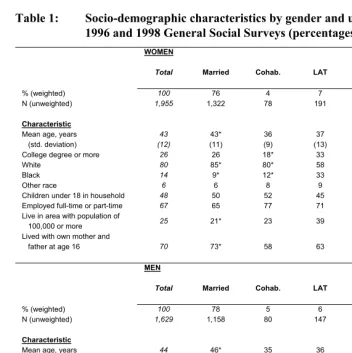
using weighted GSS data. Seven percent of U.S. women and 6% of U.S. men report that they are in a LAT relationship, representing 35% of all individuals who are not married or cohabiting. These individuals would be classified as “single” in conventional studies that focus exclusively on co-residential unions.
Table 1: Socio-demographic characteristics by gender and union status, 1996 and 1998 General Social Surveys (percentages unless noted)
WOMEN
Total Married Cohab. LAT
Single: Previously married Single: Never married
% (weighted) 100 76 4 7 9 4
N (unweighted) 1,955 1,322 78 191 255 109
Characteristic Mean age, years (std. deviation) 43 (12) 43* (11) 36 (9) 37 (13) 51* (14) 35 (13)
College degree or more 26 26 18* 33 19* 30
White 80 85* 80* 58 69 53
Black 14 9* 12* 33 27 40
Other race 6 6 8 9 5 8
Children under 18 in household 48 50 52 45 37 29*
Employed full-time or part-time 67 65 77 71 63 83
Live in area with population of
100,000 or more 25 21* 23 39 35 47
Lived with own mother and
father at age 16 70 73* 58 63 68 58
MEN
Total Married Cohab. LAT
Single: Previously married Single: Never married
% (weighted) 100 78 5 6 5 6
N (unweighted) 1,629 1,158 80 147 124 120
Characteristic Mean age, years (std. deviation) 44 (12) 46* (11) 35 (10) 36 (14) 46* (14) 35 (13)
College degree or more 29 31 16* 29 16* 29
White 83 85* 65 75 84* 76
Black 10 8* 19 19 13 10
Other race 7 7 16 6 3 14
Children under 18 in household 42 49* 39* 9 12 9
Employed full-time or part-time 82 83 73 79 79 75
Live in area with population of
100,000 or more 24 21* 33 35 27 44
Lived with own mother and
father at age 16 74 76* 63 64 74 69
Source: Weighted data from the 1996 and 1998 General Social Surveys, adults 23-70 years old.
Couples are heterosexual couples.
People in LAT unions differ demographically from their peers who are in married and cohabiting unions. For both women and men, individuals in LAT unions are younger than those who are married. Those in LAT unions are almost twice as likely to have a college degree as those in cohabiting unions (33% vs. 18% for women; 29% vs. 16% for men). As a group, women in LAT relationships are more ethnically diverse than those who are married or cohabiting. For example, 58% of women in LAT unions describe themselves as White compared to 85% of those who are married, and 80% of those who are cohabiting. Among men, 75% of those in LAT unions identify themselves as White, higher than the 58% of women in LAT unions. But without information about partners’ characteristics, we cannot determine whether LAT relationships, like cohabiting unions, are more heterogamous on race-ethnicity than are marriages (Blackwell and Lichter 2004).
Among women, there is little difference by union status in the percentage living with children: 45% of those in LAT unions live with children, compared to 50% of married women and 52% of cohabiting women. Among men, however, only 9% of those in LAT unions live with children, compared to 49% of married men and 39% of male cohabiters. There are few differences by union status in whether individuals are employed, although married and previously married women are slightly less likely to be employed than are other women and all men. Women and men in LAT unions are more likely than are married people to live in an urban area. Like cohabiters, those in LAT relationships are also less likely to have grown up living with both of their parents than are their married counterparts. Those in LAT unions closely resemble single people who have never been married: the two groups have similar mean ages, amounts of schooling, and racial composition.
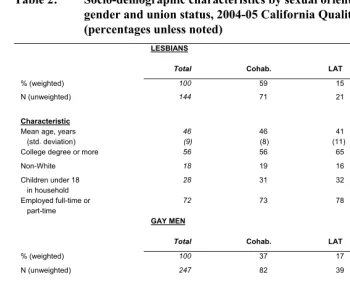
In the next table we present results for similar analyses of self-identified lesbians, gay men, and heterosexual women and men using the weighted Cal-QOL data. Table 2 shows that 15% of lesbians and 17% of gay men are in LAT relationships.13 As is true
for putative heterosexuals in the GSS, lesbians and gay men who are in non-residential partnerships are a substantial minority of lesbians and gay men who would be classified as single by conventional indicators of relationship status, 37% and 27%, respectively. Compared to lesbians and gay men, slightly lower percentages of heterosexual women and men in the Cal-QOL sample report that they are in a LAT relationship, 12% of
13 The prevalence of LAT unions among lesbians and gay men in the Cal-QOL is slightly higher than reported
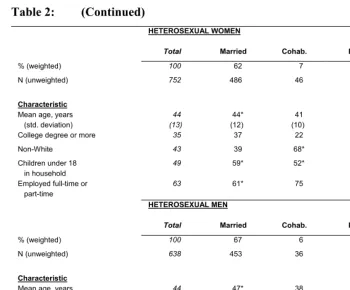
women and 13% of men. The sexual orientation difference was marginally statistically significant among men (t = 1.68; p = .09) but not statistically significant among women (t = 1.00; p = .32).
Table 2: Socio-demographic characteristics by sexual orientation,
gender and union status, 2004-05 California Quality of Life Survey (percentages unless noted)
LESBIANS
Total Cohab. LAT Single
% (weighted) 100 59 15 26
N (unweighted) 144 71 21 52
Characteristic Mean age, years (std. deviation)
46 (9)
46 (8)
41 (11)
51* (9)
College degree or more 56 56 65 50
Non-White 18 19 16 16
Children under 18 in household
28 31 32 18
Employed full-time or part-time
72 73 78 65
GAY MEN
Total Cohab. LAT Single
% (weighted) 100 37 17 46
N (unweighted) 247 82 39 126
Characteristic Mean age, years (std. deviation)
46 (10)
46 (9)
44 (10)
47 (11)
College degree or more 62 68 57 60
Non-White 25 21 36 25
Children under 18 in household
4 7 0 2
Employed full-time or part-time
Table 2: (Continued)
HETEROSEXUAL WOMEN
Total Married Cohab. LAT Single
% (weighted) 100 62 7 12 20
N (unweighted) 752 486 46 76 144
Characteristic Mean age, years (std. deviation) 44 (13) 44* (12) 41 (10) 40 (12) 49* (14)
College degree or more 35 37 22 35 35
Non-White 43 39 68* 47 46
Children under 18 in household
49 59* 52* 29 31
63 61* 75 74 60
Employed full-time or part-time
HETEROSEXUAL MEN
Total Married Cohab. LAT Single
% (weighted) 100 67 6 13 14
N (unweighted) 638 453 36 69 80
Characteristic Mean age, years (std. deviation) 44 (13) 47* (12) 38 (11) 38 (15) 40 (13)
College degree or more 40 44 33 31 28
Non-White 44 43 33 52 44
Children under 18 in household
41 52* 34* 15 16
Employed full-time or part-time
78 81* 82 70 68
Source: Weighted data from the California Quality of Life Survey, 2004-05, adults 23-70 years old.
* Difference from LAT statistically significant at p ≤ .05 Variables are described in the text.
Lesbians in LAT unions are younger than those who are single, a finding consistent with Carpenter and Gates (2008). This is in seeming contrast to the pattern for heterosexual women for whom the ages of those in LAT relationships and the never married single women are similar. Because of small sample sizes, however, the single category in Table 2 combines never married and previously married women, who are typically older.14 There is no statistically significant age difference between lesbians in
cohabiting and LAT relationships, although lesbians in cohabiting relationships are five years older on average than lesbians in LAT relationships. Notably, there are no age gradients by union status among gay men, also consistent with Carpenter and Gates (2008). In contrast to the patterns for heterosexual women and men in the GSS, for lesbians and gay men there are no statistically significant education or race-ethnic differences between those in LAT unions and those in cohabiting unions. The data suggest, however, that gay men in LAT relationships are somewhat more ethnically diverse than are cohabiting gay men: 36% of gay men in LAT relationships are non-White compared to 21% of cohabiting gay men.
The bottom two panels of Table 2 show the demographic characteristics of heterosexuals in the Cal-QOL by union status. These results are generally consistent with those in Table 1. For example, women and men in cohabiting and LAT relationships are younger than those who are married. There are, however, two exceptions to this similarity. In the Cal-QOL sample, heterosexual women in LAT relationships are much less likely to live with a minor child compared to married or cohabiting women, but in the GSS sample there are no differences among women in the presence of children by union status. In addition, although the GSS data suggest an association between education and union status, there are no significant education by union status differences in the Cal-QOL samples of heterosexual women and men.
4.2 Multivariate analysis of demographic correlates
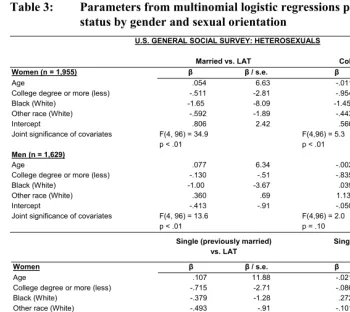
In Table 3 we present results of multinomial logistic regressions of union status on age, education, and race-ethnicity, stratified by gender and sexual orientation. The results in the two top panels of Table 3 are based on GSS data from putative heterosexuals. The net associations are largely consistent with the gross associations in Table 1. Age increases the log odds that a person will be married instead of in a LAT union. For women, having a college education reduces the log odds of being married rather than being in a LAT union. There is no statistically significant association between education and being married vs. in a LAT relationship for men. Other associations are
similar for women and men. Blacks are less likely than Whites to be married than in a LAT relationship. Age is not associated with being in a cohabiting vs. a LAT union. Having at least a college degree decreases the log odds of cohabiting vs. being in a LAT union.
Table 3: Parameters from multinomial logistic regressions predicting union status by gender and sexual orientation
U.S. GENERAL SOCIAL SURVEY: HETEROSEXUALS
Married vs. LAT Cohabiting vs. LAT
Women (n = 1,955) β β / s.e. β β / s.e.
Age .054 6.63 -.011 -.72
College degree or more (less) -.511 -2.81 -.954 -2.72
Black (White) -1.65 -8.09 -1.45 -3.39
Other race (White) -.592 -1.89 -.443 -.79
Intercept .806 2.42 .566 .94
Joint significance of covariates F(4, 96) = 34.9 p < .01
F(4,96) = 5.3 p < .01 Men (n = 1,629)
Age .077 6.34 -.002 -.09
College degree or more (less) -.130 -.51 -.835 -2.11
Black (White) -1.00 -3.67 .039 .10
Other race (White) .360 .69 1.13 1.96
Intercept -.413 -.91 -.050 -.08
Joint significance of covariates F(4, 96) = 13.6 p < .01
F(4,96) = 2.0 p = .10
Single (previously married) vs. LAT
Single (never married) vs. LAT
Women β β / s.e. β β / s.e.
Age .107 11.88 -.021 -1.49
College degree or more (less) -.715 -2.71 -.086 -.29
Black (White) -.379 -1.28 .272 1.01
Other race (White) -.493 -.91 -.101 -.22
Intercept -3.96 -9.93 .226 .39
Joint significance of covariates F(4,96) = 39.7 p < .01
F(4,96) = 1.0 p = .42 Men
Age .079 5.46 -.012 -.72
College degree or more (less) -.920 -2.73 -.082 -.24
Black (White) -.636 -2.10 -.652 -1.35
Other race (White) -.481 -.65 .774 1.29
Intercept -3.15 -5.33 .412 .67
Joint significance of covariates F(4,96) = 10.1 p < .01
Table 3: (Continued)
CALIFORNIA QUALITY OF LIFE SURVEY: LESBIANS AND GAY MEN
Cohabiting vs. LAT Single vs. LAT
β β / s.e. β β / s.e.
Lesbians (n = 144)
Age .073 1.62 .138 2.85
College degree or more (less) -.451 -.67 -.543 -.72
Non-White (non-Hispanic White) .601 .73 .615 .65
Intercept -1.55 -.82 -5.49 -2.53
Joint significance of covariates χ2 (3) = 3.3
p = .35
χ2 (3) = 8.4
p = .04 Gay men (n = 247)
Age .008 .33 .027 1.19
College degree or more (less) .368 .78 .027 .06
Non-White (non-Hispanic White) -.688 -1.23 -.362 -.71
Intercept .378 .31 -.182 -.15
Joint significance of covariates χ2 (3) = 2.48
p = .48
χ2 (3) = 2.65
p = .45
Sources: Weighted data from the 1996 and 1998 General Social Surveys, adults 23-70 years old. Weighted data from the California
Quality of Life Survey, 2004-05, adults 23-70 years old who identify themselves as lesbian or gay.
Results are from four multinomial logistic regressions, one for each gender and sexual orientation. Reference group for each covariate is in parentheses.
Tests of the joint significance of covariates suggest that women and men in LAT unions do differ demographically from those in marital or cohabiting unions. But the tests for the joint significance of covariates for the contrast between being single never-married and being in a LAT relationship are not statistically significant. This is consistent with the gross associations in Table 1 suggesting that those in LAT unions and single never-married people are demographically similar.
We compared these results to results from the same model estimated for
heterosexual women and men in the Cal-QOL (not shown). In these models, we combined previously married and never married single people. The associations between age and union status were similar for the two samples. However, the Cal-QOL and GSS results differ in the education-union status association. The GSS findings, as shown in the top two panels of Table 3, indicate that having a college education reduces the log odds of being in a cohabiting vs. LAT relationship for both women and men. Being college educated also reduces women’s log odds of being married vs. in a LAT union. But in the Cal-QOL sample of heterosexuals, there is no statistically significant association between education and union status. This is consistent with the absence of a zero-order association in Table 2. We speculate about the difference between the GSS and Cal-QOL results in the discussion section.
LAT union (p = .11). There are no statistically significant associations between age and union status among gay men, a pattern consistent with the results in Table 2 and with those reported by Carpenter and Gates (2008). Among lesbians, the test of joint significance of covariates is statistically significant for the single vs. LAT union comparison, but not for the cohabiting vs. LAT union comparison. For gay men, neither of the tests of joint significance is statistically significant.
4.3 Union status differences in attitudes and expectations about marriage among heterosexuals
Using GSS data, we show in Table 4 the predicted probabilities of agreeing with four attitudes about work, individualism, and gender roles by union status. For individuals in LAT or cohabiting unions, we also show the predicted probability that individuals expect to marry their current partner. Probabilities are arbitrarily evaluated for a 35 year-old White woman who did not complete college. The parameters from the models generating these predicted probabilities are in Appendix Table A-1. As a group, heterosexuals in LAT unions have more individualistic attitudes, are more work-oriented, and are more likely to prefer that women and men share market and non-market work than their married counterparts. The predicted probability of preferring that men and women share responsibility for paid work and family care giving, for example, is .78 for those in LAT unions but .67 for married people.
Table 4: Predicted probabilities of agreeing with statements about individualism, family ideals, and expectations about marriage by union status
N Married Cohabit. LAT
Single: Previously
married
Single: Never married
“Work is a person’s most important activity.” (agree or strongly agree)
Source: 1998 GSS
957 .15* .30 .26 .15+ .26
Prefer that men and women share responsibility for paid work and family care giving
Source: 1996 GSS
1,211 .67* .88+ .78 .71 .80
Prefer that the man and woman be emotionally dependent
Source: 1996 GSS
1,178 .43 .22* .38 .34 .27
“Personal freedom is more important than the companionship of marriage.” (agree or strongly agree)
Source: 1996 GSS
1,201 .07* .27 .18 .15 .14
Marriage with current partner is “very” or “somewhat” likely
Source: 1996 and
1998 GSS
472 – .76* .61 – –
Source: Weighted data from the 1996 and 1998 General Social Surveys, adults 23-70 years old. Ns are unweighted.
* Test of difference from LAT statistically significant at p ≤ .05 + Test of difference from LAT statistically significant at .10 ≤ p < .05
Predicted probabilities are from logistic regressions of agreement on union status, gender, age, education, and race-ethnicity, evaluated for a 35 year-old White woman who did not complete college. See Appendix Table A-1 for model parameters.
These union status differences in attitudes are similar for women and men, with one exception: Women in LAT unions are more likely than are their married counterparts to agree that “Work is a person’s most important activity.” In contrast, men in LAT unions and married men hold similar attitudes about the importance of work (results not shown).
4.4 Union type differences in perceptions of support from partners for heterosexuals, gay men and lesbians
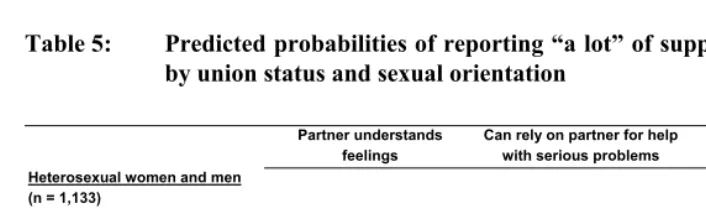
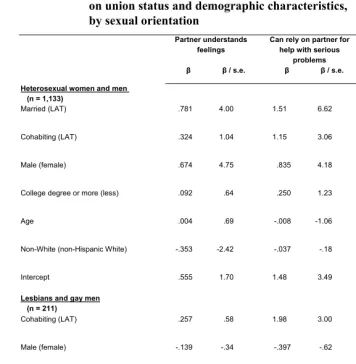
We used the Cal-QOL data to investigate how much support individuals in different types of unions perceive from their partners. We conducted two separate analyses, one for heterosexual women and men and one for lesbians and gay men. Table 5 includes the predicted probabilities by union type that individuals report “a lot” of support from their partner, adjusting for gender, age, education, and race-ethnicity. As in Table 4, we report the predicted probabilities of each type of support for a 35 year-old White woman who did not complete college. The full models are reported in Appendix Table A-2.
Table 5: Predicted probabilities of reporting “a lot” of support from partner, by union status and sexual orientation
Partner understands feelings
Can rely on partner for help with serious problems
Can open up to partner
Heterosexual women and men (n = 1,133)
Married .69* .87* .82*
Cohabiting .58 .82* .72
LAT .50 .59 .66
Lesbians and gay men (n = 211)
Cohabiting .70 .98* .84
LAT .65 .89 .86
Source: Weighted data from the California Quality of Life Survey, 2004-05, adults 23-70 years old.
* Test of difference from LAT statistically significant at p ≤ .05
Predicted probabilities are from logistic regressions of reporting “a lot” of support on union status, gender, age, education, and race-ethnicity and evaluated for a 35 year-old White woman who did not complete college. See Appendix Table A-2 for model parameters.
Individuals in LAT unions perceive moderate to high levels of support from their partners, but they report less instrumental support than do those who are married or cohabiting. Among heterosexuals, for example, the predicted probability of being able to rely on a partner “a lot” for help with a serious problem is .87 for a married person, .82 for a cohabiter, and .59 for someone in a LAT union. The differences between individuals in marital and LAT unions and between those in cohabiting and LAT unions are statistically significant at p ≤ .05.
statistically significant difference between those in LAT relationships and cohabiters in how much individuals say their partners understand their feelings or that they can open up to their partners.
In a separate analysis (not shown), we investigated interactions between gender and union status. Although heterosexual men reported higher levels of support from their partners than did heterosexual women, we found no evidence that the association between union status and perceived support is different for women and men within each sexual orientation group.
5. Discussion
Demographic data that focus only on household-based relationships ignore the fact that some couples live apart but maintain significant ties to each other. By expanding conventional union categories to include “Living Apart Together” (LAT) unions for both heterosexual and same-sex couples, our study illustrates the diversity of couple relationships in the United States. These non-residential unions are part of a broad shift in how individuals organize their family relationships. By ignoring non-residential partnerships, researchers miss sources of support that may enhance individuals’ well-being. How serious an omission this is depends on how common LAT relationships are: Our finding that one third of individuals who would be classified as “single” by conventional measures of union status are actually in LAT relationships suggests that ignoring these relationships is a serious problem.
Estimates of the prevalence of LAT relationships in the heterosexual population vary for the two data sources we use. With national data from the late 1990s, we estimate that 6% of men and 7% of women were in non-residential relationships compared to 13% and 12% of heterosexual men and women, respectively, for California in the mid 2000s. The higher prevalence estimates for the more recent data from California can be interpreted as either an increase in non-residential unions over time or as attributable to California’s more advanced stage in the Second Demographic Transition (Lesthaeghe and Neidert 2006). Without more recent national data on LAT unions, we cannot distinguish between these two interpretations.
Prevalence estimates from both of our cross-sectional data sources may understate the importance of LAT relationships in individuals’ lives if there are high rates of transition between LAT and other union statuses (Binstock and Thornton 2003). Longitudinal data are needed to estimate the incidence of LAT unions and to determine for whom LAT is a transitional arrangement and for whom it is a long-term way of life. Taking account of movements in and out of relationships might be especially important for comparisons among lesbians, gay men, and heterosexuals in light of the higher rates of disruption that characterize same-sex co-residential unions (Andersson et al. 2006, Kalmijn, Loeve, and Manting 2007). If lesbians and gay men experience more rapid transitions out of co-residential unions, they are likely to spend relatively more time single or in relationships that are sometimes, but not always, less committed, such as LAT unions. This may account for our finding that LAT relationships are more common among gay men than among heterosexual men in cross-sectional data.
Our findings also shed light on the significance of LAT relationships throughout the life course. Among heterosexual women and men and among lesbians, age decreases the chance of being in a LAT union compared to a co-residential union (marriage for heterosexual women and men, cohabitation for lesbians). This pattern in both the national and California samples is consistent with qualitative evidence that LAT relationships are a way for young people to balance a desire for intimacy with the pursuit of education, work, or financial goals (Levin 2004).
The absence of association between age and LAT union status for gay men is consistent with Carpenter and Gates’ (2008) finding using another sample from California. Our combined findings suggest that non-residential partnerships are a significant union type throughout the lives of gay men. Gay men may be better able than lesbians or heterosexual women and men to afford the financial costs of maintaining two separate households. Determining why LAT relationships do not appear to be a life course phenomenon for gay men is an important question for future research.
individuals’ economic resources throughout life as well as contextual factors such as employment opportunities and housing markets.
We find that for the United States as a whole, as in Europe, education is positively associated with being in a non-residential partnership compared to cohabitation (for women and men) and compared to marriage (for women) (Haskey and Lewis 2006, Castro-Martín, Domínquez-Folgueras, and Martín-García 2008). For California, however, there is no statistically significant association between education and LAT union status once age and race-ethnicity are taken into account. The absence of an education-union status association holds for heterosexual men and women as well as for gay men and lesbians in California. The different results for the United States as a whole and California suggest the intriguing possibility that educational gradients in the prevalence of non-residential relationships erode with more widespread acceptance of the diverse ways that members of couples can share their lives beyond the context of traditional marriage.
Consistent with findings from in-depth interview studies in other countries (Haskey and Lewis 2006, Levin 2004), we found that in the United States heterosexuals in LAT unions place a higher value on independence and are more likely to expect both partners to contribute to paid work and family care giving, compared to married people. This finding is compatible with the portrait of LAT heterosexual couples as being more work-oriented, individualistic, and egalitarian than married people. The lack of parallel data for lesbians and gay men on attitudes toward work, individualism, and gender roles poses a problem for research on same-sex relationships. A question about sexual orientation on future versions of the General Social Survey core questionnaire will provide much needed information about the attitudes of lesbians and gay men.
Overall, our findings reinforce the view of LAT relationships as heterogeneous. That less than two thirds of heterosexuals in LAT unions expect to marry their current partner is only one illustration that LAT relationships, like cohabitating unions, are not always a stepping stone to marriage. The diversity of couple types is part of the long-term movement away from lifelong marriage and the growing number of choices individuals are able to make about their personal lives (Bumpass 1990, Surkyn and Lesthaeghe 2002). It is tempting to treat these emerging couple types, such as LAT unions, as less consequential than more established union types such as marriage or cohabitation. To be sure, living together almost always entails some degree of economic and social interdependence. But couples may maintain significant ties even if they do not live together (Haskey and Lewis 2006); in our study, for example, individuals in LAT and cohabiting unions reported similar levels of emotional support. And even when a couple lives in the same household, the individuals may have only marginal connections to each other’s lives (Cross-Barnet, Cherlin, and Burton 2008).
Appreciating the role of LAT relationships throughout the life course – particularly as an arrangement that enables individuals to balance autonomy with the obligations of intimate relationships – is critical for understanding family ties in the 21st century.
Integration of LAT relationships into theories of family change, however, is hampered by the lack of data on non-residential unions. One reason for the lack of data is the inherent ambiguity about whether a couple is “Living Apart Together” or in a less committed dating relationship (Levin and Trost 1999, Sobotka and Toulemon 2008). To address this problem, the wording of questions about relationship status should distinguish LAT unions from less committed relationships in a way that is meaningful to respondents (Kiernan 2002). Survey questions about LAT status use the following terms: “main romantic involvement” (GSS), a “relationship partner” (Cal-QOL), an “intimate relationship” (the 2001 Canadian Social Survey), or a “regular partner” (the Omnibus Survey in Great Britain). It is unknown, however, whether individuals in LAT unions would describe their unions using these terms and whether these terms elicit responses that distinguish serious unions from more casual dating unions. The difficulty of determining the most appropriate phrase is similar to the problem of describing cohabiting “partners” (Manning and Smock 2005).
interviewing and cognitive interviewing should inform new data collection on LAT relationships.
A second reason for the lack of data on LAT relationships is the household-based orientation of most demographic surveys that neglect couple relationships when both partners are not in the sampled household. Identifying LAT unions in survey data requires information about union status that is not conditional on whether an individual lives with a partner. The question sequence in the 1996 and 1998 General Social Surveys is a good example of how to do this. In these years, the survey asked unmarried respondents if they have a “main romantic involvement;” if the respondent answered affirmatively, the survey then asked if the respondent was living with the partner. This question ordering means that all individuals who are part of a couple are identified in the same way. Questions about a couple’s relationship, such as the amount of shared leisure time or frequency of disagreements, should be asked in the same way regardless of whether the partners live together. Adopting this strategy is more difficult for some aspects of the relationship than for others, as is evident in studies of parent-adult child relationships (Bianchi et al. 2008).
Researchers should also develop better ways to identify who lives together. Most research treats co-residence as a dichotomy: people either live with their partner or they do not. For a significant minority of the population, however, residence is not a dichotomy and may be better conceptualized as a continuum (Martin 2007). Determining where and with whom a person lives is especially challenging for researchers studying both LAT and cohabiting unions because these unions are often transitory states (Binstock and Thornton 2003, Bumpass and Lu 2000, Carlson, McLanahan, and England 2004).
6. Acknowledgements
References
ABC News (2006). The new American family: Living apart together [electronic resource]. New York: ABC News Internet Ventures. http://abcnews.go.com/ GMA/AmericanFamily/Story?id=2023499&page=1
Adamczyk, A. and Pitt, C. (2009). Shaping attitudes about homosexuality: The role of religion and cultural context. Social Science Research 38(2): 338-351.
doi:10.1016/j.ssresearch.2009.01.002.
Andersson, G., Noack, T., Seierstad, A., and Weedon-Fekjaer, H. (2006). The demographics of same-sex marriages in Norway and Sweden. Demography
43(1): 79-98. doi:10.1353/dem.2006.0001.
Ariza, M. and de Oliveira, O. (2001). Contrasting scenarios: Non-residential family formation patterns in the Caribbean and Europe. International Review of Sociology 11(1): 47-61. doi:10.1080/03906700020030992.
Bawin-Legros, B. and Gauthier, A. (2001). Regulation of intimacy and love semantics in couples living apart together. International Review of Sociology 11(1): 39-46.
doi:10.1080/03906700020030983.
Beaujouan, E., Regnier-Loilier, A., and Villeneueve-Gokalp, C. (2008). Neither single, nor in a couple: A study of living apart together in France. Paper presented at the 2008 meetings of the Population Association of America, New Orleans, Louisiana, April 16-19 2008.
Becker, G. (1981). A Treatise on the family. Cambridge, MA: Harvard University Press. Becker, G. (1991). A Treatise on the family (enlarged ed.). Cambridge, MA: Harvard
University Press.
Bianchi, S., Hotz, V.J., McGarry, K., and Seltzer, J. (2008). Intergenerational ties: Alternative theories, empirical findings and trends, and remaining challenges. In: Booth, A., Crouter, A., Bianchi, S., and Seltzer, J. (eds.). Intergenerational caregiving. Washington, DC: Urban Institute Press: 3-43.
Binstock, G. and Thornton. A. (2003). Separations, reconciliations, and living apart in cohabiting and marital unions. Journal of Marriage and Family 65(2): 432-443.
doi:10.1111/j.1741-3737.2003.00432.x.
Black D., Sanders, S., and Taylor, L. (2007). The economics of lesbian and gay families. Journal of Economic Perspectives 21(2): 53-70. doi:10.1257/ jep.21.2.53.
Blackwell, D. and Lichter, D. (2004). Homogamy among dating, cohabiting, and married couples. The Sociological Quarterly 45(4): 719-737. doi:10.1111/ j.1533-8525.2004.tb02311.x.
Brim, O., Baltes, P., Bumpass, L., Cleary, P., Featherman, D., Hazzard, W., Kessler, R., Lachman, M., Markus, H., Marmot, M., Rossi, A., Ryff, C., and Shweder, R. (1995-1996). National Survey of Midlife Development in the United States (MIDUS). [Computer file]. ICPSR02760-v4. Ann Arbor, MI: DataStat, Inc./Boston, MA: Harvard Medical School, Dept. of Health Care Policy [producers], 2007. Ann Arbor, MI: Inter-university Consortium for Political and Social Research [distributor], 2007-04-16.
Brooks, J. (2006). Home alone together [electronic resource]. New York: The New York Times. http://www.nytimes.com/2006/05/04/garden/04lat.html?ex=114697 4400&en=d78b85489f3ac8ee&ei=5087%0A.
Bumpass, L. (1990). What’s happening to the American family? Interactions between demographic and institutional change. Demography 27(4): 483-498.
doi:10.2307/2061566.
Bumpass, L. and Lu, H-H. (2000). Trends in cohabitation and implications for children’s family contexts in the United States. Population Studies 54(1): 29-41.
doi:10.1080/713779060.
California Health Interview Survey (2005). CHIS 2003 methodology series: Report 4 – Response rates. Los Angeles, California: UCLA Center for Health Policy Research.
Caradec, V. (1996). Les formes de la vie conjugale des ‘jeunes’ couples ‘âgés’.
Population 51(4-5): 897-927.
Carlson, M., McLanahan, S., and England, P. (2004). Union formation in fragile families. Demography 41(2): 237-261. doi:10.1353/dem.2004.0012.
Carpenter, C. and Gates, G. (2008). Gay and lesbian partnership: Evidence from California. Demography 45(3): 573-590. doi:10.1353/dem.0.0014.