Original Research Article
Effects of ZnO Nanoparticles on Initial Adhesion and
fimH
Gene Expression
in Uropathogenic
Eschercia coli
Ali Shakerimoghaddam1, Ezzat Allah Ghaemi1, *Ailar Jamali1 1 Laboratory Sciences Research Center, Golestan University of Medical Sciences, Gorgan, Iran
ABSTRACT
Introduction: Uropathogenic Escherichia coli (UPEC) strains are the main cause of urinary tract infections. Adhesion is one of the main and primary steps of UPEC pathogenicity. Type 1 fimbriae are bacterial surface structures that play an important role in bacterial adhesion. The aim of this study was to evaluate effects of ZnO nanoparticles on the initial adhesion and fimH gene expression in UPEC strains. Materials and Method: Four UPEC isolates from patients with urinary tract infection were exposed to sub-minimum inhibitory concentration of ZnO nanoparticles (1250 μg/ml). Expression of the fimH gene was evaluated by Real-time PCR. Result: Presence of the ZnO nanoparticles reduced fimH expression in all four isolates. The highest and lowest rates of down-expression were 1.4-fold and 16.37-fold, respectively. These results were confirmed with phenotypic observations. Conclusions: Sub-MIC concentrations of ZnO significantly reduce the expression of the fimH gene in strong biofilm forming UPEC strains but cannot inhibit biofilm formation. However, further studies are required to confirm whether ZnO nanoparticles could completely prevent UPEC adhesion.
KEYWORDS: UTI, UPEC, ZnO nanoparticle
*Correspondence: Ailar Jamali, Address: Laboratory Sciences Research Center, Golestan University of Medical Sciences, Gorgan, Iran, Telephone: +981732421651, Email: [email protected]
INTRODUCTION
Uropathogenic Echercschia coli (UPEC) strains are the main cause of urinary tract infections (UTIs). These bacteria are responsible for over 90% of uncomplicated UTIs ]1[. Approximately 40-50% of healthy adult women will experience UTI in their lifetime [2]. UTI has high mortality rates in many countries and its treatment is costly [3]. Patients with urinary catheter have significantly higher risk of developing the infection. According to previous studies, bacterial biofilm are formed on the catheter seven days after using catheter, which can eventually lead to UTI [4]. The first essential steps of developing a lasting UTI are invasion and primary adhesion [5]. Type 1 fimbriae is the most common virulence factor produced by more than 80% of UPEC strains. Type 1 pilus is encoded by the fim gene cluster (fimA-H). The tip of this hair-like adhesive organelle is composed of subunits FimF, FimG and FimH (mannose-binding adhesive subunit). UPEC strains that express FimH effectively bind to both monomannose and trimannose glycoprotein receptors on the surface of epithelial cells in the urinary tract, which leads to bacterial colonization [6].
Biofilm is a community of growing microorganisms that are attached to a surface and enclosed in a self-produced exopolysaccharide matrix. In biofilms, bacteria are protected from environmental stress such as host immune system, dryness and antibiotics [7]. Due to the increased rate of resistance to antimicrobial agents, infectious diseases remain a public health problem worldwide. Treatment of antibiotic-resistant bacteria require high doses of antibiotics that often causes intolerable toxicity. Therefore, alternative strategies for treatment of bacterial infections are being investigated. Nanostructures (<100 nm) have been introduced as new antimicrobial agents with unique physical and chemical properties. Their exact mechanism of action is not yet fully understood. Metal nanoparticles cause DNA damage and destroy bacteria via various methods including oxidation of membrane lipids, changing the permeability of the bacterial cell wall and releasing the cell content. ZnO nanoparticles are relatively cheap, UV-resistant and have antimicrobial activity in natural pH. These advantages have expanded
the use of these nanoparticles for clinical purposes. Among the metal oxide nanoparticles, ZnO has shown the most toxic effects against E. coli. These nanoparticles disrupt the integrity of the membrane by producing reactive oxygen species, and destroy bacteria [8-11]. The aim of this study was to determine the effects of ZnO nanoparticles on the initial adhesion and level of fimH gene expression in UPEC strains isolated from UTIs.
MATERIALS AND METHODS
Bacterial strains
Three UPEC isolates from patients with UTI (from 176 samples) in hospitals of Gorgan (Iran) were investigated. E. coli PTCC 1399 strain was used as the positive control for biofilm production and presence of the fimH gene. Minimum inhibitory concentrations (MICs) and sub-MIC of ZnO (USA, lot number: us3590) for all four isolates were determined (by agar dilution method) as 2500 μg/ml and 1250 μg/ml, respectively.
Biofilm production measurement
The effects of nanoparticles on biofilm of isolates were evaluated according to the method described by Samet et al. [12]. Samples with OD values less than 0.1 and between 0.1 and 0.2 were considered as non-biofilm former and poor non-biofilm former, respectively. Samples with OD value of 0.2-0.3 and more than 0.2-0.3 were considered as moderate biofilm former and strong biofilm former, respectively [13]. All experiments were repeated three times and the mean values were used for the analysis of results.
Determination of fimH gene expression by Real-Time PCR
All four strains formed biofilm in the test tube in the presence and absence of sub-MIC concentrations of ZnO (1250 μg/ml). RNA extraction was performed from the biofilms formed on the tube wall using RNX-Plus kit according to the manufacturer's instructions (SinaColon). Decontamination with genomic DNA was done using RNase-free DNaseI according to the manufacturer's instructions
(Thermo Scientific). One μg of RNA treated with the DNaseI was used for cDNA synthesis using RevertAid First Strand cDNA Synthesis Kit (Thermo Scientific). Expression of the fimH gene was evaluated using specific primers (Table 1)[14,15]. Real-time PCR was performed by an ABI-7300 thermocycler (Advanced Biosystems, Foster, California, USA) using SYBR Green kit (ampliqon, Denmark).
Table 1. Specific primers used in the study
Name Sequence (5 to 3) Size (bp) FimH(F) GCTGTGATGTTTCTGCTCGT 168
FimH( R) AAAACGAGGCGGTATTGGTG
gapA (F) ACTTACGAGCAGATCAAAGC 170
gapA(R) AGTTTCACGAAGTTGTCGTT
Temperature conditions consisted initial denaturation at 95oC for 15 minutes followed by 35 cycles of 95°C for 15 seconds and 60°C for 1 minute. GapA gene encoding glyceraldehyde 3-phosphate dehydrogenase was used as the independent internal control. In this study, CTs obtained from the Real-time PCR were used in the ΔΔCT formula to calculate mRNA expression levels [16].
RESULTS
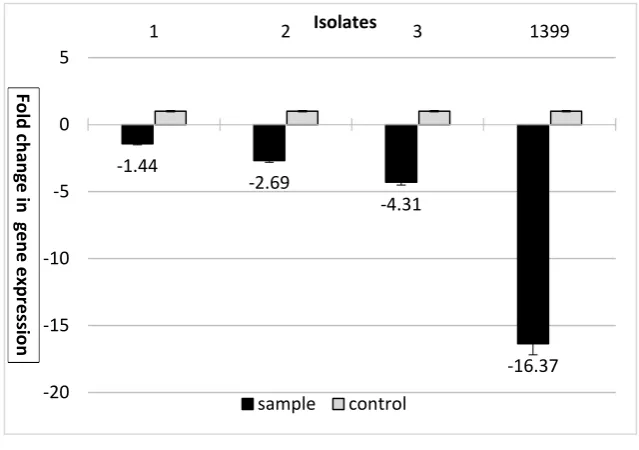
Type 1 fimbriae are one of the main adhesins necessary for bacterial adhesion. In this study, we examined the effect of sub-MIC concentrations (1250 μg/ml) of ZnO nanoparticles on the expression of fimH gene in UPEC isolates using Real-time PCR. All isolates produced strong biofilms, which was later weakened in the presence of sub-MIC concentrations of ZnO nanoparticles. The sub-MIC concentration of ZnO nanoparticles caused 1.4, 2.69, 4.31 and 16.37-fold reduction in fimH expression in isolates 1, 2, 3 and PTCC 1399 (Figure 1).
The results of gene expression were consistent with results of the phenotypic observations (biofilm formation and gene expression levels decreased in all four isolates) (Table 2).
DISCUSSION
Irreversible adhesion is the first essential step of UPEC pathogenicity. At this stage, majority of bindings are specifically between bacterial adhesins and host cell surface receptors. This highly stable attachment leads to establishment of bacteria on the cell surface and causes infection. Amalaradjou et al. have recently shown that essential oil of cinnamon (Trans-cinnamaldehyde) decreases expression of genes related to bacterial adhesion and invasion (fimA, fimH, papG, sfaS, focA). They concluded that the down-expression of the mentioned genes also
reduces adhesion (2). Burt et al. showed that the essential oil of thyme prevents motility by inhibiting synthesis of flagella in E. coli O157:H7 [17]. In the present study, ZnO nanoparticles decreased the expression of fimH, an important gene involved in the irreversible adhesion.
Jin-Hyung Lee et al. reported that zinc ions and ZnO nanoparticles markedly inhibit production of virulence factors (pyocyanin, pseudomonas quinolone signal, pyochelin and hemolytic activity) and biofilm formation in Pseudomonas aeruginosa [18]. -1.44
-2.69
-4.31
-16.37 -20
-15 -10 -5 0 5
1 2 3 1399
Fo
ld
c
h
an
ge
in
g
e
n
e
e
xp
re
ssi
o
n
Isolates
sample control
Figure1. Down-expression of the fimH gene in the presence of sub-MIC concentrations of ZnO nanoparticles
Table 2. Results of gene expression and biofilm formation
Isolates
Biofilm formation based on OD
Gene expression
reduction
Before treatment with sub-MIC of ZnO nanoparticles
After treatment with sub-MIC of ZnO nanoparticles
1 0.317(strong) 0.122(weak) 1.44
2 0.404(strong) 0.148(weak) 2.69
3 0.869(strong) 0.150(weak) 4.3
PTCC 1399 0.467(strong) 0.162(weak) 16.37
These results are consistent with our findings. Islam and et al. also showed that biofilm formation in UPEC isolates containing the flu genes (coding ag43) is inhibited by nitric oxide, an effect not observed in isolates without the flu genes [19]. In a previous study, we showed that ZnO nanoparticles reduce biofilm formation and expression level of the flu gene in UPEC [11].
The results of this study and our previous study showed that sub-MIC concentrations of ZnO nanoparticles reduce the expression of flu gene and fimH gene, which in turn reduces biofilm formation. However, further studies are required on gene expression and adhesion of bacteria to surfaces to determine whether ZnO nanoparticles could completely prevent UPEC adhesion and biofilm formation.
CONCLUSION
Sub-MIC concentrations of ZnO significantly reduce the expression of the fimH gene in strong biofilm forming UPEC strains but cannot inhibit biofilm formation.
CONFLICT OF INTEREST
The authors declare that there is no conflict of interest.
ACKNOWLEDGMENTS
We would like to thank Maya Babai and Hanieh Bagheri (Golestan University of Medical Sciences) for providing the bacterial strains, and Masood Bazori for technical advice. The authors also acknowledge Naemeh Javid and Hanieh Bagheri for their helpful comments and support in scientific discussion. This study was sponsored by the Laboratory Sciences Research Center, Golestan University of Medical Sciences, Gorgan, Iran.
REFERENCES
1. Zhang L, Foxman B. Molecular epidemiology of Escherichia coli mediated urinary tract infections. Frontiers in bioscience. 2003;8:e235-e44.
2. Soto SM, Guiral E, Marco F, Vila J. Biofilm Formation in Uropathogenic Escherichia coli
Strains: Relationship with Urovirulence Factors and Antimicrobial Resistance. Clinical Management of Complicated Urinary Tract Infection: InTech; 2011.
3. Anderson GG, Goller CC, Justice S, Hultgren SJ, Seed PC. Polysaccharide capsule and sialic acid-mediated regulation promote biofilm-like intracellular bacterial communities during cystitis. Infection and immunity. 2010;78(3):963-75.
4. Hanna A, Berg M, Stout V, Razatos A. Role of capsular colanic acid in adhesion of uropathogenic Escherichia coli. Applied and environmental microbiology. 2003;69(8):4474-81.
5. Amalaradjou MAR, Narayanan A, Venkitanarayanan K. Trans-cinnamaldehyde decreases attachment and invasion of uropathogenic Escherichia coli in urinary tract epithelial cells by modulating virulence gene expression. The Journal of urology. 2011;185(4):1526-31.
6. Heydari H, Shokrollahi MR, Movahedi Z. Frequency of type 1 fimbriae among E. coli subtypes isolated from patients with urinary and gastrointestinal tract infection. Life Sci J. 2013;10(7): 578-82.
7. Solano C, Echeverz M, Lasa I. Biofilm dispersion and quorum sensing .Current opinion in microbiology. 2014;18:96-104.
8. Shrestha A, Zhilong S, Gee NK, Kishen A. Nanoparticulates for antibiofilm treatment and effect of aging on its antibacterial activity. Journal of endodontics. 2010;36(6):1030-5. 9. Hajipour MJ, Fromm KM ,Ashkarran AA, de Aberasturi DJ, de Larramendi IR, Rojo T, et al. Antibacterial properties of nanoparticles. Trends in biotechnology. 2012;30(10):499-511.
10. Huh AJ, Kwon YJ. “Nanoantibiotics”: a new paradigm for treating infectious diseases using nanomaterials in the antibiotics resistant era. Journal of Controlled Release. 2011;156(2):128-45.
11. Shakerimoghaddam A, Ghaemi EA, Jamalli A. Zinc oxide nanoparticle reduced biofilm formation and antigen 43 expressions in uropathogenic Escherichia coli. Iranian Journal of Basic Medical Sciences. 2017;20(4):451-6. 12. Samet M, Ghaemi E, Jahanpur S, Jamalli A. Evaluation of biofilm-forming capabilities of urinary Escherichia coli isolates in microtiter plate using two different culture media. International Journal Of Molecular And Clinical Microbiology. 2013;3(1):244-7.
13. Naves P, Del Prado G, Huelves L, Gracia M, Ruiz V, Blanco J, et al. Measurement of biofilm formation by clinical isolates of Escherichia coli is method‐dependent. Journal of applied microbiology. 2008;105(2):585-90.
14. Pusz P, Bok E, Mazurek J, Stosik M, Baldy-Chudzik K. Type 1 fimbriae in commensal Escherichia coli derived from healthy humans. Acta biochimica Polonica. 2014;61(2):389-92. 15. Viveiros M, Dupont M, Rodrigues L, Couto I, Davin-Regli A ,Martins M, et al. Antibiotic stress, genetic response and altered permeability of E. coli. PloS one. 2007;2(4):e365.
16. Schmittgen TD, Livak KJ. Analyzing real-time PCR data by the comparative CT method. Nature protocols. 2008;3(6):1101-8.
17. Burt SA ,van der Zee R, Koets AP, de Graaff AM, van Knapen F, Gaastra W, et al. Carvacrol induces heat shock protein 60 and inhibits synthesis of flagellin in Escherichia coli O157: H7. Applied and environmental microbiology. 2007;73(14):4484-90.
18. Lee J-H, Kim Y-G, Cho MH, Lee J. ZnO nanoparticles inhibit Pseudomonas aeruginosa biofilm formation and virulence factor production. Microbiological research. 2014;169(12):888-96.
19. Islam s. Effect of nitric oxide on biofilm formation by Escherichi a coli. uppsalat universitet. 2008;5(3):17.
20. Burt SA ,van der Zee R, Koets AP, de Graaff AM, van Knapen F, Gaastra W, et al. Carvacrol induces heat shock protein 60 and inhibits synthesis of flagellin in Escherichia coli O157: H7. Applied and environmental microbiology. 2007;73(14):4484-90.
21. Lee J-H, Kim Y-G, Cho MH, Lee J. ZnO nanoparticles inhibit Pseudomonas aeruginosa biofilm formation and virulence factor production. Microbiological research. 2014;169(12):888-96.
22.Islam s. Effect of nitric oxide on biofilm formation by Escherichi a coli. uppsalat universitet. 2008;5(3):17.