DEMOGRAPHIC RESEARCH
VOLUME 28, ARTICLE 15, PAGES 421-432
PUBLISHED 6 MARCH 2013
http://www.demographic-research.org/Volumes/Vol28/15/ DOI: 10.4054/DemRes.2013.28.15
Descriptive Finding
Post-divorce custody arrangements and
binuclear family structures of Flemish
adolescents
An Katrien Sodermans
Sofie Vanassche
Koen Matthijs
© 2013 Sodermans, Vanassche & Matthijs.
This open-access work is published under the terms of the Creative Commons Attribution NonCommercial License 2.0 Germany, which permits use, reproduction & distribution in any medium for non-commercial purposes, provided the original author(s) and source are given credit.
1 Introduction 422
2 Data and methods 423
2.1 The Leuven Adolescents and Families Study 423 2.2 A residential calendar to measure residential arrangements 425
3 Results 426
3.1 Post-divorce custody arrangements 426 3.2 Post-divorce family structures following parental divorce 427
4 Conclusion 430
Demographic Research: Volume 28, Article 15 Descriptive Finding
Post-divorce custody arrangements and binuclear family structures
of Flemish adolescents
1An Katrien Sodermans2
Sofie Vanassche3
Koen Matthijs4
Abstract
BACKGROUND
Because of the tendency towards equal parental rights in post-divorce custody decisions, the number of children living partially in two households after divorce has increased. Because of this evolution, traditional family typologies have been challenged.
OBJECTIVE
In this study, we want to describe the post-divorce custody arrangements and family configurations of Flemish adolescents (between 12 and 18 years old).
METHODS
We use four waves of the Leuven Adolescents and Families Study, a yearly survey in which adolescents are questioned at school about their family life, family relationships and various dimensions of their wellbeing. Our research sample consists of 1525 adolescents who experienced a parental break-up. First, we present information on the proportion of adolescents in different custody arrangements, according to divorce cohort, age and sex. Next, we describe post-divorce family configurations, according to the custody arrangement and different criteria of co-residence between children and step-parents.
1 Sofie Vanassche and An Katrien Sodermans share first authorship of this publication.
2 Katholieke Universiteit Leuven, Faculteit Sociale Wetenschappen, Onderzoeksgroep Gezin & Bevolking, Belgium. E-mail: [email protected].
3 Katholieke Universiteit Leuven, Belgium. E-mail: [email protected]. 4
RESULTS
We observe a higher proportion of adolescents spending at least 33% of time in both parental households (shared residence) for more recent divorce cohorts. A large proportion of adolescents is living with a new partner of the mother or father, but there are important differences, according to the criteria used to define stepfamily configurations.
CONCLUSIONS
The relatively high incidence figures of children in shared residence challenge the current dichotomous post-divorce family concept in terms of single parent families and stepfamilies. Family typologies applying a binuclear perspective are therefore increasingly meaningful and necessary. In addition, shared residence increases the chance of co-residence with at least one step-parent, and increases the proportion of children with a part-time residential stepmother.
1. Introduction
One of the challenging issues for future demography and family sociology is the question of how to define and measure the family situation of children following parental divorce. In many research articles, single parent families are dichotomously distinguished from stepfamilies, as if there existed clear, undisputable boundaries between the two family configurations. With the growing number of children living partially in two households after divorce, this dichotomy is challenged. Shared parental responsibilities have become the norm in many countries and the number of children in joint physical custody is rising. Consequently, an increasing number of children are living a substantial amount of time in both parental households, in which different family configurations may exist. In addition, children in joint custody situations stochastically have a higher chance of living with a new partner of mother or father, or both. This has important consequences for the way we look at families and how we describe them.
Demographic Research: Volume 28, Article 15
physical custody, also known as „shared residence‟, was introduced in 2006 as the default residential model following parental divorce.
No official figures exist for residential arrangements or post-divorce family structures. Decisions on residential arrangements are consolidated in court, but these statistics are not available on an aggregate national level. As a consequence, Belgian policy makers have no precise information on the residential arrangements of divorced families. Post-divorce family configurations are also difficult to register, as the factual living situation is often different from the official one due to financial, practical or other reasons. Moreover, stepfamilies are difficult to detect, as information is needed on the biological relatedness of all household members. Some attempts have been made to estimate the number of Flemish children living in stepfamily formations (for example by Lodewijck 2005), but the reliability margins are relatively high.
The aim of this study is twofold. First, we describe the proportion of adolescents in different residential arrangements for different divorce cohorts. We thereby expect to reveal an increase of children in shared residence for the more recent cohorts. Secondly, we illustrate the post-divorce family configurations of adolescents, taking into account their residential arrangement. We thereby focus on the question of how different definition criteria alter the distribution of specific family configurations. To achieve this, we make use of data from the Leuven Adolescents and Families Study (Vanassche et al. 2012). These data are very suitable for the aim of this article, due to the particular research design of the study and the measurement instruments regarding the custody arrangement and family configurations of adolescents.
2. Data and methods
2.1 The Leuven Adolescents and Families Study
The Leuven Adolescents and Families Study (Dutch abbreviation „LAGO‟) is a repeated
The design of the study guarantees a sample of adolescents across all social layers, spread across schools that differ in the socio-economic and cultural backgrounds of their pupils. There is a very limited selective non-response rate (<1%) compared to other large-scale surveys. A unique characteristic of the questionnaire is that, in case of divorce, detailed information is asked about the family situation of both parental households. In that sense, the LAGO study is adapted to the binuclear family situation of children following parental divorce. The codebooks of all LAGO rounds are available at
www.soc.kuleuven.be/lagoenglish.
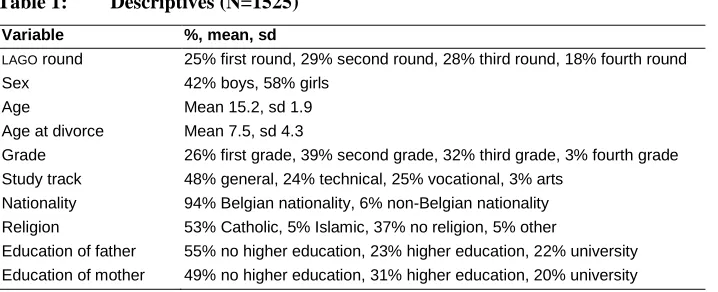
Currently, four rounds of LAGO have been completed (between 2008 and 2012), resulting in a database with information on 7035 adolescents. The combined sample distribution of sex, age and educational track resembles that of the Flemish secondary school population very well (Vanassche et al. 2012). Approximately 26% of the adolescents experienced a parental divorce or separation5, which is in line with the population figures reported by Lodewijckx (2005). Our research sample is limited to the 1525 adolescents with divorced or separated parents, both of whom were alive at the time the questionnaire was administered, and who indicated that they live with at least one of their biological parents. Table 1 shows some basic descriptive statistics.
Table 1: Descriptives (N=1525)
Variable %, mean, sd
LAGO round 25% first round, 29% second round, 28% third round, 18% fourth round
Sex 42% boys, 58% girls
Age Mean 15.2, sd 1.9
Age at divorce Mean 7.5, sd 4.3
Grade 26% first grade, 39% second grade, 32% third grade, 3% fourth grade
Study track 48% general, 24% technical, 25% vocational, 3% arts
Nationality 94% Belgian nationality, 6% non-Belgian nationality
Religion 53% Catholic, 5% Islamic, 37% no religion, 5% other
Education of father 55% no higher education, 23% higher education, 22% university
Education of mother 49% no higher education, 31% higher education, 20% university
Demographic Research: Volume 28, Article 15
2.2 A residential calendar to measure residential arrangements
Residential arrangements, if included at all in surveys, are generally measured rather basically, with simple predefined categories (for example: living with mother, living with both parents, living with father). Therefore, a new measurement instrument, the residential calendar, was developed by the authors to measure post-divorce residential arrangements (Sodermans et al. 2012). The residential calendar is a visual depiction of a normal month, each box representing a part of a day (Figure 1). Respondents need to indicate on a monthly basis, which days and nights they spend with their mother, with their father, or somewhere else. Clear instructions are provided, followed by an example of a residential situation and a correctly completed calendar.
Figure 1: The residential calendar
Monday Tuesday Wednesday Thursday Friday Saturday Sunday
Week 1
Week 2
Week 3
Week 4
3. Results
3.1 Post-divorce custody arrangements
Almost 33% of adolescents always live with their mother, and another 33% indicate that they live mostly with their mother. 25% of adolescents live alternately with their mother and father. Only 4% live mostly and 5% always with their father. Within the group of adolescents with shared residence, the majority (67%) live exactly 50% of time with their mother and father. Almost 9% of adolescents with shared residence indicate that they spend more time in the paternal household, while 24% spends more time in the maternal household. These figures show that, despite the changing normative climate towards equal parental rights, the mother is still the dominant caregiver after a parental break-up for the majority of the children. Yet, there are reasons to assume that the role of the father has become more important. As can be derived from Table 2, the proportion of adolescents in shared residence more than triples between the first and last divorce cohort.6 Simultaneously, the proportion of adolescents living always with the mother is lower for recently divorced parents.
Table 2: Proportion of adolescents in different residential arrangements, according to divorce cohort
% 1990-1995 1996-1999 2000-2005 2006-2011
Always with mother 52.2 45.7 26.0 27.8
Mostly with mother 27.2 35.1 34.8 28.1
Shared residence 9.8 14.1 29.3 32.8
Mostly with father 6.5 2.9 4.3 4.7
Always with father 6.1 2.2 5.6 6.6
N 92 276 624 320
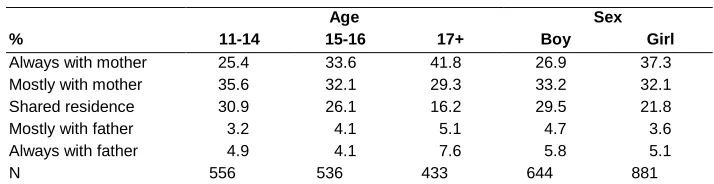
The differences between divorce cohorts can be partially due to age differences. Adolescents whose parents divorced more recently are on average younger than those in older divorce cohorts. Table 3 shows that shared residence is less probable for adolescents older than 16. The finding that older adolescents are more likely to live exclusively with the same parent has been demonstrated by other research as well (e.g. Cancian and Meyer 1998).
6
Demographic Research: Volume 28, Article 15
Table 3: Proportion of adolescents in different custody arrangements, according to age and sex
Age Sex
% 11-14 15-16 17+ Boy Girl
Always with mother 25.4 33.6 41.8 26.9 37.3
Mostly with mother 35.6 32.1 29.3 33.2 32.1
Shared residence 30.9 26.1 16.2 29.5 21.8
Mostly with father 3.2 4.1 5.1 4.7 3.6
Always with father 4.9 4.1 7.6 5.8 5.1
N 556 536 433 644 881
Children with shared residence make transitions between the maternal and paternal household on a regular basis. The majority of adolescents (67%) move four times per month, corresponding with living one week with mother, followed by one week with father, the so-called „every-other-week arrangement‟. Around 30% of adolescents move more frequently between the two parental households.
Shared residence is more likely for boys than for girls (Table 3). This confirms previous research and is explained by Fox and Kelly (1995) by the fact that fathers make more of an effort to gain custody when sons are involved. Girls, on the other hand, are more likely to always live with the mother (37%) than boys are (27%).
3.2 Post-divorce family structures following parental divorce
with a stepfather, only 5% of adolescents report living at least 66% of time with a stepmother.
Table 4a: Partner situation of the mother, according to the residential arrangement of the child (N=1505)
Total % Column % Always with mother Mostly with mother Shared residence Mostly with father Always with father TOTAL
No partner 12.6 10.3 8.8 1.3 1.4 34.4
38.6 31.4 34.9 30.7 26.6
LAT-relation 4.8 4.8 4.1 0.7 0.4 14.7
14.6 14.6 16.1 16.1 7.6
Unmarried cohabitation
8.8 10.1 8.2 1.3 2.3 30.6
26.8 30.8 32.5 30.7 44.3
Remarried 6.5 7.6 4.1 0.9 1.1 20.3
19.9 23.3 16.4 22.6 21.5
Table 4b: Partner situation of the father, according to the residential arrangement of the child (N=1446)
Total % Column % Always with mother Mostly with mother Shared residence Mostly with father Always with father TOTAL
No partner 9.3 8.7 8.0 1.6 2.2 29.8
30.5 25.9 30.8 37.1 40.0
LAT-relation 2.8 4.4 4.8 0.8 0.8 13.6
9.3 12.9 18.6 17.7 13.8
Unmarried cohabitation
10.7 14.2 9.1 1.0 1.5 36.5
35.0 42.1 35.1 24.2 26.3
Remarried 7.7 6.4 4.1 0.9 1.1 20.2
Demographic Research: Volume 28, Article 15
Table 5 presents the post-divorce family configuration of adolescents from a binuclear perspective. In the first column, a broad definition of co-residence is used, while in the second column co-residence is defined as living at least 33% in a household. Under the broad definition of co-residence, one out of six adolescents lives permanently with the mother and one out of six lives fulltime with mother and stepfather. A very small group lives fulltime with a single father or with father and stepmother. Almost one out of six adolescents commutes between two single parent households. More than a quarter of the adolescents alternately live in a single parent household and a stepfamily. Finally, one fifth lives part-time in two stepfamily configurations. Overall, 65% of all adolescents live at least some time with a step-parent after the parental divorce.
Under the more strict definition of co-residence, one out of three adolescents live fulltime with a single mother, and a third lives fulltime with mother and stepfather. The other six remaining binuclear family configurations are almost equally distributed over the remaining third of adolescents. Overall, 55% of the adolescents with divorced parents lives at least one third of time with a step-parent.
The four combinations of family configurations are relatively equally divided within the groups of shared residence under both conditions, such as the presence or absence of a step-parent within the mother and father custody group. Overall, approximately three out of four adolescents in shared residence have at least one step-parent, versus one out of two adolescents in mother or father custody.
Table 5: The post-divorce family situation of adolescents, according to two different criteria
%
Child is living at least some time (>0%) in household
Child is living at least 33% in
household
Fulltime with single mother 17.5 32.5
Fulltime with single father 2.9 5.1
Fulltime with mother and stepfather 15.4 33.1
Fulltime with father and stepmother 2.5 4.3
Alternating with single mother, and with single father 14.3 6.7
Alternating with mother and stepfather, and with single father
13.0 5.7
Alternating with single mother, and with father and stepmother
15.3 6.1
Alternating with mother and stepfather, and with father and stepmother
19.2 6.7
4. Conclusion
The aim of this study was to describe the post-divorce family configurations of adolescents, with a focus on the increasing number of children in shared residence, and the implications for stepfamily formation.
First of all, we observe an increase in the proportion of adolescents spending at least 33% of time in both parental households between the first and last divorce cohort. Especially for divorces from 2006 onwards, when the legal presumption for shared residence was installed, this figure is rather high, reflecting the diminution of the maternal dominance in custody arrangements. Moreover, we notice a rather inflexible interpretation of shared residence, as the majority of joint custody children can be classified in the every-other-week arrangement (living exactly 50% of time in each parental household). However, the purpose of the law was to stress gender neutrality and to enhance father-child contact, rather than striving for equal division of children between both parents. The relatively high incidence figures of shared residence challenge the current dichotomous post-divorce family concept in terms of single parent families or stepfamilies, and raise questions such as how to classify part-time single parent and part-time stepfamily formations. Family typologies applying a binuclear perspective are therefore increasingly meaningful and necessary.
Secondly, a transversal look at the adolescent population shows that the large majority is living with a mother‟s or father‟s new partner following parental divorce. From a life course perspective, the proportion of adolescents with divorced parents that has ever lived with a step-parent will even be higher. According to the criteria that are used to define step-parents, there are, however, important differences in the proportion of children with a stepmother and with a stepfather. Due to dominant residence with the mother, children most often live with a stepfather, especially if strict co-residence criteria are applied. With the increasing proportion of children in shared residence, we may however expect an increasing number of children living with a stepmother. Complementary, we may expect the proportion of fulltime residential stepfathers to decline. More gender equal residential arrangements may thus diminish existing differences between the parental role of stepfathers and stepmothers.
Demographic Research: Volume 28, Article 15
Bibliography
Cancian, M., and Meyer, D.R. (1998). Who gets custody? Demography 35(2): 147-157.
doi:10.2307/3004048.
Eurostat (2010). Statistics [electronic resource]. Luxembourg: Eurostat.
http://epp.eurostat.ec.europa.eu/portal/page/portal/population/introduction.
Fox, G.L., and Kelly, R.F. (1995). Determinants of child custody arrangements at divorce. Journal of Marriage and the Family 57(3): 693-708.
doi:10.2307/353924.
Lodewijckx, E. (2005). Kinderen en scheiding bij hun ouders in het Vlaamse Gewest. Een analyse op basis van Rijksregistergegevens. [Children and parental divorce in the Flemish Region. An analysis on National Register data.]. Brussel: Studiedienst van de Vlaamse Regering: 65 pp.
Melli, M.S. (1999). Guideline review: Child support and time sharing by parents.
Family Law Quarterly 33(1): 219-234.
Sodermans, A.K., Vanassche, S., Matthijs, K., and Swicegood, G. (2012). Measuring post-divorce living arrangements: Theoretical and empirical validation of the residential calendar. Journal of Family Issues. doi:10.1177/0192513X12464947.