RESEARCH ARTICLE
Comparison between the auditory lateralization ability of
normal hearing elderly and youth with filtered noise
Yones Lotfi1, Maryam Bastami1*, Zahra Hosseini Dastgerdi1, Enayatollah Bakhshi2
1- Department of Audiology, University of Social Welfare and Rehabilitation Sciences, Tehran, Iran 2
- Department of Biostatistics, University of Social Welfare and Rehabilitation Sciences, Tehran, Iran
Received: 2 Oct 2018, Revised: 17 Oct 2018, Accepted: 21 Oct 2018, Published: 15 Jan 2019
Abstract
Background and Aim: Aging affects the
audi-tory lateralization function that is achieved thr-ough processing binaural cues. One of the most important benefits of this process, along with getting informed of sound location, is increasing signal to noise ratio and improvement of speech comprehension in crowded environments, which is one of the most common hearing complaints in the elderly. This study aimed to compare the performance of the lateralization function under the headphone conditions between the elderly and the youth, with a filtered noise stimulus.
Methods: This study was performed between
22 elderly aged 60−80 and 22 young people aged 20−30. The auditory threshold was less than 25 dB HL in 250 to 4000 Hz frequencies in both groups. By applying a time delay of −880 to +880 microsecond and the intensity differe-nce of −10 to +10 dB between the two ears, and with high-pass and low-pass noise stimulus, the lateralization function was examined. For descr-iption of the lateralization function, scatter diag-ram and in order to compare the results, paired t-test and independent t-test were used.
Results: Findings showed that the elderly's
err-ors were increased in all tests compared to those
of the youth group. There was a significant difference (p < 0.05) between the two groups in lateralization by time clues with low-pass and high-pass noise.
Conclusion: Results confirm the impairment of
the lateralization and processing of binaural cues in the elderly differently.
Keywords: Elderly; lateralization; low-pass
noise; high-pass noise
Citation:Lotfi Y, Bastami M, Hosseini Dastgerdi Z, Bakhshi E. Comparison between the auditory lateralization ability of normal hearing elderly and youth with filtered noise. Aud Vestib Res. 2019;28(1):49-56.
Introduction
Elderly, based on World Health Organization (WHO), is defined as age 60 or higher [1]. With age, structure and function of almost all levels of the auditory system from the external ear to auditory cortex are affected, and these changes are manifested as presbycusis. In most cases, peripheral and central disorders happen simu-ltaneously, but occasionally there is an auditory information processing defect in spite of normal hearing level [2]. Peripheral and central pro-cessing disorders have significant effects on the elderly’s communication ability, and their common complaint is speech perception diffi-culty especially in noisy environments [3].
Age-* Corresponding author: Department of Audiology,
related changes in the central auditory system can affect important aspects of auditory proce-ssing such as binaural auditory proceproce-ssing. One of the essential abilities that happens as a result of the binaural hearing is sound source latera-lization and localatera-lization in the auditory space [4] which helps animals in survival and humans in danger awareness and distance perception [5]. Lateralization and localization in the horizontal plane take place by comparing interaural time difference (ITD) and interaural intensity differe-nce (IID) information between two ears. Accor-ding to duplex theory, both binaural cues are frequency specific in a way that ITD is related to low frequencies (lower than about 2 kHz) and IID is related to higher frequencies (above 2500 Hz). In middle frequencies (1500−3000 Hz), there is a vague relation between these cues and frequencies. The duplex theory is specific to pure tones. Evidence shows that ITD is used for localization of complex high frequency stimuli (above 1500 Hz) such as filtered noise. In this case, the location of the stimulus is determined by envelope instead of fine structure [6]. These binaural cues are the base for all binaural pro-cessing and spatial hearing which are important for auditory localization, environmental sounds awareness, separating the auditory target from background non-relevant sounds and selective attention. In humans, all of these capabilities are important for increasing signal to noise ratio improvement and speech perception in noisy situations or in presence of multiple talkers (cocktail party effect) [7,8]. The first stage of binaural processing is superior olivary complex (SOC) in low brainstem consisting of two nuc-lei: medial superior olive (MSO) and lateral superior olive (LSO). ITD and IID are proce-ssed differently in these regions which are acc-ounted as bottom-up or data-driven processing. This processing pathway relies on input infor-mation and central auditory integrity [9]. Top-down or concept-driven processing contributes to precise localization and streaming which is dependent on higher order sources such as atten-tion and memory [10]. There is evidence that shows the elderly with normal hearing have difficulties in lateralization and localization in
comparison with young subjects that they do not benefit from binaural hearing [11]. Researchers have tested lateralization in the elderly by diffe-rent methods. Delphi et al. have pointed out that Dobreva et al. used the wide band, high-pass and low-pass noise, with a loudspeaker to test localization precision and accuracy and showed that elderly show lower precision and accuracy compared with young and middle-aged subjects [12]. Based on Moosavi et al., Bobkoff et al. tested lateralization using click in 78 subjects aged from 21 to 88 years old with a normal hearing under headphone and showed that late-ralization ability is diminished by age [13]. Strouse et al. examined 12 young and 12 elderly with normal hearing level, monaural gap detec-tion and ITD threshold for click under head-phone and reported that elderly have higher gap detection and ITD threshold than youngsters [14].
As lateralization and binaural processing are the base for very important and complex processing of auditory system including speech perception in noise and in presence of competing sounds, precise and comprehensive examination of late-ralization in elderly is important to understand the processing to plan right rehabilitation meth-ods to meet their communication needs [15]. As mentioned, studies have used different meth-ods for the examination of auditory lateraliza-tion. As click is a transient stimulus, it contains a wide spectrum that provides a lot of frequency information for lateralization and makes laterali-zation easy [16]. On the other hand, as most natural sounds such as speech have a wide fre-quency range, a study using pure tones cannot provide precise information about everyday lateralization performance [17]. Therefore, we tried to use a stimulus with much similarity to everyday sounds.
for localization and provide ITD. Perception of high-pass noise is mostly based on the envelope, it is harder to discriminate, and it is more sen-sitive for differentiating normal subjects from impaired ones (unlike low-pass noise which due to being simple to identify, it has low sensitivity for detecting patients with brainstem impair-ment). The reason for selecting 2 kHz cut-off point is that in the middle frequencies (1500− 3000 Hz), ITD and IID are vague [18]. The aim of the present study was a more precise exa-mination of ITD and IID processing for low-pass and high-low-pass noise with 2 kHz cut-off frequency under headphone.
Methods
This cross-sectional study was carried out bet-ween 22 elderly 60 to 80 years old with mean age of 63.36 years and a standard deviation of 2.27, including 13 (59.09%) women and 9 (40.91%) men, and 22 young 20 to 30 years old with mean age of 25.05 and a standard deviation of 1.63, including 12 (54.55%) female and 10 (45.45%) male with normal hearing and being monolingual (speaking only Persian). The num-ber of samples was obtained based on the most similar researches and studies carried out glo-bally [14]. The sampling method was the con-venience one in which the young people were selected from the students at the University of Social Welfare and Rehabilitation, and the elde-rly were chosen from the eldeelde-rly people referr-ing to the cultural centers of several regions in Tehran. After receiving consent letters from the individuals, their personal information including age and medical history were recorded in the history form. Then, in order to assess the mental health status of the elderly, the Persian version of the mini-mental state examination (MMSE) test was used. The inclusion criterion was a score of 25 or more [19], and in both groups, Edinburgh manual excerpt scale test was used for right-handed endorsement. Next, for the aim of examining the auditory condition at first, external ear examinations were performed using otoscope Rister 2010, in order to examine the middle ear condition the Zodiac 901 tympano-meter (manufactured by Madsen of Denmark),
the tympanometric benchmark of An type and hearing assessment (hearing threshold in both ears at frequencies of 250 to 4 kHz less than 25 dB HL and difference of threshold in each frequency between two-side 5 dB or less) using a midimate 622 audiometer (GN otometrics company, Denmark) speech audiometry (single-syllable recognition score of better than 80% in both ears) was used to confirm the normal hear-ing of samples. Finally, the subjects who were eligible for research were selected and latera-lization valuations was conducted under head-phones for these people. In this study, the res-ponses for each individual, in four situations of interaural time difference with high-pass noise (ITDHPN), interaural time difference with low-pass noise (ITDLPN), interaural intensity diffe-rence with high-pass noise (IIDHPN) and inte-raural intensity difference with low-pass noise (IIDLPN) tests were evaluated.
of corresponding speaker. In the next step, the subjects themselves referred to corresponding speakers. After complete assurance of learning how to execute and function in each ITDLPN, ITDHPN, IIDLPN, and IIDHPN tests, nine sti-muli were presented. Each stimulus was repea-ted twice, randomly and in general, every per-son responded to 72 stimulations in 4 tests. To describe and analyze statistical data, the sca-tter diagram [in this graph, the X-axis represents the applied ITD and IID (in ITD from −880 to +880 microseconds, and in the IID from −10 to +10 dB), and the Y-axis represents the position of the speakers (loudspeaker 1−9)[. In Excel software, and to separately compare the error rate of the responses in each group and also to compare errors between the two groups, inde-pendent and paired t-test were used, respec-tively. The calculation of the error rate of res-ponses in each test was such that, for example, if the latency of +220 was given to a person’s ear and instead of showing the speaker number 6, the loudspeaker 7 was shown, one error and if, the loudspeaker 9 was shown, three errors were counted. Then, errors were collected at each separate position (each speaker) and then, with the sum of all errors in each of the 9 positions the total error in each test was calcu-lated. The response errors in the IID tests (IIDLPN and IIDHPN) were also obtained in the same way. Finally, statistical analysis was performed by SPSS software version 21.
Results
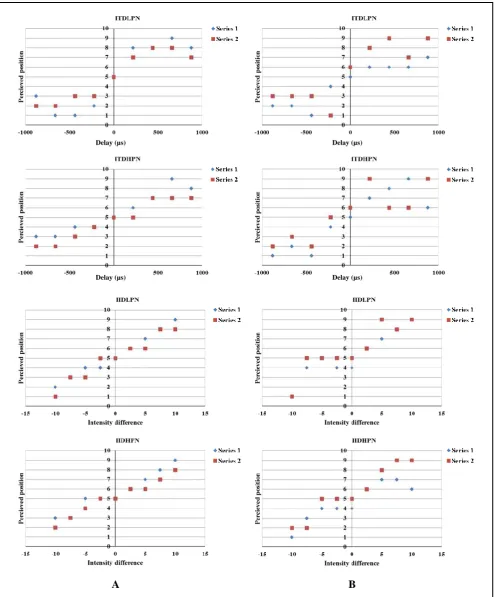
Mean and standard deviation of pure tone ave-rage in young subjects and the elderly were 7.50 ± 3.36 dB HL and 14.31 ± 4.95 dB HL, res-pectively. Fig. 1 depicts, the scatter plot for ITDHPN, ITDLPN, IIDHPN and IIDLPN in a young and an old subject.
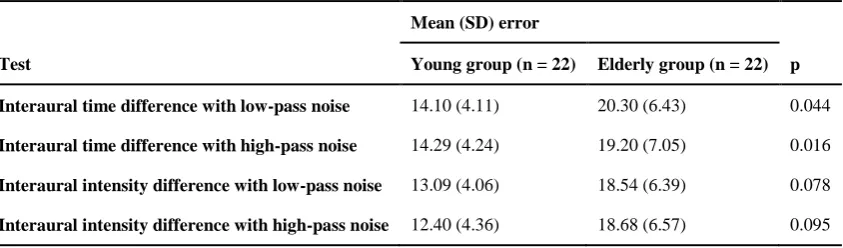
Table 1 summarizes mean and standard devi-ation of errors in ITDHPN, ITDLPN, IIDHPN and IIDLPN tests for young and old subjects. In general, the ITD test showed more errors than IID. Comparing results in youngsters through paired t-test showed a significant difference between ITDHPN and IIDHPN (p = 0.048) and the average of error in the ITDHPN test was
higher.
Comparing results with the paired t-test in the elderly showed a significant difference bet-ween ITDHPN and IIDLPN (p = 0.005) and IIDLPN and IIDHPN (p = 0.008). As shown in Table 1, comparing errors via independent t-test showed a significant difference for ITDHPN and ITDLPN between the two groups (p = 0.044 and p = 0.016, respectively). In general, mean and standard deviation for errors in elderly were higher than those in young subjects in four mentioned situations.
Discussion
Scatter plot of lateralization in the elderly and young group showed dispersed responses for both ITD and IID but the dispersion was more for the elderly. For good lateralization perfor-mance, both cues in addition to monaural spec-tral cues (provided by auricle) are needed. As this test was performed under headphone and sound location was not real, all auricle spectral information was omitted and that made respon-ses more dispersed in headphone testing [20]. In both groups, dispersion and mean value of ITD test errors were more than those of IID. Studies have shown that ITD processing is more comp-licated than IID and needs precise temporal pro-cessing at SOC. For IID, different nuclei and pathways are responsible [21]. In the present study, errors and the dispersion were higher for elderly than for young subjects and this finding is in agreement with those of Zakari and Patuzzi based on Delphi et al.’s report. It is also in agreement those of Bobkoff et al. that showed age-related changes in peripheral and central auditory system is mostly temporal and elderly had higher gap detection and ITD threshold than young subjects [12,16]. Studies have shown that decreased neural activity and dyssynchrony are the main reasons for the temporal and spatial cue encoding deficits in elderly [22].
Fig. 1. Perceived position in four lateralization tests in A) a young female, and B) an old male. ITDLPN; interaural time difference with low-pass noise, ITDHPN; interaural time difference with
high-pass noise, IIDLPN; interaural intensity difference with low-pass noise, IIDHPN; interaural intensity difference with high-pass noise.
A B
Delay (µs) Delay (µs)
from +440 to +880 (right loudspeakers number 7, 8, and 9) were leaned to asymptote. Asym-ptote showed that there was not a significant location perception with changing ITD from −440 to −880 and from +440 to +880 microse-conds and location discrimination shows decre-ment. In the IID test, the function was an appr-oximately straight line from −10 to +10 [20]. This linear function shows that with increasing IID from 0 to −10 dB for left loudspeakers and from 0 to +10 dB for right loudspeakers, loca-tion perceploca-tion changes and IID discriminaloca-tion is available up to 10 dB or more [23]. Latera-lization plot showed no difference in IID test with low-pass and high-pass noise but for ITD test, the plot for high-pass noise was a little wider than low-pass noise and responses were a little leaned to central situations (loudspeakers 4, 5, 6). In comparison between IID (IIDLPN, IIDHPN) and ITD (ITDLPN, ITDHPN) situ-ations, data dispersion in high-pass noise was higher and errors were higher in elderly than in young subjects. In several studies, it was shown that low-pass noise is easy to localize and late-ralize but high-pass noise, due to lack of adequ-ate energy for ladequ-ateralization via ITD (ITDHPN) and lateralization through signal envelope ins-tead of fine structure, is harder [18,24]. In the present study, wider plot for ITDHPN than ITDLPN is secondary to inadequate energy in HPN for lateralization using ITD. Also, it was shown that the elderly’s lateralization ability was diminished for central positions (loud-speakers number 4, 5 and 6) mostly in ITD
situations which are in agreement the findings of Bobkoff et al. [16]. Studies have shown that subjects with inferior colliculus (IC) and cortex disorders have problems with midline laterali-zation. As most inhibitory functions are in these regions and with aging these inhibitory func-tions decrease, more errors in discriminating locations in the midline and around it might be the consequence [13,18].
IID and spectral cues are dependent on high fre-quencies which are vulnerable to high frequency hearing loss but studies indicated that horizontal localization using IID shows no reduction with age [25]. In the present study, errors and IID dispersion in the elderly was higher than those in young subjects but the difference was not significant. The different effects of aging on ITD and IID lateralization might be indicative of different central processing for these two cues so that deficit in one mechanism is not essentially indicative of deficit in the other one [16].
In the present study, by comparing lateralization errors in two groups, it seems that spatial proce-ssing in elderly is affected and it is shown by localization and lateralization disability. Koehnke and Besing indicated that lateralization and localization deficit can make it hard for subjects to suppress unwanted information in noisy environments [11]. In general, the past studies, as well as the present one, show that lateralization tests have good abilities in testing elderly, and accompanying other central audi-tory tests can improve diagnosis process and Table 1. Mean (standard deviation) error scores for lateralization tests in the young and
elderly groups
Mean (SD) error
Test Young group (n = 22) Elderly group (n = 22) p
Interaural time difference with low-pass noise 14.10 (4.11) 20.30 (6.43) 0.044
Interaural time difference with high-pass noise 14.29 (4.24) 19.20 (7.05) 0.016
Interaural intensity difference with low-pass noise 13.09 (4.06) 18.54 (6.39) 0.078
provide beneficial information about lateraliza-tion and spatial processing in elderly with com-plaint of hearing in noisy places [12]. It is suggested that ITD test be added to auditory processing test battery for elderly and laterali-zation test be conducted on elderly with a pro-ven speech in noise perception to ensure which mechanism of speech perception in noise is effective.
Conclusion
Response pattern in ITD test was sigmoid or S-shaped and IID test was approximately linear in elderly and young subjects. IID responses were more coherent than ITD which indicates that ITD is a harder cue than IID. Elderly show-ed different performance in all situations com-pared with young subjects. A significant incr-ease in dispersion and errors in the elderly is indicative of lateralization and binaural hearing deficit. However, in general, there was a signifi-cant difference between the two groups in late-ralization ability with low-pass and high-pass noise (p < 0.05).
Acknowledgements
This article is extracted from M. Bastami’s thesis with the ethic code: IR.USWR.REC. 1396.390 at University of Social Welfare and Rehabilitation Sciences. Authors wish to thank all participants and Mr. Reza Tajik, the secre-tary general of security department at artistic and cultural organization of municipality, for introducing us to the cultural centers of districts 1, 3, 5, 7, 13 and 14.
Conflict of interest
The authors declare that they have no conflict of interest.
References
1. Feyzi V, Hasheminejad N, Jafari Roodbandi AS. [Relationship between visual, hearing and memory disabilities and hand grip strength and the systems usability available to the elderly living in nursing homes in Kerman, Iran]. Iranian Journal of Ageing. 2017;11(4):484-93. Persian. doi: 10.21859/sija-1104484
2. Bellis TJ, Jorgensen LE. Aging of the auditory system and defferential diagnosis of central auditory processing disorder in older listeners. In: Musiek FE, Chermak GD, editors. Handbook of central auditory processing
disorder, vol. I. Auditory neuroscience and diagnosis. 2nd ed. San Diego: Plural Publishing; 2014. p. 499-532. 3. Freigang C, Schmiedchen K, Nitsche I, Rübsamen R.
Free-field study on auditory localization and discrimi-nation performance in older adults. Exp Brain Res. 2014;232(4):1157-72. doi: 10.1007/s00221-014-3825-0
4. Sams M, Hämäläinen M, Hari R, McEvoy L. Human auditory cortical mechanisms of sound lateralization: I. Interaural time differences within sound. Hear Res. 1993;67(1-2):89-97.
5. Lotfi Y, Moosavi A, Zamiri Abdollahi F, Bakhshi E, Sadjedi H. Effects of an auditory lateralization training in children suspected to central auditory processing disorder. J Audiol Otol. 2016;20(2):102-8. doi: 10.7874/jao.2016.20.2.102
6. Middlebrooks JC. Sound localization. Handb Clin Neurol. 2015;129:99-116. doi: 10.1016/B978-0-444-62630-1.00006-8
7. Small SA, Ishida IM, Stapells DR. Infant cortical auditory evoked potentials to lateralized noise shifts produced by changes in interaural time difference. Ear Hear. 2017;38(1):94-102. doi:
10.1097/AUD.0000000000000357
8. Edmonds BA, Krumbholz K. Are interaural time and level differences represented by independent or inte-grated codes in the human auditory cortex? J Assoc Res Otolaryngol. 2014;15(1):103-14. doi: 10.1007/s10162-013-0421-0
9. Tollin DJ. The lateral superior olive: a functional role in sound source localization. Neuroscientist. 2003;9(2): 127-43. doi: 10.1177/1073858403252228
10. Wood KC, Bizley JK. Relative sound localisation abili-ties in human listeners. J Acoust Soc Am. 2015;138(2): 674-86. doi: 10.1121/1.4923452
11. Koehnke J, Besing JM. The effects of aging on binaural and spatial hearing. Semin Hear. 2001;22(3):241-54. doi: 10.1055/s-2001-15629
12. Delphi M, Lotfi MY, Moossavi A, Bakhshi E, Bani-mostafa M. Reliability of interaural time difference-based localization training in elderly individuals with speech-in-noise perception disorder. Iran J Med Sci. 2017;42(5):437-42.
13. Moosavi A, Hosseini dastgerdi Z, Lotfi Y, Mehrkian S, Bakhshi E, Khavar Ghazalani B. Auditory lateralization ability in children with (central) auditory processing disorder. Iranian Rehabilitation Journal. 2014;12(1):31-7.
14. Strouse A, Ashmead DH, Ohde RN, Grantham DW. Temporal processing in the aging auditory system. J Acoust Soc Am. 1998;104(4):2385-99.
15. Li-Korotky HS. Age-related hearing loss: quality of care for quality of life. Gerontologist. 2012;52(2):265-71. doi: 10.1093/geront/gnr159
16. Babkoff H, Muchnik C, Ben-David N, Furst M, Even-Zohar S, Hildesheimer M. Mapping lateralization of click trains in younger and older populations. Hear Res. 2002;165(1-2):117-27. doi: 10.1016/S0378-5955(02)00292-7
17. Borod J, Obler L, Albert M, Stiefel S. Lateralization for pure tone perception as a function of age and sex. Cortex. 1983;19(2):281-5.
and multiple sclerosis lesions. Hear Res. 2000;143(1-2):29-42. doi: 10.1016/S0378-5955(00)00019-8
19. Foroughan M, Jafari Z, Shirin Bayan P, Ghaem Magham Farahani Z, Rahgozar M. [Validation of mini-mental state examination (MMSE) in the elderly population of Tehran]. Advances in Cognitive Science. 2008;10(2):29-37. Persian.
20. Lotfi Y, Hosseini Dastgerdi Z, Moossavi A, Mehrkian S, Bakhshi E. [Evaluation of auditory lateralization ability and its development in normal children with 8 to 11 years of age]. Audiol. 2014;23(4):60-8. Persian.
21. Green JS, Sanes DH. Early appearance of inhibitory input to the MNTB supports binaural processing during development. J Neurophysiol. 2005;94(6):3826-35. doi:
10.1152/jn.00601.2005
22. Lotfi Y, Ahmadi T, Moossavi A, Bakhshi E. Binaural
sensitivity to temporal fine structure and lateralization ability in children with suspected (central) auditory processing disorder. Auris Nasus Larynx. 2018. pii: S0385-8146(18)30370-5. doi: 10.1016/j.anl.2018.06.005
23. Freigang C, Richter N, Rübsamen R, Ludwig AA. Age-related changes in sound localisation ability. Cell Tissue Res. 2015;361(1):371-86. doi: 10.1007/s00441-015-2230-8
24. Bernstein LR, Trahiotis C. Enhancing sensitivity to inte-raural delays at high frequencies by using "transposed stimuli". J Acoust Soc Am. 2002;112(3 Pt 1):1026-36. 25. Eddins AC, Ozmeral EJ, Eddins DA. How aging