https://doi.org/10.5194/gmd-11-2333-2018 © Author(s) 2018. This work is distributed under the Creative Commons Attribution 4.0 License.
The implementation of NEMS GFS Aerosol Component (NGAC)
Version 2.0 for global multispecies forecasting at NOAA/NCEP –
Part 2: Evaluation of aerosol optical thickness
Partha Sarathi Bhattacharjee1, Jun Wang2, Cheng-Hsuan Lu3, and Vijay Tallapragada2
1I. M. Systems Group, INC. at NOAA/NWS National Centers for Environment Prediction, College Park, MD 20740, USA 2NOAA/NWS National Centers for Environment Prediction, College Park, MD 20740, USA
3University of Albany, State University of New York, Albany, NY 12222, USA
Correspondence:Partha Sarathi Bhattacharjee ([email protected]) Received: 10 December 2017 – Discussion started: 20 December 2017
Revised: 27 April 2018 – Accepted: 2 May 2018 – Published: 19 June 2018
Abstract. An accurate representation of aerosols in global numerical weather prediction (NWP) models is important to predict major air pollution events and to also understand aerosol effects on short-term weather forecasts. Recently the global aerosol forecast model at NOAA, the NOAA Environ-mental Modeling System (NEMS) GFS Aerosol Component (NGAC), was upgraded from its dust-only version 1 to in-clude five species of aerosols (black carbon, organic carbon, sulfate, sea salt and dust). This latest upgrade, now called NGACv2, is an in-line aerosol forecast system providing three-dimensional aerosol mixing ratios along with aerosol optical properties, including aerosol optical thickness (AOT), every 3 h up to 5 days at global 1◦×1◦resolution. In this pa-per, we evaluated nearly 1.5 years of model AOT at 550 nm with available satellite retrievals, multi-model ensembles and surface observations over different aerosol regimes. Evalu-ation results show that NGACv2 has high correlEvalu-ations and low root mean square errors associated with African dust and also accurately represented the seasonal shift in aerosol plumes from Africa. Also, the model represented southern African and Canadian forest fires, dust from Asia, and AOT within the US with some degree of success. We have identi-fied model underestimation for some of the aerosol regimes (particularly over Asia) and will investigate this further to improve the model forecast. The addition of a data assimi-lation capability to NGAC in the near future is expected to provide a positive impact in aerosol forecast by the model.
1 Introduction
aerosol feedbacks in short-range (1–5-day) forecasts. How-ever, the advancement in computing power, improved aerosol models and enhanced aerosol observations now allow a more systematic documentation of the impact of aerosols (and un-certainties therein) on weather forecasts (Tanaka et al., 2003; Morcrette et al., 2009; Westphal et al., 2009). Some of the NWP centers have embarked on aerosol data assimilation efforts using both passive and active sensors (Sekiyama et al., 2010; Zhang el al., 2008; Benedetti et al., 2009). Sev-eral studies have shown improvement in NWP forecasts by the inclusion of aerosols (Haywood et al., 2005; Mulcahy et al., 2014). Short-range forecasts of aerosols by NWP centers are particularly beneficial for air quality forecasts and other societal needs in the event of large dust events (like transat-lantic dust plumes from Sahara) or biomass burning episodes (e.g., southern Africa, North and South America, and South-east Asia).
Verification of aerosol forecasts against available obser-vations is important to correct systematic model biases and to understand the model’s variability characteristics. Previ-ous studies have been done evaluating the performance of the European Centre for Medium Range Forecast (ECMWF) aerosol model by comparing model data to satellite and ground observations (Morcrette et al., 2009; Mangold et al., 2011; Cesnulyte et al., 2014). These studies focused on the comparison of monthly mean and daily aerosol quanti-ties in both visible and UV wavelengths as well as look-ing into different case studies (e.g., Saharan dust event, high sea-salt aerosol load). Eskes et al. (2015) provided a general overview of the validation approach for the Euro-pean operational CAMS (Copernicus Atmospheric Monitor-ing Service) global forecast system which uses data assim-ilation to combine in situ and remote-sensing observations for atmospheric aerosols. Campbell et al. (2012) evaluated NASA Cloud Aerosol Lidar with Orthogonal Polarization (CALIOP) aerosol optical thickness (AOT) against the Navy Aerosol Analysis and Prediction System (NAAPS) to quali-tatively assess day/night retrieval skill of the satellite and its accuracy. NAAPS also developed an AOT reanalysis product using the assimilation of quality-controlled retrievals from the satellite and found that the reanalysis follows the sea-sonal and interannual variability for the total AOT quite well (Lynch et al., 2016).
At NOAA, a prognostic aerosol capability was developed at the Environmental Modeling Centre (EMC) of the Na-tional Centers of Environmental Prediction (NCEP) in 2012. NASA’s bulk aerosol scheme (an in-line version of the God-dard Chemistry, Aerosol, Radiation and Transport model (GOCART); Chin et al., 2002; Colarco et al., 2010) was incorporated into the NOAA Environmental Modeling Sys-tem (NEMS) to establish an interactive global aerosol fore-casting system: NEMS GFS Aerosol Component version 1.0 (hereafter NGACv1) (Lu et al., 2016). The model became operational in 2012, providing 120 h global dust forecasts, once per day. It was incorporated as one of the seven global
models in the world’s first global multi-model aerosol en-semble product – the International Cooperative for Aerosol Prediction Multi-Model ensemble (ICAP-MME; Sessions et al., 2015) – to forecast dust on a real-time basis. NGACv1 was also incorporated into the World Meteorological Organi-zation (WMO) Sand and Dust Storm Warning Advisory and Assessment System (SDS-WAS) northern Africa–Middle-East–Europe (NA-ME-E) node to provide timely and quality sand and dust storm forecasts.
NGACv1 was recently upgraded to include four more aerosol species (sea salt, sulfate, black carbon and organic carbon) from its previous version of dust-only forecasts. This upgrade of the model (hereafter NGACv2) also uses near-real-time satellite-based smoke emissions and was declared operational in March 2017. The focus of this paper is the evaluation of the NGACv2 AOT product at 550 nm. The pa-per is organized as follows: Sect. 2 presents general informa-tion about the NGAC model and a summary of the products. Satellite and ground data sets used in this evaluation are de-scribed in Sect. 3. Section 4 shows comparisons of NGACv2 with ICAP-MME and satellite retrievals. The evaluation of NGACv2 aerosol products with in situ measurements is pre-sented in Sect. 5. Section 6 describes two events (one is Cen-tral African smoke and the other is transatlantic dust) where NGAC forecasts are compared to observations. Section 7 fin-ishes with a discussion and concluding remarks. Detailed de-scriptions of NGACv2 and its outputs and its operational im-plementation are described in Part 1 of this paper (Wang et al., 2018).
2 Model description
NGACv2 is a global in-line aerosol forecast system. The forecast model component of NGAC is NOAA’s operational Global Forecast System (GFS) based on NEMS, which, in turn, is based on the common modeling framework using the Earth System Modeling Framework (ESMF). GFS is a spec-tral model, comprised of model dynamics and physics in a hydrostatic system with a reduced Gaussian grid and hybrid (sigma and pressure) vertical levels. The aerosol component of NGACv2 is GOCART, which was developed at NASA Earth Science Programs to simulate atmospheric aerosols (including sulfate, black carbon (BC), organic carbon (OC), dust and sea salt) and sulfur gases (SO2) (Chin et al., 2002,
2007; Ginoux et al., 2001; Colarco et al., 2010). Dust and sea-salt emissions are dependent on wind speed, whereas BC and OC are produced from biomass burning and bio-fuel consumption. Sulfate is produced from the oxidation of SO2 and dimethylsulfide (DMS). Daily biomass
biomass burning emissions (BC, OC, SO2, etc.), blended fire
observations from NESDIS/STAR’s Global Burning Emis-sion Product from a constellation of Geosationary satellites (GBBEP; Zhang et al., 2012) and NGAC/GMAO’s Quick Fire Emissions Data version 2 from a polar orbiting sensor (QFED2; Darmenov and Dal Silva, 2015). NGACv2 is a joint collaboration between NOAA and NASA and represents an efficient way of transitioning research into NCEP operations. More details about model configuration, emission data sets, budget, post-processing and NEMS GFS coupling with GO-CART are discussed in Wang et al. (2018).
NGACv2 currently runs at T126L64 (∼110 km) which is a lower horizontal resolution than the current operational GFS (T1534L64, ∼13 km as of March 2017). Aerosol ini-tial conditions are taken from the 24 h NGAC forecasts from the previous day while meteorological initial conditions are downscaled from the high-resolution Global Data Assimila-tion System (GDAS) analysis. NGACv2 runs twice a day at 00:00 Z and 12:00 Z and produces output on a 1◦×1◦ longitude/latitude grid at 3-hourly forecast intervals from 00 to 120 hours. Output files contain both two-dimensional and three-dimensional fields of various aerosol and mete-orological variables. Total AOT is calculated based on all five species of aerosol at 340, 440, 550, 660, 860, 1110 and 1630 nm wavelengths. AOT from each species at 550 nm is also available, as well as mixing ratios (in three dimensions), sedimentation flux, dry and wet deposition flux, and scaveng-ing flux. A full list of NGACv2 output is available in Wang et al. (2018).
3 Data
Here we describe both NGACv2 and other observational AOT datasets used in this study. As AOT (column-integrated extinction coefficient) at 550 nm is a common reference for much of the previous work that involves satellite aerosol retrievals, we have considered this one quantity for all the evaluations. Daily NGACv2 forecast data from June 2015 to October 2016 (17 months in total) are used to evaluate spatial and temporal variation for global and regional scales. NGACv2 550 nm AOT (total and individual species) data are two-dimensional (1◦×1◦grid) and in GRIB2 format.
MODIS provides near-global coverage of aerosol mea-surements in space and time. We used a MODIS Level-3 (daily and monthly at 1◦×1◦) AOT dataset in this study (https://ladsweb.nascom.nasa.gov/, last access: March 2018). The dataset belongs to the Collection 6 combined land and ocean from the Aqua satellite (Levy et al., 2013). This lat-est collection of MODIS data includes AOT data based on refined retrieval algorithms, in particular the expanded Deep Blue algorithm (Hsu et al., 2013; Sayer et al., 2013). It intro-duces a merged AOD product, combining retrievals from the Dark Target (DT) and Deep Blue (DB) algorithms to produce a consistent data set covering a multitude of surface types
ranging from oceans to bright deserts (Sayer et al., 2014). We have used 550 nm MODIS AOT variables “dark target” and “deep blue” (for brighter surfaces) for all the statisti-cal comparisons in this paper. We also used the new aerosol product Dark_Target_Deep_Blue_Combined_Mean to qual-itatively compare model results.
The Visible Infrared Imaging Radiometer Suite (VIIRS) sensor onboard the Suomi National Polar Orbiting (S-NPP) satellite provides sets of aerosol environmental data records (EDRs) based on daily global observations from space (Jack-son et al., 2013; Liu et al., 2013). Beginning in 2012, VIIRS provides AOT at 550 nm at a global 0.25◦×0.25◦horizontal resolution. Daily gridded VIIRS data used in this paper are from the NOAA STAR ftp site at ftp://ftp.star.nesdis.noaa. gov/pub/smcd/jhuang/npp.viirs.aerosol.data/edraot550 (last access: March 2018). We have also used Enterprise Process-ing System (EPS) VIIRS data (1◦×1◦resolution), which use a newer aerosol algorithm to retrieve AOT for dust in Africa (Ciren et al., 2012; Laszlo and Liu, 2016) and became oper-ational in July 2017.
ICAP-MME provides 6-hourly forecasts of total and dust AOD globally out to 120 h at 1◦×1◦ resolution (Reid et al., 2011; Sessions et al., 2015). Total AOD in ICAP-MME is provided by the four core multispecies models: the Eu-ropean Centre Medium Range Weather Forecasts Coper-nicus Atmosphere Monitoring Service (ECMWF-CAMS), the Japan Meteorological Agency Model of Aerosol species in the Global Atmosphere (JMA-MASINGAR), the NASA Goddard Earth Observing System Version5 (NASA-GEOS5) and the Naval Research Lab Navy Aerosol Analysis and Prediction System (NRL-NAAPS) modeling systems. Dust-only AOD are provided by the aforementioned four models, plus the Barcelona Supercomputer Center Chemical Trans-port Model (NMMB/BSC-CTM), the United Kingdom Met Office Unified Model (UKMO-UM) and NGACv1. All four of the multispecies models invoke aerosol data assimilation (DA) and satellite-based smoke emissions. In this study, we have used coincident 6-hourly ICAP-MME forecasts of each day to compare them to NGACv2 results. Multi-model en-sembles, which use independent and skilled forecasts, are an ever increasing tool for forecasters as they are more accurate than the individual member deterministic models (Meehl et al., 2007; Fordham et al., 2012). As NGACv2, ICAP-MME and MODIS products all have a 1◦horizontal resolution.
al., 2002). AERONET employs the CIMEL sun–sky spec-tral radiometer which measures direct sun radiances at eight spectral channels centered at 340, 380, 440, 500, 675, 870, 940 and 1020 nm. AOT uncertainties in the direct sun mea-surements are within±0.01 for longer wavelengths (longer than 440 nm) and ±0.02 for shorter wavelengths (Eck et al., 1999). NGACv2 outputs AOT at 550 nm and several AERONET sites do not report at 500 or 550 nm wavelengths. To compare with NGACv2 550 nm AOT data, AERONET AOT at 440 and 675 nm were linearly interpolated on a log– log scale to provide 550 nm AOT. All AERONET data are sampled temporally at±1 h of daily 3-hourly NGACv2 fore-casts (for example, at any particular location AERONET measurements between 11:00 Z and 13:00 Z are averaged to compare them to the 12:00 Z model forecast). A 2 h time win-dow is created to allow for more sampling of AERONET measurements over any location. Also, we discarded very high AERONET AOT values (over 2.5) from all stations when statistical analysis was performed. Some of the sta-tion data report AOT of 5 and above in extreme high-aerosol events (smoke and pollution transport) which may not be simulated by the model due to coarse resolution. We esti-mated that approximately 3 % of the data are discarded due to this threshold. We have given more weight to the number of sample points and AERONET location (Table 2) for qual-itatively describing correlation coefficients at each location as “low”, “moderate” and “high” in this study. Model AOT at a site was extracted and compared only when AERONET had measurements in that time window. In this study we have used all available level 1.5 (cloud-screened) daily AOT data sets for the same time period (Smirnov et al., 2000).
Quantitative analysis in this study is performed by calcu-lating the following parameters: the average, standard devi-ation, correlation coefficient (R) and root mean square error (RMSE) of unitless 550 nm AOT.
4 Comparison with satellite observations and ICAP-MME
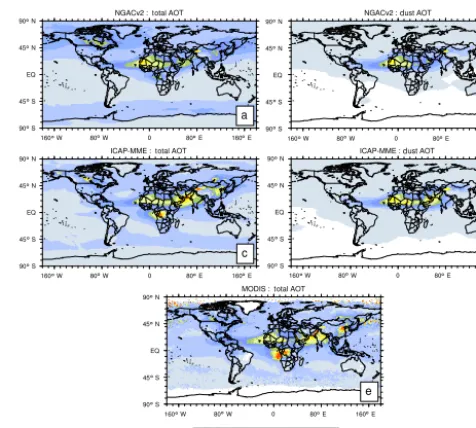
We compared seasonal variations (all four seasons: JJA, SON, DJF and MAM) of model forecast AOT with MODIS data for 2015–2016. We analyzed model results for both 2015 and 2016, and Fig. 1 shows results from 2015. Figure 1 shows global maps of AOT (total and dust from NGACv2) against ICAP-MME and MODIS (total AOT) for 2015 JJA (average of June–July–August). Higher burdens of AOT are found during the Northern Hemisphere summer, as wind-blown dust over northern Africa and the Persian Gulf and smoke over southern Africa and North America contributes the majority of high AOT shown in Fig. 1. NGACv2 sea-sonal variation is in qualitative agreement with both MODIS and ICAP-MME for many of the locations that represent major aerosol regimes, although there are a few notice-able differences. Major dust events over Africa, the
Mid-Figure 1.Global maps of averaged AOT 550 nm for JJA (June– July–August) 2015. Total AOT from NGACv2, ICAP and MODIS are in(a, c, e); NGACv2 dust-only is in(b), and ICAP dust-only is in(d). NGAC, ICAP and MODIS AOT 550 nm are at 1◦resolution. Values beyond the range of the color bar are represented by the end colors.
dle East and northwestern China are very similar in dust-only AODs between NGACv2 and ICAP-MME (Fig. 1b, d). Dust-transported plumes from northern Africa to the Atlantic Ocean are the most visible feature for both the models and satellite products (Fig. 1a, c and e). Smoke events located on the western coast of southern Africa and Canada are from NGACv2 OC AOT (not shown). Persistent sea-salt aerosol bands at 60◦S are evident from model total AOT (Fig. 1a, c). Some of the differences in total AOT (for example, lower AOT over India and China) are the results of known issues associated with NGACv2 which will be discussed later on. Since daily gridded MODIS data are used, which are not sampled at model forecast hours, some of the differences be-tween NGACv2 and MODIS can be attributed to data sam-pling.
for the same months and aerosol species (line plots in Fig. 2). We added MODIS total AOT at 23◦W to validate our model results. Latitudinal changes in the aerosol plume off the coast of western African coast are shown by NGACv2 for the se-lected months. In the winter (Fig. 2a–c) maximum values of AOT are located around 10◦N, but in July the max moves further north to around 18–20◦N (Fig. 2g–i). Biomass burn-ing in northern Africa is most active in the winter season, as OC AOT shows high values between 0 and 5◦N (Fig. 2c). So, high values of total AOT in Fig. 2a are contributed to by dust and OC aerosols and also by sea-salt aerosols in higher latitudes between 50 and 60◦N (not shown). In contrast, in July the total AOT peak shifts to 20◦N (Fig. 2g) and dust is the dominant aerosol contributing to total AOT (Fig. 2h). In the summer season dust originates from the western Sa-hara, under the conditions of a thermal low that prevails over that region (due to intense solar heating). In July 2016 biomass burning contributed much of OC aerosols across the Atlantic south of the equator (Fig. 2i). Also, OC and sul-fate (not shown) from Europe contributes to total AOT in July (Fig. 1g). Compared to strong latitudinal variations in December and July, all the AOT peaks are less intense in April (Fig. 2d–f), with the majority contribution from dust aerosols. Model results agree with latitudinal variation at the 23◦W location, where total AOT peaks match between NGACv2 and MODIS across all 3 months (Fig. 2a, d and g). Seasonal shifts in transatlantic aerosol plumes are of the kind that have been observed through satellites and reported in nu-merous studies (Takemura et al., 2000; Kaufman et al., 2005; Ben-Ami et al., 2009).
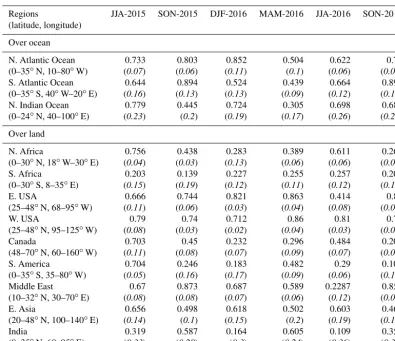
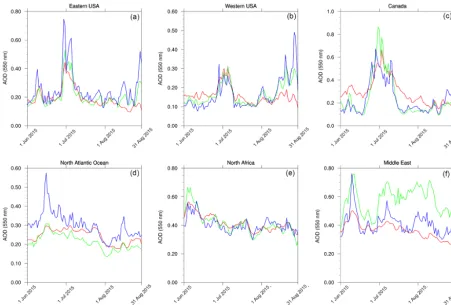
For quantitative comparisons we selected key aerosol gions over the land and ocean and extracted the model re-sults and satellite data over those regions (Fig. 3). We have used 6-hourly model forecasts and averaged them to cal-culate the daily mean AOT values over these regions. The three ocean regions include the North and South Atlantic oceans and North Indian Ocean, which are major long-range aerosol transport pathways for dust, smoke and sulfate. Fig-ure 3 shows nine land regions including two dust source regions (North Africa and the Middle East), two biomass burning regions (South America and southern Africa), three regions over North America (eastern and western US and Canada) and two major pollution source regions (India and East Asia). Previous studies have shown that aerosols over India and East Asia are composed of different aerosol types and the relative contribution of individual species varies with season (Kedia et al., 2014; Bhawar et al., 2016). Table 1 summarizes the latitude–longitude bounds of all the 12 re-gions, along with correlation coefficients and RMSEs for NGACv2 and MODIS for different seasons between 2015 and 2016. Figure 4 shows one such daily time series for 2015-JJA in the selected six regions where we have included ICAP-MME results as well. The time series of individual regions provides a general characterization of the overall difference between model and satellite products. Figure 4a
Figure 2.Latitude–time Hovmöller plot of NGACv2 total, dust and OC AOT (all at 550 nm) over the Atlantic Ocean, zonally averaged (between 60◦W and 30◦E). Top row(a, b, c)is for December 2015, middle row(d, e, f)for April 2016 and bottom row(g, h, i)for July 2016. Line plots show zonal average of total, dust and OC AOT at 23◦W (over Atlantic Ocean). NGACv2 and MODIS total AOT are represented by black and red lines, respectively, in the line plots.
Figure 3.Map of 12 global zones selected for aerosol analysis be-tween NGACv2, MODIS and ICAP. Details about each zone are described in Table 1.
and c show that NGACv2 agrees very well with both ICAP-MME and MODIS over one strong biomass burning event in North America during late June–early July 2015. How-ever, the NGACv2-simulated peak is broad compared to an-other two, indicating that the model is less sensitive to cap-turing some of the AOT variations over Canada (Fig. 4c). For African dust, NGACv2 correlates well when the dust plume is present over land (Fig. 4e) but underestimates it over the ocean (Fig. 4d).
Table 1.Correlation coefficients and RMSE (in italics) of total AOT at 550 nm in different seasons between NGACv2 and MODIS over selected regions of the globe. Daily AOT from model and satellite data are considered for these calculations.
Regions JJA-2015 SON-2015 DJF-2016 MAM-2016 JJA-2016 SON-2016
(latitude, longitude)
Over ocean
N. Atlantic Ocean 0.733 0.803 0.852 0.504 0.622 0.71
(0–35◦N, 10–80◦W) (0.07) (0.06) (0.11) (0.1) (0.06) (0.07)
S. Atlantic Ocean 0.644 0.894 0.524 0.439 0.664 0.896
(0–35◦S, 40◦W–20◦E) (0.16) (0.13) (0.13) (0.09) (0.12) (0.13)
N. Indian Ocean 0.779 0.445 0.724 0.305 0.698 0.688
(0–24◦N, 40–100◦E) (0.23) (0.2) (0.19) (0.17) (0.26) (0.21)
Over land
N. Africa 0.756 0.438 0.283 0.389 0.611 0.265
(0–30◦N, 18◦W–30◦E) (0.04) (0.03) (0.13) (0.06) (0.06) (0.03)
S. Africa 0.203 0.139 0.227 0.255 0.257 0.208
(0–30◦S, 8–35◦E) (0.15) (0.19) (0.12) (0.11) (0.12) (0.17)
E. USA 0.666 0.744 0.821 0.863 0.414 0.84
(25–48◦N, 68–95◦W) (0.11) (0.06) (0.03) (0.04) (0.08) (0.05)
W. USA 0.79 0.74 0.712 0.86 0.81 0.71
(25–48◦N, 95–125◦W) (0.08) (0.03) (0.02) (0.04) (0.03) (0.03)
Canada 0.703 0.45 0.232 0.296 0.484 0.205
(48–70◦N, 60–160◦W) (0.11) (0.08) (0.07) (0.09) (0.07) (0.07)
S. America 0.704 0.246 0.183 0.482 0.29 0.103
(0–35◦S, 35–80◦W) (0.05) (0.16) (0.17) (0.09) (0.06) (0.13)
Middle East 0.67 0.873 0.687 0.589 0.2287 0.855
(10–32◦N, 30–70◦E) (0.08) (0.08) (0.07) (0.06) (0.12) (0.08)
E. Asia 0.656 0.498 0.618 0.502 0.603 0.467
(20–48◦N, 100–140◦E) (0.14) (0.1) (0.15) (0.2) (0.19) (0.14)
India 0.319 0.587 0.164 0.605 0.109 0.354
(8–35◦N, 68–95◦E) (0.33) (0.28) (0.3) (0.24) (0.36) (0.31)
aerosol plumes as well as the presence of sea salts. On the other hand, dust from the Arabian Peninsula travels across the northern Indian Ocean between May to August to reach the Indian subcontinent (Shalaby et al., 2015). In the winter, pollution outflow from the Indian subcontinent creates a haze plume over the ocean (Ramanathan et al., 2001). NGACv2 shows a low RMSE error (and high correlations) in both the North and South Atlantic Ocean. However, higher RMSE is given over the Indian Ocean during both summer seasons, and this is related to an underestimation of dust transport from the Middle East.
Over land, the performance of NGACv2 is mixed across different regions, as shown in Table 1. Over the continen-tal US (both eastern and western US), the model shows both high correlations (more than 0.5 in all seasons, except the summer of 2016) and low RMSE (less than 0.12) compared to satellite products in all six seasons of the current analysis. We noticed a drop in the correlation coefficient in summer 2016 (0.41) from the previous summer (0.66) in the east-ern US (RMSE remains low in both summers), and this may be partly due to the absence of a very high-aerosol event (Canadian smoke event) like the one that occurred in 2015
(Fig. 4a, b). In summer 2016, the highest total AOT averaged over the eastern US from MODIS is 0.35, compared to 0.78 in 2015. The modeled and MODIS AOTs in the Saharan dust source region (N. Africa) show a correlation over 0.6 (with low RMSE) during the major dust outbreak seasons in sum-mer. Over the biomass burning regions (in South America), the model shows low correlation (and high RMSE) during September–November, when most of the Amazon forest fires take place. But in the non-burning season both the correla-tions and RMSE improve. The magnitude of the maximum AOT over South America is largely underestimated by the model by a factor of 3, indicating that the biomass burning emission in the model is probably too low during the burning season.
Figure 4.Regional time series comparison of daily modeled and satellite-retrieved AOT between 1 June and 31 August 2015 over selected regions(a–f). See Table 1 for description of the regions. Points over the ocean are masked for calculating AOT over land-only regions and vice versa.
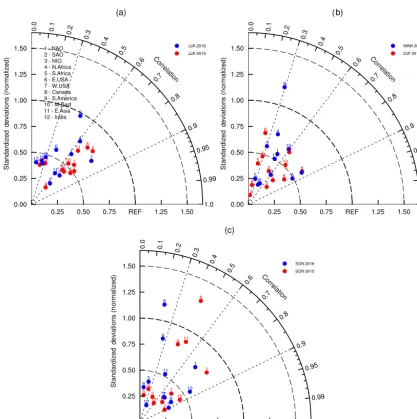
agreement of two fields, and standard deviations are normal-ized by the corresponding observations. In general, a model’s performance is better in summer months (JJA; Fig. 5a) than other seasons in terms of low variance and high correlations over most of the regions. However, in future we need a more detailed study to understand some of the interannual vari-ations shown by the model, particularly over land regions (Fig. 5).
One major difference between the model and the satel-lite data is over India, where the model has a much lower AOT in all seasons (low R and high RMSEs). The largest contribution from aerosol loading over India comes from the anthropogenic component (with the majority as sulfate, fol-lowed by OC and BC) and by dust blown from the Mid-dle East and western India during May–July. This bias in AOT by NGACv2 may be due to high aerosol scavenging by clouds and precipitation and their subsequent removal of them from the atmosphere. Also, dust blown from Middle East is underestimated by NGACv2 (Fig. 4f), contributing to lower AOT in the pre-monsoon season over India. Yoo et al. (2013) evaluated GFS forecasts against satellite obser-vations and identified large discrepancies in low cloud frac-tions over land and oceans. There could be several factors
responsible for such discrepancies, such as (a) the removal of cloud condensate water by strong vertical diffusion in the shallow convective scheme; (b) microphysical processes in-teracting with stratocumulus clouds removing cloud conden-sate water; (c) the precipitation scheme used in the model leading to large aerosol removal through wet deposition. All this could cause the low bias in AOT over India (and East Asia) as sulfate aerosols (and also 20 % BC and 50 % OC in GOCART are hydrophilic) are formed in the clouds and hy-groscopic growth is most effective in high-humidity regions near clouds.
5 Comparison with AERONET
Table 2.Locations of AERONET stations, correlations, RMSE and number of paired observations with NGACv2.
Locations Latitude, Correlation RMSE N
longitude coefficients (sample no.)
1. Dakar 14◦N, 16◦W 0.554 0.356 1430 2. Ilorin 8◦N, 4◦E 0.628 0.449 944 3. Banizoumbou 13◦N, 2◦E 0.547 0.345 1516 4. La Laguna 28◦N, 16◦W 0.686 0.204 901 5. Saada 31◦N, 8◦W 0.633 0.157 1575 6. Capo Verde 16◦N, 22◦W 0.611 0.213 1089 7. IER Cinzana 13◦N, 5◦W 0.565 0.293 1070 8. Tamanrasset 22◦N, 5◦E 0.744 0.245 1333 9. Oujda 34◦N, 1◦W 0.397 0.179 535 10. ARM-Graciosa 39◦N, 28◦W 0.544 0.064 750 11. Tizi Ouzou 36◦N, 4◦E 0.614 0.117 942 12. Ben Salem 35◦N, 9◦E 0.681 0.144 1131 13. Barcelona 41◦N, 2◦E 0.497 0.144 1123 14. Granada 37◦N, 3◦W 0.62 0.122 1602 15. Mallorca 39◦N, 2◦E 0.588 0.113 1273 16. Toulon 43◦N, 6◦E 0.401 0.172 1025 17. Cabo da Roca 38◦N, 9◦W 0.326 0.157 833 18. Sede Boker 30◦N, 34◦E 0.522 0.146 1778 19. KAUST Campus 22◦N, 39◦E 0.606 0.324 1601 20. Cape San Juan 18◦N, 65◦W 0.578 0.14 822 21. SEGC Gabon 0◦S, 11◦E 0.699 0.575 504 22. Mongu Inn 15◦S, 23◦E 0.603 0.394 984 23. ICIPE Mbita 0◦N, 34◦E 0.395 0.502 752 24. Alta Floresta 9◦S, 56◦W 0.582 0.37 926 25. Manaus 2◦S, 59◦W 0.303 0.415 769 26. Ft. McMurray 56◦N, 111◦W 0.459 0.2611 582 27. Saturn Island 48◦N, 123◦W 0.194 0.2 660 28. Bozeman 45◦N, 111◦W 0.256 0.187 799 29. Halifax 44◦N, 63◦W 0.409 0.177 955 30. Toronto 43◦N, 79◦W 0.228 0.221 1066 31. Bondville 40◦N, 88◦W 0.364 0.185 786 32. GSFC 38◦N, 76◦W 0.301 0.18 1062 33. Key Biscayne 25◦N, 80◦W 0.365 0.196 645 34. ARM-Cart site 36◦N, 97◦W 0.327 0.1588 899 35. Trinidad Head 41◦N, 124◦W 0.266 0.176 612 36. Tucson 32◦N, 110◦W 0.415 0.107 882 37. Chapais 49◦N, 74◦W 0.229 0.234 642 38. Yellowknife 62◦N, 114◦W 0.4 0.251 513 39. Sioux Falls 43◦N, 96◦W 0.422 0.212 658 40. Bonanza Creek 64◦N, 148◦W 0.593 0.276 382 41. Georgia Tech. 33◦N, 84◦W 0.372 0.175 689 42. LISCO 40◦N, 73◦W 0.315 0.144 698 43. Fresno_2 36◦N, 119◦W 0.481 0.186 680 44. Sevilleta 34◦N, 106◦W 0.392 0.054 891 45. Mexico City 19◦N, 99◦W 0.248 0.429 599 46. Mauna Loa 19◦N, 155◦W 0.053 0.073 1202 47. Kyiv 50◦N, 30◦E 0.284 0.216 1086 48. Leipzig 51◦N, 12◦E 0.233 0.182 830 49. Ascension Island 7◦S, 14◦W 0.556 0.169 1257 50. Issyk-Kul 42◦N, 78◦E 0.415 0.14 882 51. Dalanzadgad 43◦N, 104◦E 0.308 0.164 626 52. Beijing 39◦N, 116◦E 0.416 0.614 636 53. Chiayi 23◦N, 120◦E 0.165 0.699 526 54. Jaipur 26◦N, 75◦E 0.293 0.432 917 55. Karachi 24◦N, 67◦E 0.358 0.345 816 56. Hanimaadhoo 6◦N, 73◦E 0.184 0.409 995 57. Amsterdam Isld. 37◦S, 77◦E 0.284 0.111 523
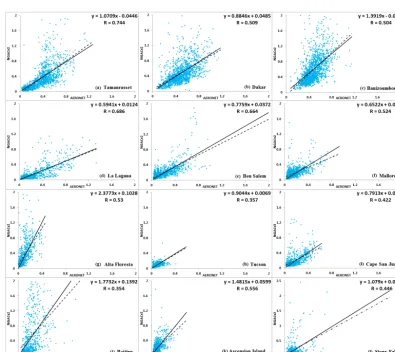
NGACv2 and AERONET. The first seven sites in Fig. 6 are located on the west coast of northern Africa and are dom-inated by dust aerosols. The model closely reproduces the observed variation (with R between 0.5 and 0.6 and low RMSE). Site 8 (Tamanrasset), located at the center of the
Sa-hara, shows very highR(0.74) because of its location in the active dust source area (maxima of the dust source function in the model) (Figs. 7a and 8a). However, the model overes-timates AOT during the low-dust AOT period (November to March) over this site, which leads to higher RMSE.
Sites 9–12 (Fig. 6 and Table 2) are located at the north-ern boundary of Africa and are influenced by dust from the Sahara: Oujda in Morocco, Graciosa Island in the Azores (in the Atlantic Ocean), Tizi Ouzou in Algeria and Ben Salem in Tunisia (Figs. 7e and 8e). These sites are located further from the Sahara (compared to the first six sites), but the transport of dust simulated by the model matches closely with observa-tions (withR ∼0.5). Aerosols at sites 13–17 in Fig. 6 con-tain dust aerosols from Africa and other aerosol types from the European landmass. All these sites are located in southern Europe (near the western part of Mediterranean Sea) and are influenced by desert dust transported from arid areas in North Africa and the advection of anthropogenic particles from the central European industrial area (Mallet et al., 2013). Ta-ble 2 and Figs. 7 and 8f suggest model AOT correlations vary between 0.32 and 0.62 at these sites, with associated low RMSE.
Sites 18 and 19 are located in the Middle East and con-sist mainly of mineral dust. NGACv2 correlates better with the King Abdullah University of Science and Technology (KAUST) campus site (located in Saudi Arabia) with a cor-relation above 0.6, but the corcor-relation decreases to 0.52 at Sede Boker, which is located further north on the Arabian Peninsula. Despite a high correlation at the KAUST campus site, the model often underestimates some of the higher AOT events at this location which gave rise to a higher RMSE (∼0.32). Sites 21–23, located in equatorial and southern Africa, are influenced mainly by biomass burning. Biomass burning activity peaks during August–September at these sites and the magnitude of the maximum AOT at the three southern African sites is underestimated by the model by a factor of almost 2 to 3 (high RMSE in Table 2), suggest-ing that the biomass burnsuggest-ing emission in the model is prob-ably low during the burning season. A similar underestima-tion of AOT is also observed over two of the South American sites (24 and 25 in Fig. 6). Model-simulated AOT correlates well (0.58) at site 24, which is largely due to the model esti-mating low AOT at these sites during the non-biomass burn-ing seasons (Figs. 7 and 8g). But the model underestimates AOT (∼3 times) between September and November when the biomass burning season prevails in Brazil.
Figure 5.Taylor diagrams for(a)JJA,(b)MAM and DJF, and(c)SON between NGACv2 and MODIS over 12 regions described in Table 1. On the Taylor diagrams, angular axes show spatial correlations between modeled and observed fields; radial axes show spatial standard deviation normalized against that of the observations. Each dot represents a region in Table 1 identified by its number on top. NAO: North Atlantic Ocean; SAO: South Atlantic Ocean; NIO: North Indian Ocean in the figure.
AOT over Fort McMurray and Yellowknife during major fire events that included May 2016 around Fort McMurray. The rest of the locations over the continental US (hereafter CONUS) show mixed results in terms ofRand RMSE (Ta-ble 2). Southwestern sites (sites 36, 43 and 44) influenced by dust in the spring and sulfate in summer showR of around 0.4 (Figs. 7 and 8h). Sites in the northern and northeastern parts of CONUS are dominated by anthropogenic pollution (sulfate) and occasional smoke from Canada in winter and spring. NGACv2 correlates reasonably well with (R∼0.35) model underestimation of sulfate aerosols in summer. Also, the model does not have nitrate aerosols from anthropogenic sources, which leads to an underestimation of AOT. Kroll and
Seinfeld (2008) have shown that anthropogenically emitted nitrogen oxides (NOx) can directly affect the formation of
secondary organic aerosols (SOAs).
Figure 6.Correlation map of total AOT at 550 nm between NGACv2 and AERONET sites. Approximate location of AERONET centers in the map represented as filled circles. Name and location of these sites are listed in Table 2.
Figure 9.Comparison of total AOD between forecasts of NGACv2 and ICAP-MME to observations of VIIRS and MODIS for selected days in July 2016. For both models, daily 6-hourly forecasts are averaged to compare them to daily satellite observations for each day. Apart from VIIRS, which is at 0.25◦resolution, all others are at 1◦. Satellite observations have data gaps, which are in white (third and fourth rows). The black dot in the first panel represents the approximate location of AERONET station Gabon.
(R∼0.3) with an underestimation of AOT in summer over Mexico City (site 45) and Kyiv (site 47). Ascension Island (site 49) is located in the remote southern Atlantic Ocean and is affected by biomass burning outflow from southern Africa (Figs. 7 and 8k). The model is able to reproduce high biomass burning events over this location as shown by a high corre-lation (R=0.55) and low RMSE (Table 2). Sea-salt aerosol is dominant over remote Amsterdam Island in the southern Indian Ocean and model correlation is low (R=0.28) at a 95 % confidence intervals but associated with low RMSE. NGACv2 shows R∼0.32 with AERONET measurements in three larger metropolitan cities (sites 52, 54 and 55 in Ta-ble 2), with an underestimation of sulfate and anthropogenic aerosols during the summer months at all three Asian loca-tions (Figs. 7 and 8i).
6 Case studies
6.1 July 2016 smoke event
Figure 10.Comparison of 550 nm AOD between NGACv2, ICAP-MME and AERONET location at Gabon for the month of July 2016. Blue line represents total AOD, green line is OC, and brown line represents BC AOD, all from NGACv2. Red asterisk symbol is for AERONET observations at that location, and black squares are ICAP-MME 6-hourly forecast. AERONET station location is marked in Fig. 9.
and northwest in the month of July. Figure 9 shows that NGACv2 captured this smoke event quite well and quali-tatively matches (in terms of location and advection) both ICAP-MME and satellite observations. The magnitude of AOT, however, is underestimated by the model compared to ground station and satellite observations (Figs. 9, 10). Smoke AOT has been added as a new capability in NGACv2 and uses different emissions than the models that are under the ICAP assembly, which independently verifies model perfor-mance.
We also looked into model AOT against one AERONET station in Central Africa (Fig. 10) during this fire event. The location of that AERONET station (station SEGC_Lope_Gabon in the AERONET database) is marked in Fig. 9. We compared total, OC and BC (only) AOT from NGACv2 to observed AOT at that station. We also added 6-hourly daily forecast of ICAP-MME for the month of July 2016 in the Fig. 10. Both model and station observations show an increase in AOT after 10 July, which continues to grow higher after 15 July until the end of the month. The majority of total AOT in Fig. 10 is contributed by biomass-burning-generated OC, with some increase in BC also ob-served. Figure 10 shows that the model AOT pattern for the month matches closely with surface observations. In terms of intensity, the majority of the reported AOT from AERONET
are higher than the model forecast, which is also due to a dif-ference in spatial resolution between the model and surface observations.
6.2 June 2015 dust event
During boreal summer, dust from the deserts of the Sahara, the largest sources of dust in the world, is transported across the Atlantic Ocean by prevailing tropical easterly winds (Karyampudi et al., 1999). According to recent satellite es-timation, each year 182 million tons of dust on average leave the western edge of Sahara, and of that 27.7 million tons falls on the surface of the Amazon basin (Yu et al., 2015). Huge plumes of Saharan dust were swept off the coast of western Sahara in the middle of June 2015 and traveled across the At-lantic Ocean to reach the southeast corner of the US (UMBC smog blog reported days of dust in the Caribbean and Gulf of Mexico at http://alg.umbc.edu/usaq/archives/2015_06.html, last access: March 2018). The actual dust storm began on 13 June when a storm system off the west coast of Africa stirred up a heavy stream of dust from Senegal, western Sa-hara and Mauritania. On 22 June, the SaSa-haran dust had trav-eled more than 5000 miles to reach southern Texas, where it contributed to moderately poor air quality. Figure 11 shows NGACv2 total AOT forecasts for the selected days of 13, 17 and 21 June. These days show the progression of dust west-ward from the African coast with high AOT above 1 over land which gradually decreases as the dust storm crosses over the ocean. ICAP, MODIS and EPS-VIIRS (all in 1◦×1◦ hor-izontal resolution) are compared to NGACv2 in Fig. 11.
Figure 11.Comparison of total AOD between forecasts of NGACv2 and ICAP-MME to observations of EPS-VIIRS and MODIS for selected days in June 2015. Satellite observations have data gaps, which are in white (third and fourth rows). All data in this figure are at 1◦resolution. Black dots in the first panel represent approximate locations of AERONET stations.
high AERONET values at these locations, but the model-simulated intensity is lower compared to the observation.
7 Summary and conclusions
This paper presents an evaluation of NOAA’s new updated aerosol forecast model NGACv2, which became operational in March 2017. The model couples NEMS GFS with NASA’s GOCART aerosol and is an in-line global aerosol fore-cast system. The model forefore-casts five species of aerosol (dust, sea salt, BC, OC and sulfate) every 3 h, twice per day (00:00 Z and 12:00 Z) and out to 5 days on a global 1◦×1◦horizontal grid. We extensively evaluated 17 months of model-simulated total AOT both temporally and spatially against satellites (MODIS, VIIRS) and multi-model ensem-ble (ICAP-MME) data. Satellite AOT retrievals inherently have greater uncertainty, which is further exacerbated by us-ing measurements from multiple satellites. The long-term MODIS AOT, on the other hand, provides a consistent mea-surement platform, and hence it is used for the validation of model results in this study. We also compared model results
with more than 50 AERONET station observations, which are spread globally and represent different aerosol regimes.
Figure 12.Comparison of 550 nm AOT between NGACv2 and four AERONET locations for the month of June 2015. The blue line represents total AOT, the green line is for dust and the brown line is for OC AOT, all from NGACv2. The red asterisk is for AERONET observations at that location. AERONET station locations are marked in Fig. 11a.
The comparisons of model forecasts with surface point lo-cations show results similar to our comparisons with MODIS in larger gridded domains. The model reproduces the sea-sonal variations at most of the sites, especially those sites on the African continent where dust and biomass plumes domi-nate. The model also captures dust and smoke outflow from Africa at AERONET locations that are present in the Atlantic Ocean (Cape Verde, Ascension Island) even though the mag-nitudes do not match with these point observations. Model AOT captures two other dust regions (the Arabian Peninsula and Asian dust near the source region) but underestimates them quantitatively as these dust plumes undergo long-range transport over Asia. The model forecasts large biomass burn-ings over Canada in both 2015 and 2016, and it agrees well with AERONET station data. However, like other aerosol forecast models, NGACv2 also produces weaker AOT sig-nals for some aerosol events and regimes. The model under-estimates AOT over the Amazon region in both years and also for the Indonesian fire event in 2015. It also underes-timates sulfate AOT over Asia, which results a large under-estimation of total AOT compared to AERONET over these locations.
The 2015 fire season in Indonesia started in July and lasted through October, with haze extending through Malaysia, Sin-gapore and Thailand, and it exposed millions of people to hazardously poor air quality (Field et al., 2016). Figure 13 shows total AOT from NGACv2, ICAP-MME and MERRA-2 forecasts compared to EPS-VIIRS observation on a sin-gle day in September 2015 over southeast Asia. Six-hourly model forecasts are averaged to get daily AOT for the mod-els. NGACv2 underestimates total AOT which is caused by low smoke emission (both OC and BC) data used by the model for this fire event. Wei et al. (2017) studied both fore-cast and analysis of MERRA-2 aerosol fields and compared this with NGACv2. That study also compared aerosol anal-ysis increments (defined as difference between analanal-ysis and model first guess) of all four cycles of MERRA-2 and found large AOT analysis increment (0.6–0.8) in the 06:00 Z DA cycle which contributed to higher AOT in MERRA-2. Thus, the underestimation of Indonesian fire by NGACv2 can be at-tributed to both near-real-time emissions and the absence of DA. Lynch et al. (2016) showed that AOT DA is as important as tuning processes of the sources and sinks of aerosols.
At present, model comparisons with satellite results can be meaningfully interpreted in regions where AOT is very high and dominated by a single aerosol (dust or smoke). In mixed aerosol regimes, particularly over land (where pol-lution, long-range transport of biomass burning or dust all contribute), the model seems to simulate an AOT lower than the observations by a factor of 2–3. We discussed some of these problems associated with the model that include the quick removal of aerosols (scavenging), the type of micro-physics scheme (creation of too few or excessive boundary layer clouds that reduce sulfate AOT generation) and lower emission factors (over South America and Asia). Our next
steps will be addressing these issues with the model and fur-ther improving overall model forecasts, with a particular fo-cus on Asia. Ongoing DA work with NGAC shows some im-provements in terms of total AOT over Asia through DA (Lu et al., 2017).
Expanding the aerosol species from dust only in NGACv1 to multispecies in NGACv2 provides a more complete global aerosol forecast using near-real-time global biomass burn-ing emission data GBBEPx. It also provides direct guid-ance on long-range aerosol transport and the impact on particulate matter over CONUS and will be used as the dynamical boundary conditions for a regional air qual-ity model like the Communqual-ity Model for Air Qualqual-ity (CMAQ) which runs as part of NOAA’s National Air Qual-ity Forecast CapabilQual-ity (Lee et al., 2017). This work pro-vides general validation results to characterize the present NGACv2 performance and identify deficiencies for fu-ture improvements. Daily NGACv2 web graphics can be viewed at http://www.emc.ncep.noaa.gov/gmb/NGAC/html/ realtime.ngac.html (last access: March 2018), and near-real-time comparisons with other models, satellites and AERONET stations are posted at http://www.emc.ncep.noaa. gov/gmb/NGAC/NGACv2 (last access: March 2018).
Code and data availability. NCEP operational products are acces-sible to general users, free of charge in real time at NOAA Op-erational Model Archive and Distribution System (NOMADS). The NCEP Central Operations (NCO) ftp site provides the source code, relevant run scripts and fixed fields files at http: //www.nco.ncep.noaa.gov/pmb/codes/nwprod/ngac.v2.3.0 (last ac-cess: March 2018). The NGACv2 output is in GRIdded Binary Version 2 (GRIB2) format on a 1◦×1◦grid, with 3-hourly out-put up to 120 h. NGACv2 products from NOMADS are available at http://nomads.ncep.noaa.gov/pub/data/nccf/com/ngac/prod (last ac-cess: March 2018). The NCAR Command Language (NCL) pro-gram is used to generate all the figures in this paper (https://www. ncl.ucar.edu/, last access: March 2018).
Competing interests. The authors declare that they have no conflict of interest.
the production of the data used in this work. The authors would like to thank the two anonymous reviewers for their valuable suggestions and comments.
Edited by: Rolf Sander
Reviewed by: two anonymous referees
References
Ben-Ami, Y., Koren, I., and Altaratz, O.: Patterns of North African dust transport over the Atlantic: winter vs. summer, based on CALIPSO first year data, Atmos. Chem. Phys., 9, 7867–7875, https://doi.org/10.5194/acp-9-7867-2009, 2009.
Benedetti, A., Morcrette, J.-J., Boucher, O., Dethof, A., Engelen, R. J., Fisher, M., Flentje, H., Huneeus, N., Jones, L., Kaiser, J. W., Kinne, S., Mangold, A., Razinger, M., Simmons, A. J., and Suttieet, M.: Aerosol analysis and forecast in the Euro-pean Centre for Medium Range Forecasts Integrated Forecast System: 2. Data assimilation, J. Geophys. Res., 114, D13205, https://doi.org/10.1029/2008JD011115, 2009.
Bhawar, R. L., Lee, W.-S., and Rahul, P. R. C.: Aerosol types and radiative forcing estimates over East Asia, Atmos. Environ., 141, 532–541, 2016.
Campbell, J. R., Tackett, J. L., Reid, J. S., Zhang, J., Curtis, C. A., Hyer, E. J., Sessions, W. R., Westphal, D. L., Prospero, J. M., Welton, E. J., Omar, A. H., Vaughan, M. A., and Winker, D. M.: Evaluating nighttime CALIOP 0.532 µm aerosol optical depth and extinction coefficient retrievals, Atmos. Meas. Tech., 5, 2143–2160, https://doi.org/10.5194/amt-5-2143-2012, 2012. Cesnulyte, V., Lindfors, A. V., Pitkänen, M. R. A., Lehtinen, K.
E. J., Morcrette, J.-J., and Arola, A.: Comparing ECMWF AOD with AERONET observations at visible and UV wavelengths, Atmos. Chem. Phys., 14, 593–608, https://doi.org/10.5194/acp-14-593-2014, 2014.
Chin, M., Ginoux, P., Kinne, S., Torres, O., Holben, B. N., Duncan, B. N., Martin, R. V., Logan, J. A., Higurashi, A., and Nakajima, T.: Tropospheric aerosol optical thickness from the GOCART model and comparisons with satellite and sunphotometer mea-surements, J. Atmos. Sci., 59, 461–483, 2002.
Chin, M., Diehl, T., Ginoux, P., and Malm, W.: Interconti-nental transport of pollution and dust aerosols: implications for regional air quality, Atmos. Chem. Phys., 7, 5501–5517, https://doi.org/10.5194/acp-7-5501-2007, 2007.
Ciren, P., Liu, H., Kondragunta, S., and Laszlo, I.: Adapting MODIS Dust Mask Algorithm toSuomi NPP VIIRS for Air Quality Ap-plications, AGU Fall Meeting Abstracts, San Francisco, 11–16 December 2012.
Colarco, P., da Silva, A., Chin, M., and Diehl, T.: Online simulations of global aerosol distributions in the NASA GEOS-4 model and comparisons to satellite and ground-based aerosol optical depth, J. Geophys. Res., 115, D14207, https://doi.org/10.1029/2009JD012820, 2010.
Darmenov, A. and Da Sila, A. M.: The Quick Fire Emissions Dataset (QFED) – Documentation of versions 2.1, 2.2 and 2.4, NASA Technical Report Series on Global Modeling and Data Assimilation, NASA/TM-2015-104606, Vol. 18, 211 pp., avail-able at: http://gmao.gsfc.nasa.gov/pubs/tm/ (last access: Novem-ber 2017), 2015.
Eck, T. F., Holben, B. N., Reid, J. S., Dubovik, O., Smirnov, A., O’Neill, N. T., Slutsker, I., and Kinne, S.: The wavelength depen-dence of the optical depth of biomass burning, urban and desert dust aerosols, J. Geophys. Res., 104, 31333–31350, 1999. Eskes, H., Huijnen, V., Arola, A., Benedictow, A., Blechschmidt,
A.-M., Botek, E., Boucher, O., Bouarar, I., Chabrillat, S., Cuevas, E., Engelen, R., Flentje, H., Gaudel, A., Griesfeller, J., Jones, L., Kapsomenakis, J., Katragkou, E., Kinne, S., Langerock, B., Razinger, M., Richter, A., Schultz, M., Schulz, M., Su-darchikova, N., Thouret, V., Vrekoussis, M., Wagner, A., and Zerefos, C.: Validation of reactive gases and aerosols in the MACC global analysis and forecast system, Geosci. Model Dev., 8, 3523–3543, https://doi.org/10.5194/gmd-8-3523-2015, 2015. Field, R. D., van der Werf, G. R., Fanin, T., Fetzer, E. J., Fuller, R.,
Jethva, H., Levy, R., Livesey, N. J., Luo, M., Torres, O., and Wor-den, H. M.: Indonesian fire activity and smoke pollution in 2015 show persistent nonlinear sensitivity to El-Nino induced drought, P. Natl. Acad. Sci. USA, 113, 9204–9209, 2016.
Fordham, D. A., Wigley, T. M., Watts, M. J., and Brook, B. W.: Strengthening forecasts of climate change impacts with multi-model ensemble averaged projections using MAG-ICC/SCENGEN 5.3, Ecography, 35, 4–8, 2012.
Forster, P., Ramaswamy, V., Artaxo, P., Berntsen, T., Betts, R., Fa-hey, D. W., Haywood, J., Lean, J., Lowe, D. C., Myhre, G., Nganga, J., Prinn, R., Raga, G., Schultz, M., and Van Dorland, R.: Changes in Atmospheric Constituents and in Radiative Forc-ing, in: Climate Change 2007: The Physical Science Basis. Con-tribution of Working Group I to the Fourth Assessment Report of the Intergovernmental Panel on Climate Change, edited by: Solomon, S., Qin, D., Manning, M., Chen, Z., Marquis, M., Av-eryt, K. B., Tignor, M., and Miller, H. L., Cambridge University Press, Cambridge, United Kingdom and New York, NY, USA, 2007.
Gelaro, R., McCarty, W., Suárez, M. J., Todling, R., Molod, A., Takacs, L., Randles, C. A., Darmenov, A., Bosilovich, M. G., Re-ichle, R., Wargan, K., Coy, L., Cullather, R., Draper, C., Akella, S., Buchard, V., Conaty, A., da Silva, A. M., Gu, W., Kim, G., Koster, R., Lucchesi, D. Merkova, J. E., Nielsen, G. Partyka, G., Pawson, S., Putman, W., Rienecker, M., Schubert, S. D., Sienkiewicz, M., and Zhao, B.: The Modern-Era Retrospective Analysis for Research and Applications, Version 2 (MERRA-2), J. Climate, 30, 5419–5454, https://doi.org/10.1175/JCLI-D-16-0758.1, 2017.
Generoso, S., Bréon, F.-M., Balkanski, Y., Boucher, O., and Schulz, M.: Improving the seasonal cycle and interannual variations of biomass burning aerosol sources, Atmos. Chem. Phys., 3, 1211– 1222, https://doi.org/10.5194/acp-3-1211-2003, 2003.
Ghan, S. J., Liu, X., Easter, R. C., Zaveri, R., Rasch, P. J., Yoon, J., and Eaton, B.: Toward a minimal representation of aerosols in climate models: Comparative decomposition of aerosol direct, semidirect and indirect radiative forcing, J. Climate, 25, 6461– 6476, 2012.
Ginoux, P., Chin, M., Tegen, I., Prospero, J. M., Holben, B., Dubovik, O., and Lin, S.-J.: Sources and global distributions of dust aerosols simulated with the GOCART model, J. Geophys. Res., 106, 20255–20273, 2001.
Haywood, J. and Boucher, O.: Estimates of the direct and indirect radiative forcing due to tropospheric aerosols: A review, Rev. Geophys., 38, 513–543, https://doi.org/10.1029/1999RG000078, 2000.
Haywood, J. M., Allan, R. P., Culverwell, I., Slingo, T., Mil-ton, S., Edwards, J., and Clerbaux, N.: Can desert dust ex-plain the outgoing longwave radiation anomaly over the Sa-hara during July 2003?, J. Geophys. Res., 110, D05105, https://doi.org/10.1029/2004JD005232, 2005.
Holben, B. N., Eck, T. F., Slutsker, I., Tanré, D., Buis, J. P., Set-zer, A., Vermote, E., Reagan, J. A., Kaufman, Y. J., Nakajima, T., Lavenu, F., Jankowiak, I., and Smirnov, A.: AERONET – A Federated instrument network and data archive for aerosol char-acterization, Remote Sens. Environ., 66, 1–16, 1998.
Hsu, N. C., Jeong, M.-J., Bettenhausen, C., Sayer, A. M., Hansell, R., Seftor, C. S., Huang, J., and Tsay, S.-C.: En-hanced Deep Blue aerosol retrieval algorithm: The sec-ond generation, J. Geophys. Res.-Atmos., 118, 9296–9315, https://doi.org/10.1002/jgrd.50712, 2013.
Jackson, J., Liu, H., Laszlo, I., Kondragunta, S., Remer, L. A., Huang, J., and Huang, H.-C.: Suomi-NPP VIIRS Aerosol Algo-rithms and Data Products, J. Geophys. Res., 118, 12673–12689, https://doi.org/10.1002/2013jd020449, 2013.
Karyampudi, V.: Validation of the Saharan dust plume conceptual model using Lidar, Meteosat, and ECMWF Data, B. Am. Mete-orol. Soc., 80, 1045–1075, 1999.
Kaufman, Y. J., Koren, I., Remer, L. A., Tanré, D., Ginoux, P., and Fan, S.: Dust transport and deposition observed from the Terra-Moderate Resolution Imaging Spectroradiometer (MODIS) spacecraft ovet the Atlantic Ocean, J. Geophs. Res., 110, D10S12, https://doi.org/10.1029/2003JD004436, 2005. Kedia, S., Ramachandran, S., Holben, B. N., and Tripathi, S. N.:
Quantification of aerosol type, and sources of aerosols over the Indo-Gangetic Plain, Atmos. Environ., 98, 607–619, 2014. Kroll, J. H. and Seinfeld, J. H.: Chemistry of secondary organic
aerosol: formation and evolution of low-volatility organics in the atmosphere, Atmos. Environ., 42, 3293–3624, 2008.
Laszlo, I. and Liu, H.: EPS Aerosol Optical Depth (AOD) Al-gorithm Theoretical Basis Document, VIIRS ATBD, JPSS in-ternal note, available at: https://www.star.nesdis.noaa.gov/jpss/ documents/ATBD/ATBD_EPS_Aerosol_AOD_v3.0.1.pdf (last access: March 2018), 2016.
Levy, R. C., Mattoo, S., Munchak, L. A., Remer, L. A., Sayer, A. M., Patadia, F., and Hsu, N. C.: The Collection 6 MODIS aerosol products over land and ocean, Atmos. Meas. Tech., 6, 2989– 3034, https://doi.org/10.5194/amt-6-2989-2013, 2013.
Lee, P., McQueen, J., Stajner, I., Huang, J., Pan, L., Tong, D., Kim, H., Tang, Y., Kondragunta, S., Ruminski, M., Lu, S., Rogers, E., Saylor, R., Shafran, P., Huang, H., Gorline, J., Upadhayay, S., and Artz, R.: NAQFC developmental forecast guidance for Fine particulate matter (PM2.5), Weather Forecast., 32, 407–421, 2017.
Liu, H., Remer, L. A., Huang, J., Huang, H.-C., Kondragunta, S., Laszlo, I., Oo, M., and Jackson, J. M.: Preliminary Evaluation of Suomi-NPP VIIRS Aerosol Optical Thickness, J. Geophys. Res., 119, 3942–3962, https://doi.org/10.1002/2013jd020360, 2013. Lohmann, U. and Feichter, J.: Global indirect aerosol
ef-fects: a review, Atmos. Chem. Phys., 5, 715–737, https://doi.org/10.5194/acp-5-715-2005, 2005.
Lu, C.-H., da Silva, A., Wang, J., Moorthi, S., Chin, M., Colarco, P., Tang, Y., Bhattacharjee, P. S., Chen, S.-P., Chuang, H.-Y., Juang, H.-M. H., McQueen, J., and Iredell, M.: The implementation of NEMS GFS Aerosol Component (NGAC) Version 1.0 for global dust forecasting at NOAA/NCEP, Geosci. Model Dev., 9, 1905– 1919, https://doi.org/10.5194/gmd-9-1905-2016, 2016.
Lu, C.-H., Wei, S.-W., Zhang, X., Kondragunta, S., Chen, S.-P., Zhao, Q., Wang, J., Bhattacharjee, P., and McQueen, J. T.: The utilization of satellite observations for improving Global aerosol forecasting, Asia Oceania Geosc. Soc. Conference, Singapore, 11 August 2017.
Lynch, P., Reid, J. S., Westphal, D. L., Zhang, J., Hogan, T. F., Hyer, E. J., Curtis, C. A., Hegg, D. A., Shi, Y., Campbell, J. R., Rubin, J. I., Sessions, W. R., Turk, F. J., and Walker, A. L.: An 11-year global gridded aerosol optical thickness reanalysis (v1.0) for at-mospheric and climate sciences, Geosci. Model Dev., 9, 1489– 1522, https://doi.org/10.5194/gmd-9-1489-2016, 2016.
Mallet, M., Dubovik, O., Nabat, P., Dulac, F., Kahn, R., Sciare, J., Paronis, D., and Léon, J. F.: Absorption properties of Mediter-ranean aerosols obtained from multi-year ground-based remote sensing observations, Atmos. Chem. Phys., 13, 9195–9210, https://doi.org/10.5194/acp-13-9195-2013, 2013.
Mangold, A., De Backer, H., De Paepe, B., Dewitte, S., Chiapello, I., Derimian, Y., Kacenelenbogen, M., Léon, J.-F., Huneeus, N., Schulz, M., Ceburnis, D., O’Dowd, C., Flentje, H., Kinne, S., Benedetti, A., Morcrette, J.-J., and Boucher, O.: Aerosol anal-ysis and forecast in the European Centre for Medium Range Weather Forecasts Integrated Forecast System: 3. Evaluation by means of case studies, J. Geophys. Res., 116, D03302, https://doi.org/10.1029/2010JD014864, 2011.
Menon, S., Hansen, J., Nazarenko, L., and Luo, Y.: Climate effects of black carbon aerosols in China and India, Science, 297, 2250– 2253, https://doi.org/10.1126/science.1075159, 2002.
Meehl, G. A., Covey, C., Delworth, T., Latif, M., McAvaney, B., Mitchell, J. F., Stouffer, R. J., and Taylor, K. E.: The WCRP CMIP3 multimodel dataset – A new era in climate change re-search, B. Am. Meteorol. Soc, 88, 1383–1394, 2007.
Morcrette, J.-J., Boucher, O., Jones, L., Salmond, D., Bechtold, P., Beljaars, A., Benedetti, A., Bonet, A., Kaiser, J. W., Razinger, M., Schulz, M., Serrar, S., Simmons, A. J., Sofiev, M., Suttie, M., Tompkins, A. M., and Untch, A.: Aerosol analysis and fore-cast in the European centre for medium-range weather forefore-casts integrated forecast system: forward modeling, J. Geophys. Res., 114, D06206, https://doi.org/10.1029/2008JD011235, 2009. Mulcahy, J. P., Walters, D. N., Bellouin, N., and Milton, S.
F.: Impacts of increasing the aerosol complexity in the Met Office global numerical weather prediction model, Atmos. Chem. Phys., 14, 4749–4778, https://doi.org/10.5194/acp-14-4749-2014, 2014.
integrated analysis of the climate forcing and effects of the great Indo-Asian haze, J. Geophys. Res., 106, 28371–28398, https://doi.org/10.1029/2001JD900133, 2001.
Rappold, A. G., Stone, S. L., Cascio, W. E., Neas, L. M., Kilaru, V. J., Carraway, M. S., Szykman, J. J., Ising, A., Cleve, W. E., Meredith, J. T., Vaughan-Batten, H., Deyneka, L., and Devlin, R. B.: Peat bog wildfire smoke exposure in rural North Carolina is associated with cardiopulmonary emergency department visits assessed through syndromic surveillance, Environ. Health Persp., 119, 1415–1420, 2011.
Reid, J., Benedetti, A., Colarco, P. R., and Hansen, J. A.: International operational aerosol observability work-shop, B. Am. Meteorol. Soc., 92, ES21–ES24, https://doi.org/10.1175/2010BAMS3183.1, 2011.
Sayer, A. M., Hsu, N. C., Bettenhausen, C., and Jeong, M.-J.: Vali-dation and uncertainty estimates for MODIS Collection 6 “Deep Blue” aerosol data, J. Geophys. Res.-Atmos., 118, 7864–7872, https://doi.org/10.1002/jgrd.50600, 2013.
Sayer, A. M., L. A. Munchak, N. C. Hsu, R. C. Levy, C. Bet-tenhausen, and M.-J. Jeong: MODIS Collection 6 aerosol prod-ucts: Comparison between Aqua’s e-Deep blue, dark target and “merged” data sets and usage recommendations, J. Geophys. Res.-Atmos., 119, 13965–989, 2014.
Sekiyama, T. T., Tanaka, T. Y., Shimizu, A., and Miyoshi, T.: Data assimilation of CALIPSO aerosol observations, Atmos. Chem. Phys., 10, 39–49, https://doi.org/10.5194/acp-10-39-2010, 2010. Sessions, W. R., Reid, J. S., Benedetti, A., Colarco, P. R., da Silva, A., Lu, S., Sekiyama, T., Tanaka, T. Y., Baldasano, J. M., Basart, S., Brooks, M. E., Eck, T. F., Iredell, M., Hansen, J. A., Jorba, O. C., Juang, H.-M. H., Lynch, P., Morcrette, J.-J., Moorthi, S., Mulcahy, J., Pradhan, Y., Razinger, M., Sampson, C. B., Wang, J., and Westphal, D. L.: Development towards a global oper-ational aerosol consensus: basic climatological characteristics of the International Cooperative for Aerosol Prediction Multi-Model Ensemble (ICAP-MME), Atmos. Chem. Phys., 15, 335– 362, https://doi.org/10.5194/acp-15-335-2015, 2015.
Shalaby, A., Rappenglueck, B., and Eltahir, E. A. B.: The clima-tology of dust aerosol over the arabian peninsula, Atmos. Chem. Phys. Discuss., 15, 1523–1571, https://doi.org/10.5194/acpd-15-1523-2015, 2015.
Smirnov, A., Holben, B. N., Eck, T. F., Dubovik, O., and Slutsker, I.: Cloud Screening and quality control algorithms for the AERONET database, Remote Sens. Environ., 73, 337–349, 2000.
Takemura, T., Okamoto, H., Maruyama, Y., Numaguti, A., Hig-urashi, A., and Nakajima, T.: Global three-dimensional simula-tion of aerosol optical thickness distribusimula-tion of various origins, J. Geophys. Res., 105, 17853–17873, 2000.
Tanaka, T. Y., Orito, K., Sekiyama, T. T., Shibata, K., Chiba, M., and Tanaka, H.: MASINGAR, a global tropospheric aerosol chemi-cal transport model coupled with MRI/JMA98 GCM: model de-scription, Pap. Meteorol. Geophys., 53, 119–138, 2003.
Taylor, K. E.: Summarizing multiple aspects of model perfor-mance in a single diagram, J. Geophys. Res., 106, 7183–7192, https://doi.org/10.1029/2000JD900719, 2001.
Wang, J., Bhattacharjee, P. S., Tallapragada, V., Lu, C.-H., Kondra-gunta, S., da Silva, A., Zhang, X., Chen, S.-P., Wei, S.-W., Dar-menov, A. S., McQueen, J., Lee, P., Koner, P., and Harris, A.: The implementation of NEMS GFS Aerosol Component (NGAC) Version 2.0 for global multispecies forecasting at NOAA/NCEP – Part 1: Model descriptions, Geosci. Model Dev., 11, 2315– 2332, https://doi.org/10.5194/gmd-11-2315-2018, 2018. Wei, S.-W., Zhao, Q., Chen, S. P., Wang, J., Bhattacharjee, P. S.,
Kondragunta, S., McQueen, J.., and Lu, S.: Improving NCEP global aerosol forecasts by data assimilation of VIIRS aerosol products, Fifth AMS Symposium on the Joint Center for Satel-lite Data Assimilation, Seattle, WA, USA, 23–26 January 2017, American Meteorological Society, 2017.
Westphal, D. L., Curtis, C. A., Liu, M., and Walker, A. L.: Opera-tional aerosol and dust storm forecasting, in: WMO/GEO expert meeting on an international sand and dust storm warning sys-tem, IOP conference series: Earth and Environmental Science, 7, 012007, https://doi.org/10.1088/1755-1307/7/1/012007, 2009. Yoo, H., Li, Z., Hou, Y.-T., Lord, S., Weng, F., and Barker, H. W.:
Diagnosis and testing of low-level cloud parameterizations for the NCEP/GFS model using satellite and ground-based measure-ments, Clim. Dynam., 41, 1595–1613, 2013.
Yu, H., Chin, M., Yuan, T., Bian, H., Remer, L. A., Prospero, J. M., Omar, A., Winker, D., Yang, Y., Zhang, Y., Zhang, Z., and Zhao, C.: The fertilizing role of African dust in the Amazon rainforest: A first multiyear assessment based on data from Cloud-Aerosol Lidar and Infrared Pathfinder Satellite Observations, Geophys. Res. Lett., 42, 1984–1991, https://doi.org/10.1002/2015GL063040, 2015.
Zhang, J., Reid, J. S., Westphal, D. L., Baker, N. L., and Hyer, E. J.: A system for operational aerosol optical depth data as-similation over global oceans, J. Geophys. Res., 113, D10208, https://doi.org/10.1029/2007JD009065, 2008.
Zhang, X., Kondragunta, S., Ram, J., Schmidt, C., and Huang, H.-C.: Near-real-time global biomass burning emissions product from geostationary satellite constellation, J. Geophys. Res., 117, D14201, https://doi.org/10.1029/2012JD017459, 2012. Zhao, T. X., Stowe, L. L., Smirnov, A., Crosby, D., Sapper, J., and