R E S E A R C H
Open Access
Accelerometry-enabled measurement
of walking performance with a robotic
exoskeleton: a pilot study
Luca Lonini
1,2, Nicholas Shawen
1, Kathleen Scanlan
1, William Z. Rymer
3, Konrad P. Kording
2,3and Arun Jayaraman
1,2*Abstract
Background:Clinical scores for evaluating walking skills with lower limb exoskeletons are often based on a single variable, such as distance walked or speed, even in cases where a host of features are measured. We investigated how to combine multiple features such that the resulting score has high discriminatory power, in particular with few patients. A new score is introduced that allows quantifying the walking ability of patients with spinal cord injury when using a powered exoskeleton.
Methods:Four spinal cord injury patients were trained to walk over ground with the ReWalk™exoskeleton. Body accelerations during use of the device were recorded by a wearable accelerometer and 4 features to evaluate walking skills were computed. The new score is the Gaussian naïve Bayes surprise, which evaluates patients relative to the features’distribution measured in 7 expert users of the ReWalk™. We compared our score based on all the features with a standard outcome measure, which is based on number of steps only.
Results:All 4 patients improved over the course of training, as their scores trended towards the expert users’scores. The combined score (Gaussian naïve surprise) was considerably more discriminative than the one using only walked distance (steps). At the end of training, 3 out of 4 patients were significantly different from the experts, according to the combined score (p< .001, Wilcoxon Signed-Rank Test). In contrast, all but one patient were scored as experts when number of steps was the only feature.
Conclusion:Integrating multiple features could provide a more robust metric to measure patients’skills while they learn to walk with a robotic exoskeleton. Testing this approach with other features and more subjects remains as future work.
Keywords: Spinal cord injury (SCI), Lower limb exoskeleton, Outcome measure, Walking skills, Paraplegia,
Wearable accelerometer, Naive Bayes
Background
Clinical scores of walking ability are crucial in many areas of physical rehabilitation to assess the efficacy of a therapeutic intervention or an assistive device, as well as to discriminate the ability between different patients [1, 2]. One domain of interest is evaluating
functional ambulation in individuals who suffered a spinal cord injury (SCI). Even though many outcome measures target the SCI population [3, 4], currently there exist no specific measures targeting the ability of a patient to use a lower limb robotic exoskeleton to walk overground and achieve functional ambulation.
Lower limb exoskeletons are bilateral powered orth-oses designed to provide assistance for sit-to-stand and for walking and, in some cases, to assist lower extremity function in individuals with incomplete or complete SCI [5–8]. Currently, several exoskeletons are transitioning from purely research and rehabilitation devices to * Correspondence:[email protected]
1Max Nader Lab for Rehabilitation Technologies and Outcomes Research, Rehabilitation Institute of Chicago, 345 E Superior St, Chicago, IL 60611, USA 2Department of Physical Medicine and Rehabilitation, Northwestern University, Chicago, IL 60611, USA
Full list of author information is available at the end of the article
personal mobility systems that individuals with SCI could use to walk inside their home and in their communities [9, 10]. A paradigmatic case is the ReWalk™, which has been approved by the Food and Drug Administration to be sold to individuals with SCI as a take-home personal mobility device.
Quantitative clinical assessment of exoskeletons is fun-damental to evaluate their safety and effectiveness when used by individuals with disabilities. Specifically, individ-uals with complete SCI, who aim at taking an exoskel-eton home as a personal mobility device, require an intensive training protocol to become independent users. Such training is typically delivered in a clinical setting and therefore clinicians need a robust metric to evaluate if a patient has reached a level of ability and expertise to independently use the device at home and in the com-munity. Obtaining a robust index of the patients’ walk-ing skills with an exoskeleton could also be used to inform health insurance companies about the actual improvements in functional mobility for potential reim-bursement. This point is crucial as the cost of these devices is extremely high and therefore any support funding has to be justified.
The primary clinical outcome measures currently used to assess functional ambulation with exoskeletons are the 6-Minute-Walk-Test (6MWT) and the Ten-Meter-Walk-Test (10mWT) [11, 12]. These two tests measure, respectively, the distance walked in six minutes and the time to walk over a distance of 10 m, while walking at a constant speed. Despite being validated in spinal cord injury populations [13], it is questionable whether these measures are sufficient to fully evaluate a patient skill and the device efficiency. Indeed, other studies have measured additional features to characterize walking skills with robotic exoskeletons.
Specifically, amongst the features quantified there are: the kinematics of the hip, knee and ankle joints in patients trained to use the ReWalk™[14], as recorded via a motion capture system; the exertion level based on the heart rate normalized to the walking speed (i.e. physiological cost index) [15] and the oxygen uptake [16, 17]. Other metrics used include the variation in vertical and lateral amplitude of the head motion [18], ground reaction forces analysis [19] and the ability to maintain eye contact to assess cog-nitive effort [20]. Even when multiple features were mea-sured, each study reports the values of each feature individually to characterize functional ambulation with exoskeletons. Therefore it is unclear how each feature contributes to the overall expertise of a subject. Further-more, some of the captured features require complex and expensive lab equipment, commonly seen only in large hospitals and university settings.
In the current study, we propose to combine multiple features of walking performance by estimating their
probability distribution over a set of expert users who have been previously trained extensively to use the exo-skeleton. New participants are then scored based on how well their features fit the experts’probability distri-bution. Building on this principle, we define a new score to quantify walking ability with exoskeletons: the Gauss-ian Naïve Bayes surprise. The term surprise is derived from information theory and represents the amount of unexpected information provided by an event [21]. We apply our score to quantify the walking skills of four in-dividuals with complete SCI, as they are trained to use the ReWalk™ exoskeleton. Four features are computed from the trunk accelerations, which are recorded using a commercial wearable accelerometer while subjects per-form a 6MWT with the exoskeleton. We estimate the parameters of the features probability distribution from seven expert subjects (1 SCI and 6 able-bodied) that received extensive prior training with the device, and compute the Gaussian naïve Bayes surprise of the four SCI participants with respect to the experts. The score based on all four features is compared with one based only on number of steps (an equivalent of distance walked), in terms of the separation between experts and patients that is yielded by the two indices.
Methods
The ReWalk™exoskeleton
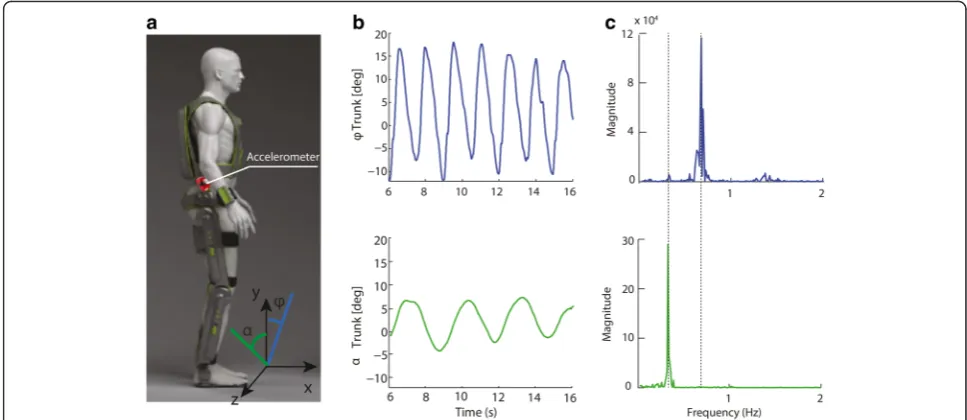
The ReWalk™(ReWalk Robotics Inc., Marlborough, MA, USA) is a motorized lower limb exoskeleton suit de-signed to provide legged mobility to paraplegic patients who suffered a spinal cord injury from level T4 to L5. The device has two actuated degrees of freedom - one at the hip and one at the knee on each side – and has a passive spring-assisted dorsiflexion joint at the ankle. Figure 1a shows a schematic of the device.
The robotic suit is attached to the subject’s waist and legs by means of Velcro straps. A backpack worn by the subject contains the batteries and the controller of the device. A wristwatch connects wirelessly to the control-ler and is used to switch between five activity modes (sit, standup, walk, upstairs, downstairs).
Once in walking mode, the user triggers each step by leaning his/her body forward: a tilt sensor located on the left flank detects when the trunk angle exceeds a prede-fined threshold (8° in our case) and the robot executes a pre-programmed step. Crutches are used to stabilize the body. The robot kinematics, including the joints range of motion and stepping speed, can be personalized with the accompanying software.
Study design
of expert subjects (5 F, 6 M; ages: 36.9 ± 14 years). The remaining four SCI individuals were new to the device and were trained at the Rehabilitation Institute of Chicago under the supervision of a physical therapist over a period from 6 to 12 weeks. Demographic data of these subjects is reported in Table 1. All subjects were consented and Northwestern University’s Institutional Review Board approved the study.
An able-bodied expert walker was defined as one who could walk continuously for 30 min, receiving at most contact guard assistance (CGA) for safety reasons. A maximum of 3 breaks during the 30 min walking period were allowed, each resting period lasting up to a max-imum of 2 min each. Subjects had to walk for at least 6 min continuously before any break could be taken. The six able-bodied subjects were trained over multiple sessions until they met this goal.
The SCI expert was a person with over 500 h of walk-ing experience with the exoskeleton. This person has been used by ReWalk™ Robotics to act as their demo
performer at numerous health conferences with the exo-skeleton. The SCI expert also owns a take-home device which she uses regularly for personal mobility. Following training and a warm-up phase, subjects underwent two 6MWT spaced from each other by at least 1 min. During each 6MWT, participants walked across a 30 m straight hallway, turning at each end to reverse the direction of walking. The ReWalk™gait settings were the same across all expert users and are reported in Table 2.
The four novice participants were trained three times per week for 12 weeks, except for one patient (R10) who was trained for only 6 weeks due to an incompatibility with his work schedule. Each training session consisted of about an hour of walking with the exoskeleton, with the first 1–3 sessions focused primarily on static stand-ing balance trainstand-ing and weight shifts in the ReWalk using the forearm crutches. The initial balance training sessions helps the participant learn on how to balance with the device in an upright position prior to walking initiation. Specific to the study a 6MWT was performed in the middle of each training session. The level of assistance (LOA) was kept at the minimum safe level for all patients during each 6MWT and varied depending on the skill achieved by the subject. Assistance was pro-vided only to prevent falls and not to sustain walking and therefore should not bias the features during the test. The LOA for all subjects was either CGA or super-vision at the end of training. The ReWalk™ settings changed across subjects and training sessions, and were chosen by the therapist according to the patients’skills.
Fig. 1ReWalk™exoskeleton and measured trunk angles.aSchematic of the ReWalk™exoskeleton suit. The tri-axial wearable accelerometer attached on the right flank of the robot recorded the body accelerations while the subject walked with the device. Features to score walking quality were computed from the accelerations (see text).bThe trunk angles in the frontal (x-y) and lateral (y-z) plane during walking (φ, frontal, blue line;α, lateral, green line).cThe power spectral density plots of the trunk angles: the x-value of each maximum corresponds to the frequency of the oscillations in the plane. The step frequency corresponds to the maximum in the x-y plane
Table 1Demographic data of the four ASIA AIS A SCI participants
Subject ID Age/Sex Level of Injury Time since injury Injury cause
R09 23/M T8 1 yr. 7 mo. Gun-shot
wound
R10 63/M T10 7 yr. 7 mo Ski accident
R11 33/F T9 2 yr. 11 mo. Gun-shot
wound
R15 29/M T10 10 mo. Motor-cycle
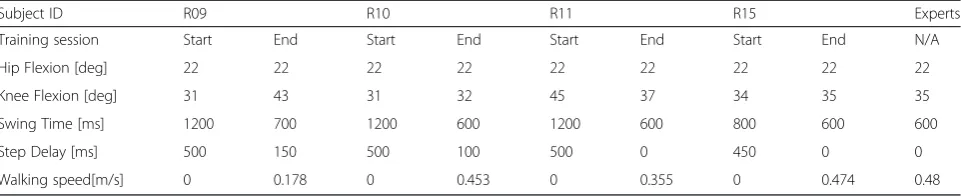
At the end of training, all settings were chosen to be the closest match to the experts’ settings. The values used and the speeds achieved during a 10mWT at the begin-ning and end of traibegin-ning are reported in Table 2.
Accelerations during each 6MWT were recorded with a tri-axial wearable accelerometer (Actigraph, Florida, USA) placed on the exoskeleton in mid-sagittal position 20 cm above the hip joint, on the right side (Fig. 1a). The spot was chosen to detect the trunk motions that the subjects used to trigger the steps. Data was recorded on the device onboard memory (1 GB) at a sampling frequency of 100 Hz. Missing data from some of the patients’sessions was due to either missed recordings or inability of the patient to complete the 6MWT.
Walking quality features
Acceleration data corresponding to walking was visually identified and manually extracted from each recorded session. An uninterrupted period of walking in a training session is denoted as an “acceleration clip”; therefore data from each session consists of multiple clips. We excluded clips shorter than 4 s, such that each clip con-tains at least 400 samples.
The following 4 features (x1…x4) were computed from the acceleration clips to evaluate walking quality for each minute of walking in a 6MWT.
Step frequency (x1)
Each step is triggered by a motion of the trunk in the frontal (x-y) plane, followed by a lateral motion in the planey-z(see Fig.1a), which is used to offload the swing-ing leg and allow clearance of the foot. These two oscil-latory movements in orthogonal planes were estimated by low-pass filtering the acceleration measured in each plane with a second-order Butterworth filter (1.5 Hz cut-off frequency):
φ¼ tan−1 ax
ay ; α
¼ tan−1 az
ay
ð1Þ
with φ and α being, respectively, the frontal and
lat-eral instantaneous angle. This approximation is valid
when the body accelerations are small compared to gravity [22, 23].
During walking, the motions in the two planes are periodic, with the frequency of the frontal angle φ (pitch) being twice that of the lateral angle α (roll) (Fig. 1b). We verify this condition by computing the power spectral density (PSD) of the trunk angle in each plane (Fig. 1c). This condition ensures that the accelerations in the clip correspond to actual walk-ing. Since one period of an oscillation in the frontal plane corresponds to a step, we estimate the step frequency x1 as:
x1¼argmaxfðPSDð Þφ Þ; ðf >0Þ ð2Þ
wherefis the frequency in Hz.
Standard deviation of the frontal angle (x2)
We hypothesized that increased training with the de-vice will lead to smaller body motions that are reflected in a lower standard deviation of the trunk frontal angle (pitch).
x2¼
ffiffiffiffiffiffiffiffiffiffiffiffiffiffiffiffiffiffiffiffiffiffiffiffiffiffiffiffiffiffiffiffiffiffi
1
M−1
XM
t¼1
φt−φ
ð Þ2
v u u
t ð3Þ
whereφ is the mean value andMis the number of
sam-ples in the clip.
Approximated energy expenditure (x3)
A quantity that correlates with energy expenditure (E) during walking was computed by summing the abso-lute values of the accelerations and integrating them over a time interval (epoch), after gravity was re-moved with a high-pass filter (Butterworth 2nd order, cut-off frequency 0.25 Hz).
Ek ¼
Z tkþ1
tk
axð Þt
j j þayð Þt þjazð Þt j
dt ð4Þ
where the subscript k indicates the k-th epoch and the epoch length ([tk,tk+ 1]) is set to 0.5 s. The unit of
meas-urement of E is commonly known as “acceleration
counts” or “counts” and it measures the movement
Table 2ReWalk™settings and walking speed at the beginning and end of training for all participants
Subject ID R09 R10 R11 R15 Experts
Training session Start End Start End Start End Start End N/A
Hip Flexion [deg] 22 22 22 22 22 22 22 22 22
Knee Flexion [deg] 31 43 31 32 45 37 34 35 35
Swing Time [ms] 1200 700 1200 600 1200 600 800 600 600
Step Delay [ms] 500 150 500 100 500 0 450 0 0
intensity over the 3 axes. Although the correlation with energy expenditure has only been verified in free walking
subjects [24], we believe this is still a reasonable
assump-tion in our setup.
Counts are normalized by the number of steps taken by the subject in the acceleration clip, yielding the energy expenditure (counts) per step:
x3¼
X
kEk
Nsteps ð5Þ
Number of steps (x4)
Number of steps is used in place of distance walked to ensure that the feature is independent of the step length, which varies amongst subjects. For each walking clip in a given session, the number of steps was computed from the step frequency and the duration of the clip Tc. This
feature characterizes the ability of taking multiple consecutive steps.
x4¼x1;cTc ð6Þ
where the subscriptcrefers to the indexed clip.
We compute a feature vector x= (x1,…,x4)T for every minute of a 6MWT; if multiple clips (walking bouts) are present within the minute window, the values of the features are averaged across clips, with
the exception of number of steps, which was
summed.
Gaussian naïve Bayes surprise
Our goal is to score a patient’s skill at walking with the exoskeleton relative to a trained expert user, according to the values of the features. We start by estimating the probability distribution of the features across the expert subjects and then measure the likelihood of a patient being an expert user.
A simple yet effective approach in many cases is to as-sume that the features are conditionally independent, which is also known as the naïve Bayes assumption [25]. If the features are normally distributed, the joint prob-ability distribution of the features over the expert subjects is:
p x1;…;x4jμi;H;σ2i;H
¼Y4
i¼1
p xijμi;H;σ2i;H
¼Y4
i¼1
1
ffiffiffiffiffiffiffiffiffiffiffiffiffi
2πσ2 i;H
q e
−ðxi−μi;HÞ2
2σ2
i;H ð7Þ
where xi indicates the i-th feature value for a subject,
and μi,H and σi,H are, respectively, the mean and
stand-ard deviation of that feature across the expert subjects.
By taking the negative natural logarithm of (7) we ob-tain the Gaussian naïve Bayes surpriseΨ:
Ψ¼−lnp
¼−X4
i¼1
1
2ln 2πσ
2 i;H
þ xi−μi;H
2
2σ2 i;H 0
B @
1 C
A ð8Þ
We can interpret (8) as the log probability of a subject being expert, under the assumption of independence of the features. In our model, the farther the feature values of a subject from the mean values of expert subjects, the larger the surprise. Importantly, each feature in (8) is weighted by the inverse of its variance: thus, features with lower variance across expert subjects are weighed more, as they are considered more reliable for quantify-ing walkquantify-ing skills.
In order to normalize the values ofΨ, we compute the z-score of the Gaussian naïve Bayes surprise with respect to its distribution across the expert subjectsΨh:
ZΨ¼Ψσ−Ψh
Ψh
ð9Þ
where Ψ is the Gaussian naïve Bayes surprise for a
given subject, and Ψh and σΨh are, respectively, the
mean and the standard deviation of the distribution
Ψh (i.e. the surprise across expert subjects). This
dis-tribution is estimated by a leave-one-subject-out cross validation, such that each expert subject is scored
relative to all the others. Thus, the z-score for the j
-th expert subject is:
ZΨh;j ¼
Ψj−Ψh jf g σΨh jf g
j¼1;…;S
ð Þ ð10Þ
where Sis the number of expert subjects and the
nota-tion h\{j} indicates that the value is computed over all
the subjects except subjectj.
The z-score ZΨ (9) indicates by how many standard
deviations a subject’s performance is above or below the mean performance of the experts. If a subject’s z-score is within ±2, we consider the subject’s walking skills are not significantly different from that of an expert user.
We evaluate the discriminatory power of the index at separating new users from experts by comparing the score values whenZΨis computed using all the features
Ψ¼1
2 log 2πσ
2 4
þðx4−μ4Þ 2
2σ2 4
ð11Þ
Results
Expert subjects’scores
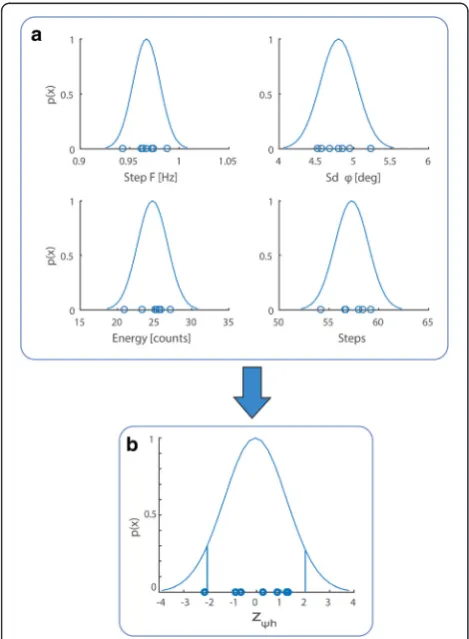
Probability distributions of features were computed by fitting Gaussians to the walking data of expert subjects (Fig. 2a). Mean step frequency and number of steps across experts were 0.97 ± 0.014 Hz and 57.3 ± 1.67 steps, respectively (mean ± standard deviation). Mean standard deviation of trunk frontal tilt and counts (ap-proximated energy expenditure) were 4.8° ± 0.24° and 24.7 ± 2.02 counts, respectively. These values are the average across each minute of the 6MWT for all sub-jects. Step frequency was the feature with the lowest standard deviation (0.014 Hz) across subjects. These dis-tributions characterize successful control behavior.
In order to combine the individual features into a joint score, the degree to which the subject’s behavior differs from that of the expert population is quanti-fied for each feature. From the Gaussian fit, we can read out the probability and, according to naïve Bayes, we then multiply these probabilities across all features. Each expert subject was scored relative to the others by computing the z-score of the Gaussian naïve Bayes surprise (10): individual scores were all within ±2, except for one able-bodied subject who had a score of -2.2 because the robot malfunctioned and stopped twice during her test, thus affecting her total number of steps. The mean z-score across experts was -0.04 (Fig. 2b). Importantly, the SCI ex-pert did not score differently from the able-bodied: therefore, her features fit the distribution of the able-bodied subjects, thus confirming that performance was comparable and consistent across all expert subjects. This result indicates that the features char-acterizing expert performance are not significantly different across experts and therefore our pool of subjects is sufficiently uniform. We thus have a meas-ure that quantifies deviation from typical expert per-former level.
Patients’scores during training
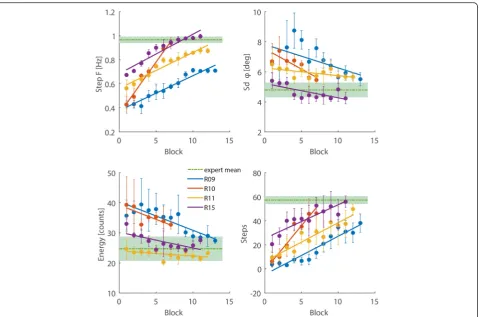
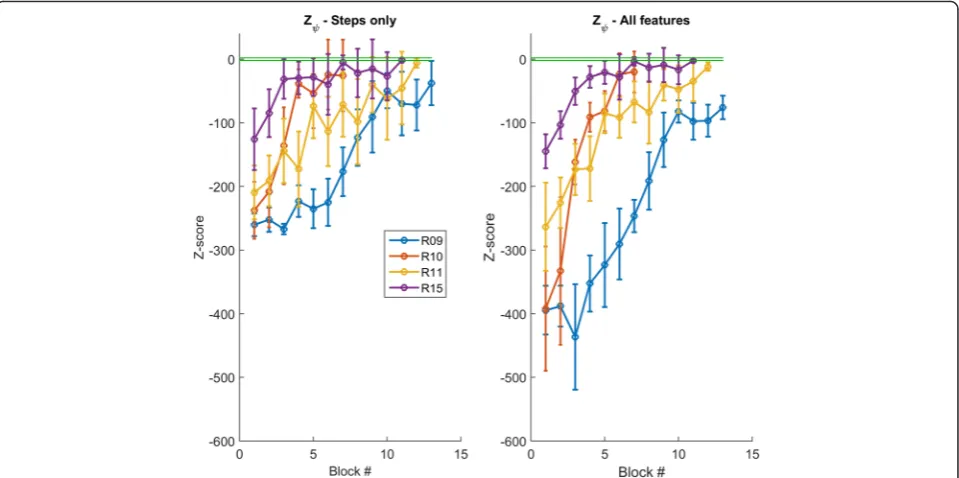
Improvements in patients were reflected in the features values getting closer to the mean values of expert sub-jects (Fig. 3). Step frequency (x1) and number of steps (x4) were positively correlated with session for all patients (Pearson’s r> 0.87, p < 0.001); standard deviation of the trunk angleφ(x2) and energy expenditure (x3) decreased over time for all patients (Pearson’sr<−0.6, p< 0.05), ex-cept for patient R11, whose acceleration counts (energy) were about the same than that of the experts for the entire training. Learning rates and initial values of each feature varied drastically across patients, confirming that different features captured different aspects of learning.
We compared the z-scores when using only steps as feature with that obtained when all the features are used. Both scores showed that patients improved as a result of training (Fig. 4). Using all the features magnified separ-ation across patients as well as from experts, and overall reduced the standard deviation of the score within ses-sions, thus aiding detection of improvements towards optimal expertise.
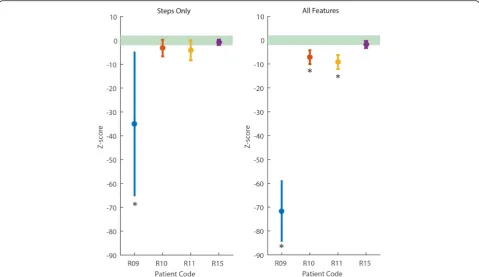
We compare the two scores in terms of their discrim-inatory power, by testing which patients have a z-score that is above -2 standard deviations from the experts in the last two training sessions. Using the score based on steps yielded that 3 patients (R10, R11 and R15) were not significantly different from the experts (One tailed Wilcoxon signed rank test, p> 0.13). In contrast, when all features are used, only patient R15
Fig. 2Feature distributions and z-scores across expert subjects.
is classified as expert (p= 0.42), with the others all being scored as non-experts (p< 0.001) (Fig. 5). The result of the combined features model was in agree-ment with the evaluation of the physical therapist that trained the patients and evaluated their skills in-dependently from the model prediction.
Discussion
In this study, a simple setup consisting of a wearable accelerometer was used to quantify walking skills in subjects with spinal cord injury who were trained to walk with an exoskeleton. A set of features was com-puted from the trunk accelerations of the subjects as they were trained to use the ReWalk™. Features were combined into a single index of walking quality, the Gaussian naïve Bayes surprise, which scored patients relative to expert subjects, who received extensive prior training with the exoskeleton. We found that our index has a higher discriminatory power than the index that used number of steps as the only feature. A discriminatory score with increased sensitivity can better support clinicians’ decisions on whether a
participant needs more training or is ready to use the robotic exoskeleton at home. This is crucial, given that an individual with complete SCI and walking with a 50 lb powered exoskeleton using a walker or forearm crutches is in a precarious situation, and sig-nificant expertise is required to avoid adverse events while moving in a community environment, even in the presence of a companion.
Previous studies trying to assess how SCI individ-uals perform with lower limb exoskeletons have used a combination of standard clinical outcome measures and other specialized analysis, including kinematics, dynamics and physiological features [14–20]. Despite using multiple features to characterize walking skills with a particular device, these previous studies have looked at each variable individually. It is thus unclear which features are more important to evaluate the performance of a subject for independent walking. In our combined score model, each feature is weighted by the inverse of its variance, as estimated from a pool of expert users. Therefore, our method automat-ically infers the feature importance from the experts’
data, in order to evaluate the walking skills of a new subject.
Furthermore, previous exoskeleton research measured performance at a single time point, usually following training. In this work the change in individual features across training sessions was tracked, which allows analyzing the learning curve of participants. This infor-mation could help clinicians at predicting patients‘ ex-pertise and determine how much additional training is needed to reach expert proficiency. Furthermore, given the early stage of development of robotic exoskeletons, additional insights into the patients’learning curve could guide the design of future exoskeletons and the planning of training sessions, by considering how each feature changes for different patients.
Our work has several limitations: considering our sample size, a study with a larger pool of subjects is crucial to validate the results and remains as future work. Secondly, only 4 features from the trunk accel-erations to evaluate walking quality were computed; incorporating other features could capture additional factors that affect walking skills with the exoskeleton. Similarly, deriving features that directly quantify safety, such as walking stability or probability of falls, could provide a significant improvement over the current model. Interestingly, other studies have tried
to infer the stability of walking from body
accelerations in both healthy and subjects at risk of falls [26–28]; however all these studies were per-formed on freely walking subjects and how to trans-late these methods to subjects walking with an exoskeleton should be investigated.
Ideally the features should be independent, which is not true in our case, as the standard deviation of the trunk tilt and the acceleration counts are expected to be strongly correlated. The feature independence (naïve Bayes) assumption was chosen to keep the model simple and to prevent overfitting of the probability distribution parameters. This assumption could be relaxed if data from more subjects are available. On the other hand, the naïve Bayes assumption proved to work well in several problems even where the features are actually not inde-pendent [29]. Similarly, it has been shown that redun-dant features can still describe different aspects of walking skills during training in individuals with spinal cord injury [30].
Conclusion
The current study provides a first step towards the construction of an index that quantifies walking skills in exoskeletons, by integrating multiple features (met-rics) in a principled way. Combining multiple features could help clinicians to determine when a patient has reached a level of ability to walk safely at home and
in the community with a robotic exoskeleton. We used a simple sensor to infer relevant quantitative data about walking skills in individuals with complete SCI and were able to track their progress over time. More advanced wearable sensors [31, 32] could be used to derive additional features, as well as to pro-vide feedback on the optimality of the subject move-ments and potentially facilitate learning. Future work is necessary to determine the most effective feedback system to address this question. Overall, the proposed approach of constructing an index of walking per-formance could be applied to any other situation where expert performance is measured along with existing performance. This could be useful across a wide range of rehabilitation studies and beyond.
Abbreviations
6MWT:6 minute walk test; 10mWT: 10 meter walk test; CGA: contact guard assistance; LOA: level of assistance; SCI: spinal cord injury.
Competing interests
Dr. Jayaraman is on the clinical advisory board of ReWalk Robotics, the designer of the ReWalk™exoskeleton. The other authors declare that they have no competing interests
Authors’contributions
LL conceived of the study, developed the model and wrote the manuscript. NS participated in the design of the study, collected and analyzed the
data. KS trained the patients and collected the data. WZR conceived of the study. KPK developed the model and assisted in writing the manuscript. AJ conceived of the study and assisted in writing the manuscript. All authors read and approved the final manuscript.
Acknowledgements
The study was completely supported by the U.S. Department of Education, National Institute on Disability and Rehabilitation Research, NIDRR-RERC, Grant Number H133E120010
Author details
1Max Nader Lab for Rehabilitation Technologies and Outcomes Research, Rehabilitation Institute of Chicago, 345 E Superior St, Chicago, IL 60611, USA. 2Department of Physical Medicine and Rehabilitation, Northwestern University, Chicago, IL 60611, USA.3Sensory Motor Performance Program, Rehabilitation Institute of Chicago, Chicago, IL 60611, USA.
Received: 5 October 2015 Accepted: 22 March 2016
References
1. Mudge S, Stott NS. Outcome measures to assess walking ability following stroke: a systematic review of the literature. Physiotherapy. 2007;93:189–200. 2. Yang JF, Musselman KE. Training to achieve over ground walking after
spinal cord injury: a review of who, what, when, and how. J Spinal Cord Med. 2012;35:293–304.
3. Jackson AB, Carnel CT, Ditunno JF, Read MS, Boninger ML, Schmeler MR, et al. Outcome measures for gait and ambulation in the spinal cord injury population. J Spinal Cord Med. 2008;31(5):487.
4. Musselman K, Brunton K, Lam T, Yang J. Spinal cord injury functional ambulation profile a new measure of walking ability. Neurorehabil Neural Repair. 2011;25:285–93.
5. Mikołajewska E, Mikołajewski D. Exoskeletons in neurological diseases-current and potential future applications. Adv Clin Exp Med. 2011;20: 227–33.
6. Díaz I, Gil JJ, Sánchez E. Lower-limb robotic rehabilitation: literature review and challenges. J Robotics. 2011; doi:10.1155/2011/759764.
7. Yan T, Cempini M, Oddo CM, Vitiello N. Review of assistive strategies in powered lower-limb orthoses and exoskeletons. Rob Auton Syst. 2015;64: 120–36.
8. Louie DR, Eng JJ, Lam T. Gait speed using powered robotic exoskeletons after spinal cord injury: a systematic review and correlational study. J Neuroeng Rehabil. 2015;12(1):1.
9. Lajeunesse V, Vincent C, Routhier F, Careau E, Michaud F. Exoskeletons’ design and usefulness evidence according to a systematic review of lower limb exoskeletons used for functional mobility by people with spinal cord injury. Disabil Rehabil Assist Technol. 2015; doi:10.3109/ 17483107.2015.1080766.
10. Yang A, Asselin P, Knezevic S, Kornfeld S, Spungen A. Assessment of in-hospital walking velocity and level of assistance in a powered exoskeleton in persons with spinal cord injury. Top Spinal Cord Inj Rehabil. 2015;21(2):100–9.
11. Esquenazi A, Talaty M, Packel A, Saulino M. The ReWalk powered exoskeleton to restore ambulatory function to individuals with thoracic-level motor-complete spinal cord injury. Am J Phys Med Rehabil. 2012;91:911–21. 12. Zeilig G, Weingarden H, Zwecker M, Dudkiewicz I, Bloch A, Esquenazi A.
Safety and tolerance of the ReWalk™exoskeleton suit for ambulation by people with complete spinal cord injury: a pilot study. J Spinal Cord Med. 2012;35:96–101.
13. Lam T, Noonan VK, Eng JJ. A systematic review of functional ambulation outcome measures in spinal cord injury. Spinal Cord. 2008;46:246–54. 14. Talaty M, Esquenazi A, Briceno JE. Differentiating ability in users of the
ReWalk TM powered exoskeleton: An analysis of walking kinematics. Rehabilitation Robotics (ICORR), 2013 IEEE International Conference on. 2013. p. 1–5.
15. Farris RJ, Quintero HA, Murray SA, Ha KH, Hartigan C, Goldfarb M. A preliminary assessment of legged mobility provided by a lower limb exoskeleton for persons with paraplegia. IEEE Trans Neural Syst Rehabil Eng. 2014;22:482–90.
16. Brissot R, Gallien P, Le Bot MP, Beaubras A, Laisné D, Beillot J, Dassonville J. Clinical experience with functional electrical stimulation-assisted gait with parastep in spinal cord–injured patients. Spine. 2000;25:501–8.
17. Goldfarb M, Korkowski K, Harrold B, Durfee W. Preliminary evaluation of a controlled-brake orthosis for FES-aided gait. IEEE Trans Neural Syst Rehabil Eng. 2003;11:241–8.
18. Ohta Y, Yano H, Suzuki R, Yoshida M, Kawashima N, Nakazawa K. A two-degree-of-freedom motor-powered gait orthosis for spinal cord injury patients. Proc Inst Mech Eng H. 2007;221:629–39. 19. Fineberg DB, Asselin P, Harel NY, Agranova-Breyter I, Kornfeld SD,
Bauman WA, Spungen AM. Vertical ground reaction force-based analysis of powered exoskeleton-assisted walking in persons with motor-complete paraplegia. J Spinal Cord Med. 2013;36:313–21.
20. Neuhaus PD, Noorden JH, Craig TJ, Torres T, Kirschbaum J, Pratt JE. Design and evaluation of mina: A robotic orthosis for paraplegics. Rehabilitation Robotics (ICORR), 2011 IEEE International Conference on. 2011:1-8. 21. Ghahramani Z. Information Theory. In: Nadel L, editor. Encyclopedia of
Cognitive Science. John Wiley and Sons. 2006. doi:10.1002/0470018860. 22. Kamen G, Patten C, Du CD, Sison S. An accelerometry-based system for the
assessment of balance and postural sway. Gerontology. 1998;44(1):40–5. 23. Fisher CJ. Using an accelerometer for inclination sensing. In: AN-1057,
Application note. Analog Devices. 2010. http://www.analog.com/media/en/ technical-documentation/application-notes/AN-1057.pdf. Accessed 15 Dec 2015.
24. Bouten CV, Koekkoek KT, Verduin M, Kodde R, Janssen JD. A triaxial accelerometer and portable data processing unit for the assessment of daily physical activity. IEEE Trans Biomed Eng. 1997;44:136–47. 25. Murphy KP. Machine learning: a probabilistic perspective. Cambridge: MIT
Press; 2012.
26. Dingwell JB, Cusumano JP. Nonlinear time series analysis of normal and pathological human walking. Chaos. 2000;10(4):848–63.
27. Menz HB, Lord SR, Fitzpatrick RC. Acceleration patterns of the head and pelvis when walking are associated with risk of falling in community-dwelling older people. J Gerontol A Biol Sci Med Sci. 2000;58(5):M446–52.
28. Menz HB, Lord SR, St George R, Fitzpatrick RC. Walking stability and sensorimotor function in older people with diabetic peripheral neuropathy. Arch Phys Med Rehabil. 2004;85(2):245–52.
29. Hand DJ, Yu K. Idiot’s Bayes—not so stupid after all? Int Stat Rev. 2001;69: 385–98.
30. Forrest GF et al. Are the 10 meter and 6 minute walk tests redundant in patients with spinal cord injury? PLoS One. 2014;9(5):e94108.
31. Patel S, Park H, Bonato P, Chan L, Rodgers M. A review of wearable sensors and systems with application in rehabilitation. J Neuroeng Rehabil. 2012;9: 1–17.
32. Hernandez J, Li Y, Rehg JM, Picard RW. BioGlass: Physiological parameter estimation using a head-mounted wearable device. Wireless Mobile Communication and Healthcare (Mobihealth), 2014 EAI 4th International Conference on. 2014:55–8.
• We accept pre-submission inquiries
• Our selector tool helps you to find the most relevant journal • We provide round the clock customer support
• Convenient online submission • Thorough peer review
• Inclusion in PubMed and all major indexing services • Maximum visibility for your research
Submit your manuscript at www.biomedcentral.com/submit