SYSTEMATIC REVIEW PROTOCOL
How do selected crop rotations affect
soil organic carbon in boreo-temperate
systems? A systematic review protocol
Magnus Land
1*, Neal Robert Haddaway
1, Katarina Hedlund
2, Helene Bracht Jørgensen
2, Thomas Kätterer
3and Per‑Erik Isberg
4Abstract
Background: Soils are important global carbon pools that are under threat from intensive land use through a variety of agricultural practices. Sustainable management of agricultural soils may have the potential to mitigate climate change through increased carbon sequestration and increase their fertility. Among management practices to increase carbon sequestration, crop rotation designs have often been tested on yield effects in long‑term agricultural experi‑ ments. However, in these studies, soil organic carbon (SOC) was monitored but not always the key objective. Thus, here we provide a method for a systematic review to test the effects of common crop rotations on SOC sequestration to provide evidence on the most sustainable management regimes that can promote SOC storage.
Methods: This systematic review incorporates studies concerning selected crop rotations (rotations‑vs‑monocul‑ tures, legumes‑vs‑no legumes, and perennials‑vs‑annuals) collated in a recently completed systematic map on the effect of agricultural management on SOC, restricted to boreo‑temperate systems (i.e., the warm temperate climate zone). Some 208 studies relevant for this systematic review were identified in the systematic map. An update of the original search (September 2013) will be undertaken to identify newly published academic and grey literature. Studies will be critically appraised for their internal and external validity, followed by full data extraction (meta‑data describing study settings and quantitative study results). Where possible, studies will be included in meta‑analyses examining the effects of the different rotational practices. Implications of the findings will be discussed in terms of policy, practice and research, and the nature of the evidence base.
Keywords: Agriculture, Conservation, Rotational, Leguminous, Land management, Climate change, Land use change, Carbon sequestration
© The Author(s) 2017. This article is distributed under the terms of the Creative Commons Attribution 4.0 International License (http://creativecommons.org/licenses/by/4.0/), which permits unrestricted use, distribution, and reproduction in any medium, provided you give appropriate credit to the original author(s) and the source, provide a link to the Creative Commons license, and indicate if changes were made. The Creative Commons Public Domain Dedication waiver (http://creativecommons.org/ publicdomain/zero/1.0/) applies to the data made available in this article, unless otherwise stated.
Background
Soils contain the largest terrestrial carbon (C) pool glob-ally that is sensitive to changes in land use and agricul-tural management practices [1]. Indeed, soils could provide a vital ecosystem service by acting as a carbon sink, potentially mitigating climate change by sequester-ing carbon through soil organisms and plant roots [2, 3]. Increasing temperatures in combination with manage-ment can potentially increase rates of decomposition of
soil organic carbon and the production of atmospheric CO2 [4]. Approximately 10% of soil carbon is held in crop lands [5], which cover around 12% of the terres-trial land area of the planet [6]. However, arable soils are under considerable threat due to unsustainable cultiva-tion practices and it has been estimated that US soils may have lost 30–50% of the soil organic carbon (SOC) that they contained prior to the establishment of agriculture [7]. This carbon loss has been attributed to management of the soils through subsequent losses from erosion and decomposition. This indicates that sustainable use of agricultural soils may have the potential to mitigate cli-mate change through carbon sequestration [8, 9]. With
Open Access
*Correspondence: [email protected]
1 Mistra EviEM, Stockholm Environment Institute Stockholm, P.O. Box 24218, 104 51 Stockholm, Sweden
recent policies on green economy, initiated by UN and the ongoing EU strategy on bioeconomy [10, 11], and the urge to minimise the use of fossil fuels, there is a grow-ing need to evaluate which farmgrow-ing practices can offset the losses of carbon from soils when providing biomass resources [12].
Beyond mitigating climate change, SOC sequestration potentially has a number of additional associated bene-fits, including: increased soil fertility [13, 14]; improved biological and physical soil characteristics [15] via a reduction in bulk density, improved water-holding capac-ity and enhanced activcapac-ity of soil microbes [16] (although this may increase CO2 emissions); and increased soil bio-diversity [17]. Promoting SOC also often increases soil biodiversity and ecosystem functions by mediating nutri-ent cycling, soil structure formation, and crop resistance to pests and diseases, with consequent benefits for agri-cultural productivity [18].
In agricultural production systems, by sowing a specific sequence of crops in the same field (crop rotation) farm-ers can improve control of weeds, pests and diseases, avoid exhaustion of the soil and increase SOC and nitrogen fixa-tion. Further benefits can be gained where attributes of these crops act together to maintain or enhance produc-tion levels [19, 20]. Thus, by using a set of more diverse crops or by introducing perennial grasses that improves SOC sequestration, the productivity can be increased at the same time as minimising environmental impacts [21, 22].
The effect of different crop rotations on yields has often been tested in long-term (decades) agricultural experi-ments, where SOC has been a factor monitored in the experiments but not always as the key objective of the study [23]. Similarly, the impacts of crop rotation on SOC have, as far as we know, not been comprehensively synthesised to date. Whether this is due to the complex-ity of crop management or to a lack of knowledge of the contribution of combinations of crops to SOC is yet to be shown. Calculations have indicated that perennial forages can provide more below-ground SOC than the common crops, especially if crop residues are not returned or if the perennial forages are discontinued [24], for example, and diverse crop rotations that involve perennial forage crops (with high contributions to belowground SOC) can be important for SOC, although such impacts have not been commonly studied [25].
Identification of the topic
The subject of crop rotation was originally identified and included in the previously published systematic map [26] following discussions with Swedish stakeholders, including the Swedish Board of Agriculture. Following completion of the systematic map, several groups of crop rotation were identified as potential topics for full systematic review
based on a number of key criteria: the presence of suffi-cient reliable evidence; the relevance of the topic for stake-holders; the benefit of a systematic approach to a topic that has received some attention in traditional reviews; and the added value of investigating effect modifiers and sources of heterogeneity across studies via meta-analysis. In March 2016, the topic was accepted for full systematic review fol-lowing discussion with a committee of international scien-tists (Mistra EviEM ExComm).
Objective of the review
The effects of crop rotations on SOC have previously been reviewed [27, 28] and various authors have inves-tigated topics such as inclusion of leys [25], legumes [21], or crop combinations [29]. However, none of these reviews have been systematic in nature. Therefore, the objective is to systematically review and synthesise exist-ing research pertinent to selected crop rotation practices in warm temperate and snow climate zones (see “Popu-lation” below for details) using, as a basis, the evidence identified within a recently completed systematic map [26]. The systematic map aimed to collate evidence relat-ing to the impacts of all agricultural management on soil organic carbon in boreo-temperate regions.
The primary question in this systematic review is “What is the effect of different crop rotations on soil organic car-bon (SOC) in boreo-temperate systems?” This is a fairly broad question, but it will be split into three questions with different sets of interventions and comparators. The rationale behind this is that while many studies have compared crop rotations with monocultures (single crop farming systems), a significant amount of studies have compared different crop rotations with each other [26]. The first question will address the effect of any crop rota-tion relative to monocultures, and the other two quesrota-tions will address the effect of specific crop rotations relative to other crop rotations. These questions are very closely related to each other, and therefore it seems sensible to combine them in one systematic review. Although the effect of specific crop rotations will be evaluated through sub-group analyses within the first question, a large por-tion of the evidence base would be ignored if direct com-parisons between different crop rotations were to be excluded. The three questions this review will address are:
1. What is the effect of crop rotation on soil organic carbon in boreo-temperate systems?
2. What is the effect of crop rotations involving legumi-nous plants on soil organic carbon in boreo-temper-ate systems?
Elements of the systematic review questions
Population: Arable soils in agricultural regions from the warm temperate climate zone (fully humid and summer dry, i.e., Köppen–Geiger climate classification; Cfa, Cfb, Cfc, Csa, Csb, Csc) and the snow climate zone (fully humid, i.e., Köppen–Geiger climate classification; Dfa, Dfb, Dfc) [30] (see Fig. 1).
Outcome: SOC (measured as either concentra-tion or stock).
Question 1
Intervention: Crop rotations including rotational cycles extending for 2 years or more. Comparator: Monocultures.
Question 2
Intervention: Crop rotations involving sown legumi-nous plants.
Comparator: Crop rotations not including sown leguminous plants.
Question 3
Intervention: Crop rotations involving sown peren-nial crops (>1 year).
Comparator: Crop rotations including only sown annual crops.
Methods
Searches
Original systematic map search
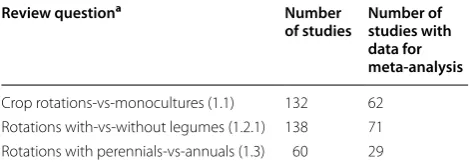
Searches of 17 bibliographic databases were under-taken as part of the published systematic map between the 16th and 19th September 2013 [26]. This search was broader than just crop rotation, including also interven-tions relating to amendments, fertilisers and tillage (some 24,500 results were retrieved). These searches were sup-plemented by searches for grey literature via web search engines and organisational websites, and by searches of the bibliographies of 127 relevant reviews and meta-analyses identified during screening of literature for the systematic map. No literature was provided by experts or stakeholders. The numbers of articles included in the systematic map and relevant for this systematic review are shown in Table 1. Full details for all searches can be found in supplementary information accompanying the systematic map described in Haddaway et al. [26].
Updated search
Bibliographic databases A search update will be under-taken to capture research published since the original search in September 2013. The update will be restricted to four bibliographic databases: (1) Academic Search Premier ( https://www.ebscohost.com/academic/academic-search-premier), (2) PubMed (https://www.ncbi.nlm.nih.gov/ pubmed), (3) Scopus (https://www.elsevier.com/solutions/ scopus), (4) Web of Science Core Collection (http://apps. webofknowledge.com/), and one academic search engine, Google Scholar (https://scholar.google.se/), which has been shown to be effective at identifying both academic and grey literature [31]. The use of a larger number of data-bases during conduct of the systematic map resulted in a large number of duplicates but supplied no additional rel-evant studies. Only English language search terms will be used, but all articles identified in Danish, English, French, German, Italian, and Swedish will be included (non-Eng-lish articles often have an abstract in Eng(non-Eng-lish and may in that way be retrieved in the searches). Based on the find-ings in the systematic map [26], we do not believe that the bias potentially introduced by the restriction to English language search terms will be critical.
In bibliographic databases the following search string will be used to search on ‘topic words’ combined with Boolean operators. This search string has been adapted from the original string used in the published systematic map [26] to specifically target the crop rotation subjects identified above and restricted to the period since the original search was undertaken (September 2013):
soil* AND (arable OR agricult* OR farm* OR crop* OR cultivat*) AND (legume$ OR pulse$ OR “green-manure” OR alfalfa$ OR lupin$ OR bean$ OR pea$ OR lentil$ OR clover OR soy OR soybean$ OR per-ennial$ OR grass* OR ley$ OR permaculture OR rotation OR monoculture OR “mono culture”) AND (“soil organic carbon” OR “soil carbon” OR “soil C” OR “soil organic C” OR SOC OR “carbon pool” OR “carbon stock” OR “carbon storage” OR “soil organic matter” OR SOM OR “carbon sequestrat*” OR “C sequestrat*”)
[the underlined text indicates modifications to the orig-inal systematic map search string]
The wildcards * and $ represent any number of charac-ters and exactly zero or one character, respectively.
Internet searches In Google Scholar the following search string will be used and the first (up to) 1000 records down-loaded for both title and full text searches:
soil AND carbon AND (rotation OR legume OR monoculture OR perennial OR fallow OR ley OR annual OR alfalfa OR pulse)
Search results from Google Scholar will be extracted using web searching software [32] for the date range 2013–2017. A maximum of 1000 results (ordered by an undisclosed algorithm) is extractable from Google Scholar for any one search.
Supplementary searches Reviews and meta-analyses identified through screening of search results from the search update described above will be subject to an addi-tional screening process, whereby the bibliography of each article is screened for potentially relevant articles.
Article screening and study inclusion criteria
A total of 735 studies have already been identified as part of the recent systematic map [26]. These studies were originally assessed according to inclusion criteria prede-fined in the systematic map protocol [33]. The original inclusion criteria were modified to include only studies investigating crop rotation practices. The inclusion cri-teria for the primary question used to screen all stud-ies (including the original crop rotation studstud-ies and the updated search results) are as follows:
Relevant populations: Arable soils in agricultural regions from the warm tem-perate climate zone (fully humid and summer dry, i.e., Köppen–Geiger climate clas-sification; Cfa, Cfb, Cfc, Csa, Csb, Csc) and the snow cli-mate zone (fully humid, i.e., Köppen–Geiger climate clas-sification; Dfa, Dfb, Dfc). Fig-ure 1 displays the geographi-cal regions covered by these zones. These zones were selected due to their relative homogeneity and relevance to the Swedish environment. Relevant intervention 1: Any crop rotation including
Table 1 Number of studies investigating different crop rotation impacts on soil organic carbon in systematic map
a Codes within parenthesis refer to categories used in the systematic map by Haddaway et al. [26]
Review questiona Number
of studies Number of studies with data for meta-analysis
rotational cycles extending for two years or more.
Relevant comparator 1: Monocultures where only one annual crop is grown per year. Relevant intervention 2: Crop rotations involving
sown leguminous plants. Leg-umes may include the follow-ing: alfalfa/lucerne, species of the genus Cajanus (such as pigeon pea), chickpea, clo-ver, cowpea, species of the genus Dolichos, fava/broad bean, field beans, lablab, len-tils, lupin, peanut, soybean, velvet bean, and vetch. Some studies refer to only ‘pulses’ or ‘legumes’.
Relevant comparator 2: Crop rotations not including sown leguminous plants. Relevant intervention 3: Crop rotations including
sown perennial crops among the annual crops. Perennial crops are defined as any per-ennial species that is grown without tillage or other destruction of vegetation for 2 growth seasons. Perennial crops include: legumes or/and grass species, also described as fallow, grass, meadow or ley.
Comparator 3: Crop rotations including only sown annual crops.
Relevant outcomes: Soil carbon measures, includ-ing: soil organic carbon (SOC), total organic carbon (TOC), total carbon (TC), and soil organic matter (SOM). This may be expressed either as a concentration (e.g. g/kg or %) or as a stock (e.g. Mg/ ha).
Relevant study types: Field studies examining inter-ventions that have lasted at least 10 years to ensure that changes in soil carbon are detectable [34].
Every study identified via the update will be screened through three stages: title, abstract and full text. At each level, records containing or likely to contain relevant
information will be retained and taken to the next stage. Where information is lacking (e.g., where abstracts are missing), the record will be retained and screened at next stage in order to be conservative. Records that cannot be obtained in full text will be recorded and reported. A list of all articles excluded at full text, with reasons for exclu-sion, will be provided in an additional file. Screening will be performed by one reviewer, and a subset of 10% of the records at each level will be screened by a second reviewer. A Kappa test [35] will be performed on the dual screening at each level to assess the level of agreement. Where agreement is lower than moderate (kappa = 0.6), discrepancies will be discussed in detail and if needed the inclusion criteria will be clarified. To ensure improve-ment in consistency, a further subset will be screened and tested until kappa >0.6.
Study quality assessment
Critical appraisal undertaken in the completed systematic map
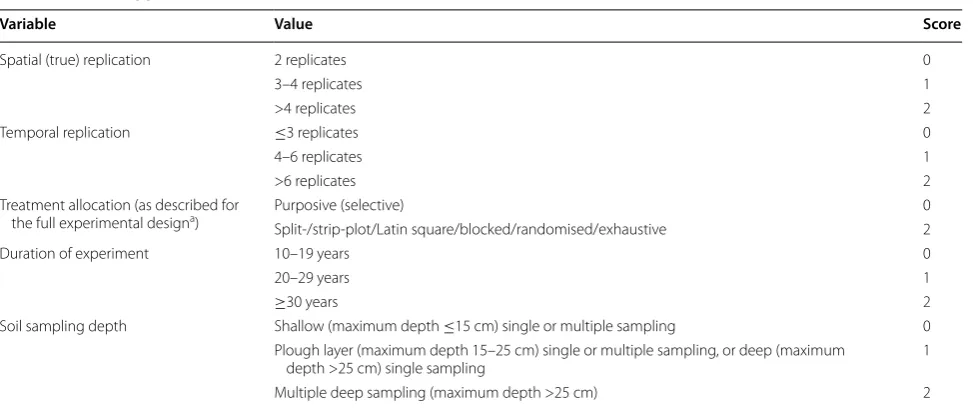
Critical appraisal of relevant studies was undertaken in the systematic map to exclude studies that were non-gen-eralizable or susceptible to bias (e.g. lacking methodolog-ical details or replication), and to assess the reliability of the evidence base. Reasons for exclusion were transpar-ently recorded for all studies (see supplementary infor-mation in Haddaway et al. [26]). To further assess the reliability of studies passing the initial critical appraisal, five domains were assessed: spatial replication (number of spatial replicates); temporal replication (number of sampling time points); treatment allocation (e.g. rand-omized, blocked, purposeful); study duration (length of experimental period); soil sampling depth (number and extent of soil depth samples taken). For each domain, studies were awarded a 0, 1, or 2 for the degree of reliabil-ity as described in Table 2. Where insufficient informa-tion was reported a ‘?’ was awarded. See Haddaway et al. [26] for full details of the methods used and results from the systematic map.
Critical appraisal for this systematic review
Data extraction strategy
Meta-data will be extracted for all studies. This informa-tion will include the following: citainforma-tion; study locainforma-tion (country, site, climate zone, latitude and longitude); soil type (classification or percent clay/silt/sand); bulk density; study description (start year, duration, treatments inves-tigated, cropping system, experimental design); sampling strategy (spatial and temporal replication, subsampling (distribution of sampling points), soil sampling depth, car-bon measurement method). In addition, study findings (i.e., quantitative data) will be described (outcome type, units, data location, measure of variability) and extracted.
For question 1, crop rotations will be separated into the following categories:
1. Crop rotations versus monocultures 1.1. Rotations involving legumes
1.2. Rotations involving fallow with mixed vegeta-tion or sown leys
1.3. Rotations involving cereals only 1.3.1. Winter crops
1.3.2. Spring crops
1.4. Rotations involving other crops
For questions 2 and 3 crop rotations will be separated into the following categories:
2. Rotations with versus without legumes 2.1. Grain and forage harvested legumes 2.2. Unharvested legumes (green mulch)
3. Rotations with harvested perennials versus annuals
3.1. Short-term perennials (1–2 year of a rotation) 3.2. Long-term perennials (>2 year of a rotation)
Meta-data will be extracted into one database describ-ing all studies, whilst quantitative data (i.e., study find-ings) will be extracted into separate spreadsheets for each study for transparency. Effect sizes for use in meta-analyses will then be calculated within each of these files before being combined for analysis. Effect sizes used in analyses will be raw mean difference expressed in g/kg for concentrations or kg/ha for stocks. All carbon meas-ures will be converted to SOC and study findings will be standardised according to study duration. In order to account for the potentially non-linear nature of changes to soil carbon, a categorical coding variable (coded as ‘short-term’ [10–19 years], ‘medium-term’ [20–29] or ‘long-term’ [>29]) will be included in meta-analyses as a moderator to investigate the influence of study duration. Data from studies quoting carbon stocks rather than con-centrations will be converted to concentration to enable equivalent effect sizes to be incorporated in one meta-analysis. Studies that do not provide bulk density along with stocks will be analysed separately as independent tests of stocks data (where universal soil depth limits can be ascertained across the evidence base). Data extraction will be performed by two reviewers. To check repeatabil-ity a subset of 10% of the included articles will initially be subject to data extraction by both reviewers. Results will be compared and any discrepancies will be discussed until consensus is reached. The extracted data records will be made available as additional files.
Table 2 Critical appraisal criteria
a Experimental designs are described by Singh and Masuku [36]
Variable Value Score
Spatial (true) replication 2 replicates 0
3–4 replicates 1
>4 replicates 2
Temporal replication ≤3 replicates 0
4–6 replicates 1
>6 replicates 2
Treatment allocation (as described for
the full experimental designa) Purposive (selective) 0
Split‑/strip‑plot/Latin square/blocked/randomised/exhaustive 2
Duration of experiment 10–19 years 0
20–29 years 1
≥30 years 2
Soil sampling depth Shallow (maximum depth ≤15 cm) single or multiple sampling 0
Plough layer (maximum depth 15–25 cm) single or multiple sampling, or deep (maximum
depth >25 cm) single sampling 1
Potential effect modifiers and reasons for heterogeneity Data related to key sources of heterogeneity, which will be extracted after critical appraisal, include climate zone, latitude, longitude, and soil type (classification or tex-ture), tillage (intensity and depth), and application of fer-tilisers, organic amendments such as slurry and manure, or harvested crop residues. These potential modifiers were identified by a team of methodological experts and open for public stakeholder comment. They will be used in meta-analyses to account for significant differences between studies, as described below in Synthesis. All studies used in this review will be long-term (>10 years) agricultural sites, and so the impacts of interventions will all be investigated in relation to implementation of alter-native agricultural practices on similar land-use types. Where possible, baseline data will be used to account for variability within studies.
Data synthesis and presentation
A narrative synthesis of the evidence base will be under-taken using tables and figures that both describe the evi-dence base itself and the findings of individual studies. In addition, meta-analysis will be performed where possible, as described below.
The questions will be answered by synthesising studies in three sets of meta-analyses; one for each question. Where studies include a combination of legumes, perennials and other crop rotations these will be analysed in each case by including these confounded studies in a sensitivity analy-sis: e.g. where monocultures of cereals are compared with rotations involving legumes, these data will be included in either analysis as a supplementary group of studies fol-lowing analysis of studies that are not confounded (e.g. monocultures of cereals versus monocultures of legumes). Adjustment of significance thresholds will be undertaken accordingly to avoid multiplicity of p values.
The meta-analyses will be performed on SOC data from the upper soil layer 0–30 cm, as studies have recorded SOC across a number of soil depths of the upper layer. SOC data from deeper soil layers (>30 cm) are less frequent [26] and not included in this review. The data in the meta-analysis will be given a depth correc-tion factor to weight data that came from a soil layer less than 30 cm. This factor will be calculated as the fraction of the profile covered by the data (e.g. a value of 0.67 for 0–20 cm depth). Where data overlap the 30 cm boundary a maximum value of 1 will be used. This approach is con-servative, since SOC concentration generally decreases with depth.
Sensitivity analyses
Studies may not be includible in meta-analysis where they do not report one of three key variables for each
treatment: mean, variability measure (e.g. standard deviation), and sample size (true spatial replication) [37]. Many studies identified in the systematic map by Haddaway et al. [26] failed to report suitable measures of variability across all treatments that would facilitate meta-analysis. However, in some instances an overall var-iability measure across intervention groups is provided or may be calculated that may be used as an estimate of variability. Furthermore, some studies report other sum-mary results that may be sufficient to calculate variability either between or across interventions. For these cases where variability is estimated, sensitivity analysis will be performed both with and without the estimated vari-ability studies to investigate the influence of less reliable measures on the review findings. As described above in Critical Appraisal, sensitivity analysis will also be per-formed to investigate the influence of ‘low’ reliability studies on the review findings.
Accounting for multiplicity of p values
Since several subgroup analyses and sensitivity analyses will be undertaken, the threshold for p value significance should be adjusted conservatively depending on the number of a priori tests performed. Emphasis will also be put on the magnitude of statistically significant findings (i.e., biological significance will be discussed rather than significance itself).
Meta-analyses will be summarised in tables (for sensi-tivity analysis and subgroup analysis results) and in for-est plots (for meta-analysis outputs). Forfor-est plots will be summarised across groups (i.e., by effect modifiers) where the number of included studies is substantial. The potential risk of publication bias will be investigated through funnel plots.
Authors’ contributions
This review protocol is based on a draft written by NRH. All authors assisted in editing and revising the draft. All authors read and approved the final manuscript.
Author details
1 Mistra EviEM, Stockholm Environment Institute Stockholm, P.O. Box 24218, 104 51 Stockholm, Sweden. 2 Department of Biology, Lund University, 223 62 Lund, Sweden. 3 Department of Ecology, SLU, P.O. Box 7044, 750 07 Upp‑ sala, Sweden. 4 Department of Statistics, Lund University, P.O. Box 743, 220 07 Lund, Sweden.
Acknowledgements
This protocol was considerably improved by constructive suggestions and comments made by two anonymous reviewers.
Competing interests
The authors declare that they have no competing interests. Any reviewer that is also an author of relevant articles will not be included in the decisions con‑ nected to inclusion and critical appraisal of these articles.
Availability of data and materials
Funding
This protocol and the forthcoming review are financed by the Mistra Council for Evidence‑Based Environmental Management (EviEM), to which two of the authors (NRH and ML) are affiliated. EviEM is funded by the Swedish Foundation for Strategic Environmental Research (Mistra). KH, HBJ and PEI were funded by EviEM and Lund University. TK was funded by EviEM and the Swedish University of Agricultural Sciences.
Publisher’s Note
Springer Nature remains neutral with regard to jurisdictional claims in pub‑ lished maps and institutional affiliations.
Received: 15 November 2016 Accepted: 17 March 2017
References
1. Lal R. Managing soils and ecosystems for mitigating anthropogenic carbon emissions and advancing global food security. Bioscience. 2010;60(9):708–21.
2. Lal R. Sequestering carbon in soils of agro‑ecosystems. Food Policy. 2011;36(Supplement 1):S33–9.
3. Stockmann U, Adams MA, Crawford JW, Field DJ, Henakaarchchi N, Jenkins M, Minasny B, McBratney AB, de Courcelles VD, Singh K, et al. The knowns, known unknowns and unknowns of sequestration of soil organic carbon. Agr Ecosyst Environ. 2013;164:80–99.
4. Davidson EA, Janssens IA. Temperature sensitivity of soil car‑ bon decomposition and feedbacks to climate change. Nature. 2006;440(7081):165–73.
5. Jobbagy EG, Jackson RB. The vertical distribution of soil organic carbon and its relation to climate and vegetation. Ecol Appl. 2000;10(2):423–36. 6. Betts RA, Falloon PD, Goldewijk KK, Ramankutty N. Biogeophysical effects
of land use on climate: model simulations of radiative forcing and large‑ scale temperature change. Agric For Meteorol. 2007;142(2):216–33. 7. Kucharik CJ, Brye KR, Norman JM, Foley JA, Gower ST, Bundy LG. Measure‑
ments and modeling of carbon and nitrogen cycling in agroecosystems of southern Wisconsin: potential for SOC sequestration during the next 50 years. Ecosystems. 2001;4(3):237–58.
8. Gonzalez‑Sanchez EJ, Ordonez‑Fernandez R, Carbonell‑Bojollo R, Veroz‑ Gonzalez O, Gil‑Ribes JA. Meta‑analysis on atmospheric carbon capture in Spain through the use of conservation agriculture. Soil Tillage Res. 2012;122:52–60.
9. Lal R, Delgado J, Groffman P, Millar N, Dell C, Rotz A. Management to mitigate and adapt to climate change. J Soil Water Conserv. 2011;66(4):276–85.
10. European Commission. The bioeconomy strategy. Research & Innovation. http://ec.europa.eu/research/bioeconomy/index. cfm?pg=policy&lib=strategy. Accessed 12 Jan 2017.
11. UNEP: Working towards a Balanced and Inclusive Green Economy: A United Nations System‑wide Perspective. In: United Nations; 2011: 204. http://www.unep.org/publications/search/pub_details_s.asp?ID=6261. 12. Blanco‑Canqui H. Crop residue removal for bioenergy reduces soil carbon
pools: how can we offset carbon losses? Bioenergy Res. 2013;6(1):358–71. 13. Bolinder M, Kätterer T, Andrén O, Ericson L, Parent L‑E, Kirchmann H.
Long‑term soil organic carbon and nitrogen dynamics in forage‑based crop rotations in northern Sweden (63–64N). Agr Ecosyst Environ. 2010;138(3):335–42.
14. Lal R, Follett R. Soils and climate change. In: Lal R, Follett R, editors. Soil carbon sequestration and the greenhouse effect, vol. 57. 2nd ed. Madi‑ son: SSSA Special Publication; 2009.
15. Hati KM, Swarup A, Dwivedi A, Misra A, Bandyopadhyay K. Changes in soil physical properties and organic carbon status at the topsoil horizon of a vertisol of central India after 28 years of continuous cropping, fertilization and manuring. Agr Ecosyst Environ. 2007;119(1):127–34.
16. Yang X, Li P, Zhang S, Sun B, Xinping C. Long‑term‑fertilization effects on soil organic carbon, physical properties, and wheat yield of a loess soil. J Plant Nutr Soil Sci. 2011;174(5):775–84.
17. Holland J. The environmental consequences of adopting conserva‑ tion tillage in Europe: reviewing the evidence. Agr Ecosyst Environ. 2004;103(1):1–25.
18. Barrios E. Soil biota, ecosystem services and land productivity. Ecol Econ. 2007;64(2):269–85.
19. Bullock DG. Crop‑rotation. Crit Rev Plant Sci. 1992;11(4):309–26. 20. Brady MV, Hedlund K, Cong RG, Hemerik L, Hotes S, Machado S, Mattsson
L, Schulz E, Thomsen IK. Valuing supporting soil ecosystem services in agriculture: a natural capital approach. Agron J. 2015;107(5):1809–21. 21. Gan YT, Hamel C, O’Donovan JT, Cutforth H, Zentner RP, Campbell CA,
Niu YN, Poppy L. Diversifying crop rotations with pulses enhances system productivity. Sci Rep. 2015;5:14625.
22. Campbell CA, Janzen HH, Paustian K, Gregorich EG, Sherrod L, Liang BC, Zentner RP. Carbon storage in soils of the North American Great Plains: effect of cropping frequency. Agron J. 2005;97(2):349–63.
23. Christensen BT, Johnston AE. Soil organic matter and soil quality‑lessons learned from long‑term experiments at Askov and Rothamsted. Dev Soil Sci. 1997;25:399–430.
24. Bolinder MA, Janzen HH, Gregorich EG, Angers DA, VandenBygaart AJ. An approach for estimating net primary productivity and annual carbon inputs to soil for common agricultural crops in Canada. Agr Ecosyst Environ. 2007;118(1–4):29–42.
25. Bolinder MA, Katterer T, Andren O, Parent LE. Estimating carbon inputs to soil in forage‑based crop rotations and modeling the effects on soil carbon dynamics in a Swedish long‑term field experiment. Can J Soil Sci. 2012;92(6):821–33.
26. Haddaway NR, Hedlund K, Jackson LE, Jørgensen HB, Kätterer T, Lugato E, Söderström B, Thomsen IK. What are the effects of agricultural manage‑ ment on soil organic carbon (SOC) stocks? A systematic map. Environ Evid. 2015;4:23.
27. Christopher SF, Lal R. Nitrogen management affects carbon sequestration in North American cropland soils. Crit Rev Plant Sci. 2007;26(1):45–64. 28. West TO, Post WM. Soil organic carbon sequestration rates by till‑
age and crop rotation: a global data analysis. Soil Sci Soc Am J. 2002;66(6):1930–46.
29. Hurisso TT, Norton JB, Norton U. Soil profile carbon and nitrogen in prairie, perennial grass‑legume mixture and wheat‑fallow production in the central High Plains, USA. Agric Ecosyst Environ. 2013;181:179–87. 30. Kottek M, Grieser J, Beck C, Rudolf B, Rubel F. World map of the Köppen–
Geiger climate classification updated. Meteorol Z. 2006;15(3):259–63. 31. Haddaway NR, Collins A, Coughlin D, Kirk S. The role of Google Scholar in
evidence reviews and its applicability to grey literature searching. PLOS ONE. 2015;10(9):e0138237.
32. Haddaway NR. The use of web‑scraping software in searching for grey literature. Grey J. 2015;11(3):186–90.
33. Söderström B, Hedlund K, Jackson LE, Kätterer T, Lugato E, Thomsen IK, Jørgensen HB. What are the effects of agricultural management on soil organic carbon (SOC) stocks? Environ Evid. 2014;3:2.
34. Smith P. How long before a change in soil organic carbon can be detected? Glob Change Biol. 2004;10(11):1878–83.
35. Cohen J. Weighted kappa: nominal scale agreement provision for scaled disagreement or partial credit. Psychol Bull. 1968;70(4):213.
36. Singh AS, Masuku MB. An Insight in Statistical Techniques and Design in Agricultural and Applied Research. World J Agric Sci. 2012;8(6):568–84. 37. Haddaway NR. A call for better reporting of conservation research data
![Fig. 1 World map of Köppen–Geiger climate classification (From Kottek et al. [30])](https://thumb-us.123doks.com/thumbv2/123dok_us/9127145.1905880/3.595.57.541.460.711/fig-world-map-koppen-geiger-climate-classification-kottek.webp)