SYSTEMATIC MAP
Evidence for changes in the occurrence,
frequency or severity of human health impacts
resulting from exposure to alien species
in Europe: a systematic map
Helen R. Bayliss
1, Stefan Schindler
2,3*, Mildren Adam
2, Franz Essl
2,3and Wolfgang Rabitsch
2Abstract
Background: Alien species are frequently considered a serious environmental threat but negative impacts on human health through injury, allergy, or as vectors of disease sometimes have the most dire consequences for human livelihoods. Climate change and the increasing magnitude and frequency of introductions of species across geo-graphic barriers as a result of international trade are likely to change their establishment, spread, abundance, physiol-ogy or phenolphysiol-ogy, potentially also altering their human health impacts. Yet despite receiving increasing attention in the scientific literature, there have been few attempts to quantify recent changes in human health impacts. Here we report the findings from a systematic map of the literature identifying evidence of any change in the occurrence, frequency or severity of impacts of alien species on human health in Europe over the last 25 years.
Methods: We conducted a systematic search of the ecological and medical literature using English language search terms to identify potentially relevant studies. Search results were assessed against inclusion criteria published in an a priori protocol at title, abstract and full-text to determine their suitability for inclusion in the review. Repeatability was checked at each stage by comparing a subset between reviewers and testing for inter-rater agreement using Cohen’s kappa test. Studies deemed relevant at full text were coded against bibliographic, inclusion and study design criteria to create a searchable database of evidence.
Results: Searches retrieved over 15,700 results yet only sixteen cases met criteria for inclusion in the systematic map. Most of this evidence represents first records of impacts from different areas, and in particular first reports of transmis-sion of exotic diseases by introduced mosquito species.
Conclusions: There is currently limited published evidence demonstrating a change in the occurrence, frequency or severity of human health impacts caused by alien species in Europe over the last 25 years. Relevant studies relate to only a few species, often report specific cases and rarely link health impacts with ecology, distribution or spread of the species. Difficulties in attributing human health impacts, such as stings or allergies, to a specific alien species likely complicate attempts to measure changes, as may differences in professional interests between the environ-mental and health professions. Future studies could helpfully compare spread or abundance with reported, rather than potential, health impacts. Better cooperation between invasion ecologists and health professionals working in affected areas are likely to be necessary to improve the evidence base on this topic for the future.
Keywords: Allergens, Biological invasions, Bites, Dermatitis, Disease, Public health, Stings
© The Author(s) 2017. This article is distributed under the terms of the Creative Commons Attribution 4.0 International License (http://creativecommons.org/licenses/by/4.0/), which permits unrestricted use, distribution, and reproduction in any medium, provided you give appropriate credit to the original author(s) and the source, provide a link to the Creative Commons license, and indicate if changes were made. The Creative Commons Public Domain Dedication waiver (http://creativecommons.org/ publicdomain/zero/1.0/) applies to the data made available in this article, unless otherwise stated.
Open Access
*Correspondence: [email protected]
Background
Alien species are frequently considered a serious envi-ronmental threat but some have impacts detrimental to human health through injury, allergy, or as vectors of disease ([1–3]; Table 1). Climate change and increasing propagule pressure due to international trade are likely to change the spread, abundance, physiology or phenology of alien species [4–6], potentially also altering their human health impacts [1]. Many alien species will likely benefit from climate change as some ecological traits provide high plasticity and therefore support adaptation capacities to cope with changing conditions [6–8]. Global change may lead to new public health concerns as alien species expand their range or enter new areas, or may alter the severity of health impacts by changing the physiology or quantity of potential allergens or irritants produced (Fig. 1). It is therefore important to consider if and how the health impacts of alien species are changing over time to inform effective public health policies for the future.
To date, there have been few attempts to systematically identify or quantify the extent of alien species impacts on human health. A recent review by Schindler et al. [1] found that most articles describe the types of health impacts without quantitative assessment of numbers of people affected. Further, research on this topic appears biased towards a few species, hindering a balanced under-standing of the scale, patterns and trends of these impacts [1, 3]. This bias towards a small number of species is problematic as the information may not be generalisable to other species, meaning that emerging risks to public health may not be fully recognised [1]. Without this infor-mation, it will prove challenging to prepare appropriate and timely environmental or public health responses to emerging threats in the face of climate change.
Despite receiving increasing attention in the scien-tific literature, there have been few attempts to quantify recent changes in the human health impacts of alien spe-cies. To address this, we report the findings from a sys-tematic mapping of the literature identifying evidence of any change in the occurrence, frequency or severity of
impacts of alien species on human health in Europe over the last 25 years.
Objective of the review
The review objective was to use systematic mapping methodology as described in the a priori protocol [9] to identify the current state and distribution of evidence relevant to the review question. Specifically, this map aims to collate studies that quantitatively report changes in human health impacts from alien species in Europe over the last 25 years. The evidence base is used to iden-tify areas suitable for future systematic reviews and key knowledge gaps.
Primary question: What evidence exists for
changes in the occurrence, severity or frequency of human health impacts result-ing from exposure to alien species in Europe?
The question consists of the following components:
Population: Any human population resident in
Europe
Exposure: Contact with species alien to all or
part of Europe
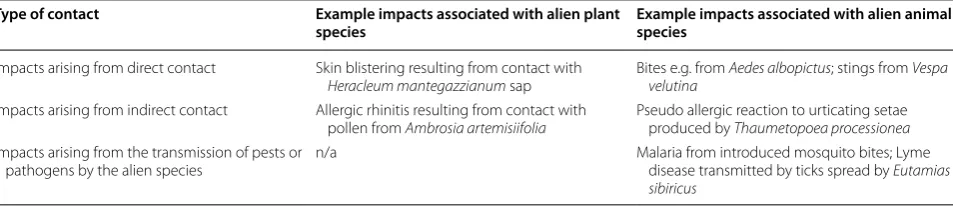
Table 1 Types of health impacts associated with contact with alien plants and animals considered within the remit of this systematic map
Type of contact Example impacts associated with alien plant
species Example impacts associated with alien animal species
Impacts arising from direct contact Skin blistering resulting from contact with
Heracleum mantegazzianum sap Bites e.g. from
Aedes albopictus; stings from Vespa velutina
Impacts arising from indirect contact Allergic rhinitis resulting from contact with
pollen from Ambrosia artemisiifolia Pseudo allergic reaction to urticating setae produced by Thaumetopoea processionea Impacts arising from the transmission of pests or
pathogens by the alien species n/a Malaria from introduced mosquito bites; Lyme disease transmitted by ticks spread by Eutamias sibiricus
Comparator: No contact or more/less frequent or severe contact
Outcome: Change in the occurrence, frequency
or severity of health impacts in human populations since 1990
Methods
This systematic map was conducted in accordance with the CEE Guidelines for Systematic Review and Evidence Synthesis in Environmental Management Version 4.2 [10] to methods specified a priori in a previously pub-lished protocol [9]. Following publication of the proto-col, study inclusion criteria were subsequently refined to improve consistency in reviewer screening, as detailed in the Study inclusion criteria section below.
Searches
A comprehensive search of multiple information sources attempted to capture an un-biased sample of both pub-lished and grey literature, using terms and sources iden-tified during scoping and tested for comprehensiveness using a sample of relevant known studies [9]. All searches were conducted in 2015 by HB, MA and SS. Full details of all of the searches, including dates, sources, platforms, terms, numbers of results generated and destination of retrieved records are reported in Additional file 1.
Search terms
Search terms relating to both alien species and their human health impacts were used to identify potentially relevant studies. Due to the different search functionali-ties of the sources used the exact search strings deployed varied across databases. Full details of each search string, including any wildcards, Boolean operators (e.g. AND or OR), nesting (brackets), phrase searching and limits used, are provided in Additional file 1. Exposure search terms included in combination: “invasive species”; alien; “non-native”; exotic; “introduced species”; “non-indigenous” and weed. Outcome search terms included in combina-tion: allerg*; hay-fever; asthma; dermatitis; bite; biting; sting*; toxic*; poison*; venom*; irrita*; disease; outbreak; epidemic; parasit*; vector; host; reservoir; “human health” and “public health”. Although the use of subject headings such as MeSH was considered, they were not used during the searches for this systematic map. How-ever, this could be addressed in future updates or in other maps using similar search sources.
Search sources
The systematic map searches encompassed eight online bibliographic databases (Web of Science; MEDLINE; CINAHL; CAB Direct including CAB Abstracts and
Global Health; EMBASE; SCOPUS; TOXNET includ-ing DART (Developmental and Reproductive Toxicol-ogy); Armed Forces Pest Management Board Literature Retrieval System), Google Scholar to help identify grey or recently published literature, and a range of special-ist sources relating to either health or alien species (see Additional file 1 for full details of all sources searched). Alien species databases were searched using the species names identified in the protocol and cited references screened for potentially relevant articles.
In addition, recent issues of three alien species journals not yet indexed in Web of Science (NeoBiota, Manage-ment of Biological Invasions and Bioinvasion Records) were hand searched by screening at title all articles to identify any potentially relevant to the systematic map topic. Online early articles (prior to allocation in an issue) as well as the most recent three issues of two other jour-nals (Biological Invasions and Aquatic Invasions) were also hand screened to account for time lags in articles being indexed in the bibliographic databases.
Supplementary searches
References contained within review articles identified either during scoping or during the screening of the sys-tematic map search results were checked for additional relevant studies that may have been missed.
Reference management and recording
Results of the bibliographic database searches and the first 100 hits from the Google Scholar searches were exported into RefWorks reference management soft-ware. Search results were later transferred to EndNote referencing software to allow for offline screening and enhanced sharing of files between the project team. All other search results were screened online at title and any potentially relevant results were recorded in a spreadsheet.
Study inclusion criteria
Study inclusion criteria were defined as part of protocol development, and were subject to refinement during arti-cle screening to ensure consistency between reviewers. The refinement expanded on the reasons for exclusion detailed in the final sentence under exposure. Studies were included in the systematic map database if they met the following inclusion criteria:
Population: Any human population resident in
Europe.
Exposure: Contact with species alien to Europe
define alien species as species trans-ported by direct or indirect human agency beyond the biogeographic lim-its of their past or present geographic ranges into areas in which they do not
naturally occur [11, 12]. For the
pur-poses of this map, we included alien vector species (e.g. mosquitos, ticks, sandflies), which may carry and trans-mit infectious pathogens to humans, and alien reservoir species (e.g. mam-mals, birds and reptiles), which are intermediate or long-term hosts of pathogens of infectious diseases (cat-egories 1b, 2a, 2b and 2c under the
framework identified by [3]). We
excluded pathogens, pets, domestic or exotic animals that have direct impacts (e.g. bites from exotic snakes in captiv-ity) or that serve as vectors or reser-voirs, poisonous species imported for consumption and European species that do not fall under the definition of alien species above.
Comparator: No contact or less frequent or severe
contact. Any time series or spatial comparison.
Outcome: Change in the occurrence, frequency
or severity of health impacts in human
populations since 1990 [9].
Study design: All study designs were included that provided sufficient data to meet the other systematic map inclusion cri-teria, as long as the study period took place including or since 1990. Studies published after 1990 but completed prior to this date were not included.
Tests for consistency
Tests for consistency between reviewers were con-ducted at the title, abstract and full text stages of article screening.
A subset of 100 titles randomly generated using the Excel random number generator function were assessed by three reviewers prior to title screening to ensure that the inclusion criteria would be applied consistently (HB, SS and MA). Scores were compared using Cohen’s Kappa test [13], and inter-reviewer scores were fair-to-moder-ate (0.232, 0.441 and 0.513 between reviewer-pairs; 56%
overall reviewer agreement). All titles without agreement across all three reviewers were discussed to determine which should be included or excluded; disagreements generally resulted from either a difference of opinion as to how generally the criteria should be applied or a dif-ference in reviewer knowledge (for example if a reviewer was unsure of whether a location or a species met the inclusion criteria they might keep in an article for further checking that had been excluded by the other reviewers). This resulted in a refined understanding of the inclusion criteria, as reflected above.
A second set of 100 references, randomly generated in the same way as the first set, were also assessed at title by the same reviewers to measure whether inter-rater agree-ment had improved following refineagree-ment of the criteria. Kappa scores were good (0.658, 0.718 and 0.650) with 82% complete agreement between reviewers, suggesting an improvement in consistency as to how the inclusion criteria were applied.
A further set of 100 randomly selected abstracts were assessed independently by all three reviewers and inter-rater agreement again scored using Cohen’s kappa test. Reviewers were in complete agreement over 63% of the abstracts (either scored Y/Y/Y or N/N/N). Kappa scores were moderate to good (0.518; 0.733 and 0.579 between reviewer-pairs).
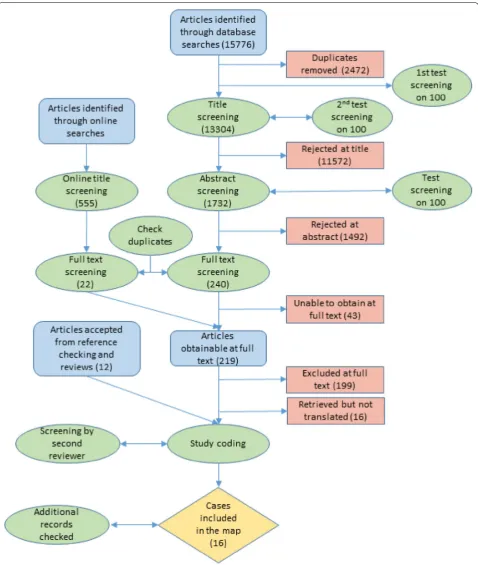
All articles selected as meeting the review inclusion criteria at full-text and subjected to study coding were assessed independently by two reviewers to check for consistency and any discrepancies discussed with a third reviewer if agreement could not be reached. Any arti-cles that were identified for full text assessment but were either unavailable to the review team or were excluded for failing to meet the inclusion criteria at full text are listed in Additional file 2, along with reasons for their exclusion. The number of studies included or excluded at each stage of the systematic mapping process were recorded in a flowchart.
Study quality assessment
Data coding strategy
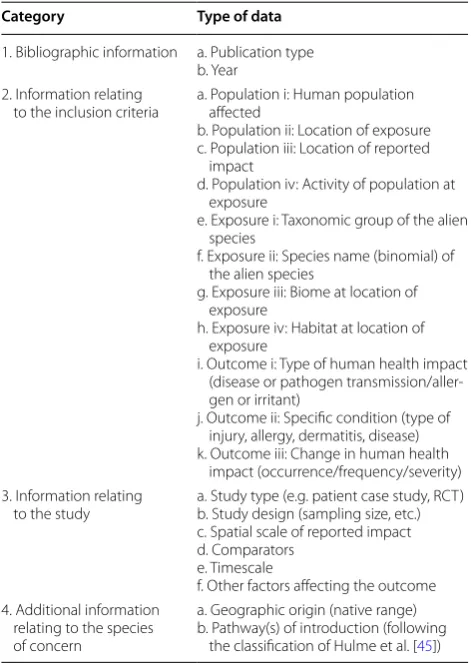
All studies assessed at full text that were deemed to meet the systematic map inclusion criteria were subject to data extraction and coding by one reviewer and checked by a second to minimise errors and ensure consistency. Map codes were devised by the reviewers and were piloted during a data extraction test to ensure they were suitable for the types of information required. Initially, study cod-ing was trialled uscod-ing Google Forms as per Bottrill et al. [14], however a specially designed spreadsheet generated in Microsoft Excel was used for the final review so that reviewers could work offline. Studies were coded for four types of information (Table 2). Data for categories 1–3 (i.e. bibliographic information, information relating to the inclusion criteria, and information relating to the study) were retrieved from the included studies (where pre-sented), but data for the fourth category (i.e. additional information relating to the species of concern including geographic origin and pathways of introduction) were retrieved by the reviewers from the databases EASIN (http://easin.jrc.ec.europa.eu/use-easin/species-search),
NOBANIS (https://www.nobanis.org/) and DAISIE (http://www.europe-aliens.org/) if available. For some categories, multiple codes were applied (for example, where a species is believed to have been introduced along multiple pathways).
Study mapping
Once relevant studies were assessed, coded and checked by a second reviewer, the data were included in a search-able spreadsheet detailing each of the coded varisearch-ables. Simple descriptive statistics relating to key trends in the final dataset were generated in Excel for presentation in the final systematic map report.
Results
Review descriptive statistics
A flow chart showing the number of studies identified, included and excluded at each stage of the systematic mapping process is provided in Fig. 2. The bibliographic database and Google Scholar searches yielded a total of 15,776 search results. Of these, 2472 were removed as duplicates using the automatic duplicate removal func-tion in EndNote. The remaining 13,304 results were screened at title, abstract and then full text against the inclusion criteria and additional duplicates (undetected by EndNote) were removed manually. Results from the other searches (of the specialist sources and hand searches of recent journal issues) yielded over 550 results and were screened at title level online. Although more than 200 articles were selected for assessment at full text, with 43 unobtainable and a number available in non-Eng-lish languages, only sixteen cases were included in the final systematic map of the evidence (Additional file 3).
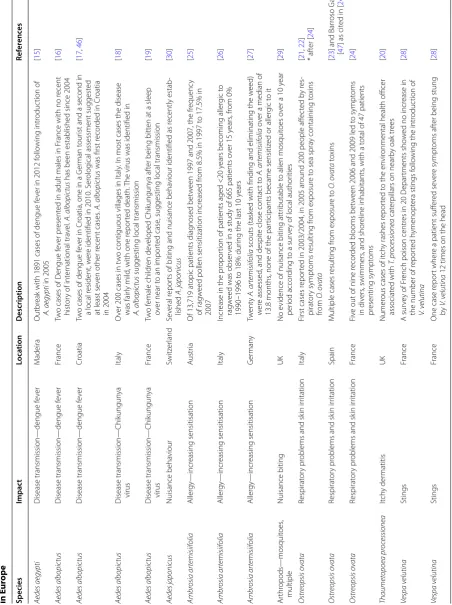
Mapping the quantity of papers relevant to the question There is currently little evidence demonstrating a change in the occurrence, frequency or severity of human health impacts resulting from exposure to alien species in Europe. The evidence base predominantly constitutes data on arthropods, plants and algae taken from jour-nal articles published since 2001 (Table 3), and much of the available evidence represents first reports of illness or injury resulting from exposure to alien species. Five studies provide the first reports of transmission of exotic diseases (two of Chikungunya virus and three of dengue fever) by non-native mosquito species of the Aedes genus (A. albopictus and A. aegypti) established within Europe [15–19]. Two adults were infected with dengue in France in 2010 [16], and around 17 in Croatia following identifi-cation of dengue fever in a returning German tourist the same year [17]. An outbreak of dengue fever in Madeira, Portugal in 2012 (the first dengue epidemic reported in Europe since 1928) affected at least 1800 people within a
Table 2 Categories used for coding studies included in the systematic map at full text
Category Type of data
1. Bibliographic information a. Publication type b. Year
2. Information relating
to the inclusion criteria a. Population i: Human population affected b. Population ii: Location of exposure c. Population iii: Location of reported
impact
d. Population iv: Activity of population at exposure
e. Exposure i: Taxonomic group of the alien species
f. Exposure ii: Species name (binomial) of the alien species
g. Exposure iii: Biome at location of exposure
h. Exposure iv: Habitat at location of exposure
i. Outcome i: Type of human health impact (disease or pathogen transmission/aller-gen or irritant)
j. Outcome ii: Specific condition (type of injury, allergy, dermatitis, disease) k. Outcome iii: Change in human health
impact (occurrence/frequency/severity) 3. Information relating
to the study a. Study type (e.g. patient case study, RCT)b. Study design (sampling size, etc.) c. Spatial scale of reported impact d. Comparators
e. Timescale
f. Other factors affecting the outcome 4. Additional information
relating to the species of concern
a. Geographic origin (native range) b. Pathway(s) of introduction (following
matter of months [15]. In 2007 in Ravenna, Italy, an out-break of Chikungunya virus perhaps introduced by a visi-tor from India affected two villages, leaving over 200 ill
Table
3
Summar
y of
studies demonstr
ating a change in
the o
ccurr
enc
e, fr
equenc
y or se
verit
y of
human health impac
ts r esulting fr om exp osur e t o alien sp ecies in E ur op e Species Impac t Loca tion Description Ref er enc es Aedes aegypti Disease transmission— dengue f ev er M adeira Outbr
eak with 1891 cases of dengue f
ev
er in 2012 f
ollo wing intr oduc tion of A. aegypti in 2005 [ 15 ] Aedes albopictus Disease transmission— dengue f ev er France Tw
o cases of D
engue f
ev
er pr
esent
ed in adult males in F
rance with no r
ecent
hist
or
y of int
er
national tra
vel
.
A. albopictus
has been established since 2004
[ 16 ] Aedes albopictus Disease transmission— dengue f ev er Cr oatia Tw
o cases of dengue f
ev
er in Cr
oatia, one in a G
er
man t
our
ist and a second in
a local r
esident, w
er
e identified in 2010. S
er
olog
ical assessment suggest
ed
at least se
ven other r
ecent cases
.
A. albopictus
was first r
ecor
ded in Cr
oatia in 2004 [ 17 , 46 ] Aedes albopictus Disease transmission— Chik ungun ya virus Italy O
ver 200 cases in t
w
o contiguous villages in I
taly
. I
n most cases the disease
was fair
ly mild
, with one r
epor
ted death.
The virus was identified in
A. albopictus
suggesting local transmission
[ 18 ] Aedes albopictus Disease transmission— Chik ungun ya virus France Tw o f emale childr en de veloped Chik ungun ya af
ter being bitt
en at a sleep
ov
er near t
o an impor
ted case
, suggesting local transmission
[ 19 ] Aedes japonicus Nuisance beha viour Switz er land Se veral r epor
ts of biting and nuisance beha
viour identified as r
ecently estab -lished A. japonicus [ 30 ] Ambr osia ar temisiifolia Aller gy—incr easing sensitisation A ustr ia O
f 13,719 at
opic patients diag
nosed bet
w
een 1997 and 2007, the fr
equenc
y
of ragw
eed pollen sensitization incr
eased fr
om 8.5% in 1997 t
o 17.5% in
2007 [ 25 ] Ambr osia ar temisiifolia Aller gy—incr easing sensitisation Italy Incr
ease in the pr
opor
tion of patients aged <20
y
ears becoming aller
gic t
o
ragw
eed was obser
ved in a study of 665 patients o
ver 15 y ears , fr om 0% 1990–1996 t
o 18% dur
ing the last 10
y ears [ 26 ] Ambr osia ar temisiifolia Aller gy—incr easing sensitisation G er man y Tw ent y A. ar temisiifolia scouts (task
ed with finding and eliminating the w
eed)
w
er
e assessed
, and despit
e close contac
t t
o
A. ar
temisiifolia
o
ver a median of
13.8
months
, none of the par
ticipants became sensitiz
ed or aller
gic t o it [ 27 ] Ar thr opods—mosquit oes , multiple Nuisance biting UK No e
vidence of nuisance biting attr
ibutable t
o alien mosquit
oes o
ver a 10
y
ear
per
iod accor
ding t
o a sur
ve
y of local author
ities [ 29 ] O str eopsis o vata Respirat or y pr
oblems and sk
in ir
ritation
Italy
First cases r
epor
ted in 2003/2004, in 2005 ar
ound 200 people aff
ec ted b y r es -pirat or y sympt oms r esulting fr om exposur e t
o sea spra
y containing t
oxins from O . o vata [ 21 , 22 ] * af ter [ 24 ] O str eopsis o vata Respirat or y pr
oblems and sk
in ir
ritation
Spain
M
ultiple cases r
esulting fr om exposur e t o O . o vata to xins [ 23
] and Bar
roso G ar cía et al . [ 47
] as cit
ed in [
24 ] O str eopsis o vata Respirat or y pr
oblems and sk
in ir
ritation
France
Fiv
e out of nine r
ecor
ded blooms bet
w
een 2006 and 2009 led t
o sympt
oms
in div
ers
, swimmers
, and shor
eline inhabitants
, with a t
otal of 47 patients
pr esenting sympt oms [ 24 ] Thaumetopoea pr oc essionea Itch y der matitis UK Numer
ous cases of it
ch
y rashes r
epor
ted t
o the en
vir
onmental health officer
associat ed with T. pr oc essionea cat er
pillars on near
by oak tr
ees [ 20 ] Vespa v elutina Stings France A sur ve
y of F
rench poison centr
es in 20 D
epar
tments sho
w
ed no incr
ease in
the number of r
epor
ted h
ymenopt
era stings f
ollo
wing the intr
oduc tion of V. v elutina [ 28 ] Vespa v elutina Stings France
One case r
epor
t wher
e a patient suff
er
ed se
ver
e sympt
oms af
ter being stung
by
V. v
elutina
12 times on the head
[
28
Although these studies represent outbreaks occurring at a relatively local scale, the number of individuals affected ranged from 2 to more than 2000. Another impact arising from contact with alien animal species is contact derma-titis. The first localised reports of dermatitis associated with contact with caterpillars of the oak processionary moth Thaumetopoea processionea follow the accidental introduction of the species to London (UK) from con-tinental Europe on imported trees [20]. Local residents and management workers were affected.
Evidence also suggests that harmful blooms of alien uni-cellular algae such as Ostreopsis species are causing sig-nificant health impacts along European coasts, with cases reported from Italy [21, 22], Spain and France [23, 24]. Numbers affected ranged from only a handful of cases to over two hundred depending on the outbreak. Those affected were beach users involved in a range of recrea-tional activities including swimming and diving, and suf-fered from both respiratory problems and skin irritations following contact that regressed over time [24].
Not all studies present first reports of impacts. Several large-scale long term studies of individuals with allergic symptoms demonstrate changes in sensitisation levels to Ambrosia artemisiifolia among the general popula-tion across Europe, indicating that levels of sensitisapopula-tion are rising and the proportion of young people sensi-tised is increasing [25, 26]. However, Brandt et al. [27] found no sensitisation or allergy development in a sam-ple of 20 ragweed workers resulting from exposure to A. artemisiifolia.
Other studies demonstrated no significant change in impacts over time. De Haro et al. [28] reported no increase in the number of hospitalisations resulting from envenomations following the introduction of Vespa velu-tina to France, although evidence that at least one enven-omation has occurred exists, and similarly, Medlock et al. [29] reported no calls to local authorities resulting from nuisance biting caused by non-native mosquito species in England (all calls were for native species). However, in Switzerland, reports of nuisance biting from the mos-quito Aedes japonicus were reported following introduc-tion [30].
The main pathways of arrival of the alien species with health impacts included in this map are as contaminants or as stowaways, originating from Asia, North America and Africa.
Mapping the quality of papers relevant to the question Most papers included in the systematic map present numbers of patients affected by an illness or outbreak resulting from environmental exposure to an alien spe-cies and so many of the features associated with a well-designed scientific experiment are lacking. For example,
temporal and geographical scales tend to reflect the extent of the outbreak and comparators are rarely reported. Studies that assess longer term impacts (e.g. Ambrosia [25, 26]) tend to report longer time periods and larger geographic areas but are still reliant on recorded data of impacts. These data reflect only those individuals contacting relevant agencies or reporting symptoms (e.g. to allergy centres), and so anyone affected that did not seek medical attention, or conversely, anyone exposed who did not experience symptoms, will not be repre-sented. Many studies were excluded because there was no attempt to include a temporal comparator.
Discussion
Perhaps the greatest threat to human health in Europe currently posed by alien species is the transmission of exotic diseases by non-native arthropods. Some patho-gens have the potential to significantly affect large num-bers of citizens within relatively short time frames, as demonstrated for example by the outbreak of Chikun-gunya fever in Italy (e.g. [32]). Despite a relative lack of evidence within this map on allergenic plant species, sensitivity to A. artemisiifolia appears to be increasing in Europe. There is much data available in the literature (for example on pollen loads and season lengths) that sug-gests the spread of this allergenic species will continue to increase the burden on health care systems result-ing from the treatment of long-term allergic conditions. Other health impacts are likely to result from either potentially high contact but temporally and geographi-cally restricted events associated with seasonal abun-dance of species with cyclic populations, or ad hoc events resulting from random encounters such as envenoma-tions by V. velutina. Increased monitoring and reporting is critical to establish baselines in impact data and iden-tify any geographic and temporal trends.
For many health-relevant alien species, knowledge gaps must be interpreted as lack of accessible data rather than providing evidence of no impact. It may be the case that evidence exists but it is not accessible using stand-ard systematic reviewing or mapping methodologies, and that alternative methods (for example, compiling data from press reports or accessing national medical records or databases) must be used to increase the informa-tion available in this area. For many alien species, exist-ing evidence of health impacts did not fit the inclusion criteria for this map (for example ad hoc case reports referring to injuries sustained following contact with H. mantegazzianum as mentioned above) and this may be a suitable topic for a future evidence map to help quan-tify the health impacts of alien species. Regardless, a lack of baseline data on the health impacts of alien species is concerning as without this evidence it is difficult to establish how much of a risk these species pose to human health currently and in the foreseeable future and there-fore to determine an appropriate management response. Further, without a better understanding of which species pose a tangible threat and where, it is difficult to justify or target awareness raising measures for relevant primary care workers, meaning that patients may not receive an accurate or as rapid diagnosis as possible.
Although there is relatively little direct evidence of trends in health impacts of alien species in Europe, there is much related literature that did not fit the criteria for inclusion in this systematic map but which may provide valuable infor-mation to help inform decisions. Examples of this indirect evidence not contained within the map include:
• Individual case reports. Although these case reports provide valuable evidence that a given species is hav-ing an impact (e.g. [31]), they do not represent the magnitude of effects or whether changes are occur-ring, and as ad hoc events do not provide an accurate baseline against which to measure future changes. An exception is where a case report represents the first report of an impact from a new area as it shows that the alien species is present where it previously was not. This information was included in the map.
• Studies looking at vector competence. Evidence that specific species can carry and transmit particular diseases (or evidence for feeding on different hosts) is likely to be valuable when assessing the potential risks posed by introduced vector species but does not provide evidence of an impact and so has not been included here.
• Studies looking at levels of sensitivity or reactivity to allergenic substances without a comparator. For example, studies showing the prevalence of sensitiv-ity to A. artemisiifolia would not be included unless there was evidence that levels of sensitivity had changed over time or due to exposure.
in the wild, meaning that the risk of injury or disease transmission is likely to be different.
• Impacts caused by exotic diseases that have been contracted by humans returning from endemic areas, unless there appears to have been subsequent local spread by alien species (e.g. [35]).
• Impacts resulting from the introduction of free-living microorganisms that may pose a threat to human health when accidentally imported. For example, a number of harmful microorganisms have been trans-ported internationally in ballast water (e.g. [36, 37]).
• Impacts resulting from intentional ingestion of alien species. For example, Datura stramonium is some-times consumed recreationally for its hallucinogenic effects, and has been implicated in hospitalisations both within Europe [38] and elsewhere (e.g. [39, 40]). Although the number of voluntary poisonings result-ing from D. stramonium consumption in France appears to be increasing [38], the reasons for this are complex and may relate to increasing popular-ity among recreational drug users rather than abun-dance in the wild.
• Studies that deal with health-relevant alien species, but not with their explicit health impacts, even if some covered topics such as management costs or impacts of global change.
Given the limited evidence base available, it is diffi-cult to currently assess the extent of the impacts of alien species on human health, let alone determine whether global change is driving changes in the occurrence, fre-quency or severity of human health impacts and, if so, in which directions. Better linking between data on spread/abundance and human health impacts over time (and ideally from the point of introduction onwards for species that are not yet established or still spreading) are required to explore this issue further, and are likely to require collaborative approaches between the envi-ronmental and the health communities. The taxonomic and geographical biases in the available data make it difficult to draw broader conclusions about changes in health impacts as they may not transfer across species or regions. For established alien species that are wide-spread, studies correlating health impacts against abun-dance or comparing different climatic conditions (such as annual rainfall) or management regimes on health outcomes may be valuable in helping to determine their impacts. For more recently introduced species, studies mapping health impacts may help to monitor spread, focus awareness raising activities aimed at minimising exposure, and provide justification for action aimed at containing the species within a restricted area if eradica-tion is not possible. However, this research suggests that
these types of studies are still relatively rare in the scien-tific literature.
Limitations of the map
Systematic reviews and maps aim to undertake com-prehensive searches using bibliographic databases, but it is impossible to undertake exhaustive searches of all potentially relevant sources due to resourcing and lan-guage constraints. Even within the results retrieved for this systematic map, there are a number of studies that were unobtainable or published in languages other than English, and so have not been included in the final evi-dence base. As with any systematic review or map, it is also possible that some relevant studies may have been missed during the searching or screening processes as a result of human error, unclear reporting by the pri-mary authors or use of different terminology from that used here. Further, studies in which relevant species are grouped generally with other (native) species are unlikely to have been detected without specific reference to the search terms identified here. However, this map provides the most comprehensive collection of evidence on this topic to date, and highlights some important limitations that need to be addressed to develop this evidence base in the future.
Revisiting the conceptual model
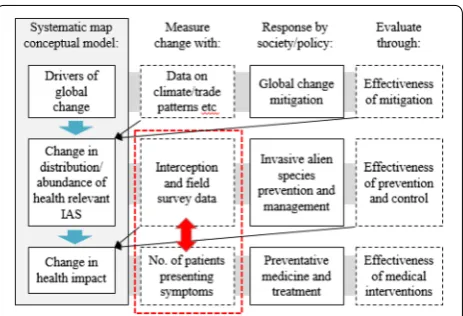
We believe the conceptual model originally presented in our protocol, although simplistic, to be generally cor-rect. However, we expand it out to include the differ-ent types of data that relate to each of the compondiffer-ents (Fig. 3) and highlight knowledge gaps and opportunities for future research. The topic of this systematic map (in red in Fig. 3) suggests that there have been relatively few studies directly linking either changes in the abundance or spread of alien species with the human health impacts with which they are associated. However, other areas identified within our conceptual diagram—effectiveness of management of either species or health impacts—are potential topics for further study. For example, data exist on the effectiveness of management of A. artemisiifolia (e.g. [41–43]) and on the effectiveness of treatments for allergies caused by Ambrosia pollen and may prove valu-able areas to pursue in future systematic reviews.
Future updating of the map
to whether there is much potential evidence being pub-lished and should be undertaken before an update is commenced.
Conclusions
There is some evidence for changes in the human health impacts of alien species within Europe over the last 25 years. However, compared to the relevance of the topic for human well-being (e.g. [44]), there are few stud-ies demonstrating changes in health impacts over time mapped to changing spread or abundance of the alien species. Relevant studies relate to only a few species, often report specific cases or outbreaks, and rarely link health impacts with ecology, distribution or spread of the species, or with public health. Difficulties in attrib-uting human health impacts such as stings or allergies to a specific species likely complicate attempts to meas-ure changes, as do different research interests between ecologists and health professionals. Better cooperation between invasion ecologists, health professionals and others working in affected areas are likely to be necessary to improve the evidence base on this topic for the future.
Implications for policy/management
There is a clear need for better recording/reporting of impacts to determine whether particular alien spe-cies present a human health issue or not, to identify any trends (such as changes in impacts) and to inform policy and management appropriately. We recommend that a precautionary approach is adopted towards spe-cies likely to pose a threat to human health, and par-ticularly for those species with demonstrable health impacts noted elsewhere. Prevention, detection and rapid response should be prioritised for species of highest con-cern and risk not yet present and preparations made to raise awareness among relevant professionals (e.g. doc-tors, environmental managers) and publics most likely to encounter the species (e.g. swimmers, gardeners as appropriate) to facilitate identification and minimise impacts resulting from exposure. For species already pre-sent in an area, more thorough assessment of the scale of impacts to date would be valuable in justifying the case for management (or otherwise), and in helping to inform other areas not yet affected by the potential impacts. Depending on the species of concern, alternative forms of data such as vector competence or population sen-sitivity may be necessary to underpin prioritisation or management decisions until suitable evidence regarding absolute trends in health impacts have been established.
Implications for health professionals
Better awareness of the issue of alien species with potential health impacts among health professionals
may be desirable to aid in diagnosing and, in relevant cases, reporting. In particular, knowledge of emerging threats from species that have been recently introduced or are likely to arrive (so called ‘alert species’) could aid in tracking spread, assessing impacts and prioritising management. Understanding seasonal, temporal and geographical changes in the frequency or severity of symptoms associated with specific species (if possible to determine) could also aid in diagnosis and appropri-ate treatment. This may require a mechanism by which impacts can be reported and recorded to contribute to an evidence base in this area, similar to those used for notifi-able diseases. For now, we strongly advocate that health professionals report unusual health impacts relating to alien species in the scientific literature.
Implications for research
Researchers could helpfully aim to link reported human health impacts with ecological aspects to expand the evi-dence base on this potentially important topic, rather than studying one or the other in isolation—in particular studies matching data on spread or abundance over time to recorded health impacts would be beneficial (i.e. link-ing data contained within the red box in Fig. 3), rather than using proxy measures or inferring links. Longer term datasets will prove important in assessing any potential changes in impacts, even if just to compare levels of sen-sitisation or impact on the population. For example, stud-ies reporting sensitisation rates to Ambrosia or impacts resulting from exposure to harmful algal blooms could usefully include data from multiple years to see whether levels change over time. Also, related areas (for example vector competence) may provide a useful tool for assess-ing risk but a better understandassess-ing of how these translate into actual health impacts is necessary, particularly where actual impacts may differ due to different physical, envi-ronmental or climatic conditions between different parts of the affected range. This requires collaborative working between both research communities but may also open up new funding avenues for researchers wishing to con-duct studies at the interface between ecology or biogeog-raphy and human health.
Authors’ contributions
HB, SS, AP, FE and WR developed the review protocol. HB and MA conducted the searches. HB, SS and MA screened the search results, undertook full text
Additional files
Additional file 1. Full details of searches conducted.
Additional file 2. List of studies excluded at full text with reasons for exclusion.
assessment and coded relevant studies for inclusion in the map. HB, SS and AP drafted the review manuscript with input from MA, FE and WR. All authors read and approved the final manuscript.
Author details
1 Centre for Evidence-Based Conservation, School of the Environment, Natural Resources and Geography, Bangor University, Bangor LL57 2UW, UK. 2 Environ-ment Agency Austria, Spittelauer Lände 5, 1090 Vienna, Austria. 3 Division of Conservation Biology, Vegetation and Landscape Ecology, University of Vienna, Rennweg 14, 1030 Vienna, Austria.
Acknowledgements
We thank Hans-Peter Hutter and Peter Wallner and two anonymous referees for comments that informed the review methodology and Bethan O’Leary for assistance with the database searches and Irene Oberleitner for her support in finding full text articles. We thank two referees for their comments that helped refine the final manuscript.
Competing interests
The authors declare that they have no competing interests.
Availability of data and materials
Data generated or analysed during this study are included in this published article and its additional information files. A file containing all 15,776 detected articles is available from the corresponding author on request.
Sources of support
This study was funded under the Austrian Climate and Energy Fund within the Framework of the ACRP Program (Project Number KR13AC6K11141).
Publisher’s Note
Springer Nature remains neutral with regard to jurisdictional claims in pub-lished maps and institutional affiliations.
Received: 17 January 2017 Accepted: 27 July 2017
References
1. Schindler S, Staska B, Adam M, Rabitsch W, Essl F. Alien species and public health impacts in Europe: as literature review. NeoBiota. 2015;27:1–23. 2. Hulme PE. Invasive species challenge the global response to emerging
diseases. Trends Parasitol. 2014;30:267–70.
3. Mazza G, Tricarico E, Genovesi P, Gherardi F. Biological invaders are threats to human health: an overview. Ethol Ecol Evol. 2014;26:112–29. 4. Tatem AJ, Rogers DJ, Hay SI. Global transport networks and infectious
disease spread. Adv Parasitol. 2006;62:293–343.
5. Essl F, Dullinger S, Rabitsch W, Hulme PE, Hülber K, Jarošík V, Kleinbauer I, Krausmann F, Kühn I, Nentwig W, Vilà M, Genovesi P, Gherardi F, Desprez-Loustau M-L, Roques A, Pyšek P. Socioeconomic legacy yields an invasion debt. PNAS. 2011;108(1):203–7.
6. Hellmann JJ, Byers JE, Bierwagen BG, Dukes JS. Five potential con-sequences of climate change for invasive species. Conserv Biol. 2008;22:534–43.
7. Dukes JS, Mooney HA. Does global change increase the success of biological invaders? Trends Ecol Evol. 1999;14:135–9.
8. Mooney HA, Hobbs RJ. Invasive species in a changing world. Washington: Island Press; 2000.
9. Bayliss HR, Schindler S, Essl F, Rabitsch W, Pullin AS. What evidence exists for changes in the occurrence, frequency or severity of human health impacts resulting from exposure to alien invasive species in Europe? A systematic map protocol. Environ Evid. 2015;4:10.
10. Collaboration for Environmental Evidence. Guidelines for systematic review and evidence synthesis in environmental management. Version 4.2. Environmental Evidence. 2013. http://www.environmentalevidence. org/Documents/Guidelines/Guidelines4.2.pdf. Accessed 2 Aug 2017. 11. Richardson DM, Pyšek P, Rejmánek M, Barbour MG, Panetta FD, West CJ.
Naturalization and invasion of alien plants: concepts and definitions. Divers Distrib. 2000;6:93–107.
12. Blackburn TM, Pyšek P, Bacher S, Carlton JT, Duncan RP, Jarošík V, Wilson JRU, Richardson DM. A proposed unified framework for biological inva-sions. Trends Ecol Evol. 2011;26:333–9.
13. Cohen J. A coefficient of agreement for minimal scales. Educ Psychol Meas. 1960;20:37–46.
14. Bottrill M, Cheng S, Garside R, Wongbusarakum S, Roe D, Holland M, et al. What are the impacts of nature conservation interventions on human wellbeing: a systematic map protocol. Environ Evid. 2014;3:16. 15. Sousa CA, Clairouin M, Seixas G, et al. Ongoing outbreak of dengue type
1 in the Autonomous Region of Madeira, Portugal: preliminary report. Euro Surveill. 2012;17:20333.
16. La Ruche G, Souarès Y, Armengaud A, Peloux-Petiot F, Delaunay P, Desprès P, et al. First two autochthonous dengue virus infections in metropolitan France, September 2010. Euro Surveill. 2010;15(39):19676.
17. Gjenero-Margan I, Aleraj B, Krajcar D, Lesnikar V, Klobučar A, Pem-Novosel I. Autochthonous dengue fever in Croatia, August–September 2010. Euro Surveill. 2011;16:19805.
18. Rezza G, Nicoletti L, Angelini R, Romi R, Finarelli AC, Panning M, et al. Infection with chikungunya virus in Italy: an outbreak in a temperate region. Lancet. 2007;370:1840–6.
19. Grandadan M, Caro V, Plumet S, et al. Chikungunya virus, Southeastern France. Emerg Infect Dis. 2011;17(5):910–3.
20. Mindlin MJ, de Waroux OL, Case S, Walsh B. The arrival of oak procession-ary moth, a novel cause of itchy dermatitis, in the UK: experience, lessons and recommendations. Public Health. 2012;126(9):778–81.
21. Gallitelli M, Ungaro N, Addante LM, Procacci V, Silveri NG, Sabba C. Respiratory illness as a reaction to tropical algal blooms occurring in a temperate climate. JAMA. 2005;293(21):2595–600.
22. Brescianini C, Grillo C, Melchiorre N, Bertolotto R, Ferrari A, Vivaldi B, Icardi G, Gramaccioni L, Funari E, Scardala S. Ostreopsis ovata algal blooms affecting human health in Genova, Italy, 2005 and 2006. Euro Surveill. 2006;11(9):E060907.
23. Kermarec F, Dor F, Armengaud A, Charlet F, Kantin R, Sauzade D, Gian-netti S, de Haro L. Les risques sanitaires liés à la présence d’Ostreopsis ovata dans les eaux de baignade ou d’activités nautiques. ERS. 2008;7(5):357–63.
24. Tichadou L, Glaizal M, Armengaud A, Grossel H, Lemée R, Kantin R, Lasalle J-L, Drouet G, Rambaud L, Malfait P, de Haro L. Health impact of unicel-lular algae of the Ostreopsis genus blooms in the Mediterranean Sea: experience of the French Mediterranean coast surveillance network from 2006–2009. Clin Toxicol. 2010;48(8):839–44.
25. Hemmer W, Schauer U, Trinca A, Neumann C, Jarisch R. Ragweed pollen allergy in Austria: a retrospective analysis of sensitization rates from 1997 to 2007. J Allergy Clin Immunol. 2011;127:AB170.
26. Asero R. The changing pattern of ragweed allergy in the area of Milan, Italy. Allergy. 2007;62(9):1097–9.
27. Brandt O, Zuberbier T, Bergman K-C. Risk of sensitization and allergy in Ragweed workers—a pilot study. Allergy Asthma Clin Immunol. 2014;10(1):1.
28. De Haro L, Labadie M, Chanseau P, Cabot C, Blanc-Brisset I, Penouil F, NATL COORDINATION COMM TOXICOVIGIL. Medical consequences of the Asian black hornet (Vespa velutina) invasion in Southwestern France. Toxicon. 2010;55(2–3):650–2.
29. Medlock JM, Hansford KM, Anderson M, Mayho R, Snow KR. Mosquito nuisance and control in the UK—a questionnaire-based survey of local authorities. Eur Mosq Bull. 2012;30:15–29.
30. Schaffner F, Kaufmann C, Hegglin D, Mathis A. The invasive mosquito Aedes japonicus in Central Europe. Med Vet Entomol. 2009;23:448–51. 31. Chan JCY, Sullivan PJ, O’Sullivan MJ, Eadie PA. Full thickness burn
caused by exposure to giant hogweed: delayed presentation, histologi-cal features and surgihistologi-cal management. J Plast Reconstr Aesthet Surg. 2011;64:128–30.
32. Schaffner F, Medlock JM, Bortel W. Public health significance of invasive mosquitoes in Europe. Clin Microbiol Infect. 2013;19:685–92. 33. Editorial team, Bertrand S, Rimhanen-Finne R, Weill FX, Rabsch W,
Thornton L, Perevoščikovs J, van Pelt W, Heck M. Salmonella infections associated with reptiles: the current situation in Europe. Euro Surveill. 2008;13(24):18902.
• We accept pre-submission inquiries
• Our selector tool helps you to find the most relevant journal
• We provide round the clock customer support
• Convenient online submission
• Thorough peer review
• Inclusion in PubMed and all major indexing services
• Maximum visibility for your research
Submit your manuscript at www.biomedcentral.com/submit
Submit your next manuscript to BioMed Central
and we will help you at every step:
35. Mittermayer H, Haditsch M. Parasitic diseases and arthropod-borne infec-tions in travel medicine. Denisia. 2002;6:557–71.
36. Altug G, Gurun S, Cardak M, Ciftci PS, Kalkan S. The occurrence of patho-genic bacteria in some ships’ ballast water incoming from various marine regions to the Sea of Marmara, Turkey. Mar Environ Res. 2012;81:35–42. 37. Gollasch S, Minchin D, Matej D. The transfer of harmful aquatic organisms
and pathogens with ballast water and their impacts. In: Matej D, Gollasch S, editors. Global maritime transport and ballast water management, vol. 8. Dordrecht: Invading Nature—Springer Series in Invasion Ecology; 2014. p. 35–58.
38. Arouko H, Matray M, Bragança C, Mpaka J, Chinello L, Castaing F, Bartou C, Poisot D. Voluntary poisoning by ingestion of Datura stramonium. Another cause of hospitalization in youth seeking strong sensations. Ann Med Interne. 2003;154:46–50.
39. Soneral SN, Connor NP. Jimson weed intoxication in five adolescents. Wisc Med J. 2005;104:70–2.
40. Fuchs J, Rauber-Lüthy C, Kupferschmidt H, Kupper J, Kullak-Ublick GA, Ceschi A. Acute plant poisoning: analysis of clinical features and circum-stances of exposure. Clin Toxicol. 2011;49:671–80.
41. Milakovic I, Fiedler K, Karrer G. Management of roadside populations of invasive Ambrosia artemisiifolia by mowing. Weed Res. 2014;54:256–64. 42. Essl F, Biró K, Brandes D, Broennimann O, Bullock JM, Chapman DS,
et al. Biological flora of the British Isles: Ambrosia artemisiifolia. J Ecol. 2015;103:1069–98.
43. Schindler S, Bayliss H, Essl F, Rabitsch W, Follak S, Pullin AS. Management effectiveness of invasive common ragweed Ambrosia artemisiifolia: a systematic review protocol. Environ Evid. 2016;5:11.
44. Rabitsch W, Essl F, Schindler S. The rise of non-native vectors and reser-voirs of human diseases. In: Vila M, Hulme PE, editors. Impact of biological invasions on ecosystem services, vol. 12. Cham: Invading Nature— Springer Series in Invasion Ecology; 2017. p. 263–75.
45. Hulme PE, Bacher S, Kenis M, Klotz S, Kühn I, Minchin D, et al. Grasping at the routes of biological invasions: a framework for integrating pathways into policy. J Appl Ecol. 2008;45:403–14.
46. Schmidt-Chanasit J, Haditch M, Schöneberg I, Günther S, Stark K, Frank C. Dengue virus infection in a traveller returning from Croatia to Germany. Euro Surveill. 2010;15:19677.