REVIEW
High resolution remote sensing
for reducing uncertainties in urban forest
carbon offset life cycle assessments
Jan Tigges
*and Tobia Lakes
Abstract
Background: Urban forests reduce greenhouse gas emissions by storing and sequestering considerable amounts of carbon. However, few studies have considered the local scale of urban forests to effectively evaluate their poten-tial long-term carbon offset. The lack of precise, consistent and up-to-date forest details is challenging for long-term prognoses. Therefore, this review aims to identify uncertainties in urban forest carbon offset assessment and discuss the extent to which such uncertainties can be reduced by recent progress in high resolution remote sensing. We do this by performing an extensive literature review and a case study combining remote sensing and life cycle assess-ment of urban forest carbon offset in Berlin, Germany.
Main text: Recent progress in high resolution remote sensing and methods is adequate for delivering more precise details on the urban tree canopy, individual tree metrics, species, and age structures compared to conventional land use/cover class approaches. These area-wide consistent details can update life cycle inventories for more precise future prognoses. Additional improvements in classification accuracy can be achieved by a higher number of fea-tures derived from remote sensing data of increasing resolution, but first studies on this subject indicated that a smart selection of features already provides sufficient data that avoids redundancies and enables more efficient data processing. Our case study from Berlin could use remotely sensed individual tree species as consistent inventory of a life cycle assessment. However, a lack of growth, mortality and planting data forced us to make assumptions, therefore creating uncertainty in the long-term prognoses. Regarding temporal changes and reliable long-term estimates, more attention is required to detect changes of gradual growth, pruning and abrupt changes in tree planting and mortality. As such, precise long-term urban ecological monitoring using high resolution remote sensing should be intensified, especially due to increasing climate change effects. This is important for calibrating and validating recent prognoses of urban forest carbon offset, which have so far scarcely addressed longer timeframes. Additionally, higher resolution remote sensing of urban forest carbon estimates can improve upscaling approaches, which should be extended to reach a more precise global estimate for the first time.
Conclusions: Urban forest carbon offset can be made more relevant by making more standardized assessments available for science and professional practitioners, and the increasing availability of high resolution remote sensing data and the progress in data processing allows for precisely that.
Keywords: Urban remote sensing, Life cycle assessment, Urban forests, Carbon offset, Uncertainty, High resolution, Individual tree detection, Tree species, Change detection, Climate change mitigation
© The Author(s) 2017. This article is distributed under the terms of the Creative Commons Attribution 4.0 International License (http://creativecommons.org/licenses/by/4.0/), which permits unrestricted use, distribution, and reproduction in any medium, provided you give appropriate credit to the original author(s) and the source, provide a link to the Creative Commons license, and indicate if changes were made.
Open Access
*Correspondence: [email protected]
Background
Studies around the world have confirmed the role urban forests play in reducing greenhouse gas emissions by storing and sequestering a considerable amount of car-bon [1–4]. However, urban forest carbon offset is still regarded with uncertainty due to the lack of precise details on global coverage [5]. Additionally, the urban scale has become more relevant due to the steady fail-ure of global policies to effectively regulate local carbon emissions. Recent carbon ratings and initiatives should therefore not underestimate the local scale of urban for-est carbon offset and should be sure to effectively evalu-ate their potential long-term offset [6].
Urban forests have been discussed as a potential new source of carbon credits, such as by raising revenue for future green investments. Therefore, knowledge of local conditions is essential to better evaluate future oppor-tunities, such as urban carbon offset markets, which have gained considerable interest among local govern-ments [7–9]. This could also take into account aspects of avoided emissions and climate change damage, which are commonly referred to as “social costs of CO2 emis-sions” (SCC) [10]. According to the estimated SCC for 2010 (USD 80 per ton of carbon), US urban forests have stored approximately USD 50 billion in value (2005 level) and have sequestered USD 2 billion in value annually [11]. This creates awareness of the matter by monetizing urban forest carbon offset, but the “real” costs can also be underestimated—for instance, SCC calculations do not necessarily fully consider how climate change affects eco-systems, biodiversity loss and limits of resources, which cause uncertainty in SCC estimates [10, 12].
Urban forest carbon offset is by no means a static value, as its complexity and dynamics need to be considered in order to properly assess its long-term net contribution. An example of a more holistic consideration is a life cycle assessment (LCA) to consider urban forests’ carbon bal-ance throughout a lifetime (cradle-to-grave approach) [13]. This allows for more precisely addressing urban for-est heterogeneity and dynamics, for instance: its aspects of structure, planting, maintenance, growth, mortality and more. However, precise information on these fea-tures is scarce, not up-to-date or does not cover large spatial expanses, and therefore more standardized meth-ods are required for consistent spatially explicit informa-tion [14]. Traditional sampling approaches using land use classes for urban forest carbon estimates are less feasible for precisely addressing in-class variability [15]. There is also no consistent global urban tree canopy model con-sidering precise details [5]. Fortunately, this lack of pre-cise, up-to-date and area-wide urban environmental information can be narrowed using recent innovative technology, such as high resolution remote sensing [16].
The aim of this review is to identify high uncertainties in urban forest carbon offset assessment and discuss the extent to which such uncertainties can be reduced by recent progress in high resolution remote sensing. This would help to improve long-term prognoses of urban forest carbon offset, which is essential for better evaluating the effectiveness of local projects like urban forest carbon offset markets. First, we evaluate state-of-the-art studies on urban forest carbon storage and sequestration. We discuss uncertainties of long-term carbon offset including aspects of supply and demand, and more holistic approaches using LCAs. Second, we identify remote sensing’s potential of high resolution imagery to reduce such uncertainties by providing more consistent and detailed tree inventories. Therefore, we refer to potentials and limitations of classifying urban tree canopies, individual trees and urban tree species. Additionally, we show examples of carbon estimates indicating the benefits of an increasing resolution. In the subsequent section, we provide a case study of urban forest carbon offset for the city of Berlin, Ger-many. Our case study results and discussion exemplify carbon offset long-term prognoses by combining recent progress of remotely sensed individual tree species and an LCA of 60 years. Finally, we evaluate further remote sensing potentials of increasing temporal resolution to reduce uncertainties related to urban forest dynamics. This includes aspects of urban tree growth, pruning, mortality and replanting.
Main text
Urban forest carbon offset—status quo and remaining uncertainties
Research on spatiotemporal changes in urban ecosys-tem services still faces challenges due to non-uniform and multifunctional approaches, different methodolo-gies, diverging stakeholders’ interests or a lack of relevant information [21], among others, information on urban forest carbon offset. Especially the lack of information refers to the dynamics of urban forests, which are associ-ated with natural disturbances like differences in growth, diseases, stresses and natural hazards, or to other anthro-pogenic disturbances in particular, such as influences of environmental actors, management, political discourses and related land use change dynamics [17, 22, 23]. Cli-mate change effects can also lead to further exacerbations and stress for urban forests [24]. Because of all of this, it is challenging to account for a thorough consideration for future prognoses, such as for urban forest carbon offset in the long-term. However, the consideration of urban ecosystem service dynamics could serve as advice for sustainable future implementation policies [25], or for improved climate change resilience of and through urban ecosystem services [26].
Current information on supply and demand
Information on the supply of urban forest carbon stor-age and sequestration is not commonly available, and information of the demand side is even scarcer. It has been suggested that there is a need to address the supply and demand of such urban ecosystem services in a more spatially explicit manner [27], and environmental qual-ity and policy goals would need to set a standard for the supply and demand [28]. However, it is still arguable just what the minimum standard for this is, though it would be a certain boundary for assessing and managing urban ecosystem services such as urban forest carbon offset. Zhao et al. [29] focused on differences in forest carbon offset (supply) and total carbon emissions (demand) across the Twin Cities (Minneapolis–Saint Paul) met-ropolitan area of Minnesota, US: sequestration of 2010 could compensate a small rate of 1% of local anthropo-genic carbon emissions, as well as the avoided emissions of already stored carbon should not be underestimated. Additionally, there have been obvious spatial differences that have demonstrated that some counties could com-pensate more than 10% of local carbon emissions using trees, which is slightly higher than what US forests com-pensate for total US averaged carbon emissions accord-ing to information from the Environmental Protection Agency (EPA). Chen [1] showed for 35 major Chinese cities that urban vegetation could offset fossil emission of cities from 0.01% in Hohhot to 22.45% in Haikou in 2010. The dominance of young trees stand of those Chinese cit-ies should not be underestimated, as they will experience substantial growth in the near future. Therefore, forest
growth and planting can notably supplement carbon off-set in the matter of urban carbon footprinting, which has so far been underestimated. Additionally, the demand of anthropogenic carbon emissions has been dominated by fossil energy up until this point. This offers a great deal of potential for being reduced and substituted by alterna-tives, which causes a higher contribution of urban forests’ carbon offset. Consequently, this could increase environ-mental awareness in cities.
More holistic approaches using life cycle assessments
been stated by experts or literature. Emissions due to tree maintenance had been below even 2% concerning the total annual energy consumption of an urban park, as Solà et al. [33] showed in a case study at Montjuïc Park in Barcelona, Spain. However, McPherson et al. [30] addressed the necessity for more efficiency con-cerning the potential to further avoid emissions during maintenance: irrigation and removal of trees accounted for more than 15% of total CO2 emissions, and mulch decomposition of dead tree biomass was responsible for 65.1% during a 40-year LCA of urban trees planted in Los Angeles, US. It also remains unclear the extent to which an increase in maintenance of a single tree and the result-ing increase in CO2 emissions can lead to extended tree longevity and a positive effect on the net carbon balance [34], or if more efficient maintenance can result in both lower emissions and higher tree longevity.
Concluding the complexity of urban forest carbon off-set, LCA seems to be a promising approach for better understanding urban forest dynamics. However, studies on this differ, and most of them address only parts of a complex LCA or consider a small temporal horizon. This has left plenty of space for interpretation regarding how to entirely fulfill the phases of an LCA concerning its suggested formal standard (ISO 14040 and 14044) [13], including: (1) goal and scope definition, (2) inventory analysis, (3) life cycle assessment and (4) interpretation, critical review and reporting. For example, McPherson et al. [30] stated that the available studies on the LCA of urban forest carbon offset have so far failed to account for the full scope of emissions associated at each life stage of a tree. The traditional forestry sector shows similar chal-lenges. Although such studies have been performed since the 1990s, and before urban applications, there is still a lack of consistent and comprehensive studies. Instead, LCA studies differed due to decisive assumptions and their subsequent results concerning system boundaries, functional units, impact categories, considered pro-cesses, allocation, LCA methods, available databases, and accuracy metrics [35]. It would certainly be worthwhile to discuss the LCA of urban forest carbon offset in the matter of harmonization or better comparability, such as by increasing precision and data consistency. This should reduce the high variability of LCA results, and especially address differences in tree mortality and growth; for-est structures concerning size, age, tree species; data on private and public areas; related data retrieval; (re)plant-ing; actual and potential reuse of dead biomass; and other aspects. It has been challenging to retrieve such neces-sary data, especially due to the heterogeneous urban for-est structure, as well as get access to details across public and private space or beyond administrative bounda-ries that are also consistent and up-to-date [17, 36, 37].
Improvements should definitely aim at reducing the expensive and time consuming data collection process, as it is an important part of LCAs [13].
Reducing uncertainties part 1—recent high resolution remote sensing for more consistent urban tree inventories The development and contributions of high resolution remote sensing have been successfully applied to provide input for improved modeling of urban ecosystem ser-vices concerning area-wide details, which are consistent and up-to-date. Generally, this can help to increase the comparability of different sites [38, 39]. Increasing spa-tial, spectral and temporal resolutions have successfully shown an increase in precision, for example, to moni-tor the changes at the individual tree level or to identify the diversity of urban tree species [40, 41]. Moreover, unmanned aerial vehicles (UAVs) have expanded the pos-sibilities of urban vegetation mapping and field surveys, and have thus contributed to the growing data availability of remotely sensed imagery [42]. Hence, recent remote sensing offers new monitoring options for dynamic urban environments, for example as a consistent input for urban forest LCAs. High resolution remote sensing has been recommended for supplying more adequate data on local and regional differences and changes in urban forest cover [18], and as a promising standard inventory pro-cedure for assessing the status quo of urban forests [39, 43, 44]. The benefits of high resolution remote sensing data have already been shown by several studies on urban forest carbon offset [11, 45]. However, few studies have identified the extent to which an increasing resolution of remotely sensed data can reduce uncertainties in map-ping carbon estimates of urban forests [46, 47]. This also refers to precise remotely sensed data retrieval on urban tree canopies, individual trees and species, which are of utmost importance for an LCA.
Urban tree canopy classification
occurring by chance when mapping the urban tree can-opy using airborne LiDAR height data (1 height point/ m2) and QuickBird satellite data (2.4 m pixel size). Simi-lar errors were stated in other very high resolution stud-ies. They occurred with objects that were smaller than a remotely sensed pixel (mixed pixel problem), which mostly appeared for urban vegetation with high prox-imity to the edges of buildings [50]. As this situation is frequently found in densely built areas, it is likely to bias spatially explicit carbon estimates in the end. The quanti-tative effects of such very high resolution problems have rarely been considered as of yet. This can be overcome by further increasing the resolution in the centimeter range, but at the cost of extensive resource requirements, espe-cially for processing [51]. Therefore, we suggest a mini-mum quality of urban tree canopy mapping because it is a standard baseline parameter of forest carbon offset and will have a significant influence within an LCA.
Individual tree detection
Individual tree information, such as tree growth and mortality issues, is highly relevant for urban carbon esti-mates if we want to address variability within land cover/ use classes. However, the acquisition of urban tree inven-tory data is resource intensive and still lacks systematic monitoring [52]. This has made remotely sensed individ-ual tree detection (ITD) a great advantage, though it has so far only rarely been applied in the urban context [53]. The ITD for urban forest carbon estimates has minimal scaling effects compared to traditional accurate sampling approaches of land use classes, which instead address a coarse neighborhood or city level [47, 54]. Therefore, uncertainty of carbon estimates is likely to be reduced by remotely sensed ITD, which delivers more precise infor-mation regarding differences within and between land cover/use classes. Additionally, remotely sensed ITD is independent from administrative boundaries and offers possibilities of spatial expansion concerning more precise information of the urban–rural gradient.
Early ITD approaches have made use of multispectral remote sensing data for classifying overstory tree crowns [55]. The feasibility of ITD for estimating tree dimensions and biomass has grown alongside the availability of high resolution LiDAR data as three-dimensional point clouds (echo-based), the very high point densities of which can penetrate the tree canopy and subsequently improve understory estimates [56]. Alternatives are the frequently available processed height products, such as canopy height models (CHM), most of which are simplified dis-crete return LiDAR data reduced to the first return signal (upper tree canopy) [53]. Additional adequate height data for ITD has been offered by photogrammetry options of very high resolution multispectral sensors [57], which
has gained attention due to the ever decreasing equip-ment costs of UAVs offering accuracy at cm-level resolu-tion [58, 59].
Kaartinen et al. [60] provided a comprehensive review of tree detection methods based on the international benchmarking study “Tree Extraction.” The results of a heterogeneous forest test site were highly affected by the chosen algorithm (range between 40 and 90% of trees correctly detected) rather than a CHM of different point density (2–8 points/m2). This showed that local maxima finding algorithms provides fast and ready to use results, as well as advanced algorithms like minimum curvature-based tree detection to deliver precise estimates for a tree inventory. The tree height reached an RMSE of 0.5 m. Automated methods also outperformed manual tree detection from remotely sensed data, which implies that field data can be more relevant as a reference for validating and correcting derived estimates. Compared to very high point density LiDAR data, Orka et al. [61] showed fairly accurate estimates of tree height (RMSE, 0.76–0.84 m) and derived stem diameter (RMSE, 3.10 to 3.17 cm) for a highly heterogeneous non-urban forest structure (echo-based LiDAR point clouds, small foot-print < 21 cm, a mean pulse density of about 5/m2 with a total return of 30–100 echoes). The ITD of very small and young trees could benefit from a higher point density (> 10 points/m2) [60]. Additionally, the results of origi-nal LiDAR point clouds seemed to output more realis-tic forest structures than CHM-based ITD [62]. Higher variability of CHM-based results could also be due to smoothing algorithms, interpolation methods and cho-sen grid spacing during model production [53].
species. They also felt that a minimum height threshold was appropriate in order to exclude shrubs. The outer boundaries of individual trees were segmented using an inverse tree climbing method referred to as “the donut expanding and sliding method.” The results should be improved regarding more complex crown shapes, as individual trees were assumed to have a circular shape. For example, Ardila et al. [41] successfully used an automated region-based active contours approach for multispectral data, which allowed for better address-ing realistic crown shapes and could better handle the spectral variability of neighboring pixels, which has been a significant challenge for very high spatial reso-lution imagery. This active contours approach might be improved if extended by photogrammetric three-dimensional data of multispectral imagery. An object-based segmentation approach could also be used to reduce the spectral variability of remotely sensed data [64], but this is more labor intensive and sensitive to the expert’s classification rules [41]. Additionally, algo-rithms for tree segmentation would have to consider potential over-segmentation of individual tree crowns, especially due to very high resolution data [65]. Recent progress in low-altitude UAV photogrammetry could also provide precise terrain models to reduce the effect of heterogeneous vegetation cover [66], as the lack of adequate ground points can also lead to significantly underestimating urban tree dimensions [67]. Original full waveform LiDAR, which samples a returned signal at the LiDAR sensor with a very high rate appearing as a wave, or synergies combining different sensors using higher spatial, spectral and temporal resolution, could further increase the precision of urban tree dimensions [53, 68–72].
The increasing resolution of remotely sensed imagery and the development of methods and carrier systems are likely to supplement traditional urban field surveys if no up-to-date data is available or there is no data at all. However, a comprehensive review published by Zhen et al. [72] pointed out that ITD methods and data would require more suited applications, such as for urban con-ditions, and that assessment metrics are inconsistent for evaluating and comparing results. More than 200 studies from 1990 to 2015 were published on ITD, and applications in urban settings have increased during the last 10 years. In the near future, the use of low-cost UAVs is likely to increase as it offers multiple options. For instance, Jaakkola et al. [73] attached a GPS/IMU positioning system, two laser scanners, a CCD camera, a spectrometer and a thermal camera to UAVs. This setup allowed for classifying individual tree heights with a standard deviation of 30 cm for a heterogeneous urban forest.
Urban tree species classification
The composition of tree species becomes relevant for a heterogeneous forest structure particularly, for instance, concerning stress resistance, species and site-specific dif-ferences in growth and mortality, or difdif-ferences across large areas. Therefore, numerous studies have addressed tree species classification using high resolution remote sensing.
fairly accurate results for tree species classification [79, 80]. Structural features derived by high point density LiDAR data allowed similar overall accuracies above 75% within a heterogeneous non-urban forest [81]. Original full waveform LiDAR could further improve the overall accuracy compared to approaches using traditional pre-processed LiDAR data, which is mostly decomposed to discrete peak data in particular [82]. The intensity data recorded for each laser point in a LiDAR system also slightly improved species classification [83]. Further-more, the combination of sensors can be promising for improved classifications. For instance, combining hyper-spectral and LiDAR in particular increased the accuracy for specific tree species from 29% to 71% (tall palm spe-cies, Washingtonia robusta) [84]. Recent progress in three-dimensional hyperspectral remote sensing should receive more attention in the future, which Nevalainen et al. [85] applied for ITD (number and location) and species classification in boreal forests using a combina-tion of a low-altitude UAV-based photogrammetric point cloud for CHM model production (10 cm raster) and hyperspectral imaging (33 spectral bands, 10 cm ground sampling distance). Nevalainen et al. applied a Random Forest classifier for tree species and reached an over-all accuracy of 95%, but varied between 40 and 95% for detecting individual trees due to the heterogeneous site conditions using a local maxima filter algorithm inte-grated into Fusion software by McGaughey [86]. In this context, we suggest comparing the accuracy and preci-sion of further available ITD approaches.
Recent available studies clearly indicate a high poten-tial for classifying tree species under heterogeneous con-ditions using high resolution remote sensing. Fassnacht et al. [87] reviewed currently available tree species clas-sification studies and identified promising local scale approaches with multiple options of available remote sensing data. However, recent results still lack adequate transferability across large areas. Experts requested a better understanding of tree species differentiation concerning structural, spectral or phenological indica-tors rather than solely data-driven statistics, most of which are highly locally tailored classification achieve-ments. To the authors’ knowledge, an approach does not yet exist that solely addresses a single tree species. This would be highly appropriate concerning the prevalence of other native and alien species within urban forests, which is still an information gap [88]. More specifically, future research will need to discover whether there is a unique indicator or a combination for a single tree spe-cies using remote sensing data, or if we are limited to dis-tinguishing between species using a more locally tailored approach. This should not be taken to underestimate recent options for making use of remotely sensed tree
species classification. However, approaches should be adapted to the selected location and at least include the area’s most dominant tree species, therefore employing a more representative tree population. This would contrib-ute to better assessing the overall classification accuracy of tree species.
Examples concerning the effects of an increasing resolution on carbon estimates
Urban forest carbon estimates at different scales exem-plify the importance of an increasing resolution for spa-tially explicit information. The local carbon estimates (individual tree level) of Boston, US were highly under-estimated by available national datasets of the same area by 30% (NBCD, National Biomass and Carbon Dataset, 30 m pixel size) to more than 90% (United States Depart-ment of Agriculture Forest Service Forest Inventory and Analysis, USDA FS-FIA, 250 m pixel size) [47]. Less uncertainty for increasing resolution has been confirmed for urban forest carbon estimates at the neighborhood level by up to 11% (LiDAR point density 1.2–5.8 points/ m2) [46]. Singh et al. [89] addressed the challenges of decreasing resolution from a maximum of ca. 14–0.15 points/m2 for regional carbon estimates of urban forests in Charlotte, North Carolina, US because processing very high point density LiDAR data is resource intensive and is likely to hold redundant information. Just 40% of the available LiDAR points were sufficient without compro-mising the accuracy of biomass estimates. This was also confirmed by Garcia et al. [56] for national forest carbon estimates, who found that a reduction of LiDAR point density could be sufficient (10–5 points/m2) except for very low point density. It remains unclear for urban for-est carbon for-estimates if metrics derived from processed discrete returns of a crown height model show a higher dependence on point density than metrics derived from the original echo-based LiDAR data as they did for for-ests in the study by Garcia et al. [56].
resolution remote sensing imagery, which led to a cor-rection of the national average of urban forest carbon density (2002: 92.5 tC/ha per unit of tree cover; corrected 2013: 76.9 tC/ha per unit of tree cover). Pasher et al. [91] assessed Canada’s urban forests at the national scale, with carbon storage and sequestration data adapted from US urban forests by Nowak et al. [11]: they selected admin-istrative boundaries (reconciliation units) of dominant urban land use. These selected areas were divided by a 1 km grid. A random selection of grid cells was used for each reconciliation unit to classify the urban tree canopy using a point sampling approach. Samples were manu-ally classified using very high resolution remote sens-ing orthophotos (10–25 cm pixel size) and upscaled for the total urbanized area of each associated reconcilia-tion unit, which resulted in a final carbon estimate. This improved assessment of the urban tree canopy showed a sequestration rate of 937,000 tC/year for urban forests in Canada, which is 20 times higher than the current offi-cial report by Environment Canada (46,000 tC/year), and could be explained by its assumed very conservative urban tree density of 10 trees/ha [91]. Due to the exten-sive requirements of resources and manual workload, Pasher et al. suggested (semi) automated processing of remote sensing imagery to advance their approach for assessing the urban tree canopy or to provide general rapid re-assessments. They referred to medium reso-lution satellite imagery (20–30 m pixel size), which is widely available at the national scale and can improve the upscaling process of regional estimates.
Both Nowak et al. [11] and Pasher et al. [91] were able to update national urban forest carbon storage and sequestration estimates, especially concerning higher resolution remote sensing data for a precise urban tree canopy. Their applied methodologies of estimated urban forest carbon removals of Canada and the US are consist-ent with IPCC [92] standards and can therefore be used for annual inventory reporting to the United Nations Framework Convention for Climate Change (UNFCCC). As such, this could be a first step towards a consistent global approach for urban forest carbon offset and related dynamics. Unfortunately, the individual tree level is too resource intensive to be applied globally as of yet, though a global urban tree density map would highly advance carbon estimates for an LCA equivalent to a recent available global tree density map of 1 km2 resolution by Crowther et al. [93]. In this context, continuous evalua-tion of recent satellite missions of extensive area cover-age could further improve global urban forest estimates, such as RapidEye (6.5 m pixel size, 5 spectral bands, daily revisit), TerraSAR X Tandem (e.g. global digital surface model, 12 m pixel spacing) or Sentinel-2 (down to 10 m pixel size, 13 spectral bands) [94–96].
The Berlin case of urban forest carbon offset—an example of combining remote sensing and LCA
To relate our findings of this review to a more concrete situation, we conducted a simplified LCA of urban for-est carbon offset for Berlin, the capital of Germany. The aim of this case study is to assist scientists and profes-sional practitioners to provide basic long-term progno-ses for environmental awareness and to utilize the recent progress made in remote sensing, such as providing a more consistent tree inventory. We pointed out the chal-lenges of assumed tree growth, mortality and planting to achieve the sensitization for the role of urban forest car-bon offset.
Case input data—LCA inventory of remotely sensed individual tree species
The city of Berlin (52°31′N, 13°24′E) has a moderate cli-mate and is characterized by a mostly flat topography. Its administrative area is approximately 890 km2, 40% of which is covered by vegetation such as urban forests, parks, street trees and urban agriculture [97]. More than 290 km2 of Berlin is taken up by urban forests, which constitutes the largest urban forest in Germany; Ber-lin’s public parks cover approximately 55 km2. Because a consistent and up-to-date tree database covering private and public areas does not exist, we updated our LCA tree inventory using a high resolution remote sensing approach using the final results of individual tree species information, previously published by Tigges et al. [15, 40]: the final tree database contained consistent informa-tion concerning locainforma-tion, height, crown width and DBH for each individual tree as well as its species and species fraction of the total tree population. The tree species (Fig. 1) had been derived by applying advanced machine learning on a time series of RapidEye satellite imagery reflecting phenological differences between tree spe-cies (5 images during the growth season of 2009; pixel size of 6.5 m). Individual tree metrics were derived from a LiDAR-based tree crown model (winter 2007/2008; regular grid of 4 height points/m2), a local maxima filter algorithm that is integrated into Fusion software [86] and laser scanning calculations for DBH estimates from Zhao et al. [98]. Remotely sensed data covered an overlapping area of approximately 700 km2 of the city of Berlin, which resulted in a classified urban tree canopy of 213 km2 (Fig. 1).
Case approach—LCA concerning 60 years of growth, mortality and replanting
alive and dead biomass. The initial year of our LCA was set to 2008, according to the date of the LiDAR data. Results were presented at regular 10-year intervals. We accomplished the LCA stages of growth, mortality and planting as follows:
Growth: we used allometric biomass equations and DBH-growth functions (cm/year) for each tree class listed in Table 1 to receive future estimates on tree size and biomass: most dominant individual tree species in the study area are listed as classes 1–10; classes 1–8 are
classified using RapidEye satellite data with its fraction of the total tree canopy (CHM); Class “mix” includes all other species of the total tree canopy, mostly comprising classes 9 and 10. Strohbach et al. [32] applied growth data from a street-tree database of Leipzig, Germany, which was utilized for this case study, as non-linear regres-sion functions better reflect a more natural pattern con-cerning a smaller annual DBH-growth for mature trees (Table 1). We used those functions to convert DBH esti-mates from our remotely sensed data from 2008 to age Fig. 1 LCA inventory of remotely sensed trees in Berlin, Germany. Spatial distribution of a dominant tree species and b tree density per unit of land cover [15]. Class “mix” refers to difficult-to-classify tree species in the tree canopy. Approximately 1.4 million trees were classified with a mean tree height of 15 m and a mean DBH of 36 cm. No data was available for the outer black areas, which are mostly covered by forests
Table 1 Most dominant tree species for biomass and growth calculations
Class Genera
Tree species CHM (%) Biomass estimatesAllometric equation Growth function (DBH); residual error
1 Acer campestre, Acer platanoides, Acer sp. 12.9 Equation 2, Acer saccharum [99] 202.9173∗(1−e(age∗ −0.0019))0.7992
; 5.48 2 Aesculus hypocastanum 13.4 Table 1, Aesculus indica [100] 175.5828∗(1−e(age∗ −0.0042))0.8958
; 6.57
3 Fagus sylvatica 10.4 Appendix A, Equation 89, Fagus sylvatica
[101]
202.9173∗(1−e(age∗ −0.0019))0.7992
; 6.15
4 Pinus sylvestris 11.3 Table 3, Pinus sylvestris [102] 135.4549∗e−3.1143∗e(age∗ −0.0152) ; 4.74 5 Platanus hispanica 1.9 Volume of Platanus acerifolia, gravity of
Platanus [103, 104]
170.5888∗(1−e(age∗ −0.0047))0.913 ; 4.95
6 Populus nigra, Populus alba 1.8 Populus tremula [101] 93.5402∗(1−e(age∗ −0.0152))1.1518
; 10.77 7 Quercus robur, Quercus rubra, Quercus sp. 8.6 Table 3, Quercus sp. [102] 70.2797∗e−2.8528∗e(age∗ −0.0289)
; 4.03 8 Tilia cordata, Tilia×vulgaris, Tilia
platyphyl-los 13.2 Appendix A, Equation 607, [52, 101] Tilia cordata
56.4678∗(1−e(age∗ −0.0182))1.053
; 5.71
9 Betula pendula / Appendix A, Equation 31, Betula pendula
[101] 199.1001∗(1−e
(age∗ −0.0029)
)0.8865; 4.48
10 Robinia pseudoacacia / Table 2, Equation 6, Robinia pseudoacacia
[105] 116.6451∗e
−3.1542∗e(age∗ −0.0198) ; 5.40
estimates of each individual tree. We then simulated a 60-year life cycle for annual estimates of DBH using our adapted growth functions. The results of each year were used as input for allometric equations of above-ground biomass approximations (Table 1). We multiplied our biomass estimates by 0.5 to convert above-ground dry biomass into units of carbon (C) [18]. Because allomet-ric equations demonstrate high under- and overesti-mates, recent studies require them to be adapted for use in specific urban applications [19]. However, we did not have any specific information for Berlin. Therefore, we carefully selected the species that best matched our case study (Table 1) and did not apply any correction factor for urban biomass estimates as Nowak et al. [18] had done. If no species-specific equations were available, we fol-lowed the approach taken by Hutyra et al. [37] by select-ing equations of the same genus. If we could not classify a tree species (Class mix, Table 1), we used the average estimate of dominant tree species in our case study area. Our results summarized the total alive biomass for each land use class at 10-year intervals.
Mortality: estimates of urban tree mortality are affected by high uncertainty due to differences in tree physiology, biophysical and environmental conditions, planting strat-egies, social-ecological behavior, future climate change and more [30, 106–108]. Due to high uncertainty and simplification we assumed annual static mortality rates. We also did not have specific information on young tree or long-term tree mortality for our case study. However, we considered differences between the urban heterogene-ous environment and management conditions according to land use classes of parks, streets and mixed residential or commercial use. We consequently assigned our classi-fied individual tree species to these classes, the bounda-ries of which we took from digital OpenStreetMap data. We also applied a buffer zone of 10 m for streets to account for trees with high proximity. The highest annual mortality rate of 3.5% was assigned to street trees due to multiple stress factors, such as pollution, sealed surface, traffic safety issues and other growth-limiting conditions. Recent studies showed similar mortality rates between 3.5 and 5.1% for urban street trees [109]. A tree mortality of 1% was set for parks, which we assumed to have fewer stress factors than street trees. We assigned a tree mor-tality of 2% to mixed areas because the space was likely to be limited for large tree growth. Although our mortality rates were based on the assumption of high uncertainty, results could be used to generally reflect a sensitivity concerning a mortality range of 1–3.5%. We achieved the mortality rates of our land use class by applying an annual stratified random selection of individual trees in our tree database. We did not exclude very old trees using a threshold of a maximum age, but we indicated
high uncertainty when the average age of the tree popula-tion exceeded 80 years, which is unlikely for the major-ity of urban trees [110]. Our results summarized the dead biomass for each land use class, which was accumulated at 10-year intervals.
Planting: we applied a separate calculation of a poten-tial tree planting initiative of 100,000 trees with a growth period of 70 years. Tree growth and alive biomass were calculated using a mixture of dominant tree species (Class mix, Table 1). We indicated the tree population half-life in our results—the years until 50% of the tree population is dead—for an annual static mortality rate of 3.5% (20 years), 2% (35 years) and 1% (69 years), and dis-cussed how far an extensive replanting could compensate for alive biomass loss concerning our LCA of 60 years.
Miscellaneous: due to limitations of this study our cal-culations did not account for emissions of maintenance, tree production, planting, irrigation, processing of dead biomass, tree removal and residual biomass from regular pruning. We added the consequences of these limitations to our discussion.
Case results and discussion—urban forest carbon offset for streets, mixed and park areas
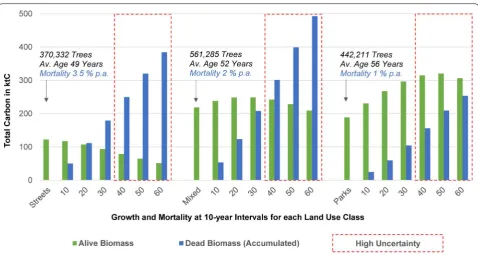
Our LCA of 60 years on urban forest carbon offset clearly indicates the dominant impact of an increasing annual tree morality between our land use classes of parks (low, 1%), mixed areas (moderate, 2%) and streets (high, 3.5%) (Fig. 2). Street trees show a continuous decline in abso-lute alive biomass. After 20 years the amount of accumu-lated dead biomass is already higher than alive biomass. Trees of mixed areas reveal a slight increase in alive biomass, which levels off after 30 years and then con-tinuously declines. Accumulated dead biomass of mixed areas exceeds alive biomass after 40 years. Park trees show a dominant effect of growth with an increase in alive biomass for 50 years and with a marginal decrease for the last 10 years of our assumed 60-year LCA.
exceed the average age of 80 years after 30 years of our LCA.
The carbon estimates per unit of land cover are con-solidated for all land use classes at 10-year intervals in Table 2. We found that the carbon density of alive bio-mass in Berlin increases by almost 25% for the first 30 years of our LCA (2008–2038); thereafter, it continu-ously decreases. Our study concludes that the carbon density of alive biomass is always higher than the initial year of 2008 (7.3 tC/ha) if the average age of the total tree population is allowed to exceed 80 years. The initial sequestration rate decreases rapidly for the first 30 years. After this time period, the growth of the remaining tree population cannot compensate for its previous losses and the total alive biomass declines. The carbon density of accumulated dead biomass exceeds alive biomass density at 40 years of our LCA. At the end of our LCA (2068), the
carbon density of dead biomass (16.2 tC/ha) is more than 100% higher than alive biomass (8.0 tC/ha).
Results of our potential tree planting of 100,000 trees of mixed dominant tree species (Table 1) show an increase of alive biomass with a total of approximately 68 ktC for 70 years of growth (Fig. 3). The planted tree population decreases to 50% (population half-life), resulting from a high annual mortality (3.5%) with an alive biomass of approximately 3.5 ktC after 20 years of growth. A moder-ate mortality (2%) leads to an alive biomass of approxi-mately 10 ktC after 35 years of growth and approxiapproxi-mately 35 ktC after 69 years of growth for a low mortality (1%). Street trees continuously lose alive biomass (Fig. 2): 15.2 ktC in the first 20 years of our LCA. Our assumed extensive tree planting of 100,000 trees (+ ca. 3.5 ktC at population half-life of 20 years) needs to be more than four times larger to compensate for this short-term loss Fig. 2 LCA of 60 years on urban forest carbon offset in Berlin. The carbon weight for alive and accumulated dead biomass is presented in kilotons (ktC) for our land use classes (streets, mixed, parks). The absolute tree population, the assumed mortality rate of each land use class and its average age is indicated for the LCA start in 2008. A red border marks a tree population of an unlikely very high average age (> 80 years)
Table 2 Temporal development of urban forest carbon estimates in Berlin
Carbon estimates LCA
Land cover of 700 km2 Start 10 20 30 40 50 60
Alive biomass
Density average (tC/ha) 7.3 8.3 8.9 9.1 9.0 8.7 8.0
Dead biomass (accumulated)
of alive biomass. Concerning estimates of mixed areas, it takes 40 years till carbon sequestration cannot compen-sate our assumed tree loss of 2% p.a. any longer. The rel-evant decrease of alive biomass is less than 1 ktC (Fig. 2). Therefore, planting 100,000 trees in mixed areas (+ 10 ktC at population half-life of 35 years) is likely to com-pensate for the loss of alive biomass. We assumed a low mortality rate of 1% p.a. for park trees, which leads to an extended time span of 60 years till carbon sequestra-tion cannot compensate tree loss any longer. The relevant decrease of alive biomass is 14.1 ktC (Fig. 2). Conse-quently, a planting initiative of 100,000 park trees (+ 35 ktC at population half-life of 69 years) is likely to extend the amount of alive biomass for long-term purposes.
In this case study, we could make use of recent progress in high resolution remote sensing to increase consistency of an LCA inventory on urban forest carbon offset. We did this by providing area-wide details of remotely sensed individual tree species. To the best of our knowledge, this is the first urban study combining individual tree metrics with spatially explicit species information for an LCA of urban forest carbon offset. Our results point out the challenges of assumed tree growth and mortality of street trees, mixed areas and parks, which greatly affect the future role of urban forest carbon offset. Furthermore, our findings call attention to the potential of tree planting to compensate for losses of alive biomass.
Our results show that urban forest carbon offset is dominated by our assumed tree mortality. The significant impact of an increasing mortality rate on urban forest carbon offset was also confirmed by Strohbach et al. [32]. Only park trees have a positive balance of alive biomass minus accumulated dead biomass for a 60-year LCA. In particular, the high loss of street and mixed trees reduced the overall growth potential of the remaining tree popu-lation. The increasing average age structure is also likely to augment the risk of tree loss. Therefore, our results certainly underline the necessity of adequate forest man-agement applications across the city. It remains unclear, in how far the high amount of dead biomass contributes to net carbon offset, which grew twice as much as alive biomass after 60 years (Table 2). Other LCA approaches utilized advanced processing of dead biomass, such as composting or wood chip production for energy con-sumption [30, 32]. Consequently, the decomposition of dead biomass means a release of carbon emissions, and urban forests of our case study would be a net carbon source. However, our case study can become a net carbon sink if dead biomass is used for energetic purposes and substitutes fossil energy.
Our results show the possibilities of extensive tree planting. Replanting 100,000 trees has the capability to compensate for losses in alive biomass. However, this potential requires rapid replanting, low mortality rates (< 2% p.a.) as well as extended tree longevity exceeding 80 years. The lack of relevant data on future tree replant-ing rates, mortality, growth and longevity make it diffi-cult to provide long-term prognoses for our case study. Increasing disturbances in growth, mortality and replant-ing rates would affect the spatial expanse and quantity of alive biomass. Today’s financial constraints of cities might limit investments into green infrastructure, such as an extensive tree replanting program [111]. In particular, the lack of young tree mortality data causes high uncer-tainty concerning the true quantitative requirements to compensate for tree loss [112]. As such, further discus-sion is needed on urban forest management plans and political decision-making concerning urban dwellers’ desires and climate change adaptation in particular [113]. In this context, our city-wide average of carbon density in Berlin most likely falls in the lower range of urban for-est studies obtained from globally selected cities of tem-perate climate zones (11–38 tC/ha) [17]. The temporal development of our carbon density shows that estimates will remain in the lower range if management plans do not consider extensive replanting and densification.
It should be made clear that, in reality, our assumed values for tree growth, mortality and planting would be an exception rather than the rule. These values can vary widely and be extremely site- and species-specific [107, Fig. 3 Potential tree planting initiative of 100,000 trees. Calculations
114]. Climate change especially could increase stresses on urban forests and change their value, which would then require adapted management strategies [113, 115]. Our assumed constant mortality rates did not describe the complexity of natural and anthropogenic disturbances adequately [110]. However, the lack of mortality relevant statistics and in situ data from Berlin did not allow us to further calibrate or validate our case study. Moreover, the high uncertainty of our case study results refers to the high average age of the tree population, which had already reached an average of 80 years after 30 years of our LCA. Therefore, our results should be taken care-fully and one should consider the possibility of an exten-sive underestimation of dead biomass for the period from 2038 till 2068. In this regard, only few studies exist on urban tree growth and longevity and require further improvements in quantitative assessments [116]. Due to limitations we did not consider pruning trees, which would increase the amount of dead biomass for our esti-mates. Pruning of 10% above-ground biomass at 10-year intervals could be considered a common practice accord-ing to recent studies [30, 32]. Our simplified case study also excluded emissions related to tree planting, such as maintenance, tree production, transportation, planting, irrigation, processing of dead biomass and tree removal. These might be considered less relevant for the net car-bon offset of our case study because recent studies on LCA of urban tree planting showed a relative small share on emissions of 1–5% of the total tree biomass (alive plus dead) [30, 32]. However, an accounting for decomposi-tion of dead biomass, dead roots and irrigadecomposi-tion can sig-nificantly increase the share of carbon emissions.
In general, our LCA inventory data of remotely sensed individual tree species contributed consistent details across large areas, and therefore avoided current dis-advantages of general field data-based methods or requirements of widely used approaches of the i-Tree ECO model. Zhao et al. [29] confirmed the advantages of LiDAR data and individual tree detection to retrieve consistent and area-wide LCA inventory data, which our case study could increase in precision by providing addi-tional tree species information. However, Zhao’s and our LiDAR-based remote sensing approach did not include understory and very small trees (< 3 m) [15], which can grow to a considerable quantity in the long term. Fur-ther differentiation for our tree species (Table 1) is also a suggestion for improvement because our mixed class covered a considerable fraction (> 25%) of the total tree population. This can be of utmost importance when con-sidering the role of invasive species. For instance, Horn et al. [117] pointed out the role of invasive species on urban forest carbon offset, which was approximately 5% for a subtropical urban forest. Even more relevant were
temporal changes of the urban species structure. Nowak et al. [118] showed slight changes in tree canopy size from 1999 to 2009, in Syracuse, New York; however, the number of trees increased by more than 20% with inva-sive species as the main cause. This indicates the impor-tance of the individual tree level and changes in forest composition. Therefore, high resolution remote sensing has great potential to monitor necessary environmental details and should considerably improve tree species clas-sification and individual tree detection in urban settings.
We can conclude that our simplified LCA of urban forest carbon offset offers new insights into how high resolution remote sensing can be used as a consistent baseline of individual tree species. Future progress in remote sensing will show if we can extend the classifica-tion of tree species and the detecclassifica-tion of individual trees with increasing precision. This might change the way we assess major knowledge gaps regarding the role of inva-sive tree species and private properties in particular. Time series of remotely sensed data can offer the poten-tial to validate and calibrate predictive models due to changes in tree size, species structure, age structure and replanting. This is particularly true for the current lack of urban tree mortality data, where remote sensing can help to detect potential risks and stresses and reveal irregular or chaotic spatiotemporal patterns of disturbances. All of this can help cities and other stakeholders to consider the role of urban forest carbon offset more adequately; for instance, to complement current carbon balances.
Reducing uncertainties part 2—remotely sensed long‑term monitoring for considering urban forest dynamics
Remotely sensed high resolution monitoring would cer-tainly contribute to improving an LCA of urban forest carbon offset by providing additional data for calibration and validation. Researchers and professional practition-ers have requested long-term ecological studies to extend the knowledge of urban forest dynamics. However, few studies on urban tree growth and related changes exist, and they all rely on regional networks or research related projects, such as the International Tree Failure Database (ITFD), for instance. Experts are aware of remote sens-ing’s opportunities for developing a more consistent urban forest database, but it is still far from being real-ized as a common international standard [116].
Tree growth and pruning
predicting crown width and tree height, but the vari-ability of the resulting estimates can be high. For exam-ple, additional age to DBH-growth functions allow for estimating the urban forest age structure, but available studies rarely address the various urban tree species, tree dimensions and site conditions. Additionally, increas-ing climate change effects can cause water and heat stress, substantially reducing tree growth [114, 122–124]. Therefore, the variability of remotely sensed tree dimen-sions, as mentioned earlier in this review, does not allow for deriving the specific age of a single tree. We rather suggest providing a certain range of the tree age, which can be used as a baseline for additional processing or modeling.
Future studies and applications should place greater focus on urban forest dynamics using high resolution remote sensing. Detailed characterizations and monitor-ing highly benefit from increasmonitor-ing temporal resolution in particular. This allows for potential change detection of urban tree growth and pruning and for monitoring abrupt changes like replanting or tree loss. However, precise estimates would come at a high price, as change detection errors are likely to significantly increase as a function of heterogeneity, quality and resolution of imagery, or misregistration errors of remotely sensed time series [125]. This makes it difficult to reliably esti-mate changes over time for an individual tree. Regard-ing precise estimates of urban forests, little is known on monitoring the changes of individual trees using very high resolution remote sensing, such as Ardila et al. [41] successfully used a region-based active con-tours approach for a time series of multispectral data to detect abrupt and gradual changes of individual trees. For example, remotely sensed tree dimensions would allow for improved monitoring of residual biomass, large quan-tities of which can be obtained from urban forests for energy purposes [126]. Additionally, Sajdak et al. [127] applied predictive modeling approaches and showed cor-relations between residual biomass and the parameters of crown diameter or stem DBH, which could be derived from remotely sensed individual trees. Due to the vari-ability of remotely sensed tree dimensions, we suggest stretching the intervals for monitoring urban forests in order to retrieve notable physical changes of tree growth and derived parameters. For this very reason, further research is necessary to confirm the precision of gradual changes, like tree growth (height and crown) and prun-ing, using high temporal resolution remote sensing.
Mortality and replanting
Temporal increases and decreases of the urban forest canopy is crucial information for an LCA of urban for-est carbon offset. Until now, few studies have addressed
urban forest dynamics across large areas, and most of them use moderate resolution (30 m pixel size) and adapt ground-based carbon measures to vegetation indices using spectral bands of Landsat satellite data [128, 129]. Moderate resolution of Landsat satellite imagery is likely to underestimate urban forest cover. However, Landsat satellite time series was sufficient for indicating a long-term trend of urban forest increase (growth + replant-ing) and decrease (mortality), which was likely to be balanced for urban forests in Syracuse, US from 1985 to 1999 [128], or to have highly increased for urban forests and shrubs in Xi’an, China from 2004 to 2010 [129]. The importance of temporal changes has also made remote sensing a source for validating reported facts. Nowak et al. [130] chose higher resolution time series to bet-ter address the trend of urban tree cover across the US. They manually digitized high resolution paired aerial photographs and Google Earth imagery (selection of 2001–2009 for 20 US cities and 1000 randomly selected urbanized areas). The results of this sampling approach indicated a decline of forest cover for most US cities at a rate of approximately 7900 ha/year, or 4 million trees per year. Other work of Merry et al. [131] indicated only slightly changes in tree canopy size for longer periods of time for selected US cities (1951–2010, Detroit and Atlanta). However, they suggested advanced remote sens-ing techniques to consider variations in spatial distribu-tion more adequately. For example, the tree canopy cover report of Boston, US showed significant overestimation due to misclassification of grass and shrubs as tree can-opy compared to an assessment performed with high res-olution QuickBird satellite and LiDAR data [47].
potential risk [136]. This can advance an LCA to better consider the effects of temporal urban forests’ stresses.
Conclusions
Recent progress in high resolution remote sensing and methods is adequate for delivering more precise details on the urban tree canopy, individual tree metrics, spe-cies and age structures compared to conventional land use/cover class approaches. These area-wide consistent details can update life cycle inventories for more precise future prognoses.
Additional improvements in classification accuracy can be achieved by a higher number of features derived from remote sensing data of increasing resolution, but first studies on this subject indicated that a smart selection of features already provides sufficient data that avoids redundancies and enables more efficient data process-ing. Automated and efficient processing of very high resolution data should be employed if possible due to the increasing workload, variability of data and user inter-action, which can cause unresolved uncertainties. More consistent reporting of uncertainties and a better under-standing of today’s locally tailored approaches would allow for more generic and transferable approaches. However, this will not neglect today’s advantages of high resolution remote sensing, which already extend the pos-sibilities of traditional field-based retrieval of heteroge-neous urban forest structures across large and private areas and should be applied more frequently.
In the matter of temporal changes and reliable esti-mates, more attention is required to detect the changes of gradual growth, pruning and abrupt changes to the plant-ing and mortality of individual trees. Therefore, precise long-term ecological monitoring of urban forest dynam-ics should be intensified, especially due to increasing cli-mate change effects. The results would be beneficial for calibrating and validating recent studies of urban forest carbon offset, which have so far focused on the status quo and net sequestration for the following year but have scarcely addressed a longer timeframe. Furthermore, pre-cise change detection is highly relevant for the supply and demand of urban forest carbon offset.
A precise global estimate of urban forest carbon off-set is still missing. However, upscaling approaches have improved national estimates in the US and Canada using higher resolution remote sensing data, which should be continued to reach an initial global coverage. The future role of urban forest carbon offset can be made more rele-vant if more standardized assessments are made available for science and professional practitioners, and the ever increasing availability of high resolution remote sensing data and the progress in data processing allows for pre-cisely that.
Abbreviations
AVHRR: advanced very high resolution radiometer; C: carbon; CHM: canopy height models; CO2: carbon dioxide; DBH: diameter at breast height; EPA: Environmental Protection Agency; FIA: Forest Inventory and Analysis; ha: hectare; IPCC: Intergovernmental Panel on Climate Change; ISO: Interna-tional Organization for Standardization; ITD: individual tree detection; ITFD: International Tree Failure Database; LCA: life cycle assessment; LiDAR: light detection and ranging; NBCD: National Biomass and Carbon Dataset; NDVI: normalized difference vegetation index; RMSE: root means square error; t: ton; TM: thematic mapper; UAV: unmanned aerial vehicles; USDA: United States Department of Agriculture.
Authors’ contributions
Literature research, calculations, evaluation JT (completely). Conception and crea-tion of the manuscript JT (predominantly). Suggescrea-tions on structure and review of the manuscript TL. Both authors read and approved the final manuscript.
Acknowledgements
The authors are grateful to Dr. Michael Strohbach (Institute of Geoecology, Technische Universität Braunschweig, Germany) for sharing field data on tree growth and discussing urban forest life cycle assessments. We also thank the anonymous reviewers and the editor for their constructive input.
Competing interests
The authors declare that they have no competing interests.
Availability of data and materials
The datasets used in this article are available upon request.
Consent for publication
All authors consent to the publication of this manuscript.
Ethics approval and consent to participate
Not applicable.
Funding
This study was supported by the German Research Foundation (DFG) as part of the Research Training Group 780 3 and 4 on “Perspectives on Urban Ecol-ogy” (Project Numbers: 32108303 and 32108304).
Publisher’s Note
Springer Nature remains neutral with regard to jurisdictional claims in pub-lished maps and institutional affiliations.
Received: 10 May 2017 Accepted: 27 September 2017
References
1. Chen WY. The role of urban green infrastructure in offsetting carbon emissions in 35 major Chinese cities: a nationwide estimate. Cities. 2015;44:112–20.
2. Churkina G, Brown DG, Keoleian G. Carbon stored in human set-tlements: the conterminous United States. Glob Change Biol. 2010;16(1):135–43.
3. Liu C, Li X. Carbon storage and sequestration by urban forests in Shen-yang, China. Urban For Urban Green. 2012;11(2):121–8.
4. Stoffberg GH, van Rooyen MW, van der Linde MJ, Groeneveld HT. Carbon sequestration estimates of indigenous street trees in the City of Tshwane, South Africa. Urban For Urban Green. 2010;9(1):9–14. 5. Churkina G. The role of urbanization in the global carbon cycle. Front
Ecol Evol. 2016;3:144.
6. Scyphers SB, Lerman SB. Residential landscapes, environmental sustain-ability and climate change. In: Holt WG, editor. From sustainable to resilient cities: global concerns and urban efforts. Bingley: Emerald Group Publishing Limited; 2014. p. 81–100.
8. Poudyal NC, Siry J, Bowker JM. Urban forests and carbon markets: buy-ers’ perspectives. J For. 2011;109(7):378–85.
9. Poudyal NC, Siry JP, Bowker JM. Urban forests’ potential to supply mar-ketable carbon emission offsets: a survey of municipal governments in the United States. For Policy Econ. 2010;12(6):432–8.
10. van den Bergh JCJM, Botzen WJW. Monetary valuation of the social cost of CO2 emissions: a critical survey. Ecol Econ. 2015;114:33–46. 11. Nowak DJ, Greenfield EJ, Hoehn RE, Lapoint E. Carbon storage and
sequestration by trees in urban and community areas of the United States. Environ Pollut. 2013;178:229–36.
12. Baveye PC, Baveye J, Gowdy J. Monetary valuation of ecosystem ser-vices: it matters to get the timeline right. Ecol Econ. 2013;95:231–5. 13. Klöpffer W. Background and future prospects in life cycle assessment.
Dordrecht: Springer; 2014.
14. Kremer P, Hamstead Z, Haase D, McPhearson T, Frantzeskaki N, Anders-son E, et al. Key insights for the future of urban ecosystem services research. Ecol Soc. 2016;21(2):29.
15. Tigges J, Churkina G, Lakes T. Modeling above-ground carbon storage: a remote sensing approach to derive individual tree species informa-tion in urban settings. Urban Ecosyst. 2017;20(1):97–111.
16. Kadhim N, Mourshed M, Bray M. Advances in remote sensing applica-tions for urban sustainability. Euromediterr J Environ Integr. 2016;1:7. 17. Strohbach MW, Haase D. Above-ground carbon storage by urban trees
in Leipzig, Germany: analysis of patterns in a European city. Landsc Urban Plan. 2012;104(1):95–104.
18. Nowak DJ, Crane DE. Carbon storage and sequestration by urban trees in the USA. Environ Pollut. 2002;116(3):381–9.
19. McHale M, Burke I, Lefsky M, Peper P, McPherson E. Urban forest biomass estimates: is it important to use allometric relationships devel-oped specifically for urban trees? Urban Ecosyst. 2009;12(1):95–113. 20. Peper PJ, Alzate CP, McNeil JW, Hashemi J. Allometric equations for
urban ash trees (Fraxinus spp.) in Oakville, Southern Ontario, Canada. Urban For Urban Green. 2014;13(1):175–83.
21. Luederitz C, Brink E, Gralla F, Hermelingmeier V, Meyer M, Niven L, et al. A review of urban ecosystem services: six key challenges for future research. Ecosyst Serv. 2015;14:98–112.
22. Bahadur AV, Tanner T. Policy climates and climate policies: analysing the politics of building urban climate change resilience. Urban Clim. 2014;7:20–32.
23. Lauf S, Haase D, Kleinschmit B. Linkages between ecosystem services provisioning, urban growth and shrinkage—a modeling approach assessing ecosystem service trade-offs. Ecol Indic. 2014;42:73–94. 24. Kuttler W. Climate change in urban areas, part 1, effects. Environ Sci Eur.
2011;23(1):1–12.
25. Haase D, Larondelle N, Andersson E, Artmann M, Borgström S, Breuste J, et al. A quantitative review of urban ecosystem service assessments: concepts, models, and implementation. Ambio. 2014;43(4):413–33.
26. McPhearson T, Andersson E, Elmqvist T, Frantzeskaki N. Resilience of and through urban ecosystem services. Ecosyst Serv. 2015;12:152–6. 27. Larondelle N, Lauf S. Balancing demand and supply of multiple urban
ecosystem services on different spatial scales. Ecosyst Serv. 2016;22(Part A):18–31.
28. Baró F, Haase D, Gómez-Baggethun E, Frantzeskaki N. Mismatches between ecosystem services supply and demand in urban areas: a quantitative assessment in five European cities. Ecol Indic. 2015;55:146–58.
29. Zhao C, Sander HA. Quantifying and mapping the supply of and demand for carbon storage and sequestration service from urban trees. PLoS ONE. 2015;10(8):e0136392.
30. McPherson EG, Kendall A. A life cycle carbon dioxide inventory of the million trees Los Angeles program. Int J Life Cycle Assess. 2014;19(9):1653–65.
31. McHugh N, Edmondson JL, Gaston KJ, Leake JR, O’Sullivan OS. Modelling short-rotation coppice and tree planting for urban carbon management—a citywide analysis. J Appl Ecol. 2015;52(5):1237–45. 32. Strohbach MW, Arnold E, Haase D. The carbon footprint of urban green
space—a life cycle approach. Landsc Urban Plan. 2012;104(2):220–9. 33. Solà J, Núñez M, Gabarrell X, Boada M, Rieradevall J. Service sector
metabolism: accounting for energy impacts of the Montjuic urban park in Barcelona. J Ind Ecol. 2007;11(2):83–98.
34. Nowak DJ, Stevens JC, Sisinni SM, Luley CJ. Effects of urban tree management and species selection on atmospheric carbon dioxide. J Arboric Urban For. 2002;28(3):113–21.
35. Klein D, Wolf C, Schulz C, Weber-Blaschke G. 20 years of life cycle assessment (LCA) in the forestry sector: state of the art and a methodi-cal proposal for the LCA of forest production. Int J Life Cycle Assess. 2015;20(4):556–75.
36. Davies ZG, Edmondson JL, Heinemeyer A, Leake JR, Gaston KJ. Mapping an urban ecosystem service: quantifying above-ground carbon storage at a city-wide scale. J Appl Ecol. 2011;48(5):1125–34.
37. Hutyra LR, Yoon B, Alberti M. Terrestrial carbon stocks across a gradient of urbanization: a study of the Seattle, WA region. Glob Change Biol. 2011;17(2):783–97.
38. Lakes T, Hostert P, Kleinschmit B, Lauf S, Tigges J. Remote sensing and spatial modeling of the urban environment. In: Endlicher W, editor. Perspectives in urban ecology—studies of ecosystems and interactions between humans and nature in the metropolis of Berlin. 1st ed. Berlin: Springer; 2011. p. 231–59.
39. Davies ZG, Dallimer M, Edmondson JL, Leake JR, Gaston KJ. Identifying potential sources of variability between vegetation carbon storage estimates for urban areas. Environ Pollut. 2013;183:133–42. 40. Tigges J, Lakes T, Hostert P. Urban vegetation classification: benefits
of multitemporal RapidEye satellite data. Remote Sens Environ. 2013;136:66–75.
41. Ardila JP, Bijker W, Tolpekin VA, Stein A. Multitemporal change detection of urban trees using localized region-based active contours in VHR images. Remote Sens Environ. 2012;124:413–26.
42. Kaneko K, Nohara S. Review of effective vegetation mapping using the UAV (unmanned aerial vehicle) method. J Geogr Inf Syst. 2014;6:733–42. 43. McPherson EG, Xiao Q, Aguaron E. A new approach to quantify and
map carbon stored, sequestered and emissions avoided by urban forests. Landsc Urban Plan. 2013;120:70–84.
44. Shojanoori R, Shafri HZM. Review on the use of remote sensing for urban forest monitoring. Arboric Urban For. 2016;42(6):400–17. 45. Rao P, Hutyra LR, Raciti SM, Finzi AC. Field and remotely sensed measures of soil and vegetation carbon and nitrogen across an urbanization gradient in the Boston metropolitan area. Urban Ecosyst. 2013;16(3):593–616.
46. Chen G, Ozelkan E, Singh KK, Zhou J, Brown MR, Meentemeyer RK. Uncertainties in mapping forest carbon in urban ecosystems. J Environ Manag. 2017;187:229–38.
47. Raciti SM, Hutyra LR, Newell JD. Mapping carbon storage in urban trees with multi-source remote sensing data: relationships between biomass, land use, and demographics in Boston neighborhoods. Sci Total Envi-ron. 2014;500–501:72–83.
48. Zhang X, Ni-meister W. Remote sensing of forest biomass. In: Hanes JM, editor. Biophysical applications of satellite remote sensing. Berlin: Springer; 2014. p. 63–98.
49. Richardson JJ, Moskal LM. Uncertainty in urban forest canopy assessment: lessons from Seattle, WA, USA. Urban For Urban Green. 2014;13(1):152–7.
50. Schreyer J, Tigges J, Lakes T, Churkina G. Using airborne lidar and Quick-Bird data for modelling urban tree carbon storage and its distribution— a case study of Berlin. Remote Sens. 2014;6(11):10636–55.
51. Weng Q, Quattrochi DA, Carlson TN. Remote sensing of urban environ-ments: special issue. Remote Sens Environ. 2012;117:1–2.
52. Jenkins JC, Chojnacky DC, Heath LS, Birdsey RA. National-scale biomass estimators for United States tree species. For Sci. 2003;49(1):12–35. 53. Zhang C, Zhou Y, Qiu F. Individual tree segmentation from lidar point
clouds for urban forest inventory. Remote Sens. 2015;7(6):7892. 54. Popescu SC. Estimating biomass of individual pine trees using airborne
lidar. Biomass Bioenergy. 2007;31(9):646–55.
55. Key T, Warner TA, McGraw JB, Fajvan MA. A comparison of multispectral and multitemporal information in high spatial resolution imagery for classification of individual tree species in a temperate hardwood forest. Remote Sens Environ. 2001;75(1):100–12.
56. Garcia M, Saatchi S, Ferraz A, Silva CA, Ustin S, Koltunov A, et al. Impact of data model and point density on aboveground forest biomass estimation from airborne lidar. Carbon Balance Manag. 2017;12(1):4. 57. Baltsavias EP. A comparison between photogrammetry and laser
![Table 1, Aesculus indica [100]](https://thumb-us.123doks.com/thumbv2/123dok_us/9123789.1905460/9.595.59.538.500.717/table-aesculus-indica.webp)