* Senior Library and Information Officer, National Institute of Public Finance and Policy, New Delhi.
Disseminating Knowledge Resources
Through Weblogs
S. Siva Chidambaram*
This paper is based on the case study which keeps updating my professional knowledge through Scholarly Electronic Publishing
Weblogs by Charles W. Bailey from the year 1992. This SEPW insight
helped me to create a Weblogs for library service for the Internet resources. Weblogs is one of the current awareness services tools in the Internet era in the Digital Library world. This article describes under the following sections: What is Weblogs? How to create a Weblogs and its importance in the field of Library and Information Science. Definition of Weblogs in the context of libraries. And also highlights the important library Weblogs.
1 Introduction
“A Look Back at Sixteen Years as an Internet Electronic Publisher” entitled as a subject in my E-mail sent by Prof. Charles W. Bailey’s listserve [email protected] on June 29, 2005. I was fortunate to receive this E-mail in time. From the beginning of my career in Library Science from 1991 a special PACS Review issue on “Network-based Electronic Serials” appeared. I am one of the regular readers of Prof. Charles W. Bailey’s scholarly communication services. The uniqueness of his service coincides with the evolution of the networking development such as PACS, PACS Review (Public-Access Computer Systems Review) PACS_L Mailing list issues are distributed through Listserve software as ASCII files. PACS News, a free electronic newsletter was established in 1992. Since 1994, PACS Review and PACS News have been available via Gopher server. The first HTML version of PACS Review was established in 1995 added with authors who were allowed to update their articles in this review. This version was called “Network-Based Electronic Publishing of Scholarly Works: A Selective Bibliography” with 26 versions. In 1996
he started publishing the first HTML version of Scholarly Electronic
Publishing Bibliography (SEPB), a free updated electronic book. Then
in 1997 the SEPB became SEPR (Scholarly Electronic Publishing
Resources). Now this valuable Info-product is developed as SEPW
(Scholarly Electronic Publishing Weblogs) and RSS feed added in March 2005. The advantage for us is that SEPB, SEPR and SEPW comes under Creative Command Attribution-Non-Commercial License. The latest 58th version SEPB was published on June 10, 2005. In fact, I would
like to prepare a detailed study about this service coverage. When I received the NACLIN 2005 brochure Entitled “Strategies for Managing Knowledge Resources: Promoting Research, Education and Skills”, I had planned to describe in detail Prof. Bailey’s SEPW products and its development. In fact, that may be the right topic for this convention. But while collecting the literature review, I found the following articles described in this electronic publication. Anyhow, I was really excited with the Weblog version of SEPW and the same insights helped me to create blog for NIPFP Library to disseminate the “Internet Resource of Indian Public Finance” information available on the Net with linking options. Before starting this service, I prepared the feasibility study material and that will be described in this article.
Internet accelerates information overload in the networking world. Since the late 1970s, it is an outgrowth of the ARPANET. The Internet becomes ubiquitous in nature. Library and Information professionals are forced to use the Internet as a reference tool to do immediate search for primary information. Especially, reference service/desk at the special library, we search the Website to find some data, articles, information, etc. The reader would like to keep this link information in the proper form. That’s why we chose the bookmark. But the bookmark can be maintained in the PC, it can’t be shared in the network environment. Based on this type of need the Blogs concept arrived in the 1990s. Blogs were originally named Weblogs, a name coined by Jorn Berger in December 1997. This was later shortened to “Blog” (we was dropped) with the person keeping the Weblog being known as a “blogger”.
containing a “mixture in unique proportion of links, commentary, and personal thoughts and essays. “In publications that track Weblogs, this definition from Salon contextualises best describes the functions: “Weblogs, typically, are personal Websites operated by individuals who compile chronological lists of links to stuff that interests them, interspersed with information, editorialising and personal asides. A good Weblog is updated often, in a kind of real-time improvisation, with the pointers to interesting events, pages, stories and happenings elsewhere on the Web. New stuff piles on top of the page; older stuff sinks to the bottom”.
Dave Winer, on his site, says that there are four key words that describe the personal Web publishing communities known as Blogs:
1. A Weblog is personal – done by a person not an organisation and you see a personality that makes it interesting.
2. A Weblog is on the Web–updated frequently and accessed via a Web browser.
3. A Weblog is published – process is automated; can use advanced writing tools and syndication can be active – form of publishing technology.
4. A Weblog is part of the community – does not stand-alone – and connects people together using the Web through common interests. Journals, diaries and other written expression composed in the first person are also part of Weblogs.
2 A Brief History of Weblogs
In 1997, Jorn Berger with his Robert Wisdom Weblog coined the term “Weblog”. When Google released the free Weblog creation programs such as “Blogger” at www.Blogger.com in 1999 the proliferation of the Blogs increased dramatically. These programs are easy for even those who are not familiar with the HTML skills. In fact this program process is called “push button publishing”. Most recently according to Penry Garrod’s regular columns in Ariadne Issue No: 40 says that a search on Google (using the search terms “Library Weblog” returns 544,000 hits on June 21, 2004. But when I searched the same word “library Weblog” in the same search engine on July 14, 2005, it yielded 1,720,000 hits. It is almost double the hit within the year period. In Yahoo search engine there is an excellent article overview of the history and development of Blogs entitled “Genesis of Blogging”.
The specialty of development of Blogs is without the help of an editor and technical people are writing directly and publishing with the simple three easy step clicking option “Create an account, Name your
Blog, Choose a template and publish it”. With this immediacy, intimacy
and frankness fact the Blogs are created and disseminated better than E-mail. Stephen O’Hears writing in Education Guardian believes that Weblogs have a key role to play in education, partly because they are so easy to use.
“Blog software simplifies the process of writing and publishing online. Creating and editing Blog entries is no more difficult than sending an E-mail.”
3 Definition of Weblogs
The slogan “push-button publishing for people” makes Weblogs have an extensive professional impact, particularly journalists and Library and Information scientists who are given a wide range of definitions for the simple concept. With my preference I like the following definition in the context of library Weblogs.
“Blogs are a natural for librarians”, says Paula J. Hane (2001); certainly some librarians have been quick to recognise that Weblogs can be important sources of information and information dissemination tools for communication. The best Weblog I know is Charles W. Bailey’s.
Scholarly Electronic Publishing Weblogs. Peter Scott’s definition in
4 The Structure of Weblogs
Although the above definition of Blogs is broad enough to describe the structure, the blogs generally have home page with static content and a list of the most recent posts. Posts are chunks of text and links arranged in reverse chronological order. Each post generally has the following fields: Title, Date-time stamp, Body Comments, Track banks and permalinks.
Home page columns may be more static or contain automatically generated content, such as headlines from recent posts, links to personal profile, links to the archive, and a list of favourite Websites, etc. Archives are created immediately so the same post will occur on the main page and in the archive section. The structure of the archives, post pages, comment pages and permalinks can be exploited for precision searching. Therefore the nascent distinctive features of the Weblog is as follows (2005):
- Automatic formatting of content in the form of “headlines”, followed by “entries”, or “stories”
- Time-and date-stamp of entries
- Archiving of past entries
- A search function to search through all entries
- A “blogroll”-a list of other Blogs read by the author(s) of the current Blog
- A section associated with each entry where readers can post comments on the entry
- Simple syndication of the site content via RSS (Really Simple Syndication)
Typically, these features are all supported by Blog server software, and the user (or “blogger”) does not have to do any programming or even formatting, to create a technically sophisticated, visually impressive Website.
Blogs have a very low barrier to access. You post using E-mail, voicemail, Web forms, or a downloaded WYSIWYG program. Hosted Blogs have preformatted template choices that allow varieties of layout and colour without detailed knowledge of HTML, cascading style sheets (CSS), or XML. The content can be anything from a sparse list of links to
extensive collections of essays, videos, recordings, or pictures. Feeds are XML-formatted abbreviated posts or lists of headlines then can be gathered, displayed, and consumed efficiently in an aggregator.
Many so-called Blog search engines really only index feeds. Feeds are XML versions of the Blogs that can be read using an aggregator or incorporated into portals or Web pages. Many feeds are not full-text. In fact, some just include the title of the post. Additionally, many scholarly journals mainstream media outlets, and government agencies offer feeds. Searches in these engines provide many more relevant posts higher in the result list, but return fewer results overall. Below are several of the most useful Blog-specific search engines:
Bloglines [www.bloglines.com]
Feedster [www.feedster.com]
PubSub [www.pubsub.com]
Technorati [www.technorati.com]
Waypath [www.waypath.com]
5 How to Create a Simple Blog
The creation of Weblog is very simple and takes only a few minutes to develop a Blog. Blog can be created by the free and fee-based software. I develop the Blog through blogger.com (free) in the following simple steps. It is just like the “do it yourself” method:
First: create a free account in blogger.com
Second: Location of the Blog to default is free Blog at blogspot.com
Third: as usual read the Terms of Service
Fourth: choose a template for your Blog. Now your Blog is ready (see the figure). Then you have to post an entry to your Blog.
6 Creating Weblogs for Libraries
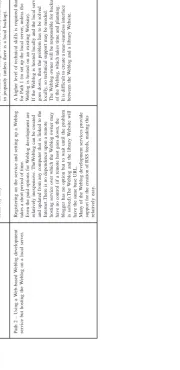
Laurel A. Clyde in his book Weblogs and Libraries describes four different pathways to develop Weblogs for individuals as well as libraries. Here I am listing the four different paths and their advantages and disadvantages in tables only.
Path 1 - Using external, Web-based Weblog development software and an external Weblog hosting service (bearing in mind that some of the Web-based Weblog development services also provide Weblog hosting services).
Path 2 - Using external, Web-based Weblog development software but hosting the Weblog on a local server.
Path 3 - Downloading Weblog development software to a local machine, creating and updating the Weblog on the local machine and hosting the Weblog on a local server.
Path 4 - Using a locally developed Weblog system (‘roll your own’) and hosting the Weblog locally.
The advantages and disadvantages of each path are listed in Table 1. Any decision about Weblog software need not necessarily be the ‘final solution’. It is possible to migrate a Weblog. From one Weblog software/system to another, particularly if the Weblog owner has kept a backup of the archives. In an article written for his own Library Stuff Weblog. Steven M. Cohen has described a series of moves, from Blogger
to Movable Type to Radio and back to Blogger again.3 These three
moves in no way reflect the quality of the software packages but rather a need to have support for particular Weblog features and for particular versions of RSS. By the same token, any decision about Weblog hosting also need not be final; it is, in fact, easier to move a Weblog to a new host than to move it to new software. However, it is even easier if no changes have to be made to software or to hosting for the Weblog.
7 Conclusion
Information explosion in the Internet era and its influence at the library primary source in the electronic medium is available on the network world with the E-mail overload. The Weblogs may be given much relief because of the intimacy, immediacy nature of creation of Weblog without any technical skills like HTML creation and linking, etc. With
the slogan of “push-button publishing for the people” by Blogger “changed the face of the Web”, said Neil Macintosh in The Guardian British newspaper article “A Tale of One Man and His Blog” and no need of new skills to learn for creating Blogs. There is no need of specific software to browse; Blogs can be browsed by any Web browser. Weblogs provide an alternative to multiple electronic list subscriptions and ever-increasing amounts of E-mail as well as the new mechanism of Current Awareness Services in the libraries. This service may be used as a Reference Service tool. Librarians have always had two primary missions - preserving all human knowledge and connecting users to the knowledge that can serve them. Based on the updating modality of anywhere from the desktop, chronological order of posts, links to the other source of information and referral linking to other Weblogs and resources they can be used at the Reference Desk or in the provision of information services. The Weblog will play a major role in the information service field. Finally I conclude with a following statement made by Hazel D’Aguiar in Clip Update magazine. “I have felt much more up-to-date with issues affecting libraries…since starting to read Blogs, and have enjoyed being part of a wider community of bloggers, and that is just by commenting…Blogs provide us with a beautifully simple method of developing a global community for the exchange of knowledge.”
References
1 O’Hear, Stephen. “Logs Prepare to Go on a Roll”. Education Guardian June 8, 2004.
http://education.guardian.co.uk/elearning/story/0,10577,1233425,00.html 2 Library Weblogs - list of library weblogs by country
http://www.libdex.com/weblogs.html 3 Peter Scott’s blog
http://blog.xrefer.com/
4 Blogger (free Weblog tool from Google) http://www.blogger.co/
5 Winship, Ian. “Weblogs and RSS in Information Work. How Can Weblogs be Used in a Library and Information Service”? Library + Information Update, 3(5) 2004, pp.30-31
http://www.cilip.org.uk/update/issues/may04/may.html
7 Aguiar, H.D. “Weblogs: The New Internet Community?” Library + Information Update, 2(1), January 2003, pp.38-39.
8 The Shifted Librarian (Jenny Levine, Homer Library, Illinois) http://www.theshiftedlibrarian.com
9 Clyde, Laurel A. “Weblogs and Libraries, 2004, Chandos, Oxford. 1 0 Clyde, Laurel A. “Weblogs and Blogging - Part 1”. Free Pint No.111
http://www.freepint.com/issues/020502.htm?issue=111
1 1 Clyde, Laurel A. “Weblogs and Blogging - Part 2”. Free Pint No.112 http://www.freepint.com/issues/160502.htm?issue=112
T
able 1 Blogging Paths: Advantages and Disadvantages of Each
Blogging Path
Advantages
Disadvantages
Path 1- Using a W
eb-based W
eblog development
Registering on the service and setting up a W
eblog The W eblog owner is dependent upo
n both a remote
service and an external W eblog hosting service takes a short period of time. W
eblog service and a remote hosting service; if
(bearing in mind that some of the W
eb-based When free W eblog and hosting services are used, either goes down, then there is nothi
ng the blogger
W eblog development services also provide W eblog
this can be a very cheap way to begin.
can do except wait. hosting services).
Even the paid options are relatively inexpensive.
While most W
eblog development services provide a
The W
eblog can be created and updated from any
degree of flexibility , the blogger will not have
computer that is linked to the Internet.
complete control over the appearance of the
It is not necessary to purchase any special software
W eblog; further , the greater the W eblog owner ’s or equipment.
deviation from the service’s standard templates,
There is no need for the blogger to learn about
the greater the level of technical skill needed. maintaining a server.
The service may not support some of the features
It is not necessary for the blogger to have a high
the blogger would like to have. level of technical skills.
It is difficult to create a near-seamless interface
Support is usually available from the service and/
between the W eblog and a library W ebsite.
or from a user group.
The W eblog will have a dif ferent base URL from
Many of the W
eblog development services provide
the
library
W
e
bsite.
support for the creation of RSS feeds, making this
If the hosting company goes out of business, then relatively easy .
the content of W
eblogs hosted on the system may be
in jeopardy (unless there is a local backup).
Path 2 – Using a W eb-based W eblog development
Registering on the service and setting up a W
eblog A higher level of technical skil
ls is required than
service but hosting the W eblog on a local server . takes a short period of time.
for Path 1 (to set up the local server, unless th
e
Even the paid options for W
eblog development are
W eblog is hosted on an existing W ebsite). relatively inexpensive. TheW eblog can be created
If the W
eblog is hosted locally and the local server
and updated from any computer that is linked to the
goes down, then the problem has to be solved
Internet.There is no dependence upon a remote
locally , so technical support may be needed. hosting service over which the W
eblog owner may
The
W
eblog owner will be responsible for backup
have no control (if a remote host goes down, the
of the W eblog, which takes time and planning.
blogger has no option but to wait until the problem
It is difficult to create a near-seamless interface
is solved).The W
eblog and the library W
ebsite will between the W eblog and a library W ebsite.
have the same base URL. Many of the W
eblog development services provide
support for the creation of RSS feeds, making this relatively easy
Blogging Path Advantages Disadvantages Path 3 – Downloading W eblog development
If the software is chosen well, then it should
A higher level of technical knowledge is required
software to a local machine, creating and updating
support all or most of the W
eblog features that the
than for Path 1 or Path 2. the W eblog on the local machine and hosting the W eblog owner would like to have.
If the local server goes down, then the problem
has W eblog on a local server .
There will be more possibilities to customise the
to be solved locally , so technical support will
appearance of the W
eblog. W
ith content on the local
be
needed.
server
, the W
eblog owner has control over the
The
W
eblog owner will be responsible for backup
archives.
of the W
eblog, which takes time and planning.
It is easier to create a seamless interface between
The selected software must run on the in-house the W
eblog and a library W
e bsite. equipment (whether Windows, Macintosh, Linux/ The W
eblog and the library W
ebsite will have the
UNIX)
which
may
limit
choice.
same base URL.
Path 4 – Using a locally developed W
eblog system This path gives the organisation complete control
This path requires the highest
level of technical
(‘roll your own’) and hosting the W eblog locally .
over the software, the features of the W
eblog and knowledge and skills. the machine on which the W eblog is hosted T
echnical personnel will need to have knowledge
The or
ganisation may be able to create a W
eblog of databases, XML and scripting languages like
using software that is already available within the
.asp or PHP , among other things. organisation (such as database software). If the W
eblog owner does not have those skills, then
The advantage of this is that no one has to learn to
he or she will be dependent on technical staff at
use
a
new
system.
every step of the process.
The
W
eblog can be developed to meet specific local
Ongoing maintenance costs increase with the
needs, with the highest level of customisation
complexity of the W eblog that is built. W
eblog features can be developed as needed.
The costs in technical staff time will be higher than
The integration of the W
eblog into the W
ebsite of for the other paths. the library can be seamless.
No free support will be available from outside the
The
W
eblog will have the same base URL as the
organisation.
library W