Open Access
Minireview
Recent developments in multiple sclerosis therapeutics
Rebecca I Spain*, Michelle H Cameron and Dennis Bourdette
Address: Oregon Health & Science University, Department of Neurology, CR120, 3181 SW Sam Jackson Park Road, Portland, OR 97239, USA
Email: Rebecca I Spain* - [email protected]; Michelle H Cameron - [email protected]; Dennis Bourdette - [email protected] * Corresponding author
Abstract
Multiple sclerosis, the most common neurologic disorder of young adults, is traditionally considered to be an inflammatory, autoimmune, demyelinating disease of the central nervous system. Based on this understanding, the initial therapeutic strategies were directed at immune modulation and inflammation control. These approaches, including high-dose corticosteroids for acute relapses and long-term use of parenteral interferon-β, glatiramer acetate or natalizumab for disease modification, are at best moderately effective. Growing evidence supports that, while an inflammatory pathology characterizes the early relapsing stage of multiple sclerosis, neurodegenerative pathology dominates the later progressive stage of the disease. Multiple sclerosis disease-modifying therapies currently in development attempt to specifically target the underlying pathology at each stage of the disease, while avoiding frequent self-injection. These include a variety of oral medications and monoclonal antibodies to reduce inflammation in relapsing multiple sclerosis and agents intended to promote neuroprotection and neurorepair in progressive multiple sclerosis. Although newer therapies for relapsing MS have the potential to be more effective and easier to administer than current therapies, they also carry greater risks. Effective treatments for progressive multiple sclerosis are still being sought.
Introduction
Multiple sclerosis (MS) is a chronic progressive disorder of the central nervous system (CNS). It is traditionally con-sidered to be an inflammatory disorder characterized by episodic CNS demyelination. However, current under-standing is that neurodegeneration dominates the pro-gressive stages of the disease. This article summarizes the pathogenesis of MS, reviews approved MS therapies and discusses the proposed mechanisms and likely benefits and risks of new MS therapeutics.
Disease pathogenesis and disease subtypes
MS presents in most people (80%) with clinical relapses characterized by fully or partially-reversible focal
neuro-logical deficits [1]. Relapsing-remitting MS (RRMS) is dominated by inflammation, oedema and the physiologic actions of cytokines [2]. Active inflammation of the brain and spinal cord is visualized as gadolinium enhancing white matter lesions on magnetic resonance imaging (MRI). After 10-20 years, or median age 39.1 years, about half of those with RRMS gradually accumulate irreversible neurologic deficits in the absence of clinical relapses or new white matter lesions by MRI [3]. This stage is known as secondary progressive MS (SPMS). The remaining 20% with progressive clinical deterioration from the onset of the disease have primary progressive MS (PPMS) [1]. PPMS and SPMS are thought to be dominated by axonal degeneration in the absence of overt inflammation [4]
Published: 7 December 2009
BMC Medicine 2009, 7:74 doi:10.1186/1741-7015-7-74
Received: 3 November 2009 Accepted: 7 December 2009
This article is available from: http://www.biomedcentral.com/1741-7015/7/74
© 2009 Spain et al; licensee BioMed Central Ltd.
which is most likely a result of oxidative damage and/or increased susceptibility to injury caused by the loss of the myelin sheath.
Current MS therapeutics
Clinically significant acute MS relapses are usually treated with high-dose, short-term, intravenous corticosteroids (methylprednisolone 1 g/day for 3-5 days). This shortens relapse duration but does not improve the degree of recovery or the long-term course of the disease [5-7]. Dis-ease-modifying therapies (DMT) for MS alter the course of the disease. They lower the clinical relapse rate, extend the time to next relapse and reduce the accumulation of new lesions on MRI, all of which are intended to decrease the long-term accumulation of disability. The first approved DMT for MS, subcutaneous interferon beta-1b (IFNβ-1b, marketed as Betaseron in the USA and as Betaferon in Europe), was approved by the US Food and Drug Admin-istration (FDA) for RRMS in 1993. This was based on the pivotal placebo-controlled trial in which treated subjects had significantly lower annualised relapse rates and more subjects were relapse-free after 2 years [8]. IFNβ (inter-feron beta) acts as an anti-inflammatory and has several mechanisms of action, including a reduction in the pro-duction of pro-inflammatory IFNγ and TNFα, inhibition of T-cell activation and clonal expansion, modulation of cytokine and matrix metalloproteinase production and the release and inhibition of T-cell migration and entry into the CNS [9].
Since the release of IFNβ-1b, five other parenteral medica-tions have been approved for the treatment of MS: IFNβ -1a (Avonex©, Biogen Idec, North Carolina, USA), IFNβ-1a (Rebif©, EMD Serono, Geneva, Switzerland), glatiramer acetate (GA, Copaxone©, Teva Pharmaceuticals, Petah Tikva, Israel), mitoxantrone (Novantrone©, OSI Pharma-ceuticals, New York, USA) and natalizumab (Tysabri©, Biogen Idec, Massachusetts, USA). The IFN products are thought to all have similar mechanisms of action although they differ in the route of administration, rapid-ity of onset of action and risk of induction of neutralizing antibodies [10]. In contrast, GA - a synthetic copolymer of glutamic acid, lysine, alanine and tyrosine - is believed to activate Th2 regulatory cells in the periphery. These acti-vated Th2 cells cross the blood brain barrier (BBB) and enter the CNS where they shift the immune response from pro-inflammatory to anti-inflammatory by secreting cytokines that down-regulate the inflammatory response and inhibit pro-inflammatory Th1 cells. Mitoxantrone is an antineoplastic agent that inhibits DNA and RNA syn-thesis of B and T-cells. While approved for the treatment of RRMS and SPMS [11-13], it has only shown a clear ben-efit for patients still experiencing relapses and developing new MRI lesions. Increasing recognition of short and long-term risks of cardiotoxicity, acute leukaemia and
bone marrow suppression limit its use [14-16]. Natalizu-mab is the first monoclonal antibody (MAB) therapy approved for the treatment of MS. It binds to VLA-4 on the surface of leukocytes, preventing T-cells from crossing the BBB into the CNS [17]. Natalizumab was found to reduce MS relapses by 68% compared to placebo[18] but its use is limited by its association with the development of pro-gressive multifocal leukoencephalopathy (24 patients at the time of this writing)[19], as well as melanoma[20]and primary CNS lymphoma[21] which are all probably due to an altered immune surveillance. In response, the FDA limited approval of natalizumab to patients failing other MS therapies and requires patients to be enrolled in a safety monitoring programme.
Future directions
DMT development for MS is an area of active research and many potential agents are in various phases of investiga-tion. Most of these are oral medications or MABs that tar-get specific aspects of inflammation in RRMS. Others are designed to have neuroprotective and neurorestorative effects in PPMS and SPMS (Figure 1).
Oral anti-inflammatory agents for RRMS (Table 1)
Fingolimod (FTY720), a small molecule derived from a fungus and chemically related to sphingosine, causes internalization of sphingosine-1-phosphate (S1P) recep-tors on lymphocytes, thereby blocking their egress from lymph nodes and thymus. The reversible
lymphocytopae-Disease-modifying therapies in development target the pathology underlying the stage of multiple sclerosis (MS)
Figure 1
Disease-modifying therapies in development target the pathology underlying the stage of multiple sclero-sis (MS). Clinical course is indicated by the black line with stepwise increases in disability in early disease caused by relapses and, later, by gradual progression of disability in sec-ondary progressive MS (SPMS) and from disease onset in pri-mary progressive MS (PPMS). Anti-inflammatory therapies are effective in relapsing-remitting MS and SPMS when relapses are still present. Neuroprotective therapies target neurodegeneration in SPMS without relapses and PPMS.
Inflammation
Neurodegeneration
Anti-inflammatory
therapies Neuroprotectivetherapies
RRMS SPMS
nia prevents activated T cells from crossing the BBB and causing inflammation [22]. Fingolimod may also have direct effects via the S1P receptors present on all CNS cells types. A phase II clinical trial in RRMS found that fingoli-mod significantly reduced gadolinium-enhancing lesions and relapse rates compared to placebo [23] and a second trial demonstrated fingolimod's superiority to IFNβ-1a [24]. A European phase III clinical trial of fingolimod for RRMS has been completed, and a USA phase III trial is underway http://www.clinicaltrials.gov. Frequent adverse events associated with fingolimod include nasopharyngi-tis, dyspnea, headache and nausea. Rare serious adverse events in the trials were skin cancers and two deaths, one each from herpes encephalitis and disseminated varicella, all suggesting an inadequate immune surveillance.
The antimetabolite cladribine, an adenosine analogue, incorporates into DNA and causes the death of rapidly proliferating inflammatory B and T cells, thus resulting in selective and long-lasting lymphocyte depletion. Approved as a therapy for use in hairy-cell leukaemia, early trials indicated that cladribine was effective for RRMS but not SPMS [25,26]. A recent phase III trial in RRMS (CLARITY) demonstrated a significant benefit of cladribine over placebo with a reduction in annualized relapse rate of over 50% at 96 weeks [27]. Based on this trial, the manufacturers are applying for FDA registration for cladribine. Cladribine has an appealing short admin-istration schedule and is generally well-tolerated, but there were some serious adverse events in the trial includ-ing herpes zoster in 2% of subjects, three cancers and four deaths in the cladribine groups [27].
There are three oral agents in phase III trials in RRMS, laquinimod, teriflunomide and BG00012. Laquinimode and teriflunomide are thought to work in part by shifting the T-cell balance from pro-inflammatory Th1 cells to anti-inflammatory Th2 cells. Laquinimod is a chemically and pharmacologically distinct derivative of the drug roquinimex, the study of which in RRMS was halted due to significant pulmonary and cardiac toxicity [28]. A 24 week phase II trial of laquinimod demonstrated a signifi-cant reduction of gadolinium-enhancing lesions on MRI
over placebo [29]. Based on these promising early results, two phase III trials are underway in patients with RRMS. Teriflunomide is the active metabolite of leflunomide, a drug used in rheumatoid arthritis. It also inhibits dihydro-orotate dehydrogenase, the enzyme necessary for de novo
synthesis of pyrimidine, thus reducing activated B and T cell proliferation [30]. A promising phase II trial [31] has led to phase III placebo-controlled trials of teriflunomide RRMS and clinically isolated syndrome (CIS). Need for pre-treatment with cholestyramine or activated charcoal and the frequent association of hypertension, alopecia and rash could potentially limit its use. BG00012 proba-bly affects MS primarily through its anti-oxidant effects. It is an oral formulation of dimethyl fumarate, a topical agent used to treat psoriasis. Promising early studies [32] led to a phase III trial now underway.
Based on the observation that there is a reduction in MS relapses during pregnancy, a condition associated with high levels of and progesterone, it is thought that or pro-gesterone may benefit patients with MS and propro-gesterone have potent anti-inflammatory effects and may also pro-vide neuroprotective benefits by increasing oligodendro-cyte precursor cell number[33] and promoting oligodendrocyte process formation [34]. Phase III trials of oral estriol in conjunction with glatiramer acetate in RRMS are ongoing.
Monoclonal antibodies for RRMS (Table 2)
Alemtuzumab targets the CD52 antigen present on T cells, B cells, monocytes, macrophages and eosinophils, but not stem cells, and causes reversible leukocyte depletion. Ale-mtuzumab is approved for chronic lymphocytic leukae-mia and showed promise in early trials for RRMS [35] but not SPMS [36]. Patients with RRMS treated with alemtu-zumab compared to IFNβ-1a had significantly lower risk for relapse (75%) and reduction in sustained disability (65%) over 2 years [35]. Safety concerns included three cases of immune thrombocytopenic purpura with one fatality, Grave's disease, autoimmune anaemias and neu-tropenias and Guillain-Barre syndrome. Phase III trials are ongoing. Daclizumab depletes leukocytes by binding to the α-chain of the IL-2 receptor (CD25) required for T cell
Table 1: Oral anti-inflammatory agents for relapsing-remitting multiple sclerosis (RRMS).
Agent Proposed mechanisms of action Stage of development*
Fingolimod (FTY 720) Binds sphingosine-1-phosphate on T cells preventing circulation and CNS entry Phase III for RRMS Cladribine Selectively depletes B and T cells by causing DNA damage Phase III for RRMS and CIS Laquinimod Shifts T cells from TH1 (pro-inflammatory) to TH2 (anti-inflammatory) Phase III
Teriflunomide Shifts T cells from TH1 (pro-inflammatory) to TH2 (anti-inflammatory); Blocks pyrimidine and reproduction of rapidly dividing B and T cells
Phase III for RRMS and CIS
BG00012 (dimethyl fumarate) Antioxidant Phase III
*compiled from clinicaltrials.gov
proliferation and activation. Daclizumab, approved for treatment of renal transplant rejection, appears to stabi-lize disease in RRMS patients who have failed IFN therapy [37,38] and is in Phase II clinical trials for RRMS. Adverse events associated with daclizumab include thromboses, lymphoproliferative disorders, and infections. Rituximab, a MAB that depletes CD20+ B cells, is an approved therapy for haematological malignancies, rheumatoid arthritis and thrombocytopenic purpura. B-cell dependent mecha-nisms such as antigen presentation, antibody secretion and demyelination, are increasingly implicated in the pathogenesis of MS [39,40]. A phase II trial [41] and case reports [42] show promise for its use in RRMS [43]. Adverse effects of rituximab include progressive multifo-cal leukoencephalopathy, pancytopenias, Stevens-John-son syndrome and rare infections.
Neuroprotective and neurorestorative agents for PPMS and SPMS
Thus far, all of the anti-inflammatory therapies that are effective in RRMS have had minimal or no effect in con-trolling progressive MS. There is a growing belief that SPMS and PPMS will not respond to anti-inflammatory
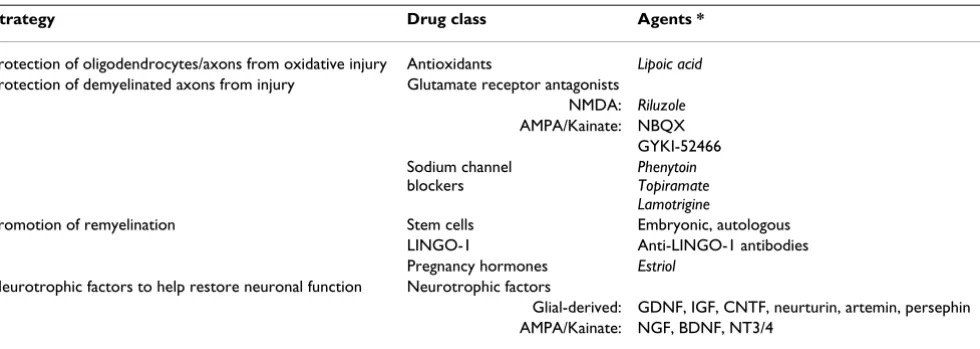
therapies and that neuroprotective and neurorestorative therapies that affect neuronal integrity will be required for progressive MS. A variety of existing and novel approaches are under investigation as neuroprotective and neu-rorestorative therapies in progressive as well as relapsing MS (Table 3). Therapeutic strategies include protecting demyelinated axons as well as oligodendrocytes (the CNS myelin-producing cells) from oxidative injury, promoting neuronal remyelination and restoring neuronal growth and function with neurotrophic factors [44]. Lipoic acid, a fatty acid present in certain foods and available as an oral supplement, may protect oligodendrocytes by anti-oxidant mechanisms and effects on microglia. Lipoic acid is well tolerated [45] and phase II trials of this compound in RRMS and SPMS are being planned. Drugs that block glutamate receptors present on demyelinated axons may prevent oxidative injury [46]. Riluzole, an oral glutamate NMDA receptor antagonist approved for use in amyo-trophic lateral sclerosis [47], is being evaluated in con-junction with IFNβ-1a in a phase II trial for early MS. Another strategy for neuroprotection in MS is selective sodium channel blockade with antiepileptic medications including phenytoin, topiramate and lamotrigine [48,49].
Table 2: Monoclonal antibodies for relapsing-remitting multiple sclerosis (RRMS)
Agent Proposed mechanisms of action Stage of development*
Alemtuzamab Leukocyte depletion; Depletes CD52 B and T cell populations, monocytes, macrophages and eosinophils
Phase III for RRMS
Daclizumab Leukocyte depletion; Binds cell-surface receptor IL2; reduces T cell proliferation and activation Phase II for RRMS Rituximab B cell-directed therapy; Depletes CD20 B cell population Phase III for RRMS
*Compiled from http://www.clinicaltrials.gov
Table 3: Oral and parenteral neuroprotective and neurorestorative agents for primary progressive multiple sclerosis (MS) and secondary progressive MS.
Strategy Drug class Agents *
Protection of oligodendrocytes/axons from oxidative injury Antioxidants Lipoic acid Protection of demyelinated axons from injury Glutamate receptor antagonists
NMDA: Riluzole AMPA/Kainate: NBQX
GYKI-52466 Sodium channel
blockers
Phenytoin Topiramate Lamotrigine
Promotion of remyelination Stem cells Embryonic, autologous LINGO-1 Anti-LINGO-1 antibodies Pregnancy hormones Estriol
Neurotrophic factors to help restore neuronal function Neurotrophic factors
Glial-derived: GDNF, IGF, CNTF, neurturin, artemin, persephin AMPA/Kainate: NGF, BDNF, NT3/4
*oral agents are indicated in italics
A recent phase II trial of lamotrigine in SPMS, however, failed to meet its primary endpoint of reducing the rate of central cerebral volume loss [50,51].
Trials of stem cell transplantation, with the goal of repop-ulating oligodendrocytes, are underway in people with MS. Remyelination may also be promoted by blocking leucine rich repeat and Ig domain-containing, Nogo Receptor-interacting protein 1 (LINGO-1), a protein on the surface of neurons that inhibits differentiation of pre-cursor oligodendrocytes into mature cells. Antibody blockade of LINGO-1 has shown promise in an animal model of MS [51]. Neurotrophins are protein factors pro-duced by CNS cells that support neuronal growth, survival and differentiation [52]. In MS, secretion of the neuro-trophin brain-derived neurotrophic factor (BDNF) is low and dysregulated [53] and BDNF is therefore also being considered as a therapeutic target.
Conclusion
Current MS therapeutics are moderately effective for mod-ifying disease during its relapsing-remitting phase. There are a number of oral and parenteral agents that target inflammation in development and several are likely to be approved for treatment of RRMS within the next few years. These therapies will likely more effectively control RRMS but will also carry greater known and, as yet, unknown safety risks. These risks and benefits will have to be weighed carefully against the efficacy and proven safety of the IFNs and GA. Furthermore, none of the anti-inflam-matory therapies currently in late stage of development are likely to benefit patients with SPMS and PPMS. Devel-opment of effective neuroprotective and neurorestorative therapies are needed in order to benefit patients with pro-gressive MS.
Abbreviations
BBB: blood brain barrier; BDNF: brain-derived neuro-trophic; CIS: clinically isolated syndrome; CNS: central nervous system; DMT: disease-modifying therapy; FDA: US Food and Drug Administration; GA: glatiramer ace-tate; IFN: interferon; LINGO-1: leucine rich repeat and Ig domain-containing, Nogo Receptor-interacting protein 1; MAB: monoclonal antibody; MRI: magnetic resonance imaging; MS: multiple sclerosis; PPMS: primary progres-sive MS; RRMS: relapsing-remitting MS; SIP: sphingosine-1-phosphate; SPMS: secondary progressive MS.
Competing interests
RIS has no competing interests. MHC has received hono-raria for speaking from Teva Neuroscience. DB has research grants from the National Institutes of Health, the Department of Veterans Affairs and the National Multiple Sclerosis Society. DB has also received honoraria for speaking/consulting or unrestricted educational grants,
from Teva Neuroscience, Biogen Idec, EMD Serono and Bayer USA.
Authors' contributions
RIS and MHC contributed equally to the paper. All authors were involved in the drafting of the manuscript and revision for important intellectual content. All authors read and approved the final manuscript and have given their approval of final published version.
Acknowledgements
MHC is grateful for support from a Sylvia Lawry Physician Fellowship Award from the National Multiple Sclerosis Society.
References
1. Compston A, Coles A: Multiple sclerosis. Lancet 2008, 372:1502-1517.
2. Frohman EM, Racke MK, Raine CS: Multiple sclerosis - the plaque and its pathogenesis. N Engl J Med 2006:942-955.
3. Confavreux C, Vukusic S: Natural history of multiple sclerosis: a unifying concept. Brain 2006, 129:606-616.
4. Kezele IB, Arnold DL, Collins DL: Atrophy in white matter fiber tracts in multiple sclerosis is not dependent on tract length or local white matter lesions. Mult Scler 2008, 14:779-785. 5. Milligan NM, Newcombe R, Compston DA: A double-blind
con-trolled trial of high dose methylprednisolone in patients with multiple sclerosis: 1. Clinical effects. J Neurol Neurosurg Psychia-try 1987, 50:511-516.
6. Zivadinov R, Rudick RA, De Masi R, Nasuelli D, Ukmar M, Pozzi-Mucelli RS, Grop A, Cazzato G, Zorzon M: Effects of IV methyl-prednisolone on brain atrophy in relapsing-remitting MS.
Neurology 2001, 57:1239-1247.
7. Beck RW: The Optic Neuritis Treatment Trial. Arch Ophthalmol
1988, 106:1051-1053.
8. The IFNB Multiple Sclerosis Study Group: Interferon beta-1b is effective in relapsing-remitting multiple sclerosis. I. Clinical results of a multicenter, randomized, double-blind, placebo-controlled trial. In NeurologyVolume 43. The IFNB Multiple Sclero-sis Study Group; 1993:655-661.
9. Goodkin D: Interferon beta-1b. Lancet 1994, 344:1057-1060. 10. Schwid SR, Panitch HS: Full results of the Evidence of Interferon
Dose-Response-European North American Comparative Efficacy (EVIDENCE) study: a multicenter, randomized, assessor-blinded comparison of low-dose weekly versus high-dose, high-frequency interferon beta-1a for relapsing multi-ple sclerosis. Clin Ther 2007, 29:2031-2048.
11. Mauch E, Kornhuber HH, Krapf H, Fetzer U, Laufen H: Treatment of multiple sclerosis with mitoxantrone. Eur Arch Psychiatry Clin Neurosci 1992, 242:96-102.
12. Noseworthy JH, Hopkins MB, Vandervoort MK, Karlik SJ, Lee DH, Penman M, Rice GP, Grinwich KD, Cauvier H, Harris BJ: An open-trial evaluation of mitoxantrone in the treatment of progres-sive MS. Neurology 1993, 43:1401-1406.
13. Edan G, Miller D, Clanet M, Confavreux C, Lyon-Caen O, Lubetzki C, Brochet B, Berry I, Rolland Y, Froment JC, Cabanis E, Iba-Zizen MT, Gandon JM, Lai HM, Moseley I, Sabouraud O: Therapeutic effect of mitoxantrone combined with methylprednisolone in mul-tiple sclerosis: a randomised multicentre study of active dis-ease using MRI and clinical criteria. J Neurol Neurosurg Psychiatry
1997, 62:112-118.
14. Goodin DS, Arnason BG, Coyle PK, Frohman EM, Paty DW, Thera-peutics and Technology Assessment Subcommittee of the American Academy of Neurology: The use of mitoxantrone (Novantrone) for the treatment of multiple sclerosis: report of the Thera-peutics and Technology Assessment Subcommittee of the American Academy of Neurology. Neurology 2003, 61:1332-1338.
16. Voltz R, Starck M, Zingler V, Strupp M, Kolb HJ: Mitoxantrone therapy in multiple sclerosis and acute leukemia: a case report out of 644 treated patients. Mult Scler 2004, 10:472-474. 17. Ransohoff RM: Natalizumab for multiple sclerosis. N Engl J Med
2007:2622-2629.
18. Polman CH, O'Connor PW, Havrdova E, Hutchinson M, Kappos L, Miller DH, Phillips JT, Lublin FD, Giovannoni G, Wajgt A, Toal M, Lynn F, Panzara MA, Sandrock AW, AFFIRM Investigators: A rand-omized, placebo-controlled trial of natalizumab for relaps-ing multiple sclerosis. N Engl J Med 2006, 354:899-910. 19. Berger JR, Houff SA, Major EO: Monoclonal antibodies and
pro-gressive multifocal leukoencephalopathy. mAbs 2009, 1:1-7. 20. Ismail A, Kemp J, Sharrack B: Melanoma complicating treatment
with Natalizumab (Tysabri) for multiple sclerosis. J Neurol
2009, 256:1771-1772.
21. Schweikert A, Kremer M, Ringel F, Liebig T, Duyster J, Stuve O, Hem-mer B, Berthele A: Primary central nervous system lymphoma in a patient treated with natalizumab. Ann Neurol 2009, 66:403-406.
22. Hiestand PC, Rausch M, Meier DP, Foster CA: Ascomycete deriv-ative to MS therapeutic: S1P receptor modulator FTY720.
Prog Drug Res 2008, 66:361.
23. Kappos L, Antel J, Comi G, Montalban X, O'Connor P, Polman CH, Haas T, Korn AA, Karlsson G, Radue EW, FTY720 D2201 Study Group: Oral fingolimod (FTY720) for relapsing multiple scle-rosis. N Engl J Med 2006, 355:1124-1140.
24. Cohen J, Pelletier J, Kappos L, Barkhof F, Comi G, Hartung HP, Mon-talban X, Khatri B, Tiel-Wilck K, Izquierdo G, et al.: Oral fingolimod (FTY720) significantly reduced relapse rate compared with intramuscular interferon beta-1a in relapsing-remitting mul-tiple sclerosis: clinical results from a 12-month phase III study (TRANSFORMS). ECTRIMS 2009.
25. Costello K, Sipe JC: Cladribine tablets' potential in multiple: sclerosis treatment. J Neurosci Nurs 2008, 40:275-280.
26. Beutler E, Sipe JC, Romine JS, Koziol JA, McMillan R, Zyroff J: The treatment of chronic progressive multiple sclerosis with cladribine. Proc Natl Acad Sci USA 1996, 93:1716-1720.
27. Giovannoni G, Comi G, Cook S, Rammohan K, Rieckmann K, Sørensen PS, Vermersch P, Chang P, Hamlett A, Musch B, et al.: Clin-ical outcomes with cladribine tablets in the 96-week, phase III, double-blind, placebo-controlled CLARITY study in patients with relapsing-remitting multiple sclerosis. ECTRIMS
2009.
28. Noseworthy JH, Wolinsky JS, Lublin FD, Whitaker JN, Linde A, Gjorstrup P, Sullivan HC: Linomide in relapsing and secondary progressive MS: part I: trial design and clinical results. North American Linomide Investigators. Neurology 2000, 54:1726-1733.
29. Comi G, Pulizzi A, Rovaris M, Abramsky O, Arbizu T, Boiko A, Gold R, Havrdova E, Komoly S, Selmaj K, Sharrack B, Filippi M, LAQ/5062 Study Group: Effect of laquinimod on MRI-monitored disease activity in patients with relapsing-remitting multiple sclero-sis: a multicentre, randomised, double-blind, placebo-con-trolled phase IIb study. Lancet 2008, 371:2085-2092.
30. Dimitrova P, Skapenko A, Herrmann ML, Schleyerbach R, Kalden JR, Schulze-Koops H: Restriction of de novo pyrimidine biosynthe-sis inhibits Th1 cell activation and promotes Th2 cell differ-entiation. J Immunol 2002, 169:3392-3399.
31. O'Connor PW, Li D, Freedman MS, Bar-Or A, Rice GP, Confavreux C, Paty DW, Stewart JA, Scheyer R, Teriflunomide Multiple Sclerosis Trial Group and University of British Columbia MS/MRI Research Group: A Phase II study of the safety and efficacy of terifluno-mide in multiple sclerosis with relapses. Neurology
2006:894-900.
32. Kappos L, Gold R, Miller DH, Macmanus DG, Havrdova E, Limmroth V, Polman CH, Schmierer K, Yousry TA, Yang M, Eraksoy M, Meluzi-nova E, Rektor I, Dawson KT, Sandrock AW, O'Neill GN, BG-12 Phase IIb Study Investigators: Efficacy and safety of oral fumarate in patients with relapsing-remitting multiple sclerosis: a mul-ticentre, randomised, double-blind, placebo-controlled phase IIb study. Lancet 2008, 372:1463-1472.
33. Gregg C, Shikar V, Larsen P, Mak G, Chojnacki A, Yong VW, Weiss S: White matter plasticity and enhanced remyelination in the maternal CNS. J Neurosci 2007, 27:1812-1823.
34. Gold SM, Voskuhl RR: Estrogen and testosterone therapies in multiple sclerosis. Prog Brain Res 2009, 175:239-251.
35. CAMMS223 Trial Investigators, Coles AJ, Compston DA, Selmaj KW, Lake SL, Moran S, Margolin DH, Norris K, Tandon PK: Alemtuzu-mab vs. interferon beta-1a in early multiple sclerosis. N Engl J Med 2008, 359:1786-1801.
36. Paolillo A, Coles AJ, Molyneux PD, Gawne-Cain M, MacManus D, Barker GJ, Compston DA, Miller DH: Quantitative MRI in patients with secondary progressive MS treated with mono-clonal antibody Campath 1H. Neurology 1999, 53:751-757. 37. Bielekova B, Howard T, Packer AN, Richert N, Blevins G, Ohayon J,
Waldmann TA, McFarland HF, Martin R: Effect of CD25 anti-body daclizumab in the inhibition of inflammation and stabi-lization of disease progression in multiple sclerosis. Arch Neurol 2009, 66:483-489.
38. Rose JW, Burns JB, Bjorklund J, Klein J, Watt HE, Carlson NG: Dacli-zumab phase II trial in relapsing and remitting multiple scle-rosis: MRI and clinical results. Neurology 2007:785-789. 39. Weber MS, Hemmer B: Cooperation of B Cells and T Cells in
the Pathogenesis of Multiple Sclerosis. Results Probl Cell Differ
2009 in press.
40. Racke MK: The role of B cells in multiple sclerosis: rationale for B-cell-targeted therapies. Curr Opin Neurol 2008, 21(Supple 1):S9-S18.
41. Hauser SL, Waubant E, Arnold DL, Vollmer T, Antel J, Fox RJ, Bar-Or A, Panzara M, Sarkar N, Agarwal S, Langer-Gould A, Smith CH, HERMES Trial Group: B-cell depletion with rituximab in relaps-ing-remitting multiple sclerosis. N Engl J Med 2008, 358:676-688.
42. Stuve O, Leussink VI, Frohlich R, Hemmer B, Hartung HP, Menge T, Kieseier BC: Long-term B-lymphocyte depletion with rituxi-mab in patients with relapsing-remitting multiple sclerosis.
Arch Neurol 2009, 66:259-261.
43. Jacob A, Weinshenker BG, Violich I, McLinskey N, Krupp L, Fox RJ, Wingerchuk DM, Boggild M, Constantinescu CS, Miller A, De Angelis T, Matiello M, Cree BA: Treatment of neuromyelitis optica with rituximab: retrospective analysis of 25 patients. Arch Neurol
2008, 65:1443-1448.
44. Benarroch EE: Oligodendrocytes: susceptibility to injury and involvement in neurologic disease. Neurology 2009:1779-1785. 45. Yadav V, Marracci G, Lovera J, Woodward W, Bogardus K,
Mar-quardt W, Shinto L, Morris C, Bourdette D: Lipoic acid in multiple sclerosis: a pilot study. Mult Scler 2005, 11:159-165.
46. Newcombe J, Uddin A, Dove R, Patel B, Turski L, Nishizawa Y, Smith T: Glutamate receptor expression in multiple sclerosis lesions. Brain Pathol 2008, 18:52-61.
47. Killestein J, Kalkers NF, Polman CH: Glutamate inhibition in MS: the neuroprotective properties of riluzole. J Neurol Sci 2005, 233:113-115.
48. Black JA, Waxman SG: Phenytoin protects central axons in experimental autoimmune encephalomyelitis. J Neurol Sci
2008, 274:57-63.
49. Stys PK: General mechanisms of axonal damage and its pre-vention. J Neurol Sci 2005, 233:3-13.
50. Kapoor K, Furby J, Hayton T: Outcomes of a phase II rand-omized controlled trial of neuroprotection with lamotrigine in secondary progressive multiple sclerosis. Mult Scler 2009, 15(Suppl 2):27.
51. Mi S, Miller RH, Tang W, Lee X, Hu B, Wu W, Zhang Y, Shields CB, Zhang Y, Miklasz S, Shea D, Mason J, Franklin RJ, Ji B, Shao Z, Chédotal A, Bernard F, Roulois A, Xu J, Jung V, Pepinsky B: Promotion of central nervous system remyelination by induced differenti-ation of oligodendrocyte precursor cells. Ann Neurol 2009, 65:304-315.
52. Loeb JA: Neuroprotection and repair by neurotrophic and gli-otrophic factors in multiple sclerosis. Neurology 2007, 68(Suppl 3):38-54.
53. Azoulay D, Urshansky N, Karni A: Low and dysregulated BDNF secretion from immune cells of MS patients is related to reduced neuroprotection. J Neuroimmunol 2008, 195:186-193.
Pre-publication history
The pre-publication history for this paper can be accessed here: