tripleC 8(1): 77-108, 2010 ISSN 1726-670X
http://www.triple-c.at
What is information? A multidimensional concern
José María Díaz Nafría
Universidad de León, Spain; Science of Information Institute, USA; E-mail: [email protected]
Abstract: Looking for an answer to the posed question, we will first go through a brief historical enquiry aiming at exploring the development of the uses given to the Latin word “information” from its Greek roots until its scientific formalisation in hands of the Mathematical Theory of Communication. Secondly and starting from the conceptual limitations of Shannon’s theory, we will put forward the most important theoretical demands claimed by many scientific and technical fields, directly concerned with the usage of information concepts. Such claims eventually entail an open critic to Shannon’s definition with different degrees of radicality, proposing a perspective change in which the different uses and disciplinary interests might be better represented. In order to foster an interdisciplinary approach aiming at gathering together the competing views of information and at bridging their theoretical and practical interests, a sketched glossary of concepts concerning information is proposed as an interdisciplinary tool.
Keywords: Information concepts, Information theories, Interdisciplinarity, Mathematical Theory of Communication…
Acknowledgement: I wish to thank the invitation from Sankt Pölten University of Applied Sciences, Austria, in autumn 2008, to hold some lectures in this topic for undergraduate students in informatics and media studies. The kind and interested attention received in this center devoted to applied matters showed that –regardless Shannon’s famous remark about the scope of engineering– there are other aspects of information concerning different scientific and societal interests, which might become indeed “relevant to the engineering problem”. I am also grateful to the Unified Theory of Information Research Group and the ICTs & Society Center, inviting me to lecture in a related topic within a colloquium at the University of Salzburg. Finally, I wish to acknowledge Francisco Salto’s role since all what is discussed in the article stood up within BITrum project proposal, we both authored, and Mercedes Osorio’s help improving the language.
The evolution from the industrial society to the “information era” is a crucial juncture of our times and a usual concern in classrooms, offices and streets. However, the very con-cept of “information” puts forward deep and challenging questions. Just one binary digit may tell us if the universe is about to col-lapse, thus being very informative, and all millions of terabits on the web (measured in a Shannon’s sense) may also be generated by the whim of electrons in a rheostat, therefore being uninformative.
The Mathematical Theory of Communica-tion (MTC) makes it possible to measure the capacity of channels and to understand in-formation in its syntactical aspects, as a physical magnitude. Information is measured on average and messages come from com-binations of objects selected from a pre-determined set. However, the informational content of typical human messages seems to
have semantic properties of its own (not on average) that are not apprehensible in bits. This fast incursion in the forest of problems and theories of information try to search an answer to:
Which are the difficulties both theoretical and technical, both conceptual and techno-logical that might be encountered in defining a useful unified information concept, valid for cables and organisms, for antennas and societies, for robots and mental states?
1.
Concept Lability
of the dictionary). Such common use ap-proximately refers to “the act or fact of in-forming”, or, in other words, “to find out about something”. Moreover, the course of what– has–been–called “information” through-out history shows: on the one hand, the persis-tence of the most remote roots; on the other hand, the constant tension to reflect in the meaning itself the uses and interests posed by everyday life. No matter whether this is ordinary life or the one carried on within a specialised group, for instance, devoted to a specific field of scientific research. This means that through metonymies and meta-phors the term has gradually adapted itself, as far as possible, to various and collective uses and interests. However for some sixty years, the scientific use of the information notion has categorised the term to a large extent, making its sense much more precise but also unrulier, which has created further tension when striving for making certain points of view clearer.1 This tension is espe-cially obvious between theories that because of a limited universe of reference could be axiomatised (becoming indeed mathematical theories) and those others that in order to not diminish the regarded reality have adopted open models, whose formalisation has not been mathematized, or its mathematical form has resulted of impractical complexity.
Briefly, when it comes to illustrate the dif-ferent approaches to the term “information”, it has to be focused in two main directions: On the one hand, toward its very remote roots – including the different meanings it has ac-quired until the present day–; on the other hand, toward the plurality of meanings given by different scientific communities and other socio-cultural groups of varied nature.
1 Despite the accuracy of Shannon’s mathematical
approach, its corresponding concept has also been branded as dark and distant from its usual meaning (Segal 2003; Capurro & Hjørland 2003; Floridi 2005).
2.
Historical Roots (from ancient
times to nowadays)
22.1. Antiquity (Greek and Latin roots)
As mentioned above, the Latin term infor-matio (disseminated in different degrees to other European languages, obviously includ-ing the Romance ones) derives from the verb informare. Primarily meaning “to form”, it was used both in a tangible sense ( corpo-raliter), i.e. the effect on something material, and in an intangible or spiritual sense, i.e. linked to moral and pedagogical uses.3 In its tangible meaning, the use of the term “ infor-matio” refers to both artisan (or technical) contexts, as it can be found in Virgil (Vergili 1900, b. VIII, v. 264, 426, 447), and biological contexts, e.g. in Varro (Gellius 2006).4
In both meanings, but more especially in the tangible one, the Latin concept grasped a Greek-rooted ontology and epistemology – consequence of the Greek influence on Ro-man culture–, which entailed the recurrent translation of Greek concepts into Latin, such as eidos, idea, morphe or typos… with a long intellectual tradition. This can be found in both Latin and Christian authors, as Cicero, Augustine of Hippo, Aquinas or generally in medieval scholasticism –whose concern was mainly inmersed in intellectual frames and devoted to pedagogical, moral and biological issues–. In this tradition, we eventually find restrictive uses to tangible or intangible senses; swinging from a high development level to a more common sense. In the case of Augustine and Aquinas –who will greatly in-fluence the future meaning of the concept–
2 Although a deeply inquiry is desirable to grasp the
actual dynamics of the “information” senses throughout history, we just pursue here to sketch the most significant changes in a summarized account. Detailed studies can be found in the given references throughout this section.
3 A thorough inquiry of the historical uses of the Latin
term and its derivatives can be found in Capurro (1978), who also offers a briefer but sharp account in a co-authored work (Capurro & Hjørland 2003).
4 In a sense that can be considered as “partially
rescued” in the context of the biological morphogenesis from the late 18th century with authors, such as Oken
79 José María Díaz Nafría
we find a very refined use in both an episte-mological and ontological sense.5
In sum, the plurality of meanings that fore-shadows the current conflict regarding infor-mation can already be observed in antiquity as a whole. However, these meanings were loaded with an ontology that will gradually disappear due to the emergence and course of modernity, as Peters argued (1988). These changes are fundamental in order to under-stand the formalisation of the information concept by the mathematical theory of infor-mation in the 20th century.
2.2. The rise of Modernity
With the advent of Modernity, the old, or-dered and structured cosmos gives way to a world of corpuscular movements, where con-sciousness take account of its dynamics. The antique world was structured according to supra-sensory and eternal forms enabling the intellectual apprehension of such cosmos. However, the new “picture” of the modern world comes from fragmentary, fluctuant and even hazardous units of feeling that has to be arranged by consciousness itself. Thus “under the tutelage of empiricism, information gradually moves from structure to matter, from form to substance and from intellectual order to sensory impulses” (Peters 1988, p.13).
Reasonably, the Greek hylemorphism, embraced by medieval scholasticism in both ontological and epistemic senses, should gradually disappear in the course of this radi-cal transformation. In this trend, the meaning of “giving form” will be now consigned to a domain, regarded as more consistent, namely consciousness6. Thus former
5 According to Capurro & Hjørland (2003, p. 355), the
20th century gives rise to the “renaissance of the
onto-logical dimension of the Greek roots of informatio be-yond a restrictive humanistic view”. However, an under-ground continuity of the old ontology into the modern one might be argued, for instance, in terms of a gradual transformation of the classical “chain of being” into the modern theory of biological evolution (Bowler 1992, pp. 155-192).
6 The Enlightenment might be indeed considered –
from a modern point of view – as a vast effort of forming consciousnesses or even of transmitting between them those correct forms created from “clear and different ideas”.
tivity and consistency of “form” is followed by a radical dependence on the subject that fundamentally subjectivised such form. Like-wise, the atomisation of the external world is now associated with the atomisation at the level of ideas, whose interrelation with the world becomes problematic because of sub-stantial restrictions on sensitive mechanisms. Through these means and according to em-piricist epistemology, consciousness can ob-tain information about the world. Briefly, in an ontological level, form and structural unit lose importance while both world and conscious-ness become analytical, i.e. devisable into more elemental parts. Furthermore, in a epi-stemic level, truth becomes also analytical.
2.3. The rise of contemporary science, the context of the Mathematical Theory of Communication
purpose of achieving an order that cannot be explained without his intervention.7
According to a subsequent quantitative ad-justment, entropy and information become at the same level. Hence, information rescues a classical reversibility that was questioned by the new worldview8. However at the same time, a new model of knowledge and even of cosmos –compatible with each other- are forged, in which the information that can be extracted from this ‘cosmos’ and its unavoid-able uncertainty become key issues of the worldview itself.
Thus, two contradictory movements occur at the crystallization of the information con-cept:
• The analytical and mechanistic ideal of
rationalism is taken as a model of the measurability of information, including the informative process itself9.
• The uncertainty itself, i.e. limiting
one-self to the purely observable as a cri-terion of reality, becomes the
7 An excellent inquiry in the forging of the physical
no-tion of informano-tion throughout the work of their authors can be found in the mentioned book of Segal (2003, 16-32).
8 The contradictory reduction of entropy entailed by
the intervention of Maxwell’s demon, leaving the system more ordered than before (in a flagrant violation of the second law of thermodynamics, which could be for instance used to obtain energy), is compensated with the contribution of information bythe demon itself according to its enquiries (up to the point in which the demon is not able to obtain new information as to increase the order of the system). According to Bidón-Chanal (1971), this exorcism of the demon represents a combination of two different notions of information: as acquisition of knowledge –implying an intrinsic increase of entropy–, and an Aristotelian notion as order. According to this combination knowledge is able to reconstruct order. Hence, deterministic reversibility results by assuming the exact adjustment of both quantities. Yet, if an additional restriction is considered regarding a limit in the acquisition of knowledge, the process will be irreversible and, therefore, more coherent with contemporary physical assumptions.
9 The author (Díaz2007, 2009) refers to the Lockean
root of Shannon’s model of communication, highlighting its deficiency with regard to the pragmatic point of view. If this is the case –and according to the persistence pointed out by Floridi of Shannon’s communication model in the alternatives to his theory of information– this will be an important conceptual burden that should be overcome (Floridi2005).
stone of the idea and measurement of information.
It is especially paradoxical that this confu-sion occurred, as previously mentioned, from the matrix of statistical physics, since its worldview is beyond the first of the referred movements (Segal 2003, 15-65). However, as stated by Danchin (Segal 2003, ix-x), this cannot be understood without the develop-ment of telecommunication engineering in the post-war context10 as well as the rationalisa-tion of economic exchanges, whose models of rationality were purely classical and –to a large extent– direct heirs of 19th century posi-tivism.
Thus, it can be said that the imperatives of technological development –both in com-munication and in computing–, and even the prestige of its brilliant career, gave rise to a theoretical eclipse that –as in other fields– was argued in terms of technocracy11 by Frankfurt School and, especially, by Haber-mas (1970). From this narrow technical and economic viewpoint, we might enumerate the most relevant information issues for the Mathematical Theory of Communication (MTC) as follows:
a) How shall information optimally be com-pressed, i.e. coded by a minimum quantity of resources?
b) How shall the maximum amount of infor-mation be transmitted for a given set of resources;
c) How information amount shall be ac-counted, so that we can predict the ne-cessary resources and, therefore, the costs.
10 Shannon himself worked in this field, as previously
done by Nyquist and Hartley, whose contributions were essential for Shannon’s theory, as pointed out by himself (Shannon 1948).
11 According to Danchin (see SEGAL, op. cit.), “the
81 José María Díaz Nafría
Nevertheless, beyond MTC formalisations, the reality depicted by evolutionist biology and quantum mechanics involved a world of interrelations absolutely irreducible to classi-cal mechanicism. Hence not surprisingly, due to the centrality of information in these new sciences, they encountered significant ten-sions by adopting the notion of information coined by the MTC. Moreover, the tensions that came up into social sciences were also very significant, after an initial euphoria of having this new mathematical tool on hand. In these disciplines, the semantic and prag-matic dimensions of information (supported by the linguistic use) are essential to explain the problems under study; but they are alien to the MTC, as stated by Shannon repeatedly (1948, 1949). Thus, in the context of these controversies, the concept of information has intended to limit itself to the uses and inter-ests of each theoretical field, sometimes with the intention of completing the MTC, some-times openly contradicting some of its points (especially, as general theory of information); at other times with the aim of superseding it.
3.
Current points of view on
informa-tion
As generally highlighted, since the MTC focuses its efforts on the quantitative deter-mination of information, it makes the quality indistinguishable. It refers exclusively to the syntactical aspects of information (Floridi 2005a-c, Segal 2003, Capurro 2005), even though it is difficult for information to be ex-clusively linked to this aspect, whatever sense of information is used (unless it were restricted to the MTC quantification, therefore just referred to the uncertainty values of the signals used in the communicative process). A qualitative approach shows the importance of both its semantic dimension (whereby the signals or symbols considered by the MTC are necessarily referred to something) and its pragmatic one (whereby information is the foundation for action, whether by intentional actors, living beings or automatic systems). This does not simply mean broadening the attributes or details of the reference, but also an important negative limitation driving to
exclude what could not be discriminated at a merely syntactical level.12
As pointed out by Machlup and Mansfield (1983), this negative nature can be illustrated by considering the requirements that human contexts normally impose on the legitimate meaning of information, i.e. need for truth, value, innovation, surprise or reduction of uncertainty. This would classify as non-informative those messages that, even com-plying with all syntactic requirements, were false, incorrect, useless, redundant, expected or promoters of uncertainty. To this regard, the MTC could not say much; neither could any other just syntactical approach. There-fore, the multi-dimensionality of information has to be accounted.
Hence from the previously mentioned theoretical coherence or the conceptual ex-tension posed by different approaches, a panoply of alternatives and criticism has arisen since the MTC was formulated. This must be taken into account in order to distin-guish “what is being called information” and to envisage “what might be called informa-tion”, so that the interests at stake were re-flected and the mutual understanding were possible.
Aiming to address the different ap-proaches in a systematic way, as well as in-creasing the perception of relationships be-tween such approaches, a three-fold classifi-cation is proposed, as follows:
a) According to the ontological and epistemo-logical categories involved, i.e. with regard to fundamental questions, such as: “Is it something objective or subjective?”, “Does it refer to an independent or dependent ontological category?”, “Does it require an abstract, general or human subjectivity?”, “Does it depend on its truth-value, rel-evance (social, political or psychological), meaning or interpretation (in theoretical or cultural contexts)?
12 In his analysis of the qualitative nature of
b) According to the considered dimensions of information (syntactical, semantic, prag-matic, etc.).
c) According to the disciplines, from which it is proposed or elaborated.
3.1. Ontological and epistemological categorisation
The fact of being or not considered as something objective is perhaps the main dis-tinction that can be made concerning what is understood by information. If it is objective it will be independent from mental states or user’s intentions; if it is subjective it will de-pend on the interpretation of a cognitive or intentional agent.13 Between both poles, an intermediate approach could be adopted, according to which it is not necessary to con-sider information as something having its own entity or something belonging to subjec-tivity, but rather in terms of a relationship. This may enable an action to be executed, an order to be obeyed, an structure to be estab-lished or simply allows a behaviour, adapta-tion or an interpretaadapta-tion (even though it could be referred to any type of intentionality).
In the most extreme position of objectivist categorisation, information is deemed as a third metaphysical principle, in the sense ex-pressed by the popular Wiener’s adage: “In-formation is in“In-formation, not matter or en-ergy” (Wiener 1948, p. 132; Günther 1963). This principle is sometimes associated with a teleological description of the universe as it happens in Teilhard de Chardin’s “noo-sphere”, to which Stonier refers (1991), or in an openly theological “cosmovision”, as in Gitt (1996). Regarding the MTC, it remains unclear if the authors consider information as objective, substantial (as sometimes inter-preted) or by the contrary it refers to the un-certainty concerning the identification of the signals being received in the communication process. This second interpretation seems closer to the interest frame, in which the theory was developed (Shannon 1948, 1949).
13 The relevance of this distinction is, for instance,
considered by Capurro and Hjorland (2003, p. 396).
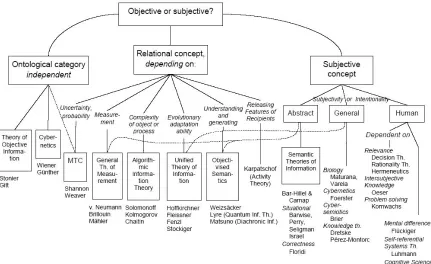
Figure 1 shows a relevant number of theo-retical viewpoints –without attempting to be exhaustive, these models are grouped into theories named under a title that not always corresponds with the one used by the authors, but referred to some key elements of their works and to a relative parallelism of their approaches–. It arranges different in-formation concepts with respect to its greater or lesser subjective nature. On the left, the most objectivist theories are placed; on the right, the most subjectivist ones, and centred, a range of intermediate theories that normally adopt a two-fold approach. This is, e.g., the case of Weizsäcker’s dual concept of his ob-jectivised semantics, in which information is defined as: 1) what might be understood (even if it is done by an abstract intention-ality) and 2) what generates information (Weizsäcker 1974, p. 351).
As a relational concept, information might be dependent:
• on reception probability or uncertainty
as in MTC.
• on measurement processes, as in the
general theory of measurement (Neu-man 1932, Brillouin 1956, Mähler 1996);
• on the complexity of a referred object
or process to be done, as in the “Algor-ithmic Information Theory” (Solomonoff 1964, Kolmogorov 1965, Chaitin 1969, 1982);
• on the understanding potentials and
generating facts of the mentioned “ob-jectivised semantics” (Weizsäcker 1974) and other related or similar ap-proaches as Lyre’s information-theoretic atomismus (1998) or Matsuno’s informational diachronism of evolution (1998);
• on the evolutionary adaptation ability of
self-organizing systems as in the “Uni-fied Theory of Information” (Hofkirchner 1999b);
• on the releasing features of recipients
as in Karpatschof’s activity theory (2007)
83 José María Díaz Nafría
a certain kind of subjectivity or intentionality. This is the case of the Unified Theory of In-formation – frequently presented as a media-tor of all points of views without falling into reductionism or holism (Fenzl & Hofkirchner, 1997) –, which appeals to a certain degree of
intentionality, not necessarily human, that we call general. The complexity may present different degrees depending on the process this theory refers to (i.e. adaptation of sys-tems with a greater or lesser complexity).
Figure 1. Taxonomy of theories based on information as something objective, relational or subjective.
Nevertheless, trying to give account of all processes and to explain the emergence of more complex auto-organizing systems, this approach also refers to the organisation of physical systems without intentionality
Thus, intentionality belongs to the realm of the most complex systems (normally human or social) aiming to harmonise with dia-chronic struc-turing and organisation from the most simple elements.14
If information is considered from a sub-jectivist point of view, the objective qualities of signals are left apart, focusing on those regarded as relevant by subjects (interpret-ers). However, this does not mean that in-formation is only interpreted from an anthro-pocentric point of view (or something just
14 avoiding a strictly casual explanation (bottom-up) or
its exclusively projectionist counterpart (top-down)
curring inside minds15), but that subjectivity may be referred to an inten-tionality that can be:
a) Abstract, or formal, in the sense of a se-ries of general conditions of representa-tion and intellecrepresenta-tion of reality, as it hap-pens in most of the semantic theories of information (Bar-Hillel & Carnap 1953, Barwise & Perry 1983, Barwise & Selig-man 1997, Israel & Perry 1990, Floridi 2004-2005c);
b) general, in the case of information as a construct of an observer (whether human or not), who finds differences in its cir-cumstance –as suggested by Maturana and Varela (1980) from a biological ap-proach, or by Heinz von Foerster from a
15 Indeed sometimes, an externalist viewpoint is
cybernetic perspective (1981)– (Brier 2008, Dretske 1981, Pérez-Montoro 1997);
c) human, in whose case the consideration of language (Wilson 1993), interpretation (Capurro 2008), action (Benthem 2003, 2008, Floridi 2005d), cognitive mecha-nisms (Flückiger 2005) or social systems (Luhmann 1987) become essential, while the quest for relevance, whether social or individual, veracity or relationship with knowledge turn into articulating aspects (Kornwachs 1996, Oeser 1976, Habermas 1981).
With regard to the epistemic value of each perspective, it is clearly neutral for objectivist conceptions (the value of information lies in itself and it is meaningless to talk about truth) while it can be considered subjectivist or not for those conceptions depending on inten-tionality, especially if they are linked to know-ledge or semantic issues. To some extend when moving from left to right in fig. 1, we go from ontological to epistemological questions. The particular epistemic value will depend on the attention paid to syntactical, semantic and pragmatic aspects.
3.2. Dimensional approach
The perspective adopted concerning which dimension of information is to be considered, is also a clarifying aspect of the scope and intention of the different information con-cepts.
As mentioned above, both epistemological and ontological consequences will result from this stance. If just the syntactical level is con-sidered, the question about the truth of the content is meaningless, whereas the way toward the objectification of information is maximally feasible16. On the other hand, when pragmatics comes on stage, the ques-tion about truth is substituted by others, such as value or utility.
16 According to Zoglauer(1996),the naturalisation of
the information concept is only possible at the syntactical level, even if it is related to semantic units mentally de-pendent or to any type of functional information that could be interpreted by a Turing machine.
Briefly, the three mentioned dimensions of information could be characterised by means of three major questions17: 1) concerning the syntactical content, “How is it expressed?”; 2) for the semantic content, “What does it rep-resent?” as well as “with which truth value?”; and, 3) for the pragmatic content, “What value and utility has it?”.
Although in communicative or information-transmission processes, speaking about transmission of semantic contents without expression is clearly meaningless, and such contents are in turn necessary to identify the pragmatic contents, it is still unclear to what extent each question determines the other two. Although the three regarded dimensions are usually considered hierarchically (being the syntactical aspects at the lowest level and the pragmatic one at the highest one), different positions can be taken to this regard due to different reasons: 1) the degree of freedom that each aspect lets the others de-pends on the adopted point of view, 2) usu-ally some of the mentioned levels are not considered at all, and 3) in some cases the levelism is avoided.
Thus, whereas the MTC is only related to the syntactic dimension –regarding the other two besides the point– some semantic ap-proaches consider the semantic question strongly restricted by Shannon’s information – such as in Weaver (Shannon & Weaver 1949) – while others consider a weak restric-tion allowing a large margin of freedom (Slo-man 1978, Floridi 2005c, §4).18
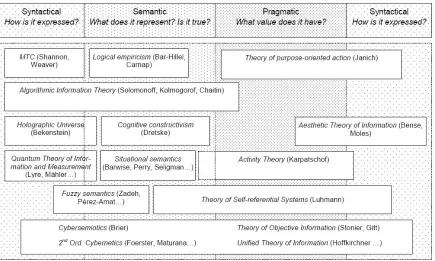
In Figure 2 (not trying to be exhaustive once again), it is shown the extent to which each concept answers to the posed ques-tions about the multi-dimensionality of infor-mation .19
17 Within this section, just the syntactic, semantic and
pragmatic dimensions will be considered, though some authors refer to others (see note 12, Gitt 1996).
18 To this respect, it is remarkable that there are good
reasons to consider that a simple noise (for example, due to the thermal erratic movement of electrons in a resistor), although maximally pondered by the MTC in terms of entropy or amount of information, does not meet the requirements commonly attributed to information. However, a single bit may tell us if the Ptolemaic uni-verse is or not thecase or if war has begun, which might drastically change our worldview or our expectations.
19 Notice in fig. 2 the syntactical dimension is located
85 José María Díaz Nafría
Figure 2. Aspects of qualitative content covered by different information concepts.
Shannon’s information as well as the reformulations trying to supersede the inconsistencies with respect to modern physics epistemology are located at the syntactical plane (quantum information theory or information according to the holographic principle). The last-mentioned cases are represented as partially covering semantic aspects, since –contrary to the classical MTC concept– there is a certain degree of indeterminacy in the description of reality by means of data, implying that information is necessarily mediated by theory. However, this consideration rather belongs to an epistemological level concerning the observation and measurement of reality, therefore not referring to what is commonly
understood as semantic aspects of
information.It is rather an additional limitation at the syntactical level with regard to MTC assumptions.20 If only semantic questions are to be accounted, there are a significant
inclusion or exclusion of any of the three dimensions represented without hierarchy.
20 Such additional limitation can be, for example,
il-lustrated by the fact that Von Neumann’s entropy, re-lated to quantum states, is smaller than Shannon’s en-tropy (Neumann 1932).
number of proposals that, in turn, present important internal differences hardly reconcilable, as they are rooted in atavistically opposed assumptions, such as empiricist, constructivist or rationalist positions. Thus, although the semantic value of a proposition –assumed as informative– it is usually referred to probabilistic computations (inspired by Shannon’s quantification model) and the “Inverse Relationship Principle” is followed, linking the increase in information to the decrease in possibilities (Barwise 1997), a different probabilistic approach can be found in each case:
• For Bar-Hillel’s and Carnap’s logical
empiricism (1953), the probability space is based on the result of a logical con-struction of atomic propositions in a formal language;
• in Dretske’s cognitive constructivism,
the probability of the observed state of affairs is accounted (Dretske 1981);
• in situational semantics, the probability
are accounted (Barwise & Seligman 1997);
• in Zadeh’s fuzzy semantics, the
cate-gories used in the descriptors are asso-ciated to elastic constraints and fuzzy quantifiers (Zadeh 1986).
In the algorithmic information theory, differ-ing from the combinatory and probabilistic approaches, information content is defined in terms of the minimal resources to reproduce (compute) something, whether a mere binary structure, an object or the development of a certain operation (Somolonoff 1964, Kol-mogorov 1965, Chaitin 1966, 1982a). Hence, this approach by referring to the expressive resources required to perform something covers both the syntactic and the semantic issues. But considering that certain codes are just aimed at doing something –purpose ori-ented – the pragmatic questions may also arise21.
In an expressly pragmatic sense, Janich’s theory of information (1998) refers to pur-pose-oriented human actions searching the possibility of reproducing such actions through artificial anthropomorphic devices articulated by standard interrogative dia-logues, qualified by information predicates. Hence, a two-fold attention to pragmatic and syntactical dimensions is found.
In a higher degree of abstraction regarding informative pragmatics, Karpatschof’s activity theory (2007) reduces the syntactical field to that of qualities of signals with regard to a “release mechanism”’, which –so to speak– rules the roost. Thus Karpatschof’s approach focuses on the characteristics of this mecha-nism as a system containing potential and stored energy that can be released in a
21 Indeed, the complexity limit studied by Chaitin in
re-lation with Gödel’s incompleteness theorem and Turing’s halting theorem can be interpreted as having a practical scope, since the knowledge background or the used/selected semantic frame limits what can be done and therefore what can be pursued (Chaitin 1982a, 1982b, Lyre 2002, §1.4.2).
In the sense that algorithmic information theory also deals with an optimal representation of something, the theory can also be understood as a semantic and syn-tactical approach. So is considered by LYRE, H. Informa-tionstheorie, Wilhelm Fink Verlag (UTB), Munich, 2002.
cific way, whenever trigged by a signal fulfil-ling certain conditions22.
In an integrating perspective of the three
considered information dimensions,
Luhmann’s theory of self-referential systems (1987) considers information as mediating instance between the “meaning offer” (typical of the cultural circumstance) and “under-standing”. Thus, semantic and pragmatic di-mensions are in this case closely related, whereas social systems can be considered as both worlds of meanings or problem-solving worlds. This interrelation of pragmatic and semantic dimensions constitutes in Lyre’s Quantum Theory of Information (1998) or Weizsäcker’s semantic theory (1974) the condition for the possibility of the objectivisa-tion of semantics, achieving the unificaobjectivisa-tion of the three fundamental dimensions of informa-tion (Lyre 2002), solving for the syntactical one the already mentioned epistemological defects of the MTC –especially in relation to the certitudes of quantum theory.
In a more hierarchical sense of the three dimensions of information, the unified theory of information intends to cover all problems related to information, such as physical-, or-ganic- or social phenomena, by means of the self-organisation paradigm (Hofkirchner 1997, Fenzl & Hofkirchner 1997). In this ap-proach the three referred dimensions are considered as levels: the constitution of the syntactical level is the condition and substra-tum for the articulation of a semantic level, and this one is, in turn, the condition and substratum for the self-re-creation of a prag-matic level (Hofkirchner 1999a, 1999b). This hierarchy is also shared by Stonier’s (1999) and Gitt’s objectivised information (1996). Gitt considers two additional levels below and over the other three ones, the statistical level –below the syntactical one– and the apobetic
22 One of the benefits of Karpatchof’s proposal,
87 José María Díaz Nafría
level (or purpose level) –over the pragmatic one.
3.3. Domain approach
Other perspective that allows us to distin-guish the scope and interests reflected in the different approaches to information are the scientific and technical disciplines involved in their development. If these approaches come from telecommunications, biology or sociol-ogy, “information” will be obviously used in a different sense. The first one intends not to get involved in questions of meaning or rel-evance (Shannon 1948), the second one usually avoids intentionality, which cannot be left apart in sociology.
Despite this heteronomy, one of the most outstanding characteristics of information theories is perhaps that they have intended to embrace very different points of view, even in those cases with no apparent intention of being exhaustive. Such was the case of the MTC, though mainly developed within the frame of telecommunications and mathemat-ics, its concepts arose (as widely shown by Segal 2003) from thermodynamics and quan-tum physics, statistics –linked to eugenic pro-jects– and telecommunications, and it was applied to many natural and social sciences.
Figure 3. Relationship among theories of information and technical and scientific disciplines.
In any case, this prominent interdisciplinary nature is especially observed in the founda-tions of classical cybernetics in 1940s consti-tuted from contributions derived from physics, biology, psychology, automation, neurophysi-ology or psychiatrics. Interrelation that can
However, in spite of this background of re-lationships between scientific and technical specialities, some theories have been devel-oped from not so open contexts. Such is the case of the Algorithmic Information Theory, mainly linked to mathematics and computing (especially in its genesis); the Aesthetic Theory of Information, linked to the theory of art, mathematics and psychology (Bense 1969, Moles 1972); the theories of rational action or self-referential systems, developed in the field of social sciences –such as the theory of self-referential systems or the criti-cism on information media– and, finally, the semantic theories, of a more philosophical and logical nature.
Figure 3 shows –not thoroughly again– the relationships between scientific and technical disciplines, taxonomically ordered, as partici-pants in the definition of different information concepts. As it can be observed, on the one hand, the deep interrelation among academic disciplines shows the typical interdisciplinarity of information theories; on the other hand, the fact of having located natural sciences on the left and social or human sciences on the right has the consequence that on the left the most syntactical and objectivist theories prevail, while on the right, the semantic, pragmatic and most subjectivist theories are predomi-nant.
4.
Problems of reductibility and
agreement
Summarising, some of the posed problems in order to achieve a generalisation of the in-formation concept, so that no point of view is left aside, could be enumerated as:
a) Is there a single notion useful for all disci-plines? In other words, might every scien-tific notion be reduced into a single and fundamental one?
b) Is there any meaning of informational con-tent, being at the same time useful and relevant, able to unify the different ap-proaches to information, including inten-tional contents and those leaving the question of intentionality aside or avoided?
c) Could a general meaning be accepted and agreed by all disciplines?
d) Would this general –and consequently abstract– meaning of information be use-ful?
e) What ontological, epistemological and methodological consequences would en-tail the supposed validity of this type of notion?
f) Can the question of information be dis-connected from those of knowledge, communication, reproduction or self-regulation?
As it was previously highlighted, there are some shortcomings in every concept of infor-mation with regard to others. For instance:
• the canonical definition of the MTC
comes into conflict with the irreversibility of the theory of measurement, which is more consistent with the approach of quantum mechanics;
• merely syntactical approaches avoid
ir-reducible semantic aspects;
• veracity can or cannot be taken into
ac-count, as well as contradictions or tau-tologies;
• relevance might be a major issue or
ex-cluded in non-contextualist approaches.
The tension among theoretical positions strongly depends on the problems they tackle. Since any science spins around its own prob-lems, how the others consider them will be essential to achieve a unifying arena. Just to mention some problems that might arise by gathering the information theories considered above: measure, stability, control, adaptative efficiency, maximal capacity of storable data, maximal efficiency of a code, communication, knowledge, context, truthfulness, truth, contradiction, socialization, coexistence, plu-rality, politic participation, security, identity, creativity, sustainability, etc.
89 José María Díaz Nafría
different words, while in other cases, the same word is used but it is understood with different meanings.23 Therefore, in order to achieve a generalization of the information concept it will be of major importance to know: what the others understand about the terms they use to articulate their theories; and which are their particular positions – in every related issues.
23 To some extend, this is related to the 20th century
controversy about the “indeterminacy of translation”, which crosses many different scientific fields (from philology or anthropology to physics or mathematics).
Appendix: Glossary as an interdisciplinary tool
The following glossary has just been developed for a short number of entries as an example of what-it-could-be. The purpose of such a glossary, conceived as an interdisciplinary tool for disambiguation and mutual understanding between different points of view concerning information, is double-faced: 1st) the clarification of the terms used by each point of view and, 2nd) the analysis of the main problems regarding information from each approach. This is the reason why some articles –of restricted use– may be very concise, while others –open to controversy– may exhibit a larger extension.
A.1. Arrangement of entries and symbols
Main voices are highlighted with bold char-acters, followed by the most common used names for the same concept –or the nearest ones – in French (F), German (G) and Spanish (s). Whenever a voice is used in compound names the simple voice is typed in capital let-ters before all the compounds ones. Instead of rewriting the simple voice, it is symbolized by the special character ~. Secondary voices are typed in italics within articles of the pri-mary voices. Whenever a voice is highlighted in italics and goes along with the symbol →, it indicates that such voice is further developed in an article of the glossary. In case a particu-lar voice is used in a restricted field or only by a limited number of authors, they will be specified between square brackets.
For abbreviation purpose the following ACRONYMS has been frequently used within the text: AIT shortens Algorithmic Information Theory; MTC, Mathematical Theory of Com-munication; UTI, Unified Theory of Informa-tion.
A
Alphabet (F. alphabet, G. Alphabet, S.
Al-fabeto; from Latin alphabētum, and this from Greek λφα, alfa, and β τα, beta) has been originally used to refer to the writing system whose symbols (letters) are in relative corres-pondence with phonemes of the spoken lan-guage, in contrast to those writings in which the correspondence is established with mor-phemes or syllables. However, the usage has been extended to refer the set of symbols employed in a communication system. This is the sense normally used in communication theory and particularly in the model of
infor-mation transmission (especially in
its syntactic level, such as in the case of MTC), labelling the finite set of symbols or messages that make up the →code which must be known for both the emitter and the receiver.
There are two fundamental features to characterise the alphabet with regard to its performance in communication efficiency: 1) its adequacy to the constraints of the com-munication channel (e.g., that the stroke could be continuous or not, or that the spectral con-tent had to be limited to a given range); 2) the differentiability of its component symbols. The former because it will just be effective what success in crossing the channel; the latter because depending on it the reception in noisy environments will be better or worse. Indeed, Kotelnikov (1959) proved that the de-tection error probability is a function of such differences (measured in terms of energy with respect to the noise spectral density).
91 José María Díaz Nafría
Amount of semantic information [Bar-Hillel & Carnap] →content-measure.
Aspects of information (F. aspects de l’information, G. Aspekte der Information, S.
aspectos de la información) are also referred as dimensions. The designation of syntactic, semantic and pragmatic aspects proceeds from Peirce’s definition of sign according to a triple perspective linking the sign with itself, with the object and with the subject (Peirce 1873). Such triadic relationship is taken by Morris, linked to specific studies: syntax, se-mantics and pragmatics, respectively (Morris 1938).
Autopoiesis (from Greek αυτο-ποιησις, ‘auto (self)-creation’), neologism introduced in 1971 by the Chilean biologists Humberto Maturana and Francisco Varela to designate the organisation of living systems in terms of a fundamental dialectic between structure and function (Maturana & Varela 1980). Although the term emerged in biology, afterwards it came to be used in other sciences as well. Its use by the sociologist Niklas Luhmann is worth pointing out (Luhman 1989). The →UTI takes and reproduces the concept in more differentiated categories (→self-restructuring, self-reproduction and self-recreation).
For Maturana and Varela, autopoiesis is a fundamental condition for the existence of living beings in the continuous production of themselves. According to Maturana ( Trans-formation in coexistence), “living beings are networks of molecular production in which the produced molecules generate, through their interactions, the same network that creates them”. Autopoietic systems are those showing a network of processes or operations that characterise them and have the capacity to create or destroy elements of the same sys-tem as a response to the disturbances of the medium. Within them, even if the system changes structurally, the network that charac-terises them would remain invariable during its whole existence, maintaining its identity.
For Luhmann, autopoiesis means a new theoretical paradigm, which, if applied to social systems, has a self-referential nature that does not restrict itself to the structural level; they construct themselves the elements constituting them. Thus, whereas in biological
systems reference corresponds to self-reproduction, in social (or psychic) systems, it is constituted through meaning (Sinn), which, in its turn, is produced by the “processing dif-ferences” which permit to “select” from the “meaning offer” (Mitteilung). According to Luhmann’s interpretation, “communication” (Kommunikation) melts the difference be-tween “information” (Information), “meaning offer” (Mitteilung) and “understanding” ( Ver-stehen) (in which each part differentiates the other two and leads them towards a unity), whereas information just refers to a selection within the “meaning offer” through a connec-tion between differences. Therefore, strictly speaking, there is no transmission of informa-tion between emitter and receiver; instead, the former makes a suggestion for the selection of the latter, so that the information for both is different, though in any case constituted through communication processes.
B
Behaviour (F. comportement, G.
Verhal-ten, S. comportamiento) is generally used to
refer to the set of responses of animals or humans to exogenous stimuli (from the envi-ronment) or endogenous stimuli (from the or-ganism itself). It plays a key role in the →UTI as a fundamental feature of the macro level (where the pragmatic aspects of information are expressed separately) concerning the way in which the system interacts with its adjacent ones in the network. What structure is to the micro-level and state to the meso-level, be-haviour is to the macro-level, to which the ex-ternal manifestations of the system (or out-puts) belong. The eventual differences of these outputs must be based on a change of the state, being this supported by a change in the relationships or elements of the structure (Fenzl & Hofkirchner 1997).
sys-tem will respond to the environmental chan-ges. Depending on the severity of these changes the system will be forced or not to modify its activity, either following its own in-terest or that of the network to which it be-longs. From this point of view, behaviour in-volves the highest manifestation of informa-tion, where the syntactic and semantic as-pects are subsidiary, representing the pre-condition of behaviour.
C
Channel (F. canal, G. Kanal, S. canal).
Communication ~ deals in the MTC and by extension in many other information and communication theories, with the medium (or set of media) that allow(s) transmitting the signals generated by the transmitter to the receiver. As stated by Shannon: “merely the medium used to transmit the signal from transmitter to receiver. It may be a pair of wires, a coaxial cable, a band of radio fre-quencies, a beam of light, etc” (Shannon 1948).
To some extend, the objective of the transmission coding is to adapt the messages, sent through the information source, to the characteristics of the channel (which has cer-tain limitations and available resources, such as the bandwidth or frequency margin that can be sent). In the analysis, Shannon distin-guishes between channels without noise (which is nothing but a theoretical abstraction that can approximately correspond to a situa-tion in which the noise is negligible with re-spect to the received signals) and channels with noise (which is the most normal situation and must be especially considered whenever the noise is notably present with respect to the signal).
A fundamental part of Shannon’s theory is aimed at finding the limits of the →information amount that can be sent to a channel with given resources (Shannon 1948).
Code (F. code, G. Kode, S. código) is a
system of signs and rules for converting a piece of information (for instance, a letter, word, or phrase) into another form or repre-sentation, not necessarily of the same type. In communication (especially, in
telecommunica-tions) and information processing: encoding
is the process by which information is con-verted into symbols (usually belonging to an →alphabet) being communicated, stored or processed; whereas decoding is the reverse process which reconverts code symbols into information understandable or useful to the receiver.
Notice that from this point of view the code is supposed to be simultaneously known by the sender (or source) and the receiver (or destination), which explains the intercom-prehension between them (in case it involves intention) or interoperability (if the information is understood only at a pragmatic or oper-ational level). Therefore, this point of view deals with a traditional relation to reversibility, which would explain neither the emergence nor the dynamics of code. An improvement of this perspective can be found in Foerster´s criticism at of first order →cybernetics, which is intended to be improved in second order cybernetics as means of explaining self-referential and →autopoietic processes (Foerster 1984).
In semiotics, as system of signs, a code is a system of correlations or correlation rules between the coding system (system of signifi-ers or syntactic space or expression space) and a codified system (system of meanings or semantic space or content space). In words of Umberto Eco: the code “associates a vehicle-of-the-sign (or signifier) with some-thing that is called its meaning or sense” (Eco 1973).
CONTENT
(F. contenue, G. Gehalt, S.conte-nido)
93 José María Díaz Nafría
level but not in the other two (Floridi 2005c, Flückiger 2005, Pérez 1990, Pérez-Amat 2008).
Information ~ [AIT, Chaitin]: I(x) of a binary sequence x is defined as “the size in bits (number of binary digits) of the smallest pro-gram for a canonical universal computer U to calculate x” (Chaitin 1982).
It was first introduced in equivalent terms by Solomonoff (1960), who talked about “minimal description” and “amount of informa-tion” in a preliminary approach to his Univer-sal Theory of Inductive Inference (1964), which is taken as a first formulation of the Al-gorithmic Information Theory (AIT). Kol-mogorov (1965) and Chaitin (1966), who also provide independent early formulations of the AIT, provided equivalent definitions to the size of such “minimal description”, which is very well known as Kolmogorov’s complexity but is also called algorithmic complexity, algorith-mic entropy, Kolmogorov-Chaitin complexity, stochastic complexity or program-size com-plexity.
An important conclusion of AIT is the in-computability of I(x) or K(x) –in Kolmogorov terminology–, which is close related with Tur-ing’s Halting theorem.
Informational ~ [Israel and Perry]. In the situational semantic approach of Israel and Perry, where the relationships between the contents of an information system are con-sidered as architectural, the informational con-tent of a fact may involve very remote objects from those involved in the particular fact and will “only be information when the constraints and connecting facts are actual”. (Israel & Perry 1990b).
~-measure [Bar-Hillel & Carnap], cont(), is provided as a first explicatum of the amount of semantic information in Bar-Hillel and Carnap’s probabilistic approach to semantic information (1953). The content-measure of a sentence is defined as the sum of the meas-ures ascribed to the elements of its content, based on proper measure-functions and state-descriptions referring to possible states of the universe of discourse.
Due to the inadequacy of such explicatum for inductively independent predicates, a sec-ond explicatum for the amount of semantic information is suggested, called measure of information, inf(), defined as: inf(i) = log2(1/[1-cont(i)]).
This probabilistic approach to semantic in-formation was further developed by several authors (Floridi 2005c, Dretske 1981), provid-ing different interpretations for the probability space to which they are referred. For in-stance, while in Bar-Hillel & Carnap (1953) the probability distribution results from a logical construction of atomic statements in a chosen formal language, in Dretske (1982) the proba-bility refers to the observed state of affairs.
Generally, if we denote by P(i) the proba-bility of a instance of semantic information i: 1) the content-measure CONT (generalizing Bar-Hillel & Carnap’s 1st explicatum and hav-ing the drawbacks of not behav-ing additive and well condizionated) can be defined as the complement of the priori probability: CONT(i)=1-P(i); and 2) informativeness, INF (generalizing Bar-Hillel & Carnap’s measure of information): INF(i) = log2(1/[1-CONT(i)]) =
–log2P(i), which is indeed similar to Shannon’s
measure.
Context (F. contexte, G. Kontext, S.
con-texto ; from the Latin verb contextere, mean-ing ‘to weave’ or ‘interlace’) in a figurative sense, it refers to both the interlacement of the meanings contained in a text or, generally, in a communication and the circumstance in which this communication occurs (e.g. phys-ical, pragmatic and cultural environment). It allows the clarification of the communicated sense. Although the meaning of ‘context’ is common in relation to enunciations, the ‘con-text of something’ is understood by extension to the structure in which it is situated, and without which it could not be understood, or it could be less intelligible.
time, place and action within communication frame), social and personal (defined by the relationship between the communicants, their attitudes, interests and their respective know-ledge).
There is significant disparity in the con-sidered role of context between different no-tions of information: from complete oblivion (in the most objectivised meanings of informa-tion, it is entirely contained within the mes-sage) to central attention (in those perspec-tives, for which information only makes sense in social frameworks or in adaptation to the environment, the message is a mere key to release the information contained in the text). Ironically, while in linguistics the con-sideration of context was brought to the fore-front and in physics the classical conception of the outer observer was lost (Lyre 2002, Se-gal 2003), at the same time the MTC was de-fining information as a typical characteristic of the information source without making refer-ence to its context (Díaz & Al Hadithi 2009). Something similar could be said about the founding of the “cognitive sciences” in the “symposium on information theory” of 1956, which minimized the consideration of cultural and historical contexts in which cognitive pro-cesses happen (Miller 2003). Nevertheless, though it might be spoken about epistemo-logical anachronism, it has to be pointed out on the one hand, the then open discussion about hidden variables in quantum theory; on the other hand, the running project on the uni-fication of sciences at Vienna Circle, whereas the so-called historicist turn, underlining the importance of cultural contexts, was still far away (Kuhn 1963).
However in →cybernetics, the contextual-ized character of information has been a basic aspect of its theory from the very beginning. Indeed, information makes sense in this ap-proach as a means to pursue an objective within a given pragmatic situation, thus the generalized context (Wiener 1948). Even so, it is in second order cybernetics where the em-phasis on context will become larger, as the regulation of the environment itself is part of both the adaptive process and the observation (Foerster 1981).
From the point of view of quantum physics, information is –as stated by Mahler– a
“con-textual concept”, intrinsically linked to a “situa-tion”. This situation is just the dynamic scen-ario in which a system takes “decisions”, giv-ing place to an “information flow”. Therefore, in accordance with current physics, it cannot be stated that information is encoded in phys-ical, elementary components, but that it ap-pears after measuring (Mähler 1996).
In the analysis of the semantic aspects of information, a change has also been observed towards a wider consideration of context: from the “ideal receiver” of Bar-Hillel and Carnap (1952), able to assess information in terms of a structure of atomic statements (in an almost formalised language), to the situational se-mantics of Barwise, Perry, Israel… (Barwise & Perry 1983, Barwise & Seligman 1997, Israel & Perry 1990a, 1990b), where information is not longer a property of events but something conveyed by information reports regarding states of affairs in given situations. Hence in situation theory, information is dependent of ‘situations’ (about the generalised context mentioned above) and consistency restric-tions between statements (→informational content). Regarding the personal context, Dretske’s approach (1982) considers informa-tion in relainforma-tion to a knowledge background, while Floridi bases information not in terms of truth (as Dretske or the situationalists do, in-volving a certain privileged view beyond all context), but in terms of veracity, entailing the fallibility of the interpreter and the belonging to a temporality and a finite knowledge (Floridi 2005b, 2005c).
Although, as mentioned before, many of the information theories related to cognitive sci-ences show a reducing trend to minimise the role of context, in other fields of social sci-ence, several approaches have arisen high-lighting context as an essential element. Therefore, while under the cognitive interpre-tation: the subject extracts information from the physicochemical properties of sensorial stimuli; in hermeneutics, historical ap-proaches, critical- or Luhmann’s sociology: reference and meaning only appear contex-tualised in cultural worlds.
95 José María Díaz Nafría
approximations, information acquires the level of genuine historical phenomena (Brown & Duguin 2000, Borgman 1999), i.e. historicity or temporality becomes an essential feature of information. But to this temporality of informa-tion is also arrived by Matsuno or Lyre from strictly physical assumptions (Matsuno 1998, Lyre 1998, 2002). In Luhmann’s →systems theory (1987), there is not properly a trans-mission of information, instead the emitter just makes a suggestion for the selection within the “offer of meanings” (Mitteilung), character-ising a communication process in a specific, socio-linguistic circumstance. Therefore this social circumstance (context) implies a sort of closure in communication. However, in Habermasian critical sociology, the subject (or receiver), though framed within a given life horizon, has a reflexive faculty (or communi-cative competence, attained by virtue of being part of a certain social group), which eventu-ally allows him to identify the distortions, asymmetries and censures conditioning any factual communication processes (Habermas 1981). Thus Habermas makes possible to go –so to speak– beyond Luhmann’s “meaning offer” (context closure) or to move – by means of willpower – the hermeneutic life horizon.
Contradiction (F. contradiction, G. Widerspruch, S. contradicción). Relationship between an affirmation and a negation having the same subject and predicate. It was tradi-tionally studied under the “law of non-contradiction” and initially formulated and studied by Aristotle as a supreme principle of beings and thinking. It can be formulated as: “the same attribute cannot at the same time belong and not belong to the same subject and in the same respect.” (Aristotle, Metaph. B.IV, §3)
It has adopted a twofold interpretation dis-tinguished by either a logical or an ontological sense, even erecting as an ontological princi-ple, i.e. as expression of the constituting structure of reality. However, its fall as un-questionable principle can be found in Hegel’s regard of contradiction as a basis of reality’s internal movement (though generally the phi-losopher refers more to opposing realities than contradicting ones) (Hegel 1841). Within the dialectic tradition of Hegelian roots, Adorno judges that there exists a link between
the ontological and logical aspects (Adorno 1966). According to such link the “repressive structure of reality” and the coercive character of survival as well are reflected in the logical principle of contradiction (1956). Regarding Adorno’s negative dialectics, the possibility of transcending both the law of non-contradiction and the law of identity accounts for the ca-pacity to overcome social contradictions. Generally according to dialectical schools, the consideration of the logical law is just subor-dinate to the need of overcoming contradic-tions of reality.
This – so to speak – utilitarian regard (ge-netic, following Adorno’s interpretation) of the law of non-contradiction can also be found in some of the information theories based on self-referential systems. For instance, from a cybernetic perspective, the logical law of non-contradiction can be considered as being a part of the regulation mechanism under nor-mal conditions, whereas the overcoming of such law corresponds to the need of re-adapting the mentioned regulation to chan-ging circumstances (s. positive and negative →feedback).
Although the law of non-contradiction might be easily refuted in its most brief expression (removing the italic text in the above formula-tion, without which it might be exposed to a large number of paradoxes), it must be pointed out that the remark of “at the same time and under the same respect” makes it less vulnerable. This remark also introduces a necessary contextualization of the statements (to which we have referred to in the →context article) for a correct analysis of the consis-tency of the semantic content of information, such as the approaches of Bar-Hillel and Car-nap (1953), Dretske (1981) and Situation Theory (Barwise 1997) propose – though only the last ones consider context as a key issue.