www.ijper.org
The Effectiveness of Problem-Based Learning
on Evidence Based Medicine: A Double-Blind
Randomized Trial
Jin Hui Tian1, Ai Ping Liu2, Ke Hu Yang1* and Xiping Shen3
1Evidence-Based Medicine Center, School of Basic Medical Sciences, Lanzhou University, Gansu, China. 2The Health School of Gansu Province, Gansu, China.
3School of Public Health, Lanzhou University, Gansu, China.
ABSTRACT
Problem-based learning is recognized as promoting integration of knowledge and fostering a deeper approach to life-long learning, but is associated with significant resource implications. This paper utilizes preliminary data from both the facilitator and postgraduate viewpoint to determine whether the use of this novel methodology is feasible with large groups of postgraduates in evidence based medicine. To investigate the effectiveness of problem-based learning (PBL) in comparison with lecture-based learning (LBL) in postgraduate coursework on evidence based medicine by the double-blind randomized control trial. Participating postgraduates were assigned to the LBL group and PBL group. The examination scores, questionnaire, and seminars were used to evaluate the teaching effectiveness. SPSS 11.5 software was used for statistical analysis.103 postgraduates were included in the study, the baseline characteristics were balanced between the two groups. The examination mark was higher in the PBL group than in the LBL group, there were significant differences between the two groups in the attitude of the LBL. The postgraduate of PBL group revealed a high overall satisfaction with the course. The problem-based program appeared to be more effective than the lecture-based program in EBM teaching.
Keywords: Problem-based learning, Evidence-based medicine, Postgraduate.
INTRODUCTION
Problem-based learning (PBL) is a learn-ing method that encourages students to develop self directed learning and critical thinking skills.1 In contrast to lecture-based
learning (LBL) curriculum. Where the material to be taught is arranged according to some subject, PBL is designed around a series of “problems” that students have to resolve. PBL students use the problem
sce-nario to define their objectives. soon after,
they do independent, self directed study before returning to the group to discuss and
refine their acquired knowledge.2 it can be
seen that PBL is an instructional
student-centered approach which uses carefully
constructed clinical problems as a context
for postgraduate to: define their learn
-ing needs, conduct self-directed enquiry,
DOI: 10.5530/ijper.47.3.3
Address for correspondence
Ke Hu Yang
Evidence-Based Medicine Center, School of Basic Medical Sciences, Lanzhou University, Gansu, China. Tel: +86 931 891 2767 E-Mail: kehuyangebm2006@ 126.com
integrate theory and practice, and apply
knowledge and skills to develop a solu
-tion to a defined problem. PBL is not only
problem solving, but rather it uses
appro-priate problems to increase knowledge and understanding. PBL has now spread widely
across the globe and beyond the healthcare disciplines.3,4
into the decision making process for patient care. EBM
requires new skills of the clinician, including efficient
literature-searching, and the application of formal rules of evidence in evaluating the clinical literature.5 But the
overall evidence of teaching effectiveness for EBM is not strong, there is not enough evidence to support the utility of PBL for EBM learning in universities in China.
The purpose of this study was to assess the effect and
learning satisfaction of PBL in a course of evidence based medicine in postgraduates on the ability of
constructing clinical question, searching and selecting
relative literature, evaluating evidence and applying evi-dence into clinical practice.
METHODS Study design
This prospective, randomized, control study was designed to compare the efficacy of PBL and LBL in
a course of evidence based medicine in postgraduates.
The allocation sequence generation, data analysis was performed by the Shen XP, who did not take part to
perform this study and holds the primary data. All
the authors reviewed the data, vouch for the com
-pleteness of the data and data analyses, and wrote the
manuscript.
The study written informed consent was obtained from all participants and teacher. All participants were ran -domly assigned to receive either PBL or LBL, according to random digits table by Shen XP. A randomization
sequence was determined by random numbers gener
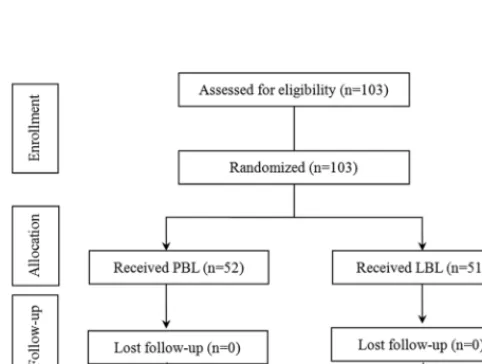
-ated by a Microsoft Excel Software program. Outcome of all participants were assessed at end of study (after 18 weeks) (Figure 1).
Participating postgraduates
The course of EBM at the Lanzhou University has tra-ditionally been located in the second semester of the
medical curriculum and is given on a once weekly basis. First-year medical postgraduates attending the Lanzhou University were included in the study. The participants were not told which method was used.
Intervention procedure
PBL group
The postgraduates of the PBL group were divided into nine small groups; each subgroup was given a clinical conduction. the postgraduate had the follow
-ing objectives: to provide a clinical question accord-ing
to a clinical case; to search and evaluate the relative
evidence of the clinical question; to apply the best evidence to the patient. Finally, they had to commu -nicate their conclusions to the other members of the study group, and take an examination in order to pass the subject.
The problem consisted of a clinical case that described a usual situation in clinical practice. The step as
following: (1) detect and clarify unfamiliar clinical conduction; (2) define the questions to be discussed;
(3)discuss the problems, suggesting possible answers on basis of the current self-knowledge; (4) repeat
steps 2 and 3 and sort answers into tentative solutions;
(5)formulate learning objectives and consensus on the learning objectives in group, teacher checks learning objectives; (6)all postgraduates search and gather rela-tive information for each learning objecrela-tive; (7)share the results of private study; teacher checks learning and evaluate the group.
LBL group
The LBL group received lectures in which the teacher
made a presentation and then described the solution to similar clinical cases to those addressed by the LBL group. They had to study the material presented in class.
Outcome and evaluation methods
Three different approaches were used to evaluate the outcome, knowledge tests was used to evaluate the basic knowledge of evidence based medicine, questionnaire was used to collect related data on the attitude of post
-graduates of both groups for the LBL, seminar was to collect related data on satisfaction with the PBL course and dissatisfaction with the PBL course.
1. Knowledge tests: the examination of EBM at the end of the semester, the postgraduates of both groups used the same examination after comple-tion of the course; the examinacomple-tion was designed
as a combined glossary/short-essay test. Standard answers for all questions were defined and handed out to the staff before students’ answers in the examination were scored. The staff that scored the examinations was blinded as to the identity and group of the students.
2. A questionnaire was completed to investigate the attitude of postgraduates of both groups for the LBL after the course.
3. A seminar was held to address postgraduates’ satisfaction with the PBL course and dissatisfac -tion with the PBL course.
Ethical review
Permission was obtained in advance from the Ethical Review Boards of the School of Basic Medical Sciences of Lanzhou University where the research was con
-ducted. The aim of the study was explained to the stu
-dents and participation was entirely voluntary.
Statistical analysis
The statistical analysis was performed using SPSS 11.5; an analysis of differences of continuous variables was
performed using independent t-tests, but categorical
outcomes for the proportions of students with events
with Pearson’s Chi-Square statistic. The level of signifi
-cance was 0.05.
RESULTS Participation
103 postgraduates were included in the study; all post
-graduates took the final examination of EBM, Fifty-two of these postgraduates were from the PBL group and fifty-one from the LBL group. The distribution of base
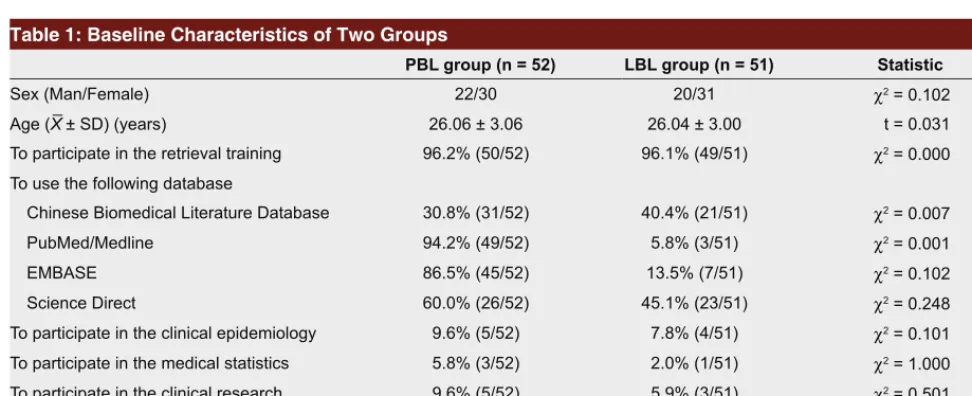
-line characteristics was balanced between the two arms.
(Table 1)
Postgraduate examination marks
The distribution of examination marks between the groups is shown in Table 2. The mean mark was higher (p < 0.05) in the PBL group than in the LBL group.
Questionnaire on attitude of postgraduates for the LBL
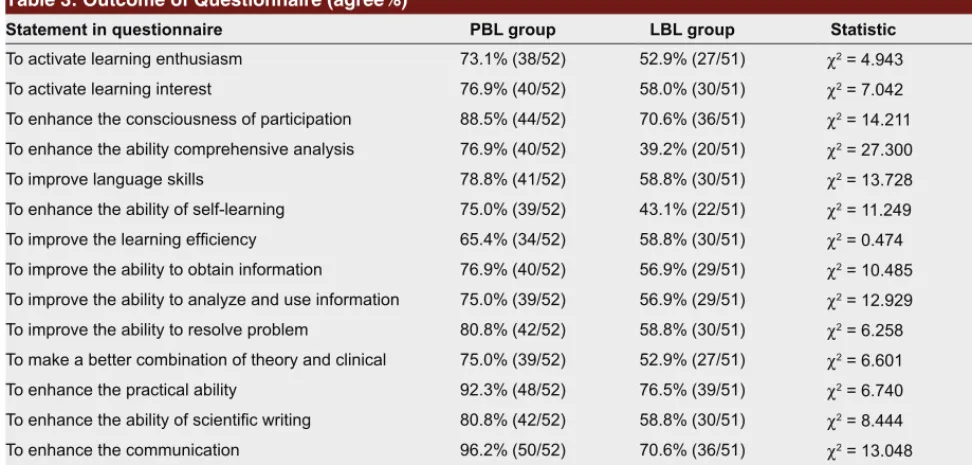
Table 3 shows significant differences in the attitude
of postgraduates of both groups for the LBL. 94.2% (49/52) postgraduates thought that the PBL method
was currently the best teaching methods in the PBL
group. 74.5% (38/51) postgraduates thought that the
Table 1: Baseline Characteristics of Two Groups
PBL group (n = 52) LBL group (n = 51) Statistic P
Sex (Man/Female) 22/30 20/31 χ2 = 0.102 0.750
Age ( ¯X ± SD) (years) 26.06 ± 3.06 26.04 ± 3.00 t = 0.031 0.975 To participate in the retrieval training 96.2% (50/52) 96.1% (49/51) χ2 = 0.000 0.984
To use the following database
Chinese Biomedical Literature Database 30.8% (31/52) 40.4% (21/51) χ2 = 0.007 0.945
PubMed/Medline 94.2% (49/52) 5.8% (3/51) χ2 = 0.001 0.980
EMBASE 86.5% (45/52) 13.5% (7/51) χ2 = 0.102 0.749
Science Direct 60.0% (26/52) 45.1% (23/51) χ2 = 0.248 0.618
To participate in the clinical epidemiology 9.6% (5/52) 7.8% (4/51) χ2 = 0.101 0.750
To participate in the medical statistics 5.8% (3/52) 2.0% (1/51) χ2 = 1.000 0.317
To participate in the clinical research 9.6% (5/52) 5.9% (3/51) χ2 = 0.501 0.479
To know the evidence-based medicine 98.1% (51/52) 98.0% (50/51) χ2 = 0.000 0.989
To know the of PBL 23.1% (12/52) 25.5% (13/51) χ2 = 0.082 0.775
Table 2: Comparison of Test Scores ( –X± SD)
Basic knowledge of
EBM
Clinical
question Literature search Evaluating evidence evidenceApplied Total score
Maximum score 20 20 20 15 25 100
PBL Group 16.00 ± 1.76 14.35 ± 1.82 14.54 ± 2.16 13.62 ± 2.28 21.94 ± 2.72 80.48 ± 6.84 LBL Group 13.27 ± 4.43 12.10 ± 2.71 12.57 ± 2.08 9.78 ± 4.02 19.88 ± 4.03 67.63 ± 9.38
Statistic 6.516 4.923 4.717 5.929 3.034 7.935
teacher/university should reform teaching methods in the LBL group.
Seminars
The postgraduates of the PBL group revealed a high
overall satisfaction with the course. Postgraduates
said that the PBL teaching model can effectively train postgraduate clinical thinking, cultivate the abilities of deconstructing problems, comprehensive analysis, literature retrieval, language expression, exploration
innovation; and overall improve the teaching qual
-ity of EBM. Some student said that: “I learned where to search various sources of information and how to participate in a group”, “self-confidence, shared infor -mation, different opinions” and “My developing on
this module will help me study my other modules next
semester”. at the same time, Postgraduates of LBL group said that LBL places students in a passive rather
than an active role, which hinders learning and requires the instructor to have or to learn effective writing and
speaking skills.
DISCUSSION
The summary findings
When we perform the PBL method in EBM, we should know the characteristic of EBM and PBL. The advan
-tages of PBL include: PBL method offers a flexible
learning process, enhancing postgraduates to decide
and prioritize their own learning agenda. It confers postgraduates a chance to use their own experiential knowledge, and allows them to reflect on the very pro
-cess of their own thinking. It could make them more goal-oriented, seeing their work in a larger perspective,
and is an excellent introduction to the research process.
In PBL one is allowed to make mistakes and learn from them. Finally, group interaction enables individuals to
see the many perspectives on a problem. All of these
are valuable professional and team-working skills for
life beyond university. But, postgraduates are no longer
given the “answers”, and this can require a change in
attitude and mind-set.6
Our study confirmed that PBL is a useful method for
postgraduates learning EBM. The PBL postgraduates
obtained a good examination mark, which was higher
than the mean mark achieved by students receiving LBL.
Compared with LBL methods, the teaching method of
PBL could activate learning enthusiasm and interest; improve problem analysis; enhance independent study
abilities, comprehensive analysis and learning efficiency;
digesting the contents of study and strengthening the
teacher-student communication. Most studies show
the same result.7 Therefore, compared with LBL, PBL
could promote self-motivation and self-responsibility to learn, facilitate more enjoyable and more effective
learning, encourage learning from experience, allowing students to use and organize what has been learnt to understand problems, integrate knowledge with prac -tice, nurture the ability to analyze problems and to
iden-tify and acquire knowledge and skills needed to deal with real-life situations, develop teamwork and communica
-tion skills, train postgraduates to be reflective and assess their own and others’ work and cultivate independence,
curiosity, and skills for self-directed, life-long learning.
The barriers to PBL implementation in China
First, PBL is more expensive than LBL. Indeed, the PBL curriculum necessitates a large number of well-equipped
Table 3: Outcome of Questionnaire (agree%)
Statement in questionnaire PBL group LBL group Statistic P
To activate learning enthusiasm 73.1% (38/52) 52.9% (27/51) χ2 = 4.943 0.084
To activate learning interest 76.9% (40/52) 58.0% (30/51) χ2 = 7.042 0.030
To enhance the consciousness of participation 88.5% (44/52) 70.6% (36/51) χ2 = 14.211 0.001
To enhance the ability comprehensive analysis 76.9% (40/52) 39.2% (20/51) χ2 = 27.300 0.000
To improve language skills 78.8% (41/52) 58.8% (30/51) χ2 = 13.728 0.001
To enhance the ability of self-learning 75.0% (39/52) 43.1% (22/51) χ2 = 11.249 0.004 To improve the learning efficiency 65.4% (34/52) 58.8% (30/51) χ2 = 0.474 0.789
To improve the ability to obtain information 76.9% (40/52) 56.9% (29/51) χ2 = 10.485 0.005
To improve the ability to analyze and use information 75.0% (39/52) 56.9% (29/51) χ2 = 12.929 0.002
To improve the ability to resolve problem 80.8% (42/52) 58.8% (30/51) χ2 = 6.258 0.044
To make a better combination of theory and clinical 75.0% (39/52) 52.9% (27/51) χ2 = 6.601 0.037
To enhance the practical ability 92.3% (48/52) 76.5% (39/51) χ2 = 6.740 0.034 To enhance the ability of scientific writing 80.8% (42/52) 58.8% (30/51) χ2 = 8.444 0.015
To enhance the communication 96.2% (50/52) 70.6% (36/51) χ2 = 13.048 0.001
rooms for small groups. In addition, it requires other
important resources to support subgroup investigations, including instructional materials (both textbooks and
multimedia), space, and library, equipment, and support
personnel.8
Second, the adoption of the PBL curriculum involves a radical change for teachers used to traditional teaching
methods. Teachers are not always ready for this radical
change. Similarly, the implementation of the PBL cur-riculum implies a radical change for students used to traditional teaching methods. Given the fact that PBL is student-centered, and that students are expected to be independent learners, the transition from conventional
curricula to PBL is sometimes difficult.
Third, faculties lack rewards for PBL teaching: Indeed
professors get more compensation for research and
publication than for teaching. Furthermore, given the
fact that PBL is experimental, the compensation system may de facto produce disincentives.8
Limitations
The PBL group could have been affected by the teacher. It is also possible that the postgraduates in the PBL group received more attention from the teacher than those in the LBL group. Thus, postgraduates’ individual
behaviors such as motivation may have been influenced
by their perception that they received more attention
from the teacher in the PBL group compared with their
experience in previous lecture classes. In addition, the
sample size was small, and the study period was only 18 weeks.
CONCLUSION
Postgraduates who participated in the PBL obtained significantly higher grades than those attending lectures
during the course. PBL can enhance postgraduates’ achievement of both professional skills and process skills. Postgraduates of the PBL group spent more time
on group work and reference analysis than those attend -ing conventional lectures. The time devoted by teachers
was much higher in the PBL group. But the effect of
PBL needs to be studied in clinical practice after the postgraduates’ graduation.
REFERENCES
1. Neufeld VR, Barrows HS. The “McMaster Philosophy”: an approach to
medical education. Journal of Medical Education 1974; 49(11):1040–50.
2. Wood DF. Problem based learning. British Medical Journal 2003;
26(7384):328–30.
3. Ozturk C, Muslu GK, Dicle A. A comparison of problem-based and traditional education on nursing students’ critical thinking dispositions. Nursing Education Today 2008; 28:627–32.
4. Tseng HC, Chou FH, Wang HH. et al. The effectiveness of problem-based
learning and concept mapping among Taiwanese registered nursing students. Nursing Education Today 2011; 31(8):e41–46.
5. Straus SE, Scott Richardson W, Glasziou P, et al. Evidence-based Medicine: How to Practice and Teach EBM. (Third Edition). 2005, Edinburgh, Churchill Livingstone.
6. Jones RW. Problem-based Learning: Description, Advantages,
Disadvantages, Scenarios and Facilitation. Anaesth Intensive Care 2006; 34(4):485–8.
7. Hwang SY, Kim MJ. A comparison of problem-based learning and
lecture-based learning in an adult health nursing course. Nurse Education Today 2006; 26(4):315–21.
8. Albanese MA, Mitchell S. Problem-based learning: a Review of literature