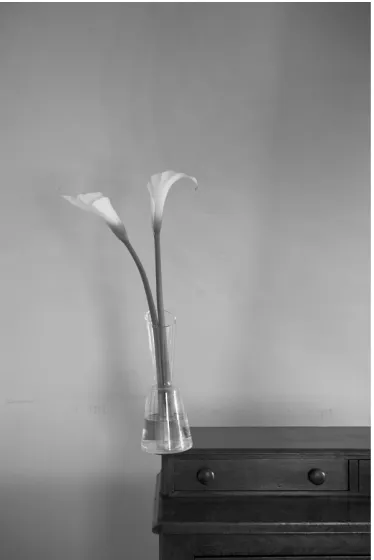
University of New Orleans University of New Orleans
ScholarWorks@UNO
ScholarWorks@UNO
University of New Orleans Theses and
Dissertations Dissertations and Theses
Summer 8-6-2018
The Everyday Universe
The Everyday Universe
Ashley W. Hope [email protected]
Follow this and additional works at: https://scholarworks.uno.edu/td
Part of the Fine Arts Commons
Recommended Citation Recommended Citation
Hope, Ashley W., "The Everyday Universe" (2018). University of New Orleans Theses and Dissertations. 2517.
https://scholarworks.uno.edu/td/2517
This Thesis is protected by copyright and/or related rights. It has been brought to you by ScholarWorks@UNO with permission from the rights-holder(s). You are free to use this Thesis in any way that is permitted by the copyright and related rights legislation that applies to your use. For other uses you need to obtain permission from the rights-holder(s) directly, unless additional rights are indicated by a Creative Commons license in the record and/or on the work itself.
The Everyday Universe
A Thesis
Submitted to the Graduate Faculty of the University of New Orleans
in partial fulfillment of the requirements for the degree of
Master of Fine Arts in
Fine Arts
by
Ashley Hope
B.F.A. University of Georgia, 2002
ii
Acknowledgements
This thesis is dedicated to my two children, Robert and Lizzie.
I would also like to extend a heartfelt thank you the University of New Orleans Fine Arts faculty members for three years of support and encouragement. I am especially grateful to
iii
Table of Contents
List of Illustrations ... iv
Abstract ... v
Introduction ... 1
Background …... 2
MFA Trajectory ... 6
Conclusion... 26
References ... 27
iv
List of Illustrations
Harry Callahan, Grasses, Wisconsin, silver gelatin print, 1959 ……….. 1
Andre Kertesz, The Fork, Paris, silver gelatin print, 1928 ……… 2
Andre Kertesz, Martinique, silver gelatin print, 1972 ………. 3
Aaron Siskind, Jerome 21, silver gelatin print, 1949 ………... 3
Bill Brandt, Nude Baie de Anges, silver gelatin print, 1959 ………... 3
Vicki Ragan, Recurring Visions 6, silver gelatin print, 1994 ………... 4
Abelardo Morrel, Six Dictionaries, silver gelatin print, 2000 ………... 4
Abelardo Morrel, Two Forks Under Water, silver gelatin print, 1993 ……….. 4
Garage staircase, inkjet print,2010 .……… 5
Untitled (fish), inkjet print, Fall 2015 .……… 6
Untitled (green cup), inkjet print, Fall 2015 .……….. 7
John Pfahl, Australian Pines, Fort De Soto, Florida,C-print, 1977 ………. 7
Gabriel Orozco, Watermelons and Cats, cibachrome print, 1992 ……….. 8
Meatball Sandwich, inkjet print, Winter 2015 .………...………….. 8
Still Life, inkjet print Spring 2016 ………..9
Eileen Quinlan, Smoke and Mirrors #21 and 23 (two works), C-print, 2005 ……… 10
Magazine construction, inkjet print, 2016 ……….. 10
Vera Lutter, Cold Spring, III, unique silver gelatin print, 2013 ……….... 11
Pictures of Pictures (sidewalk crack), inkjet print, 2016 .………... 12
Sidewalk Universe #8, inkjet print, 2016 ……….. 13
Zeke Berman, Cubes, silver gelatin print, 1979 ………..………….. 14
Kenneth Josephson, Chicago, silver gelatin print, 1973 ……….. 15
Kenneth Josephson, Chicago, silver gelatin print, 1970 ……….. 15
Jan Groover, Untitled, silver gelatin print, 1983 ………….……….. 16
Pictures of Pictures (chalk and sunlight), inkjet print, 2017………... 17
Pictures of Pictures (morning light), inkjet print, 2017 ……… 18
Pictures of Pictures (houseplant), inkjet print, 2017 ………. 19
Pictures of Pictures (kitchen window), inkjet print, 2017 ……… 20
Untitled (dryer sheets), silver gelatin photogram on fiber paper, 2017 ..………... 21
v
Abstract
I take inspiration from ordinary objects and materials. Through photography, I attempt to transcend the familiar to discover complexity within the bits and pieces of my everyday life. Like other artistic representations, a photograph is a singular portrayal, not an actualization of physical reality. My artistic exploration of this involves incorporating elements of abstraction to point to the truth that all photographs are, by nature, an
abstraction of our physical reality based on perspective. The resulting images often share a quality of impermanence, counterbalanced by the act of making a photographic document. By evoking this temporal quality of photography and abstracting familiar materials and surfaces, I aim to create a playful tension in my imagery.
1
Introduction
"To me, photography is an art of observation. It's about finding something interesting in an ordinary place... I've found it has little to do with the things you see and everything to do with
the way you see them." - Elliott Erwitt
Photography, as an act of seeing, is central to my art practice and my interaction with the world. It wasn’t until I studied photography in college, however, that I began thinking of it as a medium to make art. Until then, photography, in my young mind, was a way to capture and display personal memories. I still have and treasure the albums of childhood pictures taken by mother to document family events and, as a teenager, I frequently carried a camera of my own to take pictures of friends and places I visited. When I took my first darkroom class in college, however, my relationship with
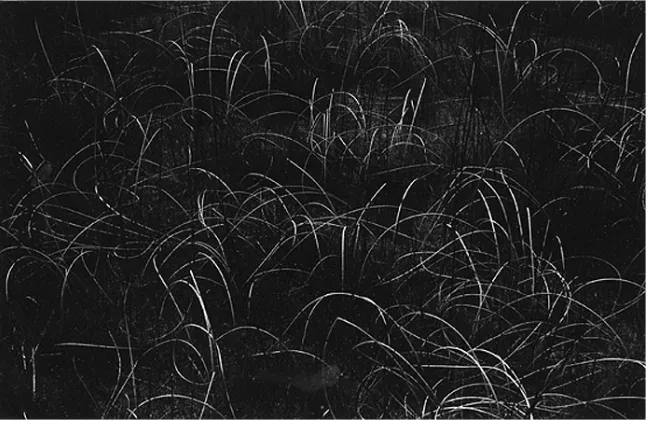
photography changed. I became less interested in making candid pictures of people. Photography, instead, became a way to see and process the physical world. It was also the first time I had studied the work of fine art photographers in depth. My experience of an exhibition of Harry Callahan’s work during this time was particularly informative; I was struck by Callahan’s keen sense of transforming ordinary environments into compelling, poetic black and white images. This was the way I wanted to make pictures.
Fig. 1. Callahan, Grasses, Wisconsin, 1959
To explain the development of my photographs while at UNO, I’ll provide a
background of my relationship with photography between my undergraduate and graduate studies. I’ll then explain influences, milestones and the work I choose for my thesis
2
Background
After graduating with a BFA, I continued to make photographs with both manual film and pinhole cameras. The slow nature of shooting this way, processing the film and making silver prints created opportunities to look closer and think more deeply about the nature of light when rendered in a photograph. During this time, I was focused on the technical and formal aspects of making a good picture. I got a job working in a
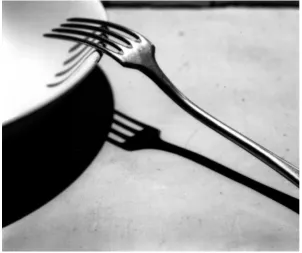
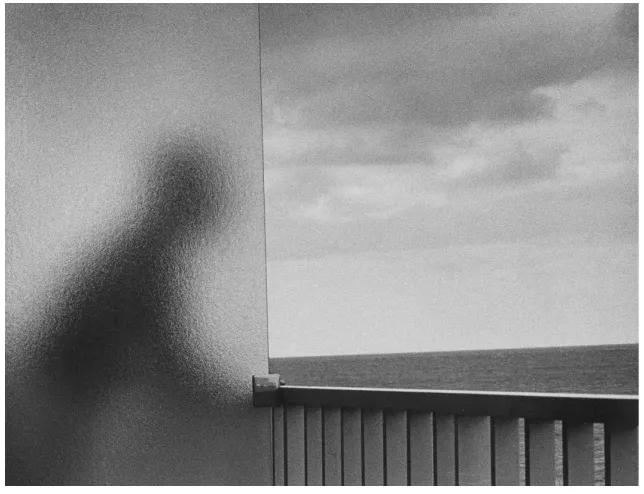
photography gallery in Atlanta and the exposure to a wide range of fine art photographers and collectors fostered further introspection and careful looking. I was drawn to the work of many Modernist photographers who played with formal qualities and abstraction while also retaining a sense of physical reality in their images; some of those artists include Andre Kertesz, Aaron Siskind, Edward Weston and Bill Brandt. I also responded to
contemporary photographers who drew inspiration from these artists, such as Vicki Ragan and Abelardo Morell, who used light, shadow, perspective, scale and framing to play with the viewer’s contextual perception of objects and bodies in relation to how they were accustomed to experiencing them in the physical world.
3
Fig. 3. Kertesz, Martinique, 1972
4
Fig. 6. Ragan, Recurring Visions 6, 1994
Fig. 7. Morrel, Six Dictionaries, 2000 Fig. 8. Morrel, Two Forks Under Water,
5
During this time, I also photographed commercially and eventually became preoccupied with a career in making saleable pictures of architecture, interiors and
product. I was happy to be paid well to make these “beauty shots,” to visually articulate my clients’ vision and to help them effectively grow their businesses by collaborating to
portray their brand and style. My study of light, shadow and composition informed this work and the rapid pace and high level of output in the commercial setting strengthened my technical skills. However, I was more personally interested in finding ways to make pictures that had nothing to do with selling a product but were instead simple studies of light and form. This is a picture I made in a parking garage while walking to my car after work.
Fig. 9. Garage staircase, 2010.
6
MFA Trajectory
When I first enrolled in the MFA program at UNO in the fall of 2015, I was feeling burnt out from years of managing a household, caring for young children and maintaining a career. In the transition from making commercial work for clients to making art work for myself, I grappled with finding a place to get started. To get the ball rolling, I decided to start taking pictures while on my daily walks with my kids as an exercise in looking, occasionally manipulating the environment.
7
Fig. 11 Untitled (green cup), Fall 2015
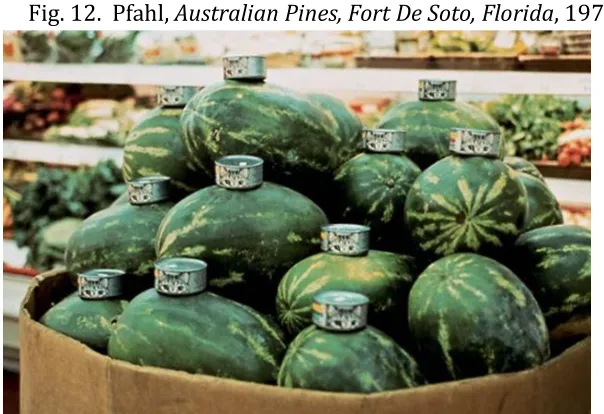
I started looking at John Pfahl’s Altered Landscapes series, in which he playfully manipulated the camera optics through perspective and strategically inserted manmade materials. I also looked at photographs by Gabriel Orozco, a polymedia artist and master of play. Both of these artists intrigued me with their playfulness and their ability to find poetry within the ordinary.
8
Fig. 12. Pfahl, Australian Pines, Fort De Soto, Florida, 1977
Fig. 13. Orozco, Watermelons and Cats, cibachrome print, 1992
Inspired by this, when shooting furniture for a client during winter break, I decided to insert part of my lunch into the scene. I liked the contrast between the gilded, perfectly
accessorized vignette and the reality of the sloppy sandwich and took a picture of it.
9
Later that semester, I was trying to create visual tension with a playful set-up of a vase on the edge of the flat surface. After years of making pleasing compositions, it felt more fun to do the opposite and make an awkward picture. The process of making this picture was an important exercise in breaking out of my commercial conditioning to make pleasing, salable images.
Fig. 15. Still Life, Spring, 2016
I was also looking at Eileen Quinlan’s “Smoke and Mirrors” series during this time. Relative to her background as an assistant to commercial photographers, she says of this work: “I wanted it... to evoke the subtle, manipulative ways that abstraction is deployed in advertising and mass media.”1 I related to her desire to show the seams or acknowledge the tricks used in this type of photography. I started creating abstract mood pictures by folding and rephotographing appropriated magazine imagery. This was a first step toward working with abstraction and playing with the tension between reality and photographic representation. Quinlan’s perspective on this resonated; she notes, “[abstraction] is a problematic term. Especially regarding photography. Obviously you could argue that all photographs are abstractions of, or from, reality.”2
10
Fig. 16. Quinlan, Smoke and Mirrors #21 and 23 (two works), 2005
Fig. 17. Magazine construction, 2016
11
ways to create imaginary spaces. In Houston, I saw both James Turrell’s sculptural light installations and an exhibition of Vera Lutter’s Inverted World. I was especially inspired by Lutter’s use of the negative image to create a sort of parallel universe to the reality we expect.
Fig. 18. Lutter, Cold Spring III, 2013
I began making imaginary spaces using familiar processes of reframing. I liked the aspect of incorporating recognizable surfaces and decided to make pictures using the textures and cracks of the sidewalks around my home. This idea was born from frequent, slow walks around the neighborhood with my young children and served as a way to physically interact with our environment together. Using graphite and newsprint, I made rubbings of the cracks and textures of the sidewalk, an imprint or trace of the physical
world. I then made photographs of those rubbings, careful to include the borders of the
12
photography, these images of rubbings (or visual traces) of the physical world served as a sign of a representation (the rubbing) that is no longer there.3
While both watching and influencing the perceptive development of my children, I’ve become more attuned to the ways in which humans engage the senses to process the physical world. And, because my children are not yet aware of the banal, they see the world in a way that helps me to look again. As Picasso famously said, in thinking about new perceptions, “Every child is an artist. The problem is how to remain an artist once we grow
up.” Slowing down to their pace affords opportunities to engage more deeply with
everyday surfaces and materials. By discussing the formal aspects of image making in this process, my kids are provided with an introduction to a visual vocabulary and, by thinking out loud, I connect the internal process to the external act. In this work, my aim was to escape the pedestrian reality of the cracked concrete and to achieve this, I chose to eliminate color, crop tightly, and accentuate tone, shadow, texture and angle. Later, I discovered that the inverted versions of these pictures resembled images of space. I liked that the borders were visible and I began thinking about all of the little universes, the many versions of individual perception that exist within each person.
Fig. 19. Pictures of Pictures (sidewalk crack), 2016
13
Fig. 20. Sidewalk Universe #8, 2016
During candidacy, the feedback from faculty was that my work read almost exclusively as formal studies. It was clear that I needed to hone my conceptual ideas and find more effective ways to depict them. I began reading Simulacra and Simulation, Jean Baudrillard’s examination on the nature of reality and human understanding of existence and truth. He writes, “The simulacrum is never that which conceals the truth—it is the truth which conceals that there is none. The simulacrum is true.”4 This idea resonated in relation to my interests in individual perception and the false socialized authority
associated with the medium of photography. A photograph is a likeness or representation, not a manifestation, of reality. Countless versions of the “truth” exist, each based on
individual perspective.
14
Related to the “truth claim” of the medium, I was drawn to writings with a
phenomenological approach, those that focused on the experience of the individual in the making of, as well as viewing of, photographs. Roland Barthes’ shifted from first arguing
for the indexicality of photography in “The Photographic Message”5 toward a more
phenomenological view In Camera Lucida (published twenty years later in 1981 and a year
before Simulacra and Simulation), emphasizing the experience of the individual (both “operator” and “spectator”) as it relates to intentionality.6 And, while I had been familiar
with Susan Sontag’s rejection of photography as an agent of truth in On Photography, her
writing on the role of the photographer and individual perception led me to look at work by postmodern photographers such as Kenneth Josephson and Zeke Berman, who played with perspective and illusion in their images to address the deceptive nature of the medium. I responded to the way they employed visual devices to address the ideas of individual perspective and shifting truth while also referencing the process of photography itself. This way of thinking about photography and perception expanded my view of the medium and critically informed the way I worked moving forward.
5 Barthes, The Photographic Message, 196-199.
15
Fig. 22. Berman, Cubes, 1979
Fig. 23. Josephson, Chicago, 1973
16
I was also informed by the work of Jan Groover, another photographer playing with perspective. Specifically, I was looking at her “Kitchen Still Life” series, in which she arranged commonplace kitchen tools into abstract still lifes. While the objects in these images are recognizable as domestic tools, the reflective forms and lines divide up the picture plane into essential shapes. While elevating domestic subject matter, Groover rendered strong formal images by focusing on how the objects related to one another in space. As MoMA curator Susan Kismaric surmises, ''The drama in Groover's pictures arises from the tension between the form of the picture [Groover’s motto was “Formalism is everything”] and the things we know to exist in the world.''7
Fig. 25 Groover, Untitled, 1983.
17
These were also ideas I wanted to explore with my photographs. Instead of making images that read only as formal abstractions, I wanted to incorporate elements of
abstraction to point to the truth that all photographs are, by nature, an abstraction of our physical reality based on perspective. While still often thought of as an objective
document, they create a scaled and flattened likeness of three-dimensional space.
I began making pictures of pictures: a crumpled rubbing of a sidewalk, an inverted photograph reinserted and re-photographed, a simple drawing using sunlight and chalk. These images share a quality of impermanence, counterbalanced by the act of making a photographic document. To indicate that modifications were added in the physical space and not made in Photoshop, I included elements of the scene’s construction: a paper clip, tape, a stick of chalk, etc. These devices also serve as a means to emphasize the artifice of photography. By abstracting the familiar, manipulating perspective and evoking the temporal quality of photography, I was aiming to create a playful tension in my imagery and reference the ideas I had studied around representation, truth and reality.
18
19
20
Fig. 28 Pictures of Pictures (kitchen window), 2016
21
the existence of individual consciousness. I wonder about their interior life, the little universe that exists within. Because I spend a lot of time in and around my home with them, making pictures often serves as my own form of play, a respite from the pedestrian reality of my domestic routine. By slowing down and looking closely, I discover novelty, complexity and expanse within the bits and pieces of my everyday life.
This same approach also led me to experiment in the darkroom to make photograms using everyday, domestic materials including dryer sheets, cling wrap, paper towels,
produce wrappers and other textured household surfaces. When layered together on the paper, the dryer sheets yielded a bouldered, stonelike texture that resembled a mountain range, creating a tension between illusion and reality as well as the reference to, what often feels like, the enormity and the work I’m responsible for in raising children and running a household. This process also allowed me to focus on the manipulation of the materials as well as the process of darkroom printing, a respite from my everyday routine.
22
Fig. 30.Detail - Untitled (dryer sheets), photogram, 2017
In this work, I take inspiration from László Moholy-Nagy, who famously experimented with elements of visual perception through his photograms in the early 20th century. He
advocated for artists to explore abstraction in photography as a means to see the world in a new way, coining the term “the New Vision.” Moholy-Nagy looked for “new relationships between the known and the as yet unknown,” transformation of the familiar into
something transcendent or mystical.
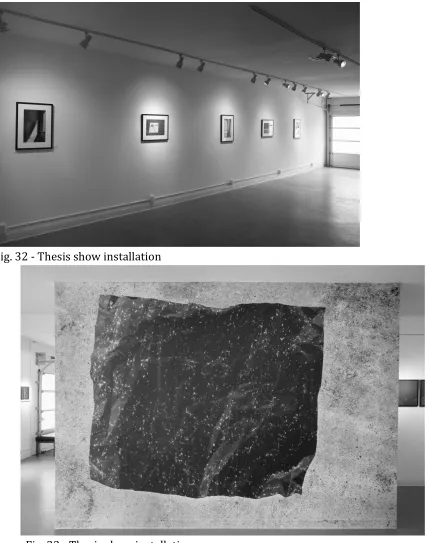
For my thesis show, I made more of the inverted sidewalk rubbings with varying textures and manipulations (folding, tearing, taping) while thinking of them as individual universes. I played with the scale of the prints and enjoyed the difference of my relative perceptual experience of them: I could become disoriented by the larger print while
23
In my thesis show, “The Everyday Universe,” I included two photograms, the wallpaper image of the sidewalk rubbing, several postcard sized universes and the five “Pictures of Pictures.” The unifying aspects of this body of work include the use of everyday materials (dryer sheets, houseplants, sidewalk concrete), a careful consideration of texture and the formal use of monochrome. The rectangle, as a prescribed shape in which to make and take pictures, is also a recurring element as a means to reference the camera’s viewing frame.
24 Fig. 32 - Thesis show installation
25
26
Conclusion
Barthes’ and Sontag’s ideas on perception and truth, as they relate to photography, are, more than ever, relevant because of the medium’s expanding influence on human existence in the digital age. In “What’s the Point of an Index?,” Tom Gunning focuses on the individual experience of photographs, arguing that they exceed the function of a sign and open “up a passageway to it’s subject, not as a signification but as a world, multiple and complex.” He also makes the case that the ease of manipulation in digital photography decisively refutes the truth claim of the medium but that “the ‘delight’ of digitally manipulated photographs depends on the photograph as potentially an accurate
representation.”8 Photographs have a long history of being manipulated, but it was not as
apparent or understood before Photoshop. Even in the digital age, photographic imagery
retains a psychological quality of being a potentially accurate representation. The artists and ideas I’ve studied over the last three years in the MFA program have addressed this relationship between photography, truth and perception and directly informed the work I made for my thesis show. Through this program, I’ve gained a deep understanding of the technological, cultural and art-historical evolution of photography, providing me with a fuller awareness of my place as an artist.
27
References
Barthes, Roland, and Susan Sontag. A Barthes Reader. n.p.: New York : Hill and Wang, 1981.
Barthes, Roland. Camera lucida: reflections on photography. New York: Hill and Wang, 1981.
Baudrillard, Jean. Simulacra and Simulation. Ann Arbor: University of Michigan, 1994
Bowcock, Simon. “Photography Eats Itself? ‘Metapicturism’ at the 2015 Unseen Photo Fair.”
Photomonitor. October 2015.
http://www.photomonitor.co.uk/2015/10/metapicturism_unseen/
Bryant, Eric. "The Indecisive Image." Artnews 107, no. 3 (March 2008): 106
Bunnell, P.C.. "Rexer, Lyle. The edge of vision: the rise of abstraction in photography."
CHOICE: Current Reviews for Academic Libraries, 2010.
Cain, Susan. Quiet : The Power of Introverts in a World That Can't Stop Talking. New York: Crowblishers, 2012.
“Eileen Quinlan and Walead Beshty.” Bomb - Artists in Conversation, September 2009.
http://bombmagazine.org/article/3348/walead-beshty-eileen-quinlan“
Eler, Alicia. "Aspen Mays." Art Papers, September 2009.
Groover, Jan, Mark Trottenberg, Tina Barney, Bruce Boice, John Szarkowski, Andy
Grundberg, Hayes Greenfield, and Edgar B. Howard. 2003. Tilting at space: the work of Jan Groover. New York, NY: Checkerboard Film Foundation.
Grundberg, Andy. “The Crisis of the Real: Photography and Postmodernism.” In The
Photography Reader, edited by Liz Wells. (London and New York: Routledge, 2003), 164-79.
Grundberg, Andy. “Photography View, Taming Unruly Reality. The New York Times, March 3, 1987.
28
Gunning, Tom. “What’s the Point of an Index?” Nordicom Review 205, September 2004.
Robertson. "Kenneth Josephson." Artnews 109, June 2010, no. 6: 111.
Moholy-Nagy, László , and Daphne M. Hoffmann. The New Vision: From Material to Architecture. New York: Brewer, Warren & Putnam, Inc, 1932.
Pfahl, John. Altered Landscapes : the Photographs of John Pfahl. n.p.: Friends of Photography, 1981.
Rexer, Lyle. The Edge of Vision : The Rise of Abstraction in Photography. n.p.: Aperture, 2009.
Roncevic, Mirela. "Orozco, Gabriel. Gabriel Orozco: Photographs." Library Journal, 2004.
Sontag, Susan. On Photography. New York: Picador, 1974.
Szarkowski, John. Mirrors and windows : American photography since 1960. n.p.: New York: Museum of Modern Art; Boston, 1978.
Tagg, John. The Burden of Representation : Essays on Photographies and Histories.Amherst: University of Massachusetts Press, 1988.
29
Vita