DEMOGRAPHIC RESEARCH
VOLUME 34, ARTICLE 9, PAGES 259
284
PUBLISHED 9 FEBRUARY 2016
http://www.demographic-research.org/Volumes/Vol34/9/ DOI: 10.4054/DemRes.2016.34.9
Research Article
Non-standard work schedules, gender, and
parental stress
Mariona Lozano
Dana Hamplová
Céline Le Bourdais
©2016 Lozano, Hamplová & Le Bourdais.
This open-access work is published under the terms of the Creative Commons Attribution NonCommercial License 2.0 Germany, which permits use, reproduction & distribution in any medium for non-commercial purposes, provided the original author(s) and source are given credit.
1 Introduction 260
2 Background 261
2.1 Non-standard schedules and stress: Schedule control and flexibility 261 2.2 Gender differences in work and family roles: Implications for
non-standard work and stress
262
2.3 Confounding factors and control variables 264
2.4 The Canadian context 264
3 Hypotheses 265
4 Data and methods 266
4.1 Data 266
4.1.1 Dependent variable 266
4.1.2 Explanatory and control variables 267
4.2 Method 268
5 Results 269
5.1 Multivariate models – Who is stressed? 272 5.2 Multivariate models – How much are parents stressed? 276
6 Discussion and conclusion 277
7 Acknowledgments 279
Non-standard work schedules, gender, and parental stress
Mariona Lozano1
Dana Hamplová2
Céline Le Bourdais3
Abstract
BACKGROUND
Working non-standard hours changes the temporal structure of family life, constraining the time that family members spend with one another and threatening individuals‟ well-being. However, the empirical research on the link between stress and non-standard schedules has provided mixed results. Some studies have indicated that working non-standard hours is harmful whereas others have suggested that working atypical hours might facilitate the balance between family and work. Moreover, there is some evidence that the association between stress and non-standard employment has different implications for men and women.
OBJECTIVE
This paper examines the association between non-standard work schedules and stress among dual-earner couples with children. Two research questions are addressed. First, do predictability of the schedule and time flexibility moderate the link between non-standard work hours and stress? Second, do non-non-standard schedules affect men‟s and women‟s perceptions of stress differently?
METHODS
We use a sample of 1,932 working parents from the Canadian 2010 General Social Survey, which includes a time-use diary. A sequential logit regression analysis stratified by gender is employed to model two types of result. First, we estimate the odds of being stressed versus not being stressed. Second, for all respondents feeling stressed, we estimate the odds of experiencing high levels versus moderate levels of stress.
1 McGill University, Canada (Corresponding author). E-Mail: [email protected]. 2
Institute of Sociology, Czech Academy of Sciences, Czech Republic.
RESULTS
Our analysis shows that the link between non-standard working hours and perceived stress differs between mothers and fathers. First, fathers with non-standard schedules appear more likely to experience stress than those working standard hours, although the results are not significant. Among mothers, having a non-standard schedule is associated with a significantly lower risk of experiencing stress. Second, the analysis focusing on the mediating role of flexibility and predictability indicates that predictability is more important than flexibility. Workers with non-standard predictable schedules exhibit a lower risk of being stressed than those with non-standard unpredictable hours. Work flexibility does not seem to bring any additional advantage to women. However, it is linked to higher odds of being stressed for fathers, particularly among those having non-standard schedules.
1. Introduction
Previous studies have indicated that the relationship between stress and employment cannot be reduced solely to the number of hours worked, but that work schedules need to be taken into account (Davis et al. 2008; Fenwick and Tausig 2001). In particular, stress appears to be closely related to non-standard working hours (Jamal 2004). Yet, despite the agreement that having non-standard schedules matters, studies have presented an ambiguous picture of whether the effect of atypical hours is beneficial or detrimental to individuals‟ perception of stress. Much of the literature has emphasized the moderating effect of schedule control and has suggested that non-standard working hours may be associated with different perceptions of stress, depending on the control that workers exert over their work schedule (Carlson, Grywacz, and Kacmar 2010; Hook and Wolfe 2011). Similarly, it is likely that the predictability of the schedule (i.e., the ability to forecast and plan working hours) might also alleviate some of the negative impact of non-standard schedules. Nevertheless, predictability as a moderator of the association between stress and non-standard schedules has not received much attention in the literature.
differences regarding the harmonization of work and family life, we expect non-standard work to have different implications for men‟s and women‟s perceptions of time pressures and stress.
In the empirical part, we focus on Canadian mothers and fathers from dual-earning families. Canada is an interesting study case as non-standard work has become more common over the last three decades (Cranford, Vosko, and Zukewich 2003). In 2010 nearly 30% of the workforce was engaged in non-standard employment.
The paper is organized as follows. Section 2 provides background information and an overview of existing research on non-standard schedules, stress, and gender differences. Research hypotheses are presented in Section 3, and Section 4 describes the data and methods used in the analysis. Finally, we report results in Section 5, and conclude with a discussion in Section 6.
2. Background
2.1 Non-standard schedules and stress: Schedule control and flexibility
So far, empirical research has provided an unclear picture regarding the effect of non-standard schedules on individuals‟ well-being and perceived stress, especially among dual-earner couples with children. On the one hand, non-standard schedules have been shown to reduce family time among parents and to hinder work and family arrangements, and thus to increase the level of stress reported by working parents in the United States (Davis et al. 2008) and Canada (Strazdins et al. 2006; Zuzanek 2000). Bulanda and Lippmann (2009) reviewed the existing literature on parents‟ time with children in the United States and concluded that mothers who work evening and nights, or at irregular intervals, have little or no access to quality childcare services. As a result they are required to use alternative childcare arrangements, walking a tightrope between parental time, family networks, and public and/or private services, which may contribute to intensifying the perception of daily stress.
hours in order to soften conflicts between work and family, and to facilitate childcare. However, Barthe, Messing, and Abbas (2011), using their own data for the service sector in Quebec, suggested that a non-standard schedule might alleviate work-family conflict only if working hours are fixed and shifts are regular.
These results seem to suggest that two factors intervene in the relationship between non-standard hours and the perception of stress: flexibility (the voluntary or involuntary nature of such schedules) and predictability (knowing in advance which hours will be worked). So far, researchers have focused predominantly on the role of flexibility and existing studies demonstrate that it is an important variable mediating the link between standard hours and stress (Carlson, Grywacz, and Kacmar 2010). Involuntary non-standard work schedules (i.e., those that are arranged by employers and to which employees must comply as a condition of employment) are usually negatively linked to a variety of family outcomes (Barnett and Gareis 2009; Bulanda and Lippmann 2009). By contrast, the opportunity to choose non-standard working hours when needed might partly alleviate work-family conflicts (Baxter 2010; Hook and Wolfe 2011).
In spite of the general agreement that flexibility matters, some authors have questioned whether it is the flexibility or the predictability of the work schedule that is most relevant when explaining perceived stress (Henly, Shaefer, and Waxman 2006). Whether employers post schedules at the last minute, change working hours at short or no notice, or place their employees „on call‟, it tends to negatively affect their personal and family life and inflate work-life conflict. Indeed, there is some evidence that working parents with little control over their schedule and working hours struggle to arrange childcare and are more likely to report higher levels of time stress and work-family conflict, and lower job and life satisfaction (Henly, Shaefer, and Waxman 2006). Yet in the literature predictability has received much less attention than flexibility, and the distinction between flexibility and predictability has not always been explicit.
2.2 Gender differences in work and family roles: Implications for non-standard work and stress
(Presser, Gornick, and Parashar 2008; Connelly and Kimmel 2007; Fortin and Huberman 2002), and they are also differently involved in childcare and housework activities (Hook and Wolfe 2011; Craig and Powell 2011; Bianchi 2011).
There are several reasons why non-standard schedules are likely to affect men and women differently. First, it is possible that the process underlying the motivation for non-standard work varies by gender. Past analyses suggest that women are more likely to schedule their paid work hours around their children‟s care needs in order to be available during particular periods of the day. Evidence of such timing preferences among mothers has been observed in the U.S. (Connelly and Kimmel 2007), as well as in Australia (Craig and Powell 2011). Jang, Zippay, and Park (2012), who examined the role of gender in the relationship between flexible work schedules and stress using U.S. data, found that women and workers with family responsibilities experienced a more significant decrease of stress than men and workers without family responsibilities, when they had the option of flexible work arrangements.
Australian researchers concluded that non-standard schedules have different effects on mothers‟ and fathers‟ abilities to combine employment with caring because they are employed in distinctive industries in the labor market (Hosking and Western 2008). Indeed, occupational sex segregation has to be considered when examining whether non-standard employment benefits mothers and fathers differently. In Canada women are still concentrated in a number of occupations and strata within organizations (Fortin and Huberman 2002; Uppal and LaRochelle-Côté 2014). Therefore, when assessing the extent to which workers are able to choose non-standard work to better balance their work and family lives, the type of occupation needs to be taken into consideration. Indeed, voluntary non-standard schedules are more common among highly skilled workers (Davis and Kalleberg 2006). For these more privileged workers, the ability to choose non-standard working hours is often just another option among a wide variety of organizational policies that facilitate work-family balance (Berg, Kallberg, and Appelbaum 2003). By contrast, irregular and unpredictable schedules disproportionally affect low-wage workers in industries ranging from healthcare to manufacturing and are ubiquitous in some jobs that can be classified among „pink collar jobs‟, i.e., service occupations (Ben-Ishai, Hammad, and Warden 2014; Lambert 2008).
of unpaid work (i.e., the ability to hire paid services for caring and helping with household tasks) has been invoked as a factor that can mediate the relationship between non-standard work schedules and time stress (Bianchi 2011). However, institutional childcare services generally do not meet the specific needs of parents with non-standard schedules. Therefore, having the ability to hire external help might be more beneficial to mothers than fathers, and to mothers working non-standard schedules.
2.3 Confounding factors and control variables
To understand the link between non-standard employment and stress, the analyses must consider a range of possible confounding factors. We have already mentioned the importance of taking the type of occupation into account. Other dimensions of employment are also likely to affect mothers‟ and fathers‟ perceptions of stress, such as being self-employed or a paid-worker, and working long or short hours.
The analysis also needs to consider the family characteristics of the parents. Apart from childcare responsibilities and the ability to hire services at home, living in a stepfamily or with a cohabiting rather than married partner may also influence parental stress. Stepfamily couples, compared to those families with only biological or adopted children, have been found at higher risk of reporting work and family imbalances, possibly due to the lower involvement of the non-biological parent in childcare (Papernow 2013). Similarly, some studies have shown that in contrast to married parents, cohabiting parents are more likely to experience a negative relationship between non-standard work schedules and parental well-being (Liu et al. 2011). Several factors might contribute to the observed differences. For example, cohabiting parents are more likely to experience economic hardship (Bumpass and Lu 2000) and less likely to have access to family support (Eggebeen 2005). Consequently, they might be more pressured to enter the labor market and might not have the luxury of forgoing employment that does not fit their scheduling preferences for coping with family needs.
2.4 The Canadian context
According to the Canada Labour Code, 8 hours in a day and 40 hours in a week are considered the standard hours of work, with a maximum of 48 hours that employees may work in a week, and the typical regular schedule is defined as 9am to 5pm, Monday through Friday. The definition of non-standard schedules comprises regular and evening work, rotating and split shifts, casual or on-call jobs, as well as irregular shifts. Between 1989 and 1994 the share of the workforce engaged in some type of non-standard employment grew from 28% to 34% (Vosko, Zukewich, and Cranford 2003), and in 2001 about 38% of all employed Canadians worked in non-standard jobs (Kapsalis and Tourigny 2004). In 2005 the proportion of employed Canadians who worked other than during regular daytime was approximately 28% (Williams, 2008), and it has hovered around this level ever since then. In 2010, according to our own calculations, the percentage of non-standard workers was around 30% (Statistics Canada, General Social Survey 2010). The vast majority (82%) of workers with non-standard schedules worked full-time (30 hours or more per week). Women made up approximately 37% of all full-time non-standard workers, with nearly 7 in 10 of those working part-time (Williams 2008).
3. Hypotheses
Based on the existing research reviewed above, five research hypotheses are formulated:
H1: Parents with standard schedules feel less stressed than those with non-standard
schedules.
H2: Predictability mitigates some of the negative association between stress and
non-standard employment. Non-standard work schedules are particularly harmful if they are unpredictable.
H3: Flexibility also alleviates some of the negative association between stress and
non-standard employment. Those with non-standard but flexible schedules are less stressed than those with non-standard but fixed schedules.
H4: Non-standard schedules have different implications for mothers‟ and fathers‟
perceived stress. They are more important for mothers than for fathers.
H5: Mothers‟ stress levels are likely to be more closely influenced by
4. Data and methods
4.1 Data
The analysis used the 2010 Canadian General Social Survey (hereafter GSS), which collected information on time allocation. Respondents (aged 15 years and older) were asked to describe how they use their time during a given 24-hour period. In total, 15,390 respondents participated in the survey. Interviews were conducted on a weekday or during the weekend and throughout a complete year, so that every day and month is equally represented. Although the GSS diary data were collected from interviews more or less equally across the seven days of the week, we applied a day-of-the-week weight to ensure equal representation of all days of the week and to correct for any differential response rate across the seven days of the week. Survey respondents recounted the day of the interview‟s activities in sequence, and their daily time activities summed to exactly 24 hours. This is a major advantage of using the time-diary format over other types of survey, in which respondents often provide time estimates that add up to more than 24 hours a day. The reliability and validity of time-diary estimates compared with survey data has been well documented (Schulz and Grunow 2011).
The analytical sample is limited to dual-earner couples, either married or cohabiting, aged 25–54, with at least one child between 0–17 years old living in the household. Statistics Canada distinguishes four types of employment: paid workers, self-employed individuals, seasonal workers, and unpaid family workers. We restricted our sample to paid workers and self-employed individuals4. Respondents who reported having worked during the week prior to the interview and whose partner also worked during that week were selected. Our analytical sample comprised 1,974 respondents but was restricted to 1,932 individuals who had no missing information on the dependent or any of the explanatory or control variables.
4.1.1 Dependent variable
The dependent variable, perceived level of stress5, is derived from the GSS question: “Thinking about the amount of stress in your life, would you say that most days are: not very stressful; a bit stressful; quite a bit stressful; or extremely stressful?” Working
4
We are aware that, in terms of work schedule, these two groups are heterogeneous, since self-employed workers may have more control over their schedules. Nonetheless, this might vary depending on the industry and the economic activity that they carry out. For this reason, we kept both groups and controlled for type of employment in the analysis.
5
parents who reported that most days were “quite a bit” or “extremely” stressful were classified as being highly stressed. Those who reported that most days were “a bit” stressful were categorized as moderately stressed, and those who reported that most days were “not very stressful” were classified as not being stressed.
4.1.2 Explanatory and control variables
As some of the respondents filled in the time-use diary on a day when they were not working, the work schedule is identified from the GSS question “Which of the following best describes your usual work schedule at your main job?” Both self-employed and self-employed answered this question. Respondents could choose from nine answers: 1) a regular daytime schedule or shift, 2) a regular evening shift, 3) a regular night shift, 4) a rotating shift (one that changes periodically from days to evenings or to nights), 5) a split shift (one consisting of two or more distinct periods each day), 6) a compressed work week, 7) on call or casual, 8) an irregular schedule, and 9) other. Two variables were created based on this question. The first variable distinguishes respondents who work standard schedules (response category 1) and those with non-standard working hours (categories 2–8). The second variable divides non-non-standard schedules between predictable (responses 2, 3, 4, 5) and unpredictable (on call, casual, or irregular, i.e., responses 7 and 8). We used the same criteria to measure partners‟/spouses‟ work schedules. Respondents in category 9 (other) were dropped from the analysis as it was not possible to classify them.
Flexible time was measured based on the following question, “Do you have a flexible schedule that allows you to choose the time you begin and end your work day?” Positive answers were coded as 1. We also included controls for number of hours worked and occupational categories. Working hours were classified into “less than 15 hours a week”, “between 15 to 29”, “between 30 and 40”, and “more than 40 hours a week”. In addition, we classified occupations into “white-collar jobs”, which comprised management and professional occupations, technologists, technicians, and technical occupations; “pink-collar jobs”, which covered clerical and sales and service occupations; and “blue-collar jobs”, which involved trades, transport, and equipment operators and related occupations, occupations unique to primary industries, and occupations unique to processing, manufacturing, and utilities. A dummy for self-employment was included.
preschool (0–4), primary school (5–12), and high school ages (13–17). We also included categories comprising multiple age groups, one comprising couples with all their children between ages 5–12 and 13–17, and another of couples having at least one child between 0 and 4 and other children in any of the other age groups. Furthermore, information on respondents‟ time spent on childcare and housework time was also included in all models. This information was derived from the time diaries. The pre-coding of activities into housework and childcare categories was done by Statistics Canada. Childcare included the following activities: helping children, reprimanding, reading with children, talking/conversation, playing with children, food preparation for children, feeding, putting them to bed, getting them ready for school, personal care for children, medical care, other non-educational help, and commuting to/from school or day-care. Housework included: meal preparation, indoor and outdoor cleaning, laundry, ironing, folding laundry, interior and exterior maintenance and repairs, and other domestic/household work. Original variables were expressed in minutes: we converted these into hours, and classified responses into four categories: none, 1 to 3 hours, 4 to 6 hours, and 7 hours or more a day. Partners/spouses‟ participation in housework was also measured to address the gender division of household labor. The information was reported by respondents, who were asked to estimate the number of hours their partners spent on housework in the week before the interview6. Respondents could choose from the following categories: 0 hour, 1–14 hours, 15–29 hours, 30 hours or more.
Marital status and family structure were also taken into account. For marital status we differentiate married couples from those living in common-law unions (marriage was used as a reference category). In addition, we identified families with only biological and adopted children and stepfamilies with or without children common to the couple. We also included a series of dummy variables to capture the household annual income and the respondent‟s level of education. Finally, we added a flag variable to control for whether the interview took place on a weekday or during a weekend, with Saturday and Sunday coded as 0 and the other days coded as 1.
4.2 Method
Two logit regressions were run in a sequential manner to estimate the effect of the explanatory variables. We first estimated the odds of being stressed rather than not
6 We recognize that differences in measures between respondents and spouses‟ housework time make the
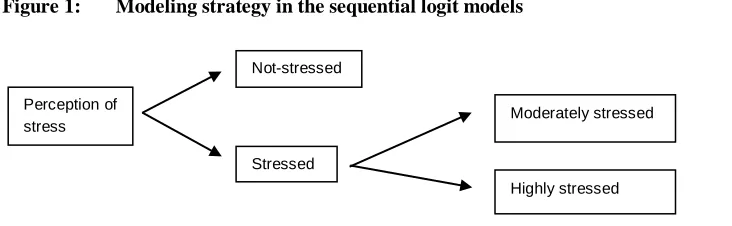
experiencing any stress. However, we also acknowledge that it makes a difference whether an individual experiences moderate or severe levels of stress. Thus, in a second step, we focused only on those who reported some stress and distinguished between individuals who were highly stressed and those who were only moderately stressed (see Figure 1). Using sequential logit models had several advantages. First, it provided a clearer picture of differences between the stressed and non-stressed individuals than multinomial logit, as it compares these two groups directly in the first step. Second, the two-step modeling process offered a clearer picture of how various control variables intervened in different processes.
Figure 1: Modeling strategy in the sequential logit models
We estimate four models for each outcome. Model 1 estimates the overall difference between respondents working standard and non-standard schedules after adjusting for all control variables (i.e., occupation, employment status, paid home services, time spent on childcare and domestic chores, age of children, marital status, family structure, household income, education, and the day of data collection). Model 2 adds predictability to the equation and explores the question of whether non-standard schedules are less stressful if they are predictable. Model 3 tests whether non-standard schedules are less stressful if they are flexible and the worker can choose when to start and end his/her work. Finally, Model 4 considers both flexibility and predictability simultaneously. All models are estimated separately for mothers and fathers.
5. Results
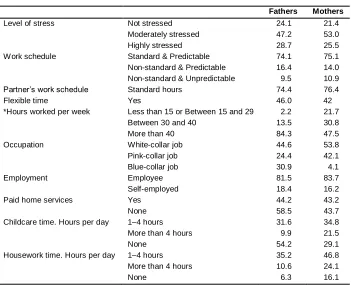
Table 1 reports descriptive statistics. It shows that men tend to work longer hours than women. In our sample, more than 80% of fathers worked more than 40 hours per week whereas only two-fifths of mothers did. By contrast, there were three times as many women who worked less than 30 hours per week than men. Fathers not only worked
Perception of stress
Not-stressed
Stressed
Moderately stressed
longer hours but were also slightly more likely to have flexible and non-standard schedules. In our data, 46% of fathers reported having flexible working hours and 26% non-standard schedules, compared to 42% and 25% of mothers respectively. By contrast, women devoted significantly more time to childcare and domestic work. Over 58% of male respondents did not report doing any domestic chores and 54% did not spend any time on childcare in the observed day (compared to 29.1% and 43.7% of women). Finally, mothers appeared to be more stressed than fathers (78.5% versus 75.9%) but fathers were slightly more likely to experience very high levels of stress.
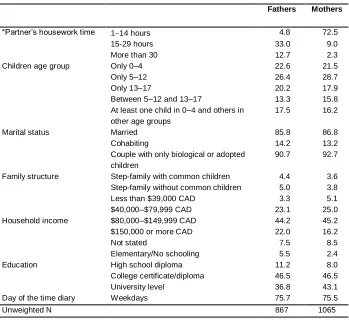
Table 1: Descriptive statistics
Fathers Mothers
Level of stress Not stressed 24.1 21.4
Moderately stressed 47.2 53.0
Highly stressed 28.7 25.5
Work schedule Standard & Predictable 74.1 75.1
Non-standard & Predictable 16.4 14.0
Non-standard & Unpredictable 9.5 10.9
Partner’s work schedule Standard hours 74.4 76.4
Flexible time Yes 46.0 42
*Hours worked per week Less than 15 or Between 15 and 29 2.2 21.7
Between 30 and 40 13.5 30.8
More than 40 84.3 47.5
Occupation White-collar job 44.6 53.8
Pink-collar job 24.4 42.1
Blue-collar job 30.9 4.1
Employment Employee 81.5 83.7
Self-employed 18.4 16.2
Paid home services Yes 44.2 43.2
None 58.5 43.7
Childcare time. Hours per day 1–4 hours 31.6 34.8
More than 4 hours 9.9 21.5
None 54.2 29.1
Housework time. Hours per day 1–4 hours 35.2 46.8
More than 4 hours 10.6 24.1
Table 1: (Continued)
Fathers Mothers
*Partner’s housework time 114 hours 4.8 72.5
15-29 hours 33.0 9.0
More than 30 12.7 2.3
Children age group Only 0–4 22.6 21.5
Only 5–12 26.4 28.7
Only 13–17 20.2 17.9
Between 5–12 and 13–17 13.3 15.8
At least one child in 0–4 and others in other age groups
17.5 16.2
Marital status Married 85.8 86.8
Cohabiting 14.2 13.2
Couple with only biological or adopted children
90.7 92.7
Family structure Step-family with common children 4.4 3.6
Step-family without common children 5.0 3.8
Less than $39,000 CAD 3.3 5.1
$40,000–$79,999 CAD 23.1 25.0
Household income $80,000–$149,999 CAD 44.2 45.2
$150,000 or more CAD 22.0 16.2
Not stated 7.5 8.5
Elementary/No schooling 5.5 2.4
Education High school diploma 11.2 8.0
College certificate/diploma 46.5 46.5
University level 36.8 43.1
Day of the time diary Weekdays 75.7 75.5
Unweighted N 867 1065
Source: GSS 2010, Statistics Canada. *Note: Given strict disclosure rules set by Statistics Canada, we are not able to show percentages for all the categories of these covariates.
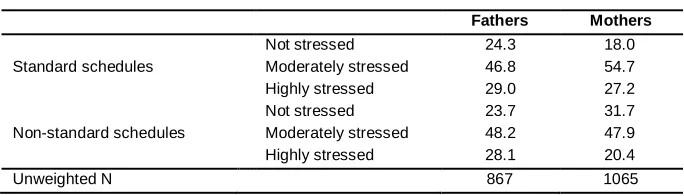
(20.4%). Nevertheless, the table reports only crude differences and the statistical significance of the observed differences was not tested.
Table 2: Levels of stress and working schedules
Fathers Mothers
Standard schedules
Not stressed 24.3 18.0
Moderately stressed 46.8 54.7
Highly stressed 29.0 27.2
Non-standard schedules
Not stressed 23.7 31.7
Moderately stressed 48.2 47.9
Highly stressed 28.1 20.4
Unweighted N 867 1065
Source: GSS 2010, Statistics Canada
5.1 Multivariate models – Who is stressed?
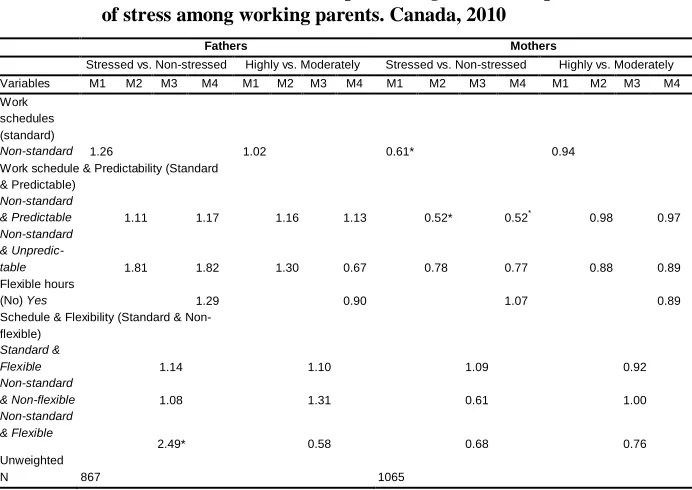
In the first step, we estimate the odds of being generally stressed most days after controlling for socio-demographic characteristics and work- and family-related confounding factors (Table 3). Model 1 tests whether individuals with non-standard schedules experience more stress than those with standard schedules, as was predicted in Hypothesis 1. In the male sample, the association between non-standard schedules and stress is positive even though the difference between fathers with standard and non-standard schedules is not significant. However, contrary to our prediction, mothers with non-standard schedules are found to be significantly less stressed. Model 1 indicates that women with non-standard working hours have approximately 40% lower odds of being stressed than those in standard jobs. Thus the finding observed in the descriptive statistics is confirmed even in the model that removed the effect of possible confounding factors. This model also suggests that the link between non-standard hours and stress is very different for fathers and mothers, as was predicted in Hypothesis 4. Yet Model 1 does not consider possible differences between various types of non-standard schedule.
schedules appear to be particularly beneficial if they are predictable. Mothers with non-standard and predictable working hours have approximately 50% lower odds of being stressed than those with standard jobs. Even though it seems that non-standard hours are beneficial for mothers even if they are unpredictable, the difference between standard and non-standard unpredictable hours is not statistically significant.
Table 3: Estimated odds ratios for sequential logit models of perceived levels of stress among working parents. Canada, 2010
Fathers Mothers
Stressed vs. Non-stressed Highly vs. Moderately Stressed vs. Non-stressed Highly vs. Moderately Variables M1 M2 M3 M4 M1 M2 M3 M4 M1 M2 M3 M4 M1 M2 M3 M4 Work
schedules (standard)
Non-standard 1.26 1.02 0.61* 0.94
Work schedule & Predictability (Standard & Predictable)
Non-standard
& Predictable 1.11 1.17 1.16 1.13 0.52* 0.52* 0.98 0.97
Non-standard &
Unpredic-table 1.81 1.82 1.30 0.67 0.78 0.77 0.88 0.89
Flexible hours
(No) Yes 1.29 0.90 1.07 0.89
Schedule & Flexibility (Standard & Non-flexible)
Standard &
Flexible 1.14 1.10 1.09 0.92
Non-standard
& Non-flexible 1.08 1.31 0.61 1.00
Non-standard & Flexible
2.49* 0.58 0.68 0.76 Unweighted
N 867 1065
Source: GSS 2010, Statistics Canada. Note: The models control for all the covariates included in Table 4.
opportunity to choose when to work might lead to blurred boundaries between work and other domains of life and to an inability to free oneself from work requirements (Peters, den Dulk, and Van der Lippe 2009). It is possible that this problem is particularly pressing among men with non-standard schedules.
Finally, Model 4 includes both predictability and flexibility. As it was not possible to include both sets of interactions into the model due to collinearity, Model 4 uses only a single measure of flexibility. The conclusion that it is the predictability, not flexibility, which matters for mothers is confirmed even when both predictability and flexibility are entered into the model. In the male sample the estimated size of odds ratios for predictability practically does not change when flexibility is added to the model. Thus the overall effect of flexibility is also relatively weak and non-significant in the male sample. Flexibility seemed to matter only for a specific sub-group of men (i.e., those with flexible non-standard schedules) and, contrary to our prediction, it was associated with an elevated risk of stress.
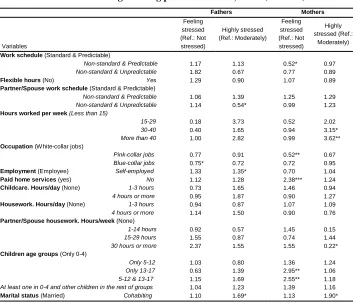
Table 4 reports the Model 4 odds ratios of all covariates. This table suggests that there is no link between partners‟ work schedules and respondents‟ perceptions of stress. To fully understand the household dynamic of non-standard schedules we estimated an additional model that interacted respondents‟ and their partners‟ schedules (results available upon request). Even though none of the differences were significant, there was some indication that fathers with non-standard schedules are more likely to report being stressed if their partners work standard hours. In the female sample, non-standard schedules remained associated with lower reports of stress, irrespective of the partner‟s schedule.
None of the work-related covariates appear to significantly influence the likelihood of feeling stressed, except for occupation. Table 4 shows that women working in pink-collar occupations are significantly less stressed than those in white-pink-collar jobs. However, a separate analysis showed that men with blue-collar jobs are less stressed only if they work standard schedules (results available upon request). By contrast, blue-collar workers with non-standard schedules face higher risks of stress. Among women, pink-collar occupations are less stressful for both women working standard and non-standard schedules. Nevertheless, the benefits of pink-collar occupations appear to be stronger among women with non-standard schedules.
not reported in the table but available upon request). Indeed, there is some previous empirical evidence that parents with non-standard working schedules monitor their adolescent children more (Han and Waldfogel 2007). Furthermore, mothers who cannot rely on any paid domestic services are 2.4 times more likely to be stressed than those who are using paid help. We also tested whether the availability of paid domestic help is more important for mothers with non-standard schedules because they cannot rely on standard childcare services (not reported in the table, available upon request). The data indicated that having a domestic help decreases maternal stress, but the effect is nearly identical between women with standard and non-standard jobs.
Table 4: Estimated odds ratios for sequential logit models of perceived levels of stress among working parents. Canada, 2010. (Model 4)
Fathers Mothers
Variables Feeling stressed (Ref.: Not stressed) Highly stressed (Ref.: Moderately) Feeling stressed (Ref.: Not stressed) Highly stressed (Ref.: Moderately)
Work schedule (Standard & Predictable)
Non-standard & Predictable 1.17 1.13 0.52* 0.97
Non-standard & Unpredictable 1.82 0.67 0.77 0.89
Flexible hours (No) Yes 1.29 0.90 1.07 0.89
Partner/Spouse work schedule (Standard & Predictable)
Non-standard & Predictable 1.06 1.39 1.25 1.29
Non-standard & Unpredictable 1.14 0.54* 0.99 1.23
Hours worked per week (Less than 15)
15-29 0.18 3.73 0.52 2.02
30-40 0.40 1.65 0.94 3.15*
More than 40 1.00 2.82 0.99 3.62**
Occupation (W hite-collar jobs)
Pink-collar jobs 0.77 0.91 0.52** 0.67
Blue-collar jobs 0.75* 0.72 0.72 0.95
Employment (Employee) Self-employed 1.33 1.35* 0.70 1.04
Paid home services (yes) No 1.12 1.28 2.38*** 1.24
Childcare. Hours/day (None) 1-3 hours 0.73 1.65 1.46 0.94
4 hours or more 0.95 1.87 0.90 1.27
Housework. Hours/day (None) 1-3 hours 0.94 0.87 1.07 1.09
4 hours or more 1.14 1.50 0.90 0.76
Partner/Spouse housework. Hours/week (None)
1-14 hours 0.92 0.57 1.45 0.15
15-29 hours 1.55 0.87 0.74 1.44
30 hours or more 2.37 1.55 1.55 0.22*
Children age groups (Only 0-4)
Only 5-12 1.03 0.80 1.36 1.24
Only 13-17 0.63 1.39 2.95** 1.06
5-12 & 13-17 1.15 1.69 2.55** 1.18
At least one in 0-4 and other children in the rest of groups 1.04 1.23 1.39 1.16
Table 4: (Continued)
Fathers Mothers
Variables
Feeling stressed (Ref.: Not stressed)
Highly stressed (Ref.: Moderately)
Feeling stressed (Ref.: Not stressed)
Highly stressed (Ref.: Moderately)
Family structure (Only biological or adopted children)
Step-families with common child 0.57 0.55 4.18* 1.64
Step-families without common child 1.10 0.66 1.02 1.58
Household income (Less than $39,999)
$40,000-$79,999 0.72 0.67 0.58 0.95
$80,000-$149,000 0.71 0.69 0.52 0.72
Education (Elementary)
$150,000 or more 0.91 0.45 0.54 0.86
University degree 1.48 1.14 0.79 0.69
College diploma/certificate 1.32 0.80 0.61 0.80
High school diploma 2.02 0.73 0.50 0.83
Day of the time diary Weekdays 0.87 1.14 0.59 0.88 Constant 2.84 0.46 0.61 0.19
Unweighted N 867 1065
Source: GSS 2010, Statistics Canada
5.2 Multivariate models – How much are parents stressed?
Models in the previous section demonstrate that mothers with non-standard schedules are less likely to feel stressed most days but that fathers tend to find non-standard schedules more stressful than having standard 9am to 5pm jobs. These results indicate that there is a link between schedule and the overall risk of being stressed, but do not say anything about how much stress mothers and fathers experience. Therefore in the next step we tested the difference between feeling moderate and high levels of stress. Table 3 shows that when we compare respondents who report being “quite a bit” or “extremely” stressed to those being just “a bit stressed”, there is generally no difference between workers with standard and standard hours. Fathers and mothers with non-standard schedules have practically the same odds of being highly stressed than their vis-à-vis in standard jobs (odds ratios of 1.02 for fathers and 0.94 for mothers). There is also no clear tendency with respect to flexibility and predictability.
blue-collar jobs generally face lower risk of extreme stress. By contrast, self-employment puts fathers at risk of experiencing very high levels of stress. None of these factors matters for mothers. In their case, the risk of experiencing very high levels of stress is linked primarily to the number of hours worked per week. Only one factor seems to alleviate the risk of high levels of stress among mothers: having a partner who actively participates in domestic chores. Finally, stress levels appear to be particularly high among cohabiting couples. This finding holds for both mothers and fathers. This might be surprising, given the increasing functional similarity between married and cohabiting unions. However, a growing body of literature demonstrates that marital and cohabiting unions are not identical even in societies where cohabitation is highly institutionalized (Hamplova, Le Bourdais, and Lapierre-Adamcyk 2014). For instance, cohabitors, on average, have lower incomes than married couples and lower access to family support. All these factors might contribute to higher levels of stress among cohabitors.
6. Discussion and conclusion
Non-standard work schedules are often viewed as an important life stressor and many authors argue that non-standard working hours are associated with the risk of burnout, emotional exhaustion, stress, and health problems. However, empirical studies do not univocally support the idea that such work arrangements are indeed harmful. The ambiguity of empirical evidence suggests that non-standard schedules are present in diverse work and life situations and might not always have negative consequences for workers and their families.
This paper tested the hypothesis that the association between non-standard hours and stress is mediated by the flexibility and predictability of the work schedule. Specifically, we expected individuals working non-standard hours to be more stressed than those working standard hours, but that the predictability of the schedules would mitigate some of the negative consequences associated with non-standard schedules. Similarly, we predicted that flexibility, i.e., the opportunity to choose when to start and when to finish work, would alleviate part of the harmful effect of non-standard schedules. Furthermore, we argued that non-standard schedules have different implications for men‟s and women‟s well-being because both genders face different time constraints.
found that the opposite holds for mothers. In their case, having a non-standard schedule was associated with a significantly lower risk of experiencing stress. This result suggests that women use non-standard forms of employment as a means to achieve better life-work balance. However, the benefits of non-standard schedules appeared to be limited to situations where the working hours were predictable. We could not confirm that unpredictable non-standard work hours were significantly different from standard schedules.
Even though the empirical analysis confirmed the existence of a link between schedule and stress, especially among women, our data did not reveal a significant association between non-standard schedule and the experienced level of stress. In other words, non-standard schedules predict whether workers are stressed but not whether they experience high or low levels of stress.
As for the mediating role of flexibility and predictability, the GSS data indicated that predictability is more important than flexibility. Thus those with non-standard predictable schedules were less stressed than those with non-standard unpredictable hours (and in the female sample also less stressed than those with standard employment arrangements). Yet work flexibility did not seem to bring any additional advantage to women. Among fathers, flexibility even seemed to increase stress, particularly for those having non-standard schedules. The relatively weak and even negative implications of flexibility might be surprising. However, there is some evidence that flexibility might not always be good for workers. For example, time-spatial flexibility might increase stress because it leads to blurred boundaries between work and private life and makes it more difficult to be free from work (Peters et al. 2009).
In general, our results concerning the negative association between non-standard work schedules and stress raise questions about the selection of mothers into the various categories of work schedule. Our analysis is based on cross-sectional data and cannot address individuals‟ movements into and from jobs with non-standard schedules. It is likely that women who find these work arrangements particularly stressful might either leave these jobs or even drop out of the labor market. Consequently, the pool of mothers working non-standard schedules that are observed at a given point of time might consist of particularly resilient women or of women whose situations make the balance of family and work easier.
in order to fully understand the relationship observed between non-standard schedules and the perception of stress among employed parents.
7. Acknowledgments
References
Barnett, R.C. and Gareis, K.C. (2009). Mothers‟ shiftwork: Effects on mothers, fathers and children. In: Crane, R.D. and Hill, J.E. (eds.). Handbook of families and work interdisciplinary perspectives. Lanham, Maryland, US: University Press of America: 355–373.
Barthe, B., Messing, K., and Abbas, L. (2011). Strategies used by women workers to reconcile family responsibilities with atypical work schedules in the service sector. Work 40: 47–58.
Baxter, J. (2010). An exploration of the timing and nature of parental time with 4–5 years olds using Australian children‟s time use data. Australian Institute of Family Studies (Research paper No. 45).
Begall, K., Mills, M., and Ganzeboom, H.B.G. (2014). Non-standard Work Schedules and Childbearing in the Netherlands: A mixed-method couple analysis. Social Forces online first 00(00): 1–32.
Ben-Ishai, L., Hammad, W., and Warden, C. (2014). Tackling unstable and unpredictable work schedules. A policy brief on guaranteed minimum hours and reporting pay policies. Washington DC, New York, Chicago: Centre for Law and Social Policy, Retail Action Project, and Women Employed (Research Report).
Berg, P., Kalleberg, A.L., and Appelbaum, E. (2003). Balacing work and family: The role of high-commitment environments. Industrial Relations: A Journal of Economy and Society 42(2): 168–188. doi:10.1111/1468-232X.00286.
Bianchi, S.M. (2011). Family change and time allocation in American families. The ANNALS of the American Academy of Political and Social Sciences 638: 21–44.
doi:10.1177/0002716211413731.
Bulanda, R.E. and Lippmann, S. (2009). Wrinkles in parental time with children: Work, family structure, and gender. Michigan Family Review 13(1): 5–20.
Bumpass, L. and Lu, H. (2000). Trends in cohabitation and implications for children‟s family contexts in the United States. Population Studies 54(1): 29–41.
doi:10.1080/713779060.
Connelly. R. and Kimmel, J. (2007). The role of non-standard work hours in maternal caregiving for young children. IZA Discussion Paper Series No. 3039.
Craig, L. and Powell, A. (2011). Non-standard work schedules, work-family balance and the gendered division of childcare. Work, Employment & Society 25(2): 274–291. doi:10.1177/0950017011398894.
Cranford, C.J., Vosko L.F., and Zukewich, N. (2003). Precarious employment in the Canadian labour market: A statistical portrait. Just Labor: A Canadian Journal of Work and Society 3: 6–22.
Davis, A.E. and Kalleberg, A.L. (2006). Family-friendly organizations? Work and family programs in the 1990s. Work and Occupations 33(2): 191–223.
doi:10.1177/0730888405280446.
Davis, K.D., Goodman, B., Pirretti, A.E., and Almeida, D.M. (2008). Nonstandard work schedules, perceived family well-being, and daily stressors. Journal of Marriage and Family 70(4): 991–1003. doi:10.1111/j.1741-3737.2008.00541.x. Eggebeen, D.J. (2005). Cohabitation and exchanges of support. Social Forces 83(3):
1097–1110. doi:10.1353/sof.2005.0027.
Fenwick, R. and Tausig, M. (2001). Scheduling stress. Family and health outcomes of shift work and schedule control. American Behavioral Scientist 44(7): 1179– 1198. doi:10.1177/00027640121956719.
Ferrao, V. (2010). Paid Work. Women in Canada: A gender-based statistical report.
Statistics Canada 89-503-X.
Fortin, N.M. and Huberman, M. (2002). Occupational gender segregation and women‟s wages in Canada: An historical perspective. Centre interuniversitaire de recherché et analyse des organisations, CIRANO, 2002s-22, March.
doi:10.2307/3552342.
Fudge, J. (2011). Working-Time Regimes, Flexibility, and Work-Life Balance: Gender Equality and Families. In: Krull, C. and Sempruch, J. (eds.) Demystifying the family/work conflict: Challenged and possibilities. Vancouver, Canada: University of British Columbia Press: 170–193.
Hamplova, D., Le Bourdais, C., and Lapierre-Adamcyk, E. (2014). Is the cohabitation-marriage gap in money pooling universal? Journal of Marriage and Family
Han, W.J. (2004). Nonstandard work schedules and child care decisions: Evidence from the NICHD study of early child care. Early Childhood Research Quarterly
19(2): 231–256. doi:10.1016/j.ecresq.2004.04.003.
Han, W.J. and Waldfogel, J. (2007). Parental work schedules, family processes, and early adolescents‟ risky behavior. Children and Youth Services Review 29:1249– 1266. doi:10.1016/j.childyouth.2007.05.011.
Henly J.R., Shaefer, H.L., and Waxman, E. (2006). Nonstandard work schedules: Employer- and employee-driven flexibility in retail jobs. Social Service review
80: 609–634. doi:10.1086/508478.
Hook, J.L. and Wolfe, C.M. (2011). Parental involvement and work schedules: Time with children in the United States, Germany, Norway and the United Kingdom.
European Sociological Review online first 00(00): 1–15.
Hosking, A. and Western, M. (2008). The effects of non-standard employment on work-family conflict. Journal of Sociology 44(1): 5–27.
doi:10.1177/1440783307085803.
Jacobs, J.A. and Gerson, K. (2004). The time divide. Work, Family and Gender Inequality. Cambridge, MA: Harvard University Press.
Jamal, M. (2004). Burnout, stress and health of employees on non-standard work schedules: A study of Canadian workers. Stress and Health 20(3): 113–119.
doi:10.1002/smi.1012.
Jang, S.J., Zippay, A., and Park, R. (2012). Family roles as moderators of the relationship between schedule flexibility and stress. Journal of Marriage and Family 74(4): 897–912. doi:10.1111/j.1741-3737.2012.00984.x.
Kapsalis, C. and Tourigny, P. (2004). Duration of non-standard employment. Statistics Canada Catalogue no. 75-001-XE.
Lambert, S.J. (2008). Passing the buck: Labor flexibility practices that transfer risk onto hourly workers. Human Relations 61(9): 1203–1227.
doi:10.1177/0018726708094910.
Liu, H., Wang, W., Keesler, V., and Schneider, B. (2011). Non-standard work schedules, work-family conflict and parental well-being: A comparison of married and cohabiting unions. Social Science Research 40(2): 473–484.
doi:10.1016/j.ssresearch.2010.10.008.
Mattingly, M.J. and Sayer, L.C. (2006). Under pressure: gender differences in the relationship between free time and feeling rushed. Journal of Marriage and Family 68(1): 205–221. doi:10.1111/j.1741-3737.2006.00242.x.
Papernow, P.L. (2013). Surviving and thriving in stepfamily relationships: What works and what doesn’t? New York, US: Routledge.
Peters, P., den Dulk, L., and Van der Lippe, T. (2009). The effect of time-spatial flexibility and new working conditions on employees‟ work-life balance: the Dutch case. Community, Work, and Family 12(3): 279–297.
doi:10.1080/13668800902968907.
Presser, H.B., Gornick, J.C., and Parashar, S. (2008). Gender and nonstandard work hours in 12 European countries. Monthly Labor Review: 83–103.
Schulz, F. and Grunow, D. (2011). Comparing diary and survey estimates on time use.
European Sociological Review: 1–15.
Strazdins, L., Clements, M.S., Korda, R.J., Broom, D.H., and D‟Souza, R.M. (2006). Unsociable work? Nonstandard work schedules, family relationships and children‟s well-being. Journal of Marriage and Family 68(2): 394–410.
doi:10.1111/j.1741-3737.2006.00260.x.
Täht, K. and Mills, M. (2012). Nonstandard work schedules, couple desynchronization, and parent-child interaction: A mixed-method analysis. Journal of Family Issues
33(8): 1054–1087. doi:10.1177/0192513X11424260.
Uppal, S. and LaRochelle-Côté, S. (2014). Changes in the occupational profile of young men and women in Canada. Statistics Canada Catalogue no. 75-006-X.
Vosko, L.F., Zukewich, N., and Cranford, C. (2003). Precarious jobs: A new typology of employment. Perspectives on Labour and Income 4(10).
Williams, C. (2008). Work-life balance of shift workers. Perspectives, Statistics Canada Catalogue no. 75-001-X.