University of New Orleans University of New Orleans
ScholarWorks@UNO
ScholarWorks@UNO
University of New Orleans Theses and
Dissertations Dissertations and Theses
5-20-2005
The Moderating Effects of Parenting on the Development of
The Moderating Effects of Parenting on the Development of
Externalizing Problems in Toddlers
Externalizing Problems in Toddlers
Sarah Robison
University of New Orleans
Follow this and additional works at: https://scholarworks.uno.edu/td
Recommended Citation Recommended Citation
Robison, Sarah, "The Moderating Effects of Parenting on the Development of Externalizing Problems in Toddlers" (2005). University of New Orleans Theses and Dissertations. 243.
https://scholarworks.uno.edu/td/243
THE MODERATING EFFECT OF PARENTING ON THE DEVELOPMENT OF EXTERNALIZING PROBLEMS IN TODDLERS
A Thesis
Submitted to the Graduate Faculty of the University of New Orleans in partial fulfillment of the requirements for the degree of
Master of Science in
Psychology
by
Sarah D. Robison B.A., Miami University, 2002
Table of Contents
List of Tables ... iii
List of Figures ... iv
Abstract...v
Introduction...1
Method ...10
Results...18
Discussion...26
References...35
List of Tables
Table 1 ...18
Table 2 ...19
Table 3 ...21
Table 4 ...23
Table 5 ...24
List of Figures
Abstract
Clarifying processes associated with emerging externalizing behavior problems during early childhood was the focus of this study. Data were collected from 100 parent-child dyads when children were 2, 3, and 4 years. An incremental risk model was hypothesized to explain the emergence of externalizing behavior problems. Theoretically, children’s temperamental propensity towards negative emotional reactivity increases risk for noncompliance,
noncompliance that increases risk for externalizing behaviors by age 4. Parenting was identified as the mechanism by which children’s progression along the incremental risk pathway is
Introduction
Externalizing problem behavior has been found to demonstrate remarkable stability from early childhood through adolescence (Campbell, 1995; Cummings, Iannotti & Zahn-Waxler, 1989; Fagot, 1984; Olweus, 1979). Adolescents identified with serious disruptive behavior problems often have a history of conduct problems, beginning during the preschool years
(Moffitt, 1990). Particularly troublesome, clinical levels of externalizing behaviors in school-age children and adolescents seem to be highly resistant to change and intervention efforts (Kazdin, 1995). Moreover, nearly 15% of preschool children are identified as having mild to moderate behavior problems (Campbell, 1995). In addition to externalizing behavior problems, poor self control and problematic social relationships have been identified as the most prevalent mental health problem among preschool children (Campbell, 1990). The sizeable portion of young children experiencing behavior problems is concerning because these children may be at increased risk for developing more serious disruptive behavior problems during middle childhood and adolescence. Identifying risk factors associated with preschool externalizing problems may improve prevention efforts aimed at reducing conduct problems during later developmental periods.
The goal of the present study is twofold. First, the validity of an incremental risk model was evaluated. Children characterized as temperamentally difficult or reactive at age 2 are expected to resist parents’ socialization efforts as evidenced in high levels of noncompliance at age 3. In addition, children displaying high levels of noncompliance at age 3 are expected to have learned to resist commands and requests from parents, increasing their risk for externalizing problems at age 4. Second, the quality of parenting is hypothesized to affect children’s
parenting may model and reinforce angry child behavior and intensify children’s risk for noncompliance at age 3 and externalizing problems at age 4.
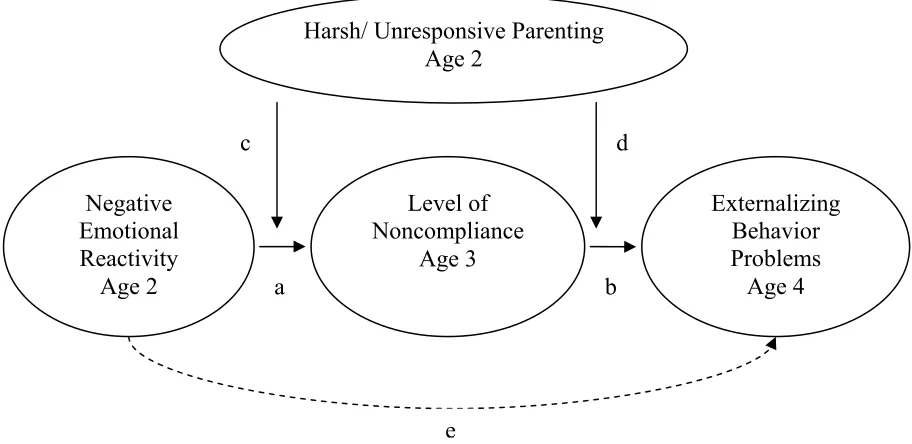
The model in Figure 1 illustrates the theoretical assumptions to be tested in the present study. As depicted in Figure 1, children with a temperamental propensity towards negative emotional reactivity are expected be at increased risk for noncompliance (Figure 1, path a), noncompliance that increases children’s risk for externalizing behaviors by age 4 (Figure 1, path b). Theoretically, parenting is identified as the mechanism by which children’s risk for
progression along this pathway is amplified or minimized. Parenting is hypothesized to
moderate the link between children’s level of negative emotional reactivity and noncompliance (Figure 1, path c) as well as the link between noncompliance and externalizing behaviors (Figure 1, path d). The subsequent sections will review the empirical research supporting each of these expectations.
Figure 1. An incremental risk model explaining the development of externalizing behavior
problems during early childhood
Harsh/ Unresponsive Parenting Age 2
Negative Emotional Reactivity
Age 2
Level of Noncompliance
Age 3
Externalizing Behavior Problems
Age 4
c d
a b
Children’s Negative Emotional Reactivity as a Risk Factor for Externalizing Behavior Problems
Recent empirical work suggests that precursors of externalizing behavior may be present as early as infancy. Specifically, infant temperamental characteristics may increase children’s risk for later externalizing problems (Bates, Maslin, & Frankel, 1985; Kagan, 1998).
Temperament is generally defined as a unique constitutional factor differentiating one child from another and includes individual differences in affective, motor, and attentional reactivity and self-regulation (Rothbart & Bates, 1998). Rothbart’s and Bates’ (1998) definition includes individual differences related to both the expression of negative emotionality and emotion regulation. More recently, investigators have begun to differentiate children’s reactivity from efforts to regulate emotions (e.g., Calkins, Smith, Gill, & Johnson, 1998). Negative emotional reactivity reflects the ease with which children react to change with negative emotions such as anger, sadness, or fear (Scaramella & Conger, 2003). In contrast, emotion regulation reflects self-regulatory processes which serve to modulate the expression of negative emotion
(Thompson, 1994). Children’s propensity towards emotional arousal likely influences children’s ability to regulate their negative emotions. That is, more intense negative emotional reactions will likely interfere with children’s efforts to control their emotions and to comply with requests from parents (Kochanska, 1997, Scaramella & Leve, 2004).
became distressed during frustrating situations scored higher on concurrent measures of aggressive acting-out behaviors than children who were less easily distressed. In addition to concurrent associations, early child distress has been linked to more externalizing problems during the preschool period. For example, Hagekull (1994) found that negative emotionality during the toddler years predicted externalizing behavior problems at age 4. Similarly, children who were rated as highly reactive and emotionally negative during observational interactions with mothers at age 2 were rated as having more behavior problems than their peers upon entry into school (Rubin, Burgess, Dwyer, & Hastings, 2003; Shaw, Owens, Vondra, & Keenan, 1996). Taken together, these results suggest that children’s propensity towards negative emotional reactivity during the toddler years may be associated with increased risk for
externalizing behavior problems during the preschool period. One possible explanation for this association may be the more proximal effects of negative emotional reactivity on adjustment indices during the toddler period like noncompliance.
Negative Emotional Reactivity as a Risk Factor for Noncompliance
Although a direct link appears to exist between temperamental reactivity propensities and externalizing behavior problems, noncompliance during toddlerhood may be an intermediary step that links negative emotional reactivity and later externalizing problems (Figure 1, path e). Although normative at certain levels, high levels of noncompliance during the toddler years may be an indicator of increased vulnerability for developing externalizing behavior problems.
comply with parents’ requests upon demand (Kochanska, 1995). Variations in children’s emotional reactivity may interfere with their efforts to comply with parents’ requests. A temperamental propensity towards negative emotional reactivity is expected to increase children’s risk for noncompliance during the toddler years (Figure 1, path a). Consistent with this expectation, toddlers who tend to react to requests from parents with strong negative emotions have been found to experience more difficulty complying with parents’ requests as evidenced in higher rates of noncompliance (Braungart-Reiker, Garwood, & Stifter, 1997; Eisenberg, Cumberland, & Spinrad, 1998; Himmelfarb, Hock, & Wenar, 1985; Keenan, Shaw, Delliquadri, Giovannelli, & Walsh, 1997). In contrast, less emotionally reactive or more inhibited toddlers have been found to comply more frequently with mothers’ directives and requests (Kochanska, Murray, Jacques, Koenig, & Vandegeest, 1996). Quite possibly by complying with parental requests children learn to regulate their behavior and emotional reactivity and begin to internalize parental expectations as well as societal norms and values (Kopp, 1982). High levels of noncompliance during the toddler years combined with a propensity for emotional over-arousal may increase children’s risk for externalizing behavior problems during the preschool developmental period.
Noncompliance as a Risk Factor for Externalizing Problems
Frequent bouts of active noncompliance or outright refusals to comply with parents’ requests are expected to increase risk for externalizing problems (Figure 1, path b).
Theoretically, noncompliance is distinct from externalizing behavior problems. Patterns of noncompliance are generally limited to active refusals to cooperate with demands from an adult with authority (e.g. parent, teacher) while externalizing behavior problems are present in
overactive behavior (Achenbach & McConaughy, 1987). This conceptual distinction is important given that certain levels of noncompliance are developmentally appropriate in the toddler years whereas externalizing problems are not. During the toddler period children often test parental limits and low to moderate levels of noncompliance may provide opportunities for children to develop social skills and assert their autonomy in socially acceptable manner (Kuczynski, Kochanska, Radke-Yarrow, & Girnius-Brown, 1987).
However, high rates of noncompliance during the toddler years may not have positive effects on children’s adjustment and may increase children’s risk for developing externalizing behavior problems (Campbell & Ewing, 1990). Shaw and colleagues (1998) found that child noncompliance observed during mother-child interactions at age 2 predicted externalizing problems at age 4 (Shaw, Winslow, Owens, Vondra, Cohn, & Bell, 1998). Possibly, high rates of noncompliance reflect elevated risk for self-regulatory difficulties during the preschool period such as an inability to delay impulsive responding (Campbell, March, Pierce, Ewing, &
Szumowski, 1991; Rothbart & Bates, 1998). Such impulsive and disregulated behaviors may place children at risk for a series of negative family interactions and later social and behavior problems, including peer rejection and delinquency (Patterson, DeBaryshe, & Ramsey, 1989) and may be associated with the development of externalizing behavior problems upon school entry.
control their behavioral and emotional outburst is expected to be associated with more noncompliance and later externalizing problems. That is, with development children are
expected to demonstrate more and more behavioral control, a failure to acquire such self control is reflected in higher rates of externalizing behavior during the preschool years. Importantly, not all highly reactive children evidence compliance problems or even externalizing problems. Parenting may be a factor that intensifies or diminishes children’s risk for developing externalizing behavior problems during the preschool period.
The Moderating Effect of Parenting on the Association between Emotional Reactivity and Child
Noncompliance
emotional arousal to levels that interfere with their ability to comply with parents’ requests (Kochanska, 1995; Scaramella & Leve, 2004). For example, Belsky, Hsieh, and Crnic (1998) found that infant negative emotionality and maternal negativity interacted to predict problem behaviors among boys at age 3. In contrast, parents of emotionally reactive children who are able to respond to their children’s negative emotional reactions without harsh parenting may facilitate children’s ability to regulate their own behaviors, thus decreasing risk for
noncompliance (Kochanska, 1995). In other words, harsh parenting may intensify risk for noncompliance only for the most highly reactive and emotionally negative children (Figure 1, path c).
The Moderating Role of Parenting on the Association between Noncompliance and Externalizing
Problems
More than expected rates of child noncompliance during the toddler years may be a necessary condition for later externalizing problems, but not a sufficient one. Parents’ responses to children’s noncompliance are expected to influence children’s risk for developing
mothers of children with conduct problems spent significantly more time engaged in angry conflict than mothers of non-conduct problem children. Frequently noncompliant toddlers may evoke more harsh parenting reactions, reactions that reinforce children’s angry, oppositional, and defiant behaviors (Figure 1, path d). However, parents who respond to children’s noncompliant behavior without harsh responses may teach children more adaptive strategies, increasing the likelihood of child compliance and reducing children’s risk for externalizing behaviors (Paterson & Sanson, 1999).
To summarize, the toddler years may represent a developmental period where children test parental limits and parents must, for the first time, consistently set and maintain these limits. This stressful context is well suited for the emergence of maladaptive parent-child interactions, interactions that may increase children’s risk for externalizing behavior problems during the preschool period. Toddlers with a tendency to react to changes and restrictions in the environment with strong and negative emotions are expected to be at greater risk for
noncompliance during the toddler years. More than expected levels of toddler noncompliance should increase the likelihood of externalizing behavior problems one year later. As depicted in Figure 1, the proposed study will examine longitudinal associations among negative emotional reactivity, child noncompliance, and externalizing behavior problems in children from ages 2 - 4 using annual assessments. The following hypotheses will be tested:
1. Negative emotional reactivity at age 2 will be statistically and significantly correlated with noncompliance at age 3 (Figure 1, path a).
3. Noncompliance at age 3 will mediate the direct association between negative emotional reactivity at age 2 and externalizing behavior problems at age 4 (Figure 1, path e). 4. Harsh parenting will moderate the association between negative emotional reactivity and
noncompliance, such that, under conditions of high levels of harsh parenting (above the median), negative emotional reactivity will be statistically and significantly correlated with levels of noncompliance. Under conditions of less harsh parenting (below the median), negative emotional reactivity will be unrelated to levels of noncompliance (Figure 1, path c).
5. Harsh parenting will moderate the association between noncompliance at age 3 and externalizing behavior problems at age 4. Under conditions of high levels of harsh parenting (above the median), noncompliance at age 3 will be statistically and significantly associated with externalizing at age 4; for low levels of harsh parenting (below the median) no association between noncompliance at age 3 and externalizing at age 4 will emerge (Figure 1, path d).
Method
Participants
their emerging families of procreation. Data collected from a subsample of target adolescent participants from the FTP who had at least one child 18 months of age by 1999, or by the eleventh year of data collection are included in the present report.
Beginning in 1997, the oldest biological child of the target participants also was recruited and participated in annual assessments. One hundred target parents (63 mothers and 37 fathers) and their children (60 boys and 40 girls) are included in this study. These families completed annual assessments with their children beginning when their children were 2 years of age. At their first assessment children averaged 2.4 years of age and included 43 boys and 29 girls.
Clarification of sample size. All target participants with children were invited to
participate with their children starting in 1997. However, 7 of the target participants already had children who were 3 or 4 years of age. These target participants and their children were included in the study and all have missing data for age 2, three of these participants also have missing data for age 3. The following year, an additional 20 children were added to the study, some of whom had not been assessed at age 2. Moreover, given target participants’ long term commitment to the study, a commitment that now spans more than 15 years, participants who were unable to participate in one year of the study were still invited to participate in subsequent years.
Consequently, although the total number of targets with children included in the study is 100, the sample included in each age group is smaller than this number (n at age 2 = 72; age 3 = 73; age 4 = 75).
Procedures
questionnaires prior to beginning the home assessment. At each home assessment, children were videotaped playing alone, interacting with the target parent, completing a structured
temperament battery, and playing with the interviewer. Videotaped activities were later rated by trained coders. Only the procedures for the data used in the present study are described. The procedures were essentially the same at each assessment age and will be described together with specific attention to the procedures relevant to the proposed measures.
During the 2-year in-home assessment, children were videotaped completing a modified version of the Laboratory Temperament Assessment Battery (Goldsmith et al., 1999).
Specifically, the gentle arm restraint task was used to measure children’s negative emotional reactivity. During this task children were seated on the floor with the mother (not necessarily the target parent) sitting behind them. Children were given an attractive musical toy and after
playing with the toy for 30 seconds, mothers were instructed to hold their children’s arms gently but firmly to their sides so that children could not break free. After a 30 second restraint,
mothers released their children’s arms and children resumed play with the toy. This restraint and release sequence occurred twice.
At the 2- and 3-year assessments children were videotaped with the target parents during two interaction tasks, a puzzle task and a clean-up task. For the puzzle task, interviewers
of the toys so that at the end of these 5 minutes all children had a standardized “mess” to clean up. Target parents were instructed to have the child clean up all of the toys and, while they could offer any necessary guidance, the child must clean up the toys alone. The clean up task lasted for 10 minutes.
Measures
Children’s levels of negative emotional reactivity, noncompliant behavior, externalizing problem behaviors, and harsh parenting were measured using multiple indicators whenever possible. The measures used to evaluate each construct will be described in turn.
Child negative emotional reactivity. Observer and parent ratings were used to measure
children’s level of negative emotional reactivity at age 2. Observer ratings will be described first. Trained coders rated the intensity of children’s angry emotions during the two 30-second restraint episodes of the gentle arm restraint task. Each 30-second restraint episode was divided into three 10-second epochs and each epoch was coded, resulting in a total of six coded epochs. During each epoch, coders rated three dimensions of child reactivity: body anger, intensity of distress, and intensity of struggle. Body anger consisted of child kicking, back arching, and pushing against the mother during each epoch. Coders scored 1 if the particular behavior occurred and 0 if it did not. A body anger indicator was created by summing all instances of
body anger across each epoch (possible range 0-18). Coders rated the intensity of child distress during each epoch on a 6-point scale (0 = no distress; 5 = full intensity cry/scream). An intensity
of distress score was created by averaging observer ratings of children’s distress vocalizations
indicator was created by averaging struggle ratings across the 6 epochs. Correlations among observer indicators of child reactivity ranged from .58 to .71 (p < .01).
In order to measure consistency across raters, two raters coded 25% of all restraint tasks. Inter-observer reliability estimates indicated strong consistency across raters. Percent agreement was computed and indicated that raters obtained perfect agreement across all ratings 81% of the time. Indicators of body anger required perfect agreement because these scores were
dichotomously rated. The intensity ratings were based on a continuum, requiring judgment of emotional intensity. In order to evaluate how discrepant intensity ratings were percent
agreement scores were also computed using a +/- 1.0 of the standard criteria. Raters were in agreement 96% of the time when using a one-step differential. Taken together these reliability estimates suggest that when raters were not in perfect agreement they were within one point of each other in almost every instance. Because the body anger and intensity of distress and struggle scores were rated using different scales, these three indicators were standardized and averaged to create a single indicator of observed child reactivity (X = .01; SD = .87).
Parents’ reports of children’s angry reactivity were derived from the anger proneness
subscale of the Toddler Behavior Questionnaire (TBQ; Goldsmith, 1996) when children were 2
years old. The TBQ is a 100-item parent questionnaire designed to measure child temperament. The anger proneness subscale consists of 28 items. Sample items include: when you removed
proneness The average target parent report of anger proneness was 3.39 (SD = .66), indicating that parents perceived some anger in their child.
An overall indicator of children’s negative emotional reactivity was computed using both the observer ratings and parent report scores. Although observer ratings of children’s negative emotional reactivity were positively correlated with parents’ reports of children’s anger
proneness, this correlation was not statistically significant (r = .19; p = .13). Parent report scores were standardized and averaged with the observer ratings to create a single score of child
negative emotional reactivity (X= -.01; SD = .77).
Child noncompliance. Observer ratings of children’s behavioral responses to parents’
requests during the clean up task at 3-years of age were used to measure child noncompliance. Trained observers coded the clean-up task using the Iowa Family Interaction Rating Scales (Melby & Conger, 2001). Four codes were used to measure children’s active resistance to parents’ requests, or noncompliance. The behaviors observed during the clean up task included: whine/complain, antisocial, defiance, and compliance (reversed scored). Coders rated behaviors on a 9-point continuum ranging from not at all characteristic of the child (1) to mainly
characteristic (9). Average Intraclass Correlation Coefficient (ICC) estimates were .84 for children’s behavior during the clean-up task. Cronbach alpha coefficients suggested good internal consistency (α = .90). Noncompliance scores were created by averaging the 4 codes to create a single score of noncompliance for the task. The average noncompliance score was 4.88 with a standard deviation of 1.94 suggesting that children were somewhat noncompliant and scores showed good variability.
noncompliance indicated that children were somewhat more noncompliant with mothers (X = 5.23; SD = 1.87) than with fathers (X = 4.45; SD = 1.96). This difference approached statistical significance, t(71) = -1.73, p = .09, two-tailed.
Child externalizing behavior. The Child Behavior Checklist (CBCL; Achenbach, 1994)
was used to measure parents’ reports of their child’s externalizing problems at 4 years of age. The CBCL is a 113-item questionnaire designed to assess behavior and emotion problems in children and is widely used to measure children’s internalizing and externalizing behavior problems. All items are rated on a 3-point Likert scale (0 = not true; 1 = sometimes/somewhat true; 2 = very true/mostly true). Two factors are generally created from the CBCL, externalizing problems (26 items) and internalizing problems (25 items). Only the externalizing subscale was used in the present study. One limitation of the externalizing subscale is that it includes items that measure children’s reactivity and noncompliance in addition to more general aggressive and destructive behaviors.
In an attempt to minimize overlap among study constructs and ensure the validity of constructs assessed at each age a modified version of the CBCL externalizing scale was used in the proceeding analyses. Items that overlapped with negative emotional reactivity and
overall indicator of child externalizing behavior problems. The average externalizing score was 6.83 (SD = 3.74), indicating relatively low levels of externalizing problems.
Harsh parenting. Observer ratings were used to measure parents’ harsh parenting
behaviors towards their child during the puzzle and clean-up tasks at the 2-year assessment. Two harsh parenting scores were created, one measuring parenting observed during the puzzle task and one measuring parenting observed during the clean up task. The harsh parenting score consisted of seven codes: hostility, reciprocate hostility, antisocial behavior, harsh discipline, anger/coercion, physical attack, and intrusive parenting. Parents’ behaviors directed toward their child were rated by trained observers on a 9-point continuum ranging from 1 (not at all
characteristic of the parent) to 9 (mainly characteristic of the parent).
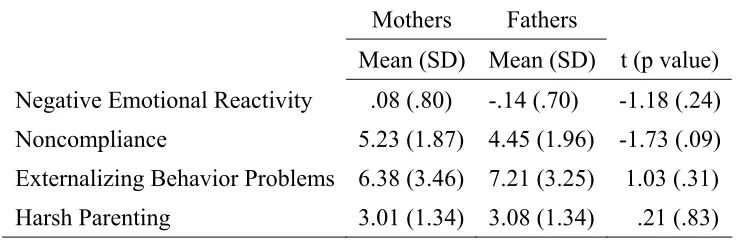
Table 1. Test for Equality of Means among Child Negative Emotional Reactivity,
Noncompliance, Externalizing Behavior Problems, and Harsh Parenting by Parent Gender
Mothers Fathers
Mean (SD) Mean (SD) t (p value) Negative Emotional Reactivity .08 (.80) -.14 (.70) -1.18 (.24) Noncompliance 5.23 (1.87) 4.45 (1.96) -1.73 (.09) Externalizing Behavior Problems 6.38 (3.46) 7.21 (3.25) 1.03 (.31) Harsh Parenting 3.01 (1.34) 3.08 (1.34) .21 (.83)
Results
The analyses designed to test the study hypotheses will proceed in four steps. First, to evaluate the extent to which study constructs varied by parent gender, t-tests were computed to compare the means for mothers and fathers. Second, to examine the hypothesized associations among child negative emotional reactivity, noncompliance, externalizing behaviors, and harsh parenting correlations were computed and will be described. Third, multiple regression equations were computed to test the hypothesized mediating effects of noncompliance on the association between negative emotional reactivity and externalizing behaviors. Finally, to test the moderating effect of harsh parenting on children’s increasing risk for externalizing behavior problems, multiple regression equations were computed with interaction terms following procedures outlined by Baron and Kenny (1986).
Comparisons of Study Constructs by Parent Gender
externalizing behavior problems (t(73) = 1.03), and harsh parenting (t(70) = .21) based on gender
of the target parent. Results are summarized in Table 1.
Correlational Analyses: Evaluation of Hypotheses 1-3
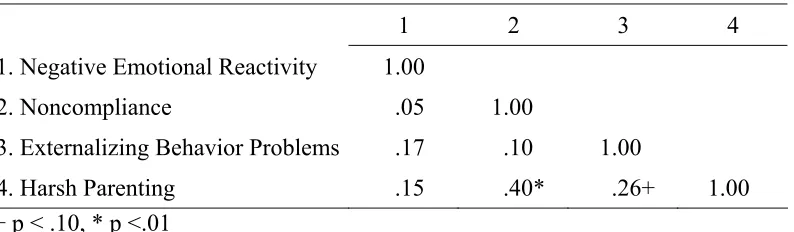
The first two hypotheses were evaluated using correlational analyses. Correlations were first computed for the whole sample and then separately for mothers and fathers. Consistent with Hypothesis 1, a statistically significant and positive correlation between negative emotional reactivity at age 2 and noncompliance at age 3 was expected. In contrast to expectations, child negative emotional reactivity was uncorrelated to later levels of noncompliance (r = .05; see Table 2). Hypothesis 2 postulated that children’s noncompliance at age 3 would be significantly correlated with externalizing behaviors at age 4. The results of the correlations did not support this expectation (see Table 2).
Table 2. Correlations among Negative Emotional Reactivity, Noncompliance, Externalizing
Behavior Problems and Harsh Parenting
1 2 3 4 1. Negative Emotional Reactivity 1.00
2. Noncompliance .05 1.00
3. Externalizing Behavior Problems .17 .10 1.00
4. Harsh Parenting .15 .40* .26+ 1.00
+ p < .10, * p <.01
Although not explicitly hypothesized, child negative emotional reactivity was expected to be statistically, significantly, and positively correlated with externalizing behavior problems in order for noncompliance to mediate this association (Baron & Kenny, 1986). Contrary to expectations, negative emotional reactivity and externalizing behavior problems were not
between study constructs, the preliminary conditions for mediation were not met. Although children’s noncompliance did not mediate the association between children’s negative emotional reactivity and externalizing problems, tests of the moderational effects of harsh parenting on the components of the incremental risk model were still possible.
The next set of correlations considered the associations among the child variables and harsh parenting. When testing for statistical moderation, it is preferred that the moderator variable be uncorrelated with both the predictor and the criterion (Baron & Kenny, 1986).
Therefore, harsh parenting was expected to be unrelated to child constructs of negative emotional reactivity, noncompliance, and externalizing behaviors. Contrary to expectations, harsh
parenting was positively and statistically significantly correlated with child noncompliance at age 3 (r = .40; p <.01; see Table 2). Moreover, harsh parenting was marginally significantly correlated with children’s externalizing behavior scores age at 4 (see Table 2). These
associations will likely result in significant main effects for harsh parenting in the regression equations, but are not relevant conceptually to testing the moderator hypotheses (Baron & Kenny, 1986).
Table 3. Correlations among Negative Emotional Reactivity, Noncompliance, Externalizing
Behavior Problems, and Harsh Parenting by Child Gender a
1 2 3 4 1. Negative Emotional Reactivity .15 .27 -.10
2. Noncompliance -.03 .32 .27
3. Externalizing Behavior Problems .11 -.00 .16
4. Harsh Parenting .33* .56** .32+
Note. a Girls are above the diagonal; boys are below the diagonal + p < .1, * p < .05, ** p < .01
Moderational Analyses: Hypotheses 4-5
Children’s negative emotional reactivity was expected to predict higher levels of noncompliance, only when parents were rated higher on harsh parenting (Hypothesis 4). Additionally, the statistical interaction between children’s noncompliance and harsh parenting was expected to statistically and significantly predict higher levels of children’s externalizing problems (Hypothesis 5). Multiple regression equations were computed to test each of these hypotheses. The conditions for moderation will be described first. Then, results associated with Hypothesis 4 will be described, followed by a discussion of the results associated with
Hypothesis 5.
interaction term is centered to reduce problems with multicollinearity (Baron & Kenny, 1986). This approach will be used to evaluate Hypotheses 4 and 5.
A multiple regression equation was computed to test the moderational effects of harsh parenting on the relationship between child negative emotional reactivity and child
noncompliance. To control for possible gender effects, child gender was entered into the first step of the regression equation. Child negative emotional reactivity and harsh parenting were then regressed onto child noncompliance in the second and third step, respectively. Finally, the child negative emotional reactivity by harsh parenting interaction term (centered) was entered in the last step. A statistically significant interaction term would support the hypothesized
prediction that harsh parenting moderates the effects of child negative emotional reactivity on noncompliance.
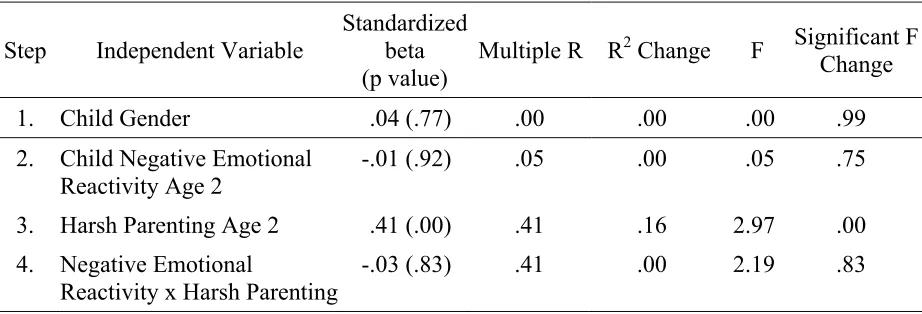
The results of the regression analysis are presented in Table 4. In contrast to
expectations, the standardized beta associated with child negative emotional reactivity was not statistically significantly associated with child noncompliance. The beta associated with harsh parenting was statistically significant, indicating that harsh parenting predicted child
Table 4. Summary of the Results of the Multiple Regression Analysis Testing the Main and
Interaction Effects of Children’s Negative Emotional Reactivity and Harsh Parenting on Children’s Noncompliance (n = 48)
Step Independent Variable
Standardized beta
(p value) Multiple R R
2 Change F Significant F Change
1. Child Gender .04 (.77) .00 .00 .00 .99
2. Child Negative Emotional
Reactivity Age 2 -.01 (.92) .05 .00 .05 .75 3. Harsh Parenting Age 2 .41 (.00) .41 .16 2.97 .00 4. Negative Emotional
Reactivity x Harsh Parenting
-.03 (.83) .41 .00 2.19 .83
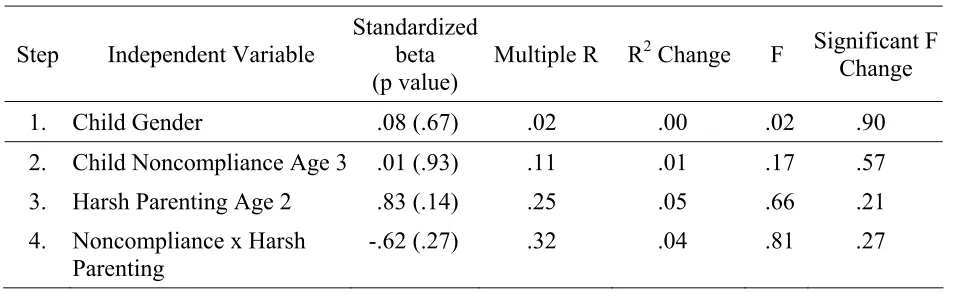
To test the expectation that harsh parenting would moderate the association between child noncompliance and child externalizing problems a second multiple regression was computed. As in the first regression equation, child gender was entered in the first step to control for possible effects of this variable. In the second step, child noncompliance was regressed onto child externalizing behavior. The harsh parenting variable was entered into the third step and the centered child noncompliance by harsh parenting interaction term was entered in the last step. Again, moderation will be indicated by the significance of the interaction term in the regression model.
As presented in Table 5, child noncompliance was not statistically significantly associated with externalizing behavior problems. Harsh parenting did not explain significant portions of the variance associated with externalizing behavior problems. In addition, the
Table 5. Summary of the Results of the Multiple Regression Testing the Main and Interactive
Effects of Children’s Noncompliance and Harsh Parenting on Children’s Externalizing Behavior Problems (n = 32)
Step Independent Variable
Standardized beta
(p value) Multiple R R
2 Change F Significant F Change
1. Child Gender .08 (.67) .02 .00 .02 .90
2. Child Noncompliance Age 3 .01 (.93) .11 .01 .17 .57 3. Harsh Parenting Age 2 .83 (.14) .25 .05 .66 .21 4. Noncompliance x Harsh
Parenting
-.62 (.27) .32 .04 .81 .27
In contrast to expectations, harsh parenting did not statistically interact with child negative emotional reactivity and noncompliance to increase children’s risk for externalizing behavior problems. However, a statistically significant main effect for harsh parenting was evident, such that exposure to harsh parenting was a significant predictor of child noncompliance one year later. Since this study included both mothers and fathers, the effect of parent gender on this association was explored further. Although the mean levels of harsh parenting and child noncompliance were not significantly different based on parent gender, the pattern of
associations among these constructs may vary by parent gender. Because of the small sample size relative to the number of predictors, using regression analyses to further explore the effect of parent gender was not possible. Alternatively, correlations among study constructs were
marginally significantly correlated with children’s externalizing scores at age 4, but fathers’ harsh parenting was not (see Table 6). Significant difference (r to z test) and equivalence tests for dependent correlations were conducted to compare the correlation of mothers’ use of harsh parenting with child noncompliance and fathers’ use of harsh parenting with child
noncompliance. The difference in the correlation for noncompliance was -.36 (95% confidence interval for the difference -.79 to .16). Although this difference cannot be considered
significantly different, they cannot be considered functionally equivalent either because the confidence intervals do not fall within equivalence thresholds even with very conservative threshold limits (e.g., the upper confidence intervals are greater than an upper equivalence threshold of .3; see Rogers, Howard, & Vessey, 1993 for related discussion). Similarly, the difference in the correlation for mothers’ and fathers’ use of harsh parenting and child
externalizing problems was .17 (95% confidence interval for the difference -.41 to .67). These results suggest that harsh parenting significantly predicts child noncompliance similarly for both mothers and fathers.
Table 6. Correlations among Negative Emotional Reactivity, Noncompliance, Externalizing
Behavior Problems, and Harsh Parenting by Parent Gender
1 2 3 4 1. Negative Emotional Reactivity .10 .13 .12
2. Noncompliance -.08 .04 .24
3. Externalizing Behavior Problems .28 .18 .30+
4. Harsh Parenting .25 .60* .13
Discussion
The goal of the present study was to identify risk factors associated with the emergence of externalizing behavior problems during the toddler and preschool aged periods. During the toddler years, parents increasingly expect their children to comply with their requests and to exhibit behavioral control. Increases in parents’ expectations for compliance coincide with children’s own interests in autonomy and independence. Thus, the toddler years represent the first time in which parents’ and children’s goals are in conflict. When parents use emotionally negative and harsh parenting during interactions with their children, children with a propensity towards negative emotional reactivity may be more at risk for entering onto a developmental pathway of risk for problem behaviors. This study sought to clarify processes associated with the emergence of externalizing behavior problems during early childhood and the conditions under which such problem behaviors emerge.
An incremental risk model was hypothesized to account for behavioral changes
associated with the emergence of externalizing problems during early childhood. Specifically, toddlers with a propensity towards strong negative emotional reactivity at age 2 were expected to evidence more compliance problems at age 3, noncompliance that predicted levels of
The Incremental Risk Model
A number of theoretical models have been proposed to explain the association between harsh parenting and the emergence of externalizing problems in children. For instance, the coercion model argues that the quality of parenting interacts with children’s temperamental propensities to affect risk for externalizing problems (e.g., Patterson, Reid, & Dishion, 1992; Scaramella & Leve, 2004; Shaw & Bell, 1993). Specifically, harsh parenting, when paired with a highly reactive and emotionally negative child, may increase children’s risk for externalizing problems in part because these parent-child interactions are expected to be more conflictual. The proposed incremental risk model represents a variation of this model by suggesting that
children’s propensities towards negative emotional arousal may in itself be associated with increased risk for externalizing problems, in part because children’s reactivity propensities may interfere with their acquisition of behavioral control. Contrary to expectations, no statistically significant associations among these constructs emerged. That is, children’s propensities towards negative emotional reactivity were unrelated to their levels of noncompliance one year later, noncompliance which was not associated with externalizing problems one year later.
Moreover, problems are most likely to persist in the context of family stress (Campbell, 1995). Thus, in some social contexts noncompliance may be a stronger indicator of risk for
externalizing problems. The present study focused only on noncompliance and only measured noncompliance at home with one parent on one day. Perhaps broadening the construct to include behavioral control problems evidenced in multiple settings (e.g., home, daycare, supermarket) and with multiple caregivers (e.g., babysitter, grandparent, teacher) would produce results more consistent with the hypotheses.
In contrast, among more socially and economically affluent families, progression along the trajectory may be slower. Externalizing behavior problems that stem from children’s earlier reactivity propensities and noncompliance may not be evidenced until children enter school later in the preschool years. For example, Bates, Petit, Dodge, & Ridge (1998) reported that within a representative sample, infants’ difficult temperament, including resistance to control and ease of frustration, correlated with externalizing problems during middle childhood. In addition,
Guerrin, Gottfried, and Thomas (1997) followed 130 low-risk infants through age 12 and found that parent ratings of infants’ temperamental negativity at 1 ½ years predicted externalizing behavior problems consistently and significantly throughout childhood. Specifically, infant temperament was significantly correlated with parent report of externalizing behaviors through age 12 and teacher report from ages 6-8. The availability of financial and support resources available to more affluent families may provide some protection against the development of externalizing problems during early childhood. Examining the links from emotional reactivity during the toddler years (e.g., age 2), noncompliance during the preschool years (e.g., age 3-4), and externalizing problem behaviors during the early school years (e.g., 5-6) may have produced results consistent with hypothesized expectations. Such a finding would be consistent with an explanation that the harmful effects of temperamental reactivity and behavioral noncompliance emerge more slowly among more normative samples in contrast to more high-risk samples.
Second, global ratings of children’s noncompliance may be less sensitive in
parents’ requests or actively refused parents’ requests. In contrast, whine/complain and externalize negative measured children’s overall negativity. Although whine/complain and externalize negative often co-occur with children’s active refusal to obey a parental request, these codes also could co-occur with compliance (e.g., grudging compliance). Microsocial ratings of the frequency with which children actively refused to comply with a parental request may better distinguish normative from problematic levels. Future research comparing the effectiveness of microsocial and global ratings of noncompliance is clearly needed.
Finally, a modified externalizing score was used in the present study to minimize conceptual overlap among study constructs. The externalizing subscale of the Child Behavior Checklist contains a number of items that matched the operationalization of children’s emotional reactivity (e.g., easily frustrated, angry moods) and children’s noncompliance (e.g., defiant, disobedient) and these items were not included in the subscale. These results likely represent a more conservative estimate than reported in other investigations in which the full subscale was used. Quite unique to the present study, very little reporter overlap existed across any of the measures. Parents’ report of children’s anger proneness and observed high distress were used to measure negative emotional reactivity at age 2. Observational coders who rated children’s emotional reactivity propensities were different from the observational coders who rated
children’s compliance at age 3. Parents’ reports were used to measure externalizing problems at age 4. The lack of shared method variance is a clear strength of the design, but may have
The Moderational Effects of Harsh Parenting on Risk for Developing Externalizing Problems
During Early Childhood
Not all emotionally reactive children evidence compliance or externalizing problems. Parenting was hypothesized to amplify or minimize children’s risk for developing externalizing behavior problems during the preschool period. The lack of statistical significance for the incremental risk model did not rule out the possibility that harsh parenting moderated the theoretical associations. Specifically, toddlers with a highly reactive and emotionally negative temperament may be more noncompliant when parents are harsh. Similarly, the interaction of harsh parenting and noncompliance may predict level of externalizing behavior problems during preschool. Contrary to expectations, no evidence for harsh parenting as a moderator emerged. The main effect of harsh parenting was a statistically significant predictor of children’s
noncompliance.
The lack of empirical support for the expectation that harsh parenting and child temperamental propensities interact to affect noncompliance is quite surprising given the
differences did not emerge, previous research almost exclusively relies on samples of mothers and children. Children may respond differently to harsh parenting from mothers than fathers and the long term effects of mothers’ and fathers’ harsh parenting on children’s adjustment is not known. Additional research is clearly needed to replicate findings of mothers using samples of fathers.
In contrast to expectations, levels of harsh parenting at age 2 and noncompliance at age 3 were unrelated with externalizing behavior problems at age 4. Social interactional theories argue that risk for problem behaviors emerge when harsh parenting and child noncompliance are mutually reinforcing and contingent (e.g., Patterson et al., 1992). Quite possibly noncompliance is associated with risk for emerging externalizing only when children’s noncompliant behaviors evoke harsh parenting. Harsh parenting that immediately follows an act of child noncompliance may shape and reinforce problem behavior. In other words, when children fail to comply with parents’ requests and parents react to their noncompliance with angry and harsh behavior, children may be even less likely to comply with parents’ requests. Frequently occurring
demand—resistance parent-child interactions likely fail to teach children behavioral control and may promote the development of externalizing behavior problems over time (Frick, 1998; Patterson, 1982; Shaw & Bell, 1993). Consequently, harsh parenting behaviors in direct
response to children’s noncompliance may increase risk for externalizing behavior problems
A second possible explanation is that children’s emotional reactivity moderates the association between noncompliance and externalizing behaviors. For instance, Caspi, Henry, McGee, Moffitt, and Silva (1995) found that 3 year old children’s behavior problems were most likely to persist when children also displayed high levels of negative emotional reactivity. High rates of noncompliance may be symptomatic of low behavioral control or internalization
(Kochanska, 1991, 1995). Children who fail to learn how to control impulsive behaviors during the preschool years may be at greater risk for problems associated with impulsive behavior. Learning to control impulsive behaviors may be most important and most difficult for emotionally reactive children, since aggressive and impulsive behavior often accompanies emotional outbursts. When children enter the school having never developed behavioral and emotional control, they may be at greatest risk for experiencing conflicts with peers, teachers and parents (Patterson, DeBaryshe, & Ramsey, 1989). As the number of contexts in which children evidence problems increases, so too should their risk for externalizing problems (Campbell, 1995).
Limitations and Future Directions
account the mutual influences of child characteristics on parenting. Finally, global rating of child noncompliance may be less sensitive to distinguishing high from low risk children. Measuring the specific parenting responses to child noncompliance may clarify the process by which negative parent-child reciprocities emerge and come to affect increases in child problem behavior over time.
As noted earlier the toddler years present a number of unique parenting challenges. Parents must balance limit setting and compliance with children’s need for autonomy and independence (Shaw & Bell, 1993). The results of this study clearly indicate that identification of mechanisms associated with increased risk for externalizing problems is difficult and
References
Achenbach, T. (1994). Child Behavior Checklist. VT: University of Vermont.
Achenbach, T.M. & McConaughy, S.H. (1987). Empirically based assessment of child and
adolescent psychopathology: practical applications. London: Sage Publications.
Bank, L., Dishion, T.J., Skinner, M. (1990). Method variance in structural equation modeling: Living with “glop”. In G.R. Patterson (Ed.), Depression and Aggression in Family
Interaction (pp. 247-279). Hillsdale, NJ: Erlbaum.
Baron, R.M. & Kenny, D.A. (1986). The moderator-mediator variable distinction in social psychological research: Conceptual, strategic, and statistical considerations. Journal of
Personality and Social Psychology, 51, 1173-1182.
Bates, J., Maslin, C., & Frankel, K. (1985). Attachment security, mother-child interaction, and temperament as predictors of behavior-problem ratings at age 3 years. In I.
Bretherington & E. Walters (Eds.), Growing points of attachment theory and research.
Monographs of the Society for Research in Child Development, 50 (Nos. 1-2, 167-193).
Bates, J.E., Pettit, G.S., Dodge, K.A., & Ridge, B. (1998). Interaction of temperamental resistance to control and parenting in the development of externalizing behavior.
Developmental Psychology, 34 (5), 982-995.
Belsky, J., Hsieh, K.H., & Crnic, K. (1998). Mothering, fathering, and infant negativity as antecedents of boys’ externalizing problems and inhibition at age 3 years: Differential susceptibility to rearing experience? Development and Psychopathology, 10, 301-319.
Braungart-Rieker, J., Garwood, M.M., & Stifter, C.A. (1997). Compliance and noncompliance: The roles of maternal control and child temperament. Journal of Applied Developmental
Psychology, 18 (3), 411-428.
Cairns, R.B., & Cairns, D.D. (1991). Social cognition and social networks: A developmental perspective. In D.J. Pepler & K. H. Rubin (Eds.), The development and treatment of
childhood aggression (pp. 249-278). Hillsdale, NJ: Erlbaum.
Calkins, S.D., Johnson, M.C. (1998). Toddler regulation of distress to frustrating events: temperamental and maternal correlates. Infant Behavior and Development, 12 (3),
379-395.
Calkins, S.D., Smith, C.L., Gill, K.L., & Johnson, M.J. (1998). Maternal interactive style across contexts: relations to emotional, behavioral and physiological regulation during
toddlerhood. Social Development, 7 (3), 350-369.
Campbell, S.B. (1990). Behavior problems in preschool children: Clinical and developmental
issues. New York: Guilford Press.
Campbell, S.B. (1995). Behavior problems in preschool children: a review of recent research.
Journal of Child Psychology and Psychiatry, 36 (1), 113-149.
Campbell, S.B. (1997). Behavior problems in preschool children: Developmental and family issues. In T.H. Ollendick & R.J. Prinz (Eds.), Advances in clinical child psychology
(Vol. 9, pp. 1-26). New York: Plenum.
Campbell, S.B. & Ewing, L.J. (1990). Hard-to-manage preschoolers: Adjustment at age nine and predictors of continuing symptoms. Journal of Child Psychology and Psychiatry, 31,
Campbell, S.B., March, C.L., Pierce, E., Ewing, L.J., & Szumowski, E.K. (1991). Noncompliant behavior, overactivity, and family stress as predictors of negative maternal control in preschool children. Development and Psychopathology, 3, 175-190.
Campbell, S.B., Pierce, E.W., Moore, G., Marakovitz, S., & Newby, K. (1996). Boys’
externalizing problems at elementary school: Pathways from early behavior problems, maternal control, and family stress. Development and Psychopathology, 8, 701-720.
Coleman, J., Wolkind, S., & Ashley, L. (1977). Symptoms of behaviour disturbance and adjustment to school. Journal of Child Psychology and Psychiatry, 18, 201-210.
Crowther, J.K., Bond, L.A., & Rolf, J.E. (1981). The incidence, prevalence and severity of behavior disorders among preschool-age children in day care. Journal of Abnormal
Child Psychology, 9, 23-42.
Caspi, A., Henry, B., McGee, R.O., Moffitt, T.E., & Silva, P.A. (1995). Temperamental origins of child and adolescent behavior problems: From age three to age fifteen. Child
Development, 66, 55-68.
Cummings, E.M., Iannotti, R.J., & Zahn-Waxler, C. (1989). Aggression between peers in early childhood: individual continuity and developmental change. Child Development, 60,
887-895.
Earls, F., & Jung, K.G. (1987). Temperament and home environment characteristics as causal factors in the early development of child psychopathology. Journal of the American
Academy of Child and Adolescent Psychiatry, 25, 540-549.
Eisenberg, N., Cumberland, A., & Spinrad, T.L. (1998). Parental socialization of emotion.
Eisenberg, N., Fabes, R.A., Nyman, M., Bernzweig, J., & Pinuelas, A. (1994). The relations of emotionality and regulation to children’s anger-related reactions. Child Development,
65, 109-128.
Fagot, B.I. (1984). The consequences of problem behavior in toddler children. Journal of
Abnormal Child Psychology, 12 (3), 385-395.
Frick, P.J. (1998). Callous-unemotional traits and conduct problems: Applying the two-factor model of psychopathy to children. In D.J. Cooke et al. (Eds.), Psychopathy: Theory,
research and implications for society, (pp. 161-187). Netherlands: Kluwer.
Gardner, F.E. (1989). Inconsistent parenting: Is there evidence for a link with children’s conduct problems? Journal of Abnormal Child Psychology, 17, 223-233.
Goldsmith, H.H. (1996). Studying temperament via construction of the Toddler Behavior Assessment Questionnaire. Child Development, 67, 218-235.
Goldsmith, H.H., Reilly, J., Lemery, K.S., Longley, S., & Prescott, A. (1999). The laboratory
temperament assessment battery: Preschool version. Unpublished manuscript.
Guerin, D.W., Gottfired, A.W., & Thomas, C.W. (1997). Difficult temperament and behaviour problems: A longitudinal study from 1.5 to 12 years. International Journal of
Behavioral Development, 21, 71-90.
Hagekull, B. (1994). Infant temperament and early childhood functioning: Possible relations to the five-factor model. In C.J. Halverson, Jr., G.A. Kohnstamm, & R.P. Martin (Eds.),
The developing structure of temperament and personality (pp. 227-240). Hillsdale, NJ:
Himmelfarb, S., Hock, E., & Wenar, C. (1985). Infant temperament and noncompliant behavior at four years: A longitudinal study. Genetic, Social, & General Psychology Monographs,
111 (1), 7-21.
Hinde, R.A., Tamplin, A., & Barrett, J. (1993). A comparative study of relationship structure.
British Journal of Social Psychology, 32, 191-207.
Ingoldsby, E.M., Shaw, D.S., Owens, E.B., & Winslow, E.B. (1999). A longitudinal study of interparental conflict, emotional and behavioral reactivity, and preschoolers’ adjustment problems among low-income families. Journal of Abnormal Child Psychology, 27 (5),
343-356.
Kagan, J. (1998). Biology and the Child. In W. Damon & N. Eisenberg (Eds.), Handbook of
child psychology: Social, emotional, and personality development, (pp.177-236). NY:
Wiley.
Kazdin, A.K. (1995). Conduct disorders in childhood and adolescence. Thousand Oaks, CA:
Sage.
Keenan, K., Shaw, D.S., Delliquadri, E., Giovannelli, J., & Walsh, B. (1998). Evidence for the continuity of early problem behaviors: Application of a developmental model. Journal of
Abnormal Child Psychology, 26, 441-454.
Kochanska, G. (1993). Toward a synthesis of parental socialization and child temperament in early development of conscience. Child Development, 64, 325-347.
Kochanska, G. (1995). Children’s temperament, mothers’ discipline, and security of
attachment: multiple pathways to emerging internalization. Child Development, 66,
Kochanska, G. (1997). Multiple pathways to conscience for children with different
temperaments: From toddlerhood to age 5. Developmental Psychology, 33, 228-240.
Kochanska, G., Murray, K., Jacques, T.Y., Koenig, A.L., & Vandegeest, K.A. (1996). Inhibitory control in young children and its role in emerging internalization. Child
Development, 67, 490-507.
Kopp, C.B. (1982). Antecedents of self-regulation: a developmental perspective.
Developmental Psychology, 18, 199-214.
Kuczynski, L., Kochanska, G., Radke-Yarrow, M., & Darby-Welsch, J. (1987). A developmental interpretation of young children’s noncompliance. Developmental
Psychology, 23, 799-806.
Ledingham, J.E. (1991). Social cognition and aggression. In D.J. Pepler & K.H. Rubin (Eds.),
The development and treatment of childhood aggression (pp.279-286). Hillsdale, NJ:
Erlbaum.
Lee, C.L., & Bates, J.E. (1985). Mother-child interactions at age two years and perceived difficult temperament. Child Development, 56, 1314-1325.
Lorenz, F.O., Conger, R.D., Simon, R.L. (1991). Economic pressure and marital quality: An illustration of the method variance problem in the causal modeling of family processes.
Journal of Marriage & the Family, 53, 375-388.
Melby, J.N. & Conger, R.D. (2001). The Iowa family interaction rating scales: Instrument summary. In P.K. Kerig & K.M. Lindahl (Eds.), Family observational coding systems:
Resources for systematic research (pp. 33-57). Mahwah, NJ: Erlbaum.
Olweus, D. (1979). Stability of aggressive reaction patterns in males: A review. Psychological
Bulletin, 86 (4), 852-875.
Patterson, G.R. (1982). Coercive Family Process. Eugene, OR: Castalia.
Paterson, G. & Sanson, A. (1999). The association of behavioral adjustment to temperament, parenting, and family characteristics among 5 year old children. Social Development, 8,
293-309.
Patterson, G.R., DeBaryshe, B.D., & Ramsey, E. (1989). A developmental perspective on antisocial behavior. American Psychologist, 44, 329-335.
Patterson, G.R., Reid, J.R., & Dishion, T.J. (1992). Antisocial boys. Eugene, OR: Castalia.
Rogers, J. L., Howard, K. I., & Vessey, J. T. (1993). Using significance tests to evaluate equivalence between two experimental groups. Psychological Bulletin, 113, 553-565.
Rothbart, M.K. & Bates, J.E. (1998). Temperament. In W. Damon & N. Eisenberg (Eds.),
Handbook of Child Psychology: Social, emotional, and personality development
(pp.105-176). New York: Wiley.
Rubin, K.H., Burgess, K.B., Dwyer, K.M., & Hastings, P.D. (2003). Predicting preschoolers’ externalizing behaviors from toddler temperament, conflict, and maternal negativity.
Developmental Psychology, 39 (1), 164-176.
Rubin, K.H., Hastings, P., Chen, X., Stewert, S. & McNichol, K. (1998). Intrapersonal and maternal correlates of aggression, conflict, and externalizing problems in toddlers. Child
Development, 69, 1614-1629.
Sanson, A., Smart, D., Prior, M., & Oberklaid, F. (1993). Precursors of hyperactivity and aggression. Journal of the American Academy of Child and Adolescent Psychiatry, 32,
1207-1216.
Scaramella, L.V. & Conger, R.D. (2003). Intergenerational continuity of hostile parenting and its consequences: the moderating influence of children’s negative emotional reactivity.
Social Development, 12 (3), 420-439.
Scaramella, L.V. & Leve, L.D. (2004). Clarifying parent-child reciprocities during early childhood: The early childhood coercion model. Clinical Child and Family Psychology
Review, 7, 89-107.
Shaw, D.S. & Bell, R.Q. (1993). Developmental theories of parental contributors to antisocial behavior. Journal of Abnormal Child Psychology, 21, 493-518.
Shaw, D.S., Keenan, K., & Vondra, J.I. (1994). Developmental precursors of externalizing behavior: ages 1-3. Developmental Psychology, 30 (3), 355-364.
Shaw, D.S., Owens, E.B., Giovannelli, J., & Winslow, E.B. (2001). Infant and toddler pathways leading to early externalizing disorders. Journal of the American Academy of Child and
Adolescent Psychiatry, 32, 1207-1216.
Shaw, D.S., Owens, E., Vondra, J., & Keenan, K. (1996). Early risk factors and pathways in the development of early disruptive behavior problems. Development and Psychopathology,
8 (4), 679-699.
Smith, C.L., Calkins, S.D., Keane, S.P., Anastopoulas, A.D., & Shelton, T.L. (2004). Predicting stability and change in toddler behavior problems: Contributions of maternal behavior and child gender. Developmental Psychology, 40, 29-42.
Snyder, J. & Patterson, G.R. (1995). Individual differences in social aggression: A test of a reinforcement model of socialization in the natural environment. Behavior Therapy, 26,
371-391.
Thompson, R.A. (1994). Emotion regulation: A theme in search of definition. Monographs of
the Society for Research in Child Development, Vol 59 (2-3) 25-52, 250-283.
Vita