http://www.triple-c.at
Social Media and the Public Sphere
Christian Fuchs
University of Westminster, London, UK, [email protected], http://fuchs.uti.at
Abstract: Social media has become a key term in Media and Communication Studies and public dis-course for characterising platforms such as Facebook, Twitter, YouTube, Wikipedia, LinkedIn, Word-press, Blogspot, Weibo, Pinterest, Foursquare and Tumblr. This paper discusses the role of the con-cept of the public sphere for understanding social media critically. It argues against an idealistic inter-pretation of Habermas and for a cultural-materialist understanding of the public sphere concept that is grounded in political economy. It sets out that Habermas’ original notion should best be understood as a method of immanent critique that critically scrutinises limits of the media and culture grounded in power relations and political economy. The paper introduces a theoretical model of public service me-dia that it uses as foundation for identifying three antagonisms of the contemporary social meme-dia sphere in the realms of the economy, the state and civil society. It concludes that these limits can only be overcome if the colonisation of the social media lifeworld is countered politically so that social me-dia and the Internet become public service and commons-based meme-dia.
Keywords: social media, Internet, public sphere, Jürgen Habermas, political economy, public service media
Acknowledgement: This paper is the extended printed version of Christian Fuchs’ inaugural lecture for his pro-fessorship of social media at the University of Westminster that he took up on February 1st, 2013. He gave the lecture on February 19th, 2014, at the University of Westminster.
1. Introduction
Contributions to discussions of Internet, social media and the public sphere often tend to stress new technologies’ transformative power. Some examples:
• Yochai Benkler stresses the emergence of a networked public sphere: “The easy possibil-ity of communicating effectively into the public sphere allows individuals to reorient them-selves from passive readers and listeners to potential speakers and participants in a con-versation“ (Benkler 2006, 213). “The network allows all citizens to change their relation-ship to the public sphere. They no longer need be consumers and passive spectators. They can become creators and primary subjects. It is in this sense that the Internet de-mocratizes“ (Benkler 2006, 272)
• Zizi Papacharissi describes the emergence of a “virtual sphere 2.0”, in which citizen-consumers participate and express “dissent with a public agenda […] by expressing politi-cal opinion on blogs, viewing or posting content on YouTube, or posting a comment in an online discussion group” (Papacharissi 2009, 244).
• Manuel Castells stresses the novelty of this sphere: “The construction of the new public sphere in the network society proceeds by building protocols of communication between different communication processes” (Castells 2009, 125).
• Jean Burgess and Joshua Green (2009, 77) argue that YouTube is a “cultural public sphere” because “it is an enabler of encounters with cultural differences and the develop-ment of political ‘listening’ across belief systems and identities”.
stresses, that besides the focus on political communication a “virtue of Habermas’s approach is to focus on the necessary material resource base for any public sphere” (Garnham 1992, 361). Habermas points out that the public sphere is a question of its members’ command of resources (property, intellectual skills) “But even under ideally favorable conditions of com-munication, one could have expected from economically dependent masses a contribution to the spontaneous formation of opinion and will only to the extent to which they had attained the equivalent of the social independence of private property owners“ (Habermas 1992, 434). The approaches discussed above do not ask the questions: Who owns Internet platforms? Who owns social media?
The contribution presented in this paper challenges public sphere idealism. It argues for a materialistic understanding and return to Habermas’ original concept that encompasses the perspective of critical political economy as a foundation for the analysis of so-called “social media”. Social media has since the mid-2000s become a buzzword and marketing ideology aimed at attracting users and investors to platforms such as Facebook, Twitter, YouTube, Wikipedia, LinkedIn, VKontakte, Blogspot, Weibo, Wordpress, Tumblr, Pinterest, or Insta-gram. Many people understand social networking sites, blogs, wikis, user-generated content sharing sites and microblogs as social media. The term social media however brings up the question if not all media are in one respect or another social. This depends on how one de-fines the social. As a consequence, one needs social theory in order to understand what is social about social media (Fuchs 2014c).
Sociality can mean that a) human thought is shaped by society, b) humans exchange symbols by communicating in social relations, c) humans work together and thereby create use-values, d) humans form and maintain communities. These definitions of sociality corre-spond to the social theory concepts of social facts, social relations, co-operation and com-munity (Fuchs 2014c, chapter 2). Described as information processes, sociality can be ex-pressed as a threefold interconnected process of cognition (a), communication (b) and co-operation (c, d) (Fuchs 2014c, chapter 2). Media and online platforms reflect these forms of sociality to different degrees:
• Cognition: Reading books, watching the news or a film on TV and listening to the radio involves just like Internet use the engagement with texts that reflect social contexts in so-ciety.
• Communication: Online communication is not new: Ray Tomlinson sent the first Internet email from one computer to the other in 19711.
• Co-operation: Online communities are not new, already in the 1980s there were bulletin board systems such as the WELL. Computer-supported co-operative work (CSCW) be-came an academic field of studies in the 1980s, reflecting the role of the computer in col-laborative work. The 1st ACM Conference on CSCW took place in December 1986 in Austin, Texas. The concept of the wiki is also not new: Ward Cunningham introduced the first wiki technology (the WikiWikiWeb) in 1995.
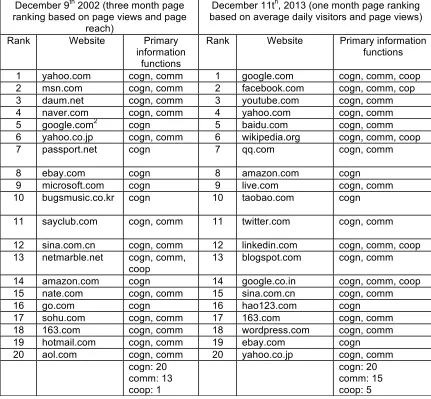
Online sociality is not new. A specific aspect of Facebook and related platforms is that they integrate tools that support various forms of sociality into one platform. They are tools of cognition, communication and co-operation. How has the landscape of the World Wide Web (WWW) changed in the past 10 years? Table 1 presents an analysis of the most used web-sites in the world in 2002 and 2013.
December 9th 2002 (three month page ranking based on page views and page
reach)
December 11th, 2013 (one month page ranking based on average daily visitors and page views)
Rank Website Primary
information functions
Rank Website Primary information functions
1 yahoo.com cogn, comm 1 google.com cogn, comm, coop
2 msn.com cogn, comm 2 facebook.com cogn, comm, cop
3 daum.net cogn, comm 3 youtube.com cogn, comm
4 naver.com cogn, comm 4 yahoo.com cogn, comm
5 google.com2 cogn 5 baidu.com cogn, comm
6 yahoo.co.jp cogn, comm 6 wikipedia.org cogn, comm, coop
7 passport.net cogn 7 qq.com cogn, comm
8 ebay.com cogn 8 amazon.com cogn
9 microsoft.com cogn 9 live.com cogn, comm
10 bugsmusic.co.kr cogn 10 taobao.com cogn
11 sayclub.com cogn, comm 11 twitter.com cogn, comm
12 sina.com.cn cogn, comm 12 linkedin.com cogn, comm, coop 13 netmarble.net cogn, comm,
coop
13 blogspot.com cogn, comm
14 amazon.com cogn 14 google.co.in cogn, comm, coop
15 nate.com cogn, comm 15 sina.com.cn cogn, comm
16 go.com cogn 16 hao123.com cogn
17 sohu.com cogn, comm 17 163.com cogn, comm
18 163.com cogn, comm 18 wordpress.com cogn, comm
19 hotmail.com cogn, comm 19 ebay.com cogn
20 aol.com cogn, comm 20 yahoo.co.jp cogn, comm
cogn: 20 comm: 13 coop: 1
cogn: 20 comm: 15 coop: 5
Table 1: Information functions of the top 20 websites in the world (data source: alexa.com)
In 2002, there were 20 information functions and 13 communication functions and one coop-eration function available on the top 20 websites. In 2013, there were 20 information func-tions, 15 communication funcfunc-tions, and 5 cooperation functions on the top 20 websites. The quantitative increase of collaborative features from 1 to 5 has to do with the rise of Facebook, Google+, Wikipedia and LinkedIn: collaborative information production with the help of wikis and collaborative software (Wikipedia, Google Docs) and social networking sites oriented on community-building (Facebook, Google+, LinkedIn). There are continuities and discontinui-ties in the development of the WWW in in the period 2002-2013. The changes concern the rising importance of co-operative sociality. This change is significant, but not dramatic. One novelty is the rise of social networking sites (Facebook, LinkedIn, Google+, MySpace, etc). Another change is the emergence of blogs (Wordpress, Blogger/Blogpost, Huffington Post), microblogs (Twitter) and file sharing web sites (YouTube), which have increased the possibil-ities of communication and information sharing in the top 20 US websites. Google has broadened its functions: It started as a pure search engine (in 1999), introduced communica-tion features in 2007 (gMail) and its own social networking site platform (Google+) in June 2011.
This paper contextualizes social media in society with the help of the concept of the public sphere. The public sphere is just one way of achieving this aim, there are other social theory
concepts (such as power, ideology, capitalism, democracy, participation, labour, control, sur-veillance) that need to be used together with the notion of the public sphere in a theory of the Internet and society (Fuchs 2008, 2014c). Section 2 discusses the concept of the public sphere, section 3 the role of the media in the public sphere, section 4 social media and the public sphere. Section 5 draws some conclusions about how to advance from social media as a sphere colonised by capital and the state towards social media as public service, com-mons-based media and a truly public sphere.
2. The Concept of the Public Sphere
Habermas (1991, 1) stresses that if something is public it is “open to all”. The task of a public sphere is that society can become engaged in “critical public debate” (Habermas 1991, 52). The public sphere would therefore require media for information and communication and access by all citizens. The logic of the public sphere is independent of economic and political power (Habermas 1991, 36): “Laws of the market [...] [are] suspended as were laws of the state“. Habermas thereby stresses that the public sphere is not just a sphere of public politi-cal communication, but also a sphere free from state censorship and from private ownership. It is free from particularistic controls.
Both Jürgen Habermas (1991) and Hannah Arendt (1958) stress that in pre-modern socie-ty the private realm was simultaneously the realm of the family and the economy. Modern society would have seen the rise of the capitalist economy and the modern state as relatively autonomous interconnected spheres. The economy became disembedded from the family and a separate sphere of modern society based on commodity production and wage-labour emerged. The realm of the economy is mediated with the household as realm of reproductive labour. “The emergence of society – the rise of housekeeping, its activities, problems, and organizational devices – from the shadowy interior of the household into the light of the pub-lic sphere, has not only blurred the old borderline between private and political, it has also changed almost beyond recognition the meaning of the two terms and their significance for the life of the individual and the citizen” (Arendt 1958, 38). The notion of the private became split into the sphere of private ownership in the economy and intimacy in the family. The economy started to no longer be part of private households, but became organised with the help of large commodity markets that go beyond single households. The modern economy became “a private sphere of society that […] [is] publicly relevant” (Habermas 1989, 19). It became a political economy. The British economist James Steuart formulated this change in 1767 in his book An inquiry into the principles of political economy – that was the first English book having the term “political economy” in its title –the following way: “What oeconomy is in a family, political oeconomy is in a state” (Steuart 1767). Political economy also became a field of study that analyses the production, distribution and consumption of goods and con-sidered the moral question of how the state and the economy shall best be related (Capo-raso and Levine 1992).
creates sections of overlap between the public sphere and these realms: the socio-political sphere, the socio-economic sphere and the socio-cultural sphere.
Figure 1 visualizes a model of modern society. The model is grounded in the social theo-ry insight that the relationship between structures and actors is dialectical and that both lev-els continuously create each other (for dialectical solutions of the structure-agency problem in social theory, see: Archer 1995, Bhaskar 1993, Bourdieu 1986, Fuchs 2003a, 2003b, Gid-dens 1984).
Figure 1: A model of modern society
Political roles
citizen, politician, bureaucrat, politi-cal party member
Socio-political roles
privacy advocates, electoral reform advocate, feminist activist, gay-rights activists, anti-racist advocate, youth movement advocate, peace movement activist, anti-penitentiary advocate, anti-psychiatry activist, non-governmental organ-isation member/activist, non-parliamentary politi-cal activist (student groups, non-parliamentary fascist groups, non-parliamentary leftist groups, etc)
Economic roles
capital owner, entrepreneur, man-ager, employee, prosumer, self-employee
Socio-economic roles
labour activist, union member, consumer protec-tionists, environmental activist
Private roles
lover, family member, friend, con-sumer, audience member, user
Socio-cultural roles
sports group member, fan community member, parishioner, member of a sect or cult, profes-sional organizations and associations, self-help groups, neighbourhood association, etc
Table 2: Social roles in modern society
Peter Lunt and Sonia Livingstone (2013) reflect on articles covering the topic of the public sphere that were published in the years 1979-2012 in the journal Media, Culture & Society. They say that Habermas faced many criticism, including “his ideal of civic republicanism based on a form of direct democracy that could not accommodate the complexity and scale of modern society” and “his apparent blindness to the many varieties of exclusion (based on gender, class, ethnicity, etc.)” (Lunt and Livingstone 2013, 90). He would have revised his approach, recognising “a plurality of public spheres” and “the contested nature of public life” (Lunt and Livingstone 2013, 92) as well as the “importance of inclusivity, diversity, identity, the end of consensus government, distributed governance, and the complexity of social sys-tems” (95).
Lunt and Livingstone point out doubts that can be summarised as three main criticisms of Habermas’ notion of the public sphere:
• The working class critique • The postmodern critique
• The cultural imperialism critique
The working class critique stresses that Habermas focuses on the bourgeois movement and neglects other popular movements that existed in the 17th, 18th and 19th century, such as the working class movement. Oskar Negt’s and Alexander Kluge’s (1993) notion of a prole-tarian (counter) public sphere can be read as both a socialist critique and a radicalization of Habermas’ approach (see: Calhoun 1992, 5; Jameson 1988).
Such criticism should however see that Habermas acknowledged in the preface of Struc-tural Transformation the existence of a “plebeian public sphere” like in the Chartist movement or the anarchist working class (Habermas 1991, xviii) and that he pointed out that the “eco-nomically dependent masses” would only be able to contribute “to the spontaneous formation […] of opinion […] to the extent to which they had attained the equivalent of the social inde-pendence of private property owners“ (Habermas 1992, 434).
the first 30 years, which changed in the 1770s (Thale 1995). There was a 6 pence entry fee to the LCS meetings, so not everyone could attend. So it clearly was a public sphere with limits. There were around 650 participants at each weekly debate (Thale 1989). There were not just indoor, but also outdoor meetings. The LCS propagated Mary Wollstonecraft’s femi-nist writings.
The working class critique often also argues that Habermas idealises the bourgeois pub-lic sphere, which is however a misunderstanding. Habermas does not idealise the bourgeois public sphere, but rather applies an elegant dialectical logic to show that the bourgeois ideals and values find their own limits in the existence of stratified power relations and class. Ha-bermas showed based on Marx (critique of the political economy: class character of the pub-lic sphere) and Horkheimer (ideology critique: manipulated pubpub-lic sphere) how the very prin-ciples of the public sphere are stylised prinprin-ciples that in reality within capitalist society are not realised due to the exclusory character of the public sphere and the manipulation of the pub-lic sphere by particularistic class interests. Habermas’ theory of the pubpub-lic sphere is an ideol-ogy-critical study in the tradition of Adorno’s (2003) method of immanent critique that con-fronts the ideals of the public sphere with its capitalist reality and thereby uncovers its ideo-logical character. The implication is that a true public sphere can only exist in a participatory society.
Liberal ideology postulates individual freedoms (of speech, opinion, association, assem-bly) as universal rights, but the particularistic and stratified character of unequal societies undermines these universal rights and creates inequality and therefore unequal access to the public sphere. There are specifically two immanent limits of the bourgeois public sphere that Habermas discusses:
• The limitation of freedom of speech and public opinion: if individuals do not have same formal education and material resources available, then this can pose limits for participa-tion in the public sphere (Habermas 1991, 227).
• The limitation of freedom of association and assembly: big political and economic organi-sations “enjoy an oligopoly of the publicistically effective and politically relevant formation of assemblies and associations” (Habermas 1991, 228).
Habermasian public sphere analysis with the help of the epistemological method of imma-nent critique compares an actual public sphere (political economy and political communica-tion) to the ideal and values of the public sphere that bourgeois society promises (freedom of speech, freedom of public opinion, freedom of association, freedom of assembly). The public sphere is a concept of immanent critique for criticising the shortcomings of societies. Haber-mas does not necessarily say that it exists everywhere, but that it should exist. Immanent critique compares proclaimed ideals to reality. If it finds out that reality permanently contra-dicts its own ideals, then it becomes clear that there is a fundamental mismatch and that re-ality needs to be changed in order to overcome this incongruity.
The bourgeois public sphere creates its own limits and thereby its own immanent critique.
In capitalism, “the social preconditions for the equality of opportunity were obviously lacking, namely: that any person with skill and ’luck’ could attain the status of property owner and thus the qualifications of a private person granted access to the public sphere, property and education. The public sphere […] contradicted its own principle of universal accessibility“ (Habermas 1991, 124). “Similarly, the equation of ’property owners’ with ’human beings’ was untenable; for their interest in maintaining the sphere of commodity exchange and of social labor as a private sphere was demoted by virtue of being opposed to the class of wage earn-ers, to the status of a particular interest that could only prevail by the exercise of power over others“ (Habermas 1991, 124f). “Under the conditions of a class society, bourgeois democ-racy thus from its very inception contradicted essential premises of its self-understanding“ (Habermas 1991, 428). Thomas McCarthy interprets Habermas approach as arguing that the “Enlightenment’s promise of a life informed by reason cannot be redeemed so long as the rationality that finds expression in society is deformed by capitalist modernization ” (Haber-mas 1984, xxxvii).
Action, Habermas (1984, 1987) reformulated the notion of the feudalisation of the public sphere as the colonisation of the lifeworld: “The thesis of internal colonization states that the subsystems of the economy and state become more and more complex as a consequence of capitalist growth, and penetrate ever deeper into the symbolic reproduction of the lifeworld” (Habermas 1987, 367). The “colonization of the lifeworld by system imperatives […] drive[s] moral-practical elements out of private and political public spheres of life” (Habermas 1987, 325). The “imperatives of autonomous subsystems make their way into the lifeworld from the outside – like colonial masters coming into a tribal society – and force a process of assimila-tion upon it” (Habermas 1987, 355).
The colonisation of the lifeworld (Habermas 1984, 1987) results in the centralisation of economic power (companies, market concentration, monopolies) and political power (state, bureaucracy). Bureaucratisation is a transformation through which “the state was infused into [civil] society (bureaucracy) and, in the opposite direction, through which [civil] society was infused into the state (special-interest associations and political parties)”. Monetarisation and commodification transmogrify the public sphere into “a sphere of culture consumption” that is only a “pseudo-public sphere” (Habermas 1991, 162) and a “manufactured public sphere” (Habermas 1991, 217).
But the two concepts of feudalisation and colonisation are not just negative forms of cri-tique, but imply the possibility of a reversal – processes of decolonization, lifeworldisation, commonification so that communicative action substitutes the systemic logic of money and power and participatory democracy and spaces of co-operation emerge. Thomas McCarthy’s in the preface to the Theory of Communicative Action defines decolonisation as the “expan-sion of the areas in which action is coordinated by way of communicatively achieved agree-ment”. It sets “limits to the inner dynamic of media-steered subsystems and to subordinate them to decisions arrived at in unconstrained communication” (Habermas 1984, xxxvii).
Are ideology or hegemony better and more critical terms than the public sphere? They are certainly both critical terms needed in a toolbox of a critical theory of society, but only focus on the manipulation of information and consensus to domination and tend to remain idealis-tic, whereas the public sphere is an economic and political concept that focuses on the inclu-siveness of ownership and decision-making. It allows stressing not only aspects of public discussion, but also the public or private ownership of crucial goods and services such as communications.
The postmodern critiquepoints out that the public sphere has been a sphere of educated, rich men, juxtaposed to the private sphere that has been seen as the domain of women. Women, gays and lesbians, and ethnicities would have been excluded from the public sphere. It would therefore today be more promising that struggles against oppression take place in multiple subaltern counter publics than in one unified sphere. The criticism also stresses that an egalitarian society should be based on a plurality of public arenas in order to be democratic and multicultural (Benhabib 1992, Fraser 1992, Eley 1992, Mouffe 1999, Rob-erts and Crossley 2004). Habermas agrees that his early account in The Structural Trans-formation of the Public Sphere (Habermas 1991), originally published in German in 1962, has neglected proletarian, feminist, and other public spheres (Habermas 1992, 425-430).
The cultural imperialism critique stresses that the public sphere is a Western enlighten-ment concept that Western societies use for trying to impose their political, economic and social systems on other countries. Jim McGuigan’s formulates in this context a criticism of Nicholas Garnham’s interpretation of Habermas: “we have to entertain the possibility that the global public sphere is a Western fantasy and perhaps a last gasp of its otherwise shaky bid for or to sustain global hegemony” (McGuigan 1998, 96).
Concerning the question if there is a global public sphere, Colin Sparks (1998) stresses that broadcasting is mainly national. “Global” stations such as CNN and BBC World would reach limited audiences that are mainly located in the West. They would also predominantly have Western-made and Western-focused contents. He therefore suggests to abandon the term global public sphere and to better use the term “imperialist, private sphere” (Sparks 1998, 122). The public sphere is not only about information and communication, but also about ownership. Therefore the existence of transnational forms of media and communica-tion doesn’t imply the existence of a global public sphere.
Public spaces and public spheres are not specific to the West. The public teahouse is an old cultural practice and space in many parts of the world, such as in China, Japan, Iran, Turkey, UK. Di Wang (2008) compares the early 20th century Chinese teahouse to the British
public houses. It is a common space, where people from all walks of life go for different pur-poses. The Chinese word for teahouse is (cháguăn).
Chengdu (成都) is the capital of the Southwestern Chinese province Sichuan (四川). It has about 7.7 million inhabitants in its urban core. “Teahouses in Chengdu, however, were re-nowned for their multiclass orientation. One of the ‘virtues’ of Chengdu teahouses was their relatively equality” (Wang 2008, 421). Women were first excluded, but by 1930 fully accept-ed. These teahouses were not just cultural spaces, but also political meeting points, where political debates took place and political theatre pieces were performed, which attracted not only citizens, but also government spies. Wang (2008) discusses the role of the Chengdu teahouses during the 1911 Railroad Protection Movement. Public meeting places are spheres of civil engagement that can turn into political spaces of communication and protest.
The public sphere is both process and space: “In periods of mobilization, the structures that actually support the authority of a critically engaged public begin to vibrate. The balance of power between civil society and the political system then shifts” (Habermas 1996, 379). Juha Kovisto and Esa Valiverronen (1996) see the public sphere not as domain, but as pro-cess of counter-hegemonic struggles. A public sphere emerges where people struggle for a better society and their struggle is a process of constituting the public that creates spatial domains of resistance in the public. The public sphere is simultaneously process and space. Social organisation turns into a public sphere when people act politically in common for a joint goal that fosters participatory democracy instead of economic and state power and when they use grassroots organisations and/or the occupation or creation of public space as political strategy. Neo-Nazis do not form a public sphere because their organization struc-tures and goals are authoritarian, opposed to participatory democracy.
King-dom, the United States, Vietnam, Western Sahara. Common aspects of these protests were that many of them used the tactic of making space public and political and that these protests took place in a common crisis of society. Resistance is as old as class societies, so public spheres have been formed as resisting publics throughout the history of class societies.
3. The Media and the Public Sphere
For Habermas (1984, 1987), a medium is an entity that enables social relations. He distin-guishes between the steering media of money and power on the one hand and unmediated communicative action on the other hand. Niklas Luhmann (1995) in contrast to Habermas argues that all social systems are communication systems and organise their communication around specific media and binary codes such as money and paid/unpaid in the economy or power and in office/out of office in politics. Communication is a social relation, in which hu-mans interact mutually with the help of symbols and thereby create meaning of each other and the world. It is a constitutive feature of society and all social systems. Communication requires and is not possible without media: storage media (information technologies) such as paper, tapes, film reels, computer hard disks, DVDs, web space; transport media (communi-cation technologies) such as the telephone, television, radio, e-mail; and collaborative media (technologies of co-operation) such as wikis and online communities.
Whereas property (such as money and other commodities) and power can certainly be seen as media of social relations, a specific feature of the media and communication system is that it communicates content created or co-created by human beings that is stored, inter-preted and re-interinter-preted in order to make meaning of the world. In modern society, the cul-tural system is not isolated, but culture is mediated by money in the culture industry and power in political communication. The cultural system has its own economy and politics.
Figure 2: The media system in modern society
Organisation form
CAPITAL STATE CIVIL SOCIETY
Structures Commodities Public Goods Gifts
Structures Prices Taxes Reciprocities
Agency Personal Possession Shared Use Co-Creation
Agents Consumers Citizens Communards
Moral values Liberty Equality Mutuality
Table 3: Three political economies of the media (Murdock 2011, 18)
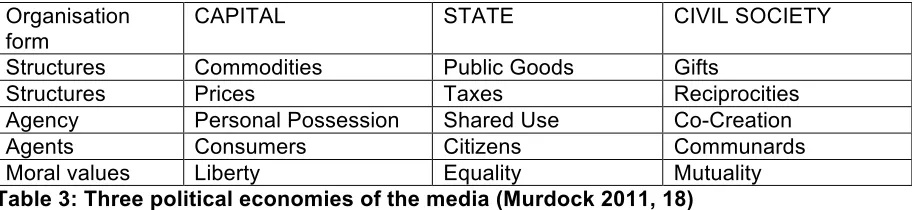
Graham Murdock (2011) distinguishes between three political economies of the media in modern societies. Media can take on the form of commodities organised by capital, public goods organised by the state and gifts organised by civil society (see table 3).
Williams we can therefore say that information media have a) their specific culture that stores and communicates information in public and helps producing meaning and b) a specific mode of economic organisation of culture, a political economy of culture, that enables the ownership, control, production, diffusion and consumption of information. The media have an economic and a political dimension, they are owned in specific ways and are channels for political information and debate: “A newspaper or a TV channel is at one and the same time a commercial operation and a political institution” (Garnham 1990, 110). Table 4 distin-guishes two levels of the organisation of information media and introduces based on Graham Murdock’s typology a distinction between capitalist media, public media and civil society me-dia.
Capitalist media Public service media Civil society me-dia
Economy (ownership)
Corporations State institutions Citizen-control
Culture (public cir-culation of ideas)
Content that addresses humans in various so-cial roles and results in meaning-making
Content that addresses humans in various social roles and results in mean-ing-making
Content that ad-dresses humans in various social roles and results in meaning-making
Table 4: Two levels of the three political economies of the media
The media system has a public role for making information public. Public culture is however mediated by political economy and ownership structures (see table 4):
• Capitalist media are companies that are privately owned by single individuals, families or shareholders. They are culturally located in the public sphere, but at the same time they are part of the capitalist economy and therefore not only produce public information, but capital and monetary profit by selling audiences/users and/or content.
• Public media are funded by or with the help of the state and/or are created and main-tained by a specific statute. They are seen as a public service that plays the role of provid-ing political, educational and entertainment information to citizens. They are as organisa-tions located in or close to the state system.
• Civil society media are full parts of the public sphere. They are economically related to the state if they receive subsidies and often stand in an antagonistic relation to the capitalist economy and governments because as alternative media they tend to reject for-profit and commercial logic and they tend to express alternative points of view that challenge gov-ernments and corporations. Civil society media are media that are run, owned and con-trolled by citizens as common projects. They express alternative points of view on the lev-el of culture and have alternative organisation modlev-els at the levlev-el of political economy (Fuchs 2010, Sandoval and Fuchs 2010).
Media make information public on their cultural level, but only some of them are publicly con-trolled on the economic level by state-funded institutions or civil society, whereas capitalist media are profit-making corporations based on private ownership.
public sphere in appearance only” (Habermas 1991, 171). Habermas critically observes that in capitalist media, publicity is not generated from below, but from above (Habermas 1991, 177).
James Curran (1991) argues that before 1850s there was a rich history of radical news-papers in the UK and that it was easy and cheap to create such newsnews-papers. Examples of the radical 19th century UK press are: Liberator, London Dispatch, Northern Star (a Chartist
newspaper that existed from 1837 until 1852 and had a circulation of around 50 000), Politi-cal Register, Poor Man’s Guardian, Reynolds News, Trades Newspaper, Twopenny Trash, Voice of the People, Voice of West Riding, Weekly Police Gazette (Curran and Seaton 2010, chapter 2). The radical press had an important role in radical politics and was associated with civil society groups such as the National Union of the Working Classes, the Chartist Move-ment, or the Society for Promoting the Employment of Women. Later advertising rose and it became ever more expensive to run a newspaper so that the press shifted towards the right and the labour press came to an end in the 20th century. Curran argues that the 19th century
press had “a radical and innovatory analysis of society” and “challenged the legitimacy of the capitalist order” (Curran 1991, 40). Habermas would dismiss the role of the radical press, whereas 19th century London press consisted of “conflicting public spheres” (Curran 1991,
42). Curran’s position can be characterized as being close to Negt and Kluge’s (1993) stress on a proletarian public sphere.
One should however see that Habermas’ concerns about the economic colonisation of the life-world and the feudalisation of the media system show his concerns about capitalist media and his preference for non-capitalist media. Habermas’ notion of the feudalised public sphere reflects Marx’s (1842) concern that the “primary freedom of the press lies in not being a trade”. Slavko Splichal (2007) stresses in this context that Ferdinand Tönnies and Karl Bücher shared Marx’s insight that media can only constitute a public sphere if they are non-commercial. The public sphere has never materialized “because of unequal access to com-munication channels, uneven distribution of communicative competence, and the reduction of public debates to a legitimisation of dominant opinions created by either the ‘business type’ or the ‘government type’ of power elites” (Splichal 2007, 242).
There are several problems of how capitalist media limit the public sphere:
• Media concentration: There is a tendency that market competition results in concentration. In the commercial media landscape, the mechanism of the advertising-circulation spiral enforces media concentration (Furhoff 1973).
• Commercialised and tabloidised content: Advertising-financed media tend to more focus on entertainment than news, documentaries and educational programmes because this content is better suited for attracting advertisers (Jhally 1990, Smythe 1954, Williams 1990).
• Power inequalities: There are power differentials in commercial media that disadvantage individuals and groups that do not have significant shares of money, political influence and reputation and disempower their voices and visibility:
a) Private media ownership gives owners the possibility to influence media content. b) For-profit and advertising logic makes media organisations dependent on market and commodity logic and prone to exclude voices that question these logics.
c) There is an educational and economic gap that can privilege educated and wealthy in-dividuals in the consumption of demanding and costly culture.
There are general concerns about advertising culture (for an overview see the contributions in Turow and McAllister 2009):
• Advertising is product propaganda that conceals actual or possible negative features of products.
• Advertising only presents the products and ideologies of powerful companies and discrim-inates competing products and views and of less powerful actors, especially
non-commercial and non-profit organizations.
• Advertising advances the concentration of the economy.
• Advertisers try to manipulate humans’ needs, desires, tastes, purchasing and consump-tion decisions.
• Advertising is mainly aimed at wealthy consumers.
• Advertising structures the corporate media as a filter in such a way that criticisms of cor-porate behaviour are avoided in order not to face loss of advertising clients.
• Advertisers try to calculate and make purely mathematical assumptions about human be-haviour and interests (e.g. lives in a certain area, has a specific skin colour and age => has low income, no loan should be offered). They statistically sort consumers and users into groups and tend to discriminate especially the weak, people with low purchasing power and people of colour who as a consequence have disadvantages in society.
• Advertisements frequently contain and tend to enforce stereotypes, prejudices and biases. Examples are classist, racist and patriarchal stereotypes.
• Advertisements present women frequently in a sexist way.
• Advertising tends to violate consumer privacy and to use sensitive personal data for commercial purposes.
• Advertising fosters mass consumption of mostly non-renewable resources that end as waste in nature. Advertising aggravates the ecological crisis.
• Advertising fosters the programming of light entertainment and thereby advances the tab-loidization of the media as well as the undermining of public service media/content. Habermas’ (1991, 175-195) main concern about advertising is that it has the potential to de-politicise the public. This would on the one hand be due to particularistic interests: “The pub-lic sphere assumes advertising functions. The more it can be deployed as a vehicle for politi-cal and economic propaganda, the more it becomes unpolitipoliti-cal as a whole and pseudo-privatized” (Habermas 1991, 175). On the other hand the influence of economic logic on the media would result in tabloidisation: “Reporting facts as human-interest stories, mixing infor-mation with entertainment, arranging material episodically, and breaking down complex rela-tionships into smaller fragments – all of this comes together to form a syndrome that works to depoliticize public communication” (Habermas 1996, 377). Private control of the media can easily result in an “uneven distribution of effective voice” (Couldry 2010, 145). The economic and political-cultural dimensions of the public sphere are in this respect connected: “Having a voice requires resources” (Couldry 2010, 7). Voice requires a material form (Couldry 2010, 9). In order to be heard and seen, one needs resources that enable media power. Media are the main mechanisms of creating voice and visibility in society. Private ownership of the me-dia can harm the public visibility of and attention to citizens’ voices.
There has been a tradition of public service broadcasting in Europe and other parts of the world that has been a crucial dimension of the modern media system in the 20th and 21st cen-turies. Thinking of the BBC, most readers familiar with it will be able to come up with some points of criticism. It is however remarkable that since its inception in 1922 the BBC has by and large remained advertising-free in its UK-based core operations. Being advertising-free and funded either by a licence fee or taxes are features that the BBC shares with public broadcasting institutions in countries such as Finland, France, Spain, Sweden and Norway. Mixed public broadcasting systems that combine state-organized funding with advertising exist in contrast in countries such as Austria, Denmark, Germany, Hungary, Italy, the Nether-lands, Poland, or Portugal. France and Spain have in recent years phased out advertising-based funding on public broadcasting.
mixed programmes on national channels available to all” (Scannell 1989, 137).
By broadcasting and media in general, public information comes into private household and private affairs become public: “Broadcasting has created a public world of public persons who are routinely made available to whole populations. But at the same time it has brought private persons into the public domain” (Scannell 1989, 141). “Broadcasting, then, brings public life into private life, and private life into public life, for pleasure and enjoyment and en-joyment as much as for information and education” (Scannell 1989, 143). Besides these general characteristics, there are two important features of public media that distinguish them from privately controlled media:
• Common culture: They make culture commonly available to citizens: “European public service broadcasting has represented a real step forward in the attempt to create a com-mon culture” (Garnham 1990, 126).
• Public ownership: Nicholas Garnham (1990, 132) stresses that public ownership and the non-profit and non-commercial status of the BBC is an important difference to the com-mercial media system that remains “the basis for its potential as a public service”.
Habermas points out that the idea of the public sphere is connected to public services con-trolled and owned by the public: “In a democratic constitutional state, there are also public goods such as the undistorted political communication, that may not be tailored to the profit expectations of financial investors” (Habermas 2011, 101, translation from German3).
The BBC’s structure reflects the commitment to the public sphere on a cultural and an economic level:
• Common culture:
The BBC’s Royal Charter4 defines the BBC’s public purposes:
“The Public Purposes of the BBC are as follows – (a) sustaining citizenship and civil society;
(b) promoting education and learning;
(c) stimulating creativity and cultural excellence;
(d) representing the UK, its nations, regions and communities; (e) bringing the UK to the world and the world to the UK;
(f) in promoting its other purposes, helping to deliver to the public the benefit of emerging communications technologies and services and, in addition, taking a leading role in the switchover to digital television” (BBC Royal Charter, §3).
The overall cultural task is “to inform, educate and entertain” (BBC Royal Charter, §5). The BBC Agreement5 (§14, 1) further specifies that the “content of the UK Public Services
taken as a whole must be high quality, challenging, original, innovative and engaging”. • Public ownership:
The BBC’s core activities are non-commercial: “The BBC as a corporation shall not direct-ly provide any commercial services, but it may carry out other trading activities” (BBC Agreement §68, 1). The BBC is a public trust: “The Trust is the guardian of the licence fee revenue and the public interest in the BBC” (BBC Royal Charter, §22). Its core activities are advertising-free: “The BBC is not permitted to carry advertising or sponsorship on its public services. This keeps them independent of commercial interests and ensures they can be run purely to serve the general public interest. If the BBC sold airtime either wholly or partially, advertisers and other commercial pressures would dictate its programme and schedule priorities. There would also be far less revenue for other broadcasters. The BBC is financed instead by a TV licence fee paid by households. This guarantees that a wide
3 “Im demokratischen Verfassungsstaat gibt es auch öffentliche Güter wie die unverzerrte politische Kommu-nikation, die nicht auf die Renditeerwartungen von Finanzinvestoren zugeschnitten werden dürfen” (Habermas 2011, 101).
4http://downloads.bbc.co.uk/bbctrust/assets/files/pdf/about/how_we_govern/charter.pdf (accessed on December 11, 2013).
range of high-quality programmes can be made available, unrestricted, to everyone” (BBC Advertising Policy6).
The Communications Act 2003 (§264, 6) defines public service in a rather idealist manner as providing information, entertainment, education, cultural diversity, fair and well-informed news reporting, sports and leisure interests, science, religion, beliefs, social issues, interna-tional affairs, specialist interests, programmes for children and young people, and regional diversity. It neglects aspects of a public economy and therefore opens a door to the commer-cialisation of the BBC. “This made the idea of funding public content rather than, or even instead of, public service institutions thinkable” (Lunt, Livingstone and Brevini 2012, 118).
In recent years, scholars committed to the concept of public service have responded to the challenge of digital media and the increasing commercialisation of the media by introduc-ing the notion of public service media (PSM). These activities have especially been organ-ised around the bi-annual RIPE Conference Series (Re-Visionary Interpretations of the Pub-lic Enterprise) that has been organised since 2002. The “PSB role as the central force pre-serving the cohesion of society clearly needs to be safeguarded and, crucially, extended to the online world” (Jakubowicz 2007, 35).
Bardoel and Lowe (2007) point out cornerstones of the concept of public service media (PSM):
• The extension of public service from broadcasting to the media in general.
• In the age of digital media, public service audiences should not be targets of transmitted information, but partners and participants.
• Neoliberalism has put public funding of public service under commercial and market pres-sures that question its legitimacy (“waste of public money”, “lack of audience interest”). Slavko Splichal (2007) gives a concise definition of PSM: “In normative terms, public service media must be a service of the public, by the public, and for the public. It is a service of the public because it is financed by it and should be owned by it. It ought to be a service by the public – not only financed and controlled, but also produced by it. It must be a service for the public – but also for the government and other powers acting in the public sphere. In sum, public service media ought to become ‘a cornerstone of democracy’” (Splichal 2007, 255).
The European Commission (2009) uses the term public service media by stressing that these media enrich “public debate and ultimately can ensure that all citizens participate to a fair degree in public life” (§10). “In this context, it must be recalled that the public service re-mit describes the services offered to the public in the general interest. The question of the definition of the public service remit must not be confused with the question of the financing mechanism chosen to provide these services” (§49).
The Committee of Minsters (2007) defines public service media the following way: “Public service media should offer news, information, educational, cultural, sports and entertainment programmes and content aimed at the various categories of the public and which, taken as a whole, constitute an added public value compared to those of other broadcasters and con-tent providers”.
Such policy definitions are in contrast to the one provided by Splichal idealist and cultural-ist. They ignore aspects of political economy that shape the way media are organised and can operate. They overlook the crucial implications of public ownership as well as of being non-profit and non-commercial. Idealist definitions of public service media advance the pos-sibility to introduce the logic of commerce and commodification to public service and to ideo-logically and politically-economically mould them thereby into the logic of capitalism. Cultural idealism is an ideology that harms a true understanding of public service media. Public ser-vice media require a cultural-materialist definition and understanding of the public in public service.
Table 5 introduces a model of public service media that operates on three dimensions. There are economic, political and cultural dimensions of public service media: organisation, participation and content. On each level, there is the production, circulation and use of a
specific good that is organised in line with the logic of public service. So for example public ownership of PSM is an economic aspect of the means of communicative production.
Sphere Media Production Circulation Use
Culture: social meaning
Content Independence, unity in diversity,
educa-tional content
Cultural com-munication and debate
Cultural dialogue and
understand-ing Politics:
collective deci-sions
Participation Independence, unity in diversity (repre-sentation of minority
interests and com-mon affinity and reference points for
society), political information
Political com-munication and debate
Political dialogue and
understand-ing
Economy: property
Organisation and
tech-nology
Public ownership Non-profit, non-market
Universal access, universal availa-bility of
technolo-gy
Table 5: A model of public service media
On the economic level, PSM are means of production, circulation and consumption. PSM’s means of production are publicly owned. The circulation of information is based on a not-for-profit logic. Consumption is made available in principle to everyone by giving citizens easy access to PSM’s technology and information. On the political level, PSM make available in-clusive and diverse political information that can support political debate and the achieve-ment of political understanding. On the cultural level, PSM provide educational content that has the potential to support cultural debate and the achievement of understanding in society.
4. The Internet, Social Media and the Public Sphere
The differentiation of modern society into various spheres, such as the capitalist economy, the state, civil society, and the sphere of the family and intimacy, has resulted in a division between what is considered the private sphere and the public sphere. The modern idea of privacy stands in the context of the division of spheres.
Private Public
individual social
family society
economy polity
civil society state
life world systems world agent/action structure
everyday life structure/system/power
nature culture
feelings reason
freedom power
arts sciences
personal political
negative frdom positive freedom
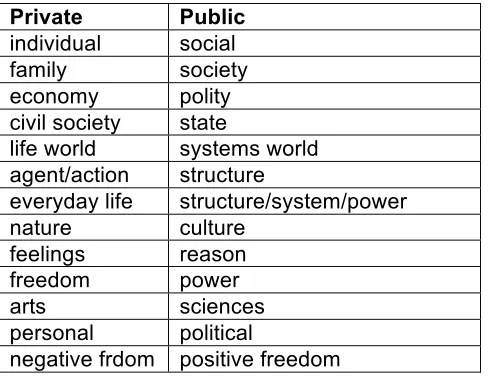
Historically, the division of labour has brought about separations of spheres such as work time/free time, work place/household, paid/unpaid, urban/rural, wage/reproductive labour, mental/physical labour, men/women, developed/developing world, industry/agriculture. Such divisions of spheres are also divisions of power. Nicholas Garnham (2000, 174) argues that the division between private/public is a typically “Western post-Enlightenment” thought and practice that is associated with a number of other divisions that are shown in table 6.
In modern society, we associate the realms of intimacy/family and the economy as the realm of private ownership with the private realm, whereas we associate the state, civil socie-ty and the media with the public realm. There are different definitions of privacy (Fuchs 2011) that share as the least common denominator that they all have to do with the question if and which spaces, behaviours, communications and data that concern individuals and groups should be available and accessible to others or not. According to Hannah Arendt, the distinc-tion between the private and the public sphere is relevant for the privacy concept because it entails “the distinction between things that should be shown and things that should be hid-den” (Arendt 1958, 72). Privacy has to do with the question what dimensions of human life should be made visible to the public or should remain invisible. Many of us may feel uncom-fortable about the idea that advertisers and employers get access to the health databases of our general practitioners and hospitals because we may fear that patients may get harmed. Figure 3 shows a research result that indicates that Internet users are sceptical about the sharing of health data.
Figure 3: Result from research conducted in the research project “Social networking sites in the surveillance society” (see: http://www.sns3.uti.at, Kreilinger 2014)
We may not feel the same discomfort as in the case of health data sharing about the idea to abolish anonymous bank accounts in Switzerland that companies and wealthy people use for offshoring profits and income in order to evade paying taxes in their countries of residence. But both issues are discussed under the topic of privacy – health privacy and financial priva-cy.
The connection between privacy and private property becomes apparent in countries like Switzerland, Liechtenstein, Monaco, or Austria that have a tradition of relative anonymity of bank accounts and transactions. Money as private property is seen as an aspect of privacy, about which the public have no or only very restricted information. In Switzerland, bank se-crecy is defined in the Federal Banking Act (§47). The Swiss Bankers Association sees bank
52.8
27.9
12.1 6.3 1
0 10 20 30 40 50 60
don’t agree at all don’t agree neutral agree totally agree
Q47: Imagine that in the course of a routine test a hospital
determines that you are overweight. You think it is OK
that your data is passed on to health companies, which
anonymity as a form of “financial privacy”7 that needs to be protected and of “privacy in
rela-tion to financial income and assets“8. In most countries, information about income and the
profits of companies (except for public companies) is treated as a secret, a form of financial privacy. The problem of secret bank accounts and transactions and the intransparency of richness and financial flows is not only that secrecy can in the economy supports tax eva-sion, black money, and money laundering, but also that financial privacy masks wealth gaps. Financial privacy reflects the classical liberal account of privacy. So for example John Stuart Mill formulated a right of the propertied class to economic privacy as “the owner’s privacy against invasion” (Mill 1848, 43).
A further criticism of the privacy concept has been that it helps confining women to the household and shielding domestic violence. Seyla Benhabib (1992, 89f) says in this respect that the distinction between the private and public realm has “served to confine women and typically female spheres of activity like housework; reproduction; nurture and care for the young, the sick, and the elderly to the ‘private’ domain”. Anita Allen summarises the feminist criticism of privacy in the following words: “Under fading regimes of patriarchy, privacy is the place where men lord over women and is the excuse that the state uses to justify letting them do it” (Allen 2003, 42). The right to bodily privacy can however also physically protect victims of violence from the offenders.
• The brief discussion shows that discussing privacy requires us to ask: For whom shall privacy be guaranteed or limited for which purpose and in which context (Fuchs 2011)? Privacy is a social, contextual and relational moral value (Fuchs 2011).
The emergence of “social media” is embedded into the trend that boundaries between the dualities of modernity have become somewhat liquid and blurred: we find situations where the distinctions between play and labour, leisure time and work time, consumption and pro-duction, private and public life, the home and the office have become more porous. Concepts such as digital labour, online prosumption, consumption work, produsage, crowdsourcing, freeconomy or playbour (play labour) have been used to describe transformations in the me-dia, culture and society associated with social media. The liquefaction of boundaries is not, as Zygmunt Bauman (2005, 2000/2012) says in an overarching claim, the main feature of modernity today. It is more modest to assume that it is one of modernity’s tendencies be-sides other features such as commodification, financialisation, informatisation, mediation, globalisation, or individualisation. I would therefore not speak of liquid life, liquid world and liquid modernity, as Bauman (2005, 2000/2012) does. Liquefaction may be the outcome of a number of developments in society:
• The globalisation of society, the economy and culture.
• Increased mobility and the transnational flows of workers, people, capital, information, finance, goods and services.
• Neoliberal policies that deregulate employment and relatively decrease wages, which makes people work longer hours.
• The rise of a flexible mode of production.
• The job crisis that makes people commute longer time and distances to and from their workplaces.
• The constant quest for reducing production and circulation costs in order to increase prof-its.
Two examples of liquefaction: Around 1 million people commute in and out of London every weekday by rail and bus9. Table 7 shows results of a study that analysed how British rail
passengers spend their time on the train and compared results for 2004 and 2010. This comparison is meaningful because the Amazon Kindle was introduced in the UK in 2009, Facebook in 2005 and the iPad in 2010.
7http://www.swissbanking.org/en/mobile/medienmitteilung-20130318, accessed on December 12, 2013. 8http://www.swissbanking.org/en/bankkundengeheimnis.htm, accessed on December 12, 2013.
Commuter activities 2004 (some of the time during journey)
Commuter activities 2010 (some of the time during journey)
Reading for leisure on out-ward journey
47% 46%
Window gazing, people watching on outward journey
50% 45%
Text messages and phone calls for personal reasons on outward journey
18% 32%
Working or studying on out-ward journey
27% 31%
Working or studying on re-turn journey
29% 31%
Listening to
music/radio/podcast on out-ward journey
12% 28%
E-mails (outward journey) 20%
Eating, drinking (outward) 8% 12%
Non-personal text messages, phone calls (outward)
7% 18%
Talking to other passengers (outward)
11% 11%
Being bored (outward) 13% 13%
Internet browsing (outward) 13%
Sleeping (outward) 16% 17%
Table 7: Activities that UK commuters’ spent doing some of the time while travelling by rail, 2004 and 2010, N=26,221 (2004), 19,715 (2010) (data source: Lyons, Jain, Susilo and Atkins
2013)
The statistics show that commuters’ most common activities have in 2010 been reading for leisure, gazing out of the window/watching people, working, using the phone for personal or non-personal reasons, listening to music or the radio, reading and sending e-mails. This shows that the commuter train is simultaneously a public and a private space, where those on the way to their jobs engage in personal activities for leisure, work activities and media use for both work and private activities. The commuter train is a liquid space, where work time and leisure time blur. For commuters the Internet and mobile phones play an important role as means of communication for both personal and work-related activities while on the move. Commuting is a mobile activity that brings people from their homes to their workplaces and back. Media are tools that allow commuters to use the daily commuting time for both work and leisure from mobile places, they are liquid technologies for the organisation of time and space.
media and cultural industries in 2012 (N=656)10. 21% of the respondents worked more than
60 hours a week, nearly 50% more than 50 hours, and 56% 10 hours or more a day. 47% earned less than £25,000. This shows that freelancers tend to work long hours. The liquefac-tion of the home and the work place and working time and leisure time they experience tends to be dominated by more time being occupied by labour. At the same time liquefaction does not mean a high income for most freelancers. Connected to the freelance economy is a crowdsourcing economy, in which companies try to find cheap or unpaid labour on the Inter-net with the help of platforms such as Amazon Mechanical Turk, eLance, oDesk, or Peo-plePerHour.
The liquefaction of boundaries is not automatically good or bad, but under the current ne-oliberal framework the logic of private profit and state power colonises the blurring of bound-aries so that the becoming-public of the private and the becoming-private of the public is col-onised by the systems of the economy (commodification) and the state (bureaucratisation).
There are 2 constitutive features of how social media such as Facebook are connected to the liquefaction of boundaries (Fuchs and Trottier 2013):
• Integrated sociality: Social media enable the convergence of the three modes of sociality (cognition, communication, cooperation) into an integrated form of sociality. This means for example on Facebook, an individual creates a multi-media content like a video on the cognitive level, publishes it so that others can comment (the communicative level), and al-lows others to manipulate and remix the content, so that new content with multiple author-ship can emerge. One step does not necessarily result in the next, but the technology has the potential to enable the combination of all three activities in one space. Facebook, by default, encourages the transition from one stage of sociality to the next, within the same social space.
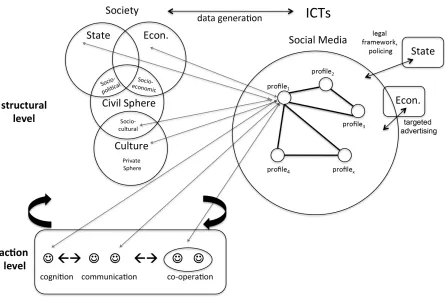
• Integrated social roles: Social media such as Facebook are based on the creation of per-sonal profiles that describe the various roles of a human being’s life. On social media like Facebook, we act in various roles (as friends, citizens, consumers, workers, colleagues, fans etc), but all of these roles become mapped onto single social media-profiles that are observed by different people that are associated with our different social roles. This means that social media like Facebook are social spaces, in which social roles tend to converge and become integrated in single profiles.
A Facebook profile holds a1) personal data, a2) communicative data, a3) social network da-ta/community data in relation to b1) private roles (friend, lover, relative, father, mother, child, etc.) b2) civic roles (socio-cultural roles as fan community members, neighbourhood associa-tion members, etc), b3) public roles (socio-economic and socio-political roles as activists and advocates), b4) systemic roles (in politics: voter, citizen, client, politician, bureaucrat, etc.; in the economy: worker, manager, owner, purchaser/consumer, etc.).
Figure 4 visualizes social roles and information processes on social media.
Figure 4: Social roles and information processes on social media (Fuchs and Trottier 2013)
Table 8 shows three basic antagonisms of contemporary social media. They are located in the realms of the economy, politics and civil society. I will for each dimension discuss how it relates to the public and the private realms.
Sphere Antagonism between…
Economy users’ interest in data pro-tection and corporate tax accountability on the one side …
… and corporations’ interest in user data’s transparency/commodification and corporate secrecy on the other side
Politics citizens’ interest to hold the powerful accountable and protect communications from powerful institutions’ access on the one side …
… and on the other side power holders’ in-terest to keep power structures secret and to criminalise the leaking and making-public of any data about them.
Civil society networked protest commu-nication that creates politi-cal public spheres online and offline …
… and the particularistic corporate and state control of social media that limits, feudalises and colonises these public spheres
Table 8: 3 antagonisms of social media
form EX-99.1, February 5, 2014). Given that Twitter is not making any profits, the question is if it was wise decision to list the company on the New York Stock Exchange in autumn 2013. On the day that Twitter’s annual losses were announced, its stock market value on the New York Stock Exchanged dropped from US$ 65 on February 5, 2014, to US$ 50 on February 6 (data source: Yahoo! Finance). In contrast, Google’s share price stood at the same time at almost US$ 1200 and Facebook’s share doubled its value from around US$30 in 2012 to above US$ 60 in February 2014 (data source: Yahoo! Finance). Where do corporate social media’s profits come from?
On social media, users generate, upload and update personal, communicative and social network data stemming from their roles in the economy, politics, civil society and culture. In addition, many social media platforms retrieve and store data about user behaviour on their sites and the Internet in general. The data is partly kept private (visible only to single users), semi-public (visible to a group) or public (visible to everyone). Most corporate social media’s capital accumulation model is to turn private, semi-public and public user data into a com-modity that is sold to advertising clients that present targeted advertisements to users. Given that Facebook and Google’s paid engineers alone only maintain platforms that without usage behaviour are devoid of sociality and economic value, it is reasonable to assume that corpo-rate social media users are unpaid workers who genecorpo-rate economic value. In this context the notion of digital labour has been coined (see the contributions in Scholz 2013).
Dallas Smythe (1977) argued that on commercial broadcasting, audiences conduct labour that creates an audience commodity. On corporate social media, we can speak of an Internet prosumer data commodity generated by digital labour (Fuchs 2014a, chapters 4 and 11). It is qualitatively different from the audience commodity in a number of respects:
• Measuring audiences has in broadcasting and print traditionally been based on studies with small samples of audience members. Measuring user behaviour on corporate social media is constant, total and algorithmic.
• Audience commodification on social media is based on the constant real-time surveillance of users.
• User measurement uses predictive algorithms (if you like A, you may also like B because 100 000 people who like A also like B).
• User prices are often set based on algorithmic auctions (pay per view, pay per click) Turning user data into a private good controlled by social media companies is legitimated with the help of privacy policies. Some examples:
• Google: “We use the information that we collect from all of our services to provide, main-tain, protect and improve them, to develop new ones and to protect Google and our users. We also use this information to offer you tailored content – such as giving you more rele-vant search results and ads” (Google Privacy Policy, version from June 24, 2013)
• Facebook: “we may use all of the information we receive about you to serve ads that are more relevant to you” (Facebook Data Use Policy, version from November 15, 2013) • Twitter: “When you use Twitter to follow, tweet, search or interact with Tweets, we may
use these actions to tailor Twitter Ads for you. For example, when you search for a specif-ic term, we can show you promoted content related to that topspecif-ic. We also might tailor ads using your profile information or location, which may be based on your mobile device loca-tion (if you've turned on localoca-tion features) or your IP address. This helps us show you lo-cal ads and other ads that you might prefer. Twitter may also tailor ads based on infor-mation that our ad partners provide us, like browser-related inforinfor-mation (a browser cookie ID) or a scrambled, unreadable email address (a hash)” (How Twitter Ads Work, version from December 12, 2013). “If you prefer, you can turn off tailored ads in your privacy set-tings so that your account is not matched to information shared by ad partners for tailoring ads” (Twitter Privacy Policy, version from October 21, 2013).