University of New Orleans University of New Orleans
ScholarWorks@UNO
ScholarWorks@UNO
University of New Orleans Theses and
Dissertations Dissertations and Theses
Spring 5-13-2016
Survey of Autonomic Computing and Experiments on JMX-based
Survey of Autonomic Computing and Experiments on JMX-based
Autonomic Features
Autonomic Features
Adel R. Azzam
The University of New Orleans, [email protected]
Follow this and additional works at: https://scholarworks.uno.edu/td Part of the Systems Architecture Commons
Recommended Citation Recommended Citation
Azzam, Adel R., "Survey of Autonomic Computing and Experiments on JMX-based Autonomic Features" (2016). University of New Orleans Theses and Dissertations. 2123.
https://scholarworks.uno.edu/td/2123
This Thesis-Restricted is protected by copyright and/or related rights. It has been brought to you by
ScholarWorks@UNO with permission from the rights-holder(s). You are free to use this Thesis-Restricted in any way that is permitted by the copyright and related rights legislation that applies to your use. For other uses you need to obtain permission from the rights-holder(s) directly, unless additional rights are indicated by a Creative Commons license in the record and/or on the work itself.
Survey of Autonomic Computing and Experiments on JMX-Based Autonomic Features
A Thesis
Submitted to the Graduate Faculty of the University of New Orleans
in partial fulfillment of the requirements for the degree of
Master of Science in
Computer Science
by
Adel Azzam
B.S. University of New Orleans, December 2010
II
Dedication
III
Acknowledgement
There are many people who have helped me along my journey. I feel so blessed and fortunate to have the family, friends, colleagues, classmates and teachers that I do. I don't think I can remember everyone but the following people come to mind.
I would firstly like to thank my advisor, Dr. Shengru Tu. He has been very supportive, patient, and helpful through it all. He has gone above and beyond, sometimes even meeting with me on weekends to help me with the work. I am very appreciative of his mentorship and wisdom. I cannot express my gratitude adequately in writing.
Also, I would like to express my gratitude to my other committee members - Dr. Mahdi Abdelguerfi and Dr. Minhaz Zibran. They have both been supportive and helpful. Many thanks to both committee members for taking time out of their busy schedules to help me.
Furthermore, I would like to thank Dr. Adlai DePano , Dr. Christopher Summa, and Dr. Christopher Taylor, and Dr. Walter Michaelis for being great teachers and mentors for me through the years.
I would like to thank fellow UNO alumni Daniel Stocker (MS, class of 1996 ) and James Sauvinet (MS, class of 2013) for their help and mentoring.
Other students who deserve thanks are Jorge Chao, Md. Rakibul Islam, Lu Yang, and Nathan Cooper.
I would like to thank my parents and my siblings. They have always been there for me. My father, Dr. Rasheed Azzam, helped me with editing, reviewing, and mentoring. My brother Omar Azzam also helped. I also must acknowledge the support of my extended family overseas and in the United States.
IV
Table of Contents
List of Figures ... VII
List of Tables ... IX
Abstract ... X
Chapter 1. Introduction ... 1
Chapter 2. Survey of Autonomic Computing ... 3
2.1 Individual Implementations of Autonomic Computing ... 3
2.1.1 DARPA Projects ... 3
2.1.2 NASA ... 4
2.2 System Approach to Autonomic Software ... 5
2.2.1 IBM’s Grand Vision of 2001 ... 5
2.2.2 Self-CHOP Properties of an Autonomic Computing System ... 6
2.2.3 Evolutionary Levels in Pursuit of Autonomic Computing ... 7
2.2.4 Key Features of Autonomic Computing ... 9
2.2.5 MAPE-K Model ... 9
2.2.6 Research on Decision-Making Techniques ... 11
2.3 IBM’s Autonomic Computing Architectural Concepts and Toolkit ... 12
2.3.1 Key Component Areas ... 14
2.3.2 Technologies ... 14
2.3.3 Tools ... 14
2.3.4 Scenarios ... 15
2.3.5 Information and Documentation ... 15
2.3.6 Autonomic Computing Toolkit Technologies ... 15
2.3.7 Autonomic Management Engine ... 19
2.4 CASCADAS ACE ... 20
2.4.1 The ACE Theoretical Principles ... 21
2.4.1.1 Semantic Self-Organization ... 21
2.4.1.2 Clustering ... 21
V
2.4.1.4 Synchronization ... 22
2.4.1.5 Situation Awareness ... 23
2.4.1.6 Pervasive Supervision ... 23
2.4.1.7 Functionality Repository... 24
2.5 Autonomic Computing in Practice ... 25
2.5.1 DB2 ... 25
2.5.2 Oracle ... 27
2.5.3 Monit ... 30
2.5.4 MapReduce ... 32
2.7.5 Watchdog Scripts ... 34
2.7.6 Apache Commons Daemon ... 34
2.7.7 daemontools ... 35
2.8 Code Adaptation ... 36
2.8.1 Operating System-Level Adaptation ... 36
2.8.2 Application Program-Level Adaptation ... 38
2.8.3 Program-Level Adaptation in Light of the Java Language ... 40
2.9 Autonomic Computing and its Relation to Service-Oriented Architecture (SOA) . 42 2.9.1 Service-Oriented Architecture ... 42
2.9.2 Autonomic Multimodal Interaction Model Utilizing Service-Oriented Architecture in a Pervasive Environment ... 44
2.9.3 Service Configuration and Composition Design Pattern for Autonomic Computing Systems ... 46
Chapter 3. Applied Technology and Techniques ... 48
3.1 Java Management extensions (JMX) ... 48
3.1.2 The Roles of JMX in Autonomic Computing ... 50
3.1.3 JMX for Autonomic Logging ... 50
3.1.4 JMX for Self-Healing with Respect to Memory Usage ... 51
3.2 Logging and Checkpointing as a Means of Facilitating AC Features ... 52
Chapter 4. Experiments on JMX-Based Autonomic Features ... 54
4.1 The JMX-based API Supporting Autonomic Features ... 56
VI
4.3 Distributed Matrix Multiplication by Pipelines ... 68
4.3.1 Matrix Multiplication Pipelines ... 68
4.3.2 Instrumentation in the Pipeline Program for Autonomic Features ... 71
Chapter 5. Discussion and Conclusion ... 75
References ... 77
VII
List of Figures
Figure 2.1 - Self-CHOP properties ...7
Figure 2.2 - Evolutionary Levels in AC spectrum ... 10
Figure 2.3 - Autonomic Computing Reference Architecture ... 13
Figure 2.4 - Autonomic Management Engine Hosting Environment ... 20
Figure 2.5 - Two types of Inter-ACE communication ... 22
Figure 2.6 - Configuring Automatic Maintenance in DB2... 26
Figure 2.7 - The Self-Tuning Memory Manager ... 27
Figure 2.8 - Monit ... 31
Figure 2.9 - MapReduce ... 33
Figure 2.10- Watchdog Script ... 34
Figure 2.11 - OS-Level Autonomic Manager ... 37
Figure 2.12 - RACS and RAPS architectures ... 43
Figure 2.13 - The Multimodal Model ... 45
Figure 3.1 - Commonly used JMX interfaces ... 49
Figure 3.2 - JConsole ... 51
Figure 3.3 - The autonomic_util package ... 55
Figure 4.1 - Interface CheckpointMBean ... 56
Figure 4.2 - Part of class Checkpoint ... 57
Figure 4.3 - Method notifyCheckpointDone in class Checkpoint ... 58
Figure 4.4 - Method handleNotification in class CheckpointListener ... 60
Figure 4.5 - Interface IOMonitorMBean ... 61
VIII
Figure 4.7 - Method notifySocketException in class SocketMonitor ... 62
Figure 4.8 - handleNotification method in class SocketListener ... 62
Figure 4.9 - Method handleNotification in class MemListener ... 63
Figure 4.10 - ServerSideManager , executed as an independent thread ... 64
Figure 4.11- Rollback function in class ServerSideMonitor ... 64
Figure 4.12 - State Diagram of FixedMessageSequenceProtocol ... 65
Figure 4.13 - Instrumentation in FixedMessageSequenceServer ... 67
Figure 4.14 - Initializing matrix a ... 69
Figure 4.15 - Initializing matrix b ... 69
Figure 4.16 - Computing a term in matrix c ... 70
IX
List of Tables
Table 1 - Evolutionary Levels in the Autonomic Computing Spectrum ...8
Table 2 - Oracle Database’s AC Abilities ... 30
Table 3 - Monit’s AC Abilities ... 31
Table 4 - MapReduce's AC Abilities ... 33
X
Abstract
Autonomic Computing (AC) aims at solving the problem of managing the rapidly-growing complexity of Information Technology systems, by creating self-managing systems. In this thesis, we have surveyed the progress of the AC field, and studied the requirements, models and architectures of AC. The commonly recognized AC
requirements are four properties - configuring, healing, optimizing, and self-protecting. The recommended software architecture is the MAPE-K model containing four modules, namely - monitor, analyze, plan and execute, as well as the knowledge repository.
In the modern software marketplace, Java Management Extensions (JMX) has facilitated one function of the AC requirements - monitoring. Using JMX, we
implemented a package that attempts to assist programming for AC features including socket management, logging, and recovery of distributed computation. In the
experiments, we have not only realized the powerful Java capabilities that are unknown to many educators, we also illustrated the feasibility of learning AC in senior computer science courses.
1
Chapter 1. Introduction
Autonomic computing is a concept that brings together many fields of computing
with the purpose of creating computing systems that manage themselves (Huebscher
2008). Autonomic computing is a paradigm for dealing with the growing complexity of
computer systems, which currently requires system administration. This paradigm
contributes to a number of other technologies such as grid computing, virtualization, and
service-oriented architecture (SOA) (Ganek 2007). Autonomic computing is inspired by
the human autonomic nervous system (ANS), which regulates our body functions.
IBM forecasts that the number of computing devices will grow at the rate of 38%
per year (“IBM” 2). While business productivity is rising, these advances are creating
management challenges for IT staff. Applications often span multiple resources –
application servers, Web servers, integration middleware, and legacy systems. These
composite applications are difficult to manage. At the same time there is a growing
volume of data, escalating demand and requiring more complex IT environments.
Estimates indicate that up to 80% of an average company’s IT budget goes to the
maintenance of existing software (Ganek 2007).
As demand for skilled IT personnel easily outstrips supply, labor costs now
exceed equipment costs by a large ratio, up to 18:1. IBM started calling for the grand
challenge of autonomic computing in 2001. This initiative aimed to develop computing
systems capable of self-management, to overcome the rapidly growing complexity of
2
In this thesis, we will review the autonomic computing landscape, the system
requirements, the essential properties, and the architectural models of autonomic
computing. At the heart of autonomic computing is the concept of software adaptation
which can be achieved either at the operating system levels or at the specific
programming levels. We will discuss the techniques at both levels, briefly including
program-level adaptation in light of the Java language. The thesis will pay more
attention to the relation of autonomic computing to Service-Oriented Architecture (SOA).
Particularly, we will study the SOA-approach to autonomic computing for pervasive
systems, as well as a software architecture for the dynamic configuration and
composition of communication services, which applies the composition design pattern.
The literature surveyed has clearly indicated that autonomic computing has been
in the requirements of all the modern critical enterprise systems. Autonomic features
have been implemented in numerous distributed applications. A trend of increasing
demand for autonomic features has been demonstrated in both Web and mobile
applications, as well as cloud-based information systems. However, such a critically
important aspect of computation has not been studied enough in computer science
education. A goal of this thesis is to investigate the feasibility of adopting autonomic
computing concepts and techniques in advanced computer science courses. A
particular focus will be on distributed programs because of the inherently unreliable
nature of network communication. Through a series of experimental programming
exercises, we hope to develop a software library that can simplify implementations of
3
Chapter 2. Survey of Autonomic Computing
2.1 Individual Implementations of Autonomic Computing
Even before IBM’s Autonomic Computing initiative came into existence, inroads
into the subject area were being made by the US Department of Defense and NASA. In
this chapter, we review Autonomic Computing history, and also look at current software
that demonstrates Autonomic Computing abilities.
2.1.1 DARPA Projects
Many self-management research projects were launched by DARPA for military
applications. The first set of DARPA projects were focused on enabling a generation of
self-repairing, self-forming, self-defending and heterogeneous networks, in order to
provide security and critical advantages in unpredictable and dangerous environments.
Some of these projects included the Small Unit Operations-Situational Awareness
System (SUO-SAS) program, the Optical RF Combined Link experiment (ORCLE),
Future Combat Systems Communications (FCS-C), and the Wireless Networks after
Next (WNaN) program.
A series of DARPA programs was launched for addressing autonomy issues in
battery-powered wireless systems, such as unattended ground sensor (UGS) networks
(Lalanda 2014).
One of the more interesting projects launched by DARPA was the Dynamic
Assembly for System Adaptability, Dependability and Assurance (DASADA), which
4
ensuring the dependability of mission-critical systems. Some of the research motivated
by this project has initiated architecture-driven solutions for self-managing large-scale
distributed systems. These solutions rely on the extraction of runtime software
"gauges." These gauges are used for the monitoring of system dependability properties
(e.g. safety, security, and architectural coherence), analyzing the collected information
for detecting variance from the predicted behavior, and dynamically adapting the system
in order to prevent violations of acceptable behavior (for example, self-repairing running
systems) (Lalanda 2014).
2.1.2 NASA
NASA has a natural interest in the field of autonomic capabilities, due to the
nature of its unmanned space missions. In these missions, communication between
land-based control centers and spacecraft is frequently unavailable and continuously
affected by long round-trip delays. In these contexts, the success of costly explorations
has been totally dependent on the autonomic capabilities of spacecraft devices, which
allow rapid control decisions to be made in real-time. Self-repair and self-reconfiguration
are also critical capabilities in these missions, since direct communication with the
devices is impossible.
The autonomic ability in NASA space missions includes star-tracking based
navigation, self-directing antennas, automatic fault reactions, and data storage and
retransmission. One example is the AutoNav autonomous navigation system, which
was employed on board the Deep Space 1 (DS1) and Deep Impact spacecrafts for
5
The popular Mars rover was another example of an autonomic system. Planet
surface explorations demand the autonomous rovers to find their way through often
difficult and rugged territories.
Yet another project with a futuristic slant that NASA unveiled is called the
Autonomous Nano Technology Swarm (ANTS) program (2000). ANTS uses the idea of
a generic architecture for human/robotic space mission, which is based on an ant
colony analogy. The ant-colony provides an excellent example of self-organization that
engenders a resilient and relatively cheap system. The ANTS system also utilizes high
social interaction capabilities that enable self-organization into various structures in
order to achieve predefined goals (Lalanda 2014).
2.2 System Approach to Autonomic Software
2.2.1 IBM’s Grand Vision of 2001
On October 15th, 2001, the vision of autonomic computing was made explicit by
Paul Horn, the then senior vice president of IBM Research. In his speech he suggested
to build computer systems that “regulate themselves much in the same way our
autonomic nervous system regulates and protects our bodies” (Ghosh 2007).In other
words, there should be a minimum of human interference (IBM 2).
To solidify and prove their mission, IBM released an IBM Autonomic Computing
Toolkit through its DeveloperWorks website. It was a free add-on to the Eclipse
development environment. This was implemented in Java and had features such as
“Common Base Events” and a “Generic Log Adapter”, along with an “Autonomic
Management Engine.” However, support for this toolkit was discontinued by IBM in
6
2.2.2 Self-CHOP Properties of an Autonomic Computing System
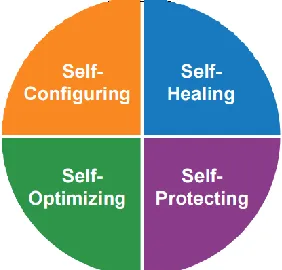
There are four key properties for any given autonomic computing system:
self-configuration, self-healing, self-optimization and self protection. These properties are
often abbreviated as the "Self-CHOP properties" (also termed "Self-X"). Below we
summarize what these terms mean.
Self-Configuration
Self-Configuration means the system’s ability for automatic configuration of
components, according to high-level goals. More specifically, this capability gives the
system the power to adapt to unpredictable situations. For example, it may remove or
add new components, or install software changes (without stopping the current service)
(Huebscher 2008).
Self-Healing
Self-healing denotes the ability to automatically discover, and subsequently
correct, faults. For example, a service disruption in a major website can be prevented if
our system has self-healing abilities. This is of interest to all major websites, as they can
increase profits by minimizing their downtime (Huebscher 2008).
Self-Optimization
This refers to the automatic control of resources, and monitoring them to ensure
peak functioning with respect to the defined requirements. In other words, this enables
the system to tune itself on-the-fly to proactively improve the current processes, and to
reactively respond to environmental conditions. This quality is of interest in the security
7
Self-Protecting
The system must be able to proactively identify and protect against any arbitrary
attacks or vulnerabilities. For example, any large enterprise system may be susceptible
to denial-of-service attacks. This is vital in the current era of ever-increasing
connectivity, as exemplified by the rapid adoption of smart phones.
Self-protection also includes a system's ability to prevent physical harm – such
as the motion detection in modern laptops, which protects disk drives by temporarily
parking the disk-drive head upon sensing that it is being dropped.
2.2.3 Evolutionary Levels in Pursuit of Autonomic Computing
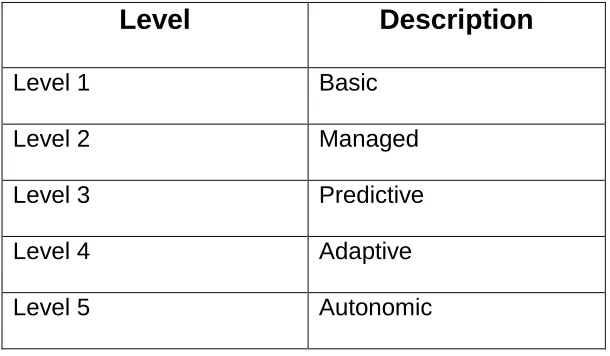
IBM introduced five evolutionary levels in the autonomic computing spectrum.
These levels are defined as follows in Table 1 (Gusworld 1):
8
Table 1 - Evolutionary Levels in the Autonomic Computing Spectrum
Level
Description
Level 1 Basic
Level 2 Managed
Level 3 Predictive
Level 4 Adaptive
Level 5 Autonomic
At the very beginning, Level 1 is the Basic level. This level corresponds to the
situation today - where systems are mostly managed manually. Here, we have many
sources of system generated data, that require a highly skilled staff.
The next level is Managed, and here we have greater system awareness,
improved productivity and consolidation of data and management tools.
In Level 3, the Predictive level, the system monitors and recommends actions,
and the staff will approve or disapprove those actions. Thus, it “figures out” the plan and
awaits a human’s approval.
Next is Level 4 – the Adaptive level where the system monitors and initiates
action, and then the staff manage that against service level agreements.
Finally, Level 5 is fully Autonomic. The system will monitor and initiate actions
based on business processes. In this stage the IT staff can focus on implementing
9 2.2.4 Key Features of Autonomic Computing
IBM's autonomic computing manifesto identified eight key characteristics that
define an autonomic system (Lalanda 2014):
1. Holding self-knowledge and consisting of elements that have system
identification information
2. Being able to reconfigure in reaction to environmental changes (which are
potentially unpredictable)
3. Always in a state of striving to optimize functioning, in order to reach predefined
criteria
4. To first detect, and then recover, from component failures in order to maintain
global dependency
5. In regards to various threats, being able to anticipate, detect and avoid them in
order to maintain integrity and security.
6. Acquiring environment knowledge and behaving in a context-sensitive manner
7. Implementing open standards in order to be able to survive in a heterogeneous
ecosystem
8. Hiding complexity through bridging the gap between underlying IT resources and
business goals.
2.2.5 MAPE-K Model
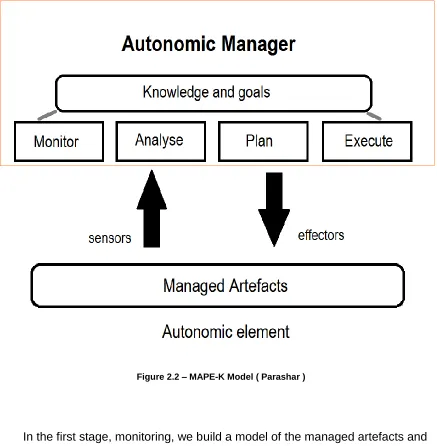
Central to the autonomic computing architecture is the idea of an autonomic
manager and a MAPE-K loop. This is simply a logical architecture, not a mandatory
10
autonomic loops. MAPE-K is an acronym for monitor, analyze, plan, execute, and
knowledge. These are the aspects involved within any autonomic cycle.
Figure 2.2 – MAPE-K Model ( Parashar )
In the first stage, monitoring, we build a model of the managed artefacts and
execution context. Following this, analysis uses the blueprint built by the monitoring to
assess the situation and determine any anomalies (Lalanda 2014).
The planning stage comes after analysis. Its purpose is to figure out a set of
11
lastly, the execution stage carries out plans, dealing directly with the effectors that are
provided through the managed artifacts (Lalanda 2014).
The MAPE-K logical architecture is extremely important in the field of autonomic
computing. It gives a structural framework to begin with when creating an autonomic
system. The architecture is scalable because the activities can be run on different
machines (Lalanda 2014).
2.2.6 Research on Decision-Making Techniques
There is significant research in the area of decision making, in regards to
autonomic computing. A paper by Maggio et al. describes various approaches and
techniques, and outlines five main techniques for them: heuristic solutions, standard
control–based solutions, advanced control-based solutions, model-based machine
learning solutions, and model-free machine learning solutions (Maggio 2011).
Heuristic solutions begin with a guess about application needs, and adjust it.
They are designed for simplicity and performance, and thus sacrifice precision. They
usually cannot be proven to converge to the optimum value. For example, the greedy
approach optimizes resource allocation and energy management in a hosting center
(Maggio 2011).
Standard control-based solutions use canonical models and apply standard
control techniques such as Proportional Integral (PI) controllers, Proportional Integral
and Derivative (PID) controllers, optimal controllers, or Petri nets. Two examples of
these models are discrete-time linear models and discrete event systems. Important
12
Advanced control-based solutions involve complex models (involving some
unknown parameters like machine workload) that may be estimated online, to provide
Adaptive Control (AC). Adaptive Control requires the ability to change controller
parameters in real-time, and an identification mechanism. Another advanced control
strategy is Model Predictive Control (MPC). In MPC the controller selects the next
actions based on the prediction of the future system reactions. Although the overhead of
such solutions is greater than that of standard controls, one may still be able to formally
analyze parameter-varying systems. Thus, one may prove stability and obtain formal
guarantees even in the case of unknown operating conditions. For example, one
real-world example adjusts the CPU percentage dedicated to a web server adaptively
(Maggio 2011).
In model-based machine learning solutions, a framework is required in which to
learn system behavior and adjust tuning points online. Neural Networks (NN) are often
used to build control-oriented nodes. Once trained, NNs may predict the system
reaction to various inputs. It should be noted that the structure of the network and the
training data quality are paramount.
2.3 IBM’s Autonomic Computing Architectural Concepts and Toolkit
In IBM’s 2005 white paper (“An architectural blueprint for autonomic computing”)
a common approach was outlined, along with terminology, to describe a self-managing
13
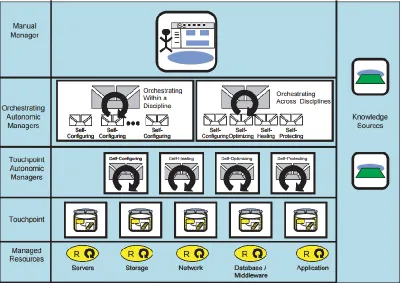
system are connected using enterprise service bus patterns. This enterprise service bus
integrates the various building blocks, which include:
Touchpoints for managed resources
Knowledge Sources
Autonomic Managers
Manual Managers
Figure 2.3 below shows this autonomic computing reference architecture:
Figure 2.3 – Autonomic Computing Reference Architecture ("An architectural blueprint")
IBM’s software framework for Autonomic Computing was released in 2004, and
was called the “Autonomic Computing Toolkit.” It was built in Java, and distributed
14 2.3.1 Key Component Areas
The content of the IBM Autonomic Computing Toolkit can be divided into four
main categories:
Technologies
Tools
Scenarios
Information and documentation
2.3.2 Technologies
System capabilities that utilize the technologies in the Autonomic Computing
Toolkit include common systems administration, problem determination, and solution
installation and deployment.
Problem determination capabilities can be enhanced via the Autonomic
Management Engine (AME), the Generic Log Adapter, the Log and Trace Analyzer, and
Common Base Events. The Integrated Solutions Console is used to create effective
common systems administration capabilities. Finally, the Solution Install technologies
provide capabilities for solution configuration and deployment (Jacob 2004).
2.3.3 Tools
The Autonomic Computing Toolkit also provides the tooling needed to customize
the technologies so that solutions can be created for specific needs. Tools like the
Integrated Solutions Console Toolkit, Resource Model Builder, Adapter Rule Editor, and
15 2.3.4 Scenarios
The Autonomic Computing Toolkit also provides scenarios that show how the
technologies work together, and how they may be used in realistic solutions. The
scenarios are used as testing environments. All scenarios are demonstrated using the
technologies and tools available in the Autonomic Computing Toolkit. There is a
problem determination scenario performing self-healing, as well as two automated
installation scenarios performing self-configuring tasks.
2.3.5 Information and Documentation
The Autonomic Computing Toolkit also has useful material for educating users. It
provides detailed individual technology and tooling documentation, to assist with
developing autonomic solutions (Jacob 2004 ).
2.3.6 Autonomic Computing Toolkit Technologies
The tools and technologies contained in the Autonomic Computing Toolkit are
intended to help product developers create autonomic capabilities in their products. One
example of an implementation of an autonomic manager is provided by the Autonomic
Management Engine (AME). The AME includes built-in representations of the four parts
of the control loop (monitor, analyze, plan, execute).
Developers use several technologies to create touchpoints to enable managed
resources to communicate with autonomic managers. One example of these
technologies is the Generic Log Adapter, which is included in the Toolkit to translate
product log messages into a Common Base Event (CBE) data format. The Common
Base Event is an XML structure which can be consumed by an autonomic manager
16
The Log and Trace Analyzer is then used to process these messages. Afterward,
it analyzes them and presents a view of the log events.
Self-configuration is enabled also, via the Solution Install components of the
Toolkit, while self-management capabilities are enabled via the Integrated Solutions
Console. Administrative console functions vary from run-time monitoring and control to
setup and configuration (Jacob 2004).
Referring again to the MAPE-K figure (Figure 2.2), let us consider how
information is passed to the autonomic manager. In the Autonomic Computing Toolkit
this would be accomplished through the sensor interface. For unsolicited events, a
current resource might generate its own log file. Then the Generic Log Adapter facility
would be utilized to convert log entries to Common Base Events. It is also possible for
an application to create its own Common Base Events directly (Jacob 2004).
The Generic Log Adapter (GLA) is one example of a facility that helps adapt a
product to participate in the autonomic computing architecture. It does this by creating
Common Base Events which can then be consumed by an autonomic manager. For
example, using the GLA we can use a product log file to generate Common Base Event
data. First, a rule-based parser processes a log file, and then the log file is translated
into the Common Base Event format. The Autonomic Computing Toolkit includes the
GLA to help products adapt to the autonomic architecture without having to alter the
way it creates its log files (Jacob 2004).
One single GLA runtime may be used to parse the log files of multiple products,
17
includes a handler that can pass the Common Base Event information to the autonomic
manager (using the effector and sensor interfaces) (Jacob 2004).
In conjunction with the GLA, the Adapter Rule Editor tool is used. This provides
the tooling to create the specific parser rules, which are used by the GLA at runtime to
create CBE objects.
The next MAPE-K component is monitoring. This component can either consume
unsolicited Common Base Events, or can request specific sensor information. The
building blocks for monitoring the IT environment are resource models, which are
leveraged via automated best practices. These resource models contain specific
metrics, thresholds, events, and parameters which are used to gauge the health of IT
resources. They also contain specifications for corrective actions, if failures and error
conditions come up (Jacob 2004).
The Resource Model Builder provides a standard Eclipse-based interface that
provides a wizard to build resource models. This facility uses predefined resource
models to specify which resource data gets accessed from the system at runtime and
how this data is processed. For example, the Process resource model retrieves data
related to running system processes. The resource model automatically collects
performance data, and this gets processed by an algorithm to determine whether or not
the system is performing up to expectations (Jacob 2004).
When a resource model is run (at a managed resource), it gathers data at regular
intervals, known as cycles. A resource model with a cycle time of 100 seconds gathers
18
resources (which are specified in the resource model). The default cycle time of each
supplied resource model can be modified as required.
Furthermore, each resource model has thresholds. A threshold is a named
property of the resource (with a default value that can be modified).
The autonomic manager consists of the monitoring, analysis, plan, and execute
components. The Autonomic Computing Toolkit provides an implementation called the
Autonomic Management Engine. It is intended primarily for testing the components of
the autonomic environment, and is a black-box implementation (Jacob 2004).
AME monitors system resources using resource models. It also sends
aggregated events and performs corrective actions for problems. AME constantly
monitors the system, checking for events to handle.
The Log and Trace Analyzer (LTA) may be considered a partial implementation
of the autonomic manager, covering the monitor and analyze parts of the control loop.
The LTA enables analysis, viewing, and correlation of log files. It therefore makes it
easier to resolve problems within multi-tier systems by consuming data in the Common
Base Event format and providing specialized visualization and analysis of the data
(Jacob 2004).
The LTA contains a log-analysis engine, which provides an algorithm that takes
an incident which is recorded in a log file as an input parameter. Then it matches this
incident based on predefined rules against the symptoms of an available symptom
database, and finally returns an array of objects representing the directives and
19
analysis engine, and a set of instruments which could be used to implement a custom
analysis engine (Jacob 2004).
Rather than using the rules-based parser provided by the GLA, the LTA enables
the writing of Java code-based parsers. Parsers written in Java code are usually used
when the individual log messages are very complex. The Autonomic Computing Toolkit
provides a number of parsers and rules for several existing IBM products (Jacob 2004).
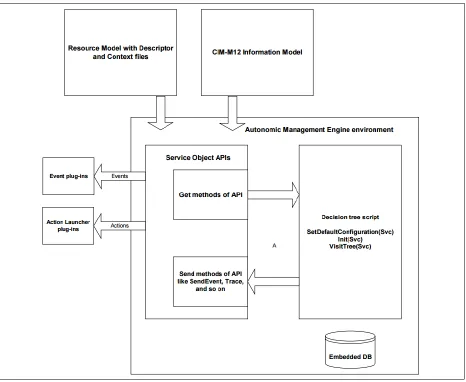
2.3.7 Autonomic Management Engine
The Autonomic Management Engine (AME), illustrated in Figure 2.4 below,
supplies a hosting environment for the resource model decision algorithms. These
autonomic resource models are created using JavaScript. The core decision algorithm
of the resource model is the VisitTree() method which is run by the AME at a given
time cycle defined by the resource model descriptor, which itself is an XML file (Jacob
20
Figure 2.4 - The Autonomic Management Engine Hosting Environment (Jacob)
2.4 CASCADAS ACE
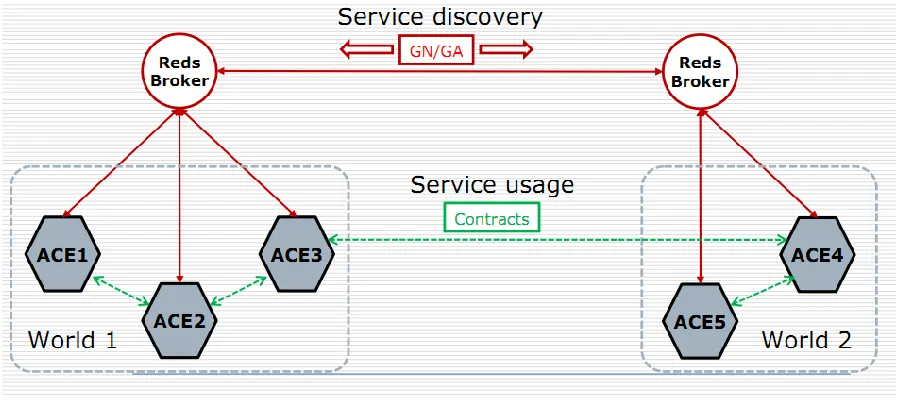
A European consortium picked up where IBM left off, implementing their own
version of an autonomic computing platform. It is called the Component-ware for
Autonomic Situation-aware Communications, and Dynamically Adaptable Services
open-21
source platform used to set up autonomic services in a distributed environment (ACE
Autonomic Toolkit).
2.4.1 The ACE Theoretical Principles
2.4.1.1 Semantic Self-Organization
The Autonomic Communication Element (ACE) framework stores algorithms that
support semantic self-organization of ACEs. These algorithms come in the form of
autonomous clustering, synchronization, and differentiation. The commonality among
all three aggregation methods is that the choice of aggregation partners is influenced by
knowledge (and hence, evaluation) of the context they are operating in ("ACE
Autonomic Toolkit").
2.4.1.2 Clustering
If an ACE detects a discrepancy in its list of required or available functionality
(perhaps because of a change in the local environment due to a surge in demand), then
it starts a “rewiring” procedure. The initiating node’s algorithm can pick one or more of
the first ACE neighbors as match-makers. Also, the constraint on the conservation of
the number of links may be relaxed ("ACE Autonomic Toolkit").
2.4.1.3 Differentiation
The purpose of differentiation is to allow ACEs to decide whether to terminate
themselves (locally) under an inappropriate workload. Thus, resources can be
transferred between applications in a way such that released resources can be
22
– a biological phenomenon which means “the development of form and structure in an
organism during its growth from embryo to adult" (“morphogenesis”).
2.4.1.4 Synchronization
The purpose of synchronization is to find or create partnerships based on the
time activity patterns of the constituent ACEs. The synchronization requires two main
prerequisites:
1. Establishing a collaborative overlay which combines components that feature
activity patterns that are compatible a priori starting from a random bootstrap
configuration
2. Finding ways of adjusting individual time-cycles in order to create opportunities
for collaborating (which would not exist if every individual activity pattern was set
from the beginning).
23 2.4.1.5 Situation Awareness
Situation-awareness denotes the ability of refining decisions according to the
specific contextual situation, and this requires tools and models for analyzing and
organizing pieces of information. There, the ACE Framework defines a Knowledge
Network (KN) service, which is accessible (through aggregation) by ACEs as a
system-wide service. Knowledge Networks process information in order to make a collection of
Knowledge Atoms (KAs). These KAs structure the processed information into a data
model which is built on the basis that any amount of contextual knowledge is created as
a result of an event occurring. Furthermore, a dedicated data model is made to
represent any fact as a 4-tuple of the form (who, what, where, when).
2.4.1.6 Pervasive Supervision
To detect and correct hazard situations, an ACE needs a supervision system.
This is an ongoing system with a Sensor that links the supervision system with the ACE.
Every ACE uses the dedicated supervision organ to export a management interface
through which internal state and session objects can be obtained.
Whenever a new event arrives, the Executor adds the input of each PEX to it.
Processing speeds of individual PEXs may differ, but the whole system is unaffected
because PEXs are independent (run on separate threads and have separate input
queues).
It is important to note that there are two PEX types: a “Normal” PEX, which at
start-up gets a new input queue and a new Execution Session; and a “Child” PEX,
which at start-up will inherit the Execution Session of its parent PEX, and also inherits
24
processes/Plans for each client. Parent and Child share the Execution Session and so
they can synchronize through reading/writing into it.
2.4.1.7 Functionality Repository
The Functionality Repository is the ACE organ which takes care of deploying and
managing functionalities (common and specific functionalities) within the ACE. It also
provides features for calling these functionalities using Events.
The main purpose of the Functionality Repository is to enable common and
specific functionalities to be deployed into the ACE instance. Once deployed into the
ACE they can be accessed through ACE events. Thus the Functionality Repository has
two sides: as a storage facility and as a provider of an accessible interface.
As a storage facility, the Functionality Repository keeps track of the deployed
functionalities, creates and stores instances of the underlying classes, and maintains
call-related variables.
As an accessible interface, it listens to specific ACE events and then interprets
them as calls to the functionalities. The ACE Functionality Repository also follows the
Event-based access model as the ACE organs. Therefore, the input of each invocation
is an internal ACE event (called FunctionalityCallEvents) that is produced by the
Executor when the execution of a transition begins (and is sent directly or through the
Bus). Also, the output of a call is an arbitrary set of events (that may be fixed or varying)
created by the functionality. The Functionality Repository transmits these events to the
25
2.5 Autonomic Computing in Practice
The autonomic computing principles have been applied to many enterprise
software systems. A number of software utility packages are available in the market
today.
2.5.1 DB2
IBM is the main user of Autonomic Computing principles. This is exemplified in
the enterprise database suite, DB2. DB2 version 9 has a number of autonomic features
that are designed to make database administration almost effortless, such as:
self-tuning memory management
auto-configuration enabled by default
automatic database maintenance
automatic storage management
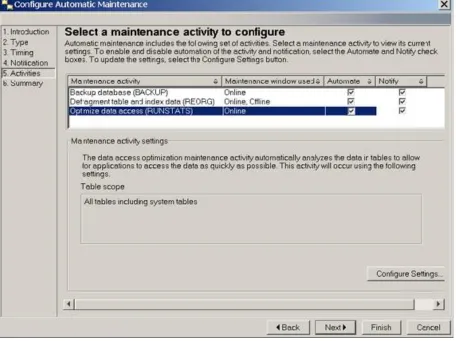
Figure 2.6 below shows a screenshot of the automatic maintenance feature: 1
26
Figure 2.6 –Configuring Automatic Maintenance in DB2 (screenshot)
DB2 9 utilizes a feature called self tuning memory manager (STMM), which is
shown below in Figure 2.7. This feature eases the task of memory configuration (often a
burden on database administrators). It does this by automatically setting optimal values
for most of the memory configuration parameters, including package cache, buffer
pools, locking memory, sort heap, and the total database shared memory.2
27
Figure 2.7 - The Self-Tuning Memory Manager (Saraswatipura)
2.5.2 Oracle
In Oracle SQL versions 11g and up, there are a number of tools that can aid in
implementing an autonomic system. One example is using REDO logs, which are binary
files that store change vectors. The changes are written to the redo logs in a circular
28
that as the instance switches from one redo log to another, the previous log is written
out to an archive log file.
The following is an example of how we can use Oracle’s memory management
functions:
ALTER SYSTEM SET log_archive_dest_1='LOCATION=[/LOCATION]'
SCOPE=both;
If we want to simulate a series of log switches, we may use the following
command several times:
ALTER SYSTEM SWITCH LOGFILE;
In general, Oracle Database provides a built-in infrastructure for defining
maintenance activities. There is powerful scheduling functionality introduced with Oracle
Database 11g Schedule to run tasks such as the following:
gathering optimizer statistics in order to update the system catalog with
information on the data in indexes and tables
creating statistical profiles for optimal statistics collection (based on table
analysis and query feedback)
Performing database backups
Reorganizing fragmented tables
By default the maintenance window begins at 10:00 PM every night, and lasts
until 6:00 AM the next morning and throughout the weekend. All the maintenance
29
This allows it to adapt to specific scheduling needs. The tasks of automated optimizer
statistics collections, automatic SQL tuning, and reorganizing fragmented tables are all
built into Oracle Database 11g and run periodically.
Oracle - Resource Control
One powerful aspect of running a task in a maintenance window is the ability to
control the system resources and limit resource use in favor of more business-critical
activities. By using bandwidth quotas, the Oracle Resource Manager optimizes resource
utilization globally and allows maintenance tasks to use the available resources without
affecting higher priority activities.
Oracle - Space Reorganization
Tables in a database become fragmented, and therefore reorganization tasks are
run to increase object access performance and optimize space usage. Oracle 11g is
capable of scheduling reorganization jobs online. Also, it provides a set of options like
moving tables, adding/dropping partitions, changing structures, etc.
Oracle - Automation of SQL Tuning
Oracle provides a SQL Tuning Advisor, which analyzes problematic SQL
statements and makes specific recommendations to tune it. The core of this technology
is the Automatic Tuning Optimizer (ATO). ATO is an improved version of Oracle's query
optimizer that runs the actual analyses on behalf of the SQL Tuning Advisor. It uses
dynamic sampling and partial execution methods to verify its own estimates of
selectivity, cost, and cardinality. It also uses the past execution history of the SQL
statement in order to determine optimal settings for the optimizer. Recommendations
generated by the ATO include creation of new indexes, updating of optimizer statistics,
30
object in Oracle 11g offering a way to tune SQL statements). Then it collects information
on predicate selectivity, skews, and data correlations for the specific SQL statement.
These are then used by the query optimizer to produce an ideal execution plan
(“Oracle" 10).
Table 2 - Oracle Database’s AC Abilities
Self-Configuring Self-Healing Self-Optimizing Self-Protecting
Resource Control
Space Reorganization
n/a ATO n/a
2.5.3 Monit
Monit is a utility available on UNIX systems, which is used to manage and
monitor the operating system. It is an open source program.
Monit can exhibit proactive capabilities. For example, if sendmail is not running,
Monit can restart sendmail automatically. Also, if Apache is using excessive resources
then Monit can stop/restart Apache, and send the user an alert. Monit also can monitor
specific process characteristics (i.e. how much memory a process is using, CPU usage,
and Load Average).3
31
Monit is also used to monitor files, directories, and file systems on localhost.
This is useful for checking issues such as timestamp changes, size changes, or
checksum changes. Security issues can also be monitored – you can check that md5 or
sha1 checksum of files do not change.
Below in Figure 2.8 is a graph generated by Monit, which shows CPU and
memory usage, along with other information :
Figure 2.8 - Monit ("Danschultzer/monit-graph")
Table 3 - Monit’s AC Abilities
Self-Configuring Self-Healing Self-Optimizing Self-Protecting
32 2.5.4 MapReduce
MapReduce has gained huge popularity, mainly due to its adoption by Google.4
MapReduce borrows from the autonomic computing genre in that it utilizes distributed
computing. MapReduce is used to process and generate large data sets, via a
distributed and parallel algorithm on a cluster.5
MapReduce is useful in a large range of applications, including distributed
sorting, distributed pattern-based searching, web link-graph reversal, Singular Value
Decomposition, web access log stats, inverted index construction, machine learning,
document clustering, and statistical machine translation. Furthermore, the MapReduce
model has been ported to several computing environments such as multi-core and
many-core systems, desktop grids, volunteer computing environments, mobile
environments, and dynamic cloud environments.
Google, for example, used MapReduce to completely regenerate its index of the
Internet. This replaced old ad hoc programs that updated the index and ran analyses.
A distributed file system is used to store stable inputs and outputs for
MapReduce. The transient data is stored on local disk, and fetched by the reducers.
33
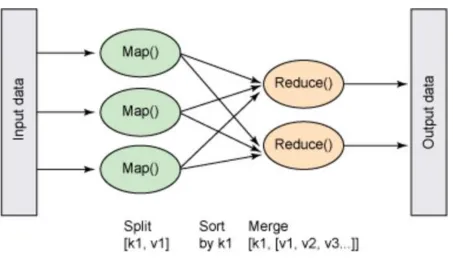
In Figure 2.9 below is a high-level diagram of MapReduce, which is an algorithm
used to divide a computation among many computers for parallel processing:
Table 4 - MapReduce AC Abilities
Self-Configuring Self-Healing Self-Optimizing Self-Protecting
Applicable n/a Applicable n/a
34 2.7.5 Watchdog Scripts
One way that programmers often implement failsafe abilities is via "watchdog
scripts." A watchdog script is simply a system script that is triggered after a specific
action on the program being monitored. The following is a simple example of a Windows
watchdog script, which utilizes a Windows batch file:
A watchdog script is especially useful for system administrators, who often need
to keep track of runaway processes. These scripts are popular in Unix and Linux system
administration.
2.7.6 Apache Commons Daemon
One way autonomic computing behavior can be implemented using Java is to
use an Apache utility called Daemon.6
Apache Daemon has two parts: a native library written in C which interfaces with
the operating system, and the library that provides the Daemon API (written in Java). 7
6 http://stackoverflow.com/a/30020831/763029
35
Depending on which operating system we are using, an application can be run either as
a service (Windows) or a daemon (Linux). On Windows, we may use ProcRun.exe to
run the Java application as a service. And on Unix, we may use JSvc for running the
Java application.
Table 5 - Apache Common’s AC Abilities
Self-Configuring Self-Healing Self-Optimizing Self-Protecting
n/a Applicable through
ProcRun.exe on
Windows, or JSvc
on Unix
n/a n/a
2.7.7 daemontools
Specific to the UNIX operating system, there is a very useful utility called
daemontools. This is a collection of tools for managing UNIX services, and among them
there is a program called supervise. supervise starts and monitors a service. It is
run as follows:
supervise s
When run, it switches to the directory named s and starts ./run. It restarts
./run if ./run exists, and also maintains status information (in a binary format) inside
the directory s/supervise (which must be writable to supervise). This status
36
information can be read by svstat. To check whether supervise is running
successfully, one may use the svok tool.8
2.8 Code Adaptation
At the heart of autonomic computing is the concept of software adaptation.
Self-management cannot be achieved without the ability to modify the behavior and structure
of a system. Software adaptation requires changing low-level code, which is often
intricate and complicated. Side effects could be unforeseen. Since the code that is to be
modified has been run, the computation state has to be preserved. Software adaptation
can be achieved either at the operating system levels or at the specific programming
levels (Lalanda 2014).
2.8.1 Operating System-Level Adaptation
Figure 2.11 below demonstrates an OS-Level Autonomic Manager:
37
Figure 2.11 – OS-Level Autonomic Manager (Parashar)
Dynamic adaptation at the operating system level is not intrusive because the
internals of the programs are not changed. They change the resources and services
provided by the operating system.
Much research has been conducted in order to allow the dynamic integration of
services and resources. For example, most operating systems are capable of
integrating new resources in real-time without interruption of services. This is the case
of the Universal Plug and Play (UPnP) standard, originally developed by Microsoft
38
Operating systems allow the dynamic deployment of new services. Deployment
includes activities such as installation, activation, and deactivation. On Linux and many
Unix systems, in order to install a new shell command one simply copies the executable
(binary file/script) into the ‘/bin’ directory. The service is "launched" afterward by typing
its name, and it then becomes available to the OS computing environment. In a sense,
operating systems have an infrastructure that appears autonomic, in order to
dynamically adapt software systems. But new code is not finely integrated into the
existing code. Rather, it is packaged and deployed as a stand-alone service in the OS
file. Some running code can then call this new service (Lalanda 2014).
In spite of the aforementioned ability to dynamically integrated new code, building
a dynamic application on top of an OS is very complex. It is often based on ad hoc
mechanisms set up by the application itself. The example of the shell command that we
mentioned above is based on the introspection of directories specified in a global
environment variable. Also, it is difficult to create an infrastructure for the interception
and redirection of messages that are exchanged between two internal structures of the
application code. Thus, OS-based techniques remain impractical due to excessive
complexity (Lalanda 2014).
2.8.2 Application Program-Level Adaptation
Dynamic adaptation is at the core of many programming languages, and a
number of techniques have been applied to allow code evolution at runtime. Dynamic
linking is one of them. In the Smalltalk programming language, code is dynamically
39
dynamic. In the Erlang language developers can dynamically load new code and
explicitly manage code replacement (Lalanda 2014).
These are powerful techniques which can be used by autonomic managers to
bring about dynamic code adaptation. However, these techniques are very hard to
master and control. Excessive use of programming-level techniques results in buggy
code, which is very hard to test and maintain. Programming-level techniques have a
strong impact on the code itself. For instance, in order to dynamically load C libraries,
extension points (variation points) need to be introduced. This results in complex code.
Variation points cannot be introduced everywhere in the code because it quickly
becomes unmaintainable (Lalanda 2014).
The C modules that can be linked dynamically are packaged into specific
libraries. The implementation of these libraries depends on the OS. These specific
libraries are called shared libraries (.so) in Linux and dynamic-link libraries (.dll) in
Windows. For example, the following code shows how to load a library with the
dlopen() function, how to get a shared library symbol address, and finally how to
unload the shared library with the dlclose() function:
void *handle;
int *iptr, (*fptr)(int);
/* loading expected library */
handle = dlopen(“/usr/home/me/mylib.so”, RTLD_LOCAL | RTLD_LAZY);
/* Getting the address << my_function >> and << my_data >> */ *(void **)(&fptr) = dlsym(handle, “my_function”);
iptr = (int *)dlsym(handle, “my_data”);
40
Dynamism in C is unwieldy and complex. Furthermore, C has little supporting
mechanisms that limit programming errors. Dynamic libraries get loaded with no
verification about the correctness of the new code, such as a typing system. Issues like
dangling pointers can arise freely, as there is no preventive verification when a module
is unloaded (Lalanda 2014).
2.8.3 Program-Level Adaptation in Light of the Java Language
In Java, source code is always transformed into byte code to be executed by a
virtual machine. A virtual machine is an abstraction layer that isolates applications from
computer specifics (operating system, physical hardware architecture). This abstraction
layer can minimize the effort involved in porting software between different systems
(Lalanda 2014).
In Java there is no static linking. Loading a class is performed on demand when
the class is needed for execution. The action of loading classes in a virtual machine at
runtime is done by a specific entity called a class loader. The job of the class loader is
to resolve external references. To do this it needs to locate libraries that contain the
appropriate classes in the system resources, and then load them into the virtual
machine. Many class loaders can be used in the same virtual machine, and their use is
based on the following rules:
Every class loader (except the initial one, called a bootstrap) has a parent
Each class loader delegates the task of class loading to its parent before doing
41
By default, a Java virtual machine has three hierarchical class loaders:
The initial class loader whose job is to load standard Java classes (rt.jar)
The extension class loader which loads classes of the extension directory
(jre/lib/ext)
The application class loader, which loads archives defined by the CLASSPATH
More class loaders may be added to load specific aspects in a systematic way,
and each class loader will then have its own name scope. This allows the loading of
two implementations of the same class as long as they are loaded by two different class
loaders. Therefore, two versions of a class may be used by different parts of a system,
which provides flexibility. In addition, backtracking to an earlier state is made possible.
However, the class loader concept is not easy for programmers to master. This results
in buggy situations where unexpected classes are used in a program (Lalanda 2014).
Unlike the C approach, verification is done before loading a Java library. Type
system compatibility is checked. The following example code shows how to dynamically
load a Java class:
Class type = ClassLoader.getSystemClassLoader().loadClass(name); Class type = this.getClass().getClassLoader().loadClass(name); Object obj = type.newInstance();
Dynamic code loading is an essential feature that allows the introduction of new
code in the scope (namespace) of some code already running without interruption. But
42
when one wants to replace a class. However, a class loader cannot unload a class.
Unloading a class needs unloading the class loader itself.
In this case, it is necessary to be able to deploy, load, and instantiate the new
structure. Finally, the structure to be replaced is then required to vanish. It has been
unloaded from the virtual memory, with clients of the old structure being rerouted into
the new one (Lalanda 2014).
2.9 Autonomic Computing and its Relation to Service-Oriented Architecture (SOA)
Service-Oriented Architecture provides an architectural framework where
software components communicate with other components using an agreed-upon
protocol. It provides an easy way to build up complex applications from many different
sources. SOA may also be used to implement AC features.
2.9.1 Service-Oriented Architecture
Many data centers, including Google and eBay, organize their systems using
Service Oriented Architecture (SOA). A collection of servers, applications, and data at a
site is called a farm, while a collection of farms is termed a geoplex.
A service is either cloned or partitioned. Cloning means that the data is copied
onto a collection of nodes. Each node can provide its own storage (inefficient if many
nodes) or it may use a shared disk or disk array. The collection of clones is called a
Reliable Array of Cloned Services, or RACS. We may then partition the data among a
43
then form a pack. The set of nodes that provide a packed-partitioned service is called a
Reliable Array of Partitioned Services (or RAPS).
Figure 2.12 - RACS and RAPS architectures (Parashar)
A RAPS is functionally superior to a RACS, but a RACS is easier to build and
maintain. Therefore, many data centers try to maximize the use of the RACS design.
RACS are good for read-only, stateless services (often found at the front end of a data
center), while RAPS are better for update-heavy states (as found in storage back-end).
Figure 2.12 above illustrates both architectures.
Most data centers apply SOA principles. All these systems have developed in an
organic way, beginning with a few machines in a single room. The configuration and
44
need to be resolved within seconds. Thus, automation is a highly desired quality (van
Renesse 2007).
In modern SOA technology, each service has its own management console.
However, the deployed services depend on one another. If one service is problematic, it
may be due to a failure in another service. Therefore, obtaining a global view and
quickly finding the source of the problem is necessary. When each service supports for
self-management and self-configuration, a global diagnosis could be possible (van
Renesse 2007).
A Scalable Monitoring and Control Infrastructure (SMCI) can be used to solve
these problems. It can monitor arbitrary sensor data available in the system, and has a
global presence. Following this, the SMCI can give a global view by installing an
appropriate aggregation query. Not only is this useful to a system administrator, but
such data can also be fed back into the system to automate the control of resource
allocation or even drive actuators (rendering the system managing and
self-configuring) (van Renesse 2007).
2.9.2 Autonomic Multimodal Interaction Model Utilizing Service-Oriented Architecture in a Pervasive Environment
There is a wealth of research on the SOA-approach to autonomic computing for
pervasive systems. One approach is described by Avouac et al (Avouac 2011).
Pervasive computing systems typically consist of multiple devices and software
entities that may interact with each other. Many types of devices can be made available
for different purposes – interacting with the real environment, providing display and
45
The challenge of pervasive computing lies in providing coherent pervasive
environments. These environments offer useful applications and services in a
heterogeneous setting with varied and distributed dynamic devices and software
services, that communicate via various protocols (Avouac 2011).
Advances in SOA have improved the outlook of pervasive computing. Many
smart devices today are exposed as services, and their capabilities are described and
dynamically published by service providers, and are chosen and called by service
consumers at runtime (Avouac 2011).
SOA allows ample flexibility in operations and functions which results in powerful
solutions that are hard to manage. To meet the challenges in management a “Dynamic
Multimodality” software framework is proposed. In this framework the whole multimodal
processing system is generated and maintained at runtime by an autonomous manager.
The processing system is modular and is made of service-oriented components. This
framework is shown below in Figure 2.13:
46
The purpose is to clearly separate the multimodal processes, the input interaction
devices (which are volatile and may leave/join the environment), and the applications
that may appear and disappear dynamically (Avouac 2011).
2.9.3 Service Configuration and Composition Design Pattern for Autonomic Computing Systems
Mannava and Ramesh (Mannava and Ramesh, 2012 B) proposed a software
architecture, which uses a service configuration and composition design pattern for the
dynamic configuration and composition of communication services. It does this by
satisfying the self-configuration and self-composition characteristics of autonomic
computing systems, which software designers and/or programmers can utilize to drive
their work (Mannava 2012).
The aforementioned architecture is divided into four modules: the monitoring
module, the decision-making module, and the Self-Optimization and Self-Configuration
modules (Mannava 2012).
There are a number of design patterns used in this architecture. The following is
a list of these design patterns :
Observer: A One-to-Many dependency between objects, so that when an object
changes state, all of its dependents will be notified
Cased based reasoning: this design pattern separates the decision-making
47
Row Data Gateway: Borrowing from database theory, enfold the data structures
and their database access code within row data gateways whose internal
structure models a database record (which offers a representation-independent
data access interface to clients)
Adaptation Detector: Interpret monitoring data and decide when an adaptation
is required
Event Notifier: Enable components to react to the occurrence of particular
events in other components without knowledge of each other (while allowing
dynamic participation of components and introduction of new events)
Strategy: Family of encapsulated algorithms that can be interchanged. Strategy
allows the algorithm to vary based on the client
Master-Slave: used when implementing an encapsulated implementation. We
may need to provide fault tolerance, increased performance, or result accuracy
for a component implementation
Thread per connection: a single thread is created for each process. This design
pattern is usually used for the client-server model
Server reconfiguration: This pattern is used to reconfigure an application
structured as a server-client architecture. Components can be removed from the
server architecture through the Component Removal Pattern.
In real software systems, pattern composition has been known to be a challenge
to applying design patterns. The authors, Mannava et al, utilized a number of design
patterns including web services, which is defined based on three roles: service provider,