Abstract
Objective:We intended to determine the reliability of a brief life satisfaction scale in a sample of patients with chronic diseases, and to analyze its external validity. Methods: Reliability and factor analysis of the 8-item `Brief Multidimensional Life Satisfaction Scale’ (BMLSS) were performed according to standard proce-dures. The test sample contained 979 individuals (mean age 54 ± 11 years). Forty-two percent had cancer, 22% chronic pain conditions, 10% depressive disorders, 6% other chronic diseases, and 20% were healthy.
Results: Reliability analysis of the 8-item pool revealed a good internal consistency coefficient (Cronbach´s al-pha = .869), and a single-factor structure which ex-plains 53% of variance. The BMLSS sum scores signif-icantly differed with respect to the underlying disease, family status, duration of disease, and age. The highest scores were found in healthy individuals, and the low-est in patients with chronic pain conditions and de-pressive disorders. In cancer patients, the BMLSS cor-related negatively with Depression/Anxiety (HADS), Fatigue (CFS-D), and positively with SF-12´s mental health and to a weaker content also with physical health. Stepwise regression analyses revealed that life satisfaction can be predicted best by (the absence of) depression, but also by Conscious Living (AKU), which is an active cognitive-behavioral style in terms of adaptive coping.
Conclusions: The evaluation of the BMLSS revealed that the instrument has good psychometric properties and can be regarded as a brief, reliable and valid mea-sure of LS in patients with chronic diseases. The in-strument can be an important additive to existing health-related quality of life questionnaires, since it captures dimensions that contribute to quality of life but are not health related.
Key words: Life satisfaction, questionnaire, chronic dis-eases, patients
B
ACKGROUNDOne area of psychology analyzes subjective well-be-ing, people's cognitive and affective evaluation of their lives. This includes what one calls happiness, peace, fulfillment, and life satisfaction (LS) [1]. Although per-sonality can explain a significant amount of variability in subjective-well-being, not only personal dispositions
but also life circumstances influence long-term levels of subjective well-being, e.g., LS [1]. This unique di-mension can be seen in the context of the conceptual-izations of quality of life. Ferrans [2] differentiated five broad categories of quality of life, i.e., social utili-ty, happiness/affect, normal life, achievement of per-sonal goals, and satisfaction. LS is influenced by indi-viduals' perception of certain aspects of life important to them, which may vary with respect to their impor-tance between the individuals. These aspects can be re-garded as external factors with an impact on quality of life, and thus can be considered as determinants [3].
To define the term `satisfaction´, one may argue that satisfaction is the extent of an individual´s experience compared with his expectations. In terms of `patients´ satisfaction´, this facet refers to medical care and ser-vice quality (which may impact health-related behav-ior), more specifically, to the extent to which general health care needs and condition-specific needs are met [4]. But `life satisfaction´ refers to a much broader con-cept. Even patients with impaired perception of health status, which may have more social needs, can have high satisfaction with various dimensions of life con-cerns. While it is true that patients with chronic disease may experience decreased quality of life and LS, it is not necessarily true for all individuals. Specifically, there is an increasing evidence that cancer patients not only experience traumatic stress, but in several cases also personal growth (reviewed in [5]). Moreover, in HIV infected individuals one may observe an increase of religiousness/spirituality which may predict slower disease progression [6]. While several patients may ex-perience posttraumatic growth, mostly in the domain of appreciation of life, it was nevertheless not related to the level of psychological distress [7].
In six European countries, Borg et al. [8] investigat-ed the relationship of LS to health, self-esteem, as well as social and financial resources among elderly with re-duced functional capacity. In all national samples, overall health, self-esteem, and feeling worried, rather than activities of daily living capacity, were significant-ly associated with LS as measured with Life Satisfac-tion Index Z scale [8]. The findings indicate the im-portance of taking not only the reduction in function-al capacity into account but function-also the individufunction-al's per-ception of health and self-esteem. Personal rather than environmental factors are important for LS among people with reduced daily living capacity.
Eur J Med Res (2009) 14: 171-177 © I. Holzapfel Publishers 2009
V
ALIDATION OF THE
B
RIEF
M
ULTIDIMENSIONAL
L
IFE
S
ATISFACTION
S
CALE IN
P
ATIENTS WITH
C
HRONIC
D
ISEASES
A. Büssing1, J. Fischer1, A. Haller1, P. Heusser2, T. Ostermann1, P. F. Matthiessen1 1Chair of Medical Theory and Complementary Medicine, Faculty of Medicine, University of Witten/Herdecke, Germany
On the basis of the `2005 Behavioral Risk Factor Surveillance System´, an ongoing, state-based, random-digit telephone survey, 6% of US adults were dissatis-fied with their lives [9]. As the level of LS decreased, the prevalence of fair/poor general health, disability, and infrequent social support increased as did the mean number of days within one month of physical distress, mental distress, activity limitation, depressive symptoms, anxiety symptoms, sleep insufficiency, and pain; also the prevalence of smoking, obesity, physical inactivity, and heavy drinking increased with decreasing level of LS [9]. Moreover, adults with chronic illnesses were significantly more likely than those without to re-port life dissatisfaction [9]. Notably, all of these associ-ations remained significant after adjusting for socio-de-mographic characteristics. Findings of Strine et al. [9] showed that health-related quality of life and health risk behaviors varied with the level of LS.
In most cases of chronic illness, there is no option of healing in terms of full physical and psychical restoration. However, although the `medical model´ refers to an optimal level of functioning, patients should not be reduced on their defects or illness-relat-ed deficiencies, instead one should bring forward con-comitantly their potential for life and development. Thus, one has to ask for the underlying aspects of LS, which is of outstanding importance not just because patients with high satisfaction may be more active in their own health care, but also to identify specific (ex-istential) needs which may impact the health-related needs and quality of life.
As LS appears to encompass many individual life domains, it may be an important concept for public health research. In fact, chronic illness affects not only physical and mental functioning, but also the working abilities, employment, and financial situation; and final-ly may have an impact on famifinal-ly life, friendships etc. Living with chronic disease and suffering obviously af-fects various aspects of life concerns. Consequently, it is of outstanding importance to improve physical and mental health conditions, and health-related quality of life. But the patients should not be reduced to their functional competence, i.e., physical symptoms and de-ficiencies, and thus one has to ask for the putative pos-itive fields of life dimensions such as family life, friendships, living location, work, financial situation, generally oneself and overall life, and future perspec-tives. Several other variables may be important too. For example, several patients with chronic diseases, partic-ularly patients with cancer, highly value spirituali-ty/religiosity as a resource to deal with illness [10-14]. Also dimensions such as finding meaning and purpose in life are important issues [15], and how patients inter-pret their illness [16-18]. Recently, we were able to veri-fy that perceptions of illness in terms of the positive disease interpretations `challenge´ and `value´ are cor-related with adaptive coping strategies, while negative interpretations such as `interruption/loss´ and `ene-my/threat´ were associated with depression and anxi-ety, and inversely with mental health-related quality of life and LS [16].
Melendez et al. found evidence of significant posi-tive relations between psychological well-being dimen-sions and LS and between physical conditions and LS
as well [19]. A structural model gave valuable informa-tion about the pattern of multivariate relainforma-tionships among the variables. Physical and psychological being had a large effect on LS, albeit psychological well-being was the major predictor of LS [19]; a second re-sult was that the influence of socio-demographic vari-ables on LS were low, and they operated through the ef-fects that maintain either on psychological well-being (or its individual indicators) or on physical conditions.
Because LS captures dimensions that contribute to quality of life, we intended to design a brief add-on scale to existing health-related quality of life question-naires and referred to the work of Huebner and co-workers [20, 21]. This group has developed the `Brief Multidimensional Students' Life Satisfaction Scale´, which refers to the much longer `Student's Life Satis-faction Scale (SLSS)´. This longer scale, which was de-signed to measure students´ life satisfaction, demon-strated acceptable internal consistency and a uni-di-mensional factor structure. In contrast to Diener´s 5-item `Satisfaction with Life Scale´ [22] with its very general domains, the `Brief Multidimensional Stu-dents' Life Satisfaction Scale´ addresses circumscribed aspects of students´ life. However, to address certain aspects of life important to patients with chronic dis-eases, we intended (1) to determine the reliability of a modified LS scale, the `Brief Multidimensional Life Satisfaction Scale´ (BMLSS), in a sample of patients with chronic diseases (and some healthy individuals), and (2) to analyze the external validity of this instru-ment in terms of adaptive coping, mood, and health-related quality of life.
M
ETHODSPARTICIPANTS
For this multicenter cross-sectional anonymous survey we analyzed the data of 979 individuals from already existing data pools of the hospitals mentioned below. Their institutional heads gave approval to run this anonymous survey. All subjects were informed of the purpose of the investigation, were assured of confi-dentiality, gave informed consent to participate, and completed the German language questionnaire by themselves which neither asked for names, initials, ad-dresses or clinical details (with the exception of a diag-nosis). The questionnaires were anonymous (and in accordance with similar instruments approved by the ethical commission of the University Witten/ Herdecke for current studies), and the pooled data could not be tracked back to the individual patients.
Because we intended to have a more complete picture, we had neither inclusion nor exclusion criteria (with the exception of children and adolescents). The patients from the psychotherapeutic Oberberg Clinics were at the moment of recruitment no active substance abusers.
DEMOGRAPHICCHARACTERISTICS
The individuals (75% women) had a mean age of 54 ± 11 years. Thirteen percent were <40 years of age (just 4 were < 20 years of age), 24% between 41-50 years, 34% between 51-60 years, 25% between 61-70 years, and 4% >70 years. Most subjects were married (63%) or lived with a partner not married with (8%), 11% lived alone, 10% were divorced, and 7% were wid-owed. A Christian affiliation was predominant (75%), 3% had other religious affiliations and 22% had none. Twenty-nine percent had a secondary education (Hauptschule), 20% a junior high school education (Realschule), 41% a high school education (Gymnasi-um), 9% other, and <1% none.
Forty-two % had cancer, 22% chronic pain condi-tions (among them, 20% fibromyalgia, 17% spine-as-sociated pain syndromes such as chronic back pain etc., 8% limp amputations and phantom pain, 6% poly-arthritis, 4% migraine/headache, and various other chronic pain conditions), 10% depressive disorders with/without alcohol addiction, 6% other chronic dis-eases, and 20% healthy individuals.
MEASURES ANDSTATISTICALANALYSIS
The items of the LS scale were derived from the 6-item `Brief Multidimensional Students' Life Satisfac-tion Scale´ [20,21] and from physicians input, i.e., Fam-ily Life; Friendships; Work (replaced the item School); Myself; Where I live; Overall Life; and two new items, i.e., Financial Situation and Future Prospects.
The eight items of the BMLSS (Table 1) refer to in-trinsic dimensions (Myself, Overall Life), social dimen-sions (Friendships, Family life), external dimension (Work, Where I live), and the perspective dimension (Financial Situation, Future Prospects). Items referring to the health situation were intentionally not included and should be measured with a specific health-related quality of life tool. (However, BMLSS Version 2 heeds three additional items, i.e. health situation, effectiveness of treatment, and own abilities to deal with daily life.)
Each item was introduced by the phrase: “I would describe my satisfaction with …”, and scored on a 7-point scale from dissatisfaction to satisfaction (0 - Ter-rible; 1 - Unhappy; 2 - Mostly dissatisfied; 3 - Mixed (about equally satisfied and dissatisfied); 4 - Mostly satisfied; 5 – Pleased; 6 - Delighted). The BMLSS sum score was referred to a 100% level ("Delighted").
Data were treated as ordinal data. The reliability of the scale was evaluated with internal consistency coef-ficients, which reflect the degree to which all items on a particular scale measure a single (uni-dimensional) concept. To combine several items with similar con-tent, we relied on the technique of factor analysis (ex-traction of main components with Eigenvalues > 1), which examines the correlations among a set of vari-ables in order to achieve a set of more general `fac-tors´. Factor analyses were repeated rotating different numbers of items (Varimax rotation with Kaiser Nor-malization) in order to arrive at a solution embodying both the simplest structure and the most coherent one. To analyze the external validity, the BMLSS scale was correlated with the Hospital Anxiety and Depression Scale (HADS [21, 23]); Escape from illness, an add-on scale of the AKU questionnaire [13, 24]; the Cancer Fa-tigue Scale (CFS-D [25]); and physical and mental health-related quality of life as measured with the Med-ical Outcomes Study Short-Form Health Survey SF-12 [26,27]. Adaptive coping styles were measured with the AKU questionnaire (AKU is an acronym of the Ger-man translation of “Adaptive Coping with Disease”) [13, 28, 29], which refers to the concept of an internal respectively an external locus of disease control. The instrument differentiates 6 factors (i.e., Conscious Way of Living; Positive Attitudes; Reappraisal: Illness as Chance; Trust in Medial Help; Search for Information and Alternative Help; Trust in God´s Help).
Reliability and factor analyses, analyses of variance (ANOVA), correlation (Spearman rho) and stepwise regression analyses were performed with SPSS 15.0 for Windows (SPSS GmbH Software, Munich). We consid-ered a level of p < 0.05 as statistically significant.
R
ESULTSRELIABILITY ANDFACTORANALYSIS
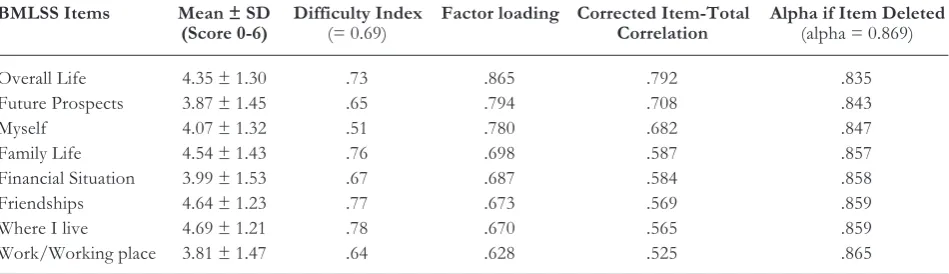
As shown in Table 1, reliability analysis of the 8-item pool revealed that the construct had a good internal
Table 1.Mean values and reliability parameters. One component extracted (Eigenvalue 4.2): 53% of explained variance.
BMLSS Items Mean ± SD Difficulty Index Factor loading Corrected Item-Total Alpha if Item Deleted
(Score 0-6) (= 0.69) Correlation (alpha = 0.869)
Overall Life 4.35 ± 1.30 .73 .865 .792 .835
Future Prospects 3.87 ± 1.45 .65 .794 .708 .843
Myself 4.07 ± 1.32 .51 .780 .682 .847
Family Life 4.54 ± 1.43 .76 .698 .587 .857
Financial Situation 3.99 ± 1.53 .67 .687 .584 .858
Friendships 4.64 ± 1.23 .77 .673 .569 .859
Where I live 4.69 ± 1.21 .78 .670 .565 .859
consistency (Cronbach´s alpha = 0.869). The item dif-ficulty (4.12 [mean value] / 6) was 0.69, and none of the items exceeded the acceptable range of 0.2 to 0.8.
Factor analysis revealed a Kaiser-Mayer-Olkin value of .887, which as a measure for the degree of com-mon variance, indicates that the item-pool seems to be suitable for a factorial validation. Primary factor analy-sis pointed to a 1-factor solution (initial Eigenvalue = 4.2), which explains 53.1% of variance (Table 1). The more general item Overall Life had the strongest fac-tor loading, the item Work the lowest. The mean scores of the 8 items ranged from 3.81 (“mostly satis-fied”) to 4.69 (“pleased”), i.e., the lowest scores were found for Work and Future Prospects, and the highest for Where I live and Friendships (Table 1). The vari-ous LS dimensions correlated strongly with Overall Life (Table 2), particularly the items Myself (r = 0.69) and Future Prospects (r = 0.66), indicating that Over-all Live is a broad and general dimension.
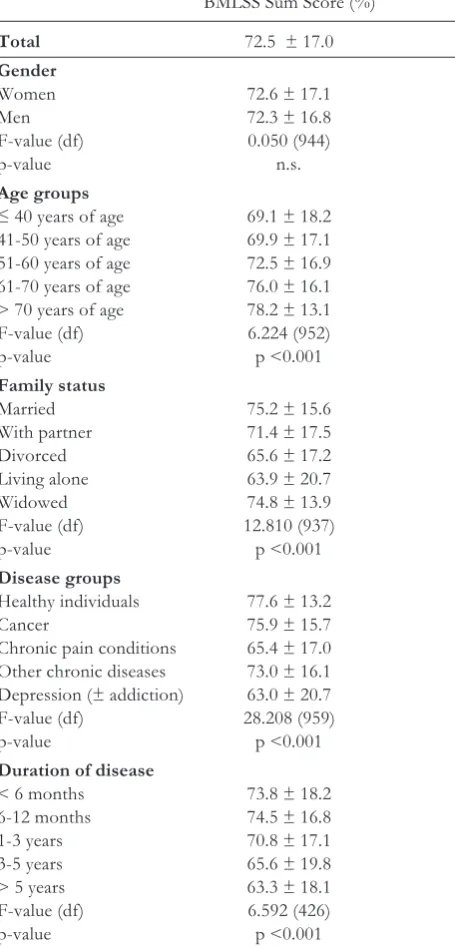
IMPACT OFSOCIO-DEMOGRAPHICVARIABLES As shown in Table 3, the BMLSS sum scores signifi-cantly differed with respect to the underlying disease (F = 28.208), family status (F = 12.810), duration of disease (F = 6.592), and age (F = 6.224), but not for gender (F = 0.050; n.s.) or religious denomination (F = 2.258; n.s.). We observed higher LS score also in in-dividuals with a higher educational level (F = 3.103; df = 942; p = 0.015); but because the healthy individuals almost had the highest educational level, this variable should not be overinterpreted.
In general, the highest LS scores were found in healthy individuals, and the lowest in patients with chronic pain conditions and depressive disorders (Table 3). Moreover, individuals with higher age, those who were married or widowed, and patients with a shorter course of disease had better BMLSS scores than individuals of younger age (< 50 years of age), longer course of disease (> 3 years), and those di-vorced or living alone. Thus, from a theoretical point of view, these differences are plausible.
Among the patients, those with cancer had the highest LS scores. However, Escape from illness was the lowest in cancer patients as compared to other pa-tients; the highest scores were found in patients with chronic pain conditions (F = 37.953; df = 731; p <0.001).
Table 2.Correlation analyses between life satisfaction dimensions. All variables were significant at the 0.01 level (Pearson Cor-relation; 2-tailed). Strong correlations were highlighted.
Family Friend- Work Myself Where Overall Financial Future
Life ships I live live Situation Prospects
Family Life 1 ,493 ,306 ,493 ,411 ,608 ,350 ,492
Friendships 1 ,391 ,460 ,420 ,509 ,303 ,389
Work 1 ,453 ,323 ,437 ,390 ,451
Myself 1 ,443 ,691 ,403 ,587
Where I live 1 ,524 ,404 ,401
Overall Live 1 ,536 ,664
Financial Situation 1 ,611
Future Prospects 1
Table 3. Life satisfaction scores and demographic data. Re-sults are mean values and SD. The LS sum score refers to a 100% level.
BMLSS Sum Score (%)
Total 72.5 ± 17.0
Gender
Women 72.6 ± 17.1
Men 72.3 ± 16.8
F-value (df) 0.050 (944)
p-value n.s.
Age groups
≤ 40 years of age 69.1 ± 18.2 41-50 years of age 69.9 ± 17.1 51-60 years of age 72.5 ± 16.9 61-70 years of age 76.0 ± 16.1 > 70 years of age 78.2 ± 13.1 F-value (df) 6.224 (952)
p-value p <0.001
Family status
Married 75.2 ± 15.6
With partner 71.4 ± 17.5
Divorced 65.6 ± 17.2
Living alone 63.9 ± 20.7
Widowed 74.8 ± 13.9
F-value (df) 12.810 (937)
p-value p <0.001
Disease groups
Healthy individuals 77.6 ± 13.2
Cancer 75.9 ± 15.7
Chronic pain conditions 65.4 ± 17.0 Other chronic diseases 73.0 ± 16.1 Depression (± addiction) 63.0 ± 20.7 F-value (df) 28.208 (959)
p-value p <0.001
Duration of disease
< 6 months 73.8 ± 18.2 6-12 months 74.5 ± 16.8
1-3 years 70.8 ± 17.1
3-5 years 65.6 ± 19.8
> 5 years 63.3 ± 18.1 F-value (df) 6.592 (426)
CONSTRUCTVALIDITY
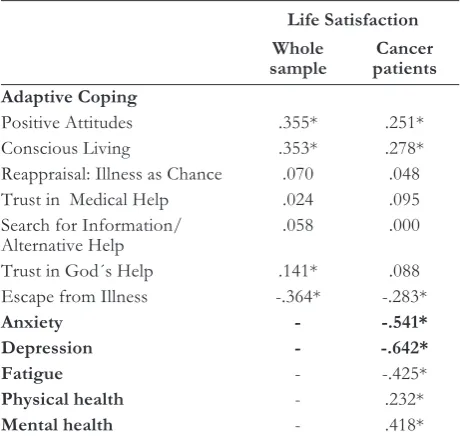
Among the whole group of patients, we correlated the BMLSS scores with adaptive coping styles (AKU) and Escape from illness. As shown in Table 4, LS correlat-ed moderately particularly with intrinsic adaptive cop-ing strategies such as Positive Attitudes and Conscious Living (which are active cognitive-behavioral styles), and moderately negative with Escape from illness (which is an escape-avoidance strategy).
In cancer patients, the LS correlated strongly verse) with Anxiety and Depression, moderately (in-verse) with Fatigue, and moderately (positive) with mental health-related quality of life, while physical health correlated weakly (Table 4).
In patients with depressive disorders (with or with-out alcohol addiction), the BMLSS correlated nega-tively with Beck´s Depression Index (r = -0.669; p <0.0001), which confirms the results observed in the cancer patients.
Stepwise regression analyses revealed that LS can be predicted best by (the absence of) depression (Beta = -0.571; p <0.001), but also by Conscious Living (Beta = 0.163; p = 0.007). The predictive power of the model was sufficiently high (R2 = 0.410). Excluded variables were anxiety; Escape from Illness; fatigue; SF-12´s health related quality of life; age; duration of disease, and other adaptive coping strategies.
D
ISCUSSIONThe concept of LS goes far beyond patients´ func-tional competence and health satisfaction. Even pa-tients with impaired perception of health status, which may have more social needs, can have high satisfaction with various dimensions of life concerns. To opera-tionalize this concept and to evaluate a brief and com-pact scale to measure LS, which can easily be
incorpo-rated as an important additive to existing health-relat-ed quality of life questionnaires, we have develophealth-relat-ed the BMLSS. This tool captures dimensions that con-tribute to quality of life but are not health related. We can state that the 8-item instrument had a good inter-nal consistency coefficient, and a single-factor struc-ture which explains 53% of variance. External valida-tion revealed positive associavalida-tions of the BMLSS with health-related quality of life and intrinsic coping strategies, and negative associations with depression, anxiety, fatigue, and an escape-avoidance strategy. Re-gression analyses revealed that LS can be predicted best by (the absence of) depression and by Conscious Living, which is a active cognitive-behavioral style in terms of adaptive coping [13,29]. This is in line with the finding of others that particularly psychological well-being was is a major predictor of LS [19].
Among the patients, those with cancer had the high-est LS scores. This could be due to the fact that cancer patients were significantly older than the others, while healthy individuals and patients with depressive disor-ders were the youngest (F = 87.279; p <0.0001); thus, higher LS can be explained by higher age, too. Another important finding of this analysis was that LS scores of cancer patients were similar to healthy individuals, de-spite of their fatal diagnosis. As reported previously, cancer patients do not necessarily regard illness as a dispensable interrupt of life, but also as a challenge, a chance to reflect and to change life and behavior [10,12,16]. A recent review on posttraumatic growth in cancer patients confirms significant differences be-tween patients with cancer and other traumas [30], among them differences in the interpretation of cancer as a future, ongoing and chronic integration threat, and also uncertainty and vulnerability.
In contrast, patients with chronic pain conditions and depressive disorders had significantly lower LS scores than patients with cancer. One may suggest that hope, as an important aspect in health-related quality of live, is much higher in cancer patients, while partic-ularly patients with chronic pain conditions may have experienced the limitations of the health care system in regard of an effective pain management. Thus, their frustration might be much higher, which in turn de-creases satisfaction with life. A hint which would sup-port this suggestion could be a significantly lower Es-cape from illness in cancer patients than in patients with chronic pain conditions.
Within this context one may discuss also the con-cept of reframing (which means to understand and use multiple perspectives), i.e., patients with chronic diseases have to re-adjust their life expectations to the new condition, and in relation to that – reframed – ex-pectation, they could be just as satisfied as other per-sons. In fact, to find meaning in the chronic illness process involves a patient’s assenting to the illness and reframing its implications positively [15]. Schroevers and Teo [7] stated that “greater use of the coping strategies instrumental support, positive reframing, and humor was associated with more posttraumatic growth”. Patients with chronic diseases are thus not exclusively `functionally deficient´ (albeit the symp-toms of disease may persist), because several aspects of life concerns may be vital and important to them.
Table 4. External correlation. * p <0.01 (Spearman rho; 2-tailed). Strong correlations were highlighted.
Life Satisfaction
Whole Cancer
sample patients
Adaptive Coping
Positive Attitudes .355* .251*
Conscious Living .353* .278*
Reappraisal: Illness as Chance .070 .048 Trust in Medical Help .024 .095 Search for Information/ .058 .000 Alternative Help
Trust in God´s Help .141* .088 Escape from Illness -.364* -.283*
Anxiety - -.541*
Depression - -.642*
Fatigue - -.425*
Physical health - .232*
The priority of these aspects may vary between the in-dividuals depending on various variables.
Taken together, our BMLSS scale has important strengths, i.e., it is compact, multimodal, and applica-ble to patients with chronic diseases. Its brief nature allows it to be easily added to large surveys that can in-clude only a few extra questions on this dimension. In contrast to the general domains of Diener´s 5-item `Satisfaction with Life Scale´ [22] (i.e., In most ways my life is close to my ideal; The conditions of my life are excellent; I am satisfied with my life; So far I have gotten the important things I want in life; If I could live my life over, I would change almost nothing), the BMLSS addresses individuals' perception of circum-scribed aspects of life important to them. These items thus can prioritize LS aspects relevant for the individ-ual.
A limitation of our study was the overrepresenta-tion of women, and the fact that we had a dominance of patients with cancer and chronic pain conditions, which might not be representative for the general pop-ulation of people living with chronic disease. Never-theless, further work has to be done in validating this instrument in longitudinal and interventional studies.
C
ONCLUSIONSThe evaluation of the BMLSS revealed that the instru-ment has good psychometric properties. The scale can be an important additive to existing health-related quality of life questionnaires, since it captures dimen-sions that contribute to quality of life but are not health related. The fact that LS was inversely associat-ed with mood states, and positively with health-relatassociat-ed quality of life and the intrinsic adaptive coping, indi-cates that this instrument may be used to examine the effect of positive coping with chronic disease on LS.
Acknowledgements: We highly appreciate the contribution of Hans-Joachim Balzat (Pain Outpatient Clinic, Communal Hospital in Herdecke), Dr. Ralf-Achim Grünther (Ortho-paedic Clinic in Bad Bocklet and Baumrain Clinic in Bad Berleburg), Prof. Dr. Götz Mundle (Oberberg Clinic Schwarzwald), and several others who encouraged their pa-tients to fill out the questionnaires.
R
EFERENCES1. Diener E, Oishi S, Lucas RE: Personality, culture, and subjective well-being: emotional and cognitive evaluations of life. Annu Rev Psychol 2003, 54: 403-425.
2. Ferrans CE: Conceptualizations of quality of life in car-diovascular research. Prog Cardiovasc Nurs 1992, 7: 2-6. 3. Moons P, Marquet K, Budts W, De GS: Validity,
reliabili-ty and responsiveness of the "Schedule for the Evaluation of Individual Quality of Life-Direct Weighting" (SEIQoL-DW) in congenital heart disease. Health Qual Life Outcomes 2004, 2: 27.
4. Asadi-Lari M, Tamburini M, Gray D: Patients' needs, sat-isfaction, and health related quality of life: towards a com-prehensive model. Health Qual Life Outcomes 2004, 2: 32.
5. Jim HS, Jacobsen PB: Posttraumatic stress and posttrau-matic growth in cancer survivorship: a review. Cancer J 2008, 14: 414-419.
6. Ironson G, Stuetzle R, Fletcher MA: An increase in reli-giousness/spirituality occurs after HIV diagnosis and
pre-dicts slower disease progression over 4 years in people with HIV. J Gen Intern Med 2006, 21 Suppl 5: S62-S68. 7. Schroevers MJ, Teo I: The report of posttraumatic
growth in Malaysian cancer patients: relationships with psychological distress and coping strategies. Psychooncol-ogy 2008, 17: 1239-1246.
8. Borg C, Fagerstrom C, Balducci C, Burholt V, Ferring D, Weber G et al.: Life satisfaction in 6 European countries: the relationship to health, self-esteem, and social and financial resources among people (Aged 65-89) with reduced functional capacity. Geriatr Nurs 2008, 29: 48-57.
9. Strine TW, Chapman DP, Balluz LS, Moriarty DG, Mok-dad AH: The associations between life satisfaction and health-related quality of life, chronic illness, and health behaviors among U.S. community-dwelling adults. J Community Health 2008, 33: 40-50.
10. Büssing A, Ostermann T, Matthiessen PF: Search for meaningful support and the meaning of illness in German cancer patients. Anticancer Res 2005, 25: 1449-1455. 11. Büssing A, Ostermann T, Matthiessen PF: Role of
reli-gion and spirituality in medical patients: confirmatory re-sults with the SpREUK questionnaire. Health Qual Life Outcomes 2005, 3: 10.
12. Büssing A, Ostermann T, Koenig HG: Relevance of reli-gion and spirituality in German patients with chronic dis-eases. Int J Psychiatry Med 2007, 37: 39-57.
13. Büssing A, Ostermann T, Matthiessen PF: Adaptive cop-ing and spirituality as a resource in cancer patients. Breast Care 2007, 195-202.
14. Büssing A, Fischer J, Ostermann T, Matthiesen P.F.: Re-liance on God´s help, depression and fatigue in female cancer patients. Int J Psychiatry Med 2008, 38: 357-372. 15. Baker C, Stern PN: Finding meaning in chronic illness as
the key to self-care. Can J Nurs Res 1993, 25: 23-36. 16. Büssing A, Fischer J: Interpretation of illness in cancer
survivors is associated with health-related variables and adaptive coping styles. BMC Women´s Health 2009, (in press).
17. Degner LF, Hack T, O'Neil J, Kristjanson LJ: A new ap-proach to eliciting meaning in the context of breast can-cer. Cancer Nurs 2003, 26: 169-178.
18. Wallberg B, Michelson H, Nystedt M, Bolund C, Degner L, Wilking N: The meaning of breast cancer. Acta Oncol 2003, 42: 30-35.
19. Melendez JC, Tomas JM, Oliver A, Navarro E: Psycho-logical and physical dimensions explaining life satisfaction among the elderly: A structural model examination. Arch Gerontol Geriatr 2008, (in press).
20. Huebner ES, Suldo S, Valois RF, Drane JW, Zullig K: Brief multidimensional students' life satisfaction scale: sex, race, and grade effects for a high school sample. Psy-chol Rep 2004, 94: 351-356.
21. Zullig KJ, Huebner ES, Gilman R, Patton JM, Murray KA: Validation of the brief multidimensional students' life satisfaction scale among college students. Am J Health Behav 2005, 29: 206-214.
22. Diener E, Emmons RA, Larsen RJ, Griffin S: The Satis-faction With Life Scale. J Pers Assess 1985, 49: 71-75. 23. Herrmann C: International experiences with the Hospital
Anxiety and Depression Scale--a review of validation data and clinical results. J Psychosom Res 1997, 42: 17-41. 24. Büssing A, Keller N, Michalsen A, Moebus S, Ostermann
T, Matthiessen PF: Spirituality and Adaptive Coping Styles in German Patients with Chronic Diseases in a CAM Health Care Setting. Journal of Complementary and Integrative Medicine 2006, 3: 1-16.
26. Resnick B, Nahm ES: Reliability and validity testing of the revised 12-item Short-Form Health Survey in older adults. J Nurs Meas 2001, 9: 151-161.
27. Ware J, Jr., Kosinski M, Keller SD: A 12-Item Short-Form Health Survey: construction of scales and prelimi-nary tests of reliability and validity. Med Care 1996, 34: 220-233.
28. Büssing A, Keller N, Michalsen A, Moebus S, Ostermann T, Matthiessen PF: Spirituality and Adaptive Coping Styles in German Patients with Chronic Diseases in a CAM Health Care Setting. Journal of Complementary and Integrative Medicine 2008, 3: 1-16.
29. Büssing A, Ostermann T, Matthiessen PF: Wer kontrol-liert die Gesundheit? - Adaptive Krankheitsverar-beitungsstile bei Patienten mit chronischen Erkrankun-gen. Deutsche Zeitschrift für Onkologie 2008, 40: 150-156.
30. Sumalla EC, Ochoa C, Blanco I: Posttraumatic growth in cancer: reality or illusion? Clin Psychol Rev 2009, 29: 24-33.
Received: October 16, 2008 / Accepted: February 24, 2009
Address for correspondence:
Prof. Dr. med. Arndt Büssing
Chair of Medical Theory and Complementary Medicine University of Witten/Herdecke
Gerhard-Kienle-Weg 4 58313 Herdecke Germany