R E S E A R C H A R T I C L E
Open Access
Association between lower serum
bicarbonate and renal hyperfiltration in the
general population with preserved renal
function: a cross-sectional study
Minseon Park
1, Rina So
2, Kwon Wook Joo
3and Hyung-Jin Yoon
2*Abstract
Background:Lower serum bicarbonate, mainly due to the modern Western-style diet, and renal hyperfiltration
(RHF) are both independently associated with higher mortality in the general population with preserved renal function. The objective of this study was to evaluate the association between serum bicarbonate and RHF.
Methods:The health data of 41,886 adults with an estimated glomerular filtration rate (eGFR)≥60 mL/min per 1.73 m2 were analyzed. The eGFR was calculated with the Chronic Kidney Disease Epidemiology Collaboration creatinine equation and RHF was defined as eGFR with adjusted residuals > sex-specific 95thpercentile.
Results:The adjusted mean of eGFR was lower in the highest quintile of serum bicarbonate than in other quintiles, after adjusting for confounders. A lower percentile rank of serum bicarbonate was associated with higher odds of RHF. The odds ratio (OR) for RHF in the lowest quintile of serum bicarbonate was 1.39 (95 % confidence interval, 95 % CI, 1.11–1.75) compared to the highest, after adjusting for confounders. With subgroup analysis, the association was prominent in participants with a body mass index >25 kg/m2(OR 1.98, 95 % CI 1.32–2.95 in the lowest quintile compared to the highest), compared to those with a body mass index≤25 kg/m2(OR 1.18, 95 % CI 0.89–1.56 in the lowest quintile compared to the highest).
Conclusions:This study observed an association between lower serum bicarbonate and higher odds of RHF and the possible differential effect of obesity in this association. It is necessary to confirm the association between lower serum bicarbonate and RHF and its causality.
Keywords:Chronic kidney disease, Glomerular filtration rate, Metabolic acidosis, Renal hyperfiltration, Serum bicarbonate
Background
Metabolic acidosis is one of the earliest complications of chronic kidney disease (CKD). Low serum bicarbonate has been associated with a poor renal outcome and increased mortality, while the beneficial effects of raising serum bicarbonate with alkali supplementation or dietary inter-ventions have been reported in patients with CKD [1]. The correlation between low serum bicarbonate and an increased risk of incident CKD has been reported in
community-dwelling cohorts [2, 3]. Although several mechanisms explaining the association between low serum bicarbonate and poor renal outcome in patients with CKD [1] have been suggested, the underlying mechanism explaining the association between low serum bicarbonate and incident CKD in the general population is not yet clear.
Renal hyperfiltration (RHF), which may be a poten-tially reversible stage of CKD, has been associated with many clinical conditions such as diabetes, hypertension and obesity, and with various lifestyle factors such as smoking, low cardiopulmonary fitness, and a lack of physical activity [4–11]. Recently, we have reported an
* Correspondence:[email protected]
2Department of Biomedical Engineering, Seoul National University College of
Medicine, 101 Daehak-ro, Jongno-gu, Seoul 110-744, Republic of Korea Full list of author information is available at the end of the article
association between RHF and increased all-cause and cardiovascular mortality in a relatively healthy adult population [12].
An acidogenic diet, deficient in fruit and vegetables, coupled with excessive consumption of animal products and sodium chloride, has been associated with cardio-vascular risk by causing insulin resistance, an elevation in blood pressure, and metabolic syndrome. RHF has been proposed as one of the renal adaptive responses to an acidogenic diet, which is believed to be the main cause of low serum bicarbonate in subjects with pre-served renal function [13]. The correlation between RHF and low serum bicarbonate has not been tested, how-ever. Elucidating the association between RHF and low serum bicarbonate may be important for studying the pathophysiology of linkage between dietary factors, CKD and cardiometabolic risk and for developing dietary guide-lines for the prevention of CKD and long-term, all-cause and cardiovascular mortality associated with RHF in the general population.
To evaluate the relationship between the serum bicar-bonate level and RHF, we examined the health screening data of a relatively healthy population of 41,886 adults with an estimated glomerular filtration rate (eGFR) of 60 mL/min per 1.73 m2or higher.
Methods
Participants and data collection
Among 68,838 health screenings performed at the Health Promotion Centre of Seoul National University Hospital between Jan 2001 and Dec 2012, 14,465 re-peated screenings and 10,577 screenings with missing data on age, sex, weight, height, blood pressure, serum bicarbonate, or serum creatinine were excluded. After the further exclusion of 1,910 screenings of participants younger than 20 years of age and with an eGFR of less than 60 mL/min per 1.73 m2, we analyzed the health re-cords of the first screening visit of 41,886 adults. The study protocol was approved by the Institutional Review Board of Seoul National University Hospital.
Information on smoking status, alcohol ingestion, regular exercise, and previous history of diabetes, hyper-tension, and pharmacological treatment for diabetes and/or hypertension was obtained using a structured, self-report questionnaire and validated by direct inter-view with trained nurses. Trained physicians interinter-viewed and examined all participants just before the health screening. The smoking status was classified according to three categories: current smokers, ex-smokers, and non-smokers. Participants who smoked at least one cigarette per day at the time of the health screening were catego-rized as current smokers. Participants who reported that they did not smoke at the time of the screening, but who used to smoke were categorized as ex-smokers. Regular
drinkers were defined as participants who consumed alcoholic beverages at least once a week. Regular exercise was defined as exercise lasting longer than 30 min at least three times per week.
All the participants visited the hospital after an over-night fast. Body mass index (BMI) was calculated by div-iding weight (kg) by height (m) squared. Blood pressure (BP) was measured using an automated BP-measuring device (Jawon, Busan, Korea) after resting in a sitting position for at least five minutes.
Blood samples and a urine specimen were taken after an overnight fast. Serum chemistry including bicarbonate and creatinine were measured using a Toshiba 200FR, a spectrophotometric chemistry auto analyzer (Toshiba Medical Systems Co., Tokyo, Japan). Serum creatinine was measured using the Jaffé method. To adjust the serum creatinine measurements to isotope dilution mass spec-trophotometry, we reduced the serum creatinine levels by 5 % as previously recommended [14]. The partici-pant’s eGFR was calculated with the Chronic Kidney Disease Epidemiology Collaboration equation (CKD-EPI) [15]. Serum bicarbonate was measured with en-zymatic method using venous serum. The normal range of the bicarbonate of the venous serum in Seoul National University Hospital was 24–31 mEq/L. Albu-minuria and urine pH were determined with a single spot urine dipstick analysis (YD Diagnostics, Yong-In, Korea), which was performed on morning urine samples after overnight fasting and was reported as negative, trace, 1+, 2+, 3+, or 4+. Albuminuria was defined as 1+ or higher. Urine pH was reported as 5.0, 5.5, 6.0, 6.5, 7.0, 7.5, 8.0, or 8.5. The participants who underwent health screening between Jan 2001 and May 2006 had lean mass evaluation using Inbody 2.0 (Biospace, Seoul, Korea) [16].
Statistical analysis
Statistical analysis was conducted with R software 3.0.2 (http://www.R-project.org). The distribution of clinical parameters across the quintile groups of serum bicar-bonate was compared with an ANOVA test for continu-ous variables and a chi-square test for discrete variables.
history of therapy for diabetes and/or hypertension, BMI, systolic BP, fasting serum glucose, serum uric acid, serum calcium, serum albumin, serum triglyceride, serum high-density lipoprotein cholesterol, and albuminuria. The point-wise estimates and confidence intervals of odds ratio curves were computed with a multivariate logistic regres-sion method adjusted for age, sex, BMI, systolic BP, alcohol intake, smoking status, regular exercise, previous medica-tion for hypertension and/or diabetes, serum fasting glucose, serum uric acid, serum calcium, serum albumin, serum triglyceride, serum high-density lipoprotein choles-terol, and albuminuria. Penalized splines were used as the smoothing technique and the spline degrees of freedom were selected on the basis of the lowest Akaike Information Criterion. Two-sided p values less than 0.05 were consid-ered statistically significant.
Results
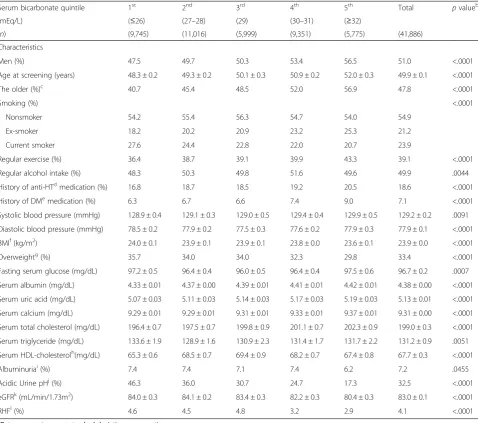
Table 1 describes the general characteristics of the par-ticipants, who had a mean age 49.5 years and of whom 51.0 % were male. The proportion of men, the mean age, the proportion of participants exercising regularly in-creased along with the increasing bicarbonate quintile level. The proportion of current smokers increased ac-cording to the decreasing serum bicarbonate quintile. The percentage of overweight participants with a BMI higher than 25 kg/m2 decreased from 35.7 % in the 1st quintile to 29.8 % in the 5thquintile (Table 1).
The adjusted mean eGFR of the highest quintile of serum bicarbonate was significantly lower than that of the other quintiles (adjusted mean eGFR 81.4 mL/min per 1.73 m2, 95 % confidence interval 81.0–81.8 mL/min per 1.73 m2 in the first quintile; 81.5, 81.1–81.9 in the second quintile, 81.4, 81.0–81.9 in the third quintile, 80.6, 80.2–81.0 in the fourth quintile, 79.7, 79.3–80.2 in the highest quintile) after adjustment for age, sex, smok-ing status, regular exercise, alcohol smok-ingestion, history of pharmacological therapy for hypertension and/or dia-betes, BMI, systolic BP, fasting serum glucose, serum uric acid, serum calcium, serum albumin, serum trigly-ceride, serum high-density lipoprotein cholesterol, and albuminuria (p< 0.0001 the highest quintile vs the other quintiles by generalized linear model; Fig. 1).
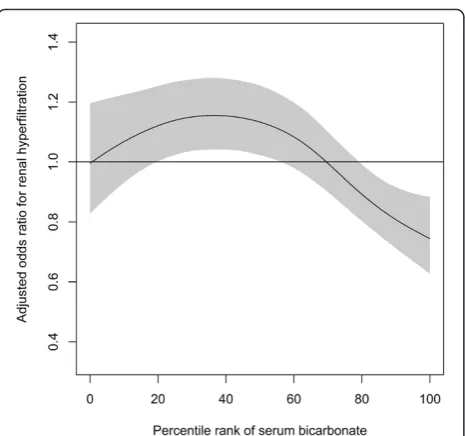
The association between the distribution of serum bi-carbonate and the odds of RHF, defined as an eGFR with an adjusted residual higher than the 95thpercentile, was analyzed with multivariate logistic regression analysis, adjusted for age, sex, smoking status, regular exercise, alcohol ingestion, history of pharmacological therapy for hypertension and/or diabetes, BMI, systolic BP, fasting serum glucose, serum uric acid, serum calcium, serum albumin, serum triglyceride, serum high-density lipo-protein cholesterol, and albuminuria. The lower percent-ile rank of serum bicarbonate was associated with higher
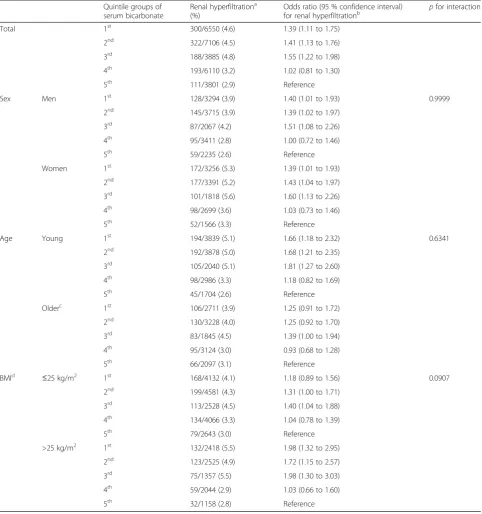
odds of RHF (Fig. 2). With multivariate logistic regression analysis, the odds of RHF in the lower quintile groups of serum bicarbonate were higher than that in the highest quintile group (odds ratio 1.39, 95 % confidence interval 1.11–1.75 in the lowest quintile, 1.41, 1.13–1.76 in the sec-ond quintile, 1.55, 1.22–1.98 in the third quintile, com-pared to the highest quintile; Table 2). After exclusion of the participants taking anti-hypertensive medications, the association between RHF and serum bicarbonate was similar (odds ratio 1.40, 95 % confidence interval 1.11–1.77 in the lowest quintile, 1.38, 1.10–1.74 in the second quintile, 1.55, 1.21–1.99 in the third quintile, compared to the highest quintile; data not shown). After exclusion of the participants with fasting serum glucose above 125 mg/dL, the association between RHF and serum bicarbonate was significant (odds ratio 1.26, 95 % confidence interval 1.00–1.58 in the lowest quintile, 1.32, 1.06–1.75 in the second quintile, 1.55, 1.22–1.97 in the third quintile, compared to the highest quintile; data not shown).
With subgroup analysis, the association between serum bicarbonate level and the odds of RHF was significant only in participants with a BMI higher than 25 kg/m2 com-pared to those with a BMI of 25 kg/m2or lower, although the p value for interaction did not reach the statistical sig-nificance (Table 2). The odds ratio of the lowest quintile was 1.98 (95 % confidence interval 1.32–2.95) compared to the highest quintile in participants with a BMI higher than 25 kg/m2, and was 1.18 (95% confidence interval 0.89–1.56) in those with a BMI of 25 kg/m2 or lower (Table 2). Urine pH and serum anion gap were not asso-ciated with the odds of RHF (data not shown).
Discussion
This study, using a very large sample size, observed that a lower serum bicarbonate level was associated with in-creased odds of RHF, defined as an eGFR with adjusted residuals above the sex-specific 95thpercentile. This ob-servation was more prominent in subjects with a BMI above 25 kg/m2than in the counterpart subgroup with a BMI below 25 kg/m2, although the results of the sub-group analysis did not reach the statistical significance.
of all-cause and cardiovascular mortality risk in the general population has been suggested [12]. But the clarification is still needed on the mechanism(s) under-lying this association.
The modern Western-type diet is characterized by a deficiency of fruit and vegetables and excessive consump-tion of animal products, and the metabolism of sulfur-containing amino acids such as methionine, homocysteine,
and cysteine in animal proteins and cereal grains generates sulfate, a non-metabolizable anion constituting a major determinant of the daily acid load [13]. All the subjects in this study had an eGFR higher than 60 mL/min per 1.73 m2where the excretion of daily acid load should not be abnormal, and the lower serum bicarbonate level ob-served in a number of these subjects could be assumed to be resulting from dietary causes [19].
Table 1General characteristics of the participantsa
Serum bicarbonate quintile 1st 2nd 3rd 4th 5th Total pvalueb
(mEq/L) (≤26) (27–28) (29) (30–31) (≥32)
(n) (9,745) (11,016) (5,999) (9,351) (5,775) (41,886)
Characteristics
Men (%) 47.5 49.7 50.3 53.4 56.5 51.0 <.0001
Age at screening (years) 48.3 ± 0.2 49.3 ± 0.2 50.1 ± 0.3 50.9 ± 0.2 52.0 ± 0.3 49.9 ± 0.1 <.0001
The older (%)c 40.7 45.4 48.5 52.0 56.9 47.8 <.0001
Smoking (%) <.0001
Nonsmoker 54.2 55.4 56.3 54.7 54.0 54.9
Ex-smoker 18.2 20.2 20.9 23.2 25.3 21.2
Current smoker 27.6 24.4 22.8 22.0 20.7 23.9
Regular exercise (%) 36.4 38.7 39.1 39.9 43.3 39.1 <.0001
Regular alcohol intake (%) 48.3 50.3 49.8 51.6 49.6 49.9 .0044
History of anti-HTdmedication (%) 16.8 18.7 18.5 19.2 20.5 18.6 <.0001
History of DMemedication (%) 6.3 6.7 6.6 7.4 9.0 7.1 <.0001
Systolic blood pressure (mmHg) 128.9 ± 0.4 129.1 ± 0.3 129.0 ± 0.5 129.4 ± 0.4 129.9 ± 0.5 129.2 ± 0.2 .0091
Diastolic blood pressure (mmHg) 78.5 ± 0.2 77.9 ± 0.2 77.5 ± 0.3 77.6 ± 0.2 77.9 ± 0.3 77.9 ± 0.1 <.0001
BMIf(kg/m2) 24.0 ± 0.1 23.9 ± 0.1 23.9 ± 0.1 23.8 ± 0.0 23.6 ± 0.1 23.9 ± 0.0 <.0001
Overweightg(%) 35.7 34.0 34.0 32.3 29.8 33.4 <.0001
Fasting serum glucose (mg/dL) 97.2 ± 0.5 96.4 ± 0.4 96.0 ± 0.5 96.4 ± 0.4 97.5 ± 0.6 96.7 ± 0.2 .0007
Serum albumin (mg/dL) 4.33 ± 0.01 4.37 ± 0.00 4.39 ± 0.01 4.41 ± 0.01 4.42 ± 0.01 4.38 ± 0.00 <.0001
Serum uric acid (mg/dL) 5.07 ± 0.03 5.11 ± 0.03 5.14 ± 0.03 5.17 ± 0.03 5.19 ± 0.03 5.13 ± 0.01 <.0001
Serum calcium (mg/dL) 9.29 ± 0.01 9.29 ± 0.01 9.31 ± 0.01 9.33 ± 0.01 9.37 ± 0.01 9.31 ± 0.00 <.0001
Serum total cholesterol (mg/dL) 196.4 ± 0.7 197.5 ± 0.7 199.8 ± 0.9 201.1 ± 0.7 202.3 ± 0.9 199.0 ± 0.3 <.0001
Serum triglyceride (mg/dL) 133.6 ± 1.9 128.9 ± 1.6 130.9 ± 2.3 131.4 ± 1.7 131.7 ± 2.2 131.2 ± 0.9 .0051
Serum HDL-cholesterolh(mg/dL) 65.3 ± 0.6 68.5 ± 0.7 69.4 ± 0.9 68.2 ± 0.7 67.4 ± 0.8 67.7 ± 0.3 <.0001
Albuminuriai(%) 7.4 7.4 7.1 7.4 6.2 7.2 .0455
Acidic Urine pHj(%) 46.3 36.0 30.7 24.7 17.3 32.5 <.0001
eGFRk(mL/min/1.73m2) 84.0 ± 0.3 84.1 ± 0.2 83.4 ± 0.3 82.2 ± 0.3 80.4 ± 0.3 83.0 ± 0.1 <.0001
RHFl(%) 4.6 4.5 4.8 3.2 2.9 4.1 <.0001
a
Data represent mean ± standard deviation or proportion b
Based on ANOVA for continuous variables and chi-square test for discrete variables c
Older than median age at screening, 51 years for women and 50 years for men d
Hypertension e
Diabetes mellitus f
Body Mass Index g
BMI >25kg/m2
h
Serum high-density lipoprotein cholesterol i
Spot urine dipstick test for albuminuria 1+ or higher j
Urine pH≤5.5
k
Estimated glomerular filtration rate calculated with the Chronic Kidney Disease Epidemiology Collaboration creatinine equation l
Subclinical metabolic acidosis can cause various renal adaptive responses, including RHF. Metabolic acidosis due to an acidogenic diet has been hypothesized to cause insulin resistance, metabolic syndrome, and hence cardiovascular risk [13]. Although subclinical chronic metabolic acidosis may be a possible mechanism explaining the association between RHF and increased mortality, this possibility has not been tested as yet. Re-cently, a lower serum bicarbonate level has also been re-ported as an all-cause and cardiovascular mortality risk factor in the general population with preserved renal function [20]. The association between RHF and the lower serum bicarbonate level observed in this study may suggest the possibility of metabolic acidosis as a mechanism linking RHF and increased mortality risk. The observation that the association between RHF and the lower serum bicarbonate level was more prominent in the subjects with BMI higher than 25 kg/m2 may be indirect evidence of the linkage between metabolic acidosis, metabolic syndrome, and cardiovascular risk. Recently, the association between low serum bicarbonate and a higher risk of incident CKD in the general popula-tion with preserved renal funcpopula-tion has been reported. Complement activation and tubulointerstitial injury due to a compensatory increase in ammoniagenesis in the remaining nephrons, a marker of tubular dysfunction, and a marker of dietary habits such as lower intake of fruit and vegetables have been proposed as possible explanations [2, 3]. As RHF has been associated with a rapid decline in eGFR in a population with preserved renal function [12], the association between low serum bicarbonate and RHF may be another explanation for the association between lower serum bicarbonate and incident CKD.
Clarification is still needed regarding the mecha-nism(s) underlying the association between the low serum bicarbonate level and RHF. It is well known that high protein intake can increase the glomerular filtration rate in human beings and that substitution of soy pro-tein for animal propro-tein results in less hyperfiltraton [21]. In a cross-sectional study of 2,938 CKD patients, the percentage of total protein intake from plant sources was associated with a higher serum bicarbonate level [22]. An explanation for the differential effect of the sources of protein in RHF is not available. It has been suggested that chronic acidosis, chronic potassium deficiency, and chronic hyperfiltration share a common signaling pathway to the demand for increased hydrogen transport [23]. Therefore, the hypothesis that a higher dietary acid load mainly from animal proteins and cereals decreases the serum bicarbonate level and thereby causes RHF needs to be tested through random-ized controlled studies.
The association between RHF and serum bicarbonate was not linear. This can be explained by the activation Fig. 2Association between the percentile rank of serum bicarbonate
of counter-balancing mechanism(s) such as tubuloglo-merular feedback. An S-shaped relationship between loop of Henle perfusion rate and single nephron GFR in rat has been reported [24]. This hypothesis needs to be confirmed.
Contrary to serum bicarbonate levels, either of serum anion gap and urine pH was not associated with RHF in this study. The explanation for this lack of association is not clear. Higher dietary sodium intake has been re-ported to be associated with hyperchloremic metabolic
Table 2Association between serum bicarbonate level and renal hyperfiltration
Quintile groups of serum bicarbonate
Renal hyperfiltrationa (%)
Odds ratio (95 % confidence interval)
for renal hyperfiltrationb pfor interaction
Total 1st 300/6550 (4.6) 1.39 (1.11 to 1.75)
2nd 322/7106 (4.5) 1.41 (1.13 to 1.76)
3rd 188/3885 (4.8) 1.55 (1.22 to 1.98)
4th 193/6110 (3.2) 1.02 (0.81 to 1.30)
5th 111/3801 (2.9) Reference
Sex Men 1st 128/3294 (3.9) 1.40 (1.01 to 1.93) 0.9999
2nd 145/3715 (3.9) 1.39 (1.02 to 1.97)
3rd 87/2067 (4.2) 1.51 (1.08 to 2.26)
4th 95/3411 (2.8) 1.00 (0.72 to 1.46)
5th 59/2235 (2.6) Reference
Women 1st 172/3256 (5.3) 1.39 (1.01 to 1.93)
2nd 177/3391 (5.2) 1.43 (1.04 to 1.97)
3rd 101/1818 (5.6) 1.60 (1.13 to 2.26)
4th 98/2699 (3.6) 1.03 (0.73 to 1.46)
5th 52/1566 (3.3) Reference
Age Young 1st 194/3839 (5.1) 1.66 (1.18 to 2.32) 0.6341
2nd 192/3878 (5.0) 1.68 (1.21 to 2.35)
3rd 105/2040 (5.1) 1.81 (1.27 to 2.60)
4th 98/2986 (3.3) 1.18 (0.82 to 1.69)
5th 45/1704 (2.6) Reference
Olderc 1st 106/2711 (3.9) 1.25 (0.91 to 1.72)
2nd 130/3228 (4.0) 1.25 (0.92 to 1.70)
3rd 83/1845 (4.5) 1.39 (1.00 to 1.94)
4th 95/3124 (3.0) 0.93 (0.68 to 1.28)
5th 66/2097 (3.1) Reference
BMId ≤25 kg/m2 1st 168/4132 (4.1) 1.18 (0.89 to 1.56) 0.0907
2nd 199/4581 (4.3) 1.31 (1.00 to 1.71)
3rd 113/2528 (4.5) 1.40 (1.04 to 1.88)
4th 134/4066 (3.3) 1.04 (0.78 to 1.39)
5th 79/2643 (3.0) Reference
>25 kg/m2 1st 132/2418 (5.5) 1.98 (1.32 to 2.95)
2nd 123/2525 (4.9) 1.72 (1.15 to 2.57)
3rd 75/1357 (5.5) 1.98 (1.30 to 3.03)
4th 59/2044 (2.9) 1.03 (0.66 to 1.60)
5th 32/1158 (2.8) Reference
a
SeeMethodsfor details b
By multivariate logistic regression analysis, adjusted for systolic blood pressure, alcohol intake, smoking status, regular exercise, medication for hypertension and/ or diabetes, serum fasting glucose, serum uric acid, serum calcium, serum albumin, serum triglyceride, serum high density lipoprotein-cholesterol, and albuminuria, where age, sex, or body mass index were added as adjusted variables except for the variable of interest
c
Older than the sex-specific median age, 51 years for women and 50 years for men d
acidosis [25] and RHF [26] in general population. In Korea, the mean dietary sodium intake per person was 4.6–4.7 g/day, higher than that in Western countries [27]. The lack of association between serum anion gap and RHF can be explained by the confounding effect of higher dietary sodium intake. This hypothesis needs to be confirmed by future studies. The measurement of urine pH in this study was done by dipstick test on voided urine not on 24-h urine collection. The first void urine pH by paper strip has been reported not being a reliable indicator of daily net endogenous acid produc-tion [28]. The associaproduc-tion between urine pH and RHF may need to be analyzed with urine pH measured using 24-h urine collection.
It can be argued that volume depletion caused by diuretic medications can confound the association be-tween RHF and serum bicarbonate. After exclusion of the participants taking anti-hypertensive medications, the association was similar and the possibility of con-founding effect of diuretic medication can be reason-ably excluded. Although hyperglycemia may influence the prevalence of RHF in the quintile groups of serum bicarbonate, the association between RHF and serum bicarbonate was independent of fasting serum glucose. After exclusion of the participants with fast-ing serum glucose above 125 mg/dL, the association was still significant. Therefore, the possibility of con-founding effect of hyperglycemia in this association seems to be quite low. The subset of the participants who underwent health screening between Jan 2001 and May 2006 measured lean mass with bioimpe-dance analysis [16]. With inclusion of lean mass quartile in the multivariate logistic regression model, the associ-ation between RHF and serum bicarbonate was independ-ent of the lean mass quartiles. Therefore, the confounding effect of skeletal muscle protein metabolism caused by chronic metabolic acidosis on the association between RHF and serum bicarbonate could be excluded.
With subgroup analysis, the association between the serum bicarbonate quintile groups and RHF was signifi-cant only in subjects with a BMI higher than 25 kg/m2, although the p value for interaction was not significant. A possible differential effect according to BMI can suggest the pathophysiological roles of obesity in the association between serum bicarbonate and RHF [20]. Although the association between metabolic acid load and type 2 dia-betes or hypertension has been observed only in studies of women [29–33], the current study did not observe a gender effect in the association between lower serum bicarbonate and RHF. Future studies on the possible gender effect in the association between metabolic acid load and RHF are necessary.
There are some weaknesses in this study. First, the study design was cross-sectional and the causal relationship
between lower serum bicarbonate level and RHF could not be conclusively determined. Prospective studies may provide definite evidence. Second, the results of this study emerged from observations in a single hospital and with a population consisting of a single ethnic origin. Therefore, any extrapolation of the results to other ethnic groups should be treated with caution. Third, the measurement of serum bicarbonate was performed only once. The sub-jects visited the hospital for a routine health screening, not on account of their illnesses, and the measurements could be assumed to be representative of the stable condition of the participants on a regular diet. Forth, the data on the hydration status of the participants were not available. Although the participants of this study were relatively healthy and supposed to be in a stable condition, the confounding effect of the volume status on the associ-ation between RHF and serum bicarbonate observed in this study could not be excluded clearly. The duration of fasting was usually shorter than 12 h and supposed to be similar across the quintile groups of serum bicarbonates. Therefore, the degree of volume depletion and its impact on the association between RHF and serum bicarbonate might be minimal. Fifth, GFR was estimated, not mea-sured. Lastly, the data on the duration of diabetes of the participants was not available. Although the association was independent of fasting serum glucose, the effect of the duration of diabetes on the lower prevalence of RHF in the quintile groups with higher serum bicarbonate levels could not be excluded clearly. Despite these limita-tions, to the best of our knowledge, this study observed for the first time the association between lower serum bicarbonate level and RHF in a relatively large population with preserved renal function sufficient to excrete a daily acid load.
Conclusions
In conclusion, in a very large sample size lower serum bicarbonate was associated with higher odds of RHF, and with subgroup analysis, the possible differential effects of obesity have been suggested. These observations can pro-vide clues for the study of the pathophysiology of the link-age between dietary factors, CKD and cardiometabolic risk, and for the development of dietary guidelines to prevent CKD or cardiovascular diseases. It is necessary to confirm the association between lower serum bicarbonate level and RHF and its causality through prospective studies.
Abbreviations
BMI:body mass index; BP: blood pressure; CI: confidence interval; CKD: chronic kidney disease; CKD-EPI: Chronic Kidney Disease Epidemiology Collaboration equation; DM: diabetes mellitus; eGFR: estimated glomerular filtration rate; HDL-cholesterol: high-density lipoprotein cholesterol; HT: hypertension; OR: odds ratio; RHF: renal hyperfiltration.
Competing interests
Authors’contributions
MP and HJY designed the study and prepared the manuscript, RS collected and analyzed the data and KWJ provided clinical and scientific interpretation of the results. All the authors have approved the manuscript and agreed to its submission to your esteemed journal.
Acknowledgement
This work was supported by a grant from the National Research Foundation of Korea (NRF) funded by the Korean government (Ministry of Education and Science Technology, 2010-0028631).
Author details
1
Department of Family Medicine, Seoul National University Hospital, Seoul, Republic of Korea.2Department of Biomedical Engineering, Seoul National
University College of Medicine, 101 Daehak-ro, Jongno-gu, Seoul 110-744, Republic of Korea.3Department of Internal Medicine, Seoul National
University College of Medicine, Seoul, Republic of Korea.
Received: 22 April 2015 Accepted: 23 December 2015
References
1. Dobre M, Rahman M, Hostetter TH. Current Status of Bicarbonate in CKD. JASN: Journal of the American Society of Nephrology; 2014.
2. Driver TH, Shlipak MG, Katz R, Goldenstein L, Sarnak MJ, Hoofnagle AN, et al. Low serum bicarbonate and kidney function decline: the Multi-Ethnic Study of Atherosclerosis (MESA). Am J Kidney Dis. 2014;64(4):534–41.
3. Goldenstein L, Driver TH, Fried LF, Rifkin DE, Patel KV, Yenchek RH, et al. Serum bicarbonate concentrations and kidney disease progression in community-living elders: the Health, Aging, and Body Composition (Health ABC) Study. Am J Kidney Dis. 2014;64(4):542–9.
4. Mogensen CE, Christensen CK. Predicting diabetic nephropathy in insulin-dependent patients. N Engl J Med. 1984;311(2):89–93. 5. Nelson RG, Bennett PH, Beck GJ, Tan M, Knowler WC, Mitch WE, et al.
Development and progression of renal disease in Pima Indians with non-insulin-dependent diabetes mellitus. Diabetic Renal Disease Study Group. N Engl J Med. 1996;335(22):1636–42.
6. Schmieder RE, Messerli FH, Garavaglia G, Nunez B. Glomerular hyperfiltration indicates early target organ damage in essential hypertension. Jama. 1990; 264(21):2775–80.
7. Chagnac A, Weinstein T, Herman M, Hirsh J, Gafter U, Ori Y. The effects of weight loss on renal function in patients with severe obesity. J Am Soc Nephrol. 2003;14(6):1480–6.
8. Okada R, Yasuda Y, Tsushita K, Wakai K, Hamajima N, Matsuo S. Glomerular hyperfiltration in prediabetes and prehypertension. Nephrol Dial Transplant. 2012;27(5):1821–5.
9. Maeda I, Hayashi T, Sato KK, Koh H, Harita N, Nakamura Y, et al. Cigarette smoking and the association with glomerular hyperfiltration and proteinuria in healthy middle-aged men. Clin J Am Soc Nephrol. 2011;6(10):2462–9. 10. Park M, Ko Y, Song SH, Kim S, Yoon HJ. Association of low aerobic fitness
with hyperfiltration and albuminuria in men. Med Sci Sports Exerc. 2013; 45(2):217–23.
11. Melsom T, Mathisen UD, Eilertsen BA, Ingebretsen OC, Jenssen T, Njolstad I, et al. Physical exercise, fasting glucose, and renal hyperfiltration in the general population: the Renal Iohexol Clearance Survey in Tromso 6 (RENIS-T6). Clin J Am Soc Nephrol. 2012;7(11):1801–10.
12. Park M, Yoon E, Lim YH, Kim H, Choi J, Yoon HJ. Renal Hyperfiltration as a Novel Marker of All-Cause Mortality. JASN: Journal of the American Society of Nephrology; 2014.
13. Adeva MM, Souto G. Diet-induced metabolic acidosis. Clinical nutrition (Edinburgh, Scotland). 2011;30(4):416–21.
14. Hallan SI, Matsushita K, Sang Y, Mahmoodi BK, Black C, Ishani A, et al. Age and association of kidney measures with mortality and end-stage renal disease. Jama. 2012;308:2349–60.
15. Inker LA, Schmid CH, Tighiouart H, Eckfeldt JH, Feldman HI, Greene T, et al. Estimating glomerular filtration rate from serum creatinine and cystatin C. N Engl J Med. 2012;367:20–9.
16. Park M, Yoon E, Lim YH, Kim H, Choi J, Yoon HJ. Renal hyperfiltration as a novel marker of all-cause mortality. J Am Soc Nephrol. 2015;26(6):1426–33.
17. Melsom T, Mathisen UD, Ingebretsen OC, Jenssen TG, Njølstad I, Solbu MD, et al. Impaired fasting glucose is associated with renal hyperfiltration in the general population. Diabetes Care. 2011;34:1546–51.
18. Brenner BM, Lawler EV, Mackenzie HS. The hyperfiltration theory: a paradigm shift in nephrology. Kidney Int. 1996;49(6):1774–7.
19. Cordain L, Eaton SB, Sebastian A, Mann N, Lindeberg S, Watkins BA, et al. Origins and evolution of the Western diet: health implications for the 21st century. Am J Clin Nutr. 2005;81(2):341–54.
20. Park M, Jung SJ, Yoon S, Yun JM, Yoon HJ. Association between the markers of metabolic acid load and higher all-cause and cardiovascular mortality in a general population with preserved renal function. Hypertens Res. 2015. 21. Anderson JW. Beneficial effects of soy protein consumption for renal
function. Asia Pac J Clin Nutr. 2008;17 Suppl 1:324–8.
22. Scialla JJ, Appel LJ, Wolf M, Yang W, Zhang X, Sozio SM, et al. Plant protein intake is associated with fibroblast growth factor 23 and serum bicarbonate levels in patients with chronic kidney disease: the Chronic Renal Insufficiency Cohort study. J Ren Nutr. 2012;22(4):379. e371. 23. Alpern RJ, Horie S, Moe O, Tejedor A, Miller RT, Preisig PA. Chronic
adaptations in proximal tubular H/HCO3 transporters. Kidney Int Suppl. 1991;33:S29–32.
24. Davis JM, Haberle DA, Kawata T, Schmitt E, Takabatake T, Wohlfeil S. Increased tubuloglomerular feed-back mediated suppression of glomerular filtration during acute volume expansion in rats. J Physiol. 1988;395:553–76. 25. Frassetto LA, Morris Jr RC, Sebastian A. Dietary sodium chloride intake
independently predicts the degree of hyperchloremic metabolic acidosis in healthy humans consuming a net acid-producing diet. Am J Physiol Renal Physiol. 2007;293(2):F521–5.
26. Ogna A, Forni Ogna V, Bochud M, Guessous I, Paccaud F, Burnier M, et al. Association between obesity and glomerular hyperfiltration: the confounding effect of smoking and sodium and protein intakes. Eur J Nutr. 2015. 27. Lee HS, Duffey KJ, Popkin BM. Sodium and potassium intake patterns and
trends in South Korea. J Hum Hypertens. 2013;27(5):298–303. 28. Whiting SJ, Muirhead JA. Measurement of net acid excretion by use of
paper strips. Nutrition (Burbank, Los Angeles County, Calif). 2005;21(9):961–3. 29. Mandel EI, Curhan GC, Hu FB, Taylor EN. Plasma bicarbonate and risk of
type 2 diabetes mellitus. Can Med Assoc J. 2012;184(13):E719–25. 30. Mandel EI, Forman JP, Curhan GC, Taylor EN. Plasma bicarbonate and odds
of incident hypertension. Am J Hypertens. 2013;26(12):1405–12. 31. Murakami K, Sasaki S, Takahashi Y, Uenishi K. Association between dietary
acid-base load and cardiometabolic risk factors in young Japanese women. Br J Nutr. 2008;100(3):642–51.
32. Zhang L, Curhan GC, Forman JP. Diet-dependent net acid load and risk of incident hypertension in United States women. Hypertension. 2009; 54(4):751–5.
33. Fagherazzi G, Vilier A, Bonnet F, Lajous M, Balkau B, Boutron-Rualt MC, et al. Dietary acid load and risk of type 2 diabetes: the E3N-EPIC cohort study. Diabetologia. 2014;57(2):313–20.
• We accept pre-submission inquiries
• Our selector tool helps you to find the most relevant journal
• We provide round the clock customer support
• Convenient online submission
• Thorough peer review
• Inclusion in PubMed and all major indexing services
• Maximum visibility for your research
Submit your manuscript at www.biomedcentral.com/submit