R E S E A R C H
Open Access
Serum trace elements in obese Egyptian children:
a case
–
control study
Seham FA Azab
1*, Safaa H Saleh
2, Wafaa F Elsaeed
2, Mona A Elshafie
2, Laila M Sherief
2and Asmaa MH Esh
2Abstract
Background:To date, only a few studies on child obesity concerned Trace Elements (TE). TE is involved in the pathogenesis of obesity and obesity related diseases. We tried to assess trace elements status [zinc (Zn), copper (Cu), selenium (Se), iron (Fe), and chromium (Cr)] in obese Egyptian children and their relationships with serum leptin and metabolic risk factors of obesity.
Methods:This was a case–control study performed with 80 obese children (BMI≥95thcentile for age and gender) and 80 healthy non-obese children with comparable age and gender as the control group. For all subjects, serum Zn, Cu, Se, Fe, ferritin and Cr as well as biochemical parameters including lipid profile, serum glucose and homeostasis model assessment of insulin resistance (HOMA-IR) were assessed. Levels of serum leptin were measured by (enzyme-linked immunosorbent assay [ELISA] method), and serum insulin was measured by an electrochemiluminesce immunoassay.
Results:Compared to the control group, serum Zn, Se, and Fe levels were significantly lower (all P< 0.01) and serum Cu level was significantly higher (P< 0.01) in the obese children. Meanwhile, no significant differences were observed in serum ferritin or Cr levels (P> 0.05). A significant negative correlation was found between serum leptin and zinc levels in the obese children (r=−0.746;P< 0.01). Further, serum Zn showed significant negative correlations with total cholesterol TC levels (P< 0.05) and were positively correlated with high density lipoprotein- cholesterol HDL-C levels (P< 0.01) in the obese children. In addition, serum Se levels showed significant positive correlations with HOMA-IR values in the obese children (P< 0.01).
Conclusion:The obese children may be at a greater risk of developing imbalance (mainly deficiency) of trace elements which may be playing an important role in the pathogenesis of obesity and related metabolic risk factors.
Keywords:Trace elements, Obesity, Children
Background
Childhood obesity has been called“one of the most ser-ious public health challenges of the 21st century” [1]. According to the report of International Obesity Task Force (IOTF), in the year 2000 about 10% (a total of 155 million) of the young people aged 5–17 years globally were overweight; among whom 2-3% (30–45 million) were obese, a further 22 million younger children are also affected according to previous IOTF global estimates based on WHO data for under-fives [2,3]. Developing countries are facing the double burden of nutritional tran-sition, i.e. malnutrition and micronutrient deficiencies as
well as a rapidly growing epidemic of childhood obesity [4]. Genetic factors, environmental factors, lifestyle prefer-ences, and cultural factors seem to play major role in the rising prevalence of obesity worldwide [5,6]. Leptin, a 16 kDa neurohormone predominantly synthesized and re-leased into blood by adipocytes and serves as a signal for the brain of the body’s energy store. Leptin controls food intake through its receptors in the hypothalamus by inhi-biting the release of NPY which has an augmentative ef-fect on food intake. By reducing food intake and increasing thermogenesis, leptin is a key hormone in the regulation of body weight and nutrition [7]. Interest in trace elements has been steadily increasing over the last 25 years. Trace elements are essential nutrients with regu-latory, immunologic, and antioxidant functions resulting
* Correspondence:[email protected]
1
Faculty of Medicine, Zagazig University, 18 Omar Bin Elkhattab St, Al Qawmia, Zagazig City, Sharkia Governorate, Egypt
Full list of author information is available at the end of the article
from their action as essential components or cofactors of enzymes throughout metabolism [8]. To date, only a few studies on child obesity concerned Trace Elements (TE). TE are involved in the production of or in the protection against inflammation and peroxidation which are key fac-tors in the development of the metabolic complications of obesity, arterial hypertension, dyslipidemia and insulin re-sistance or diabetes [9]. Therefore, it is important to know and measure trace elements status in children because the alterations in the content may play an important role in the pathogenesis of obesity and related metabolic risk fac-tors. In this study, we aimed to estimate serum trace ele-ments status [zinc (Zn), copper (Cu), selenium (Se), iron (Fe), and chromium (Cr)] in obese Egyptian children in comparison with normal weight controls. Further, correla-tions between serum trace elements levels and body mass index (BMI), serum leptin, lipid profile, fasting glucose, in-sulin and homeostasis model assessment of inin-sulin resist-ance (HOMA-IR) were also determined in these children.
Methods
This was a case–control study performed in Zagazig University Children Hospital Outpatient Clinics from May 2011 to April 2013. Subjects were children attend-ing the specialized obesity outpatient clinic of Zagazig University Hospital. They were all apparently healthy with no obvious endocrine disease. Our study included 80 obese subjects with BMI≥95thcentile for age and sex (36 girls and 44 boys). The age of the obese children ranged from 5.5 to 10 years (mean, 7.8 years). Eighty non obese children of comparable age and sex who were found healthy after the evaluation in pediatric clinics were included as controls.
Exclusion criteria
Children with syndromal obesity, endocrine disorders, any physical disability, history of chronic medication use, use of mineral and/or vitamin supplements, history of any chronic diseases and/or chronic medication use or children under special diets were not included in the study.
A detailed medical and family history was obtained from all subjects. At enrollment, obese and control subjects underwent physical examination including weight, stand-ing height, BMI, and blood pressure measurements.
Anthropometrics
Height was measured without shoes using a Harpenden stadiometer (Harpenden, Holtain Ltd., UK) to the near-est 0.1 cm. Weight was measured to the nearnear-est 0.1 kg on a standard beam scale with the subject dressed only in light underwear and without shoes. The waist circum-ference was measured at its smallest point between the iliac crest and rib cage, and the hip circumference was
measured at its largest width over the greater trochan-ters. All the measurements were repeated twice. The weight status was recorded as the BMI, calculated as fol-lows: BMI = weight (kg)/height(m)2. Because the BMI varies according to age, we standardized the value for age and sex by converting to a “z score” [10] and ex-pressed the value as the BMI-SDS, which was calculated as follows: BMI-SDS = [individual measurement− popu-lation mean]/popupopu-lation SD. Overweight was defined as BMI between 1 and 1.99 SD and obesity above 2 SD. The distribution of fat mass was expressed by the waist-to-hip ratio (waist circumference/hip circumference).
Pubertal stage was assessed according to Tanner cri-teria. All our subjects (obese and control groups) were in the pre-pubertal stage (boys with pubic hair and go-nadal stage I, girls with pubic hair and breast stage I).
Biochemical analysis
On the first visit after enrollment, blood sample was drawn after an overnight fast from both groups. Serum lipids, glucose and insulin levels were measured immedi-ately. Blood samples were drawn using metal-free and stainless steel needles into appropriately coated tubes (Becton Dickinson Laboratories, Franklin Lakes, NJ, USA) for measurement of serum levels of zinc, copper, selenium, iron, and chromium in obese and control chil-dren. The tubes were centrifuged at 2,000 × g for 10 mi-nutes and the samples were tested for trace elements using Inductively Coupled Plasma mass-spectrometry (ICP-MS) (Perkin Emler Optima 4300, DV, USA) [11]. Serum Ferritin was analyzed by an immuno-assay (Elecsys, Boehringer Manneim, France).
Serum leptin and insulin measurement
Cholesterol LDL, Spinreact, Sant Esteve de Bas, Spain). High total cholesterol with concentrations >200 mg/dL, high LDL with concentrations > 100 mg/dL, high triglycer-ides with concentrations >150 mg/dL, and low HDL with concentrations <50 mg/dL [13].
The homeostasis model assessment of insulin resist-ance was calculated with the following formula (HOMA‐ IR) = [fasting insulin (uU/ml) × fasting glucose (mmol/L)]/ 22.5 [14].
Ethics
Informed parental consent was obtained to be eligible for enrollment into the study. The study was done ac-cording to the rules of the Local Ethics Committee of Faculty of Medicine, Zagazig University, Egypt.
Statistical methods
SPSS version 19 and EPI-info Version 6.04 were used for data analysis. The data are expressed as the mean ± SD or median (min-max) where appropriate. Test selection was based on evaluating the variables for normal distri-bution using theShapiro-Wilk test. If the variables had a normal distribution,Student’s t-testwas used. If the vari-able did not have a normal distribution, the analysis was done using the Mann–Whitney U test. Categorical data were evaluated by Pearson’s chi-square test. Statistical correlations were calculated byPearson’s correlation test. P< 0.05 was considered significant.
Results
Our study included 80 obese subjects (36 girls and 44 boys, mean age 7.8 ± 2.3 years, mean body mass index [BMI] 28.8 ± 2.6 kg/m2, mean BMI- z score3.7 ± 0.6, all pre-pubertal stage) and 80 non-obese control subjects (40 girls and 40 boys, mean age 8.1 ± 1.9 years, mean BMI 16.2 ± 2.4 kg/m2, mean BMI- z score 0.32 ±0.4, all pre-pubertal stage) whose clinical characteristics are listed in Table 1. The obesity and control groups showed no significant differences in terms of age or gender
(P> 0.05). Compared to the controls, the obese children demonstrated significant differences in a number of clin-ical risk factors including body weight, BMI, BMI-z score, waist circumference, hip circumference, and waist/hip ra-tio (all p < 0.01; Table 1).
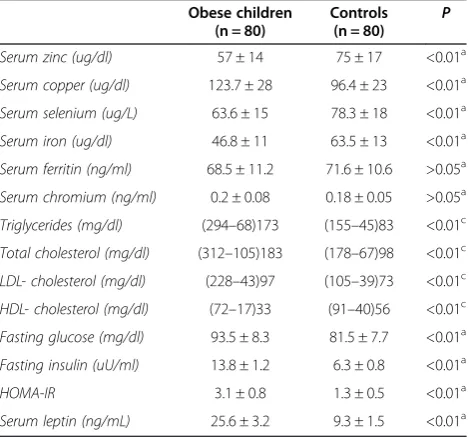
Serum Cu levels, triglycerides, total cholesterol, LDL-C, fasting blood glucose, fasting blood insulin, and HOMA-IR in obese children were significantly higher (all P< 0.01), whereas serum Zn, Se, Fe levels and HDL-cholesterol, were significantly lower than those of healthy controls (allP< 0.01). However, no significant differences were observed in serum ferritin or Cr levels between both groups (P> 0.05; Table 2). Serum leptin was significantly higher in the obese children compared to the control group (25.6 ± 3.2 vs 9.3 ± 1.5 ng/mL;P< 0.01) (Table 2).
The obese children had significantly lower median serum zinc, selenium and iron levels compared to non-obese controls (57 ± 14 vs 75 ± 17 ug/dl); (63.6 ± 15 vs 78.3 ± 18 ug/L); and (46.8 ± 11 vs 63.5 ± 13 ug/dl); re-spectively (all P< 0.01) (Figure 1A, B, C) respectively.
Simple correlation analyses were performed to investi-gate the association of serum trace elements levels with BMI and serum leptin level among studied subjects. The BMI was positively correlated with serum leptin level (r= 0.539, P< 0.01). Both serum Zn and iron levels showed significant negative correlations with BMI (r=−0.646, P< 0.01 and r=−0.479, P< 0.05; respectively) in the obese children. On the other hand, no significant correlations were found between serum Cu, Se or Cr levels and BMI in the obese children (allP> 0.05; Table 3).
Table 1 Baseline clinical data of the obese children and non-obese controls
Obese children (n = 80)
Controls
(n = 80) P
Age (years) 7.8 ± 2.3 8.1 ± 1.9 >0.05a
Male/female 44(55%)/36(45%) 40(50%)/40(50%) >0.05b
BMI (kg/m2) 28.8 ± 2.6 16.2 ± 2.4 <0.01a
BMI z score 3.7 ± 0.6 0.32 ±0.4 <0.01a Waist circumference(cm) 87.5 ± 8.7 59.6 ± 7.6 <0.01a Hip circumference(cm) 97.3 ± 5.4 73.5 ± 4.8 <0.01a Waist/hip ratio 0.89 ± 0.06 0.81 ± 0.05 <0.01a
BMI, body mass index; Values are mean ± standard deviations.a
Student’st-test. b
Chi-square test.Pvalue < 0.05 indicates a significant difference.
Table 2 Baseline laboratory data of the obese children and non-obese controls
Obese children (n = 80)
Controls (n = 80)
P
Serum zinc (ug/dl) 57 ± 14 75 ± 17 <0.01a
Serum copper (ug/dl) 123.7 ± 28 96.4 ± 23 <0.01a
Serum selenium (ug/L) 63.6 ± 15 78.3 ± 18 <0.01a
Serum iron (ug/dl) 46.8 ± 11 63.5 ± 13 <0.01a
Serum ferritin (ng/ml) 68.5 ± 11.2 71.6 ± 10.6 >0.05a
Serum chromium (ng/ml) 0.2 ± 0.08 0.18 ± 0.05 >0.05a
Triglycerides (mg/dl) (294–68)173 (155–45)83 <0.01c
Total cholesterol (mg/dl) (312–105)183 (178–67)98 <0.01c
LDL- cholesterol (mg/dl) (228–43)97 (105–39)73 <0.01c
HDL- cholesterol (mg/dl) (72–17)33 (91–40)56 <0.01c
Fasting glucose (mg/dl) 93.5 ± 8.3 81.5 ± 7.7 <0.01a
Fasting insulin (uU/ml) 13.8 ± 1.2 6.3 ± 0.8 <0.01a
HOMA-IR 3.1 ± 0.8 1.3 ± 0.5 <0.01a
Serum leptin showed significant negative correlation with serum zinc levels in the obese children (r=−0.746; P< 0.01). On the other hand, no significant correlations were observed between serum leptin and serum Cu, Se, Fe or Cr levels in the obese children (all P> 0.05; Table 3).
On the contrary, no significant correlations were ob-served between BMI or serum leptin and studied trace elements in the non-obese controls (allP> 0.05).
To maximize the clarity in Tables 4 and 5 only statisti-cally significant coefficients were included.
In the obese children, serum Zn showed significant negative correlations with serum TC levels (r=−0.454, P< 0.05; Table 4). Otherwise, serum Zn levels showed significant positive correlation with HDL-C levels (r= 0.608, P< 0.01). By contrast, no significant correlation was found between serum Cu, Se, Fe or Cr levels and lipid profile in the obese children (allP> 0.05; Table 4).
Serum Zn levels were negatively correlated with fast-ing glucose levels and HOMA-IR values in the obese children (r=−0.326,P< 0.05 and r=−0.469,P< 0.05; re-spectively; Table 5). Of note, serum Se levels showed sig-nificant positive correlations with HOMA-IR values in the obese children (r= 0.635, P< 0.01). On the other hand, no significant correlation was found between serum Cu, Fe or Cr levels and glycaemia control param-eters in the obese children (allP> 0.05; Table 5).
0 10 20 30 40 50 60 70 80 90
Obese children Control Group
(u
g/dl)
Serum iron level among studied subjects (p<0.01)
0 10 20 30 40 50 60 70 80 90 100
A
B
C
Obese children Control Group
(ug
/dl)
0 20 40 60 80 100 120
Obese children Control group
(ug /
L)
Serum zinc level among studied subjects (p<0.01)
Serum selenium level among studied subjects (p<0.01)
Figure 1Serum zinc, selenium, and iron level among studied subjects. ASerum zinc level among studied subjects.BSerum selenium level among studied subjects.CSerum iron level among studied subjects.
Table 3 Correlations of serum trace elements levels with BMI and serum leptin in the obese children
Body mass index Serum leptin
r p r p
BMI (kg/m2) - - 0.539 <0.01
Serum leptin (ng/mL) 0.539 <0.01 -
-Serum zinc (ug/dl) −0.646 <0.01 −0.746 <0.01
Serum copper (ug/dl) 0.112 >0.05 −0.245 >0.05
Serum selenium (ug/l) −0.108 >0.05 −0.078 >0.05
Serum iron (ug/dl) −0.479 <0.05 −0.245 >0.05
Serum chromium (ng/ml) −0.063 >0.05 −0.078 >0.05 BMI, body mass index. Values are Correlation coefficientr(Pearson’s Correlation
Discussion
Recent evidence suggests that deficiencies of some micro-nutrients are related to obesity and fat deposition [15]. Few studies about the role of Zn in childhood obesity were published [16,17]. Some demonstrated a reduction in serum concentration of zinc in obese children [18]. Our study confirms the significantly lower serum Zn level in the obese children compared to the non-obese controls (57 ± 14 vs 75 ± 17 ug/dl;P< 0.01). Further, we observed a significant negative correlation between serum leptin and zinc levels in the obese children (r=−0.746; P< 0.01). Zinc, in particular, takes part in the metabolism of hor-mones involved in the pathophysiology of obesity. It has been observed that zinc concentration is directly ated with serum leptin concentration, an adipokine associ-ated with satiety [19]. This association could be explained by the effect of zinc-α2-glycoprotein (ZAG) on leptin con-centrations. ZAG is an adipokine involved in lipolysis in the adipocyte that is down-regulated in obesity. In obese individuals, low ZAG gene expression is associated with low serum adiponectin and high plasma leptin levels, and may play an important role in the pathogenesis of obesity [20]. Chen et al., suggested in their study that leptin resist-ance that occurred in obesity might have resulted from zinc deficiency [21]. On the contrary, no differences were observed in zinc concentrations between obese and non-obese Turkish children [22].
Cu is a component of antioxidant enzymes that act to protect the body against the action of free radicals, espe-cially in cardiovascular diseases. An imbalance in the metabolism of Cu might trigger hypercholesterolemia and disorders in oxidative stress [23]. In trace element metabolism the best known interaction is the reported antagonism between zinc and copper [24]. The present study showed that serum Cu level in the obese children was significantly higher than those in healthy controls (P< 0.01). This agreed with Lima et al. who reported that copper concentrations in plasma in the overweight and obese groups were significantly higher than those in the control group [25]. The results found by the authors suggest that excess weight associated with lipid metabol-ism disorders might predispose to changes in Cu con-centrations in plasma indicating a possible mechanism of this mineral, contributing to peroxidation or acting as an antioxidant. Clouet et al. [26] pointed out that, simi-lar to iron, copper may also have an indirect impact on fatty acid oxidation and ATP production in mitochon-dria, helping the body’s metabolism to break down fatty acids and reduce fat.
Selenium, which is nutritionally essential for humans, is a constituent of more than two dozen selenoproteins (such as glutathione peroxidase GPx and selenoprotein P). These selenoproteins offer antioxidant protection against free radicals and other damaging reactive oxygen
Table 4 Correlations of serum trace elements with lipid profile in the obese children and non-obese controls
Obese children (n=80) Controls (n=80)
TGs TC LDL-C HDL-C TGs TC LDL-C HDL-C
Serum zinc −0.268 −0.454* −0.254 0.608** −0.056 −0.115 −0.098 0.197
Serum copper 0.193 0.038 0.078 −0.153 0.137 0.069 0.037 −0.067
Serum selenium −0.148 −0.197 −0.165 0.234 −0.091 −0.087 −0.165 0.184
Serum iron 0.094 0.158 0.186 −0.211 0.038 0.105 0.143 −0.178
Serum chromium −0.135 −0.118 −0.156 0.209 −0.112 −0.087 −0.068 0.149
TGs, triglycerides; TC, total cholesterol; LDL-C, low density lipoprotein- cholesterol; HDL-C, High density lipoprotein- cholesterol. Values are Correlation coefficientr
(Pearson’s Correlationanalysis). *P< 0.05; **P< 0.01.
Table 5 Correlations of serum trace elements with glycaemia control parameters in obese children and non-obese controls
Obese children (n=80) Controls (n=80)
Glucose Insulin HOMA-IR Glucose Insulin HOMA-IR
Serum zinc −0.326* −0.235 −0.469* −0.079 −0.063 0.096
Serum copper −0.105 −0.285 −0.163 −0.065 0.191 0.234
Serum selenium 0.203 0.119 0.635** 0.073 0.144 −0.208
Serum iron −0.181 −0.154 −0.148 0.134 −0.235 −0.265
Serum chromium 0.143 −0.268 −0.123 −0.078 0.156 −0.087
HOMA-IR, homeostasis model assessment of insulin resistance. Values are Correlation coefficientr(Pearson’s Correlationanalysis).
species [27] which are associated to the metabolic com-plications of obesity. In our study obese children had lower serum selenium levels compared to non-obese peers (63.6 ± 15 vs 78.3 ± 18 ug/L; P< 0.01). These re-sults were concordant with a recent study by Ortega et al., who found that children with excess of weight have a poorer selenium status than children of normal weight, which can contribute to poor antioxidant protec-tion [28]. By contrast, Bouglé et al., reported that none of their obese subjects did present with low Se levels; and their overall good Se status is supported by the nor-mal activity of GPx [17].
In our study, significantly decreased serum Fe levels in obese children than those of the healthy controls (46.8 ± 11 vs 63.5 ± 13 ug/dl; P< 0.01); were in agreement with the findings of many other investigators [29,30]. Of note, there was no significant difference between obese chil-dren and non-obese peers as regards to serum ferritin levels (P> 0.05). Previous studies define Fe status by its serum levels [29,30] when considering ferritin level, the prevalence of iron deficiency is quite lower. It remains unclear, however, if the lower serum iron and elevated ferritin level seen in obesity are most reflective of a func-tional iron deficiency related to an inflammatory state, or if obesity is also a risk factor for true iron deficiency [31].
The significance of chromium as a trace nutrient is well documented and its function in the control of glu-cose and lipid metabolism has been claimed [32]. Our results indicated no association between serum chro-mium levels and obesity.
In our study, obese children have significantly higher TGs, TC and LDL-C, whereas HDL-C was significantly lower compared to non-obese peers (P< 0.01). In con-trast, Woo et al., studied a cohort of obese subjects of Chinese ethnicity that did not show elevated cholesterol levels compared to a control group [33]. In addition, our results indicate that there are only few statistically sig-nificant correlations between trace elements and lipid profile was discovered in the obese children while there is no such correlation in healthy controls. In the obese children, we observed a significant negative correlation between serum Zn and TC levels (r =−0.454; P< 0.05) and a significant positive correlation existed between serum Zn and HDL-C levels (r =0.608;P< 0.01); mean-while the control group showed no such correlation. These findings indicate the possible effect of Zn level on serum lipid profile and this effect may be due to the role of Zn as an antioxidant. Thus, the decrease in Zn level in obese children may lead to increased lipid peroxida-tion and leading to increased levels of TC, TG and LDL-C. These results are concordant with those of a recent report by Gunasekara et al. who found that treatment with Zn re-duced TC, TG, and LDL-C plasma levels and increased HDL-C levels [34].
Our data showed no significant correlation between serum Cu, Se, Fe, Cr and lipid profile parameters in the obese children (P> 0.05) which confirm the results of previous studies [17,22].
In our study, association of trace elements levels with glycaemia control parameters especially HOMA-IR values was assessed. Negative correlations were found between serum Zn levels and both fasting glucose and HOMA-IR in the obese children (r=−0.326, P< 0.05 andr=−0.469,P< 0.05; respectively). Zinc plays a major role in the stabilization of insulin hexamers and the stor-age of hormone in the pancreas [35] and its deficiency seems to impair release of insulin [8]. In the present study serum Se levels showed significant positive corre-lations with HOMA-IR values in the obese children (r = 0.635;P< 0.01). These results are concordant with those of a recent report by Stranges et al., who found a signifi-cant positive association between plasma Se and glucose levels at both baseline and follow up. They stated that high-Se diets may stimulate the release of glucagon, promoting hyperglycemia, or induce overexpression of glutathione peroxidase-1 and other antioxidant seleno-proteins resulting in insulin resistance and obesity [36].
Our study pointed out that the consequences of changes in serum trace elements during childhood are much more important for the health of the public than is generally realized. Trace elements deficiencies may increase the risk of obesity and related diseases. So im-proving their status could give an opportunity to influ-ence the clinical course of obesity [17]. There are some new studies in literature investigating the serum trace el-ements in obese adolescents and adults [37,38], However to the best of our knowledge, this was the first study of these trace elements in obese Egyptian children. The small sample size was one of our limitations in this study; we suggest that multicenter approaches may be necessary to attain larger sample size. Due to the lack of evaluations on metabolic risks and pubertal status; as all our subjects were in the pre pubertal stage, it was not possible to discuss more interesting and deeper findings.
The lack of longitudinal data showing whether weight loss can reverse the values of these trace elements; was another limitation in our study.
Conclusion
The obese children may be at a greater risk of develop-ing imbalance (mainly deficiency) of trace elements which may be playing an important role in the patho-genesis of obesity and related metabolic risk factors.
Abbreviations
Competing interests
The authors declare that they have no competing interests.
Authors’contributions
SFAdesigned the study, collected samples, performed the statistical analysis, wrote discussion, and submitted the manuscript.SS and WEreviewed the results and discussion.ME and LSparticipated in the design of the study and helped to draft the manuscript. A Econceived of the study and coordinated the sample collection and analysis. All authors read and approved all the manuscript.
Acknowledgments
The authors thank the staff of Outpatient Clinics in Zagazig University Children’s Hospital for their collaboration in sampling as well as our patients who participated in the study. Our institutional review committee of ethical research approved the study.
Author details
1Faculty of Medicine, Zagazig University, 18 Omar Bin Elkhattab St, Al Qawmia,
Zagazig City, Sharkia Governorate, Egypt.2Faculty of Medicine, Zagazig University, Zagazig, Egypt.
Received: 9 December 2013 Accepted: 12 February 2014 Published: 20 February 2014
References
1. World Health Organization:Global strategy on diet, physical activity, and health: childhood overweight and obesity.http://www.who.int/dietphysical activity/childhood/en/.
2. World Health Organization:Obesity: preventing and managing the global epidemic, report of a WHO consultation, WHO technical report series,No. 894.Geneva: WHO; 2000. http://www.who.int/nutrition/publications/obesity/WHO_TRS_894/en/. 3. Lobstein T, Baur L, Uauy R:IASO international obesity TaskForce: obesity in
children and young people: a crisis in public health.Obes Rev2004,5(1):4–104. 4. Wang Y, Lobstein T:Worldwide trends in childhood overweight and
obesity.Int J Pediatr Obes2006,1:11–25.
5. Krebs NF, Jacobson MS:American academy of pediatrics committee on nutrition: prevention of pediatric overweight and obesity.Pediatrics2003,112(2):424–430. 6. Grundy SM:Multifactorial causation of obesity: implications for
prevention.Am J Clin Nutr l1998,67:563S–572S.
7. Thaler JP, Schwartz MW:Minireview: Inflammation and obesity pathogenesis: The hypothalamus heats up.Endocrinology2010,151:4109–4115.
8. Lobo JC, Torres JP, Fouque D, Mafra D:Zinc deficiency in chronic kidney disease: is there a relationship with adipose tissue and atherosclerosis?
Biol Trace Elem Res2010,135:16–21.
9. Wintergerst ES, Maggini S, Hornig DH:Contribution of selected vitamins and trace elements to immune function.Ann Nutr Metab2007,51:301–323. 10. Group. WMGRS:WHO Child Growth Standards: Length/height-for-age,
weight-for-age, weight-for-length, weight-for-height and body mass index-for-age: Methods and development.InOrganization GWH.2006:312. http://www.who.int/childgrowth/standards/Technical_report.pdf. 11. Nuttall KL, Gordon WH, Ash KO:inductively coupled plasma mass
spectrometry for trace element analysis in the clinical laboratory.
Anal Clin Lab Sci1995,25:264–271.
12. DRG International Inc:DRG Leptin (Sandwich) ELISA (EIA-2395) [Internet] Springfield: DRG International Inc.; c2012.2013. http://www.drg-international. com/ifu/eia-2395.pdf.
13. Pearson TA, Blair SN, Daniels SR, Eckel RH, Fair JM, Fortmann SP, Franklin BA, Goldstein LB, Greenland P, Grundy SM, Hong Y, Miller NH, Lauer RM, Ockene IS, Sacco RL, Sallis JF Jr, Smith SC Jr, Stone NJ, Taubert KA:
AHA Guidelines for Primary Prevention of Cardiovascular Disease and Stroke: 2002 Update: Consensus Panel Guide to Comprehensive Risk Reduction for Adult Patients Without Coronary or Other Atherosclerotic Vascular Diseases, American Heart Association Science Advisory and Coordinating Committee.Circulation2002,106(3):388–391.
14. Matthews DR, Hosker JP, Rudenski AS, Naylor BA, Treacher DF, Turner RC:
Homeostasis model assessment: insulin resistance andβ-cell function from fasting plasma glucose and insulin concentrations in man.
Diabetologia1985,28:412–419.
15. Garcia OP, Long KZ, Rosado JL:Impact of micronutrient deficiencies on obesity.Nutr Rev2009,67(10):559–572.
16. Costarelli L, Muti E, Malavolta M, Cipriano C, Giacconi R, Tesei S, Piacenza F, Pierpaoli S, Gasparini N, Faloia E, Tirabassi G, Boscaro M, Polito A, Mauro B, Maiani F, Raguzzini A, Marcellini F, Giuli C, Papa R, Emanuelli M, Lattanzio F, Mocchegiani E:Distinctive modulation of inflammatory and metabolic parameters in relation to zinc nutritional status in adult overweight/ obese subjects.J Nutr Biochem2010,21:432–437.
17. Bouglé DL, Bureau F, Laroche D:Trace element status in obese children: Relationship with metabolic risk factors.e-SPEN, The European e-Journal of Clinical Nutrition and Metabolism2009,4(2):98–100.
18. Do Nascimento Marreiro D, Fisberg M, Franciscato Cozzolino SM:Zinc nutritional status in obese children and adolescents.Biol Trace Elem Res
2002,86:107–122.
19. Mantzoros CS, Prasad AS, Beck FW, Grabowski S, Kaplan J, Adair C, Brewer GJ:Zinc may regulate serum leptin concentrations in humans.J Am Coll Nutr1998,17(3):270–275.
20. Mracek T, Ding Q, Tzanavari T, Kos K, Pinkney J, Wilding J, Trayhurn P, Bing C:
The adipokine zinc-alpha2-glycoprotein (ZAG) is downregulated with fat mass expansion in obesity.Clin Endocrinol (Oxf )2009,72(3):334–341. 21. Chen MD, Lin PY:Zinc-induced hyperleptinemia relates to the amelioration
of sucrose-induced obesity with zinc repletion.Obes Res2000,8:525–529. 22. Tascilar ME, Ozgen IT, Abaci A, Serdar M, Aykut O:Trace elements in obese
Turkish children.Biol Trace Elem Res2010,143(1):188–195.
23. Klevay LM:Cardiovascular disease from copper deficiency-a history.J Nutr
2000,130(Suppl 25):489–492.
24. Dambal SS, Indumati V, Kumari S:Relationship of obesity with micronutrient status.IJABPT2011,2:280–284.
25. Lima SC, Arrais RF, Sales CH, Almeida MG, de Sena KC, Oliveira VT, de Andrade AS, Pedrosa LF:Assessment of copper and lipid profile in obese children and adolescents.Biol Trace Elem Res2006,114:19–29.
26. Clouet P, Henninger C, Bezard J:Study of some factors controlling fatty acid oxidation in liver mitochondria of obese Zucker rats.Biochem J1986,239:103–108. 27. Sunde RA:Selenium. InModern Nutrition in Health and Disease.11th edition.
Edited by Ross AC, Caballero B, Cousins RJ, Tucker KL, Ziegler TR. Philadelphia, PA: Lippincott Williams & Wilkins; 2012:225–237.
28. Ortega RM, Rodríguez-Rodríguez E, Aparicio A, Jiménez-Ortega AI, Palmeros C, Perea JM, Navia B, López-Sobaler AM:Young children with excess of weight show an impaired selenium status.Int J Vitam Nutr Res2012,82(2):121–129. 29. Sanad M, Osman M, Gharib A:Obesity modulate serum hepcidin and
treatment outcome of iron deficiency anemia in children: a case control study.Ital J Pediatr2011,37:34.
30. Moayeri H, Bidad K, Zadhoush S, Gholami N, Anari S:Increasing prevalence of iron deficiency in overweight and obese children and adolescents (Tehran Adolescent Obesity Study).Eur J Pediatr2006,165:813–814. 31. Yanoff LB, Menzie CM, Denkinger B, Sebring NG, McHugh T, Remaley AT,
Yanovski JA:Inflammation and iron deficiency in the hypoferremia of obesity.Int J Obes (Lond)2007,31(9):1412–1419.
32. Balk EM, Tatsioni A, Lichtenstein AH, Lau J, Pittas AG:Effect of Chromium Supplementation on Glucose Metabolism and Lipids: A systematic review of randomized controlled trials.Diabetes Care2007,30(8):2154–2163. 33. Woo KS, Chook P, Yu CW, Sung RY, Qiao M, Leung SS, Lam CW, Metreweli
C, Celermajer DS:Overweight in children is associated with arterial endothelial dysfunction and intima-media thickening.Int J Obes Relat Metab Disord2004,28:852–857.
34. Gunasekara P, Hettiarachchi M, Liyanage C, Lekamwasam S:Effects of zinc and multimineral vitamin supplementation on glycemic and lipid control in adult diabetes.Diabetes Metab Syndr Obes2011,4:53–60.
35. Wijesekara N, Chimienti F, Wheeler MB:Zinc, a regulator of islet function and glucose homeostasis.Diabetes Obes Metab2009,11(Suppl 4):202–214. 36. Stranges S, Sieri S, Vinceti M, Grioni S, Guallar E, Laclaustra M, Muti P, Berrino
F, Krogh V:A prospective study of dietary selenium intake and risk of type 2 diabetes.BMC Public Health2010,21:564.
37. Suliburska J, Cofta S, Gajewska E, Kalmus G, Sobieska M, Samborski W, Krejpcio Z, Drzymala-Czyz S, Bogdanski P:The evaluation of selected serum mineral concentrations and their association with insulin resistance in obese adolescents.Eur Rev Med Pharmacol Sci2013,17(17):2396–2400. 38. Yerlikaya FH, Toker A, ArıbaşA:Serum trace elements in obese women
with or without diabetes.Indian J Med Res2013,137(2):339–345.
doi:10.1186/1824-7288-40-20