An Innovative Framework for Exploring the Museum Experience
Shunli Liu1 and Muhammad Zaffwan Idris2*
1Faculty of Art, Computing & Creative Industry, UniversitiPendidikan Sultan Idris, TanjongMalim, Perak, 35900, Malaysia
2Faculty of Art, Computing & Creative Industry, UniversitiPendidikan Sultan Idris, TanjongMalim, Perak, 35900, Malaysia
IJMSSSR 2020 VOLUME 2
ISSUE 1 JANUARY – FEBRUARY ISSN: 2582-0265 Abstract: This paper contributes our overall research project on museum user experience (UX), and the purpose of the paper is to construct an appropriate framework for our current research project to support the researcher in presenting stories about how representative users experience the museum. From a methodological point of view, this study employed service design (SD) approach through a combination of two models/frameworks: the Gamification-based persona model “four types of players”, as well as the service process-based framework “pre-during-post”.
Keywords: User Experience, UX, Museum, Framework, Service Design
1. Introduction
An important change in the museum over the past half century has been the adjustment from collections to serving the public. In particular, previous studies have shown that 80% of visitors spend time in museum for the aim of an experience. As the user-centric service design (SD) places great emphasis on personal experience, the SD methods can be used to investigate the experience and understand the needs of visitors. Specifically, SD aims to provide users or customers with experiences over time to improve their experiences. As for this study, two models/frameworks in SD will contribute the generation of a new framework for investigating museum user experience (UX).
2. Background
3. Purpose of this Study
The purpose of this paper is to construct a desirable framework for our current museum UX research project to support the entire project in presenting stories about how representative users experience the museum. So far, to be frankly, despite previous studies on UX, the method of assisting researchers in exploring museum UX is still traditional, and its effect is not good. It is hoped that this research will provide insights for museum practitioners and scholars so that they have a better understanding of how to explore the museum service experience, thereby helping to make better designs or research.
4. Persona Technique in Service Design (SD)
As mentioned early, user-centric SD is strongly focused on individual experience, the distinct motivations of museum users must be considered. As stated by Shen Maosheng that the first thing to do is to understand the composition of the museum visitors (Tian, 2018). Coincidentally, Falk and Dierking (2013) also made a similar statement: “it is important to understand who your visitors are and develop an interpretive plan will meet their needs and interests.” Further, according to many previous studies, the target of experience is based on the hypothesis that the experience is exactly related to the specific needs or interests of the user you created. These all provided rationalities for the launching of persona technique.
Persona typically refer to fictional personality, representing hypothetical user groups with common interests, common behavioral patterns, or demographic and geographic similarities (Stickdorn, Hormess, Lawrence, & Schneider, 2018; Law & Leicester, 2018). In contrast, traditional user persona strategies focus on only one character consistent with UX design. As an extension of UX, recent practice has emphasized the context that multiple roles may support SD (Law & Leicester, 2018). Accordingly, persona technique in SD is expected to solve the imperative bother of understanding the composition of museum visitors raised in previous literature (Tian, 2018).
On how to apply the technique of persona, Nielsen and Hansen (2014) draws on a large number of previous findings on persona from research to practice, and concluded most authors believe that personas should usually be generated at the beginning. They are based on field data such as surveys, user interviews, observations or combinations thereof. In addition, other authors point out that the touch point is a technique for understanding and jotting down personas’ experiences (Nielsen & Hansen, 2014; Touloum et al., 2017; Touloum, Idoughi, & Seffah, 2018; Stickdorn, Hormess, Lawrence, & Schneider, 2018).
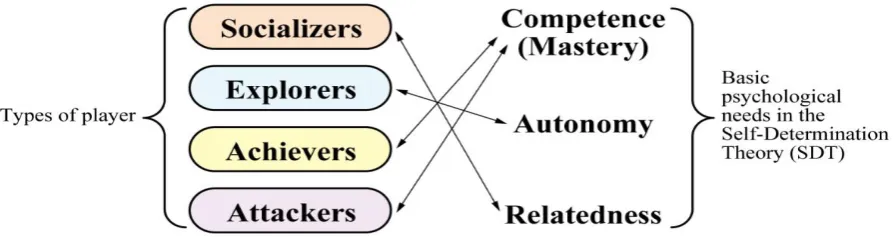
Figure 2. Framework of gamer psychology (Liu & Zaffwan, 2018)
5. Service Process-based Framework “Pre-During-Post”
A great deal of previous research illustrate that the main challenge for researchers is to understand museum UX through on-site and online (ICOM, 2016; Ober-Heilig, Bekmeier-Feuerhahn, & Sikkenga, 2014; Neumeier, 2005; Kim, 2008). Meanwhile, in the field of museum branding, there is almost no systematic research using SD methods to explore UX by considering both on-site and online. With regard to the sustainable development of museums, although most of the studies focus on ‘During-visit’ (on-site), a few studies have recognized the critical role played by ‘Pre-visit’ and ‘Post-visit’ (online) (Falk & Dierking, 2013; Liu & Liu, 2017). Accordingly, this section highlights a “pre-during-post” framework based on service stages. Returning briefly to the subject of SD methods, many tools have been mentioned in previous literature: creating persona, journey maps, writing user stories, online ethnography, service safari, shadowing, diary research, context cards, and various forms of interviews. Despite various tools described above, they can be still organized throughout the service phases.
In customer SD theory, there is a large volume of published studies describing the three service phases (e.g., Qin, 2014). In this framework, specifically, service touch points can be divided into three stages: ‘Pre-Service’, ‘During Service’, and ‘Post-Service’, which may be managed by the collaboration of front and backstage. Accordingly, Falk and Dierking (2013), Liu and Liu (2017) in their study noted that the visitors’ experience of the museum is also ordered into three service stages: ‘Pre-visit’, ‘During-visit’, and ‘Post-visit’ (Figure 2). Falk and Dierking (2013) noted the museum experience begins before visiting the museum and continues long after visitors leave the museum. In other words, in addition to the ‘During-visit’ stage of the visitor in the physical museum, the audience experience away from the museum during ‘Pre-visit’ and ‘Post-visit’ phases is also part of the overall experience.
6. A Framework for Museum Experience Investigation
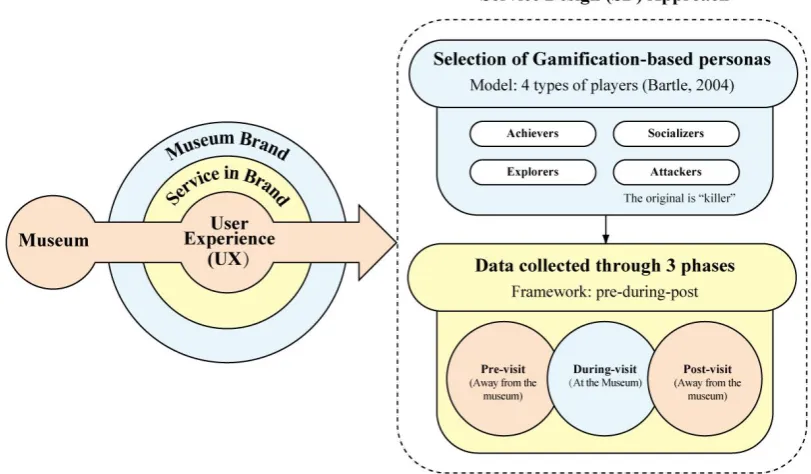
By adopting the SD method, this study attempts to construct a framework to assist museums in providing stories about how representative users experience museums. In particular, this study will first identify gamified personas and then evaluate the online and offline services of the museum throughout ‘Pre-visit’, ‘During-visit’, and ‘Post-visit’. To clarify concepts and propose relationships among concepts, the framework for this exploratory study was established and proposed (Figure 3).
Figure 3. A framework for museum experience investigation
The conceptual framework above shows ideas for how to explore the museum. The research is mainly performed through two models/frameworks: the Gamification-based persona model “four types of players”, as well as the service process-based framework “pre-during-post”. Between them, the Gamification-based model is used to select personas, and the SD process-based model is associated with the three stages with touch points.
7. Discussion and Conclusion
This study has employed SD approach to create an innovative framework for our museum UX research project to help further understand users. Based on the understanding of SD methods, the entire research will investigate museum experience during the whole service stages: ‘Pre-visit’, ‘During-visit’, and ‘Post-visit’, with its research environment include both ‘physical’ and ‘virtual’. In particular, the highlights of this framework are that adopting of Gamification-based personas can facilitate the improvement of users’ engagement and increase the satisfaction of individuals, which is regarded the user-centric philosophy. Collectively, compared with those traditional methods, the findings obtained by the interdisciplinary method in this study have practical significance. Thereby, this study will hopefully provide insights to museum practitioners and scholars to have a better understanding of museum service UX so as to help develop a better design or research.
8. References
1. Bartle, R. A. (2004). Designing Virtual Worlds. US: New Riders.
4. Falk, J. H., & Dierking, L. D. (2013). Museum Experience Revisited (2nd ed.). Left Coast Press.
5. Garrett, J. J. (2011). The Elements of User Experience: User-Centered Design for the Web and Beyond (2nd ed.). Berkeley: New Riders.
6. Hamari, J., & Koivisto, J. (2015). Why Do People Use Gamification Services? International Journal of Information Management, 35(4), 419–431. https://doi.org/10.1016/j.ijinfomgt.2015.04.006
7. ICOM. (2016). ICOM MILANO 2016: 24th General Conference Museum and Cultural Landscapes. Milan, Italy.
8. Kim, S. (2008). Understanding of Museum Branding and Its Consequences on Museum Finance. University of Akron.
9. Law, E. L., & Leicester, L. E. (2018). From UX Design Methods to Service Design Methods: Is it just a Matter of Scalability? In Experience Design Meets Service Design – Method Clash or Marriage? workshop in conjunction with CHI’18. Montreal, Canada.
10. Liu, J., & Liu, F. L. (2017). Public Service Design of Internet+ Museum Based on Role Cognition: Taking the Palace Museum as an Example. Art & Design, (11), 118–119.
11. Liu, S. L., & Zaffwan, M. I. (2018). Constructing A Framework of User Experience for Museum Based on Gamification and Service Design (Vol. 04007, pp. 1–5). Luoyang, China.
12. Liu, S. L., & Zaffwan, M. I. (2019). Exploring Museum Service Experience Using Gamification-based Personas with Distinct Motivations. In IOP Conference Series: Materials Science and Engineering (pp. 3– 8). Luoyang, China. https://doi.org/10.1088/1757-899X/573/1/012020 Murphy, J. (1988). Branding. Marketing Intelligence & Planning, 6(4), 4–8.
13. Neumeier, M. (2005). The Brand Gap: Revised Edition (2nd ed.). Peachpit Press.
14. Nicholson, S. (2015). A RECIPE for Meaningful Gamification. (T. Reiners & L. C. Wood, Eds.), Gamification in Education and Business. New York.
15. Nielsen, L., & Hansen, K. S. (2014). Personas is Applicable: A Study on the Use of Personas In Denmark. In Proceedings of the SIGCHI Conference on Human Factors in Computing Systems (pp. 1665–1674). ACM.
16. Ober-Heilig, N., Bekmeier-Feuerhahn, S., & Sikkenga, J. (2014). Enhancing Museum Brands with Experiential Design to Attract Low-involvement Visitors. Arts Marketing: An International Journal, 4(1/2), 67–86. https://doi.org/10.1108/AM-01-2014-0006
17. Qin, Z. (2014). To Enhance Service Experience Through Service Touchpoints Design. Package & Design, (3), 103–105.
18. Sandoval, S., & Sortland, O. (2013). Building A Service Design Explanation. Retrieved from http://odasortland.com/service-design-explanation/
19. Segelström, F., Raijmakers, B., & Holmlid, S. (2009). Thinking and Doing Ethnography in Service Design. IASDR: Rigor and Relevance in Design, (January 2009), 1–10.
20. Shan, J. X., & Mao, Y. (2016). From the Forbidden City to the Palace Museum: An Interview with Director Shan Jixiang. Southeast Culture, (5), 12–19.
21. Stickdorn, M., Hormess, M. E., Lawrence, A., & Schneider, J. (2018). This Is Service Design Doing: Applying Service Design Thinking in the Real World. O’Reilly Media, Incorporated.
22. Tian, J. (2018). Summary of the 2017 Annual Conference of the Archaeological & Heritage Museum of the China Museum Association. Newsletter of China Museums, (2), 19–24.
23. Touloum, K., Idoughi, D., & Seffah, A. (2017). User Experience in Service Design: A Case Study from Algeria. IT Professional, (February), 56–58.
24. Touloum, K., Idoughi, D., & Seffah, A. (2018). Adding UX in the Service Design Loop: The Case of Crisis Management Services. Interaction Design and Architecture(S), (37), 47–77.