OPEN A
CCE
SS
JZ
AR E
videnc
e-based practic
OPEN A
CCE
SS
Evidence-based practice
Comparison of growth rates of hand-reared and mother-reared Sunda
pangolin (
Manis javanica
) pups at the Night Safari (Singapore).
Francis Cabana1, Claudia Tay1, Irfan Arif21Wildlife Reserves Singapore, 80 Mandai Lake Road, 729826, Singapore 2Korean Advanced Institute of Science and Technology
Correspondance: F Cabana PhD; [email protected]; Phone: +65 63608652
Keywords: carnivore, diet, metabolism, milk replacer, myrmecophage
Article history:
Received: 19 Jun 2018 Accepted: 06 Nov 2018 Published online: 31 Jan 2019
Abstract
The Sunda pangolin (Manis javanica) is a critically endangered myrmecophagous mammal, found
throughout Southeast Asia. A rescue centre receiving custom’s seizures must be able to rehabilitate
these animals. Unfortunately, gestating females tend to either abort or give birth during this period of stress, leaving rescue centres with new-born pups, perhaps needing hand-rearing. The Night Safari (Singapore) has been caring for M. javanica since 2005 through rescue operations; however, they officially became part of the animal collection in 2008. On two separate occasions, motherless pups have been brought to the rescue centre by officials, and had to be hand-reared, both fed a feline milk replacer. The aim of this study was to compare the growth rates of hand-reared versus mother-reared pangolin pups. The hand-reared pups had a significantly lower growth rate than mother-reared pups. The hand-reared pup’s growth rate slowed significantly at around day 80. Feline milk was nonetheless successful but did not have a growth rate similar to mother-reared. Other myrmecophagous milks become energetically denser, and the protein to fat ratio decreases throughout lactation. This could be trialled in future hand-rearing cases to compare growth rates.
Background
The Sunda pangolin (Manis javanica) is a critically endangered myrmecophagous mammal, found throughout Southeast Asia, from Indonesia to Thailand, Cambodia, Laos and Vietnam (Challender et al. 2011). It is reported as one of the most trafficked animals on earth, placing successful rescue, rehabilitation and animal release as a top priority for their conservation (Chin and Pantel 2008; Ling 2008; Newton et al. 2008; Chin et al. 2015). When a seizure occurs, rescue centres may receive a single confiscation of up to 160 animals, as is routinely observed in Vietnam. A rescue centre must
be able to rehabilitate these animals through adequate housing, husbandry and veterinary care. This is not easily
accomplished as pangolins require a specialised diet with a complex transitioning period from live ants to an artificial diet
(Cabana et al. 2017) and they are often received by the centre stressed, injured and immunocompromised (Chin et al. 2006). Unfortunately, gestating females tend to either abort or give birth during this period of stress, leaving rescue centres with new-born pups. In even more unfortunate circumstances, the mother may die, leaving the rescue centre staff to hand-rear
the baby pangolin.
The Night Safari (Singapore) has been caring for M. javanica
since 2005 through rescue operations; however, they officially became part of the animal collection in 2008. The Night Safari now has a proven longevity record of being the first institution
worldwide to successfully breed surviving M. javanica pups
Neonate survival should be higher if the milk replacer has similar nutrient composition of that same species; however, pangolin
milk has not yet been analysed. Previous milk replacers consisted
of diluted evaporated milk; however, commercial milk replacers now on the market may be more suitable for a variety of species
(Livers 1973). Manis javanica was previously hand-reared in 2005;
however, the paper did not supply specific information on the milk replacer used (Stich 2005). Other reported successes used kitten
milk (Nguyen et al. 2013). Success has also been recorded in an
Indian pangolin (Mohapatra and Panda 2014). The milk replacer used was Royal Canin puppy milk, which led to a healthy adult (Mohapatra et al. 2013). Thus, both artificial canine and feline milks have successfully been used for hand-rearing pangolins.
The aim of this study was to compare the growth rates of
pangolin pups raised on a commercial milk replacer versus those
reared by their mothers to compare efficiency and appropriateness of current suggested methods.
Action
Hand and mother-reared pangolin pups
On two separate occasions, we received pangolin pups for hand-rearing. The first (February 2016) was hand-reared using KMR kitten milk (PetAg, USA) and the second (June 2017) was hand-reared using Milk Matrix 42/25 (PetAg, USA). Different formulas were used because of rupture of inventory. For the first two days, the milk replacers were supplied at 50% strength, on the third day 75%, with full strength on the fourth day, as recommended by Nguyen et al. (2013). Hand-reared animals were weighed regularly (scales accurate to 0.1g), on average every two weeks, and mother-reared animals (all individuals, Table 1) were weighed opportunistically, depending on when they were awake and
not riding on their mother’s back, to prevent any unnecessary
stress. They were lifted by their tail and placed in a cotton bag and weighed. The weight of the bag was then subtracted, and the resulting weight of the pups was recorded. The pups did not seek to escape, or struggle and this technique is widely used by pangolin holders for the safety of the animal and handler (Nguyen et al. 2013). Since the age (in days) of the two rescue animals was unknown, weights were compared between the two groups after 7 days, as it was assumed they may have been underweight upon arrival (body condition score between 1 and 2), because it was not known how long they had been without milk. Aligning the
weights, age was estimated based on the known age and weights of the captive-bred pups in order to compare growth rates.
Nutrient and energy intake
The weight of food ingested at each meal was recorded and the nutrient analysis available from the Zootrition© (Saint Louis, MO, USA) database and Cabana et al. (2017) (Table 2) was used to calculate the crude protein, crude fat and metabolisable energy (ME) intakes of the pangolin pups. To calculate ME, the average digestibility quotients from Lin et al. (2015) diets 1 and 2 were used (as their diet 3 was too different from the present study’s artificial diet and digestibility numbers were significantly different). The following ME values were used: crude protein 14.39 kJ/g (average digestibility of 86.05%), crude fat 35.15 kJ/g (average digestibility of 93.40%) and total non-structural carbohydrates remained at 16.74 kJ/g as due to unknown information on this fraction for pangolins. The milk proteins may have a higher digestibility than solid food protein; however, since these values are also unknown for pangolins, 14.39 kJ/g was used for both. No energy derived from neutral detergent fibres (NDF) was included in the diet, and calculated values were considered as minimum estimated ME
intakes. Statistics
A linear regression model was used to analyse the growth of the pangolin pups. Most reviewed growth models (i.e., such as Gompertz or Logistic), consider growth over the whole lifespan of the species, whereas the present study considered growth only up to day 161 (spanning through weaning, slightly into subadult growth).
An analysis of covariance (ANCOVA) was carried out under two models using R Statistical Package. A first model (coded df.ml), analysed the weight variance of the pangolins according to age only, whereas a second (coded df.lmint) analysed the weight variance of the pups by the interaction between their age and
rearing methods.
The body weight data of each pangolin was plotted according to its age in days and two lines were created (Loess method), one for hand-reared and one for mother-reared to visually represent the growth rates. A sudden change in growth rate was observed around the 80th day for hand-reared pups; this structural break was analysed using a Chow-test (Breitung and Eickmeier 2011) to determine if relevant.
Table 1. Information on captive bred and rescued Sunda pangolin (Manis
javanica) pups reared by the Night Safari (Singapore). Table 2. javanicaNutrient contents of diet items offered to Sunda pangolins () during hand-rearing and weaning at the Night Safari (Singapore) Manis (dry matter basis).
Individual Sex Origin Date Born Age at Death
Radin m Captive Bred 13/7/2014 Alive
Serai f Captive Bred 7/10/2016 9 M
Wanita f Captive Bred 14/1/2011 Alive
Anggun m Rescued 31/12/2015* Alive
Sandshrew m Rescued 11/12/2016* Alive
Nutrient KMR Milk Matrix 42/25 Ant eggs Artificial Diet
Moisture 6 6 29.8 57.2
Ash (%) 6.6 7.37 5.6 3.83
Crude Protein (%) 42.0 42.0 51.8 31.33
Crude Fat (%) 25.0 25.0 25.8 16.37
NDF (%) 0 0 12.8 7.63
ME (kJ/g) 19.25 19.12 17.19 17.11 *Date of birth of rescued pangolins was estimated according to weight.
Consequences
Nutrient content of milk replacers
Carnivorous milk replacers of choice included KMR and Milk Matrix 42/25, which have been developed for the feline physiological model. Both are from the same manufacturer and contain similar ingredients (vegetable oil and casein proteins), with similar concentrations of crude fat and crude protein, and only slightly different micronutrients (Table 2). The small differences in micronutrients would not be expected to have a significant impact on the growth of the pangolin pups. Both milk formulas led to similar growth rates in the pangolin pups.
Nutrient intake
Growth rates of hand- versus mother-reared pangolin pups
The two hand-reared pups received different diets: as neonates and following weaning. Pup 1 was fed its artificial diet much earlier than pup 2 as he found it palatable and was thus weaned earlier (Table 3). Pup 2 ate ant eggs and milk for a longer period of time (until 126 days of age) due to difficulties transitioning to the artificial diet. The growth rates of mother-reared and hand-reared pangolin pups had significantly different residuals when controlled for estimated age (T=10.3, P=0.001), with mother-reared pangolins having a faster growth rate compared to the hand-reared pangolins. The mother-reared animals displayed a steeper and more linear growth rate compared to the hand-reared pups (on average 14.33 g gained/day versus 7.48 g gained/day respectively, Figure 1). According to the Chow Test, the sudden change in slope of the hand-reared line was significantly different than before the change (F=19.5, P=0.0001). There was no significant difference in growth curves noted, despite different energy intakes mentioned. The mother-reared pangolins had a significantly higher growth rate when compared to the hand-reared pangolins. This result might be expected, as hand-reared large hairy armadillos
(Chaetophractus villosus) were on average 26% lighter than parent-reared pups (Beekman et al. 1999; Gage 2002; Olocco and Duggan 2004) whereas after weaning, the pangolins were roughly 34% lighter than mother-reared. The rearing techniques were nonetheless successful, as the pups weaned successfully, transitioned to adult artificial diets, reached adult weights and are undergoing rehabilitation process for eventual release. They are generally considered adult at two years old and could weigh between 2 and 4 kg at that age. A break in the growth rate of the hand-reared pups was also observed, with a sharp decrease in growth rate after day 80. The nutrient content of the milk formula used over time, the composition of solid food introduced, or the process of weaning may each have led to this change in growth
rates.
Table 3. Rearing diets of two rescued Sunda pangolins (Manis javanica) at the Night Safari (Singapore) where 1 was fed KMR (PetAg, USA) and 2 was fed Milk Matrix 42/25 (PetAg, USA).
Age (day, calc) Mean Milk Consumed (ml/day) ±
Standard Deviation # Feeds per day Mean % Body Weight Milk Consumed Other Foods Consumed
Pup 1 Pup 2 Pup 1 Pup 2 Pup 1 Pup 2
31-45 61.2 ± 28.5 4 11
46-60 105.7 ± 22.1 118.0 ± 27.6 4 12.6 16.4
61-75 73.3 ± 28.0 110.7 ± 26.7 3 7.7 12.2 10 g ant eggs 10 g ant eggs
76-90 56.0 ± 20.0 98.0 ± 37.8 2-3 5.0 8.8 10 g ant eggs 10 g ant eggs
91-105 18.3 ± 20.3 66.0 ± 14.2 2 1.6 5.8 20 g ant eggs + 50 g Diet 70 g ant eggs
106-120 Weaned 70.0 ± 0.0 2 5.9 90 g ant eggs
121-135 70.0 ± 0.0 2 5.3 90 g ant eggs
136-150 46.0 ± 12.4 1-2 3.2 120 g ant eggs
151-165 49.1 ± 3.0 1 3.4 120 g ant eggs
Bo
dy
w
ei
gh
t
Age.Day
Rearing
Different nutrient intakes
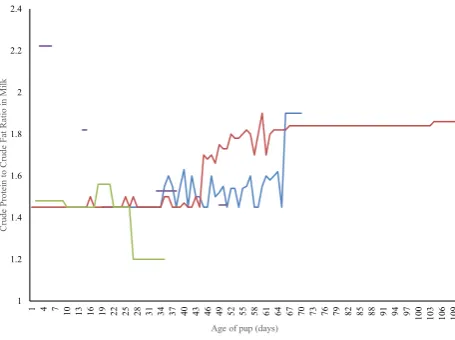
During the milk only phase, the differences in nutrients ingested between both hand-reared pangolins were negligible as both milk formulas had similar macronutrient formulations. Variation in nutrients ingested appeared when solids were introduced into the diet. The daily crude protein concentration of ingested diets ranged from 33.6 to 50.1% [average 44.9% S.D.±3.9, dry matter basis (DMB)], whereas crude fat concentrations ranged from 17.4 to 29.7% (average 26.9% S.D.±2.9 DMB). This maintained the crude protein to crude fat ratio (CP:CF) between 1.4 and 1.9 (average 1.7 S.D.±0.2) with the trend being generally to increase (Figure 2). This is contrary to the CP:CF of aardvark milk (White et al. 1985) or
nine-banded armadillo (Dasypus novemcinctus) milk which starts
off much higher and also decreases (Power et al. 2018).
No analysis of pangolin milk has yet been published, and all trials to extract milk from pangolins at Night Safari (personal
observation) or Save Vietnam’s Wildlife (personal communication
Nguyen 2016) have failed; instead it is necessary to rely on nutrient composition information from models such as giant anteaters, armadillos and aardvarks. Aardvarks are a useful model, as up to 70% of captive-born aardvarks require hand-rearing under human care, therefore their milk and rearing has been extensively studied (Stetter 2003). Armadillo milk may be a more appropriate
model, although less extensively studied. Anteater, armadillo
and aardvark milks are relatively low in lactose which decreases further throughout the lactation period (White et al.1985; Power et al. 2018). By mid-lactation, only 1.6% of the milk’s energy comes from lactose in aardvark milk, as opposed to 28% from cow’s milk (White et al. 1985).
Different studies report different average values of giant anteater milk nutrient composition. Earlier studies report crude protein concentration of 30% and crude fat concentration of 54% DMB (Spector 1956), while more recent studies state average values of 49.6% crude protein and 8.8% crude fat DMB (Power et al. 2015). Aardvark milk averaged 33% crude fat and 42% crude protein (White et al. 1985). A direct comparison is not possible between the milks of these different animals as each
study is composed of a different number of samples at different intervals throughout lactation, some of which are not mentioned. It is common for the composition of mammal milk to change throughout the lactation period, exemplified by the aardvark milk which has been analysed at different points in time. Its crude protein concentration increases slightly (+0.8%); however, crude fat increases (+7.5%) within the first month alone (White et al. 1985). Thus, the crude protein to crude fat ratio (CP:CF) started at 1.46 and decreases to 1.16 within a month (Figure 2). Although it is unclear at which stage in lactation the milk sample was taken, the average anteater milk’s CP:CF is high at 5.63 and decreases throughout lactation (Power et al. 2015). Contrary to the decreasing CP:CF of aardvark milk, the hand-rearing formula in the present study started with similar values of 1.46; however, as solid foods were added, the ratio increased up to 1.91. This may explain why growth rates appear similar until day 80, followed by a break in the growth rate. Giant armadillo milk begins with a high CP:CF of 2.23 and decreased to 1.45 within 50 days (Power et al. 2018). This milk has a high mineral content which is correlated with its high protein content. This may be necessary to grow the armadillo’s bony carapace and may also help with growing pangolin scales. Being made of keratin, they would also require significant amounts of protein and calcium for synthesis, making
the armadillo a more suitable model.
As the CP:CF of aardvark milk decreases, the energy value of the milk increases by nearly 15% over 30 days as fed (White et al. 1985). Successfully hand-reared aardvark pups drank Milk Matrix 42/25 mixed with 30/55 in a 62:38 ratio, which increases the crude fat from 25 to 38%, and decreases the CP:CF from 1.46 to 1.02% (Mutlow and Mutlow 2008). Bickel et al. (1976) added coffee cream to their KMR to increase the crude fat concentration of milk for their giant anteater pup even though giant anteater milk is lower in fat compared to the aardvark or nine-banded armadillo (Power et al. 2015). Assuming the aardvark or armadillo are appropriate models for Sunda pangolins, they may have an increased metabolic need after day 80 which must be supported by a higher fat, ergo higher energy, milk replacer. This is supported
1 1.2 1.4 1.6 1.8 2 2.2 2.4
1 4 7 10 13 16 19 22 25 28 31 34 37 40 43 46 49 52 55 58 61 64 67 70 73 76 79 82 85 88 91 94 97 100 103 106 109
Cr ude P rot ei n to Cr ude F at R at io i n M ilk
Age of pup (days)
Pangolin 1 Pangolin 2 Aardvark Armadillo
0 200 400 600 800 1000 1200
0 0.2 0.4 0.6 0.8 1 1.2 1.4 1.6
M et ab ol isab le En er gy In ges ted (k J)
Metabolic Body Weight (kg0.75)
Figure 2. Crude protein: crude fat ratios ingested throughout the hand-rearing of two Sunda Pangolins (Manis javanica, red and blue) compared
with aardvark (Orycteropus afer, green) and nine-banded armadillo
(Dasypus novemcinctus, purple) milk composition over time. Aardvark milk composition from White et al. (1985) and armadillo milk composition from Power et al. (2018).
Figure 3. Metabolisable energy ingested (kJ) and metabolic body weight (kg0.75) by two hand-reared Sunda pangolins (Manis javanica) where one was transitioned to an artificial diet earlier (weaned at 106 days, red diamonds), compared to one that was weaned much later (165 days, blue
by the apparent successful rearing of an Indian pangolin whose growth rate did not experience a break (Mohapatra et al. 2013). The canine milk used had a CP:CF of 0.85, with a higher fat content compared to feline milk. The evidence we have gathered supports our hypothesis that the CP:CF of the hand-rearing milk for pangolins should be decreasing rather than increasing over lactation, thus energy concentrations (especially from fat) should be increasing. Future attempts at pangolin hand-rearing at Night Safari will begin with a feline milk replacer and transition to a higher fat formula, either by adding lipids or changing to another high fat, and possibly lower lactose, formula. Although many nutrient components comprise an ideal milk replacer, modifying crude fat and crude protein contents and ratios based on existing evidence, provide a solid starting point.
Weaning
The M. javanica husbandry manual recommends feeding 20% of body weight daily, dispersed over four feedings per day during early neonatal growth stage; once the pup reaches 700 g, three feedings per day should suffice (Nguyen et al. 2013). The highest percentage body weight ingested by the two pups in this study was 16%, with a progressive decrease to about 2% at time of weaning. These higher values are comparable to reported intakes of 8.5 to 15% body weight in large hairy armadillos (Olocco and Duggan 2004).
One hand-reared pup was weaned at day 106 with a lower body weight (1.1 kg) compared to pup 2, who was weaned at day 165
weighing 1.5 kg. Weaning for M. javanica is reported between
105 and 136 days of age (Zhang et al. 2017). Our mother-reared pangolins appeared to have been weaned by day 110 (female, weight of 2085 g) and by day 115 (male, weight of 2190 g). We recognised the artificial diet should only be fed in small volumes until the 105th day, as it greatly increases the CP:CF and decreases the energy ingested. Alternatively, a weaning diet with a lower CP:CF could be created and trialled. The average ME kJ/kg of metabolic body weight (body weight kg0.75) of pup 1 was 546.45, while that of pup 2 was 734.82 kJ/kg (Figure 3). Providing solid food may have increased satiety without necessarily meeting their nutrient needs. Mohapatra et al. (2013) only began feeding ant eggs at day 108 to M. crassicaudatus. The transition from a liquid to a solid adult diet was described as the biggest challenge for Edentate hand-rearing, as it is for all species (Meritt 1994).
Captive breeding challenges
While the milk formula proved successful and led to two healthy adults, growth rate was not as rapid as seen in mother-reared individuals, suggesting future improvements may optimise milk formulation. The weaning process also needs to be improved, as it was observed that rapid weaning led to lower weight gains. With pangolins becoming more and more prominent in rescue
centres across Southeast Asia, accompanied by births to injured, diseased or dying mothers unable to properly raise their pups,
improvements to hand-rearing protocols should be a priority, including care of young rescued or abandoned pups and eventual release. While mother-rearing may be optimal, success rates are historically low for this species. At the Night Safari, the success rate was 40% with captive-born pup survival, and few individuals survived past two years old in the breeding centre described in Zhang et al. (2017). Hand-rearing improvements are an essential factor to develop when perfecting the husbandry of this elusive and highly specific species to increase survival rates of pups.
In summary, feline milk replacers were successfully used to hand-rear two Sunda pangolins. Their growth rates were significantly lower than those of mother-reared pups; however, they eventually reached normal adult weights. Xenarthran milk generally tends to be high in protein compared to fat and
carbohydrates with a decreasing CP:CF (Power et al. 2015). If a situation occurs in which hand-rearing another pangolin pup is necessary, this should start with a formula with added protein and calcium and phosphorous and for the CP:CF of the formula to be
gradually decreased.
Acknowledgements
We would like to thank the Night Safari pangolin keepers for their record keeping, as well as Dr Serena Oh for record keeping of the hand-reared pangolins. We also want to thank two anonymous reviewers for greatly improving the quality of this manuscript.
References
Bickel C.L., Murdock G.K., Smith, M.L. (1976) Hand-rearing a giant anteater Myrmecophaga tridactyla at Denver Zoo. International Zoo Yearbook 16: 195–198.
Beekman S.P.A., Kemp B., Louwman H.C.M., Colenbrander, B. (1999) Analyses of factors influencing the birth weight and neonatal growth rate of cheetah (Acinonyx jubatus) pups. Zoo Biology 18: 129–139.
Breitung J., Eickmeier S. (2011) Testing for structural breaks in dynamic factor models. Journal of Econometrics 163: 71–84.
Cabana F., Plowman A., van Nguyen T., Chin S.C., Wu S.L., Lo H.Y., Watabe H., Yamatoto, F. (2017) Feeding Asian pangolins: An assessment of current diets fed in institutions worldwide. Zoo Biology 36: 298–305.
Challender D.W.S., Nguyen T.V., Jones M., May, L. (2011) Time-budgets and activity patterns of captive sunda pangolins (Manis javanica). Zoo Biology 29: 1–13.
Chin S.Y., Pantel, S. (2008) Pangolin capture and trade in Malaysia. In Pantel S., Chin S.Y. (eds.) Proceedings of the workshop on the trade and conservation of pangolins native to South and Southeast Asia, Singapore Zoo, Singapore (pp 143–162.). Selangor, Malaysia: TRAFFIC
Southeast Asia.
Chin S.C., Lien C.Y., Chan Y.T, Chen C.L., Yang Y.C., Yeh, L.S. (2015) Hematologic and serum biochemical parameters of apparently healthy rescued Formosan pangolins (Manis pentadactyla). Journal of Zoo and Wildlife Medicine 46: 68–76.
Chin S.C., Liu C.H., Guo J.C., Chen S.Y., Yeh, L.S. (2006) A 10-year review of autopsy of rescued Formosan pangolin (Manis pentadactyla pentadactyla) in Taipei zoo. Proceedings of AZWMP, 43.
Gage L.J. (2002) Hand-Rearing Wild and Domestic Mammals. United States
of America, Iowa, Iowa State Press.
Lim N.T., Ng, P.K. (2008) Home range, activity cycle and natal den usage of a female Sunda pangolin Manis javanica (Mammalia: Pholidota) in
Singapore. Endangered Species Research 4: 233–240.
Lin M.F., Chang C.Y., Yang C.W., Dierenfeld, E.S. (2015) Aspects of digestive anatomy, feed intake and digestion in the Chinese pangolin (Manis
pentadactyla) and Taipei Zoo. Zoo Biology 34: 262–270.
Ling X. (2008) The pangolin trade in China. In Pantel S., Chin S.Y. (eds.) Proceedings of the workshop on the trade and conservation of pangolins native to South and Southeast Asia, Singapore Zoo, Singapore (pp 189–193.). Selangor, Malaysia: TRAFFIC Southeast Asia. Livers T.H. (1973) The use of milk replacers for hand-rearing carnivores.
International Zoo Yearbook 13: 211–213.
Mohapatra R.K., Panda, S. (2014) Husbandry, behaviour and conservation breeding of Indian pangolin. Folia Zoologica 63: 73–80.
Mohapatra R.K., Panda S., Sahu S.K., Roy P.K., Purohit K.L., Mishra, C.R. (2013) Hand-rearing of rescued Indian pangolin (Manis crassicaudata) at Nandankanan Zoological Park, Odisha. Indian Zoo Yearbook VII: 17–21.
Meritt D.A. (1994) Hand-Rearing Edentates Infant Diet Notebook. AZA Animal Health Committee, American Zoo and Aquarium Association (AZA), Maryland and West Virginia.
Mutlow A.G., Mutlow, H. (2008) Caesarian section and neonatal care in
the Aardvark (Orycteropus afer). Journal of Zoo and Wildlife Medicine 39: 260–262.
Nguyen V.T., Clark L., Phuong T.W. (2013) Husbandry guidelines for Sunda Pangolins (Manis Javanica). Save Vietnam’s Wildlife, Cuc Phuong. Newton P., Thai N.V., Roberton S., Bell, D. (2008) Pangolins in peril: using
local hunters’ knowledge to conserve elusive species in Vietnam. Endangered Species Research 6: 41–53.
Olocco M.J., Duggan, A. (2004) The first hand-rearing of larger hairy
armadillos (Chaetophractus villosus) at the Temaiken Foundation. Edentata: Newsletter of the IUCN Edentate Specialist Group (pp. 27–
Power M.L. (2015) Nutrient composition of the milk of the giant anteater
(Myrmecophaga tridactyla). AZA Nutrition Advisory Group Conference Proceedings: Portland, Oregon, USA.
Power M.L., Watts S.M., Murtough K.L. Knight F.M. (2018) Macronutrient composition of milk of captive nine-banded armadillos (Dasypus novemcinctus). Journal of Mammalogy In Press.
Spector W.S. (1956) Handbook of biological data. Philadelphia and London:
Saunders.
Stetter, M.D. (2003). Tubulidentata (Aardvarks). In Fowler M.E., Miller R.E.
(eds.) Zoo and Wild Animal Medicine 5th ed (pp. 538–541). United
States of America, St. Louis: Elsevier Science.
Stich I. (2005) Handrearing of a Malayan pangolin in the Angkor Centre for Conservation of Biodiversity. ZGAP Mitteilungen 2: 3–4.
Vijayan M., Yeong C., Ling, D. (2009) Captive management of Malayan pangolins Manis javanica in the Night Safari. In Workshop on trade and conservation of pangolins native to south and southeast Asia (p. 119).
White J.M., Williams G., Samour J.H., Drury P.J.J., Cheeseman, P. (1985) The composition of milk from captive aardvark (Orycteropus afer). Zoo Biology 4: 245–251.
Zhang F., Yu J., Wu S., Li S., Zou C., Wang Q., Sun. R. (2018) Keeping and