Patient Experience Journal
Volume 6 | Issue 1
Article 5
2019
Exploring interventions to increase primary care
providers’ use of self-management goals
Nanci Reiland
Lewis University College of Nursing and Health Sciences, [email protected]
Kathleen Fitzgerald
Lewis University College of Nursing and Health Sciences, [email protected]
Mary E. Maragos
Will County Community Health Center, [email protected]
Follow this and additional works at:
https://pxjournal.org/journal
Part of the
Health and Medical Administration Commons
,
Health Policy Commons
,
Health
Services Administration Commons
, and the
Health Services Research Commons
This Research is brought to you for free and open access by Patient Experience Journal. It has been accepted for inclusion in Patient Experience Journal by an authorized editor of Patient Experience Journal.
Recommended Citation
Reiland, Nanci; Fitzgerald, Kathleen; and Maragos, Mary E. (2019) "Exploring interventions to increase primary care providers’ use of self-management goals,"Patient Experience Journal: Vol. 6 : Iss. 1 , Article 5.
Exploring interventions to increase primary care providers’ use of
self-management goals
Cover Page Footnote
Cover Page Footnote Acknowledgements This project was funded in part by a grant from the Beryl Institute
for Patient Experience. Special thanks to the administration and staff of Will County Community Health
Center, Joliet IL, for assistance with this project.
Patient Experience Journal
Volume 6, Issue 1 – 2019, pp. 31-36
Patient Experience Journal, Volume 6, Issue 1 – 2019
© The Author(s), 2019. Published in association with The Beryl Institute and Patient Experience Institute
Downloaded from www.pxjournal.org 31
Research
Exploring interventions to increase primary care providers’ use of self
-management goals
Nanci Reiland,
Lewis University College of Nursing and Health Sciences, [email protected]
Kathleen Fitzgerald,
Lewis University College of Nursing and Health Sciences, [email protected]
Mary E. Maragos,
Will County Community Health Center, [email protected]
Abstract
Accreditors, such as the Joint Commission, consider evidence of patient engagement strategies for awarding Primary Care/Patient-Centered Medical Home (PCMH) accreditation. This project explored the use of brief Motivational Interviewing (MI) training at a local county health center and evaluated the impact on the documented use of self-management goals (SMGs) for patients with diabetes and hypertension. Methods included a professional development
program, including an online module, presentation, and educational materials. The goal was to increase providers’ MI
knowledge and skills to better construct and document SMGs. The program impact was evaluated by chart review to determine the use of SMGs by providers in patients with diabetes and hypertension. The presentation evaluation included participant scoring of statements based on learning objectives. Results of the presentation objectives included > than 3.88/4 means of each item and indicated satisfaction with the presentation. Pre implementation (N=120) chart review demonstrated that only 7% of the charts contained SMG documentation. One month after the program
completion, no change (6%) was noted in providers’ (N= 86) SMG documentation. Informal interviews with providers
indicated favorable attitudes toward increasing patient engagement with MI and formation of SMGs but challenges were identified such as too little time with patients, health literacy, and lack of resources. Conclusions indicate that innovative options should be developed to support providers in the development and documentation of SMGs.
Keywords
Patient-centered medical home, self-management goals, chronic disease, motivational interviewing, patient engagement
Introduction
The Patient-Centered/Primary Care Medical Home model (PCMH) focuses on accessible, quality, comprehensive, and coordinated services.1 The concept of patient-centered care (PCC) aims for high patient satisfaction and is recognized as a health care quality measure.2 Clear communication, shared decision-making, and supported self-management are integral components of PCMH and PCC.3
Development of self-management goals (SMG) is one plan of care outcome that involves collaborative
communication. These mutually set goals are developed from the holistic perspective of the patient, while taking into account personalized assessment of motivators, barriers, and confidence levels.4 The patient-centered SMGs, when developed appropriately, include the factors of being specific, measurable, achievable, result-oriented and time-sensitive, commonly referred to as SMART goals.5
Vital to collaborative communication and provider-patient partnerships is the ability of providers to use active
listening and personalized reflections based on an
understanding of the patient’s situation, goals, values,
motivators, and self-confidence. These skills can be enhanced through the use of Motivational Interviewing practices. Motivational Interviewing (MI), described as a type of counseling that assists patients in self-identifying behavioral goals and plans, has been proven effective with various types of self-management situations.4 MI allows the practitioner to use the concepts of change theory as a strategy to facilitate patients’ identification of assets and
barriers to lifestyle changes that impact their health. This technique emphasizes building a trusting provider-patient partnership through the use of open-ended questioning, affirming statements, reflection on the patient’s own
words and a summarization of the interaction in order to move toward assisting the patient in goal setting.4
Increasing use of self-management goals, Reiland et al.
32 Patient Experience Journal, Volume 6, Issue 1 – 2019
on the concepts of coaching and MI.6 Research9 exploring the impact of MI interventions on chronic health
conditions and clinical outcomes includes a study of multi-morbidity heart failure patients and tested the effectiveness of nurse-led MI interventions in relation to hospital readmissions and self-care measures. The preliminary results8 suggest that MI may be an effective method of decreasing multi-morbidity hospital readmissions and increasing self-care behaviors in heart failure patients. Other studies9 have used MI to promote the push toward PCMH models of care, especially for vulnerable
populations and those dealing with chronic conditions, such as Type 2 diabetes.
The Project
All of these concepts came into play at a midwestern Federally Qualified Health Center (FQHC). With the federal push to ensure that all FQHCs are operating under the PCMH model, the health center was recently certified through the Joint Commission. The survey identified several areas that require enhancements to optimize patient-centered, interactive care for patients with certain chronic conditions. One area identified was to ensure primary care providers, specifically those dealing with diabetic and hypertensive patients, make use of the self-management goal (SMG) setting process to better engage with patients and their needs. With funding and incentives awarded for Joint Commission Ambulatory Care and PCMH accreditation, 10 the health center administration had prioritized the need to expand the use of patient SMGs by teaching MI skills to primary care providers, both physicians and nurses. The goal was to meet the criteria for accreditation and provide continuous quality improvement.
Eisler’s Cultural Transformation Model (CTT) provided a
framework for developing strategies and programming to
enhance providers’ movement to a health care model that
embraces partnership.11 CTT describes and supports a paradigm shift to a sustainable and effective partnership that emphasizes caring, inclusive relationships.11,12,13 CTT offers a framework for moving from domination to partnership within a broad range of organizations and describes patient-centered care (PCC) as one of the important health care initiatives that supports the movement to a partnership model.11 This shift requires that providers acquire new communication skills, especially related to active listening and engaging patients in
conversations about their unique situations. The project question, does the training of MI techniques improve
primary care providers’ use of patient SMGs in patients
with diabetes and/or hypertension, guided the development, implementation and evaluation of this program.
The purpose of this project and evaluation discussed in this article was to explore the use of brief MI training at a local FQHC and to evaluate the impact on the
documented use of SMGs for patients with diabetes and hypertension over a sixteen-week period. In a study of providers engaging with pediatric patients regarding weight control,14 researchers looked at whether an abbreviated MI
training would impact providers’ ability to better engage
with patients. The brevity of training in this study supports the scope and length of training that would fit the needs of busy community health centers and offers ideas as to the content and resources to include in training.
This focused program was the first phase of a larger process of implementing patient-centered, provider-engaged care that would meet the PCMH criteria and satisfy Joint Commission standards as well as transform the provider-patient relationship into an enhanced partnership. Project submittal to the Institutional Review Board categorized the project as program implementation and evaluation.
Methods
The first phase of the project was to teach MI skills to the physicians and nurse practitioners. Variables influencing the teaching of MI skills included the limited time available for patient visits, the brevity of staff professional
development time, emphasis on practical applications for the diverse population, provider interest in user-friendly tools, and focused outcome evaluation.
The development of programming to increase primary
care providers’ motivation, self-efficacy, and competence in the use of MI skills aligns with the concepts of Eisler’s
theory.11 The use and documentation of SMGs are expected outcomes of providers that ascribe to a partnership model with their patients. By supporting the enhancement of patient-centered techniques and skills, the goal is to see an increase in the use of partnership practices such as the documentation of SMGs.
Several months prior to the main project implementation, monthly staff meetings were utilized to introduce the changes that were required to meet the Joint Commission standards for SMGs. Approximately thirty staff members attended discussions guided by brief slide presentations with content on the PCMH model, the attributes and benefits of patient engagement, patient-provider partnerships, the basics of MI and the development of SMGs. The heightened awareness and excitement surrounding the recent Joint Commission accreditation provided an optimized learning environment. Interactions with staff identified several health care providers who expressed commitment to enhancing patient-provider communication and supporting patient self-management.
These “champions” were offered encouragement and
Increasing use of self-management goals, Reiland et al.
Patient Experience Journal, Volume 6, Issue 1 – 2019 33
During the four-month study period, a more focused discussion related to MI and the development of SMGs was conducted with nurse practitioners and physicians. An interactive online module was developed and deployed to all providers including primary care, pediatrics, obstetrics, dental and behavioral health (n= 21). This user-friendly online survey had introductory knowledge regarding behavioral change theory, SMART self-management goals and basic information on the clinical use of MI. To meet
the providers’ busy schedules, the module could be
completed in approximately twenty minutes and allowed flexible access while employing a variety of learning strategies such as case studies and video clips. Embedded questions and activities provided for timely learner feedback along with rationale for the correct and incorrect answers. Twelve providers completed the module within the three-week release window. Of the seven targeted health care providers who treat patients with diabetes and/or hypertension, five completed the online module. A
majority of the module’s embedded learning assessments reflected attainment of knowledge about the concepts. Areas such as distinguishing between stages of change and evaluating completeness of SMGs showed several participants having difficulty with those concepts. This information was able to guide the development of a more comprehensive face-to face presentation.
The following month, a more detailed professional development presentation was delivered to all healthcare providers and clinic nursing staff based on the findings from the online module and content of previous staff encounters. A local university faculty member, experienced in MI in the clinical setting, provided a one-hour
interactive, lecture-style presentation. To best use the limited time during the staff meeting, the first half of the presentation focused on reviewing change theory and its relationship to MI technique. Provider concerns about fitting more expectations into the brief 15-minute exam time were addressed by the presenter who offered options and examples of encompassing MI techniques while not increasing visit time. The remainder of the hour involved role-playing with audience members to practice the use of MI techniques and development of SMART SMGs. As a guide and reminder of the SMG process, health care providers received a motivation and confidence ruler. This hands-on tool allows for a talking point and visual to
enhance the discussion of a patient’s values and motivators
about a behavior change as well as their confidence in being successful with the planned change. Similar to a pain scale, the tool asks patients to choose a number
representative of how motivated they are to make the identified change along with how confident they are that they will be successful with the change. The participants (n=30) completed an evaluation of the program.
Two weeks later, as a follow-up to the MI presentation, primary care providers who were most likely to be
involved with the care and self-management planning for patients with diabetes and hypertension were consulted. Focus on this small group was intentional to better evaluate the project purpose of improving SMG
documentation based on Joint Commission criteria. These providers (n=5) also completed both the online
educational modules and face-to face educational sessions. The discussions were informal exchanges of feedback, perspectives, and ideas about the incorporation of MI and the development of SMGs with patients.
These select providers were also asked several open-ended questions to allow discussion into their perceptions of patient engagement and MI strategies. Questions included: 1) Are there other tools or resources needed to be better able to incorporate patient engagement and the self-management process into a visit? 2) What are some of the obstacles to incorporating MI techniques or developing SMGs?
After each discussion, the provider was offered a copy of
Motivational Interviewing in Health Care4 for their personal
use. This easy-to-use text 4 offers practical suggestions on incorporating MI techniques into a busy patient visit. The text 4 provides fundamentals of change theory and
coaching communication to enhance the reader’s
consideration of MI as a tangible and effective strategy in improving patient self-management. Additional copies of the MI text were made available to other health care
providers through the health center’s resource library.
Evaluation Instruments
For assessment of the MI/SMG staff educational component, an anonymous seven-item Likert-style post-presentation paper survey tool was utilized. The participants scored the following objectives related to the extent they felt the objective was met: (Score 1 for “Not at all” to score 4 for “Great Extent”):
1) Describe the stages of change 2) List the criteria for SMART goals
3) Discuss motivators, challenges, and barriers to change 4) Apply methods of questioning to enhance patient self-reflection and engagement.
The impact of the educational interventions on the
project’s goal was evaluated by a pre- and post-program chart review. Descriptions of SMG data collection instruments from the literature guided the data collection process.8,15 The chart review data extraction form
Increasing use of self-management goals, Reiland et al.
34 Patient Experience Journal, Volume 6, Issue 1 – 2019
aspect of the SMART goals and a value of “1” would be
inserted if the identified goal met that characteristic (i.e. if the SMG was identified as being patient-centered, it received one point). A SMG could score from 1-6 points.
Baseline data were collected retrospectively one month after the completion of the online and face-to-face presentations. Technology support personnel collated patient identification numbers for those who met the following criteria: 1) having a primary care visit during a specified two-week period in early December 2017; 2) provider was one of the five primary care providers that participated in both the online module and face-to-face MI presentation; 3) patient was over the age of 18, and 4) had a diagnosis of diabetes and/or hypertension. Post-education data were collected using a two-week period of visits in early April 2018 using the same criteria. The collected data did not contain patient demographics or provider information to protect confidentiality. Several locations within the EHR were reviewed for the documentation of SMGs, including the chronic care management, visit narrative and patient plan section.
Findings
The multi-modal evaluation methods offered ongoing assessment of the various strategies implemented during the four-month pilot project. The educational
programming, both online and face-to-face, was generally well received by those who participated and completed the evaluation. Results of the presentation evaluations (n=30) reflected high levels of acquisition of program objectives (stages of change theory mean 3.88/4.0; SMART goal criteria mean 3.91/4.0; Motivators/barriers to change mean 3.9/4.0; Methods of questioning mean 3.91/4.0). Participants were also satisfied with the presentation format (mean 3.97/4.0) while expressing extreme
satisfaction with the MI faculty presenter’s style (mean
4.0/4.0).
The informal interviews with several of the primary care providers reflected intentions to increase provider-patient engagement and offered statements affirming the impact that such has on clinical outcomes and patient satisfaction. Several primary care providers verbalized philosophies that respect the role of the patient in their own care and used terminology involving self-management criteria and MI concepts. Barriers that were verbalized in the individual interviews included the strain of fitting more into the allotted brief exam time. A more collaborative
communication style, such as MI, was identified as taking more time than currently available to work with chronic care management patients. A common theme seemed to
be the providers’ desire and commitment to growing a
trusting provider-patient partnership in competition with the clinical exam requirements and increasing demands for documentation. One provider who has continually
expressed a passion for patient-centered care recalled a past experience at another community clinic where ancillary staff were trained in basic MI and counseling techniques and were called in to assist with SMG and action plan development. Discussions with providers and staff also highlighted the need to address health literacy, language and cultural barriers along with the limited
resources of the health center’s diverse population.
In evaluating the overall impact of the project
implementation on the primary care providers’
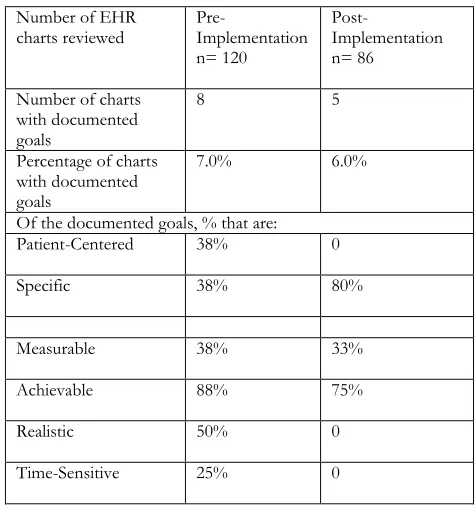
documented use of SMG in patient populations with diabetes and/or hypertension, the pre- (n= 120) and post- (n= 86) program chart reviews were conducted and analyzed by the same project coordinator. Originally, the intent was to only identify SMGs that were documented in the Chronic Care Guidelines section of the EHR. Initial review indicated that this area was not being used by the providers so a more extensive review of the individual EHRs was completed to ascertain if goals were being placed elsewhere (i.e. patient plan or narrative section). Both the pre- and post-review noted that very few patient self-management goals were being documented in any section of the chart and the impact of the educational sessions was not reflected in the post-intervention SMG documentation (Table 1). There was little difference between the pre- and post-program chart reviews of entries found to have any sort of SMG documented (with 7% and 6 % respectively).
Table 1: Electronic Health Record SMG Documentation Review
Number of EHR charts reviewed
Pre-Implementation n= 120
Post-
Implementation n= 86
Number of charts with documented goals
8 5
Percentage of charts with documented goals
7.0% 6.0%
Of the documented goals, % that are:
Patient-Centered 38% 0
Specific 38% 80%
Measurable 38% 33%
Achievable 88% 75%
Realistic 50% 0
Increasing use of self-management goals, Reiland et al.
Patient Experience Journal, Volume 6, Issue 1 – 2019 35
Limitations
Limitations that likely impacted the results of this program were the limited time frame for implementation and evaluation—sixteen weeks. Had more time been available, the lack of provider use of the specified EHR section could have been addressed more directly in
communications. Similar to findings in the literature,8,15 the health center is very busy and healthcare provider time is primarily committed to direct patient care.
Although the nursing and ancillary staff were not the target audience for the interventions, they appeared to be interested in the content. This set of stakeholders was not included in the initial project group primarily due the time
limitations and the staff’s ability to devote time to
additional training at this busy health center. The
possibility of including nursing and ancillary staff may be a viable option for the health center and has been
demonstrated in the literature.8,,15
Although the data collection involving SMART goal characteristics are evidence-based,5 the aspects of patient-centeredness, specificity, being measurable, achievable, result-oriented and time-sensitive required some
subjectivity on the project coordinator’s part. Because the
goals were not found in the identified Chronic Care Self-Management section, the reviewer needed to make some judgments to extract possible samples of goals that were patient behavior and not clinically focused. An example is
deferring a statement such as “increase exercise” but accepting a statement of “talked with patient about ways to increase exercise.” Although the latter did not fully
meet the criteria for SMGs, it pointed to a more collaborative discussion, possibly taking into account the
patient’s situation and preferences. Had goals been
documented in an identified SMG section, there would be more clarity on how the goal was developed. An additional limitation would be the small sample size of the providers included in the chart review. Due to the project focus,
only specific primary care providers’ patients were
reviewed whereas other specialties may have increased their use of SMGs.
Discussion and Recommendations
Although the findings from the assessment of SMGs documented in the EHR did not reflect an improvement, the progression of a cultural change at the project FQHC was evident through the increase in provider verbalization of ways to enhance patient engagement and strategies that may be realistic at the health center. The process of change and cultural shift involves a systematic reflection and assessment of the processes and personnel of the FQHC. Change brings challenges and conflicts but can also allow re-visioning and a recommitment to quality. This impetus can allow positive momentum to progress a cultural shift.
One cultural shift that has occurred is a pilot study on the use of student nurses as coaches to meet with patients that are identified as ready to address change and goal setting. Continued innovations at this FQHC should play on the positive response that providers have had so far. Additional professional development opportunities and shared input into pilot projects that enhance patient engagement and support processes for patient self-management will likely provide continued improvement in quality patient care.
This first phase of the FQHC’s overarching goal of strengthening the clinic’s provider-patient partnership allowed the health center to engage its staff in professional development activities that focused on quality, patient-centered care. Important discoveries were made through this process. A task force involving both IT and providers would be helpful in identifying an appropriate placement of SMGs that will be accessible by internal and external
audit but also be a visible part of the patient’s discharge
plan. The online module and video copy of the face-to-face presentation are available for current staff that did not participate, as well as new hires.
As the health center continues to progress on its PCMH journey, the involvement of stakeholders on all levels is crucial. Future initiatives should further involve patients, community members, and all staff. Making patient-centeredness more visible will promote the awareness and motivation that was awakened through these professional activities. This should include language and literacy sensitive signage, patient education materials, social media posts, and patient portal messages. Online tools and resources are widely available to develop patient materials that increase awareness of individual roles in their own health.
These innovations support the PCMH model and will reflect care under that model for continued accreditation by the Joint Commission. System-wide change also involves reflection and assessment of processes and personnel. Having a common mission, vision and goals can foster collaboration and respect for the individual
members’ ability to impact that change.
References
1. Schram, A. The patient-centered medical home: Transforming primary care. Nurse Pract, 2012; 37(4), 33-39. doi: 10.1097/01.NPR.0000412893.04686.1e 2. Robinson, J. H., Callister, L. C., Berry, J. A., and
Dearing, K. A. Patient-centered care and adherence: Definitions and applications to improve outcomes. J Am Acad Nurse Pract, 2008; 20, 600–607.
doi:10.1111/j.17457599.2008.00360.x
Increasing use of self-management goals, Reiland et al.
36 Patient Experience Journal, Volume 6, Issue 1 – 2019
help us weather the perfect storm? J Gen Intern Med, 2012; 27(5), 588–94. doi: 10.1007/s11606-011-1964-6
4. Rollnick, S., Miller, W. R., Butler, C. C., & Aloia, M. S. Motivational Interviewing in health care: Helping patients change behavior, 2008; Guilford Press, NY, NY.
5. Centers for Disease Control & Prevention. Writing SMART objectives. Evaluation Briefs, 2009; 3b. Retrieved September 17, 2017 from
www.cdc.gov/Healthyyouth/evaluation/pdf/brief3b.p df
6. Lenzen, S., Daniels, R., van Bokhoven, M., van der Weijden, T., & Beurskens, A. Setting goals in chronic care: Shared decision making as self-management support by the family physician. Eur J Gen Pract, 2015; 21, 138-144. doi: 10.3109/13814788.2014.973844 7. Riegel, B., Creber, R. M., Hill, J., Chittams, J., & Hoke,
L. Effectiveness of motivational interviewing in decreasing hospital readmission in adults with heart failure and multimorbidity. Clin Nurs Res, 2016; 25(4), 362-377. doi:10.1177/1054773815623252
8. Creber, R. M., Patey, M., Lee, C. S., Kuan, A., Jurgens, C., & Riegel, B. Motivational interviewing to improve self-care for patients with chronic heart failure: MITI-HF randomized controlled trial. Patient Educ Couns, 2016; 99(2), 256–264. doi: 10.1016/j.pec.2015.08.031 9. Stevens, G., Shi, L., Vane, C., Nie, X., & Peters, A.
Primary care medical home experience and health-related quality of life among adult Medicaid patients with type 2 diabetes. J Gen Intern Med, 2014; 30(2), 161-8. doi:10.1007/s11606-014-3033-4
10. Joint Commission. Primary care medical home, 2017; Retrieved June 17, 2017 from
https://www.jointcommission.org/accreditation/pchi. aspx
11. Eisler. R. & Potter, T. Transforming interprofessional partnerships: A new framework for nursing and partnership-based health care. 2014; Indianapolis, IN, Sigma Theta Tau International.
12. Potter, T. Partnership-based health care: Suggestions for effective application. Interdisciplinary Journal of Partnership Studies, 2015; 1(1), Article 8. Retrieved September 10, 2017 from
http://pubs.lib.umn.edu/ijps/vol1/iss1/8
13. Oehlert, J. Themes in health care culture: Application of cultural transformation theory. Interdisciplinary Journal of Partnership Studies, 2015; 2 (1), article 6. Retrieved September 1, 2017 from
http://pubs.lib.umn.edu/ijps/vol2/iss1/6
14. Welsh, J., Nelson, J., Walsh, S., Sealer, H., Palmer, W., & Vos, M. Brief training in patient-centered
counseling for healthy weight management increases counseling self-efficacy and goal setting among pediatric primary care providers: Results of a pilot program. Clin Pediatr, 2014; 54(5), 425-429. doi: 10.1177/0009922814553432
15. Christison-Lagay, J. Facilitating diabetes
self-management goal setting in a real-world primary care center. Diabetes Educ, 2007; 33, 145S-150S. doi: 10.1177/0145721707305215
16. Flottemesch, T. J., Scholle, S. H., O’Connor, P. J.,
Solberg, L. I., Asche, S., & Pawlson, L. G. Are characteristics of the medical home associated with diabetes care costs? Med Care, 2012; 50(8), 676–684. doi: 10.1097/MLR.0b013e3182551793