Motalebi A. A.
Protein and lipid changes of FPC produced from Caspian Sea
Kilkas in VP and MAP during storage at different temperatures
Khoshkhoo Zh.1*; 2; Razavilar V. 3; KhanipourA. A. 4
Received: June 2011 Accepted: November 2011
Abstract
Fish Protein Concentrate (FPC) is a healthy, sustainable and high nutritive product that produced from fish and protein and other nutrients are more concentrated than in the fresh fish. The aim of this research is to study the sustainability of FPC produced from Kilka (combination of three Caspian Sea Kilka species, Clupeonella engrauliformis, C. grimmi and C. cultriventris which were not identified and processed separately) in VP (Vacuum Packaging) and MAP (Modified Atmosphere Packaging) at different temperatures during six months of storage. According to result of chemical analysis performed, protein content was evaluated 91.2%, lipid 0.5%, ash 3.6%, moisture 2.3%, TVN 10 mg/100g and peroxide 5 meq/kg in the produced FPC before packing. Amino acids and fatty acids were also determined. Lipid amount in FPC after 6 months at 35°C in VP changed from 0.50 to 0.45 and in MAP (combined of 60% CO2, 30% N2 and 10% O2), decreased from 0.50 to 0.36. It was also detected that increase in temperature leads to more decrease in lipid content but it was not significant (P>0.05). Protein content of FPC has changed from 91.2% to 73.6% during six months at 35°C in VP and 69.4% in MAP. But at 5°C, protein contents were changed from 91.2% to 88.4% and 81.2% in VP and MAP, respectively; these changes were significant (P<0.05) but the decrease in MAP was again more than VP.
Keywords: Fish Protein Concentrate, Kilka, Vacuum Packaging, Modified Atmosphere Packaging
_________________________
1-Ph.D Student, Science & Research Branch, Islamic Azad University (IAU), Tehran, Iran. 2- Iranian Fisheries Research Organization, P.O. Box 14155-6116, Tehran, Iran.
3 -Department of Veterinary, Faculty of Tehran University, Iran. 4- National Fish Processing Research Center, Anzali, Iran. *Corresponding Author's email: [email protected]
Introduction
Since variety of fishes as an animal protein source has a high nutritive value, consumption of them not only meets many nutritive requirements of the body, but is also useful for improving the human health, so many countries have tried to increase per capita consumption of this nutritive source )Dvorak, 2002(. Fish protein concentrate (FPC) is a healthy, sustainable and high nutritive product that is sanitisedly produced from fishes in which, protein and other nutrients are more concentrated than in fresh fishes (Doraiswamy, 1963). FPC was first publicized widely in the late 1960s, as the most promising way to eliminate worldwide malnutrition (Pariser, 1980).
`International Food and Agriculture Organization (FAO) (2006) defined FPC as any stable fish preparation, intended for human consumption, in which the protein is more concentrated than in the original fish and divided that into three types: Type A: a virtually odorless and tasteless powder having a maximum total fat content of 0.75%; Type B: a powder having no specific limits as to odor or flavor, but definitely having a fishy flavor and a maximum fat content of 3 %; Type C: normal fish meal produced under satisfactorily hygienic conditions.
FPC can play an effective role in decreasing protein deficiency in some crowded parts of the world that suffers from malnutrition. Studies have shown that adding FPC to human diets has positive effects specially for growing babies and pregnant women (FAO, 2006). FPC is a low cost animal protein with high
quality, so it can be used as a protein supplement to increase nutritive value of foods (Cordova, 2007). Considerable works were done to develop FPC production methods and use it in different foods, but unfortunately there is little information about sustainability of FPC during storage at different environmental conditions (Rasekh, 2001).
Kilka is one of the most important economic fishes of the Caspian Sea. It is a native species of the Caspian Sea, Black Sea, Azouph Sea and is found in all parts of the Caspian Sea specially along the coastal line. It belongs to the Clupeidae family and three species are identified from Kilka in the Caspian Sea, Clupeonella engrauliformis (Anchovi), C. grimmi (Large eyed Kilka) and C. cultriventris (Common Kilka) (Nelson, 1998). Due to the fact that Kilka fishes are so sensitive, tiny and slender, during their capture and storage some parts of their body is always hurt and loses the proper quality to produce different products that can be directly used by humans (Nelson, 1998).
Replacing the atmosphere of a food stuff pack with a various combination of gases is called modified atmosphere packaging. Modified atmosphere packaging is divided into low O2-MAP and high O2-MAP (Alasalvar et al., 2005). CO2, N2 and O2 are the main three gases which are commercially used in modified atmosphere packing (Farber, 1991). CO2 is the most important gas used in MAP method. This is because of the preventive effect of CO2 on bacterial and fungal
growth. CO2 prevents growth of so many spoiler bacteria and the rate of this prevention has a linear relation with CO2 concentration in the modified atmosphere of the pack. Dhananjaya and Stroud (1994) noted 4 mechanisms for this preventive effect: 1) Changing the function of cellular membrane and affecting the nutrients absorption and metabolism of the microorganism; 2) Directly preventing enzymes or reducing the enzymes activity; 3) Changing the intercellular pH of the microorganism or cellular membrane penetration; 4) Involving directly in
changing the physiochemical
characteristics of proteins.
The volume of the modified atmosphere must be 2-3 times of food stuff volume (Farber, 1991). Nitrogen is an odorless, evasive gas which has little solubility in water and lipids. Nitrogen postpones the spoilage, oxidation and microorganisms growth. This gas could prevent the crash of CO2 contained packs and prohibit molding and insect strikes (Farber, 1991).
Oxygen prevents anaerobic bacterial growth but promotes aerobic bacterial growth. It is usually not used for packing oily fishes and is suitable for packing small low fat fishes. Oxygen below 2% in the pack’s atmosphere widely prevents spoil odor and flavor and rancidity. Of course, many other gases such as CO, SO2, NO, N3, Cl and Ar are studied to include in MAP.
In vacuum packing, after putting the product in a pack with low oxygen penetrance, the atmosphere of the pack will be removed and the pack will be sealed. The gaseous atmosphere of the vacuum packs will possibly change during
storage (because of microorganism metabolisms) and so the atmosphere will be modified indirectly. Oxygen presence leads to oxidation and microorganism’s growth and development in some cases. Therefore, in vacuum packing, oxygen and other gases are removed to extend the shelf life of the product (Ozogul, 2004).
The aim of this study is to investigate the sustainability of FPC produced from Kilka by isopropanol extraction in VP and MAP at different temperatures during six months storage.
Materials and methods
To produce FPC from Kilka, a method given by FAO was used (FAO, 2006). First, fishes were captured from the Caspian Sea, Anzali harbor and then transferred to National Processing Researches Center by C.S.W. (Chilled Sea Water) method. Fishes were washed with hygienic water and their heads, tails and viscera were removed. After that, they were transferred to the deboner device (Sepamatic, Germany) to remove their bones, skin and fins from meat. Pure meat was transferred to isopropanol (2 portion alcohol: 1 portion fish) at environment temperature (25.8°C) for 50 min, after this period, primary press was done and prepared press cake was transferred to the second phase of concentrate production. In this phase, press cake was placed in isopropanol (2 portion alcohol: 1 portion fish), at 75°C for 90 min in a bain-marie. Then it was pressed again and the prepared press cake was placed in solvent (with the same proportion) and for the third phase of extraction it was held in bain-marie at 75°C for 70 min. It was pressed again and
transferred to a dryer at 125°C. This product was grinded and passed through 100 µ filter. At First, Chemical factors were determined to evaluate qualitative specifications of FPC produced from Kilka fishes. Then the final product was packaged in 100g packs by Vacuum Packaging (VP) and Modified Atmosphere Packaging (MAP) (60% CO2, 30% N2 and 10% O2), and stored at 5, 20 and 35°C for six months to evaluate the changes of protein and lipid contents. Protein content was determined by Kjeldhal method (A.O.A.C., 1984) and lipid content by method described by Bligh and Dyer (1959), moisture content by oven method (Parvaneh, 1995), ash content by electrical stove (A.O.A.C, 1990), Peroxide Value (PV) by Lee method described by Hasegawa (1987), Total Volatile Nitrogen (TVN) by macro Kjeldhal (Parvaneh, 1995), amino acid contents by the
reverse-phase HPLC (model:Younglin) method (Strydom and Choen, 1993), fatty acid methyl esters where prepared as described in ISO 5509 (2000) and their contents in the sample determined by Hewlett- Packard 6890 Gas Chromatograph according to comparison of the retention time of the sample to the standard sample (Shafii, 1994).
For statistical analyses, the data were subjected to analysis of variance (one-way ANOVA), using LSD range test.
Results
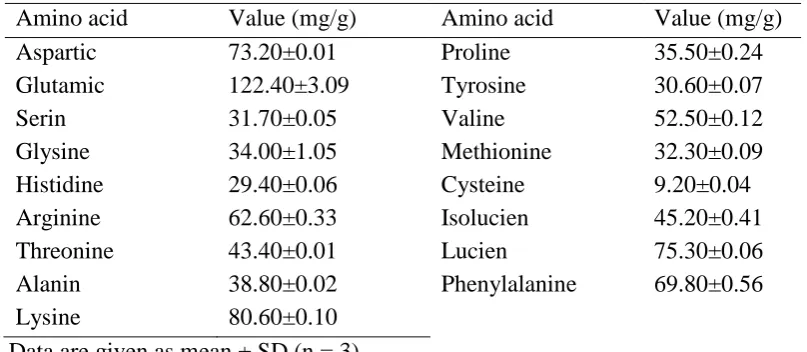
Chemical compositions of fish protein concentrate processed from Kilka are presented in table 1. The amounts of amino acids of FPC made from Caspian Sea Kilkas are presented in table 2. The amounts of fatty acids in the FPC produced from Caspian Sea Kilkas are presented in table 3.
Table 1: Chemical compositions of Kilka protein concentrate
Protein % Lipid
% TVN
mg/100g POV
meq/kg Ash
% Humidity
%
91.2±1.01 0.50±0.01
10.00±0.12 5.0±0.06
3.6±0.03 2.3±0.01
Data are given as mean ± SD (n = 3)
Table2: The amounts of amino acids of FPC produced from Caspian Sea Kilkas
Amino acid Value (mg/g) Amino acid Value (mg/g)
Aspartic 73.20±0.01 Proline 35.50±0.24
Glutamic 122.40±3.09 Tyrosine 30.60±0.07
Serin 31.70±0.05 Valine 52.50±0.12
Glysine 34.00±1.05 Methionine 32.30±0.09
Histidine 29.40±0.06 Cysteine 9.20±0.04
Arginine 62.60±0.33 Isolucien 45.20±0.41
Threonine 43.40±0.01 Lucien 75.30±0.06
Alanin 38.80±0.02 Phenylalanine 69.80±0.56
Lysine 80.60±0.10
Data are given as mean ± SD (n = 3)
Table3: The amounts of fatty acids in the FPC produced from Caspian Sea Kilkas.
Fatty acid Myristic
Acid Myristoleic
acid Palmitic
acid Palmitoleic
acid Stearic
acid Oleic acid
Arachidic acid
(g/100g) 2.94±0.00
0.28±0.08 27.95±0.31
0.48±0.03 5.52±0.35
40.50±0.17 1.25±0.06
Data are given as mean ± SD (n = 3)
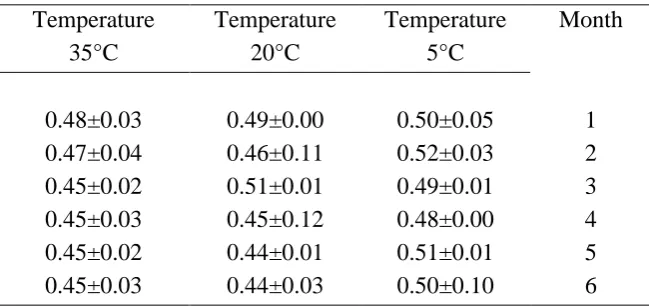
Table 4: The changes of the lipid contents in vacuum packed FPCs at different temperatures (%)
Month Temperature
5°C Temperature
20°C Temperature
35°C
1 0.50±0.05
0.49±0.00 0.48±0.03
2 0.52±0.03
0.46±0.11 0.47±0.04
3 0.49±0.01
0.51±0.01 0.45±0.02
4 0.48±0.00
0.45±0.12 0.45±0.03
5 0.51±0.01
0.44±0.01 0.45±0.02
6 0.50±0.10
0.44±0.03 0.45±0.03
Data are given as mean ± SD (n = 3)
Lipid Contents of the Kilka Protein Concentrates stored at different temperatures The percent of lipid in FPC stored at
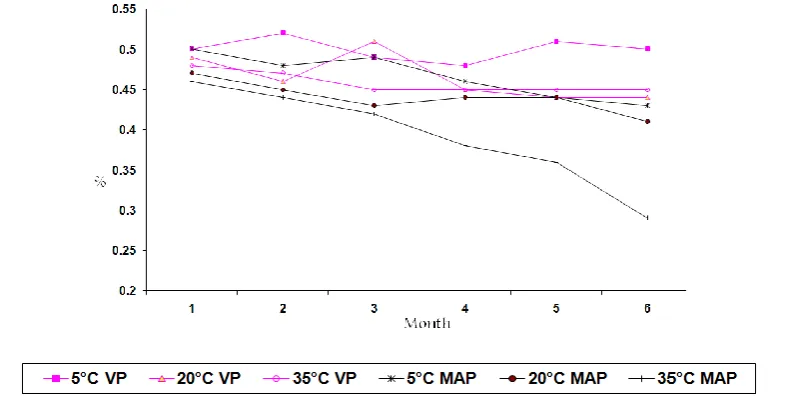
different temperatures in vacuum packages are presented in table 4.Lipid content has not been changed significantly with increase of temperature and storage time. The lipid percentage of FPC stored at
different temperatures MAP packages are presented in table 5. Small decrease is observed in lipid percent due to increase in temperature and stoking time, but these changes were not significant (P>0.05).
Table 5: The changes of the lipid contents in MAP packed FPCs stored at different temperatures during 6 months (%)
Month Temperature
5°C Temperature
20°C Temperature
35°C
1 0.50±0.22
0.47±0.00 0.46±0.01
2 0.48±0.02
0.45±0.00 0.44±0.01
3 0.49±0.02
0.43±0.00 0.42±0.01
4 0.46±0.92
0.44±0.00 0.38±0.01
5 0.44±0.01
0.44±0.01 0.36±0.01
6 0.43±0.00
0.41±0.02 0.29±0.01
Data are given as mean ± SD (n = 3)
Figure 1: Lipid changes in VP and MAP at different temperatures during 6 months. Results of FPC protein content produced
from Kilka in different temperatures The data presented in tables 6 and 7, show that protein content of FPC preserved at different temperatures is decreased with
the increase in the temperature and stocking duration. More decrease in protein content in MAP in comparison with VP is observed.
Table 6: Changes of protein contents of vacuum packed FPCs stored at different temperatures during 6 months (%).
Month Temperature
5°C Temperature 20°C
Temperature 35°C
1 91.20±0.92
0.1389.60± 87.65±1.04
2 91.10±0.05
86.30±1.13 86.23±0.22
3 89.60±0.04
84.24±0.01 84.80±0.13
4 89.40±0.49
82.20±0.04 80.20±0.02
5 89.70±0.16
82.50±0.44 78.20±0.46
6 88.40±0.39
82.50±0.52 73.60±0.07
Table 7: Protein content changes of stored MAP FPCs at different temperatures during 6 months (%)
Month Temperature
5°C Temperature 20°C
Temperature 35°C
1 89.54±0.02
84.70±0.03 80.22±0.72
2 89.46±0.03
84.30±0.01 78.42±0.06
3 88.92±0.00
82.20±0.07 75.62±0.12
4 87.10±0.01
79.80±0.02 72.28±0.02
5 83.24±0.07
78.20±0.07 70.80±0.09
6 81.20±0.03
73.40±0.02 69.40±0.05
Data are given as mean ± SD (n = 3)
Figure 2: Protein changes in VP and MAP at different temperatures during 6 months
Discussion
As shown in table 1, protein and lipid contents are 91.2% and 0.5%, respectively. According to FDA (2006), FPC can be used in human diets as a nutritive supplement, if it has high hygienic quality, more than 75% protein and less than 0.5% lipid. According to FAO (2006) and FDA (2006) guidelines, the produced FPC is classified as type A, and could be used as a rich protein supplement.
The protein and lipid contents of FPC processed from silver carp (Hypophthalmicthys molitrix) are reported 81% and 0.37%, respectively (Azhdary, 2006). The FPC produced from Kilka has higher protein content which could be due to different causes; mainly fish species. FPCs made from different types of fishes have different chemical and physical specifications and it can affect chemical compositions of the final product (Ershoff, 1970). About 20% minerals which is due to the high amount of bones and 78% protein were determined in FPC produced from menhaden (Brevoortia patronus) (Doraiswamy, 1963), while FPC produced from red hake (Urophycis chuss) contains 13% minerals and 85% protein (Cordova, 2007). Lipid content is also different in
different kinds of fishes, but during press and extraction process by lipid solvents, it decreases to less than 1%, therefore, FPC produced from different fishes did not show much difference in the lipid content.
Lipid content of processed FPC of Kilka was evaluated 0.5% (table 1), according to tables 4 and 5, after six months of storage at 35°C, lipid content in VP changed to 0.45%; So it did not show significant decrease; But in MAP, it was decreased to 0.36%. It is because of O2 presence in MAP package and oxidation of lipids. It is also detected that an increase of temperature induces and accelerates oxidation. Chen and Gong (2007) have investigated lipid oxidation of raw red claw crayfish tail meat in VP and MAP (80% CO, 10% O2 and 10% N2) during 14 days of preservation at 2°C, it was detected that lipid oxidation in VP occurred lower than in MAP. The oxidation-related changes of lipid and cholesterol contents of milk powder stored in VP and MAP is reported by Cluskey (1997) and the lowest lipid and cholesterol oxidation was observed in VP. In another research, decrease in extractable amounts of lipid in stored FPC with 0.5% lipid after
6 months at 37°C and in 50°C (very significantly) is reported. Also the amount of neutralized lipids, free fatty acids, C20:5 and C22:6 polyunsaturated fatty acids were decreased (Medwadowski, 1971).
According to tables 6 and 7, protein content of FPC (91.2%), after 6 months at 35°C, was decreased to 73.6% and 69.4% in VP and MAP, respectively. It is due to the O2 presence and aerobic bacterial reactions, but at 5°C, protein content in VP and MAP were decreased from 91.2% to 88.4% and 81.2%, respectively. These changes are very small but higher in MAP (P<0.05). Parr (1998) had studied the stability of amino acids packed in PVC bottles during 30 days storage at room temperature (25°C) and refrigerator temperature (4°C), it is reported that in the sample which was held in the refrigerator, amino acids did not change, but those held in room temperature showed decreases in arginine and methionine.
In conclusion, like the results of the present study and all the discussed cases, the changes of lipid and protein contents is much less in VP and in comparison to MAP, their after storage quality is better preserved and the shelf life would be longer. Also it is revealed that storing Kilka FPC in lower temperature will maintain its nutritional value for a longer period of time.
Acknowledgements
Special thanks to the personnel and experts of National Processing Researches Center of Aquatics, Nuclear Energy Organization and Caspian Sea Ecology Research Center of Iran.
References
A.O.A.C., 1984. Official methods of analysis (14th edition), Association of Official
Analytical Chemists, Washington. D. C. USA.
A.O.A.C., 1990. Official methods of analysis (15th edition), Association of Official Analytical Chemists, Arlington, V. A. USA.
Alasalvar, C., Al-Farsi, M., Quantick, P.C., Shahidi, F. and Wiktorowicz, R. 2005. Effect of chilled storage and modified atmosphere packaging (MAP) on antioxidant activity, anthocyanin, carotenoids, phenolics, and sensory quality of ready-to-eat shredded orange and purple carrots. Food Chemistry. 89, 69–76.
Azhdary, M. 2006. Fish ice cream. Ph.D. thesis. 78.
Bligh, E. G., and Dyer, W. J. 1959. A rapid method of total lipid extraction, Canadian Journal of Biochemistry and Physiology, 37, 911-917.
Chen and Gong. 2007. Microbiological and physicochemical stability of red claw crayfish tail meat stored with modified atmosphere packaging. Dissertation Abstract International. 69, 147.
Cluskey, S., Connolly, J.F., Devery, R., Kelly, J., and Stanton, C. 1997. Lipid and cholesterol oxidation in whole milk powder during processing and storage. Journal of food science. 47, 63-75.
Cordova Murueta, J. H., Navarrete del Toro, M. L., and Garcia Carreno, F. 2007. Concentrates of fish protein from bycatch species produced by various drying processes. Food Chemistry, 100, 705-711.
Dhananjaya .D and Stroud. G. D. 1994.
Chemical and sensory changes in haddock and herring stored under modified
atmospheres, International Journal of Food Science and Technology 29. pp. 575–583.
Doraiswamy. 1963. Fish protein food in feeding trials with school children. Indian Journal Pediant, 30, 266.
Dvorak, P., 2002. Sopmething fishy is going on in Japan in the ice cream. Journal of Wall Street. Eastern edition. Pg.A.1.
Ershoff., 1970. Beneficial affects of fish protein concentrate on increment in body weight and microscopic appearance of the tibia and alveolar bone of rats fed a wheat flour containing ration. Journal of Dent.res, 44(3), 581- 588.
FAO., 2006. Fish Protein Concentrate, fish flour, fish hydrolyzate. Animal Feed
resource information system.
http://www.fao.org/ag/aga/agap/frg/afris/D ata/334.HTM
Farber, J.M. 1991. Microbiological aspects of modified atmosphere packaging technology-A review. J. Food Prot., 54, 58–70.
FDA., 2006. Food additives permitted for direct addition to food for human consumption. FDA, department of health and human services.
http://www.federalregister.gov/articles/200
7/08/21/E7-16322/food-additives- permitted-for-direct-addition-to-food-for-human-consumption-polydextrose
Hasegawa, H., 1987. Laboratory manual on analytical methods and procedures for fish and fish products. Southern Asian Fisheries Development Center, Singapore. A-3. 1-2, B- 3. 1-25, E- 2.1 -3.
ISO., 2000. ISO 5509-Animal and vegetable fats and oils -- Preparation of methyl esters of fatty acids. International organization for standardization.
http://www.iso.org/iso/catalogue_detail.ht m?csnumber=11560
Medwadowski, B., Haley, A., and Van Der Veen, J. 1971. Effect of storage on lipids of fish protein concentrate. Journal of American Oil Chemists Society, 48, 782-783.
Nelson, G., Paxton, J. R., and Eschmeyer, W. N. 1998. Encyclopedia of fishes. San Diego. Academic Press. 91-95.
Ozogul, F., Polat, A. and Ozogul, Y. 2004. The effects of modified atmosphere packaging and vacuum packaging on chemical, sensory and microbiological changes of sardines (Sardina pilchardus). Food Chem., 85, 49–57.
Pariser, E. R., and Wallerstein, M., 1980. Fish protein concentrate, lessons for future food supplementation. Food Policy. 5, 298-305.
Parr. M. D., Bertch, K. E., and Rapp, R. P., 1998. Amino acid stability and microbial growth in total parental nutrient solution. Health- System Pharmacy. 11, 57- 80.
Parvane, V., 1994. Food quality control and chemical analysis. Tehran University Press. 33.
Rasekh, J. G., Stillings, B. R., and Dubrow, D. L. 2001. Moisture adsorption of fish protein concentrate at various relative humidities and temperatures. Journal of Food Science, 36, 705-707.
Shafii, A. 1974. Chromatography and Spectrometry. Tehran University Press. 654.
Strydom, D. J. and Choen, S. A., 1993.
Technique in protein chemistry. IV. Academic Press. SanDiego. 299- 301.